For the past several years my wife and I have been searching for an authentic antique tall case clock. I finally found one at an estate auction an hour down the road from where I live and seized the opportunity to purchase a clock I knew practically nothing about. In this blog article, I will describe first impressions and the results of my preliminary research.
I have had only one tall clock in my collection, a Ridgeway Westminster chime clock from the mid-1990s. It is stately with handsome lines but it is a modern clock with a contemporary German-made movement and certainly not an antique.
Servicing this clock from the Canada Clock Company was a real challenge as I encountered many issues that conspired to slow my progress.
I found this clock in an antique shop in downtown Truro, Nova Scotia at basically a give-away price. The seller knew nothing about the Canada Clock Co. and that was fine with me.
So, what happens when amateurs and backyard mechanics get their hands on a movement. Read on.
But first, a little about the short-lived Canada Clock Co.
Canada Clock Co Hamilton Cottage Extra
The Canada Clock Company in its three iterations made clocks in Ontario, Canada between 1872 and 1884. The Canada Clock Co, the Hamilton Clock Co. and then Canada Clock Co. (redux) struggled over a 12 year period to put Canada on the clock-making map. Ultimately their efforts failed. Nonetheless, there are a number of fine examples that have survived to this day
Description
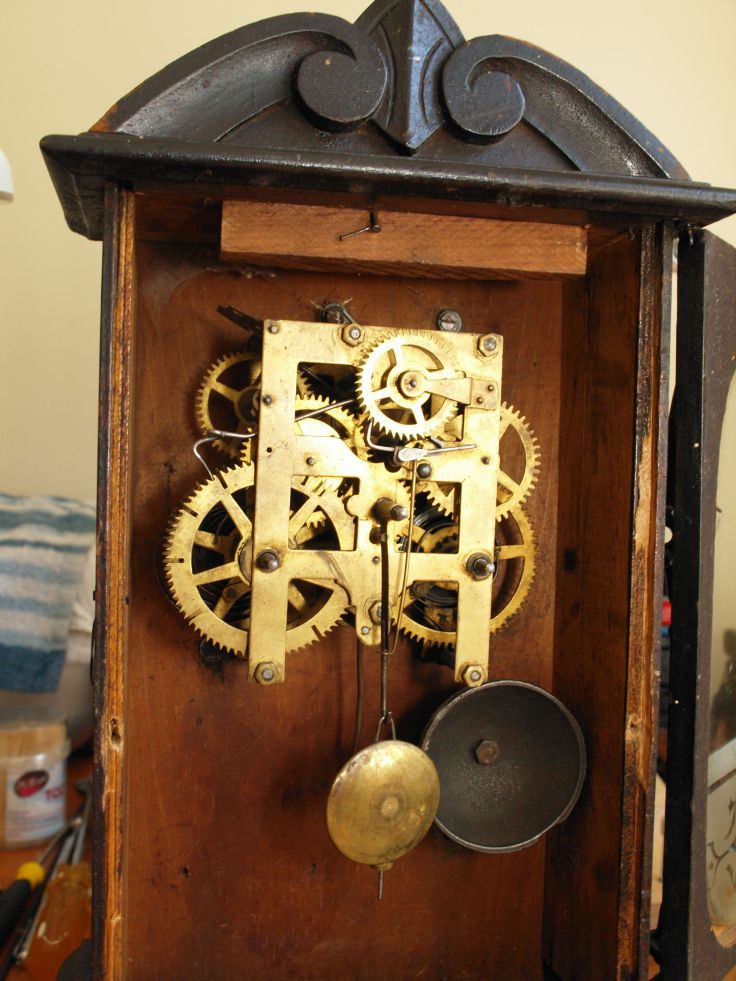
The clock is a 30-hour time and strike movement on a bell. It is the “Hamilton Cottage Extra”, one of the least expensive in their line of cottage clocks.
The label is in fair condition but identifies the model name and yes I paid far less than the sticker price
The case, which is in fair condition, reflects the age of the clock, grimy with numerous chips and scuff marks. Constructed of pine with a walnut stain finish the case has a minimum of decorative features and reflects the muted Victorian style of the times. The label is in fair condition and there is a stamp on the top of the label which says, “…A Hill &Co.”.
The lower part of the tablet has an etched glass floral design common on Canada Clock Company clocks. The dial face is flaked in places, has been “touched up” and will need attention.
The Maltese hands are original.
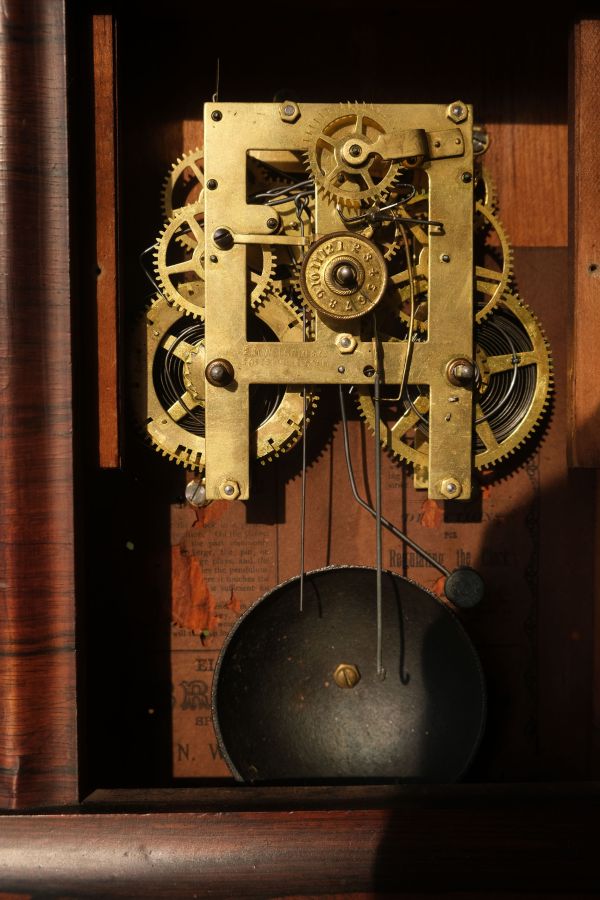
Original time and strike 30-hour movement
I tested the movement while in the case. The time side runs with a little encouragement while the strike side has the typical run-on strike when things fall out of adjustment.
Assessment of the Movement
When I disassembled the movement there were a few unexpected surprises. I now have answers for a movement that is running poorly.
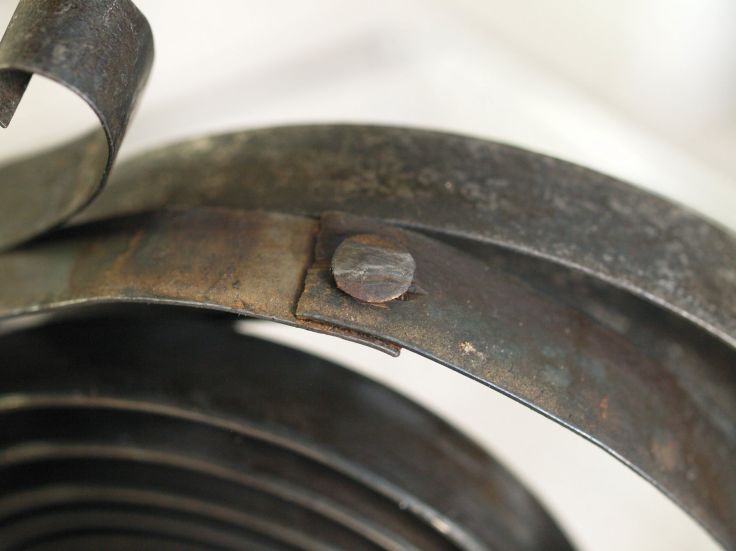
Strike side mainspring riveted together
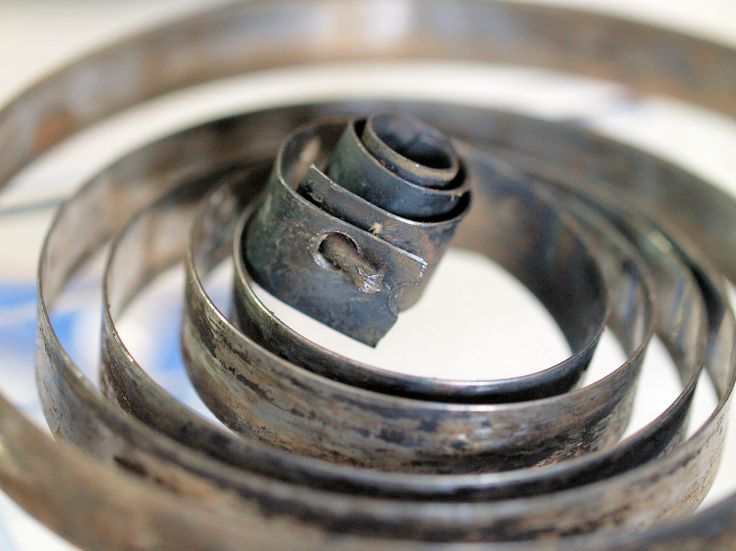
Both mainsprings had been modified, a very old repair. I try not to be judgemental when I see this and respect the folks that made every effort to keep their clocks running as best they could often with limited means. However, these look dangerous and must be replaced.
Time side mainspring with a nail holding parts of the mainspring together
Now on to other issues.
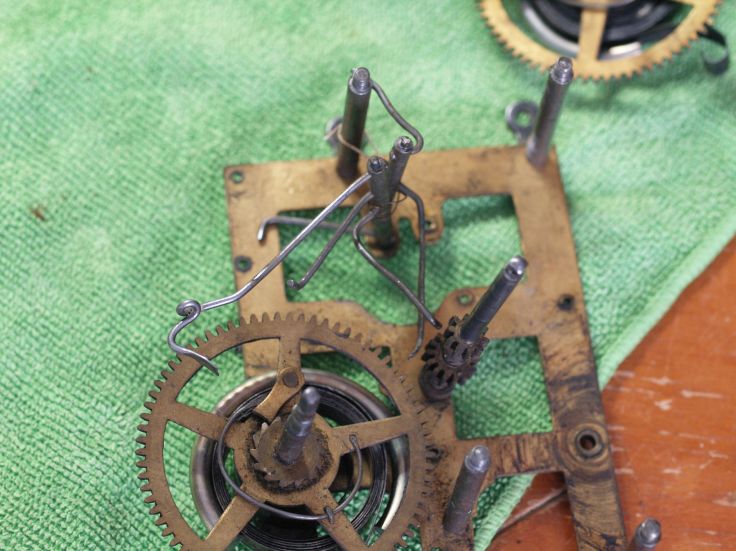
Levers bent in all directions
This is the strike side. What are the correct positions for the levers? Bent so many times it will take trial and error to find precisely where the levers should go.
The “hammer”
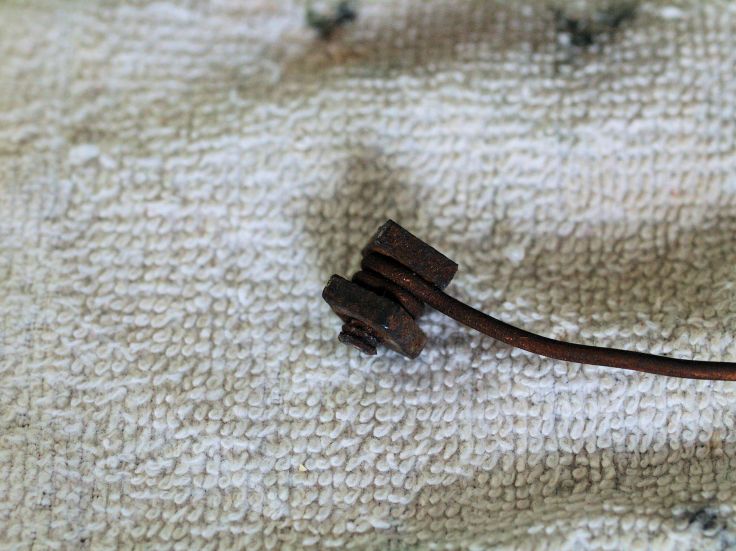
The hammer is actually a copper wire wound around 2 nuts and it is loose in the arbour.
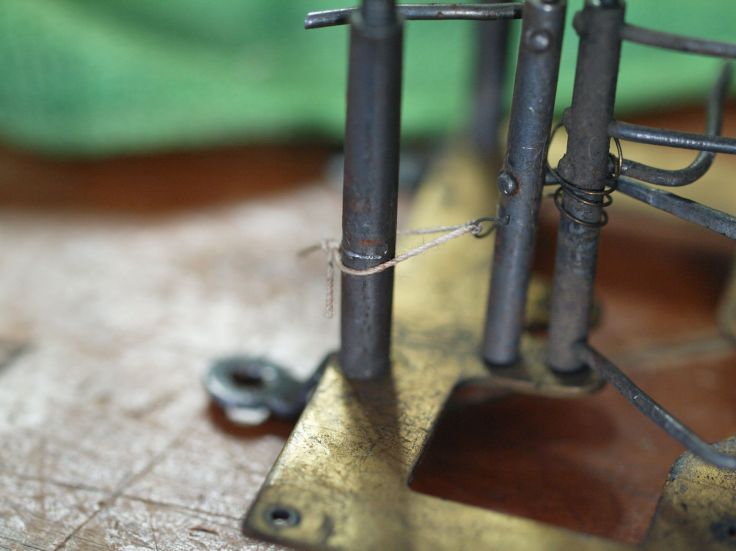
Helper “string” or helper spring
There is enough helper spring to wrap around the pillar but someone thought the string was necessary. It will be replaced with a new spring.
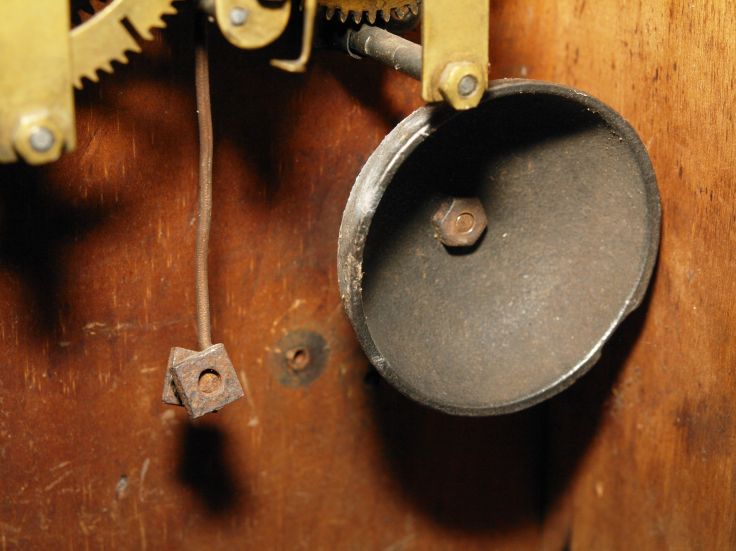
Nuts for a hammer and the bell has been repositioned
While the bell may be original, Judging from the number of holes, it has been relocated and raised to work with the home-made hammer.
The movement is a disappointing mess but not unfixable. In the clock business, you must expect the unexpected. In the meantime, I can clean the parts and perform pivot polishing and bushing work while I await parts.
I am determined to get this clock running so, stay tuned for the movement servicing and dial painting!
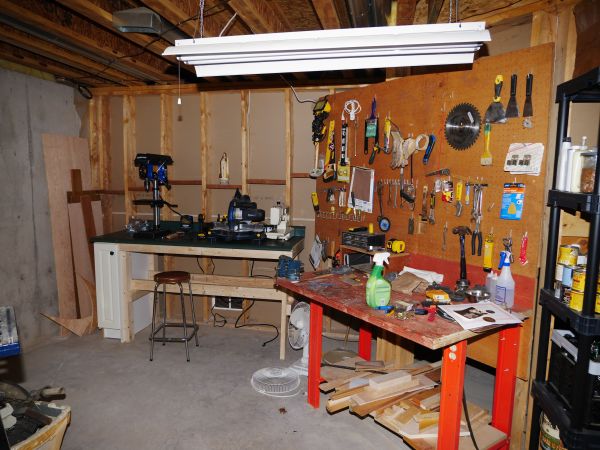
My clock hobby has evolved to the point that I am constantly looking for ways to increase efficiency and adapt space to suit my needs. What began as an upstairs bedroom has become my office/shop for the past 6 years.
The acquisition of new tools and equipment means more space and, of course, more room for clocks.
Why does a mechanical clock movement require servicing? The answer is fairly straight forward.
Keeping your clock in good running condition requires maintaining the movement’s working parts and maintaining the working parts reduces wear. Ideally, most clocks should be serviced every three to five years to maximize longevity and ensure proper functioning.
This article describes the 7 steps that I typically follow when servicing an antique or vintage clock movement. A common American 8-day time and strike, pendulum-driven movement is used as an example.
This is a Seth Thomas round top mantel clock in for servicing. This is Part I of two parts.
Among the most respected American clockmakers is the Seth Thomas Clock Co. My collection consists of six Seth Thomas clocks representing several styles made between 1865 and 1930.
Seth Thomas time and strike 8-day alarm clock
I purchased this particular mantel clock at the National Association of Watch and Clock Collectors conference in Springfield Ma. in June of 2019.
I was working on a E. N. Welch (ca. 1875) mantel clock movement in the late fall of 2019, giving it a thorough cleaning during which I installed 6 bushings.
During our recent trip to the southern part of Ireland including the capital city of Dublin, I expected to see antique mechanical clocks in some of the pubs and I was not disappointed. I tried to visit as many pubs as possible to search for clocks, of course, and while there I sampled the local ales and lagers though no Irish visit is complete without a pint or two of Guinness stout.
Let me begin by saying that I love antique stores and I spend a considerable amount of time in them. While I don’t always buy, if I see something I try to get a fair price. Browsing through the aisles looking for that unique, one of a kind item can be a very satisfying experience.
I was in a local antique shop the other day and I was impressed at the number of antique clocks offered for sale but the prices were, in my view, way out of line.
For example, a Gilbert Admiral time-only wall clock, that I bought in the fall of 2019 for a fraction of the $300 the store wanted was missing its decorative pendulum and was not running. $150 is a fair price with the original pendulum but at $300 it will stay on the wall of this shop for a long time. So, naturally, I passed on it.
This rather plain, box-like 8-day hour strike Rosewood veneered shelf clock is up for servicing. This is Part II of a two-part series. Go to Part I to read my notes and observations while disassembling the movement and the initial steps required to bring the clock to running condition.
The movement is in reasonably good condition but not without issues. It was running prior to cleaning (though not a full 8-day cycle) so I did not expect any further running issues after servicing and my principal goal was that it would run the full 8-day cycle.
I always take a number of photographs when I disassemble a movement. It is much easier than making diagrams and notes and best for future reference particularly when photos are archived.
This rather plain, box-like 8-day hour strike shelf clock is up for servicing. I wrote about first impressions in Sept 2019 and said at that time that the clock is in reasonably good condition, runs well, but needs a good cleaning.
Among the most respected and prolific American clockmakers is the Seth Thomas Clock Co. of America. Every collector I know has at least one Seth Thomas clock in their collection.
My modest collection consists of six Seth Thomas clocks representing several styles, all unique and from the period 1865 to 1930.
This is a Seth Thomas time and hour strike large round top (model name or number unknown) made in the 1870s. For first impressions of this clock, go here.
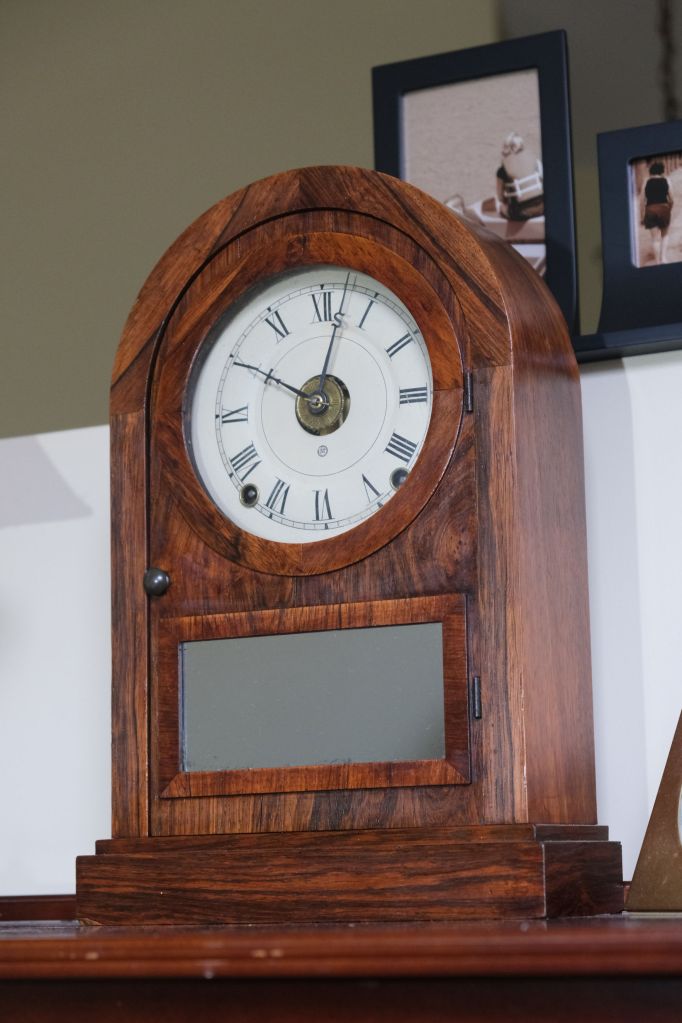
Seth Thomas round top shelf clock, veneer missing top left of the door frame
This shelf clock was purchased at the National Association of Watch and Clock Collectors conference in Springfield Ma. in June of 2019.
The clock case is in such remarkable condition it would be a shame to ignore that one small blemish and once you see the missing veneer the eye is always drawn to it
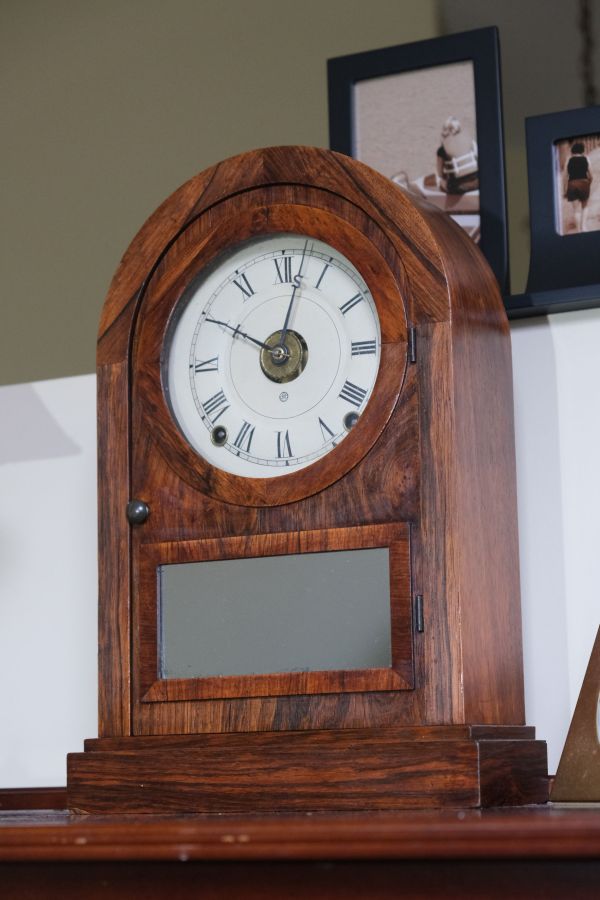
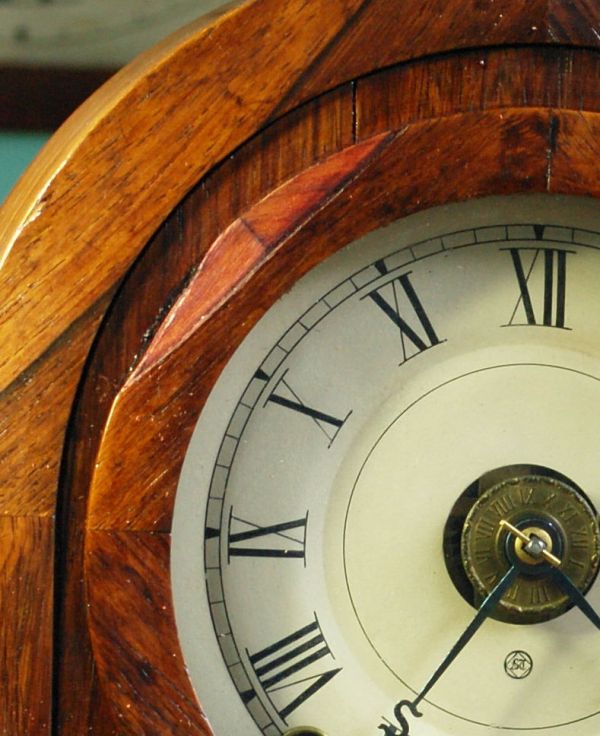
The clock measures 15 inches in height, 10 inches wide at the base and 4 inches deep. The attractive Rosewood veneered case has a mirrored rectangular lower tablet. The grain of the Brazilian Rosewood is bold and nicely textured. However, a sliver of the veneer is missing between the 9 and 12 o’clock position of the dial bezel which, in my view, is repairable. My wife did not notice this until I pointed it out.
A previous owner attempted to hide the missing veneer by tinting the exposed area.
If you live in the Maritimes provinces of Canada and are keenly interested in vintage and antique clock and watch collecting and repair this will be of interest to you.
On November 2-3, 2019 the Maritime Association of Watch and Clock Collectors held its inaugural meeting. Five members came together from various parts of the Maritimes to meet in Prince Edward Island (Canada) to form a club of like-minded individuals.
After months of planning and discussions in preparation for the inaugural 2-day meeting the response from all present was very positive
Although the skill level varied among participants, all who attended have a keen interest in horology and are willing to share their knowledge and experiences with others.
A educational component of the meeting, a lesson in bushing
After months of planning and discussions in preparation for the inaugural 2-day meeting the response from all present was very positive.
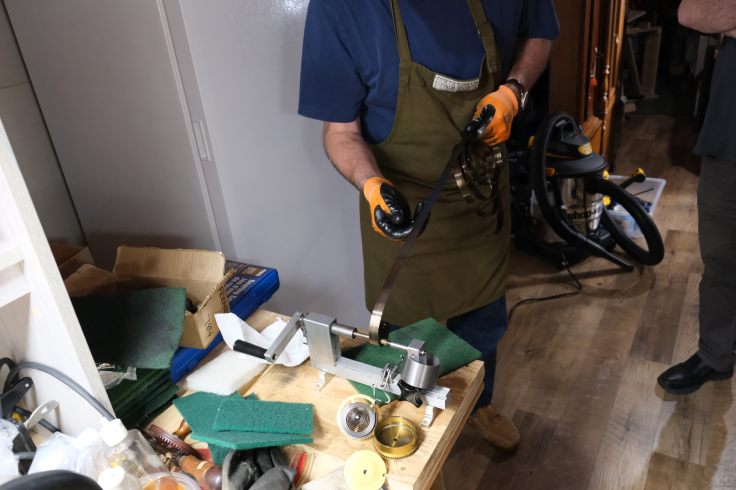
Demonstration of the cleaning of a mainspring
The goal of this new group is to gather individuals from across the Maritime provinces (PEI, New Brunswick and Nova Scotia) to share experiences, mentor each other, learn new techniques, provide opportunities to acquire clocks and watches and foster social interaction.
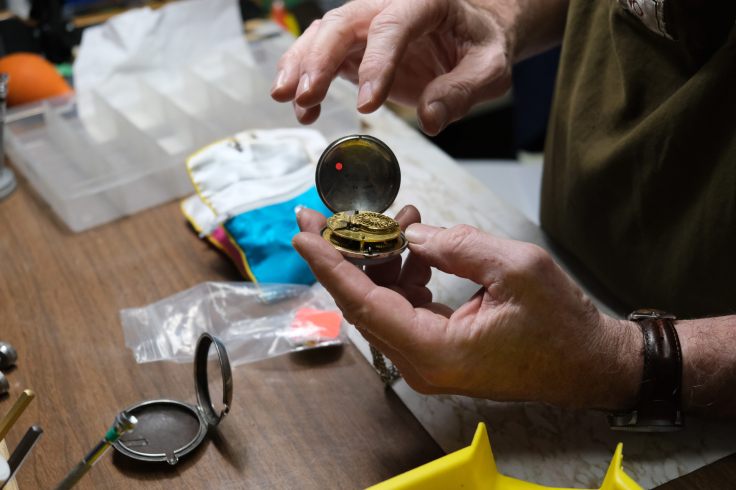
Inspecting an antique pocket watch
During our first meeting we discussed the name of the new association. We also discussed the format of our meetings, the venue, whether it be in one location or throughout the Maritimes, the frequency of meetings, outreach through social media, resource books, the training component within our meetings and what we can offer to each other both inside and outside our regular meetings.
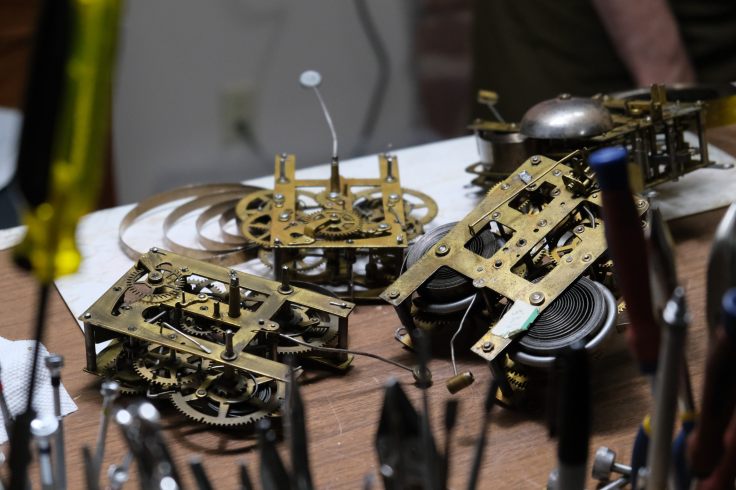
A collection of clock movements in need of repair
We agreed that the new organization should be called MAWCC, the Maritime Association of Watch and Clock collectors. We agreed to no less than 2 meetings per year but that sub-groups would meet more frequently. At this point in time we are not affiliated with the NAWCC (National Association of Watch and Clock Collectors).
If you are from the Maritime region of Canada (Prince Edward Island, New Brunswick, Nova Scotia) and you have a keen interest or wish to advance your skills in horology and would like to connect with like-minded individuals feel free to email me at ronjoiner@gmail.com.
I am a big fan of weight driven clocks and will add them to my collection when time, opportunity and finances allow.
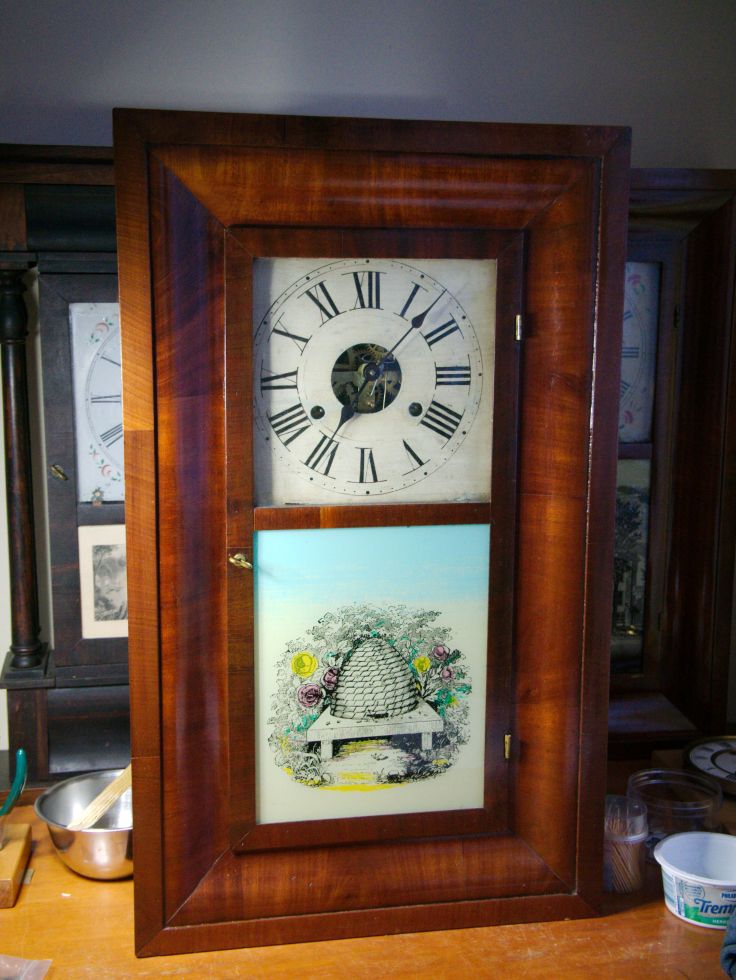
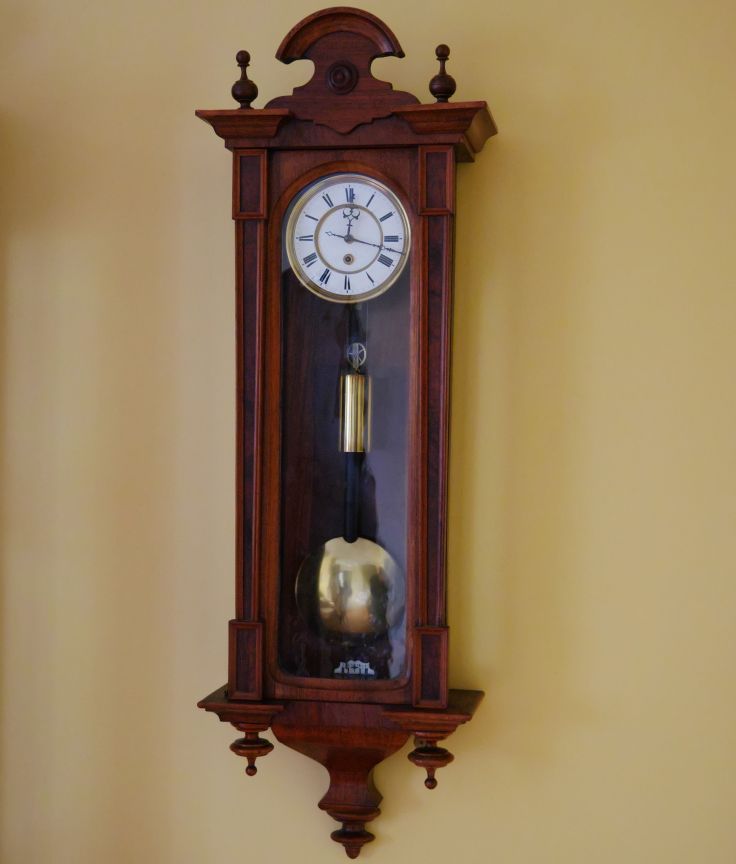
There are generally 2 categories of motive power for mechanical clocks. The energy required to run a clock is provided either by a spring or a weight. Most of my collection is spring-driven but 10 clocks are driven by weights and they represent the broad period from 1835 to 1996.
here are some interesting facts about my ten weight driven clocks:
Eight are American,
Two are Austro-German,
Three are Ogee style,
Five are thirty-hour or one-day,
Two are column style
One is woodworks, and
Three have deadbeat escapements with maintaining power
Rather than describe each one I will let the photos (with captions) speak for themselves.
About three years ago I wrote a piece on clock prices. At that time antique and vintage clock prices had taken a tumble. Where are we now? Have things changed in 2020? Are antique and vintage clock prices going up or down? Is this the time to buy or sell?
Let me come quickly to the point. Anyone who shops today for an antique or vintage clock is well aware that the clock market has been depressed for quite some time and continues on a downward spiral.
Follow me as I explore how clock prices are set, factors that affect the sale of a clock and the reasons why prices are dropping.
Two very desirable clocks from the American Clock and Watch Museum, Bristol Conn.
Informed buyers always make much better choices
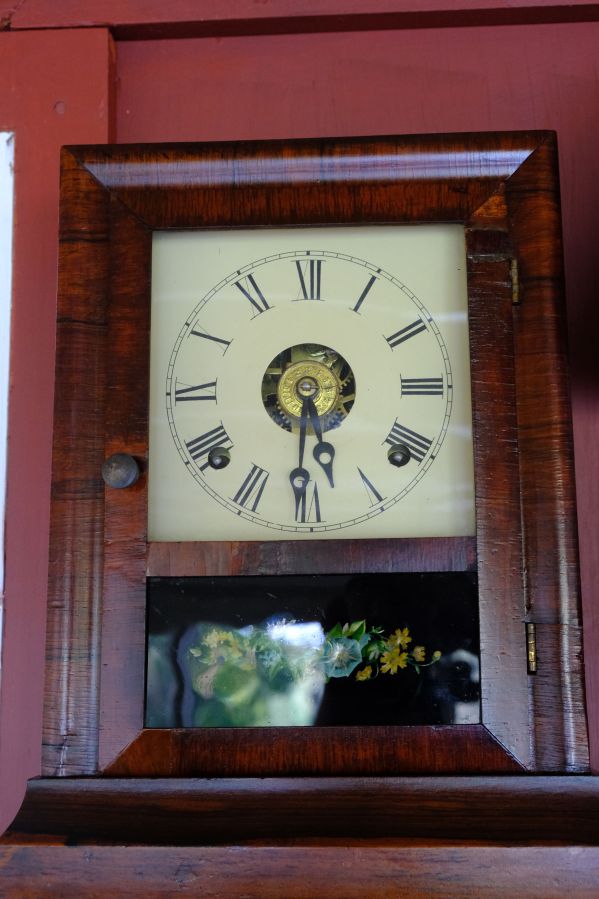
30-hour Ogee shelf clocks, as nice as this one, can be found for a lot less than you think
Pricing is as volatile as it was three years ago. The pricing of a clock on an online site or a paper ad is just as murky and as confusing as ever. There is no true “standard” pricing for any vintage or antique clock. As with most objects, there is a price range that most would consider reasonable.
This blog is intended for those who have an interest in horology and more specifically, antique and vintage mechanical clocks, both collecting and repair.
For some reason the translate widget was dropped when I migrated to a new template this past year, so here it is again. It is the very first widget on the right of the page.
My blog reaches over 100 countries in the world. In many of those countries English is not the main language.
In an effort to continue to reach a wider audience I have re-installed the widget that will permit you, the reader, to read my blog articles in the language of your choice.
En un esfuerzo por llegar a un público más amplio, instalé un nuevo widget que le permitirá a usted, el lector, leer los artículos de mi blog en el idioma que elija
Afin de toucher un public plus large, j’ai installé un nouveau widget qui vous permettra, en tant que lecteur, de lire les articles de mon blog dans la langue de votre choix
Um ein breiteres Publikum zu erreichen, habe ich ein neues Widget installiert, mit dem Sie als Leser meine Blog-Artikel in der Sprache Ihrer Wahl lesen können
Click “Translate My Blog” on the upper right side of each page.
Every now and then a clock is temperamental. I am not talking about the signs of wear that will certainly stop a clock but occasionally it is serviced, everything looks good but it is downright cantankerous. Anyone who has 400-day anniversary clocks knows exactly what I mean. Are clocks moody?
I relocated my unmarked Vienna Regulator one-weight (time-only) wall clock from one room to another and it decided to stop, just like that! A push of the pendulum and 10 minutes or two hours later, it stops. Normally when a clock is moved and level is confirmed (and the movement in beat) it happily ticks along but not this time. Is my Vienna Regulator moody?
It is one of my favourite clocks and I wanted it to run.
Miniature one-weight Vienna wall clock
Some might call it a mini Vienna Regulator others might call it just small. It is 34 inches long 4.75 inches deep and 11 inches at the widest point and 8.5 inches at the waist. Time-only Vienna Regulators are my absolute favourite. They are simple andusually very reliable.
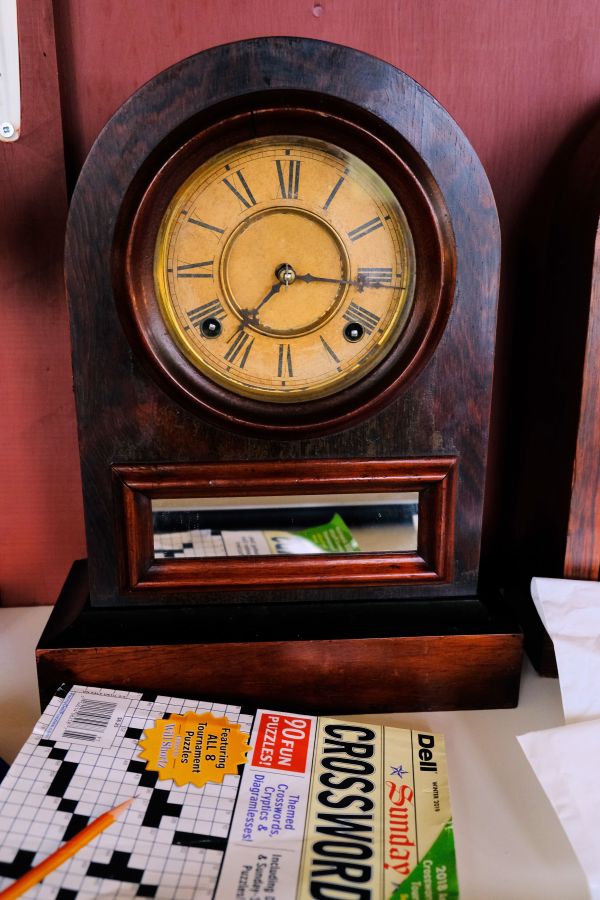
This interesting Rosewood veneered round top, mirrored tablet shelf clock appears to be a Jerome in name only. It is not a fake or marriage but a curious product of early to mid-1870s marketing.
But first, a little Jerome history.
Jerome & Co. shelf clock
One might be tempted to assume that this clock is associated with Chauncey Jerome, one of America’s most noted clockmakers who died in 1868.
Chauncey was well out of the clock business at the time of his death which poses two possibilities; 1) the Jerome in this instance may be Samuel B. Jerome of New Haven, Connecticut or 2) it is the New Haven Clock Company that was selling clocks using the trade name Jerome & Co. It would seem that New Haven and S.B. Jerome would be in conflict with each other. It’s all a bit confusing and perhaps more research is need to find those answers. In any event the Jerome name had strong marketing power.
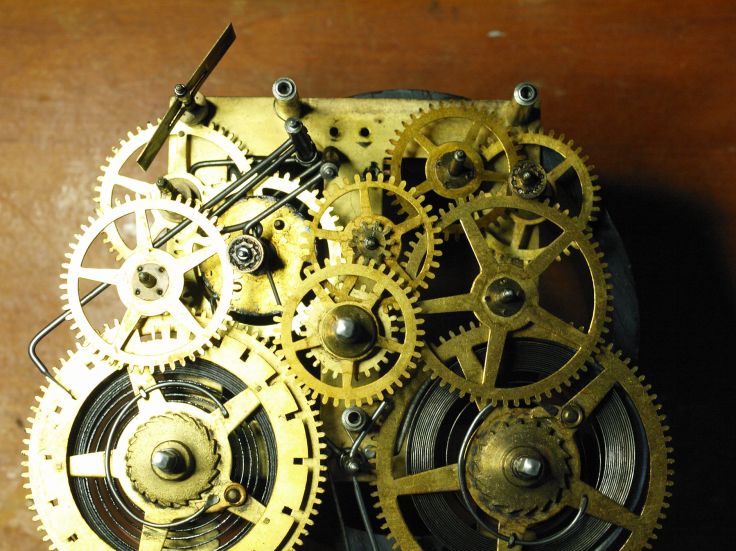
How you ever wondered what keeps antique mechanical clocks going? It’s a miracle they work at all when they are as worn as this one.
Jerome & Co. time and strike movement with front plate removed, minus the escape wheel
Most old clocks I come across have common issues, dirty, oily movements and worn pivot holes here and there. Generally, all they need is a bushing or two and a good cleaning to put right.
Last week I wrote about a Jerome & Co. time and strike mantel clock I bought in Springfield Mass. during the annual convention of the National Association of Watch and Clock Collectors in June 2019. However, no amount of encouragement would make it run reliably.
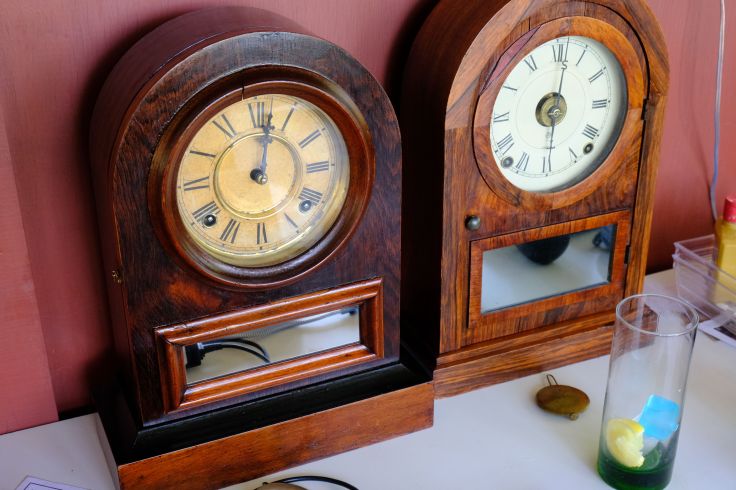
Jerome (left) and Seth Thomas (right) round top clocks side by side
How you ever wondered what keeps mechanical clocks going? It’s a miracle they work at all when they are so worn as this one.
Most old clocks I come across have common issues, dirty, oily movements such as worn pivot holes here and there. Generally all they need is a good cleaning to put right.
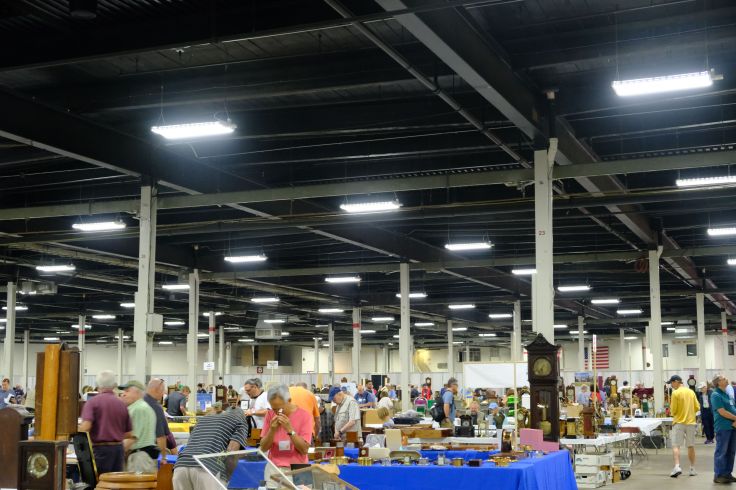
Vendors mart at the NAWCC convention, June 2019
I bought this Jerome & Co. time and strike mantel clock in Springfield Mass. during the annual convention of the National Association of Watch and Clock Collectors in June 2019 and I have only just got around to having a good look at it. It was purchased as part of a small package deal with other mantel clocks. All the clocks had very good cases but movement maintenance was largely ignored by the previous owner.
While the Jerome & Co mantel clock case was in exceptional condition, the movement was in pretty bad shape. No amount of encouraging would make it run.
In terms of style it is referred to as a round top, from the mid to late 1870s
Chauncey Jerome along with his brother Noble introduced the first mass-produced brass movement in 1839 two years after the depression of 1837 knocked out 90% of factories in the Northeast (New England States). The 30-hour brass movement was rugged, cheap to repair and not subject to swelling found in wood movement clocks. Despite business ups and downs Chauncey able was able to maintain a viable clock business until 1868 but later died penniless. This 8-day clock was made well after Chauncey’s death under the New Haven banner.
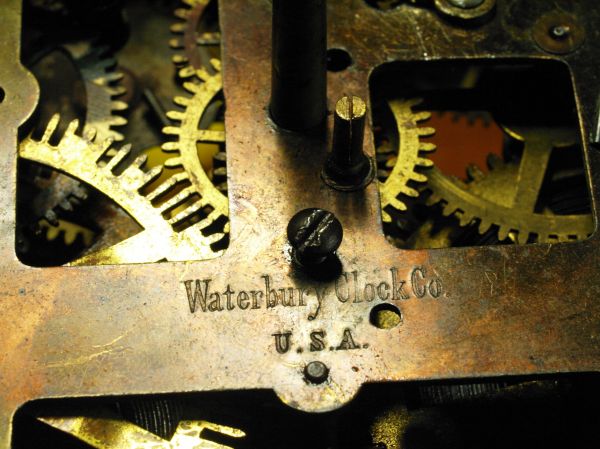
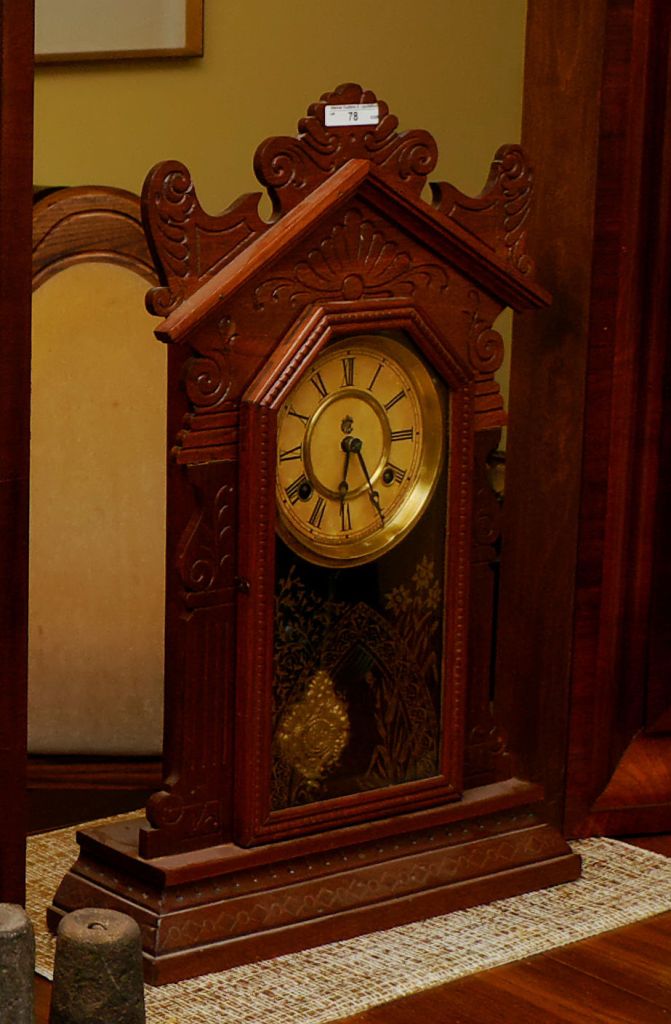
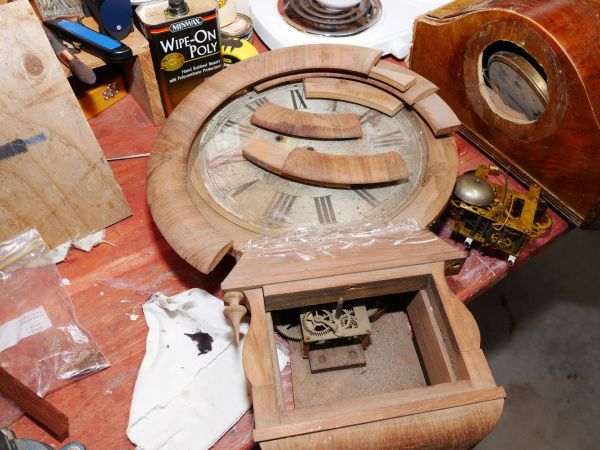
This attractive parlour clock, a Waterbury York, circa 1900, was bought at auction in the spring of 2019. Though inexpensive it is certainly worth servicing which is the subject of this article.
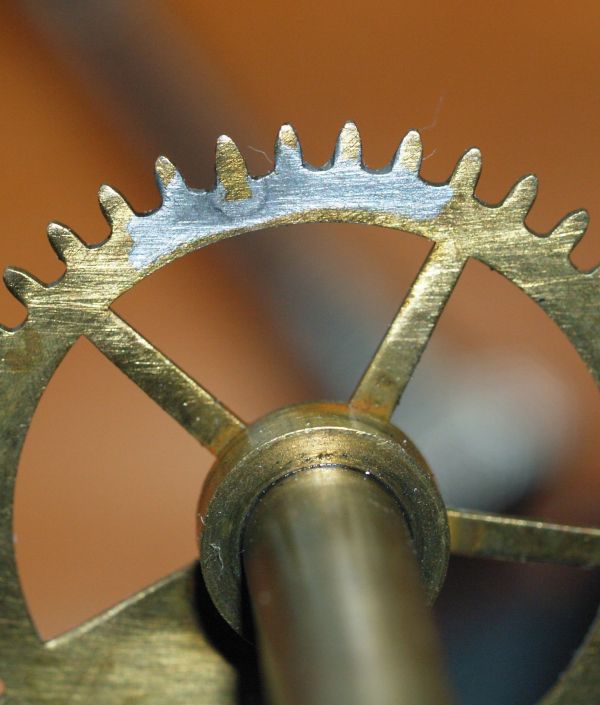
The time side was running but the strike side did not function at all. Usually these sorts of problems amount to simple lever adjustment issues but there were other surprises awaiting me.
The auction tag is still on the clock, the day I bought it
The Waterbury Clock Company was incorporated in the city of Waterbury, Connecticut, on March 5, 1857. Until the Great Depression, Waterbury had been quite prosperous, but like so many companies, most of the profits lined the pockets of its Directors instead of being reinvested in new equipment and updated facilities. In 1932 the company was bought and re-organized under the name Ingersoll-Waterbury.and in later years the company morphed into the Timex Corporation. If you peruse the Timex site today you will see a line of Timex watches called the Waterbury collection.
This is Part II of a 2 part series on a clock collectors predicament: preserve or restore and consume
In Part 1, I put forward the argument that if we acquire a clock that has been changed from its original state are we adding or subtracting from its value if we make further changes?
The solution to preserve or restore might not be the only factor to consider when addressing your newly acquired antique clock. Technical limitations of the collector (owner) must also be considered. Cost and time are other factors. A decision now might not be the same decision someone else might make or I would make at a different time.
Let’s now consider the movement and the case.
The movement
Beginning with the movement; should it be in running condition? Should the movement be untouched as a historic object? If it has not been altered and if there have been no changes during its life, doing nothing is an option. If changes have been made to the movement over the years which may include gear teeth repair, bushing work or new pivots or pinions, should these changes be considered in preservation or restoration? Should bad repairs be reversed?
Little changes adding up over time as the ship moved from what it had been to what it would be next
James S. A. Corey, Babylon’s Ashes
This is Part I of a 2 part series on a clock collectors predicament: preserve or restore and consume
This quote from Babylon’s Ashes (The Expanse) sums up the theme of this 2-part blog post. If we acquire a clock that has been changed from its original state are we adding or subtracting from its value if we make further changes?
Part I explores whether we should make any changes to our newly acquired clock if its condition is less than desirable and in Part II, later this week, I explore the movement and the case.
If your newly acquired antique or vintage clock is in excellent shape count yourself lucky but often it may either need major remediation or at least minor adjustments. The impulse is to do something to make it better but not enough to change it in a significant way.
Let’s consider what you have. Is it a clock or a historical object? Should it be changed in any way? And if changed how different would it be from what it had been? Should it be preserved or restored? It may represent an important part of horological history but if value is important will restoration or preservation have a positive or negative effect on its worth?
Fully restored Mauthe wall clock CA. 1895
To preserve or restore is one of the fundamental questions concerning collectors. Preservation means halting further deterioration. Restoration, on the other hand, involves returning the object to its former state or period-correct condition.
Every blogger knows that it takes time to build a popular blog and unless you have a surefire winning formula right off the mark it takes months if not years to build a loyal following.
Many blogs fail within the first few months out of frustration yet patience, determination and some hard work is all it takes to find a rhythm that works.
Daniel Dakota wall clock
With over 130,500 page views since 2015, upwards of 4000 average monthly views and over 900 views per week I recently checked my stats to find the 10 most popular blogs of all time.
The experts are going elsewhere and that is fine with me because this blog was never intended to appeal to those running a repair business or involved in the commerce of antique clocks
Here they are. Click on the links to see what all the fuss is about.
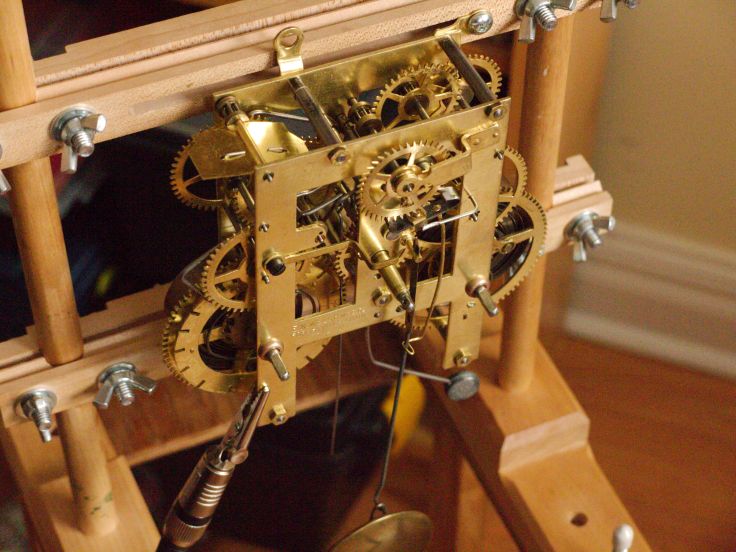
A distinctive feature of this Seth Thomas round top is the lyre shaped 8-day Plymouth time and strike spring-driven movement with a hour strike on an iron bell. Not all of these models have the alarm but this one does. The movement is die-stamped “S. Thomas, Plymouth Conn.” and fitted with Geneva stops (stop-works) to improve timekeeping. It is a large movement squeezed into a relatively compact space.
I wrote two previous articles, one on first impressions and the other on sprucing up the case and a future article (December 24, 2019) addressing a small veneer issue on the front access door but this post concerns the alarm mechanism.
A simple job, less than half an hour in total and the only difficulty was waiting for the part
The alarm mechanism is located just below the movement and to the left and connected by wire to the alarm adjustment wheel mounted on the centre cannon. Both the alarm and the movement strike on the iron bell.












 Antique and Vintage Mechanical Clocks
You must be logged in to post a comment.