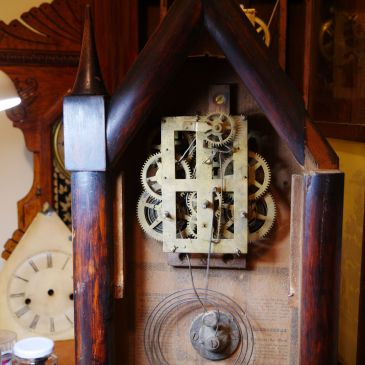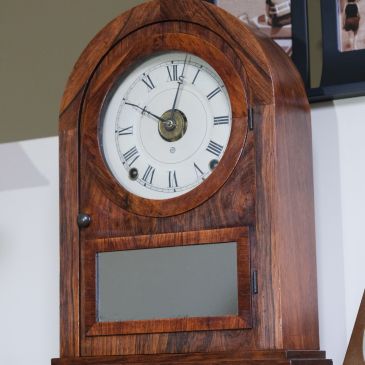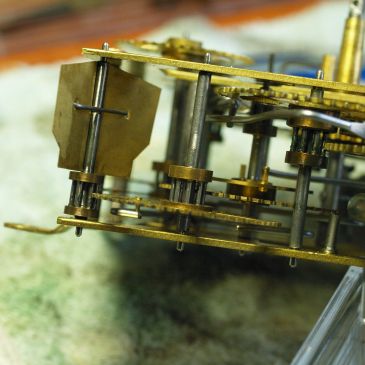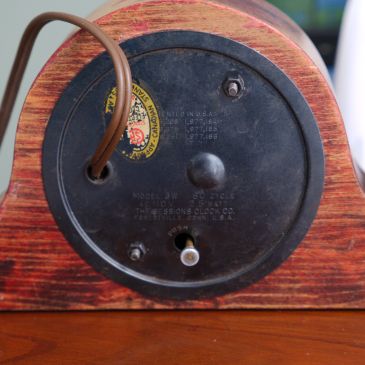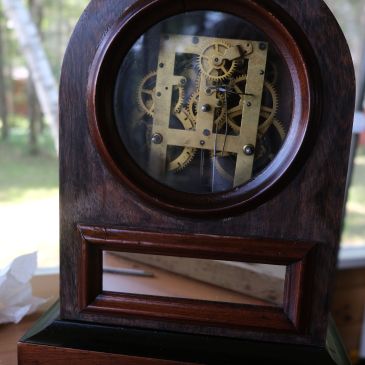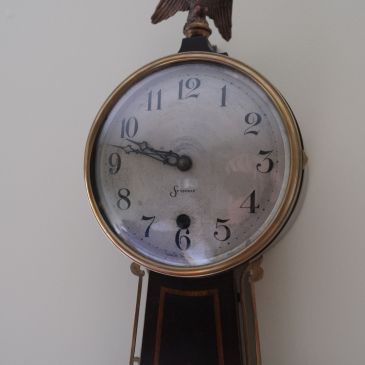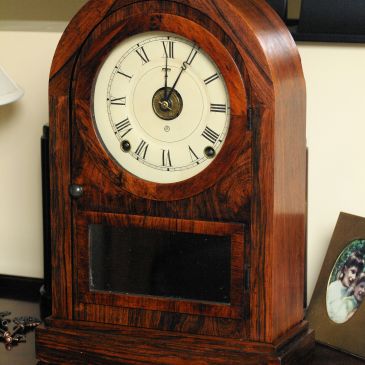
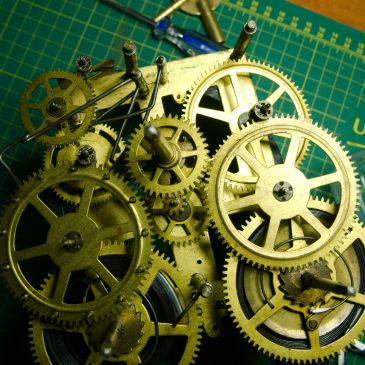
I originally assumed this clock was a Seth Thomas since it had a Seth Thomas movement. After a thorough search on the web, I concluded that this was not a Seth Thomas case. I searched for clocks made by other clockmakers, starting with E.N Welch, Ansonia (because it is similar in style to the Syria), Gilbert, Sessions and finally Waterbury. The term “Waterbury cabinet clock” generated some hits. I found one on an auction site then, two more. I now have a case made by a different maker than the movement and in clock circles this is called a marriage.
The case is a Waterbury model called the “Wren”. I found three Wren models, two with paper dials and one with the identical dial pan as this clock. It may well be that this dial pan is original to the case.
Despite the fact that it is a marriage I might keep it. The case is attractive and the movement fits the case, although both the centre hole and regulator hole over the 12 look to have been bored out and not in a tidy way.
The dial has been cleaned and repainted.
Cleaned and repainted dial
Now to the case. It Stands 13 1/8″ Tall By 12 5/8″ Wide And 5 1/2″ deep. As of this writing if you search for this model you might see one or two without the top crown. It is easily detached and no surprise that it might go missing.
Crooked finial
The case is in good shape with no parts missing however, the top finial on the right is not correctly aligned with the bottom column which I did not notice till I began cleaning the case. Evidently it had detached in the past and a past repairer glued it back not noticing the misalignment. It was simple matter of prying the finial off, regluing and centering it.
Two other pieces had to be reglued, a support piece for the crown and crosspiece in the back for one of the sides of the crown.
I cleaned the case with Murphy’s soap and following the scrubbing I decided that there was enough shellac worn off that a fresh coat would make the case much more appealing.
Finial is reattached and straighter
New coat of shellac
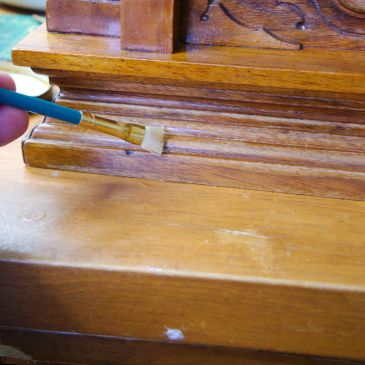
I applied traditional shellac, mixing amber flakes and alcohol with a broad artists brush. In the next shot you can see the difference between the left side of the crown and the right. I now have the option of leaving the finish as-is or aging it by “dulling” it with 4X0 steel wool.
Crown section
In the next photo is the completed case.
To me it is a huge improvement.
All this is being done while the movement is undergoing testing and once the testing is complete the two, the case and the movement will be “married” again.
Now if I can find the matching glass and bezel it will be complete.
This is the model 2038 with a bim-bam strike or what Gilbert called a Normandy Chime in its sales catalog. The model number along with the words “Normandy Chime” are stamped on the bottom of the case. The “Normandy Chime” was reminiscent of the old bells of Normandy (Corneville) in France.
Gilbert tambour clock
In terms of nomenclature within clock circles, calling it a “Chime” certainly adds to the confusion as this would be considered a striking clock rather than a chiming one.
The movement has been serviced
Clocks such as this that have not seen servicing in many years fail because of a combination of bushing wear and old oil buildup.
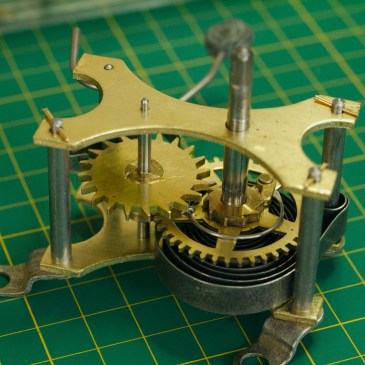
The movement was cleaned, the mainsprings serviced, pivots polished, 5 bushings installed to address wear issues and tested prior to returning it to its case.
Gilbert movement with a date stamp of 1925
The door catch
Although serviced well over a year ago I never got around to repairing the door catch. I could not figure out a way to make an effective catch and I don’t think the solution I came up with is the best possible one.
Now, you might think, why is this such a big deal? It’s not, but without the catch the door pops open a little and will not stay closed, enough to annoy the heck out of me.
Brass tab fashioned into a catch
The solution, for now, is a brass tab with a hole drilled through it to accommodate one of the bezel screws. It is not perfect but allows the door to close securely.
Front glass and bezel of Gilbert clock
I have no idea what the original catch looked like but evidently it was a poor enough design that it broke at some point in the clock’s history.
The clock is promised as a gift and now I am now assured that everything works properly.
This E. Ingraham & Co. clock is a garden variety parlour clock. There is nothing special about it but among parlour clocks, it has nice lines and reflects a more conservative approach to clock designs of the late 19th century. It is an 8-day time and strike clock purchased from a local antique store in the spring of 2019. I have recently serviced a number of clocks in preparation for sale and I also considered selling this one. While I am not in the business of selling clocks I will let go of the odd one to keep my collection manageable. My wife feels that it is a keeper though and I agree.
This was a running clock before I took it apart and my goal is to give it a good cleaning and address wear issues
Stamped in the middle of the front plate is “E Ingraham Co patent date Oct 8, 78 Nov 11, 79, Bristol Conn.” On the inside floor below the pendulum, it is stamped “Manufactured by the E. Ingraham & Co, Bristol Conn”. It was not a common practice to stamp the inside floor but it is an interesting feature.
E Ingraham parlour clock with Swigart dial
Tran Duy Ly’s book on Ingraham clocks shows this model, the Mystic, from the 1897 catalogue. The clock sold new for $6.50. Although found in the 1897 catalogue it might have been made some years earlier. Two numbers are neatly etched into the lower right-hand side of the front plate and they are H25,915 and H27,475. They look like service dates, Sept 1915 and April 1975.
There is a stylized “S” logo on the dial face. Some might mistakenly take it for a Sessions clock. The dial is a replacement made by E&J Swigart, a supplier of replacement dials along with other clock and watch supplies. Swigart went out of business in October of 1992. 1972 was the last year they made reproduction clock dials and this appears to roughly coincide with the 1975 service date.
Assessment of the movement
I have worked on a number of Ingraham movements, some with helper springs and some without. It looks to me that helper springs were added, which is not a bad thing and they will stay on the movement. Installing helper springs to ensure levers drop as they should is not an uncommon practice.
Normally these old movements are in varying degrees of wear and quite often there are punch marks around almost every pivot hole plus they are very dirty. This movement has had 13 bushings installed and is surprisingly clean for its age.
This was a running clock before I took it apart and my goal is to give it a good cleaning and address wear issues along the way. It might require some intervention but my first impression is that it looks very good.
Ingraham Mystic
I found a bent second wheel pivot on the strike side. Before blaming a previous repair it is possible that I was the culprit. Both mainsprings were clamped to restrain their power but when I removed the top plate a wheel sprung out from the strike side. Evidently, the strike side mainspring still had residual power remaining and might have bent the pivot. It was easily straightened.
The main and second wheels on both sides are inscribed for location, so, that is helpful. The strike side mainspring arbour hook has been repaired although the pin is loose and had to be secured. It also appears both mainsprings are replacements. The warning wheel lantern pinion shroud has also been repaired. The clutch on the motion works looks like a repair but I have seen at least one other Ingraham like it, so, I’m not sure.
Ingraham Mystic, warning wheel with additional punch marksIngraham Mystic, motion works clutch
This clock has had a lot of attention and has led an easy life. The repairs are neat and tidy and appear professionally done.
But there is some wear. The clock requires bushings on both the time side and the strike side. One on the time side and 3 on the strike side, one new, and 3 replacement bushings.
Reassembly and testing
The third wheel on the strike side is a combined locking and pin wheel with 2 locking pins and 2 hammer pins. There is no cam on this arbor, unlike many other American movements. The spaces between the pins allow for the drop lever to descend.
The count wheel is advanced by two protruding pins on the third wheel lantern shroud. It is necessary to ensure that the count wheel is firmly in place, not loose but not too tight, so the third wheel pins can advance the count. The warning wheel is set about half a revolution to set up the strike. During reassembly one of the two lock pins is placed on the locking lever, the end of which has a hook. This is to permit the count lever to go into one of the deep slots.
Since I have worked on a couple of Ingraham movements in the last month there was no need to separate the plates to make additional adjustments.
Unlike earlier Ingraham movements that have no passing strike on the half-hour, this has one.
It is on the test stand and I will let it run for a cycle or two before returning it to its case.
Ingraham Mystic on the test stand, beat amplifier attached
It’s really nice to work on a clock that has been so obviously well cared for. It will look great and run well though the only item that detracts from the clock is the Swigart replacement dial.
After having completed work on the case and dial pan of the Ingraham Grecian time and strike shelf clock it is now on to servicing the movement.
Ingraham Grecian refreshed case
Assessing the movement
The movement is in surprisingly good condition for its age. It has been serviced in the past, when, I don’t know. Here’s what I discovered during the inspection.
In an early servicing, 3 bushing holes were punched. Many years ago clock repairers used a punch to close pivot holes that had elongated after years of wear and it was considered an acceptable practice at that time. Not today!
The mainsprings and alarm spring appear to be original and the alarm mechanism showed no evidence of wear.
At a later point a clock repairer installed 3 brass bushings, 1 on the front plate and 2 on the backplate.
Pivots had been replaced on one end of the warning wheel and one end of the third wheel time-side.
The thin brass strap that trips the alarm has been re-riveted.
Ingraham Grecian, a replaced pivot, a very good job by a past repairer
The repairs were neat and professional.
But there were problems
While there were some decent repairs, someone attempted a homemade fix and it became a non-working clock. I suppose that is to be expected from a clock that is 149 years as it passes through several hands.
It appears that the clock was eventually passed on to someone who had little knowledge of things mechanical. It might have been simply out of beat and an attempt was made to adjust the crutch by twisting the crutch loop around the pendulum leader. I can only assume that in their attempt to access the mechanism to “fix” it, the dial and brass bezel were damaged in the process.
Without impulse the clock would run a minute and stop and would never run in that condition.
I reshaped the crutch loop and bent the crutch slightly to achieve a healthy beat and the clock began to run.
While the clock was running I discovered a bent escape wheel tooth. It was running despite this issue, but the verge would occasionally skip the bent tooth. A bent tooth is often the direct result of transporting a clock without removing the pendulum bob.
Servicing the alarm
There is not much to the alarm mechanism. Three pins hold the 2 small plates. I doubt this alarm was used much, It was taken apart, parts cleaned in the ultrasonic, reassembled and oiled.
Ingraham Grecian, the alarm mechanism
Servicing the movement
After letting down the mainsprings and disassembling the movement the first order of business is to straighten the bent escape wheel tooth. The trick is to “draw out” the tooth out with a pair of smooth flat jawed pliers. It is important not to stretch the tooth as this will introduce other escapement issues. Unbending the tooth is a simple procedure but a disaster if things go wrong.
Ingraham Grecian, a clean movement with a small amount of wear
Next is the inspection of pivots, lantern pinions, wheel teeth, arbours, cut pinions, of which there are two in the motion works. All looked good. The gears were meshing well on both time side and the strike side.
Ingraham Grecian, checking the strike side for wear
Following the inspection is parts cleaning in the ultrasonic machine. Once the parts are dry I inspected the movement more closely for any issues I might have missed. Next is polishing the pivots.
Once the pivots are polished it is time for bushing work if required. In the case of this movement 2 are required for the front plate and 3 for the back. On the backplate, one of the bushings is the escape wheel bridge.
Ingraham Grecian, bushing the escape wheel bridge
There were two other pivot holes that were iffy and okay for now but since I am keeping the clock it will be inspected in 3 or 4 years for wear.
Reassembly comments
The third wheel on the strike side is a combined locking and pin wheel with 2 locking pins and 2 hammer pins. There is no cam, unlike many other American movements. The spaces between the pins allow for the drop lever to descend.
The fourth wheel is the warning wheel only and it is not used for locking.
Unlike later Ingraham movements that have a passing strike on the half-hour, this is an hour strike only.
Ingraham Grecian, the inside pins are for the strike hammer
The count wheel is advanced by two protruding pins on the third wheel lantern shroud, another unusual feature. It is important to ensure that the count wheel is firmly in place, not loose but not too tight, so the third wheel pins can advance the count. The stiffness can be adjusted by bending the brass clip on the count wheel.
During reassembly, the warning wheel is set about half a revolution to prepare for the strike. Also during reassembly one of the two lock pins is placed on the locking lever, the end of which has a hook. This is to permit the count lever to go into one of the deep slots.
Ingraham Grecian movement on the test stand
Sometimes it takes a couple of tries to get it right. Usually, I must make an adjustment or two after the plates are together but I was lucky the first time.
Ingraham Grecian shelf clock C.1871
When I finished servicing the movement the new hands arrived from a supplier. So, here it is with new hands attached and the movement back in the case.
Ingraham Grecian Harris and Sons auction photo (with permission)
This attractive shelf clock was bought on an online auction in early January 2021. From the auction photos, I expected a clock that required attention and now, having received it, I am pleasantly surprised that it is in better condition than I thought.
Under the auction studio light (first photo), the case might appear to look reasonably good. Closeup, there is a lot of oily dirt and grime. Servicing the movement will wait for another day. Restoring the case and dial is first.
The vibrant grain of rosewood is there, underneath the grime
Restoration of the case and dial pan
The design of the E. Ingraham Grecian 8-day time and strike shelf clock is neoclassical. It is not only aesthetically pleasing to patrons of the nineteenth century but remains so today. it is timeless.
The age-old debate about what to do with a clock case often arises. Some say, “leave it”, the finish, however grimy is part of a clock’s history. I am not of that camp. If I found the perfect classic car in an old barn I would not leave the dirt and grime on the finish to preserve its patina? Rather, I would polish it to show it off to the world.
This clock is not a candidate for stripping the finish. Stripping is a last resort. Good old fashioned soap and water work is perfect for a project such as this.
Old clocks especially those that are over 100 years old are generally very dirty and the grime is layered. The home environment was a very different place a century ago. Smoking in the home was common, many homes had wood and coal fires for heat, humidity varied because of poor insulation and anything in suspension landed on the furniture. This Ingraham clock is no exception. The rosewood veneer deserves to be shown off and that can only be achieved by peeling off the dirt to reveal the texture of the grain underneath.
Ingraham Grecian Harris and Sons auction photo (with permission)
For cleaning, I prefer a light coloured microfiber cloth so that I can visualize how much dirt I am removing as I proceed with the cleaning. I use several during the course of the project. Diluted Murphy’s soap is used for the case and full strength for the stubborn areas.
Rubbing is required but I don’t want to get too carried away as the cloth might snag a piece of the veneer on a corner. I start with a discreet area first to see what effect the cleaning is having. Working one section at a time, I clean down to the veneer. Any shellac that remains will be removed during the cleaning.
The case looks bleached after the cleaning but a damp cloth will show the grain, the effect shellac will have once the cleaning stage is complete.
I let the case dry thoroughly before applying the first coat of shellac. Shellac is prepared in the traditional manner, flakes and lacquer thinner and mixed to a one pound cut allowing fast drying.
For this project, I applied 2 coats of shellac. Between coats, I used 4X0 steel wool to smooth out any imperfections. After the second coat, I use steel wool to take away the glossy look of the shellac.
Next is the dial.
Ingraham Grecian shelf clockIngraham Grecian clock, the dial is detached from the bezel
Above is a photo of the dial when I received the clock. It is off-center because nothing is securing the dial face to the brass bezel.
The rear of the dial, 2 new dial tabs
Two of the four tabs securing the dial face on the rear of the brass bezel were broken. The arrows show the two new tabs. I am not a whiz with a soldering iron and did the best I could but the results, to me, are acceptable. The thin brass tabs were sourced from a supplier. The tabs, once secured, are bent to secure the dial in place.
Ingraham Grecian
The numerals were in-painted. The dial was in generally good condition though there were losses outside the chapter ring. I mixed and matched paint to touch up the areas of paint loss, and installed a new grommet to replace the missing time-side one. The brass bezel, inner brass ring, and strike side grommet were polished with Brasso as the last step.
E. Ingraham Grecian shelf clock
The case and dial part of the project is complete and in a future post I will address servicing the movement.
This article is the first look at one of my latest online auction finds, an E. Ingraham & Company shelf clock known as the Grecian.
The Ingraham Clock Company operated under a number of minor name variations over the years, E. Ingraham, E & A Ingraham, the E. Ingraham Company, E. Ingraham and Company from 1844 to 1885. Later The Ingraham Company made electric clocks and wristwatches. McGraw-Edison now owns the company and quartz clocks bearing the Ingraham name are still manufactured.
Ingraham Grecian shelf clock, a day after the auction purchase
Although not rare the Grecian is quite collectible. Patent dates on the label date the clock to around 1871. The only other one I have seen is at the American Watch and Clock Museum in Bristol Connecticut, a mosaic maple and walnut version.
American Watch and Clock Museum in Bristol Connecticut
It is a handsome clock with clean lines. The E. Ingraham Grecian 8-day time and strike shelf clock is neoclassical in design. It is not only aesthetically pleasing to patrons of the nineteenth century but remains so today.
It is a distinctive clock. It has a moulded Rosewood bezel, carved volutes below the dial frame (or rosettes as Ingraham called them in his patent letters), and a Rosewood veneered case. The dial frame and bezel are one section that makes up the hinged front access door. There are walnut cased versions and mosaic as well but Rosewood has a certain exotic allure. Elias Ingraham was a case designer and no doubt had a hand not only in the design but the choice of woods used for case construction.
This clock was bought at an online auction in early January 2021. From the auction photos, I expected a clock that needed work and now, after having received it, I am pleasantly surprised that will not take much to service the movement and clean the case.
General condition
The case is Rosewood but because of the buildup of dirt and grime over the years, the grain and texture of the wood are hidden. Upon closer examination, there are some small chips of veneer missing from the corner edges of the base, not surprising given the age of the clock. The rounded top and volutes are perfect.
There is some wear on the top part of the base under the door and that is to be expected. The curved wood bezel is in very nice condition. The backboard has age-related cracks in two places but will not require a repair. There is a slight corner separation on the left side of the base but everything else is tight. The door clasp looks good.
Ingraham Grecian shelf clock
The dial screws came out too easily and the screw holes are well worn. The dial has been taken off more than a few times to make adjustments. The dial is also misaligned as a result of the new screw holes. Both the minute and hour hands are incorrect. The moon hour hand is too short and the minute hand is a slender spade. Both will be replaced.
Ingraham Grecian shelf clock
The painted zinc dial face, which for some reason is detached from the brass bezel, appears to be original with some flaking on the edges. There is a missing time side grommet. The alarm dial is loose, not seemingly attached to anything, and came off easily once the hands were detached. The brass bezel needs a good cleaning.
Ingraham Grecian shelf clock, fair label, cast brass bell
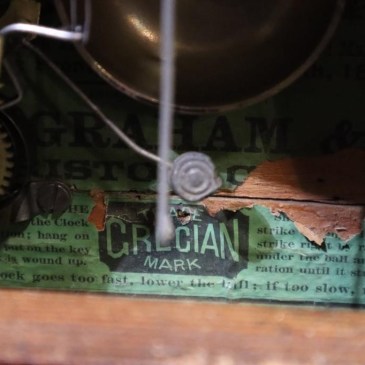
The unique green triangular label inside the case is in fair condition with pieces missing at the lower cracked section of the backboard. I found a loose 3cm piece at the bottom of the case which can easily be glued back in place. The alarm mechanism is in excellent condition. The spring on the alarm is typically broken on these old clocks; this one is fine. I doubt if it has seen much use. The bell is cast brass and there are two strike hammers; one on the inside, which is for the alarm, and one on the outside, the hour-strike hammer.
I was told by the seller that the clock would run for a few minutes, even strike but then it stops, which tells me that nothing is broken. The crutch loop is twisted around the pendulum rod and since there is no impulse it is not surprising the clock would stop. I doubt it ran more than a few seconds.
It is a pinned movement. Later movements have screws or bolts holding the plates together. The movement might have been worked on in the past although it is hard to tell. The two lower pins look original but the top pins look like replacements. If it was worked on it was done with care. There are no tell-tale signs such as marks, scratches, and punch marks that indicate past servicing. Since the mainsprings are wound tight I won’t know the extent of wear until I take the movement apart.
I can only guess that the butchered crutch and the detached dial are the results of someone who did not know what they were doing when making an attempt to get the clock to run.
The plan of action
The case:clean all wood surfaces thoroughly with Murphy’s Soap. Cleaning will no doubt remove remnants of the old shellac and new shellac prepared in the traditional manner (flakes and alcohol) will be applied to all the exterior surfaces. The finish will then be dulled with 4X0 steel wool.
The movement: The movement will be completely disassembled and inspected for wear, and cleaned. New bushings will be installed if needed. I made some adjustments to the crutch and ran the clock for two days and it was striking correctly during that period. The mainsprings look to be in good condition and provide plenty of power. The alarm mechanism which might never have been operational, will be taken apart and cleaned. The alarm dial is a friction fit and will be tightened up once the movement is reinstalled and should work as intended. The crutch loop will be repaired.
The dial: I will leave the dial as-is despite a little paint loss on the edges. Once the dial is aligned properly these should be hidden, for the most part. The dial pan has separated from the bezel. A past tinkerer used cellophane tape to secure the dial pan to the bezel and even attempted to solder two of the tabs, poorly I might add. These are fixable. More difficult is sourcing a 2 3/4 inch moon minute hand.
Well, that’s it for now. I plan to get started fairly soon. The only thing stopping me is a Seth Thomas #2 that has stopped and needs a look-see. There will be more on the Ingraham clock later.
Canadian made Arthur Pequegnat Simcoe mantel clock, circa 1916, $300 (in Canada)
There are many types and styles of clocks and dozens of manufacturers. If you are a collector you know exactly what you are looking for and have a good idea of its approximate value. If you are not an “expert”, selecting an antique clock can be a daunting task. But this article is not about helping you find that special clock. It is about the variables that affect clock prices in 2021.
Mantel clocks on display in a museum
Over the years I have learned the value of many antique and vintage clocks. When I come across an interesting clock on an online for sale site or in an antique store I have several questions in mind. Is there anything special about it? When was it made? Is it rare? Is it historically significant? Is the price too high or too low and why? How much work must I put into it if it clearly needs TLC and will the seller accept a lower price? That said, I am prepared to walk away at any point.
For example, E. Ingraham clocks are common and can be had for very little money but the more desirable Ingrahams of the 1860s and 70s are those that Elias Ingraham had a hand in designing. The Ingraham Grecian is an attractive example of a clock that was designed in a period of American clock manufacturing where dappearance and uniqueness mattered.
E. Ingraham Grecian shelf clock C. 1870
Condition is important. One look at the case will tell me how well it was cared for. In my experience, it is pretty rare to find a clock that has been professionally serviced and many where a previous owner applied their limited skills to get it running. However, if you have the skills to service the movement and are handy at restoration, there are certainly bargains to be found.
If acquiring antique and vintage clocks is something you enjoy but have no knowledge of clock repair, the cost of servicing must be factored into the price particularly if you want it to run reliably.
Let’s assume that you are looking for an authentic antique or vintage clock that has not been altered in any way save for minor cosmetic touch-ups. What factors influence the price you pay for a clock today?
Miniature one-weight Vienna regulator wall clock, unsigned, circa 1870, in the $400 range
Here is a list of factors I would consider in making your next purchase and why you would pay more for some clocks and less for others.
Variables that affect clock prices today
Wall clocks generally command higher prices than mantel clocks, the exceptions are Asian wall clocks and the like that have little value.
Most mantel clocks less than 100 years old have little value.
Clocks that come from a prominent collection that are well cared for and in excellent condition are more desirable.
Demand in your local area affects price; Canadian-made clocks are sought after in Canada whereas the same clocks are almost worthless in the US.
Weight-driven clocks are more desirable than spring-driven clocks. The exception is the modern weight-driven grandfather clock whose value has plummeted in recent years.
Condition is key, a clock in excellent condition is worth more than one in poor condition or with parts missing.
Running clocks are worth (generally) more than non-running clocks.
A recently serviced clock is worth more than one that has either not been serviced in a long time or never serviced.
The same clock may be worth more than others that are the same or similar if it has special provenance i.e. a well-documented tall case clock that came from Grover Cleveland’s home.
A clock with a replacement movement is termed a marriage by collectors. Marriages are worth far less than an authentic clock but acceptable by some collectors.
Any clock that has had its mechanical movement replaced with a quartz one is worthless.
One of the largest factors in a clock’s value is the manufacturer. Many from Sessions Clock Co. are rather ordinary and relatively inexpensive but some Seth Thomas Sonora Chime clocks, for example, have good value.
Age does not always equate to a higher price. A clock that is 170 years old is not necessarily worth more than one that is 50 years old.
Mechanism type; double and triple fusee clocks and pinwheel regulators are worth more than open-spring-driven mantel clocks or modern tall-case weight-driven clocks.
Some clockmakers are more desirable than others; generally speaking a German-made Winterhalder and Hofmeier mantel clock is worth more than a similar American-made Gilbert mantel clock. Assuming both are in the same condition, an unsigned four-glass French clock has a greater value than a branded American crystal regulator.
Scottish tall case clock, circa 1848 for under $300
The Law of Supply and demand and the 30-hour ogee
The law of supply and demand is the theory that explains the interaction between the sellers of a resource and the buyers for that same resource. Generally, as price increases, people are willing to supply more and demand less and vice versa when the price falls. At the end of the day, the clock market is very unpredictable. Clocks on eBay that go for $400 one month are $100 the next.
An interesting example is a 30-hour ogee clock. Prior to the popularity of online auction sites 30-hour ogee clocks (below) were commanding prices in the hundreds of dollars. Antique stores had them in the $250-400 range and when the internet came along supply increased and prices dropped.
George H. Clark 30 hour Ogee, circa 1860
I have paid low prices for some of my clocks but higher for what I call special clocks that are not necessarily rare but are made with some level of precision or unique in design.
Seth Thomas Regulator #2, circa 1925, $800-1000 range
Closing thoughts
In commercial transactions, the principle that the buyer purchases at his own risk in the absence of an express warranty is termed Caveat Emptor, or let the buyer beware. In the clock world, buyers have little or no recourse if those goods turn out to be defective, misrepresented, or broken. The best of luck trying to get your money back if you are a successful bidder on an online auction site and your package arrives in pieces.
Selecting and purchasing an authentic antique mechanical clock can be a daunting task but it can also be a very rewarding experience.
Tick-Talk Tuesday is about the letters and comments I receive from you, the reader, concerning your clock, issues you might have had, challenges you face or a clock you would like me to profile. I give my responses to your question(s) and provide advice on your particular clock concern. For those comments and questions that stump even me, I consult within my clock circles for the best possible answer
8-day Waterbury ogee clock
It’s an 1870 Waterbury clock, it’s not in the best shape but it seems so sad to see family heirloom that’s was passed down over the years just tossed aside
AS writes,
I have been interested in old clocks and have 4. My maternal great grandparents were all watchmakers in England and I wished they were still alive to teach me the trade. The other day I found this old clock in a second-hand store and I fell in love with, It’s an 1870 Waterbury clock, it’s not in the best shape but it seems so sad to see family heirloom that’s was passed down over the years just tossed aside, I loved it so I bought, It needs some repair and would love to repair it myself, do you have any advice on where I can get it to fix or how to fix it myself I have tried online to find a diagram of the inside so I have an idea on how to fix but found nothing.
Waterbury 8-day ogee clock movement – side view
My reply,
Hi and thanks for coming to my blog.
I have no doubt that the clock you bought is from the 1870s. The style is called “Ogee” because of the curved veneer molding. Yours is unusual in that it has two front doors rather than the typical one door. You are correct; it needs love and attention.
I have several suggestions for you. One, you can learn about servicing clocks by taking courses online. Dave LeBounty is one source. They are not free, however.
Two, there is a clock forum site operated by the National Association of Watch and Clock Collectors (NAWCC). It is free to post, you do not need a paid membership and you can ask questions about your clock and get some guidance on how to repair it.
Waterbury 8-day ogee clock movement
Three, Steven Conover has several excellent books on clock repair. He has one that focuses on time and strike movements, like yours. It is an excellent guide and easy to follow.
Fourth, You can get your hands dirty by taking out the movement and taking it apart yourself. I can walk you through the process.
Hope this helps.
Waterbury 8-day ogee clock movement – backplate
AS replies,
Thank you for your reply, and advice. I will look into the NAWCC, Would love to try and fix it myself, as it would be a joy to learn the craft and maybe save other old clocks. The only clock repair here in New Glasgow closed years ago, so there is no one here to do repairs which is a shame as these old clocks are a part of history and should be saved. I have managed to get the gearbox out, it is in need of a good cleaning and does need some parts, It doesn’t have a spring but 2 ropes that wrap around 2 gears and spindles on either side then attach to 2 weights. The ropes need replacing as well as new weights, If you could walk me through it that would be wonderful. It is a grand old piece and I would love to see it working again.
Note: There are far more 30-hour ogees than there is the 8-day type. I have not come across one in quite some time. In my collection, my 4 ogees are all 30-hour clocks.
Over the summer of 2020, I was asked to service a friend’s clock. It is an attractive machine-carved oak Ansonia Syria parlour clock in the popular Arts and Crafts style of the late 19th century.
Ansonia Syria
It has great sentimental value to my friend but she recognized that it was in need of adjustment or repair. It had been in her late husband’s family for a number of years and she wanted it to preserve it as a reminder of his life.
This is Part II of a two-part series. My general comments and first impressions are found in Part I which you can find here.
It is an attractive clock in relatively good shape for its age. From my research, I have determined that it was made sometime in the early to mid-1890s.
Time and strike movement with an 1882 patent date
In this post, I will continue with disassembly, cleaning, general comments about the condition of the movement, and any potential trouble spots.
Dis-assembly and servicing the movement
The movement is held in the case by 4 screws. Once out of the case the first order of business is to restrain the mainsprings with mainspring C-clamps before separating the plates. Safety is paramount; those springs are powerful.
Although C-clamps are the round type in the following photo I prefer flat clamps for most American movements. Either will do but flat clamps are perfect for tight spaces.
Olie Baker spring winder
After disassembly, my Olie Baker spring winder was put into action to unwind the spring, inspect it for cracks, surface rust, or any other issues.
Each mainspring is stretched out and cleaned with a Scotchbight pad and WD-40. It is carefully wiped down leaving no trace of the WD-40 and placed in the ultrasonic cleaner for 20 minutes. Once out of the ultrasonic cleaner, you must work quickly to dry and clean the mainspring. Rust is insidious and will creep in quickly.
The mainsprings looked very good and once cleaned and carefully inspected I have no hesitation reusing them.
A mainspring is cleaned, oiled and returned to its arbour
I applied a drop of Keystone mainspring oil on each of the coils, wound the spring several times to spread the oil. Once the C-clamp is re-applied and hooked on to the arbour, the excess oil is wiped away. The clicks are in good shape, sometimes a weakness in American movements. At this point, there is nothing more to be done to the mainsprings until the movement is assembled, so, let’s put them aside.
I try to minimize wrestling with American time and strike movement so that once I have the top plate on I loosely attach the bottom two screws and move to the time side because the strike side wheels and levers can be the most frustrating to position correctly and are left to the last
Everything is ready for the next step
I inspected each of the wheels and pivots for wear and found everything including the lantern pinions to be in generally very good condition with one exception. There is minor wear on the flywheel lantern pinions but not enough to warrant replacement at this point.
I usually put the time and strike gears and pretty much everything else in one or two containers. When you have done many movements you learn to quickly identify the location of each component. I can take out any wheel or lever, for example, and identify its specific location. However, if you are just starting out or have not built up enough confidence I highly recommend separating the two sides. In the early days of clock servicing, that is exactly what I did.
I was curious to find that a past repairer scratched “S” (for strike) and “T” (for time) on each one of the wheels according to their location. I understand why but esthetically it does not look good. However, marking the mainspring arbours came in handy. I make it a point to return each mainspring on the arbour they came from. In most cases, the mainsprings are the same length and thickness but every now and then I come across two different sizes. Better to be safe than sorry. That aside the movement appears to be in good condition.
A bushing is marked for replacement
Once the parts are cleaned and dried and the pivot holes are pegged it is on to the next step, pivot polishing. I use a #11 Emory board to polish pivots. I secure each of the wheels in a 3-jaw chuck on my Taig metal lathe and move the Emory boards in an up and down motion to polish the pivots.
Taig lathe at its slowest speed setting
Following the polishing, it is on to any bushing work that may be needed. In the case of this movement, two bushings were needed, the second wheel, front plate and the fourth wheel backplate. Here, a new Bergeon brass bushing is pushed into the bottom plate.
New Bergeon bushing. Notice the fixed lifting lever, lower left
Movement Re-assembly
And now for re-assembly and testing.
Since the lifting lever is attached to the bottom plate and is otherwise immoveable the count lever is the only component that has to be put in its correct location.
I try to minimize wrestling with American time and strike movement so that once I have the top plate on I loosely attach the bottom two screws and move to the time side because the strike side wheels and levers can be the most frustrating to position correctly and are left to the last.
All is ready for the top plate
Once the time side wheels and the hour gear are in place I attach the third screw and then work the wheels and levers into place on the strike side. Once everything is in place I tighten all the screws. A pivot locator is your best friend when re-assembling any movement.
Pivot locator
On the first attempt, I was not able to synch the strike side locking wheel (sometimes you get lucky the first time) but I mounted the movement on the test stand overnight to check out the time side and the next day it was running as expected. The locking wheel pin needs to be adjusted but that can wait till tomorrow.
One issue raised its head after re-assembly. The strike side gears were not moving at all. I tested each gear and found the flywheel (governor) was sluggish and had no end shake. It freed up if the nut nearest the flywheel was loose enough. The reason. A past repairer installed a bushing that was too tall for the plate. End shake allows freedom of the movement when the plates are screwed tightly down. I filed down the protruding bushing on the inside of the plate and the strike side then ran smoothly.
On the test stand
Next day
Now to open up the top part of the strike side to reposition the locking wheel. Safety first. I restrain the mainsprings just in case the whole thing explodes. I re-positioned the stop pin so that it is resting on the stop lever and presto, everything is working as it should.
I would like to refresh the case but the owner left strict instructions to leave it as-is.
Over the summer I was asked to service a friend’s clock. It is an attractive machine-carved oak Ansonia Syria parlour clock in the popular Arts and Crafts style of the late 19th century.
”my poor clock needs a good servicing and cleaning. It runs slow, eg. I set it and would it on Sunday and by Friday it’s about 14 minutes slow, about 2-3 minutes per day, and it needs new hands”
It has great sentimental value to my friend but she recognized that it was in need of adjustment or repair. It had been in her late husband’s family for a number of years and she wanted it to preserve it as a reminder of his life.
Ansonia Syria mantel clock
It was in a well-packed box and in it was a note. The note said, ”my poor clock needs a good servicing and cleaning. It runs slow, eg. I set it and would it on Sunday and by Friday it’s about 14 minutes slow, about 2-3 minutes per day, and it needs new hands”.
Packaged with care
I opened the box, attached the pendulum, gave both arbours several turns, and started the clock. The fact that it is in running order and striking correctly is certainly a positive sign and testament to the fact that it was serviced in the past. Does it need a simple cleaning and regulating or is something else going on?
Apart from a couple of nicks and scratches, the case looks good. I asked the owner if she would like the case reconditioned and she said she prefers it the way it is. Fair enough.
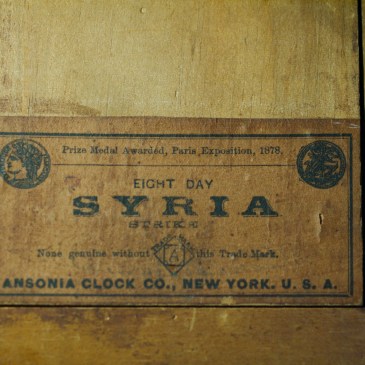
The Ansonia Syria is an attractive mantel clock and according to the label affixed to the inside of the back access door, it is an 1878 Paris Exposition winner. This is helpful because it allows the clock to be dated. On the movement, there is a patent date of June 18, 1882. It is probably safe to say that it was made within a few years of the 1882 date which puts it in the late -1880s to 1890s. Tran Duy Ly in his book on Ansonia clocks (page 245) lists the year of manufacture as 1894.
The Ansonia Clock Company competed with many popular clock companies of the time; Waterbury, Gilbert, Seth Thomas, E. N. Welch, and New Haven to name a few.
Let’s look into this clock a little further. A few interesting anomalies struck me as I examined the clock case and the movement.
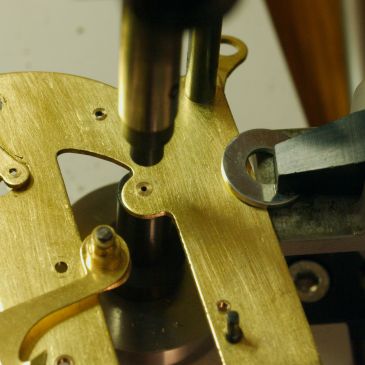
Just above the 12, there is a brass insert that looks like the head of a large pin. It is there to conceal a hole. Although difficult to see in the photo, the letters “S” and “F” appear at either side of the pin. The pin hides the hole for the regulator. Clocks with this type of regulator come with two-sided keys and the smaller end is used to insert into the hole and regulate the clock to slow it down or speed it up. The dial pan is also held in place by common nails.
This movement in this case does not have a regulator mechanism and the mechanism was not removed from the movement. This is a period-correct Ansonia replacement movement that originally came out of a kitchen clock with an alarm. The alarm would have been attached to an activating lever which has been cut off on this movement (see the centre of below shot).
The base of the alarm actuatorStandoffs on the back of the movement
In the above photo, you can see standoffs on the rear plate and clearly standoffs on the front plate. The front standoffs are fashioned from a brass ribbon, bent, drilled out, and cut to fit. The clock is, what we term in the clock business, a marriage. It is always nice to see that it has a movement from the same manufacturer and from the same period as the clock case but a marriage certainly reduces its desirability and makes it difficult to classify it as an antique.
Next, the suspension spring post has been re-soldered, loose perhaps.
And lastly, the hour hand is a replacement. The original hour hand would have been a trident style.
That having been said, the clock has great sentimental value for the owner, and the fact that it is a marriage and has undergone changes over the years may not be a factor.
The movement has been worked on in the past. There are 16 replacement bushings. The bushing work looks professional and after a first look perhaps 2 or 3 require replacement though none on the strike side. Otherwise, the movement was dirty and had thick black-greenish oil residue on several pivots. Not surprising in an antique clock but indicative of some level of wear. The mainsprings were dripping with brown oil, but I have seen a lot worse.
The next step is to service the movement. Part 2, in four days’ time will detail disassembly, bushing work, and general cleaning.
Some time ago I wrote an article on an interesting acquisition, an Ansonia Extra Drop, a true barn find.
This Ansonia Extra Drop time-only Rosewood veneered wall clock was manufactured in the early 1880s by what was then known as the Ansonia Brass and Copper Company.
It was in pretty rough shape when I bought it and the only significant part missing is the brass dial bezel and a number of minor items such as the verge, hands, pendulum bob, suspension spring/rod, and the drop access door (which I made later on).
I was challenged by the whole prospect of putting the many pieces back together and giving what most would consider a throw-away movement, a second chance.
A sad-looking and seized time-only movement
Here is the movement when I found it. What a sight! I thought if I stripped away all the rust and dirt something of value would be salvageable. How many of you would simply toss it out?
After disassembly, scrubbing, cleaning, and one new escape wheel bushing here is the final result.
Cleaned and serviced time only movement
First servicing
The fact that the spring was unwound on the movement when I received it tells me two things. One, the chance that it is “set” is reduced and secondly, having an open coil means more surface rust on the outer part of the spring.
I did my best to remove most of the rust on the mainspring and it went back in the movement. A short while later I discovered that the clock would only run if I wound it about halfway. Otherwise, if wound tight it would not run at all. The surface rust was evidently causing it to stop.
Some clockmakers who after observing any rust on a mainspring would immediately toss it out and argue that the spring is weaker because of the presence of surface rust. In this case, the mainspring is unsightly but has no cracks and has plenty of power.
Other repairers apply a liquid or gel, black tea, or even use electrolytic rust removal to extricate the rust. I know I risk igniting a debate about mainspring replacement and if I were in the business of clock repair, I would certainly toss out the mainspring and pass the cost on to the customer. However, I am hesitant to spend money on a new mainspring for what is essentially a $5.00 barn-find clock and my challenge was to spend as little money as possible on this clock.
During the initial servicing, I managed to get rid of most of the mainspring rust.
Second servicing
Still some problems. After several months I took it apart again, ran the parts through my new ultrasonic cleaner which I did not have at the time of the first servicing. I placed the mainspring in as well. Scotch Brite abrasive pad and WD40 combined are excellent for cleaning a mainspring and I was able to effectively smooth out the rough and rusty outer sections of the mainspring. Again, I checked for cracks and suspicious imperfections and found none. After rubbing the abrasive pad over the mainspring several times I gave it a healthy coating of Keystone mainspring oil. A smoother, rust-free mainspring should function a lot better.
Rather than mount the movement on the test stand, I installed it back into its case but left the dial off so I could monitor it more closely. It runs very well and has run several full 8-day cycles.
Ansonia movement in its case
I realize that I have pushed the limit of this mainspring and the next step is a replacement but we’ll see what happens after the testing period.
Weeks later
The movement continues to run well and now it is time to put everything back together.
Among American clocks, the name Elisha Manross does not immediately come to mind unlike well-known clockmakers such as Seth Thomas, New Haven or Waterbury. However, Elisha Manross (1792-1856) was an important pioneer of the Connecticut clock.
Brass mainsprings are very rare. It is possible for a clockmaker to go through their entire career without seeing brass mainsprings. Why? Because brass was used for a very short period as a mainspring in clocks. From 1836 to 1850 brass mainsprings were used because steel was considered very expensive. It was not until 1847 that the tempered steel mainspring developed for everyday clocks was introduced and with it, the brass mainspring faded into clock history.
Tempered brass mainspring, American Clock and Watch Museum, Bristol Connecticut, June 2019
Quite often 30-hour time and strike Gothic Steeple clocks such as this one by Elisha Manross (Ca. 1847) have steel mainsprings because the original brass mainsprings broke and were replaced. That the mainsprings in this clock are original and still in excellent condition tells me that this clock did not have a particularly hard life.
Elisha Manross 30 hour movement, as found
My plan is to preserve the brass mainsprings. Some might be tempted to replace them with steel ones. My interest is in preserving the brass mainsprings in this clock because they represents a very important part of the history of American clocks and should be back in the movement where they belong.
In light of current world events the antiquevintageclock.com family wish to convey our sympathy and condolences to those effected by Covid 19
Finish almost completely gone, right side
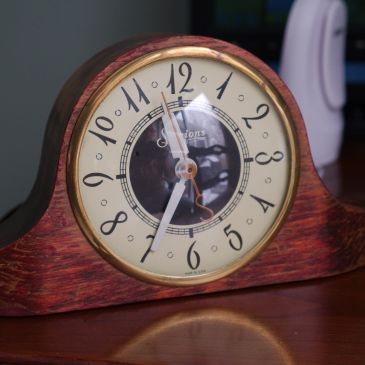
My daughter found this vintage Sessions electric table clock, a model 3W and gave it to me as a Christmas gift. It is made, by the Sessions Clock Co. Forestville, Connecticut in 1936 and sold in Canada (a Canadian Standards Approval sticker is on the back).
Left side
On the back, it states that it consumes 2.5 watts, I guess they couldn’t call it model 2.5! It was probably a very affordable clock in its day and available almost anywhere.
At 4 1/2 inches tall and 8 1/4 inches wide, it would fit on any countertop, bookcase etc. but it lacks an alarm it would not be a suitable bedside table clock. There is only one control in the rear, a push-and-twist-in knob that sets the time. Pretty simple!
Stripping the finish
Everything else, the face, hands, brass bezel were in great shape but the finish on the case had almost completely worn off. It is one block of wood and likely pine and likely tinted lacquer.
My daughter and I chose to work on the finish together. We stripped the case down completely and applied a light walnut stain. Several coats of shellac followed by sanding with 0000 steel wool between coats and finishing with paste wax completed the project.
New and improved 3W
The result is a richer, darker finish, more in keeping with the original. Given that it runs so well a refinish is a complement to a very simple but stylish desk clock.
Hi readers, in light of current world events the antiquevintageclock.com family wish to convey our sympathy and condolences to those effected by Covid 19
Dating a clock can be a challenge and often an estimate within a range of dates is the best that can be accomplished. Dating some clocks can be relatively easy as in the case of this Sessions Beveled Number 2 tambour style time and strike. Inside the back access door, it is stamped Sept 1927, the date of manufacture.
Further research about the clockmaker, the movement design and the label will reveal a date within a narrow range
Inside access door of Sessions tambour clock
Sessions Beveled No. 2
This Gilbert time and strike movement has a die-stamped year but the month of manufacture is unknown. Other markings in the case might narrow it down.
Gilbert movement made in 1906
Research concerning the maker, the clock design, the model name or number and the label may reveal the exact date or something within a narrow range of years. Books on the identification of American clocks such as those by Tran Duy Lycan be very helpful.
Let’s look at this Elisha Manross Gothic Steeple clock.
Elisha Manross (1792-1856) was an important pioneer of the Connecticut clock and made a variety of clock styles, one of which is the gothic steeple pictured below.
Elisha Manross Gothic Steeple clock. Hands are incorrect; it would have had spade hour and spear minute hands
Although Elisha Manross had been active in Bristol clock-making since 1812 and earlier he shows in the Bristol tax records as making clocks from 1842-1851. His business was dissolved in 1854 and the factory was purchased in 1855 by E.N. Welch.
Manross made two steeple clocks. One is 20″ high and 10″ wide, the other is 19 1/2 inches high by 9 1/2 inches wide. The larger case would have made for other labels but the smaller size such as this one was manufactured in the Manross factory.
A very dirty Elisha Manross 30 hour movement, just out of the case
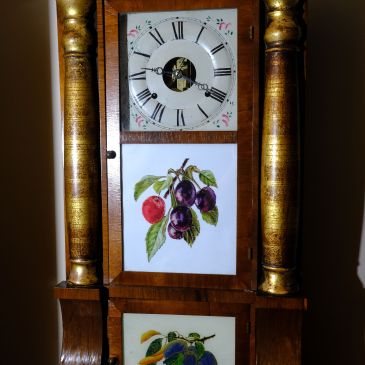
This 30-hour clock by Elisha Manross has some distinctive features that help in its dating. Let’s narrow down the date by looking at the design of the movement and case. Three features make this clock interesting. One, it has very rare brass mainsprings; two, the count-wheel is located in the middle on the backplate and three, the veneer on the front columns and door is in a vertical orientation.
Brass mainsprings
Brass mainsprings were invented, patented and first used in 1836 by Joseph Shaylor Ives. Brass was cheaper and more accessible than steel in the mid-1830s and 1840s. Silas B. Terry developed steel springs for clock use in the Bristol area circa 1847, and as steel improved and became cheaper, brass springs quickly disappeared.
In the history of the American clockmaking, brass mainsprings had a very short life, between 1836 and 1850. The brass mainsprings on this movement have survived for a very long time and most clocks of this age have had replacement steel mainsprings.
Count-wheel
Many American time and strike movements have the count wheel located on the left side of the front plate just above the mainspring (or winding arbour for a weight-driven clock). Placing the count wheel in the rear of this movement adds complexity to the lever arrangement. Also absent is a strike-side cam wheel typically found on later American time and strike movements.
Manross backplate showing location of count-wheel
Veneer and vertical orientation
Exotic woods were used to cover the pine case. Elisha Manross clocks were either clad in Rosewood veneer or Mahogany. Manross clocks were produced with the Mahogany veneer in a vertical orientation, such as this clock, and Rosewood veneer in a horizontal orientation. American clockmakers did not normally orient the veneer in this manner.
Left front column
Dating this clock – let’s see what the data tells us
Records also show that steeple cases were made by Manross between 1847 and 1853. The label on the clock is in remarkable condition for a 168-year-old clock and is extremely helpful in dating this clock. On the back of the door, the left side of the upper tablet is the inscription 8/43, not once but twice. Is this the date the case was made? The door is clearly original to the case since it has the same vertical orientation as the veneer.
Records also show the sale of 705 cases (unknown as to type) to “E. Manross” during the months July-November, 1843. It is very possible the case was constructed in 1843, stored until later when the movements were placed in the case and readied for sale.
The date of August 1843 is inconsistent with the label, located on the inside backboard, which was printed by Elihu Geer at his shop on 10 State Street, Hartford Conn on or about 1850. The label was likely added to the case just prior to the sale of the clock.
We can conclude that the clock was made no earlier than 1843 and no later than 1850 and we can safely date this clock within a 5-7 year period.
Dating aside, it is truly remarkable that a mechanical device that is 173 years old is still operating to this day.
This rather plain, box-like 8-day hour strike Rosewood veneered shelf clock is up for servicing. This is Part II of a two-part series. Go to Part I to read my notes and observations while disassembling the movement and the initial steps required to bring the clock to running condition.
The movement is in reasonably good condition but not without issues. It was running prior to cleaning (though not a full 8-day cycle) so I did not expect any further running issues after servicing and my principal goal was that it would run the full 8-day cycle.
I always take a number of photographs when I disassemble a movement. It is much easier than making diagrams and notes and best for future reference particularly when photos are archived.
This rather plain, box-like 8-day hour strike shelf clock is up for servicing. I wrote about first impressions in Sept 2019 and said at that time that the clock is in reasonably good condition, runs well, but needs a good cleaning.
Though my collection consists of mechanical clocks exclusively, now there is an exception, a vintage Sessions electric table clock, model 3W with sweep second hand, made, of course, by the Sessions Clock Co. Forestville, Connecticut in 1936 and sold in Canada (a Canadian Standards Approval sticker is on the back).
Also on the back, it states that it consumes 2.5 watts, They couldn’t call it model 2.5! It was probably a very affordable clock in its day and available almost anywhere.
At 4 1/2 inches tall and 8 1/4 inches wide, it would fit on any countertop, bookcase etc. although because it lacks an alarm it would not be a bedside table clock. There is only one control in the rear, a push-and-twist-in knob that sets the time. Pretty simple!
Back of clock showing patent dates, CSA decal, adjustment knob and cord
It arrived with a missing plug, a detached minute hand and a finish that was almost completely worn off but the convex glass, face, brass bezel and motor are all in very good condition.
This interesting Rosewood veneered round top, mirrored tablet shelf clock appears to be a Jerome in name only. It is not a fake or marriage but a curious product of early to mid-1870s marketing.
But first, a little Jerome history.
Jerome & Co. shelf clock
One might be tempted to assume that this clock is associated with Chauncey Jerome, one of America’s most noted clockmakers who died in 1868.
Chauncey was well out of the clock business at the time of his death which poses two possibilities; 1) the Jerome in this instance may be Samuel B. Jerome of New Haven, Connecticut or 2) it is the New Haven Clock Company that was selling clocks using the trade name Jerome & Co. It would seem that New Haven and S.B. Jerome would be in conflict with each other. It’s all a bit confusing and perhaps more research is need to find those answers. In any event the Jerome name had strong marketing power.
How you ever wondered what keeps antique mechanical clocks going? It’s a miracle they work at all when they are as worn as this one.
Jerome & Co. time and strike movement with front plate removed, minus the escape wheel
Most old clocks I come across have common issues, dirty, oily movements and worn pivot holes here and there. Generally, all they need is a bushing or two and a good cleaning to put right.
Last week I wrote about a Jerome & Co. time and strike mantel clock I bought in Springfield Mass. during the annual convention of the National Association of Watch and Clock Collectors in June 2019. However, no amount of encouragement would make it run reliably.
Once the Sessions Clock Co acquired E. N. Welch assets in 1902 (for the history of E. N. Welch go here) the company was well on its way to becoming one of the biggest clock producers in America. Production began in 1903 and between that time and 1933 Sessions produced 52 models of mechanical clocks, ranging from Advertisers, large and small clocks with logos of various businesses, to wall, or regulator clocks, and shelf or mantel clocks, designed for the home. Some Session clocks from this period are prized by collectors but most others are of the generic kind that have limited value today.
During our stay in Springfield Ma. to attend a NAWCC annual clock convention in June 2019 we stopped in Bristol, Connecticut about 45 minutes drive south of Springfield. In Bristol, Connecticut is the American Clock and Watch Museum. The non-descript white clapboard New England styled salt-box is what first greets the visitor.
Although the museum is dedicated to American clock and watch makers it is a must see for any clock enthusiast
I admit I was a little disappointed after visiting the stately edifice of the NAWCC museum in Columbia, Pennsylvania but once I entered the side entrance door my disappointment evaporated. I was immediately impressed with the friendly and knowledgeable staff, the quality of the displays and the vast, well-organized collection of American clocks and watches. The following photos tell the story.
When I attended the NAWCC Convention In June 2019 I bought this clock at the clock mart which is a unique opportunity to find that special clock among thousands offered for sale.
I have always equated E.N Welch with quality and this clock is no exception. I have one other Welch, the Whittier, a parlour clock, which is part of the “author” series, made in 1893. The seller knew nothing about this clock but it was attractive so I bought it.
8-day Welch movement with alarm
In 1902 the E. N. Welch Clock Co. was absorbed by the Sessions Clock Company. E N Welch had a long and glorious history and are best known for their “Patti” series of fine clocks since Patti clocks are named after famous opera stars of the time. This clock was made well before reorganization in the mid-1890s when it began producing clocks that were less expensive to manufacture, like the Whittier that had wider appeal. This clock is from about 1875.
Among the most respected American clockmakers is the Seth Thomas Clock Co. In my collection are 6 Seth Thomas clocks representing several styles all of which are unique representing the period between 1865 and 1930.
I acquired this clock at the National Association of Watch and Clock Collectors conference in Springfield Ma. in June of 2019.
Visiting any clock museum is always an interesting and engaging experience.
On our way from Boston to Springfield Ma. to attend the NAWCC (National Association of Watch and Clock Collectors) Convention 2019 we stopped in a small community called Grafton and in that community is the Willard House and Clock Museum one of the foremost museums of its kind in America. The unassuming location on a quiet country road in a pastoral setting of fields and forest was a pleasant surprise. The museum was the home of Benjamin and then, Simon Willard, celebrated clockmaker and inventor. Born in 1753 Simon Willard spent his formative years in Grafton, later moving to Boston.
The Willard name may not be immediately recognizable outside the United States but he is regarded as important source of innovative design in the American clock industry.
The vast collection of clocks housed inside is surprising for the size of the museum. The collection ranges from Massachusetts shelf clocks, to tall-case and Willard’s famous banjo clocks.
You must be logged in to post a comment.