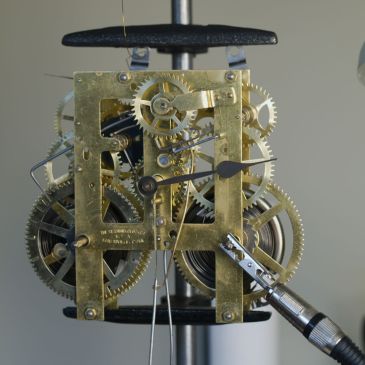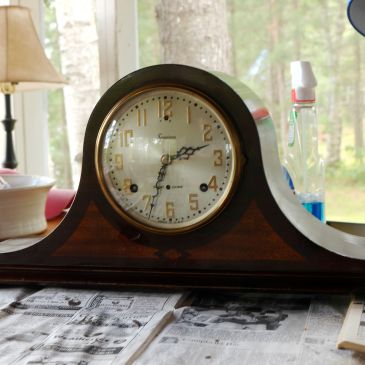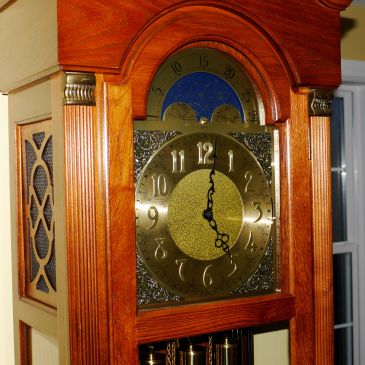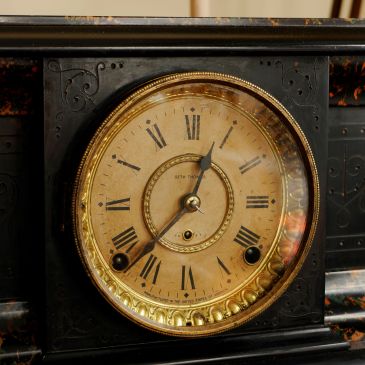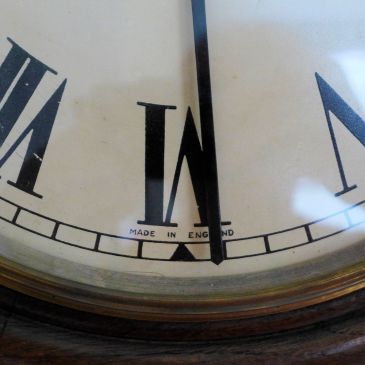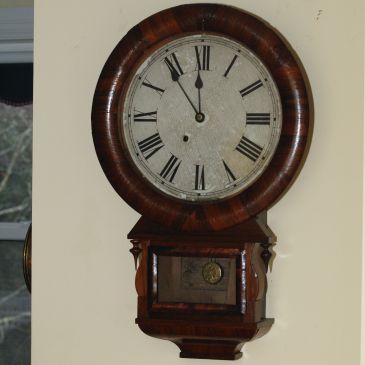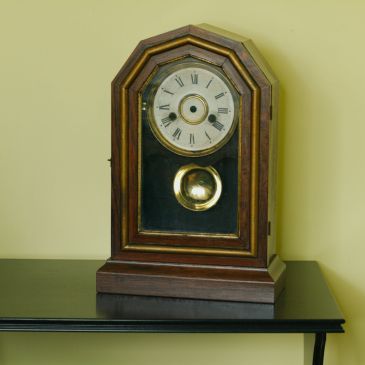
One of my retirement gifts in 2016 was a 2-weight time and strike Gustav Becker wall clock. My wife had thoroughly searched eBay and picked what she determined to be the best gift for me considering a Gustav Becker wall clock had always been on my wish list. It was everything I had hoped for but the clock came with one hiccup and a pretty big one at that.
It was badly damaged in shipment. Finials snapped off, all glass was broken, weights were dented, trim pieces fell off, the brass dial bezel was bent, a bent gathering pallet and the movement was missing critical strike side rack and snail parts. I managed to obtain a few pieces from the seller which was not everything I required and also put in a damage claim with the postal service but received nothing from them.
The main case was largely untouched at least
It was a good learning experience that taught me that one should avoid shipping a clock unless the shipper knows exactly what they are doing.
Where to start? At the time I was not sure how to approach rebuilding the clock. Do I set it aside for a later project or just dive into the deep end and learn as I go?
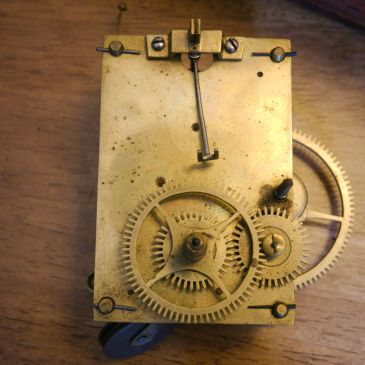
The original movement from 1902 is missing strike-side parts
I decided to have a go at it. After gluing the parts back on, replacing the glass, sprucing up the case, and sourcing a new movement (the original 1902 movement was replaced with a 1917 movement made in the same Braunau factory) the clock was finally coming together and at the end of the three-month project, it taught me a few things about movement servicing, sourcing of parts and case repair.
My wife took a look at this clock the other day and suggested I write an update. She said that it still looked impressive years after. I put a lot of work into this clock and it appears to have paid off as it still looks great on my living room wall.
I am all in for a bargain and one cannot buy a clock any cheaper. A friend spotted this German-made Jauch time-only calendar clock in a thrift shop for $1.65.
Schoolhouse clock made in Western Germany by Jauch
The date stamped on the movement is July 1979 which is no surprise since the clock has a number of modern features such as a magnetic lower door clasp and lift-up hinged dial bezel.
Jauch time-only movement, PL42, length of pendulum in cms, date7/79
The clock is certainly a nostalgic return to the oak-cased schoolhouse clocks found in many schoolrooms 100 years ago like the Gilbert Admiral calendar clock (pictured below) from the late 1890s, but the case is a cheaper pine instead of oak.
Glbert Admiral time-only wall clock with calendar
The clock looks good on any wall and to many, this vintage clock would appear, at first glance, to be an antique.
In an earlier post, I noted that there is not a lot wrong with this clock. The case needs a little tender loving care which is easily remedied and the movement looks very clean.
I removed the movement from its case since it was not running, mounted it on a movement test stand, and made an anchor adjustment by moving the pallets slightly. The movement was now in beat. I oiled the movement and it has been running for several days.
The movement is on a test stand and running in beat
Two vertical pieces that looked like wallboard or laminate flooring hold the movement in place. The two sides are secured with 2 Robertson screws. I doubt the manufacturer would have used Roberton screws since this type of screw is widely used in Canada but seldom elsewhere.
When I removed the movement I noticed additional screw holes. So, it seems to be a later fix, but why? Is the movement a replacement? If so, why bother with such a cheap clock? A mystery to be sure.
The movement looks very clean and looks to have had little running.
Next is taking the movement apart. I wonder if any surprises await me.
Jauch was related to one of the oldest Black Forest clock-maker families. The Gerbrueder Jauch company manufactured hall, wall, and mantel clocks and movements for the trade including those that were spring and weight operated. In late 1979, the company fell victim to a curtailed export limiting production. Gerbrueder Jauch GmbH eventually went bankrupt in 1986. The remaining stock was purchased by a leading clock/watch supply house in the USA.
The company was a respected supplier of relatively inexpensive but attractive clocks for the average home. This drop octagon schoolhouse-style clock is a prime example of an inexpensively made clock for the masses.
Drop octagon wall clock with the back panel removed
The clock is 23 inches high, 15 inches across, and almost 5 inches deep, dimensions that are very close to the classic American schoolhouse clock made over 100 years ago. Rather than an oak case which is typically found in antique American clocks, the case for this one is a much cheaper pine.
This clock’s bezel is hinged at the top with a flip-up design rather than one that swings to the right which makes winding the clock a two-handed operation.
Flip-up bezel
The clock has “Western Germany” on the bottom part of the dial and the movement which is also stamped July of 1979.
Magnetic catch
For all you history buffs, the Berlin wall was erected in 1961, and Germany was finally unified in 1989.
Standard Jauch time-only movement with calendar feature
I have worked on Jauch time-only movements in the past but never one with a calendar feature. One interesting aspect is the distance from the dial face to the winding arbour necessitating a long #7 key which I do not have.
This one is not in working order. Laying it down flat will cause the escape wheel to run but once on the wall, it abrupting stops after a swing or two of the pendulum. I suspect the anchor escapement is way off or there is serious bushing wear in the top part of the train.
A friend spotted this clock in a local thrift shop for $1.65. Why so little? Thrift shops deal with a constant flow of donated items so any price charged is pure profit. Vintage quartz clocks usually wind up at the thrift shop but not many mechanical clocks do. This is a good find since there isn’t anything fundamentally wrong with the clock save for a scuffed-up case which can be easily remedied with a cleaning and a fresh clear-coat finish.
Western Germany; why not simply “West Germany”
Unless there is something seriously wrong with the movement such as spring barrel bushing wear that I have seen on other Jauch movements, it should be an easy task to have this clock running again.
A museum is an institution dedicated to the display of objects of lasting interest or historic value. A museum can display just about anything but TheCanadian Clock Museum, located in Deep River, Ontario (Canada) focuses on Canadian clocks or clocks that have a Canadian connection.
Canadian Clock Museum
Most are mechanical clocks as you would expect but the most extensive collection of (Toronto-based) Snider electric clocks is contained within its walls.
This Snider clock is located in the foyer of a Quebec City boutique hotelDisplay of Snider clocks in the entry foyer of the museum
There are static displays that change very little over the years but Curator Allan Symons continues to acquire new and interesting clocks of all types and it seems that in the past two years some large hall and grandfather clocks have been added. Interesting, because they take up a lot of space and space is at a premium in this tightly packed museum.
Despite the museum’s diminutive size, there is a relaxing flow as one explores many manufacturers and thematic displays. It is easy to get lost in the history of the many clocks on display. There is just enough information on the description cards adjacent to each clock to keep the visitor’s interest without getting too deep into the weeds.
Many clocks come with interesting stories that Allan will happily relate but some histories are, unfortunately, incomplete. Clock collectors know that as clocks pass from hand to hand some or all of the history is lost forever.
The clock that intrigued me most in this, my seventh trip to the museum, is a top-of-the-line grandfather clock made by the Blackforest Clock Company of Toronto and donated to the museum. Founded in 1928 by Leopold and Sarah Stossel the Blackforest Clock Company and later the Forestville Clock Company was a prolific producer of clocks for Canadian Homes. Complete clocks were imported from Germany or movements were imported and installed in locally made cases.
The company continued as the Blackforest Clock Company until 1941 at which point the Second World War and the unfortunate association with Germany led to a name change to the Forestville Clock Company. During the war years, movements were sourced from England, France, and the US. As factories ramped up production Forestville resumed importing movements from Germany. Ed Stossel retired in 1979 and the company could not survive much longer without his leadership.
Blackforest hall clock
This imposing floor clock stands about 7 1/2 feet tall and is a majestic piece of mahogany cabinetry with carved bonnet and capitals, fluted columns, hand-painted moon dial, carved feet, and a large central finial over a carved head of a young woman(?).
Stunning top piece with carvings
The weights are cable wound by inserting a winding crank in the 3 arbours on the dial face. The case was not made in-house at the Blackforest Clock Co. but by a smaller firm specializing in grandfather clock cases (Westminster Time & Clock Industries from Scarborough, perhaps?).
However, the unique feature of this clock is the Westminster chimes on five tubular bells, one tube extending all the way to the inside bottom of the case. The chime hammers are driven by a large pin drum located on the top of the movement. The sound is not overly loud but melodious.
Westminster 3-train movement
If you have but a casual interest in clocks there are other displays of interest, one of which is an old phonograph made by the Victor Talking Machine Company, Camden, New Jersey, USA) and sold as the Victrola brand by the Ormes Furniture Company Limited of Ottawa.
Victrola was a brand name for the many table and floor models made by the Victor Talking Machine Company starting around 1927. The new models promoted the latest recordings made via microphone for the first time starting in the mid-1920s.
The museum’s large floor model is one version of the Credenza model.
Starting around 1900, before electricity availability, records were both recorded and played back acoustically. Microphones and electric motors changed the music recording industry.
In the late 1920s, the Credenza was considered a state-of-the-art player for 78rpm records and it was available in either an electric version or a 4-spring wind-up. The museum has the electric version. The fidelity of this stand-up model is remarkable as it capably projects the music into a large room.
Victrola record player, the Credenza
Allan played a 78rpm disc recorded in 1951 by Mary Ford and Les Paul, yes the same Les Paul of guitar fame. The song was How High the Moon and the Victrola filled the room despite the limitations of a steel needle (stylus) and an acoustic trumpet (folded 6-foot wood horn).
Not only is the museum worth at least a one-time visit for clock lovers but return visitors will always be rewarded with some new and, of course, fascinating additions.
However, if you are unable to visit the museum Allan will take you on a virtual tour that will no doubt pique your interest to come and enjoy the museum’s many offerings.
The hour hand is loose on my unmarked circa 1840s banjo clock. It is an unusual problem and I can’t say I have ever come across an issue like this in my years of clock repair. It is supposed to friction fit on the hour pipe but the hand is definitely quite loose.
I have attributed this fine precision-made weight-driven banjo timepiece to John Sawin or one of his apprentices or associates. John Sawin, who apprenticed under Simon Willard, made clocks in the Boston area in the early 1800s and it appears that this clock was made in or around 1840.
It is not the usual ornate clock with reverse-painted tablets, gilt features, and an American eagle finial that one would envision as a classic banjo clock. This mahogany-cased clock is simple with timeless lines.
Back to the hour hand. I posted the issue on an online clock forum site and the consensus seems to be that I must stake the hour hand in several places on the inside so that it would fit tightly on the hour pipe.
The hour hand is on the right
On most American clocks the hour hand has a collet and the hour hand/collect friction fits onto the hour pipe. No so on early banjo clocks.
Collet on the hour hand
The staking went well, the hour hand fits snuggly and I am pleased.
Well, it has been hectic this past week or so (late September and early October 2022). Some of you were affected by Hurricane Ian in Florida (USA) which was incredibly devasting but we had a bit of weather here as well when Hurricane Fiona passed very slowly over Nova Scotia (Canada).
It was largely a wind and felled tree event for us as the storm lasted almost 24 hours but it also meant that our electric infrastructure took a serious beating as 4 out of 5 people were without power at the peak of the hurricane.
As a result, we were without power for 8 days. Fortunately, some years ago we had our house wired for a standby generator. We were able to stay warm, keep our food refrigerated, and enjoyed hot showers every day. Some of our neighbors were not so lucky. We provided water and kept items of theirs in our fridge/freezer during the outage.
I usually spend many hours a week with my hobby repairing and restoring old clocks and generally performing periodic inspections of the clocks I have on display throughout my home and of course, adding new and interesting clocks to my collection. But not lately!
Attending to storm damage on our property was the number one priority. We live on a treed lot and unfortunately quite a number of our trees went down but none threatened our house, thankfully. Of course, we were chainsawing and picking up branches daily and as of this writing, we are still in the process of cleaning up our property. After 30-plus downed trees the property looks quite different.
However, all is not lost. I have managed to keep up with my blog, stealing what time I can, and so there has been no interruption in my posts. I have even managed to reply to your letters.
We have made progress on the cleanup and things are slowly getting back to normal so that now I can get back to what I enjoy most, clock collecting and repair.
Unless a clock has a distinctive provenance or, is rare, it is difficult to make any sort of profit on an antique clock today. Some unique clocks, ones with a special history or, those made by famous clockmakers (those in the clock world know who they are) have retained their value and are highly desired by collectors.
Just because something is old does not necessarily mean it has value. A 100-plus-year-old common antique clock is worth very little today because thousands were made by many manufacturers over the years and quite a few have survived to this day. For example, there was a time before the internet came along that ogee clocks sold for $300 or more but are much cheaper now thanks to online for-sale sites that have depressed their value. It’s all about supply and demand.
Selling an antique clock can be a challenge but a few simple rules to follow will make it easier to part with your clock.
Does it run?
If the clock is running and was recently serviced by a competent repair person, state it as such. If the clock is running but the movement needs to be cleaned, state that it requires cleaning and possible issues that might need to be addressed such as running too slow or too fast or stops after a while. If the clock is not running say why or simply state you do not know the reason.
Describe excessive wear, damage, or missing pieces such as crowns, finials, keys, glass, and trim pieces.
Ogee style clock
Preparing the clock for sale
A clock in running condition will be worth more than one that is not running. If you are handy and know your way around clock movements, and can service a clock yourself, a serviced clock will command a higher price. A clock case cleaned of grime will present better than a dirty one unless you are a stickler for “patina”.
Missing hands or dial glass will adversely affect the price. Items such as these are not costly to replace and parts are typically available from clock suppliers but it means the buyer assumes that expense.
Mantel clock
Disclosure
Honesty is the best policy when selling your clock and if it has issues it is better to let the buyer know beforehand. It is therefore important to let the prospective buyer know as much as possible about the clock so that surprises can be avoided. A clock that is a marriage, a case with a similar but with a replacement movement, should be stated as such. Disclose issues such as replaced glass, newer dial, replacement crowns and finials, case repairs, or full case restoration.
Wall clock, known as a schoolhouse clock
Determining a price
Setting a price requires a little research on your part. What you paid for it originally may not be the best indicator of its value. What you think it might be worth may be far removed from the price you will finally realize.
Check eBay, Facebook Marketplace, and other for-sale sites for clocks that are similar and price yours within that range. Pricing too high will discourage inquiries but price the clock lower if you are eager to get rid of it.
Woodworks clock with a missing crown or topper
Where to advertise
There are various methods of selling a clock. Word of mouth is certainly the most rudimentary while the internet provides many more selling advantages. Facebook for-sale sites, local online for-sale sites like Kijiji, eBay, flea markets, consignment shops, and auction houses are popular places to sell a clock. Setting up an account for most online sites is a prerequisite.
For national or international sales, factor shipping into the price. Advertising locally and delivering the clock to the new owner avoids the hassle of shipping and the potential for breakage and of course other headaches.
Grandfather clock
Photographing your clock
Few cell phones are capable of capturing a detailed image but for most purposes, it is enough. Out-of-focus images are a no-no and will put off prospective buyers.
Several images from different angles as well as a photo of the inside of the clock case are much more helpful than simply one photo. During daylight, place the clock near a window and position yourself between the window and the clock to take a series of photos in natural light. If there is damage or wear take closeup photos of those areas.
If you have a dedicated camera experiment with artificial light take the best angles to get optimum results.
Description of your clock
Crafting an ad is an art in itself. You must be concise and accurate and not too wordy. There is a delicate balance between too little and too much information. Too much information or very little information means fewer inquiries from prospective buyers.
State the clock’s maker if possible, the model if possible, the year it was made or a reasonable estimate, the type, (time-only, striking clock, chiming clock), and the style of clock, whether it be a mantel, wall, shelf, parlor, Ogee, tall-case, and so on as well as any distinctive features.
A steeple clock with an alarm function or a clock with a second hand or calendar are examples of features that might attract specific buyers.
Well, there you have it. I think I have covered the most important points and if I have missed any, let me know. Good luck with your sale!
Between 1903 and 1933 the Sessions Clock Company of America produced 52 models of mechanical clocks ranging from simple mantel clocks and shelf clocks to wall or “regulator” clocks all designed for the home or small businesses.
Found in many homes across America Sessions clocks were regarded as relatively inexpensive, simple in design, and decently constructed aside from one noted design flaw, the clicks. After a hundred years many Sessions clocks are still running.
Mission style clock by Sessions
This is the only mission-style clock in my collection. I was not particularly looking for this one but a $10 find in a thrift shop is hard to pass up. Though this clock is non-running Sessions movements are simple enough to work on.
As there is no maker’s label I can’t tell you the model name or number of this wall clock but I assume that it was made in the early part of the 20th century.
The movement
The case is in very good condition and there is nothing missing save the winding key which can be easily sourced. The minute hand broke while I was setting the time, probably as a result of being bent so many times. That can be repaired.
Sessions movement with front plate off
The movement is a conventional Sessions design with a between-the-plates escapement setup as opposed to earlier Sessions movements that had inboard escapements.
I noticed many “X” marks around bushings but I did not see punch marks or replacement bushings. Was it meant to have had the bushings replaced?
Servicing the mainsprings
The cam wheel pegs for the striking lever have both been soldered and although it is not a very neat job the repair seems strong enough.
There is a hole adjacent to the escape wheel arbor which might have been made through manufacture but it is oddly close to the escape wheel bushing hole.
One more issue. The actuator arm for the hour strike had been bent so many times that it snapped off when I tried to test the clock before disassembly. This can also be repaired.
In short, this is a clock that has been worked on in the past and I would think, not by a professional. Sometimes home-cooked repairs are strong and functional and other times they leave a lot to be desired.
All is not lost and I think this movement can be saved.
A fusee clock movement is a type of mechanical clock mechanism that uses a conical pulley (the fusee) and a chain or cable to provide a more consistent driving force to the clock’s gear train. The fusee mechanism was commonly used in early pocket watches and large clocks to compensate for the decreasing tension of the mainspring as it unwound.
As a typical mainspring winds up, its tension is strongest, which leads to the clock running too fast. As the mainspring unwinds, its tension weakens, causing the clock to run slower. The fusee counteracts this by gradually changing the ratio of the force applied to the gears, ensuring a steady, regulated power supply. This innovation helps the clock maintain accuracy throughout its entire run.
Fusee movements are often considered an important step in the evolution of horology, showcasing the ingenuity of early clockmakers in solving the problem of maintaining consistent timekeeping. Today, they are still highly valued by collectors and horologists for their craftsmanship and historical significance.
Fusee movement in run-down condition
Most fusee movements were equipped with anchor escapements, though some featured lever or deadbeat escapements. Earlier fusee movements often had decorative sculpted pillars and pins to secure the plates, while later models used plain pillars with screws. This difference in design is one way to determine the age of the clock.
Jacob Zech is credited for inventing the fusee in 1525 although drawings of a fusee appear in Leonardo De Vinci’s notebooks.
Fusee in its run-down condition
Parts of a Fusee Movement
a) Spring drum
b) Winding arbour
c) Fusee
d) Main wheel
e) Chain (or gut or wire)
Of course, the above diagram does not show the wheels above the main wheel and merely illustrates the essential components of the fusee section.
A chain-driven fusee is the norm although wire and gut are common. Gut was used at first but around 1650 chains began to be used, which lasted longer.
How does it function?
The spring drum’s axis is parallel to the axis of the fusee. Around the drum is wound a chain that is attached to the fusee at its largest diameter. An attached mainspring is coiled inside the drum that sits next to the fusee.
When the key is inserted into the arbour of the fusee it pulls the chain causing the drum to rotate. Because the inner end of the spring is attached to the drum, the drum rotates until the spring is completely coiled. The spring is then at its maximum tension. At full winding, the chain is completely wound onto the fusee.
As the spring begins to uncoil the chain is on the smallest diameter of the fusee. The pull on the spring drum becomes less as the diameter of the fusee increases. The diameter of the fusee becomes larger giving greater leverage.
The greater turning moment provided by the larger radius at the fusee compensates for the weaker force of the spring, keeping the drive torque constant and that is why fusee clocks are better timekeepers than conventional spring clocks.
Fusee movements are generally more expensive than conventional spring drive movements. Double and triple fusees add to the cost and complexity.
Disadvantages of fusee movements include their difficulty to adjust. If the fusee chain breaks, the force of the mainspring can send the end whipping around inside the clock, potentially causing damage. Any collateral damage, if present, must be repaired as part of the restoration. Additionally, if a replacement mainspring is needed, it must be an exact match; otherwise, the fusee will need to be adjusted to accommodate the new spring.
Despite their complexity and the challenges involved in servicing them, fusee clocks have maintained their value over the years and continue to be highly sought after by serious collectors.
Once the Sessions Clock Co acquired E. N. Welch assets in 1902 (for more on the history of E. N. Welch Clock Co. go here) the company was well on its way to becoming one of the biggest clock producers in America. Production began in 1903 and between that time and 1933 Sessions produced 52 models of mechanical clocks, ranging from Advertisers, large and small clocks with logos of various businesses, to wall, or regulator clocks, and shelf or mantel clocks, designed for the home.
The vast majority of Sessions clocks are generic types that have limited value today. I do not know one particular clock made by Sessions that is highly sought after by collectors today although if there is one, please let me know. Found in many homes across North America, they were robust and strong runners despite being inexpensive and plentiful. You might call them the Chevrolet of American clocks.
Of those, I have worked on, the one Achilles heel is the flimsy click design.
I did not have a Mission-style clock in my collection so, this is a long overdue acquisition. Items missing on this clock are the winding key, a #6, and a label which is normally affixed to the backboard. Hence I do not know the model’s name.
In the below photo, the minute hand is missing. I have it but it snapped in two when I attempted to set the time and it will need to be repaired.
Sessions Mission style wall clock
The mainsprings were wound tight. Rather than let the springs down I ran the time side of the clock during the summer. The time side appeared to be fine, a small matter of putting it in beat but the strike side was erratic and struck either at will or incessantly. Something is amiss on the strike side and that means servicing is in order.
I noticed almost immediately that there is what looks like homemade bushing on the second wheel strike side much like a Rathburn bushing but obviously done by a home handyman. It likely works okay but I will remove it to see what issues I find.
Looking over the movement I can see that it has been serviced several times. The pillar nuts are chewed up and there are X marks besides most of the bushing holes and of course one or two bushings with punch marks. I also see a bit of soft solder on the movements in various places such as the third wheel strike side, and time side main wheel arbor which tells me that the repairs were not professional.
I will have a more detailed description of the movement when I dive deep into cleaning and repairing it in the days to come.
Whether you are working on your first clock movement or have repaired dozens, resources, I believe, are essential. There is only so much information gained from a YouTube video, antique clock information site or how-to instructional resources online. Sadly some information is just plain wrong.
There comes a point in time when you simply must have more detailed information that one can reference without painstakingly plowing through a frustrating Google search.
My clock resource library
Opinions vary as to what constitutes an essential clock repair library but I believe a combination of instructional manuals, clock identification guides, and historical horology should be at the heart of any clock library.
I will begin with what I determine to be essential resources and additional resources I have recently added to my library.
But first, here are a few I recommend.
My go-to set of books for American clocks is a series of working manuals authored by Steven G. Conover.
Conover books
Working with Anniversary or 400-day clocks requires the Horolvar 400-day Clock Repair Guide. 400-day clocks can be quite finicky and you are asking for trouble if you do not have this resource. The perfect companion is Mervyn Passmore’s book entitled Anniversary Clock Adjusting. It is a little short on depth but simple and to the point.
Horolovar 400 Day Clock Repair Guide
Next are three books by Philip E. Balcome.
Balcomb clock books
The Clock Book– An Overview of Heirloom and Contemporary Clocks in the American Home (not a repair book per se but a guide to identifying clock parts, types, styles, and trends)
The Clock Repair First Reader – Second Steps for the Beginner
The Clock Repair Primer– The Beginners Handbook
Balcome books are easy reads and are targeted at beginners and more advanced repairers.
John Plewes focuses on Canadian Made clocks. This is a good how-to manual though not as detailed as the Conover books mentioned above.
Solid information on Canadian clocks
Now, for my newest books and how I came to be in possession of them.
The Heritage Clock shop in Brockville, Ontario went out of business on May 28, 2022, after 29 years of serving the community of clock lovers. There is a chance that new owners will step in but not yet, so far. Sadly many of these mom-and-pop shops have now disappeared and with it the knowledge and expertise of antique and vintage clocks.
My newest collection of books is as follows. The photos should be self-explanatory.
Price and identification guidesThese I would rarely useA good source of historical background informationLimited use but I might regret throwing these away some dayPerhaps the best books of the new bunchGood information from the two Candain books on the left
Fortunately, a member of the Ottawa Valley Watch and Clock club was able to pick up the books which were free to a good home. Naturally, that person selected what they wanted and passed the remainder to me through another member.
Most of the books are price guides from the 1980s and 90s though some are helpful guides and manuals. The estimated values of the clocks in the identification guides are outdated as clock prices have dropped precipitously in the past decade but they provide a handy resource for types and models from various manufacturers.
Most of my work up to now has been with American and Canadian clocks, though some are German, French, and of course, British.
What I am missing are instructional manuals for foreign clocks (French, German, etc.), and historical information for Canadian Clock companies. The new books I have brought into my collection do not address this issue but if one is in the process of expanding a clock library it is always a work in progress.
All successful blogs grow and develop. With development comes transformation and better ways of managing communications and so, I have decided to make a change in the way that you, the reader, can communicate with me more effectively.
Up to now, I have used my personal email account for your letters. It has worked well to a point. Along with many other emails I receive it sometimes becomes difficult to find your particular email. Sometimes they get lost in the junk pile only to be discovered days and weeks later. As a result, I may be somewhat late in replying to you and for that, I apologize.
basic clock terminology
Previously all emails from this blog went to my Gmail account. From this day going forward, my new email address is ronjoiner@antiquevintageclock.com
Please continue to read my articles and use the search box on the right to find specific articles of interest. I typically post twice per week usually on Monday and Friday but occasionally on a Tuesday. If you like what you see, hit “like” at the end of each article.
Please leave a comment or question on my site in the comments section following each post. Those of you not comfortable with their names “out there” may contact me with your clock issue or general questions/comments privately at ronjoiner@antiquevintageclock.com
If you would like to know more about your clock or have challenges with a clock you are working on, please include pictures (of a reasonable size – under 1MB per photo) in your email to me.
Junghans Sydney cataslog photo
All blog comments are moderated, and will not appear until the author has approved them. Expect a few days to a week for a reply sent privately.
Whether you are a novice clock collector or are a little deeper into the world of horology, I will answer all emails promptly although there are times in the year when I am traveling there may be a slight delay in responding to you.
For those comments and questions that stump even me, I consult within my clock circle for the best possible answer.
Seven clocks in my collection have family connections, not necessarily with my own family but clocks that I am able to trace back through families mostly in Nova Scotia (Canada). No names are mentioned. The stories are sad in some cases but interesting nonetheless.
Let’s begin.
Waterbury wall clock
When I was a child back in the 1950s my grandparents had one clock in their home, a Waterbury drop octagon located in the kitchen above the sink. It was the only mechanical devcie that made a sound in their home.
Waterbury shot dropwall clock, homemade case
My grandfather was a veteran of the First World War and suffered from shell shock (PTSD) long after the war. His home had to be stone quiet with the exception of the time and strike Waterbury clock in the kitchen.
Not knowing much if anything about case constructionmy cousin decided to screw the bezel into the case
After he died my grandmother sold the house and moved in with one of my aunts. The clock went to one of my uncle’s kids. The original case was painted yellow to match my grandfather’s kitchen walls and either it was in poor condition or broken, and a new case was constructed by my cousin. He knew almost nothing about case construction but did the best he could. Because he did not know how to repair the movement the clock was stored in a barn for a number of years (chicken pecks on the dial face!). In 2020, he gave the clock to another cousin who was breaking up their home and asked if I would have it.
Rather than take the movement out of its homemade case and put it into something more appropriate I decided to leave it as is as the case with all its warts is part of the history of the clock.
Sawin Banjo clock from a collector in Wolfville NS
My wife found this weight drive time-only banjo clock on Facebook Marketplace. The photos were quite poor and I imagine the seller was not getting much traction on the ad. Knowing that it might be something special I made an offer, sight unseen.
Banjo clockby John Sawin or one of his associates
It had a few minor issues such as broken glass, and veneer losses but otherwise, the clock was intact including the original acorn finial.
Timepiece
I always ask the seller about a clock’s origin and in this case, the clock was from a collector in Wolfville, Nova Scotia. The seller said that her uncle had this clock as well as a number of quality clocks for as long as she could remember, perhaps 60 years or so but could not recall where the clock originally came from.
After researching this clock I discovered that it was made in or around 1840, in Boston and although unsigned has all the markings of a clock made by John Sawin (or one of his associates) an apprentice to the famous inventor of the banjo timepiece, Simon Willard.
Gilbert mantel clock Shawville
What attracted me to this clock was the condition of the case. For a 100+-year-old clock, it is in remarkably good condition.
Gilbert time and strike mantel clock
The design is simple but graceful and of course, it would have been one of the cheaper clocks in the Gilbert line.
Gilbert movement
Despite the pandemic, people were still engaged in the buying and selling of clocks. This was another Facebook ad. The price was very reasonable. The clock was bought from a family in Shawville Quebec. A family member had passed away and all household items were sold off. The seller said her mother loved the clock and polished it weekly though it had not run for years.
Because the seller did not wish to have physical contact with me the clock was placed in a recycle container on the side of the highway for me to pick up.
Mauthe Horse crown
Most would call this a Vienna-style springer. Made in or about 1885 it had been in a family since I bought it from a former superintendent of schools about 6 years ago.
In the early 1980s, his wife brought the family clock over from Holland in a suitcase. It had been in his wife’s family for several generations previously. The gentleman’s wife passed away 10 years ago and had she been alive today I would certainly have learned a lot more about its history.
Mauthe Horse Crown with replacement bottom center finial
The seller was reluctant to let this clock go since it was a happy reminder of his past life. But he was moving into the next phase of his life with a new partner and that meant divesting of furniture and other items. Like him, I think of life in phases.
Mauthe Horse Crown movement
The only issue was a missing bottom finial. I can only imagine that the finial had to be removed so the clock could fit in the suitcase.
Junghans wall clock Crispi
What happens when you get a clock in a box? Call it a collection of parts, pieces, and dust. To some, a box of clock pieces is discouraging but to me, it was a challenge.
Junghans clock in pieces
This is an antique German Junghans time and strike spring-driven clock made in the style of a Vienna Regulator. There is no serial number on the movement which dates the clock to 1899 or earlier (in 1900 Junghans began to number their movements).
Fully restored Junghans Crispi wall clock
This clock is a witness to the day of the Halifax Explosion in 1917. The result of the explosion from a munitions ship in the Bedford basin was apocalyptical.
This clock, owned by the seller’s wife’s mother caught the brunt of the blast.
Catalog photo of the Crispi, second from left
The blast not only shattered the glass panels but heavily damaged the box frame. Most of the parts sat in a box for 100 years. Since the box frame was damaged beyond repair, the seller, an amateur woodworker, built a new frame made of oak some 35 years ago. He was at a loss as to how to repair the movement, put the project aside, and lost interest.
Wag on a wall
The style of the clock is a “wag on the wall”. It is a strange name but basically, it is a clock with the movement enclosed in a small case and with a pendulum and weights exposed. It is so named because the pendulum appears to wag on the wall like a dog’s tail.
Wag on a wall, unknown maker
My wife’s uncle was an internist (internal medicine specialist) in Newfoundland and practiced for many years but dementia and its attendant complications finally got the best of him. He spent the last 5 or so years in a locked ward of a residential facility for the elderly.
The pendulum wags like a dog’s tail
As part of his practice, he set up a home office where he would receive patients and consult with colleagues. In his office was a wall clock given to him by a former patient.
When he passed away his possessions were distributed among his family members with the clock going to his brother who, himself passed away this past year. Unfortunately, there was not much interest in the clock and it spent 15+ years in a Rubbermaid container in the basement of his brother’s home.
His wife is currently in the process of moving to a smaller home, giving away what she could and since I have a keen interest in antique and vintage clocks she determined that the best place for the clock was in the hands of someone who would appreciate it.
Ingraham Huron
The clock is Rosewood “Huron” Shelf Clock, by E. Ingraham & Co., Bristol, Connecticut circa 1878.
Rare E Ingraham Huron found on a local online for-sale site
It has a paper-on zinc dial with a round glazed door and a lower glass access panel. It is a brass eight-day spring-powered movement, with a height of just under 41 centimeters.
Ingraham Huron balloon-style shelf clock
I asked the seller who was about 70 years old at the time, “what do you know about this clock?”. He extended his hand palm down out to about a meter from the floor and said, “I was this tall when I can first remember it in my grandmother’s home”. There is a penciled marking just inside the case indicating that it had been serviced by a person by the name of Hebb in 1944. The seller recalls a Hebb family who at one time lived in the Bridgewater area of Nova Scotia near where I purchased the clock.
He and his wife were in the process of dissolving their marriage and were selling off everything they own including many sentimental items.
Conclusion
I always make it a point to ask about the history of any clock I purchase. Sometimes, in the cases above I learn interesting things about the clock. In other cases, the seller knows nothing.
I wish I knew more about other clocks in my collection. Unfortunately many were passed on from seller to buyer and the history has been lost forever, but what stories some of them could tell.
Earlier this year I bid on an English-made Empire gallery clock at an online estate auction and won the bid. When I collected the clock I had hoped I had bought a clock with a fusee movement but it turned out to be one with a conventional spring-driven time-only movement. No matter, it was not an expensive clock.
Empire time-only gallery clock
A fusee clock has been on my wish list for several years and now I finally have one. A good friend was trimming his collection and offered me a time-only gallery clock with a fusee movement for a good price.
Time only clock with fusee movement
English fusee gallery clocks, also referred to as dial, school, office, railway, or wall clocks, are a must-have for any serious collector.
The heyday of the English gallery clock was between 1860 and 1930. Gallery clocks were made in the thousands to service the needs of industry and government. The gallery clock was a common sight in schools, offices, hospitals, rail stations, and businesses in the United Kingdom.
Gallery clocks with fusee movements vary greatly in size, style, and in construction. Despite being over 100 years old, they retain their original attributes of good timekeeping and reliability. Fusee movements are rugged in construction, and their success rests with the fusee, a conical-shaped component that evenly regulates the power output of the spring.
Chain-driven fusee movement
The gallery clock came in all sizes but still retained its basic design and shape. The most popular size was 12 inches (diameter of the painted dial). Generally, the smaller the dial, the rarer and more expensive the clock. This clock is among the group of common gallery clocks and has a 12-inch dial. The next smallest size would be a 10-inch dial and then an 8-inch one.
The majority of cases (back box and surround) were manufactured in mahogany; however, oak and rosewood were used. Mahogany examples are the most expensive. Oak cases are generally slightly cheaper. Ebonized cases are cheaper still. My new acquisition appears to be made of oak.
It has all the attributes of a classic gallery clock. Four pegs connect the two constituent parts through “rails” or “cleats.” To inspect a movement, it is just a matter of laying the clock face down and pulling out four wooden pegs, lifting the dial, bezel, and movement out of the rectangular box case. Later clocks were made without pegs with access to the movement via the dial.
The backplate of the fusee movement
However, to remove the movement entirely the hands must be removed and three screws holding the dial are removed as well. There is also a movement pan that is held by pins that must be taken off.
Most movements had anchor escapements, some had lever escapements and some had deadbeat escapements. Later models had plain pillars with screws. This clock has an anchor escapement and plain pillars so, not so old but still an antique.
This clock has a chain-driven fusee although wire and gut are quite common.
The maker is unknown.
Special care must be taken to service a fusee movement so, I will be treading carefully as I service this movement but for now I will run it to see if it lives up to expectations.
I often get letters from my readers that begin with something like, “I picked this up in a thrift store” and marvel at what they find for next to nothing. Quite often the item they snagged at an unbelievable price needs a little love but that is to be expected.
Sessions wall clock
While on our summer jaunts my wife occasionally drags me into the odd thrift store because as she says, you’ll never know what we’ll find” and quite often she’s right. Over the past two or three years, we have bought a few jazz and classical CDs for next to nothing (yes, CDs are back).
Recently we stopped in a small town in an adjacent province to look around. We found a couple of classical CDs and were content to leave when my wife pointed out a mission-style clock hanging behind the cash.
“What’s the price on that? “, I asked. “I don’t know, the boss is in the back” I found him throwing items into a dumpster, obviously things that could not even be given away. “I’m interested in a clock”. “Show me”, he said. We both walked to the front of the store, he looked up at the clock, rubbed his chin, and said, “how about 10 bucks”. I mean, why dicker!
I don’t have a Mission-style clock in my collection and hoped that it was a Canadian-made Arthur Pequegnat, but I knew the hands were not the type used on Pequegnat clocks. Upon first inspection, the only things missing are the winding key and a label which is normally affixed to the backboard.
Sessions time and strike movement
I thought perhaps it was an Ingraham or Sessions. Once back at home I unscrewed the back panel and identified it immediately as a Sessions movement. Still a good deal. It also tells me that it was made after 1903 the year the sessions Clock Company was formed after a group of investors bought out the assets of the EN Welch Clock Co.
The mainsprings were wound tight. Rather than let the springs down I ran the clock. The time side was fine, a small matter of putting it in beat but the strike side needs a little work. There is nothing wrong with the passing strike on the half-hour but complete silence on the hour. Something is amiss on the strike side. I‘ll give it a nudge and see what happens.
It is a $10 cottage clock my sister picked up in a yard sale several years ago and gave to me after I serviced one of her ogee clocks. There is a label on the inside that says it is made by Ansonia Brass Co. and I would date it to around the early 1880s.
It likely cost no more than 50 cents in its day, the most inexpensive of mechanical clocks but enough to provide for a family of modest needs.
Ansonia cottage clock
Not many survive to this day as they were tossed out when they stopped working. When they do survive they are often in poor condition such as this one. So, it is not surprising that time-only cottage clocks, in very good condition, are sometimes worth more and have greater collector value than larger American time and strike parlour or kitchen clocks.
A very simple time-only movement
So, why is this clock not worth much more than my sister paid for it? It’s had a hard life and has likely been altered in several ways. Original movement? It’s hard to say as there are no markings on it. Well worn? Yes! Pendulum, crutch, the mainspring, pallets; probably replacements. And why the notches on the rear of the access door?
Notches on either side of door
My wife and I love the sound of a ticking clock when we sleep at night. We both find it very soothing. And this one ticks just loud enough to be heard over our window air conditioner.
Unfortunately, the movement cannot quite run its intended 30 hours, and either the mainspring is too weak, or it needs a good cleaning. It is certainly not worth replacing a mainspring that would exceed the value of the clock so, a good cleaning is what it will get.
Time-only movements are the simplest to work on. There is only one train with three wheels plus the escape wheel. It is a matter of letting down the mainspring (a clamp is not necessary) releasing the 4 pins that hold the plates together which exposes the wheels and then taking the parts out.
Bent and worn main wheel teeth
Two issues immediately tell me that this movement does not have a lot of time left. The main wheel and the centre cannon teeth are slightly bent and it is only a matter of time when one or more break. There is not a lot of stress produced by the mainspring on the wheels of a 30-hour clock so it could take years, or perhaps even tomorrow. In any event, a repair of the wheel teeth is just not worth it.
The movement is not especially dirty but there is blackened oil in some of the pivot holes necessitating remediation. A clean in the ultrasonic followed by rinsing the parts, drying them, and then reassembly, oiling, and testing. That is it.
It is clean and I hope it will run 30 hours after the cleaning. Will it last? Well, for as long as the wheel teeth hold out. Let’s hope they do!
This wall clock was gifted to me in the spring of 2022. I have no idea who made the clock, there are no markings on the case or the movement. It was likely sold by the Forestville Clock Company of Toronto in the 1960s and my guess, a Hermle movement. I could find nothing else about it online. I wrote an article in August with first impressions.
Wag on a wall time and strike clock
The style of the clock is a “wag on the wall”. It is a strange name but basically describes what it looks like it is doing, wagging its tail. A Wag on a wall clock is a clock with the movement enclosed in a small case with a pendulum and weights exposed.
From 1660 to about 1870, the wag-on-the-wall was a very common clock style. It is so named because the pendulum appears to wag on the wall like a dog’s tail. It is also a derivative of the English lantern clock (more closely to a converted one with a pendulum). It was eventually deemed not attractive enough to hang on the wall in many upscale homes, so wooden or glass and wooden cases were added. The long-case or grandfather clock evolved from this early wags-on-the-wall. Wooden cases were used to hide the unsightly weights and cast-iron pendulum.
The style did not disappear as many manufacturers continued making the wag-on-a-wall style clock to this day.
There were several clock assemblers operating in Canada up to the mid-1970s, and it was likely imported and assembled by the Forestville Clock Company of Toronto.
It is a rack and snail movement possibly made by Hermle. The second wheel teeth are larger than one would expect so, a lot of thought went into the design of this movement. I have worked on similar movements in the past though this one is a bit different, specifically the arrangement of the hammer assembly, one main wheel is the reverse of the other, and of course, it is a weight-driven time and strike clock.
Hammer assemblyReverse chain wheels
Based on my initial observations the movement looks fairly clean despite the tarnished brass but I am expecting minor wear issues commensurate with a 60-year-old mechanical clock.
Disassembly
I took a number of photos prior to disassembly. This is my regular practice and although I have worked on many similar movements though there are always minor intricacies that differ from manufacturer to manufacturer.
To remove the movement from its case, two slotted screws holding the movement to the seat board are released plus, the weight chains must be pulled out. To release the chains the weight hooks must be removed.
The rack and snail assembly, minute wheel, hammer assembly, escapement, and pendulum leader were removed initially and placed in a collection tray. What remained were the wheels and the lifting lever between the plates secured by four pillar nuts.
The gathering pallet arbour and the main arbour are pressure fit. So, when I separated the plates most of the wheels fell out, of course. It can be a challenge for first-time clock repairers but when one works on a few there is a certain logic to the placement and orientation of the wheels.
Assessment of the movement
Because there was generally little wear, I made three decisions. I elected not to separate the central arbour and did not pull the gathering pallet from its arbour. As a result, the plate with two arbours attached was placed in the ultrasonic. I did not disassemble the main wheels which were held together with pressure washers. The main wheel ratchets and chain teeth are in very good condition and the ratchet assembly worked as it should and there was no need to take them apart.
I cleaned up residual oil and dirt around the pivot holes, removed excess oil from the pates, inspected the pivots for wear, and placed all parts in the ultrasonic cleaner. Since I was using a smaller machine than my regular US cleaner, the parts were cleaned in three batches which took a little longer.
Older, less efficient ultrasonic cleaner
I took special care drying the main wheels assemblies and ensured they were operating correctly after they were completely free of any moisture
My wife’s hair dryer came in handy but after cleaning and drying all the parts it fell off the table and broke. Sigh!
The pivots, which are in very good condition, are polished, the pivot holes pegged out and the next step is bushing work. Two bushings are required, the second wheel front plate and the centre wheel, back plate. There is minor wear on those two holes but why not address them while the movement is apart.
Reassembly
As with many rack and snail movements, most adjustments are made after the wheels are installed within the plates but three minor adjustments make the job easier and that is ensuring the gathering pallet is free of the rack, the stop wheel is in the 12 o’clock position and the hammer actuators are free of the star wheel. They must be between the star tips, if not, one of the hammers will catch on a star tip and stall the strike.
Time and strike movement
Testing
Once fully assembled the next step is installing the chains, weights, pendulum, and testing/adjustment. A small adjustment to the height of the pallets was made after which the clock ran well and continued to run well after 5 days. It is keeping very good time, as expected of a weight-driven movement as any clock that is powered by weights releases its power uniformly through its rated cycle.
Yes, it is a very plain-looking clock that reflects the style of the time (the 1960s) but it might grow on me.
There was a time in the 1970s and 1980s when every family of sufficient means had a grandfather clock in their home. It was a symbol of success but today, nobody wants them.
clock face
Two years ago my daughter bought a new home in a large western Canadian city. There were a couple of pieces of furniture in the house during the process of the sale.
Craftline grandfather clock
One item, a grandfather clock was offered for sale, my daughter consulted me and I advised her to lowball the offer. So, she bought it far below the asking price. It was clear the seller had no interest in taking it with them and they quickly agreed to the lower price.
Weights and pendulum
It is a Craftline grandfather (or tall-case) clock from about the mid-1980s. I have seen a few modern grandfather clocks and to me, this was a top-of-the-line model with selectable chimes, seconds bit, beveled glass lower access door, 12-inch pendulum bob, moon phase, crank weights, beautiful solid wood (Cherry?) case with selected veneers.
Craftline clock
The trouble is that I cannot find one darn thing about the company during an online search.
I do know that Craftline was a Canadian company that made clock cases and sourced Hermle and possibly Urgos movements, plus faces, pendulums, and weights from Germany. When they ceased production (presumably in the early 1990s) and how long the company was in business is a mystery. However, judging from the quality of this clock, they were able to compete successfully with Howard Miller, Ridgeway, and others.
However, it is a fine-looking clock that represents a time when every home had to have one.
June 2025 update: The definitive source on Craftline Industries is an article I authored earlier this year.
Tick-Talk Tuesday is about the letters and comments I have received from readers concerning clock issues, challenges faced, a clock you would profiled or advice on your particular clock concern. For those comments and questions that stump even me, I consult within my clock circles for the best possible answer
CC writes:
Hi Ron, are you still answering questions about antique clocks? I came across this (Sessions Westminster A mantel clock) at a garage sale last weekend. I need to get a replacement key, and I need to know if it is worth having it cleaned and does it need to be repaired. I think it’s really beautiful and I would love to hear how it strikes and if it has a chime. I have attached some photos, hopefully, they can help. Thank you for your time I really enjoyed reading your articles online. Sincerely, Carla. Ps, yes I have the weight I only removed it because I’ve been moving it around to clean it up and polish the wood but I have not touched the mechanisms.
Sessions Westminster chime circa 1931
My reply:
I had some difficulty downloading all the images but I saw enough to tell you that what you have is a Sessions Westminster C made in the early 1930s. Chiming clocks usually have three winding points but although yours has only two winding points it is a chiming clock since one mainspring controls the striking and chiming functions of your clock while the other operates the time train. It would take a #6 key.
Because of the complexity of the movement and you may find that some repairers will not accept this clock for repair. Be prepared to pay more than this clock is worth for a repair. You also may have a part or two missing on the pin drum which might be problematic.
When working correctly they are a nice sounding clock.
Sessions Westminster chime drum on writer’s clock
CC replies:
Hey Ron I cannot tell you how excited I am to know that this clock is working thanks to you! I ordered the size 6 key and wound it up and it just took off. My next question is how do I or what do I need to get the chime to work there is another hole a small one at the very bottom of the face and I don’t know how to turn it off or on. Any suggestions.? I hope my video comes through… The scratchy sound in the background is my pug sorry about that but this SOB is ticking and I love it!
My reply:
Clocks such as yours came with double-ended keys. One end for winding the arbors and the other for the speed regulator, at 12 o’clock and for silencing the chimes. The “silence” may be in the off position and to turn it on one would require the small end of the double-ended key.
The other more serious issue is that the chimes/strike require servicing which is not fun because these clocks are a challenge to work on.
Sessions clock face
CC replies:
Thank you, Ron. I don’t think I’m gonna be able to have it repaired I couldn’t afford it this time. And it didn’t take very long maybe a couple days. Oh well, at least it’s pretty. I know you don’t sell or hook people up with sellers but if you know anyone who might be interested in buying it… Or where I might be able to sell it, other than eBay let me know, please. If not that’s OK and thank you for your time and expertise. Sincerely CC.
How do I know if my antique mechanical clock is keeping good time? While it may be important today, years ago people had a different concept of time. Back in the 18th and 19th centuries common folk had little need to know the time of day precisely. There were no cars, TVs, or the Internet. There was little demand for careful timekeeping and clocks, whether they be spring driven or weight-driven, that were accurate to within a few minutes a week were considered excellent timekeepers. Astronomical clocks were certainly available to scientists and better regulators were made for commercial purposes (the railroads for example) but for the common man, the emphasis was on cost rather than absolute accuracy, and to-the-second time was neither sought nor desired.
The weight-driven ogee was a very popular clock for the home
The common mechanical clock for the home was a wonderful invention and by the mid-1800s, with a clock in every home people could regulate their lives whether it be sending the children off to school, attending church, or working in the fields.
In those days if the family clock stopped and usually there was only one in the home, the priority was to have it serviced often by backyard tinkerers. For those who could afford it, reputable repairpersons were available and professional repairs were provided.
Clock-maker’s shop from about 1900
Today professional repair shops are disappearing at an alarming rate and with it, knowledge is lost forever. There is no going back. Mechanical clocks are still with us and require periodic maintenance, after all, they are machines, and machines are not meant to last forever though they can last an incredibly long time if cared for properly.
That a mechanical clock can last a long time is partly because of clever engineering, robust construction, and periodic maintenance. Indeed, I have clocks in my collection that are over 150 years old that still work daily and not because of sheer luck. They are properly maintained.
180-year-old weight-driven banjo clock from Boston
Any clock repairperson will tell you that friction is a clock’s worst enemy. Worn clock parts that lack oil or dried up and dirty oil cause friction that can interfere with the running of a clock. Mitigating friction is the key a clock’s long life.
Trundle wear on a lantern pinion
Several things happen to clocks as they run year after year. Oil contaminated with dirt and dust build-up, the oil turns black and parts moving with one another generate wear, gradually at first and accelerates as grime builds. In time wheels that are unable to properly mesh with one another cause a clock to stop. In some cases, weakened or tried mainsprings become set, lose their ability to completely unwind, cannot maintain their rated cycle (One-day, 8 days), and must be replaced. Wear is reversible in most cases but occasionally replacement parts are the only option.
When to oil and when to service
There is no absolute timetable with respect to periodic maintenance and servicing. there are many opinions among clock repairers but a cycle of between one to five years is considered reasonable. If a periodic inspection reveals that the clock is clean and the pivots well-oiled the period between servicing can be extended, assuming that the clock is running well, to begin with.
Clock pivot oil
Routine maintenance should always include careful inspection and if necessary, disassembly of the movement, cleaning, addressing wear issues, reassembly, oiling, and testing. Even the simple task of reoiling a clock movement involves taking it out of its case in order to access all the oiling points.
When a clock stops
When a clock acts up it is sending out a clear message. When a clock is acting up one might be tempted to add more oil or spray the movement with either a lubricating oil or WD-40 (which is actually a water dispersant rather than oil). Doing so will actually turn the clock into a dust magnet and the combination will turn the oil or other questionable lubricant into a grinding paste around the pivots and exacerbate wear.
Those new to antique clocks will go to great lengths to avoid taking a clock movement apart but experienced clock repairers know that proper cleaning can only be done when a movement is taken completely apart. There are no shortcuts. Dunking a movement into a solution, drying it, and calling it clean is no substitute for complete disassembly. Dipping a movement into an ultrasonic cleaner also does not equate to a clean movement. Other than sending the clock to a shop which entails a fee for servicing one should either learn this task or establish a relationship with someone who knows how.
Ultrasonic cleaner by L&R
If one is mechanically inclined and comfortable working with small parts, learning to repair clocks can be a joyful and rewarding experience. Simple tools can be easily acquired and once the basics are mastered specialized tools can assist with more complex repairs.
Needless to say, one does not become an expert overnight.
My wife’s uncle was an internist (internal medicine specialist) in Newfoundland and practiced for many years but dementia and its attendant complications finally got the best of him. He spent the last 5 or so years in a locked ward of a residential facility for the elderly.
As part of his practice, he set up a home office where he would receive patients and consult with colleagues. In his office was a wall clock given to him by a former patient.
When he passed away his possessions were distributed among his family members with the clock going to his brother who, himself passed away this past year. Unfortunately, there was not much interest in the clock and it spent 15+ years in a Rubbermaid container in the basement of his brother’s home.
His wife is currently in the process of moving to a smaller home, giving away what she could and since I have a keen interest in antique and vintage clocks she determined that the best place for the clock was in the hands of someone who could have it working once again. I did not have a clear idea of what she was giving me though I knew that it was a mechanical wall clock.
Quickly mounted on the wall to check things out
The style of the clock is a “wag on the wall”. It is a strange name but basically, it is a clock with the movement enclosed in a small case and with a pendulum and weights exposed.
In the years between 1660 and 1870, the wag-on-the-wall was a very common clock. It is so named because the pendulum appears to wag on the wall like a dog’s tail. It was eventually deemed not attractive enough to hang on the wall in many upscale homes, so wooden or glass and wooden cases were added. The long-case or grandfather clock actually evolved from early wags-on-the-wall clocks. Wooden cases were used to hide the unsightly weights and cast-iron pendulum.
The style did not totally disappear as many manufacturers continued making the wag-on-a-wall style clock to this day.
There are no maker’s marks on the dial or the movement but it appears to have a Canadian connection. There were several clock assemblers operating in Canada up to the mid-1970s, and it was likely assembled by the Forestville Clock Company of Toronto from parts sourced from West Germany but I will learn more as I continue my research.
The only markings on the movement are a serial or production number ending with 65 behind the pendulum leader and UW 7/29 (a date or other measurement) just above the aforementioned number. The year 1965 seems about right judging from the two-tone case tinting popular in the 1960s, The clock case is not particularly attractive today but such was the style at the time. I don’t think it will ever be my favorite wall clock.
It is a weight-driven rack and snail time and strike movement possibly made by Hermle, Mauthe or Urgos. I have worked on similar movements in the past though this one is a bit different, specifically the arrangement of the hammer assembly and the main wheels are reversed from each other.
The weights and pendulum are polished
It is not apparent upon first inspection if the movement has ever been serviced. Rather than run the risk of further wear I plan to test it briefly before servicing the movement. The movement looks robust and well made but I am expecting minor wear issues commensurate with age when I open it up.
While it is largely intact the bottom middle finial is missing. Otherwise, the case is in very good condition for its age. I mounted it on the wall to check things out and yes, it does wag!
In an upcoming article, I will go over the steps in servicing this movement.
Like a car engine, oil is the lifeblood of a clock. A correctly oiled clock will ensure a long life. Oil is the “lifeblood” of the car engine, the same applies to a clock. Just as a car engine relies on oil to keep its moving parts running smoothly and efficiently, a clock depends on oil to reduce friction and wear between its delicate components, such as gears, pivots, and arbors.
Lubrication is essential to the efficient running of any mechanical clock movement.
German time and strike clock movement
The primary purpose of lubrication is to reduce wear. By creating a protective film between moving parts, it allows them to glide smoothly against each other, reducing resistance, improving efficiency, and minimizing energy loss.
Proper lubrication ensures smoother operation of components, which helps maintain accurate timekeeping by preventing irregular behaviour caused by increased friction. Additionally, it prolongs the lifespan of gears, pivots, and other moving parts by minimizing stress and wear.
A Quick Guide Including Some Dos and Don’ts
Avoid using spray lubricants like WD-40 on clocks, as they are unsuitable for precision mechanisms. WD-40 is a water displacement agent, not a true lubricant, and for that matter spraying any kind of lubricant can harm the clock, especially since some parts, such as wheel teeth and levers, must remain dry. Instead, use a specialized product like Keystone clock oil, specifically designed for clock mechanisms.
Keystone clock pivot oil
When applying oil, use a small amount—about the size of a pinhead—at each lubrication point. Tools such as a toothpick, small wire, needle dipper, or a clock oiler are ideal for precise application. Avoid over-oiling, as excess oil attracts dust, which can mix with the lubricant to form a paste that increases wear. Less is more which means less of something—a smaller amount of it—can at times be better than a large amount of it.
clock oiler
Focus on oiling the following areas:
The pivots of all wheels and the anchor or lever arbor on both front and back plates. In clockmaking, a pivot is the slender, polished tip of a wheel or arbor (the shaft that supports and drives the wheel) that rotates within a hole or bearing in the clock’s plate. Pivots are critical components in the mechanism as they allow wheels and arbors to spin smoothly and with minimal friction.
The crutch loop where it contacts the pendulum rod. The crutch loop is a part of the clock’s crutch, a thin, typically metal component connected to the escapement mechanism. The crutch transfers the motion from the escapement to the pendulum, keeping it swinging back and forth.
The escapement pallets. The escapement regulates the release of energy from the clock’s power source (mainspring or weights) to drive the gear train and maintain the pendulum’s motion.
Escapement pallet
The clicks. The clicks are small, rotating components in a clock’s winding mechanism. They play a vital role in ensuring that the clock’s mainspring or weight-driven system remains securely wound and does not unwind uncontrollably.
Pulley axles on weight-driven clocks. In weight-driven clocks, the pulley axles are the central shafts around which the pulleys rotate. These pulleys are part of the weight system that powers the clock.
When to Oil
Oiling a movement without first dissembling and cleaning is not recommended unless following a visual inspection the mechanism is free of black oil and the pivot holes are simply dry. Otherwise, the addition of new lubricant to old will mix with the dirt and grime to form a grinding paste which acts as an abrasive hastening pivot and pivot hole wear.
If the pivots are dry and show no residue, a small amount of oil can be applied without the need for disassembly.
During servicing, ensure the mainsprings are oiled with specialized mainspring oil. Apply the oil by drizzling it along the sides of the coiled spring, allowing it to wick between the coils, and wipe away any excess.
When oiling avoid dipping directly into the oil bottle; pour a small amount into an oil cup for easier application and to prevent contamination of the oil in the bottle.
Don’t leave the oil in a sunny window. UV rays will break down the oil and degrade its chemical structure over time. UV rays cause a process called photo-oxidation, where the oil reacts with light and oxygen. The degraded oil may become thicker, stickier, or form a residue, making it unsuitable for precise lubrication.
Cover the oil when not in use.
Routine Clock Inspection and Oiling
I inspect my clocks every 2-3 years and if the movement is free of dust and the pivot holes are dry I will apply fresh oil. If there is blackened oil around any pivot hole it is time to disassemble the movement, clean it, and apply new oil once reassembled.
Refer to this handy guide whenever your clock requires oiling to ensure proper maintenance and smooth operation. Regular attention to lubrication will help extend the life of your clock and keep it running efficiently for years to come.
In our quest to have our antique mechanical clocks run accurately the immediate response is to regulate the clock, but have you thought about calibrating your mechanical clock? It is not as difficult as it sounds.
This is not the same as regulating your clock. A properly regulated Anerican-made spring-driven clock will show the correct time at the beginning of the week but will run fast through the week and may gain as much as 3 or 4 minutes mid-week and lose time at the end of the week.
Seth Thomas spring driven round top 8-day clock
Let’s use a spring-driven mantel clock with an 8-day cycle for our example.
Mainsprings release their peak power at the beginning of their cycle. As the mainspring winds down power is gradually released until the spring unwinds completely and the clock stops.
Gilbert spring driven wall clock
On some antique clocks, one might find “stop works” (otherwise called a Geneva stop) which is a clever star-shaped brass add-on to the main wheel that reduces the full release of power initially by flattening the mainspring’s power curve over its rated cycle (8-days) and thus maintain some level of accuracy through the week.
Geneva stops as indicated by the white arrows
But most clocks I have come across don’t have this ingenious device.
Weight-driven clocks are a different kettle of fish because the release of power is constant throughout the week. Once a weight-driven clock is regulated it should not require calibration.
Gustav Becker Vienna Regulator with weights
Calibration makes the assumption that your spring-driven clock will never accurately tell the time at any one given point in its cycle and essentially means setting your clock so that it loses no more than a couple of minutes at any given time through the week.
Sessions mainsprings, one for the time train and the other for the strike train
According to the Canadian Oxford dictionary to calibrate means “to correlate readings of an instrument with a standard”. If the standard is plus or minus two minutes per week, without the use of “stops” or other means to flatten the power curve, setting the clock two minutes slow at the beginning of the week will ensure that it is never off by more than a minute or two through the week.
According to noted horologist Robert H. Croswell, “If the clock is regulated such that it has a zero net gain or loss of time from the start to the end of the week, then take ½ the maximum fast error during the week and set the clock that many minutes “slow” when the clock is wound.” If the maximum is 6 minutes, then, half would be three minutes.
One could use a complex mathematical formula to determine the precise amount of time to set the clock at the beginning of the week but setting it two minutes slow for a clock that loses 4 minutes each week should suffice for most purposes.
Having trouble getting that newly acquired clock to run continually. It may be as simple as a clock that is out of beat.
Here is a quick guide for setting the beat on your mechanical clock.
30-hour parlour clock with a pendulum
This quick guide refers to a mechanical clock with a pendulum. 400-day clocks, clocks with a balance wheel or lever escapement require a specific procedure to set the beat.
This movement has a balance type escapement requiring a very different procedure to set the beat
A pendulum clock is in beat when its ticks and tocks are even….tick…tock…tick…tock…, and is out of beat when they are uneven…ticktock…ticktock…ticktock…or tick…tocktick…tocktick…
When a clock is out of beat, either it will not run at all, or it will run for a few minutes and stop.
There are two ways to put a clock in beat. The first, and simplest, is to tilt the clock sideways, one way or the other, and listen for the beat to even out. When the beat is even, prop the clock to stay tilted that way. Now it will run, but it will look funny while tilted. If it is a wall clock the tilt may not be as noticeable but a tilting mantel clock will always look a little strange.
The second way is to adjust the crutch to one side or the other until the beat is even. The crutch is the rod that extends down from the pallets and the pallets are the things that rock back and forth. The pendulum rod passes through either a loop (called a crutch loop) or a forked foot at the end of the crutch.
If the crutch is a simple rod or wire, it is adjusted by bending it to one side or the other. If it attaches to the pallets with a friction joint, it is adjusted by holding the pallets still with one hand, and shifting (pushing) the crutch right or left on the friction joint.
Which way to tilt it? Rich Jones, a master clock repairer, has formulated a simple rule, known here as Arjay’s Maxim:
Sessions Drop Octagon with a pendulum
Tilt her till she ticks with pride Then adjust the crutch toward the high side
First, use the tilting procedure to make the beat even. Note which side is the high side. Now, straighten the clock so it’s vertical, and adjust the crutch toward the side that was the high side.
How much to adjust it? Trial and error. Adjust the crutch, then start the pendulum swinging and listen to see if it’s in beat. If it isn’t, repeat the procedure. If it goes out of beat the other way, you have adjusted it too much. Adjust it back a little. You should get it right in one or two tries.
Using toothpicks to set the beat on a 400 day clock
Now the beat is adjusted and the clock does not look strange.
A beat amplifier will amplify the beat
A clock that will not run because it is out of beat is one of the most frustrating experiences for a new clock owner. Why would your newly purchased antique mantel clock be out of beat? Because it was adjusted for the last surface it was on.
In some clocks, not all, and particularly wall clocks you will find a little plaque just below the pendulum and affixed to the back panel. this is called a beat plaque or beat scale indicator.
Having a beat scale on your clock does not necessarily mean that you have a valuable clock as most were decorative but they do have a function.
Seth Thomas #2 with beat scale just under the weight
In theory, the pendulum should align to the beat scale. The amplitude of the pendulum should also reveal the health of the movement. Most beat scales have I and II markers on each side of the scale. When the pendulum swings it should swing beyond the number I marker and close to the II. Having very little amplitude means investigating the movement, making pallet adjustments if necessary, or mitigating any wear issues.
Mauthe Horse Crown with beat scale
A beat scale as in some high-tech clocks assumes several things; the beat scale is original to the clock, the beat scale was applied dead center, the beat scale was never removed, the case of the clock has never gone through any environmental changes (warping, high humidity, etc.), the pendulum rod and bob have never gone through the same type of environmental changes as described above, the movement, pendulum, and bob have never required any repairs or maintenance that could adversely affect the dead center between the beat scale and the pendulum, and most importantly, and the beat scale was originally designed and manufactured as a high-tech object.
Having said that, certain very high-quality clocks were produced without a beat scale, were produced with a beat scale as a guide, and, to some extent, as a decorative item.
You must be logged in to post a comment.