If one were to ask those with a keen interest in Canadian antique clocks, the word Pequegnat would immediately come to mind. Pequegnat produced clocks for close to 40 years and left an indelible mark on Canadian culture.
Predating Arthur Pequegnat is a lesser known clock maker (or clock-makers) that made clocks between 1872 and 1884. The Canada Clock Co, and the Hamilton Clock Co. struggled over a 12 year period to put Canada on the clock-making map. In 1872 the Canada Clock Co. established itself in Whitby, Ontario (Canada) but lasted just 4 years before failing, though largely due to a devastating factory fire.
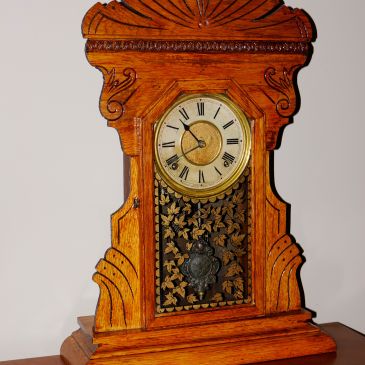
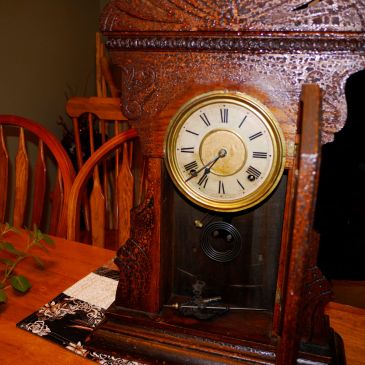
Canada Clock Company cottage clock
Out of the ashes came another attempt in 1876 and key principles including manager John Collins moved to Hamilton and set up the Hamilton Clock Company. After 4 years this new company also failed and production halted in 1880. In late 1880 one more attempt was made to establish a new company called the Canada Clock Company resurrecting the old name. It is still based in Hamilton at the old Hamilton Clock Co. factory. Success was short-lived as the company declared bankruptcy in 1884 ending a dozen years producing clocks for the Canadian market.
Although both movements and cases were made in Canada they were copies American styles
Canada Clock Company, Prince of Wales parlour clockCanada Clock Company, City of Hamilton parlour clock
I have grouped the clocks from the three companies and these are their characteristics. The most common clocks found today are the weight-driven, thirty-hour “Ogee” style, with colourful birds or flowers surrounded by a black background on the glass tablet. At least five different labels are known, four have a beaver on them. The large printed paper label was located inside the case on the lower back. Spring-driven mantel clocks with plain cases were also made with thirty-hour movements. Although both movements and cases were made in Canada they were obvious copies of American styles.
Hamilton Clock Co Gothic steeple clock with etched glass tabletClock label showing the Hamilton Clock Company factory
Also produced was a spring-driven “school house” wall clock.
At least sixty models of spring-driven mantel clocks are known, with both thirty-hour and eight-day movements. Most of the door tablets (Canada Clock Co.) have acid etched glass designs, unique to the two Hamilton-based companies and done in association with a local glass factory. Wall clocks are also found with the Canada Clock Company, Hamilton label.
The most desirable clocks are the ornate time and strike parlour clocks such as the City of Hamilton and Prince of Wales pictured above.
Unfortunately, a valiant attempt to grow a home-bred clock company failed miserably. However, the clocks of all three companies are highly sought after by Canadian collectors today.
Need a quick primer on developments and inventions in horology. You have come to the right place.
18th Century shelf clock Porto, Portugal
Though by no means a definitive guide the following are some important dates in the history of the clock as gathered through a number of sources. The difficultly in affixing some dates with precision results from discrepancies among sources.
Horological developments during the centuries before the mechanical clock are left out altogether. Water (Clepsydra) and sun clocks of the middle ages and astronomical clocks of ancient China deserve special mention but are the subject of a separate discourse and are not included here.
Important dates in Horological Development
CA. 1300 – First mechanical verge clock, Europe
1364 – Astronomical clock conceived by Giovanni de Dondi, Italy
1386 – Tower (turret) clock Salisbury Cathedral, England
Salisbury cathedral clock, photo by Dr. Meghan Joiner
CA. 1400 – Fusee invented by Jacobs, Czechoslovakia
CA. 1450 – Table clock with spring and fusee, Phillip the Good of Burgundy, France
CA. 1500 – Mainspring invented, Germany
CA. 1510 – Watch invented by Peter Henlein, Germany
CA. 1560 – Spring driven portable clock, Germany
CA. 1570 – Oldest known clock with a second hand, Orpheus clock, Germany
1637 – Galileo, swinging temple lamp, pendulum control conceived, Italy
CA. 1650 – First tower clock appears in Colonies, America
1656 – Pendulum clock devised by Huygens, Holland
1657 – Verge and foliot gives way to pendulum control, Huygens, Holland
1658 – Long-case prototype made by Fromanteel adapted from lantern clock, England
1660 – Balance wheel conceived by Hooke, England
CA. 1675 – Richard Towneley invents the dead-beat escapement, England
1675 – Balance wheel with spiral spring invented by Huygens, Holland
CA. 1675 – Recoil escapement and crutch invented by Hooke in collaboration with Clement, England
1676 – Rack striking developed by Barlow, England
1680 – 1700 – famous horologists of this era were Arnold, Earnshaw, East, Graham, Knibb, Compion and Windmills of England; Berthoud, Breguet and LeRoy of France
1701 – St Sulpice seminary tower clock (imported from France), Montreal, Canada
1713 – Harrison invents marine chronometer, England
CA. 1715 – Break-arch dial introduced
1715 – Graham perfects deadbeat escapement, regarded as the “father” of the dead-beat escapement
1717 – First tower clock of America, Benjamin Bagnall, Boston
1726 – Mercurial pendulum invented (temperature compensating pendulum), Graham, England
1726 – Wall clock by Thomas Bennett, 8 day brass, weight driven, America
1736 – Harrison’s marine chronometer tested at sea (accurately ascertaining longitude), England
1770 – White dials appear in English longcase clocks
1776 – Independent seconds train invented for watch, Pouzait, Switzerland
1790 – Vienna regulator style case emerges in Austria
1790 – American woodworks clocks begin to be appear
1802 – Willard patents his banjo clock, America
1806 – Terry introduces Pillar and Scroll clock, America
1809 – Martin Cheney leaves America to set up a clock-making shop in Montreal, Canada
1810 – Carriage clock (Pendule De Voyage) introduced by Breguet of France
1818 – Heman Clark makes wrought brass movement for Pillar and Scroll case, America
1825 – Rolled brass production begins in America
1837 – Noble Jerome 30-hour brass movement patent approved, America
1840 – American brass movements in mass production
1842 – American brass movement clocks exported to England by Chauncey Jerome
1845 – Wood-works movement production ends, America
1850 – Westminster tower clock designed by Lord Grimthorpe and made by Dent, England
CA. 1850 – Brocot (pin-wheel) escapement and pendulum suspension introduced, France
CA. 1850 – American mass production of watches begins
1860 – Junghans (Germany) sent to America to study American mass production techniques
1870 – Decline in English long-case clocks
1874 – Mass production of mantel and wall clocks begin in Whitby, Canada,
1900 – American clock production is at its height; makers are Ansonia, Ingraham, Gilbert, Howard, New Haven, Seth Thomas, Waterbury, and Welch
1904 – Arthur Pequegnat begins clock production in Berlin, Canada
1906 – Eureka electric clock introduced, America
CA. 1910 – Torsion pendulum clock (400-day) introduced, Germany
1920-40 – Decline in American mechanical clock production
1941 – Arthur Pequegnat ceases production, Canada
CA. 1960-70 – End of mass produced mechanical clocks, America (though cheaper Japanese, Korean & Chinese mechanical clocks flood North America)
Present day – Some movement and clockmakers remain; Howard Miller (Ridgeway), Keininger, Hermle, Chelsea, Jaeger LaCoultre among others
The clock is one of mans greatest achievements. The development of instruments to tell time is the unwavering toil of brilliant minds from many disciplines who, over 800 years, worked tirelessly to create, innovate and improve methods for telling the time.
Horology is not only the study of time but the synergy of art, joinery, fashion, design, décor, physics, engineering, metallurgy and mathematics. Indeed, the study of the mechanical clock is a microcosm of our society.
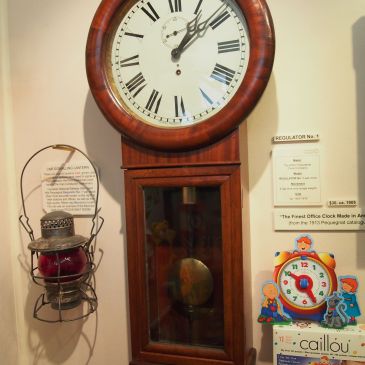
Arthur Pequegnat Regulator #1 is still on my wish list
Lots of exciting news over the summer. Six new clocks, three of which have been on my wish list for a while. One, a Cuckoo clock, is my first. Another is an Ansonia crystal regulator, two more Pequegnat clocks, a curious Waterbury wall clock and more. I will be writing about my new acquisitions in the weeks to come.
I also managed to expand my clock library as I have found several interesting books on horology which I will report on in a future article.
For those who wrote to me over the summer, thanks and again I apologize for the delay in getting back to you.
This is Part II of a two part series in which I describe the final finishing of an Arthur Pequegnat Bedford clock case.
In Part I I described the challenges of repairing the clock case and the minor repairs to the movement.
In the first part of the series I also described how I acquired this Arthur Pequegnat mantel/shelf clock during my travels to Quebec this spring.
The red oak veneered clock is complete with pendulum bob, a good label on the inside back of the access panel, coil gong and of course, the signature time and strike Arthur Pequegnat movement with nickel-plated steel plates.
Nickle-plated plates with brass bushings
It is the “Bedford” model. Online research informs me that two Bedford models were produced. This one, which is the later version, measures 9 ¾ inches high by 8 ¾ inches wide by 5 ½ inches deep. It has a silvered 6 inch dial with Arabic numerals with no Pequegnat inscription on the bottom of the dial face, spade hands surrounded by a thick brass bezel and concave base moulding. It has a passing ½ hour strike on a coiled gong.
The earlier model has a 5 inch enameled dial with stylized Arabic numerals and Pequegnat inscription on the dial face, spade hands, oak veneered case, a thinner brass bezel and convex base moulding. The case measurements are identical. The time and strike movement differs from the later model by having a ½ hour passing strike on a bell.
If the dial is a replacement, it is a Pequegnat and someone took the trouble to install larger (and correct) spade hands
I initially thought that the larger dial might make this a one-of clock but after working on the case I am inclined to believe that the dial might be a replacement. I observed two sets of screw holes, one for the larger dial and one presumably for a smaller one. A factory switch or perhaps a clock-maker replaced the dial at a later time for whatever reason. After looking at a photo of the Bedford taken at the Canadian Clock Museum in Deep River, Ontario (Canada) you can easily see the smaller dial and thinner bezel.
Bedford clock on display at the Canadian Clock MuseumArthur Pequegnat Bedford mantel clock, assembled, cleaned and working but before case refinishing
I do not think the larger dial overpowers the look of the clock, in fact, it gives it a more contemporary presence. If the dial is a replacement, it is a Pequegnat and someone took the trouble to install correctly sized spade hands. Unfortunately, the previous owner is unaware of the difference.
The task of clamping and gluing the case took several days as each section of the case required attention. And now to the final finish.
Gluing and clamping took time
Before the case restoration. Yes, the clock was in sad shape.
Very dirty case with years of grime and no grain visible
After giving the case a good cleaning I applied one thin coat of Minwax red oak stain to hide the bare areas and rough edges. I let the stain sit for 5 minutes and wiped off the excess with a cotton cloth. I allowed the case to thoroughly dry for 24 hours before the first sanding. For the final finish I chose Minwax PolyWipe for two reasons, one, it is simple to apply since it is easily wiped on and secondly, I wanted to avoid the amber tone of a lacquer which might result in concealing the grain. I applied six coats of PolyWipe and used 400 grit emery paper between each coat.
After cleaning, sanding and two coats of PolyWipe this is the result.
After two PolyWipe applications
I am pleased that the grain came up very nicely, reminding me of what it must have looked like many years ago.
Finished clock, after 6 coats of PolyWipe
After six thin coats of PolyWipe the result is a revitalized finish that is durable, attractive and will last for years.
The brass door has me puzzled. What I thought was a broken hinge was actually folded into the bezel and soldered.
7/8 inch hinge is soldered back into the bezel
Why? I am reluctant to remove the solder because I risk breaking the glass by bending the retaining tabs. They are in very tight. As it stands the glass door will friction fit onto the dial bezel. Not the best but it will do for now. I will give it a second look, perhaps I can de-solder that hinge without removing the glass.
A project that is well worth the time and effort. It is always satisfying saving an old clock and bringing it back to life.
I acquired an Arthur Pequegnat mantel/shelf clock during my travels to Quebec this spring. The red oak veneered clock is complete with original hands, pendulum bob, a good label on the inside back of the access panel, coil gong and of course, the signature time and strike Arthur Pequegnat movement with nickel-plated steel plates.
Signature Pequegnat nickle-plated steel plates
It is known as the “Bedford” model. Online research tells me that two Bedford models were produced. This one, which I believe is the later edition, measures 9 ¾ inches high by 8 ¾ inches wide by 5 ½ inches deep. It has a silvered 6 inch dial with Arabic numerals with no Pequegnat inscription on the bottom of the dial face, spade hands surrounded by a thick brass bezel and concave base moulding. It has a passing ½ hour strike on a coiled gong. The earlier model has a 5 inch enameled dial with more stylized Arabic numerals and Pequegnat inscription on the dial face, spade hands, oak veneered case, a thinner brass bezel and convex base moulding. The case measurements are identical. The time and strike movement differs from the later model by having a ½ hour passing strike on a bell.
There is a good label on the inside of the access door which says, “Bedford, eight-day mantel clock, The Arthur Pequegnat Clock Co., Kitchener, Ontario, Canada”.
The label is in good condition
The movement is not marked. Though many Arthur Pequegnat movements were stamped with the maker’s mark it is not unusual to find one without one. This edition was likely manufactured in the Kitchener, Ontario (Canada) plant between 1925 and 1930.
With click fixed the clock is tested
The only issue with the movement is the time side mainspring function which, as the previous owner explained, could not be wound with a key. Damaged top veneer and split-open side trim pieces tell me that the clock had accidentally fallen. The impact point appears to be the very top front of the clock. As a result of the impact the front panel had separated from the main part of the case, leaving a gap of about 1/8th of an inch. It also had a broken access door catch.
Damaged veneer sustained during a fall, veneer was later pushed back in place
At first I focused my attention on the movement and why the time side mainspring would not wind. It was, as I suspected, a missing click spring. The click is a pawl which engages the ratchet wheel to hold the power of the mainspring or the weight. It is moveable and connected to the mainspring by means of a rivet. The click spring is a piece of steel or brass wire which is connected to the click and seats the click in the ratchet wheel.
I had a supply of steel click springs and fashioned one to fit the click. The click, rivet and the ratchet wheel were in otherwise good condition. While the mainsprings was restrained with clamps I postioned the click spring in place applying a little solder to ensure that it remained fixed. An older similar repair occurred on the strike side with solder holding that click in place. A weak point of the movement, perhaps.
A little solder to keep the click spring in place
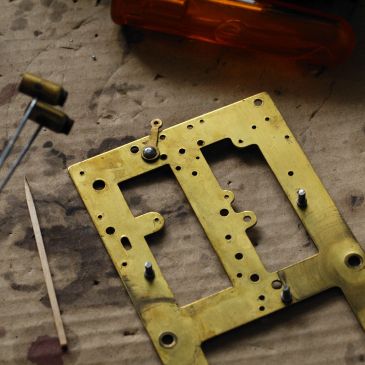
I inspected the movement for wear and discovered that it had been serviced previously. The solder on the strike side click was certainly a clue but I also noticed that some bushings had been replaced, not unusual given the age of the clock. Brass bushings were punched into the steel plates at the factory. I could see that newer bushings were installed in at least three locations.
There is no lateral movement in the gears as such lateral movement would indicate bushing or pivot wear. There is no evidence of ovalized, enlarged or mis-shapen bushing holes and the gears are meshing well. The movement is clean and free of dirt and debris and I do not feel that a full cleaning is warranted at this point. There is no excess blackened oil; the oil in the bushing holes had simply dried up. I applied clock oil to the bushings, wound both mainsprings and after days of running the movement is keeping excellent time.
With the movement out of the case, repaired and in the testing phase, I focused next on the condition of the oak veneered case. Many of the joints had separated due to the impact I mentioned earlier. Hide glue would have been used originally and could be used for case repair. I have medium strength pearl hide glue, not strong enough for this application. High strength is required to bring the trim pieces together to ensure a good long-lasting and tight fit. This is one of those occasions when a modern glue is an acceptable alternative. Yellow carpenters glue has a bonding power of two tons and I chose this type of glue for the repairs.
Each section had to be clamped for 24 hours and only one section could be worked on at a time. The result is a very time-consuming and complicated process lasting several days.
I used three clamps for one repair. Because the impact point was at the very top I had to push the sides in with a clamp while at the same time bring the front panel into the main part of the case using two clamps adjacent to each other. You can see the clamping method I employed in the next photo.
Using three clamps to bring the sides together and the front section into the case
The side base trim pieces were also split open and had to be clamped in place as you can see in the next photo.
Side trim pieces clamped
Bringing the sides of the case together resulted in raising the damaged veneer, consequently several small pieces of top veneer had to be pushed back into place. Using carpenters glue combined with an “elaborate” weight system I went about with the repair. Using a toothpick I applied carpenters glue under the veneer pieces, wiped off the excess with a wet cloth and used a block with a hole drilled to accommodate a toothpick employing enough pressure to push the small veneer pieces into place. It looks odd but it works.
Toothpick and wood piece to push the veneer in
A degreaser was used to strip years of blackened dirt/grease/grime on the case and once cleaned the original grain in the red oak veneer is now exposed to its former beauty. The case will either need a layer or two of lacquer or a more modern finish such as PolyWipe. I will cover this aspect of the restoration/repair in Part II.
Using Brasso I cleaned up years of tarnish on the brass bezel giving it a new life. I also polished the arbour grommets. The silvered dial face is in very good condition and I left that as-is.
Bezel cleaned up
I fashioned a new door catch out of a worn Sessions click.
Broken door catch was repaired using an old worn Sessions click
With the movement repaired and the successful clamping and gluing of the case the next phase is the final finishing. I am pleased that I am inching closer to bringing this clock back to life and can add it to my modest collection of Arthur Pequegnat clocks.
Most knowledgeable clock enthusiasts in Canada instantly recognize the Arthur Pequegnat Clock Company as one of Canada’s premier clock companies. Although the company went out of business over 75 years ago the Arthur Pequegnat name is still respected as a quality clock-maker.
The Arthur Pequegnat Clock Company had an illustrious albeit short life. Watchmaker Arthur Pequegnat was born in Switzerland in 1851. Arthur immigrated to Berlin, Ontario Canada in 1874 with his wife, parents, brothers and sisters; a grand total of 18 family members.
Tall case clocks made by Arthur Pequegnat
By the late 1870’s Arthur was operating a jewelry store and watch repair in Southern Ontario. By the middle 1880’s Arthur and his brother Paul were operating a shop in Berlin, Ontario (now Kitchener). After about ten years the brothers went their own way, both operating successful jewelry shops in Southern Ontario.
Mantel clocks in all shapes and sizes
In 1897 Arthur expanded his Berlin Jewelry shop to include the manufacture of bicycles. However, by 1904, with the decrease in the demand for bicycles, Arthur began to re-focus on the clock industry, by manufacturing his own clock movements at his Berlin Bicycle Manufacturing plant. At first the wooden clock cases were made by local furniture makers, however in time he manufactured his own clock cases.
The Regulator #1, Pequegnats most accurate clock
Berlin, Ontario was re-named Kitchener Ontario in 1916, due to anti-German backlash during WW I. This becomes a useful tool when dating Pequegnat clocks as labels, movements or dials marked “Berlin” date the clock to 1916 or earlier and those marked “Kitchener” are 1916 or later. Having said that, many clocks had a long production life and it is difficult to date any Arthur Pequegnat clock precisely.
The company closed it doors in 1941. Although brass was in short supply as a result of the war effort, sagging sales reflected the demand for modern electric clocks.
Yes, a brief history but as any Canadian clock collector knows Arthur Pequegnat is still a “Big” name in the clock business.
I have been to Middleton, Nova Scotia many times. I have even passed the Macdonald Consolidated School where the clock museum is located without realizing what treasures lay inside. The clock museum represents a small section of the museum, the remainder of which is dedicated to the history of the area.
In the Spring of 2018 my wife and I set off on one of our many mini staycations. On my agenda was a visit to this museum and I was not disappointed.
Macdonald Museum main clock exhibit areaHolbeck made tall-case clock
It certainly ranks as the best exhibit in Atlantic Canada
Off highway 1 on School Street, Middleton, Nova Scotia stands the Macdonald museum. I had some expectations because I had been to two well respected clock museums, the NAWCC museum in Columbia PA. and the Canadian Clock Museum in Deep River, Ontario. Though not on the same scale as these two, it certainly ranks as the best exhibit in Atlantic Canada.
The Annapolis Valley Macdonald Museum is home to the Nova Scotia Museum’s collection of over 150 antique clocks and watches. This permanent exhibit showcases items collected by the late Norman Phinney and was one of the primary reasons for establishing the Macdonald Museum. Many of the clocks are in working condition. There are a wide variety of clocks and watches on display, with some dating back to the late 17th century. Anyone interested in clocks would do well to see this exhibit – one of the best in Eastern Canada.
The museum is well laid out with enough information on each of the clocks on display to satisfy the general public and clock enthusiasts alike. Each display highlights its significance as an important development in horological history. We were alone as we walked though the main exhibit area and an adjacent room which contained a fascinating old clock-maker’s shop and a well laid out and informative interactive display on how mechanical clocks work.
Clock-maker’s shopHow mechanical clocks work
At least one example from the Baird Clock Co. of Montreal and five examples from the Arthur Pequegnat Clock Co. of Berlin (now Kitchener) Ontario were on display including the Arthur Pequegnat Regulator #1, that the company once advertised as “The finest clock made in America”.
Baird clock from MontrealArthur Pequegnat Regulator #1
None of the clocks were running, however. Though the clocks appeared to be in excellent condition, the sound of ticking clocks make for a more authentic experience. All other clock museums make a practice of running some clocks on a rotating basis at any given time.
At the entrance to the clock collection there is a simple plaque dedicated to Norman D. Phinney. Learning more about Norman D. Phinney, his contribution to the Macdonald Museum and the story of how the museum received his clock collection would add to the experience.
Norman D Phinney
If you are a clock fan or even if you only have a casual interest in the world of horology, this small clock museum may surprise you
Though perhaps not within the scope of Phinney’s original collection, examples from the Canada Clock Co. and the Hamilton Clock Co. or more peddlers clocks from Nova Scotia and New Brunswick would have provided an enhanced Canadian horological perspective.
Steeple or sharp Gothic clocks
However, these are minor quibbles and should not detract you from appreciating the high quality of the exhibits which contained British, American, French and Canadian examples or the many styles that included Pillar and Scroll, tall-case, shelf, beehive, steeple, drop octagons, mantel, alarm clocks and Ogee clocks, all of which were well represented.
If you are a clock fan or even if you only have a casual interest in the world of horology, this small clock museum may surprise you.
Oh, and while there, visit the rest of this fascinating museum.
Antique and vintage clocks evoke a time when life was simpler than the hectic times we live in today. Those nostalgic times when the things we bought and cherished were living memories of people and places that are gone but not forgotten. Antique clocks should be passed down from one generation to the next. Judging from the online marketplaces unfortunately many are not handed from father to son at all as so many have left their original owners. Is sentimentality lost on this generation?
Two such clocks have a story
Not including the the nine clocks I have in my home office there are 35 clocks displayed throughout our home. It saddens me to think that for many of my clocks I know absolutely nothing about them though I wish they all could talk. What stories they could tell.
Two such clocks have a story.
One of my clocks survived the Halifax Explosion in 1917. I know this because the people I bought it from had the clock in their family for over 100 years. It was certainly not in the condition you see here. It was a box of parts and I imagine they felt they had held onto it long enough and it was time to let it go. After I restored the clock I called back the previous owner and told him what I had done with the clock and would I kindly send him a photo of it restored to its former glory. I did and heard nothing afterwards. Sellers remorse, perhaps. I often look at the clock and try to imagine that fateful day when it fell of the wall in a modest home in North Halifax on December 6, 1917.
Junghans Crispi wall clock
Story number two. You have to feel something for some of the previous owners. This Ingraham Huron shelf clock (circa 1878) is a real gem and fairly rare, you just do not see it come up for sale very often. Some would call it a balloon clock. It was bought in a little village outside Bridgewater, Nova Scotia. My wife and I are about 2 hours away and we decided to make a trip out of getting the clock, having lunch nearby and doing a little shopping.
Do you know anyone who wants Jeff Gordon memorabilia?
Rare Ingraham Huron found on a local online for-sale site
We arrived at the sellers home, a modest nondescript bungalow. I was greeted at the door by an elderly couple. They had previously told me on the phone a day earlier that after consultation with their son they had decided on a fixed price for the clock and the price seemed very fair to us.
I asked how long they had the clock and the gentlemen who I would say was in his early seventies said that he could remember the clock in this grandmother’s home when he was quite young. He extended his hand palm down to about a meter from the floor and said, “I was this tall when I can first remember it in my grandmother’s home”. After a conversation with the couple I had discovered that they were parting ways, an amicable separation it seemed and the wife had decided to live in an apartment minutes away in Bridgewater. The husband was left with the home and his workshop in the back of the property. “He spends a lot of time out there anyway and besides, we need to get rid of stuff”. “Do you know anyone who wants Jeff Gordon memorabilia?” “No”, I said and left with the clock. It is sad that they had to part with such a memory but people change.
Seth Thomas column and cornice “Empire” style time and strike shelf clock
I guess sentimentality has a dollar value or people live with things so long that they eventually tire of having them. Deciding to get rid of things is about relieving yourself of all the stuff you’re hanging onto from past relationships and past memories. Secondly, our desire to hold onto piles and piles of old mementos can often be blamed on nostalgia. That’s because reminiscing about the past makes us feel good. It can lead to increased feelings of familial or social connectedness. If I have an old clock, looking at it can elicit positive emotions. Or, perhaps it was not an especially happy memory and getting rid of it expunges that memory.
I often wonder what will happen to my collection when I meet my fellow clock-makers in the sky. My wife knows that I have no real attachment to some of my clocks since I merely purchased them to learn how to repair them and to grow my hobby. Yes, you can have too many mantel clocks!
However, there are about ten clocks in my collection that I hope will be passed down to my kids. My four Arthur Pequegnats, two Vienna regulators, a Seth Thomas Empire style clock, my Sessions Beveled No. 2, my Ingraham Huron shelf clock and my Junghans Crispi wall clock. For some I appreciate their history and admire the folks who had them and for others they have become sentimental attachments because I spent so much time restoring them.
Canadian clock collectors are passionate about Arthur Pequegnat clocks. In private sales and online for-sale sites most sellers are knowledgeable enough to know that they are very desirable. A Pequegnat will sell for many times more than a comparable mantel clock, that is, in Canada.
Arthur Pequegnat Simcoe model mantel clock
The Arthur Pequegnat clock company had an illustrious albeit short history
The Simcoe is my fourth Arthur Pequegnat clock. It is very similar in dimensions and style to the Jewel. Whereas the Jewel is basically a unadorned box the Simcoe has a piecrust dial bezel, claw feet on each corner and lions head handles on each side. It has a coil gong for the hour strike and a bell for the half-hour passing strike.
To collectors it is referred to as a”Berlin” clock. Although it is impossible to date Pequegnat clocks precisely the name Berlin distinguishes clocks made before 1917 and those made after and up to 1941 when the factory finally shut its doors. Clocks made prior to 1917 were inscribed “Berlin”, Ontario on the dial face since Kitchener was known as Berlin until midway through World War I. From 1854 until 1912 it was the town of Berlin and City of Berlin from 1912 until 1916. Because the name Berlin had a negative association with the war against Germany the city administration chose the name Kitchener. Kitchener is the present seat of the Regional Municipality of Waterloo, Ontario (Canada).
Time and strike movement with steel plates, a common feature with Pequegnat clocks
The Arthur Pequegnat clock company had an illustrious albeit short history. Arthur Pequegnat, a watchmaker by training, was born in Switzerland in 1851. Arthur immigrated to Berlin, Ontario Canada in 1874 with his wife, parents, brothers and sisters; a grand total of 18 family members.
Arthur Pequegnat clocks such as a simple mantel clock you see here can command hundred of dollars in Canada
By the late 1870’s Arthur was operating a jewelry store and watch repair in Southern Ontario. By the middle 1880’s Arthur and his brother Paul were operating a shop in Berlin, Ontario. After ten years the brothers went their separate ways, both operating successful jewelry shops in Southern Ontario.
In 1897 Arthur expanded his Berlin jewelry shop to include the manufacture of Bicycles. However, by 1904, with the decrease in the demand for Bicycles, Arthur began to re-focus on the clock industry, by manufacturing his own clock movements at his Berlin Bicycle Manufacturing plant. Arthur obviously visualized a profit in clock making as many clocks at the time were imported from the United States. At first the wooden clock cases were made by local furniture makers, however in time he manufactured his own clock cases. Although the Arthur Pequegnat Clock Company was widely regarded as the only true Canadian clock company, lesser known companies such as the Hamilton Clock Company and the Canada Clock Company, though not as successful, predated it.
The Simcoe is a relatively nondescript clock. I passed by it in the antique store without realizing that it was a Pequegnat. My wife spotted it and I returned to take a second look. Sure enough, a Pequegnat!
The yellow oak case is in very good condition with one or two small scratches and a chip just above the top of the bezel. The dial pan has had an ugly repair, there are two brass tabs at 12 o’clock and 6 o’clock protruding though the front of the dial.
Piecrust bezel
The dial face has some crackling but is otherwise in good condition. The piecrust bezel is in very nice shape as are the claw feet and lions heads.
Lions head on case side
The movement looks very clean with little evidence of wear. There is an inscription on the back dated Jan 10, 1970. It was likely serviced on that date. In any event it does not appear to have had much running since then. Unfortunately, there is no label.
Ornate front feet
The movement was taken out of its case, inspected for wear and found to be in very good condition. The movement was oiled, returned it to its case, the beat was set and it is running strongly. The clock will be inspected in one years time to determine if servicing is required.
Case is in fair condition, dial face has some flaking, piece broken on left side of base
We have a couple of antique stores in our small town. Calling them antique stores is a bit of a stretch because there is usually more junk inside than actual antiques. We were shopping in the area of one of those “antique” stores and my wife turned to me and said, “Let’s go in”. I replied, “You know, all they have is junk”.
I thought, I might have found something important
I acquiesced. While she continued her shopping I went on ahead to look around the store and in the very back I saw a very sad looking clock that at I took for an old Sessions or a Waterbury. As I neared the clock it piqued my interest and I began to see that it was quite old. I picked it up, looked for any markings on the dial face, found none then checked the back of the clock and discovered most of an intact label revealing a what I consider to be a significant find.
Back label in good condition for the age of the clock
It is a clock from the Canada Clock Company. The Hamilton Cottage Extra was one of a range of clocks in their Metropolitan line.
This is an important discovery. The owner of the store knew nothing about clocks. He was asking $99 but after a bit of haggling, we settled on $40. I knew that it was worth much more.
Here is an excerpt on the Canada Clock Co. found at the Canadian Clock Museum in Deep River Ontario (Canada).
This company was the last of three sequential attempts to produce clocks by factory methods in Canada during the 1872 – 1884 period. The original effort by the Canada Clock Company in Whitby, Ontario was basically unsuccessful and only limited production was achieved.
In 1876, the equipment was relocated to Hamilton, Ontario to begin a second attempt as the Hamilton Clock Company, with new investors. This attempt was more successful and a fairly wide range of clocks was produced. However, sales were not very large and some of the investors left the company by 1879. At that point the president, James Simpson, ended production and proceeded with a major reorganization.
The company subsequently became the Canada Clock Company using the old Hamilton Clock Company factory and resumed production in 1880 but as a result of poor sales closed its doors in 1884.
Clocks from the Canada Clock Co.are sought after by collectors. For international readers this represents a rare find because the 1870s to the mid 1880s was a very important period for clock production in Canada. Apart from several independent clock-makers in Quebec and eastern Canada two notable companies made wholly Canadian clocks, The Arthur Pequegnat Clock Co. of Kitchener Ontario made clocks up to 1941 and Martin Cheney of Montreal made finely crafted clocks in the early 1820s. This clock was made at the Hamilton, Ontario factory which produced clocks from 1880 to 1884.
Original count wheel time and strike 30 hour movement
The 30-hour time and (bell) strike movement is in remarkably good condition and fairly clean. The back label in good condition for the age of the clock and there is a stamp on the top of the label which says, “…A Hill &Co.”. If any Hamiltonians are reading this I would be grateful if you could make inquires about this small retailer.
My preliminary examination reveals that this clock has had very few repairs over the years. I have not taken the movement out of its case to check bushing/gear wear and other issues but I am initially encouraged. The case reflects the age of the clock but I would judge the clock to be in just fair condition. There is a wooden piece that needs to be re-attached on the right side of the base. Fortunately that piece was tucked inside the clock case.
Right side needs work
Left side looks good100+ years of grime came off easily; etched glass on the bottom part of the tablet is distinctive
The crudely made case is not overly decorative and reflects a muted Victorian style of the times. The lower part of the tablet has an etched glass floral design typically found in Canada Clock Company clocks. The door clasp is original. The dial face is flaked in places and not in the best of condition though the 2 floral designs on each bottom corner are nicely preserved. The hands are original. The case is not heavy and made of pine with a deep walnut stained finish. It was grimy and dirty as expected. It cleaned it up nicely with Murphy’s soap and a sharp hobby knife was used to remove the numerous paint drops on the clock. Why folks do not put something over the clock when painting a room amazes me.
I will put the clock aside until I can determine my next steps. Do I pursue a full restoration including renewing the dial face or leave the clock largely in as-found condition? In the meantime I will re-attach the wood piece on the left side of the base.
Tick-Talk Tuesday is about the letters and comments I have received from you, the reader, concerning your clocks, issues you might have had and challenges you face and my responses to your questions with advice on your particular clock concern(s). For those comments and questions that stump even me, I consult within my clock circles for the best possible answer.
DP writes, “Hello Ron: I have a clock I bought recently at an auction.The clock is from Pictou County Nova Scotia. It has Canadian Time On the glass. I live about 50 kms from Truro. I would like to take the clock over to you and find out if it is a Pequegnat clock. The clock keeps good time. It is made out of birds eye maple. It measures 29 inches high, 15.5 inches wide and 5 inches deep. My technology skills are not very good and I am not able to send you a picture. My name is DP and I would be pleased to hear from you.”
Arthur Pequegnat Canadian Time clock
My response to DP
“Yes you are pretty close to where I am. We can meet but you can also save yourself some trouble by doing a little investigating yourself. Regarding the dimensions, are you measuring the whole clock from top to bottom. The Canadian Time is 36 inches high by 15.5 by 5 inches deep. If the entire height of yours is 29 inches you are likely missing the top piece (crown) and the bottom section or both. Most were made of quarter sawn oak. I have never seen one in Bird’s Eye maple. And the words “Canadian Time are stenciled in gold on the glass door.
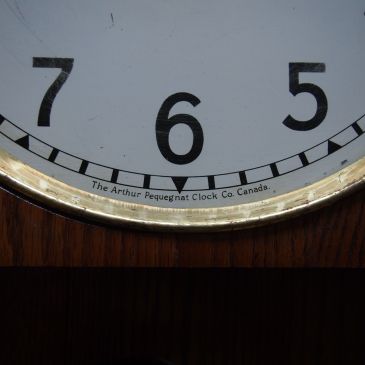
Next, on the bottom part of the dial face you should find the inscription, “Arthur Pequegnat Clock Company”. If not, it is a replacement dial.
Company name under the chapter ring
If you are adventurous enough, you can unscrew the minute hand nut, take off the minute hand and pull off the hour hand underneath which is a friction fit. Next, you can unscrew the square wood panel the dial pan is mounted on. There should be 3 screws, one on top and one on either side. Once you unscrew those you can take the piece that holds the dial pan out. You can then check to see if the company name is stamped on the lower right hand side of the movement. Obviously if it says Arthur Pequegnat, that is what you have. I have included photos showing what you should see when you open it up.
Movement after taking off the dial pan.Company name stamped on the movement
Let me know how you make out.”
DP writes back.
“Hello Ron, I am not really comfortable taking the clock apart. I did take it over to DG in BH about a week or two ago. He repairs watches and clocks. He did a repair to a thin strip or band of metal (punched a new hole through it) and then reconnected it to the movement. DP is referring to the suspension spring. When it was apart the only thing I could see written on the movement was (no jewel and I think not adjustable or unadjustable). It looks like the movement might have been replaced because there are two extra holes on the back. The dial face has been put back in place incorrectly and has nothing printed on the face. I would like to take the clock to you and just get your views and opinions on where or who might have it or any other information you can give me. I would be pleased to hear from you.”
DP, “An Arthur Pequegnat movement would never have “no jewels” or “non-adjustable”on the movement. The company name would clearly be there. What you have is what some collectors would term to be a “marriage”, that is a case with another, more modern movement. If your case is 29 inches high then something is clearly missing. If you still want me to look at it, I will. Give me a call at (phone) and we’ll meet.
Folk art version of Canadian Time
DP arrived with the clock that he won at a local auction for CDN$25. Underneath the folk art and all the modifications is, indeed, a Canadian Time Clock. What appears to be maple finish is painted Birds Eye maple; underneath is oak. The base and crown are missing; the dial is a replacement and whoever replaced it mounted the dial in the wrong position. The decals are on the outside of the glass and were added later probably the same time as the Birds eye maple finish. The pendulum bob, painted some sort of brass or gold colour, is original but the pendulum rod is a replacement with a home-made leader hook. The only thing in good shape and original is the Canadian Time reverse decal.
DP attaches the pendulum
The movement is a replacement, an Indian made reproduction time-only movement exactly like this one at Timesavers.
Found on the back of the dial pan is this inscription.
Inscription on folk art clock
REPAIRED SEPT 18, 2013
REPAIRS BY JAMES xxxxxx
12C PLEASANT ST STELLERTON NS
CLOCK AND xxxxxx CLOCKMAKER SINCE 1956
In short, it is a very modern interpretation of a classic clock. If it were my clock I would not do a thing to return it to its original condition; there are just too much things that would need to be addressed. However, it might be appealing to some people as a piece of folk art. As a piece of folk art DP should be pleased that he got a good deal.
I wrote about this clock in 2015. The Canadian Time clock was made by the Arthur Pequegnat Clock company of Kitchener, Ontario. The Arthur Pequegnat Clock Company (1904–1941) is notable as the longest lasting Canadian-based clock manufacturer. Pequegnat clocks are sought after by Canadian collectors and often command high prices on online for-sale sites.
Former railway clock from a station in Pictou County, Nova Scotia (Canada)Label on back board
The clock was made after 1917 in Kitchener, Ontario (Canada). Clocks made before 1917 had the word “Berlin” on the dial face. Kitchener was known as Berlin prior to and during the first World War. It was the town of Berlinfrom 1854 until 1912 and the City of Berlin from 1912 until 1916. Because the name Berlin was associated with the war against Germany the decision was made to change the name to Kitchener midway through the First World War. Kitchener is the present seat of the Regional Municipality of Waterloo, Ontario. Though it is impossible to determine the exact year this clock was made my guess is just prior to 1941 before the company closed it’s doors.
It is always disconcerting to open a clock up to discover punch marks on a movement
The clock was purchased in Sept 2013 and after 3 1/2 years it is overdue for servicing.
Movement showing punch marks (arrows)
It is always disconcerting to open a clock up to discover punch marks on a movement, specifically around the pivot holes as one would expect. I am one of those who believe that a punch should never be used on a clock movement. Most, including myself, would consider it a quick and easy shortcut that is not designed to extent the life of the clock in any appreciable manner. Because punching weakens the side wall of the pivot hole those two pivot holes in particular are prime examples of the need for bushings. In total the clock required 5 bushings. The second wheel pivot hole was worn the most. One back plate bushing was required for the escape wheel arbour.
Time only movement
Time only movement are relatively simple to work on and for the novice this is the first kind of movement you should tackle. Whenever working on a clock be sure to take as many photos as you can; you will need them if you get stuck re-assembling the movement. On this clock the 3rd and 4th wheels look exactly the same but in fact differ slightly in height. Photos taken at the right angles will easily confirm the difference.
Mainspring cleaned and inspected
A strange anomaly that I did not notice when I first bought the clock; additional screw holes
The mainspring is in excellent condition and might have been a replacement at some point in the clock’s life. I had some difficulty re-hooking the arbour to the spring and had to use pliers to bend it, but just a little.
I found one strange anomaly that I did not notice when I first bought the clock. There are additional screw holes in the back board leading me to believe that the clock might have had another type of Pequegnat movement which would mean that the current movement is a replacement. Possible reasons, a catastrophic failure of the original movement, a conversion from a time and strike movement to a time-only clock (requiring a new dial) – it is anyone’s guess. A mystery nonetheless.
Servicing this clock took less than a day. Testing takes a couple of weeks. With new bushings in place and an oiling this clock should run reliably for years to come.
I began keeping a detailed log of clock repairs noting, in particular, when the movement was last oiled so that I do not wait too long between inspection and oiling.
Tick-Talk Tuesday is about the letters and comments I have received from you, the reader, concerning your clocks, issues you might have had and challenges you face and my responses to your questions with advice on your particular clock concern(s). For those comments and questions that stump even me, I consult within my clock circles for the best possible answer.
Arthur Pequegnat clocks were made between 1908 and 1941 in Berlin (now Kitchener), Ontario. Those produced before 1917 had “Berlin” inscribed on the dial face. The town of Berlinfrom 1854 until 1912 became the City of Berlin from 1912 until 1916. The name Berlin was associated with the war against Germany consequently the decision was made by city officials to change the name to Kitchener midway through the First World War. Kitchener is the present seat of the Regional Municipality of Waterloo, Ontario (Canada). Arthur Pequegnat clocks were the only wholly made Canadian clocks (aside from a short run of clocks made by the Canada Clock Company and later the Hamilton Clock Company in the 1870s) and are particularly sought after by Canadian collectors.
AO from Ontario writes, “Good Morning Ron, I live in Ontario (Canada) and have two Pequegnat clocks I am thinking of selling. Could you give me an idea of how much they are worth? The mantel clock is an Oxford. Thank you.
The clocks she mentions in her email are the Arthur Pequegnat Oxford mantel clock (time and strike) and the King Edward time-only wall clock missing the King Edward lower drop decal.
Pequegnat Oxford mantel clock from the Canadian Clock Museum in Deep River, OntarioKing Edward with 15 day Moncton movement showing decal from the Canadian Clock Museum in Deep River, Ontario
I replied. “I looked at your photos and have some comments. The time-only wall clock is known as the King Edward. From the photo yours seems to look intact save for the missing decal in the lower drop. A King Edward decal should be in the middle of the glass panel. It appears to be replacement glass which will certainly affect the value. However you should be able to get in the $600 to $1000 range for your King Edward clock. If you are selling in Canada where collectors are attracted to Pequegnat clocks because they are wholly Canadian made you should do reasonably well. If the clock has been recently serviced you can expect to price it a little higher.
Mantel clocks always command lower prices but your Oxford should easily sell in the $400 range. I would price both slightly higher and see what responses you get.”
AOs reply, ” Hi again Ron, A dealer has offered me $750.00 for both clocks. Is that reasonable knowing that he has to resell them?”
I advised AO that they should dicker a bit and that the dealer certainly knows the value. I suggested that she could also try to sell it on an online for-sale site.
AO replied later and said they posted the clock on a for-sale site and the same dealer offered $650 for the King Edward.
I emailed her again asking how they made out with the sale. AO replied and said the dealer backed out and the clocks are still for sale.
UPDATE: AO wrote 1 week later and said she has sold them both for $350 more that the first offer. She is very pleased.
What most people visualize as the Schoolhouse clock
My recent acquisition of another schoolhouse clock stimulated my curiosity and prompted me to do some research on the origin of the name. In this article I will describe my thoughts on how the schoolhouse clock came to be and my most recent Sessions wall clock purchase.
During my research I found it very interesting that little can be found regarding the history of the schoolhouse clock. I realize that many older readers growing up in the rural areas of Canada and elsewhere in North American have fond memories of the one-room schoolhouse with a large clock in either the front or the back of a classroom. I did not live that experience rather, when I was young and attending a large urban school the Simplex master / slave clock is the one I remember best.
The schoolhouse clock that I bought recently adds to my modest collection of three schoolhouse clocks. Given that I spent many years as an educator, it seems only fitting that I would have an interest in schoolhouse clocks. My schoolhouse clocks are all a similar style; short drop octagon, constructed of oak, brass dial bezel, bottom glazed access sash, 12 inch dial or 9 inches as in this case of this clock and the Waterbury pictured below. Although 9 inch clocks were used in schoolhouses they were also found in office or workplace settings.
They were not called a schoolhouse clock when they were made
Schoolhouse clocks were the standard design for early North American school houses because of their larger, easy to read dials. These distinctive clocks were hung in many schools rooms across Canada. The majority had simple but tough time-only movements and some even came with a calendar function. Occasionally they were ordered with time and strike movements but the cheapest and most popular versions were time-only. This type of clock had a very utilitarian look and function.
They were not always called schoolhouse clocks. None of the labels on my clocks have the word “schoolhouse” written on them and are either described as a”drop Octagon” in the case of this Sessions or have a specific model name. The term schoolhouse clock was not applied to them when they were made but came to be known as a particular style of clock found in school settings by later collectors. If a particular style was ordered by a school authority makers might have informally described them as clocks for schools or “school clocks”. In any event, the term has become a permanent part of the clock collector language.
Label on back of Sessions clock
With a swinging pendulum visible from a distance the clock can easily be seen running and the open-door bottom access sash allowed for restarting and adjusting the rate. In some clock collecting circles it is said that schoolhouse clocks are a derivative of the English drop dial fusee clock, an example of which can be seen here. Drop dials were produced in the late 18th through to the 19th century and closely resembled the schoolhouse clock. Unlike spring-driven schoolhouse clocks, fusee clocks have conical construction from which a chain or gut-line is pulled by the mainspring barrel allowing the power of the mainspring to be released evenly thus assuring better accuracy.
When I am in the process of buying a clock I always ask the seller this question. “How much do you know about this clock?”
When I am in the process of buying a clock I always ask the question. “How much do you know about this clock?”. I always ask this question because I am interested in a clock’s provenance and some of the stories are quite intriguing. The seller, a man in his late fifties, thought about it for a moment and said, “Well, I’ve had it since I was 14”. The clock came out of a decommissioned one-room schoolhouse in a small town called Springhill, Nova Scotia (Canada). However, when I first saw the clock I said to him, “It looks like a nice office clock”. The seller quickly corrected me and said, “It’s a schoolhouse clock”. “It runs for a little bit and then stops, maybe you can do something with it”, he added.
It is a 1920’s vintage Sessions Drop Octagon wall clock. It has a solid medium dark oak case with original hands, ornate pressed brass pendulum bob, solid brass bezel, 80% of an intact label on backboard, tin dial pan and stenciled lower glazing on the sash. The paper dial is original but it is heavily “foxed”. The movement is 8-day time only. The dimensions of the clock are a 9″ diameter dial, 19″ high, 13 1/2″ wide by 4″ deep. It is in reasonably good condition given it’s age and for $20 it was quite a bargain. It is also intact; there are no missing or broken pieces.
Sessions time-only movement
I don’t think this clock has been run in quite some time.
I took it home, hung it on the wall and true to what the seller said it would run less than a minute and stop. I noticed a rubbing sound around the pendulum area as it was running. The pendulum bob was hitting against the inside front of the case. I took the movement out and observed a bent crutch rod, corrected it, put it on a test stand and it ran immediately. As expected the movement had quite a bit of grime and required attention but it ran for a day before I took it apart for a thorough servicing. I don’t think this clock has been run in quite some time.
I found it curious that the suspension spring was soldered where the spring hooks into the top block. It likely kept slipping off and solder was used to keep it in place. In any event, the spring cannot be taken out without first removing the solder! The clock is in very good overall condition for it’s age and the movement was not as dirty as I first thought. The pivots are in decent condition for the most part and there is minimal wear overall. The movement was disassembled, cleaned and in the process I decided to install two bushings for added insurance, one on the escape wheel (front plate) and the other on an intermediate wheel (front plate). The movement was tested, put in beat and reinstalled back into it’s case.
I may replace the paper dial but I am going to see if I can live with it for the time being.
The dial has many brownish spots as you can see in the next photo. The clock had to have been in a moist environment for a long period for the paper to discolour. My two options are, one, leave as is or, two, replace with a paper dial. I may replace the paper dial but I am going to see if I can live with it for the time being. The brass bezel cleaned up well but the exposed tin surrounding the paper dial has blackish areas which I managed to reduce with CLR but could not totally eliminate. Of course, I later learned that CLR is really not appropriate for this purpose as it is an acid.
Dial showing rust staining
The case has years of grime which was easily remedied with Murphy’s soap and water. It cleaned up very nicely. Following the cleaning I gave the case a light coat of shellac to restore the luster of the oak. It looks good and it runs well.
My other drop octagon clocks are a Waterbury Arion, an unknown Ansonia and an Arthur Pequegnat Brandon II.
This Waterbury Arion is 19 inches longAnsonia short drop octagon, model unknown, 12 inch dialArthur Pequegnat Brandon II, 12 inch dial
Time-only movements are the easiest to work on and a very good movement to learn on.
Repaired Sessions Drop Octagon clock
Time-only movements are the easiest to work on and a very good movement to learn on. If you are a beginner in clock collecting and repair clocks such as this are satisfying clocks to work on and presents few challenges. I am happy that I managed to bring this particular clock back to it’s former schoolhouse glory.
The term schoolhouse clock is a term that was not applied when they were made but came to be known as a particular style of clock found in school settings by later collectors. The schoolhouse clock is such an endearing name that when one thinks of a schoolhouse clock the memory of these specific styles of clock immediately comes to mind.
Everybody appreciates a serviced clock when they are making a purchase. However, there is no acceptable definition for the term “Fully Serviced”. Fully serviced may mean one thing for the amateur clock collector and repairer and another to a professional clock repair shop.
Juba Schatz mantel clock
The other day I was responding to a FaceBook post which offered a mantel clock for sale. The owner said that the clock, a 100+ year old antique, had been “fully serviced” so I asked him what he meant by that since I was curious. He said the clock was ultrasonically cleaned, the pivots were inspected, and the clock was oiled. He did not actually state that the clock was disassembled before cleaning but I assume that it was done properly although dunk and swish (or duncan swish) techniques are used more often that we realize. Dunk and swish involves immersing the entire unassembled movement into a cleaning solution and calling it “cleaned”. However, no reputable clock repair person (horologist) would employ this method. By using the term “fully serviced” the seller naturally expects to get several tens of dollars more for the clock.
No doubt who ever buys the clock will get a couple of years of service before it again needs attention. My concern is the state of the bushing holes and of course the pivots in a 100 year old clock and chances are it was not serviced properly in it’s past life.
I have disassembled and serviced a few clocks in my limited experience and my observation is that the older the clock the more the need for bushing and other repairs. My definition of servicing is this; disassemble and totally strip down, ultrasonically clean, springs unwound, inspected and oiled, pivots inspected and polished, pivot holes pegged and bushings installed / replaced if necessary, other parts inspected and addressed and the movement tested and regulated before re-installing in the case. My servicing also includes a case refresh. I serviced a 1920s Sessions Beveled No. 2 clock this spring (2016) that required 12 bushings.
Sessions Beveled No. 2 time and strike in as-found conditionFully serviced with case refresh
My Arthur Pequegnat Maple Leaf kitchen clock pictured here was professionally serviced in 2015 by a reputable clock shop and also required 12 bushings.
Arthur Pequegnat kitchen clock in as-found condition
I am currently working on a 1940s Ingersoll Waterbury which was not too badly worn but still required 3 new bushings.
This American Ingersoll Waterbury clock, circa 1940, required 3 bushings,
If you poke around some of the clock for sale sites you will see a description that reads something like this, “all of our clocks are fully serviced and tested to ensure reliable running”. But if you bring up the profile on any one of the clocks offered for sale they generally do not describe how it was serviced and / or the actual service done on the clock.
I see plenty of antique and vintage clocks on the local online for-sale sites. Many have not been serviced as you would expect but some sellers claim that their clock has been fully serviced without providing any detail about what was actually done or whether it was a backyard tinkerer who did the servicing or a professional shop. The Juba Schatz mantel clock you see in the first photo might even be described as “serviced” but all I did was take the movement out of it’s case, inspect the pivots and other parts, oil the movement and return it to its case which took about 10 minutes.
“Fully serviced” to me means defining the term when selling a clock. A reputable for sale site should say something like this, ” has been fully serviced, having been totally stripped down, ultrasonically cleaned, reassembled, runs the full length of the wind and keeping excellent time, +/- 2 minutes per 7 day period”. A little more detail would be beneficial such as specific areas that needed to be addressed or particular repairs made if required but that is about as close as you will get and for those serious about a clock purchase it might be good enough.
Fully serviced means different things to different people. Always ask before you buy.
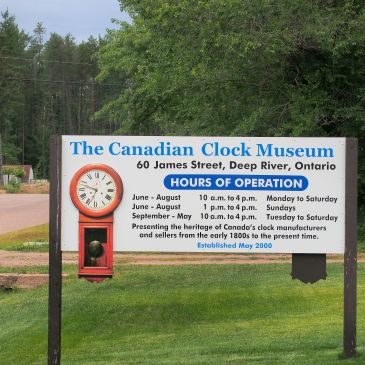
Every museum I have ever been to has allowed me to walk away with the feeling that I have learned something new. All museums document interesting histories that are intended to educate and inspire visitors. The Canadian Clock Museum at 60 James Street, Deep River, Ontario, operated by curator Allan Symons is one such example.
The Canadian Clock Museum
The Canadian Clock Museum in Deep River, Ontario is a 2 1/2 hour drive from the nation’s capital, Ottawa, Ontario. I have visited it twice and I found myself learning even more on my second tour. It has a fascinating collection of clocks that are largely from North America. However, it has the most extensive collection of Arthur Pequegnat clocks that I know of outside a private collection.
A collection of Pequegnat mantel clocks found at the museum
The Arthur Pequegnat Clock Company made clocks in Kitchener, Ontario (called Berlin, Ontario up to 1917) to 1941 when the company ceased production. Pequegnat clocks were wholly made in Canada while their counterparts built and assembled cases in Canada and imported movements from the US, England, France and Germany. The Canada Clock Company and Hamilton Clock Company had a 12 year span also made both cases and movements but not at the volume of Arthur Pequegnat.
I have written about Arthur Pequegnat clocks in previous posts and I have been slowly building a modest collection for myself.
Prince of Wales parlour clock, Canada Clock Company circa 1880Three tall case Arthur Pequegnat clocks
Many manufacturers are represented at this museum and even if you have only a passing interest in clocks you would no doubt find the displays both interesting and thought provoking. Companies represented are the Western Clock Company, Walter Clocks, the Snider Clock Corporation, Seth Thomas that operated a factory in Peterborough from the 1930’s to the 80’s, Breslin Industries, the Hammond Company of Canada Ltd to name just a few. Canadian Clock Maker Martin Cheney who briefly made high quality wall and floor clocks in Montreal in the early 1800’s is not represented, unfortunately.
Twiss tall case early 1800’s
There are even some special clocks such as this Synchronome electrical impulse master clock from the 1930’s.
Master clock mechanismMaster clock with slave clock at top
So, spend time at the museum talking to its knowledgeable curator or avail yourself of the manuals and documents at hand and conduct your own research into a specific clock.
This museum is modest by museum standards and not quite up to the scope and scale of the National Association of Watch and Clock Collectors Museum located in Columbia, Penn, USA but don’t let its compact size fool you. There is plenty to see.
If you have any interest in clocks I strongly urge you visit this one if you are at or near the Deep River area. Outside Canada? I encourage you to seek out clock museums in your own country and take the time to understand the history of clocks from around the world. Its about time!
It is time to buy the tools I need for clock repair. I already have a number of basic tools to get me started; pliers, letdown chucks, screwdrivers, etc.
However, my first significant tool is an Ollie Baker Mainspring Winder which arrived from the USA today. It is pictured below. The Ollie Baker comes with an assortment of collars for every size of mainspring.
Olie Baker spring winder
The spring winder will enable me to inspect, clean, and re-install barreled or open springs on all the clocks I will be servicing. My first impression is that it is a robust and well-machined tool that will give years of service. Indeed, one of the most important tools for clock repair enthusiasts is the spring-winder.
I also ordered bushing kit #5488 from Perrinstoday which will enable me to have the bushings I need in order to use the Bergeon Bushing Machinethat I will purchase later on this year.
The Bergeon Bushing tool is “Swiss made” and exudes quality. In every clock, due to considerable wear, the plates have to be bushed from time to time. This tool allows the bushing of plates of various sizes. The kit includes driving punches, centering bit, stakes, and reamers. I can bush by hand which some folks do by using appropriate reamers and files but I know that a bushing machine is a must-have. The first photo shows a clock movement that I had professionally bushed. It required 5 bushings in all in addition to cleaning and oiling and it runs very well.
With these tools, I can progress more seriously into this most interesting hobby.
December 18th marks the day that my Arthur Pequegnat Maple Leaf fan-top is off to repair.
Sadly this is a repair that I cannot perform myself at this stage of my learning. The problem is essentially a clutch plate off the centre arbor that is not engaging the gear for the strike side. The result is that the hour and minute hand do not move at all thus the centre arbor is quite loose. In the meantime I might as well have some bushing work and a thorough cleaning done.
Typically gingerbread clocks go for almost nothing on the for-sale sites. The fact that this is a Pequegnat means something special however and in my view it is worth preserving for years to come.
Here is the problem area.
Clutch cup is loose
Although it is difficult to visualize from this photo, the cup clutch plate is very loose and needs to be reattached to allow a firm connection to the gear beneath. As such I am prepared to put a little money into this clock and keep it in my collection.
I have had this Arthur Pequegnat Maple Leaf fan-top clock for several weeks now and have decided to keep it in my collection. I was not satisfied with the condition of the case when I first saw it and knew that something had to be done. After several hours of work on the case I can finally say that the results have been very good…not excellent because there are one or two things I would have done differently. For example, I originally used a cotton cloth to bring down the finish and ended up rubbing too aggressively in some sections. Looking back I would use 0000 steel wool from start to finish.
This shot is a comparison between the original finish and taken after hours of restoration.
Condition of clock when first brought homeAfter hours of rubbing and scrubbing
As you can see in the second photo the oak grain is natural and pronounced; the mottling has disappeared. As mentioned there were one or two spots where I was a little too aggressive with the steel wool which I may address later on but for the moment I am going to live with it.
I applied four coats of Amber Shellac and between coats I rubbed the finish with 0000 steel wool. Shellac is the proper approach for case restoration as that product would have been used at that time. The clock now looks very close to what it would have looked like at the time it was made which would be about 1910. The next photo shows the clock fully re-assembled and on display and the next, how it looked when I brought it home.
Ready to be brought to the clock shop for repairJust brought home
Although I am able to dis-assemble, clean and oil a clock mechanism there is a problem with the center arbor not engaging the strike side of the clock. It is off to Doctor Clock in Halifax for repair and cleaning of the movement.
I knew this Arthur Pequegnat clock had issues when I bought it but I felt that I just had to have a gingerbread clock for my collection. It is a beautiful clock and once fully restored it will be a show piece.
After taking the clock out of its case and investigating further I think I have located the problem and it appears that a previous owner had attempted a fix. Perhaps the repair attempt was made by the owner himself since it looks like a poor effort because of scratch and dent marks on a particular washer that can be seen in the next photo.
The photo below shows the hour cannon and minute arbor. There is a brass washer located near a toothed gear that is very loose. The washer is not secured to the post. Because the washer is very loose there is no firm connection between the gear and the one immediately beneath it. The hour pinion should have a tight fit on the centre arbor. As a result of the slippage the time side works but does not engage the centre arbor.
The movement obviously needs to be taken apart. However, the problem is twofold. First I am able to dis-assemble the movement but I do not have the skills to fix the centre arbor issue. Secondly, the plates are steel (with nickel plating) with brass bushing inserts which are not likely to be easily knocked out and they do not match modern bushings from today’s suppliers. It would take special reaming tools to install new bushings, tools I do not have. However, I can see that it needs at least 6 new bushings.
Centre arborCloser view of the arbor showing a hole that has no purpose
In the meantime I can get to work on the case. The case was likely subjected to heat (stored in hot location like an attic for a long period) and the shellac finish has melted into the alligatored finish you see here.
The solution is a special mix of alcohol, boiled linseed oil, turpentine, lacquer and vinegar. It will require time and patience but I believe I can restore the case to its original condition. There are no cracks, nicks or gouges in the finish so I have a very good starting point, I think.
If you have any comments on this fine classic feel free to post.
In November 2015, I added an Arthur Pequegnat Maple Leaf “fan top” to my collection. The clock was advertised as non-running, and the seller’s description was accurate—it had its share of challenges. While gingerbread-style kitchen clocks don’t typically appeal to me, I felt that, as a Canadian, if I were to own one, it should be a Pequegnat.
This clock dates back to the Berlin era (before 1917, when Berlin was renamed Kitchener, Ontario) and features the signature nickel-plated steel plates with brass bushings, characteristic of most time-and-strike Pequegnat clocks.
Arthur Pequegnat Maple Leaf Kitchen Clock
The clock is complete with its Maple Leaf bob, an original untouched dial, most of its label, and a remarkably well-preserved maple leaf decal on the front glass.
Berlin Ontario label, mostly intactMaple Leaf bobMaple Leaf decal
I managed to get the clock in beat by adjusting the verge, but the minute arbor is quite loose, causing the minute and hour hands to stay stationary. Instead of attempting a full repair on my own, I’m considering having the clock professionally serviced. In the meantime, I plan to remove the movement from the case to examine the issue further. It could be a simple fix—or something more complex.
The mottled finish on the entire case
The case poses another challenge. While it has no chips, cracks, or missing pieces, the seller believed the mottled finish added character. I strongly disagree—it’s far from appealing.
To gather restoration ideas, I shared this clock on theNAWCC forum site. Although the finish might be original, it appears the clock was stored in a hot environment, causing the finish to degrade. As one forum member explained, “The case was likely subjected to heat (stored in the attic), and the shellac finish has melted into the alligatored appearance you see now.” When shellac softens, it attracts airborne dirt, further compromising the surface.
Although I’m capable of refinishing the case, the movement also requires repair. After inspecting it, I’ve realized the cost of professional repairs is currently beyond my budget. However, I plan to educate myself on servicing antique clocks and intend to handle the repairs myself.
The Canadian Time clock was produced by the Arthur Pequegnat Clock Company, which holds a special place in Canadian horological history. Founded in 1904, the company became the longest-lasting Canadian-based clock manufacturer, operating until 1941. Pequegnat clocks are known for their solid craftsmanship and distinctive designs, contributing significantly to the Canadian clock-making industry during the early 20th century.
Arthur Pequegnat, originally from Switzerland, brought his expertise in clockmaking to Canada, where he established a reputation for high-quality clocks. The company manufactured a wide range of clocks, from wall clocks to mantel clocks, many of which are now highly prized by collectors for their durability and unique aesthetic. Despite the challenges of competing with larger international clock manufacturers, Pequegnat’s attention to detail and commitment to quality ensured the company’s success for several decades.
Today, Pequegnat clocks are considered a piece of Canadian history, and the company’s legacy endures through the ongoing interest of collectors and enthusiasts, like myself, who appreciate the skill and craftsmanship of these antique clocks.
Canadian Time clock by Arthur Pequegnat
This particular clock was made after 1916 in Kitchener, Ontario, Canada. Clocks made before 1917 were marked “Berlin” on the dial face. The town was known as Berlin from 1854 until 1912 and became the City of Berlin from 1912 until 1916. Due to the negative association with Germany during the First World War, the decision was made to change the name to Kitchener midway through the war. Today, Kitchener serves as the seat of the Regional Municipality of Waterloo, Ontario.
Label affixed to back of clock
Unfortunately, the exact year my clock was manufactured is unknown as Pequegnat did not date-stamp their movements, but the Canadian Time series was produced up until 1941. By that year, the demand for brass from World War II armament makers, a crucial material for clock movements, forced the Arthur Pequegnat company to halt production. If the clock was made as late as 1941, it would be 72 years old.
Checking on condition of the clock
This clock features Arabic numerals, which was less common since most were ordered with Roman numerals. As a railway clock, the use of Arabic numbers would have made it easier to read for the general public in a train station. The manufacturer allowed customers to choose between Arabic or Roman numerals when ordering. Additionally, buyers could also opt for a version of this clock with time, strike, and calendar functions.
TheCrossed horseshoes were likely added by a previous owner
The crossed horseshoes on the base of a clock are often associated with good luck and protection. In many cultures, horseshoes are considered symbols of good fortune, particularly when they are displayed with the open end facing upward, which is thought to catch and hold luck. I have not seen another Canadian Time clock with crossed horseshoes.
On prominent display in my home
I’m hoping to track down a photo of the clock from its time at the Pictou, Nova Scotia train station before it was decommissioned in the early 1990s, as that could really help narrow down the clock’s manufacturing date.
The clock itself is quite large, measuring 37 inches high, 5 inches deep, and 15 inches wide. It’s made of quarter-sawn oak, which results in boards with annual rings mostly perpendicular to the face, providing greater stability and minimizing warping.
The Canadian Time clock is a reliable timepiece, showcasing the quality and craftsmanship that went into its creation.
One of the clocks that I would like to add to my collection is the Arthur Pequegnat Regulator #1, single weight 8-day time only clock. A rare clock indeed and prices of the few I have seen are on the high side. Too rich for me at his time.
The company distinguished itself as a competitor for some of the better American wall clocks such as those made by Seth Thomas. Their wall clocks often looked like models made by Seth Thomas but some of their designs were unique. For their wooden cases, they favored the heart wood of quarter-sawn white oak that showed off beautiful ray flecks.
The regulator #1 is often compared to the Seth Thomas Regulator #2. Thousands of Seth Thomas Regulator #2s found their way into offices and rail stations all across America. The Arthur Pequegnat Regulator #1, though not as prolific, served the needs of many businesses in Canada. The clock is highly collectible in Canada and will command twice the price of similarly styled clocks by well-known American counterparts.
This photo of the Regulator #1 was taken at the Canadian Clock Museum in Deep River Ontario in 2013.
The Arthur Pequegnat clock company had an illustrious albeit short life. Watchmaker Arthur Pequegnat was born in Switzerland in 1851. Arthur immigrated to Berlin, Ontario Canada in 1874 with his wife, parents, brothers and sisters; a grand total of 18 family members.
By the late 1870’s Arthur was operating a jewelry store and watch repair in Southern Ontario. By the middle 1880’s Arthur and his brother Paul were operating a shop in Berlin, Ontario. After about ten years the brothers went their own way, both operating successful jewelry shops in Southern Ontario.
In 1897 Arthur expanded his Berlin Jewelry shop to include the manufacture of Bicycles. However, By 1904, with the decrease in the demand for Bicycles, Arthur began to re-focus on the clock industry, by manufacturing his own clock movements at his Berlin Bicycle Manufacturing plant. At first the wooden clock cases were made by local Furniture Makers, however in time he manufactured his own clock cases.
Berlin, Ontario was re-named Kitchener Ontario in 1916, due to anti-German backlash during WW I. The date becomes a useful tool when determining the age of Pequegnat clocks, Movements or Dials marked “Berlin” date the clock to 1916 or earlier and those marked “Kitchener” are 1916 or later. Since many clocks had a long production life it is difficult to date any Arthur Pequegnat clock with precision.
Regulator #1, hanging in the Macdonald Museum in Middleton, Nova Scotia, Canada
Arthur died in 1927, however, with family members in control, the company continued to operate until 1941. The war effort meant that brass became difficult to obtain and the company shut its doors. The factory never produced another clock, and was demolished in 1964. All that remains in Kitchener today is a plaque commemorating this great clock manufacturer.
MacDonald Museum main exhibit area
The Canadian Clock museum contains the largest collection of Arthur Pequegnat clocks in Canada and it is certainly worth a visit. The Macdonald Museum in Middleton, Nova Scotia has a modest collection of Pequegnat and is worth visiting if you are traveling through the province of Nova Scotia.
This my first Arthur Pequegnat clock and it is the Brandon II. The first edition was produced up to 1916. Though very similar in design, this second edition was made from 1917 to 1941.
Arthur Pequegnat Brandon II
The Arthur Pequegnat Clock Company made clocks in Kitchener, Ontario from 1903 to 1941.
Normally found in a Canadian schoolroom in the 1930s and 1940s or in an office setting it was one of Pequegnats more popular styles. It is an octagonal short drop, time-only schoolhouse clock. The first edition had the exact dimensions but with a more ornate frame around the dial bezel.
Schoolhouse clocks were generally time-only as there would be other methods, such as a bells or alarms, to mark key points in a typical school day. If situated in an office environment a strike train would be too distracting to the employees. Brandon clocks also came with calendars, a useful feature for both school or office.
Clock face Arthur Pequegnat Brandon clock
Both the case, which is made of quarter-sawn oak, and the brass movement were made by the Arthur Pequegnat Clock Company in their small Kitchener factory until 1941. Brass shortages during the Second World War caused the company to abruptly end production.
The time-only movement is relatively simple with few gears and little to go wrong. It was reliable, dependable and made to withstand the abuse of a school or office environment.
This clock was owned locally by an antique collector who after having it for a number of years decided to sell it in his antique shop in Great Village, Nova Scotia. The price was reasonable.
Arthur Pequegnat Brandon time=only movement
The case is in excellent condition, as is the face and bezel. Although the clock runs and keep reasonable time it has an annoying squeak suggesting that something is definitely amiss. I discovered that the first wheel had considerable pivot hole wear. This is the kind of repair I am unable to do at this time since I have neither the tools nor the knowledge. I brought the clock to a horologist in Halifax, Nova Scotia where the servicing was completed.
Five bushings were installed, the mainspring was cleaned and the movement was oiled. I believe it is a worthwhile investment and I expect it to be ticking away for years to come.
You must be logged in to post a comment.