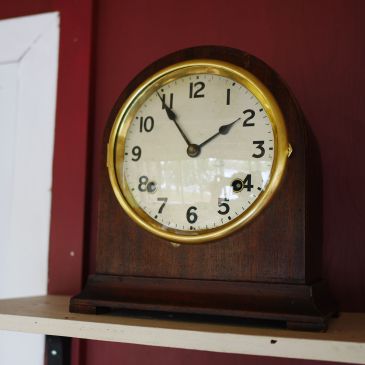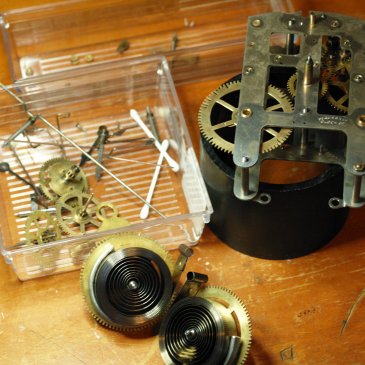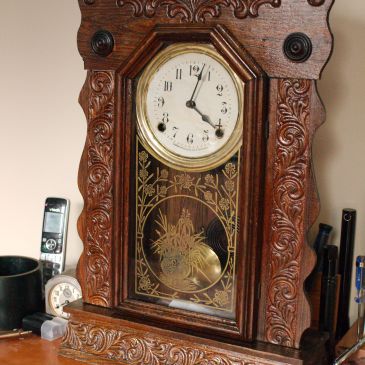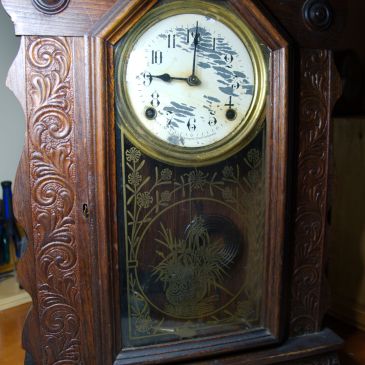
The Moncton – double spring time only – Part II – servicing the movement

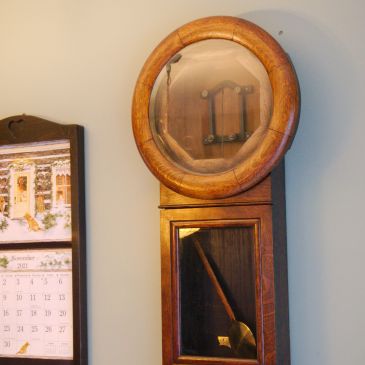
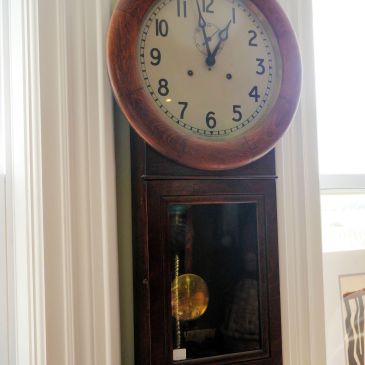
I love this clock. It is one of my favorites. Bought in the fall of 2018, it has been on the kitchen wall and running ever since. Arthur Pequegnat clocks have a solid construction, robust movements, conservative designs, are among the most dependable and reliable clocks in my collection. this model is called the Moncton.

The Moncton was a regular fixture in offices and was then considered a “high-end” office clock. Many also found their way to rail stations across Canada. There were two variations of the Moncton, a short and a long version.

Those made before 1917 were known as the First Issue and had a tapered bottom piece. The second issue had a rounded bottom with a middle cut-out.

They are attractive clocks inspired somewhat by the Seth Thomas #2 although the Moncton has a 15-day double spring driven movement instead of the single weight of the #2.

I knew it required servicing but with so many other clock projects in the way I never got around to it. In my last post I took the movement out of its case and discovered that there is not a lot wrong with it.

The time-only movement is stamped Arthur Pequegnat Clock Company

It was dirty as expected and long overdue for a cleaning.

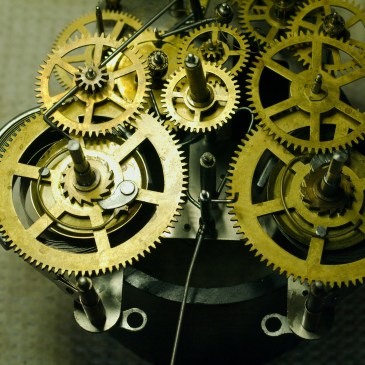
The movement is pretty simple with 4 wheels and an escape wheel plus the motion works. The two springs apply power simultaneously but one side can be wound if the other spring fails though the clock will run but for a shorter period.

The mainsprings are not what I expected, They are half the width of a typical time-only American clock. There is a reason for this. The Graham deadbeat escapement requires between one fourth to one half the driving power than the same clock using a recoil escapement. Less drive power means less wear over time. Having very few gears and little friction in the gear train also improves efficiency and time-keeping.

The Movement

Seth Thomas Regulator #2

The movement is attached to a support frame bolted to the case.

There are two screws holding the movement on the bottom that must be loosened and two long screws that go through both plates that hold it on top, much like a Seth Thomas #2.

Once disassembled I inspected the movement for wear.

I discovered the lantern pinions and pivots to be in very good condition for the age of the clock.

Time-only movement

The movement might have been cleaned at one point but there is no evidence of past repairs. The bushing holes are a little worn but not enough to warrant bushing work at this time.

Consequently, cleaning parts in the ultrasonic, polishing the pivots, cleaning the mainsprings and pegging out the bushing holes was the extent of servicing.

The movement was assembled and mounted in the clock for testing.

Cleaned and returned to the case for testing; notice the two top mounting screws

It will run for a cycle or two before I re-attach the dial and hands.

A pretty simple servicing requiring less than half a day of my time.

The Moncton – double spring time only – Part 1 – assessing the movement prior to servicing

Canadian clock collectors are very familiar with the name Arthur Pequegnat and associate the maker’s clocks with a solid construction, robust movements, conservative designs, and nationalism since many clocks were named after towns and cities in Canada. The Moncton was named after the City of Moncton in New Brunswick, Canada.

The Moncton was often found in offices and train stations across Canada and was known for its accuracy. This clock is originally from the Toronto (Ontario, Canada) area but I have no idea where it spent most of its life.

Arthur Pequegnat Moncton

For an 80+-year-old clock, it is in exceptional condition. A double spring time-only movement with a Graham deadbeat escapement running at 80BPM means that it is very accurate despite being spring-driven.

It has a 12-inch Arabic dial with simple, bold numbers. The pierced spade hands are attractive and are a common feature on many Pequegnat wall clocks. It has a fumed quarter-sawn oak case, is 35 inches high with a hinged 16-inch oak bezel door that swings to the right to reveal the dial.

The pendulum access door is 14 ½ inches high by 10 ¾ inches wide and swings to the right. The clock is 5 inches deep with wall stabilizers on either side of the case. The pendulum bob is brass over iron with an oak pendulum rod. The dial glass is original and has the “waviness” you would expect with old glass.

Assessment of the movement

With solid plates, front and back, and a mounting system similar (but not quite the same) as the Seth Thomas #2 the movement looks solid. I was expecting past repairs and some wear and, of course, a dirty movement, all confirmed when I looked at the movement for the first time.

Heavy-duty time-only movement

I removed the dial first and the movement from the case. The first step is to let down the mainsprings.

The mainsprings are much smaller than and half the width of a typical American clock with a recoil escapement. Not surprising since a Graham deadbeat escapement requires between one-fourth to one-half the driving power than the same clock using a recoil escapement. Less drive power means less wear over time. Having very few gears and little friction in the gear train also improves efficiency and time-keeping.

Even in its unserviced state, it would easily run 16 or 17 days.

I am not seeing a lot of wear, an indication that the clock has had a good life. The verge arbours may need bushing work otherwise I cannot see any other wear that is problematic. The lantern pinions are also in very good condition.

Next is to inspect the movement more closely and look for anything out of the ordinary.

In Part II I will cover the servicing of the movement.

The Pressed Wood Kitchen Clock

Pequegnat Canuck kitchen clock

Ah, the kitchen clock!

Most clock enthusiasts have at least one kitchen clock in their collection and some collect them exclusively. I am not a huge fan of them but they very popular and considered important clocks because of their relatively low cost and availability.

Thousands of inexpensive oak-cased clocks were made by various American and Canadian manufacturers in the late 19th Century to the early part of the 20th Century. They are cheap, plentiful, reliable and easy to regulate.

They were typically sold in box lots of a half a dozen or so to merchants and offered for sale to customers for a unit price of around $4.50.

Although commonly called the kitchen clock it is sometimes called the pressed wood clock.

The designs were created by using high pressure rotary presses on oak wood that had been pre-steamed to soften it. The front of the clocks frequently displayed glass tablets with bronze or silver gilt designs.

This Arthur Pequegnat Canuck clock (above) is a typical pressing with floral designs on the top crown, base, and side columns, two upper rosettes and a framed access door with a floral style glass tablet.

Pressing designs into wood was much less expensive and quicker than machine carving, though the designs tended to be taken to excess at times like we see on this Sessions Grand Assortment with a top heavy ornate crown.

Sessions Grand Assortment

American manufacturers offered kitchen clocks with slight variations in the configuration of the case components and the decoration on the glass panel. It was common to name or number the clocks and present them as part of a series.

All kitchen clocks were 8-day running and featured either a one piece or two-piece 6-inch painted dial with Roman or Arabic numerals, railroad track minute chapter ring, and blued moon shaped or spade hands. A pendulum regulated the timing. The clocks included a half-hour strike on a bell or a coiled gong and some were offered with both bell on the half-hour strike and coiled gong on the hour. Additional features such as an alarm added pennies to the cost.

With inexpensive changes in the design for the press and minor changes to the case elements, clocks of different designs could be produced. Design elements for the pendulum varied between a plain round bob to a decorative pendulum bob in many pressed wood kitchen clocks.

Steam pressed designs were not confined to kitchen clocks and quickly found their way to wall clocks like the Gilbert Admiral.

Gilbert Admiral drop octagon wall clock

I have about 100 clocks in my collection and only two are steam-pressed. It is not a style that I am actively seeking but, admittedly, some are attractive. They are easy enough to find, fairly cheap and are relatively uncomplicated to service.

Pequegnat clock purchase may not happen and that’s too bad

I am writing this post during what we all hope are the final stages of the pandemic. As of this writing there are many rules in place because of the large number of active cases. One rule is that we are not permitted to leave our municipal areas (May 2021).

As a clock collector it makes it very difficult to acquire clocks especially if the clock that one wishes to purchase is outside ones permissible locale.

For example, I was looking at an Arthur Pequegnat “maple leaf” kitchen clock that was offered for sale on Facebook Marketplace in Bathurst, New Brunswick. Bathurst is about 4 hours drive from my home and in another province which simply means that I cannot pick it up from the prospective seller nor can the seller deliver it to me at this particular time.

I communicated with the seller and I agreed that the price was reasonable. She indicated to me that if she cannot sell it locally she will put it aside for me and when she travels to Nova Scotia, we can connect.

As a Pequegnat collector this clock would be a nice addition to the three other kitchen clocks in my collection.

In early May I floated the idea that it could be shipped to me and I would pay the costs. She replied that she had “googled” it and found the process too complicated and risky. I did not argue with her.

As we are driving through New Brunswick in late June I suggested we could meet at a neutral location near where she lives.

June contact

I contacted the seller this week Late (June) and suggested a rendezvous to make the deal. “I have to speak to my husband” said the seller.

In a modern relationship where each has equal decision-making power, clearing a purchase with the husband is, well, very archaic.

Three other Pequegnat kitchen clocks in my collection are the Canuck and two in the Maple Leaf series, the “pointed top” and the “fan top”

Arthur Pequegnat Canuck kitchen clock
Arthur Pequegnat kichen clock
Arthur Pequegnat fan top kitchen clock
Arthur Pequegnat Maple Leaf Pointed Top

I suggested that we meet along the Trans Canada Highway (TCH) in New Brunswick and the seller replied that she was close to the highway. Well, she thought the TCH ran through Bathurst which is 2 1/2 hours away from the TCH. So, that will not happen. Too bad!

I like the clock and it would be a very nice addition to my collection but I will look elsewhere.

Arthur Pequegnat clocks in my collection

Eight years ago I acquired my first Arthur Pequegnat clock. In the years following, I have added to my collection and now have a total of 8. Although my collection of Pequegnat clocks is very modest by comparison to a dedicated Pequegant collector it is a good start and I would certainly like to add to that number in the future.

The Arthur Pequegnat Clock Company (1904–1941) is notable as the longest-lasting Canadian-based clock manufacturer. They made a wide variety of different styled clocks from 1904 through to 1941 from shelf and mantel clocks to wall clocks and floor models.

The time and strike with signature nickle-plated steel plates
Nickle-plated steel or brass plates

Unfortunately, it is very difficult to date a Pequegnat clock, except for what is termed pre and post-Berlin, the location of the company’s manufacturing plant. Clocks made before 1917 were inscribed “Berlin, Canada” on the dial face. Kitchener, Ontario was known as Berlin prior to and during the first World War. It was the town of Berlin from 1854 until 1912 then the City of Berlin from 1912 until 1916.

Because the name Berlin was associated with the war against Germany the town fathers decided the name Kitchener was less offensive and the change was made midway through the First World War. Kitchener is the present seat of the Regional Municipality of Waterloo, Ontario, Canada.

Most Arthur Pequegant clock movements are stamped with the company name but there are no date marks on movements indicating when it was made. Clocks made after the First War wore the company name plus Canada under the number 6 on the dial face. For example, clocks such at the Canadian Time were made from 1904 to 1941 and are separated in age by the Berlin label consequently, my Canadian Time wall clock with the Canada label could be as old as 104 or as “new” as 80 years old.

One distinctive feature on many movements is the use of nickel plating for both brass and steel plates.

Clock face Arthur Pequegnat Canadian Time clock
Arthur Pequegnat Company name

Many models continued in production right up to 1941. By 1941, the demands of World War II armament makers for brass, the essential ingredient in clock movements as well as the growing popularity of the electric clock, forced the Arthur Pequegnat company to cease production.

And now, beginning with the first clock acquired in 2013.

The Canadian Time

My first Pequegant, purchased in September 2013 hung in the Intercolonial Rail Station waiting room in Pictou, Nova Scotia.

Canadian time clock
Canadian Time

The seller arranged the purchase of the clock just prior to the station’s decommissioning in 1993. It is in very good condition, missing its door clasp but otherwise intact. There are a few scratches and nicks consistent with its age but nothing objectionable.

The Brandon (2nd edititon)

I found this clock in an antique shop just outside Truro, Nova Scotia in 2014.

Arthur Pequegant Brandon II

The case is in excellent condition but the movement was quite worn. Had I known more about servicing clocks at the time of purchase I would not have sent it to a clock repair specialist. It is one of two in my Pequegant collection serviced by someone other than myself. This is the Brandon II. The Brandon 1, the first edition, was made prior to 1918, and had an ornate pressed wood bezel. This one is simpler in design.

The Maple Leaf “Fan-top”

Next came my first Maple Leaf kitchen clock, known for its unique lower tablet of scattered maple leaves and a distinctive maple leaf pendulum.

Arthur Pequegnat Maple Leaf kitchen clock

This clock, bought in 2015, was also serviced by a clock professional. The case was in very poor condition. Stripping a case is an absolute last resort as far as I’m concerned but the finish on this clock was pretty bad. I could not leave it as it was.

The finish on a Pequegnat fan-top clock

To Pequegnat collectors, it is known as the fan-top.

The Simcoe

Three years later, the Simcoe followed me home. It was bought at an antique shop in Victoria, British Columbia in  2018.

Arthur Pequegnat Simcoe mantel clock

It is not particularly attractive. It is the only mantel clock in my Pequegnat collection and it is from the “Berlin” period.

The Bedford

2018 was a good year because I acquired 4 Pequegnat clocks. This was number two of that year.

Restored Athur Pequegnat Bedford mantel clock
Bedford shelf clock

This clock was gifted to me by a reader. He asked if I wanted the clock but I had to pick it up in Quebec which was on our way to a summer cottage in central Canada. The movement was in very good condition but the case was damaged having taken a plunge off a high shelf.

The movement was serviced without issue but the case required extensive intervention.

The third purchase that year and the fifth in my collection is the Maple Leaf Pointed Top

The Maple Leaf “Pointed Top”

There are 4 Maple Leaf clocks made by Pequegnat. Any version of the Maple Leaf is sought after by Canadian collectors but this one has distinctive pointed side columns, hence the nickname.

Arthur Pequegnat Maple Leaf Pointed Top

Although termed a kitchen clock it could easily have been placed in a living room or parlour.

The Moncton 

The last 2018 acquisition was a clock that I had in the back of my mind for quite some time and I was waiting for the right price. This is an excellent copy that is very presentable and looks great on our kitchen wall.

Arthur Pequegnat Moncton

It is a post-Berlin double spring time-only 15-day clock. Many were used in rail stations despite the fact that they were spring-driven. Weight-driven clocks were preferred for their accuracy but the Moncton was up to the task as a timekeeper.

And the last.

The Canuck 

This is the only true Pequegant “gingerbread” clock in my view.

Arthur Pequegnat Canuck kitchen clock
Canuck kitchen clock

The case was refreshed and the dial was redone. The movement was also serviced without issue.

Cleaned up more presentable

These are all keepers. Most Pequegants have kept their value over the years and in Canada, they are regarded as quality clocks for the masses. They were well built, well-designed movements with a distinctive Canadian charm as many were named after cities in Canada.

A hall clock would complete my modest collection.

Ten active clock companies in Canada during the 1950s

Canadian clock collectors are most familiar with the Arthur Pequegnat Clock Company that closed its doors in 1941 but 7 years later a number of clock companies were alive and flourishing in Canada, predominantly in areas in and around Toronto.

It is difficult to imagine that seventy years ago there were ten active clock companies in Canada. Unfortunately, none of these companies survived beyond the late 1970s.

Could any of these companies survive today?

Here are the ten Canadian clock manufacturers in no particular order:

BRESLIN INDUSTRIES: of Toronto: Clocks were a sideline for this company run by the Breslin family, whose products were focused on lamps, lampshades, and novelties. The only clocks in existence have horses as the typical 1950s theme. The wind-up movements are the same Ingraham type used by Snider, another company on this list.

INGRAHAM CANADIAN CLOCK COMPANY of Toronto. Ingraham clocks were being made by the original American company in Bristol, Connecticut from the mid-1800s. The Canadian factory was located in Toronto from the late 1940s until at least 1980. Wall and alarm models, the latter with wind-up or electric movements, were made for the Canadian market. Representative examples of typical alarm, kitchen, and starburst wall clocks with Ingraham Canadian, Ingraham Canadian Clock Co. Ltd, or Ingraham plus Made in Canada on the dial. The novelty windup alarm clocks, The Westerner and The Mountie are popular with collectors of animated models.

WESTCLOX CANADA of Peterborough, Ontario: The parent company started making alarm clocks in LaSalle, Illinois, near Chicago, before 1900. The Canadian factory operations began in Peterborough in 1920. The new building was ready in 1923. Business was so good that additions were put on several times up to the 1950s.

Westclox peterborough plant
Westclox Peterborough plant

However, by the mid-1980s the North American Westclox factories were closing down in favour of lower labour costs from China. Westclox is best known for its millions of Big Ben and Baby Ben windup and electric alarm clocks made in various styles between 1920 and the early 1980s in Canada. The company also make wall clocks for kitchens, dining, and recreation rooms starting in the 1930s. If collecting, avoid Westclox alarm clocks made in China.

Westclox LaSalle alarm clock
Westclox LaSalle alarm clock, assembled in Peterborough, Ontario

SETH THOMAS CLOCKS of Peterborough, Ontario: This old company was founded by Seth Thomas in the early 1800s in Plymouth, Connecticut (now Thomaston). In 1931 it became part of General Time Corporation, which owned Westclox. Seth Thomas brand mantel, alarm, and wall clocks were produced for the Canadian market in the Westclox factory from 1931 to the mid-1980s. However, inferior clocks produced under the Talley Industries brand are avoided by serious collectors.

NEW HAVEN CLOCK COMPANY of Brantford, Ontario: The parent company was based in New Haven, Connecticut originating in1900. Some mantel and wall clocks were made in Brantford with Canadian wood cases, but the spring-driven pendulum movements were brought in from the U.S. factory. Most clocks were made for schools and offices.

New Haven schoolhouse clock
New Haven schoolhouse clock, made in the USA but assembled in Brantford, Ontario

FORESTVILLE CLOCK COMPANY of Toronto: Set up by Leopold and Sarah Stossel as the Blackforest Clock Company in Toronto in 1928 the name changed to the Forestville Clock Company in 1941 because of World War II, and continued in business until the late 1970s. Forestville sourced movements from England, France and Germany.

Forestville Westminster chime
1970s Forestville Westminster chime, Canadian case(?) with German movement

Blackforest shelf clock
Blackforest shelf clock circa 1939

CANADIAN NEON-RAY CLOCK COMPANY: The main product was “Bulb Illuminated” advertising clocks. this business was in operation from about 1942 to the mid-1960s In Montreal. Many companies purchased these clocks to advertise their products such as soft drinks, beer, service station items like motor oil and spark plugs, ice cream, paints, meats, and mattresses.  French-language, as well as English advertising clocks, are commonly found in Canada.

CANADIAN GENERAL ELECTRIC of Barrie, Ontario. In addition to large industrial electrical components, CGE produced electric alarm, table, and kitchen wall clocks for the Canadian market from the 1930s into at least the 50s. CGE kitchen wall and alarm clocks were produced in large numbers.

SNIDER CLOCK MANUFACTURING COMPANY LIMITED of Toronto. The Snider Clock Corporation and its successor, the Snider Clock Mfg Company, flourished for over twenty-five years (1950 to 1976). Their success is a tribute to Harry Snider and his family for the many unique clock designs that were created, to the effective construction methods developed by Harry and then Michael Snider for them, and to their business skills in promoting and selling their clocks through hundreds of stores across Canada.

Snider Clock Company
Former location of the Snider Clock Company

WALTER CLOCKS of Toronto. The main product was mantel clocks. All of the cases were made in Toronto.  At least a dozen different models were produced in the mid to the late 1930s before WWII.  During that time, both time & strike and Westminster chimes spring-driven movements were imported from Britain and Germany. The war meant that overseas movements were not available and clock production stopped.  But many more models were made after WWII, from the late 1940s through to the late 1950s. The prewar models had walnut veneer cases and hinged back doors.  The removable round door on the back of the postwar models mostly made with less expensive, stained birch wood, was unique. Production continued up to the late 1950s when the last of the Walter Clocks mantel clocks were made.

Gone forever. It is a shame. Gone is the knowledge, expertise, and entrepreneurship. Could any of these companies survive today? No, they were important in their day, thrived on innovation and some were ahead of their time but the world is a different place today.

Tick Talk Tuesday #29 – A bob for a Pequegnat wall clock

DBs friend’s clock is similar to this one, an Arthur Pequegnat Brandon (2nd edition)

Tick-Talk Tuesday is about the letters and comments I have received from you, the reader, concerning your clock, issues you might have had, challenges you face or a clock you would like me to profile or my responses to your questions with advice on your particular clock concern. For those comments and questions that stump even me, I consult within my clock circles for the best possible answer

DB wrtes,

“Good morning, I stumbled across your site this morning while looking around for parts for what I think is a Pequegnat Brandon. It belongs to a friend and is missing the pendulum bob and key, but she thinks it works otherwise. I found parts that seem to be appropriate, but I’d like to find originals (or close to it) if I could.

Any advice?”

Pendulum bob
Pendulum bob

My reply,

Hi DB,

Thanks for your email. There is no known source for original Pequegnat parts although you might get lucky on eBay when clocks are parted out. It must be as close to 4.3 oz. or 125 grams, 62mm or 2.5 inches as possible, and it must be adjustable. I don’t see anything at Perrins, a Canadian supplier and the closest I could find is this one at Timesavers in the US. This one at Ronell looks to be the same but cheaper.

https://www.ronellclock.com/Adjustable-Pendulum-225-Bob-PM-63.htm?categoryId=-1

Ron

DB reply,

“Wow Ron, that’s very helpful, thank you very much.”

Pequegnat Simcoe – servicing the movement

Arthur Pequegnat Simcoe mantel clock

The Simcoe is one of 8 Arthur Pequegnat clocks in my collection. It is very similar in dimensions and style to the Jewel produced around the same time but a few dollars more at the time. The Jewel is an unadorned box while the Simcoe has more bling, a piecrust dial bezel, claw feet on each corner and lions head handles with rings on each side.

Time and strike movement with steel plates
Time and strike movement with nickle-plated brass plates

To collectors, it is often referred to as a”Berlin” clock. Although it is impossible to date Pequegnat clocks the name Berlin distinguishes clocks made before 1917 and those made after and up to 1941 when the factory finally shut its doors for good. Clocks made prior to 1917 were inscribed “Berlin”, Ontario on the dial face as Kitchener was known as Berlin until midway through World War I. Kitchener is the present seat of the Regional Municipality of Waterloo, Ontario (Canada). Those made afterwards have only the company name.

I passed by the clock in an antique store in Victoria, British Columbia without realizing that it was a Pequegnat. My wife has an eagle eye, told me to take a second look and I returned. Sure enough, a Pequegnat!

The yellow oak case is in very good condition with one or two small scratches and a chip just above the top of the bezel. The dial pan has had an ugly repair, there are two dabs of solder at 12 o’clock and 6 o’clock protruding through the front of the dial.

Piecrust bezel
Piecrust bezel with some ugly repairs

The working movement looked to be in good shape but I expected some wear when I took it apart. After all, it is nearly110 years old.

I don’t know why Pequegnat chose to nickel-plate its movements. Perhaps the look was more exotic but the practical reason was to mitigate the formation of rust, The plating distinguished itself from similar American offerings notably the Seth Thomas number 89. Earlier Berlin movements had nickel-plated brass plates while later Kitchener clocks had steel plates with pressed in brass bushings.

Nickle-plated brass plate, rear

Front plate with duller finish

On to the movement itself. Having a bell for the 1/2 hour strike adds to the complexity of the movement. It does not surprise me that later Pequegnat dispensed with the bell and relied on a passing strike gong. A keyhole regulator adjustment on earlier clocks, another complexity, gave way to an adjustable pendulum.

Key hole regulator adjustment

As expected, there were no surprises. The only evidence that the clock has been worked on is the newer strike side mainspring which is slightly smaller in height than the time side. Regardless, both springs run the full 8-day cycle.

There was no evidence of bushing work in the past and it is no surprise that it required some bushing work. Four were required on the time side and one on the strike side: S2R, T3F, T4F and EW front and back.

Assembly and testing

Now on to assemble and test the movement.

Assembly went well. On the test stand, the movement seemed to be working well but after a few days, I observed that it was not striking every hour. It was working well before I worked on it, so, something is amiss.

I wound the mainsprings tight thinking it was a power issue until I discovered that the helper spring on one of the lifting levers did not have enough tension. In other words, the unlocking lever was not lifting the count lever to prepare for warning. The solution? Tighten the lever helper spring.

In the meantime, I gave the case a good cleaning and one coat of shellac.

After a week it is running well and back on display.

Arthur Pequegnat Simcoe

Pequegnat kitchen clock servicing – Part II – cleaning, pivot polishing, bushing work and testing

On the bench is an Arthur Pequegnat time and strike kitchen clock which is part of the popular Maple Leaf series produced up to 1941 when the company closed its doors for good. In Part I of this two-part series I discussed disassembly and assessment of the work to be done.

In this Part II I continue with cleaning, pivot polishing, bushing work assembly and testing.

Nickel-plated steel plates

Parts cleaning

All parts are cleaned in the ultrasonic and dried immediately afterwards. The mainsprings were cleaned, oiled and placed back in their spring retainers.

Bushing work

One of the pivots had small amount of scoring but otherwise all other pivots were in good shape, polished and made ready for bushing. Here I have the wheels ready for polishing. An emery board is perfect for pivot polishing. A steady-rest (top right) also comes in handy for those pivot ends that are difficult to secure in the 3-jaw chuck.

Getting ready to polish the pivots
Getting ready to polish the pivots, steady-rest is in the upper right of the photo

As mentioned in Part I, I wanted to begin with the most problematic bushing wear, the escape wheel, but first it meant straightening out one of the pivots. A straight pivot will allow the arbour to align better.

Bent pivot
Bent pivot, escape wheel

Here (below) is the hatchet job of a past repairer. Normally I have sympathy for folks who had few tools to work with in the old days but attempting to close a pivot hole so aggressively and bending a pivot in the process is terrible workmanship. It is a wonder the clock ran at all.

Punch marks around a pivot hole

The new bushing is certainly an improvement. My one concern was cutting into the steel as the pressed brass inserts for the bushings are not quite on-center. It is a quick way to ruin a Bergeon reamer and this time, it was close! This was the toughest one, the other 4 on the time side were standard installs. As mentioned in the last post, the strike side pivot holes were in great condition which happens when the strike side is not wound.

New escape wheel bushing

Reassembly and testing

Now, on to reassembly. The last 2 movements I worked on had steel plates with a similar problem; bent plates. If they are bent in any way it is a struggle to align the top and bottom pillars. Moreover, if the plates are bent especially in the middle they may impede the running of the movement as there may be insufficient end-shake for the wheels to run. There needs to be a little end-shake or the gear’s arbour will bind. I am not a big fan of steel plates.

Generally, I do not replace helper springs but if they are broken, replacement is essential. Many Canadian time and strike clocks have helper springs to maintain tension on lifting and locking levers including the lever for the strike action. The hammer spring looked good when I disassembled the movement but during reassembly, the spring promptly snapped. The .35mm brass spring was replaced with one the same size.

Having worked on two other similar Pequegnat movement recently, I knew exactly where to position the stop wheel for the strike side. Everything went together smoothly, the movement is now on the test stand and destined to run for years to come.

The case is in great shape but the dial was beginning to flake. I found the right combination of colours and inpainted where needed.

As received with some flaking of the dial

Maple Leaf kitchen clock

While there was little wrong with the clock before servicing it is nice to know it will continue along for many years to come.

Pequegnat kitchen clock servicing – Part I – disassembly and assessment

On the bench is an Arthur Pequegnat time and strike kitchen clock which is part of the popular Maple Leaf series produced up to 1941. Among collectors it is know as the “Pointed Top”. This Canadian made clock was bought at an antique store in Bloomfield, Ontario the summer of 2018 and presumably spent its life in or around the Toronto area.

The Arthur Pequegnat Clock Co. made clocks in Kitchener, Ontario (Canada) from 1904 to 1941. Canadian clock collectors are very familiar with the name and associate Pequegnat clocks with solid construction, robust movements, conservative designs and nationalism since many clocks were named after towns and cities in Canada.

Pequegnat made mantel, shelf, hall clocks (Tall case) and wall clocks mostly of oak though some were mahogany veneered. The Kitchen clock or gingerbread clock as it is often called was very popular at the time and Pequegnat made an effort to keep up with current styles with a range called the Maple Leaf. There were six versions of the Maple Leaf clock made by the Arthur Pequegnat Clock Co. Though the dimensions are similar they share two unique characteristics; all Maple Leaf’s have the distinctive maple leaf tablet and Maple Leaf pendulum. It is Pequegnat’s interpretation of a truly Canadian clock styled after similar American ones.

I always make it a point to mark the time side wheel and mainspring so as not to confuse the two

It is a distinctive Arthur Pequegnat movement with nickel-plated steel plates (confirmed with a magnet) and brass bushings pressed into the plates. Unlike most Pequegnat movements this one is unmarked. Because of the shortage of brass after the First World War, Pequegnat used steel for their plates but with pressed brass bushing inserts. There must have been a cut-off date when Pequegnat switched from brass to steel plates so, this movement may have been made during the transition period at or around 1916.

Nickel-plated steel plates

Not surprisingly it had been worked on in the past. One escape wheel bushing on the front plate has ugly punch marks around it made while a past repairer attempted to close a pivot hole. In the process the pivot was bent. Upon closer inspections there are dients on the top of the pivot.

Punch marks around a pivot hole
Ugly punch marks around escape wheel pivot hole

Otherwise there appears to be an average amount of wear for its age. I corrected one small issue right away; the half hour strike arm was loose in the arbour and had turned to one side. I oriented it to the correct position and secured it with Lock-Tite.

Disassembly and assessment

Ah, but I discovered another reason why the strike arm was loose. While the time side requires at least 5 or 6 bushings due to excessive wear, the strike side has almost no wear at all. I can only surmise that the strike side was seldom wound. It makes perfect sense that the half-hour strike arm was twisted out of the way so as not to make any sound at all.

Overall, less bushing work for me but as far as I am concerned both sides are meant to run and they will.

Broken pressure washer on the count wheel

Though still usable the pressure washer on the count wheel is broken.

Bushing work

I thought I would tackle the worst bushing first, the escape wheel, back plate. First, to straighten the bent pivot. I put the wheel in the chuck of my mini lathe and gave the wheel a few spins. Yes, definitely bent.

Bent pivot
Bent pivot

Using a punch I inserted the hollow end into the pivot and determined where I had to bend it by giving it a few more slow spins on the lathe. It is soft steel and bends easily.It is important not to be too aggressive as the pivot can snap off. Installing a new pivot is not fun!

Using a hollow end punch to straighten a pivot

Once straightened I gave it a good polish.

Polishing the pivot
Polishing the pivot with an emery board

It is worth mentioning that on this movement the time side mainspring is 17.2 mm high while the strike side is 15.6mm; not the first time I have seen a differential on movement such as this. I always make it a point to mark the time side wheel and mainspring so as not to confuse the two.

Now it is on to cleaning, pivot polishing, bushing work and testing which will be discussed in Part II.

The pandemic allowed time to service my clocks and help me understand “sympathetic vibration”

I know many of you did your best to adapt to isolation during what is now known as The Coronavirus Pandemic. It changed the way we think, the way we behave and the way we interact with each other. My condolences to those who suffered during this infamous chapter of our lives particularly those of you who lost loved ones.

I had already established my clock hobby long beforehand so the last few months meant that I was able to focus on tasks that I had planned to do but wondered whether I would ever have the time. Corvid19 changed that.

What was also very different was that I could no longer acquire new clocks to add to my collection. So, instead of searching for new ones, I serviced ones in my collection which is not a bad thing.

However, on day 6 of the weekly cycle, the clock would stop and always on day 6. Why?

I was very productive.

I have a small but growing collection of Arthur Pequegnat clocks and was able to service a good number of them and in the process learn the differences, some major and some minor, between early Pequegnat movements and later ones. I honed my skills as a clockmaker, meeting new challenges with each movement I worked on. Four of those clocks are:

Restored Athur Pequegnat Bedford mantel clock
Arthur Pequegnat Bedford shelf clock

Restored Arthur Pequegnat Bedford shelf clock; case and movement are now done.

Arthur Pequegnat Canuk, kitchen clock

Arthur Pequegnat Simcoe

As with the Bedford, Maple Leaf “pointed top” and the Simcoe the cases, including the dial and movement were done.

Maple Leaf kitchen clock, the “pointed top”

However, I was also able to focus on what I consider my most exciting clock acquisition in the last 3 years, my circa 1850 Scottish tall case clock.

I reconditioned and repaired the case and serviced what I would call the most frustrating movement I have encountered to date, an English bell strike. Plenty of patience is required for this one. It is all about small adjustments and in this case, mostly the strike side. Just when you think things are going well, another issue surfaces. I should have expected that working on a 170-year-old clock is not easy.

McLachlan tall case clock

English bell strike

I was unable to return the movement to the case immediately because it had to go through the testing process which meant constructing a clock stand. I have two other stands but they are too short and made specifically for wall and mantel clocks. Taking ideas from similar test stands online I constructed a 48″ high tall case test stand for my English bell strike movement.

A tall case test stand

The phenomenon of sympathetic vibration

However, during movement testing which lasted for weeks, I encountered a consistent problem. On day 6 of the weekly cycle, the clock would stop and always at about the same point in time. Why? It is something called “sympathetic vibration”. When the clock stops as the weights descended to the level of the pendulum a harmonic phenomenon occurs “wherein a formerly passive string or vibratory body responds to external vibrations to which it has a harmonic likeness”.

In practical terms, when the weights on a tall clock descend to the point where it’s at about the same height as the pendulum, the weights may begin to swing slightly. Since the power that drives the pendulum is now swinging the weight as well, the pendulum does not get its share of power and stops. Sometimes, despite the swinging of the weights the movement soldiers on but in the case of this movement there is insufficient over-swing of the pendulum to compensate for the loss of power.

It can generally be addressed in a tall case clock by fastening the upper part of the case to the wall, or by mounting the case on a solid foundation. For a free-standing clock stand placing a block of stiff foam rubber between the stand and the wall usually cures the problem.

Although the Scottish tall case project consumed a lot of time, it was very satisfying and it was a great learning experience.

More clocks

There are some other clocks I could have mentioned, two German time and strike clocks, a Mauthe and a Muller, a Gufa Westminster chime but suffice to say I made a lot of progress with my collection.

However, beyond the hours of time, it is self-satisfaction and a sense of accomplishment while engaged in productive activities that are the real intrinsic benefits. And folks, that’s what a hobby is all about.

Pequegnat Bedford – servicing the movement

Restored Athur Pequegnat Bedford mantel clock
Restored Arthur Pequegnat Bedford mantel clock

To Canadian clock collectors, Arthur Pequegnat are clocks highly regarded. Irrespective of model names they are generally classified as either “Berlin” or “Kitchener”. The Arthur Pequegnat Bedford is a Kitchener clock. Let me explain.

Although it is impossible to date Pequegnat clocks to the exact year of production, the name Berlin distinguishes clocks made before 1917 and those made after and up to 1941 when the factory finally shut its doors for good. Those made after 1917 are referred to as Kitchener clocks. Prior to 1917 “Berlin”, Ontario (Canada) was inscribed on the dial face and after the war, simply “Canada”.

Later Pequegnat movements, such as this one, have steel plates with brass bushing inserts while older Pequegnat movement plates were nickle plated brass

Kitchener is the present seat of the Regional Municipality of Waterloo, Ontario (Canada).

This clock was given to me by a gentleman from Quebec City in May 2018. He wrote to me and asked if I wanted it, at no cost. It was his father’s clock and he felt it should go to a home where it would be appreciated. All I had to do was pick it up. While on our annual journey to our cottage in central Canada we stopped by, spent the morning chatting about clocks and other things, and have become friends ever since.

Bedford with a 6-inch dial, Canadian Clock Museum

This clock might possibly be a variant. Most Bedfords have the smaller 6-inch dial as opposed to the larger 7-inch dial on this clock.

The dial bezel and glass might also have been added as part of a later repair. The past owner told me that the clock fell and the damage was extensive. I spend part of the summer of 2018 reconstructing and refinishing the case but did nothing with the movement.

Gluing and clamping the case

Now, two years later, the movement must be serviced.

Later Pequegnat movements, such as this one, have steel plates with brass bushing inserts while older Pequegnat movement plates were nickel-plated brass. The change to steel was made during World War I when brass was in short supply. Most Pequegnat movements are stamped with the company name; this movement is unmarked.

Standard Pequegnat movement with steel plates

It was a running clock when I received it, had been running since 2018 and I did not expect too many issues while performing the service nonetheless there were problem areas. In a past repair, someone attempted to close pivot holes by punching into the steel plate. That did not work well. There is some bushing wear and from my initial assessment, at least 5 or 6 new bushings are required. On the other hand, the pivots look to be in very good condition.

Servicing the mainsprings

The strike side’s main wheel assembly fell apart when I removed the mainspring. Using a punch I staked it back together. The mainsprings are in very good condition with no rust or cracks and will be re-used. They were cleaned, oiled with Keystone mainspring oil and reinstalled on their wheels.

Servicing the mainsprings

Bushing work

As mentioned above, a past repairer attempted to unsuccessfully close at least 4 existing bushings by punching into the steel plate, so, this movement has never been bushed.

This movement was certainly more worn than I thought. After assessing the movement a second time I determined that 9 bushings were required, 6 for the time side and 3 for the strike side. With brass inserts punched into a steel plate, one is always fearful of an insert becoming dislodged or falling out. Not this time, everything went smoothly.

The 4th wheel on the strike side is unlike every other wheel with a thinner shaft just below the pivot area. The shaft was turned in order to access the lantern pinions from that end. Why not come in from the other side?

Odd repair on 4th wheel, strike side

I have seen many interesting repairs over the years so I am not especially surprised.

Parts laid out after cleaning in the ultrasonic

Once the repairs are made, the parts are cleaned, the pivots polished and new bushings installed, it is on to reassembly.

Everything but the verge is ready for the top plate

Once the wheels and levers are in position it is ready for the top plate. The escapement verge is installed once the plates are together.

During the course of reassembly I discovered a bent steel front plate which meant lining holes to the pillars was frustrating. Brass bends easily but steel also bends with enough force. I suppose if one attempts to punch a plate to close pivot holes while the movement is assembled, the plates might just get bent.

On the test stand. Beat amp microphone attached to set and monitor the beat

Then, it is on the adjustments and testing. The movement is running and striking as it should but a testing period of a couple of 8-day cycles should tell me if any further adjustments are required.

After two weeks all is good and the movement is returned it its case. It should be good for years to come.

Servicing a Pequegnat time and strike movement

Pequegnat was in the business of making clocks in Kitchener, Canada for over 35 years, 1903 to 1941. Unfortunately the shortage of brass during World War II was the death knell for this company. Pequegnat clocks are sought after by Canadian clock collectors and command higher than average prices, in Canada at least. The best collection of Pequegnat clocks can be found at the Canadian Clock Museum in Deep River, Ontario.

This article concerns the servicing of a typical Pequegnat time and strike movement. By typical I mean that most time and strike movements have steel plates with brass bushing inserts pressed into the plates. This was a working clock when I got it but I knew that there had to be wear issues that needed to be addressed.

This movement comes out of a Canuck.

Arthur Pequegnat Canuck gingerbread clock

The Canuck is a gingerbread style clock, not particularly sought after by collectors but an attractive clock for the kitchen or the dining area.

Time and strike movement

I began with revitalizing the case which meant giving all the oak surfaces a good cleaning followed by two coats of shellac. The dial was in poor condition and I considered an aftermarket dial but in the end decided to try a little inpainting with good results.

Before (inset) and after clock dial

Pequegnat movements with steel plates are nickle plated. Most of the plating has worn off on this movement so while it make look dirty after cleaning it is simply tarnished. The movement is well constructed with 4 cut pinions and 6 lantern pinions. I am going out on a limb here but I have worked on a lot of similar American movements and this movement, in my view, is better designed in many ways.

Dirty and tarnished but in good shape otherwise

I do not not believe this movement has ever been worked on. I see no evidence of past repairs and/or adjustments which is a good thing because undoing previous bad work can be very frustrating. There is some bushing wear as expected, but the pivots, cut pinions and lantern pinions are all in excellent condition.

All wheels minus the hammer and lever

The time side required 4 new bushings, T2F, T3F, T4F and T4R. The strike side required one bushing, T3F. There is plenty of power left in the mainsprings which were cleaned and oiled. Otherwise, the movement was dirty, though I have seen far worse. My ultrasonic took care of most of the dirt and grime but the wheels benefited from additional hand cleaning.

Getting everything working nicely when all is back together is more luck than skill. The strike side did not lock as it should but I decided to test the time side for a few days before opening up the plates to move the stop wheel into its correct position. Everything is working now.

On the test stand

A nice little project and while I would not say it was brought back to life it is completely serviced and will run for many years to come.

Pequegnat gingerbread clock and dial inpainting

In light of current world events the antiquevintageclock.com family wish to convey our sympathy and condolences to those effected by Covid 19

In this article, I will describe the steps taken to inpaint and restore the dial of an Arthur Pequegnat time and strike gingerbread clock.

But first, what is inpainting? And what does it have to do with clock dials?

Inpainting is a dial restoration or conservation process where damaged, deteriorating, or missing parts of a dial are filled in to present a complete image.

And what does the term dial restoration mean?

Dial restoration includes adhering loose flakes, filling areas of loss, cleaning, colour matching, repairing graphics, inpainting of decorative artwork and sealing. Some dials are easier to work on than others but generally speaking American antique clocks dials are good candidates. Dial inpainting can be hit and miss, and the final results can range from fair to excellent.

Here is an earlier project. The before photo shows the significant losses on the dial of an 1850s Seth Thomas column and cornice clock.

Before inpainting

And, after inpainting. In this example, restoring the floral spandrels and the chapter ring was the most challenging part of the project.

Working on a clock dial

I was pleased with the final result though these dials are among the easiest to work on.

After: Seth Thomas dial, column and cornice clock

Now let’s turn to a circa 1918 Arthur Pequegnat Canuck time and strike gingerbread clock. There was considerable paint loss, numerals in a script that is a challenge to reproduce and a chapter ring consisting of small dashes with a 4-dot pattern every 5 minutes. To make matters worse, a previous owner had made an attempt to paint in larger sections of the dial.

Given its poor condition, I was initially tempted to buy a replacement dial; $50.00 for paper-on-tin and $4.00 for a paper dial plus tax and shipping. However, I decided to attempt inpainting.

My supplies, which I have on-hand, consisted of:

  • Level 3 – 10/0 spotter artist’s paintbrush
  • #2 artist’s paintbrush
  • A selection of satin finish water-based acrylic paints; white, yellow, red, and blue
  • Black paint for numerals
  • Pitt artist’s pen, fine tip
  • Pencil eraser
  • Toothpicks for mixing paint
  • Q-Tips to remove over painted areas and polish brass bezel
  • Woodblock

Supplies

Occasionally I use a pencil eraser to remove dirt around the centre and winding arbour hole holes. It is very effective at removing years of dirt and grime.

White is the base paint. Others colours are mixed to replicate the aged finish. There is no magic to this. It takes trial and error to match the dial colour which had yellowed considerably over the years. An exact match is more luck than skill and there are a thousand shades of off-white. I suggest painting in warm light or natural light for best results. Arriving as close as possible to the aged finish was my objective.

The numbers were in reasonably good shape and it takes a steady hand to fill in the missing sections especially the dashes on the chapter ring. For very thin lines, I use a black artist’s pen with a fine tip.

Before and after

Of course, upon close examination, you can see the infilled areas and the touched-up numbers but from average viewing distance, it is difficult to tell.

About 1/2 meter away (the case had been cleaned earlier).

While I was working in the dial I cleaned the brass bezel with Q-Tips and Brasso.

Before (inset) and after

There are some dials I leave as-is since the age and patina of the dial is an important part of the character of the clock but if it is too far gone, as in these examples, inpainting is certainly an option.

All in all a very satisfying project. Now on to servicing the movement.

My collection of Arthur Pequegnat clocks

In light of current world events the antiquevintageclock.com family wish to convey our sympathy and condolences to those effected by Covid 19

There are a fair number of Canadian clock enthusiasts that have various sized collections of Pequegnat clocks. Skip Kerr‘s extensive collection immediately comes to mind.

Although my collection is modest by comparison with just eight Arthur Pequegnat Canadian-made clocks they cover a range of models from kitchen to wall clocks.

The Arthur Pequegnat Clock Company was in business in Berlin, later renamed, Kitchener, Ontario (Canada) from 1904 to about 1941. Pequegnat clocks are well known among Canadian Clock collectors. Many are still running today and they can be easily found on local and national online for-sale sites and you might even find them on the northern border states of the US.

Here they are; I will let the captioned photos speak for themselves.

Arthur Pequegnat Maple Leaf kitchen clock, otherwise known as the “Fan top”

Restored Athur Pequegnat Bedford mantel clock
Arthur Pequegnat Bedford mantel clock (variant with larger dial)

Arthur Pequegnat Simcoe mantel clock
Arthur Pequegnat Simcoe mantel clock, Berlin period

Arthur Pequegnat Canadian Time (time-only) wall clock

Arthur Pequegnat Brandon (second version)

Arthur Pequegnat Canuck kitchen clock (otherwise known as a gingerbread clock)

Arthur Pequegnat Kitchen clock, Maple Leaf, otherwise known among collectors as the “pointed top”

Arthur Pequegnat Moncton, double spring time-only 15-day clock, post-Berlin (after 1917)

My journey goes on as I continue to purchase Pequegnat clocks adding them to my collection. I have yet to secure a tambour style clock and a Regulator #1 is certainly on the top of my list.

Arthur Pequegnat Canuck gingerbread clock first look

Hi readers, in light of current world events the antiquevintageclock.com family wish to convey our sympathy and condolences to those effected by Covid 19

I have a total of eight Arthur Pequegnat clocks in my collection. The newest, an Arthur Pequegnat Canuck is not exactly my favorite though it is not unattractive for a gingerbread clock. The company made a range of kitchen clocks but I have seen very few in the true gingerbread style, such as this one.

The clock runs well though it will certainly need servicing

Few are offered on online for-sale sites so it is quite possible that not many of them have survived over the years. Collectors would often pass them up as most other Pequegnat clocks are considered more desirable and valuable.

Label located under the base of the clock

Continue reading “Arthur Pequegnat Canuck gingerbread clock first look”

Suspicious Pequegnat clock found in antique store

I discovered this wall clock in an antique store in Victoria, British Columbia and the store shall remain nameless to protect the guilty. I have been on the lookout for a calendar clock and from a distance it looked like this was it. As I neared I realized that what I was looking at was some kind of interesting marriage.

The top dial and bezel is Pequegnat, Brandon II, the bottom is something else

Continue reading “Suspicious Pequegnat clock found in antique store”

Arthur Pequegnat clock stops after 4 days

One of the few clocks that I have had professionally serviced is an Arthur Pequegnat kitchen clock (Fan Top). In the early days of clock collecting and repair I had not acquired the necessary skills and experience to perform my own work and had some of my special clocks serviced by a skilled clock-maker. I consider this Arthur Pequegnat “fan-top” kitchen clock, a special clock.

The following comments are not a reflection of the work done by a professional clock repair shop. I consider the clock-maker who performed the service on this clock to be highly competent and I would recommend them to anyone but mechanical clocks can be very temperamental at times.

Arthur Pequegnat kitchen clock commonly known as a “Fan Top”

Two years after the clock was serviced, it stopped. It shouldn’t have! I considered all of the possibilities including weak mainsprings, bushing issues, bent, twisted or torn suspension spring and bent wheels to name a few.

Continue reading “Arthur Pequegnat clock stops after 4 days”

John Plewes and clock repair – a must have reference for Canadian collectors

Although there are two dozen clock books in my collection I am always on the look out for more. Some of my books profile various types and styles of clocks, some explore the history of horology while others are concerned with clock repair and case restoration.

Part of every vacation or daily outing in my province of Nova Scotia or elsewhere in Canada involves scouring the used books stores for clock books. Sometimes I am lucky and manage to locate some good ones but quite often I will leave used book stores disappointed.

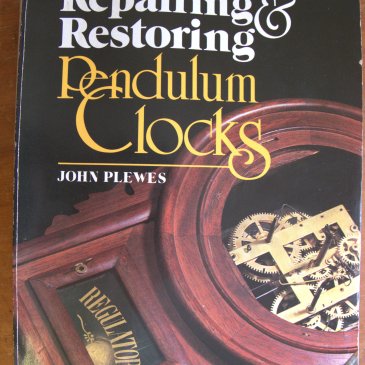
This past summer (2018) I picked up John Plewes excellent book entitled Repairing and Restoring Pendulum Clocks, published in 1984.

The table of contents describes what he covers in his book.

Contents of the book

Specialized procedures

Although the book is no longer in print it provides excellent examples of clock repair procedures by describing step-by-step instruction for overhauling and repairing many movements plus the repair and restoration of dials, and cases of antique pendulum clocks. Commonly found clocks that you are likely to inherit or find on online auction sites, flea markets and antique stores are covered.

John Plewes covers clocks from Britain, Canada, the US, France and Germany. There are plenty of diagrams and photos in the book to assist the amateur or expert repair person .

For example, Chapter 4 covers the Pequegnat Regulator #1 8-day movement.

“The finest clock made in America”; Pequegnat advertisement. This clock hangs in the Canadian Clock Museum

The clock is markedly similar to the Seth Thomas Regulator #2 shown below.

Seth Thomas Regulator #2

Plewes makes several interesting points regarding the design of this clock. He discusses the difficulty in finding a replacement weight and often the lighter Seth Thomas weight is substituted which leads to the clock stopping after a while. Plewes is surprisingly critical of the #1 at one point stating that the hands are too heavy since they influence the force applied to the train. The pendulum arc changes when the minute hand indicates 20 minutes after, as against that at 50 minutes. The solution, he feels, is to counterweight the hands or install lighter hands. Plewes opines that the whole point of a regulator is to maintain the constant arc and Pequegnat seemed to have missed that point when designing the clock.

Plewes covers a lot of ground in his book. Some of the advice is certainly beyond the skill level of an amateur clock repair person but if you are interested in growing within the world of clock repair and case restoration it will provide an invaluable resource.

Also included are safety tips, shop techniques, and a glossary of terms.

The book was last published over 30 years ago but If you can find it, and are interested in clock repair from a Canadian perspective it is well worth the cost.

A new & exciting direction in clock collecting & repair

I have been collecting clocks for over 8 years. In that time I have enjoyed my hobby immensely and I am constantly on the lookout for new and interesting acquisitions. It is more like a daily passion.

However, I now realize that as my collection steadily grows I have more than I need or want. I cherish some of my clocks and intend to keep them for years; my Arthur Pequegnats, selected Seth Thomas clocks, clocks made by the Hamilton Clock Co. and the Canada Clock Co., my Vienna regulators and some of my German wall clocks. I don’t mind parting with other clocks now or in the foreseeable future. Some I will miss and others I will not.

A house can only hold so many clocks

My daughter correctly pointed out that I should adopt a one clock comes in another goes out approach. “One-in, one-out”, she says and it makes perfect sense.

A house can only hold so many clocks. In my small office which is 10X12 I have a total of 15 clocks, 10 of which are running daily and the remainder in various states of repair. Outside my office, at any given time, there are 26 clocks in a number of rooms around the house. I am not one of those persons on YouTube who feel the need to cover their walls with clocks. I prefer to display them in a natural way, as an integral part of the decor of my home. The number is not all that important but I am trying to keep it manageable.

Kienzle clock on display with Ingraham Huron
Kienzle World Time clock and Ingraham Huron balloon style shelf clock

I have decided that now is the time to sell some of my clocks. My objective is not to make money but to recover the cost of the original purchase plus my labour on each clock that I sell. These are the clocks that have left my collection recently.

I am making more critical choices when adding pieces to my collection
Mauthe Westminster chime mantel clock, circa 1950
Juba Schatz Bim-Bam mantel clock, circa 1948
Four spandrels surrounding the chapter ring
Hermle Westminster chime with moon phase circa 1985

I have also gifted eight clocks over the last 3 years and most have been mantel clocks. Antique and vintage clocks make wonderful gifts to friends and family. It is cool to see them displayed and running in their homes when I visit though I know darn well that they are wound just hours before my arrival.

On a clock forum site recently someone said’ “How many clocks do you need”. The answer, “Just one more”

As my knowledge of the clock world grows and my experience repairing and restoring them expands I am making more critical choices when adding pieces to my collection. However, those critical choices often translate into spending more money. For example, recent acquisitions have been a Seth Thomas Regulator #2 and an Arthur Pequegnat Moncton, both wall clocks.

Seth Thomas Regulator #2, time-only, weight driven clock Circa 1922
Arthur Pequegnat Moncton, double spring time only clock, Circa 1930

I believe my new approach is a natural progression and perhaps I have been subconsciously heading down that path for a year or more. Unless a clock has an interesting provenance, is rare, uncommon, unique and/or is a challenge to restore I will now shy away from most of the garden variety clocks one sees on online for-sale sites and yes, I still have a few of those.

On a clock forum site recently someone said’ “How many clocks do you need”. The answer, “Just one more”.

I knew during the course of collecting antique and vintage clocks combined with increased knowledge/experience that my hobby would evolve and continuing my horological journey in a slightly different way is about time,

Tick Talk Tuesday #20 Pequegnat Classic mantel clock $6 online purchase

The Classic, made by the Arthur Pequegnat Clock Co.

Tick-Talk Tuesday is about the letters and comments I have received from you, the reader, concerning your clock, issues you might have had, challenges you face or a clock you would like me to profile and my responses to your questions with advice on your particular clock concern. For those comments and questions that stump even me, I consult within my clock circles for the best possible answer

DS from New Brunswick, Canada writes, “Good day Mr. Joiner, I have purchased my first Pequegnat clock by accident. It was just a parts buy but I was quite surprised to see it was an Arthur Pequegnat Bedford Classic.  Now I’m looking at resurrecting this old girl. My concern is the dial. I’ve found a few few Bedford clock online but they have porcelain dials with a proper side hinged bezel but mine is a metal dial soldered into bezel so it opens upwards? I removed the bezel to try to rotate it but the only screw holes will only mount it as you see it. Would the brushed(?) metal dial have been an option or is this clearly a poor replacement. Any thoughts or opinions would be appreciated. I live just outside of Buctouch and could make the trip if you would like to see it for a closer inspection.
Thanks”

A reused label

My reply,”

Hi and thanks for your email.

Nice find. First of all it is called the Classic. The Bedford label was used and crossed out. Though not common I have seen this before.

I have attached a link to the Classic which is part of Skip Kerr’s extensive Pequegnat collection. You will see that his clock has a smaller (original) dial which is in keeping with the size and style of the case.

http://www.skipkerr.com/image.aspx?id=832

It is a Pequegnat dial though not normally for that particular clock and yes, Pequegnat made brushed metal/painted metal dials. I have never seen a Pequegnat clock with the hinge in that location but you never know, it might be a variant.

It might also be a replacement. If so, I would think that the “newer” dial’s hinge would not fit if hinged on either side. Are there any screw holes at all on the left or the right? The dial is soldered to the bezel? That is unusual. I don’t see any glass?

The next is a link to an article I wrote concerning a Bedford clock. You will notice that the case is quite different and yes, the dial on mine is a replacement and larger than the original, just like yours.

Restored Athur Pequegnat Bedford mantel clock
Arthur Pequegnat Bedford model, mantel clock

Rather than change it out I would keep it the way it is, after all, it is part of the clock’s provenance.

Here is a post on the Bedford clock

Buctouch is a very pretty area.

Hope that answers your questions.”

DS replies,”Thank you sir, it was a $6 online auction purchase. I was fond of the case style and thought I could strip it and update it for our guest room, maybe even paint it (I know I used the “P” word). Once I received and inspected it couldn’t believe it was a Pequegnat. Thinking it was another mass produced import I expected missing parts and poor veneer but other than the missing glass and hands it is complete and in working order. I’m honored to have the opportunity to save this piece and will enjoy it for many years to come. The body has only one set of screw holes for the bezel, I tried to reposition the bezel then I would re-solder the face in the proper position but nothing lines up except the current position so I welcome your idea to leave it as found.

Thanks again for your advice and link I will definitely take a look. I enjoy researching and learning with each new piece I collect.

Happy hunting, DS”

Later DS wrote, “Well sir I’ve cleaned up the original case, installed new hands and replaced the glass. I believe the bezel and face may be original. There are only one set of screw holes in the case and the bezel and when I correct the bezel the wood trim on the case interferes with opening the bezel. So there it is my first Pequegnat. Thanks for the information on my clock. Now on to the next.”

Another happy Pequegnat clock collector.

Antique and vintage wall clock collection

It has taken me 6 years to assemble my collection of antique and vintage clocks. Although I have many clocks, wall clocks are my particular favorites. Check out my collection of antique and vintage wall clocks in this YouTube video I made in January 2019.

Feel free to comment.

Best clock moments of 2018

2018 was a successful year for my horological hobby in many ways. I met interesting people with fascinating stories, discovered new antique clock sources and had fun along the way. The best clock moments, in no specific order, during 2018 were:

Arthur Pequegnat Moncton

Finding an Arthur Pequegnat Moncton double-spring time-only wall clock was a big plus. This clock has been on my wish list for 5 years and I finally found one in excellent condition and the price was within my budget. This brings to seven Arthur Pequegnat clocks in my collection.

Seth Thomas #2 Regulator

The Seth Thomas #2 has been on my wish list for 5 years as well. This single weight-driven, time-only wall clock is from the 1920s. It is Mahogany veneered and like the Moncton is in very good condition. It is now hung in my front entry way.

Seth Thomas Regulator #2

August Schatz & Sohne W3 shelf clock

In August 2017 I asked for help finding a case for my Schatz movement after locating it in an antique store. Little did I realize that I would eventually have that case.

Rear plate
Rear plate

This is the result when you ask a 90 year old cabinet maker and joiner from Virginia to make a case for an August Schatz & Sohne W3 triple chime movement.

August Schatz & Sohne W3 mantel clock

A special thanks to all those who commented on articles and those who send me letters concerning their particular clock problem

Selling clocks

I sold two clocks this year not because I did not like or appreciate them but I must pare down my collection to allow space for new acquisitions. The Juba Schatz “bim-bam” time and strike mantel clock was one

Juba Schatz time and strike clock

and the other, a Mauthe Westminster mantel clock.

Acquiring new tools

Aside from small hand tools acquired this year, the most significant purchase was an L&R Ultrasonic cleaner which does a terrific job of cleaning clock parts.

Ultrasonic cleaner by L&R

Setting up and organizing my workshop

I managed to create space in my basement for an area to work on clock cases and other related woodworking tasks. A new drill press is on the far bench to the left.

New work area in basement

Cuckoo clock

My first cuckoo clock was a gift from my cousin this past year. It is in good working order but it will need a new set of bellows which will be one of my summer projects in 2019.

Dave’s cuckoo clock

Antiquevintageclock.com

I am pleased that my blog has also been very successful with over 93,000+ total views. I would like to thank all those who commented on articles and those who sent me letters concerning their particular clock issue.

I look forward to this new year and I am sure that 2019 will be an equally successful year as I further my horological pursuits.

Arthur Pequegnat Moncton wall clock

Arthur Pequegnat Moncton time-only wall clock

I discovered this Arthur Pequegnat Moncton in an antique store in Bloomfield, Ontario. I had my eye on it during a visit to the antique shop this past summer (2018), thought about it before taking the plunge later in the fall to buy it. These clocks do not come up very often and the price was right.

The Arthur Pequegnat Clock Co. made clocks in Kitchener, Ontario (Canada) from 1904 until the company closed its doors in 1941. The clock firm was originally founded in 1903 by Saas & Ford but was purchased by Arthur Pequegnat the following year.

Canadian clock collectors are very familiar with the name and associate Arthur Pequegnat clocks with solid construction, robust movements, conservative designs and nationalism since many clocks were named after towns and cities in Canada. However, the use of city names began to decline in the late 1920s when models such as the Eclipse and Swan were introduced. Arthur Pequegnat also showed his patriotism to the Royal family and to Canada and therefore named a number of models, the Monarch, the King Edward, the Maple Leaf, the Dominion, the Canadian Time and so on.

Pendulum, beat plate & centre cut rounded bottom

Pequegnat made mantel, parlour clocks, as well as Mission, kitchen, gingerbread, tambour, wall, and floor models (hall clocks). In most households of the period, a clock was a decorative status symbol, not just a timepiece, and was displayed in a prominent place in the home—usually the parlour.

Prices increased over the period the Pequegnats were in business but ranged from four dollars for the Midget to seven dollars for the simple round Toronto model, to $112 for the Alberta floor model in mahogany. The wide variety of designs and relatively low prices appealed to many Canadians. Today, the appeal of these timepieces remains as Pequegnat clocks are sought after by Canadian collectors.

This, the Moncton, is the seventh Arthur Pequegnat clock in my collection. This clock is named after a city in the province of New Brunswick (Canada). It is only fitting that Pequegnat supplied clocks to the railway as Moncton was once a rail hub for the Canadian National Railway.

This clock is in good condition overall. It has a 12 inch Arabic dial with simple, bold numbers. The pierced spade hands are attractive and are a feature on many Pequegnat wall clocks. It has a fumed quarter-sawn oak case, is 35 inches high with a hinged 16 inch oak bezel door that swings to the right to reveal the dial. The drop door is 14 ½ inches high by 10 ¾ inches wide and also swings to the right. The clock is 5 inches deep with wall stabilizers on either side of the case. The pendulum bob is brass over iron with an oak pendulum rod. The dial glass appears to be original and has the “waviness” you would expect with glass that is over 80 years old.

View of lower case

Although the lower glass has the same waviness it appears to have been changed out early in the clocks life as the retaining rails look to be replacements. Unfortunately, it is missing the label. Other minor issues are a small scratch on the dial face that is visible when the light is right and a screw hole on the back panel just below the beat plate to secure the clock to the wall. Evidently the stabilizers were not used.

This clock was made after 1916. Those made prior to that date were inscribed “Berlin” (Ontario) on the dial. On 1 January 1917, anti-German sentiments in Canada during the First World War spurred residents of Berlin, Ontario to change the city’s name to Kitchener. This is the only definitive way of dating a Pequegnat clock so, this clock would be between 80 and 100 years old. The Moncton wall clock was manufactured almost as long as the company was in existence.

The Moncton is a 15-day time-only clock with two winding arbours on the dial face. This is achieved by means of two mainsprings both of which are wound at the beginning of the running cycle releasing their power together. Two other wall clocks, the Regina and the King Edward (variant) were also available with a 15-day double spring movement. However, unlike most spring driven clocks that have recoil escapements this movement has a Graham deadbeat escapement which contributes to its accuracy. The seconds hand is not a true second hand and runs off the escapement taking 80 beats to complete the “minute”. As a testament to its accuracy and dependability many of these clocks were ordered as train station clocks across Canada.

Two winding arbours for double spring time-only movement

The “Moncton” came in two basic styles. One was made for Canadian National Railways and was five centimeters (two inches) shorter than the regular model.  Some such as this one, were fitted with a seconds hand on a separate dial above the main hands. This feature is also found on the Regulator I which was Pequegnat’s most accurate model. The 1st Issue was 33 1/4 inches high by 15 1/2 inches wide with the  triangular bottom. The 2nd issue of the clock has a height of 33 1/4 inches and a width of 16 inches with a centre cut rounded bottom. The 2nd issue clock is also found with cases that measure 35 inches in height such as this one.

Moncton first issue, Roman Numeral dial

The “Moncton” was first featured in the 1913 catalogue and the again in the 1918, 1920 to 1925 Wall Clock catalogues and Pequegnat’s final catalogue put out in 1928.

The Moncton closely resembles the Seth Thomas #2 in size and shape down to the seconds hand, 80BPM and beat plate but unlike the #2, the Moncton is spring driven. The Moncton was an alternative to the #2 which was a well made American regulator but costlier and with a shorter running cycle.

Seth Thomas Regulator #2

The seller tells me that the clock came from the north of Toronto (Ontario) and apologized for not knowing more about its history. He has had it for about 1 ½ years.

I removed the dial to inspect the movement. As expected it is large and heavy with solid plates mounted to an iron frame. It is not difficult to see that it was designed to be rugged and dependable. I did not check the back plate but judging from what I see on the front plate there appears to be little wear. The first wheel on the right side is the only one that has a newer bushing. Given its condition it was well cared for and did not have a hard life.

Large and heavy time-only movement

This clock has been on my wish list for some time.”Monctons” are up for sale from time to time, but they are getting harder to find. I have seen examples come and go but this one is in great shape and the time was right to add it to my collection.


The Canada Clock Company (Hamilton Clock Co.) – a brief history

If one were to ask those with a keen interest in Canadian antique clocks, the word Pequegnat would immediately come to mind. Pequegnat produced clocks for close to 40 years and left an indelible mark on Canadian culture.

Predating Arthur Pequegnat is a lesser known clock maker (or clock-makers) that made clocks between 1872 and 1884. The Canada Clock Co, and the Hamilton Clock Co. struggled over a 12 year period to put Canada on the clock-making map. In 1872 the Canada Clock Co. established itself in Whitby, Ontario (Canada) but lasted just 4 years before failing, though largely due to a devastating factory fire.

Case is in fair condition, dial face has some flaking
Canada Clock Company cottage clock

Out of the ashes came another attempt in 1876 and key principles including manager John Collins moved to Hamilton and set up the Hamilton Clock Company. After 4 years this new company also failed and production halted in 1880. In late 1880 one more attempt was made to establish a new company called the Canada Clock Company resurrecting the old name. It is still based in Hamilton at the old Hamilton Clock Co. factory. Success was short-lived as the company declared bankruptcy in 1884 ending a dozen years producing clocks for the Canadian market.

Although both movements and cases were made in Canada they were copies American styles

Canada Clock Company, Prince of Wales parlour clock

Canada Clock Company, City of Hamilton parlour clock

I have grouped the clocks from the three companies and these are their characteristics. The most common clocks found today are the weight-driven, thirty-hour “Ogee” style, with colourful birds or flowers surrounded by a black background on the glass tablet. At least five different labels are known, four have a beaver on them. The large printed paper label was located inside the case on the lower back. Spring-driven mantel clocks with plain cases were also made with thirty-hour movements. Although both movements and cases were made in Canada they were obvious copies of American styles.

Hamilton Clock Co Gothic steeple clock
Hamilton Clock Co Gothic steeple clock with etched glass tablet

Loss on the clock label
Clock label showing the Hamilton Clock Company factory

Also produced was a spring-driven “school house” wall clock.

At least sixty models of spring-driven mantel clocks are known, with both thirty-hour and eight-day movements.  Most of the door tablets (Canada Clock Co.) have acid etched glass designs, unique to the two Hamilton-based companies and done in association with a local glass factory. Wall clocks are also found with the Canada Clock Company, Hamilton label.

The most desirable clocks are the ornate time and strike parlour clocks such as the City of Hamilton and Prince of Wales pictured above.

Unfortunately, a valiant attempt to grow a home-bred clock company failed miserably. However, the clocks of all three companies are highly sought after by Canadian collectors today.

Website Powered by WordPress.com.

Up ↑