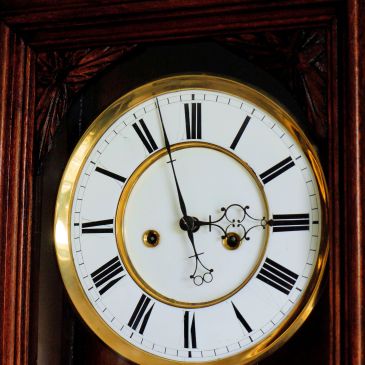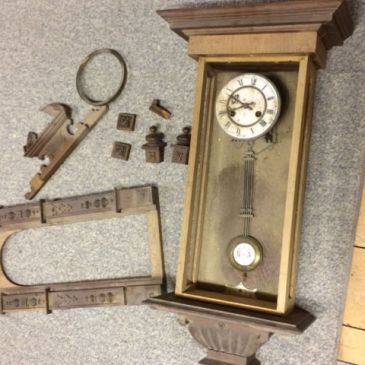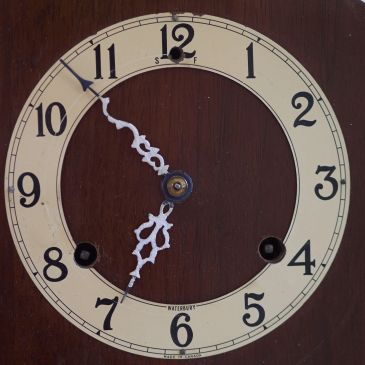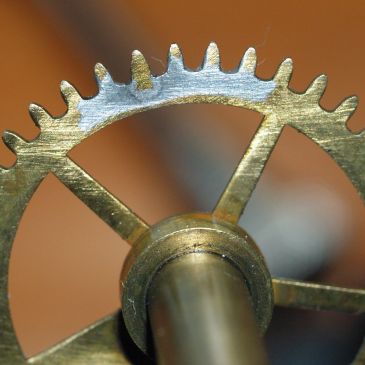
Tick-Talk Tuesday is about the letters and comments I have received from you, the reader, concerning your clocks, issues you might have had and challenges you face and my responses to your questions with advice on your particular clock concern(s). For those comments and questions that stump even me, I consult within my clock circles for the best possible answer.
WC writes. “Hello Ron. I enjoy your blog. I came across it by investigating a repair for my Chelsea Vanderbilt ships bell mantel clock, passed along from my Grandfather’s estate. I was hoping you could give me some advice on a repair issue. 2 1/2 years ago I shipped the clock to Chelsea in Massachusetts for factory overhaul. Six or seven weeks later the clock was returned, and has functioned beautifully, after 15 or 20 years of dormancy.
Yesterday I went to wind the clock side on the usual schedule of once a week, and the key spun violently backwards in my hand.There is now no tension in the winding port, I suspect the spring has snapped. The basic overhaul charge was nearly $500, and the warranty was 2 years parts/ maintenance. Since there is no consultation available with Chelsea, I am reluctant to ship the clock back for additional repair, not knowing what on earth they would charge me again, as another $500 would rock the boat on this end. I could investigate names of clock-maker/ clock repair sites in the greater Bay Area, where I live. Is this Chelsea that challenging of a repair?
The clock holds some sentimental value, but surely not enough to lose sleep over. Thank you, your thoughts are greatly appreciated.”
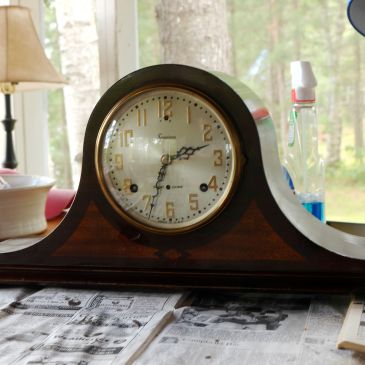
Similar to clock in this article
I wrote to WC and explained to him that I have not worked on one but I do know that this is not a clock that a novice or intermediate repair person would tackle. One of the issues is that only those who are authorized to repair them have access to the parts since Chelsea places limits on parts distribution so that they can perform repairs in-house. I explained that he may be experiencing a failed click. These movements are more prone to click return spring failure than main spring failure. Oftentimes when a click fails it takes other parts with it, i.e. secondary damage. However, the design of this clock makes it easy to take out either spring without disturbing anything else. If the click has let go and nothing else is damaged I advised him that he can fix the mainspring and click on his own or take it to a competent repair person in the area where he lives to effect the repair as long as it does not require additional parts. If the issue is limited to a failed click the repair cost would be far less than a more extensive repair.
The issue is whether or not Chelsea will stand by their warranty. WC has since corresponded with Chelsea and has sent the clock in for repair. They will assess what needs to be done and will consider the fact that it is just off warranty.
Let’s hope there is a happy ending to WCs plight and that Chelsea takes a reasonable approach in dealing with WC.
I acquired my Ansonia drop octagon clock in April of last year (2016) and put off servicing this clock because it was in good running order, kept good time and I had a number of other clocks that needed more attention. Now it’s on the bench.
Last week I wrote that I was in the process of deciding whether or not to purchase this Swiss made Jaeger LeCoultre musical alarm clock. I saw it in an antique store in Langford, BC (Canada) and went away thinking about it. I had several questions in my mind as I walked away.
The seller was asking CDN199; a fair price?
Is it collectible?
I would like to narrow the vintage, the year it was made, thoughts?
I ended up not buying this clock for three reasons
3 days later the same seller decided that he wanted CDN299 and would not negotiate a lower price.
An extensive search on all auction sites plus clock related sites revealed no references to this clock although I have no doubt that it is a Jaeger LeCoultre. That leads me to believe that it is not as desirable as other LeCoultre alarm clocks.
I question the ethics of an antique dealer where half or more of the items on the floor have no price tag.
How do I feel about passing up this clock? The seller did not get my money! It would have nice to have, but more opportunities to find a similar clock will come along and likely from an ethical seller.
Tick-Talk Tuesday is about the letters and comments I have received from you, the reader, concerning your clocks, issues you might have had and challenges you face and my responses to your questions with advice on your particular clock concern(s). For those comments and questions that stump even me, I consult within my clock circles for the best possible answer.
Stromberg Carlson master clock
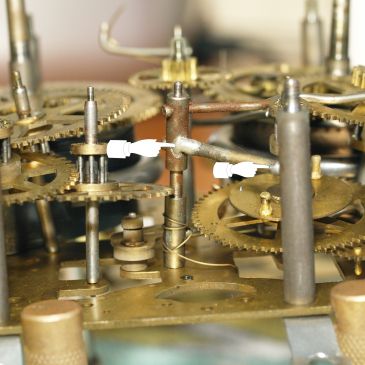
DP writes to me and asks what the lever does on the anchor (left arrow) and what happens if you move it one way or the other. He also asked about the purpose of the slot as indicated by the right arrow. The right part of the photo refers to a lower part of the clock.
Well, first of all what is DP referring to. This is a Stromberg Carlson master clock manufactured in 1947. Stromberg Carlson was a telecommunications equipment and electronics manufacturing company in the United States, formed in 1894. It was one of five companies that controlled the national supply of telephone equipment until after World War II.
A master clock is a precision clock that provides timing signals to synchronize slave clocks as part of a network of clocks. Networks of electric clocks connected by wires to a precision master pendulum clock began to be used in institutions like factories, offices, and schools around 1900. Many of you might recall the Simplex clock in your classroom which was but one slave clock among dozens in your school all physically connected to one clock, the master clock.
I do not have a particular expertise in Electric horology and asked him if I could consult within my clock circles.
Later on that day I responded. “Regarding your question (s), I gather you know that you have a master clock from which any number of slaves are run. The arrow on the left appears to be a contact activator similar to what one one might find on an IBM master clock, for 2 second contacts to advance slave clocks at a fast rate of impulse every two seconds. The slot on the right looks like it would be for an anchoring screw.”
Stromberg Carlson movement
DPs response. “As you can see in this other clock mechanism that it doesn’t have that lever so yours is a good explanation. There is 6351-M stamped on my clock mechanism. However, the clock itself is not in its original configuration. I was told that originally it was used as a master clock in a school to control all the other clocks. I was told that an electrical engineer reworked it so that it would run off of house current. Too bad that he didn’t leave it the way it was originally. You can tell from the holes in the back wooden panel and now an occupied ceramic insulator that the was much more to it.”
As DP states, his clock was converted. In fact many were converted from 20VDC to 110 volts AC. Presumably a safer way to run the clock but unfortunate because it takes away some authenticity.
In answering DPs question I have now expanded my knowledge of electro-mechanical clocks.
“Life is a box of chocolates….you never know what you are going to get”, Forest Gump
Buying a clock without actually touching and inspecting it is always a gamble and making a judgement based on images, many of which are poor quality, complicates the decision-making even further. There are stories of people buying clocks online only to find that the clock they thought had a antique mechanical movement arrived with a quartz one.
There are many challenges facing the clock shopper in today’s online world. Once your interest is piqued you may ask yourself these questions:
Did I get my money’s worth? Will I be “ripped off”?
Will it work when I get it home?
What do I have to do to fix whatever might be wrong?
What did the seller not disclose?
There are accepted rules about buying clocks on online for-sale sites. Online for-sale sites are ubiquitous and in many countries in the world. Here is an example of rules that are found on a particular site that I frequent.
All transactions should take place in person with cash. Do not ship items and do not accept other payment methods.
Never click links in an email that ask you to sign in to xxxx. All “Your xxxx account has expired” emails are fakes.
xxxx, eBay and PayPal do not offer buyer or seller protection for xxxx items. Such emails are fakes.
But for more specific rules on how to buy that special clock you were always looking for, see Ron’s Rules at the end of this post.
Follow this exchange between myself and the seller and consider my thoughts on this and other online clock purchases later in the article.
The clock
Unknown mantel or shelf clock.
Actual Ad photo
The exact words of the ad
Wind up alabaster clock. Very heavy. $80.00
The email exchange between myself and the seller
NOTE: This particular online for-sale site has an encrypted email service, therefore in my exchange I do not know the seller’s actual email address. This is a necessary protection for both parties.
Me
Do you know the company that made the clock and how old it is? Thanks
From the wording of the ad I am assuming at this point that the seller knows very little about the clock
Seller
Sorry I don’t know who made or how old it is. I bought it in an auction a few years back. Thanks xxxx
Me
Since you do not know the maker and I would have to drive from xxxxx, would you accept $60 for the clock.
Seller
Before you decide to drive from xxxxxx I would like you to know that the chimes do not work. I know that the clock would be worth more but 60.00 is fine if you would like to have it. Thanks xxxx. Let me know .
Me
If the chimes don’t work it is not a huge problem. Does it look like all the parts are there or is anything missing? I am still interested if the parts are there.
Seller
Everything is in tact. It was last serviced a few years back and worked great, but went to wind the chimes and they seemed to slip on the spring… However the clock still works just had it put away for a couple of years.
Me
For $60 I will buy it. How does 2pm today sound?
Seller
Yes we will make sure we are at home. Will you find the place OK? If not we could meet you part ways.
Later
I provided the seller with my telephone number. He subsequently calls to give me his address. The call is important because I suspect he wants to get a feel for who he is dealing with and that is the correct way to approach sales such as this.
Thoughts
It is important to be ready to pick the item up ASAP. You do not want to allow too much time for the seller to have second thoughts or to have someone else move in ahead of you. I often suggest meeting that same day, in a neutral place or at their home but most suggest meeting at their home. A neutral place is an option and I had to do this only once in over 2 dozen purchases.
My preliminary analysis based on the limited information that I have is that it is an French or English made time and strike shelf clock and judging from the problem on the “chime” side it might just be a bad click although it is possible that parts of the movement have been damaged. It is impossible to know until I see it and bring it home.
You might suggest I ask more questions about the clock or have the seller send additional photos of the movement or even a closeup of the clock face. It is only a $60.00 clock! In my experience once you attempt to have the seller take extra steps to sell their clock especially a clock at this price, the chances of a loss of sale increases. Were I to shell out hundreds of dollars I would definitely ask for more information and detailed, higher resolution photos.
Ron’s Rules
Locate the clock you are looking for online and try to avoid Chinese or Korean clocks often advertised as “31 day” clocks. (For some reason people think they are worth a lot of money and they are garbage – usually!)
Communicate by email and ask questions but not too many as to scare the seller off. Suggested questions might be:
Does the clock run?
Who is the maker (manufacturer)?
If it does not run, are all the pieces intact?
How old is it?
How long have you had it?
Would you accept a lower price because…….(justify reason(s))?
Arrange final meeting details by phone.
Meet the same day if possible.
Meet the seller in person.
Meeting at their home is preferred but a neutral location such as in front of a public building or in a mall is an option
Pay in cash.
Thank him/her for the sale.
Final thoughts
Check the dates on the listings. The longer they are listed the more the seller is inclined to sell for a better price.
Once, I gave the seller a day or two to think about my offer. I took a chance but got the clock for a decent price. (see first image)
Meeting the same day is crucial; you don’t want the seller to get cold feet and you don’t want someone coming behind you to buy the clock.
Only once did the seller accept a cheque from me because of past dealings with him. Cash is the rule.
If you cannot negotiate a final price by email suggest talking it over on the phone
Be courteous and polite at all stages of the deal
My wife and I are in the mood for a road trip. Now, with cash in hand, let’s get into the car and go for a drive.
This is Part II of a multi part series on the Sessions Westminster A chiming mantel clock.
Side view of Sessions Westminster A
Inside the plates they are a conventional Sessions clock. Outside the plates is an entirely different story
Sessions Westminster A clocks are true chiming clocks that play the Westminster chime sequences on the quarter hours and strike the hour count on the hour. The unique design combines the chiming and striking functions in one train powered by a single main spring. Between the movement plates these movements are very similar to other Sessions non-chime (strike only) movements. The going (time) train is controlled by a basic recoil escapement with the strip pallets or verge located between the plates. Inside the plates they are a conventional Sessions clock.
Outside the plates is an entirely different story. At the front of the movement one will notice that this is a rack and snail strike train but it has TWO racks and TWO snails. A look at the back of the movement reveals a small cam in the middle of the plate and a large “player drum” or pin drum. The two racks working together with the little cam and the player drum, which can shift outward to play chimes or inward to strike the hour, is what makes it all work. The chime sequence is self‐synchronizing and with so few working parts, once setup correctly this can be a relatively trouble free movement. (Source R. Croswell’sTaming the Sessions Two Train Clock)
This clock requires servicing for two reasons;
It runs for several minutes or an hour or so and then stops
The striking and chiming is very erratic. It might strike 4 o’clock one hour and 9 o’clock the next and the hammers “hang up” during the quarter hour chime.
There are a number of “exterior” parts that must be removed before separating the plates
Dis-assembly of the Westminster A is conventional however there are a number of “exterior” parts that must be removed before separating the plates. The regulator gearing, verge, drum assembly, hammers and racks as well as other parts are removed one after another. The additional parts add considerable complication to the movement and can lead to issues when servicing. I will describe two particular issues I have encountered in the process of working with this movement. I believe these issues, which I will describe later, are likely what frustrate most clock repair persons when working on the Westminster A.
Rear plate showing regulator, verge and chime drum. Clamp on mainspring
I chose to leave the mainsprings in while taking the movement apart though I contained the power using C-clamps. On this clock the mainsprings can be removed without dis-assembly. This allows the repair person to easily service the mainsprings or the clicks (which are notoriously bad on Sessions clocks generally).
Unfastening the drum and hammer assembly went without issue since there are only two bolts securing it to the plate.
The 2 racks, a unique feature, work together to produce the strike. They are located one on top of the other and are secured to a post.
Two racks stacked on top of each other. The post on the right accommodates two springs
Taking them off requires releasing a pressure washer on the top of the post. They came out easily. However, one rack is missing a return spring which might partly explain the erratic striking of the clock. Such a simple thing that may make a big difference. I may have to buy or fashion a spring.
Rack with spring
Rack without spring. The spring clips into the hole on the rack arm
Specialized tools are needed to remove some parts. Those I don’t have
Two issues.
One, I could not remove the hub supporting the gathering pallet pins seen here. It’s unfortunate because there is more lateral movement of the arbour that I am comfortable with which tells me that a bushing is required. I did not want to risk damaging the arbour and I don’t have specialized tools to do the job. I may have to live with it. However, it may not be so bad once the other bushing work is completed.
Gathering pallet pins
Two, I could not remove the centre cam despite pulling and gently prying.
Centre shaft cam
Again, I did not want to risk damaging the arbour. Specialized tools, such as a puller in this case, are required to remove it. That, I don’t have.
This clock has a unfortunate reputation for soft pivots
I will have to work around these two issues. Pressure fitted parts on any movement are very frustrating when said parts cannot be removed without special tools and this one is a challenge indeed. Re–assembly might be a little frustrating particularly with the centre arbour still attached to the rear plate which may effectively be “in the way” of positioning other wheels in place.
I inspected the pivots on the wheels and they all look good (no tapering) with expected wear for a clock of this period. I was worried because this clock has a reputation for soft pivots and perhaps because this is a later model, Sessions might have been introduced harder steel for the pivots. There is plenty of bushing work that needs to be done, however.
On to cleaning, bushing work, re-assembly and testing in Part III.
This is Part I of a multi-part blog wherein I explore the challenges of repairing a Sessions Westminster A tambour style time, strike and chime mantel clock. This part is the introduction.
Th Vintage Sessions Westminster A mantel clock
In August 2015 I wrote, “This a good project clock that is not for the inexperienced. As I gain more knowledge I will tackle this most interesting clock.” Well the time is now.
Well, it’s been two years and I have looked at this clock often enough and wondered what it would be like to finally get it running. Time to take the plunge.
The Sessions Westminster A mantel clock was made in Forestville Connecticut, USA. The first year of production for this model was 1927. Between 1903 and 1933 Sessions produced 52 models of mechanical clocks, ranging from advertisers, large and small clocks with logos of various businesses, to wall, or “Regulator” clocks, and shelf or mantel clocks, designed for the home.
Some Sessions clocks from this period are prized by collectors. The Westminster A is particularly sought after though collectors prefer it to be serviced and in running condition.
Raised Roman numerals and faux inlay
The case is in exceptional condition
The clock is tricky to repair and most horologists prefer to stay clear of it
This clock is 21 inches long and 10 inches high, has a mahogany finish with faux wood inlay and raised metal gold-coloured numerals on the dial face. It is a quarter-hour 8-day Westminster chime clock operating on two trains, the going train (time) with the strike and chime train combined. It also has small arbour just below the hour cannon to turn off the chimes/strike and is called “Silent Chime”. Sessions was not alone in producing two-train clocks and other makers incorporated this design later in the 1930’s and 1940’s. However, Sessions was probably the best known for this feature. This clock was sold in 1931 (inscription on label, back of access door). The sale price was $29.95 which would have been substantial considering a working man’s salary in those days.
Sessions Westminster chime drum
The clock is tricky to repair and horologists will generally try to stay away from it. I will be going through a step-by-step process and relying heavily on Robert Croswell’s excellent instructional manual called Taming the Sessions Two Train MovementFebruary 2016 edition.
In August 2015 I wrote, “This a good project clock that is not for the inexperienced. As I gain more knowledge I will tackle this most interesting clock.”
I have done some bushing work and from what I can see there is certainly bushing work to be done. I have removed the movement once before to replace a bad click which as easy fix since the mainsprings can be removed without dis-assembly. The click holds the tension or power of the mainspring and is identified by a clicking sound when the key is turned. But the real challenge will begin as I attempt to understand how the chime mechanism works and if I can re-assemble it successfully.
Follow me as I dis-assemble, clean and repair the movement in Part II.
Occasionally, I receive private email from readers.
One reader asked why I dated the clock to 1950
I received a couple such emails regarding my Kienzle World Time clock and it prompted me to dig a little deeper into the origin of this unique clock.
The clock is substantial, measuring 13 and 3/4″ high, 10″ wide 2 and 1/2″ deep. It is certainly a singular work of elegance, style and a genuine stand-out in any room.
Vintage single train Kienzle World Time desk clock
One reader asked why I dated the clock to 1950.
I referred the reader to this article. The article suggested that the mechanical version of the World Time was introduced the late thirties. It had a healthy production run and there were several variations. Mine was “Made in Germany” (West Germany was created in 1949) and might have been manufactured on or before 1949 which would not have prevented it from selling in the 50s. For most of the ones advertised on Ebay, 1950 appears to be the most commonly cited year of manufacture though there are no specific markings regarding date of manufacture on my clock.
It was designed in 1939 and at least one clock was made that year
However, here is some additional information which suggests that although it was designed in 1939 at least one clock was made that year though it did not go into full production until much later.
A birthday present for an infamous leader of Germany
The first Kienzle World Time clock was presented to Adolf Hitler on his 50th birthday in 1939 by the government of Würthemberg. The classical design with the world map in the “Mercator” (cylindrical map projection) style and the moving narrow scale with the time in the denoted cities came from the, at that time, Heinrich Johannes Möller, a famous designer who was working for Kienzle from 1931 onward til 1970. Möller was hired at age 27 and became Kienzle’s principle designer. The original clock had a bulky “foot” or base and was decorated with swastika patterns on the edge. After the war, the decoration was altered, the base became smaller but the general layout of the dial was preserved through all permutations of the clock, from the early mechanical versions to the electro-mechanical version and finally the quartz movements in the 80s. A curious feature of the clock is that it shows Germany to be the centre of the world.
Kienzle 24 hour time sequencer
Back of Kienzle clock showing winder and speed adjustment
The World Time clock turned out to be a long standing model and was available to purchase up until the 1996 Kienzle bankruptcy. During the period that the World Time Clock was introduced (1939) Kienzle had more than 6500 employees and a production rate of 5 million clocks.
Through the later 50s and 60s Kienzle clocks lost their stylistic prominence and followed then current (international) stylistic influences but Heinrich Johannes Möller was a significant influence not only on the design of Kienzle clocks but in the clock world in general.
Ridgeway Hamilton Country, Westminster Chime, 1996
How did we get the name grandfather clock?
Most serious clock collectors and enthusiasts do not use the term grandfather clock when conversing with each other.
Firstly, most clock collectors and enthusiasts do not use the term grandfather clock when interacting with each other. I tend to use the word when conversing with family and friends because they know exactly what I am talking about. The name first appeared in a song. In 1876, a song called My Grandfather’s Clock by Henry C. Work popularized the term grandfather clock and the name has stuck to this day. You can listen to Work’s famous song here.
Twiss Canadian tall clock circa 1890
Secondly, depending on where you are in the world this style of clock may have a different name. In England it would be referred to as a “long-case clock” while Americans prefer the term “tall clocks.” During the 20th and 21st centuries, some writers, including those writing for museum-sponsored publications, have combined regional names into one term,“tall case clock.” It is also referred to as a “floor clock”. These clocks have the following features in common. They are a tall, freestanding, made from a variety of wood, are time and strike though all modern clocks include a chime, weight-driven pendulum with the pendulum held inside the waist or throat of the case. The case often features elaborately carved ornamentation on the hood (or bonnet), which surrounds and frames the dial, or clock face.
A trio of Arthur Pequegnat tall clocks, circa 1912
Let’s go further back in history
Let’s go back in history. In the 16th and 17 century English lantern or chamber clocks were popular but they had serious limitations. Lantern clocks used a verge and foliot escapement and were notoriously inaccurate and unreliable, in fact, some had to be wound two and three time a day and were limited to a 12-15 hour run time. Many of the verge escapement with pendulums had a very wide pendulum swing.
It is widely accepted that the anchor escapement was invented by Robert Hook around 1657. An escapement is basically a speed regulator on a clock. At about the same time the pendulum was invented. The anchor escapement made for shorter pendulum swings, and heavier and longer pendulums. Since the pendulum had a lower beat a clock with an anchor escapement required less power and could run longer, up to 8 days. Only then did cabinetmakers get involved in building a case around the weights and pendulum. For an excellent article on the origin and evolution of the anchor escapement go here.
Hugh Gordon long-case clock circa 1740
As long-case clocks became popular regional styles began to emerge.
This article will explore the notion that a Vienna Regulator clock is not a true regulator. I realize that any discussion of regulator clocks produces a wide variety of conflicting opinions, nevertheless, here is my take subject of the Vienna Regulator and why it is not a true regulator.
The word “regulator” is loosely defined but according to this definition it is a master clock, usually of great accuracy, against which other clocks are checked. Respected collectors like Derek Roberts tend to stay away from defining a regulator clock and instead refer to them as precision pendulum clocks. In this article I will present three examples for the reader to consider.
Every clock that has the word regulator on it is not a regulator
Every clock that has the word regulator on it is not a regulator. Think about it. Why would a clock manufacturer put the word “regulator ” on a clock? It is simply a marketing ploy. The term “regulator” is one that connotes accuracy but in the frantic world of clock marketing it is a word that sells plenty of clocks.
If it was expressly designed as a precision pendulum clock it can be called a regulator
Definition of a regulator
It is not difficult to define a “regulator” by its mechanical characteristics. Regulator clocks were invented in the late 18th century as a quest for greater timekeeping accuracy. If the clock was designed as a precision pendulum clock it can be called a regulator. The principle features of a regulator clock are:
Quality weight driven device,
With maintaining power,
A heavy pendulum (not necessarily mercury),
Generally eight-day movement, though some are more than 8 days,
Has some form of temperature control compensation,
Has a seconds dial,
Is 60 beats per minute,
Has one gear train
Features a deadbeat or pinwheel escapement and
Is expressly engineered to keep accurate time.
Complicated features like calendars and strike trains are omitted in the quest for accuracy. Regulators were (are) capable of extreme accuracy for a mechanical clock.
Does the addition of a strike train take a clock out of the regulator category? In theory, yes. The strike train takes some of the accuracy out of the clock, as the time train produces more friction when lifting the strike levers. If we accept the definition of a regulator as an extremely accurate clock to be used as a time standard, you will not find a strike train on these clocks.
Here are three examples
Example number 1. Arthur Pequegnat Regulator #1, A Handsome Clock, fitted with a Movement which is un-excelled”, Beautiful Finish on both Movement and Case, (Arthur Pequegnat advertisement)
The Arthur Pequegnat Regulator #1 clock is often compared to the Seth Thomas Regulator #2 as a precision regulator. Many Regulator #1 clocks found their way into offices and rail stations all across Canada. The Regulator #1 is the best timekeeper made by The Pequegnat Clock Company of Kitchener Ontario (Canada). The company states this in it’s advertising: “A Handsome Clock, fitted with a Movement which is un-excelled“, Beautiful Finish on both Movement and Case” and “The Finest Office Clock Made”! They are weight driven, time-only, at 80 beats per minute, had a deadbeat escapement, with heavy pendulum, eight day movement with a brass weight hung on an iron bracket, maintaining power, a seconds dial and were designed to keep accurate time. It was a reasonably accurate clock used as a time standard.
However, some would argue that at 80 beats per minute it would not be considered a true regulator.
Is this Arthur Pequegnat Regulator #1 a regulator?
Example number 2. Mauthe “Horse Crown” time and strike spring driven wall clock.
The clock you see in the photo below is typically advertised on online for-sale sites as a “Vienna Regulator”. It is an attractively designed 1890s spring driven, time and strike clock made by Frederick Mauthe. Those individuals who sell these clocks have no hesitation in calling them Regulators. Let’s apply the definition above.
Is this a precision regulator?
A spring driven movement disqualifies it immediately.
Is it not capable of extreme accuracy.
It is 116 beats per minute
Was it conceived and designed as a precision clock? No!
Is this Mauthe horse crown wall clock a Vienna Regulator?
Example number 3. Miniature one-weight Vienna Regulator
This is an Austro-Hungarian era time-only weight driven clock made in the early 1870s. Many would accept this as a Vienna Regulator and would have no hesitation advertising it as such. It has a deadbeat escapement, it has one weight, is a time-only movement, has a heavy pendulum, with an eight day running time and has maintaining power.
Is this one-weight miniature Vienna wall clock a regulator?
Let’s apply the definition above.
Is this a regulator? No!
There is no seconds dial, and, is
80 beats per minute
Is it capable of extreme accuracy. No!
Was it specifically designed as a precision clock? No!
Granted, it is capable of some accuracy but it is not a reference timepiece. However, there is little doubt that some post office and rail clocks in the Vienna style such as this Wilhelm Bauer post office wall clock (below) were considered “regulators” in their day when common folk set their watches and clocks by them.
Is this Wilhelm Bauer post office clock a regulator?
The Vienna Regulator clock and its characteristics
The Vienna Regulator is a particular style of clock made in Germania or the Austrian empire. They are characterized by finely crafted (ornate at times) cases with accurate movements. While they were capable of keeping good time, they were not designed as a precision instrument and were not capable of extreme accuracy. They have some but not all the characteristics of a regulator but they are not a true regulator. While the Vienna Regulator may not be true regulator it reflected not only the style and craftsmanship of the period they were made but the quest for accuracy. No one can argue that the best workmanship and attention to detail were put into the many clocks that were produced during what some might call the pinnacle of clock design and engineering.
As much as they are called regulators the three examples presented above are not true regulators. Regulators were (are) capable of extreme accuracy for a mechanical clock and nothing I have in my collection remotely qualifies as a regulator.
However, in the world of clock collecting and repair it is perfectly acceptable to continue referring to them as regulators since they are generally accepted as such. The word regulator has become part of the lexicon of collectors even if they do not strictly fall within the definition of a true regulator clock.
This is what happens when you get a clock in a box. Call it a collection of parts, pieces and dust. This is an antique German Junghans time and strike spring driven clock made in the style of a Vienna Regulator. There is no serial number on the movement, dating the clock to 1899 or earlier (in 1900 Junghans began to number their movements). To some a box of clock pieces is discouraging but to me it is a challenge.
Where to start?
It was advertised on a local online for-sale site as a clock that fell off a wall during the Halifax Explosion and I thought, well, that’s an intriguing story! As most Canadians know, the Halifax Explosion was a significant event in Canada 100 years ago.
On the morning of 6 December 1917 the SS Mont Blanc a French cargo ship laden with high explosives and Benzol collided with the Norwegian vessel SS Imo in the Narrows, a strait connecting the upper Halifax harbour to Bedford Basin. A fire on board the French ship ignited her cargo, causing a large explosion that devastated the Richmond District of Halifax. Approximately 2,000 people were killed by blast, debris, fires and collapsed buildings, and an estimated 9,000 others were injured.
The result was the largest human-made explosion prior to the detonation of the first atomic bombs in 1945. Nearly all structures within an 800-metre (2,600 ft) radius, including the entire community of Richmond, were obliterated. This clock is a witness to that day. In 1918, Halifax sent a Christmas tree to the City of Boston in thanks and remembrance for the help that the Boston Red Cross and the Massachusetts Public Safety Committee provided immediately after the disaster. That tradition carries through to this day.
The case is cleaned up and we are visualizing where the parts go
It appears that the parts have literally sat in a box for the past 100 years.
The blast not only shattered the glass panels but heavily damaged the box frame. It appears that most of the parts have literally sat in a box for the past 100 years. I cannot imagine when the movement last worked, probably ticking its last on that fateful morning in December. Since the box frame was damaged beyond repair following the explosion, the seller, an amateur woodworker, built a new frame made of softwood and oak veneers some 30 years ago. You can see the lighter coloured pieces in the photo below that were never stained and finished. He admits that he knows nothing about clocks and eventually lost interest in the project. I am impressed with his skills since the work on the frame looks solid and well constructed.
Top centre final is missing as well as two other finials
The top centre final is missing, two other finials and some small trim pieces
Why was he letting it go? He said there had been a change in his life and it was time to move on. When I asked him about the history of the clock he said that his wife’s grandparents lived on Princess Place in North End Halifax. Princess Place is further south of the main area of devastation so houses in that area would have sustained heavy structural damage. The clock was blown off the wall by the blast wave. The clock remained in the family all these years, the seller having received it from his wife’s aunt.
I took it home stared at the box for a while trying to decided whether or not I made the right decision. I then set to determine what steps I should take to restore this fine clock. I poked through the box to see what was there and began to itemize the parts, arranging them on the case as best I could and proceeded to clean the case and determine the next steps. I was fortunate to have had someone send me the actual catalog image of the clock which you can see below.
The clock is called the Crispi by Yunghans. Yunghans is a reputable German clock-maker and continues in the watch business to this day. This is what the clock should look like and it will be a excellent guide for restoration. There will be obviously be some subtle differences between my clock and the clock in the catalog when the project is completed but to the casual eye it will look exactly the same.
The Crispi model in the 1902 Junghans catalog
Junghans trademark
Time and count-wheel strike movement
I have ordered the following parts from Timesavers; 3 new finials in the style that best fits the clock, 2 door hinges, 2 door latches and some trim pieces. I will have to build the bases for the finials from scratch. The lower section of an oak spindle will do just fine. There are other trim items that are missing but I will strategically arrange the remaining trim pieces as best I can.
Oak stairway spindle
The best news is that the movement is complete and in working order. The movement ran for a day on a test stand before I stopped it. It needs a very thorough cleaning which will be the next step in this project.
In Part II I will describe cleaning the movement and any issues that may arise as a result of disassembly.
In Part III I will explain the procedures involved in the case restoration once the remaining parts arrive.
What most people visualize as the Schoolhouse clock
My recent acquisition of another schoolhouse clock stimulated my curiosity and prompted me to do some research on the origin of the name. In this article I will describe my thoughts on how the schoolhouse clock came to be and my most recent Sessions wall clock purchase.
During my research I found it very interesting that little can be found regarding the history of the schoolhouse clock. I realize that many older readers growing up in the rural areas of Canada and elsewhere in North American have fond memories of the one-room schoolhouse with a large clock in either the front or the back of a classroom. I did not live that experience rather, when I was young and attending a large urban school the Simplex master / slave clock is the one I remember best.
The schoolhouse clock that I bought recently adds to my modest collection of three schoolhouse clocks. Given that I spent many years as an educator, it seems only fitting that I would have an interest in schoolhouse clocks. My schoolhouse clocks are all a similar style; short drop octagon, constructed of oak, brass dial bezel, bottom glazed access sash, 12 inch dial or 9 inches as in this case of this clock and the Waterbury pictured below. Although 9 inch clocks were used in schoolhouses they were also found in office or workplace settings.
They were not called a schoolhouse clock when they were made
Schoolhouse clocks were the standard design for early North American school houses because of their larger, easy to read dials. These distinctive clocks were hung in many schools rooms across Canada. The majority had simple but tough time-only movements and some even came with a calendar function. Occasionally they were ordered with time and strike movements but the cheapest and most popular versions were time-only. This type of clock had a very utilitarian look and function.
They were not always called schoolhouse clocks. None of the labels on my clocks have the word “schoolhouse” written on them and are either described as a”drop Octagon” in the case of this Sessions or have a specific model name. The term schoolhouse clock was not applied to them when they were made but came to be known as a particular style of clock found in school settings by later collectors. If a particular style was ordered by a school authority makers might have informally described them as clocks for schools or “school clocks”. In any event, the term has become a permanent part of the clock collector language.
Label on back of Sessions clock
With a swinging pendulum visible from a distance the clock can easily be seen running and the open-door bottom access sash allowed for restarting and adjusting the rate. In some clock collecting circles it is said that schoolhouse clocks are a derivative of the English drop dial fusee clock, an example of which can be seen here. Drop dials were produced in the late 18th through to the 19th century and closely resembled the schoolhouse clock. Unlike spring-driven schoolhouse clocks, fusee clocks have conical construction from which a chain or gut-line is pulled by the mainspring barrel allowing the power of the mainspring to be released evenly thus assuring better accuracy.
When I am in the process of buying a clock I always ask the seller this question. “How much do you know about this clock?”
When I am in the process of buying a clock I always ask the question. “How much do you know about this clock?”. I always ask this question because I am interested in a clock’s provenance and some of the stories are quite intriguing. The seller, a man in his late fifties, thought about it for a moment and said, “Well, I’ve had it since I was 14”. The clock came out of a decommissioned one-room schoolhouse in a small town called Springhill, Nova Scotia (Canada). However, when I first saw the clock I said to him, “It looks like a nice office clock”. The seller quickly corrected me and said, “It’s a schoolhouse clock”. “It runs for a little bit and then stops, maybe you can do something with it”, he added.
It is a 1920’s vintage Sessions Drop Octagon wall clock. It has a solid medium dark oak case with original hands, ornate pressed brass pendulum bob, solid brass bezel, 80% of an intact label on backboard, tin dial pan and stenciled lower glazing on the sash. The paper dial is original but it is heavily “foxed”. The movement is 8-day time only. The dimensions of the clock are a 9″ diameter dial, 19″ high, 13 1/2″ wide by 4″ deep. It is in reasonably good condition given it’s age and for $20 it was quite a bargain. It is also intact; there are no missing or broken pieces.
Sessions time-only movement
I don’t think this clock has been run in quite some time.
I took it home, hung it on the wall and true to what the seller said it would run less than a minute and stop. I noticed a rubbing sound around the pendulum area as it was running. The pendulum bob was hitting against the inside front of the case. I took the movement out and observed a bent crutch rod, corrected it, put it on a test stand and it ran immediately. As expected the movement had quite a bit of grime and required attention but it ran for a day before I took it apart for a thorough servicing. I don’t think this clock has been run in quite some time.
I found it curious that the suspension spring was soldered where the spring hooks into the top block. It likely kept slipping off and solder was used to keep it in place. In any event, the spring cannot be taken out without first removing the solder! The clock is in very good overall condition for it’s age and the movement was not as dirty as I first thought. The pivots are in decent condition for the most part and there is minimal wear overall. The movement was disassembled, cleaned and in the process I decided to install two bushings for added insurance, one on the escape wheel (front plate) and the other on an intermediate wheel (front plate). The movement was tested, put in beat and reinstalled back into it’s case.
I may replace the paper dial but I am going to see if I can live with it for the time being.
The dial has many brownish spots as you can see in the next photo. The clock had to have been in a moist environment for a long period for the paper to discolour. My two options are, one, leave as is or, two, replace with a paper dial. I may replace the paper dial but I am going to see if I can live with it for the time being. The brass bezel cleaned up well but the exposed tin surrounding the paper dial has blackish areas which I managed to reduce with CLR but could not totally eliminate. Of course, I later learned that CLR is really not appropriate for this purpose as it is an acid.
Dial showing rust staining
The case has years of grime which was easily remedied with Murphy’s soap and water. It cleaned up very nicely. Following the cleaning I gave the case a light coat of shellac to restore the luster of the oak. It looks good and it runs well.
My other drop octagon clocks are a Waterbury Arion, an unknown Ansonia and an Arthur Pequegnat Brandon II.
This Waterbury Arion is 19 inches long
Ansonia short drop octagon, model unknown, 12 inch dial
Arthur Pequegnat Brandon II, 12 inch dial
Time-only movements are the easiest to work on and a very good movement to learn on.
Repaired Sessions Drop Octagon clock
Time-only movements are the easiest to work on and a very good movement to learn on. If you are a beginner in clock collecting and repair clocks such as this are satisfying clocks to work on and presents few challenges. I am happy that I managed to bring this particular clock back to it’s former schoolhouse glory.
The term schoolhouse clock is a term that was not applied when they were made but came to be known as a particular style of clock found in school settings by later collectors. The schoolhouse clock is such an endearing name that when one thinks of a schoolhouse clock the memory of these specific styles of clock immediately comes to mind.
Sadly the number of antique shops in Nova Scotia is dwindling. We were antiquing in the city of Halifax (Nova Scotia, Canada) this past spring and one of the store owners remarked that there used to be dozens of antique shops in the city, now only a few remain. There are still a few antique shops left in the rural areas and one of our favorites is located in Great Village, Nova Scotia. We decided on a little drive to Great village on a sunny fall Sunday. We were not disappointed in the variety of clocks we discovered. Although I saw all the following clocks during our day of antiquing I bought only one, the Kern “diamond face” 400 day clock (see photo below).
Window display
Unknown French clock
I want to give readers a sense of what is out there if you are collector like myself or you are new to collecting. Now is an excellent time to buy. There are certainly deals to be found and plenty of clocks in the shops. My personal experience is that the antique stores are great places to buy clocks but it can be bit of a gamble. For example, the Kern 400 day clock was advertised for a very fair price complete with glass dome. I asked the store owner if they knew anything about clocks and they said “no, nothing at all”. Sometimes that is a very good answer! The tag on the clock said “as is”. The owner evidently thought the pendulum balls were seized. Prior to the purchase I discovered, that they were, in fact, in their locked position. I got the clock home, unlocked it, gave a little push and it has been running for the past week.
Stamps for sale
You can get a “steal” of a deal, a clunker or something in between in an antique shop. In this same shop two years ago I bought an Arthur Pequegnat Brandon wall clock for under $200. The case is in excellent shape as is the dial but the movement, though barely running, required servicing. Even though I had to put a little more money into the clock I still consider it a great deal!
Having some knowledge of clock models, styles and types in particular is an advantage. Or, perhaps you might have a good sense that what you are looking at is a good deal. In the case of the Kern 400 day clock I inspected it beforehand and found that it was not only complete but in excellent condition. The $58 Garrard time and strike (photo below) might be a good deal but if it is missing the pendulum you are going to have to search long and hard for a replacement or buy one which adds to the cost. You might ask yourself, what else is missing and how much more money would I have to put into it? The Garrard was missing the front glass and I could not figure out how it was attached so I passed on it. Those are some of the factors to consider when you see something at an attractive price.
A doomed Ogee
In the case of the carriage clock (first photo) the seller wants $120 but the day I was there they were offering a 20% discount which works out to $96. There is a jewelers inscription on the front which says Ryrie Bros. Toronto. Ryrie Bros was a jeweler in Toronto and was incorporated in 1905 with James Ryrie as president and W.M. Birks as vice president. In 1924 the firm changed it’s name to Ryrie Birks and finally in 1933 became Birks. As any Canadian knows Birks (Maison Birk) is one of the premier jewelers in this country. One could comfortably date this clock at between 1905 and 1924. Although the tag says that it is French it is likely American. It might be desirable however there are two bothersome issues that I could see right away with this carriage clock. One, the left side beveled glass panel has a chip in the lower back corner and two, there are noticeable hairline cracks in the upper two corners of the face. The tag said it was in working order. $96 may not be a bad price when you consider that comparable clocks fetch upwards of $130 or more + shipping on Ebay. If it is still there before Christmas I might take a second look.
Unknown “marble” desk clock
This unknown “marble” desk clock was very interesting and quite heavy. It had an alarm clock style movement with a key wind and an adjustment for the time, and what appears to be brass bird (duck?) on it’s right side.
Kern diamond face 400 day clock
As I mentioned I bought this Kern 400 day “diamond face” clock. It is in excellent condition; unlocked the pendulum, oiled the movement, gave it a gentle push of the pendulum and now running very well.
Could be Sessions, Ingraham, Ansonia
In decent shape, 1873 it said on the label, but the seller wanted too much, $450 if I recall. The seller claims it is running, according the tag. Is it a Sessions, Ingraham, Ansonia or …..?
Sessions shelf clock in oak case
This clock looked to be in decent shape, the strike side appeared to be working properly. The case is oak but when I picked it up to examine it more closely, the construction, fit and finish had a cheap feel. There was a card inside describing a servicing performed in 1994. $68 – a little high, I thought but there may not be a lot wrong with it.
I like this clock but know very little about crystal regulators. What I do know is that most American companies made them, from simple brass and glass cases to elaborate cases with cast and gilt ornaments. Equivalent French examples seem to be more valuable than American ones. They can be highly expensive. Generally, the more elaborate the case, the more expensive the clock, even though the simple cases could easily be considered more tasteful. I remember seeing a very ornate one on Antique Roadshow which was valued at $8000. Condition is very important with these clocks, including the condition of the beveled glass, dials, and original finish (generally gilt) on the case ornaments. Is the pendulum supposed to be filled with anything? Mercury? These cylinders looked empty. The seller claims the clock is running and wants $365. A fair price? I don’t know. It needs a thorough cleaning though.
Garrard mantel clock
This English Garrard clock had a well constructed case and appeared to have a well-made, robust movement but was missing its front glass. I have been to this particular shop several times and nobody seems to be interested in the clock though the price has not changed.
Seth Thomas made by Talley Industries
I noticed a Seth Thomas mantel clock in a dark corner. This particular example is one that I would not recommend to anyone unless you are a fan of Talley Industries. It is a Seth Thomas Westminster chime mantel clock made by Talley Industries, Peterborough, Ontario in the early seventies with what appears to be an imported West German Hermle movement. This clock was cheaply constructed (corners were chipped), likely has the dreaded plated pivot problem and has absolutely no collector value. Those in the clock collecting world familiar with Seth Thomas know that it was a reputable clock maker for many years and produced many fine clocks but the Talley Industries era must have been a very dark period for the company!
A unique clock design
I hope this blog article gives the reader some ideas when it comes to antique shop clock shopping. It certainly pays to do your research. Although I love browsing the shops I do not limit my shopping to them. I acquire many of my clocks from a variety of sources including Ebay, Kijiji, and word of mouth but I like browsing through antique shops because there are always other interesting items that catch the eye.
When I bought my Ingersoll-Waterbury clock a year ago I knew that it had not been serviced but the price was reasonable and it was running. I got a lot of other projects out of the way and have finally gotten around to giving this clock a little care and attention.
Ingersoll-Waterbury clocks were sold in Canada; had Canadian made cases using American made Waterbury movements and were sold in department stores across Canada. This clock was distributed by the G. R. L’Esperance Co. from Montreal, Quebec. The label on the inside of the back access door says “Ingersoll-Waterbury Co. a division of Waterbury Clock Co.”. Ingersoll-Waterbury was the Canadian arm of the Waterbury Clock Co. Year of manufacture, I am estimating was somewhere between 1940-1944 when brass was in short supply.
The case is in very good shape though it was likely inexpensive to make. Some cost savings are evident in the use of a paper dial, flimsy clock hands and a plastic bezel with flat glass. However, I was impressed with the well designed and sturdily built movement and surprised that it did not take much to service this clock.
The front of the case has a swinging door
One unique feature is a swinging door with plastic bezel and flat glazing attached to the case by two hinges that open up to reveal the clock face and hands.
Brass bushing punched into a steel plate
The clock has a steel frame with a brass electro-plating as a rust inhibitor and brass bushings punched into drilled holes in the steel. Steel plates are not unusual as there were a number of manufacturers which used steel as a cost savings measure, for additional strength or because brass was in short supply. The plates were often plated with nickle as in the case of Arthur Pequegnat clocks or brass as in the case of this clock. One of the first things I noticed when I dis-assembled the clock were the number of punch marks adjacent to the bushings an example of which can be seen in the next photo. It must have been difficult to achieve a tight fit for the brass bushings; factory punching ensured that the bushings remained in place.
punch mark next to a bushing
I have just completed the servicing. The clock required three new bushings. Punching new brass bushings into the factory bushings took a little more care and attention than usual as I did not want to loosen the existing bushings.
8-day time and strike movement
Dis-assembly, cleaning, servicing the mainsprings, installing new bushings are no different than any other American movement. Re-assembly of the strike side requires the synchronizing of the strike side by aligning the levers and wheels correctly which usually takes several attempts for me.
The one real challenge I had was aligning the strike hammer so that it would actually strike the gong. I must have bent it when I took the clock apart. What was I thinking? I could not see the solution so I put it aside until I came up with the fix. I ended up bending it back to its correct position.
While re-installing the movement into it’s case I noticed something strange on the bottom of the clock, a mysterious hatch. On the bottom right hand side of the clock (indicated by the arrow) there is a hatch that measures 2 3/8 inches by 2 3/8 inches. On it there is an inscription which reads
“FRONT, if you know what this hatch is for, you know more than I do” signed J.H.Ross May 24, 1967.
“Front” refers to the orientation of the hatch. What is it for? I posted this on the NAWCC discussion board site and so far no-one has come up with the answer.
Arrow showing where hatch is located
Why would anyone put a hatch on the bottom of this mantel clock?
Where hatch is located
Was the hatch added later on? There is a lighter colouring of the wood to the left of the green felt which seems to indicate that a hole was cut out later to accommodate the hatch.
The hatch is open
A clasp on the other side of the hatch secures it in place and allows it to be removed.
Bottom left side
Was the trap door a chamber to hide items? Why, when it simply opens up into the case interior.
View of bottom of case
And there’s more! Here is a view of the entire bottom showing a second cutout (see arrow) on the left side. Why go through all this trouble?
The clock is all back together and in the process of being regulated but I sure would like to solve this mystery. It has taught me one thing, always look at the bottom of a case.
My next project is this vintage Ingersoll-Waterbury time and strike mantel clock. Ingersoll-Waterbury clocks were sold in Canada and had Canadian made cases using American made Waterbury movements. G.R. L’Esperance of Montreal were the sole distributors of Ingersoll-Waterbury clocks in Canada.
Waterbury has a long history going back to 1857. Like many American clock companies the Waterbury clock company had its boom periods (late 1800s) and its low period (1930s). In 1942 a Norwegian company ended up buying the Ingersoll-Waterbury Company. They built a brand new factory in the nearby town of Middlebury, CT. and in 1944 the company name was changed to United States Time Corporation; this clock was made prior to that year.
What makes this clock interesting is that it actually has a steel frame with a brass electro-plating. The plating was evidently used to stave off rust. It is very likely that this clock was made at some point through the war years (1941-44) when brass was in high demand hence the use of steel for the plates. To accommodate the pivots, brass bushings which were pressed into the steel pivot holes at the factory. My only other experience with steel plates is my Arthur Pequegnat Maple Leaf kitchen clock which has nickle-plated steel plates. The Maple Leaf by Arthur Pequegnat is shown in this next photo.
Arthur Pequegnat Maple Leaf kitchen clock with nickle-plated movement
Waterbury back plate
As you can see the movement is quite dirty and will require a thorough cleaning which can only be accomplished by a complete dis-assembly. Once disassembled comes the inspection and servicing.
Centre canon repair
Punch mark adjacent to bushing
Reverse side of punched bushing showing oil cup
This clock has never been bushed. The punch marks found adjacent to three of the bushings were likely factory made to set the bushings in place. There is one tooth repair (fourth photo) on the centre canon gear which appears to be the only evidence of work performed on this clock after it left the factory and the only indication that this clock was ever serviced.
The case is in very good condition requiring only a cleaning and polishing. I may touch up the clock hands with a little white paint.
I have determined that only 5 bushings need to be “replaced”, so time to get started. I will report on my progress with this clock in an upcoming article.
In this fourth and final entry of the series I will discuss bushing work, re-assembly and finally, testing and mounting the movement back into it’s case. Part I of this series can be found here, Part II here and Part III here,
Once the pivots are inspected, cleaned and polished it is now time to install any bushings required as result of careful inspection.
Bergeon Bushing Machine
I acquired a Bergeon Bushing Machine in the spring of this year (2016). As I mentioned in Part III, some may prefer to bush by hand which I think is commendable but I have decided to go the bushing machine route. In the last few months I have been using and learning its many tools. It comes with a set of chucks and reamers some of which (right side rear) are a bit of a mystery to me. I cannot see using any of the large reamers any time soon though I assume that if I am working on tall-case clocks which have larger movements they would come in handy.
Chucks and reamers
First is selecting the correct bushing using a micrometer to measure the diameter of the pivot. Then, I select the proper bushing from my Bergeon assortment kit.
Using a micrometer to check pivot diameter on the escape wheel
The bushing I have selected for the escape wheel pivot (measured at 1.46 mm) has a depth of 2 mm, an outside diameter of 3.5 mm and a pivot hole of 1.5 mm. In the next photo I am positioning it on top of the 3.47 mm. hole that I have just just “drilled” using one of the reamers. The outside diameter of the bushing is slightly larger allowing for a tight friction fit.
Positioning the bushing on the Bergeon Bushing Machine
Bushing installed
Once I have selected the correct bushing I test it on the pivot for fit and then I position it over the pivot hole and use a small hammer with it’s nylon end to tap the top of the bushing machine centre shaft lightly until the bushing is properly seated and level with the plate ensuring that the oil sink faces the outside of the plate.
New bushing installed with oil sink on the outside of the plate
To check proper fitment of the motion works bushings/pivots, I assemble all the wheels on that side (both plates), check for a smooth action and determine if any additional reaming/smoothing is required. I do the same for the strike side.
Once all the bushing work is completed and I am satisfied that each bushing fits correctly and operates smoothly, I re-assemble the mainsprings, wheels and levers and then re-attach the back plate using the five plate screws. We each have our own method of re-attaching the back plate but I work from the bottom up, that is, from the mainsprings. Once I have the mainsprings in place I immediately install the bottom 2 plate screws (loosely) and then work from the motion works side to the strike side using a pivot locator tool, if necessary, to coax the pivots into their respective holes.
Trains and levers ready for the front plate
Positioning the various levers can be a bit frustrating because those that have helper springs seem to slip out of their pivot holes easily as you are putting the plates together. Perseverance is certainly the key.
The one difficulty I had was adjusting the synchronization of the count and drop levers, that is, getting the drop lever to sit in the cam while I adjusted the locking lever position. The clock must be completely assembled at this point and once together loosen or take off the nearest pillar nut and pry the plates apart to take out both the flywheel and the locking wheel. Once out, the locking wheel can be re-positioned by moving the pin on the wheel so it rests on the locking lever. Once this is completed, re-install the flywheel. This is basically a trial and error process and I never seem to get it right the first time.
My only error in the first go-around was not restraining the strike mainspring during this procedure. While spinning wildly the strike mainspring flattened the protrusions off the cam that allows the hammer strike. Momentary panic! Once bent back into shape everything was fine. Naturally, I secured the mainspring for my second successful attempt.
Once the parts are re-assembled it is on to the final testing phase which takes days (and weeks, perhaps) as the clock is being carefully regulated. The following video shows the movement on a test stand (in this case, Gene’s Test Movement Stand). The sound of the pallet on the escape wheel is very quiet; you are hearing other clocks in this room. The clock is in beat and in the video you can see the movement of the escape wheel from various perspectives.
The movement is returned to it’s case
Once testing and regulating is completed and I am satisfied the clock will run reliably for 8 days I return it to it’s case. There are only 4 mounting screws. You may have to re-position the coil gong by loosening the adjustment nut on bottom of case to get that satisfying strike sound.
This attractive little Sessions American No. 2 time and strike mantel clock has now been serviced. It required 5 bushings and should run reliably for the next 3-5 years.
The movement is disassembled and now it is time for further inspection, cleaning, servicing the mainsprings, pegging the pivot holes, polishing the pivots and installing bushings where needed. In this, Part III we will cover cleaning and mainspring servicing.
Ultrasonic cleaner
I have a small ultrasonic cleaner so I tend to clean parts in batches since this one does not have a large capacity. An ultrasonic cleaner is not an absolute must as you can easily clean by hand but having one certainly helps.
Front and back plates
Old toothbrushes are great for getting into the crevices and I use one especially for the lantern pinions as a lot of dirt and old oil tend to accumulate in those particular areas.
indicating where bushings will be installed
This photo shows a couple of bushings that I will install. I realize that some prefer to install bushings by hand and I applaud them as it does take considerable skill but I use a Bergeon Bushing Machine which I believe simplifies the task (for me, at least). More on bushing in the next part of this series.
Olie Baker spring winder
An Olie Baker spring winder is an indispensable tool. You can easily make one of your own to save a little money if you are handy with building things. A spring winder permits you to inspect for cracks or breaks, clean and oil the springs before reinstalling them. The photo shows a C-clamp securing the mainspring prior to cleaning.
leather gloves are used to secure the spring on the winder
I have never lost an eye or a finger but I believe in safety first especially when working with mainsprings. Always wear leather gloves and eye protection. You never know when a 100 year old spring will break and fly across the room.
Click replaced
I discovered that one click had to be replaced as it was almost slipping off the ratchet. As some clock repair folks know, Sessions clocks have a reputation for bad clicks. I had a Sessions click in my supply box, fortunately. It is an easy job; just take the old one out with pliers, secure the new click and bang the rivet (supplied) into the existing hole with a ball peen hammer.
Serviced springs
The springs have been cleaned and oiled with Keystone Mainspring Oil and are completely serviced including the installation of one new click. Now comes the bushing work, re-assembly and testing. Stay tuned to Part IV of this series.
I put a quick article together on my newly acquired modern Art Deco brass Kienzle World desk clock in August and with only one photo in my post I really did not do this fine looking timepiece any justice. I hope the following photos will show that this clock really impresses. As I mentioned in my last post regarding this clock, this is one of many clocks conceived by renounced German designer Heinrich Moeller. Moeller, who was trained as a cabinet maker, began working with Kienzle as chief designer in 1931 and through to about 1970.
On display with Ingraham Huron
This vintage clock is from the period 1950 to 1960 judging from the many offerings on EBay. I noticed that this style is occasionally advertised as a 1960s clock but judging from others I have seen I am fairly confident that this is from 1950 give or take a year. This style seems to be the most desirable of the series. Later ones had quartz movements and were in less demand, judging from the lower prices. The weight is very substantial and it measures 13 and 3/4″H X 10″W X, 2 and 1/2″D.
Back showing winding key, speed adjustment access port and time adjustment knobBrass bezel
This clock is in excellent condition with minimal wear and tarnish. In fact, observe the front and side views for an appreciation of the pristine condition of this clock. The case was grimy as one might expect and a little polish brought up the finish very nicely.
Quite often small parts are missing in clocks such as this, for example, the time adjustment knob or the cover for the speed control needle. In this case everything is completely intact. It is in very good working order and will run for a full 8 days.
Decorative brass base
Will I service it? I am not sure. According to comments on the NAWCC message board some members have not had much luck working with this clock. Given that it seems to have had minimal wear and tear it may not have had a lot of use over the years so it might be wise to leave well enough alone, for now. I would like to oil it, however!
Winding crankAperture for the 24-hour day and night indication
I am very pleased with this acquisition. The clock is certainly a singular work of elegance, magnificence, style and a stand-out in any room.
This is Part II of the Sessions American No. 2 servicing. As I mentioned in my last blog entry (Part I) this clock was running but is in need of a little attention. This is a fairly simple clock to work on for an American time and strike movement. I cannot stress enough that photos are so important when working on clocks! They are a valuable reference which take a lot of the guessing out of re-assembly.
The clock is now ready for the parts to be taken off, organized in a parts container, inspected, cleaned and serviced.
Motion works mainspring is removed
X marks pivot holes that need to be bushed
This the back plate. No bushings have been installed but following my inspection a number of bushings are required, three in this particular corner. The topmost “X” is the location of the escape wheel. I always mark the suspect pivot holes with a marker so that I know what work needs to be performed on those specific pivot holes.
Dis-assembly is rarely an issue when working on these clocks. However, the helper springs (see arrow below) can be damaged and although they look like they might have been added by later clock repair they are indeed part of the original design and assembly of the movement and perform a vital function. Be very careful with them though if broken they can be replaced. The helper springs and levers can be frustrating to work with particularly when lining up the levers correctly and re-positioning the helper springs upon re-assembly.
Removing count wheel lever/helper spring
Removing the count wheel
The count wheel is secured by this washer. make sure it goes back in the same way it came out.
Marking the count wheel
Putting the count wheel in backwards will not stop the clock but it will count down the hours, not good! Not making the same mistake again I mark the count wheel so that I know that it goes in right the first time.
Motion works and strike parts separated
We each have our own way of doing things but I find it very helpful to separate the time and strike sides prior to re-assembly. It avoids confusion and makes for a more simplified process when working on your clock.
Now that the clock is disassembled it now time for further inspection, cleaning, installing bushings, and polishing the pivots which you will find in Part III.
Oiling your mechanical clock is an essential part of its maintenance, ensuring smooth operation and longevity. Proper lubrication reduces friction between moving parts, preventing wear and tear while keeping the movement running smoothly over time.
During the summer of 2016, my wife and I were traveling through the Muskoka area of the province of Ontario and stopped at a quaint village called Halliburton where we happened upon the only antique shop in town. There were a large number of clocks in the store that the proprietor had brought over from Ireland and each one was interesting.
Though there were plenty to choose from we settled on a Smiths Enfield Art Deco style oak cased mantel clock pictured below.
Smiths Enfield time and strike
It was sold as-is and non-working, with the clerk noting that the pendulum bob was missing, which explained a lower price. However, when I got the clock home, I discovered the bob wrapped in brown paper along with the key, tucked inside the clock. After attaching the pendulum bob to the rod and a bit of adjustment, I found the correct beat, and the clock started running.
At my summer place, I do not have the necessary tools to service clocks but decided to take the movement out to oil it.
Once out of the case, I discovered that someone had oiled the movement by spraying it with an unknown lubricant. Spraying a clock with any lubricant is a bad practice. Indiscriminate oiling attracts dust and grime that will accelerate wear and eventually lead to stoppage.
Given the indiscriminate use of oil, there was no sense in operating the clock so I decided to put it aside until I got home where I could disassemble, clean, and properly service the movement.
Oiling Your Mechanical Clock
Lubrication is essential to the good running of any clock movement. Oiling a movement without first dissembling and cleaning it is normally a bad practice. The addition of new lubricant to old will mix with the dirt and grime to form a paste which acts as an abrasive that will hasten pivot and pivot hole wear.
The purpose of lubrication is to reduce wear, and applying the correct amount of oil is crucial. The only exception to this is when the oil sinks are dry— in such cases, oiling the movement without disassembling it is acceptable.
Apply only as much oil as required, a tiny drop goes a long way. Clock oil should occupy about one-half the capacity of the oil reservoir. Use an approved clock oil and a pin-type oiler to apply the oil.
Clock pivot oil
Key Points Regarding Oiling
Lubricant:clock oil has the correct viscosity and has a low tendency to evaporate, spread or react adversely to various metals. Pivot oil is for pivots and spring oil is for springs; there is a difference! Clock suppliers such as Timesavers or Perrin will shave the correct oil for your clock. Do not uses household lubricants and especially WD 40 which is not a lubricant but a water dispersing agent. Synthetic oil is preferred since it retains its properties for a longer period but I work with mineral oil which is cheaper and just as effective.
When to oil:Some say that one should apply oil only after disassembling and cleaning. Others say that a clock’s service cycle might be an average of 5 years or more and oiling every two or three years without a thorough cleaning is acceptable. If there is a visible build-up of black, contaminated oily sludge in the pivot holes, a disassembly and thorough cleaning is necessary prior to oiling. A clock’s the environment will play a significant role since dusty, smoky environments contribute to accelerated wear. A sealed case will also keep out dust and lengthen the cycles between oiling.
How much oil:After oiling there should be a visible presence of oil in the oil sinks around the pivot holes. Oil running down the plates is to be avoided and is a indication that too much oil has been applied. I use a clock oiler with dispenser. Oil cup reservoirs are also very helpful as they prevent any foreign material from getting into the oil bottle when dipping with a pin type applicator. Long case clocks with larger pivot holes will require more oil than a small carriage clock.
clock oiler with dispenser
What to oil:While looking at a clock plate (front or back) work from the top to the bottom. First and foremost are the pivot holes in the plate, then the points of contact between the pendulum and the crutch, escapement pallets faces and centre and motion works arbours. I generally do not apply lubricant to the mainsprings unless I have unwound them. Once out of the clock and assessed as to their condition and cleaned, I apply Keystone mainspring oil prior to re-installation. Do not oil the gear teeth.
Mainspring winder
This short primer on oiling your clock is not meant to be a definitive guide but will give you enough information to get you started if you have just found that mechanical clock you have always wanted.
In conclusion, a properly oiled clock, combined with regular servicing, is key to maintaining its functionality and extending its lifespan. Regular lubrication helps reduce friction between the moving parts, ensuring smooth operation and minimizing wear and tear. By performing periodic maintenance, such as cleaning and oiling, you can keep the clock running efficiently for many years, preserving both its accuracy and its value.
In the year or so I have been running this blog I never imagined that it would have achieved so much. It is at 8500 and climbing page-views.
In the late spring of 2015 I attended a workshop on WordPress blogging. I was impressed how a powerful blog tool it is. I had already had some experience blogging and still maintain my Blogspot site though it was always intended to be a general interest blog only. However, I had been collecting antique and vintage clocks for about 4 years and I wanted to narrow the focus to clock collecting / repair so this was a good time to start a brand new blog and explore something more in line with my current interests.
Like any blog the first 2-3 months was a little discouraging. I was getting very few page-views, struggled with the content and tried to improve my writing style. I am sure that many out there become frustrated to the point of quitting but I was determined to press on.
Things began to pick up in the fall of 2015 with a steady increase in daily page-views. Obviously someone out there in cyberspace was interested in what I had to say. It is a lot of work and I also discovered that to improve traction to the site I had to reach a wider audience and use social media more effectively. I slowly learned that I had to not only appeal to those with a modest interest in antique clocks but those with a deeper knowledge thereby striking what I think is a comfortable balance.
Because my own knowledge about clocks was expanding I was more at ease with the content and I was developing a writing style that felt more like me. I also learned that in writing one has to edit often to ensure that the message is exactly what you intend it to be. I often save up to 20+ drafts before I publish (yes, WordPress has a really nice “save draft” feature.
I have received many comments in the last few months. Some offer suggestions and advice on projects I am working on while others are looking for direction on their particular clock problem. As for for advice given to me, I do what I can within the limits of my knowledge. Even those readers with more extensive knowledge graciously comment which I appreciate. Suggestions and the critiquing my work is all part of my learning.
As for some of my stats. My best day was in February of this year when I hit 109 page-views. On a good day I receive 45 or more page-views while the average is 32 per day with roughly 257 per week. Monday is my most active day. I have 259 followers and a few who comment regularly. I have been viewed in 88 countries. The top 6 are; USA, Canada, United Kingdom, Australia, Romania and South Africa. I am sure that there are a great many sites which do far better but I am encouraged by the steady rise in interest from those from around the world from month to month as I make continued improvements.
Since I am an amateur photographer, clocks and photography have become a happy marriage, especially the area of macro photography. Below is an example of a floating balance from a Dugena mantel clock taken with a 50mm Olympus Zuiko lens. I am using a 10 year old (old by digital standards) Olympus E330 as my go-to clock camera.
Floating balance from a Dugena mantel clock
I am also producing short YouTube videos with a Panasonic G6 which you can see on this blog from time to time.
Panasonic G6 interchangeable lens camera
Is blogging fun? Of course it is, but it is also a lot of hard work.
Let me know what blog experiences you have had that have been positive or negative
Researching clocks at the Canadian Clock Museum in Deep River, Ontario, Canada.
Taking a little time off seems like an amusing title for a clock blog. It just struck me (there I go again).
In the next few weeks you will see fewer posts as I am spending some quality time with friends and family at our summer get-away in central Canada. While in that area I intend to make my third visit to the Canadian Clock Museum in Deep River, Ontario. It is always exciting to see the newly added pieces to the museum collection and to chat with it’s knowledgeable curator.
Regular readers have no doubt observed that my usual practice in the past year is to post at least one article per week in an effort to keep readers interested and of course help me, the writer, offer the kind of content that appeals to a broad spectrum of clock enthusiasts. I typically profile my own clock collection and the trials and tribulations of maintaining and repairing my clocks plus some articles of interest based on observations in my travels and general interest clock subjects as I navigate through the fascinating world of horology.
From time to time (pun unintended) you will also find special interest articles that I write to give a broader perspective of the world of horology and I hope you enjoy reading them as much as I enjoy the research side of the equation. Even though I will be away I will try to maintain a presence on my blog by posting every two weeks or so which means you can still come back regularly. I also invite you to browse through my archive, there’s bound to something that will interest you if you are clock lover like myself.
In the weeks to come I am planning articles on Bracket clocks, how to oil and maintain your clock between servicings, a historical piece on a most interesting 17th century French cabinet maker and his contribution to horology and thoughts on the pros and cons of converting a clock from a mechanical movement to quartz.
Converted from a mechanical clock
If you have a comment on any of my posts please feel free to leave one though it may take some additional time for me to respond, so, a little patience would be appreciated.
In September I will resume my weekly posting schedule. As they say in the show business world – stay tuned!
My wife and I were at a little antique shop just outside Truro, Nova Scotia on a typical Sunday drive. I found a lovely Black Forest time-only shelf clock that was reasonably priced and bought it because it had a simple plate movement I was looking for. My wife on the other hand wandered through the same antique store and noticed a Kundo anniversary clock. Kundo was a well known German clock make and is otherwise known as Kieninger & Obergfell. Although we were not really in the market for an anniversary clock the price was right.
I noted at the time that it was not functioning but all it took when I got it home was a winding to get it running again and two weeks to regulate the time. Compared to those I have seen on EBay this one is in excellent condition and cleaned up well. The photos were taken prior to cleaning.
Kundo anniversary clock
A 400 day anniversary clock is otherwise known as a torsion pendulum clock. The torsion clock is a mechanical clock which keeps time with a mechanism called a torsion pendulum. This is a weighted disk or wheel, often a decorative wheel with 3 or 4 chrome balls on ornate spokes, suspended by a thin wire or ribbon called a torsion spring (also known as suspension spring).
Without glass dome
The torsion pendulum rotates about the vertical axis of the wire, twisting it, instead of swinging like an ordinary pendulum. The force of the twisting torsion spring reverses the direction of rotation, so the torsion pendulum oscillates slowly, clockwise and counterclockwise. The rotation is generally 270 to 360 degrees and takes about 7-9 seconds. Mine has a little bit of over-swing which is not problematic.
The clock’s gears apply a pulse of torque (provided by a winding spring) to the top of the torsion spring with each rotation to keep the wheel going. Because they are running so slowly and require little energy, they are capable of running for long periods but are not as accurate as weight driven or other spring driven clocks due to the fact that they are subject to temperature and humidity changes and the long run periods between windings augment any inaccuracy. Mine runs within 2-3 minutes a month and most would consider that to be acceptable.
Movement and pendulum with speed adjustment dial on top of 4 spokes
An adjustment allows the balls to move in and out of its axis thereby controlling the rate of the clock. The closer the balls are to the centre of the axis the faster they will spin and further from the axis results in a slower rotation. Torsion clocks were popular gifts because they would run a year between windings thus marking an important occasion or anniversary.
Torsion clocks are usually delicate, ornamental, spring wound shelf clocks which typically stand between 9 and 12 inches in height. The polished clock mechanism is usually exposed under a plastic or glass case or dome (need not be, however), to allow one to watch the torsion pendulum turn.
Movement showing spring barrel
This particular torsion clock was made in the 1970s. Shortly thereafter production of torsion clocks began to decline. There was a minor resurgence of electronically switched electro-mechanical (battery) torsion clocks but otherwise the age of the torsion clock was coming to an end.
Torsion clocks have a long history which I will explore in a future article.
I do not mean marriage in the traditional sense. In the clock world a marriage is defined as a bringing together of parts to make a complete functioning clock. Among clock circles it is generally accepted that if a clock has significant parts from another source, such as a movement, pendulum, weights, put into a different though correct case it is considered a marriage.
Gustav Becker 2-weight regulator
If it has a large number of parts from a variety of sources, even parts not original to the period or correct to the clock it might be considered something else. See my previous post for a discussion on Frankenclocks.
I am in a bit of a quandary.
I have written a number of blog posts concerning a Gustav Becker two-weight regulator clock that I bought in February. I am fascinated by what I have learned about this clock but the journey has been both enlightening and frustrating as I attempt to get it to run reliably.
I purchased it as a project clock and knew that I would have to source parts that were missing from the movement which the seller disclosed at the time of sale. I decided to buy another GB movement. About a month after I bought the clock my search on EBay bore fruit. The movement I found (from Poland!) was a Braunau movement which is the same factory but newer by 16 years (1902 versus 1918). It was an excellent fit for my clock project since up to 90% of the parts are interchangeable and the price was very reasonable.
Clock face with replacement VR hands
My intent was to part out the 1918 movement to supply the 1902 movement with the parts I needed such as two springs, a snail / star wheel, hammer assembly and gathering pallet. While I took what I could from the 1918 movement to get the original movement running I had mixed success. It ran well for a while and then it would stop and lock up for no apparent reason. It stopped several times. Each time I took it apart, inspected the parts I thought might be problematic but found nothing amiss. After I dis-assembled, cleaned and oiled the movement each time I had it out, I returned the movement to it’s case and the clock would run for a while, a couple of weeks, a couple of days, hours perhaps before it would just stop abruptly. I am sure that if I investigated further I would find a slightly bent pivot, worn pinion or problematic gear tooth somewhere. Now for plan B.
Weights for Regulator clock
I thought, well I do have the 1918 movement, why not switch them and see what happens. I returned all the parts such as star wheel / snail, springs, hammer assembly etc. from the 1902 movement to the 1918 movement and hoped that the 1918 movement once installed in the case would run and run well. I was initially concerned that the newer movement, a P27 requiring what I thought was a longer pendulum would not fit the case case but it seems to be sized perfectly. It is a mystery to me how pendulums are measured. The movement has now been in the case for the last fourteen days and it is not only running well but keeping excellent time.
The question remains, should I leave the 1918 movement in the case since it is now running well? Although it is the “correct” movement though not the original one, could the clock now be considered a “marriage”? The answer is, yes!
If I were to sell the clock I would disclose that the movement is not original to the case which would certainly affect its overall value. I could make the deal more attractive by providing the original movement as part of the sale considering that it is repairable, if I sold it! These situations occur quite often in the world of EBay et al when the clock seller chooses not to give too much detail in their description of the item when they know some parts are not original. Furthermore, from a buyers perspective there is no guarantee that the clock they are looking at is 100% original.
Gustav Becker clock occupying a prominent location in the living room
This is my first marriage. Would I do it again? If faced with similar circumstances in the future I would probably do the same thing but it has also taught me to be cautious with any potential clock purchase by asking key questions prior to any decision.
Of course this clock is not for sale. I think the clock looks outstanding on my living room wall.
Let me know if you have you performed any marriages or if you think it is an ethical practice?
There are literally thousands of clock photos posted on the internet. Being an amateur photographer myself I marvel at the care and attention that some put into the actual capture of an image for all the world to see yet others feel that their cell phone is, well, good enough. It is frustrating to see blurry and out of focus pictures taken in poor light when you really want to see the detail they are attempting to describe. Specialized cameras do have distinct advantages when it comes to capturing the fine detail of a clock, watch etc. and I will explain why this is important.
Macro shot of a lantern pinion
For example I saw a bracket clock advertised in a local online for-sale site. The photos were terrible but I knew details about the clock the seller was advertising. Too bad most of the people viewing the ad saw a blurry photo lacking detail. I pounced on it. As it turned out I was the only one who inquired. The clock was in excellent condition and the movement looked like it “came off the showroom floor” and on top of that I managed to save quite a bit of money. Had the seller taken the time to photograph the item with care and attention they would have realized much more money for the clock.
I offer you tips on how to photograph your clock whether you are showing it off, selling it or if your interest is clock repair and maintenance.
My 7 tips for effective image capture.
1) Camera: Get a decent camera that will shoot macro. No matter what you might think of cell phones as cameras its not the resolution…its the lens. Some people swear by their cell phone – for decent photography I would be swearing at it!
I use a 9 year old Olympus E330 DSLR with an equally old 50mm macro lens. Another option is to uses a set of magnifier lenses that will screw onto standard lenses which will take macro to the extreme. Some bridge cameras will do just fine and they are not all that expensive.
How about the other end of the spectrum when it would be good to have everything in focus using F22, long exposure on a tripod with indirect natural lighting. Taking pictures of a clock movement before dis-assembly is a real challenge. Pointing the camera into the chasm between the plates with all the parts and hoping to get something usable upon re-assembly sometimes works and sometimes doesn’t but it helps if everything is in focus. Using a telephoto or zoom lens as a macro also helps if a macro is unavailable. Just step back far enough to take the shot.
The newest Panasonic ILC (interchangeable Lens Camera) cameras have an interesting feature in their latest firmware update which allows post capture re-focusing that I think would be a boon to horologists. What happens essentially is that it is a focus bracketing function that stacks a burst of images together into a single file and you touch the focus point that you prefer. Great for that side shot of the internal workings of a movement. You can then shoot 30 frames per second with 30 different focus points. I might be looking for this feature in my next camera purchase.
Seth Thomas cottage clock
2) Stability: Find a tripod at a garage sale or get your old one out of the closet or at the very least put the camera on a pile of steady books. I have a sturdy Manfrotto tripod that is probably 12 years old but works very well. A tripod is a must particularly when low shutter speeds are used and it is even more important when shooting video.
3) Light: Be conscious of the light on your subject. Turning your clock around to a window in the daytime with the sun shining in will mean nice natural colors. In a dark room a flash on your camera is helpful but flashes tend to bounce light off shiny surfaces resulting in harsh images, so, indirect light is better. I use a CFL continuous lighting kit and if I need less harsh light I use a soft-box. For proper colour tones, shoot your photos in RAW and post-process for colour temperature correction.
4) Distractions: Be mindful of what else in in the shot. Your favorite clock with your equally favorite brew may not leave the best impression for some. Clear the area around the object prior to shooting or use a back-drop. A white bed-sheet will do in a pinch. In the shot below I eliminated any distractions by using a macro lens to blur the background.
Floating balance for a clock movement
5) Cropping: This related to # 4). Crop out any distractions or crop for more impact. Sometimes we don’t need to see everything, crop out what is not needed.
6) Composition; the ability to make things stand out in your photo in a particular way. Using a large aperture on your lens can result in a particular part of a clock stand out in focus while everything else is blurred. The camera sees everything which means your photo can be cluttered. Take some objects out of the photo and consider a focal point, something that naturally draws the eye.
7) Re-size: Re-size for the web. Re-sized photos retain much of the same quality as the original but are easy to upload and serve to protect your copyright.
You must be logged in to post a comment.