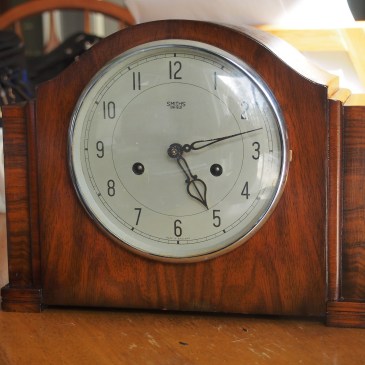
The Fleet Time Co. was a short-lived Canadian clock company that operated between the years 1936 and 1940 producing a range of two and three-train mantel clocks with movements sourced from Germany. All clocks had pendulums and were spring-driven. According to the Canadian Clock Museum in Deep River, Ontario, the company was listed as an importer of clocks and watches. The locations were 440 McGill and then 303 St. Paul West, Montreal (Canada).
The Second World War took a heavy toll on this company as the source of movements dried up and so the future prospects of this small company. Why they did not source movements from France and Germany like the Forestville Clock Co. of Toronto and others during the war years and beyond is anyone’s guess. Perhaps the margins were slim or alternate suppliers could not be found. That and the increasingly popular electric clock doomed the company.
Wood cases were made in Canada for some models while other cabinets were imported from Germany.
Of the two Fleet clocks in my collection one is this two-train clock with an unknown German movement and the other a Westminster chime mantel clock with a German Gufa movement. For more on the Gufa clock go here.
This clock is in much the same condition as my first Fleet clock, dents, gouges and scratches everywhere. Unfortunately, the tinted lacquer finishes on these old clocks do not survive well over time. It is one reason they attract little attention and sell for almost nothing despite having movements that are relatively strong runners.
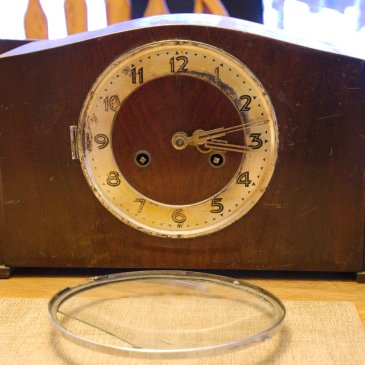
Fleet Time time and strike mantel clock, broken glass
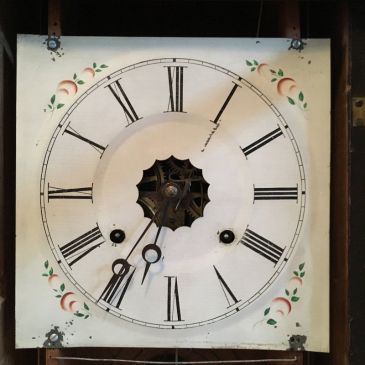
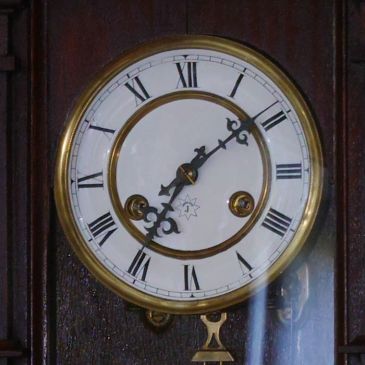
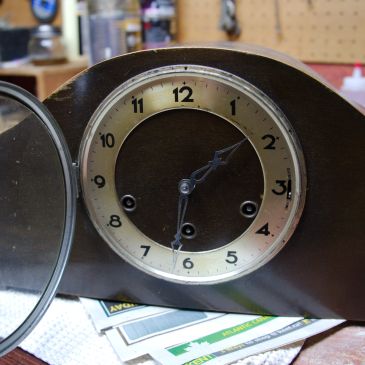
It is a plain, generic mantel clock with a walnut finish, flat front, a slightly domed top, and step-side features on outboard feet. The dial is heavily tarnished and the glass bezel that should be soldered to the chapter ring has detached. These bezels often go missing. At least it came with the clock.
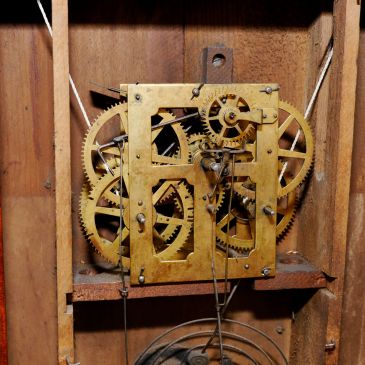
Fleet time movement
The clock strikes on 3-rods producing a bim-bam sound, just loud enough so as not to be too intrusive.
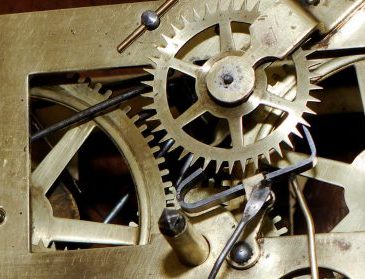
The location of the star striking wheel on the movement is somewhat unusual. Commonly found between the plates, the star wheel is on the outside of the rear plate.
Damaged Fleet Time barrel
As I have said in a previous articlethe barrel and second wheel on the time side were damaged during servicing. I don’t know who the maker is and I would appreciate any information to aid me in my search for a donor movement. The case has been reconditioned, with the addition of a dial and bezel from an old Blackforest Clock Co. clock.
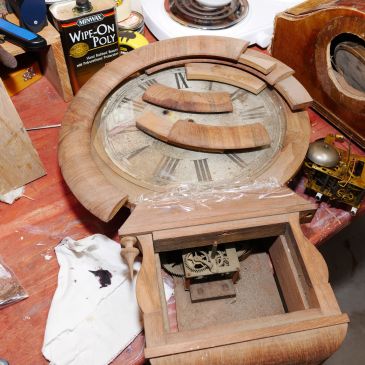
Fleet Time case ready for repaired or replaced movement
It is a nice piece of Canadian horological history that I would like to see running.
I originally assumed this clock was a Seth Thomas since it had a Seth Thomas movement. After a thorough search on the web, I concluded that this was not a Seth Thomas case. I searched for clocks made by other clockmakers, starting with E.N Welch, Ansonia (because it is similar in style to the Syria), Gilbert, Sessions and finally Waterbury. The term “Waterbury cabinet clock” generated some hits. I found one on an auction site then, two more. I now have a case made by a different maker than the movement and in clock circles this is called a marriage.
The case is a Waterbury model called the “Wren”. I found three Wren models, two with paper dials and one with the identical dial pan as this clock. It may well be that this dial pan is original to the case.
Despite the fact that it is a marriage I might keep it. The case is attractive and the movement fits the case, although both the centre hole and regulator hole over the 12 look to have been bored out and not in a tidy way.
The dial has been cleaned and repainted.
Cleaned and repainted dial
Now to the case. It Stands 13 1/8″ Tall By 12 5/8″ Wide And 5 1/2″ deep. As of this writing if you search for this model you might see one or two without the top crown. It is easily detached and no surprise that it might go missing.
Crooked finial
The case is in good shape with no parts missing however, the top finial on the right is not correctly aligned with the bottom column which I did not notice till I began cleaning the case. Evidently it had detached in the past and a past repairer glued it back not noticing the misalignment. It was simple matter of prying the finial off, regluing and centering it.
Two other pieces had to be reglued, a support piece for the crown and crosspiece in the back for one of the sides of the crown.
I cleaned the case with Murphy’s soap and following the scrubbing I decided that there was enough shellac worn off that a fresh coat would make the case much more appealing.
Finial is reattached and straighter
New coat of shellac
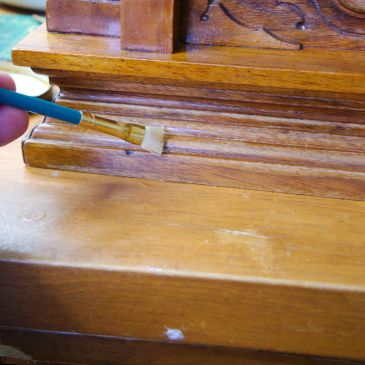
I applied traditional shellac, mixing amber flakes and alcohol with a broad artists brush. In the next shot you can see the difference between the left side of the crown and the right. I now have the option of leaving the finish as-is or aging it by “dulling” it with 4X0 steel wool.
Crown section
In the next photo is the completed case.
To me it is a huge improvement.
All this is being done while the movement is undergoing testing and once the testing is complete the two, the case and the movement will be “married” again.
Now if I can find the matching glass and bezel it will be complete.
One more shot is what it deserves. It had been running fairly well since I serviced it three years ago it but in the last few weeks it has decided to run for about 5 minutes and stop and I think I know the reason why.
Ansonia Drop Extra wall clock
This Ansonia Extra Drop time-only Rosewood veneered wall clock was manufactured in the early 1880s by what was then known as the Ansonia Brass and Copper Company.
The brass dial bezel is the only significant part missing. Minor items such as the verge, hands, pendulum bob, suspension spring/rod, and the drop access door were easily sourced. I made the drop access door later on.
Here is an article I wrote in 2018 wherein I assess the case and movement for the first time. At the time I was challenged by the prospect of putting a rusty old movement back in running condition and giving it a new life.
It was in poor condition when I bought since it literally came out of a barn and it is just pure luck that it runs at all.
The symptoms? If wound halfway it would run 3-4 days and stop. If wound tight it would not run at all because surface rust and other contaminants caused the coils to bind together. This is very typical of old clocks that have not been running for years. A movement that is “overwound” is a myth. It is the combination of old oil, rust and dirt that seizes the mainspring.
Rusty mainsprings
For some clockmakers any rust on a mainspring means that is it tossed it out because the mainspring is inherently weaker. This particular mainspring has surface rust on the outer two coils and rust on the edges of the spring. Otherwise, it has no cracks or splits and has plenty of power.
Yes, it was seized
Generally, to remove rust, repairers often apply a liquid gel, black tea, or even use electrolytic rust removal.
If I were in the business of clock repair, I would certainly replace the mainspring and pass the cost on to the customer. However, the original mainspring is part of the history of the clock and I don’t think the amount of rust is enough to prevent me from reusing as long as it is cleaned properly. As far as I am concerned, replacing a mainspring is the last resort.
Servicing yet again
Now that I have it apart why not throw the parts into the ultrasonic for a good cleaning. After everything was dry I inspected the parts, polished the pivots, and pegged the pivot holes.
I released the mainspring but this is how it came out of the case
I gave special attention to the mainspring. After inspecting it (yet again) I used a Brillo pad, steel wool and a microfiber cloth to eliminate the roughness as much as possible.
Ansonia mainspring cleaned up and ready for installation
Following the cleaning I applied a thin film of Keystone mainspring oil. I then reassembled the movement and oiled it prior to placing it on the test stand.
Ansonia movement on the test stand
While on the stand I gave the mainspring a few turns, put the movement in beat and it ran well for a couple of days which is what I expected.
On day 4, it was time for the ultimate test, to wind it fully till it winds no further. I was hoping for a good result and it ran the full 8-day cycle. The mainspring just might be “clean” enough that it will now run without stopping.
I will monitor the results of this little experiment for a while longer but for now things very good.
About a year ago I picked up two clocks. I had my eye on one, an Arthur Pequegnat Canuck shelf clock, and the other was “thrown in” as part of the deal. We completed the transaction on the Pequegnat clock and the seller asked me if I wouldn’t mind looking at a mantel clock stored on a shelf in his garage. He said, “for $10 more you can have this”. I did not know the make at the time but for $10, why not! It was in sad condition as you can see in the next photo.
Fleet clock with a worn finish
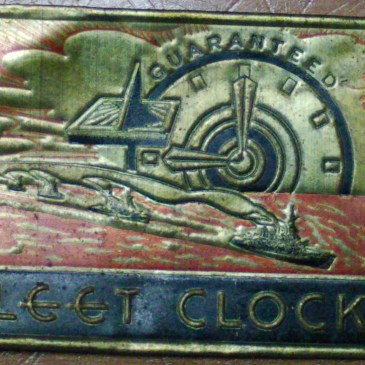
A tin plate affixed on the back of the clock told me what it was made by the Fleet Time Company of Montreal (Canada).
Many of these clocks were sold at department stores across Canada during the pre-war (WWII) era. However, this little-known Canadian clock company had a brief life span. Between 1936 and 1940 the company produced a range of two and three-train mantel clocks with movements sourced from Germany but were forced to end their operations when the war began.
Fleet Time Co. label
The Second World War took a heavy toll on this company as the source of movements dried up and so did the company’s fortunes.
Wood cases were made in Canada for some models while other cabinets were imported from Germany.
Servicing the movement
I had completed work on the case a few months ago and now it is time to service the movement.
3 train Fleet movement by Gufa
The clock has a Gufa Westminster chime movement. Gufa is the Guetenbacher Uhrenfabrik, located in Gütenbach, Germany. They manufactured 400-day clocks, cuckoo-clocks and later they became the “Jahresuhrenfabrik” (August Schatz & Sons in Triberg, Germany). Gufa is not a name horologists come across very often in North American. There is a chime gear patent date number ending in 34 which likely refers to the year 1934 indicating manufacture between 1935 and 1939. It is a solid, well-built movement.
Assessment of the movement
I had replaced the time mainspring shortly after I bought the clock but I knew that I would eventually have the movement on the workbench. As is typical of German clocks of this period in that the mainspring barrels can be removed without dismantling the movement, so, replacing the time mainspring was an easy fix.
The clock was running, though not well. On the fourth or fifth day, the chimes (and strike) would stop though the time train would soldier on a few days more. Wear issues on the strike and chime train had to be addressed.
I disassembled the movement, put the parts into the ultrasonic cleaner, and discovered afterwards that the plates had been lacquered. With the ultrasonic heat setting on, the lacquer stripped off but not uniformly. As it is a $10 clock I am not concerned about aesthetics.
Fleet movement wheels tied together according to location
To eliminate the chance that I would mix up the wheels for the 3 trains, I tied each set together. Once out of the ultrasonic cleaner I untied them and placed them in their respective trays. Westminster chime movements have similar-looking gears in the three trains and it is best to separate them to avoid frustration during re-assembly.
After inspecting the movement I determined that new bushings were required on the second wheels plus the motion works arbour. Three of the second wheels on the backplate, one bushing for the strike side second wheel front plate, and one for the motion works for a total of 5 new bushings; not bad for a 3-train movement. These are the typical wear points on three-train movements as the second wheels handle the greatest load.
Bushing work
Once the pivot holes were pegged out and the wheels rechecked in their locations, the bushing begins. Aside from the second wheels, most other pivot holes were in good shape. I don’t often use bushings with an outside diameter of 4.50mm but this movement required 4 in total. All bushings had to be reamed out with a cutting broach followed by a smoothing broach. All wheels were test fit with the plates together and things looked good.
Reassembly
Next is reassembly. With so many wheels it is a bit trickier than a two-train movement but it is important to work slowly and carefully to avoid a bent pivot. Once the wheels are positioned, test each train to check that everything is in place. After the nuts are tightened, the remaining parts such as the locking plate, chime locking lever, warning lever, rack snail, mainspring barrels and so on are installed/attached.
Testing
Of all movements, three trains are the most difficult to set up correctly. Although all three trains spin independently they are interconnected by levers. In order for everything to function in unison, careful attention must be paid to the job of each lever, what it does and how it performs its function every 15 minutes.
Gufa movement, front plate showing rack, snail, levers, and so on
Everything went fairly smoothly. Both the strike side and chime side go into warning as they should, the locking plate stops the chime at each quarter-hour including the hour, which is a good sign the locking hook on the chime train is in the correct position.
Gufa movement on the test stand
The chime strike lever is, however, sticking on the strike warning pin. Without taking the movement apart I used 1600 grit memory paper to smooth the hook end surface where it meets the strike warning wheel pin. The polishing allowed it to function a little better but continued testing revealed that that solution did not work. I finally had to remove the chime strike lever and polish the hook. the polishing was successful.
The next issue is the strike paddle which is ending the strike sequence hanging off one of the star points. The plates on the strike side must be opened up and the paddle repositioned. For safety reasons and to preserve the mechanism should things go awry, the power is let down on all mainsprings. Adjustments such as these come with the territory as nothing should be expected to work perfectly the first time.
Gufa movement, the upper wheel is the main chime wheel
After the aforementioned adjustments are made, next is the chime sequence and that means loosening the set screw for the main chime wheel and rotating the drum till the quarter strike is at the 1-2-3-4, the beginning of the sequence.
Once the adjustments have been made it is back to the test stand.
Okay, my strike paddle adjustment did not work but in the meantime, the testing of the movement proceeded and everything looks very good at this point. I will give it a few days and return to re-adjusting that paddle.
Everything is working now.
I’ll be honest, 3 train movements are not my favorite type to work on for 4 reasons. One, they often need major work only after a few years. Secondly, it is often not enough to install new bushings for worn pivot holes lower in the trains but to address other worn holes up the trains, as well. Thirdly, they are labour intensive and finally, except for modern movements, parts are almost impossible to find.
In many cases, certainly as far as a modern Hermle is concerned, it is often more cost-effective to simply replace the movement rather than repair it.
Tick-Talk Tuesday is about the letters and comments I have received from you, the reader, concerning your clock, issues you might have had, challenges you face, a clock you would like me to profile, my advice on your particular clock concern or a general clock question. For those comments and questions that stump even me, I consult within my clock circles for the best possible answer
CL writes:
“Hi Ron,
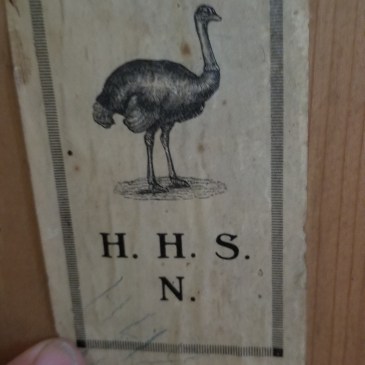
I was hoping you could help me identify a clock I purchased at an estate sale this weekend for $10. The back of the wall pendulum clock has a intact paper label with a full size standing Ostrich and the letters H H S N. Stamped on the workings is 45/100 and 27583 It is a 4 chime clock.
That is all of the identifying marks.
Any information you have would be helpful.
I did find one post on a site called Worth Point about a clock that had HHS N (Hermann Heinrich Straussj of Nurenberg)
STORAGE AUCTION FIND IN UNIT I WON IN AUCTION! If you search journeymagazine on eBay’s Discussion boards under Watches, Clocks & Timepieces I asked about this antique clock movement with the initials HHS N – and got 2 responses. First is a link that shows HHS N is a very rare clock movement that was part of the historical clock & watch exhibition in Nuremberg 1905 (Below)The 2nd is a link to a Mauthe that had HHS N clock movement in it.A VERY RARE CLOCK MOVEMENT FOR THE COLLECTOR OUT THERE!NOTE: I don’t have a key + I don’t know clock movements, so I don’t know if it works – Ask Any Questions or for more Photos – SOLD AS IS!FROM LINK GIVEN ME ON DISCUSSION BOARD: H.H.S.N. was a mark for the firm of Herm.[ann] Heinr.[ich] Strau [ =ss], of N rnberg. The only information in Abeler’s _Meister der Uhrmacherkunst_, the standard ref. for clockmakers in the German speaking tradions, is “erw. Hist. Uhrenauustell., N rnberg 1905.” In other words, they were mentioned in some connection with the historical clock & watch exhibition in N that year (in celebration of the 400th anniversary of the invention of the pocket watch (so they said) by Peter Henlein aka Petrus Hele. There were lots of firms represented, new and old clocks exhbited, etc. There’s a dozen or so small-print pages on this exhibition in several issues of the 1905 _
Thanks for your time.”
My reply:
“Hi CL
Thank you for coming to my blog.
This is a German “box” clock style from the late 1920s. The letters HHSN stand for Hermann-Heinrich Strauss, Nürnberg. Strauss in German means Ostrich. This company were clock dealers who are thought to have used Mauthe movements (and others) in their clocks. They went out of business in the late 1920s. Your clock could have been made by almost any of the big German firms at the time, Mauthe, Kienzle, Junghans etc. The movement looks like a Mauthe and that makes perfect sense. 45 refers to the length in centimetres of the pendulum (17.7 inches) while the number 100 refers to the beats per minute. 27583 is a production number and the first two digits are likely the year the clock was made.
4 -rods mean the movement will produce a very nice bim-bam strike if the hammers are aligned correctly on each of the strike rods.
It is a clock worth preserving and a steal for the price you paid.
Hope this helps
Ron”
CL replies:
“Ron,
Thank you for this knowledge! I appreciate the quick reply. I look forward to getting it cleaned and hung on our wall.”
The past year has been like nothing we have ever experienced in our lifetime. Routines, relationships and plans were upset and with them major adjustments have had to be made. The situation is improving day by day, folks are re-establishing their routines, the country is opening up and things will no doubt return to normal in the months to come and with it a new definition of normal.
How will future generations define this dark period of our lives?
The lake our Shangri-La
It is time to relax, slow down and for my wife and I that means a change of scenery as we travel to our cottage in central Canada to spend the summer season with friends and family. Our get-away plan for the summer is to relax with a few good books, do a little fishing, swimming, hiking and exchange stories with friends and neighbours over a glass (or more) of wine.
Since many of my articles have been written well in advance of the summer months there will be NO interruption in blog posts through the summer months. I will continue to maintain a steady output of 7 to 9 clock blog articles per month.
An Ansonia cottage clock with the dial removed for testing and spaghetti for lunch
Keep those cards letters coming as 1960s TV variety host Dean Martin used to say. There may be a slight delay returning your email inquiry or responding to blog post comments but rest assured that question(s) about your clock or comments regarding any of my posts are important to me and will be answered.
Roasting marshmallows
This blog profiles my own clock collection, the challenges of maintaining and repairing clocks, the joys of finding new and interesting vintage and antique clocks plus many articles of horological interest.
As we explore central Canada I will no doubt find interesting clocks as we scour antique stores, flea markets and junk shops. New clock stories, new repair challenges and perhaps the next major restoration project will also be part of my journey this summer.
Canadian Clock Museum, Deep River Ontario
Included will be a trip to The Canadian Clock Museum in Deep River, Ontario to discover new and interesting clocks added to their collection and chat with curator Allan Symons.
Use the search box to browse past articles and/or click “follow” to have clock articles brought to your mailbox every three to four days. I hope you enjoy reading them as much as I enjoy researching each and every article.
Tick-Talk Tuesday is about the letters and comments I have received from you, the reader, concerning your clock, issues you might have had, challenges you face, a clock you would like me to profile, my advice on your particular clock concern or a general clock question. For those comments and questions that stump even me, I consult within my clock circles for the best possible answer
Clock for sale
MB wrote
“Hi Ron,
I came across this clock and your blog and have fell in love with it. I want to put a bid on it but have no idea what it is worth. Could you give me your opinion please?”
I am not sure whether they fell in love with the clock or my blog!
I replied,
Attached photo
Hi and thanks for writing.
The clock you wish to bid on appears to be American-made and from the 1990s. Let me point out some factors to consider.
If the clock is from the 1990s, the movement (the mechanical works) have reached the end of its service life. Typically movements from this era have a life span of about 25 years. If it is a non-working clock, it is worn out. If it is a working clock there is not much time left on the movement. Regardless, to service or replace the movement would be in the order of $450 to $500. If it has been recently serviced (disassembled, wear issues addressed, repairs made, reassembled, tested and oiled) or the movement has been replaced with a new one, that is a big plus.
From the photo I would question why the weights are at different levels. In a working clock the three weights descend together (with slight variations) through the clock’s 8-day cycle. See attached photo (right).
Many years ago it was not unusual to spend $2000 to $3000 for one of these clocks when new. Today they are worth almost nothing. The fact that this clock appears to be in a basement or garage does not bode well for its condition. The photo is not very clear but I can see wear around the base of the clock and it may even be missing the bottommost pedestal (which might be concealed by something in front of it) which also begs the question: what else is missing?
A similar clock in excellent condition with a recently serviced movement would be in the $500 price range.
A clock, such as this, that has never been serviced whether working or not would be in the $100 – $125 price range but be prepared to spend more money on it unless you can do the repairs yourself.
MB writes back,
“Thank you so much! They did indicate that the pendulum isn’t working so I guess I will stay away.
I appreciate your detailed answer and for saving me from what sounds like it could have been a waste.
I was attracted to the style of this clock but disappointed when I learned that it was a marriage of a Waterbury case with a Seth Thomas movement. Briefly, a marriage is when parts from two different makers come together.
Buying a clock from a flea market, antique mall, a shop or what have you is always a gamble. On this particular clock there is no trademark or name on the dial or a label in the back of the case that told me who the maker was. I made an assumption and it was an impulse buy.
Glass and bezel are from a later clock
While at the antique store I opened the back of the case to confirm that the clock had a movement and it was complete with pendulum bob and coiled gong and to me everything appeared correct until I brought it home. My first thought was an Ansonia movement when I looked at it under the dim light of the store.
Seth Thomas and other makers made similar cabinet style cases but this is the Wren by the Waterbury Clock Company. Being a marriage, the clock is worth much less to those particular about such matters. No matter, it looks attractive.
I can imagine a past owner’s conversation with the repair guy, I don’t care what you do, just make it work! And the repair guy responds by removing the very worn Waterbury movement and replacing it with a Seth Thomas. Easy peasy!
One of the current seller’s stickers on the case said it was a non-working clock but with minor adjustments, such as moving the pallets closer to the escape wheel and releasing the time-side mainspring, I had it running in no time. There is not much wrong with the movement and a good cleaning plus a bushing or two should put things right.
So, what did I buy?
As I said, I like the case and it has a decent movement but when a clock is a marriage one can expect some questionable repairs and interesting changes as one takes things apart.
I am not absolutely certain the dial pan came with the case or was added later but the glass and bezel are certainly from a mid-century mantel clock. It is so ugly it will be tossed into the spare parts drawer. I will keep the dial pan but a piecrust bezel with flat glass is more appropriate for the period.
Piecrust dial on a 6-column mantel clock
Seth Thomas time and strike 8-day movement
I removed the dial and discovered a number of extra screw holes here and there, varying lengths of screws, some screw holes filled with pieces of wood, even a couple of Robertson screws (not invented until after the First War) and so on. Obviously the replacement movement required new holes and why not drill a few extra holes for good measure!
The hole on the dial just above the 12 is larger than it should be. It was either enlarged to accommodate the regulating arbour or it’s a new hole altogether.
On a positive note both the case and the movement are from a similar period.
Disassembling the movement
But this post is about servicing the movement.
I am impressed with the engineering of this Seth Thomas movement. It is robust and well-designed though it has an interesting, overly complicated, speed regulating feature.
From my research I found that the hip style movement is the type 44 which was used for a 12 year period beginning in 1890. In 1903 it was presumably replaced with the type 89 movement, simpler to manufacture, fewer parts and more reliable, and appeared in many thousands of ST mantel clocks afterwards. It has a sickle shaped brass piece between the plates so that the clock can be turned backwards repeatedly at the hour to sync the strike with the hands. It is technically called a set-back counter weight.
Brass piece indicated by arrow
Regulating arbour with worm gear on one end
There were variations of this movement, front winding movements as opposed to rear winding, with and without the worm gear speed regulator and some with stop works. This movement does not have Geneva stops.
It took me more time than usual to pry open the plates because I was slowed down by the intricacy of regulating mechanism. Part of the mechanism consists of a long arbour that passes from the front plate to the back plate. At one end is a worm gear and on the other is the regulating end. It is secured to the outside of the front plate by means of a spring with a pin through the arbour. To release the arbour, the pin must be pulled and the spring releases.
Well, actually the spring flew across the room. No problem, I’m used to crawling on the floor looking for clock parts.
I have worked on a lot of American time and strike movements but this type of regulating mechanism is a first for me. In fact, the set-back counter weight is also a first for me.
Analysis of the movement
The movement has had 12 bushings installed, 5 on the front plate and 7 on the back. The work is well done but I don’t like the arrows scratched into the plate indicating where each bushing would be installed. I use a Sharpie pen and after I have completed the bushing work I wipe the marks off with alcohol. There is no need to mar the plates.
Arrow indicating scratch mark below bushing
After looking over the movement carefully I can see there is enough wear in some bushings that they must be replaced, both second wheels, front plate, the governor, both front and back and the escape wheel bridge bushing which for some reason has punch marks around it, the only unsightly repair.
Escape wheel and bridge
The mainsprings look to be in good shape and still bears the original ST trademarks. No worn gear teeth and the pivots, plus the lantern pinions are all in great shape.
All in all, not bad for a movement that was last serviced quite a number of years ago.
Strike side of ST movement
The pivots were polished and next is the bushing work. Two were interesting to say the least.
The count count wheel and the strike pin wheel are side by side. A bushing was required for the pin wheel but I could not access it from inside the plate. This is one of those few times when drilling from the outside is the only way however, I was able to push the bushing home from the inside plate. It is one of those situation where you have to stand back, analysis the problem and consider a strategy. It worked.
The second was the escape wheel bridge. To stabilize the bridge a 5-step block jig comes in handy. Otherwise, it is very difficult to keep the bridge steady and drill a straight hole.
% level job block used for an escape wheel bridge
The drilling went fine until the last 3.47 mm cutter. When I began to drill out the hole the old bushing came out. I knew right away that the new bushing would not have a tight fit. Evidently a past repairer had the same problem.
staking set
The block from a staking set is a useful tool. With it I was able to lay the plate down on it and punch the bushing from the inside to stabilize it.
Once together everything fell into place or so I thought. Unfortunately, I will have to take it apart again because I forgot the regulating worm gear which can only be installed with the plates separated. The movement will run perfectly fine without it, but it is part of the clock.
How far do you go repairing, restoring or conserving a vintage or antique clock without changing it in a significant way?
My daughter. a civil engineer raised the philosophical argument that questions whether an object like a clock that has had all of its components replaced remains fundamentally the same object. This paradoxical thought exercise is called the Ship of Theseus. Plutarch, a Greek philosopher, asked whether a ship that had been restored by replacing every single wooden part remained the same ship.
The ship wherein Theseus and the youth of Athens returned from Crete had thirty oars, and was preserved by the Athenians down even to the time of Demetrius Phalereus, for they took away the old planks as they decayed, putting in new and stronger timber in their places, in so much that this ship became a standing example among the philosophers, for the logical question of things that grow; one side holding that the ship remained the same, and the other contending that it was not the same. Plutarch, Theseus[2]
Think about it! If something is fundamentally changed is it the same object?
One of our proud provincial symbols in Nova Scotia is a sailing ship called the Bluenose II, our provincial ambassador. The original Bluenose was a fishing and racing schooner that ran aground and sank 90 years ago. To honour the original Bluenose, the Bluenose II was built in the 1960s and sailed for over 50 years until it was determined that she was not seaworthy.
Bluenose II, Peggy’s Cove (photo, NS government, used for educational purposes)
In 2018 the hull of the Bluenose II was rebuilt with new materials. Some items such as rigging, masts, sails, ironwork, deck structures, safety equipment, and electronics were reused. Part of the timeline for future repair involves replacing the masts, sails, rigging, and deck structures. Will the ship retain its identity? To purists, no! To Nova Scotians, yes!
Let’s go beyond the nautical example and apply our example to the lantern clock.
The lantern clock is a clock with a lantern-shaped brass case made for about a century after 1630 or so. Most had one hand, all were weight-driven with a bell on top and sat on a wall bracket. They were the first type of clock widely used in English private homes in the 17th century. Eventually, the lantern clock became obsolete when tall case clocks came into fashion.
Converted lantern clock
Lantern clocks are highly collectible today and those that are in “original” condition are the most desirable. But, almost all of them have been altered, even those considered “genuine”. Check out this quote from a sellerof lantern clocks, D. and J. Benson, who are specialists in early English clocks.
We are strong believers that if a clock was converted to a different escapement many years ago, this should be retained, being part of the history of the clock, rather than reconverting clocks back to former guises. Only under compelling circumstances would a clock be returned to a former state. Only absolutely necessary restoration work is carried out in order that the original clock survives for future generations. We conserve rather than replace. D& J Benson
“Compelling circumstances”. Important provenance, perhaps?
Early conversions were from verge to anchor escapement. Later ones had the original movements removed and a fusee movement (single or double) installed. When converted, original movements including alarm mechanisms were taken out, a single-hand was replaced with two hands (or the minute hand added), broken finals and door handles might have replaced, chapter rings re-silvered, doors lost due to their nature of lifting out easily. Therefore, what is the nature of the clock after it has been changed, and how original is it? Does it retain its identity? To purists, no! To the casual collector, yes!
Let’s see how this philosophical argument plays out:
If too much is done to restore a clock is it fundamentally the same and is it considered original even though new parts were made from the same materials using the same methods when the clock was first made?
Do changes or alterations to the clock that bring it back to its original look and function including the making of new parts make it more “original”?
If one replaces one part at a time on a clock so that at some point all parts are replaced, at what point does a clock no longer become the same clock?
If you take all of those parts and make a “new” clock which of the two clocks is original? What is the nature of the clock’s identity since no two objects can occupy the same identity?
This is the dilemma of identity. One more example!
In 2016 I acquired my first weight-driven Vienna Regulator clock. As I worked on the clock I began to realize that many parts were replaced over the years such as the brass bezel, hands, glass panels, weights, and even the movement. Although the changes were part of the history of the clock I began to accept the notion that it is what it is and to a casual observer, it looks authentic.
Gustav Becker Vienna Regulator
Minimal Invasive Intervention
The term minimal invasive intervention means how far do you go to repair, restore or conserve a clock without changing it in a significant way? Some say that any work performed on an antique clock would diminish its value. Going too far to repair a clock and it begins to lose its attraction and value as a collectable object.
Is a “true collector” more interested in a movement that has never been worked on or one that has been repaired or restored? While it is always desirable to have a running clock most concede that to make a movement actually work, intervention must be accepted (bushing and pivot reconstruction, for example). The question remains; if I want the clock to function, what is the least I can do without changing it in a significant way?
Repair, Restoration, Conservation
Repair; to rectify the faults of a clock in a way that might alter it from its original form (gear replacement, pivot work, bushing work, replacement of some parts)
Restoration; the reconstruction of the movement and clock case to original condition.
Conservation; the protection of a clock using any methods that prove effective in keeping that article in as close to its original condition as possible for as long as possible.
Any amount of intervention is frowned upon by some collectors while some amount of intervention is not only necessary but desired by others and while collectors are always searching for a completely untouched clock, an antique clock in pristine condition that has never been meddled with is a rare find.
Questions, questions, questions…
Is undoing the “damage” caused by a previous poor repair an overly invasive procedure?
If the repair was done shortly after the clock was made and it was a proper repair, was clearly documented as markings inside the clock case, should it be left untouched? (example, a wheel that has a rough tooth repair but functions well). Is the poor repair part of the clock’s historical provenance and should it be left as-is?
Would bringing the movement back to its original state be considered a restoration or a repair?
Will a repair enhance or decrease the value of the clock?
Is a repair or restoration a form of conservation?
My position regarding changes to a clock
My goal is a functional clock that presents well. A non-working clock must become a working clock because that is the nature of its existence. If a clock has important provenance and extensive repairs to the movement and/or case alter it in a negative way and I will leave it alone. But I will always clean a clock case (unless otherwise directed) because as one clockmaker I know put it, “isn’t patina just another word for dirt!”.
When working on a customer’s clock I recommend presenting several options regarding the repair of the movement and addressing case issues. This past year I worked on a customer clock and asked what they wanted to be done. It had a beautifully designed case but a non-functioning movement. Make the clock run they said and replace the broken hands but don’t touch the case even though in my view the case could have used a good cleaning and a fresh coat of shellac. I did what was requested. Is the customer right? Yes!
I will leave you with two examples.
Ingraham Grecian
Ingraham Grecian
The bob wire that came with a clock appears to be a section of coat hanger wire. Replace it with a proper adjustable bob wire?
On a movement with pinned plates one of the pins is a finishing nail. Replace it with a brass taper pin?
Hell, yes on both counts!
In some circles, this trivial examples like these will provoke a heated argument. Is there a correct answer? Put twelve clockmakers in a room and you will have a thirteen opinions.
Let me begin by saying that I am not a big fan of clock movements with steel plates. Many that I have come across have brass bushing inserts that I believe to be a limitation rather than a benefit.
Waterbury short drop wall clock
The movement in this plain drop octagon case is a Waterbury time-only. When I bought the clock in January of 2016 it came without the glass and bezel which I ordered from a supplier. I was informed by the previous owner that it had been serviced so, other than the new glass and bezel plus inpainting some of the numerals I have done nothing else to it, but now it is time to service the movement.
Inpainted numerals
A diminutive size, this clock was made around 1930 just a few short years before the Waterbury Clock Company was placed in receivership.
It is a solid oak case measuring 19 inches long by 12 inches wide, with an 8 inch paper dial marked Waterbury, a black and gold pendulum aperture, and 8-day time-only movement. The bottom of the dial says, ” Made in the USA by Waterbury Clock Company”, Connecticut. These clocks are often refereed to as schoolhouse clocks though I can’t imagine the dial of a clock this small visible from the other end of a classroom.
Issues with steel plated movements
As mentioned, the movement has steel plates. Steel plates are perfectly fine and I understand why manufacturers use them, to save brass (and money), but I have two issues with them.
One, no matter how hard I try, I cannot get them to shine because the steel tends to attract tarnish which is almost impossible to remove. And of course, as they are made of steel they are prone to rusting. The solution is to plate the steel in brass or nickel as some makers did.
Arthur Pequegnat movements, with steel plates, for example, are nickel-plated. Unless the nickel plating is compromised they shine up spectacularly.
Pequegnat nickel-plated steel plates
A second issue with steel plates is the brass bushing inserts. In my view, there is simply not enough brass to work with. In most cases I use a smaller bushing than I would otherwise employ so as to avoid cutting into the steel plate. I use the Bergeon bushing system. KWM bushings may have a smaller outside diameter, I’m not sure?
Large bushings on a movement that has steel plates means there is a risk in cutting into the steel. The cutters that came with my Bergeon bushing machine are about $35CDN apiece and it would only take a cut or two into steel to render them dull and useless.
Waterbury Arion instructions
Assessing the movement
The movement is in generally good condition. The lantern pinions and gear teeth are in excellent condition. There is minimal wear on the pallets, escape wheel teeth and all parts in general.
The mainspring is definitely a replacement. The loop end looks to have been annealed. It does not look professional but the mainspring is in very good shape and is reusable. I suspect, given the length of the mainspring, that it is oversized for the movement.
The movement is certainly in need of bushing work. New bushings will extend the life of the movement.
Five bushings were installed. Two on the verge, front and back, the third wheel back plate and second and fourth wheels front plate.
Three bushings on the front plate
The pivot on the third wheel is 2.30mm in diameter. Though it would normally require a 4.50mm outside diameter bushing, a 4.50mm bushing makes a very large hole, so large in fact that it would have meant cutting into the steel plate.
I chose a 3.5 mm bushing with a 1.90mm inside diameter. Broaching out to 2.30mm, effectively removes .4 millimeters of brass with a remaining thickness of 1.2mm which should be enough. 3.00mm OD bushings were used for the 4 other pivot holes. Brass-plated movements present present fewer limitations on bushing diameter.
New third wheel bushing
The mainspring was cleaned and oiled. The movement was reassembled and put on the test stand.
Once on the test stand I noticed a wobble in the suspension leader which was rectified by tightening the suspension spring post.
If you are novice and just starting out in clock repair, time-only movements are excellent to begin with as there is only one train to work on but take extra care with movements that have steel plates.
Time-only Waterbury movement on the test stand
My suspicion about the mainspring was confirmed. 15 days later, it was still running.
After 5 years this movement should not have been as worn as it was and the issue is an oversized mainspring which puts an unnecessary load on the gears through the train. I am not about to replace the mainspring, it is just not worth it for a $40 clock, but my advice to anyone interested in clock repair is to source a mainspring that is correctly sized for the movement you are working on.
The cleaning and the installation of new bushings should nonetheless ensure years of reliable running.
7 reasons why a hobby such as clockmaking gives respite during a pandemic.
Builds self-esteem. Developing and maintaining a hobby is important because the small successes from day to day are enough to sustain oneself amid other pressures in life and it is the one solid thing to feel good about. It gives renewed energy to tackle other challenges in life.
Dial face, Scottish tall case clock C.1848
Avoid boredom. There is zero scientific evidence of this but boredom is responsible for a lot of society’s ills and destructive behaviours. Do you come home after a challenging workday to watch hours of TV when you could be doing something constructive and rewarding? If so, it is time to re-evaluate your life.
Junghans Sydney shelf clock C.1911
Enrich your perspective. There is an old adage: “The more you know, the more you grow”. Any opportunity to learn something new, to be challenged anew, is great for character-building by seeing the world through refreshed eyes. Clockmaking or any hobby helps one differentiate from others and provides key examples of overcoming adversity or tackling a difficult situation and emerging on the other side.
American Watch and Clock Collectors Museum, USA
Keeps you youthful. Establishing and maintaining a hobby is a healthy habit to form not just now but for your later years. Hobbies are excellent for brain health and help stave off cognitive decline. The older you become the more difficulty you will have struggling to fill your time with meaningful activities. Beginning a hobby early in life pays dividends in the long run much like an interest-bearing investment.
Schatz W3 bracket clock C. 1950s
Combine your hobby with other interests. Photography and traveling are two other of my interests. Blogging is another, of course. Clockmaking combines all of those interests and as a side benefit my wife, who is also my travel partner and clock locator, provides encouragement every day.
Westclox LaSalle alarm clock C. 1934
It makes one interesting. Talk about your occupation or your grandchild and before long people’s eyes begin to glaze, but mention a clock that fell off a wall during the Halifax Explosion, a clock that hung in a railway station nearby, a rare clock bought for next to nothing and ears perk up.
Junghans Crispi wall clock, C.1898
A great way to relieve stress. Hobbies provide stress relief simply because it is an oasis, a way of disconnecting temporarily and we all need a place of refuge in trying times.
Mauthe wall clock circa 1895
We are nearing the end of the pandemic and folks are returning to their former routines. If you have found a new hobby in the past year there is no doubt you have certainly acquired new skills, renewed confidence and furthered your knowledge. Don’t stop now!
Servicing the movement is complete. Next is the case.
For those unfamiliar with the HAC acronym, it stands for Hamburg American Clock Company, a well-known German company that was acquired by Junghans in the late 1920s. I have a number of German clocks including Junghans, Mauthe, Hermle, Jauch, Gufa, and Gustav Becker but this is the first HAC clock in my collection. This clock dates to somewhere between 1900 and 1908.
Here is the auction photo of the clock.
HAC mantel clock (reproduced with permission)
As you can see there is some wear as expected from a 100+-year-old clock. The dial is especially grimy.
I focused on the dial first, managing to remove most of the grime while retaining its patina. Plus I touched up the numbers and chapter ring. There were numerous scratch marks on the dial surround and I did my best to clean it up and make it more presentable but it is what it is. Check out this article for more information on cleaning the dial.
HAC clock is attractive but the dial required a lot of work
Stripping a case is always the last resort in my view. There is visible wear on the bottom corners, the lower part of the columns, and column capitals but not enough to justify removing the finish.
I cleaned the case with Murphy’s soap, applied 2 coats of shellac using 4X0 steel wool between coats followed by a coat of Minwax finishing wax.
HAC mantel clock
Better but not perfect but perfect was never my goal. Now, where to put it?
Eight years ago I acquired my first Arthur Pequegnat clock. In the years following, I have added to my collection and now have a total of 8. Although my collection of Pequegnat clocks is very modest by comparison to a dedicated Pequegant collector it is a good start and I would certainly like to add to that number in the future.
The Arthur Pequegnat Clock Company (1904–1941) is notable as the longest-lasting Canadian-based clock manufacturer. They made a wide variety of different styled clocks from 1904 through to 1941 from shelf and mantel clocks to wall clocks and floor models.
Nickle-plated steel or brass plates
Unfortunately, it is very difficult to date a Pequegnat clock, except for what is termed pre and post-Berlin, the location of the company’s manufacturing plant. Clocks made before 1917 were inscribed “Berlin, Canada” on the dial face. Kitchener, Ontario was known as Berlin prior to and during the first World War. It was the town of Berlin from 1854 until 1912 then the City of Berlin from 1912 until 1916.
Because the name Berlin was associated with the war against Germany the town fathers decided the name Kitchener was less offensive and the change was made midway through the First World War. Kitchener is the present seat of the Regional Municipality of Waterloo, Ontario, Canada.
Most Arthur Pequegant clock movements are stamped with the company name but there are no date marks on movements indicating when it was made. Clocks made after the First War wore the company name plus Canada under the number 6 on the dial face. For example, clocks such at the Canadian Time were made from 1904 to 1941 and are separated in age by the Berlin label consequently, my Canadian Time wall clock with the Canada label could be as old as 104 or as “new” as 80 years old.
One distinctive feature on many movements is the use of nickel plating for both brass and steel plates.
Arthur Pequegnat Company name
Many models continued in production right up to 1941. By 1941, the demands of World War II armament makers for brass, the essential ingredient in clock movements as well as the growing popularity of the electric clock, forced the Arthur Pequegnat company to cease production.
And now, beginning with the first clock acquired in 2013.
The Canadian Time
My first Pequegant, purchased in September 2013 hung in the Intercolonial Rail Station waiting room in Pictou, Nova Scotia.
Canadian Time
The seller arranged the purchase of the clock just prior to the station’s decommissioning in 1993. It is in very good condition, missing its door clasp but otherwise intact. There are a few scratches and nicks consistent with its age but nothing objectionable.
The Brandon (2nd edititon)
I found this clock in an antique shop just outside Truro, Nova Scotia in 2014.
Arthur Pequegant Brandon II
The case is in excellent condition but the movement was quite worn. Had I known more about servicing clocks at the time of purchase I would not have sent it to a clock repair specialist. It is one of two in my Pequegant collection serviced by someone other than myself. This is the Brandon II. The Brandon 1, the first edition, was made prior to 1918, and had an ornate pressed wood bezel. This one is simpler in design.
The Maple Leaf “Fan-top”
Next came my first Maple Leaf kitchen clock, known for its unique lower tablet of scattered maple leaves and a distinctive maple leaf pendulum.
Arthur Pequegnat Maple Leaf kitchen clock
This clock, bought in 2015, was also serviced by a clock professional. The case was in very poor condition. Stripping a case is an absolute last resort as far as I’m concerned but the finish on this clock was pretty bad. I could not leave it as it was.
The finish on a Pequegnat fan-top clock
To Pequegnat collectors, it is known as the fan-top.
The Simcoe
Three years later, the Simcoe followed me home. It was bought at an antique shop in Victoria, British Columbia in 2018.
Arthur Pequegnat Simcoe mantel clock
It is not particularly attractive. It is the only mantel clock in my Pequegnat collection and it is from the “Berlin” period.
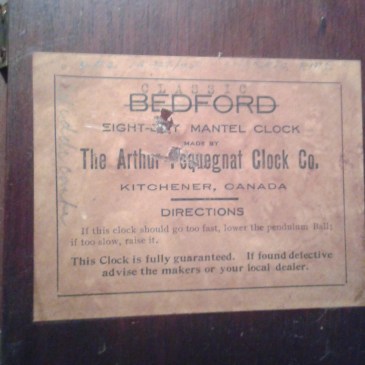
The Bedford
2018 was a good year because I acquired 4 Pequegnat clocks. This was number two of that year.
Bedford shelf clock
This clock was gifted to me by a reader. He asked if I wanted the clock but I had to pick it up in Quebec which was on our way to a summer cottage in central Canada. The movement was in very good condition but the case was damaged having taken a plunge off a high shelf.
The movement was serviced without issue but the case required extensive intervention.
The third purchase that year and the fifth in my collection is the Maple Leaf Pointed Top
The Maple Leaf “Pointed Top”
There are 4 Maple Leaf clocks made by Pequegnat. Any version of the Maple Leaf is sought after by Canadian collectors but this one has distinctive pointed side columns, hence the nickname.
Arthur Pequegnat Maple Leaf Pointed Top
Although termed a kitchen clock it could easily have been placed in a living room or parlour.
The Moncton
The last 2018 acquisition was a clock that I had in the back of my mind for quite some time and I was waiting for the right price. This is an excellent copy that is very presentable and looks great on our kitchen wall.
Arthur Pequegnat Moncton
It is a post-Berlin double spring time-only 15-day clock. Many were used in rail stations despite the fact that they were spring-driven. Weight-driven clocks were preferred for their accuracy but the Moncton was up to the task as a timekeeper.
And the last.
The Canuck
This is the only true Pequegant “gingerbread” clock in my view.
Canuck kitchen clock
The case was refreshed and the dial was redone. The movement was also serviced without issue.
Cleaned up more presentable
These are all keepers. Most Pequegants have kept their value over the years and in Canada, they are regarded as quality clocks for the masses. They were well built, well-designed movements with a distinctive Canadian charm as many were named after cities in Canada.
Tick-Talk Tuesday is about the letters and comments I have received from you, the reader, concerning your clock, issues you might have had, challenges you face, a clock you would like me to profile, my advice on your particular clock concern or a general clock question. For those comments and questions that stump even me, I consult within my clock circles for the best possible answer
Photo attached to KBs email
KB writes, “Hi Ron, I have been following your blog with interest, I have a a interesting collection of clocks, longcase, carriage and mantle. I am now in the process of restoring them. I need some help with bushing, can you please tell me how you do this. Many Thanks”
My reply
“You can hand bush, use a drill press or a bushing machine such as the Bergeon Bushing machine as demonstrated in this video. The bushing work is at the 6:40 point of the video if you want to skip ahead.
Clock collecting from a beginner’s perspective. That was the subject of my first blog post six years ago. Since then I have seen a lot of excellent and not-so-good blogs come and go but I wanted to give it my best shot and after 6 years, well, I am still here.
I started with a free WordPress plan, moved to a personal plan and then, this year, to a Premium plan. I now permit advertising on my site but my only goal is to recoup costs for server space and domain name. Anything extra is gravy.
In the early days I would stop blogging in the summer and resume in the fall. That did not work so well as my viewership fell off and I had to rebuild after the holidays. Now I schedule all my articles in advance. In fact, I typically have about 15-18 articles “in the can” at any given time. Having an inventory of articles means there is no need to scramble with something new every 3-4 days, my typical interval between articles. Some of you bloggers must know how hard it is to put words together when inspiration is lacking.
I am not sure what I was expecting 6 years ago but now have a dedicated following, receive many interesting letters each week, have met people through my blog and it seems people appreciate my content. This is reflected in statistics which are the lifeblood of any blog and it’s those daily figures that keep a blogger motivated. For instance, I have more views in a typical day than I had in the first 3 months of my blog.
Not once do I claim to be a professional horologist but after 10+ years in clock repair as a hobbyist I think I know something by now.
Welcome to my first blog post written May 15, 2015 which I will present word for word.
OK, so it’s a Chinese clock but it works
I regard myself as a clock collector and tinkerer. I am not a trained horologist nor do I have a unique talent for clock repair or even getting a simple clock back to working order, but I find the world of horology to be quite fascinating.
It is a relatively new hobby for me which began with the purchase of a Daniel Dakota time and strike wall clock. Why start with a Chinese-made clock which most would consider inferior to almost any other clock in the world. It was cheap, it piqued my interest in collecting and repair and it was something to practice on. I then moved on to a Ridgeway grandfather clock and to my current collection of Mauthe, Seth Thomas, Hermle, Forestville, Sessions, Smiths Enfield, Muller and Pequegnat clocks.
Arthur Pequegnat kitchen clock, known as the “Fan-top”
My blog will profile clocks in my collection both vintage and antique as well as describe my attempts at repair. Along the way I will seek advice from you, the reader, from clock forum sites and whatever information I can find online.
Seth Thomas Adamantine mantel clock
Clock collecting is a great conversation starter and it allows me to combine my other passions, photography and traveling (and now, writing). Locating good clocks means traveling around the province of Nova Scotia and Canada, meeting interesting people along the way and is some cases getting that one-of-a-kind deal.
Most photos on this site are my own. Photos from other sources will be given full credit. I will try to capture the beauty of these old mechanical wonders and anything about their provenance will included as well.
Forestville Westminster chime mantel clock
Stay tuned. It is all a learning experience and as I bravely go further into the hobby I hope to share my frustrations and my successes.
As Winston Churchill once said, “Success is walking from failure to failure with no loss of enthusiasm”.
I have stayed true to form since then and continue to publish 7 to 9 articles per month. Since then I have acquired dozens of antique and vintage clocks from all over Canada and probably have upwards of 80 clocks in my collection at this point. I have also said goodbye to an additional 20 clocks through local sales and as gifts. It remains a hobby that I thoroughly enjoy although occasionally I have done some paid and pro bono work.
If you have stayed with me since the beginning, thank you, but if you are new to my blog or following for the first time, welcome!
Canadian clock collectors familiar with companies such as Arthur Pequegnat, the Canada Clock Company, the Hamilton Clock Company, Forestville, and Fleet seldom consider the Snider Clock company clocks for their collections yet for a quarter of a century this home-grown Canadian company made mantel and wall clocks designed and manufactured in Toronto, Ontario.
Starburst clock in a boutique hotel, Quebec City
Harry Snider began making clocks in 1950 under the name Snider Clock Corporation. The name then changed to the Snider Clock Manufacturing Company Limited in 1957. Throughout its history it continued as a family venture until the last clock was made in 1976.
A master clock surrounded by Snider clocks, Canadian Clock Museum, Deep River Canada
Some say they only made fashion and novelty clocks and to some extent that is true. The Snider Clock company’s response to the trends and fashions encapsulated a healthy design philosophy that kept pace with the times. Innovation, quirkiness with fanciful designs are the hallmarks of their approach to clock manufacture.
Former Snider Clock Company location in Toronto as it appeared in 2007
The company began by making mantel clocks with mechanical versions supplied by Ingraham, and later, mantel clocks with electric motors imported unassembled from the Lanshire company in Chicago. In 1960 Snider shifted focus to wall clocks which were in great demand at the time, a demand likely brought on by the Sputnik satellite, the interest in space adventure and the dawn of the “Atomic age”. Models with starburst and molecular patterns attracted new buyers.
Most models were corded electric clocks but in order to do away with the cord Snider offered an upgrade to electromechanical models with battery movements. The advantage of a battery movement was the flexibly in placement anywhere in the home.
The longest running style of clock was the starburst clock. When I think of a Snider clock the first image that comes to mind is an electric kitchen wall clock in a starburst or sunburst pattern. These were very popular and Snider sold thousands.
Telephone clock
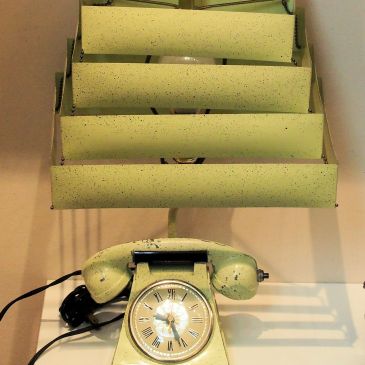
However, Snider made unusual and fanciful lamp clocks, telephone clocks, in china, metal cast, brass-plated metal and many colours such as in brown, pink, turquoise and black.
Snider Novelty clocks, Canadian Clock Museum
In the peak years, the company made 50,000 clocks, had 20 employees, and used mainly Canadian components. Throughout its history, it strove to constantly adjust to a constantly changing market.
In 1976 when Caravelle clocks (a subsidiary of Bulova) arranged licensing agreements with retailers in Canada, Snider could not compete and ended its business after 26 profitable years. A sad end to a company ultimately pushed aside by an American competitor.
This E. Ingraham & Co. clock is a garden variety parlour clock. There is nothing special about it but among parlour clocks, it has nice lines and reflects a more conservative approach to clock designs of the late 19th century. It is an 8-day time and strike clock purchased from a local antique store in the spring of 2019. I have recently serviced a number of clocks in preparation for sale and I also considered selling this one. While I am not in the business of selling clocks I will let go of the odd one to keep my collection manageable. My wife feels that it is a keeper though and I agree.
This was a running clock before I took it apart and my goal is to give it a good cleaning and address wear issues
Stamped in the middle of the front plate is “E Ingraham Co patent date Oct 8, 78 Nov 11, 79, Bristol Conn.” On the inside floor below the pendulum, it is stamped “Manufactured by the E. Ingraham & Co, Bristol Conn”. It was not a common practice to stamp the inside floor but it is an interesting feature.
E Ingraham parlour clock with Swigart dial
Tran Duy Ly’s book on Ingraham clocks shows this model, the Mystic, from the 1897 catalogue. The clock sold new for $6.50. Although found in the 1897 catalogue it might have been made some years earlier. Two numbers are neatly etched into the lower right-hand side of the front plate and they are H25,915 and H27,475. They look like service dates, Sept 1915 and April 1975.
There is a stylized “S” logo on the dial face. Some might mistakenly take it for a Sessions clock. The dial is a replacement made by E&J Swigart, a supplier of replacement dials along with other clock and watch supplies. Swigart went out of business in October of 1992. 1972 was the last year they made reproduction clock dials and this appears to roughly coincide with the 1975 service date.
Assessment of the movement
I have worked on a number of Ingraham movements, some with helper springs and some without. It looks to me that helper springs were added, which is not a bad thing and they will stay on the movement. Installing helper springs to ensure levers drop as they should is not an uncommon practice.
Normally these old movements are in varying degrees of wear and quite often there are punch marks around almost every pivot hole plus they are very dirty. This movement has had 13 bushings installed and is surprisingly clean for its age.
This was a running clock before I took it apart and my goal is to give it a good cleaning and address wear issues along the way. It might require some intervention but my first impression is that it looks very good.
Ingraham Mystic
I found a bent second wheel pivot on the strike side. Before blaming a previous repair it is possible that I was the culprit. Both mainsprings were clamped to restrain their power but when I removed the top plate a wheel sprung out from the strike side. Evidently, the strike side mainspring still had residual power remaining and might have bent the pivot. It was easily straightened.
The main and second wheels on both sides are inscribed for location, so, that is helpful. The strike side mainspring arbour hook has been repaired although the pin is loose and had to be secured. It also appears both mainsprings are replacements. The warning wheel lantern pinion shroud has also been repaired. The clutch on the motion works looks like a repair but I have seen at least one other Ingraham like it, so, I’m not sure.
Ingraham Mystic, warning wheel with additional punch marksIngraham Mystic, motion works clutch
This clock has had a lot of attention and has led an easy life. The repairs are neat and tidy and appear professionally done.
But there is some wear. The clock requires bushings on both the time side and the strike side. One on the time side and 3 on the strike side, one new, and 3 replacement bushings.
Reassembly and testing
The third wheel on the strike side is a combined locking and pin wheel with 2 locking pins and 2 hammer pins. There is no cam on this arbor, unlike many other American movements. The spaces between the pins allow for the drop lever to descend.
The count wheel is advanced by two protruding pins on the third wheel lantern shroud. It is necessary to ensure that the count wheel is firmly in place, not loose but not too tight, so the third wheel pins can advance the count. The warning wheel is set about half a revolution to set up the strike. During reassembly one of the two lock pins is placed on the locking lever, the end of which has a hook. This is to permit the count lever to go into one of the deep slots.
Since I have worked on a couple of Ingraham movements in the last month there was no need to separate the plates to make additional adjustments.
Unlike earlier Ingraham movements that have no passing strike on the half-hour, this has one.
It is on the test stand and I will let it run for a cycle or two before returning it to its case.
Ingraham Mystic on the test stand, beat amplifier attached
It’s really nice to work on a clock that has been so obviously well cared for. It will look great and run well though the only item that detracts from the clock is the Swigart replacement dial.
This Fleet Time, time and strike mantel clock is essentially a plain, garden variety clock with a walnut finish, flat front, a slightly domed top, and step-side features on corner feet. The dial is heavily tarnished and the glass bezel that should be soldered to the chapter ring is detached. These bezels often go missing and at least this one came with the clock.
The clock has some issues, none of which are insurmountable. The plan is to refinish the case, attach the bezel, clean-up the dial or replace it, install new glass, and service the movement.
In this post servicing the movement is the focus.
The movement looked reasonably good when I received it and it may have had some bushing work done in the past but once apart it was clear to me that it might never have been worked on beyond a cleaning. It ran when I got it and one is tempted to leave it as is but it was dirty, had some wear and long overdue for a good cleaning.
Servicing the movement
Fleet time movement
Disassembly and testing for wear
I discovered two troubling issues when I had it apart. I put the wheels together to check for wear and I noticed the escape wheel was a fair distance along the arbour from its correct position adjacent to the leaf pinion (no photos, sorry). The pallets were contacting the very edge of the wheel. My staking set comes in handy from time to time and it was needed to close the gap between the wheel and the pinion.
staking set
Using light taps from a hammer and an appropriately sized punch I drove the wheel closer to the pinion. The pallets now contact the middle of the wheel as they should. Odd!
Fleet time movement, dirty and in need of a good cleaning
The second was an erratic beat during the testing phase of the time side. With a beat amplifier connected, I could hear the movement go ever so slightly in and out of beat, yet the movement continued to run. There are a number of possibilities but one is a bent escape wheel arbour which, in this case, was the culprit. Bent arbours are not difficult to straighten but care must be taken to bent them carefully so as to prevent a break. A broken arbour can be a very frustrating clock problem.
Once the 2 issues were out of the way it is on to cleaning the parts, inspecting and polishing the pivots, pegging the pivot holes, followed by bushing work. Most of the bushings that were installed were on the strike side. In fact, 4 of six, 3 on the backplate and one on the front plate, strike side, and the two on the time side were on the second wheel. Two were 2.5 OD bushings. I work on a lot of American and European clocks and cannot recall using bushings that small.
Testing
After cleaning and bushing work is completed the rack, snail, levers, and strike hammers/levers are attached.
Since the star wheel is on the outside of the plate I thought attaching the strike hammers would be simple. Not so much!
Fleet Time movement, star wheel paddles
Again as in all movements with star wheels, the strike paddles must sit between the star points. One was fine, the other hung on the tip of a point. Rather than attempt to force the star into position, the strike side was partially disassembled and the star wheel was re-positioned. Yes, it meant removing wheels on the strike side to change the orientation of the star wheel but it is best to do it correctly rather than risk damage to the gear.
On this movement, the mainsprings can be removed without disassembling the movement. Handy for such things as replacing a broken mainspring and making the above adjustment.
Fleet time movement
The movement was on the test stand for two eight-day cycles and now it is time to return it to its case.
Just when everything seemed to go well – disaster
I polished the 3-rod gong and mounted it and the movement within the case. I wound the strike side fully and then wound the time side. Just as I was feeling resistance, CLUNK, and then the arbour turned freely. Did the mainspring slip off the winding arbour or, did the mainspring break?
Sourcing a mainspring is not a problem but when I removed the barrel I discovered two broken and one bent tooth on the mainspring barrel plus a broken mainspring. Make that three broken teeth since a bent tooth cannot be straightened.
Broken and bent teeth
I do not have the specialized equipment to make and install new teeth and sourcing a 60 tooth barrel that is the exact height and depth would be a challenge. Worse, the catastrophic shock of the broken mainspring took out one leaf of the second wheel pinion.
When the mainspring breaks on the arbour end, which occurred in this case, the power is released uncontrolled, and causes damage to the barrel, the second wheel or both. When the mainspring breaks at the other end it tries to unwind and the loose end provides sufficient resistance, that is, a much slower release of the energy, and is less likely to cause major damage. In the latter case the mainspring is the only thing that is damaged and it can be easily replaced. In the former, both the barrel and second wheel need to be repaired or replaced.
This is an unusual situation, but it happens.
Fleet second time wheel with bent pinion leaf which cannot be straightened
The movement was aside to consider next steps. In the meantime, the plan is to locate a donor movement. The power was let down on the strike side, and everything was placed in a sealed plastic bag and marked for storage.
I’ll be honest, this situation bummed me out and it took a week to return to servicing another movement.
The clock case
The plan, after servicing the movement, was to devote a separate post on the case but since the movement is non-functional there is not much point. While the movement was on the test stand, I spent hours on the case, stripping, finishing, and polishing including swapping out the dial and broken glass with one from a Blackforest clock from the same period (both companies used the same suppliers). The case came out better than expected but now there is no movement to put in it.
Fleet Time refinished case and replacement bezel and dial
The most disappointing part? I was at the very end of the project. The movement and rod gong were installed in the beautifully reconditioned case and I was preparing it for its first run after having tested it for two weeks. I did not expect it to go out with such a destructive bang.
Broken time-side mainspring
I asked a clock friend for some advice. He says that although the barrel teeth and leaf pinion can be fixed it is usually not worth it because the process is so time consuming. “What do you do?”, I said. “I collect movements that are used as donors for times such as this”, he replied.
There’s something deeply satisfying about winding a mechanical clock—feeling the tension build in the spring or watching the weights slowly rise as you turn the key. That simple ritual connects you to generations past, when timekeeping was both a science and a daily habit. Among the many types of mechanical clocks, the 8-day clock holds a special place. Wound just once a week, it blends convenience with craftsmanship, offering the perfect balance of tradition and practicality.
An 8-day clock is a mechanical clock that requires winding only once every seven days. While that may sound simple, there’s more to it than just the winding schedule.
Double-sided winding key
Types of Mechanical Clocks
Mechanical clocks vary in their run times. A 30-hour clock—often called a 1-day clock—needs daily winding. Many ogee weight-driven and alarm clocks fall into this category. Others, especially those with Chinese or Korean movements, can run up to 31 days. You’ll also find clocks rated for 14, 15, or even 60 days, and anniversary clocks, known as 400-day clocks, which run for more than a year on a single wind. The number of days simply refers to how long the clock will run before needing to be rewound.
Arthur Pequegnat Moncton 15-day clock
Why Regular Winding Matters
If you don’t wind a clock near the end of its run time, it will stop when the mainspring or weight no longer provides power. A serviced 8-day spring-driven clock might run a day or two beyond its rated cycle, but eventually, it will stop once the power is depleted.
Junghans 14-day time and strike mantel clock
When an 8-day clock consistently fails to run its full cycle, it’s a clear sign that servicing is needed. Dirt, worn bushings, or tired pivots can all cause power loss. Fresh oil alone won’t solve the issue—mixing new oil with old, dirty oil can actually worsen wear.
Professional clock servicing involves fully disassembling and cleaning the movement, repairing worn areas, reassembling and lubricating it, and testing for accuracy. Though servicing can be costly—and sometimes exceed the clock’s market value—it’s well worth it for pieces with sentimental or historical importance.
It’s normal for an 8-day spring-driven clock to lose a bit of time toward the end of the week. As the mainspring unwinds, the stored energy gradually decreases, slightly slowing the movement.
Speed Variations and Clock Design
Seth Thomas round top 8-day clock
Some clocks include a device called a stopwork or Geneva stop, which limits the spring’s range to its most consistent section of power. This improves timekeeping but is relatively uncommon today—many clocks that once had stopworks have had them removed by repairers over the years.
Arrows showing Geneva stops or stop works
My Personnel Collection and the Variety of Run Times
Of the more than 80 clocks in my collection, about 30 are running at any given time. Five are 1-day ogee clocks, three have 14-day run times, and the remainder are 8-day models. Most antique and vintage clocks you find in shops or online are also 8-day clocks—the classic “once-a-week winders.”
Keeping a Regular Winding Schedule
Weight-driven 8-day clocks tend to be more accurate than spring-driven ones because their power source—a descending weight—delivers a constant force. They typically need only minor time corrections.
Final Thoughts
Winding your clock at the same time each week ensures steady performance. I make it a Sunday morning ritual to wind my clocks and make any necessary time adjustments.
Like any precision instrument, a clock rewards consistent care. With proper handling, regular maintenance, and timely servicing, an 8-day clock will live up to its name—keeping time faithfully, week after week.
Feel free to share your comments or questions below!
Tick-Talk Tuesday is about the letters and comments I have received from you, the reader, concerning your clock, issues you might have had, challenges you face or a clock you would like me to profile or my responses to your questions with advice on your particular clock concern. For those comments and questions that stump even me, I consult within my clock circles for the best possible answer
MM writes, “Attached are photos of a clock my mom has. She is downsizing and does not have room for this clock. The key is there and the best I can tell the clock works and chimes. Nobody in the family has an interest. Can you suggest what she can do with this clock.
Jauch wall clock
Jauch, the maker of your clocks, was a German clock manufacturer that made fine German clocks for the masses. Other German makers made higher end clocks but many people bought Jauch clocks for their homes because the price fit within their budget. Jauch sold popular styles of clocks over a number of years but finally folded in the mid 1970s.
Westminster chime clocks can be easily sold online. I would suggest Facebook Marketplace where she could sell locally and would be able to get something in the $125 range.
She could also gift it to a friend or acquaintance.”
Dial showing three winding arbours, a chiming clock
MM evidently reconsidered and decided to keep the clock. MM replied “I’ve decided to keep the clock myself. Are there any precautions needed before movement. Do I have to secure or remove the pendulum, etc.?”
My reply, “Unhook the pendulum. You may want to wrap the pendulum in paper or tissue and place it back in the case unhooked for transport. Make sure the key is inside the case and ensure the door clasp is secure.”
“Thank you for all your help”, MM replied.
Authors’ note
It is a shame that many fine clocks are thrown away or discarded in some fashion. The generation of folks who cherished old clocks are dying off and the newer generation either sees them as irrelevant or they don’t fit the decor. People are now living longer and pass off their possessions to “children” who are already retired and have enough “stuff” of their own.
Family heirlooms are lost forever.
Clocks are the mechanical wonders of a lost era. How many machines do you know work perfectly after 100 years?
This clock was an estate auction buy in early 2021. Since my wife and I were unable to bid in person we placed an online bid. So many estate auction houses are taking this very route that the days of people packing an auction house and bidding feverishly may be behind us. It was described as an unknown clock but I’d seen enough photos online to know that I had likely won a Hamburg American Clock Co. shelf clock. And, for a small shipping fee the clock was delivered to us a few days later by courier.
HAC was a well-known German company that was founded in 1883 and made clocks for a number of years before they were acquired by Gebr Junghans Uhrenfabrik or Junghans for short, in the late 1920s. I have a number of German clocks but this is the first HAC clock in my collection.
Bracket clock, auction photo (with permission)
When I opened the box I inspected the clock for damage (there was none) and proceeded to look for the familiar cross arrows trademark on the backplate of the movement. I could see how it would have been easily missed by the auction house since the trademark was “hidden” behind the pendulum leader. Many HAC clocks have a trademark on the gong block, this one does not.
HAC trademark
The case is a little tired and worn, especially the dial, but there is nothing amiss, no parts missing. The movement works but I am not sure what to do with a very tired looking dial face.
I pulled the movement out of the case to examine it more closely, inspect for any immediate issues, and proceeded to photograph it from different angles.
HAC clock, tired but working
HAC clock movement, backplate
HAC clock movement, front plate
Like other German movements, it is robust, well-engineered and has a certain industrialized look, even crude in some respects. The front and backplates are solid indicating that it was probably an early version of this movement. There are no “extra” holes in the plates that are often found in many other German movements, holes that are made for various functions for other styles of cases. Compared this to the #36 movement (below right) from HAC. At 8.7 cms by 10.9 cms this one is almost the exact size.
HAC #36 clock movement
The plates are almost 2 mm thick, suggesting a well engineered movement.
Movements on German mantel and shelf clocks from other manufacturers are typically bolted to a seat-board. On this clock, brackets on all 4 corners attach the movement to the inside front panel which is very American!
Numbers in the top left corner of the backplate,164, 42, and 130 tell the beats per minute, the number of escape wheel teeth, and pendulum length.
I am anxious to take the movement apart and look at ways to revitalize the case and dial.
It should have been an easy fix but often when working with clock movements unexpected issues occasionally crop up.
The clock was purchased in the fall of 2018. This Seth Thomas #2 Regulator has had little done to it except oiling the movement and cleaning up the case. It is one of the most accurate mechanical clocks in my collection which is no surprise since these clocks were originally designed for offices and railways.
According to an online database, the lower section of the case was redesigned in 1922. This allows me to date the clock somewhere between 1922 and 1929. 77 weight-driven movements are very common. They were made sometime after 1915 and well into the 1940s. Perhaps the letter “K” under the 77A stamp on the movement is a clue as to exactly when it was manufactured.
It has a very attractive mahogany finish and it is a real conversation piece. There are probably more oak regulators than any other type of wood, so, mahogany, although not rare, is uncommon.
Seth Thomas Regulator #2
The suspension spring
A suspension spring is a thin band of steel called a “spring” by horologists by which the pendulum of a clock is suspended. It separates the pendulum rod and bob from the mounting post. Its purpose is to assist in controlling the rate of the pendulum swing.
The suspension spring looked tired when I first inspected the clock in 2018 and it was time for a replacement, sourced from my go-to Canadian supplier, Perrins.
Seth Thomas Regulator #2 base design
What should have taken minutes stretched to an hour or more
Seth Thomas Regulator #2 (77A (K)), the iron bracket is just behind the movement
Removing the movement prior to replacing the spring
Removing the movement consists of first removing the hands. A screw secures the minute hand while the hour hand is a friction fit and pulls straight out. The second hand also pulls off. Eight screws hold the face in place; 6 outside the chapter ring and two on either side of the second hand. Once the face is removed there is a wood crossbar, held by two larger screws in front of and either side of the movement, that must be removed.
Then the weight, which is hooked onto the pulley, is removed. There are 4 posts on the front of the movement, inboard on the bottom and above the plate screws on the top. They do not come out entirely but once unscrewed, the movement is released from an iron mounting bracket.
Next, the pendulum/rod which is hooked onto the suspension spring on the bracket is lifted out and put aside.
The movement is mounted on a heavy cast iron bracket
Replacing the suspension spring
Once the bracket was exposed I thought it would be a simple matter of swapping out the old suspension spring for the new one. If it was not original, it is, nevertheless, quite old and likely weak with age. It probably can be done in place but it is much easier simply removing the cast iron mounting bracket which is held in place by 4 wood screws.
Seth Thomas #2 suspension spring, old on left, new on right
Laying the bracket out flat simplifies pushing out the pin holding the suspension spring.
Movement bracket for Seth Thomas #2
I have come to learn that replacement parts from a supplier often must be made to fit and the suspension spring I bought is no exception. Using a pair of pliers, the pin was pushed out of the block. Once out I reamed the hole so that I did not have to struggle to install it. Except that the new pin did not fit the smaller hole in the post. So, rather than use the old pin a tapered brass pin replaced it.
Re-installation and testing
The bracket is then screwed back into the case with the suspension spring in place. The pendulum attaches to the end of the horizontal pins of the suspension spring but it is important to ensure that the end of the crutch wire, which has a 90-degree bend and hangs down from the movement goes through the opening in the pendulum.
The movement, face, and hands go back onto the clock. Push the hour hand in far enough, otherwise, it will rub against the minute hand and stop the clock.
There is very little space between the hour hand and the second’s hand. This is by design, and if you do not push the second’s hand in far enough you will know soon enough when interference stops the clock.
Level the clock case on the wall and observe the action of the pendulum.
What should have taken minutes stretched to over an hour. Now that the new suspension spring is in place, I have had a chance to look over the movement and it will be scheduled for a full servicing in the next month or so.
In the meantime, the clock is running well; there is slightly more amplitude in the pendulum swing than previously and it is keeping excellent time.
This article is the first look at one of my latest online auction finds, an E. Ingraham & Company shelf clock known as the Grecian.
The Ingraham Clock Company operated under a number of minor name variations over the years, E. Ingraham, E & A Ingraham, the E. Ingraham Company, E. Ingraham and Company from 1844 to 1885. Later The Ingraham Company made electric clocks and wristwatches. McGraw-Edison now owns the company and quartz clocks bearing the Ingraham name are still manufactured.
Ingraham Grecian shelf clock, a day after the auction purchase
Although not rare the Grecian is quite collectible. Patent dates on the label date the clock to around 1871. The only other one I have seen is at the American Watch and Clock Museum in Bristol Connecticut, a mosaic maple and walnut version.
American Watch and Clock Museum in Bristol Connecticut
It is a handsome clock with clean lines. The E. Ingraham Grecian 8-day time and strike shelf clock is neoclassical in design. It is not only aesthetically pleasing to patrons of the nineteenth century but remains so today.
It is a distinctive clock. It has a moulded Rosewood bezel, carved volutes below the dial frame (or rosettes as Ingraham called them in his patent letters), and a Rosewood veneered case. The dial frame and bezel are one section that makes up the hinged front access door. There are walnut cased versions and mosaic as well but Rosewood has a certain exotic allure. Elias Ingraham was a case designer and no doubt had a hand not only in the design but the choice of woods used for case construction.
This clock was bought at an online auction in early January 2021. From the auction photos, I expected a clock that needed work and now, after having received it, I am pleasantly surprised that will not take much to service the movement and clean the case.
General condition
The case is Rosewood but because of the buildup of dirt and grime over the years, the grain and texture of the wood are hidden. Upon closer examination, there are some small chips of veneer missing from the corner edges of the base, not surprising given the age of the clock. The rounded top and volutes are perfect.
There is some wear on the top part of the base under the door and that is to be expected. The curved wood bezel is in very nice condition. The backboard has age-related cracks in two places but will not require a repair. There is a slight corner separation on the left side of the base but everything else is tight. The door clasp looks good.
Ingraham Grecian shelf clock
The dial screws came out too easily and the screw holes are well worn. The dial has been taken off more than a few times to make adjustments. The dial is also misaligned as a result of the new screw holes. Both the minute and hour hands are incorrect. The moon hour hand is too short and the minute hand is a slender spade. Both will be replaced.
Ingraham Grecian shelf clock
The painted zinc dial face, which for some reason is detached from the brass bezel, appears to be original with some flaking on the edges. There is a missing time side grommet. The alarm dial is loose, not seemingly attached to anything, and came off easily once the hands were detached. The brass bezel needs a good cleaning.
Ingraham Grecian shelf clock, fair label, cast brass bell
The unique green triangular label inside the case is in fair condition with pieces missing at the lower cracked section of the backboard. I found a loose 3cm piece at the bottom of the case which can easily be glued back in place. The alarm mechanism is in excellent condition. The spring on the alarm is typically broken on these old clocks; this one is fine. I doubt if it has seen much use. The bell is cast brass and there are two strike hammers; one on the inside, which is for the alarm, and one on the outside, the hour-strike hammer.
I was told by the seller that the clock would run for a few minutes, even strike but then it stops, which tells me that nothing is broken. The crutch loop is twisted around the pendulum rod and since there is no impulse it is not surprising the clock would stop. I doubt it ran more than a few seconds.
It is a pinned movement. Later movements have screws or bolts holding the plates together. The movement might have been worked on in the past although it is hard to tell. The two lower pins look original but the top pins look like replacements. If it was worked on it was done with care. There are no tell-tale signs such as marks, scratches, and punch marks that indicate past servicing. Since the mainsprings are wound tight I won’t know the extent of wear until I take the movement apart.
I can only guess that the butchered crutch and the detached dial are the results of someone who did not know what they were doing when making an attempt to get the clock to run.
The plan of action
The case:clean all wood surfaces thoroughly with Murphy’s Soap. Cleaning will no doubt remove remnants of the old shellac and new shellac prepared in the traditional manner (flakes and alcohol) will be applied to all the exterior surfaces. The finish will then be dulled with 4X0 steel wool.
The movement: The movement will be completely disassembled and inspected for wear, and cleaned. New bushings will be installed if needed. I made some adjustments to the crutch and ran the clock for two days and it was striking correctly during that period. The mainsprings look to be in good condition and provide plenty of power. The alarm mechanism which might never have been operational, will be taken apart and cleaned. The alarm dial is a friction fit and will be tightened up once the movement is reinstalled and should work as intended. The crutch loop will be repaired.
The dial: I will leave the dial as-is despite a little paint loss on the edges. Once the dial is aligned properly these should be hidden, for the most part. The dial pan has separated from the bezel. A past tinkerer used cellophane tape to secure the dial pan to the bezel and even attempted to solder two of the tabs, poorly I might add. These are fixable. More difficult is sourcing a 2 3/4 inch moon minute hand.
Well, that’s it for now. I plan to get started fairly soon. The only thing stopping me is a Seth Thomas #2 that has stopped and needs a look-see. There will be more on the Ingraham clock later.
The past year will be remembered for many years. It was a very trying time for many of us but in the midst of the pandemic, there are positives. It was a time of reflection and a time that reminded folks of a past when life was simpler. More and more people have become interested in hobbies and perhaps collecting antiques in general or antique clocks in particular.
Seth Thomas adamantine mantel clock, C.1909
Perhaps you received a clock as a gift, inherited one, picked one up at an antique store, found a clock online that needs work or discovered that very rare clock that requires a little TLC to run perfectly and you want to have it running just like the good old days.
Junghans Sydney bracket clock C.1911
Two options
Basically, you have two options.
Try to fix the clock yourself, or,
Find someone to put the clock in working order.
Even if you bought a working clock, eventually it will stop running and it will require cleaning at the very least or major repairs if it is very worn.
You might attempt to fix a non-working clock yourself. With basic tools, you might get lucky with the repair of simple, cheap movements but eventually, you will require a professional. Working on clocks requires a certain skill set and plenty of patience. It takes years to attain a level of expertise not to mention the specialized equipment required to work on the mechanisms. For any high-quality or rare clock, you may not trust yourself to work on it yourself and will need a reputable clock repair person to make it right.
McLachlan tall case clock, C.1848
It may come as no surprise that there are not as many people involved in the clock repair business today as there were years ago. Clockmakers are a dying occupation. Clock repair businesses are closing when owners retire as there are not enough young people to carry on the tradition. Plus, in the digital age do analogue clocks make sense!
Kienzle World Time clock, C.1951
With so few skilled professionals left, finding a person to repair your clock requires time, effort, and research. At one time in my home province of Nova Scotia, there were a dozen repair shops operating in or near every major town. Today there are two reputable repair shops left and both are hours away from where I live. They perform excellent work but they are expensive, and why not, they provide an exclusive service.
Reputable clock repair shops have repair persons who have the necessary credentials to work on a wide variety of clocks. However, some repair shops have questionable work practices. How would you know? The Better Business Bureau is a good source to determine whether or not a business is in good standing. If a business is in good standing and has no complaints it is considered reputable according to BBB standards.
Local jewellers might advertise mechanical clock repair but very few have a certified repair person on site.
The National Association of Watch and Clock Collectors, or NAWCC, has over 175 chapters, mostly in the United States, that are devoted to the repair and restoration of clocks. Members of this organization range from interested beginners to dedicated horologists. Consumers and interested collectors can receive answers to many clock questions with a free registration on the NAWCC Forum site. Guidance and direction can be provided to those seeking a repair person in their local area.
Ingraham Huron shelf clock, C.1879
Those looking for a clock specialist in the UK should look for those individuals who have a membership in the Antiquarian Horological Society or AHS.
Contacting either of the above organizations or reading their publications will narrow down your choice of a clock repair specialist.
And finally, word of mouth. Connect with someone you know who works on clocks and watches and they likely will tell you not only where you can have your clock repaired but who is reputable and if the repair cost is reasonable.
Once you find that special clock person to repair your clock you can rest assured that it will be given the love and attention it deserves and take comfort in the fact that someone is available to look after your mechanical antique or vintage clock needs.
Canadian made Arthur Pequegnat Simcoe mantel clock, circa 1916, $300 (in Canada)
There are many types and styles of clocks and dozens of manufacturers. If you are a collector you know exactly what you are looking for and have a good idea of its approximate value. If you are not an “expert”, selecting an antique clock can be a daunting task. But this article is not about helping you find that special clock. It is about the variables that affect clock prices in 2021.
Mantel clocks on display in a museum
Over the years I have learned the value of many antique and vintage clocks. When I come across an interesting clock on an online for sale site or in an antique store I have several questions in mind. Is there anything special about it? When was it made? Is it rare? Is it historically significant? Is the price too high or too low and why? How much work must I put into it if it clearly needs TLC and will the seller accept a lower price? That said, I am prepared to walk away at any point.
For example, E. Ingraham clocks are common and can be had for very little money but the more desirable Ingrahams of the 1860s and 70s are those that Elias Ingraham had a hand in designing. The Ingraham Grecian is an attractive example of a clock that was designed in a period of American clock manufacturing where dappearance and uniqueness mattered.
E. Ingraham Grecian shelf clock C. 1870
Condition is important. One look at the case will tell me how well it was cared for. In my experience, it is pretty rare to find a clock that has been professionally serviced and many where a previous owner applied their limited skills to get it running. However, if you have the skills to service the movement and are handy at restoration, there are certainly bargains to be found.
If acquiring antique and vintage clocks is something you enjoy but have no knowledge of clock repair, the cost of servicing must be factored into the price particularly if you want it to run reliably.
Let’s assume that you are looking for an authentic antique or vintage clock that has not been altered in any way save for minor cosmetic touch-ups. What factors influence the price you pay for a clock today?
Miniature one-weight Vienna regulator wall clock, unsigned, circa 1870, in the $400 range
Here is a list of factors I would consider in making your next purchase and why you would pay more for some clocks and less for others.
Variables that affect clock prices today
Wall clocks generally command higher prices than mantel clocks, the exceptions are Asian wall clocks and the like that have little value.
Most mantel clocks less than 100 years old have little value.
Clocks that come from a prominent collection that are well cared for and in excellent condition are more desirable.
Demand in your local area affects price; Canadian-made clocks are sought after in Canada whereas the same clocks are almost worthless in the US.
Weight-driven clocks are more desirable than spring-driven clocks. The exception is the modern weight-driven grandfather clock whose value has plummeted in recent years.
Condition is key, a clock in excellent condition is worth more than one in poor condition or with parts missing.
Running clocks are worth (generally) more than non-running clocks.
A recently serviced clock is worth more than one that has either not been serviced in a long time or never serviced.
The same clock may be worth more than others that are the same or similar if it has special provenance i.e. a well-documented tall case clock that came from Grover Cleveland’s home.
A clock with a replacement movement is termed a marriage by collectors. Marriages are worth far less than an authentic clock but acceptable by some collectors.
Any clock that has had its mechanical movement replaced with a quartz one is worthless.
One of the largest factors in a clock’s value is the manufacturer. Many from Sessions Clock Co. are rather ordinary and relatively inexpensive but some Seth Thomas Sonora Chime clocks, for example, have good value.
Age does not always equate to a higher price. A clock that is 170 years old is not necessarily worth more than one that is 50 years old.
Mechanism type; double and triple fusee clocks and pinwheel regulators are worth more than open-spring-driven mantel clocks or modern tall-case weight-driven clocks.
Some clockmakers are more desirable than others; generally speaking a German-made Winterhalder and Hofmeier mantel clock is worth more than a similar American-made Gilbert mantel clock. Assuming both are in the same condition, an unsigned four-glass French clock has a greater value than a branded American crystal regulator.
Scottish tall case clock, circa 1848 for under $300
The Law of Supply and demand and the 30-hour ogee
The law of supply and demand is the theory that explains the interaction between the sellers of a resource and the buyers for that same resource. Generally, as price increases, people are willing to supply more and demand less and vice versa when the price falls. At the end of the day, the clock market is very unpredictable. Clocks on eBay that go for $400 one month are $100 the next.
An interesting example is a 30-hour ogee clock. Prior to the popularity of online auction sites 30-hour ogee clocks (below) were commanding prices in the hundreds of dollars. Antique stores had them in the $250-400 range and when the internet came along supply increased and prices dropped.
George H. Clark 30 hour Ogee, circa 1860
I have paid low prices for some of my clocks but higher for what I call special clocks that are not necessarily rare but are made with some level of precision or unique in design.
Seth Thomas Regulator #2, circa 1925, $800-1000 range
Closing thoughts
In commercial transactions, the principle that the buyer purchases at his own risk in the absence of an express warranty is termed Caveat Emptor, or let the buyer beware. In the clock world, buyers have little or no recourse if those goods turn out to be defective, misrepresented, or broken. The best of luck trying to get your money back if you are a successful bidder on an online auction site and your package arrives in pieces.
Selecting and purchasing an authentic antique mechanical clock can be a daunting task but it can also be a very rewarding experience.
You must be logged in to post a comment.