
New Haven Short Drop Octagon – two curious features

I recently purchased a vintage Canadian made New Haven 8-day short drop octagon time and strike clock. It is in the familiar style of a schoolhouse clock.

The New Haven Clock Company lasted just over 100 years.

Sadly, The New Haven Clock Company lasted just over 100 years. Much of the history of the New Haven Clock Company comes from this informative site.

In 1853 the Haven Clock Company was founded in New Haven, Connecticut by Hiram Camp (1811‑1892) and other clock-makers. The company’s mission was to mass produce inexpensive brass clock movements for use in clocks. In April, 1856 The New Haven Clock Company buys out a competitor’s company, the Jerome Clock Company. They move their production to the former Jerome factory and New Haven begins making clocks under their own trademark. In 1870 some of New Haven’s clocks are marketed under the Jerome & Co. brand.

In 1885 the company stopped selling clocks other than their own New Haven brand. In 1890 the company developed serious financial problems and efforts were made to keep it solvent until 1897 at which time the company emerges from reorganization. In 1902 Walter Chauncey Camp (1859-1925) began to turn the company around. In 1923 Walter Camp steps down as head of the company and is succeeded by Edwin P. Root.

In 1929 Richard H. Whitehead replaces Root as president of the company but by this time New Haven is again facing financial difficulties which is compounded when the Great Depression hits in November, 1929. Whitehead is able to keep the company afloat during these troubled times and the firm becomes profitable once again. From 1943 to 1945 the company uses its manufacturing plant to aid in the war effort, producing products almost exclusively for military use. In March of 1946 The New Haven Clock and Watch Company becomes the new name of the firm after it reorganizes once again. It returns to what it did best before the War, once again making clocks and watches.

The 1946 reorganization eventually leaves the company vulnerable to foreign investors and it loses control to a consortium of Swiss watchmakers. The man who had successfully shepherded the company through the hard times of the Depression years, resigns as president. In 1956 the New Haven Clock and Watch Company files Chapter 10 bankruptcy in a U.S. court. Its fortunes have declined precipitously since Whitehead’s departure and it never recovers. In 1960 the company goes out of business and the production lines are closed. The facilities are sold through a combination of public auction and private negotiation in March of 1960.

The New Haven Clock Co. of Canada was established at Brantford, Ontario (Canada) in 1906. The New Haven Clock Company of Canada was a subsidiary of the New Haven Clock Company of America. Both mantel and wall clocks were made in the Brantford plant with Canadian wood cases, but the spring-driven pendulum movements were brought in from the U.S. The Canadian arm of the New Haven Clock Company closed in 1956.

This clock was made in the 1930s and taken out of a decommissioned one-room schoolhouse in 1963.

New Haven schoolhouse clock

I am always fascinated by a clock’s history and I always ask a seller how much they know about it

I am always fascinated by a clock’s history and I always ask a seller how much they know about it. I believe a clock’s provenance is almost as important as the clock itself. The seller, a man in this seventies, related in great detail how he acquired the clock from the Lone Spruce School in Invermay Saskatchewan in 1963 when the municipality was selling off school assets. Saskatchewan is a western province of Canada. Invermay Sask is a village in the east-central region of Saskatchewan, Canada with a population of 247 in 2011. Invermay is about 75 km west of Canora or about 50 km east of Wadena on Highway 5.

New Haven clock instructions

Lone Spruce school was built between 1913 to 1915 on the west side of section 1 township 34 range 8 west of the second meridian, and it is noted by local historian Caroline McDonald, that the school was 1/2 mile north from each of the north and south corners of the section of land. Classes opened under Mr. Oliver, during World War 1. A new school was needed around 1950-1951, and the new school yard chosen was section 8 township 34 range 7 west of the second meridian, the old school yard having been two miles to the west of the new school. The old school house sat empty for 10 years and was removed in 1959-60. When the new school closed for classes, the Lone Spruce school house was re-located into Hazel Dell around 1959-1960 and decommissioned in 1963 at which time its assets were sold.

Why a school board would order time and strike clocks is an interesting question.

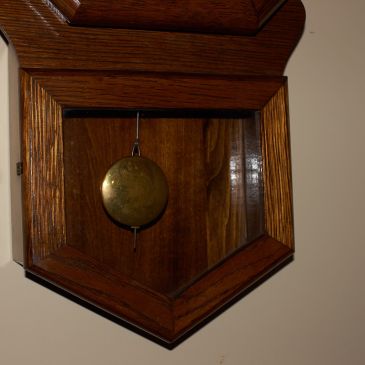
#331 appears on the inside access door. The number 331 was likely an inventory number that referred to one of a lot purchased by the municipality in the 1930s. Why a school board would order time and strike clocks is an interesting question. My other schoolhouse clocks are time-only. Why the access door is a solid sash rather than glazed is another curious question. The combination of the solid sash and time & strike movement must have hit a particular price point for the school board at that time. The teachers were likely instructed not to wind the strike side.

Time zone clocks
Time zone clocks

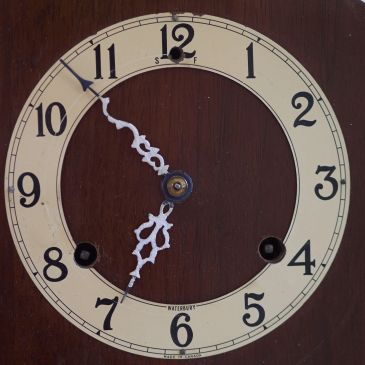
The New Haven clock is now one of three “time zone” clocks on our kitchen wall. I have a daughter in Victoria BC, and a daughter in Calgary, Alberta and at a glance I can see the time in those two regions of Canada. The New Haven clock is our local time; the Victoria clock is a Waterbury and the Calgary clock is a Sessions.

This clock is on my calendar for servicing which I will cover in an upcoming article.


Stubborn little plate clock movement

I prefer time-only clocks above anything else. They are simple to work on and because they are less complex they tend to be more accurate, relatively speaking. Most are easy to service but this little guy has me stumped.

Thousands of these relatively small German movements were made and some found their way into small shelf clocks like the ones I will be talking about in this article.

RS Blackforest mantel clock (64)
Time-only movement, German

Let’s not confuse these inexpensive clocks with better known and highly regarded Black Forest clocks of Germany

I acquired a couple of Blackforest shelf clocks about a year ago. Let’s not confuse these inexpensive clocks with better known and highly regarded Black Forest clocks of Germany. The clocks I will be discussing here were made by the Blackforest Clock Co. of Canada in the 1930s. Later on, during the war years (1941) the company felt compelled to change it’s name to the Forestville Clock Company of Canada. They sourced their movements from England during the war years and Germany prior to (and after) World War II. They are German time-only “plate-clock” movements. They are called plate clock movements because they were made to be placed behind decorative plates, commonly called delft porcelain wall clocks designed primarily for the kitchen. Many delft clocks had time-only movements just like the ones in these shelf clocks.

RS Refinished case (7)
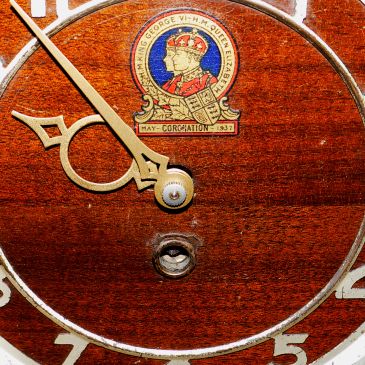
King George VI Commemorative visit 1937
RS together but not working (2)
Blackforest Shelf (mantel) clock circa 1935

They are easy to find. Antique stores, junk shops, and thrift stores all have them. They are very cheap, usually quite stressed having spent most of their lives in basements, attics and garages and probably the last clock to leave the store shelf. They are always passed over for the “better” clocks. I buy them because they are cheap and relatively easy to bring back to life. The pictures you see here are clock cases that have been significantly refreshed. Here’s a before shot.

rs-blackforest-mantel-clock-48
This is one very homely clock

 Those who are familiar with time-only movements know they are relatively simple to work on

Since the mainspring in one clock snapped in two places I have combined the best parts of each one in an attempt to have a working movement for the most attractive looking clock which for me is the 1937 commemorative edition King George VI clock. I might just throw in a quartz movement for the other clock unless I find another plate clock movement. For those who are familiar with time-only movements they are relatively simple to work on. You might call them fun and a good challenge for those new to clock repair. The gears are small and the pivots are tiny but they are easy to dissemble and put back together. No helper springs and levers to worry about. Here are some shots of the movement.

RS shelf clock number 2 (2)
Movement inside the case
rs-plate-clock-movement
Parts of two movements are combined to make a working one, back plate is off
rs-plate-clock-movement_5
All shined up and on the test stand
rs-plate-clock-movement_6
Showing unique one piece pallet, verge and pendulum assembly
OLYMPUS DIGITAL CAMERA
All in one pallets, verge and pendulum rod and bob.

I have been testing the movement with mixed results. I installed one bushing on T3 after which the movement ran better. It is in beat and will run but not for as long as I would like. Why can’t this little guy run a full eight days? The best it can do is 4 days. Perhaps a mainspring issue; too weak to give me a full eight day cycle? A pity because I truly wanted to have this thing running strong and reliably. Being a glutton for punishment I have another plate clock coming in the mail. I am not absolutely sure if it has the same movement but I am willing to bet that it does since it is another Forestville, this time a true delft clock.

These often neglected clocks are great fun to work on. Total outlay for all three clocks – $55. Not bad!

Antiquing on a Sunday afternoon

Carriage clock with Jeweler's inscription
Carriage clock with Jeweler’s inscription

Sadly the number of antique shops in Nova Scotia is dwindling. We were antiquing in the city of Halifax (Nova Scotia, Canada) this past spring and one of the store owners remarked that there used to be dozens of antique shops in the city, now only a few remain. There are still a few antique shops left in the rural areas and one of our favorites is located in Great Village, Nova Scotia. We decided on a little drive to Great village on a sunny fall Sunday. We were not disappointed in the variety of clocks we discovered. Although I saw all the following clocks during our day of antiquing I bought only one, the Kern “diamond face” 400 day clock (see photo below).

rs-great-village-antiques_3
Window display
Unknown French clock

I want to give readers a sense of what is out there if you are collector like myself  or you are new to collecting. Now is an excellent time to buy. There are certainly deals to be found and plenty of clocks in the shops. My personal experience is that the antique stores are great places to buy clocks but it can be bit of a gamble. For example, the Kern 400 day clock was advertised for a very fair price complete with glass dome. I asked the store owner if they knew anything about clocks and they said “no, nothing at all”. Sometimes that is a very good answer! The tag on the clock said “as is”. The owner evidently thought the pendulum balls were seized. Prior to the purchase I discovered, that they were, in fact, in their locked position. I got the clock home, unlocked it, gave a little push and it has been running for the past week.

Stamps for sale
Stamps for sale

You can get a “steal” of a deal, a clunker or something in between in an antique shop. In this same shop two years ago I bought an Arthur Pequegnat Brandon wall clock for under $200. The case is in excellent shape as is the dial but the movement, though barely running, required servicing. Even though I had to put a little more money into the clock I still consider it a great deal!

Having some knowledge of clock models, styles and types in particular is an advantage. Or, perhaps you might have a good sense that what you are looking at is a good deal. In the case of the Kern 400 day clock I inspected it beforehand and found that it was not only complete but in excellent condition. The $58 Garrard time and strike (photo below) might be a good deal but if it is missing the pendulum you are going to have to search long and hard for a replacement or buy one which adds to the cost. You might ask yourself, what else is missing and how much more money would I have to put into it? The Garrard was missing the front glass and I could not figure out how it was attached so I passed on it. Those are some of the factors to consider when you see something at an attractive price.

A doomed Ogee
A doomed Ogee

In the case of the carriage clock (first photo) the seller wants $120 but the day I was there they were offering a 20% discount which works out to $96. There is a jewelers inscription on the front which says Ryrie Bros. Toronto. Ryrie Bros was a jeweler in Toronto and was incorporated in 1905 with James Ryrie as president and W.M. Birks as vice president. In 1924 the firm changed it’s name to Ryrie Birks and finally in 1933 became Birks. As any Canadian knows Birks (Maison Birk) is one of the premier jewelers in this country. One could comfortably date this clock at between 1905 and 1924. Although the tag says that it is French it is likely American. It might be desirable however there are two bothersome issues that I could see right away with this carriage clock. One, the left side beveled glass panel has a chip in the lower back corner and two, there are noticeable hairline cracks in the upper two corners of the face. The tag said it was in working order. $96 may not be a bad price when you consider that comparable clocks fetch upwards of $130 or more + shipping on Ebay. If it is still there before Christmas I might take a second look.

Unknown "marble" desk clock
Unknown “marble” desk clock

This unknown “marble” desk clock was very interesting and quite heavy. It had an alarm clock style movement with a key wind and an adjustment for the time, and what appears to be brass bird (duck?) on it’s right side.

Kern diamond face 400 day clock

As I mentioned I bought this Kern 400 day “diamond face” clock. It is in excellent condition; unlocked the pendulum, oiled the movement, gave it a gentle push of the pendulum and now running very well.

Could be Session, Ingraham, Ansonia
Could be Sessions, Ingraham, Ansonia

In decent shape, 1873 it said on the label, but the seller wanted too much, $450 if I recall. The seller claims it is running, according the tag. Is it a Sessions, Ingraham, Ansonia or …..?

Sessions shelf clock
Sessions shelf clock in oak case

This clock looked to be in decent shape, the strike side appeared to be working properly. The case is oak but when I picked it up to examine it more closely, the construction, fit and finish had a cheap feel. There was a card inside describing a servicing performed in 1994. $68 – a little high, I thought but there may not be a lot wrong with it.

20161120_1451511416

I like this clock but know very little about crystal regulators. What I do know is that most American companies made them, from simple brass and glass cases to elaborate cases with cast and gilt ornaments. Equivalent French examples seem to be more valuable than American ones. They can be highly expensive. Generally, the more elaborate the case, the more expensive the clock, even though the simple cases could easily be considered more tasteful. I remember seeing a very ornate one on Antique Roadshow which was valued at $8000. Condition is very important with these clocks, including the condition of the beveled glass, dials, and original finish (generally gilt) on the case ornaments. Is the pendulum supposed to be filled with anything? Mercury? These cylinders looked empty. The seller claims the clock is running and wants $365. A fair price? I don’t know. It needs a thorough cleaning though.

Garrard mantel clock

This English Garrard clock had a well constructed case and appeared to have a well-made, robust movement but was missing its front glass. I have been to this particular shop several times and nobody seems to be interested in the clock though the price has not changed.

rs-great-village-antiques_6
Seth Thomas made by Talley Industries

I noticed a Seth Thomas mantel clock in a dark corner. This particular example is one that I would not recommend to anyone unless you are a fan of Talley Industries. It is a Seth Thomas Westminster chime mantel clock made by Talley Industries, Peterborough, Ontario in the early seventies with what appears to be an imported West German Hermle movement. This clock was cheaply constructed (corners were chipped), likely has the dreaded plated pivot problem and has absolutely no collector value. Those in the clock collecting world familiar with Seth Thomas know that it was a reputable clock maker for many years and produced many fine clocks but the Talley Industries era must have been a very dark period for the company!

rs-great-village-antiques_8
A unique clock design

I hope this blog article gives the reader some ideas when it comes to antique shop clock shopping. It certainly pays to do your research. Although I love browsing the shops I do not limit my shopping to them. I acquire many of my clocks from a variety of sources including Ebay, Kijiji, and word of mouth but I like browsing through antique shops because there are always other interesting items that catch the eye.

Ingersoll Waterbury mantel clock servicing and a little mystery thrown in for good measure

OLYMPUS DIGITAL CAMERA
Ingersoll-Waterbury time and strike mantel clock

When I bought my Ingersoll-Waterbury clock a year ago I knew that it had not been serviced but the price was reasonable and it was running. I  got a lot of other projects out of the way and have finally gotten around to giving this clock a little care and attention.

Ingersoll-Waterbury clocks were sold in Canada; had Canadian made cases using American made Waterbury movements and were sold in department stores across Canada. This clock was distributed by the G. R. L’Esperance Co. from Montreal, Quebec. The label on the inside of the back access door says “Ingersoll-Waterbury Co. a division of Waterbury Clock Co.”. Ingersoll-Waterbury was the Canadian arm of the Waterbury Clock Co. Year of manufacture, I am estimating was somewhere between 1940-1944 when brass was in short supply.

The case is in very good shape though it was likely inexpensive to make. Some cost savings are evident in the use of a paper dial, flimsy clock hands and a plastic bezel with flat glass. However, I was impressed with the well designed and sturdily built movement and surprised that it did not take much to service this clock.

OLYMPUS DIGITAL CAMERA
The front of the case has a swinging door

One unique feature is a swinging door with plastic bezel and flat glazing attached to the case by two hinges that open up to reveal the clock face and hands.

OLYMPUS DIGITAL CAMERA
Brass bushing punched into a steel plate

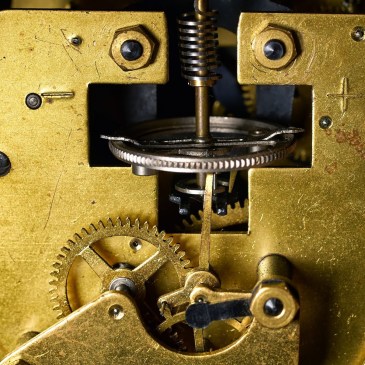
The clock has a steel frame with a brass electro-plating as a rust inhibitor and brass bushings punched into drilled holes in the steel. Steel plates are not unusual as there were a number of manufacturers which used steel as a cost savings measure, for additional strength or because brass was in short supply. The plates were often plated with nickle as in the case of Arthur Pequegnat clocks or brass as in the case of this clock. One of the first things I noticed when I dis-assembled the clock were the number of punch marks adjacent to the bushings an example of which can be seen in the next photo. It must have been difficult to achieve a tight fit for the brass bushings; factory punching ensured that the bushings remained in place.
punch mark next to a bushing

I have just completed the servicing. The clock required three new bushings. Punching new brass bushings into the factory bushings took a little more care and attention than usual as I did not want to loosen the existing bushings.

OLYMPUS DIGITAL CAMERA
8-day time and strike movement

Dis-assembly, cleaning, servicing the mainsprings, installing new bushings are no different than any other American movement. Re-assembly of the strike side requires the synchronizing of the strike side by aligning the levers and wheels correctly which usually takes several attempts for me.

The one real challenge I had was aligning the strike hammer so that it would actually strike the gong. I must have bent it when I took the clock apart. What was I thinking?  I could not see the solution so I put it aside until I came up with the fix. I ended up bending it back to its correct position.

While re-installing the movement into it’s case I noticed something strange on the bottom of the clock, a mysterious hatch. On the bottom right hand side of the clock (indicated by the arrow) there is a hatch that measures 2 3/8 inches by 2 3/8 inches. On it there is an inscription which reads

“FRONT, if you know what this hatch is for, you know more than I do” signed J.H.Ross May 24, 1967.

“Front” refers to the orientation of the hatch. What is it for? I posted this on the NAWCC discussion board site and so far no-one has come up with the answer.

Arrow showing where hatch is located

Why would anyone put a hatch on the bottom of this mantel clock?

Where hatch is located

Was the hatch added later on? There is a lighter colouring of the wood to the left of the green felt which seems to indicate that a hole was cut out later to accommodate the hatch.

The hatch is open
The hatch is open

A clasp on the other side of the hatch secures it in place and allows it to be removed.

Bottom left side
Bottom left side

Was the trap door a chamber to hide items? Why, when it simply opens up into the case interior.

View of bottom of case

And there’s more! Here is a view of the entire bottom showing a second cutout (see arrow) on the left side. Why go through all this trouble?

The clock is all back together and in the process of being regulated but I sure would like to solve this mystery. It has taught me one thing, always look at the bottom of a case.

Ingersoll-Waterbury time and strike mantel clock

Ingersoll-Waterbury mantel clock

My next project is this vintage Ingersoll-Waterbury time and strike mantel clock. Ingersoll-Waterbury clocks were sold in Canada and had Canadian made cases using American made Waterbury movements. G.R. L’Esperance of Montreal were the sole distributors of Ingersoll-Waterbury clocks in Canada.

Waterbury has a long history going back to 1857. Like many American clock companies the Waterbury clock company had its boom periods (late 1800s) and its low period (1930s).  In 1942 a Norwegian company ended up buying the Ingersoll-Waterbury Company. They built a brand new factory in the nearby town of Middlebury, CT.  and in 1944 the company name was changed to United States Time Corporation; this clock was made prior to that year.

What makes this clock interesting is that it actually has a steel frame with a brass electro-plating. The plating was evidently used to stave off rust. It is very likely that this clock was made at some point through the war years (1941-44) when brass was in high demand hence the use of steel for the plates. To accommodate the pivots, brass bushings which were pressed into the steel pivot holes at the factory. My only other experience with steel plates is my Arthur Pequegnat Maple Leaf kitchen clock which has nickle-plated steel plates. The Maple Leaf by Arthur Pequegnat is shown in this next photo.

Arthur Pequegnat Maple Leaf kitchen clock
Arthur Pequegnat Maple Leaf kitchen clock with nickle-plated movement
Waterbury back plate

As you can see the movement is quite dirty and will require a thorough cleaning which can only be accomplished by a complete dis-assembly. Once disassembled comes the inspection and servicing.

Centre canon repair
Centre canon repair
Punch mark adjacent to bushing
Reverse side of punched bushing
Reverse side of punched bushing showing oil cup

This clock has never been bushed. The punch marks found adjacent to three of the bushings were likely factory made to set the bushings in place. There is one tooth repair (fourth photo) on the centre canon gear which appears to be the only evidence of work performed on this clock after it left the factory and the only indication that this clock was ever serviced.

The case is in very good condition requiring only a cleaning and polishing. I may touch up the clock hands with a little white paint.

I have determined that only 5 bushings need to be “replaced”, so time to get started. I will report on my progress with this clock in an upcoming article.

So, my sister also loves clocks

After not having visited my sister in some time I was surprised to find that she is an avid clock collector. I must stress the word collector because although she appreciates the beauty of each clock she has acquired over the years how they run is somewhat of a mystery to her and that is just fine. While visiting her this summer three of her clocks were out of adjustment and it took no time (no pun intended) at all to get them running again. No sense paying someone to do it, that`s what brothers are for.

In my opinion the most interesting clock she has is a French time and strike bracket clock that has no visible markings yet appears to be over 100 years old. It is in beautiful condition with only a slight patina on the finish. I would love to have found out more about this clock but my stay was brief. Perhaps next time.

French bracket clock

The next clock is one my sister absolutely loves and it is a great sounding Westminster chime grandmother clock she bought some 20+ years ago. This quarter chime clock made by Craftline Industries in the early 1990s has a Canadian made case with a German movement, likely by Hermle.

Craftline grandmother clock

Next is a curiosity. When I saw the Sessions name on the dial I wondered why I had not seen this particular style of Sessions clock. Further investigation revealed it to be a six pillar Adamantine Seth Thomas case. The movement was clearly marked ST and as I said the case is certainly a Seth Thomas. So, why the Sessions clock face? Likely the original dial face was so badly marred as to be unreadable that the owner many years ago simply told the clock repair person to find another face, which he did. Since the replacement was a Sessions electric clock face he had to drills the holes to accommodate the winding arbors. Who would know! To those less knowledgeable it looks great.

Session Seth Thomas mantel clock
Sessions / Seth Thomas mantel clock

I found this little antique time-only Hamilton and Co. French-style carriage clock made in India (Calcutta) to be very interesting and so diminutive. Hamilton and Co. is probably the best known and most celebrated British clock maker in India. I would put this clock at around the 1890s. It probably needs a good cleaning since it is not in working order.

Hamilton and Co Calcutta
Hamilton and Co. Calcutta

I am not a huge fan of steeple clocks but this Waterbury clock is in very good condition save for a damaged right steeple tip. The Waterbury Clock Company is one of many 19th century Connecticut-based clock firms with a history going back to the 1850s though it closed is doors for good in 1944. More memorable are Waterbury wall and mantel clocks but like many makers of the day they had a successful line of steeple clocks.

Waterbury steeple clock

Next is a New Haven time and strike tambour style mantel clock from about the late 1920s or early 1930s. Aside from the grandmother clock which my sister bought new the New Haven mantel clock was a wedding gift of her late husband’s parents and has been in the family ever since.

New Haven Mantel clock

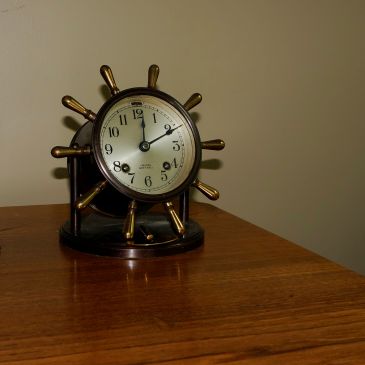
Lastly, this Chelsea ship’s bell clock is a polished beauty. A ship’s bell is used to indicate the time aboard a ship and hence to regulate the sailors’ duty watches. Unlike normal clock bells, the strikes of the bell do not correspond to the number of the hour. Instead, there are eight bells, one for each half-hour of a four-hour watch. Three bells, for example, would mean that a sailor would be 1 1/2 hours into a 4 hour watch. Each watch would take its turn with the essential activities of manning the ship’s helm, navigating and keeping a lookout.

Chelsea ship's bell cloc
Chelsea ship’s bell clock

I was quite impressed with my sister`s collection and each clock occupies a special place in her home. I find it facinating going into peoples homes and discovering the joy they experience in collecting, be it clocks in this case or anything for that matter. Collectors are truly unique people!


The shelf clock – what is it, exactly?

What is a shelf clock? If you have a number of clocks as I do it can be quite confusing to describe each specific type to the average person but it is really quite simple. Let me explain how you can identify the clock you might be looking at. The term shelf clock is a broad category but I believe it can be classified in the following ways.

Some 180 years ago the first shelf clocks were OG (Ogee) clocks. These were the first mass-produced American clocks, were inexpensive, and were made up to about the late 1870s. They represented the early years of American clock-making and the transition from more expensively produced wood movements to cheaper brass movement clocks. OG clocks are so named because of the double-curved molding on the front of the clock. The curved molding was designed to hide the weights. Many of these clocks were weight driven with 30-hour or 8-day movements and had mirrored or painted tablets. OG clocks were usually 25 inches in height and 15 inches wide and had hardwood veneers covering a softwood frame. They were surprisingly accurate and reliable.

Clocks
Spring-driven and weight driven 30 hour OG (Ogee) clocks, made by the Canada Clock Company, circa 1872-76 (Canadian Clock Museum)

Later, more stylish clocks could be found. These are called Column clocks because they would either have a half-column or full column on the left and right or even stacked half or full columns such as the one pictured below. Moldings on the top and bottom would be brought together by columns on each side of the clock with mirrored or painted tablets. Column clocks were almost exclusively weight driven with 30-hour or 8-day movements.

Column clock
Stacked Column clock, circa 1870 (Canadian Clock Museum)

At around 1840 Steeple clocks were introduced. They had a peaked centre section bordered by columns topped with finials and a peaked sash with a decorated (often hand-painted) lower tablet. They were spring driven with 8-day movements. Steeple clocks are very distinctive, stood about 15 inches high with veneered hardwood over softwood, often with reverse-painted scenes and are made by a number of well-known companies.

RS on display
Arthur Pequegnat Maple Leaf “fan top” Kitchen clock, circa 1905

Kitchen clocks (Gingerbread) were simple or ornate with carved or steam-pressed patterns made by quick-saws and heavy steel presses, stood 22-24 inches in height and about 15 inches wide, and had a decorated sash which could be a very simple design as you see here or a much fancier reverse-painted glass scene. These inexpensive, visually pleasing timepieces sat in the kitchens of lower and middle-class homes and were produced by the thousands. They were so named because of their likeness to the design of gingerbread houses at the time (early 1900s). They are usually made of oak, walnut or even walnut trimmings on oak with a metal clock face and many had a simple alarm mechanism. The Gingerbread clock you see here is the Maple Leaf “fan top” by Arthur Pequegnat. The Maple Leaf came in 4 unique styles all characterized by the maple leaf decal on the glass door.

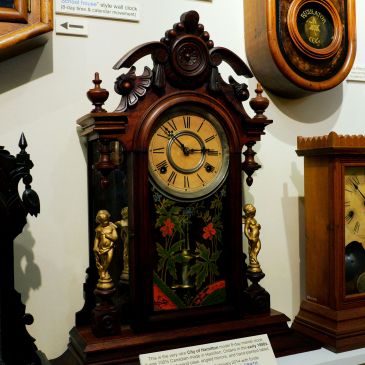
Some kitchen clocks had beautifully carved features and figurines such as this stunning clock made by the Hamilton Clock Company (Canada), though a clock such as this might be found elsewhere in the home and considered a parlor clock.

RS City of Hamilton Canada Clock Co
City of Hamilton, made by the Hamilton Clock Company, circa 1880 (Canadian Clock Museum)

When spring-driven clocks were introduced the Parlor clocks like this Hamilton Clock Company model became popular. They tended to be narrower than column clocks because they had spring-driven movements. These clocks mirrored the furniture styles of the time. This one reflected the Victorian era with its bold figurines, carved finials, elaborate patterns etched into its wooden frame, and the hand-painted floral design of the sash.

RS 45-175
Seth Thomas round top cottage clock, circa 1930

Cottage clocks are less than 15 inches high and typically 8 inches wide are small, simple in design, and take up very little space. Many have basic alarm mechanisms but have one feature that distinguishes them from other pendulum clocks. They have a clip or a clasp that secures the pendulum rod for travel. The “round top” you see here was sold by Henry Birks and Sons an upscale Canadian jeweler. Others had “beehive” tops, flat tops, or octagon tops.

Pendulum rod clip
Pendulum rod clip for Seth Thomas round top

Smaller clocks are often referred to as desk clocks. They are usually mainspring driven with a flat dial. This Kundo 400-day anniversary German clock is an example of a desk clock but it might also be described more specifically as a torsion clock. This one stands less than ten inches tall and has a glass dome, a weighted wheel with 4 balls suspended by a ribbon called a torsion spring, and an exposed movement. It was typically given as a wedding gift.

RS Kundo
Kundo 400 day anniversary clock, circa 1970

Finally, the mantel clock.

Mantel clocks can be ornate, larger, and the centerpiece in a room. This particular clock, a Mauthe pendulum mantel clock offers a precision-built sophisticated German Westminster chime movement in a relatively non-descript but attractive and well-built cabinet that is simple yet elegant.

RS Mauthe mantle clock (30)
Mauthe time. strike and chime, circa 1970

ASIDE: Is it mantel or mantle? I have always considered a mantle as something you wear, a garment or a part of the earth’s crust. A mantel on the other hand is a shelf above, say, a fireplace. I see this word interchanged so often when clocks are advertised or described that either word is universally accepted. I prefer the word “mantel”.

RS April 12th
Ingraham Huron shelf clock, circa 1878

Mantel clocks were inexpensive to make, occupied very little space, and were part decoration and part practical timepieces. Mantel clocks were made with brass, wood, porcelain, slate, Bakelite, and metal though for the most part they were designed to be lightweight (slate clocks and cast iron clocks would be the exception), simple in basic design, and very practical. Mantel clocks have lasted so long, over two centuries, because they are dependable, versatile, and work so well in many domestic situations.

The categories of shelf clocks also include carriage clocks and lantern clocks. One of the first clocks whose movement and external structure was made predominantly from brass instead of iron or wood was the lantern clock. Although the shape of the clock looks somewhat like a lantern, the derivation of the name probably stems from the French word “laiton”, meaning brass. The earliest lantern clocks had striking mechanisms; later in the 17th-century alarms were sometimes added. Some lantern clocks had pendulums and could be hung on the wall.

Carriage clocks were spring-driven clocks developed in 19th century France and are made of plain or gilt brass. They are often no more than 8 inches tall, designed to be portable, and are characterized by a rectangular shape, glass or porcelain panels, and a carrying handle on the top. If you have a Breguet carriage clock as part of your collection you are very lucky indeed!

This is by no means an exhaustive description of the types of shelf clocks. There are others such as swinging clocks, tambour clocks, pillar and scroll, and so on. Whether you are shopping for a clock as a gift or adding one to your collection or even describing what you have seen to a friend, it is important to understand the distinctions between one type and another.

A curious little Blackforest shelf clock

RS shelf clock number 2 (6)
Black Forest Clock Company of Toronto, clock in as found condition

Shelf clocks such as the one pictured have always been hard to find though I did stumble upon this one very recently (April 2016) at an antique store in Great Village, Nova Scotia. Why, because of their cheap construction and inexpensive movements, not many of these clocks have survived over the years.

This one might have had a special meaning to someone at one time because it is a memento of the King George VI coronation of 1937 which nicely dates the clock. He became King George VI of England in December 1936 following the death of his father George V and the abdication of his brother. He had been a heavy smoker and in 1951 had his left lung removed then died suddenly in the winter of 1952. Elizabeth became queen later that year.

RS Refinished case (6)
Black Forest shelf clock after case restoration

RS Refinished case (7)
Another view of refinished case

This Blackforest shelf clock is only slightly larger than the first Blackforest clock I picked up last summer (2015) and like the other, is time-only.

RS shelf clock number 2 (4)
Company plate on rear of clock

The time-only movement is very simple in design. The pendulum rod, bob and pallets are one piece.

Pendulum
One piece pendulum assembly

To adjust the beat rate you either rotate the bob left for slower rate or right to make the clock run faster or slower. Outside the back plate sits the mainspring which is housed in an open barrel and there are 5 gear wheels plus the escape wheel between two solid plates. This is an identical movement as found in my other Blackforest shelf clock  but unlike this clock it was in very poor condition. The movement is German and could have been made by a number of companies at the time; Keinzle, Mauthe, Hermle or Junghans. There are no stamps or markings on this so-called “plate” movement to give any indication of the maker. Typically many Canadian companies such as the Blackforest Clock Company of Toronto (the Forestville Clock Company after the war) imported German movements before the Second World War and installed them in Canadian made cases.

RS shelf clock number 2 (2)
Plate clock movement

RS shelf clock number 2 (12)
Commemorative Edition – 1937 Coronation of King George VI

To refinish the case I cleaned it thoroughly using Murphy’s Soap, applied three coats of dark walnut stain taking care to wipe the stain with a cotton cloth 5-10 minutes after each application. My intent was to fill in the scratches and abrasions rather than radically alter the colour. I then rubbed the cabinet with 0000 steel wool between coats and applied two top coats of clear polyurethane satin finish. I cleaned the numerals but decided against repainting rather preserving the original patina, though I applied Brasso to bring back the finish on the key wind bushing. In the end the case is a little darker but likely closer to its original finish.

shelf clock number 2 (10)
Original winding key

I haven’t quite figured this out yet but I think the winding key has a “bottle opener” design to allow the pendulum to be locked during travel. Ideas?

This clock would make a great addition to a any bedroom. It is small enough for a dresser or even a side table, quiet enough (for a mechanical clock) and is still attractive in design after all these years. Heck, you can even wind the clock in the 6 o’clock position.

My clock and Mickey Mouse are related!

Anyone who collects clocks knows that Waterbury clocks have had a long and illustrious history but did you know that the modern day Timex watch can trace it’s roots all the way back to the Waterbury Clock Company?

Let’s start with my Ingersoll-Waterbury time and strike mantel clock that I picked up late last year (2015) and following which we will explore this most interesting company.

Mantel clock
Ingersoll-Waterbury mantel clock

This mantel clock was sold to retail outlets by the G.R. L’Èsperance Company of Montreal, Canada who advertised themselves as the sole distributor. “Made in Canada” it says on the case but as is typical of clocks sold in Canada before and during the Second World War the movements were made in the USA, assembled and shipped to Canada to be installed in cases that were sold in many stores across the country. Other clock companies such as Seth Thomas established a similar practice. Aside from the very rare Martin Cheney clocks made in Montreal in the mid 18th century, the only clock company that made their own movements and built their own cases was the Arthur Pequegnat Clock Company based in Kitchener, Ontario in the early 1900s to 1941.

This Ingersoll-Waterbury mantel clock was made in 1943 and likely very popular at the time.

clock face
Clock face showing somewhat flimsy hands

It has a conventional pendulum adjusted by a small arbor under the “12” and the company logo “W” in raised relief on the bob. It has a common recoil escapement. The clock face is paper with the inscription “Waterbury” on top of the “6” and”Made in Canada” below it.

operating instructions
Label showing instructions for operating the clock

The label is a generic one found on a wide variety of clocks to save printing costs. The swinging front panel door is unique to this clock and there is a small catch underneath the right hand side to secure it.

The hands may look very ornate but they are in fact quite cheap looking. A quick search on the net reveals that are, in fact, original. The inexpensively made hands and paper face are not unexpected for a mass produced clock.

clock movement
Time and strike movement

The veneers on either side of the back panel were split open when I first received the clock but clamping and carpenter`s glue tightened things up. It is very common for clocks of this vintage to have chipped or missing pieces of veneer which unfortunately reflects their cheap construction. However, this clock presents well and is free of serious flaws on the case itself.

clock door
Swinging front panel door

The Waterbury name has been around since 1857. From my research I found that in 1922, the Waterbury Clock Company purchased the Ingersoll operation whose business had begun to decline after 1910 and had gone bankrupt two years previously due to poor management. Waterbury’s operation was particularly hard hit by the Great Depression of the 1930s. Clocks were considered luxury items and many could ill afford a timepiece for the home.
By 1932, their huge factory complex was almost idle when demand was so low. The company avoided bankruptcy and the firm was reorganized as the Ingersoll-Waterbury Company with investors raising half a million dollars in new capital. During this period (1933) the popular “Mickey Mouse” character watch was made and electric clocks were added to the line which revived the company. The Mickey Mouse watch was known as the “mouse that saved the day”. Draw any conclusion you wish.
After the USA entered World War II, the Ingersoll-Waterbury Company switched almost entirely to manufacturing war products though a small number of clocks were still produced. However, in 1942, the company was purchased by a group of Norwegian investors and a new factory was built at Middlebury, CT. Two years later, in 1944, the firm changed its name and became known as the United States Time Corporation. They introduced the widely popular “Timex” watch a year later. In November, 1969, U.S. Time was succeeded by Timex Corporation (now Timex Group), whose corporate headquarters are located in Middlebury, CT. to this day. The Timex museum, located in Waterbury, Connecticut, USA, is said to be “both the birthplace of Timex, and of modern timekeeping”.
So there you have it. My clock and Mickey Mouse are indeed related!

Forestville mantel clock

If you’re expecting a post about clocks from the Black Forest region of Germany, I apologize for the mix-up. This article is actually focused on the Forestville Clock Company of Canada.

Forestville clocks were assembled in Canada with foreign movements in local and foreign-made cases through the late 1920s to the mid-1970s. Forestville mantel clock

This particular Forestville mantel clock is not particularly special but it comes with a story.

In 2013, during a visit to the Thousand Islands, my wife and I stopped by an antique store in Gananoque, Ontario. While browsing, I was drawn to a clock that caught my attention. I was somewhat familiar with the Forestville name, as the Forestville Clock Company of Toronto had assembled thousands of these clocks. The price tag on the back was $175, which seemed a bit high to me. We stayed overnight in the area and decided to return to the store the next day. When we did, a different clerk was on duty. Although I knew the price listed, I asked him what the clock was priced at, just out of curiosity. Without checking, he replied, “It’s $75,” and I bought it. Afterward, he noticed the price tag on the back and said, “You got a good deal.” I think he learned something that day.

History of the Blackforest Clock Company of Toronto

The Blackforest Clock Company of Toronto, Ontario was founded by Leopold and Sara Stossel in 1928.  Both clock movements and complete clocks were imported from Germany and sold through department and jewelry stores across Canada. Their son Ed Stossel started working part-time with his parents’ company in the 1930s and later became a full-time employee in the late 1940s.

Some assembly work was carried out in their Wellington Street East factory. Initially, imported mantel clocks and grandfather clock movements were installed in cases made in Kitchener, but later the complete mantel clocks were imported from Germany. This arrangement was interrupted by the Second World War, which also led to a name change to the Forestville Clock Company in 1941. During the war years, this company imported its clock movements from England, the United States, and even France. However, starting in the mid-1950s German factories again became the source of most Forestville clocks, with Mauthe being a major supplier. (source: The Canadian Clock museum)

The Forestville Clock Company was very successful during the middle decades of the twentieth century. Ed Stossel retired in 1979 and unfortunately, the company survived just a few more years under new leadership.

Dial of clock
closeup of the dial

Both the movement and case were imported from Germany probably in the late 1960s or the early 1970s and the style reflects that period. There is a serial number on the backplate but it is not much help in dating the exact year the clock was made.

Movement of clock
Movement showing evidence of over-oiling

As clock manufacturers were searching for efficiencies, lever escapements replaced floating balances and pendulums in the 1960s and 1970s. I much prefer a pendulum clock but clocks such as this have the advantage of operating on surfaces that are not level.

Balance wheel and hairspring escapement
Lever escapement with speed regulator

This is a closeup of the strike lever mechanism.

inside of mechanical clock
Lever mechanism for strike
strike mechanism
Lifting mechanism for strike function

The three strike rods give the clock a “bim-bam” sound on the half-hour. Not unique but disctinctive.

This mantel clock is a handsome piece with great lines and makes a wonderful addition to my growing collection of antique and vintage clocks. However, it is quite dirty and will need a thorough cleaning. I’ll save that task for another post.

Maple Leaf clock is sent off for repairs

RS Complete so far and on display (1)
The case is about 90% restored

December 18th marks the day that my Arthur Pequegnat Maple Leaf fan-top is off to repair.

Sadly this is a repair that I cannot perform myself at this stage of my learning. The problem is essentially a clutch plate off the centre arbor that is not engaging the gear for the strike side. The result is that the hour and minute hand do not move at all thus the centre arbor is quite loose. In the meantime I might as well have some bushing work and a thorough cleaning done.

Typically gingerbread clocks go for almost nothing on the for-sale sites. The fact that this is a Pequegnat means something special however and in my view it is worth preserving for years to come.

Here is the problem area.

view of the clutch cup on the centre arbour
Clutch cup is loose

Although it is difficult to visualize from this photo, the cup clutch plate is very loose and needs to be reattached to allow a firm connection to the gear beneath. As such I am prepared to put a little money into this clock and keep it in my collection.

Maple Leaf case restoration Part 2

I have had this Arthur Pequegnat Maple Leaf fan-top clock for several weeks now and have decided to keep it in my collection. I was not satisfied with the condition of the case when I first saw it and knew that something had to be done. After several hours of work on the case I can finally say that the results have been very good…not excellent because there are one or two things I would have done differently. For example, I originally used a cotton cloth to bring down the finish and ended up rubbing too aggressively in some sections. Looking back I would use 0000 steel wool from start to finish.

This shot is a comparison between the original finish and taken after hours of restoration.

RS Pequegnat fan top (6)
Condition of clock when first brought home

RS fantop
After hours of rubbing and scrubbing

As you can see in the second photo the oak grain is natural and pronounced; the mottling has disappeared. As mentioned there were one or two spots where I was a little too aggressive with the steel wool which I may address later on but for the moment I am going to live with it.

I applied four coats of Amber Shellac and between coats I rubbed the finish with 0000 steel wool. Shellac is the proper approach for case restoration as that product would have been used at that time. The clock now looks very close to what it would have looked like at the time it was made which would be about 1910. The next photo shows the clock fully re-assembled and on display and the next, how it looked when I brought it home.

RS on display
Ready to be brought to the clock shop for repair

RS Pequegnat fan top (3)
Just brought home

Although I am able to dis-assemble, clean and oil a clock mechanism there is a problem with the center arbor not engaging the strike side of the clock. It is off to Doctor Clock in Halifax for repair and cleaning of the movement.

Maple Leaf case restoration Part 1

RS Pequegnat fan top (3)
The clock had just arrived

Although my newest Arthur Pequegnat kitchen clock was complete in every way the case looked like something pretty dire happened to the finish.

I mentioned before that the clock was likely in a very warm environment for a long period (an attic perhaps) and while there are no cracks or breaks in the wood there was a lot of what I called mottling. RS Pequegnat fan top (6)

What you see in the first photo is the condition of the case when I first got it. Some might like it that way, I don’t. The seller thought it added “character”. Hmm!

I sought some advice on the NAWCC forum site by asking a few questions and was informed that a member had put together a recipe for this kind of situation. The recipe included turpentine, alcohol, vinegar, boiled linseed oil and 000 steel wool. I found that it worked to a point but the mottling was quite pronounced and I finally had to resort to lacquer thinner and steel wool to take the stubborn stuff off.

OLYMPUS DIGITAL CAMERA
Ingredients for restoration

In some small spots I made the mistake of rubbing too enthusiastically and got down down to the bare wood but I will cover those areas later with tinted shellac a wood covering which was used at the time (circa 1910).

OLYMPUS DIGITAL CAMERA
One step closer to the finished product

The photos might show the case as darker than it is but it is a golden oak which will be close to the final product . I may have to do a little research on shellac from this point onward but I will report on my findings. Thus far a lot of the grunt work has been done.

This is taken at the final stage after the first treatment with steel wool and lacquer thinner and the mixture described above. As you can see the case has undergone a dramatic change although it is far from finished. The carved detailing is also beginning to show through.

OLYMPUS DIGITAL CAMERA
Door is reattached and first stage is complete

Any suggestions or advice would be appreciated.

Maple Leaf clock motion works issue

Pequegnat Maple Leaf (2)
The movement in its case

I knew this Arthur Pequegnat clock had issues when I bought it but I felt that I just had to have a gingerbread clock for my collection. It is a beautiful clock and once fully restored it will be a show piece.

After taking the clock out of its case and investigating further I think I have located the problem and it appears that a previous owner had attempted a fix. Perhaps the repair attempt was made by the owner himself since it looks like a poor effort because of scratch and dent marks on a particular washer that can be seen in the next photo.

The photo below shows the hour cannon and minute arbor. There is a brass washer located near a toothed gear that is very loose. The washer is not secured to the post. Because the washer is very loose there is no firm connection between the gear and the one immediately beneath it. The hour pinion should have a tight fit on the centre arbor. As a result of the slippage the time side works but does not engage the centre arbor.

The movement obviously needs to be taken apart. However, the problem is twofold. First I am able to dis-assemble the movement but I do not have the skills to fix the centre arbor issue.  Secondly, the plates are steel (with nickel plating) with brass bushing inserts which are not likely to be easily knocked out and they do not match modern bushings from today’s suppliers. It would take special reaming tools to install new bushings, tools I do not have. However, I can see that it needs at least 6 new bushings.

OLYMPUS DIGITAL CAMERA
Centre  arbor

OLYMPUS DIGITAL CAMERA
Closer view of the arbor showing a hole that has no purpose

In the meantime I can get to work on the case. The case was likely subjected to heat (stored in hot location like an attic for a long period) and the shellac finish has melted into the alligatored finish you see here.RS Pequegnat fan top (6)

The solution is a special mix of alcohol, boiled linseed oil, turpentine, lacquer and vinegar. It will require time and patience but I believe I can restore the case to its original condition. There are no cracks, nicks or gouges in the finish so I have a very good starting point, I think.

If you have any comments on this fine classic feel free to post.

Arthur Pequegnat Maple Leaf Kitchen Clock

In November 2015, I added an Arthur Pequegnat Maple Leaf “fan top” to my collection. The clock was advertised as non-running, and the seller’s description was accurate—it had its share of challenges. While gingerbread-style kitchen clocks don’t typically appeal to me, I felt that, as a Canadian, if I were to own one, it should be a Pequegnat.

This clock dates back to the Berlin era (before 1917, when Berlin was renamed Kitchener, Ontario) and features the signature nickel-plated steel plates with brass bushings, characteristic of most time-and-strike Pequegnat clocks.

RS Pequegnat fan top (3)
Arthur Pequegnat Maple Leaf Kitchen Clock

The clock is complete with its Maple Leaf bob, an original untouched dial, most of its label, and a remarkably well-preserved maple leaf decal on the front glass.

RS Pequegnat fan top (8)
Berlin Ontario label, mostly intact
RS Pequegnat fan top (18)
Maple Leaf bob
RS Pequegnat fan top (15)
Maple Leaf decal

I managed to get the clock in beat by adjusting the verge, but the minute arbor is quite loose, causing the minute and hour hands to stay stationary. Instead of attempting a full repair on my own, I’m considering having the clock professionally serviced. In the meantime, I plan to remove the movement from the case to examine the issue further. It could be a simple fix—or something more complex.

RS Pequegnat fan top (5)
The mottled finish on the entire case

The case poses another challenge. While it has no chips, cracks, or missing pieces, the seller believed the mottled finish added character. I strongly disagree—it’s far from appealing.

To gather restoration ideas, I shared this clock on the NAWCC forum site. Although the finish might be original, it appears the clock was stored in a hot environment, causing the finish to degrade. As one forum member explained, “The case was likely subjected to heat (stored in the attic), and the shellac finish has melted into the alligatored appearance you see now.” When shellac softens, it attracts airborne dirt, further compromising the surface.

Although I’m capable of refinishing the case, the movement also requires repair. After inspecting it, I’ve realized the cost of professional repairs is currently beyond my budget. However, I plan to educate myself on servicing antique clocks and intend to handle the repairs myself.

Blackforest Shelf Clock Progress

I have dis-assembled this clock twice. After the first dis-assembly I cleaned and oiled it, found everything to be in order but once I assembled it, bench-tested it to find everything seemingly correct and set the beat  it would not run more that 5 to 10 minutes at a time. When it stopped it seemed to catch on the escape wheel.

OLYMPUS DIGITAL CAMERA
Shown with back plate off

It is now stripped down again. No need to have as through a cleaning as the first go-around but now is the time to investigate other factors. It is a pretty simple clock as the photo shows.

OLYMPUS DIGITAL CAMERA
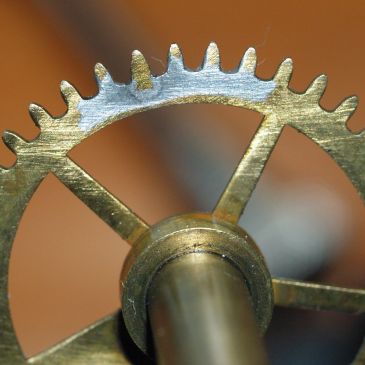
Escape wheel showing worn teeth

What I see right away is the escape wheel teeth and how some are hooked or misshapened. My temptation is to file it down but others are suggesting that I use pliers to press the hooks back into shape. I have’t decided what to do just yet.

Others have suggested that I put more weight on the pendulum which I am reluctant to do since this clock was likely designed to run on a light bob.

OLYMPUS DIGITAL CAMERA
The pendulum showing the twist adjustment for speed regulation

Now back to further investigation.

Late note: I finally got this clock to work after taking it apart twice. The second time I concentrated on the pivots discovering the at least 2 had enough rust that them that they may have slowed the clock down. I also took a burr off the escape wheel but in the process damaged the escape wheel a little, so that while the clock runs there is a little clunking sound once with each rotation, but it works and keeps time! Live and learn.

Arthur Pequegnat Canadian Time wall clock

The Canadian Time clock was produced by the Arthur Pequegnat Clock Company, which holds a special place in Canadian horological history. Founded in 1904, the company became the longest-lasting Canadian-based clock manufacturer, operating until 1941. Pequegnat clocks are known for their solid craftsmanship and distinctive designs, contributing significantly to the Canadian clock-making industry during the early 20th century.

Arthur Pequegnat, originally from Switzerland, brought his expertise in clockmaking to Canada, where he established a reputation for high-quality clocks. The company manufactured a wide range of clocks, from wall clocks to mantel clocks, many of which are now highly prized by collectors for their durability and unique aesthetic. Despite the challenges of competing with larger international clock manufacturers, Pequegnat’s attention to detail and commitment to quality ensured the company’s success for several decades.

Today, Pequegnat clocks are considered a piece of Canadian history, and the company’s legacy endures through the ongoing interest of collectors and enthusiasts, like myself, who appreciate the skill and craftsmanship of these antique clocks.

Pequegnat wall clock
Canadian Time clock by Arthur Pequegnat

This particular clock was made after 1916 in Kitchener, Ontario, Canada. Clocks made before 1917 were marked “Berlin” on the dial face. The town was known as Berlin from 1854 until 1912 and became the City of Berlin from 1912 until 1916. Due to the negative association with Germany during the First World War, the decision was made to change the name to Kitchener midway through the war. Today, Kitchener serves as the seat of the Regional Municipality of Waterloo, Ontario.

OLYMPUS DIGITAL CAMERA
Label affixed to back of clock

Unfortunately, the exact year my clock was manufactured is unknown as Pequegnat did not date-stamp their movements, but the Canadian Time series was produced up until 1941. By that year, the demand for brass from World War II armament makers, a crucial material for clock movements, forced the Arthur Pequegnat company to halt production. If the clock was made as late as 1941, it would be 72 years old.

OLYMPUS DIGITAL CAMERA
Checking on condition of the clock

This clock features Arabic numerals, which was less common since most were ordered with Roman numerals. As a railway clock, the use of Arabic numbers would have made it easier to read for the general public in a train station. The manufacturer allowed customers to choose between Arabic or Roman numerals when ordering. Additionally, buyers could also opt for a version of this clock with time, strike, and calendar functions.

OLYMPUS DIGITAL CAMERA
The Crossed horseshoes were likely added by a previous owner

The crossed horseshoes on the base of a clock are often associated with good luck and protection. In many cultures, horseshoes are considered symbols of good fortune, particularly when they are displayed with the open end facing upward, which is thought to catch and hold luck. I have not seen another Canadian Time clock with crossed horseshoes.

OLYMPUS DIGITAL CAMERA
On prominent display in my home

I’m hoping to track down a photo of the clock from its time at the Pictou, Nova Scotia train station before it was decommissioned in the early 1990s, as that could really help narrow down the clock’s manufacturing date.

The clock itself is quite large, measuring 37 inches high, 5 inches deep, and 15 inches wide. It’s made of quarter-sawn oak, which results in boards with annual rings mostly perpendicular to the face, providing greater stability and minimizing warping.

The Canadian Time clock is a reliable timepiece, showcasing the quality and craftsmanship that went into its creation.

Blackforest Shelf Clock Progress

OLYMPUS DIGITAL CAMERA
Blackforest Movement near anchor

If you are following this blog this is the same clock as the previous post. Since the movement was very dirty, I cleaned it up (ultrasonic cleaner) when all apart and reassembled and oiled it. It is a one-train movement, so not many gear wheels and pretty easy to work on. You can see by the size of the clock, a photo of which is in the last post, that the movement is quite small.

I thought with a cleanup and oiling it would be simple to get it going again but no such luck. I know that there is power getting to the escape wheel because when I disconnect the anchor it spins like a buzz saw. When I reconnect the anchor it runs for about 15 seconds and stops. I would like some ideas to get this clock running but in the meantime I have attached some photos. My question, it there anything missing here? This clock doesn’t have a suspension spring or a crutch which I find unusual. And what is that screw thing for? Comments and suggestions would be appreciated.

OLYMPUS DIGITAL CAMERA
Anchor and top of pendulum

OLYMPUS DIGITAL CAMERA
Unknown screw adjustment

OLYMPUS DIGITAL CAMERA
The movement itself

Blackforest shelf / kitchen / cottage clock

RS together but not working (2)
Finished case

This is a Blackforest shelf or kitchen clock made before the Second Word War. Blackforest is a Canadian clock company.  The Blackforest Clock Company of Toronto, Ontario was founded by Leopold and Sara Stossel in 1928.  Both clock movements and complete clocks were imported from Germany and sold through department and jewelry stores across Canada.  Their son Ed Stossel started working part time with his parents’ company in the 1930s, and later became a full-time employee in the late 1940s.

Some assembly work was carried out in their Wellington Street East factory.  Initially, imported mantel clock and grandfather clock movements were installed in cases made in Kitchener, but later the complete mantel clocks were imported from Germany.  This arrangement was interrupted by the Second World War, which also led to a name change to the Forestville Clock Company in 1941.  During the war years this company imported its clock movements from England, the United States, and even France.  However, starting in the mid nineteen fifties German factories again became the source of most Forestville clocks, with Mauthe being a major supplier. The company did not survive much past the late 1970s.

I found this in a antique shop in Kazabazua Quebec and it was in sad shape. This particular clock would have been the least expensive in the Blackforest catalog. I had an opportunity to go through the Blackforest catalog during my visit to the Canadian Clock Museum in Deep River this past summer and could not find a listing. I have no idea of the model name or number as there is no label on the clock. The only feature it shares with other Blackforest mantel clocks is the metal bezel, numerals and hands. Otherwise it is a one train time-only movement with a minimum number of gears and a unique twisting pendulum adjustment. The movement is as simple as it gets so it is easy to work on.

The photo shows the movement out of the clock and as you can see, it is quite dirty. I am in the midst of dis-assembly, cleaning (in my new Ultrasonic cleaner) and oiling. My initial observation is that the pivot holes, pivots and lantern gears are in good shape and the mainspring seems strong. Not a lot of wear for a 75+ year old clock.

RS Blackforest mantel clock (66)
Single train time-only movement

The next photos show the condition of the case when I bought it and the second is the first phase of stripping. You will notice that I did not disturb the decal; it would have been impossible to find a replacement. It was in terrible condition, likely sitting in a attic or garage for quite a few years. The spring was wound very tight and I am assuming at this point that dirt and grime caused it to cease. Although I paid $15 for it at the time it seemed too much after I got it home. Nonetheless, I went to work on it and if I can get it to function it might be worth more than I paid for it. As far as restoring this clock I used a latex dark walnut wood satin and a polyurethane top coat, not what would have been done at the time which likely would have been a dark lacquer finish. This method will be more durable. The first photo shows the case is in a restored condition and as you can seeing it is a striking little clock.

RS Blackforest mantel clock (48)
RS Blackforest mantel clock (77)

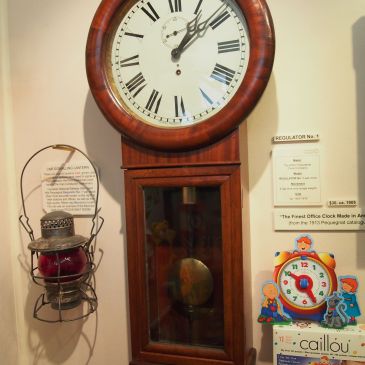
Arthur Pequegnat Regulator #1

One of the clocks that I would like to add to my collection is the Arthur Pequegnat Regulator #1, single weight 8-day time only clock. A rare clock indeed and prices of the few I have seen are on the high side. Too rich for me at his time.

The company distinguished itself as a competitor for some of the better American wall clocks such as those made by Seth Thomas. Their wall clocks often looked like models made by Seth Thomas but some of their designs were unique. For their wooden cases, they favored the heart wood of quarter-sawn white oak that showed off beautiful ray flecks.

The regulator #1 is often compared to the Seth Thomas Regulator #2. Thousands of Seth Thomas Regulator #2s found their way into offices and rail stations all across America. The Arthur Pequegnat Regulator #1, though not as prolific, served the needs of many businesses in Canada. The clock is highly collectible in Canada and will command twice the price of similarly styled clocks by well-known American counterparts.

This photo of the Regulator #1 was taken at the Canadian Clock Museum in Deep River Ontario in 2013.

The Arthur Pequegnat clock company had an illustrious albeit short life. Watchmaker Arthur Pequegnat was born in Switzerland in 1851. Arthur immigrated to Berlin, Ontario Canada in 1874 with his wife, parents, brothers and sisters; a grand total of 18 family members.

By the late 1870’s Arthur was operating a jewelry store and watch repair in Southern Ontario. By the middle 1880’s Arthur and his brother Paul were operating a shop in Berlin, Ontario. After about ten years the brothers went their own way, both operating successful jewelry shops in Southern Ontario.

In 1897 Arthur expanded his Berlin Jewelry shop to include the manufacture of Bicycles. However, By 1904, with the decrease in the demand for Bicycles, Arthur began to re-focus on the clock industry, by manufacturing his own clock movements at his Berlin Bicycle Manufacturing plant. At first the wooden clock cases were made by local Furniture Makers, however in time he manufactured his own clock cases.

Berlin, Ontario was re-named Kitchener Ontario in 1916, due to anti-German backlash during WW I. The date becomes a useful tool when determining the age of Pequegnat clocks, Movements or Dials marked “Berlin” date the clock to 1916 or earlier and those marked “Kitchener” are 1916 or later. Since many clocks had a long production life it is difficult to date any Arthur Pequegnat clock with precision.

Regulator #1, hanging in the Macdonald Museum in Middleton, Nova Scotia, Canada

Arthur died in 1927, however, with family members in control, the company continued to operate until 1941. The war effort meant that brass became difficult to obtain and the company shut its doors. The factory never produced another clock, and was demolished in 1964. All that remains in Kitchener today is a plaque commemorating this great clock manufacturer.

MacDonald Museum main exhibit area

The Canadian Clock museum contains the largest collection of Arthur Pequegnat clocks in Canada and it is certainly worth a visit. The Macdonald Museum in Middleton, Nova Scotia has a modest collection of Pequegnat and is worth visiting if you are traveling through the province of Nova Scotia.

Arthur Pequegnat Brandon time-only wall clock

This my first Arthur Pequegnat clock and it is the Brandon II. The first edition was produced up to 1916. Though very similar in design, this second edition was made from 1917 to 1941.

Arthur Pequegnat Brandon II

The Arthur Pequegnat Clock Company made clocks in Kitchener, Ontario from 1903 to 1941.

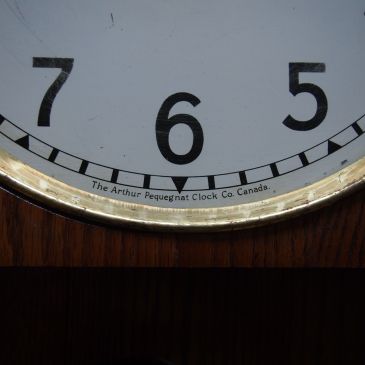
Normally found in a Canadian schoolroom in the 1930s and 1940s or in an office setting it was one of Pequegnats more popular styles. It is an octagonal short drop, time-only schoolhouse clock. The first edition had the exact dimensions but with a more ornate frame around the dial bezel.

Schoolhouse clocks were generally time-only as there would be other methods, such as a bells or alarms, to mark key points in a typical school day. If situated in an office environment a strike train would be too distracting to the employees. Brandon clocks also came with calendars, a useful feature for both school or office.

Clock face Arthur Pequegnat Canadian Time clock
Clock face Arthur Pequegnat Brandon clock

Both the case, which is made of quarter-sawn oak, and the brass movement were made by the Arthur Pequegnat Clock Company in their small Kitchener factory until 1941. Brass shortages during the Second World War caused the company to abruptly end production.

The time-only movement is relatively simple with few gears and little to go wrong. It was reliable, dependable and made to withstand the abuse of a school or office environment.

This clock was owned locally by an antique collector who after having it for a number of years decided to sell it in his antique shop in Great Village, Nova Scotia. The price was reasonable.

Arthur Pequegnat Brandon time=only movement

The case is in excellent condition, as is the face and bezel. Although the clock runs and keep reasonable time it has an annoying squeak suggesting that something is definitely amiss. I discovered that the first wheel had considerable pivot hole wear. This is the kind of repair I am unable to do at this time since I have neither the tools nor the knowledge. I brought the clock to a horologist in Halifax, Nova Scotia where the servicing was completed.

Five bushings were installed, the mainspring was cleaned and the movement was oiled.  I believe it is a worthwhile investment and I expect it to be ticking away for years to come.

Dugena Mantel Clock Dis-assembly, Cleaning and Adjustment

Dugena was a German retail clock company. The name Dugena still exists today but whether or not it is related to the Dugena company of the 1950s is anyone’s guess. This particular clock has a Hermle floating balance movement which is both reliable and dependable. Dugena, like many other clock companies at the time contracted out to a number of movement manufacturers during it’s heyday.

I bought this Dugena mantle clock for very little money. The previous owner assured me that it was an old clock and not to expect it to be perfect. He was right, it is not perfect. It is a 2-train time and strike Bim-Bam clock. When I got it it had no trouble starting. However, I could not get the clock to keep time (ran too slow) despite numerous adjustments to the balance wheel which was a little frustrating. I had to remind myself that the previous owner did say it was not perfect. There is also something amiss about the strike train side because it  strikes incessantly till the clock winds down. No doubt something is either worn, broken or misaligned. Misaligned rack and snail, I hope!


Dugena clock movement showing floating balance escapement
Hermle movement showing balance wheel escarpment

My first attempt at cleaning the clock involved taking out the movement and placing it in an ammonia bath with some Murphy’s soap, the so-called Dunk and Swish method. The net result is that once I dried it completely it functioned no differently than before, maybe even worse.

As mentioned it has a balance wheel escarpment and I am assuming the spring might be weak because the wheel does not spin more than 180 degrees. Either that or the darn thing is losing power from somewhere else. The bottom line is that it needed to be taken apart and cleaned properly. That is exactly what I am in the process of doing. My first assessment is that the clock is pretty tight and the pivots, pivots holes, pinions and arbors are in pretty good shape with a minimum of oily gunk. The springs are in barrels and at this point I am not going to service them. Reason, I don’t have the tools.

I have taken clock movements apart in the recent past and I have a pretty good understanding of what goes where and why as well as a basic set of tools to get me through. I can clean and oil but I don’t (can’t) do bushings. My hope is that once I have finished cleaning, assembling and oiling the clock it should work correctly though if it doesn’t it is no great loss. Good learning though.

So, I have a couple of choices. I can get the clock to function or I can investigate a replacement movement if it doesn’t.  The replacement movement (last photo) is $128CDN for a pendulum movement or $198CDN for a balance wheel escarpment. I will go for the pendulum movement since it is easier to work on, has fewer parts and makes that distinctive tick-tock sound. There is a third option, throw the movement into the parts pile and junk the case. We’ll see.

Balance wheel escarpment


possible replacement movement from Hermle

If I bought a new movement the clock would likely run trouble-free for years. Is it worth it? I am not sure. The case is in pretty good condition for it’s age and it would not take much to make a few cosmetic improvements to make it presentable but obviously not brand new looking.

Leave a comment for me if you have any advice.

All photos (except the last on) were taken with an Olympus E330, Zuiko 50mm F2 macro lens


Website Powered by WordPress.com.

Up ↑