Ridgeway Grandfather Clock

Should every clock collector have a Grandfather (tall case or long case) clock? No, but it was something I had always wanted.

RS Ridgeway clock_2
Ridgeway tall case clock

In 2012 I was perusing a local for-sale site and came upon this particular Ridgeway grandfather clock. The ad said that the clock was in excellent condition. When I called the seller and asked what he meant by “excellent” he said, “You have to see it to believe it”. He was right. The brass was bright and shiny and the only indication of its age (1996) is slight tarnishing of the column capitals.

Unfortunately, this type of clock takes a real hit on the used market. The smaller homes that many folks prefer today simply means there there is no room for a clock this size.

Clock face showing moon dial
Clock face showing moon dial and raised Arabic numerals

The clock has a graceful, regal look. It stands 83 inches tall, has a scalloped bonnet crown, functional blue moon dial with constellation, 5-rod Westminster chime with shut-off, stately columns with brass base and caps, raised Arabic numerals, oak solids and veneers, brass lyre pendulum with 10 5/8 polished bob and access panels on each side. It was made by the Pulsaski Furniture Company. The Pulaski company struggled financially in later years and was eventually bought out by the Howard Miller Clock Company in 2004. Howard Miller continues to offer the Ridgeway line.

clock face
Moon phase with constellation

And it came with the original cabinet key.

key
Original Ridgeway cabinet key

The seller advertised that it had a quality Keininger movement. Later ones did; this has a Hermle movement. In the 1990s the German clock company Hermle was the principle supplier.

clock movement
Hermle movement

In this case the ubiquitous 451-033, with 114 cm pendulum and 60 bps.

grandfather clock
Sussex model

The clock is very similar to the Sussex model as shown in this advertising brochure.

I have also seen the clock referred to as the Hamilton Country model. Nonetheless, it is impossible to verify since very little information about the original company exists to this day.

clock pendulum
Lyre pendulum with brass bob

The clock runs very well and to within a minute a week. When it fails it is more cost effective to replace the movement rather than bring someone in to repair it. I will simply swap the movement out with an identical one since Hermle continues to make this movement to this day.

Perhaps my only grandfather clock for now.

Gustav Becker March 2016 update part 2

As I mentioned in a previous post my Gustav Becker two weight regulator arrived with some issues. I was aware beforehand that there would be some problems as it was advertised as a ‘project” clock and that is what it has become, but not in an entirely negative way. It is all good learning.

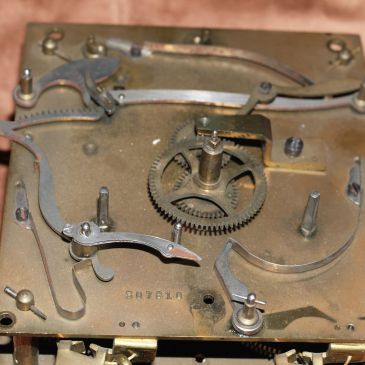
Clock movement
New movement from Poland

My donor GB clock movement arrived from Poland this week. As mentioned previously the original movement came without a star wheel/snail (not disclosed by the seller), a hammer assembly and a couple of non-operational parts which necessitated the acquisition of another movement. The gathering pallet which I originally thought was bent on the original movement has a piece broken off as I discovered when I compared it with the newer movement.

At a glance the two movements look identical but I am learning that there are key differences between the movement made in 1902 and the donor movement, made in 1918. The “newer” movement has thinner plates. The centre arbor is thicker on the new movement but the star wheel/snail is an exact fit. The escape wheel is slightly smaller. The fan on the new movement created an obstruction when I tried to install it on the old movement so out it came and replaced by the old fan. I was also able to transfer the gathering pallet as well. This time it works correctly as it advances the rack. The escape wheel is smaller on the new movement and I gather that the pendulum for the newer movement is a little shorter i.e faster rate. I am also able to salvage the hammer and hammer rod on the replacement movement though I have not attached it as yet. It would need some adjustment.

Clock part
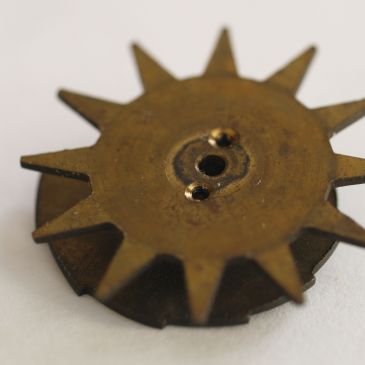
New star wheel
clock part
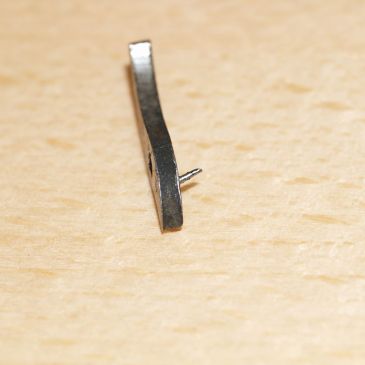
Broken gathering pallet

During the testing phase the clock is running without its dial face and hands. I am checking and calibrating the hour and half hour strike while observing the action of the strike side specifically the advance of the star and snail. All seems to be working as it should. The time and strike weights are also descending at the same rate so I am assuming that the clock is going through its correct cycle on the hour and half hour.

More testing in the next few days after which I will install the hammer assembly, the face and hands and string new cable for the weights.

Clocks of Cuba

During two vacation trips to Cuba in the last 4 months I managed to locate a few clocks in my travels. Though some clocks were very intriguing none that I saw save for the tower clocks were in working condition. Nonetheless it made me wonder about their provenance in a land that time seemingly forgot.

At Christmas time my family and I traveled to Trinidad of Cuba. We stayed overnight at Los Helechos Hotel in Topes de Collantes which is located about a half an hour bus ride from Trinidad of Cuba. The next day we spend our time exploring the wonders of Trinidad of Cuba.

I saw some interesting clocks in a couple of restaurants. The first is a Wm L. Gilbert time and strike wall clock with calendar dial from Winsted Conn., USA. It looked like a reasonably well preserved dark walnut regulator clock with an 8-day brass movement with pressed features dating to about the 1900s.

wall clock
Wm L. Gilbert clock found in a restaurant

The next is unknown to me. It is a Spanish clock. Whether or not Malaprade is the maker was difficult to determine as I could find no information on the internet. However, it is clear that this spring wound time-only clock with second hand feature was made in Barcelona. I would date it to pre-1930. It is a relatively short clock and might have been originally designed as a wall mounted clock as it stands less than 5 feet tall. I am not sure what the area around and below the keyhole represents. I cannot make out any sort of design if there is one.

Floor clock
Malaprade Floor or wall clock

Next is a floor clock. Again the maker is unknown. I do not see any winding arbors on the dial face and can only assume that it is weight driven (the weight was not attached) and that the weight (or weights) were pulled up by chain to reset the clock likely once every 8 days. This clock was clearly in meed of restoration as were most of the clocks that I saw.

Floor clock
Floor clock of unknown maker

In March we stayed at the Paradisus Rio de Oro in Holguin province located on Playa Esmeraldo near Guardelavaca. The resort is set on a beach next to Bahía de Naranjo Natural Park. In it are a number of interesting clocks.

Lobby clocks
Time only lobby clocks

There were a total of 4 of these lobby clocks which were originally intended to display time zones for the guests. They are time-only and the cases appeared to be in good shape but I do not think they have been running for quite a while. My thought is that there is nobody at the resort tasked with the responsibility of maintaining these and other fine clocks.

face of clock
Face of unknown floor clock, second hand is missing
RS Tall case clock (2)
Unknown floor clock

This clock actually works though it needs servicing. It is located in an ante-chamber adjacent to a Mediterranean themed restaurant. I opened the front door of the clock and found the rod gong impeding the pendulum. Once I dislodged the gong the clock happily began to function and it was in beat, surprisingly. Although it had two weights there were three winding arbors and I would be curious to see the internal workings of that movement. Inside the door was an official seal from the Ministerio de Cultura.

400 day clock
400 day clock

This 400 day clock was made in Germany. There were no other markings that I could determine. It could be a Kundo Kieninger & Obergfell dating to about the 1940s or so but that is just a guess. It needs a thorough servicing and clearly it has been neglected for some time.

Carriage style clock
Carriage or wall mounted clock

This is another an anniversary mantel clock but it appears to have a wall mounting bracket on the rear. Not sure why as these clocks are not meant for wall mounting. Again, an unknown maker but possibly German and in very poor condition. The front glass looks like it can be lifted up for adjustment purposes.

clock
Clock in a peasants home

While hiking through El Cubana National Forest we came across a small dwelling and we were able to briefly tour inside. In it I found an old quartz clock dating from the 1980s or earlier.

Tower clock
Tower clock at Peublo La Estrella tourist village
Tower clock
Tower clock in Holguin

The first tower clock is located in a tourist village in Cayo Santa Maria called Peublo la Estralla while the next is in a downtown principle square in the city of Holguin. The Olvera clock is a modern electric clock and I am assuming that the tower clock in Holguin might also be electric.

I am told that my next stop in Cuba (another time) should be the Paladar Decameron restaurant in Havana, a fixture in the paladar scene that’s located in the leafy residential district of Vedado. The restaurant is said to said have an old world charm with a collection of various collectibles including antique clocks of all shapes and sizes.

Cuba is a fascinating country and certainly worth exploring time and time again.

Gustav Becker update

OLYMPUS DIGITAL CAMERA
GB movement before dis-assembly

I got a lead through a email a few days ago on a Braunau movement that was up for sale on EBay and I am happy to say that I purchased it today. It should arrive by post in the next few days.

My plan is to either take the parts out of the replacement movement or use it if it is in better condition. My inclination is to keep the movement that came with the clock rather than create a “Franken-clock”.  It is preferable to keep the clock as true to the original as possible.

However, I am sure that over the years many clocks have benefited from replacement parts and after 114 years clocks such as this probably had repairs that might have included the odd part replaced. On my movement there have been 4 new bushings installed and one lever post repaired. Who knows what other parts might have been added over the years. The top plate is the only real indication I have that the clock was made in late 1902 and the clock case certainly fits that period.

This movement has one other issue that I can see. There is a lever with a pin that rotates and advances the rack. It is the gathering pallet. In the photo below you can see the pallet, indicated by the black arrow. In the photo that follows you will see that the pin that is attached to the pallet is bent. The bent pin does not allow the pallet to advance the rack. Hence the strike train does not work. So, it must be unbent or replaced.

clock movement
Black arrow showing the location of the pin
bent lever pin
Bent pin on lever

The risk is snapping the pin off if I make an attempt to straighten it. I will wait to see if the replacement movement has a pallet that is in better condition and if so, a straight swap.

clock movement
Movement is nearly dis-assembled

The last photo shows the movement almost apart and prior to cleaning and polishing.

This Gustav Becker came to me as a project clock and I am determined to get it running.  In the meantime I have installed the time side gears to check the time train and the clock is running and keeping proper time. Obviously it does not strike but in time that will be rectified.


Request for assistance – attention Gustav Becker afficionados

RSa GB movement in no weights (1)
Gustav Becker with Braunau movement

As you know from reading my last post concerning this fine timepiece I am appealing to anyone who knows anything about these particular clocks to assist me in finding a critical part for the strike side. The part is called the “star wheel / snail”. Without it the strike side will not function. The time side will happily run without it.

The photo that follows is a movement with the star wheel intact (my apologies, it is a grab from EBay). Look closely towards the bottom just off centre you will see a wheel shaped like a star with a snail type assembly on top, hence the name. That is the one I am missing. Why it was taken off my clock movement is a mystery to me but it is what it is. A couple of guesses; someone did not want the clock to strike for whatever reason or two, it was a donor clock for another.

If you look closely in the next photo towards the bottom centre it shows my clock without the star wheel. Both of these are Braunau movements.

gb2
Showing the star wheel and snail which are one piece


OLYMPUS DIGITAL CAMERA
My clock showing missing star wheel and snail


Gustav Becker clocks of that era were essentially made in two factories, the Frieberg Works and the later Braunau Works.  My clock is from the Braunau factory. The star wheel must be from a Braunau clock as the design of that wheel was slightly different than ones from Silesia clocks.

If you know of a source or you happen to have one lying around (LOL) please email me.

Oh, and one more thing. If you happen to know the size suspension spring I need that would be great.  I am missing that too.

advertized on EBay (6)
Pendulum rod near suspension spring mount. The strike rod is just to the left

There is no prize for assisting me but if you do I will give you digital hug!

Thanks for reading my blog.

Gustav Becker Vienna Regulator Braunau factory circa 1902

RS GB movement in no weights (5)
Gustav Becker Vienna Regulator

This is a Gustav Becker 2 weight “Vienna Regulator” made at the Braunau factory in 1902. The serial number is a confirmed match for the numbered series built during that period. The clock was made in the Gustav Becker Braunau works in Bohemia (now Broumov, Czech Repulic), in mid-1902. The Braunau operation started up in February 1888 and would have been producing clocks up until 1925. Bohemia is a province in the Habsburg Austrian Empire hence the reference to clocks during that period referred to as Vienna Regulator style. The definition of a Vienna Regulator is a debatable point and I will leave that up to the reader to decide.

Some notable features are the inverted keyhole movement mount, rod gong and a wood pendulum rod with brass covered zinc. There are intricately carved trim pieces, certainly a common feature of the craftsmanship found in higher end clocks of that period. The clock is 51 inches tall and is a commanding presence on any wall and certainly a great addition to our living room.

What is missing in the photo are the two weights which at this point are not attached; the condition of the cables are suspect. Replacement cables are on the list. There is also a small part of the right bottom finial which has to be reattached (glued).

The bottom middle finial is also not attached. The bottom middle finial is in the freezer right now because I noticed that it was the only part of the clock with woodworm holes. I inspected the finial carefully, banged it on white paper and not a bit of dust or dead insects. This is a good sign and one indication that the worms and their larvae have been long gone but as an extra precaution a few days in the freezer won’t hurt and once it gets to -30C here in Nova Scotia a little time outside won’t do any harm either. I am not at the point where I will introduce it to chemicals as my best guess is that the problem insects have simply left their mark and have since departed. There is no indication of any worm holes on the clock itself which leads me to believe that the bottom middle finial may not be original. Chemical eradication appears to be the only course of action it seems as freezing does nothing.

RS the case (5)
some pieces had to be reattached

At the moment this clock is not working. The clock needs a very good cleaning and possible bushing work. I have not opened it up yet to investigate further but my first inspection of the moment is that it has not seen maintenance in some time. This will be one of my first steps.

This is a good project and from time to time I will detail my progress on this fine European clock.

Gustav Becker 2-weight regulator wall clock

3Clock Cake1 [3086218]
This takes the cake
My wife bought me a Gustav Becker 2-weight regulator at a popular auction site and while I haven’t received it just yet she had to show me what it looked like in a most unusual way.  She thought that a photo would not do so she had someone make a cake from the auction site photo so that I could enjoy it before it came. That someone has a cake making business and as you can see she is very talented. It was awful hard to cut into it though.

The Gustav Becker clock which should be here in the next few days was advertised as a “project” clock so I am not expecting a perfect clock. According to the seller the strike hammer is missing although the crown, movement, weights, base, dial and pendulum are said to be original. We’ll see what else is missing when it arrives.

You can see the real clock in the following images.

$_57
Seller’s photo of Gustav Becker wall clock
$_57e
Regulator weights
$_57a
Movement and cables

Clock collectors usually pride themselves in having at least one Gustav Becker (GB) clock in their collection with earlier clocks commanding high prices. Indeed, Gustav Becker is one of the better known clock companies of the mid 1800s to 1930. In 1850 Gustav Becker opened workshops in Freiburg and Silesia, Germany.  At first, Becker struggled with untrained help, but won the “Medaille d’Or” for design at the 1852 Silesia Trade Exposition. Becker incorporated that first medal and his initials, G.B., into his trademark and into many components of his clocks, from movement, mounts to wall standoffs to beat-plates and pulleys.

Once he received the award he was able to attract skilled craftsmen to his various workshops. Until 1880 most Becker clocks were weight driven regulators but spring driven clocks followed.

Becker clocks are not too difficult to identify. Serial numbers on the clocks identify the year of manufacture. The cases of these clocks reflect the ornate furniture trends of the day and range from very simple to elaborately constructed. The casework is extraordinarily well done and often incorporates hand carving. Germany has never lacked for skilled carvers and the talent of the region’s artisans is evidenced in the Becker clock cases.

In 1926 the brand as well as the later acquisitions of Lenzkirch and Thomas Haller were absorbed by Junghans. Junghans continued to produce clocks under the Gustav Becker name until the early 1930s. While GB clocks are relatively easy to identify by their serial numbers, one way to identify a GB under the Junghans name is the serial number which was restarted at 0001 after the take over.

Does frustration await me? We`ll see. I will be posting updates on this fine timepiece as I progress through the restoration process.

Arthur Pequegnat Regulator #1

One of the clocks that I would like to add to my collection is the Arthur Pequegnat Regulator #1, single weight 8-day time only clock. A rare clock indeed and prices of the few I have seen are on the high side. Too rich for me at his time.

The company distinguished itself as a competitor for some of the better American wall clocks such as those made by Seth Thomas. Their wall clocks often looked like models made by Seth Thomas but some of their designs were unique. For their wooden cases, they favored the heart wood of quarter-sawn white oak that showed off beautiful ray flecks.

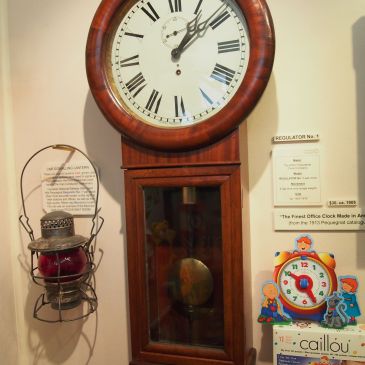
The regulator #1 is often compared to the Seth Thomas Regulator #2. Thousands of Seth Thomas Regulator #2s found their way into offices and rail stations all across America. The Arthur Pequegnat Regulator #1, though not as prolific, served the needs of many businesses in Canada. The clock is highly collectible in Canada and will command twice the price of similarly styled clocks by well-known American counterparts.

This photo of the Regulator #1 was taken at the Canadian Clock Museum in Deep River Ontario in 2013.

The Arthur Pequegnat clock company had an illustrious albeit short life. Watchmaker Arthur Pequegnat was born in Switzerland in 1851. Arthur immigrated to Berlin, Ontario Canada in 1874 with his wife, parents, brothers and sisters; a grand total of 18 family members.

By the late 1870’s Arthur was operating a jewelry store and watch repair in Southern Ontario. By the middle 1880’s Arthur and his brother Paul were operating a shop in Berlin, Ontario. After about ten years the brothers went their own way, both operating successful jewelry shops in Southern Ontario.

In 1897 Arthur expanded his Berlin Jewelry shop to include the manufacture of Bicycles. However, By 1904, with the decrease in the demand for Bicycles, Arthur began to re-focus on the clock industry, by manufacturing his own clock movements at his Berlin Bicycle Manufacturing plant. At first the wooden clock cases were made by local Furniture Makers, however in time he manufactured his own clock cases.

Berlin, Ontario was re-named Kitchener Ontario in 1916, due to anti-German backlash during WW I. The date becomes a useful tool when determining the age of Pequegnat clocks, Movements or Dials marked “Berlin” date the clock to 1916 or earlier and those marked “Kitchener” are 1916 or later. Since many clocks had a long production life it is difficult to date any Arthur Pequegnat clock with precision.

Regulator #1, hanging in the Macdonald Museum in Middleton, Nova Scotia, Canada

Arthur died in 1927, however, with family members in control, the company continued to operate until 1941. The war effort meant that brass became difficult to obtain and the company shut its doors. The factory never produced another clock, and was demolished in 1964. All that remains in Kitchener today is a plaque commemorating this great clock manufacturer.

MacDonald Museum main exhibit area

The Canadian Clock museum contains the largest collection of Arthur Pequegnat clocks in Canada and it is certainly worth a visit. The Macdonald Museum in Middleton, Nova Scotia has a modest collection of Pequegnat and is worth visiting if you are traveling through the province of Nova Scotia.

Website Powered by WordPress.com.

Up ↑