Clock Repair Efficiency with Ultrasonic Cleaning

In this article, I will outline the reasons for opting to use an ultrasonic cleaner in clock repair, delve into how the unit operates, and provide recommendations for those contemplating the use of an ultrasonic cleaner in their clock workshop.

What is an ultrasonic cleaner?

An ultrasonic cleaner typically resembles a rectangular tank made of stainless steel. It features a hinged or removable lid for easy access to the interior. Inside the tank, there are transducers mounted on the bottom or sides, which emit high-frequency sound waves.

The tank also includes controls such as timers and temperature settings to regulate the cleaning process. Additionally, there may be a drainage spout or valve for convenient removal of the used cleaning solution. Depending on the model, ultrasonic cleaners can vary in size from small tabletop units to large industrial machines.

An ultrasonic cleaner is used for cleaning a wide array of objects. The high-frequency pressure (sound) waves create cavitation bubbles within a liquid, generating intense agitation. This agitation exerts significant forces on contaminants adhering to various substrates such as metals, plastics, glass, rubber, and ceramics. This process is able to penetrate blind holes, cracks, and recesses, leading to remarkably rapid and efficient cleaning outcomes. It is ideal for cleaning clock parts. A clock sage I know once said, “Wait till you see how clean lantern pinions are after a cleaning’.

Ultrasonic cleaner by L&R
Ultrasonic cleaner by L&R is rated at 3.5 liters (.85 American gallons)

Cleaning a mechanical movement’s parts before reassembling a clock movement is crucial for several reasons:

  1. Remove Dirt and Debris: Over time, dust, dirt, and other contaminants can accumulate on the various components of a clock movement. Cleaning helps eliminate these particles, preventing potential issues and ensuring smooth operation.
  2. Prevent Wear and Damage: Dirt and grime can act as abrasives, leading to increased friction between moving parts. This friction can cause wear and damage to components over time. Cleaning ensures that parts are free from abrasive particles, preserving their longevity.
  3. Optimize Performance: A clean movement operates more efficiently. By removing any buildup that may hinder the free movement of gears, springs, and other components, the clock can function optimally, maintaining accurate timekeeping.
  4. Identify Issues: Cleaning provides an opportunity to closely inspect each part. This close examination can reveal any signs of wear, damage, or misalignment that may not be apparent when parts are dirty. Identifying issues beforehand allows for timely repairs, preventing potential problems in the future.
  5. Lubrication: Cleaning is often accompanied by the application of fresh lubrication to key components. Lubrication reduces friction between moving parts, minimizing wear and ensuring smoother operation. This step is vital for maintaining the health of the movement.
Ultrasonic cleaner from Harbor Freight
Ultrasonic cleaner from Harbour Freight

Although it is possible to clean clock movement parts by hand, an ultrasonic cleaner offers a more precise and thorough cleaning process.

The following outlines my approach to using an ultrasonic cleaner for clock servicing.

Using the ultrasonic cleaner

In the cleaner’s main tank, I pour in a pre-mix of one part Deox 007 to six parts water. Deox 007 is a biodegradable de-oxidizer and de-greaser and is my recommended solution for cleaning clock parts. While the mix is at room temperature I leave the solution in the ultrasonic machine for 10 minutes or so and use the integrated ultrasonic heater to heat the mixture. Using hot water speeds up the cleaning process, but it’s important not to make it too hot, as it can damage lacquered parts.

When cleaning multiple batches of parts, I check the water temperature to ensure it’s not too hot. If needed, I simply turn off the heater without disrupting the operation of the ultrasonic cleaner.

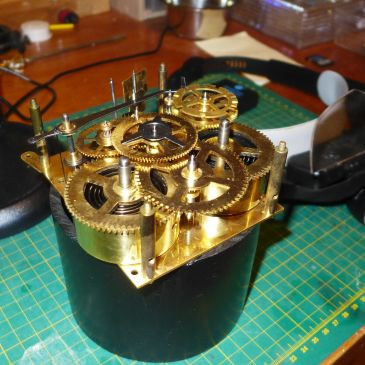
Movement plates cleaned in an ultrasonic cleaner

For heavily soiled movements, I recommend pre-cleaning with degreasing soap and water.

Typically, 15-20 minutes in the ultrasonic cleaner is enough, but timing may vary based on the machine’s power.

A mesh tray or basket might not be included with your ultrasonic cleaner. In the case of my L&R cleaner, the mesh tray was an optional accessory.

Arrange all the components in the tray or basket before placing them in the ultrasonic cleaner. Ensure as much as possible that the parts do not touch each other, and if the basket doesn’t provide enough space, consider having an additional cleaning session.

Once the parts have undergone a cycle in the ultrasonic cleaner, I inspect them to determine if an extra cycle is necessary. If not, I immerse each part in warm water to confirm the removal of any degreasing cleaner residue.

Drying is crucial to prevent rust on steel parts. After the warm bath, I lay all the parts on an absorbent paper towel, and with more paper towels I meticulously dry each part. I use a hairdryer or residual cooking oven heat (on a day my wife is baking bread) to remove moisture from lantern pinions for example.

After finishing the drying process for the clock parts, I go back to the ultrasonic cleaner. I empty the cleaning solution from the device and proceed to clean the ultrasonic cleaner itself with used paper towels from the drying phase. I then store the cleaning mixture in an old vinegar container. Following each use, I assess whether to retain or discard the mixture, opting to dispose of it if it is too murky and dark. It can be disposed of in an environmentally friendly way.

A word of caution for individuals using the heater: if there’s a distinct switch for the heater, there’s a potential risk of leaving it on when the unit is plugged in and lacks a solution in the reservoir. This poses a risk of potential damage to the heating element. Unplug the unit if it is not in use.

Other uses for the ultrasonic cleaner beyond clock repair

Beyond cleaning clock parts, ultrasonic cleaners have diverse applications across various industries and tasks. Some common uses include jewelry cleaning, dental and medical instrument cleaning, automotive parts, optical and eyewear, firearm parts, laboratory equipment, metal and plastic parts, and coins and collectibles.

In Summary

Cleaning a clock movement’s parts is a fundamental step in the maintenance and restoration process. It not only improves the immediate performance of the clock but also contributes to its long-term durability and accuracy.

However, there are exceptions to using an ultrasonic cleaner for clock parts. Ammonia-based cleaners on aluminum can darken brass, and caution is warranted. Avoid putting floating balance escapements and hairsprings in the ultrasonic cleaner as they might be damaged. Old hammered brass movements are best cleaned by hand to avoid potential damage.

An ultrasonic cleaner is a handy piece of equipment to have around the shop.

Authors Note

If a premium unit like the L&R cleaner is beyond your budget, numerous alternatives are available on online retail platforms for you to consider. The most cost-effective alternative is a used machine which can be found online but try to avoid low-cost and low-power jewelry cleaners that have small reservoirs.

The price of the L&R Q-140 has significantly increased over the past five years. When I purchased mine four years ago, it was around $600. However, I’ve noticed that it now costs upwards of $1160, a dramatic rise. Despite my satisfaction with the purchase, such a steep price would make me think twice today. If I were to make the choice again, I would probably opt for a less expensive Chinese-made cleaner and take the chance that it will last.

Set your clocks ahead this weekend

Photo by Stas Knop on Pexels.com

One of life’s unavoidable inconveniences is the act of adjusting our clocks either forward or backward in November and March. It is called Daylight Savings Time or DST. The goal of DST is to make better use of daylight by prolonging the amount of time we can spend outside during daylight hours.

Arthur Pequegnat Brandon schoolhouse clock

The argument for the abolishment of Daylight Saving Time (DST) is gathering steam. It is cumbersome, and unnecessary in today’s world. Presently, out of 195 countries globally, approximately 70 utilize DST in some capacity, with notable exceptions being Japan, India, and China among major industrialized nations.

Around 1890, Sir Sandford Fleming, a Canadian engineer credited with significant railway projects and devising an internationally accepted standard time scheme, was instrumental in the early adoption of DST.

Currently, residents in these 70 countries, including Canada, must adhere to DST conventions, adjusting their clocks forward in spring and backward in autumn. In Canada, the saying “Spring ahead, Fall behind” helps in remembering the biannual time adjustments, occurring on the second Sunday in March and the first Sunday in November.

Those possessing mechanical clocks with analog dials, simply advance the minute hand by one hour. If the clock has a chime or strike mechanism, allow it to operate naturally at the quarter-hour or the half-hour.

Despite its widespread usage, there’s a growing movement in Canada to abandon DST, citing its impracticality and lack of necessity.

The American double-dial clock

American clocks with double dials, often referred to as “double dial” or “two-dial” clocks, were common in the 19th century.

There are two categories of double-dial clocks but first, let’s talk about the calendar clock. These clocks typically have one dial for the time and another for the calendar. The reason for this design was to provide both timekeeping and a calendar function in a single device.

Seth Thomas 8-day office calendar 1895

By integrating both time and calendar functions into a single clock, manufacturers provided a practical solution for the needs of households and businesses.

Welch 5-day calendar clock 1880

Moreover, before the widespread adoption of standardized timekeeping systems, local time could vary significantly from one place to another. Having a clock that displayed both local time and the date helped people coordinate activities and synchronize their schedules more effectively.

Fashion (Southern Calendar Clock Co.) and Ithaca were well-known makers of quality shelf and wall calendar clocks. Seth Thomas was a significant producer of office calendar clocks.

Ithaca 30-day calendar clock 1866

Less common are double-dial clocks that exhibit two separate times. A typical two-dial clock of this type would display railroad time and local time or railroad time and city time.

Seth Thomas double time #17 special order clock

When the two major US railway companies adopted Standard Time in 1883 the Seth Thomas Company began the manufacture of 8-day weight-driven clocks with two time dials. The clocks would come with an upper and lower plaque depicting local time and railroad time. Some clocks were production clocks while others like the #17 were special order clocks.

Seth Thomas double time clock #6, a production clock

Both dials are run by one movement with a connecting drive shaft between the upper and lower units. Once the upper movement is set up, the lower unit will display the relative difference. Moving the hands on the upper unit moves the hands on the lower unit accordingly.

Upper movement and the lower unit are connected by a drive shaft

Examples of the more prevalent #6 can be readily found, whereas the specialized #17 is exceptionally rare. Regardless, acquiring either double-time model would entail a significant investment of thousands of dollars.

Milestones in Horology

The clock is one of man’s greatest achievements. The development of instruments to tell time is the unwavering toil of brilliant minds from many disciplines who, for over 800 years, worked tirelessly to create, innovate, and improve methods for telling the time.

Horology is not only the study of time but the synergy of art, joinery, fashion, design, décor, physics, engineering, metallurgy, and mathematics. Indeed, the study of the mechanical clock is a microcosm of our society.

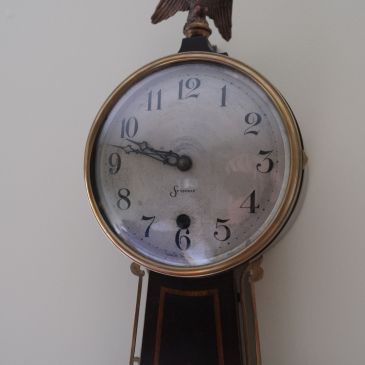
Banjo clock Ca. 1940
Banjo clock Ca. 1840

While not claiming to be an exhaustive guide, the following dates are noteworthy in the history of the clock and compiled from various sources. The challenges in pinpointing precise dates arise from disparities among sources.

Kundo standard size 400 day clock
Kundo standard size 400-day clock

Advancements in horology preceding the advent of the mechanical clock are omitted. (Clepsydra) and sundial clocks from the Middle Ages, as well as ancient Chinese astronomical clocks, warrant a separate discussion and are not encompassed in this account.

Important Dates in Horological Development

  • Around 1300 – The first mechanical verge clock in Europe
  • 1364 – Astronomical clock idea by Giovanni de Dondi, Italy
  • 1386 – Tower (turret) clock at Salisbury Cathedral, England
  • Around 1400 – Fusee power was invented by Jacobs, Czechoslovakia
  • Around 1450 – A table clock with spring and fusee by Phillip the Good of Burgundy, France
  • Around 1500 – The mainspring was invented in Germany
  • Around 1510 – The watch was invented by Peter Henlein, Germany
  • Around 1560 – A spring-driven portable clock, in Germany
  • Around 1570 – The oldest known clock with a second hand, Orpheus clock, Germany
  • Around 1620 – The production of lantern clocks in Britain increased
  • 1637 – Galileo conceives pendulum control for swinging temple lamp, Italy
  • Around 1650 – The first tower clock in America
  • 1656 – Huygens devises pendulum clock, Holland
  • 1657 – Verge and foliot replaced by pendulum control, Huygens, Holland
  • 1658 – Fromanteel adapts long-case prototype from lantern clock, England
  • 1660 – Hooke conceives balance wheel, England
  • Around 1675 – Richard Towneley invented dead-beat escapement, in England
  • 1675 – Huygens invents the balance wheel with spiral spring, Holland
  • Around 1675 – Hooke and Clement collaborated to invent recoil escapement and crutch, in England
  • 1676 – Barlow develops rack striking, England
  • 1680 -1700 – Notable horologists of this era were Arnold, Earnshaw, East, Graham, Knibb, Compion, and Windmills of England; Berthoud, Breguet, and LeRoy of France
  • 1701 – St Sulpice seminary tower clock (imported from France), Montreal, Canada
  • 1713 – Harrison invents marine chronometer, in England. For more see Dava Sobel’s, Longitude, Harrison’s struggle against the establishment to get recognition for his chronometer.
  • Around 1715 – The break-arch dial introduced
  • 1715 – Graham perfects deadbeat escapement, regarded as the “father” of the dead-beat escapement
  • 1717 – First tower clock in America, Benjamin Bagnall, Boston
  • 1726 – Graham invents Mercurial pendulum (temperature compensating pendulum), in England
  • 1726 – Thomas Bennett makes wall clock, 8-day brass, weight-driven, in America
  • 1736 – Harrison’s marine chronometer tested at sea (accurately ascertaining longitude), in England
  • 1770 – White dials appear in English longcase clocks
  • 1776 – Pouzait invents independent seconds train for the watch, Switzerland
  • 1790 – Vienna regulator-style case emerges in Austria
  • 1790 – American woodworks clocks begin to appear
  • 1802 – Willard patents banjo timepiece, America
  • 1806 – Terry introduces the Pillar and Scroll clock, America
  • 1809 – Martin Cheney sets up a clock-making shop in Montreal, Canada
  • 1810 – Breguet introduces Carriage clock (Pendule De Voyage), France
  • 1818 – Heman Clark makes wrought brass movement for Pillar and Scroll case, America
  • 1825 – Rolled brass production begins in America
  • 1836 – Tempered brass mainsprings introduced in America
  • 1837 – Noble Jerome’s 30-hour brass movement patent approved, America
  • 1840 – American brass movements in mass production
  • 1842 – Chauncey Jerome exports American brass movement clocks to England
  • 1845 – Woodworks movement production ends, America
  • 1847 – Tempered steel mainsprings begin to be manufactured in America
  • 1850 – Lord Grimthorpe designs the Westminster tower clock made by Dent, England
  • Around 1850 – Brocot (pin-wheel) escapement and pendulum suspension were introduced, France
  • Around 1850 – American mass production of watches begins. The Waltham Watch Company leads the charge
  • 1860 – Junghans technicians were sent to America to study American mass production techniques, Germany
  • 1870 – Decline in English long-case clocks
  • 1874 – Mantel and wall clock mass production begins in Whitby, Canada
  • 1900 – American clock production peaks; makers are Ansonia, Ingraham, Gilbert, Howard, New Haven, Seth Thomas, Waterbury, and Welch
  • 1904 – Arthur Pequegnat begins clock production in Berlin, Canada
  • 1906 – The Eureka electric clock was introduced, America
  • 1908 – Big Ben alarm clock enters production, in America; Baby Ben follows in 1910
  • Around 1910 – The torsion pendulum clock (400-day) introduced, in Germany
  • 1920-40 – General decline in American mechanical clock production, increase in electric clock production
  • 1927 – The quartz clock is invented but not in widespread use until the 1970s
  • 1928 – Atmos clock by Jaeger LeCoultre – perpetual motion clock powered by temperature and atmospheric pressure changes
  • 1941 – Arthur Pequegnat ceases production, Kitchener Canada
  • Around 1960-70 – End of mass-produced mechanical clocks, America (cheaper Japanese, Korean & Chinese mechanical clocks flooded North America)
  • Present day – Movement and clockmakers remain but become a fringe market; Howard Miller (Ridgeway), Keininger, Hermle, Chelsea, Jaeger LeCoultre among others
Antique Sessions Electric clock

These milestones highlight our constant quest for accurate timekeeping and showcase the human spirit’s ingenuity.

As we look back, the ticking of the clock is more than just tracking time; it symbolizes our ongoing journey to understand the essence of time. Horology serves as a testament to our commitment to precision and symbolizes our continuous efforts to enhance the quality of our lives.

(Please share any errors or omissions)

PROFILE MY CLOCK: Empire-style anniversary clock from South Africa

If you have a favorite clock in your collection that has earned a special place in your heart, we invite you to share its unique story with our readers. Whether it’s a vintage masterpiece or a modern marvel, we want to unravel the essence of what makes your clock truly exceptional. Provide me with a history of the clock and/or some interesting details that I could include in a blog article. The only identifier will be the first and last letters of your name and your country location.

I recently received a letter from D in South Africa, requesting assistance in gathering information about a particularly cherished clock that has been a part of his family for many years. D has graciously given consent for me to feature and profile this special family clock on my blog.

D writes

I hope you don’t mind me reaching out to you. My family has an Empire-style anniversary clock that I believe is rare and I am struggling to find any information, relating to its age, maker, or “story”.

Empire anniversary clock

It has been such a part of our family and I regret not exploring the history while family members were still able to shed some light on its origin…
A local clock expert has suggested it was possibly made in the early 1900s in Germany…I contacted Martin Haller who confirmed it was not made by them.

Empire anniversary clock pie crust dial face
Dial face
Empire anniversary clock, pendulum design
Unique pendulum

I believe the clock was imported to South Africa by J Muller (a jeweler)who was originally from the Black Forest in Germany and their family became well-known optometrists here in Cape Town. I think they gifted it to my great-grandparents before the First World War.
If you perhaps have any information about the clock I would be most grateful.
Many thanks, D

Empire anniversary clock back plate
Backplate

I was intrigued by D’s clock and decided to do a little digging

My reply

Hi, and thanks for your email, D. First of all, it is a fascinating clock and, in my view, quite rare. Time is the enemy of memories and once the memories are lost, they are lost forever. I know very little of the history of most of the clocks in my collection, unfortunately, but it is nice to learn that your clock has been in your family for such a long time. At least you can trace most of its history.

The photo of the face is a bit blurry but the names on the dial face of a shelf clock such as yours are usually the retailer or a dedication to an individual. I assume there is no maker’s stamp on the movement.

A Haller clock would have been an excellent guess, but I think not.

The plate image of your clock can be found in the Horolovar manual. The Horolovar manual is an indispensable resource for anyone working on, or collecting torsion clocks.

I have attached two photos from the Horolovar manual, a guide to the repair of 400-day and similar torsion clocks to aid in identifying your clock. Yours has Jahresuhrenfabrik c1902 plate 1471 (see photo). Angemeldet means declared; a “declared patent”.

Patent Angemeldet, image of clock plate for a torsion clock
The backplate of the anniversary clock

I discovered that the clock was designed by Andreas Huber.

Andreas Huber twin-loop temperature compensating pendulum

The patent for the movement is dated 1902. Your clock was likely made shortly after that date. While the clock case radiates regal elegance, it is the pendulum that is its most intriguing feature. The pendulum is unique because it is twin-loop temperature-compensating to maintain accuracy throughout its running cycle. A type not found in many anniversary clocks.

Two companies purchased movements from Andreas Huber, Badische Uhrenfabrik, and the more widely known Kienzle, both of Germany. It is also quite possible that Huber sold to other companies such as Schatz or Gustav Becker, but I have found nothing to confirm that.

You have a unique clock and, who knows, a reader somewhere in the world might provide more information so that we can both learn more about this fascinating clock.

The Steeple Clock – function combines with design

A steeple clock is a type of clock designed to resemble a miniature church steeple or spire. This style of clock is often characterized by its tall and narrow structure.

These clocks gained popularity in the mid-19th century and were often produced in various styles. The design was influenced by the Gothic Revival architecture that was prevalent during that period.

Steeple clocks are relatively common in North America as thousands were produced in America particularly but rare in other parts of the world.

New haven Gothic Steeple clock
New Haven Gothic Steeple clock

In my collection, I own three steeple clocks – the first, crafted by the American manufacturer Elisha Manross, the second by the Hamilton Clock Company of Hamilton, Ontario, and the third by The New Haven Clock Company of America, made for export and sold by Thomas Spike Jewelers in Halifax, Nova Scotia in the 1880s.

All three share a commonality with their time and strike 30-hour spring-driven movements.

The Elisha Manross steeple clock stands out with its distinctive use of tempered brass mainsprings, marking a period between 1836 and 1847 when this material was the motive force for spring-driven clocks. It represents a technological glimpse into an important era in American clockmaking.

Alisha Manross steeple clock

However, it is the steeple clock from the Hamilton Clock Company that holds a special place in my collection. Being a Canadian collector, the clock not only adds historical charm to my collection but also carries significance because it is Canadian-made.

Crafted in Hamilton, Ontario, it embodies a piece of Canadian horological heritage, making it more than just a clock but a connection to the craftsmanship and legacy of clockmaking in Canada.

Hamilton Clock Co Gothic steeple clock

The Hamilton Gothic steeple clock stands out because of a religious inscription, “Cling to the Cross,” delicately etched onto the lower glass tablet. It is a rare clock from the Hamilton Clock Co., which manufactured a variety of clocks of every style over a very short period.

The historical weight of this 30-hour steeple clock is underscored in Jim Connell’s description in a video he produced several years ago. Connell, a figure renowned in Canadian clock circles, whose acknowledgment of the clock’s rarity adds an extra layer of importance to this find. Fun fact, Jim Connell invented salt and vinegar potato chips.

This clock carries whispers of a bygone era, a testament to the Hamilton Clock Co. which, between 1876 and 1880, made a valiant though short-lived attempt to compete with the growing number of common clocks coming from the USA.

Steeple clock discussion

The term “Gothic steeple clock” specifically refers to clocks that incorporate Gothic design elements, such as pointed arches, into their structure.

An unusual "ribbed" style steeple clock
An unusual “ribbed” style steeple clock

Steeple clocks can vary in features, including different types of movements.

A trio of steeple clocks with an 8-day fusee clock in the middle

The vast majority were relatively simple designs that were spring-driven but there are some very rare examples of steeple clocks that are weight-driven and ones that incorporate fusee movements.

Unknown double steeple clock

R. Blakeslee, Jr. in or around 1850 made a 30-hour weight-driven clock with a lyre movement (not pictured). His clock also featured a compound pulley configuration on the time side, the time side weight being heavier than the strike side.

A fusee movement, unknown maker

Even more unusual are double-steeple clocks, a noteworthy example being a Birge and Fuller 8-day fusee-powered brass movement clock (not pictured) made in the mid-1840s.

During the same period, Elisha Manross made a double steeple shelf clock that had an 8-day time and strike strap brass fusee movement with a 12″ pendulum (not pictured). It features the original stenciled and painted tablets by William B. Fenn of Plymouth. William Fenn was one of the more prolific tablet makers of the mid-19th century. 

By comparison to a conventional steeple clock that stands at about 20 inches, double steeples are over 6 inches taller.

Jerome & Co. New Haven, Conn, 1850 steeple with portrait of Andrew Jackson
Jerome & Co. New Haven, Conn, 1850 steeple with the portrait of Andrew Jackson

Jerome & Co. of Chauncey Jerome fame also produced a double steeple in 1850. The one pictured above features a portrait of the seventh President of the USA, Andrew Jackson.

Gallery-style gothic clock, a variation of a steeple theme

Steeple clocks are appreciated by collectors for their historical charm and unique aesthetic, reflecting the craftsmanship and design of the era in which they were produced. They also stand as tangible expressions of the artistry and cultural influences of their respective historical periods.

How Common Are Brass Mainsprings in Clocks?

Elisha Manross, though less commonly known compared to American clockmakers such as Seth Thomas, New Haven, or Waterbury, played a significant role in the development of Connecticut clocks. In his book American Shelf and Wall Clocks Robert Ball listed Elisha Manross as being in business from 1827 -1849. 

He was a prolific clockmaker and produced a variety of clocks but one of his more desirable clocks is a “double steeple” shelf clock with an 8-day time and strike spring strap brass fusee movement with a 12″ pendulum.

Manross was known as the clockmaker’s clockmaker because his products were used by many clock-manufacturing firms such as Boardman and Wells, Sperry and Shaw, and other well-known makers. Although my clock is a 30-hour version, Manross made 8-day weight-driven movements as well.

However, the focus of this article is a 30-hour gothic steeple made in the early 1840s that came to me as part of a collection of old clocks found in a barn 20 minutes drive from my home.

The completed Manross steeple clock, the hour, and minute hand are replacements
The completed clock, the hour, and the minute hand are replacements; the original ones would have been spade and spear

There were thousands of steeple clocks made by many American manufacturers at that time but it is unusual to find one with its original brass mainsprings intact as many have undergone replacements with steel mainsprings. The brass mainsprings in this clock have not only remained but also seem to be in excellent condition.

brass mainsprings
Cleaned brass mainsprings, notice how tight the brass is in the centre

Brass springs were developed in the E.C. Brewster shop in Bristol sometime around 1833-35 and patented in 1836. They were used by Seth Thomas, Brewster & Ingraham, and others.

Brass mainsprings were uncommon in American clocks, having a brief period of use from 1836 to about 1850. Domestically manufactured mainsprings were not available in the US until 1847. In 1847, the widespread adoption of tempered steel mainsprings began and soon replaced the use of brass mainsprings in clockmaking so ending the era of brass springs. Brass springs were used in Manross miniature Ogees, and shelf clocks.

The goal of servicing

Preserving the movement with the least intervention possible is the primary goal. There is a temptation to replace them with steel counterparts and put the brass springs aside. However, to maintain the historical authenticity of this clock, they will remain in the movement.

Elisha Manross 30 hour movement, as found. It is very dirty
Elisha Manross movement, as found: Type S5.1 30-hour movement with centre mount count wheel

Working with brass mainsprings and addressing wear

Working with brass mainsprings requires careful handling; unlike steel, they cannot be stretched out for cleaning. After cleaning in an ultrasonic cleaner, and meticulous drying using strips of terry cloth worked into the coil, the results are impressive.

Upon inspecting the movement as a whole, I noticed certain pivot holes with punch marks around them. Punching was commonly used to close pivot holes then but is not considered an acceptable practice today. Despite being punched, they continued to function effectively.

To address the most significant wear, only the problematic pivot holes underwent bushing. Four bushings were added on the strike side, where wear tends to be more pronounced—a commonly encountered issue in clock restoration. There were no new bushings required on the time side.

Punch marks to close a hole on a clock plate
Punch marks to close a hole

A past tooth repair resulted in a sturdy albeit somewhat rough appearance. It could have been filed down and polished but I left it as-is because it is part of the clock’s history.

Main wheel tooth repair

The final step involved returning the clock to its case, preserving not just its functionality but also its historical integrity.

Continue reading “How Common Are Brass Mainsprings in Clocks?”

Thrift Shop Treasure for $1.65 – will it sell for more!

Jauch had ties to one of the oldest clock-maker families in the Black Forest. The Gerbrueder Jauch company, known for manufacturing hall, wall, and mantel clocks, faced challenges in late 1979 due to export restrictions, ultimately leading to bankruptcy in 1986.

Jauch schoolhouse-style clock

Renowned for providing affordable yet attractive clocks for average households, Gerbrueder Jauch GmbH produced clocks like the drop octagon schoolhouse-style clock, reminiscent of classic American designs. However, within the realm of German clockmakers, I would not place this particular maker among the elite. In terms of comparison to American counterparts, it aligns more closely with companies like the Sessions Clock Company, the company that provided clocks for the average home.

Measuring 23 inches in height, 15 inches in width, and nearly 5 inches in depth, this clock very closely resembles the dimensions of schoolhouse clocks from over a century ago. Unlike antique American clocks with oak cases, this one features a more cost-effective pine case.

Jauch wall with calendar clock with flip-up dial bezel
Jauch clock with flip-up dial bezel

Its bezel adopts a flip-up design for winding, distinguishing it from clocks with right-swinging dial bezel doors.

The clock bears the inscription “Western Germany” on the dial and movement, with the movement stamped with a production date of July 1979. For history enthusiasts, it’s noteworthy that German reunification took place in 1989, simplifying the dating of clocks from this era.

Jauch wall clock with a faux regulator case
Another Jauch wall clock with a faux regulator case, a customer’s clock

This clock requires a very long #7 key for winding, which may pose a challenge even for some collectors that have an abundance of spare keys.

The clock’s issues, suspected to be related to the anchor escapement or potential bushing wear in the top part of the train, present an interesting repair challenge.

Despite being a non-functional find, purchased for a mere $1.65 at a local thrift shop, the clock has some potential for restoration. Thrift shops often price items low for quick turnover, and this vintage mechanical clock, though uncommon among donated goods, offers promise. While the case may show signs of wear, a thorough cleaning and a fresh clear-coat finish can easily revive its appearance.

Given the absence of basic issues, apart from a scuffed-up case, restoring this Jauch clock to working order should be a manageable task, making it worthy of a price of more than $1.65, I would think.

While clock sales aren’t my usual trade, occasionally, I part with clocks to cover supplies and fund additions to my growing collection.

Trouble Strikes Thrice: The Notion of Bad Luck in Threes

The belief that bad luck happens in threes is a common folk belief that suggests that if you experience one bad event or stroke of bad luck, two more are likely to follow in quick succession. While this adage is not grounded in any scientific or empirical evidence, it has persisted for years.

In this blog post, I will recount a series of unfortunate events I’ve experienced with one specific clock, a German-made mahogany-cased Junghans Hansruck time and strike mantel clock from the latter part of 1913.

While my bad luck didn’t unfold rapidly it seems that I was destined to have problems with this clock from the outset.

Junghans Hansruck time and strike mantel clock
Junghans Hansruck time and strike mantel clock when first received

Some time ago, I purchased the clock through an online auction. Emerging as the successful bidder, I arranged for the clock to be shipped to my location. It arrived intact and undamaged.

Setback Number One

After unpacking the clock, I immediately set out to test its functionality. I wound up both the strike side and the time side, ready to set the correct time when the minute hand unexpectedly snapped off. It wasn’t an ideal beginning, to say the least. While the minute hand was repairable, it added another layer of frustration to contend with.

Okay, I can deal with the hand later. Back to the clock. The clock wasn’t working after all, but a good cleaning and addressing any wear issues should get it running again.

Showing the face of a Junghans mantel clock and the repaired minute hand
Soldered minute hand

I managed to solder the hand and put it aside while I addressed the movement.

Setback Number Two

I serviced the movement, reassembled it, and placed it on the test stand. It ran smoothly for a few days on the time side, but the strike side had issues. While investigating the malfunction I identified a small stamped metal part on the movement had bent. In an attempt to straighten it, I inadvertently applied too much force, causing the piece to snap off. I’ll call the part an actuator.

The strike actuator when activated lifts a lever to begin the strike process. The actuator is attached to the front plate with a small machine screw and is free to move.

On the center arbor is a star cam. The 2 points on the star cam rotate every 30 minutes until a star point pushes the strike actuator to begin the strike sequence. A protruding piece of metal, the contact piece for the star point on the actuator, is the part that broke as I was attempting to unbend it.

Soldered piece above the centre cannon on a Junghans Hunruck movement..
Soldered actuator

As the actuator does not apply much pressure on the lever above it, soldering should do the trick. Back to more soldering.

The actuator is repaired and the hand has been soldered. Both are functioning like new and the movement is running well on the test stand.

Setback Number Three

Satisfied that everything was working correctly after the testing phase and the movement was keeping good time I then proceeded to mount the movement into its case.

Here’s how I think the third mishap occurred.

When mounting the movement into its case, I positioned the case glass side down without any padding. My attempts to secure the movement into the case might have inadvertently stressed the dial glass, leading it to break. I didn’t hear the crack, and the second possibility is that it occurred earlier, possibly getting kicked accidentally on the floor next to my desk.

The bottom line is, that the glass is now cracked, necessitating either replacing it or salvaging the dial bezel from another clock. I don’t suppose anyone has a magical resin that will hide the crack.

I thought so!

Cracked dial glass on a Junghans mantel clock
Cracked dial glass

Most errors in clockwork are fixable, but a damaged dial glass is an exception—it cannot be repaired.

Cracked glass aside it is a very nice clock and it runs well.

Are setbacks a good thing?

I don’t often publish my mistakes but in the spirit of transparency and the unpredictable nature of clock restoration, it seems fitting to share this series of setbacks with my audience.

So, does bad luck happen in threes? From a statistical perspective, events occurring in threes are not more likely than any other numerical pattern but it happened.

Setbacks are a natural part of the process and should not deter anyone from passionately pursuing a hobby they love. Not every restoration or service of a clock goes according to plan and it’s normal to face unexpected issues when restoring or servicing clocks that are over 100 years old.

Yes, of course, there are lessons learned. But it just seems very strange that all of this happened to me with this one clock.

A tale of two mantel clocks – German vs American engineering

Assessing the quality of mantel clocks, whether American or German, involves considering various factors such as craftsmanship, materials used, design, and overall reliability. Both American and German manufacturers have a rich history in clockmaking, and each has its own unique characteristics.

In my collection, I’ve assembled a diverse array of clocks, featuring both American and European examples. Drawing upon my experiences, I can confidently say that when it comes to overall quality, I find myself favouring a typical German clock over its American counterpart.

American mantel clocks are known for their diversity in design and style. Manufacturers like Seth Thomas, Ansonia, Waterbury, Sessions, and others have produced a wide range of mantel clocks with different aesthetic influences. The craftsmanship and attention to detail in many American mantel clocks are often praised. Some American manufacturers have a tradition of incorporating high-quality materials, such as solid wood and detailed finishes.

However, the American mantel clock market has seen fluctuations in quality over time. Some collectors and enthusiasts may argue that the mid-20th century saw a decline in craftsmanship as manufacturers faced increased competition and economic pressures.

I see this clearly in American mechanical clocks made in the 1920s and 1930s. There is a definite step downwards in quality and the goal of production seems to have been to maximize profits.

Germany has a long-standing reputation for precision engineering and quality craftsmanship, and this extends to its clockmaking industry. German mantel clocks, especially those produced by renowned manufacturers like Mauthe, Junghans, HAC, Kienzle, Gustav Becker, and others are often associated with precision movements and reliable timekeepers.

German mantel clocks are also known for their mechanical excellence and commitment to traditional clockmaking techniques. Many German clocks feature intricately designed cases and precise movements, often with a focus on accuracy and durability.

German clock manufacturers maintained their commitment to producing high-quality clocks well into the 1920s and 1930s. Instead of compromising on materials or craftsmanship, they opted to charge a premium for their clocks, ensuring that the level of quality remained consistently high.

A comparison

Let’s compare a common German mantel clock with its American counterpart. Both are in my collection.

Junghans bracket style mantel clock

The Junghans mantel clock features a design reminiscent of the popular bracket-style clocks that were fashionable several years before its production around 1915. It has a mahogany veneered case, a brass case handle, brass features below the dial, a solid brass dial bezel with beveled glass, and elegant brass feet. Its sturdy time and strike movement, known for its reliability during that era, adds to the clock’s appeal as a dependable clock for the home.

Seth Thomas time and strike with type 89 movement

The Seth Thomas clock, manufactured in the United States, showcases a case of inferior quality, a basic brass bezel, and a simulated wood veneer that imitates the appearance of exotic wood. Cost-saving to maximize profit was the ultimate priority during the period of manufacture of this clock from the early 1930s.

Despite this, the clock is equipped with the reliable and durable type 89 movement, which has proven to be bulletproof and dependable over time.

Servicing a German vs an American movement

There are pros and cons to servicing either type of movement. German time and strike movements can be a bit more intricate and finicky, especially when setting up the strike side, as lining up the parts correctly is crucial. Dealing with smaller pivots also increases the risk of damage, bending, or breaking.

Conversely, with American time and strike movements, the larger pivots minimize breakage and it requires brute strength to inflict any damage when manipulating the parts.

However crude an American movement might appear in a side-by-side comparison with a German movement, there is a notable advantage to the former. An American movement (generally speaking) can endure wear much better than a German movement, and it can continue to run effectively even when significantly worn.

That said, when both are set up correctly and any wear is mitigated both American and German movements function reliably for years.

In Summary

Both American and German mantel clocks can offer high-quality options, but individual preferences may vary based on factors like design preferences and specific features.

Collectors and enthusiasts often appreciate the historical context and craftsmanship associated with clocks from both regions.

Obviously, your source of clocks depends on where you live in the world as Canadian and American clocks are widely available to those living in North America whereas the opposite is true for European and Australian residents, for example.

One last thing to note is that precision regulators from both countries are of equal quality. Whether American or German, both exhibit equal precision and performance. They both adhere to the highest standards and can be trusted for accurate timekeeping. It’s worth noting, however, that achieving such precision comes with a correspondingly high price.

These viewpoints represent my personal opinions, and I encourage readers to delve into researching specific models and manufacturers. Making an informed decision should be based on individual preferences and priorities.

Clock Repair Essentials: Trusted Suppliers for Quality Parts and Tools – a revisit

Clock repairers depend on reputable suppliers for quality parts, tools, and accessories, ensuring durability and customer satisfaction. Trusted suppliers offer a diverse selection of compatible components, expert knowledge, timely delivery, and warranty support. Efficient logistics and ample stock levels from reliable suppliers benefit repairers with waiting customers.

The suppliers mentioned below, none of whom sponsor this author, are my preferred choices based on my extensive experience in procuring parts from them over the years. I’ve also included some suppliers known for their reputation, although I haven’t personally dealt with them.

The original blog post regarding clock repair resources was published last year. However, I’d like to update the list and welcome any additional recommendations. At the request of a reader, I have added an addendum section with a description of the lever setup for the strike train.

An assortment of Bergeon bushings #5288
An assortment of Bergeon bushings

Notable suppliers, with a short description of their services and with links to each one, include:

Timesavers: According to their site, “TimeSavers is a worldwide distributor of clock parts and repair material. We have been in business since 1975.” Their extensive inventory contains thousands of parts. Timesavers is the best-known clock parts supplier in North America.

Cousins; Cousins is a UK parts supplier I have sought them out for specialty items such as brass feet for a bracket clock and parts for long case clocks and parts not readily available from North American suppliers.

Perrin: Perrin is Canada’s leading supplier of clock parts. Residing in the eastern region of Canada, I rely on Perrin as my primary supplier. NOTE: Perrin will be closing its doors in May 2024

Butterworth: I am not certain if Butterworth has a dedicated site but they can be reached on Facebook. I have ordered a pivot polishing kit from them in the past but they are also known for their unique Butterworth bearing.

Merritts: While their parts inventory may not be as comprehensive as that of other suppliers, they offer a diverse range of antique clocks available for online purchase at reasonable prices.

Meadows and Passmore: Some restrictions apply on the purchase of clock parts and it is best to check with the company before ordering.

Mile-high Clock Parts: The repairer’s source for Keystone tools, staking sets, spring winder, bushing machine as well as other parts.

Clockworks: The clock repairer’s principal source for new Hermle movements as well as other supplies and parts.

Black Forest Imports: A distributor for clock movements and supplier for case parts, tools, repair supplies, etc.

Somal Watch Supply in Toronto, Ontario, Canada is a source for Watch Movements, Watch Tools, Batteries, Mineral Glasses, Crowns, Spring Bars, and more.

Ronell: Ronell is a worldwide provider of clock repair parts and supplies.

Steady rest tool for Tiag metal lathe

A reader suggested Griffens Clocks and they can be reached here. The company acquired R&M Imports in 2019. R&M was well-known to clock enthusiasts and began as a mail-order business in 1968. Griffens also acquired the inventory and assets of the Herschede Clock Company. They are located in Portland Oregon.

ACDP: “offers professional service for all your clock parts and clock repair needs”. This site was recently passed on to me by a reader, a company in the Netherlands called ADCP. On their site, I found difficult-to-locate clock parts of antique German movements among other interesting items.

Comments about pricing

The past two years have witnessed notable price increases that might unsettle newcomers, in the field of horology. In my experience dealing with suppliers, the costs of essential items such as bushings, files, and specialized tools like bushing machines and spring winders have seen significant spikes since the global pandemic, with some prices surging by 50% to 75%.

Tool for working on escapement bridges

For hobbyists venturing into horology, there are opportunities to find bargains in the used market. However, without developed expertise in locating quality parts and tools in good condition, there’s a risk of falling prey to unscrupulous sellers.

TimeTrax model 185 clock timing machine

While the initial prices of parts may seem attractive, always consider additional factors like taxes, shipping costs, document processing fees, and potential import duties. Some suppliers also impose minimum order requirements. Certain suppliers extend their offerings beyond the clock and watch parts, including antique clocks, repair manuals, and novelty items.

The reliability and quality maintained by these suppliers not only ensure the authenticity of repairs but also contribute to preserving the art of horology so that we can enjoy our clocks today and well into the future.

Wrapping up the servicing of a Seth Thomas type 89 movement

Seth Thomas is a well-known American clock manufacturer with a long history, and they produced a variety of clock movements over the years. The Type 89 movement is one of the many clock movements produced by Seth Thomas between 1900 and 1938.

Seth Thomas mantel clock from the 1930s
Seth Thomas mantel or shelf clock

The mantel clock in question features the Type 89 movement. Acquired in the summer of 2023, this clock boasts a simple and straightforward design.

In the first part of this two-part series, I discussed the disappointments I encountered with the clock’s case.

Seth Thomas type 89 movement showing dirt and rust
Seth Thomas type 89 movement, dirty and rusty

The focus then shifted to the disassembly process and my examination of the widely-used Seth Thomas Type 89 clock movement.

My observations highlighted a replaced mainspring on the strike side, the necessity for bushing work, and indications of rust, all of which posed challenges that I committed to addressing in subsequent stages such as cleaning, bushing, oiling, and reassembly.

The focus of this blog post is the completion of servicing of this type 89 clock movement.

The front plate of a type 89 Seth Thomas movement
Front of the type 89 movement before disassembly

Cleaning of the mainsprings

There is always the temptation to do nothing with the mainsprings if they look acceptable. However, cleaning the mainsprings is an essential part of clock servicing. Uncoiling and wiping the dirt and grime from the mainsprings with a cloth is the preferred method, but cleaning them with an ultrasonic cleaner is also an option.

In Part I, I cleaned the mainsprings in my ultrasonic cleaner and provided a rationale for this decision. Before I go any further, I’d like to emphasize a crucial point regarding the cleaning of mainsprings in an ultrasonic cleaner. This practice is not recommended and should only be considered as a last resort.

While cleaning mainsprings in an ultrasonic cleaner has little impact on the surfaces or mechanism of the cleaner itself the oil removed from the mainsprings generates a black liquid that contaminates the cleaning solution, rendering it ineffective for future use.

Seth Thomas type 89 mainsprings, note the replacement spring on the right

Clamps have been applied to secure the mainsprings after oiling, and they’ve been set aside. Now, we move on to the next step: the bushing phase.

The back plate is removed on a type 89 Seth Thomas movement
Backplate removed

Bushing the movement

As the movement is fully disassembled this is the stage where bushing work can be done.
I commend individuals who choose to bush by hand, but personally, It is not for me.

Various systems exist for bushing, with KWM and Bergeon being the two most widely adopted. It’s worth noting that neither system is inherently superior to the other, as preferences tend to vary among enthusiasts. When referring to a “system,” it’s important to understand that the bushings from one system are not interchangeable with those from the other.

That said I use the Bergeon system.

Bergeon 6200 Bushing Machine
Bergeon Bushing Machine

Before bushing, I identify all the locations requiring attention and mark them with a Sharpie. There is no permanent mark as rubbing alcohol will easily remove all traces of ink.

I have an excellent assortment of bushings and have all the required ones for this project.

An assortment of Bergeon bushings, assortment #5488
An assortment of Bergeon bushings, #5488

Using cutters each hole is drilled out and chamfered, that is, removing the sharp edges to allow the pushings to be pressed in smoothly. As I insert each new bushing I test the fit by assembling the wheels to check how freely they move. This allows me to make small adjustments in the event the pivot is too tight in the bushing hole.

Cutting into the bushing hole with Bergeon bushing machine
Cutting into a brass plate

Based on my initial assessment, the bushings for both the front and back plates of the escape wheel were the most worn. The next new bushing is the fourth wheel front plate, the one adjacent to the escape wheel. After three bushings everything looks good and the wear further down the train does not look too bad. A fourth bushing for the fourth wheel should be enough.

A cutting broach is used to enlarge any holes that are a tight fit for a pivot followed by a smoothing broach. To prepare for the wheels to go back in place all bushing holes are cleaned with pegs/toothpicks.

Test fitting the time-side wheels during the bushing process, type 89 Seth Thomas movement
Test fitting the time-side wheels during the bushing process

In the photo above, the plates and gears look shinier after a session with the ultrasonic cleaner. However, it’s important to note that the main goal in clock repair isn’t to make everything as shiny as possible. The focus is on reducing wear and tear. Some dirt and grime on the plates might not come off completely during the cleaning process in every case and it is not something the clock repairer should be overly concerned with.

Back to bushing. There is a little bit of play on the second and third wheels but it is tolerable so, I think I will stop at this point.

Punching a 3.5 mm Bergeon bushing into a clock plate
Punching a bushing into the plate

Were I in the clock repair business I would bush everything on the time train, or the entire movement for that matter, but since I usually inspect movements in my collection every 2-3 years I can address any additional wear at that time.

On to the strike train. In the first article, I mentioned that there was not much wear on the strike side which might be attributable to that side not being wound as often. The only hole that must be addressed is the cam wheel bushing on the front plate. Why this bushing hole is worn much worse than the others is a bit of a mystery.

Okay, all the work is done for a total of five new Bergeon bushings. The holes have been pegged, and the movement is now ready to be reassembled.

The one hiccup encountered during the bushing process was the malfunction of my caliper tool. Fortunately, this isn’t a major problem, as all the Bergeon bushings are uniform at 3.5mm outside diameter, with inside diameters of either 1.4mm or 1.5mm so I knew what size to grab first.

Reassembly

When dealing with American 8-day time and strike movements, there are challenges in configuring the strike mechanism accurately. Occasionally, luck is on my side, and I manage to place the paddle in the deep slot, position the lever in the lowest part of the cam wheel, and align the warning wheel just right on the first attempt.

A useful tip. If the lever is in the lower part of the cam wheel and the paddle is not in the deep slot, simply move the toothed count wheel sideways so that it does not engage the pinon and reposition the wheel till the paddle finds the deep slot.

No luck setting up the strike this time! If the strike train does not lock correctly it will simply keep on running and you will know that soon enough.

The plates can be partially pried open without the risk of all the wheels and levers springing out. Repositioning the warning wheel involves moving the fly aside, carefully extracting the 4th wheel from its pivot hole, and rotating it a quarter turn or so to ensure the warning pin aligns with the stop lever.

Seth Thomas movement on the test stand

A minor issue with the hammer lever surfaced as it was not aligning correctly with the strike pins on the cam wheel. No disassembly of the movement is required for this adjustment. Simply loosen the bottom two nuts by the mainsprings, and the strike hammer can be removed to straighten it. After having been bent multiple times over the years, straightening it out resolved the issue.

Next, the movement is oiled with Keystone clock pivot oil and mounted on a test stand. After a week it is running and striking as it should.

And lastly, my new caliper arrived just as I was concluding the servicing on this clock.

Addendum

To properly configure the strike side, pay attention to the positioning of the levers as pointed out by the arrows.

Seth Thomas movement
ST movement

In the above photo, the lower arrow shows the paddle in the deep slot, and the upper arrow shows the drop lever in the indent of the cam.

Seth Thomas movement

The upper arrow shows the position of the stop pin on the stop wheel. The lower arrow shows the locking lever.

Seth Thomas type 89 movement servicing

Seth Thomas is a well-known American clock manufacturer with a long history, and they produced a variety of clock movements over the years. The Type 89 movement is one of the many clock movements produced by Seth Thomas over the years. This type was made between 1900 and 1938.

I acquired this mantel clock during the summer of 2023. From a distance, it looked very good but upon closer inspection what I thought was a rosewood veneer finish was in fact, a thin wrapper, so a bit of a disappointment.

Seth Thomas mantel clock
The simple lines of this clock was the main attraction

However, the focus of this blog post is not the clock’s case but the ubiquitous type 89 clock movement found within that made its way into thousands of Seth Thomas clocks.

Disassembly

The first step is to remove the hour and minute hands. Working from the back, four case screws release the movement from its case. Things will go along more smoothly if the coiled gong is removed as well.

Looking at the back plate, the suspension spring and rod must be removed first. Then comes the regulating adjustments screw and rod which consists of releasing 3 machine screws and then pulling out the spline gear which is operated through the clock face by the small end of a double-ended winding key. Once that hardware is removed it is on to the removal of the back plate.

A view from the back, Seth Thomas type 89 movement
A view of the movement

There are 4 nuts (plus the pendulum rod retainer screw) to be removed, however, it is advisable to unhook the helper spring at the top and the hammer spring at the bottom before lifting up the plate. This will prevent the wheels from being dislodged as the back plate is removed.

If the wheels spring out, reassembling the wheels becomes a challenging task of guesswork to determine their correct locations, especially for beginners.

Brass helper spring hooked around a post of a type 89 movement
Brass helper spring hooked around a post

As each part is removed place them in a hobby tray or receptacle so that nothing will be lost or misplaced. No matter what the skill level, separating the time side gears from the strike side is always a good practice.

Findings

Upon lifting the back plate, my initial observation was the replacement of the mainspring on the strike side at some point in the clock’s life.

Whenever I encounter a replaced mainspring, my immediate focus shifts to inspecting potential damage to the main wheel teeth and the lantern pinions in the second and third wheels. This is because the force of a break occasionally causes secondary damage along the gear train. This is often referred to as collateral damage. Fortunately, the components up the train in this movement are undamaged.

Backplate removed on the type 89 movement
Backplate removed

An initial inspection of wear indicates a need for five new bushings on the time side, while only one is necessary on the strike side. Further examination may reveal more once a more detailed assessment is conducted.

Interestingly, the strike side shows less wear, indicating that it was seldom wound. My assumption is that after the repair of the mainspring, the owner decided it wasn’t worth the risk of another mainspring break and chose not to wind it frequently or at all.

More concerning is evidence of rust on the movement posts, some pivots, and the lantern pinions. The clock was obviously stored in a humid location for a period.

Two mainsprings for the type 89 movement
Mainsprings

All parts were cleaned in the ultrasonic cleaner and thoroughly dried.

Despite my best efforts, I could not separate the main wheels from the mainsprings. I opted to place both the wheel and mainspring in the ultrasonic cleaner. This is not a typical practice for me as it dirties the cleaning solution and limits resue, but I intend to dispose of the cleaning solution after this servicing.

From control for the L&R ultrasonic cleaner
Ultrasonic cleaner

That’s all for now

Despite encountering disappointment in the clock’s case, the disassembly and findings of the ubiquitous Seth Thomas Type 89 clock movement revealed a replaced mainspring on the strike side, a need for bushing work, and evidence of rust, presenting challenges that will be addressed in the upcoming stages of cleaning, bushing work, oiling, and reassembly.

I will conclude here and save the remaining details of the servicing for a subsequent post.

Good lighting is essential for the clock hobbyist

Photo by Luca Nardone on Pexels.com

I typically refrain from endorsing products on my blog, but my daughter recently brought to my attention something she believes would greatly benefit me as a clock enthusiast. She mentioned a “neck reading light,” which her husband suggested for her. It seems that during their evening TV sessions, he found the ambient room light she used for reading to be distracting and thought a more focused light would be less intrusive.

In the past, I have used a magnifier as depicted below, and found it to be very beneficial. It features a convenient LED light on top that is very handy for extra illumination but the light has a short lifespan and it is a hassle finding and replacing the button battery. While a magnifier remains an essential tool for me, I do not use the light for the reason I mentioned.

Optivisor magnifier
Optivisor magnifier

The flexible reading light has now become an additional lighting tool.

Neck light with 2 LEDs
Neck light showing the LED lights

The reading light has flexible arms. It comes in 3 Colors, has 6 brightness levels, has adjustable color temperature, is rechargeable, and is perfect for reading, knitting, camping, and in my case repairing clocks.

Neck light shows USB-C connection for the rechargeable battery

In addition to the above items two more devices are essential not only for clock repair enthusiasts but also for any hobbyist; a lamp with a flexible neck and a small flashlight.

LED Hobby light with flexible neck and magnifier
Hobby light with flexible neck and magnifier

My old light was excellent for my needs and it lasted quite a while.

However, when the fluorescent ring tube eventually burnt out, the expense of replacing the tube surpassed the cost of investing in a high-quality new light.

Light adjustments on the LED  lamp
Light adjustments on the lamp

To replace it, I bought a flexible magnifying light equipped with adjustable intensity and the capability to modify the color temperature. I don’t use the magnifier but the light is perfect for my needs.

The last essential lighting tool is a flashlight. I Use a pocket-style flashlight that is very bright and helps illuminate those very dark areas when working with clock movements.

LED pocket flashlight

All of these items can be purchased at your local hobby store or through an online retailer such as Amazon.

The author demonstrating the magnivisor and neck light
Here I am inspecting a Seth Thomas movement using the neck light and magnifier

In clock repair, good lighting is essential. It’s not just a matter of preference; it significantly impacts the accuracy and efficiency of the repair process. Whether you’re dealing with fragile gears and pivots, making critical adjustments, or handling small components, proper illumination is crucial.

Good lighting helps you see the details clearly, preventing errors that can arise from poor visibility. A well-designed light source is not just a convenience but a practical necessity and is one of the tools on the path to effective restoration.

Disaster strikes a Junghans movement

My apologies for the wordplay in the title. I recently encountered an issue with the striking mechanism in a German clock I’m currently repairing, and in this article, I would like to describe my experience with the repair.

I have to admit it is a frustrating problem that could have been a disaster but I came up with a solution that should work.

Junghans B11 movement on the test stand
Junghans movement on the test stand

The other day I was investigating why the strike side of a Junghans time and strike movement was not functioning correctly and discovered a portion of a small stamped metal part on the exterior of the movement had bent.

I had simply pried too hard when unbending a part of the stamped metal piece and it snapped off, which surprised me. It was a very small piece and when it flew off it was hidden in the clutter of my work area but I was successful in retrieving it. Without that small piece, I was not certain I could make the repair.

Junghans movement in the clock case
The movement in the case

Perhaps I do not have the correct name for the part that bent but let’s call it the strike actuator. The strike actuator when activated lifts a lever to begin the strike process. The activator is attached to the front plate with a small machine screw and is free to move.

On the center arbor is a star cam. The 2 points on the star cam rotate every 30 minutes until a star point pushes the strike actuator to begin the strike sequence. A protruding piece of metal, the contact piece for the star point on the actuator, is the part that broke as I was attempting to unbend it.

Side view of the Junghans time and strike movement
Junghans movement side view

Needless to say, I was crestfallen. What do I do now!

There are essentially three ways of addressing a situation like this.

If I had enough spare parts, the straightforward fix would be to replace the problematic part by taking it from a donor movement. However, whereas I have an ample supply of spare American movements for American clock repairs, unfortunately, I lack spare German movements for parts.

To my knowledge, there is no established source for Junghans clock parts. While clock parts suppliers offer various components for common repairs like escapements and mainsprings, smaller parts like this are typically not readily available in their inventory.

The second solution is to simply have a nonfunctioning strike side but a clock that at the very least, tells the time.

The third alternative involves undertaking a repair, as there appears to be a potential for some sort of restoration. So, I chose to fix it. Although I cannot assure the repair’s absolute success, my intention is to conduct thorough testing to assess its effectiveness.

The Repair

To repair the actuator there is no need to disassemble the movement. One small slotted screw holds it in place. Release the screw and it is ready to be worked on.

To repair the actuator, I used a high-temperature butane torch along with a solder containing a significant amount of silver. It comes in spools and looks much like aluminum wire.

Silver solder is known for its higher melting point compared to other solder types, ensuring greater durability and reducing the risk of weld cracking.

Using hobby alligator clamps, I securely held together the broken piece and the actuator, eliminating the need to handle the pieces manually. After securing them, I dabbed flux in the weld area and then applied heat until the metal changed color and then proceeded to apply the solder.

The stamped metal part (in black) is the actuator and here you can see the successful repair
The stamped metal black part is the actuator and here you can see the successful repair

The challenging part involved aligning the fractured piece onto the actuator. I had to carefully maneuver the clamps to ensure they were positioned correctly for the welding process. The actual soldering was the easy part and literally took seconds.

After a few minutes, I reattached the actuator. I then wound both the strike and time side of the movement and observed the action of the actuator as it went through the strike sequence. It worked!

I plan to keep the movement on the test stand for a couple of weeks or more but after running it for four days the weld has held.

Final thoughts

Tackling the repair of the actuator in this Junghans clock posed its challenges, particularly in aligning and securing the broken piece onto the actuator. Importantly, in any clock servicing, mistakes may occur, but it’s crucial to remember that there are ways to address and rectify many errors. Whether through additional adjustments, alternative techniques, or seeking guidance, the learning process in clock repair involves both successes and challenges.

In the end, the commitment to problem-solving enhances one’s skills, making each repair experience a valuable lesson in the pursuit of clock repair.

The awkward task of telling someone the true value of a Common Clock

People often ask me about the value of their mechanical clock(s), but the reality is, that many of them turn out to be either common mantel clocks, clocks made in China, or clocks that have little resale value. Of course, there is the odd gem!

Expressing that the clock may not be worth as much as they believe it to be becomes a struggle for me. When I receive a letter from someone inquiring about the value of a recently obtained clock, I make an effort to provide an honest and straightforward response and so, I have come up with a 6-step guide on how to navigate the conversation with kindness and sensitivity.

Daniel Dakota mechanical wall clock, made in China
Daniel Dakota wall clock, many of which are found in flea markets today

Determining the worth of a cherished family clock can be a very delicate matter. Say you have a good grasp of the value of antique/vintage clocks, and know what is desirable/collectible and what is not, you may find yourself in a position where you need to gently convey that a clock, particularly one treasured by a friend or family member, might be a clock with limited value.

How to navigate the conversation:

  1. Acknowledge Its Sentimental Value: Start the conversation by recognizing the sentimental value attached to the clock. Express genuine appreciation for the emotional connection and especially the loving memories it holds. By starting with acknowledgment, you create a foundation for understanding.
  2. Focus on Quality and Craftsmanship: Gradually steer the conversation towards the qualities that might contribute to a clock’s value. Emphasize the significance of craftsmanship, materials, and authenticity. Share your admiration for well-crafted clocks, and express curiosity about the specific details of the clock in question.
  3. Share General Knowledge about clocks: Provide some general information about various types of clocks, highlighting the differences between common mass-produced clocks and those created with precision. Frame the conversation as an opportunity to share learning and avoid any language that might devalue their clock.
  4. Suggest an Expert Appraisal: Float the idea of seeking a professional appraisal for a more accurate understanding of the clock’s value. Assure them that appraisers can offer insights into the historical significance and craftsmanship of the clock. This shifts the focus towards an objective evaluation.
  5. Be Empathetic: Maintain empathy throughout the conversation. Acknowledge the emotional attachment and the significance the clock holds within their family. Reassure them that your intention is not to diminish its importance but to provide a comprehensive understanding.
  6. Reframe the conversation: Encourage them to consider alternative perspectives on the clock’s worth, such as its role as a family heirloom, a beautiful piece of nostalgia, or an interesting decoration with a unique story. Highlight that the value of a clock is subjective and can vary based on individual preferences.
Daniel Dakota time and strike wall clock
Inexpensive Chinese-made wall clock, circa 1960s

Navigating discussions about the value of a cherished family clock requires a delicate balance of empathy and information. Approaching the conversation with kindness helps maintain their emotional connection to the clock, acknowledging its sentimental significance within the family without being judgemental.

By gently introducing the notion that its financial value might not align with its emotional worth, you pave the way for a greater understanding.

Remember, a cherished clock is more than just its monetary value. It holds special meaning in the form of family history and sentimental connections, making it a priceless part of one’s heritage.

A Close Look at the Arthur Pequegnat Moncton Wall Clock

I stumbled upon this Arthur Pequegnat Moncton in an antique store located in Bloomfield, Ontario, Canada during a visit in 2018. Certain wall clocks from the Arthur Pequegnat Clock Co., which operated in Kitchener, Ontario, Canada, between 1904 and 1941, are rare finds, making this particular piece appealing. The company, initially founded as Saas & Ford in 1903, was later acquired by Arthur Pequegnat in the following year.

Arthur Pequegnat 15-day time-only wall clock
The most recent photo, Jan 2024

Arthur Pequegnat clocks are renowned among Canadian collectors for their sturdy construction, robust movements, conservative designs, and patriotic nomenclature, often named after towns and cities in Canada. The Moncton, named after a city in New Brunswick, Canada is a testament to this tradition. Pequegnat produced a variety of clocks, ranging from mantel and parlour clocks to Mission, kitchen, gingerbread, tambour, wall, and floor models. The wall and hall clocks are the most desirable.

Arthur Pequegnat wall clock beat scale and pendulum bob
Beat scale

This Moncton clock, the seventh in my collection, is in fine condition. It features a 12-inch Arabic dial with bold numbers, attractive pierced spade hands, and a fumed quarter-sawn oak case. The clock stands at 35 inches high, with a hinged 16-inch oak bezel door revealing the dial and a 14 ½-inch glazed drop door. The clock’s patriotic ties are evident in its association with the Canadian National Railway hub in Moncton and so, some of the specially designed Monctons found their way into rail stations across Canada.

Arthur Pequegnat 15-day double-spring movement in the Moncton wall clock
Two mainsprings power the 15-day movement

Based on the design of the lower valance this clock is a series II Monction which was produced from 1917 to 1941.

Despite its age, the clock maintains its charm, with the original dial glass displaying the expected “waviness.” However, some elements, such as the lower glass and retaining rails, appear to have to have been replaced early in the clock’s life. Unfortunately, the original label is missing. Minor imperfections include a scratch on the dial face (not visible from a distance) and a screw hole on the back panel. Screw holes are fairly common, as many of these clocks were firmly affixed to walls to ensure they remained in beat and functioned accurately.

Expose view of the 15-day time only movement in the Arthur Pequegnat wall clock
The train showing the deadbeat escapement

The Moncton is a 15-day time-only clock with a unique double spring time-only movement and a Graham deadbeat escapement, highlighting its accuracy. The second hand is a particularly attractive feature. The clock runs at 84 beats per minute or 5040 beats per hour.

The clock closely resembles the Seth Thomas #2 in size and shape, offering an alternative with a spring-driven mechanism and a longer running cycle.

Obtaining this Moncton clock marked the culmination of an extensive search, as these timepieces are progressively harder to come by. The seller, having possessed it for around 1 ½ years, had no insights into its history, yet my speculation is that it might have served as an office clock for a good portion of its life.

The lower portion of the Arthur Pequegnat Moncton 15-day wall clock
The lower valance

Although the clock ran well when I received it I serviced it as a precautionary measure.

Moncton wall clock located in the kitchen area of our home
The kitchen area of our home

This clock occupies a prominent spot in the kitchen area of our home, serving as a daily reminder of the grandeur of wall clocks of the 1920s era.

For visual learners, this YouTube video provides a helpful summary of this post.

Is this a four-glass clock or a crystal regulator

During the winter months, I teach part-time in a justice program at our local community college. The other day, I had a former student visit this blog and she commented on her admiration for one of my clocks, specifically a time and strike crystal regulator by Ansonia.

Thanks, Cate for allowing me the opportunity to profile this clock once again!

American-made 4-glass clocks are commonly referred to as crystal regulators

First a history of how I acquired the clock and what I know about it. While exploring an antique shop in Bloomfield, Ontario, my wife came across an intriguing find – an antique glass-cased brass time-and-strike American-made clock with an open Brocot escapement, manufactured by Ansonia.

This particular clock, featured in the 1905 Ansonia catalog under the name “Prism,” was priced at $29.00, a substantial sum for its time. It was the simplest design in the crystal regulator line and the lowest-priced model.

Collectors in the clock world frequently have discussions regarding the proper name for these clocks. Are they four-glass clocks or crystal regulators?

Ansonia crystal regulator
Ansonia Crystal Regulator showing the Brocot escapement with jeweled pallets

A “four-glass clock” is a broader term referring to clocks with glass panels on all four sides, while a “crystal regulator” is a more specific subtype of mantel clock known for its transparent glass panels and often associated with high-quality craftsmanship. The primary differences lie in the design, purpose, and origin. The term “crystal regulator” is used specifically for American clocks that fall under the broader category of four-glass clocks, distinguished by transparent panels on all sides. Conversely, a French-made clock with a similar appearance is generally referred to simply as a four-glass clock.

The pendulum vials contain nickel slugs

While both types typically feature Brocot escapements, there’s a notable distinction in the pendulum design. Many four-glass French clocks incorporated mercury-filled pendulum vials, whereas American crystal regulators utilized nickel slugs within transparent vials.

American Crystal Regulators were essentially replicas of French regulators, boasting similar design elements such as a stylistic gong block, visible Brocot escapements, round movement plates, and beveled glass panels. However, they were an economical alternative to the French clock.

French regulators, crafted by high-profile makers like Japy, Marti, Vincenti, and Mougin, were highly esteemed and often included mercury pendulums. In the American market, Ansonia and Seth Thomas were prominent manufacturers of such clocks. They were not built to the higher standards of a French clock and were priced accordingly. Nonetheless, American Crystal Regulators have become sought-after by clock collectors.

American-made 4-glass clocks are commonly referred to as crystal regulators

The four glass panels of this clock are in very good shape, with only a small corner chip on one panel, which I discovered a few days after purchasing the clock. Fortunately, the chip is not visible from the front. The glass was likely damaged during a servicing session.

Overall, the clock is in good condition for its age and was made somewhere between 1905 and 1910. The brass, though tarnished, cleaned up nicely with the use of a cleaner. The brass was also lacquered to maintain its shine and protect it from deterioration.

On the bench and before disassembly

Upon acquiring the clock, it was not in running order, and my initial evaluation suggested that all it might require was a thorough cleaning and some bushing work. There was certainly a small amount of wear and the movement required 5 bushings, all on the front plate.

After disassembling, cleaning, and addressing wear, it ran without issue. Now, it’s one of several clocks that run weekly.

I would have to say it is one of the more unique clocks in my collection.

Relocating a unique New Haven kit clock

For years, my wife and I have been on the hunt for an elusive Arthur Pequegnat Hall clock, a prized possession among Canadian collectors. Recently, I stumbled upon what seemed like the jackpot—a seemingly authentic piece advertised for a mere $100. However, as I explored the deal further, doubts crept in, casting a shadow over my potential bargain.

Join me on this intriguing journey as we uncover the secrets of a clock that may not be what it initially appeared to be.

It certainly looks like a weight-driven clock

The clock is closely reminiscent of Pequegnat’s craftsmanship. It was a tempting find but a closer inspection raised eyebrows. The clock hands seemed out of place (for a Pequegnat), and the overall workmanship did not quite match the renowned Pequegnat build quality. Could this have been a misstep in our quest, or was there more to this story?

Undeterred I made an over-the-phone offer of $90 and embarked on a 90-minute journey to claim what could be a gem in disguise. The seller warned of a non-functioning clock but sweetened the deal by mentioning that it had weights—only to reveal later that the weights were, in fact, fake. On top of that, a spring-driven New Haven mechanical movement lay beneath the surface.

New Haven time and strike movement

The weight cans were empty shells, and the decent-quality ladder chains with acorn pull ends were crudely strung to mimic a weight-driven movement.

Brass weight shells

Further investigation unveiled a raised platform supporting the movement, yet no traces of a seat board that usually accompanies weight-driven mechanisms. The clock’s peculiarities extended to a tied cord on the strike lever, adding to the mystery. As questions piled up, it became clear that this clock’s origins were far from conventional.

The movement is stamped 27. This could be a date stamp but it is more likely the length of the pendulum in inches. The movement plates are pinned rather than held with screws or nuts suggesting an older square-aperture type New Haven movement. Judging from the build of the movement I would say that it is earlier than 1927. The heavy, solid wood case which comes apart in three sections is certainly just as old.

I removed the movement from its case and mounted it on a test stand. The movement runs at 72 bpm, not quite the 60 bpm one would typically expect from a hall clock and the slower beat rate explains the long pendulum rod.

The only plausible explanation was clear: I had purchased a kit clock, where an independently crafted case had been paired with a New Haven movement, dial face, hands, accessory weight cans, and ladder chains with acorn pull ends. It was likely a more cost-effective means of acquiring a tall case clock back in the day.

In its new location

Despite the oddities, I had, after all, secured the clock at a reasonable price. Now, armed with the knowledge of its peculiarities, I am content with it. Servicing the movement and restoring the case have been completed and after having stood in my work area for a couple of years it was time to move it to its permanent location.

And it looks pretty good! The combination of the separately crafted case with the New Haven movement, dial face, hands, and the accessory weight cans and ladder chains with pull ends came together quite well, offering an appealing and budget-friendly tall case clock.

The lesson in all of this is that in the world of clock collecting, sometimes unexpected discoveries and not value and authenticity are the ones that leave a lasting impression.

Securing Clock Glass to a wood Bezel with Plaster of Paris: An easy Step-by-Step Guide

Antique wall clocks hold sentimental and aesthetic value, and preserving them often requires delicate restoration work. Purchasing replacement glass and securing it to a frame is one such restoration project.

Securing glass to the bezel of an antique clock can be achieved in several ways. It can be secured with tacks or clips or in the case of a metal bezel, brass tabs are soldered into the frame once the glass is in place. However, securing the glass to a wooden bezel can be more easily achieved by using Plaster of Paris.

Ansonia Extra Drop time-only wall clock (pendulum removed)

This versatile material, which can be found in any hardware store, when mixed with water, creates a durable and easy-to-use bonding plaster. In this step-by-step guide, we’ll walk you through the process of using Plaster of Paris to secure glass to the bezel of an antique wall clock.

Upon acquiring my Ansonia Extra Drop time-only clock, crafted in the early 1880s by the Ansonia Brass and Copper Company, I faced the challenge of its restoration as you can see in the following photo.

Ansonia Extra short drop wall clock
Trash or treasure?

Despite its seemingly hopeless condition, the clock retained its essential components, with the sole exception of the brass dial bezel. Although the movement was encrusted with dirt, it remained intact and presented a salvageable opportunity for restoration.

Time-only movement

After considerable sanding, rust removal, freeing of seized wheels, and subsequent bushing work, the movement miraculously began to run.

After a thorough cleaning

However, the glass was not securely fixed in its bezel and was temporarily held in place by tacks. I needed a more lasting solution to ensure the glass was firmly secured so, I opted for Plaster of Paris.

Except for the Plaster of Paris and the custom-cut glass, all the materials needed for this project are common items found in any household.

Materials Needed:

  1. Plaster of Paris
  2. Cold water
  3. Mixing bowl
  4. Stirring stick, spatula, putty knife
  5. Correctly sized glass from a clock supplier
  6. Paper towels or soft cloth
  7. Sandpaper
  8. Paint and brushes

Step 1: Detach the wood bezel from the clock case. Prepare the clock bezel by removing the glass and cleaning the bezel thoroughly. Use a soft cloth to wipe away any dust or debris. If the bezel has any imperfections, lightly sand the surface to create a smooth and clean area for the plaster.

Remove bezel

Step 2: Mix the Plaster of Paris. The instructions on the Plaster of Paris package call for a two-to-one mixture (two parts plaster to one part water) which is far too thin. I have found that three to one or more is optimal to achieve the right consistency. Mix the dry plaster with cold clean water in a bowl; it should be the firmness of a thick paste. Stir the mixture thoroughly until you achieve a smooth, lump-free consistency.

Step 3: Secure the glass onto the cleaned bezel. If the glass moves too much, use painter’s tape or masking tape to temporarily secure it in place. This will prevent the glass from shifting while applying the plaster.

No special tools are required

Step 4: Use a spatula or a one-inch putty knife (preferred) to carefully apply the plaster by spreading the mixture around the edges of the glass and onto the bezel. Ensure that the plaster is evenly distributed and covers the entire edge of the glass. Take your time to avoid air bubbles and uneven application. You have six to eight minutes of working time before the plaster begins to set.

Do not mix more material than can be used during the six to eight-minute period. However, if you have any left, simply find a hole in a nearby wall to patch.

Application of the plaster

Step 5: Once the plaster is applied, use a wet finger or a damp cloth to smooth and shape the edges. Pay close attention to the corners and make sure the plaster forms a neat, even seal between the glass and the bezel.

Step 6: Remove excess plaster before the plaster fully sets, by using a wet cloth and a putty knife to trim the edges. This will give the restoration a professional and polished appearance.

Allow to thoroughly dry

Step 7: Plaster of Paris hardens in about 30 minutes. Avoid disturbing the clock during this time to ensure a secure bond between the glass and the bezel.

Mixing acrylic water-based multi-surface paint

Step 8: Plaster of Paris is paintable.

Sanding the plaster before applying the paint

Touch up the bezel with paint. Aim to replicate the subtle hue of aged putty for a more authentic appearance.

Cure the Plaster of Paris for 24 hours before applying paint. Sand the rough areas with 200-grit sandpaper. Wipe down with a damp cloth. Apply the paint with an artist’s brush or equivalent. Allow the paint to dry completely before reassembling the clock.

Plaster of Paris in the bezel will contribute to a slight increase in weight, but the trade-off is enhanced rigidity.

The plaster is tinted to resemble aged putty

Using Plaster of Paris to secure the glass to the bezel of an antique wall clock is a straightforward and cost-effective process that, when done correctly, can not only keep the glass securely in place but will add to the clock’s appearance with the added benefit of enhancing the structural integrity of the glass within its bezel.

Following these steps will go a long way towards preserving the beauty of your antique clock for years to come.

Happy New Year from antiquevintageclock.com

As we welcome the New Year, antique clocks stand as silent witnesses to the passage of time, marking the transition from one chapter of our lives to the next.

Photo by cottonbro studio on Pexels.com

Picture a room with an antique clock, its ticking ushering in the promise of a fresh start. Old clocks remind us that each second is a valuable gift, especially as we say goodbye to the old and embrace a new beginning.

On New Year’s Eve, the clock’s ticking becomes the soundtrack to reflecting on the ups and downs of the past year. Each tick seems to echo the shared heartbeat of collective experiences. Standing on the cusp of a new chapter, let’s carry forward the lessons learned, into the new year with its promises of growth, resilience, and the unwritten pages awaiting our stories.

The author

Amidst the celebrations and confetti, may the ticking of antique clocks symbolize the anticipation of new opportunities. Wishing you a Happy New Year, filled with hope, optimism, and the joy of being with loved ones.

Let me take a moment to thank you for supporting my blog. Your support not only fuels my passion but also plays a crucial role in shaping the content and direction of the blog. I’m grateful for the encouragement and look forward to continuing this journey with you.

Regulator #1 by Arthur Pequegnat

One clock that holds a special meaning and one that I would like to add to my collection someday is the Arthur Pequegnat Regulator #1, a single-weight eight-day clock. This clock is truly a rare find, though the prices I’ve encountered thus far are a bit steep for my budget.

Arthur Pequegnat Regulator #1
Arthur Pequegnat Regulator #1, photo taken at The Canadian Clock Museum in Deep River Ontario, Canada

The Arthur Pequegnat Story

The Arthur Pequegnat clock company was a formidable contender to American wall clock manufacturers. While their wall clocks often mirrored American models, some of their designs boasted a unique touch. The company favoured the heartwood of quarter-sawn white oak for their cases, showcasing the stunning visual appeal of this choice of wood.

The story of the Arthur Pequegnat clock company is one marked by distinction. Born in Switzerland in 1851, watchmaker Arthur Pequegnat immigrated to Berlin, Ontario, Canada, in 1874 with a substantial entourage of 18 family members. Initially establishing himself as a jeweler and watch repairman in the late 1870s, Arthur and his brother Paul operated a successful shop in Berlin, Ontario, by the mid-1880s. After a decade, the brothers pursued independent ventures, each managing prosperous jewelry shops in Southern Ontario.

In 1897, Arthur expanded his Berlin Jewelry shop to include bicycle manufacturing. However, as the demand for bicycles waned by 1904, he shifted focus back to the clock industry, manufacturing his clock movements at his Berlin Bicycle Manufacturing plant. Initially, wooden clock cases were sourced from local furniture makers, but over time, Arthur began crafting his own cases.

Despite Arthur’s passing in 1927, the company, guided by family members, persevered until 1941. The scarcity of brass during the war effort led to the company’s closure. The factory, where these exceptional timepieces were crafted, never produced another clock and was eventually demolished in 1964. Today, Kitchener pays tribute to this great clock manufacturer with a commemorative plaque.

The renaming of Berlin to Kitchener in 1916, amid World War I anti-German sentiments, serves as a helpful dating marker for Pequegnat clocks. Movements or dials marked “Berlin” indicate a clock dating to 1916 or earlier, while those marked “Kitchener” are from 1916 or later. Due to the long production life of many clocks, precise dating of Arthur Pequegnat clocks remains challenging.

For a fascinating journey into the world of Arthur Pequegnat clocks, The Canadian Clock Museum stands as a treasury, boasting the most extensive museum collection of Arthur Pequegnat clocks in Canada. Additionally, the Macdonald Museum in Middleton, Nova Scotia, offers a modest yet noteworthy collection of Pequegnat clocks—a worthwhile stop for those journeying through the Canadian province of Nova Scotia.

The Regulator #1

The Regulator #1 is frequently likened to the Seth Thomas Regulator #2. While the Seth Thomas counterpart found widespread use in offices and rail stations across America, the Arthur Pequegnat Regulator #1, though less prolific, met the demands of many businesses in Canada.

The dial removed showing the movement

Although sought after by collectors the Regulator #1 has interesting technical quirks according to Canadian clockmaker John Plewes, author of Repariring & Restoring Pendulum Clocks. Plewes cites three design issues with the clock. Two are minor quibbles but the third involves the weight. Despite its similarity to the Seth Thomas Regulator #2, it requires a heavier weight (1/2 lb more) to drive it reliably. A lighter weight such as the one found on the ST#2 causes the clock to stop after a short period particularly when the minute hand is rising. The hands are simply too heavy for the clock as they influence the force applied to the train.

Plewes, therefore, takes issue with Arthur Pequegnat’s claim that the #1 is the “finest office clock made”.

Lower section of the clock case

Regardless, the clock is highly sought after among Canadian collectors, and commands a premium, often doubling the price of similarly styled clocks from well-known American counterparts such as the Seth Thomas Regulator #2.

Ah, some day!

Merry Christmas from antiquevintageclock.com!

During the Christmas season, there’s a special charm to antique clocks, each holding onto time’s precious moments. Imagine a room lit by soft twinkling lights, featuring a tall case clock as a proud symbol of craftsmanship spanning generations.

Tall case clock C.1848

As we get into the Christmas spirit, these old clocks go beyond being mere decorations; they connect us to the past, marking the holidays of days gone by.

Lego train set

The clock’s ticking signals the arrival of Christmas morning, a shared experience through the ages. This Christmas, let’s take a moment to appreciate the history held by these antique treasures. They’re more than just artifacts; they have witnessed the laughter, love, and warmth that define the season. If they could talk!

Decorated and waiting for gifts

Amid carols and a crackling fireplace, may the ticking of antique clocks resonate with the essence of togetherness. Wishing you and your loved ones a Merry Christmas filled with the charm of past times and the anticipation of treasured moments yet to come.

Thank you for supporting my blog; it serves as a meaningful gift from you to me. Your support not only fuels my passion but also plays a crucial role in shaping the content and direction of the blog. I’m grateful for the encouragement and look forward to continuing this journey with you.

Care for inactive antique/vintage clocks

What to do with an inactive clock?

Having a clock serviced and letting it sit without running for long periods can have varying effects, influenced by factors like the environment it’s in. If the clock is stored in a clean, dust-free, and controlled humidity setting, it may require less frequent running. Considerations such as the presence of pets, whose hair can find its way into delicate clock mechanisms, dusty homes, and humid conditions play a role.

In controlled museum environments, clocks are inspected according to a strict schedule

Consider the indoor environment when storing clocks. High concentrations of indoor pollutants, such as particulates, tobacco smoke, and animal dander, can affect clock mechanisms. Proper sealing of access doors, replacing broken dial glass, and keeping clocks away from dusty or humid areas can help preserve their condition.

Storing your clock in an unheated attic, for instance, with the anticipation of having it operational at a later date, is a recipe for potential disaster.

Applying a generous amount of lubricant spray on a clock’s movement during extended storage is not advisable. This practice can lead to serious issues because excess lubricant will attract dust and debris, forming a sticky residue over the entire movement. Instead, a moderate and targeted application of a lubricant intended for clock pivot holes is recommended to ensure proper functioning without negative side effects.

A general recommendation is to check and service your clock(s) on a 3-4-year schedule. During these checks, assess the condition of the clock, add oil where necessary, and note any signs of wear. This approach can keep your clock or your clock collection in good shape with minimal intervention. If pets are present, more frequent inspections may be necessary.

There are occasions when a clock requires complete servicing

For a clock that’s been inactive for a year or more, refreshing the oil before running it is advisable, especially if there’s little or no evidence of oil in the pivot holes. Quality clock oil, designed for this purpose such as Keystone pivot oil, typically doesn’t break down over a year. If a clock is well-oiled before storage but not over-oiled, it should remain in good condition during this period.

Checking for the presence of sufficient oil in the pivot holes

It should be noted that to ensure proper oiling, the movement must be taken out of its case. Of course, the hands must be removed as the first step. However, for the majority of clocks, particularly those crafted in the USA, releasing the movement from its case typically involves taking out four slotted screws.

Some collectors choose to run clocks intermittently, perhaps once every two or three months, to keep the wheels moving without excessive wear. This is particularly true for specialized clocks that may be challenging to service, to extend the time between required maintenance.

Ultimately, proactive care and regular checks can prevent clocks from deteriorating to a point where repairs become costly. Taking these measures ensures that your cherished vintage or antique clock will provide years of reliable service.

A Vintage Seth Thomas Clock with a peculiar veneered case

The Seth Thomas Clock Company, renowned for its long history dating back to the early 19th century, produced a variety of clock movements over the years, and among them is the Type 89 movement found in this clock.

Despite the absence of a specific year stamp, the clock’s design and construction suggest a manufacturing date in the mid to late 1930s. Upon initial inspection, it was evident that the clock was not functioning, a common issue with old clocks that have not run in years.

From afar the wood finish is striking

Typically, clock movements face challenges related to low power output caused by wear and tear over time. The gradual deterioration of clocks during years of operation is often attributed to factors such as dirt accumulation, inadequate lubrication, and the lack of proper adjustments.

Although dirt accumulation can persist in a movement, causing friction and wear, I decided to see if I could get the clock to run. The process involved removing the hour and minute hands, releasing four screws securing the movement to the front of the case, removing the strike block, and taking the movement out of its case.

Type 89 movement

An initial inspection revealed no visible issues with either the time or the strike side. Both mainsprings were found to be wound tight and seemingly ceased, likely due to the accumulation of glue-like dirt between the coils that will prevent the clock from running.

Seth Thomas time and strike 8-day movement

To reduce tension on the mainsprings and provide the necessary energy for the clock to start running, an unwinding of the mainspring was performed using a let-down set. Oil was also applied to the pivots, as a temporary solution. Mixing new and old oil is never a good idea as a harmful abrasive paste is produced that could accelerate wear on the pivots and bushing holes. The plan, therefore, was not to run the clock for an extended period but merely to see if it could run.

While relaxing the mainsprings enabled the movement to run strongly, an issue persisted on the strike side, necessitating further investigation. Despite this, no major issues were anticipated, and the next steps will involve disassembly, thorough cleaning, any remediation, reassembly, and testing.

But first, let’s look at the case.

The case

This clock caught my eye at a thrift shop in Renfrew, Ontario, Canada, primarily due to its attractive appearance with what seemed to be rosewood veneer. Intrigued and encouraged by the reputable Seth Thomas trademark, I decided to make the purchase, especially given the appealing price.

However, upon closer inspection at home, I discovered that what I initially believed to be genuine rosewood was actually a thin layer of faux wood wrapping, and to my disappointment, some of it was peeling off in a couple of very visible areas, the worst by the bezel catch.

The worn and peeling section is adjacent to the bezel catch

There might be speculation about whether the movement was reinstalled in a newer case, but my inclination is that this is how it originally left the factory. What the Seth Thomas company might have considered new and improved and would likely fool most consumers was but a cheap imitation.

It is clearly a cost-cutting measure rather than a later modification. Many clock companies faced financial difficulties during the Depression Years of the 1930s, leading them to seek cost-saving measures but honestly, this discovery is rather disheartening.

Nevertheless, the clock holds value because of the movement, which still has many years left. Join me later as we dismantle the clock movement and address any required repairs.

Website Powered by WordPress.com.

Up ↑