What the term a “fully serviced” clock really means
Everybody appreciates a serviced clock when they are making a purchase. However, there is no acceptable definition for the term “Fully Serviced”. Fully serviced may mean one thing for the amateur clock collector and repairer and another to a professional clock repair shop.

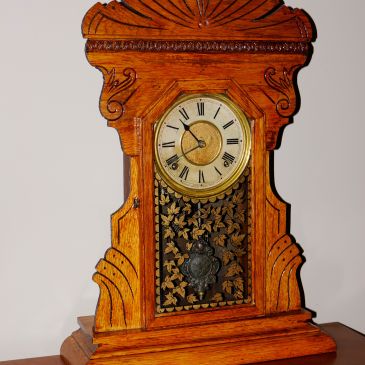
Juba Schatz mantel clock

The other day I was responding to a FaceBook post which offered a mantel clock for sale. The owner said that the clock, a 100+ year old antique, had been “fully serviced” so I asked him what he meant by that since I was curious. He said the clock was ultrasonically cleaned, the pivots were inspected, and the clock was oiled. He did not actually state that the clock was disassembled before cleaning but I assume that it was done properly although dunk and swish (or duncan swish) techniques are used more often that we realize. Dunk and swish involves immersing the entire unassembled movement into a cleaning solution and calling it “cleaned”. However, no reputable clock repair person (horologist) would employ this method. By using the term “fully serviced” the seller naturally expects to get several tens of dollars more for the clock.

No doubt who ever buys the clock will get a couple of years of service before it again needs attention. My concern is the state of the bushing holes and of course the pivots in a 100 year old clock and chances are it was not serviced properly in it’s past life.

I have disassembled and serviced a few clocks in my limited experience and my observation is that the older the clock the more the need for bushing and other repairs. My definition of servicing is this; disassemble and totally strip down, ultrasonically clean, springs unwound, inspected and oiled, pivots inspected and polished, pivot holes pegged and bushings installed / replaced if necessary, other parts inspected and addressed and the movement tested and regulated before re-installing in the case. My servicing also includes a case refresh. I serviced a 1920s Sessions Beveled No. 2 clock this spring (2016) that required 12 bushings.

Sessions Beveled No. 2 case
Sessions Beveled No. 2 time and strike in as-found condition
Fully serviced with case refresh

My Arthur Pequegnat Maple Leaf kitchen clock pictured here was professionally serviced in 2015 by a reputable clock shop and also required 12 bushings.

RS Pequegnat fan top (3)
Arthur Pequegnat kitchen clock in as-found condition

I am currently working on a 1940s Ingersoll Waterbury which was not too badly worn but still required 3 new bushings.

Ingersoll Waterbury clock
This American Ingersoll Waterbury clock, circa 1940, required 3 bushings,

If you poke around some of the clock for sale sites you will see a description that reads something like this, “all of our clocks are fully serviced and tested to ensure reliable running”. But if you bring up the profile on any one of the clocks offered for sale they generally do not describe how it was serviced and / or the actual service done on the clock.

I see plenty of antique and vintage clocks on the local online for-sale sites. Many have not been serviced as you would expect but some sellers claim that their clock has been fully serviced without providing any detail about what was actually done or whether it was a backyard tinkerer who did the servicing or a professional shop. The Juba Schatz mantel clock you see in the first photo might even be described as “serviced” but all I did was take the movement out of it’s case, inspect the pivots and other parts, oil the movement and return it to its case which took about 10 minutes.

“Fully serviced” to me means defining the term when selling a clock. A reputable for sale site should say something like this, ” has been fully serviced, having been totally stripped down, ultrasonically cleaned, reassembled, runs the full length of the wind and keeping excellent time, +/- 2 minutes per 7 day period”. A little more detail would be beneficial such as specific areas that needed to be addressed or particular repairs made if required but that is about as close as you will get and for those serious about a clock purchase it might be good enough.

Fully serviced means different things to different people. Always ask before you buy.

Servicing a Sessions American No. 2 mantel clock Part IV

In this fourth and final entry of the series I will discuss bushing work, re-assembly and finally, testing and mounting the movement back into it’s case. Part I of this series can be found here, Part II here and Part III here,

Once the pivots are inspected, cleaned and polished it is now time to install any bushings required as result of careful inspection.

Bergeon Bushing Machine

I acquired a Bergeon Bushing Machine in the spring of this year (2016). As I mentioned in Part III, some may prefer to bush by hand which I think is commendable but I have decided to go the bushing machine route. In the last few months I have been using and learning its many tools. It comes with a set of chucks and reamers some of which (right side rear) are a bit of a mystery to me. I cannot see using any of the large reamers any time soon though I assume that if I am working on tall-case clocks which have larger movements they would come in handy.

Chucks and reamers
Chucks and reamers

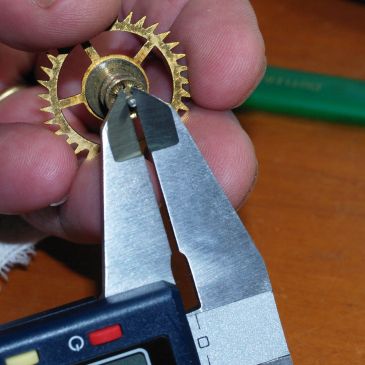
First is selecting the correct bushing using a micrometer to measure the diameter of the pivot. Then, I select the proper bushing from my Bergeon assortment kit.

Using a micrometer to check pivot
Using a micrometer to check pivot diameter on the escape wheel

The bushing I have selected for the escape wheel pivot (measured at 1.46 mm) has a depth of 2 mm, an outside diameter of 3.5 mm and a pivot hole of 1.5 mm.  In the next photo I am positioning it on top of the 3.47 mm. hole that I have just just “drilled” using one of the reamers. The outside diameter of the bushing is slightly larger allowing for a tight friction fit.

Punching the bushing home
Positioning the bushing on the Bergeon Bushing Machine
OLYMPUS DIGITAL CAMERA
Bushing installed

Once I have selected the correct bushing I test it on the pivot for fit and then I position it over the pivot hole and use a small hammer with it’s nylon end to tap the top of the bushing machine centre shaft lightly until the bushing is properly seated and level with the plate ensuring that the oil sink faces the outside of the plate.

New bushing installed
New bushing installed with oil sink on the outside of the plate

To check proper fitment of the motion works bushings/pivots, I assemble all the wheels on that side (both plates), check for a smooth action and determine if any additional reaming/smoothing is required. I do the same for the strike side.

Once all the bushing work is completed and I am satisfied that each bushing fits correctly and operates smoothly, I re-assemble the mainsprings, wheels and levers and then re-attach the back plate using the five plate screws. We each have our own method of re-attaching the back plate but I work from the bottom up, that is, from the mainsprings. Once I have the mainsprings in place I immediately install the bottom 2 plate screws (loosely) and then work from the motion works side to the strike side using a pivot locator tool, if necessary, to coax the pivots into their respective holes.

Trains and levers ready for the front plate

Positioning the various levers can be a bit frustrating because those that have helper springs seem to slip out of their pivot holes easily as you are putting the plates together. Perseverance is certainly the key.

The one difficulty I had was adjusting the synchronization of the count and drop levers, that is, getting the drop lever to sit in the cam while I adjusted the locking lever position. The clock must be completely assembled at this point and once together loosen or take off the nearest pillar nut and pry the plates apart to take out both the flywheel and the locking wheel. Once out, the locking wheel can be re-positioned by moving the pin on the wheel so it rests on the locking lever. Once this is completed, re-install the flywheel. This is basically a trial and error process and I never seem to get it right the first time.

My only error in the first go-around was not restraining the strike mainspring during this procedure. While spinning wildly the strike mainspring flattened the protrusions off the cam that allows the hammer strike. Momentary panic! Once bent back into shape everything was fine. Naturally, I secured the mainspring for my second successful attempt.

My reference for these adjustments is Steven Conover’s Striking Clock Repair Guide which is an invaluable guide to striking American clocks.

Once the parts are re-assembled it is on to the final testing phase which takes days (and weeks, perhaps) as the clock is being carefully regulated. The following video shows the movement on a test stand (in this case, Gene’s Test Movement Stand). The sound of the pallet on the escape wheel is very quiet; you are hearing other clocks in this room. The clock is in beat and in the video you can see the movement of the escape wheel from various perspectives.

Sessions American No. 2
The movement is returned to it’s case

Once testing and regulating is completed and I am satisfied the clock will run reliably for 8 days I return it to it’s case. There are only 4 mounting screws. You may have to re-position the coil gong by loosening the adjustment nut on bottom of case to get that satisfying strike sound.

This attractive little Sessions American No. 2 time and strike mantel clock has now been serviced. It required 5 bushings and should run reliably for the next 3-5 years.

Servicing a Sessions American No. 2 mantel clock Part III

Sessions American No. 2

The movement is disassembled and now it is time for further inspection, cleaning, servicing the mainsprings, pegging the pivot holes, polishing the pivots and installing bushings where needed. In this, Part III we will cover cleaning and mainspring servicing.

Ultrasonic cleaner
Ultrasonic cleaner

I have a small ultrasonic cleaner so I tend to clean parts in batches since this one does not have a large capacity. An ultrasonic cleaner is not an absolute must as you can easily clean by hand but having one certainly helps.

Front and back plates

Old toothbrushes are great for getting into the crevices and I use one especially for the lantern pinions as a lot of dirt and old oil tend to accumulate in those particular areas.

indicating wjehere bushings will be installed
indicating where bushings will be installed

This photo shows a couple of bushings that I will install. I realize that some prefer to install bushings by hand and I applaud them as it does take considerable skill but I use a Bergeon Bushing Machine which I believe simplifies the task (for me, at least). More on bushing in the next part of this series.

Olie Baker spring winder

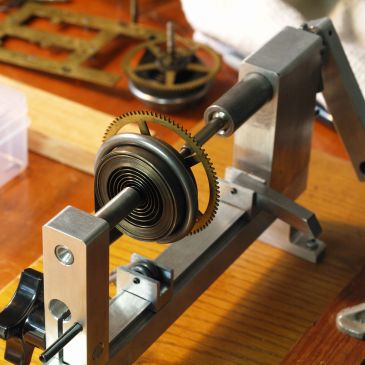
An Olie Baker spring winder is an indispensable tool. You can easily make one of your own to save a little money if you are handy with building things. A spring winder permits you to inspect for cracks or breaks, clean and oil the springs before reinstalling them. The photo shows a C-clamp securing the mainspring prior to cleaning.

OLYMPUS DIGITAL CAMERA
leather gloves are used to secure the spring on the winder

I have never lost an eye or a finger but I believe in safety first especially when working with mainsprings. Always wear leather gloves and eye protection. You never know when a 100 year old spring will break and fly across the room.

Click replaced
Click replaced

I discovered that one click had to be replaced as it was almost slipping off the ratchet. As some clock repair folks know, Sessions clocks have a reputation for bad clicks. I had a Sessions click in my supply box, fortunately. It is an easy job; just take the old one out with pliers, secure the new click and bang the rivet (supplied) into the existing hole with a ball peen hammer.

Serviced springs
Serviced springs

The springs have been cleaned and oiled with Keystone Mainspring Oil and are completely serviced including the installation of one new click. Now comes the bushing work, re-assembly and testing. Stay tuned to Part IV of this series.

Servicing a Sessions American No. 2 mantel clock Part II

Sessions American No. 2
Sessions American No. 2 time and strike
Top plate is off
Top plate is off

This is  Part II of the Sessions American No. 2 servicing. As I mentioned in my last blog entry (Part I) this clock was running but is in need of a little attention. This is a fairly simple clock to work on for an American time and strike movement. I cannot stress enough that photos are so important when working on clocks! They are a valuable reference which take a lot of the guessing out of re-assembly.

The clock is now ready for the parts to be taken off, organized in a parts container, inspected, cleaned and serviced.

Time side spring is removed
Motion works mainspring is removed
X marks pivot holes that need to be bushed

This the back plate. No bushings have been installed but following my inspection a number of bushings are required, three in this particular corner. The topmost “X” is the location of the escape wheel. I always mark the suspect pivot holes with a marker so that I know what work needs to be performed on those specific pivot holes.

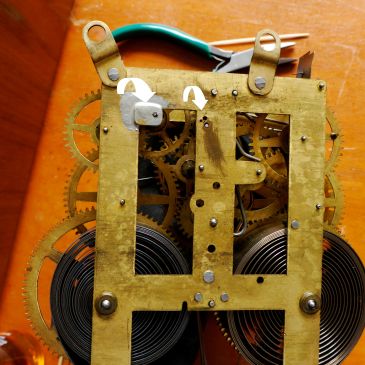
Dis-assembly is rarely an issue when working on these clocks. However, the helper springs (see arrow below) can be damaged and although they look like they might have been added by later clock repair they are indeed part of the original design and assembly of the movement and perform a vital function.  Be very careful with them though if broken they can be replaced. The helper springs and levers can be frustrating to work with particularly when lining up the levers correctly and re-positioning the helper springs upon re-assembly.

Removing lever with helper spring
Removing count wheel lever/helper spring
Removing the count wheel

The count wheel is secured by this washer. make sure it goes back in the same way it came out.

Marking the count wheel

Putting the count wheel in backwards will not stop the clock but it will count down the hours, not good! Not making the same mistake again I mark the count wheel so that I know that it goes in right the first time.

Time and strike parts
Motion works and strike parts separated

We each have our own way of doing things but I find it very helpful to separate the time and strike sides prior to re-assembly. It avoids confusion and makes for a more simplified process when working on your clock.

Now that the clock is disassembled it now time for further inspection, cleaning, installing bushings, and polishing the pivots which you will find in Part III.

Servicing a Sessions American No. 2 mantel clock, Part I

Sessions American No. 2

I am going to take you, the reader, through the process I follow when servicing a clock. There will be several posts in this series. I am not a trained expert in clock repair, nor do I do this for profit and have learned most of what I know through trial and error, careful study and of course, listening to the advice of many experts and newfound friends on the forum site at NAWCC.

If you into clock collecting you’ve probably seen one of these mantel clocks at one time or another in your travels. Literally thousands were made. This attractive little mission styled oak-cased time and strike mantel clock is a Sessions “American No. 2” dating from 1921 according to Trans Sessions book, page 121.

When I opened the back access panel to service the movement I discovered an inscription which reads, “Jim A. Kennedy, Nov 3/63, a clear, cold nite”. One can only imagine that on that particular clear, cold night, Jim A. Kennedy was doing some work on this lovely clock. It does not say where Jim lived but Jim, wherever you are and if you are still with us, your clock lives on.

Although this clock has been running steadily since I acquired it about two years ago, the time is right to put it on the workbench. American made clocks like this tend to run on and on despite requiring much needed bushing work and this one is no exception, but now it needs some loving.

I took the movement out of it’s case and examined it closely. Fortunately it has not been botched by poor repairs over the years that one sees from time to time. Things looked good, no surprises. Although no bushings have been installed on the top (back) plate there were five bushings that were installed on the bottom (front) plate at some point in this clock’s life, perhaps on that cold, clear evening in November. My initial inspection reveals that there is wear in some pivot holes and that six bushings must be installed on the back plate and of the five previously installed bushings on the front plate, two need to be replaced and at least one new bushing is required on the pallet arbor.

Although the movement appears clean at first glance it really is very dirty. This is an example of the sludge (indicated by the arrow) that has built up in this particular pivot over the years. There are other such examples on this movement.

top plate showing a build-up of dirt around a pivot hole
Top plate showing a build-up of dirt around a pivot hole

Once I tear it down completely I will be able to determine the condition of the pivots and other moving parts. I intend to clean the entire clock and clean/oil the springs as well as replace/install the aforementioned bushings. My first impression is that the mainsprings are in good condition. The clock easily ran eight days on a wind. The clicks are another matter. At least one looks like it needs replacement. Sessions clocks are notorious for their bad clicks but to put things in perspective the clicks have been in this clock likely since it was made (or perhaps 1961).

Time and strike movement with single hammer strike on a coiled gong

The escape wheel teeth may need to be filed but I will determine if filing is required once I inspect it more thoroughly.

escape wheel tooth tips
Escape wheel tooth tips

Safety first. The first task other than taking the suspension spring/rod/bob off the movement is to secure the mainsprings using mainspring clamps that are available at any clock supply store. Mainsprings can be very dangerous and it is important to contain their power when working on a clock. I always wear eye protection and leather work gloves before I let the mainsprings down with a let down key. Once you’ve released the clock from the ratchet by moving the retaining spring out of the way, the power of the spring is transferred to the let down key which allows one to gently release it until it is contained in the C-clamp. After the springs are restrained you can safely disassemble the clock.

Let down key and C-clamp

.

Movement on stands
Movement on stands

The clock is now ready to be disassembled. Tune into Part II where I will post photos of the complete disassembly stage and report on what further work needs to be done.

Sessions clock final thoughts

Sessions movement
Sessions movement in the process of repair

Regular readers have followed my progress on this 1927 Sessions tambour style clock.

Better news this time. After installing 10 bushings, repairing the strike click, replacing the pendulum bob and suspension spring and reassembling and oiling the clock and the springs I am having excellent success regulating this fine old clock. On a full wind I am getting upwards of 9 days and typically eight days through the summer. Though it sits inside our cottage in Quebec it has suffered through all manner of outside weather including high humidity and cool nights and despite these conditions it has performed admirably.

Although originally intended as a cottage clock I will be taking this clock back with me and placing it in a prominent place in my home.

All in all a great learning experience and a satisfying result.

Ingraham Huron – the secret within – Part III

RS April 12th
Minor case restoration completed

Restoring the case was relatively simple. After a thorough cleaning to lift the accumulated grime, a wax overcoat, touch-ups in discrete areas with yellow shellac, the case is very presentable for a 138 year old clock. I cleaned up the brass bezel but left the paper dial untouched. The hands are original and left those alone. The lacquer on the pendulum is still intact; no work needed on it.

And now to a further investigation of the movement.

After taking the dial pan off a couple of days ago my first impression was that the movement appeared to be in good condition. There are a number of newer bushings on the front which would have been expected for a clock of this vintage.  The servicing of the front plate looked like a capable repair. I oiled the front pivots and gave the pendulum a push, adjusted the verge and found a good beat. It ran continuously through the night. The next day I decided that if I were to keep this clock running until I can do some work on it, the movement should come out to oil the back pivots. It must have been years since this movement last saw pivot oil.

No problem. Four screws and out it came.

The secrets of this clock were now being revealed. Here you can see the back plate. I immediately observed several distressing issues with the movement. The first two problem areas are indicated by the white arrows. The left one shows a piece soldered onto the plate to address a pivot issue. The second shows a new bushing where one should not ordinarily be.

RS Ingraham movement (4)
Back plate showing two problem areas

The addition of a new bushing in that location must have been done for a reason. At this point I cannot speculate why it had to be done this way but it looks like shoddy workmanship. Otherwise, I do not see any other conventional bushing work.

You can see that the escape wheel arbor is clearly misaligned in the following photo. It works though theoretically it should not. Despite the fact that the clock is happily ticking away it is a poor fix for an unknown (to me) problem.

RS Ingraham movement (5)
Arrow showing a misaligned escape wheel arbor

The next issue is a soldered lantern pinion seen here just off the main gear (see arrow).

RS Ingraham movement (2)
Soldered lantern pinion

It is not a problem now unless one had to work on the pinions on that gear at some later date.

The fan was also repaired with solder. It looks ugly but it does not effect the running of the clock.

RS Ingraham movement (1)

So what to do? A simple bushing job I can do but serious bushing work is obviously required from someone with the experience and knowledge of Ingraham movements and I don’t have that level of expertise – yet. I may put this aside until  I gain more experience or have it professionally repaired.

I did discover one unusual feature. Although it has a wonderful gong tone on the hour it does not strike on the half hour.

For the moment is is ticking away and keeping good time.

Website Powered by WordPress.com.

Up ↑