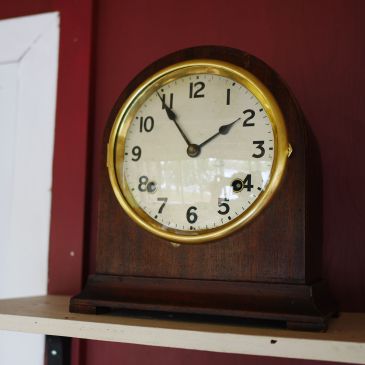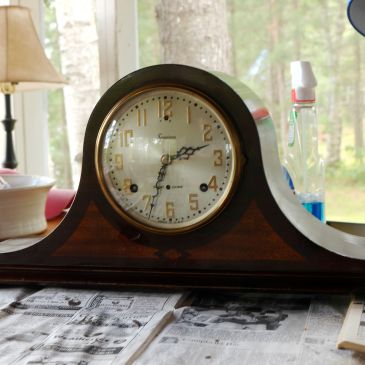
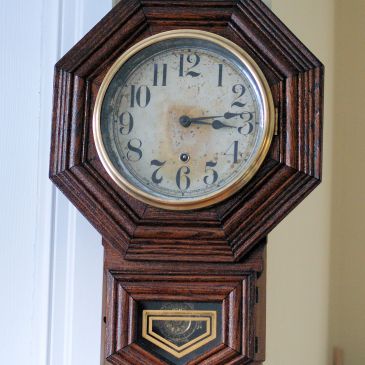
Found this little schoolhouse clock not 10 minutes from where I live. It is a Sessions Drop Octagon. It was manufactured in Forestville Conn. USA in the early 1920s and spent most of it’s life hung in a one-room schoolhouse near Springhill, Nova Scotia (Canada). The seller said that he had taken it out of the schoolhouse when it was decommissioned in the 1970s and it has been in storage ever since.
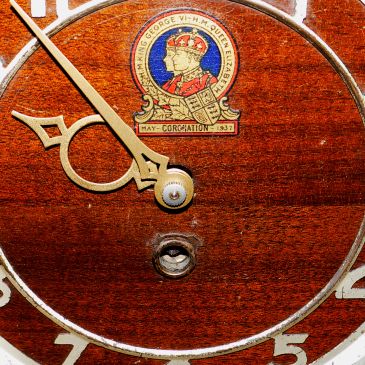
It is small, measuring 21 inches high by 13 1/2 inches wide and with a 7 inch Arabic dial.
Foxing
“It’s not running” he said. “Fine” I said. I took it home and had it running within 10 minutes. Although it ran strongly it required a good cleaning. I took the movement out of its case, dis-assembled it, cleaned all the parts in an ultrasonic cleaner, polished the pivots, cleaned and oiled the mainspring, installed 2 bushings, reinstalled the movement, tested it and set about cleaning up the case.
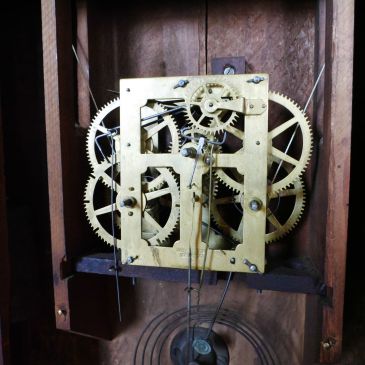
Time-only movement
After a Murphy’s Soap clean-up to the case I let it thoroughly dry then applied 2 coats of shellac to bring back the natural luster of the wood which was in otherwise good condition. The clock face had some foxing, which, in clock circles, means that some of the tin byproduct had leached through to the paper label and discoloured it. A little unsightly but I decided to live with it. I hung it up over my desk as one of a trio of time zone clocks to remind me of the time where my kids live.
Time zone clocks, Session clcok on right
The clock is a loud ticker but it runs well and should be reliable for years to come.
American Sessions time and strike clock showing a gear pivot and the build-up of dirt in the pivot hole
Is your mechanical clock not running as well as it should? Does it stop intermittently or not run at all? There may be a number of issues with the movement and among them pivot wear.
Pivots are the ends of the axles (the horological term is “arbours”) that spin in small holes drilled in the clock plates as the clock runs. They are reduced or turned down end of an arbour. These, along with the holes themselves, can become worn. The pivot hole must be perfectly round and the pivots must have a mirror-like polished surface in order to minimize friction within the train of gears. The two surfaces must be protected and the barrier between the pivot and the pivot hole is clock oil.
A badly worn pivot
A worn pivot or worn pivot hole causes the gear to slowly move away from the pinion and it will eventually stop when the gears no longer mesh properly. A clock that is in need of bushings runs erratically or stops altogether.
If a clock movement is not serviced (cleaned and oiled) routinely there will be wear in the plates of the movement where the pivots come through. If new oil is applied over the old il it will free up abrasive dirt and keep grinding away at the steel and the brass bushing hole. Worn pivots are typically found in clocks that have been oiled over and over again and not properly cleaned. The term “properly cleaned” implies disassembly of the movement, cleaning the parts, addressing wear issues, reassembly, and testing.
Occasionally you will see punch marks made to close the pivot hole. Though not an accepted practice today this was a common method of repair employed by past clock repairers
Pivots must be cleaned and polished periodically to ensure they can turn freely within the hole in the clock movement plate. A worn pivot hole is easy to observe as they are oval-shaped instead of round as you can see in the next photo.
Close-up of oval-shaped bushing wear. The circle shows what the hole should look like
The process of bushing consists of replacing the worn brass around the pivot so that the hole is round again. A new hole is drilled into the plate. A new, properly sized, the bushing is punched or pushed into the plate using a bushing machine such as a Bergeon Bushing Machine.
Some clock-makers prefer to hand bush using reamers and smoothing broaches and the results are entirely acceptable but a machine simplifies the task.
Badly worn pivots which are made of steel must be replaced with new pivot. This is called re-pivoting in clock circles. A watch or clock lathe is used for re-pivoting which involves drilling into the end of the wheel arbour with a high-speed bit and installing a new pivot made from pivot wire.
Drilling a hole with a cutting reamerPunching the bushing home using a Bergeon Bushing machineUsing a micrometer to check pivot diameter
Minor wear is tolerable and expected over the life of a clock and can be addressed by careful filing, polishing, and burnishing.
X marks pivot holes that must be bushedClock pivot oilPunch marks near the pivot hole. This was a common practice of past clock repairers
Bushing is an integral part of movement servicing. Some clocks that have been well-cared for may have minimal wear and may not require new bushings while others, through neglect or improper servicing, may require many bushings.
Bushing a clock is one of the most fundamental tasks of the clock-maker. Pivot and bushing work performed correctly will extend the life of a clock movement while ensuring that a clock runs reliably for years.
I acquired an Arthur Pequegnat mantel/shelf clock during my travels to Quebec this spring. The red oak veneered clock is complete with original hands, pendulum bob, a good label on the inside back of the access panel, coil gong and of course, the signature time and strike Arthur Pequegnat movement with nickel-plated steel plates.
Signature Pequegnat nickle-plated steel plates
It is known as the “Bedford” model. Online research tells me that two Bedford models were produced. This one, which I believe is the later edition, measures 9 ¾ inches high by 8 ¾ inches wide by 5 ½ inches deep. It has a silvered 6 inch dial with Arabic numerals with no Pequegnat inscription on the bottom of the dial face, spade hands surrounded by a thick brass bezel and concave base moulding. It has a passing ½ hour strike on a coiled gong. The earlier model has a 5 inch enameled dial with more stylized Arabic numerals and Pequegnat inscription on the dial face, spade hands, oak veneered case, a thinner brass bezel and convex base moulding. The case measurements are identical. The time and strike movement differs from the later model by having a ½ hour passing strike on a bell.
There is a good label on the inside of the access door which says, “Bedford, eight-day mantel clock, The Arthur Pequegnat Clock Co., Kitchener, Ontario, Canada”.
The label is in good condition
The movement is not marked. Though many Arthur Pequegnat movements were stamped with the maker’s mark it is not unusual to find one without one. This edition was likely manufactured in the Kitchener, Ontario (Canada) plant between 1925 and 1930.
With click fixed the clock is tested
The only issue with the movement is the time side mainspring function which, as the previous owner explained, could not be wound with a key. Damaged top veneer and split-open side trim pieces tell me that the clock had accidentally fallen. The impact point appears to be the very top front of the clock. As a result of the impact the front panel had separated from the main part of the case, leaving a gap of about 1/8th of an inch. It also had a broken access door catch.
Damaged veneer sustained during a fall, veneer was later pushed back in place
At first I focused my attention on the movement and why the time side mainspring would not wind. It was, as I suspected, a missing click spring. The click is a pawl which engages the ratchet wheel to hold the power of the mainspring or the weight. It is moveable and connected to the mainspring by means of a rivet. The click spring is a piece of steel or brass wire which is connected to the click and seats the click in the ratchet wheel.
I had a supply of steel click springs and fashioned one to fit the click. The click, rivet and the ratchet wheel were in otherwise good condition. While the mainsprings was restrained with clamps I postioned the click spring in place applying a little solder to ensure that it remained fixed. An older similar repair occurred on the strike side with solder holding that click in place. A weak point of the movement, perhaps.
A little solder to keep the click spring in place
I inspected the movement for wear and discovered that it had been serviced previously. The solder on the strike side click was certainly a clue but I also noticed that some bushings had been replaced, not unusual given the age of the clock. Brass bushings were punched into the steel plates at the factory. I could see that newer bushings were installed in at least three locations.
There is no lateral movement in the gears as such lateral movement would indicate bushing or pivot wear. There is no evidence of ovalized, enlarged or mis-shapen bushing holes and the gears are meshing well. The movement is clean and free of dirt and debris and I do not feel that a full cleaning is warranted at this point. There is no excess blackened oil; the oil in the bushing holes had simply dried up. I applied clock oil to the bushings, wound both mainsprings and after days of running the movement is keeping excellent time.
With the movement out of the case, repaired and in the testing phase, I focused next on the condition of the oak veneered case. Many of the joints had separated due to the impact I mentioned earlier. Hide glue would have been used originally and could be used for case repair. I have medium strength pearl hide glue, not strong enough for this application. High strength is required to bring the trim pieces together to ensure a good long-lasting and tight fit. This is one of those occasions when a modern glue is an acceptable alternative. Yellow carpenters glue has a bonding power of two tons and I chose this type of glue for the repairs.
Each section had to be clamped for 24 hours and only one section could be worked on at a time. The result is a very time-consuming and complicated process lasting several days.
I used three clamps for one repair. Because the impact point was at the very top I had to push the sides in with a clamp while at the same time bring the front panel into the main part of the case using two clamps adjacent to each other. You can see the clamping method I employed in the next photo.
Using three clamps to bring the sides together and the front section into the case
The side base trim pieces were also split open and had to be clamped in place as you can see in the next photo.
Side trim pieces clamped
Bringing the sides of the case together resulted in raising the damaged veneer, consequently several small pieces of top veneer had to be pushed back into place. Using carpenters glue combined with an “elaborate” weight system I went about with the repair. Using a toothpick I applied carpenters glue under the veneer pieces, wiped off the excess with a wet cloth and used a block with a hole drilled to accommodate a toothpick employing enough pressure to push the small veneer pieces into place. It looks odd but it works.
Toothpick and wood piece to push the veneer in
A degreaser was used to strip years of blackened dirt/grease/grime on the case and once cleaned the original grain in the red oak veneer is now exposed to its former beauty. The case will either need a layer or two of lacquer or a more modern finish such as PolyWipe. I will cover this aspect of the restoration/repair in Part II.
Using Brasso I cleaned up years of tarnish on the brass bezel giving it a new life. I also polished the arbour grommets. The silvered dial face is in very good condition and I left that as-is.
Bezel cleaned up
I fashioned a new door catch out of a worn Sessions click.
Broken door catch was repaired using an old worn Sessions click
With the movement repaired and the successful clamping and gluing of the case the next phase is the final finishing. I am pleased that I am inching closer to bringing this clock back to life and can add it to my modest collection of Arthur Pequegnat clocks.
While antiquing some time ago I came across boxes of clock movements in a shop. Some were fairly new though I found a Gilbert time and strike date stamped 1906 which piqued my interest. In the box was the key, the coil gong, clock hands, pendulum and movement mounting screws. A movement without a case. Hmm, interesting! Here’s what I’m thinking.
You dig up an old clock from the basement. It was your mothers and you were immediately reminded of the soothing sound of the clock when you were a kid. Wouldn’t it be nice to get that old clock running again. You fiddle with it and despite your best efforts you just cannot get the thing going. Why not bring it to the local clock-maker? He takes a look at it and explains that it is worn out. It will cost much more than the clock is worth to repair it, he says. But there is a solution. Take the works out and replace the movement with a reliable quartz one and all for less than half the cost of a repair. It sure would be nice to get that old clock running again and who would know that a new quartz movement is inside. The clock-maker takes the movement out, asks the customer if they want it, puts it in a box on a shelf and uses it for parts on the next clock. I’ll bet I’m close.
It is a Gilbert time and strike with a passing bell strike on the half hour. It has a distinctive 24 hour count wheel meaning that the count wheel rotates just once every 24 hours, each half with slots for 12 hours.
Gilbert time and strike date stamped 1906
It sat in a box in my office for several months. The other day I placed the movement on a test stand to determine its condition, wound the time side and BANG, the mainspring blew apart. A nice clean break! Luckily it did not take me or any other parts with it. The break was so far from the loop end that the mainspring was not salvageable. You can see the snapped section of the left mainspring in the photo above. Determined to see this movement in running condition I ordered a new spring from a clock supply house.
Top plate removed
When I dis-assembled the movement it was worn but repairable. However, all pivots were in very good condition except one, the second wheel on the time side, front plate. It was worn at the shoulder as you can see in the next photo.
Unusual wear on second wheel, time side
Was this enough to stop the clock and why just one? Perhaps a combination of factors. It is the second wheel and under the most axial load or probably a contaminated pivot hole with enough embedded detritus that would have ground away at the pivot shoulder.
There are only two solutions, fashion a new pivot or turn down the pivot and polish it. Fashioning a new pivot is a lot of work. However, there is enough steel left after it is turned down to give me a strong pivot. I chose the second option and installed a new bushing to fit the new pivot size which is much easier than re-pivoting. I put the wheel on a lathe and ground the pivot down to the size I wanted and then gave it a polish.
New bushing had to be punched to stay in place
The second issue was an old bushing that had been installed at some point in the clocks life. I drilled out the old bushing knowing that the replacement bushing would be loose. Alas, it slipped out too easily. The solution, two punches adjacent to the bushing to secure it in place. Punching a brass movement is rarely a good idea but this was a solution that was appropriate to the situation.
I installed two more bushings on the strike side second wheel back plate and third wheel front plate and one more on the time side, second wheel, back plate.
With the new mainspring installed and the repairs completed, it was time to assemble the clock and test it. I cannot count the number of times when I have re-assembled an American time and strike only to find that the strike setup was slightly out of adjustment. You know you have a problem when the clock strikes until the mainspring winds down. Placing the lever in the maintenance cam while the count lever is directly into the deep slot and hoping that the warning wheel pin locks at just the correct moment is always fun. I have cursed a few times when I cannot get it right. In this case it was first time lucky, the stop pin was in the right location on my first try.
On the test stand, bell is now fixed in placeAs an aid in re-assembly toothpicks remind me of the location of the bell lever
The clock has been running but does not seem to be able to get past 5 days of an 8-day cycle. I realize that there are some things I need to address before I get this clock running a full cycle but I have other projects on the go. Since this movement does not have a case I took it off the test stand, put it in a box on a shelf, included some notes, and will address it at a later date when and if I ever get a case.
Notes about the movement reminding me what needs to be done
So, I’ll wait for that illusive case but in the meantime into storage it goes.
I have always had a fascination with clocks. As a young boy I can remember the schoolhouse clock in my grandparents’ kitchen and the ticking sound it would make that echoed through the entire house.
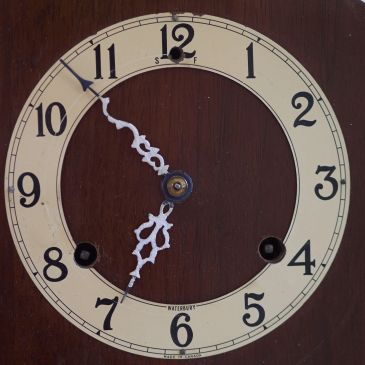
Seth Thomas Adamantine time and strike mantel clock, circa 1913
We all have busy lives and despite my interest in clocks over the years it was not until the year 2000 that I started building my collection, first with a Seth Thomas Adamantine clock and later with more mantel clocks, wall clocks and finally a grandfather clock in 2012. My collection has expanded to include virtually every style of clock though my interest lies specifically with American and European wall and shelf clocks. As I write there are about 35 clocks ticking away in my home.
In my blog I stress that I am not a trained horologist but have accumulated enough knowledge over the years that I feel capable of addressing general clock issues
Clock repair came a little later. I began with general understanding of the cleaning and oiling of clock movements in order to keep my little collection running. As I acquired clock repair tools and equipment I progressed to servicing pinions, bushings, verge repairs, cleaning of mainsprings and case restoration.
In 2015 I decided to write a blog about collecting and servicing vintage and antique clocks. There are some excellent clock blogs but many are commercial sites or professional horologists selling their services. I decided to design a blog that would appeal to the amateur clock collector/repairer. In my blog I stress that I am not a trained horologist but have accumulated enough knowledge over the years that I feel capable of addressing general clock issues. Therefore, my blog is not aimed at the professional repairer or restoration expert but the individual looking for specific information about a certain clock, those who have a particular problem with their clock and finally those who have a general interest in clock collecting and repair.
Fully restored Junghans time and strike wall clock, circa 1899Time and strike movement on a test stand after servicing
I publish an average of seven blog articles per month on a variety of clock topics. I appeal to a wide change of subjects; some articles have a philosophical perspective, some detail the challenges of working on a specific clock, some present simple repair techniques for the beginner, general maintenance tips as well as articles of general interest. As a history buff I try to include a background history or provenance of the specific clock I am profiling or information about its maker.
A micrometer is used to size a bushing for an escape wheel pivot
Blogging has also allowed me to combine my other interests, that of photography and traveling. My wife and I have had many interesting adventures seeking out unique clocks for my collection.
Mini Ogee by New Haven, the gaps in the door indicate that the front was once veneered and later stripped
This spring driven 30 hour New Haven Ogee clock is a loud ticker and rapid striker so distinctive that I can hear the ticking outside the room it is in like a mischievous puppy who wants to remind you where it is.
Judging from other New Haven clocks I have researched from this period, 1875 seems to be the approximate date of manufacture. The case measures 18 1/2 by 11 3/4 inches (47cm X 30cm) and the movement measures 3 1/2 by 5 inches (9cm X 12.7cm); a small ogee styled clock some would call a mini.
The clock is a mere reflection of its former self but not unattractive
The New Haven clock Co. has had a long and illustrious history. In 1853 the Haven Clock Company was founded in New Haven, Connecticut by Hiram Camp (1811‑1892) and other clock-makers. The company’s mission was to mass produce inexpensive brass clock movements for use in clocks. In April, 1856 The New Haven Clock Company bought out a competitor’s company, the Jerome Clock Company. They moved their production to the former Jerome factory and New Haven began making clocks under their own trademark. In 1870 some of New Haven’s clocks were marketed under the Jerome & Co. brand.
In 1885 the company stopped selling clocks other than their own New Haven brand. In 1890 the company developed serious financial problems and efforts were made to keep it solvent until 1897 at which time the company emerged after reorganization. In 1902 Walter Chauncey Camp (1859-1925) began to turn the company around. In 1923 Walter Camp stepped down as head of the company and is succeeded by Edwin P. Root.
In 1929 Richard H. Whitehead replaced Root as president of the company but New Haven again faced financial difficulties compounded by the Great Depression in November, 1929. Whitehead was able to keep the company afloat during these troubled times and the firm regained profitability. From 1943 to 1945 the company turned to the war effort, producing products almost exclusively for military use. In March of 1946 The New Haven Clock and Watch Company became the new name of the firm after it reorganized once again. It returns to what it did best before the War, making clocks and watches.
The 1946 reorganization eventually leaves the company vulnerable to foreign investors and it lost control to a consortium of Swiss watchmakers. The man who had successfully shepherded the company through the hard times of the Depression years, resigned as president. In 1956 the New Haven Clock and Watch Company filed Chapter 10 bankruptcy in a U.S. court. Its fortunes have declined precipitously since Whitehead’s departure and it never recovered. In 1960 the company went out of business and the production lines closed. The facilities were sold through a combination of public auction and private negotiation in March of 1960.
Coiled gong – a replacement from an E. N. Welch or a Gilbert.
This 30 hour New Haven Ogee looks good from a distance but closer inspection reveals a number notable issues. The movement appears original to the case and the case is in fair condition having been reconditioned at one time. Although the sides of the clock are veneered, the veneer on the front has been stripped off presumably because there was too much loss/damage. There is also some veneer loss on the top right side. Crude chisel marks on the left front indicate that the veneer in that area might have been more difficult to strip off. Unfortunate, but I have no intention of re-veneering the front. From a distance it still looks good and the casual observer will hardly know the difference.
The coil gong is a replacement and is in a slightly different location than the original gong judging from screw holes to the right. I can only surmise that the original gong somehow broke. This gong is probably from an E. N. Welch or a Gilbert.
New Haven 30 hour movement, back plate30 hour movement – front plate showing factory installed oil cups
There are oil sinks on the front but not the back plate. The sinks on the front plate are stamped by the factory and were made to look like a more expensive clock since most would not see the rear plate. An odd decision by the manufacturer but a common practice.
Side view of 30 hour movement showing count wheel and cam wheel
The plates are pinned (rather than the newer bolts or screws) and there are two solid gear wheels suggesting that it is an earlier version of this particular 30 hour movement. The suspension spring and leader are a replacement as expected given the age of the clock. The pendulum bob is a replacement and so is the dial face.
I took the movement from its case, inspected it for wear and applied clock oil. The clock is running well and does not require immediate servicing.
The clock is a mere reflection of its former self but not unattractive.
30-hour Waterbury Ogee with a beautiful veneered case
This 30 hour Ogee clock was purchased in the fall of 2017. I was eager to add this clock to my collection as it is the one particular style of clock that I do not have. From my research on Waterbury clocks I determined that it was made in or around 1870.
I decided to turn the worn trundles inward and seal them with Permatex (medium strength thread-locker) so they are fixed rather than rolling; not ideal but reversible
While the case is in remarkable condition for the age of the clock the movement has suffered the ravages of time.
Simple 30 hour movement, top plate removed
Testing over the course of a day or so revealed that clock would not run for more than a few minutes. The movement was taken out of its case and inspected to determine what needed to be done to get it to running condition.
I expected punch marks and there were a number. In the old days clock-makers would attempt to address pivot wear by closing the pivot holes with a stake or punch. Not ideal but a common practice. Bushing work was definitely required. The pivots, on the other hand, were in very good shape and polished up nicely.
Punching the bushing home
My first task was to address the bushings. Ten bushings were installed, 5 on each plate. The front bushing work included the escape wheel bridge, always a challenging spot to bush. Next I addressed the other serious wear issue – the trundles on all of the lantern pinions.
Lantern pinions on the escape wheel
The trundles on the lantern pinions were in bad shape as you can see in the photo above. The wear seen here was identical on all 4 lantern pinions. Notched trundles were not what I expected.
The trundle work was certainly the most interesting part of the repair. My experience with lantern pinion work is zero. After some research the method I selected was to hand drill through the top shroud to release the worn trundles.
Drilling through the shroud to release worn trundles; I used a smaller bit than the one pictured here
After releasing the worn trundles I used 1.10mm pivot wire which is ideal for this purpose and matched the worn trundles precisely.
Test fitting of pivot wire before the wire is cut to proper length
I began with the fly. I drilled into the top shroud. I then cut 1.10mm pivot wire into the required lengths then rounded the ends with a cut-off disc on a Dremel. After the fly was completed I addressed two more lantern pinions in the same way. I staked the shroud ends to seal the trundles inside.
With three done the escape wheel lantern pinion was next and that is when I ran into a snag. The escape wheel shroud is reversed (see photo below), so I cannot drill into the top shroud without a lot of guess work. Using needle nose pliers I decided to turn the worn trundles inward and seal them with Permatex (medium strength thread-locker) so they are fixed rather than rolling. This is not ideal but it is reversible.
There does not appear to be a definitive answer as to whether the trundles should be free-moving or fixed although I suppose they are designed to roll with the gear teeth. At some future point the trundles on this wheel will need to be replaced.
So, how do you get at those trundles?
The clock did not come with a pendulum bob so, a new one was attached. The suspension spring and leader was replaced to address a crimped spring that resulted in a wobbling pendulum bob. I used .09mm suspension spring in the correct length. The clock now runs well and it has completed a number of 30-hour cycles.
I suspect that this will be a clock that will not be run daily, the inevitable hassle of constantly winding a 30 hour clock but I am pleased that it is back in running order and I will ensure that is runs on special occasions.
My hope was that it would be a relatively straight forward exercise
This is Part 1 of servicing this 30 hour Waterbury time and strike movement. I honestly thought it would be relatively straight forward exercise. Dis-assemble, clean the parts, polish the pivots, do a little bushing work and voila! Not so.
I have worked on many clock movements but I have never seen quite the extent of wear that I found on this movement. 150 years certainly takes its toll.
Ogee clock showing replacement pendulum bob
Some time ago I profiled this Ogee clock. To reiterate, in 1839 the first prototype movement was produced for Chauncey Jerome by his brother Noble in Connecticut, USA. Jerome thought that a simple one-day clock could be produced far more cheaply than those with wooden movements at the time. Brass movements were more robust, could be transported easily and were unaffected by humidity. The simple case added to the movement was the Ogee named for its “S” shaped moldings. The success of the Ogee clock convinced other makers that there was money to be made in clock production.
This particular 30 hour time and strike Waterbury Ogee clock was produced at the height of Ogee clock production (1870s) and many thousands were sold. This is a very fine example. Absolutely nothing needs to be done to the case; it is in exceptional condition. The movement, well, that’s another story. This was not a working clock when I got it.
Waterbury clock movement
After disassembling the movement I discovered two things. One, there was evidence that it had been worked on before – as expected. There were punch and stake marks on the movement plates to close pivot holes and there was considerable wear in the lantern pinions.
Front plate has been removed
Four of the wheels have lantern pinions, with 5 trundles apiece. Trundles are the loose wires within the 2 shrouds. Dust and dirt as well as misalignment of wheel and pinion due to worn pivot holes can exacerbate the wear issue. The trundles on all 4 lantern pinions are very worn as you can see in the next two photos. I discovered why this clock does not run. When the gear teeth hits two worn trundles at precisely the right angle it locks the gear and stops the clock.
Worn trundles within lantern pinionAnother wheel with worn trundles within the lantern pinion
Professional clock-makers encounter these issues fairly regularly. Indeed, one of the most common operations in clock repair is replacing bent, broken or worn trundles. There are different methods of performing this service and the method I will employ is to drill into the shroud, extract the worn trundles, cut new ones out of pivot wire, insert them and re-knurl the shroud.
In the meantime bushing work was performed; 10 bushings were installed, 5 on the back plate and 5 on the front, including one on the escape wheel bridge. I re-assembled the movement knowing that the trundles had to be replaced, but despite new bushings the movement ran only marginally better.
Part II (Jan 2nd) details the procedure I followed to replace the trundles in the lantern pinions. Stay tuned.
EN Welch time and strike parlour clock displayed in an antique shop
In a previous article I described some of the challenges I had with this E.N. Welch clock movement.
The clock ran for about 48 hours and suddenly stopped. It seems that every time I think everything is going well, something else crops up. I dis-assembled the movement (again) and installed three more bushings, one of which is on the escape wheel bridge which I noticed had a fair amount of play. Perhaps the vertical motion of the EW was causing the clock to stop. The other two bushings were installed on the third wheel, back and front. I have decided to hold off addressing the EW teeth if the bushing work I have done has solved the stoppage issue.
I was hoping to wrap the servicing up fairly quickly but unanticipated problems continued to crop up. Having completed the work mentioned above I could see that things were beginning to change for the better.
Shortly after taken from the case. A very dirty movement with many issues
The time side ran strongly for eight days after which I reinstalled the strike train. Here is the movement running on a test stand.
Cleaned and free of rust, bushings installed and tested
Setting up the strike side required manipulating some of the lever wires which were moved out of position by the previous owner, for whatever reason. A previous repair/adjustment resulted in the lifting levers bent back into the case and the count lever pushed in an upwards orientation. As a result I had to bend the levers back into their original positions.
From left; hammer lever, count lever, lifting lever
Here is the movement installed back into its case.
E. N. Welsh Whittier model
It should now run reliably for years to come. A frustrating project with a satisfying ending.
Tools are essential for clock repair because they enable precision and accuracy, which are critical when working with delicate mechanisms and intricate components. Let’s identify the key reasons.
Antique and vintage clocks can lose significant value if repaired improperly. Using the right tools minimizes the risk of damage, preserving their historical and monetary worth. The right tools, such as screwdrivers, pliers, and tweezers, allow you to handle small parts without causing damage. Specialized tools ensure components are handled carefully and correctly.
Proper tools make the repair process faster and more straightforward. For beginners, having the right tools helps build confidence and competence. They allow you to focus on understanding clock mechanisms without being hindered by improper equipment.
This article will describe some of the tools required to tackle the repair and/or cleaning of mechanical clocks.
Based on years of clock repair experience, I recommend the following essential tools for any beginner’s toolkit. While some of these tools can be sourced from your local hardware store, specialty items will need to be ordered from clock supply companies such as Timesavers (USA), Perrin (Canada), or Meadows and Passmore (UK).
Whenever possible, avoid purchasing tools from craft shops, as their prices are often significantly higher. They are ideal for paint and quality paintbrushes but they tend to charge much higher prices for general-purpose tools. A ball peen hammer bought at a hardware store, for instance, costs half as much as one found in a craft shop.
A suggested list of items
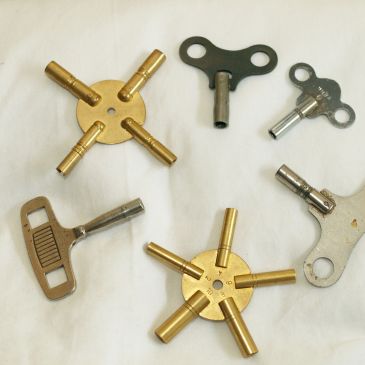
Keys: clock keys come in many different sizes. You must use the correct key for the winding arbours of your clock. The pronged keys in the photo below will fit a multitude of arbours.
4 and 5 prong keys and singles
Magnifier: They are available in various strengths and allow a much closer view of your work.
Magnifier
Work light: Illuminates your work, this one articulates and has a magnifier. I have since replaced this light with an LED one. The lamp burnt out and the cost of the fluorescent lamp was more than the entire lamp. Plus the new LED lamp has light temperature and intensity controls.
Work-light
Pliers: A variety of pliers to hold onto your work, release taper pins, tighten nuts, and cut wires. The green handle pliers are non-serrated (flat-nose).
Assorted pliers
Hammers: A ball peen hammer is very useful (not pictured). The craft clip holder is useful for steadying items that are to be soldered.
Hammers and craft clip
Files: Variety of sizes to help shape or file down anything on a movement. Avoid inexpensive Chinses files and spend a little more on quality ones.
Files
Tweezers: Getting into tight situations, grabbing small parts, and positioning parts into place are typical uses for tweezers
Tweezers
Level: To find the correct beat the movement (clock) must be level.
Level
Spring clamps: To restrain the power of the mainspring. The flat clamp (upper right) is for those mainsprings which do not leave a lot of working room. Otherwise, the other round clamps are good for most applications. I prefer the flat clamps.
Assorted clamps
Screwdrivers: Always handy to remove movements from cases, loosen bolts, and pry parts.
Screwdrivers and box wrench
Letdown set: Before working on a movement the mainsprings must be let down or restrained in their clamps. The letdown key is the safest method of letting down the mainsprings. Inserts cover most arbour sizes.
4-piece letdown set, #5-6, #7-8, #10, #12
Hand reamers and broaches (cutting and smoothing): For bushing clocks when you cannot afford the luxury of a bushing machine. Cutting and smoothing broaches are useful for enlarging a new bushing when tight tolerances are required. They come in assorted sizes.
cutting and smoothing broaches
Cotton swabs: A variety of cleaning uses.
Cotton swabs
Clock oil: Once the movement is apart and cleaned it must be re-assembled and then oiled before use. The oil, whether it is conventional or synthetic, must be specifically designed for a clock movement.
Clock pivot oil
Toothpicks: For cleaning and “pegging out” bushings on a movement
Toothpicks
Clock stand: Once the movement has been re-assembled it is tested outside the case for a short period. Gene’s movement stand is a fully adjustable test stand.
Gene’s clock movement stand
For those handy with a hammer and saw a stand can be made at home with whatever lumber is at hand.
Testing a movement on a home-built test stand
Camera: At every part of the process a digital camera can record critical stages in assembling and disassembling a movement. I use a 50mm macro lens for close work. A cellphone is a perfectly acceptable alternative but one with good macro capabilities is preferred.
Digital Camera
Electronic Caliper: Indispensable for measuring the thickness of anything be it springs, pivots, plates, and so on. Available at a clock supply house or save a little money and buy the same tool from a retail outlet such as Canadian Tire in Canada.
Using a micrometer to check pivot diameter
Pivot locator: It is an excellent tool for aligning pivots with their holes during assembly.
Build your set of tools little by little to spread the cost. You may already have some of the items I’ve mentioned but buy what you need when you need it. As for those specialized tools, broaches for example, it pays to spend a little extra for better quality.
These are the tools you require to start your journey into clock repair. If you have a tool (or tools) you feel is indispensable for the beginning clock-maker please let me know.
In Part II I will describe tools for those who would wish to advance their skills in clock repair.
Case is in fair condition, dial face has some flaking, piece broken on left side of base
We have a couple of antique stores in our small town. Calling them antique stores is a bit of a stretch because there is usually more junk inside than actual antiques. We were shopping in the area of one of those “antique” stores and my wife turned to me and said, “Let’s go in”. I replied, “You know, all they have is junk”.
I thought, I might have found something important
I acquiesced. While she continued her shopping I went on ahead to look around the store and in the very back I saw a very sad looking clock that at I took for an old Sessions or a Waterbury. As I neared the clock it piqued my interest and I began to see that it was quite old. I picked it up, looked for any markings on the dial face, found none then checked the back of the clock and discovered most of an intact label revealing a what I consider to be a significant find.
Back label in good condition for the age of the clock
It is a clock from the Canada Clock Company. The Hamilton Cottage Extra was one of a range of clocks in their Metropolitan line.
This is an important discovery. The owner of the store knew nothing about clocks. He was asking $99 but after a bit of haggling, we settled on $40. I knew that it was worth much more.
Here is an excerpt on the Canada Clock Co. found at the Canadian Clock Museum in Deep River Ontario (Canada).
This company was the last of three sequential attempts to produce clocks by factory methods in Canada during the 1872 – 1884 period. The original effort by the Canada Clock Company in Whitby, Ontario was basically unsuccessful and only limited production was achieved.
In 1876, the equipment was relocated to Hamilton, Ontario to begin a second attempt as the Hamilton Clock Company, with new investors. This attempt was more successful and a fairly wide range of clocks was produced. However, sales were not very large and some of the investors left the company by 1879. At that point the president, James Simpson, ended production and proceeded with a major reorganization.
The company subsequently became the Canada Clock Company using the old Hamilton Clock Company factory and resumed production in 1880 but as a result of poor sales closed its doors in 1884.
Clocks from the Canada Clock Co.are sought after by collectors. For international readers this represents a rare find because the 1870s to the mid 1880s was a very important period for clock production in Canada. Apart from several independent clock-makers in Quebec and eastern Canada two notable companies made wholly Canadian clocks, The Arthur Pequegnat Clock Co. of Kitchener Ontario made clocks up to 1941 and Martin Cheney of Montreal made finely crafted clocks in the early 1820s. This clock was made at the Hamilton, Ontario factory which produced clocks from 1880 to 1884.
Original count wheel time and strike 30 hour movement
The 30-hour time and (bell) strike movement is in remarkably good condition and fairly clean. The back label in good condition for the age of the clock and there is a stamp on the top of the label which says, “…A Hill &Co.”. If any Hamiltonians are reading this I would be grateful if you could make inquires about this small retailer.
My preliminary examination reveals that this clock has had very few repairs over the years. I have not taken the movement out of its case to check bushing/gear wear and other issues but I am initially encouraged. The case reflects the age of the clock but I would judge the clock to be in just fair condition. There is a wooden piece that needs to be re-attached on the right side of the base. Fortunately that piece was tucked inside the clock case.
Right side needs work
Left side looks good
100+ years of grime came off easily; etched glass on the bottom part of the tablet is distinctive
The crudely made case is not overly decorative and reflects a muted Victorian style of the times. The lower part of the tablet has an etched glass floral design typically found in Canada Clock Company clocks. The door clasp is original. The dial face is flaked in places and not in the best of condition though the 2 floral designs on each bottom corner are nicely preserved. The hands are original. The case is not heavy and made of pine with a deep walnut stained finish. It was grimy and dirty as expected. It cleaned it up nicely with Murphy’s soap and a sharp hobby knife was used to remove the numerous paint drops on the clock. Why folks do not put something over the clock when painting a room amazes me.
I will put the clock aside until I can determine my next steps. Do I pursue a full restoration including renewing the dial face or leave the clock largely in as-found condition? In the meantime I will re-attach the wood piece on the left side of the base.
There is no maker’s mark anywhere on the case or the movement
The clock is an unsigned 8-day carriage clock in a rectangular brass case. This attractive little clock has a white enameled dial with Roman numerals, blued steel hands and a spring driven time-only movement with platform lever escapement visible through the top beveled glass. The brass case has 4 beveled glass panels complete with a fold-down travel handle.
In taking the movement apart to clean it I can see “73” stamped on the bottom of the case, the case handle, the door edge and 2 or three places on the movement and the letter “B” on the back of the front plate but no maker’s mark. What do the numbers mean? I think it is an internal production stamp. Thousands of these generic carriage clocks were made and I may never know the maker. The only taper pins on this movement are those that attach the dial face to the movement. However, judging from what see and its general construction I would comfortably date this clock to the 1880s.
The movement plates are secured by screws rather than taper pins. Older carriage clocks would have taper pins securing the movement plates. This clock would have been produced for the English market since it has “S”and “F” stamped on the escapement (Slow and Fast). The key has “France” inscribed on it so if it is original, then the clock is French.
Unsigned French Carriage Clock
Time-only carriage clocks are relatively easy to work on although the platform escapement takes a extra care. I chose not to service the escapement at this time.
First, let the mainspring down to release the power. If you take a wound clock apart it can injure you. Some of the compression points between cogs can have a very high gearing so even a weakly wound clock has the capacity to trap or pinch your fingers as well as throwing out and damaging components. I use a let down key that can be purchased at any clock supply house.
Carriage clock platform escapement
Movement side view, re-assembled
Taking the movement out of the case involves releasing 4 machine screws in the base. I use several elastic bands to keep the glass in place while I lift the sides and door off the base. When holding the clock firmly observe the effect of loosening the screws. The pillars have become loose and the glass can now move a little in the frame. If you unscrew all the screws completely without understanding that the glass is loose, it is too easy for the glass panels to slide out and break. They are not easy to replace! I’ll describe my work on glass cleaning later.
There are two screws which hold the base to the movement. Unscrew those and proceed to take off the front face. The enameled face is secured by 4 taper pins. In my case they were difficult to get out so I decided to take the back plate off the movement to allow my pliers inside to release the pins. Removing the platform escapement requires releasing 4 very tiny screws. A precision slotted screwdriver is absolutely necessary. It is best to unscrew all 4 together and leave them in place once off the movement so you do not have to fiddle with them when reattaching the escapement later, unless, of course, you intend to service the escapement.
Back plate after a cleaning
I then separate the plates and inspect the wheels, pinions, pivots and pivot holes. I found a little bit of play in two pivot holes only observable with a loupe but not enough for bushing work. I polished the pivots, pegged the pivot holes and cleaned the wheels, plates and other pieces except the platform escapement in the ultrasonic cleaner.
Assembly of the movement is relatively simple as there are so few gears. Attaching the hour hand was interesting, however. Both the hour and minute hands are pressure fit, but the hour hand was a challenge because I had to use a screwdriver to push the hour shaft forward (gently) through the clock face while simultaneously attaching the hour hand. It was very tight. After a number of tries I managed to press it in securely.
It is actually quite small
Back to the glass. It is also important to put each panel back where it belongs. I discovered that there is a top and bottom orientation to each glass panel, they are cut so fine! There is enough resistance if you try to put the wrong end into the channels you will encounter difficulty. Each glass panel is taken out and cleaned with Windex and, of course, put back exactly how they came out.
Once everything is assembled the clock is oiled, wound and the time is set. Polishing the brass case is the final step. Brasso was used to clean up the brass and bring the clock back to its former glory.
Regulating your clock is the process of making repeated, precise adjustments to its mechanism with the goal of enhancing its accuracy and ensuring it functions as a reliable timekeeper over an extended period.
The running of your mechanical clock is influenced by three key factors: neglect, friction, and the environment. These elements will determine whether your clock can maintain accurate timekeeping. The article ends with tips on regulating your clock and the effects of mainspring power on timekeeping.
Let’s look at each factor.
Neglect
Neglect is easy to understand: without proper care, a clock will lose its reliability as a timekeeper. Placing a clock in a sunny spot, especially in a hot window, can cause the case to age prematurely and dry out the movement. Setting a clock near a heat source, like a heating vent, can affect its performance. Transporting a weight-driven clock without securing the weights can result in broken case parts and shattered glass. Moving a pendulum clock without removing the pendulum can cause internal damage.
Additionally, turning the hands backward should be avoided unless the manufacturer specifically permits it in the clock’s instructions.
Using a winding crank
Friction
Each moving part of a clock must be in optimal condition. The gear train should move freely, but excess friction will negatively impact the clock’s performance. Regular lubrication is crucial to prevent this. Friction causes wear, and over time, wear can lead to costly and time-consuming repairs. As bushing wear accelerates, the clock’s functionality will deteriorate, eventually causing it to stop.
Close-up of bushing wear; the pivot hole is oval when it should be circular
It’s good practice to inspect your clock’s movement every year or two and add oil if the pivots are dry. If you notice a buildup of thick, dirty oil around the pivot holes during your inspection, it’s time to service the clock’s movement. This can be done either by you, if you have the necessary skills, or by a clock specialist.
Six bushings installed on the back plate of a Sessions Westminster A mantel clock movement
Once the lubricating oil is used up or dries out the clock continues to run but the wheels are running without lubrication in their pivots holes. Once the pivot holes are enlarged (see above) the gears begin to run too deep into each other and the clock eventually stops. In clock circles the proper function of one gear operating with another, smoothly is referred to as “meshing”. Once wear becomes a factor, winding the springs no longer helps, as the springs lack sufficient power, or the gears fail to mesh properly, preventing them from overcoming friction in the gear train.
This leads some owners to think the clock is stopping due to being “over-wound,” when in reality, it’s simply worn out, or there is so much debris and dried oil in the mainspring that it sticks and refuses to unwind.
Preventative maintenance can help avoid costly repairs.
Servicing a clock is a separate topic altogether but black or green oil around or in the pivot holes is an indication that re-oiling will be ineffective; dis-assembly and cleaning of the movement is necessary.
Mixing old, dirty clock oil with new oil will speed up wear, and adding more oil won’t improve its performance.
Environment
Changes in the ambient temperature of your environment will affect it’s timekeeping rate. It is quite common to make seasonal adjustments to your clock. If you are in a temperate climate such as my part of the world, humidity, and temperature changes have a noticeable effect on the rate-keeping of any clock. Increasing the ambient temperature will slow it down, from the expansion and lengthening of the pendulum rod (unless it has a compensating type pendulum).
Clocks perform better in the more controlled environment of a home, but damp basements, window sills, bathrooms, areas above heating elements or vents, garages, and other humid spaces are unsuitable for mechanical clocks. Harsh environments can damage both the movement and the case, leading to issues like cracks, fading, and detached veneer in addition to a myriad of problems with the movement.
Pendulum bob with regulating adjustment
Regulating your Mechanical Clock
Regulating a clock often means making incremental changes to the length of the pendulum by means of a rate adjustment screw located at the end of the pendulum, or as in the case of a French clock pendulum (above) a rating screw inside the bob. Turning the rating screw clockwise shortens the pendulum (faster) and counterclockwise lengthens (slower) it.
Usually, one full turn of the screw means adding or subtracting a minute per week. To simplify the process some clocks have a rate adjustment arbour on the dial, typically at the 12 o’clock position. That way you do not have to open the access door at the back of the clock to adjust the rating nut on the pendulum.
Rate adjustment arbor
If you have a double-ended key, the smaller end is used for the rate adjustment arbour. The “S” (slow) and “F” (fast) settings correspond to adjusting the clock’s speed—slowing it down or speeding it up. Clocks may have either one of these adjustments, but sometimes both (adjustable pendulum and rate adjustment arbor), as on this French shelf clock.
French mantel clock
Rate adjustment is a trial-and-error process and typically takes a week or longer. If you can adjust your mechanical clock within a minute or two per week you are doing well. You will gradually gain a feel for the kind of adjustment required to regulate your particular clock.
Clocks without pendulums are those that have lever escapements, floating balance escapements, or balance wheel escapements. Regulation is achieved by moving a lever from slow to fast (as indicated on a wheel for instance) or adjusting weights in one direction or another on the escape wheel. There are specific directions on how to this and it is best to consult the instruction manual on your clock or search for resources online.
Mainspring Power and Regulation
When winding a spring-driven clock you are winding a sturdy coiled metal spring. The mainspring is an energy storage system or a power source. When you turn the key the winding gets tighter until you cannot turn the key any further. This stored energy (or potential energy) is now ready to be released but because a clock has reduction gears and an escapement (method for energy to escape) the energy is designed to be released at a steady and controlled rate. The purpose of the gear train is to convert the slow rotation of the main wheel into the faster rotation needed to tell the time. Each wheel in the train turns faster than the previous one.
A spring-driven clock tends to release most of its energy at the beginning of a cycle and releases less energy towards the end of it’s winding cycle which is typically an 8-day period. Most clocks will run longer than eight days but will lose more time as the spring supplies less power.
Regulating some spring-driven clocks can be challenging due to the way they release their power, though this can vary depending on the clockmaker. If your vintage or antique spring-driven mantel or wall clock is accurate to within 1-2 minutes per week, it’s performing quite well.
Sessions Beveled No 2 tambour style clock and French carriage clock
My Sessions time and strike tambour-style clock typically runs about one minute fast at the start of the week and around one minute slow by the end of the week. This is normal.
This one-weight Vienna wall clock is accurate to within 30 seconds a week
On the other hand, weight-driven clocks are more accurate since they release power at a constant rate through the winding cycle. Weight-driven clocks are generally more reliable timekeepers and are easier to regulate.
Junghans Crispi wall clock with compensating pendulum
Neglect, friction, and environmental factors play a significant role in a clock’s ability to keep accurate time. By ensuring proper maintenance, placing your clock in a location free from heat and humidity, and regularly checking for adequate lubrication, you can extend its lifespan, maintain its value, and enjoy dependable performance for years to come.
Regular reader and contributor JC suggested a few more clock terms I thought readers and fellow horologists might find interesting.
My source for this article is the Watch and Clock Encyclopedia by Donald de Clarke, published by Bonanza Books (1984) which is still available on Amazon.
Gridiron pendulum: A pendulum consisting of alternating steels and brass rods coupled together to compensate for downward expansion so that the centre of oscillation of the pendulum remains consistent with changes in temperature, invented by John Harrison in 1725.
Gridiron pendulum on a Junghans Crispi wall clock
Broaches: To broach is to open and enlarge a hole. A Broach is a steel cutting or smoothing tool with a tapered or parallel sided edge used to cut or “finish” holes in a clock plate. Used to enlarge and then finish (smooth) a newly installed bushing on a clock plate.
A set of Swiss made smoothing (or finishing) broaches
Motion Works: The train or wheels of a clock directly connected with the hour and minute hand.
Great wheel: The teeth that form part of the barrel of the going barrel. It is also the wheel to which the mainspring is attached.
The motion works of a clock; the largest wheel on this movement is the great wheel (Pequegnat Clock Co.)
Maintaining Power: A method to maintain the driving power while the weight is being lifted or mainspring with fusee is being wound. In effect keeping the mechanism going while winding.
Weight driven movement with maintaining power, (unmarked Vienna Regulator)
Huygens Endless Rope Drive: It is a method of providing maintaining power to drive the clock while the weight was being raised. The endless cord passes over pulley A which is attached to the great wheel and supports the driving weight B, it then passes over pulley C which has a ratchet to support small weight D. As cord E is pulled down to wind the clock ratchet C turns under it’s click to raise weight B which continues to drive the clock as it supplies torque to wheel A. This ingenious system is found in some 18th century long-case clocks.
Huygens endless rope
Locking Wheel (or Count Wheel): A count wheel is the wheel that determines the number of blows to be struck in striking mechanisms.
The left wheel with notches is the count wheel
Ratchet wheel: A toothed wheel into which a click engages permitting the wheel to revolve in one direction only.
Toothed ratchet wheel and click
Cam: Usually a disk so that upon revolving it transmits movement to or exerts pressure upon a connecting unit.
Arrow showing location of a cam, the fly is located in the upper right
Fly: Often called the governor or controller of a chime or strike train. It is the last piece in a train of wheels.
The language of the clock world always amazes me. There are a plethora of other clock terms that I will be happy to explore in future blogs.
Do you like the challenge of working on a mechanical clock? This one might have you ripping your hair out. These are not the best clocks to start on and can be a headache for the experienced clock-maker.
You will find Part I of this project here and Part II, here.
#1 Refinishing the case while movement is on the test bench
In August 2015 I wrote, “This a good project clock that is not for the inexperienced. As I gain more knowledge I will tackle this fascinating clock.” Well the time is now
With a little experience under my belt it time to tackle this vintage circa 1931 Sessions Westminster A chiming clock.
I had removed the movement from it’s case in 2015 to replace a bad click since the mainsprings can be easily removed without dis-assembly. The click holds the tension or power of the mainspring and is identified by a clicking sound when the key is turned on the winding arbour. Although I have not run the clock much since then the click is holding up well.
#2 Six bushings on back plate, 7 total (one not shown)
The movement required a total of 17 bushings. There was some movement of the pivots in the pallet arbour bushing holes, not enough to be overly concerning but they were addressed during servicing.
I was unable to pull the centre cam off because I do not have a puller which was unfortunate as the hole might have called for a bushing.
#3 Centre shaft cam
#4 Gathering pallet pins, also showing two racks
I was also unable to pull the arbour for the gathering pallet pins. It also might have needed a bushing though luckily I was able to bush one end. I mentioned in Part II that parts that are pressure fit on any movement are frustrating when said parts cannot be removed without special tools. Fortunately I was able to hand pull other chiming/striking parts off this movement.
#5 All parts in except the minute / hour canon
#6 Old spring on rack and new brass spring ready for the second rack.
There are two racks on this clock (see photo #4). One rack was missing it’s retaining spring. I made a new one out of brass wire. The clock was not striking properly and this small, seemingly inconsequential part might be the reason.
It shows very well for a vintage 86 year old clock
Between re-assembling the movement and testing of the time side I had an opportunity to address the finish on the case. I used a wood stain to hide scuffs and nicks, applied 5 coats of Minwax Satin Wipe-on Poly using 1500 grit emery cloth between coats to bring up the finish. Although not quite the deep luster of a clock coming out of the factory it shows very well for a vintage 86 year old clock. Purists might argue that I am using a modern finish on a classic clock but I don’t mind since the clock was found in a dusty old barn and cost me only $25.00.
Robert Croswell’s guide for the Sessions Westminster A clocks is excellent
The dial bezel was polished using Brasso.
#7 Re-finished case
Five Days Later
The clock has been running for a few days and I am satisfied that the time side is functioning well. I can now proceed with the strike and chime side, following Robert Croswell’s excellent manual.
One Week Later
The time is running well and I am getting a full cycle (8 days+) however I am still having issues with the strike side. It manages the quarter hours as it should, 4 strikes on the quarter, 8 on the half, 12 on the three quarter and 16 on the top of the hour. However it is obvious (to me) that I do not have the hour strike sequence set up properly. Robert Croswell’s guide for the Sessions Westminster A clocks is excellent but I am having difficulty understanding how the racks, and there are two, and the snails, again two, are set up.
Stay tuned, I know I will solve this little annoyance eventually.
The clock is a “Canadian made” New Haven Octagonal short drop wall clock. It was assembled at The New Haven Clock Co. of Canada plant established at Brantford, Ontario (Canada) in 1906.
New Haven schoolhouse clock
The New Haven Clock Company of Canada was a subsidiary of the New Haven Clock Company of America. Both mantel and wall clocks were made in the Brantford plant with Canadian wood cases, but the spring-driven pendulum movements were brought in from the U.S. The Canadian arm of the New Haven Clock Company closed in 1956. More information about The New Haven Clock Company can be found here. This clock was probably made in the 1940s.
The clock was removed from a schoolhouse in Saskatchewan, Alberta (Canada) in the 1960s. The previous owner said that he ran the clock for a couple of years, got tired of it and put it in storage. I hung it up on my kitchen wall for a couple of months and while it ran immediately and kept good time I considered putting off servicing with other projects on the go. However, if I ran it long enough without proper attention any wear would be exacerbated. Now is the time to service this clock.
Day One
The movement was mounted with what looked like the 4 original screws. I wondered if this movement had ever been serviced. Clues began to reveal themselves as I took the movement out for a closer inspection.
New Haven movement #304
The centre cannon arbour was very loose which is not uncommon. A bushing might be required. The pivots were in good shape and had minimal wear but most bushing holes on both the time and the strike side, front and back plates were so enlarged that there was considerable lateral movement of the wheels in both trains but not enough to stop the clock. Not the worst I have seen but clearly a clock that is in dire need of servicing. The clock ran for many years and appeared to have received not much more than basic servicing during that time.
Day Two
The movement was very dirty. The cleaning solution in the ultrasonic cleaner was dark brown in colour and large pieces of crud floated on top, a build up of dried oil and dust over the years.
An obvious example of a previous repair was the drop lever that had been soldered in two places as you can see in the photo below.
Top view of movement indicating solder points
The lever looks strong and should hold for years to come.
Strike side maintenance / drop lever
I took special care to resist bending any parts of the lever to adjust it for fear of breaking it. The helper wire/spring on the drop lever also seemed to have been replaced at some point because it looked crudely made, not something you would see in a factory installed movement. A piece of the helper wire broke off during dis-assembly which meant that I had to make a new wire/spring.
I polished the pivots and then proceeded with the bushing work prior to cleaning the movement.
Bergeon Bushing Machine
15 bushings were installed, 7 on the front plate and 8 on the rear plate. The centre cannon arbour required one bushing, a much larger one, on the rear plate.
To completely eliminate any issues with the time side I took all the strike train wheels out
Movement on test stand without strike side wheels
Without strike side wheels
Day Three to day Five
All went well while test fitting the wheels on both trains; they moved as smoothly as they should. I re-assembled the movement and attempted to align the levers on the strike side as best as I could with little success. I ran the movement on the test stand even though the drop lever was not positioned correctly. Unfortunately, the clock stopped every few hours. My suspicion was an incorrectly aligned lever somehow stopping the strike side.
To completely eliminate any issues with the time side I took all the strike train wheels out and ran the time side for 3 trouble-free days eliminating any issues with the motion works.
I consulted Steven Conover’s excellent book on strike clock movements (Striking Clock Repair Guide) to work through a solution. He devotes one chapter to the New Haven movement and clear instructions for setting up the strike side.
Day 6
After studying Steven’s manual, I reinstalled the strike side and proceeded with the necessary adjustments as follows.
The positioning of the levers are critical.
The 3 levers of the New Haven movement
There are 3 levers in this clock. Knowing how the levers function is key to getting this clock to run. The hammer strike lever (Lever number 1) performs a very simple task and installs on the bottom of the clock and is activated by the hammer lifting pins on the cam wheel. The drop and paddle lever (Lever number 2) does several jobs in unison. It pushes the unlocking lever or the lift lever (Lever number 3) down to release the warning pin to prepare the strike. The top arm of the lever number 2 rotates through the 2 – 180 degree slots of the cam while the bottom arm forms the paddle that enters the deep slots of the count wheel to indicate the strike on both the hour and half hour. The upper arm of this lever must be on the upper rear part of the slot on the cam to work correctly. I found this through trial and error. Needless to say, the positioning of the levers are critical. Once the levers were positioned correctly, the clock ran beautifully.
Post assembly testing
The clock went through it’s full 8-day cycle without any issues striking as it should. The movement was mounted back into it’s case, is being regulated and is now on display in our living room.
This very ordinary clock reflects its utilitarian role as a schoolhouse clock; it is not the best looking or the best sounding clock in the world but like a faithful servant it should run without issues for years to come.
Seth Thomas Adamantine time and strike mantel clock
I am servicing the first antique clock I ever bought. After having serviced many others it is time to give this clock a little love.
Some years ago (2000) my wife and I were traveling around Nova Scotia and stopped in a little village called Blockhouse. We found an antique store, walked in and never intended to buy an antique clock that day but left with an American Seth Thomas Adamantine mantel clock. It looked like it was worth many more times than we paid for it. We left the store thinking we had stolen it.
My research revealed that thousands were made and the price we paid at the time likely reflected its true value. The clock came home and sat on top of our piano and looked great. For a couple of years I wound it up religiously and marveled at its beautiful marbleized case and the sound of the gong on the hour and the bell on the half hour. I stopped winding it, let it sit on the piano and ignored it. About 5 years ago as I began to build my collection of vintage and antique clocks I wound it up and have kept it running ever since.
These clocks have become known to collectors as “Black Mantel Clocks”, and were popular from 1880 to 1931. Adamantine veneer was developed by the Celluloid Manufacturing Company of New York City, and was covered by U.S. Patent dated September 7, 1880. Seth Thomas Clock Company purchased the right to use the Adamantine veneer in 1881. At that time Seth Thomas stamped the year of manufacture on the bottom of each case. Though somewhat difficult to read the date on this particular clock is 1907.
Re-assembled and tested
Each clock I added to my collection needed some work and so I left the ST thinking that one day I would service it. Despite the fact that I kept it oiled, displayed it in a relatively dry dust free environment, it needed a good cleaning and a little bushing work.
Once you take a movement out of its case you begin to discover it’s little secrets. I immediately noticed a stripped speed regulating gear. The regulator arbour runs through the plates and is connected to the pendulum hanger to slow or speed up the clock. The rate adjustment is on the front of the clock and the smaller end of a double-sided key is used to speed and slow down the clock. I observed a rate adjustment screw on the pendulum bob. The “newer” bob had evidently been added at some point in the clock’s life to replace the stripped gear. The other possibility is that it might have had both. I have seen French clocks with both a front rate adjustment and an adjustable bob.
Regulating gear is stripped
The movement was taken apart and the parts were cleaned in an ultrasonic cleaner.
Back of movement showing
Bushing wear was not an excessive but enough to justify installing 4 bushings; S2 front, T2 front, and escape wheel, both front and back plates. Putting the movement back together is relatively easy though it is always frustrating positioning the helper springs and levers in place as you move the pivots into their holes. It takes me a few attempts to get the strike side gears and levers correctly aligned. The stop wheel, stop lever, maintenance lever and count wheel hook take a little trial and error and it not something I have managed to get right the first time.
Seth Thomas clock face
Once back together the movement was oiled and placed back into it’s case. It should run reliably for years to come. Save for a slight aging of the clock face the clock is in excellent original condition.
Antique Seth Thomas Adamantine clocks look great on any mantel.
The Ansonia octagonal short drop wall clock was (is) commonly known as a schoolhouse clock. This clock was manufactured in 1912. The number “12” , the year stamp, is found on the lower front plate of the movement. The letter “N” is also stamped on the movement.
In this post, Part II, I will proceed with cleaning the movement and performing required bushing work in addition to assembling and final testing.
12 and N on the plate
This is my one and only Ansonia clock. Since it is a fairly conventional time-only movement with an outboard escape wheel, it is fairly simple to work on and for those of you starting out, this is the first movement you should attempt.
Movement in the case prior to disassembly
After applying a C-clamp to the mainspring to contain the spring’s power, I disassembled the movement, placed the parts in the ultrasonic cleaner, then cleaned and polished the pivots prior to the bushing work. The clock required six bushings, three on the front plate and three on the back. The worst was the third wheel, as you can see in this photo. This is not unexpected because of the constant power and stress produced by the mainspring, but it definitely indicates a very worn pivot hole.
Close-up of bushing wear, the circle indicates where the pivot residesThe mainspring was inspected and cleanedUsing a micrometer to check pivot diameterBergeon Bushing Machine, an indispensable tool for bushing work
The only challenge I had was dealing with the brass arm that supports the front plate pivot on the escape wheel (arrow). To install the bushing I had to stabilize the arm on the bushing machine without bending or breaking it, and using very light hammer strikes to seat the bushing.
Arrow indicating tricky bushing install
The bushing went in nicely, as you can see in the next photo. Otherwise, the remaining bushing work went as expected.
Bushing installed on escape wheel arbourTesting in the case
Although I have an excellent clock stand, I decided to test the movement in the case due to the acute mounting angle of the movement. I tossed out the old screw,s which did not appear to be original, and used new slotted brass screws to attach the dial pan and the hinge for the brass bezel. In the process of fumbling with the glazed bezel, I knocked off the brass catch that fits into a slot on the case front. An angled wood block fits into the notch on the catch when the bezel is closed. I got out my torch and, with some sanding, an application of flux, and sufficient solder, the catch operates as it should.
Brass catch repair
Since I serviced the movement, why not go one step further and refresh the brass? I gave all the brass a good cleaning with Brasso, bringing back its original luster. Someone messed with the clock face some time ago, which is unfortunate, but I have decided to leave it as-is. A new paper dial face would not look right.
Ansonia clock project is complete
A simple project that can be done in half a day, enough to extend the life of this handsome antique schoolhouse wall clock that will tick along for years to come.
This is Part II of a multi part series on the Sessions Westminster A chiming mantel clock.
Side view of Sessions Westminster A
Inside the plates they are a conventional Sessions clock. Outside the plates is an entirely different story
Sessions Westminster A clocks are true chiming clocks that play the Westminster chime sequences on the quarter hours and strike the hour count on the hour. The unique design combines the chiming and striking functions in one train powered by a single main spring. Between the movement plates these movements are very similar to other Sessions non-chime (strike only) movements. The going (time) train is controlled by a basic recoil escapement with the strip pallets or verge located between the plates. Inside the plates they are a conventional Sessions clock.
Outside the plates is an entirely different story. At the front of the movement one will notice that this is a rack and snail strike train but it has TWO racks and TWO snails. A look at the back of the movement reveals a small cam in the middle of the plate and a large “player drum” or pin drum. The two racks working together with the little cam and the player drum, which can shift outward to play chimes or inward to strike the hour, is what makes it all work. The chime sequence is self‐synchronizing and with so few working parts, once setup correctly this can be a relatively trouble free movement. (Source R. Croswell’sTaming the Sessions Two Train Clock)
This clock requires servicing for two reasons;
It runs for several minutes or an hour or so and then stops
The striking and chiming is very erratic. It might strike 4 o’clock one hour and 9 o’clock the next and the hammers “hang up” during the quarter hour chime.
There are a number of “exterior” parts that must be removed before separating the plates
Dis-assembly of the Westminster A is conventional however there are a number of “exterior” parts that must be removed before separating the plates. The regulator gearing, verge, drum assembly, hammers and racks as well as other parts are removed one after another. The additional parts add considerable complication to the movement and can lead to issues when servicing. I will describe two particular issues I have encountered in the process of working with this movement. I believe these issues, which I will describe later, are likely what frustrate most clock repair persons when working on the Westminster A.
Rear plate showing regulator, verge and chime drum. Clamp on mainspring
I chose to leave the mainsprings in while taking the movement apart though I contained the power using C-clamps. On this clock the mainsprings can be removed without dis-assembly. This allows the repair person to easily service the mainsprings or the clicks (which are notoriously bad on Sessions clocks generally).
Unfastening the drum and hammer assembly went without issue since there are only two bolts securing it to the plate.
The 2 racks, a unique feature, work together to produce the strike. They are located one on top of the other and are secured to a post.
Two racks stacked on top of each other. The post on the right accommodates two springs
Taking them off requires releasing a pressure washer on the top of the post. They came out easily. However, one rack is missing a return spring which might partly explain the erratic striking of the clock. Such a simple thing that may make a big difference. I may have to buy or fashion a spring.
Rack with spring
Rack without spring. The spring clips into the hole on the rack arm
Specialized tools are needed to remove some parts. Those I don’t have
Two issues.
One, I could not remove the hub supporting the gathering pallet pins seen here. It’s unfortunate because there is more lateral movement of the arbour that I am comfortable with which tells me that a bushing is required. I did not want to risk damaging the arbour and I don’t have specialized tools to do the job. I may have to live with it. However, it may not be so bad once the other bushing work is completed.
Gathering pallet pins
Two, I could not remove the centre cam despite pulling and gently prying.
Centre shaft cam
Again, I did not want to risk damaging the arbour. Specialized tools, such as a puller in this case, are required to remove it. That, I don’t have.
This clock has a unfortunate reputation for soft pivots
I will have to work around these two issues. Pressure fitted parts on any movement are very frustrating when said parts cannot be removed without special tools and this one is a challenge indeed. Re–assembly might be a little frustrating particularly with the centre arbour still attached to the rear plate which may effectively be “in the way” of positioning other wheels in place.
I inspected the pivots on the wheels and they all look good (no tapering) with expected wear for a clock of this period. I was worried because this clock has a reputation for soft pivots and perhaps because this is a later model, Sessions might have been introduced harder steel for the pivots. There is plenty of bushing work that needs to be done, however.
On to cleaning, bushing work, re-assembly and testing in Part III.
This is Part I of a multi-part blog wherein I explore the challenges of repairing a Sessions Westminster A tambour style time, strike and chime mantel clock. This part is the introduction.
Th Vintage Sessions Westminster A mantel clock
In August 2015 I wrote, “This a good project clock that is not for the inexperienced. As I gain more knowledge I will tackle this most interesting clock.” Well the time is now.
Well, it’s been two years and I have looked at this clock often enough and wondered what it would be like to finally get it running. Time to take the plunge.
The Sessions Westminster A mantel clock was made in Forestville Connecticut, USA. The first year of production for this model was 1927. Between 1903 and 1933 Sessions produced 52 models of mechanical clocks, ranging from advertisers, large and small clocks with logos of various businesses, to wall, or “Regulator” clocks, and shelf or mantel clocks, designed for the home.
Some Sessions clocks from this period are prized by collectors. The Westminster A is particularly sought after though collectors prefer it to be serviced and in running condition.
Raised Roman numerals and faux inlay
The case is in exceptional condition
The clock is tricky to repair and most horologists prefer to stay clear of it
This clock is 21 inches long and 10 inches high, has a mahogany finish with faux wood inlay and raised metal gold-coloured numerals on the dial face. It is a quarter-hour 8-day Westminster chime clock operating on two trains, the going train (time) with the strike and chime train combined. It also has small arbour just below the hour cannon to turn off the chimes/strike and is called “Silent Chime”. Sessions was not alone in producing two-train clocks and other makers incorporated this design later in the 1930’s and 1940’s. However, Sessions was probably the best known for this feature. This clock was sold in 1931 (inscription on label, back of access door). The sale price was $29.95 which would have been substantial considering a working man’s salary in those days.
Sessions Westminster chime drum
The clock is tricky to repair and horologists will generally try to stay away from it. I will be going through a step-by-step process and relying heavily on Robert Croswell’s excellent instructional manual called Taming the Sessions Two Train MovementFebruary 2016 edition.
In August 2015 I wrote, “This a good project clock that is not for the inexperienced. As I gain more knowledge I will tackle this most interesting clock.”
I have done some bushing work and from what I can see there is certainly bushing work to be done. I have removed the movement once before to replace a bad click which as easy fix since the mainsprings can be removed without dis-assembly. The click holds the tension or power of the mainspring and is identified by a clicking sound when the key is turned. But the real challenge will begin as I attempt to understand how the chime mechanism works and if I can re-assemble it successfully.
Follow me as I dis-assemble, clean and repair the movement in Part II.
This is an antique German Junghans time and strike spring driven clock made in the style of a Vienna Regulator. It came to me as a box of parts. To some a box of clock parts and pieces is discouraging but to me it is a challenge.
Part II of a three part series on my newly acquired Junghans Crispi wall clock.
This is Part II of a three part series on my newly acquired Junghans Crispi wall clock. In Part I described the circumstances by which I came across this clock and it’s incredible story as a survivor of the Halifax Explosion of Dec 6, 1917.
This is a German count-wheel strike typically found in the lower lines of Mauthe, HAC and similar clocks. It is an open plate “bread and butter” movement, not of the highest of quality but well built and reliable. The count wheel is located to the rear between the plates and the mainsprings are enclosed in open barrels. There are no helper springs to worry about and all of the wheels are located in the centre and the upper side of the movement.
As you can see in the next two photos the movement was very dirty and I accepted the risk of running it for a day to see what issues might arise. I gave the pivots holes plenty of oil to mitigate any additional wear. What I found was a sticky hammer assembly that would malfunction intermittently which I attributed to dirt and grime buildup, otherwise the movement ran very well after not having run for 100 years. Imagine all that kinetic energy stored in the springs since 1917.
The movement is relatively easy to re-assemble but I had to install the lower centre wheel, the spring barrels and the centre cannon together with the top plate and then slide the gears in between the plates. Fortunately this process is not as difficult as it sounds but very different than laying the top plate right over the gears as you would in an American movement.
Very dirty movement
Mainspring barrel with years of dirt showing
I gave the pivots holes plenty of oil in the testing phase to mitigate any additional wear
Plates cleaned up well
All the wheels between the plates
I found everything within acceptable limits and decided that bushing work was not required
The accumulated grime of 100+ years came off following the ultrasonic cleaning. In fact I have never seen the ultrasonic solution so dirty. The plates cleaned up very well and I gave them an additional polishing with Brasso. After the parts came out of the ultrasonic I tested the movement for any evidence of excessive play and found everything within acceptable limits and decided that bushing work was not required. The pivot holes were pegged and the pivots were polished.
Springs were inspected, cleaned and oiled
There were no cracks or unusual issues with the mainsprings though I found it curious that they were very clean with no rust. There was also very little lubricant remaining. The springs are somewhat tired as you might expect but I think there is enough power remaining for a full cycle so I decided not to replace them at this point. I applied Keystone mainspring oil to the springs once I returned them to their barrels.
With the movement back together, it is time to adjust the strike side. The strike wheels must be set up correctly with respect to each other ensuring that the third (hammer lifting star wheel) and fourth wheels (the strike cam) align with he count wheel. The warning pin on the last wheel (which actually protrudes from the plate) has to be high enough for sufficient rotation. In order to count the strikes properly this relationship must be right. Unfortunately, I can never get this correct the first time.
The servicing of the movement is not without headaches, however.
The servicing of the movement is not without headaches, however. I bent a pivot on the warning wheel which I managed to successfully straighten out. The hammer arbor paddle was barely touching the star wheel and while trying to adjust it, I accidentally snapped it off along with the retaining spring. Although the clock will go though the strike sequence the gong will obviously not sound. I don’t have the tools to put in a new paddle so I will have to get that attended to somehow. I managed to correctly adjust the strike side but the clock mysteriously stops after about an hour or so. Something is definitely amiss and more investigation is required.
I have had more success with the case restoration that you will read about in Part III. In the meantime I have to constantly remind myself that this movement has not been running in 100 years!
What most people visualize as the Schoolhouse clock
My recent acquisition of another schoolhouse clock stimulated my curiosity and prompted me to do some research on the origin of the name. In this article I will describe my thoughts on how the schoolhouse clock came to be and my most recent Sessions wall clock purchase.
During my research I found it very interesting that little can be found regarding the history of the schoolhouse clock. I realize that many older readers growing up in the rural areas of Canada and elsewhere in North American have fond memories of the one-room schoolhouse with a large clock in either the front or the back of a classroom. I did not live that experience rather, when I was young and attending a large urban school the Simplex master / slave clock is the one I remember best.
The schoolhouse clock that I bought recently adds to my modest collection of three schoolhouse clocks. Given that I spent many years as an educator, it seems only fitting that I would have an interest in schoolhouse clocks. My schoolhouse clocks are all a similar style; short drop octagon, constructed of oak, brass dial bezel, bottom glazed access sash, 12 inch dial or 9 inches as in this case of this clock and the Waterbury pictured below. Although 9 inch clocks were used in schoolhouses they were also found in office or workplace settings.
They were not called a schoolhouse clock when they were made
Schoolhouse clocks were the standard design for early North American school houses because of their larger, easy to read dials. These distinctive clocks were hung in many schools rooms across Canada. The majority had simple but tough time-only movements and some even came with a calendar function. Occasionally they were ordered with time and strike movements but the cheapest and most popular versions were time-only. This type of clock had a very utilitarian look and function.
They were not always called schoolhouse clocks. None of the labels on my clocks have the word “schoolhouse” written on them and are either described as a”drop Octagon” in the case of this Sessions or have a specific model name. The term schoolhouse clock was not applied to them when they were made but came to be known as a particular style of clock found in school settings by later collectors. If a particular style was ordered by a school authority makers might have informally described them as clocks for schools or “school clocks”. In any event, the term has become a permanent part of the clock collector language.
Label on back of Sessions clock
With a swinging pendulum visible from a distance the clock can easily be seen running and the open-door bottom access sash allowed for restarting and adjusting the rate. In some clock collecting circles it is said that schoolhouse clocks are a derivative of the English drop dial fusee clock, an example of which can be seen here. Drop dials were produced in the late 18th through to the 19th century and closely resembled the schoolhouse clock. Unlike spring-driven schoolhouse clocks, fusee clocks have conical construction from which a chain or gut-line is pulled by the mainspring barrel allowing the power of the mainspring to be released evenly thus assuring better accuracy.
When I am in the process of buying a clock I always ask the seller this question. “How much do you know about this clock?”
When I am in the process of buying a clock I always ask the question. “How much do you know about this clock?”. I always ask this question because I am interested in a clock’s provenance and some of the stories are quite intriguing. The seller, a man in his late fifties, thought about it for a moment and said, “Well, I’ve had it since I was 14”. The clock came out of a decommissioned one-room schoolhouse in a small town called Springhill, Nova Scotia (Canada). However, when I first saw the clock I said to him, “It looks like a nice office clock”. The seller quickly corrected me and said, “It’s a schoolhouse clock”. “It runs for a little bit and then stops, maybe you can do something with it”, he added.
It is a 1920’s vintage Sessions Drop Octagon wall clock. It has a solid medium dark oak case with original hands, ornate pressed brass pendulum bob, solid brass bezel, 80% of an intact label on backboard, tin dial pan and stenciled lower glazing on the sash. The paper dial is original but it is heavily “foxed”. The movement is 8-day time only. The dimensions of the clock are a 9″ diameter dial, 19″ high, 13 1/2″ wide by 4″ deep. It is in reasonably good condition given it’s age and for $20 it was quite a bargain. It is also intact; there are no missing or broken pieces.
Sessions time-only movement
I don’t think this clock has been run in quite some time.
I took it home, hung it on the wall and true to what the seller said it would run less than a minute and stop. I noticed a rubbing sound around the pendulum area as it was running. The pendulum bob was hitting against the inside front of the case. I took the movement out and observed a bent crutch rod, corrected it, put it on a test stand and it ran immediately. As expected the movement had quite a bit of grime and required attention but it ran for a day before I took it apart for a thorough servicing. I don’t think this clock has been run in quite some time.
I found it curious that the suspension spring was soldered where the spring hooks into the top block. It likely kept slipping off and solder was used to keep it in place. In any event, the spring cannot be taken out without first removing the solder! The clock is in very good overall condition for it’s age and the movement was not as dirty as I first thought. The pivots are in decent condition for the most part and there is minimal wear overall. The movement was disassembled, cleaned and in the process I decided to install two bushings for added insurance, one on the escape wheel (front plate) and the other on an intermediate wheel (front plate). The movement was tested, put in beat and reinstalled back into it’s case.
I may replace the paper dial but I am going to see if I can live with it for the time being.
The dial has many brownish spots as you can see in the next photo. The clock had to have been in a moist environment for a long period for the paper to discolour. My two options are, one, leave as is or, two, replace with a paper dial. I may replace the paper dial but I am going to see if I can live with it for the time being. The brass bezel cleaned up well but the exposed tin surrounding the paper dial has blackish areas which I managed to reduce with CLR but could not totally eliminate. Of course, I later learned that CLR is really not appropriate for this purpose as it is an acid.
Dial showing rust staining
The case has years of grime which was easily remedied with Murphy’s soap and water. It cleaned up very nicely. Following the cleaning I gave the case a light coat of shellac to restore the luster of the oak. It looks good and it runs well.
My other drop octagon clocks are a Waterbury Arion, an unknown Ansonia and an Arthur Pequegnat Brandon II.
This Waterbury Arion is 19 inches long
Ansonia short drop octagon, model unknown, 12 inch dial
Arthur Pequegnat Brandon II, 12 inch dial
Time-only movements are the easiest to work on and a very good movement to learn on.
Repaired Sessions Drop Octagon clock
Time-only movements are the easiest to work on and a very good movement to learn on. If you are a beginner in clock collecting and repair clocks such as this are satisfying clocks to work on and presents few challenges. I am happy that I managed to bring this particular clock back to it’s former schoolhouse glory.
The term schoolhouse clock is a term that was not applied when they were made but came to be known as a particular style of clock found in school settings by later collectors. The schoolhouse clock is such an endearing name that when one thinks of a schoolhouse clock the memory of these specific styles of clock immediately comes to mind.
I prefer time-only clocks above anything else. They are simple to work on and because they are less complex they tend to be more accurate, relatively speaking. Most are easy to service but this little guy has me stumped.
Thousands of these relatively small German movements were made and some found their way into small shelf clocks like the ones I will be talking about in this article.
Time-only movement, German
Let’s not confuse these inexpensive clocks with better known and highly regarded Black Forest clocks of Germany
I acquired a couple of Blackforest shelf clocks about a year ago. Let’s not confuse these inexpensive clocks with better known and highly regarded Black Forest clocks of Germany. The clocks I will be discussing here were made by the Blackforest Clock Co. of Canada in the 1930s. Later on, during the war years (1941) the company felt compelled to change it’s name to the Forestville Clock Company of Canada. They sourced their movements from England during the war years and Germany prior to (and after) World War II. They are German time-only “plate-clock” movements. They are called plate clock movements because they were made to be placed behind decorative plates, commonly called delft porcelain wall clocks designed primarily for the kitchen. Many delft clocks had time-only movements just like the ones in these shelf clocks.
King George VI Commemorative visit 1937
Blackforest Shelf (mantel) clock circa 1935
They are easy to find. Antique stores, junk shops, and thrift stores all have them. They are very cheap, usually quite stressed having spent most of their lives in basements, attics and garages and probably the last clock to leave the store shelf. They are always passed over for the “better” clocks. I buy them because they are cheap and relatively easy to bring back to life. The pictures you see here are clock cases that have been significantly refreshed. Here’s a before shot.
This is one very homely clock
Those who are familiar with time-only movements know they are relatively simple to work on
Since the mainspring in one clock snapped in two places I have combined the best parts of each one in an attempt to have a working movement for the most attractive looking clock which for me is the 1937 commemorative edition King George VI clock. I might just throw in a quartz movement for the other clock unless I find another plate clock movement. For those who are familiar with time-only movements they are relatively simple to work on. You might call them fun and a good challenge for those new to clock repair. The gears are small and the pivots are tiny but they are easy to dissemble and put back together. No helper springs and levers to worry about. Here are some shots of the movement.
Movement inside the case
Parts of two movements are combined to make a working one, back plate is off
All shined up and on the test stand
Showing unique one piece pallet, verge and pendulum assembly
All in one pallets, verge and pendulum rod and bob.
I have been testing the movement with mixed results. I installed one bushing on T3 after which the movement ran better. It is in beat and will run but not for as long as I would like. Why can’t this little guy run a full eight days? The best it can do is 4 days. Perhaps a mainspring issue; too weak to give me a full eight day cycle? A pity because I truly wanted to have this thing running strong and reliably. Being a glutton for punishment I have another plate clock coming in the mail. I am not absolutely sure if it has the same movement but I am willing to bet that it does since it is another Forestville, this time a true delft clock.
These often neglected clocks are great fun to work on. Total outlay for all three clocks – $55. Not bad!
When I bought my Ingersoll-Waterbury clock a year ago I knew that it had not been serviced but the price was reasonable and it was running. I got a lot of other projects out of the way and have finally gotten around to giving this clock a little care and attention.
Ingersoll-Waterbury clocks were sold in Canada; had Canadian made cases using American made Waterbury movements and were sold in department stores across Canada. This clock was distributed by the G. R. L’Esperance Co. from Montreal, Quebec. The label on the inside of the back access door says “Ingersoll-Waterbury Co. a division of Waterbury Clock Co.”. Ingersoll-Waterbury was the Canadian arm of the Waterbury Clock Co. Year of manufacture, I am estimating was somewhere between 1940-1944 when brass was in short supply.
The case is in very good shape though it was likely inexpensive to make. Some cost savings are evident in the use of a paper dial, flimsy clock hands and a plastic bezel with flat glass. However, I was impressed with the well designed and sturdily built movement and surprised that it did not take much to service this clock.
The front of the case has a swinging door
One unique feature is a swinging door with plastic bezel and flat glazing attached to the case by two hinges that open up to reveal the clock face and hands.
Brass bushing punched into a steel plate
The clock has a steel frame with a brass electro-plating as a rust inhibitor and brass bushings punched into drilled holes in the steel. Steel plates are not unusual as there were a number of manufacturers which used steel as a cost savings measure, for additional strength or because brass was in short supply. The plates were often plated with nickle as in the case of Arthur Pequegnat clocks or brass as in the case of this clock. One of the first things I noticed when I dis-assembled the clock were the number of punch marks adjacent to the bushings an example of which can be seen in the next photo. It must have been difficult to achieve a tight fit for the brass bushings; factory punching ensured that the bushings remained in place.
punch mark next to a bushing
I have just completed the servicing. The clock required three new bushings. Punching new brass bushings into the factory bushings took a little more care and attention than usual as I did not want to loosen the existing bushings.
8-day time and strike movement
Dis-assembly, cleaning, servicing the mainsprings, installing new bushings are no different than any other American movement. Re-assembly of the strike side requires the synchronizing of the strike side by aligning the levers and wheels correctly which usually takes several attempts for me.
The one real challenge I had was aligning the strike hammer so that it would actually strike the gong. I must have bent it when I took the clock apart. What was I thinking? I could not see the solution so I put it aside until I came up with the fix. I ended up bending it back to its correct position.
While re-installing the movement into it’s case I noticed something strange on the bottom of the clock, a mysterious hatch. On the bottom right hand side of the clock (indicated by the arrow) there is a hatch that measures 2 3/8 inches by 2 3/8 inches. On it there is an inscription which reads
“FRONT, if you know what this hatch is for, you know more than I do” signed J.H.Ross May 24, 1967.
“Front” refers to the orientation of the hatch. What is it for? I posted this on the NAWCC discussion board site and so far no-one has come up with the answer.
Arrow showing where hatch is located
Why would anyone put a hatch on the bottom of this mantel clock?
Where hatch is located
Was the hatch added later on? There is a lighter colouring of the wood to the left of the green felt which seems to indicate that a hole was cut out later to accommodate the hatch.
The hatch is open
A clasp on the other side of the hatch secures it in place and allows it to be removed.
Bottom left side
Was the trap door a chamber to hide items? Why, when it simply opens up into the case interior.
View of bottom of case
And there’s more! Here is a view of the entire bottom showing a second cutout (see arrow) on the left side. Why go through all this trouble?
The clock is all back together and in the process of being regulated but I sure would like to solve this mystery. It has taught me one thing, always look at the bottom of a case.
I had a discussion with David, a horologist acquaintance who is currently working on my 138 year old Ingraham Huron mantel clock (pictured above) about clock repairs in days gone by. He said he had happened to have a conversation a few days ago with an 82 year friend who had been in the clock repair business most of his life who said that times were very different in the “olden days”.
Imagine a Canadian home in the 1920s or the 1930s. In those days a clock was like a refrigerator or a washing machine; it was an appliance. The clock was generally inexpensive and purchased for one reason, to tell the time. Quite often it was the only timekeeping device in the home for common folk. Despite the fact that they were relatively poor timekeepers, people in those days did not demand accuracy in a clock, not like today. If it was correct within a minute or two a week that was just fine. Not only was the clock cheap, it was sturdy, functional and withstood a certain amount of abuse. My Arthur Pequegnat kitchen clock, for instance, sold for $5 when it was new in 1912. Five dollars was a lot of money when the average person such as a a railway employee might have made $662 a year or about $12.75 per week, but the home had to have a clock.
This Arthur Pequegnat kitchen clock sold for $5 in 1912
There was always someone in the community that tinkered with clocks and for very little money, or a trade for services, the “appliance” was repaired and promptly returned to it’s owner. The tinkerer was usually someone who fixed things in their spare time rather than fix clocks as a profession. In larger urban centres clock repair persons (trained horologists) set up professional shops but in rural Nova Scotia those services were expensive and few and far between.
When the day came and the clock stopped running, it had to be fixed, and quickly. Often the request was, “just make it work”. The repair did not have to be pretty so long as the clock functioned and the cost of the repair was reasonable. Specialized clock tools were expensive and difficult to acquire so the tinkerer relied on tools they had lying around in the garage or the basement; a hammer, a pair of pliers, a punch, a file, a screwdriver and so on. The self-trained tinkerer did the best he could to make his neighbours’ clocks run often using questionable methods. Since brass bushings were not available the tinkerer would use a punch to close a pivot hole. In the 1940s when the soldering gun was commercially available and inexpensive, it too was added to the toolkit and often a piece of brass was soldered (or riveted) to the plate to accommodate a new pivot hole. They might also soak the movement in a bucket of gasoline overnight and then oil it with something like 3-in-1 oil. Sometimes this would be enough to clean out the gunk and allow the clock to run again, the costumer would be happy because their clock came back working and the tinkerer would charge very little for their “services”. The clock was not worth a great deal and the customer would not have had the money to pay a professional anyway. Common short-term solutions such as these often led to more frequent repairs and eventually replacement of the clock.
In the 1930s the synchronous electric clock began to replace the mechanical clock. Yet, homeowners in the rural areas who had no electricity hung on to them and kept them running, but eventually the electric clock gradually replaced the mechanical clock. Although, many of those old clocks were trashed, sent to the garage, the basement, or the attic, some were passed down to family members and are cherished keepsakes to this day. Not long after, the tinkerers in many communities began to disappear.
Today we covet our prized antique and vintage clocks that adorn our homes. When they are ticking away we marvel at the inventors and innovators of the past and when we want that certain clock, cost is no object. To repair them we employ all manner of modern technology; bushing machines, broaches, special files, clamps, spring winders and lathes to ensure that the “job is done right”, the clocks end up lasting years and are “better than ever”. But it was not always like that.
We look down upon those tinkerers of the past and the repairs they made without really understanding what it was like during those times. “What butcher worked on this?” I hear some people saying. Well, I have said it myself, but after talking to David I now have a better understanding of the clock tinkerers of past and the important work they did for their communities.
You must be logged in to post a comment.