Clocks in their natural surroundings
I noticed this topic in a well frequented clock forum site and it prompted me to write this article.

Many clock collectors realize that presentation is everything. I have about 25 clocks on display in my home and in each case I try as much as possible to situate the clock so that it catches the eye, enhances the room and stimulates conversation from friends and family.

I try not to place more than one clock in one particular location. However, I also recognize that some collectors wish to display their entire collection by having multiple clocks in one particular spot. If this is your choice, it makes perfect sense to group your clocks into types. They may be according to maker, style, type, vintage / age, or country of origin. For example, a collection might have wall clocks in one area or room, shelf clocks in another area or room, European clocks in one area, North American clocks in another and so on. I have observed that some presentations are very well thought out with a distinct theme running through while I have seen other collections that are haphazard and confusing. It takes a little care and attention when arranging your collection.

Some collectors place limits on how many clocks are displayed at one time and how many are actually running at one time. Most of the clocks I have on display are running continually but I tend to allow some clocks to stop for a “break”. Occasionally I will change the location of some clocks for a little variety keeping in mind that some are quite sensitive to being moved.

Let me show you some examples of my arrangements. You can see just three clocks in the following photo. There are in fact 7 clocks in this room but since it is a fairly large room the clocks can be nicely spread out. The most prominent is a 2-weight Gustav Becker circa 1902 which I have written about in several posts. It is 51 inches in height and certainly commands the room. At the bottom centre is a Seth Thomas time and strike round-top cottage clock made in the 1930`s and to the right is an Ansonia time-only short drop octagon, circa 1895.

clocks in a living room
Clocks in a front room

If you prefer your collection confined to one room rather than spreading the clocks throughout the house, that is certainly another option. While some prefer to consolidate their collection in one area of the house others, like myself, prefer to have clocks in almost every room. It is a matter of choice and of course, what your partner can tolerate.

RS Ridgeway clock_2
Ridgeway tall case clock

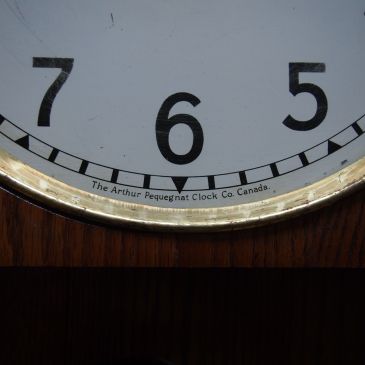
In another example my Ridgeway tall case (or grandfather clock) is one of two clocks in an entrance hallway. Unfortunately, this tall case clock is the only one I have room for. If I find another, this one would have to go. The other clock in the entrance hallway is an Arthur Pequegnat Canadian Time wall clock seen here.

RS Pequegnat
Arthur Pequegnat Canadian Time clock
RS AP repaired_5
Arthur Pequegnat Brandon schoolhouse clock

This schoolhouse clock is on the second floor of my home. We have a very simple rule; no striking clocks on the second floor for obvious reasons. The sound of a striking clock tends to keep some folks awake.

This U.M. Muller time and strike wall clock is our go-to kitchen clock.

RS Kitchen clock
U M Muller wall clock

And finally here is a Mauthe Westminster chime mantel clock appropriately placed on top of a 1947 Stromberg Carlson console radio in our dining room.

RS Mauthe mantle clock (28)
Mauthe mantel clock

It does not take much to carefully place clocks in the home but it does require some amount of thoughtfulness, care and attention. Let me know what you think about arranging your collection.

Clock collectors understand the importance of presentation when displaying their collection. While it’s generally recommended to avoid placing multiple clocks in one location, some collectors choose to showcase their entire collection together. In such cases, grouping the clocks based on maker, style, type, vintage/age, or country of origin can create a cohesive and visually appealing arrangement. Thoughtful and well-planned presentations with a distinct theme running through them tend to be more successful than haphazard and confusing displays.

It’s common for collectors to set limits on the number of clocks displayed and running at any given time. Some clocks may be allowed to stop for a “break” while others continue to run continuously. Occasionally changing the location of clocks can add variety, but it’s important to consider the sensitivity of certain clocks to being moved.

For example, in one photo, there are three prominently displayed clocks in a large room, including a 2-weight Gustav Becker clock from 1902, a Seth Thomas round-top cottage clock, and an Ansonia short drop octagon clock. The arrangement allows the clocks to command attention without overcrowding the space.

Another option is to confine the collection to one room, while others prefer to have clocks distributed throughout the house. The choice depends on personal preference and the tolerance of one’s partner.

In an entrance hallway, the Ridgeway tall case clock shares space with an Arthur Pequegnat Canadian Time wall clock. The limitations of the hallway restrict the number of clocks displayed.

A schoolhouse clock is placed on the second floor, following the rule of avoiding striking clocks in upper-level rooms to prevent disturbing sleep.

The kitchen features a U.M. Muller time and strike wall clock, which serves as a reliable timepiece for the household.

Lastly, a Mauthe Westminster chime mantel clock sits atop a 1947 Stromberg Carlson console radio in the dining room, adding a touch of elegance to the space.

Arranging a clock collection requires thoughtful consideration, care, and attention. It’s essential to find a balance between showcasing the clocks and maintaining a visually pleasing and harmonious environment. Each placement decision contributes to the overall aesthetic and impact of the collection within the home.

Why you should visit a clock museum

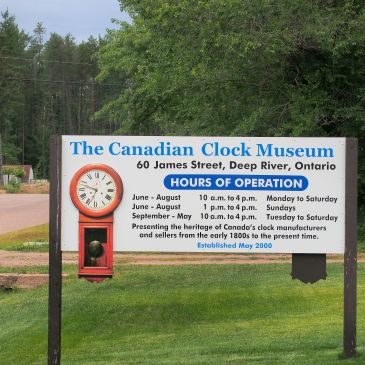
Every museum I have ever been to has allowed me to walk away with the feeling that I have learned something new. All museums document interesting histories that are intended to educate and inspire visitors. The Canadian Clock Museum at 60 James Street, Deep River, Ontario, operated by curator Allan Symons is one such example.

RS outside shots (2)
The Canadian Clock Museum

The Canadian Clock Museum in Deep River, Ontario is a 2 1/2 hour drive from the nation’s capital, Ottawa, Ontario. I have visited it twice and I found myself learning even more on my second tour. It has a fascinating collection of clocks that are largely from North America. However, it has the most extensive collection of Arthur Pequegnat clocks that I know of outside a private collection.

RS Pequegnat mantel clocks (3)
A collection of Pequegnat mantel clocks found at the museum

The Arthur Pequegnat Clock Company made clocks in Kitchener, Ontario (called Berlin, Ontario up to 1917) to 1941 when the company ceased production. Pequegnat clocks were wholly made in Canada while their counterparts built and assembled cases in Canada and imported movements from the US, England, France and Germany. The Canada Clock Company and Hamilton Clock Company had a 12 year span also made both cases and movements but not at the volume of Arthur Pequegnat.

I have written about Arthur Pequegnat clocks in previous posts and I have been slowly building a modest collection for myself.

RS Prince of Wales Canada Clock Co (2)
Prince of Wales parlour clock, Canada Clock Company circa 1880
RS pequegnat tall case clocks
Three tall case Arthur Pequegnat clocks

Many manufacturers are represented at this museum and even if you have only a passing interest in clocks you would no doubt find the displays both interesting and thought provoking. Companies represented are the Western Clock Company, Walter Clocks, the Snider Clock Corporation, Seth Thomas that operated a factory in Peterborough from the 1930’s to the 80’s, Breslin Industries, the Hammond Company of Canada Ltd to name just a few. Canadian Clock Maker Martin Cheney who briefly made high quality wall and floor clocks in Montreal in the early 1800’s is not represented, unfortunately.

Twiss long case clock
Twiss tall case early 1800’s

There are even some special clocks such as this Synchronome electrical impulse master clock from the 1930’s.

OLYMPUS DIGITAL CAMERA
Master clock mechanism
Clock
Master clock with slave clock at top

So, spend time at the museum talking to its knowledgeable curator or avail yourself of the manuals and documents at hand and conduct your own research into a specific clock.

This museum is modest by museum standards and not quite up to the scope and scale of the National Association of Watch and Clock Collectors Museum located in Columbia, Penn, USA but don’t let its compact size fool you. There is plenty to see.

If you have any interest in clocks I strongly urge you visit this one if you are at or near the Deep River area. Outside Canada? I encourage you to seek out clock museums in your own country and take the time to understand the history of clocks from around the world. Its about time!

What is my clock worth?

Every clock owner wants to know what their clock is worth and every clock seller wants to know what price they can ask for. This article will provide a guide to buying or selling an antique or vintage clock.

I will attempt to answer the following questions beginning with comments about the unpredictable clock market.

  • What factors are considered when assessing the value of a clock?
    • Is it original?
    • What type or style of clock is it?
    • Does the clock have a label, trademark, or prominent name?
    • Is it from the correct period or is it a “knock-off” or “re-issue”?
    • Does the clock have provenance?
    • What is the age and condition?
    • Is the clock collectible?
    • What is the mechanism type?
  • It all comes down to research

The unpredictable clock market

Unfortunately, in this unpredictable market, it is almost impossible to determine the value of a clock. What you think your clock may be worth today may not align with what the experts say and what others are willing to pay. What has value today may not have value tomorrow. Many factors influence the buying and selling of clocks and the clock market can be a battlefield with many casualties.

Recently, I saw a mid-1990s Howard Miller grandfather clock listed for sale on a Facebook site. I tracked the ad over the course of several days. The owner originally wanted $3000 but later stated they would take “no less than $1500” when it became obvious to them that the ad was not attracting attention. Personal value tends to be subjective and while the owner might have paid $3000 or more for a beautifully carved oak grandfather clock, its present value is not anywhere near what he thinks it is worth. I stopped following the ad but the seller likely withdrew it from sale.

Even an appraised value is the subjective opinion of an expert assessment based on condition and collectibility which is always subject to shifts in the market. My Ridgeway grandfather clock is in excellent condition, runs well, and has a command presence in my home but it is not worth much in today’s market.

Ridgeway Grandfather clock, Hamilton Country

What factors are considered when assessing the value of a clock?

Is it original? Original clocks attract buyers. The value of a clock decreases if some or many parts have been changed out. Determining whether or not a clock is original can often be difficult to determine unless viewed by an expert. The many “Vienna Regulator” clocks found on eBay and other online for-sale sites are missing parts, have had parts added such as crowns, finials, dial faces, hands, and even movements, and have weights that are not original to the clock. Back in the 1960s, many Vienna Regulators came to America in wooden crates consisting of loose movements and cases which were then married, assembled, and sold.

Would you expect a 100% original clock when the seller suggests that it is complete and original while at the same time admitting that they know nothing about clocks? Reputable auction houses have more accurate descriptions of the clocks they offer for sale when they describe condition and state if parts are missing or questionable. Moreover, they do not exaggerate the condition of a clock if they value their reputation.

Check out this article on my experience with a clock that did not have original parts
OLYMPUS DIGITAL CAMERA
Gustav Becker 2 weight regulator clock. It looks good but many parts have been replaced over the years.

What type or style of clock is it? Many mantel clocks in my collection are worth almost nothing since thousands were made and few good ones have survived. That said, some American mantel clocks are desirable and command high prices such as the Patti line of clocks from E N Welch or Sonora clocks from Seth Thomas. An 18th-century English bracket clock, an ornate French Cartel clock, or an American jeweler’s regulator are styles and types that are sought after by collectors and have retained their value over the years. On the other hand, tall-case or grandfather clocks, some as old as 200 years, can be had for a fraction of their value. Wall clocks tend to command higher prices than mantel clocks.

Does the clock have a label, trademark, or prominent name? Clocks that have an identifying label or trademark are more desirable than those that do not. Collectors often ask if the label is intact or if the movement is marked. Replacement labels are frowned upon by collectors and unmarked movements are less desirable as they may be replacements. Clocks made by prominent clock-makers add value. Old English bracket clocks with subsidiary dials, made by prominent clockmakers come to mind. A marked E. Howard or an authentic Willard banjo clock has more value than an un-named/unmarked clock similar in style and age.

RS Pequegnat fan top (8)
The rear panel of an Arthur Pequegnat kitchen clock showing the label

Is it from the correct period or a “knock-off”? Is it original or a reproduction? There are excellent examples of reproduction wall clocks that look very much like period clocks from the early 1900s that are no more than 30-40 years old. Seth Thomas made a reissue of the iconic Regulator #2 in the 1970s which is not as desirable as the original #2. Often the differences are very obvious and sometimes quite subtle.

Does the clock have provenance? Does the clock have a story or does it have historical significance or can it be placed within a historical context? This Arthur Pequegnat Canadian Time clock spent most of it’s life in a train station waiting room not 30 minutes drive from my home. In the early nineties when the station was decommissioned it was purchased by a collector and was in his hands until I bought it from him about a few years ago. This is a key selling point and may add value. The history of the clock may be an important element in a sale.

OLYMPUS DIGITAL CAMERA
Canadian Time clock by Pequgnat C.1929

The Ingraham Huron shelf clock (below) had been with a Bridgewater, Nova Scotia family since the 1890s. Balloon clocks, as they are called, seldom come up for auction and are valued by collectors because of their interesting design and limited production. In the case of this clock, This model was made between 1878 to 1880.

RS April 12th
Ingraham Huron shelf clock C.1878

What is the age and condition? Many people think their clock is worth a lot of money when they see a similar clock by the same maker sell for a high price at auction. If their clock is missing case pieces, large sections of veneer, the hands are broken and so on, the value will be adversely affected. If the dial has been badly repainted or there have been poor repairs, the clock is not considered as valuable.

The age of a clock does not always mean that it has more value. A clock may be a style, or by a maker, who, regardless of age is not popular with collectors. Sperry and Shaw 4-column New York-style 30-hour clocks, while attractive, and over 125 years old, are not sought after by collectors as Sperry and Shaw, retailers rather than clock-makers, were clock merchants who used questionable assembling methods and dishonest selling practices.

Sperry & Shaw 4 column clock
172-year-old Sperry & Shaw 4 column clock

Thousands of gingerbread or kitchen clocks were made during the period 1885 to 1915. Despite their age, few have any value.

Is the clock collectible? Rare clocks are rare because few exist or rare because few owners want to sell them. OG (Ogee) clocks are clearly antiques, some more than 150 years old, but because thousands were made they are not as collectible as a one-of-a-kind 17th century English lantern clock. 30-hour Ogee clocks are also tough to sell because of the hassle of winding them every day.

Desirability is also region-specific. Of the many parlour clocks made in Canada, those made by the Hamilton Clock Company in the 1880s (Hamilton, Ontario, Canada) are very desirable by Canadian collectors. Arthur Pequegnat clocks, wall clocks, hall clocks, mantel clocks, or kitchen clocks fetch higher prices than similarly styled clocks because they are actively sought after by collectors in Canada. Outside of Canada, they are worth far less.

Martin Cheney clocks (1810) made in Montreal (Canada) are highly collectible, of exceptional quality, and are very rare. True Vienna Regulator clocks such as those from the Biedermeier period made prior to 1850 and authenticated as original are very desirable, reflect high asking prices, and are valued more than contemporary versions.

The key is research. Check eBay, reputable auction houses, local buy-and-sell sites, clock shops, antique stores and online message boards to get a feel for the range of prices and bear in mind that markets are very volatile

Cartel clocks are exceptional 18th-century French clocks and those fabricated by clock-makers such as Joseph de Saint-Germain or Duponchel à Paris command prices in the many thousands of dollars.

What is the mechanism type? Generally, three train clocks (time, strike, and chime) are mechanically more complex and are normally valued higher than two trains (time and strike) clocks. Three-weight Vienna Regulator Grande Sonnerie clocks generally command higher prices than a single or two-weight Vienna Regulator.

American clock company Sessions sold inexpensive clocks for the masses and produced many thousands. The Sessions Westminster-A tambour style clock has an unusual 2-train chime movement (chiming clocks generally have three trains) and fetch higher prices on auction sites than other Sessions mantel clocks.

Weight-driven clocks generally command higher prices than spring-driven varieties.

RS Sessions Westminster chime circa 1931 (12)
Sessions Westminster A mantel clock, C.1927

It all comes down to research

Do your research: Check eBay, reputable auction houses, your local buy-and-sell sites, clock shops, antique stores, and online message boards to get a feel for prices. Keep in mind that markets are extremely volatile. Do your homework prior to making any purchase. What may have sold for several hundred dollars years ago (30-hour Ogee clocks) are worth much less today.

Ask questions before you purchase your next clock and if you are a seller, provide an honest description of your clock and disclosures (new pendulum, new mainsprings, etc.). Chinese, Korean, and most Japanese clocks are not particularly collectible or desirable. If you firmly believe your prized Chinese-made Daniel Dakota family heirloom is worth over $150, potential buyers may not be beating down your door but a fair price of $40-50 might result in a quick sale.

Converted Daniel Dakota
This 1960s vintage Daniel Dakota wall clock is worth almost nothing

Clock prices are all over the map and we will not see a stabilization of prices any time soon. With the advent of the internet, many clocks thought to be rare have flooded the market depressing prices. The law of supply and demand applies. As demand increases, supply decreases, and prices rise. As supply increases and demand decreases, prices drop. The only constant is high-end clocks, sought after by serious collectors that have managed to retain their value. But how many of us can afford them?

Now is a good time for that special clock. There are certainly bargains to be had if you search carefully, learn as much as you can along the way, and tread lightly into the buyers arena or if you are placing a value on your clock to prepare it for sale.

The shelf clock – what is it, exactly?

What is a shelf clock? If you have a number of clocks as I do it can be quite confusing to describe each specific type to the average person but it is really quite simple. Let me explain how you can identify the clock you might be looking at. The term shelf clock is a broad category but I believe it can be classified in the following ways.

Some 180 years ago the first shelf clocks were OG (Ogee) clocks. These were the first mass-produced American clocks, were inexpensive, and were made up to about the late 1870s. They represented the early years of American clock-making and the transition from more expensively produced wood movements to cheaper brass movement clocks. OG clocks are so named because of the double-curved molding on the front of the clock. The curved molding was designed to hide the weights. Many of these clocks were weight driven with 30-hour or 8-day movements and had mirrored or painted tablets. OG clocks were usually 25 inches in height and 15 inches wide and had hardwood veneers covering a softwood frame. They were surprisingly accurate and reliable.

Clocks
Spring-driven and weight driven 30 hour OG (Ogee) clocks, made by the Canada Clock Company, circa 1872-76 (Canadian Clock Museum)

Later, more stylish clocks could be found. These are called Column clocks because they would either have a half-column or full column on the left and right or even stacked half or full columns such as the one pictured below. Moldings on the top and bottom would be brought together by columns on each side of the clock with mirrored or painted tablets. Column clocks were almost exclusively weight driven with 30-hour or 8-day movements.

Column clock
Stacked Column clock, circa 1870 (Canadian Clock Museum)

At around 1840 Steeple clocks were introduced. They had a peaked centre section bordered by columns topped with finials and a peaked sash with a decorated (often hand-painted) lower tablet. They were spring driven with 8-day movements. Steeple clocks are very distinctive, stood about 15 inches high with veneered hardwood over softwood, often with reverse-painted scenes and are made by a number of well-known companies.

RS on display
Arthur Pequegnat Maple Leaf “fan top” Kitchen clock, circa 1905

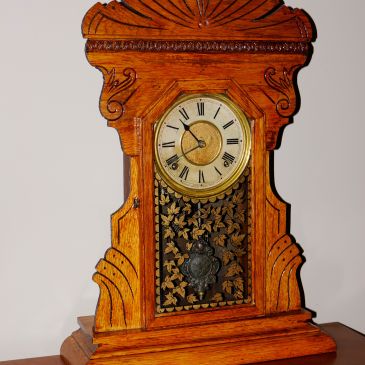
Kitchen clocks (Gingerbread) were simple or ornate with carved or steam-pressed patterns made by quick-saws and heavy steel presses, stood 22-24 inches in height and about 15 inches wide, and had a decorated sash which could be a very simple design as you see here or a much fancier reverse-painted glass scene. These inexpensive, visually pleasing timepieces sat in the kitchens of lower and middle-class homes and were produced by the thousands. They were so named because of their likeness to the design of gingerbread houses at the time (early 1900s). They are usually made of oak, walnut or even walnut trimmings on oak with a metal clock face and many had a simple alarm mechanism. The Gingerbread clock you see here is the Maple Leaf “fan top” by Arthur Pequegnat. The Maple Leaf came in 4 unique styles all characterized by the maple leaf decal on the glass door.

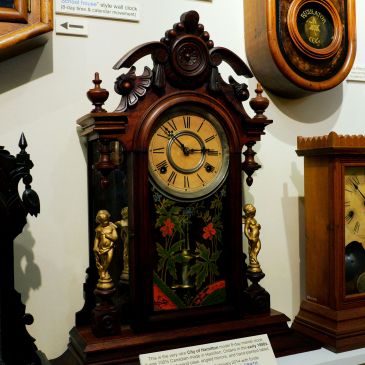
Some kitchen clocks had beautifully carved features and figurines such as this stunning clock made by the Hamilton Clock Company (Canada), though a clock such as this might be found elsewhere in the home and considered a parlor clock.

RS City of Hamilton Canada Clock Co
City of Hamilton, made by the Hamilton Clock Company, circa 1880 (Canadian Clock Museum)

When spring-driven clocks were introduced the Parlor clocks like this Hamilton Clock Company model became popular. They tended to be narrower than column clocks because they had spring-driven movements. These clocks mirrored the furniture styles of the time. This one reflected the Victorian era with its bold figurines, carved finials, elaborate patterns etched into its wooden frame, and the hand-painted floral design of the sash.

RS 45-175
Seth Thomas round top cottage clock, circa 1930

Cottage clocks are less than 15 inches high and typically 8 inches wide are small, simple in design, and take up very little space. Many have basic alarm mechanisms but have one feature that distinguishes them from other pendulum clocks. They have a clip or a clasp that secures the pendulum rod for travel. The “round top” you see here was sold by Henry Birks and Sons an upscale Canadian jeweler. Others had “beehive” tops, flat tops, or octagon tops.

Pendulum rod clip
Pendulum rod clip for Seth Thomas round top

Smaller clocks are often referred to as desk clocks. They are usually mainspring driven with a flat dial. This Kundo 400-day anniversary German clock is an example of a desk clock but it might also be described more specifically as a torsion clock. This one stands less than ten inches tall and has a glass dome, a weighted wheel with 4 balls suspended by a ribbon called a torsion spring, and an exposed movement. It was typically given as a wedding gift.

RS Kundo
Kundo 400 day anniversary clock, circa 1970

Finally, the mantel clock.

Mantel clocks can be ornate, larger, and the centerpiece in a room. This particular clock, a Mauthe pendulum mantel clock offers a precision-built sophisticated German Westminster chime movement in a relatively non-descript but attractive and well-built cabinet that is simple yet elegant.

RS Mauthe mantle clock (30)
Mauthe time. strike and chime, circa 1970

ASIDE: Is it mantel or mantle? I have always considered a mantle as something you wear, a garment or a part of the earth’s crust. A mantel on the other hand is a shelf above, say, a fireplace. I see this word interchanged so often when clocks are advertised or described that either word is universally accepted. I prefer the word “mantel”.

RS April 12th
Ingraham Huron shelf clock, circa 1878

Mantel clocks were inexpensive to make, occupied very little space, and were part decoration and part practical timepieces. Mantel clocks were made with brass, wood, porcelain, slate, Bakelite, and metal though for the most part they were designed to be lightweight (slate clocks and cast iron clocks would be the exception), simple in basic design, and very practical. Mantel clocks have lasted so long, over two centuries, because they are dependable, versatile, and work so well in many domestic situations.

The categories of shelf clocks also include carriage clocks and lantern clocks. One of the first clocks whose movement and external structure was made predominantly from brass instead of iron or wood was the lantern clock. Although the shape of the clock looks somewhat like a lantern, the derivation of the name probably stems from the French word “laiton”, meaning brass. The earliest lantern clocks had striking mechanisms; later in the 17th-century alarms were sometimes added. Some lantern clocks had pendulums and could be hung on the wall.

Carriage clocks were spring-driven clocks developed in 19th century France and are made of plain or gilt brass. They are often no more than 8 inches tall, designed to be portable, and are characterized by a rectangular shape, glass or porcelain panels, and a carrying handle on the top. If you have a Breguet carriage clock as part of your collection you are very lucky indeed!

This is by no means an exhaustive description of the types of shelf clocks. There are others such as swinging clocks, tambour clocks, pillar and scroll, and so on. Whether you are shopping for a clock as a gift or adding one to your collection or even describing what you have seen to a friend, it is important to understand the distinctions between one type and another.

Clock Repair Tools

RS Brandon
Arthur Pequegnat Brandon time only wall clock

It is time to buy the tools I need for clock repair. I already have a number of basic tools to get me started; pliers, letdown chucks, screwdrivers, etc.

However, my first significant tool is an Ollie Baker Mainspring Winder which arrived from the USA today. It is pictured below. The Ollie Baker comes with an assortment of collars for every size of mainspring.

Olie Baker spring winder

The spring winder will enable me to inspect, clean, and re-install barreled or open springs on all the clocks I will be servicing. My first impression is that it is a robust and well-machined tool that will give years of service. Indeed, one of the most important tools for clock repair enthusiasts is the spring-winder.

I also ordered bushing kit #5488 from Perrins today which will enable me to have the bushings I need in order to use the Bergeon Bushing Machine that I will purchase later on this year.

The Bergeon Bushing tool is “Swiss made” and exudes quality. In every clock, due to considerable wear, the plates have to be bushed from time to time. This tool allows the bushing of plates of various sizes. The kit includes driving punches, centering bit, stakes, and reamers.  I can bush by hand which some folks do by using appropriate reamers and files but I know that a bushing machine is a must-have. The first photo shows a clock movement that I had professionally bushed. It required 5 bushings in all in addition to cleaning and oiling and it runs very well.

With these tools, I can progress more seriously into this most interesting hobby.

Maple Leaf clock is sent off for repairs

RS Complete so far and on display (1)
The case is about 90% restored

December 18th marks the day that my Arthur Pequegnat Maple Leaf fan-top is off to repair.

Sadly this is a repair that I cannot perform myself at this stage of my learning. The problem is essentially a clutch plate off the centre arbor that is not engaging the gear for the strike side. The result is that the hour and minute hand do not move at all thus the centre arbor is quite loose. In the meantime I might as well have some bushing work and a thorough cleaning done.

Typically gingerbread clocks go for almost nothing on the for-sale sites. The fact that this is a Pequegnat means something special however and in my view it is worth preserving for years to come.

Here is the problem area.

view of the clutch cup on the centre arbour
Clutch cup is loose

Although it is difficult to visualize from this photo, the cup clutch plate is very loose and needs to be reattached to allow a firm connection to the gear beneath. As such I am prepared to put a little money into this clock and keep it in my collection.

Maple Leaf case restoration Part 2

I have had this Arthur Pequegnat Maple Leaf fan-top clock for several weeks now and have decided to keep it in my collection. I was not satisfied with the condition of the case when I first saw it and knew that something had to be done. After several hours of work on the case I can finally say that the results have been very good…not excellent because there are one or two things I would have done differently. For example, I originally used a cotton cloth to bring down the finish and ended up rubbing too aggressively in some sections. Looking back I would use 0000 steel wool from start to finish.

This shot is a comparison between the original finish and taken after hours of restoration.

RS Pequegnat fan top (6)
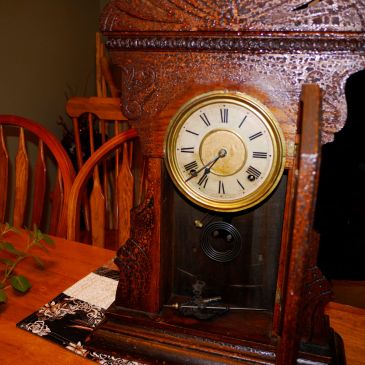
Condition of clock when first brought home

RS fantop
After hours of rubbing and scrubbing

As you can see in the second photo the oak grain is natural and pronounced; the mottling has disappeared. As mentioned there were one or two spots where I was a little too aggressive with the steel wool which I may address later on but for the moment I am going to live with it.

I applied four coats of Amber Shellac and between coats I rubbed the finish with 0000 steel wool. Shellac is the proper approach for case restoration as that product would have been used at that time. The clock now looks very close to what it would have looked like at the time it was made which would be about 1910. The next photo shows the clock fully re-assembled and on display and the next, how it looked when I brought it home.

RS on display
Ready to be brought to the clock shop for repair

RS Pequegnat fan top (3)
Just brought home

Although I am able to dis-assemble, clean and oil a clock mechanism there is a problem with the center arbor not engaging the strike side of the clock. It is off to Doctor Clock in Halifax for repair and cleaning of the movement.

Maple Leaf case restoration Part 1

RS Pequegnat fan top (3)
The clock had just arrived

Although my newest Arthur Pequegnat kitchen clock was complete in every way the case looked like something pretty dire happened to the finish.

I mentioned before that the clock was likely in a very warm environment for a long period (an attic perhaps) and while there are no cracks or breaks in the wood there was a lot of what I called mottling. RS Pequegnat fan top (6)

What you see in the first photo is the condition of the case when I first got it. Some might like it that way, I don’t. The seller thought it added “character”. Hmm!

I sought some advice on the NAWCC forum site by asking a few questions and was informed that a member had put together a recipe for this kind of situation. The recipe included turpentine, alcohol, vinegar, boiled linseed oil and 000 steel wool. I found that it worked to a point but the mottling was quite pronounced and I finally had to resort to lacquer thinner and steel wool to take the stubborn stuff off.

OLYMPUS DIGITAL CAMERA
Ingredients for restoration

In some small spots I made the mistake of rubbing too enthusiastically and got down down to the bare wood but I will cover those areas later with tinted shellac a wood covering which was used at the time (circa 1910).

OLYMPUS DIGITAL CAMERA
One step closer to the finished product

The photos might show the case as darker than it is but it is a golden oak which will be close to the final product . I may have to do a little research on shellac from this point onward but I will report on my findings. Thus far a lot of the grunt work has been done.

This is taken at the final stage after the first treatment with steel wool and lacquer thinner and the mixture described above. As you can see the case has undergone a dramatic change although it is far from finished. The carved detailing is also beginning to show through.

OLYMPUS DIGITAL CAMERA
Door is reattached and first stage is complete

Any suggestions or advice would be appreciated.

Arthur Pequegnat Maple Leaf Kitchen Clock

In November 2015, I added an Arthur Pequegnat Maple Leaf “fan top” to my collection. The clock was advertised as non-running, and the seller’s description was accurate—it had its share of challenges. While gingerbread-style kitchen clocks don’t typically appeal to me, I felt that, as a Canadian, if I were to own one, it should be a Pequegnat.

This clock dates back to the Berlin era (before 1917, when Berlin was renamed Kitchener, Ontario) and features the signature nickel-plated steel plates with brass bushings, characteristic of most time-and-strike Pequegnat clocks.

RS Pequegnat fan top (3)
Arthur Pequegnat Maple Leaf Kitchen Clock

The clock is complete with its Maple Leaf bob, an original untouched dial, most of its label, and a remarkably well-preserved maple leaf decal on the front glass.

RS Pequegnat fan top (8)
Berlin Ontario label, mostly intact
RS Pequegnat fan top (18)
Maple Leaf bob
RS Pequegnat fan top (15)
Maple Leaf decal

I managed to get the clock in beat by adjusting the verge, but the minute arbor is quite loose, causing the minute and hour hands to stay stationary. Instead of attempting a full repair on my own, I’m considering having the clock professionally serviced. In the meantime, I plan to remove the movement from the case to examine the issue further. It could be a simple fix—or something more complex.

RS Pequegnat fan top (5)
The mottled finish on the entire case

The case poses another challenge. While it has no chips, cracks, or missing pieces, the seller believed the mottled finish added character. I strongly disagree—it’s far from appealing.

To gather restoration ideas, I shared this clock on the NAWCC forum site. Although the finish might be original, it appears the clock was stored in a hot environment, causing the finish to degrade. As one forum member explained, “The case was likely subjected to heat (stored in the attic), and the shellac finish has melted into the alligatored appearance you see now.” When shellac softens, it attracts airborne dirt, further compromising the surface.

Although I’m capable of refinishing the case, the movement also requires repair. After inspecting it, I’ve realized the cost of professional repairs is currently beyond my budget. However, I plan to educate myself on servicing antique clocks and intend to handle the repairs myself.

Arthur Pequegnat Canadian Time wall clock

The Canadian Time clock was produced by the Arthur Pequegnat Clock Company, which holds a special place in Canadian horological history. Founded in 1904, the company became the longest-lasting Canadian-based clock manufacturer, operating until 1941. Pequegnat clocks are known for their solid craftsmanship and distinctive designs, contributing significantly to the Canadian clock-making industry during the early 20th century.

Arthur Pequegnat, originally from Switzerland, brought his expertise in clockmaking to Canada, where he established a reputation for high-quality clocks. The company manufactured a wide range of clocks, from wall clocks to mantel clocks, many of which are now highly prized by collectors for their durability and unique aesthetic. Despite the challenges of competing with larger international clock manufacturers, Pequegnat’s attention to detail and commitment to quality ensured the company’s success for several decades.

Today, Pequegnat clocks are considered a piece of Canadian history, and the company’s legacy endures through the ongoing interest of collectors and enthusiasts, like myself, who appreciate the skill and craftsmanship of these antique clocks.

Pequegnat wall clock
Canadian Time clock by Arthur Pequegnat

This particular clock was made after 1916 in Kitchener, Ontario, Canada. Clocks made before 1917 were marked “Berlin” on the dial face. The town was known as Berlin from 1854 until 1912 and became the City of Berlin from 1912 until 1916. Due to the negative association with Germany during the First World War, the decision was made to change the name to Kitchener midway through the war. Today, Kitchener serves as the seat of the Regional Municipality of Waterloo, Ontario.

OLYMPUS DIGITAL CAMERA
Label affixed to back of clock

Unfortunately, the exact year my clock was manufactured is unknown as Pequegnat did not date-stamp their movements, but the Canadian Time series was produced up until 1941. By that year, the demand for brass from World War II armament makers, a crucial material for clock movements, forced the Arthur Pequegnat company to halt production. If the clock was made as late as 1941, it would be 72 years old.

OLYMPUS DIGITAL CAMERA
Checking on condition of the clock

This clock features Arabic numerals, which was less common since most were ordered with Roman numerals. As a railway clock, the use of Arabic numbers would have made it easier to read for the general public in a train station. The manufacturer allowed customers to choose between Arabic or Roman numerals when ordering. Additionally, buyers could also opt for a version of this clock with time, strike, and calendar functions.

OLYMPUS DIGITAL CAMERA
The Crossed horseshoes were likely added by a previous owner

The crossed horseshoes on the base of a clock are often associated with good luck and protection. In many cultures, horseshoes are considered symbols of good fortune, particularly when they are displayed with the open end facing upward, which is thought to catch and hold luck. I have not seen another Canadian Time clock with crossed horseshoes.

OLYMPUS DIGITAL CAMERA
On prominent display in my home

I’m hoping to track down a photo of the clock from its time at the Pictou, Nova Scotia train station before it was decommissioned in the early 1990s, as that could really help narrow down the clock’s manufacturing date.

The clock itself is quite large, measuring 37 inches high, 5 inches deep, and 15 inches wide. It’s made of quarter-sawn oak, which results in boards with annual rings mostly perpendicular to the face, providing greater stability and minimizing warping.

The Canadian Time clock is a reliable timepiece, showcasing the quality and craftsmanship that went into its creation.

Arthur Pequegnat Regulator #1

One of the clocks that I would like to add to my collection is the Arthur Pequegnat Regulator #1, single weight 8-day time only clock. A rare clock indeed and prices of the few I have seen are on the high side. Too rich for me at his time.

The company distinguished itself as a competitor for some of the better American wall clocks such as those made by Seth Thomas. Their wall clocks often looked like models made by Seth Thomas but some of their designs were unique. For their wooden cases, they favored the heart wood of quarter-sawn white oak that showed off beautiful ray flecks.

The regulator #1 is often compared to the Seth Thomas Regulator #2. Thousands of Seth Thomas Regulator #2s found their way into offices and rail stations all across America. The Arthur Pequegnat Regulator #1, though not as prolific, served the needs of many businesses in Canada. The clock is highly collectible in Canada and will command twice the price of similarly styled clocks by well-known American counterparts.

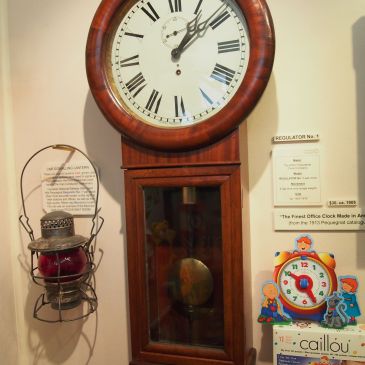
This photo of the Regulator #1 was taken at the Canadian Clock Museum in Deep River Ontario in 2013.

The Arthur Pequegnat clock company had an illustrious albeit short life. Watchmaker Arthur Pequegnat was born in Switzerland in 1851. Arthur immigrated to Berlin, Ontario Canada in 1874 with his wife, parents, brothers and sisters; a grand total of 18 family members.

By the late 1870’s Arthur was operating a jewelry store and watch repair in Southern Ontario. By the middle 1880’s Arthur and his brother Paul were operating a shop in Berlin, Ontario. After about ten years the brothers went their own way, both operating successful jewelry shops in Southern Ontario.

In 1897 Arthur expanded his Berlin Jewelry shop to include the manufacture of Bicycles. However, By 1904, with the decrease in the demand for Bicycles, Arthur began to re-focus on the clock industry, by manufacturing his own clock movements at his Berlin Bicycle Manufacturing plant. At first the wooden clock cases were made by local Furniture Makers, however in time he manufactured his own clock cases.

Berlin, Ontario was re-named Kitchener Ontario in 1916, due to anti-German backlash during WW I. The date becomes a useful tool when determining the age of Pequegnat clocks, Movements or Dials marked “Berlin” date the clock to 1916 or earlier and those marked “Kitchener” are 1916 or later. Since many clocks had a long production life it is difficult to date any Arthur Pequegnat clock with precision.

Regulator #1, hanging in the Macdonald Museum in Middleton, Nova Scotia, Canada

Arthur died in 1927, however, with family members in control, the company continued to operate until 1941. The war effort meant that brass became difficult to obtain and the company shut its doors. The factory never produced another clock, and was demolished in 1964. All that remains in Kitchener today is a plaque commemorating this great clock manufacturer.

MacDonald Museum main exhibit area

The Canadian Clock museum contains the largest collection of Arthur Pequegnat clocks in Canada and it is certainly worth a visit. The Macdonald Museum in Middleton, Nova Scotia has a modest collection of Pequegnat and is worth visiting if you are traveling through the province of Nova Scotia.

Website Powered by WordPress.com.

Up ↑