In some clocks, not all, and particularly wall clocks you will find a little plaque just below the pendulum and affixed to the back panel. this is called a beat plaque or beat scale indicator.
Having a beat scale on your clock does not necessarily mean that you have a valuable clock as most were decorative but they do have a function.
Seth Thomas #2 with beat scale just under the weight
In theory, the pendulum should align to the beat scale. The amplitude of the pendulum should also reveal the health of the movement. Most beat scales have I and II markers on each side of the scale. When the pendulum swings it should swing beyond the number I marker and close to the II. Having very little amplitude means investigating the movement, making pallet adjustments if necessary, or mitigating any wear issues.
Mauthe Horse Crown with beat scale
A beat scale as in some high-tech clocks assumes several things; the beat scale is original to the clock, the beat scale was applied dead center, the beat scale was never removed, the case of the clock has never gone through any environmental changes (warping, high humidity, etc.), the pendulum rod and bob have never gone through the same type of environmental changes as described above, the movement, pendulum, and bob have never required any repairs or maintenance that could adversely affect the dead center between the beat scale and the pendulum, and most importantly, and the beat scale was originally designed and manufactured as a high-tech object.
Having said that, certain very high-quality clocks were produced without a beat scale, were produced with a beat scale as a guide, and, to some extent, as a decorative item.
Inflation seems to be everywhere. The continuing decline in purchasing power is reflected in increased prices on almost everything.
The other day my wife and I bought a container of spray from a garden store. We thought the price was high at almost $25 but when we got to the cash, the clerk charged us $6 more. We showed her the sticker price and she said it was old stock and the computer had already adjusted the price for the new stock coming in. I understand supply chain issues and rising fuel costs but a 25% increase is a bit much. We argued and did not pay the extra $6. Needless to say we will not be buying that product again.
Everything seems to have risen in price as a result of inflation except perhaps antique and vintage clocks!
I don’t actively pursue high end clocks so, there could be movement price-wise for rare and highly collectible clocks but not for garden variety antique clocks. This completely anecdotal but I have been observing the clock market for some time and I do not see a lot of change in prices and if you are into buying and selling clocks this is not a great time to make a profit. Perhaps one day in the future but I believe that day is far off.
$12 cottage clock, unrestored
So, it has been a buyer’s market for the last number of years and it doesn’t look like things will change any time soon. There are many great bargains to be found everywhere and it doesn’t take much looking.
$40 Chauncey Jerome 30-hour ogee
Antique and vintage clocks have flooded the market in the past several years with prices tumbling even further downwards. The new generation of millennials have little interest in antiques and find it pointless to collect antique and vintage clocks. Their loss is our gain, meaning those of us who appreciate the finer things in life.
In addition, modern homes do not have the room for clocks as floor and wall space is limited. In an age when families are living in 800 square foot apartments space is at a premium though there is a hint that things could change as the migration from dense cities to smaller communities continues.
When space is at a premium grandfather clocks or any clock occupying floor or wall space are not items many would consider as necessary for the modern family home. Sentimental reasons aside, the cost of servicing far exceeds the value if the desire is to have a working clock.
$75 Junghans Crispi wall clock
Of course, I don’t have a crystal ball but judging from prices in the past few years I can comfortably predict that things will continue to be much the same this year and next. I do not expect a significant change in the months to come and that $20 bargain clock you discovered today at a flea market will not be worth much more next year.
It is a buyer’s market and there are some terrific bargains out there. Knowledge is power and no doubt there are some great clocks to be found but shop carefully and do your research.
A goggle search of Hamilton Clock Co. might lead you to the Hamilton Watch Co. or vintage 1980s German or Chinese made clocks with the Hamilton label. Your search may very well yield even more results.
In any event, it is none of the above.
I have I have six other 30-hour ogee clocks in my collection but none are Canadian. This, the seventh, will be the first home grown ogee clock in my collection.
Hamilton Clock Co. 30-hour time and strike ogee
The Hamilton Clock Company and made clocks in Hamilton, Ontario. The company was born out of the Canada Clock Company of Whitby, Ontario that was originally founded in 1872. The Hamilton Clock Company opened its doors in 1876 but did not last 4 years and went out of business in1880.
When the company closed its doors several Hamilton businessmen were anxious to form a new company and resume operations. The new company was known as the Canada Clock Company and began operations in January 1881 but 4 years later in 1885 the end came and with it the end of clock-making in Canada until 1903 when Arthur Pequegnat built a factory in Kitchener (then Berlin), Ontario to bring Canadian-made clocks to the masses.
Collectors of these clocks often refer to the second Canada Clock Company as Canada Clock Co. II. They were three distinct companies although collectors tend to group them together for simplicity. The Hamilton Clock Company and Canada Clock Co. II shared the same factory and the same clock making equipment.
Well preserved label on inside back panel
The movements were made in Canada though they were essentially copies of American movements, most notably those manufactured by the Waterbury Clock Company. Case styles were also “borrowed” from Waterbury, Ansonia and New Haven. Made in Canada, yes, original designs, no!
The ogee featured here is almost exactly the same dimensions as a typical American ogee of the time. The brass movement is a 30-hour time and strike with brass nuts to hold the plates. The movement measures 4.59″ X 3.56″.
I will be servicing the movement and addressing any wear issues but I ran it for a few days and all looks good. The case requires some work. There are a number of areas that will require new veneer. I believe the wood is mahogany and I have an old ogee case that should provide the veneer I need. I have a very busy summer so, it will be a fall project.
The example is a Fleet time and strike mantel clock from the 1930s. Fleet Time Company of Montreal, a company that was operating four short years, sourced movements from Germany prior to the Second World War. It was a very common mantel clock sold through department stores across Canada.
I like the step side design and the general simplicity of the clock.
Fleet Time case, refinished
The case was in need of refreshing but the movement looked to be in reasonably good condition and required a good cleaning and I was expecting some wear.
The movement was completely serviced with several new bushings installed. The mainsprings were removed, cleaned, and returned to their barrels.
Fleet time movement
In this movement, the mainsprings can be removed without disassembling the movement, handy for such things as replacing a broken mainspring assuming, of course that nothing else has been damaged.
During the testing phase, the mainsprings were partially wound. The intent was to see if the clock would run well. Once satisfied that the movement was running as it should I returned it to its case.
I wound the strike side fully and then wound the time side. Just as I was feeling resistance, CLUNK, the arbour turned freely. If it was a broken click or broken mainspring, either one could easily be replaced.
It has nothing to do with the force of winding a movement. Having a mainspring go bad with winding force from a key is rare, in my view.
But mainspring barrel teeth do not simply fall off.
Fleet time barrel
At times it is a mainspring but sometimes something far worse occurs.
It is not uncommon to find secondary damage to the movement, secondary or collateral damage due to the extreme shock that broke or bent the teeth and teeth cannot be straightened.
The main problem area beyond the barrel itself will be the second wheel and possibly the third wheel arbors, leaf pinions and pivots and/or damaged or missing teeth on the second and third wheels and bent or broken pinions.
Fleet second wheel, a bent leaf cannot be unbent
Is it fixable? Yes, but weighed against the value of the clock, it is just not worth it. It is much more cost effective to harvest parts from another movement.
Given the right equipment, it can be repaired. Once repaired a mainspring must be sourced and although the barrels may be identical, the mainsprings will likely be different.
The solution is locate a donor movement. In the meantime the clock has been put aside.
An attractive gallery clock made by the Empire Clock Co. of England was bought at auction this past spring. It has a very conventional time-only movement and as with most time-only movements there are only a few wheels to worry about when servicing. The minute and hour wheel are outside the front plate.
Empire gallery clock
The movement is rather large for a time-only movement and is well built. It is attached to a heavy steel plate that is screwed onto the front of the movement. The whole assembly mounts just under the dial. It has a very German look to it, though it is definitely English-made.
To access the movement the dial must be removed which is a relatively simple process of removing the hands and three small screws.
Hour and minute wheel
Four slotted screws secure the movement to the steel plate.
Time-only movement made by Empire
An curious feature is a cylindrical pendulum with a large rotating adjustment screw on the bottom. The pendulum clips into a two piece caddy system for easy transport.
Conventional wheel arrangement
For a fairly modern (1920s) movement I was surprised to find taper pins used to secure the plates. The spring barrel is no larger than one would ordinarily find in the average time and strike clock made in England or Germany.
As the movement was drenched in oil all the parts had to be wiped down before going into the ultrasonic cleaner.
I did not expect the plates and wheels to brightly shine after the ultrasonic but all the parts cleaned nicely just the same. After polishing the pivots and pegging out the holes the movement was assembled and tested.
After working with a number of American movements in the past months the pivots on this movement are comparatively tiny. This is not a movement one muscles to put back together, the pivots must be carefully guided into their holes.
A couple of weeks back I featured this Welch marine style wall clock. A marine clock can also refer to a ships’ bell clock. Ship’s bell time originated in sailing ship days, when the crew of a vessel was divided into Port and Starboard Watches, each on duty four hours, then off four hours. One stroke of the ship’s bell indicates the first half hour of the watch. Then an additional bell is struck for each succeeding half hour for a total of 8 bells.
E. N. Welch marine clock
This is not a ship’s bell clock. However, this is a clock that can be used at sea or in a rail car that simply tells the time. Lever and balance wheel escapement clocks are ideal for ship or train applications because pendulum clocks on do not work in those environments.
The movement was made for the E. N. Welch Clock Co. and I would date it around 1860, so, a 162 year old time-only clock with a balance wheel escapement and a seconds bit running off the second wheel.
The clock was bought at auction earlier this year.
The case is dirty but there are no veneer issues
From the photo above the case appears to be very stressed but under that grime and blackish tarnish could be a jewel of a clock.
Tarnished brass
The exterior of the clock has probably not been cleaned in decades or perhaps not at all.
In the old days folks cared for their furniture with weekly or monthly waxing/wiping/dusting or polishing of brass. That was simply the accepted practice. Items were not designed to be thrown-away and it was common to hold onto possessions as long as practicable.
This little clock has certainly been neglected over the years although there is nothing missing, the movement runs just fine and the open spade hands are likely original. Yes, it is dirty! You might call it patina and many collectors would accept the wear and tear over the years as part of the character of the clock. I take the view that it was meant to be shown and a little bit of intervention is perfectly acceptable.
I don’t have time to service the movement and it can wait till later this year but I was able to clean the case and polish the brass.
The brass took a lot of elbow grease and I am sure I went through half a bottle of Brasso but I like the final result. The case required cleaning with Murphy’s soap and one coat of traditionally prepared shellac.
Before
Since it is a 30-hour clock I doubt I will be running it much and servicing the movement can wait.
After
In the meantime I have an Empire gallery clock that I would like to service for summer cottage duty.
Tick-Talk Tuesday is about the letters and comments I have received from readers concerning clock issues, challenges faced, a clock you would profiled or advice on your particular clock concern. For those comments and questions that stump even me, I consult within my clock circles for the best possible answer
PS writes;
I have a 35+ year old Ridgeway Tall Case “Sussex” clock that was severely damaged in transit. It is my parents 35th wedding anniversary gift to themselves from back in the mid 80’s. They have both passed and I inherited it. It was shipped from Chicago to Phoenix where I live last month and when it arrived it was crushed pretty severely. All of the weights are dented and scuffed, the face is detached from the case and the case itself was all but destroyed.
Similar to the Sussex
The carrier is requiring me to get a detailed repair estimate, which I am more than happy to pay you for. The insurance on the freight was $3500.00 and was one of the highest policies available. Now they want a detailed breakdown estimate for repairs, which will likely exceed the 3500.00 it is insured for.
Can you please help me with this? And if you could, I would be happy to pay for your estimating services.
Please let me know so I know how to proceed.
My reply:
As I am not a professional appraiser all I can do is give some advice.
I am sorry to tell you that while your Sussex clock may have cost your parents $3500 in the 1980s it is worth far less today. I have a similar model in my dining room. It is in excellent condition but it is worth no more than $500CDN. They are simply not collectible and grandfather clocks generally are not sought after unless they have historical value or a special provenance. You will be paying many more times what it is worth to repair it. Although for sentimental reasons the cost may not be important.
I have two suggestions. One, take whatever money you can get from the carrier without having to justify a breakdown of the cost. The carrier is engaging in a stall technique and may not even agree with any appraisal you submit to them. In other words take the money and run.
My second suggestion is to find another Ridgeway Sussex (or similar model) and marry the best parts of the two clocks. Chances are you will have good weights, and good glass etc. from the replacement clock. A replacement Sussex (or similar model) should not cost more than $500 and may well be much cheaper. It will take some looking around but they do come up on auction or for-sale sites occasionally.
Clock face showing moon dial
I have another bit of advice. Your grandfather clock movement (the mechanical works) is at the end of or near the end of its service life. The movements in these clocks were generally designed to last about 25 years. It may last longer but it is living on borrowed time. They can be repaired ($$$) but replacing the movement is more cost effective.
Marine movements were in high demand by the 1850s as boat and rail traffic increased. The marine movement is a specific type that does not have a pendulum. Pendulum clocks do not work on a ship or train because they require a stable base. A marine clock has either a balance wheel or lever escapement and were the perfect choice at sea.
This is an E. N. Welch 30-hour marine clock.
Many makers including E.N Welch would buy ready made movements from other shops, assemble them and sell the finished product under their name.
A short history of E. N. Welch. The E. N Welch company was formed on July 6, 1864. Elisha N. Welch (1809 to 1887) had been making clocks at a factory site on East Main Street at Forestville, Conn. since taking over the bankrupt business of J. C. Brown in or about 1856.
Marine style clock by E. N. Welch
The Welch firm was well known for its handsome rosewood cases, though in 1885, with changing styles in furniture, the surviving firm began to introduce new models with solid walnut cases and discontinued some of the older rosewood veneered cases.
After the death of Elisha Welch in 1887, the firm steadily declined, selling off some of its assets and issuing new stock to raise much needed capital. In May of that year the factory was closed down and a receiver was appointed. The receiver spent nearly two years selling off stock and settling the debts of the firm. It was not until 1896 that the firm resumed production.
But the company continued to struggle, would not survive and in 1902 its assets were bought by the Sessions Clock Co.
This movement was not made by E. N. Welch but was sourced from Laporte Hubbell. There were many variations of this movement but the basic two plate layout was identical. In this particular movement the minute wheel is in the two o’clock position and there is the addition of a seconds arbour running off the second wheel just above the “maker’s” stamp. From 1857 to 1863 the E. N. Welch Co. used this 2-plate, 30 hour marine movement. The exact year? Certainly no later than 1863. (source, NAWCC Watch & Clock bulletin, Nov-Dec 2013)
Otherwise, the case is in good condition with two small veneer chips, the brass bezel is very dirty, almost black from years of grime, the dial has minor losses and the movement is running well at this point though at its fastest speed it is running slow.
The plan is to service the movement, and refresh the case. It should be a fun little project.
Won at auction this spring is a Daniel Pratt Jr. reverse ogee with splat although this one is missing the splat, the decorative piece on top of the case.
According to the label it was made in or after 1843.
It was also missing the suspension spring and pendulum rod and the wire with regulating screw for the pendulum bob.
Daniel Pratt Jr reverse ogee clock
There are a few other things that are not quite right. The green banding that frames the upper and lower glass looks a little strange and likely added later and the card stock which would have replaced either a mirror or reverse painted tablet looks out of place. The picture of a young soldier holding a sabre and an American flag looks quite old.
But it actually works and works well.
It has a time and strike 30-hour woodworks movement. Wood-works movements were introduced in American at the end of the 18th century and the high point of woodworks movement production was prior to the depression of 1837. During the depression most clock production was shut down and small companies began to consolidate into larger ones.
Wood-works movement
With the invention of the 30-hour brass movement by Noble Jerome, clock making began to boom again in 1838. Inexpensive woodworks movements continued to be made but by the mid 1840s the woodworks movement production had begun to phase out.
Count wheel on left, escape wheel in the middle
This movement works
The weight cord on the right side looks like it would let go at any time but what the heck, let’s see if this thing works. The green one for the strike side looks sturdy. I will restring the clock later.
I removed the verge and determined there was no power getting to the escape wheel. I felt underneath and although the weight had been wound to the top of the case the cord was binding on the main wheel. It took a little encouragement to bring the weight further down but the adjustment did the trick. I then fashioned a new suspension rod/spring from my supplies along with a pendulum wire, gave the pendulum a gentle push and success!
About 3 hours later as the weight on the time side was descending I noticed the cable had broken at some point and a past owner had simple tied the two ends together. I believe the knot was causing the power issue.
I had already tested the strike side and it was working perfectly.
I have one other Daniel Pratt Jr. clock in much better condition but the movement will not run for more than a few minutes. This one has a splat.
So, one Pratt with a not-so-good case and a working movement and the other with a stunning case but a non-working movement. Should I do a swap?
Daniel Pratt Jr with woodworks movement
I have never disassembled a woodworks movement in my years of clock repair and I doubt that many clock repairers have much experience with one. It is one of the few movement types I have zero experience with but I may have to bite the bullet some day because this clock will not run forever.
The past two years has been like nothing we have ever experienced in our lifetime. Things are improving day by day, folks are re-establishing their routines, the country is opening up and everything will no doubt return to normal in the months to come. Some would say we are in a “new world”?
How will future generations judge this dark period of our lives?
The lake our Shanghai-La
It is time to relax, slow down and for my wife and I that means a change of scenery as we travel to our cottage in central Canada to spend the summer season with friends and family. Our get-away plan for the summer is to relax with a few good books, do a little fishing, swimming, hiking and exchange stories with friends and neighbours over a glass (or two, or three) of wine.
Since many of my articles have been written well in advance of the summer months there will be NO interruption in blog posts through the summer months. I will continue to maintain a steady output of 7 to 9 clock blog articles per month.
An Ansonia cottage clock with the dial removed for testing and spaghetti for lunch
Keep those cards letters coming as 1960s TV variety host Dean Martin once said. There may be a slight delay returning your email inquiry or responding to blog post comments but rest assured that question(s) about your clock or comments regarding any of my posts are important to me and will be answered.
Roasting marshmallows
This blog profiles my own clock collection, the challenges of maintaining and repairing clocks, the joys of finding new and interesting vintage and antique clocks plus many articles of horological interest.
As we explore central Canada I will no doubt find interesting clocks as we scour antique stores, flea markets and junk shops. New clock stories, new repair challenges and perhaps the next major restoration project will also be part of my journey this summer.
Canadian Clock Museum, Deep River Ontario
Included will be a trip to The Canadian Clock Museum in Deep River, Ontario to discover new and interesting clocks added to their collection and chat with curator Allan Symons.
Use the search box to browse past articles and/or click “follow” to have clock articles brought to your mailbox every three to four days. I hope you enjoy reading them as much as I enjoy researching each and every article.
The National Day of Canada is observed as a statutory holiday on July 1st.
This post has nothing to with clock collecting or repair but why not take the time to celebrate Canada’s 155th birthday.
How it started
On June 20th 1868, a proclamation signed by the Governor General, Lord Monck, called upon all Her Majesty’s loving subjects throughout Canada to join in the celebration of the anniversary of the formation of the union of the British North America provinces in a federation under the name of Canada on July 1st 1867, with the passing of the British North American Act of 1867. This was when four colonies united.
Photo by Erik Mclean on Pexels.com, showing the Peace Tower on Parliament Hill
The July 1st holiday was established by statute in 1879, under the name “Dominion Day”.
It was not until 1917 that larger scale and more extravagant celebrations commenced. Remember this was during the war years (WWI) when Canada needed an event to lift it from the stresses of overseas conflict.
Since 1958, the government has arranged for an annual observance of Canada’s national day. The format provided for a Trooping the Colours ceremony, by the Ceremonial Guard on the lawn of Parliament Hill in the afternoon, a sunset ceremony in the evening followed by a mass band concert and fireworks display.
The format changed in 1968 with the addition of multicultural and professional concerts.
In 1981 celebrations with the addition of fireworks displays were held in 15 major cities across the nation.
On October 27th 1982, the year Canada’s Constitution was repatriated from Britain, July 1st which was known as “Dominion Day” became “Canada Day”.
Other than the interruption caused by the Pandemic the ceremony on the Hill has been held every year since 1958.
Happy Canada Day everyone and all the best to those of you who celebrate your country’s independence day.
I knew when I first laid eyes on the clock that it was missing something, the crown.
It’s too bad because it is very attractive Hamburg American Company or HAC 8-day time and strike mantel or parlour clock.
HAC mantel clock
The little plaque on the base references 1926 the year it was presented to a pastor in England presumably for years of faithful service. I think the clock was made a few years earlier. Back in those days clocks like this might have sat on a Merchant’s shelf for years.
The chap I bought it from said it was an English clock but I knew right away that it was German. It has that distinctive German look and style of a clock made after 1900. Since he was a clock collector he should have known by looking at the trademark on the back of the movement. Oh well!
Time and strike movement
Okay, back to the crown. I have another HAC time and strike with a crown.
HAC mantel clock
I am willing to bet that the crown on my new acquisition was either very similar or exactly like the one on a HAC I bought a year ago. It fits exactly into the slot on the top.
Now with a crown
A crown makes a difference. You can see that adding a crown transforms the clock. It made be subtle but there is a difference. The problem I have now is, should I leave on this clock or the other?
Let’s clear something up right away: I am not a “Dunkin Swish” enthusiast. If you’ve been researching the clock-collecting world for a while, you might have come across this term. If you haven’t, consider yourself lucky—it’s something best avoided at all costs.
“Dunkin Swish” (apologies to those named Duncan) refers to the practice of placing an assembled movement into a cleaning solution or an ultrasonic cleaning machine, drying it off, and then declaring it “clean.” This is the absolute worst method for cleaning a clock movement and is never a good way to clean mainsprings within their spring barrels.
Why? Only by disassembling the movement can you properly inspect parts, polish pivots, peg holes, and thoroughly remove the dirt and grime that accumulate in the small crevices of a movement—buildup that will accelerate wear over time.
There is only one method to properly clean a clock movement, and complete disassembly, which includes removing mainsprings from their barrels/arbours.
Here are the steps I always follow when cleaning clock parts.
Hermle movement parts after cleaning
In most cases, clock parts can be safely cleaned using an ultrasonic cleaning machine. However, in rare instances, when working with something very old and delicate, hand cleaning may be the only viable option.
For the purposes of this article, I will assume that most clocks you work on are standard common-place brass mechanical movement types found worldwide.
Let’s get started.
Pre-cleaning
Once I have the movement disassembled, I clean any stubborn stains and wipe off excess oil from the parts beforehand. From experience, I’ve learned that while an ultrasonic cleaner works remarkably well, it’s not a magic solution—tough stains don’t always come off easily in the cleaner.
Pre-cleaning has an additional benefit: it extends the life of the cleaning solution. The solution can be reused multiple times, but once it becomes too dirty or cloudy to see through, I dispose of it. Proper disposal can be a challenge, which is why I always opt for a non-ammoniated, biodegradable solution.
I also clean all the pivot holes with peg wood or toothpicks and remove oil from the pivots beforehand. Additionally, I wipe away excess oil and dirt from the mainsprings.
The ultrasonic cleaner
In the early days of my clock repair work, I used an inexpensive ultrasonic cleaning machine. It was adequate for small jewelry items and acceptable for clock parts, but as I could afford something better, I decided to invest in a commercial-grade product.
Ultrasonic cleaner
I came across many Chinese-made ultrasonic cleaners on Amazon and eBay. While some may have had positive experiences with these machines, and the prices are certainly appealing, I was looking for something of higher quality and with a solid warranty. I have no issue with Chinese ultrasonic machines, but I would only consider them if they offered a reliable return policy and warranty.
I chose L&Rfor two main reasons: their reputation and warranty. I get no credit for mentioning this company, but the link will allow you to explore their product line to find the right size for your needs. After four years of continuous use, my L&R cleaning machine has performed flawlessly. L&R meets all of my requirements.
L&R Quantrex Q140, 3.2L with heater
The Q140 with heater is the size I opted for. It will hold one complete movement but is a tight fit for larger movements. Its smaller size means less cleaning solution is used and quicker heat-up times.
A high-quality ultrasonic cleaner will not disappoint. While there may be other brands that are equally good or even better, you generally get what you pay for.
Using an Ultrasonic Cleaner
Ultrasonic cleaners use cavitation, generated by ultrasonic waves, to clean objects made of non-absorbent materials. Ultrasonic cleaning effectively removes dirt, grease, and other contaminants from delicate components without causing damage. Just look at how bright and shiny this 30-hour movement looks after ultrasonic cleaning. That said, achieving an absolutely shiny movement is not the goal.
30-hour movement after cleaning in Ultrasonic
Should everything go into the ultrasonic cleaner? Avoid mixing metals beyond brass and steel in the cleaner as they may react with each other. I also avoid placing anything plastic in it. Some modern clock movements with plastic or nylon gears and parts should be cleaned separately and not placed in the ultrasonic cleaner. Hammer heads made of leather should not be placed in an ultrasonic.
Use your own judgment with friction-fit parts, such as a center gear and pinion, as there is a risk of damaging them if you’re not confident they can be reassembled easily. Otherwise, disassemble as much of the movement as possible.
Choose the Right Cleaning Solution
Avoid using flammable substances such as alcohol, gasoline, or other volatile liquids. These can vaporize, potentially causing a fire or explosion, and release harmful gases into the workspace. Inhaling these toxic fumes is never safe.
Only solutions that are specifically designed for an ultrasonic cleaner should be used. Among acceptable cleaners is Polychem Deox 007 as a cleaning solution that works effectively. The mix is 5 to 1 ratio with water and it is free of odour. According to their product brochure Deox-007 is “an environmentally friendly, non-ammoniated concentrate cleaner. It is mildly alkaline for the efficient removal of oils, grease, tarnish, stains, corrosion, and oxidation from brass, bronze, copper, gold, and silver”. Once it has outlived its usefulness it can be safely dumped down the drain.
Wire basket holding an American-style movement in the ultrasonic before thesolution is added
Many cleaners have a safe fill line, typically about 1 inch from the top of the tank. Whether you’re cleaning one part or several, always ensure the solution reaches this fill line.
A stainless steel wire basket is also necessary as it is not advisable to place parts directly on the bottom of the cleaning tank. A stainless steel wire basket is necessary because placing parts directly on the bottom of the cleaning tank can cause them to become damaged. The basket keeps the parts elevated, allowing the ultrasonic waves to clean them evenly without contact with the tank surface.
Not quite dirty enough to throw away
Although I always drain the solution after each use, I understand for the sake of convenience why some repairers leave it in the tank if the ultrasonic cleaner is used daily.
No cleaning method I’m aware of is as effective at cleaning lantern pinions as an ultrasonic cleaner. The results are truly remarkable.
The Ultrasonic Session
I pre-heat the solution which involves pouring in the solution, turning on the heater, and allowing the ultrasonic to come up to temperature. It takes about 10 minutes.
Green heater switch
I typically run the ultrasonic for 20-30 minutes, which is usually sufficient for most jobs. On rare occasions, I’ve run parts through a second time.
Next is drying all the parts and this is where speed is essential. It is surprising how quickly rust forms on the steel parts. I use shop towels and for difficult locations such as lantern pinions, I use a hair dryer. Occasionally, if my wife is baking I will put the parts in the oven during its cool-down phase.
Years ago, some repairers salvaged parts from discarded hot-air popcorn machines, but I don’t see those around anymore. Additionally, in the past, some repairers designed heat boxes using a light bulb, but today’s LED bulbs run far too cool.
Sessions mainsprings are cleaned and ready to be re-installed in the movement
If you choose to place mainsprings in the ultrasonic cleaner, it’s important to dry them as quickly as possible.
There are two reasons why you might prefer to clean them by hand. First, they can be easily cleaned on a spring winder, and second, the solution will become dirty very quickly, shortening its lifespan.
Cleaning a mainspring
One could clean in phases—first the time side, then the strike side—if drying is a concern. Ultimately, it’s up to personal preference.
Using a small metal lathe to buff the Wheels
To buff the wheels using a small metal lathe, securely mount the wheel on the lathe’s spindle and gently apply an emery board to the wheel. Run the lathe at a low speed, applying light pressure to achieve a smooth, shiny finish.
Next, clean the pivots with an emery board. To clean the pivots with an emery board, lightly hold the board against the pivot while moving the emery board up and down at a low speed. Use gentle, consistent pressure to remove any grime or oxidation without altering the pivot’s shape or surface. Use a soft cloth to wipe off any excess residue from the pivots.
Polishing a pivot
Next Steps
Once everything is dry, the next phase involves any necessary bushing or pivot work, followed by reassembly and testing.
So, that’s the method I follow. If you have a different technique or additional steps that you include in your process, I’d love to hear about them.
Some years ago I had this brainy idea that I would have a trio of time zone clocks above our main computer in the kitchen so, when one of our children called, all we had to do was glance at the wall to see what local time it was in their region.
Back then we had a daughter in Victoria, British Columbia, another in Calgary, Alberta, and a son in Halifax, Nova Scotia. Our daughter has since moved to Ottawa, Ontario.
It was a great idea but not perfect.
Trio of clocks representing 3 time zones
The New Haven time and strike clock (the middle one in the photo above) was not as small as I wanted but it was all I had at the time. The New Haven clock was eventually gifted and replaced by an Ansonia time-only which was also still too large.
Ansonia time-only clock
The search was on for a third 14-inch drop octagon time-only clock to complete the trio. It did not matter who the maker was. It took a while but as luck would have I saw one on an online auction in the spring of this year.
It is a Sessions time-only drop octagon and identical in dimensions to the two others.
The trouble was I was not going to pay a reserve auction bid of $100CDN (79US, 63GBP). As much as I wanted the clock the price was too high though some of you may disagree.
It appeared to be in very good condition judging from the auction photos and there was nothing much wrong with it except for incorrect minute and hour hands (it would have had longer and thicker closed spade hands).
Sessions time-only clock
We had already purchased 4 clocks at this particular online auction and elected to pick them up instead of having them shipped.
When my wife called to ensure someone was there when we arrived at the auction house she was told that all unsold clocks would be individually priced and sold without tax and buyer’s premium. Luckily the Sessions was one of few unsold clocks but the price was half the reserve. So, we bought it and now it graces our wall.
The newest(middle)in our trio of clocks, from left to right, Sessions, Sessions, Waterbury
Two Sessions and a Waterbury clock. They all look great!
When I placed my online bid on this time-only gallery-style clock (local auction house) in June 1922 I had hoped it had a fusee movement since a clock with a fusee movement has always been on my wish list.
A fusee (from the French fusée, wire wound around a spindle) is a cone-shaped pulley with a helical groove around it, wound with a cord or chain which is attached to the mainspring barrel. A fusee movement improves timekeeping by equalizing the power of the mainspring over its rated running cycle. In short, it keeps better time than a conventional spring driven clock throughout its 8-day cycle.
This clock does not have a fusee movement!
Auction photo
It’s still a nice clock, however!
Most would agree that this a gallery clock, but it is also known in some circles as a pub, office, domestic or canteen clock. The dial face is 10 inches across and the case measures 14 inches in diameter. It has Roman Numerals with spade hour hand and a rod minute hand. The wood surround, which is in very good condition, appears to be mahogany. It has a high quality conventional spring driven time-only movement.
Am I disappointed that it is not a fusee? Well, a little! But the price I paid was far less than a fusee would have cost.
The movement is rather large for a time-only movement and is well built. It is attached to a heavy steel plate that is screwed onto the front of the movement. The whole assembly mounts just under the dial. It has a very German look to it, though it is definitely English-made.
Steel plate
To access the movement the dial must be removed which is a relatively simple process of removing the hands and three small screws.
Time-only movement made by Empire
Four slotted screws secure the movement to the steel plate.
An curious feature is a cylindrical pendulum with a large rotating adjustment screw on the bottom. The pendulum clips into a two piece caddy system for easy transport.
Cylinder pendulum and transport caddy
The movement is stamped “Empire” with #6617 and “made in England” at the bottom of the rear plate. The movement plates have an interesting checker-board design not unlike some German clocks of the time.
The Empire brand was introduced by The English Clock & Watch Company (a merger of H Williamson & Grimshaw & Baxter) in 1924. The company was short-lived and purchased by Smiths in 1932. Although Smiths acquired the Empire trade names there is no indication the Empire name continued after 1932.
This catalogue image below describes the clock in various configurations. “GB” refers to Grimshaw & Baxter, J.J.E Ltd, is a mystery to me, a distributor perhaps.
It needs a good cleaning but I’ll run it a week or two first and service the movement.
An English gallery clock that is made to look like a fusee that isn’t!
I never actually went to this auction but participated online. It is not quite the same as the rush of bidding in a live auction hall but exciting in its own way.
This particular auction had quite a number of clocks but I would say that most were in rough or what I would call “hobby-ready” condition.
I was looking at one particular clock but three more grabbed my attention. A total of four clocks, two shelf clocks, and two wall clocks.
My budget was $300CDN and I stuck to it. I set the maximum I would pay for each item and placed all bids within the last minute of the auction and walked away from the computer. For two of the clocks, I was prepared to let them go if bidding got too high but at the end of the day I won all four. With fees and taxes, the final invoice was $379 (a little over $300US and 240BP).
Bidding online is always a gamble. What the photos reveal does not always tell you what you are getting and I have been surprised more than once. I have a number of other photos from the auction but these are a good representation.
Hamilton Clock Co.
30-hour Ogee clock
Clock number one is a 30-hour weight-driven ogee made by the Hamilton Clock Co. based in Hamilton, Ontario in the late 19th century. This was a clock I was anxious to have since I am in the process of building a small collection of Canadian-made clocks.
I have one other clock from The Hamilton Clock Co., a 30-hour time and strike steeple clock, and one from the Canada Clock Co., a 30-hour time and strike cottage clock.
I am grouping the two companies together because one essentially grew from the other and made clocks within the same factory and with the same machinery.
Those two have etched lower tablets as on this new acquisition.
Canada Clock Co. Hamilton Cottage Extra
Hamilton Clock Co Gothic steeple clock
The Hamilton Clock Co was formed in 1876 and went out of business in 1880, a very short run for a clock company, unfortunately. The exact year of manufacture is unknown but I may know more when I receive the clock.
This clock looks like every 30-hour ogee ever made and that was the original intent, a familiar clock style that appeals to the masses. The dimensions of this Canadian-made ogee are very similar to American-made ogees and the movements, though made in Canada, are essentially indistinguishable (minor differences aside) from 30-hour ogee time and strike movements made by a number of American manufacturers of the time.
The clock appears to be intact, has its own weights and the lower etched glass tablet seems to be in fine shape judging from the auction photos but the case will need a thorough cleaning and some veneer work.
Daniel Pratt Jr
Clock number two is a Daniel Pratt Jr which I’d like to call a reverse ogee with a splat top but the splat top is missing.
I have just one Daniel Pratt Jr clock in my collection and it has an early woodworks movement. The older Pratt clock shows what the splat should look like.
Daniel Pratt Jr with woodworks movement
Reverse ogee and “splat“
According to the label on which the date 1843 is inscribed, one can assume that this is the date of manufacture, approximately.
In any event, it may have a woodworks movement. There were still a few companies who continued with the cost-effective woodworks movement but by that time the rolled brass plate movements were becoming more common.
The loss of the splat top certainly makes the clock less desirable but it was one of the cheaper clocks in this grouping and, who knows, I might have a splat made, we’ll see.
Label, weights and pendulum bob
The green banding on the upper and lower glass sections looks somewhat suspicious and could have been added later. This clock also comes with weights and what looks to be an authentic-looking pendulum bob.
The lower tablet might just be a card-stock image, again, likely not original but old nonetheless. The dial has some losses but what there is of the case looks good.
Unknown gallery clock
Clock number three is an unknown gallery clock. I have no idea of the maker and cannot even guess. I took a chance and I hope the gamble pays off.
Gallery clock
The auction information describes it as 14 inches in diameter so I am assuming the clock face is about 10 inches or so. The hands look very interesting, the case looks well-made (mahogany?) and the clock definitely has a mid to late 1800s English look.
The centrally located winding arbour tells me that it has a time-only mechanical movement.
Back of the clock
The dial looks to have been redone but I am more curious about the movement inside.
A shot of the movement from the bottom
I am not sure what I am seeing in the photo above. Certainly, a homemade door catch on the left and a large gear (perhaps a mainspring barrel), and cylinder-shaped pendulum bob. Fusee movement? I doubt it. I think it has a conventional spring-driven time-only movement but I will know in a few days.
Six-inch gallery or ships style clock
The last is a smaller gallery, ships, or marine-style clock which is spring-driven with a balance wheel. The speed adjsutment lever below the 12 is the give-away.
It is 8 1/2 inches in diameter (6-inch dial), key wound time-only 30-hour clock with a seconds bit. I cannot even guess who the maker is but could be a Waterbury, E N Welch, or some other American manufacturer.
The chunky oak case needs some attention but with a good cleaning and a coat or two of shellac, it should show nicely. Apparently, it is in working order.
Okay, so, two clock makers I am familiar with and two unknowns. I wonder what surprises await me when I open up the two unknown clocks.
In a day or so we shall see what we get. We are driving down to the auction house in the next couple of days but we will make something of our 3+ hour journey and enjoy the sites, have lunch in Annapolis Royal (Nova Scotia) and do some antiquing along the way.
The psychology of auctions, now that would be a fascinating study. How bidders behave, the frenzy of bidding wars often called “auction fever“, and the emotions wrapped into the pursuit of that one item everybody seems to want would be very enlightening.
Ingraham 30 hour cottage clock, under $30 at auction
Auctions are fantastic places to find great deals. I have found many clocks at auction for exceptional prices and have few regrets.
This post will explore how to use auction rules to the best advantage based on my experience and my observations. Presented are Ron’s tips that I have found effective. The focus is on online auction houses. eBay is another world but I suppose some of my advice may apply.
The photos on this page are auction wins over the past two years.
The classic auction
Although there are other types, the classic type of auction is where a seller sets the price, plus a time limit and bidders are encouraged to bid on the item. The highest bidder wins. This type of auction remains popular because of the familiarity and intuitive nature of the process.
Auctions can be live or online but online auctions are becoming much more common.
Using the “watch list” if offered
Many auction sites have a “watch list” which is a cool method of bookmarking the items you may (or may not) bid on. I generally peruse the auction offerings and click the watch button for those that interest me and in so doing generate a “list” of ten to twenty items for potential bids.
I hold off on bidding until I can determine which ones interest me the most, how much I am prepared to pay, and the total I have budgeted for the auction. I attempt to work within my budget but may make some adjustments during the auction.
The watch list also allows for a sober second thought before or during any auction. Put another way, I thought I wanted the item before but now I don’t.
Why you should not bid early
Auction sites want people to bid early to show everyone there is interest in the item. By revealing interest in the item others might be tempted to bid and this will drive up the bids. This benefits the auction house which makes more money on any item that sells higher. Novice auction goers are easily caught in this trap. Try not to get caught up bidding too high and too early in an auction even if it is something you really want. Fight the urge!
Establishing a limit
I consider each item carefully based on the photos and descriptions provided, determine what I would pay for the item in optimal condition, and factor in wear and tear or any parts missing in order to set an upper limit for my bid.
A tactic that works surprisingly well is to determine a maximum price on an item when the auction opens, make that bid and leave the auction.
Scottish tall case clock, $275 plus fees and taxes
Let’s say I bid $60, then leave the auction site. The next day or after the auction has ended, I will know if I won within my limit, or lost.If monitoring the auction a green win button will light on what you have won otherwise auction houses send out invoices after the auction has ended detailing items you have won. Winning is very satisfying, of course, but losing is not such a terrible thing, there is plenty of fish in the sea.
Others participating in the auction might also have set the same limit for themselves on a particular item. If I’m willing to spend $60, am I willing to spend $5 more (assuming a bid increment is $5). If I bid just higher than my limit assuming my limit is the same as others, I may still win the item without ignoring the budget I have set for the auction.
Without determining your limit, it’s too easy to get into a bidding war that might go something like this, “I was willing to spend $75, and I was outbid at $80. I could go $5 more and bid $85 but if I lose it at $85, $10 is only a tiny bit more”, and so on.
Stay within the upper limit and do not get caught up in a last-second feeding frenzy.
Auction “estimates”
This is just another method of forcing the bid higher. Ignore auction estimates unless there is a “reserve” on the item. A reserve price is a minimum price that a seller would be willing to accept from a buyer. In an auction, the seller is not typically required to disclose the reserve price to potential buyers. If the reserve price is not met, the seller is not required to sell the item, even to the highest bidder.
Proxy bidding
Most auction sites allow proxy bidding, meaning they will keep your bid as low as possible so you can win, but not exceed your maximum limit.
It works this way. I decide on a $60 upper limit and the auction’s bid increments are $5. At the start someone bids $5, I have set my bid at $60 but currently have the winning bid at $10. If someone else bids $25, my bid automatically goes to $30. They come back at $35, and my bid automatically goes to $40. If the auction ends at that point, I won the item for $40. If someone else came back before the auction ended with a $65 bid, then they win, but I do not exceed my limit. I then walk away from that item and focus on the next.
Rare items
Rare items that are desirable can be expensive. Humans tend to overvalue things they think are rare. However, thinking an item is rare might influence you to bid higher. The item may, in fact, be quite common. Do your research beforehand, or even during the auction.
For example, ogee-style clocks that some people would consider to be quite rare are, in fact, very common as thousands were produced by many American manufacturers over a span of 70 odd years.
Chauncey Jerome ogee clock, $35 at auction
Not so hidden feesand costs
There are additional fees and taxes as you would expect. Auction fees called “buyer’s Premium” is set by the auction house. The buyer’s premium is a percentage that is an additional charge on the hammer piece of the lot which is paid by the winner. Some auction houses will call it a service fee but think of it as a commission.
Buyers’ premiums may be higher for online auctions than live auctions and the percentage varies from auction house to auction house, typically between 15% and 20%. Some auction houses may even have an additional service fee above the buyer’s premium. Add taxes to determine the final price. A winning bid of $60 with a 15% buyer’s premium (our local auction houses) and sales taxes of 15% (Nova Scotia) pushes the final price to $79.35. It is the final price assuming you can jump into your car and bring the item home, otherwise, there are shipping costs. Suddenly your $60 win costs $200.
As a general rule, I do not request antique clocks to be shipped as the risk of breakage is too high.
The psychology of ownership
Here’s how it works. While you hold the winning bid, you begin to feel a sense of ownership, and the longer one holds the bid the stronger the sense of ownership. When outbid, you may think someone is trying to steal something from you and you want it back but now you are caught up in bid frenzy. To get it back you bid higher. However, even if you win the item you still lose because you have likely overpaid for it. Buyer’s remorse is the sense of regret after having paid too much.
Related is the Endowment Effect, meaning people will assign more value to an item that they own purely because they own it. This type of behaviour is typically triggered with items that have a strong emotional or symbolic significance to the individual such as something they had as a child or other nostalgic item.
A pocketful of money
Let’s say I plan on spending $500 at an online auction including buyer’s premium, tax, and shipping, so, I am limiting my actual bidding to approximately $300. Perhaps I am looking at only two items in the auction. For one I’m willing to go to $100, and for the other, I’m willing to bid up to $200 for a total of $300. I win the first item (for which I was willing to spend $100) for $25. I can now decide whether I should spend $200 on the second item, or if I’m now willing to go up to $275.
Determining a budget limit introduces an element of self-control and allows one to refocus attention on other auction offerings. It is also helpful when you are not watching the auction when it ends.
This is always an individual choice based on how much you feel the items are worth and what your research is telling you.
Ansonia Canada parlour clock, part of a $30 lot
Clock auctionhouses
An auction that consists only of antique clocks is a tough one to navigate and to win an item at a decent price. These auctions attract all manner of collectors and you might be bidding against a very determined collector who will want an item at any cost.
I find the prices in antique clock auctions to be generally quite high and unless you are looking for that special clock it is best to avoid them unless money is no object. I have much better success with estate auctions that do not generally attract dedicated clock collectors so, for the most part, you are bidding against people who have poor knowledge of antique and vintage clocks.
I suppose there are plenty of other strategies but these are the ones that have worked for me.
The Grand Assortment was sold “six in a case” to retailers who then sold them separately. The name “Assortment” seems appropriate and I am not surprised that some collectors refer to them simply as the Grand. So, was the “Assortment” a choice among a number of Grands (Grand 1, Grand 2, etc.)?
Auction Photo
Selling clocks in lots of 6 was a fairly common practice in the early part of the 20th century. An individual might order one of the clocks either directly from Sessions or working through a retailer but would normally select one from the retailer’s shelf.
This clock was bought at auction in the spring (of 2022). The plan is to fix it up and sell it to offset a recent equipment acquisition. I am not normally in the business of selling clocks but will sell the odd one locally to keep my collection manageable.
The clock case needs quite a bit of work which I will address in a future article.
The movement looks good but it is very grimy, no surprise there. We’ll get to that later in this post.
The Sessions dial
The dial, however, may not be salvageable. One option is a new paper dial, and another is a replacement with a suitable and period-correct alternative. I have the same size Arabic dial from an Ingraham gingerbread that I might use. Manufacturers interchanged Roman Numerals and Arabic dials on some models and I have seen at least one Grand Assortment on the internet with an Arabic dial so, an Arabic dial may be a good look.
These Sessions models were around for a number of years up to 1915 or so and like everything else the gingerbread clock fell out of style. I imagine this one sat on a shelf as a decoration for a good number of years after that.
The movement
Apart from having an even coating of dirt and grime all over the movement, there is surprisingly little wear.
A very dirty movement
Most Sessions movements I have come across have had a hard life and usually require a fair bit of intervention in terms of repairs including numerous new bushings. This movement may not need any as far as I can determine during my initial assessment. As a matter of fact, this is probably the least worn Sessions movement I have ever worked on. It is not without issues, however.
Judging from pivot scratch marks, wrench marks on the plate around the pillar nuts, mangled helper wires, and a replacement spring for the click on the time side it certainly has been worked on in the past, likely cleaned more than once.
A coating of dirt all over the movement
There was a film of rust on the mainsprings, not enough to write them off and they still have plenty of power left in them.
Trademark
Clicks are a documented weakness in Sessions’ movements. Both sides were in good condition although I had to re-attach the click spring on the time side. A past repairer had attempted a fix and replaced the original wire with a steel replacement wire that looks homemade, but it works. It just needed tightening.
The helper springs were evidently broken at some point and shortened. One was wrapped around the top pillar post and the lifting lever was wrapped around the count lever. Both should be attached to a pillar. I was able to reuse one but the other had to be replaced.
Helper springs top center
Most, but not all, American time and strike clocks have helper springs to maintain tension on lifting and locking levers. Springs are occasionally removed from a movement either because they are broken and/or repairers do not understand their function.
New helper spring
The mainsprings are in good condition. They were cleaned and oiled.
Mainspring retention clip to restrain the power of the springs
No bushing work is required for this movement which is a rarity for old American clocks I have come across. All pivots were polished, pivot holes pegged out and now for reassembly.
This is a fairly easy movement to reassemble but the strike side count and drop levers must be in the correct position in order for the strike side to function correctly. That means the drop lever is in the slot of the cam and the count lever is in the deep slot of the count wheel. The lock pin on the wheel just below the fan must also be next to the locking lever.
Sometimes I get it right the first time but often I must separate the plates on the top corner and re-adjust the locking wheel.
Everything in place but the escape wheel
Once re-assembled it is placed on the test stand for several cycles.
On the test stand
The next step is addressing the clock case finish.
The clock case needs quite a bit of work and may require stripping, not something I do as a matter of routine but in its present condition, it will never attract a buyer.
Jerome & Co., a marketing arm of the New Haven Clock Co. made this clock in the mid-1850s. It is a 1-day or 30-hour clock called the “Rose Cottage”. In the 1850s and later, cottage clocks could be purchased with a time and strike movement, time and strike with alarm but this one is a very simple clock that was made to do one thing, tell the time.
Jerome & Co. 1-day clock
It is a very small movement. In fact the smallest American clock movement I have ever worked on.
A very small movement
The most interesting features of this movement, besides the size, are the solid third wheel and the high mount escape wheel with the entry pallet just above the wheel itself.
The photo below shows a very interesting “fix” for a worn pivot hole, certainly an add-on by a not-so-professional clock repairer. It consists of a piece of copper wire soldered to the plate. The copper wire then loops around the pivot and keeps it from moving in the worn hole. Many repairers at the time punched around a pivot hole to close it but this is an odd repair.
The movement in its case
Other issues included finishing nails instead of taper pins to secure the plates and the mainspring loop end attached to the bottom right post instead of the left. While on the right post (as found) the mainspring uncoils and pushes against the center cannon lantern pinion and stops the clock. I doubt that the movement could run a full day.
The movement
As a time-only movement, it is pretty simple in design. It takes all but a minute to disassemble and reassemble the movement.
My first task was to remove the ugly solder and copper wire. I pulled the wire away and using a soldering gun the solder dissolved easily, both front, and back since both ends had the same “fix”.
Wire and solder removed
Once the copper wire was removed I could see that the front bushing hole was elongated as I suspected.
New bushing, upper black dot, mainspring attached to the bottom left post
The only other bushing required was the escape wheel and back-plate. The bushing hole on the escape wheel bridge is a little worn but it should do for now as this clock will not be a daily runner.
The movement is on the test stand and running well. Now to see what I can do with a very worn and very tired case.
I have a number of cottage clocks and they all seem to have one thing in common, they have lived hard lives and this one is no exception. They had the cheapest of movements, the cheapest of cases, and could be purchased for almost nothing but many have not survived and that’s too bad.
This is a one-day or 30-hour time-only cottage clock made by Jerome & Co. Most cottage clocks come with a time and strike movement, some had alarms but this has just the movement.
Jerome & Co. cottage clock
Chauncey Jerome was a prolific clockmaker and a true pioneer of the early American clock. Despite his success in clock manufacturing from the late 1830s to the early 1850s a number of poor business decisions led to bankruptcy in 1856, and the assets of the bankrupt Jerome Manufacturing Co. were purchased by the New Haven Clock Co.
Time only movement
While Jerome was involved in numerous clock-making activities after his bankruptcy and marketed clocks under his name and label, Jerome & Co. is not one of those. “Jerome & Co.” was a tradename used by the New Haven clock company.
Label
The Jerome name obviously had some cache and it was a good marketing strategy on the part of New Haven.
The plan
The movement is very simple in design. However, it has had an odd repair. On the left side of the movement is a copper wire soldered to the brass plate. The copper wire wraps around the 3rd wheel pivot and acts as a bushing. There is a similar repair on the backplate. This will be removed and replaced by a brass bushing. There are one or two other bushings required as well.
As for the rosewood veneer case, I am not sure what I will do. There are veneer losses on the right side of the case, the bottom corners, and the top left. Most of the gilt around the front access door has worn off, there are significant losses on the dial, there is a large age split on the top-right and the reverse painted lower tablet has signifciant losses. I don’t want to go too far and ruin the clock but as it is, it looks quite bad.
Can this gingerbread clock made by E. Ingraham be saved? Possibly, but this clock is destined to become a parts clock and I will explain why in this post. In the spring of this year (2022) 4 clocks were bought at auction. I can save three of them but not this one.
Gingerbread clock
Gingerbread clocks often called “kitchen clocks”, were introduced after the American Civil War and remained popular until the end of World War I.
The term is derived from the tradition of making decorated gingerbread houses which began in Germany in the early 1800s. The broad application of the gingerbread style applied to almost anything including clocks.
Auction photo
The gingerbread design is polarizing. Collectors either love them or hate them. I am not particularly fond of the design generally, with certain exceptions, but I can see how some collectors are attracted to the style.
The cases were steam-pressed oak and occasionally other hardwoods were used. Various designs were pressed by a heat-bond process which was quite advanced for the time. It was a time-saver, spectacular designs were pressed within seconds and it saved on labour costs. Hundreds of thousands of these steam-pressed oak-cased clocks were made and all are now well over 100+ years old.
So, what is off putting about this clock?
It came with no glass and to me that is the deciding factor. I do not have the time or inclination to look for an appropriate tablet for this clock and obtaining one will not increase its value appreciably will not make it more desirable.
Auction photo
The case may look good but the auction photo does not tell the entire story. There are newer screws and nails in various places in the rear of the case that were used to keep the case from falling apart and not a very professional job at that. It would have to be taken apart and re-glued.
On top of everything I don’t like this clock enough to spend any time on it.
I can use the dial for a Sessions clock I am working on and will keep the case, harvesting what wood I need for future projects.
I will inspect the movement and if things look good, service it and sell it separately.
Call this an obituary. The reality is this clock has been around for over 100 years, has served its purpose and has now come to the end of its life.
This is not the first Grand Assortment clock from the Sessions Clock Co. that I have worked on. In June 2019 I repaired a family member’s clock. It is exactly the same model.
Auction photo
The Grand Assortment was sold “six in a case” to retailers who then sold them separately. The name “assortment” seems appropriate and I am not surprised that some collectors refer to them simply as the Grand. Selling clocks in lots of 6 was a fairly common practice in the early part of the 20th century. An individual could probably order one of the clocks either directly from Sessions or working through a retailer but would normally select one from a retailer’s shelf.
Styles of Grand Assortment
Tran Duy Lyshows this Assortment model from the 1915 catalogue. It was likely made earlier but this style of clock was well on its way out by about 1915. This is Grand No. 3 and the price was $4.00, a day’s salary for a working man. All were eight-day runners but could be ordered with alarm (45 cents extra), cathedral bell (45 cents more), or standard wire bell.
This one was purchased at auction for $35 and listed as “not-tested”. “Not-tested” is an interesting auction term for “it may or may not work and it probably doesn’t”.
The note came with the clock(1903 is the year Sessions began making clocks)
Gingerbread clocks also called “kitchen clocks” were introduced after the American Civil War and remained popular until the end of World War I. The term is derived from the tradition of making decorated gingerbread houses which began in Germany in the early 1800s. The broad application of the gingerbread style applied to almost anything including clocks.
However, gingerbread clocks have polarizing designs. Collectors either love them or hate them. I am not particularly fond of the design of this one but I can see how many at the time were attracted to the style.
The clocks’ cases were steam-pressed oak and occasionally other hardwoods were used. Various designs were pressed by a heat-bond process which was quite advanced for the time. It was a time-saver, spectacular designs were pressed within seconds and it saved on labour costs. Hundreds of thousands of these steam-pressed oak-cased clocks were made and all are now well over 100+ years old.
The clock is 22 inches tall, ten inches wide with a 6-inch dial. It is a time-and-strike movement striking the hour and half-hour on a coiled wire gong.
I am not a huge fan of Sessions’ movements, particularly from this vintage. Too many helper springs, frustrating to re-assemble, and setting up the strike side is always finicky plus the poorly designed weak clicks are prone to failure (yet they’ve lasted this long!). Set up properly they will run reliably for years and are reasonably good time-keepers for a spring-driven clock.
Is it worth fixing? Certainly, there is nothing fundamentally wrong with the movement but the case is in rough shape and will require considerable intervention. The paper dial on tin is also in poor condition. Quite often the crown is broken, pieces missing or cracked which is the case for this one and unfortunately, it is not very well glued back together.
The Plan
The movement should be fairly easy to service. I don’t see a lot wrong with it upon initial inspection. As expected it is quite dirty but I don’t see a lot of wear. I won’t know conclusively until I take it apart. The plan is to put the movement in proper running order.
A dirty movement but there does not seem to be a lot of wear
The finish is badly aligorated and will need a lot of work. “Aligorated” means that over time the surface of the case was exposed to heat and high humidity causing the shellac to coagulate in clumps resulting in a mottled finish. I will attempt to renew the finish which might involve stripping the finish. That may sound extreme but it may be the only solution.
The dial is in poor condition
Rust has bled through the paper dial and as such it is beyond hope and will be impossible to restore. I may change out the Roman numeral dial with an Arabic dial from an E. Ingraham gingerbread clock from the same period. The dial size is exactly the same and the centre canon and winding arbours fit perfectly. Checking on the internet I note that there are several Grand Assortments with Arabic dials.
Once the movement is serviced and the case is redone, there should be a dramatic improvement. I have already decided that I will not be keeping it as it will be resold to offset equipment costs.
I am a bit of a sucker for cottage clocks, have several of them, most are 1 day but I find them interesting just the same. There are not many survivors for a good reason. They were the cheapest clocks one could buy and when they stopped working they were either thrown away or repaired by some local clock fellow to get a few more years out of them. I am not on a quest to obtain the most inexpensive clock possible but this little cottage clock was tacked onto several items bought on an online auction.
“You won the clock”, my wife said. “What clock?”. “You know, the cottage clock”. “Oh, that one!”
Well, here it is.
Jerome & Co cottage clock
Pretty rough! An initial inspection reveals losses on the dial, missing veneer here and there, losses on the reverse painted tablet on the lower section of the access door, gold trim that has long worn off, and a movement that has had strange things done to it.
1 Day movement
It is a time-only clock that runs for 30 hours, otherwise called a 1-day clock. It was made by Jerome & Co., a subsidiary of the New Haven Clock Co., and has no connection to Chauncey Jerome himself. Chauncey Jerome’s interests were sold off to New Haven by the mid-1850s.
The copper wire soldered to the brass plate next to the escape wheel (photo above) is an improvised bushing. I have seen a lot of interesting repairs over the years but this is different. A few other issues. The plate pins are finishing nails and one pin in the back of the movement is a toothpick! Plus, it has been sprayed with what looks like WD-40.
Like most mechanical clocks, they can be correctly repaired and brought back to life. As to the case? I will have to give it some thought.
Jerome & Co, Rose cottage
When this Jerome & Co 1-day clock was made is a mystery but the solid wheel in the upper right rear of the movement tells me that this clock may be from the 1850s or 1860s.
This attractive little clock was bought at auction earlier this spring.
The walnut case is actually in good shape and the tablet looks not only original but is in decent condition as well. I expected a well-cared-for movement but to my surprise, it was in deplorable condition, a prime example of a clock that saw little servicing and was destined to fail.
Thanks to reader JC who identified the clock as the “Canada” found in Ansonia’s 1886 catalogue.
Auction photo
After installing 7 bushings and two pivots it now running as it should.
The case
It is missing a few top pieces but surprisingly the pieces came with the clock. They are in front of the Sessions gingerbread clock in the photo below. The glue let go and of course, it is a matter of gluing them back in place.
I blame it on rough handling on the part of the auction house otherwise why would the parts come with it.
Sessions and Ansonia clocks were bought as a lot.The case after a coating of shellac
Once the parts were re-glued it was an opportunity to clean the case and apply one coat of traditional shellac.
The dial looks too new, though it looks great and was no doubt replaced at some point in the clock’s life. The spade hands look correct for the clock.
The case was surprisingly well preserved but it is unfortunate that the movement was in such poor condition but now has a new lease on life.
Here is the final result. The movement and alarm mechanism have been reinstalled back into its case. After several days it is running well and keeping good time.
A handsome clock that is even better after a refresh and minor repairs.
This 30-hour shelf clock (hour strike) was manufactured by American clock-maker E. Ingraham and Co. in the 1870s. There are various iterations of the name over the maker’s history but this was the one the company used from 1861 to 1880.
The clock was bought at auction in mid-March 2022 along with 3 other clocks. In this post, I will take the reader through the process of refreshing the case.
Auction photo
This is an excellent example of a tired case that needs attention. When I look at a clock case such as this I assume the movement is well worn but a pleasant surprise awaited.
The movement is in surprisingly good condition as a result of regular (somewhat) servicing over the years. It has been in the shop at least three times, 1879, 1916, and 1994 according to dates found on the back of the case and perhaps more occasions that are not recorded.
Analysis of the caseand plan of action
The gold banding on the front face of the “octagon top” and the inside frame of the access door has some losses and the goal is to hide the nicks with gold artist’s paint matched to the trim. First of all, it is not a true octagon but half of one, but that is how these clocks are described.
The overall finish is in fair condition. Numerous cosmetic issues such as scratches and nicks here and there over the rosewood case are evident, but a good cleaning with soap and water followed by a fresh coat of shellac should fill in the scratches and improve things dramatically.
Auction photo showing nicks and scratches
The dial shows considerable wear after years of daily use and this is a situation where a replacement paper dial might be considered but I am always hesitant because replacement dials take a certain something away from and antique clock.
However, I am going to see what I can do by attempting to bring the numbers back with black acrylic paint while retaining some of the patina.
The moon hands look correct for the period of the clock.
As a collector who has seen a good number of these styles of clocks, I first thought the access door glass was a replacement since many clocks from the early to late 19th century had reverse painted tablets.
Because of the decorative pendulum and the bright brass bell both meant to be seen, the stylized panel that serves as the base for the dial, the total absence of any paint remnants, the glass panel with its waviness and various imperfections plus the putty-like material that is used to mount the glass to the door, the glass appears to be original to the case. A pleasant surprise!
It is always a bit of a disappointment when something is lost or changed on an antique clock especially one that is close to 150 years old and when replacement parts are difficult to source.
No doubt some of the scratches on the case, dents, etc. (not all, of course) are the result of rough handling either when transporting the item to the auction house or during its stay.
Addressing issues with the case
The very first step is a good cleaning. Cleaning a clock will generally result in the removal of some of its protective finish but it is inevitable given that it has been on the clock a long time.
Auctionphoto
For old American clocks I generally use traditional shellac made by combining shellac lacquer with shellac flakes. Amber Shellac adds a certain hue to the case and the cut is light enough that it dries to the touch in less than a minute which is my preference.
When there are large flat surfaces I will use a “french polish” but for this project, a broad artist’s brush is best. I apply the shellac in long strokes completing each section at a time.
The decorative black wood panel that serves as the dial mount is also shellacked allowing for small scratches to fill in very nicely.
The original paper dial is well worn and presents significant challenges as all the numbers on the dial are either partially worn off or completely erased. This was a well-used clock!
Top and bottom lines of the numerals are filled in
Using an artist’s fine-tipped brush, black multi-surface acrylic paint, and a steady hand I filled in as much as I could. The numbers around the winding arbours were the worst because I had little to work with and they were the most difficult to reproduce.
Once all the Roman numerals were completed and thoroughly dry, I used a Sharpie fine-tip “artist’s permanent marker” and a straight edge to clean up the lines. I decided not to touch up the chapter ring other than the 5-minute markers. I am not entirely happy with the number 4 on the dial but that’s as far I am going.
Closer view of the dial
As for the gold trim on the face, I did not want to mess with the patina, nor did I wish to cover the gold which would have completely taken away from the antique look. I mixed acrylic multi-surface gold paint and a very small dab of black paint for an “aged” effect and used a fine-tipped artist’s brush to carefully dab the bare areas.
Finally, the brass bezel and inner ring were given a polishing.
The clock is complete
The clock has been transformed. The dial has been rejuvenated, the movement serviced and reinstalled, the bell gong attached, the case given its many touch-ups, and the decorative pendulum is attached. Now to regulate the clock.
In the final analysis, I believe that I have struck the balance every collector and restorer seeks and that is maintaining the original patina of the clock while not taking away its antique look. It is 145 year old antique that has seen good use over the years but applying modern techniques that are minimally invasive have brought it back to life.
I have one more decision to make. I acquired this and three other clocks to sell in order to offset the cost of new equipment but now that I have seen the final result I wonder!


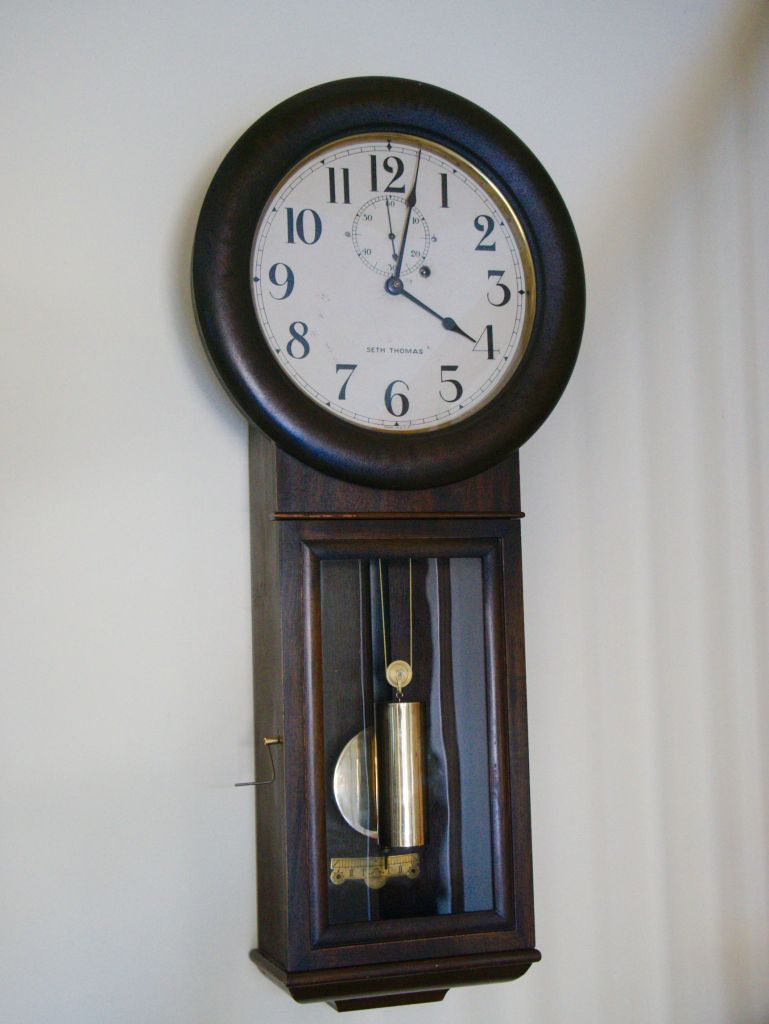
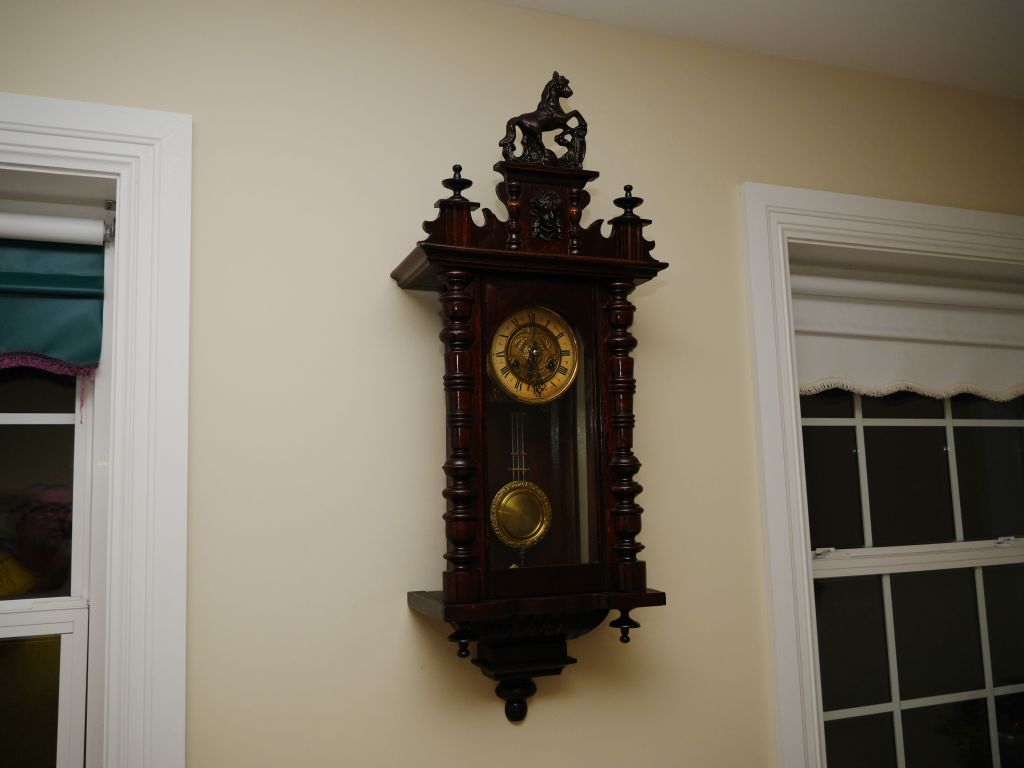
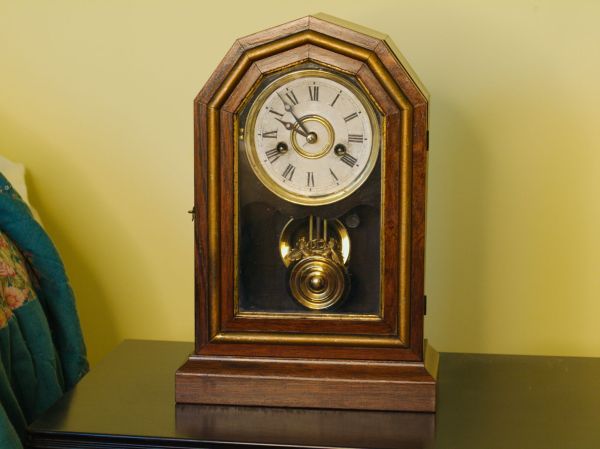
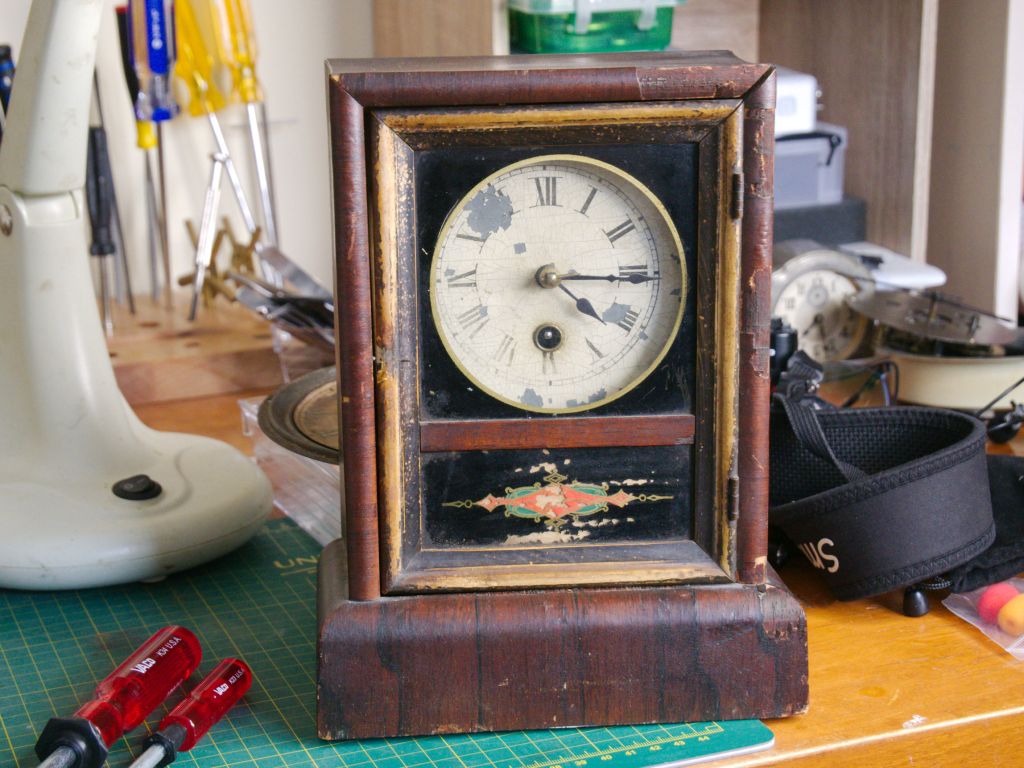
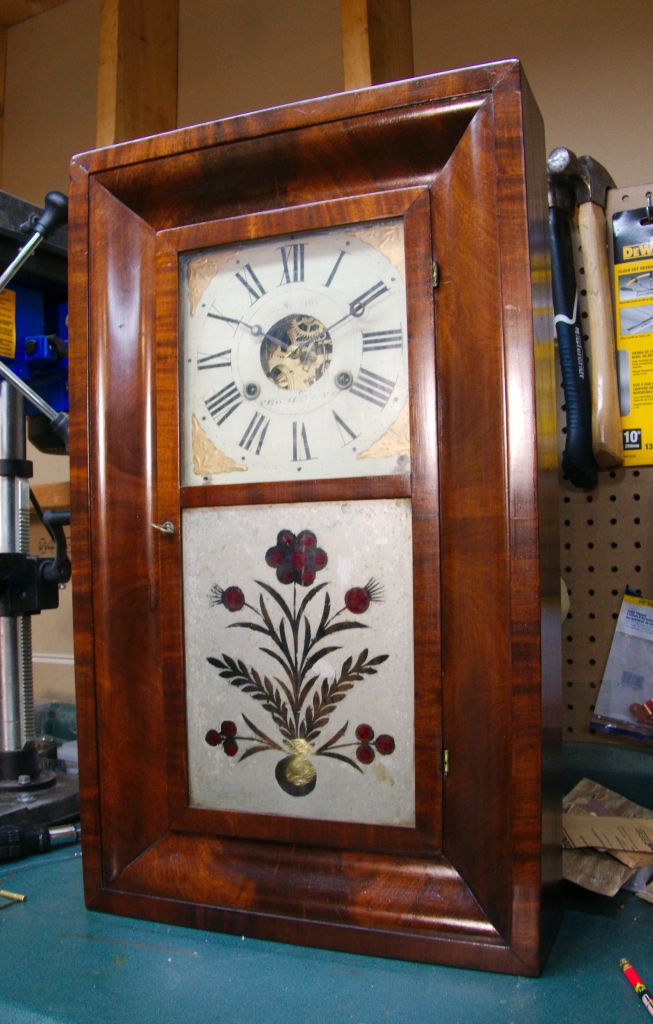
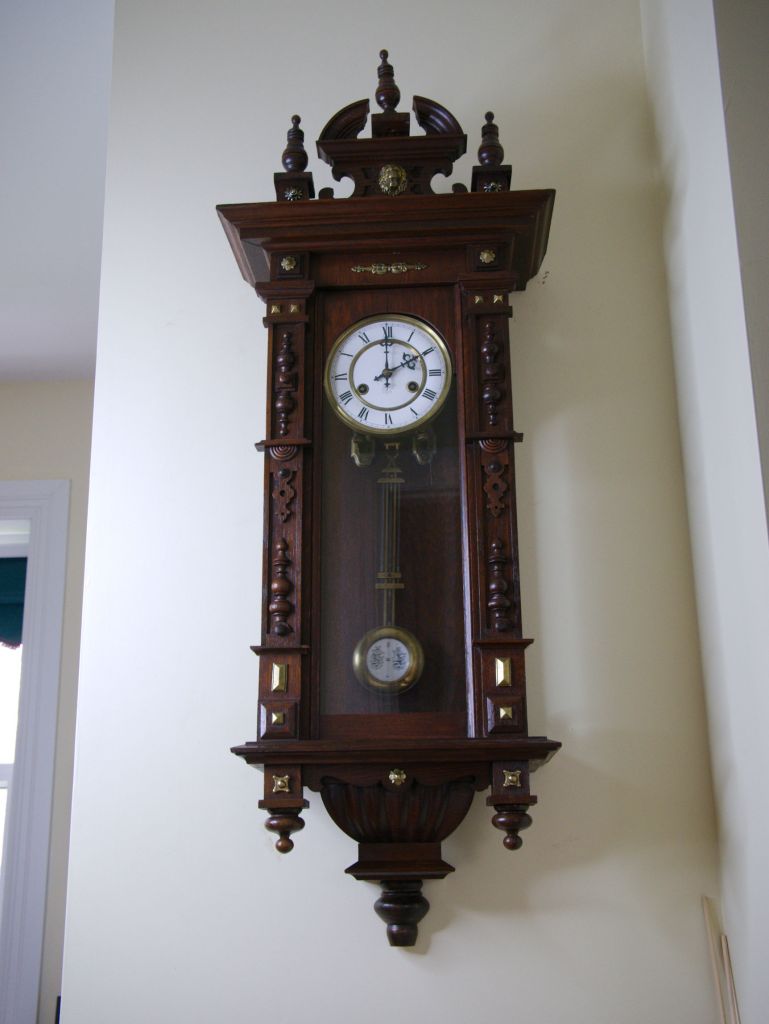

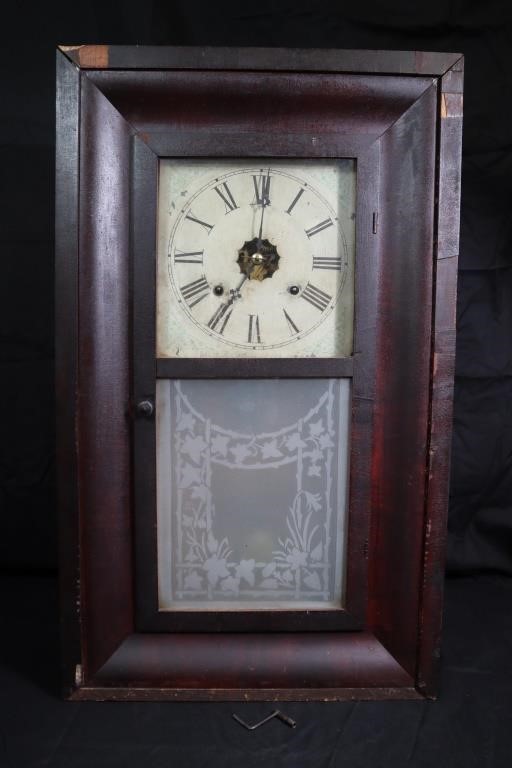

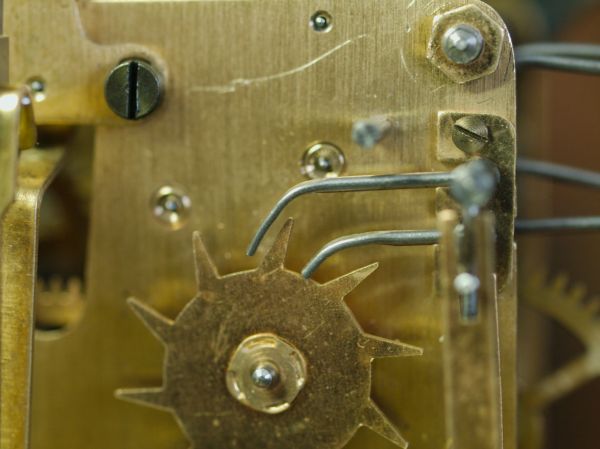
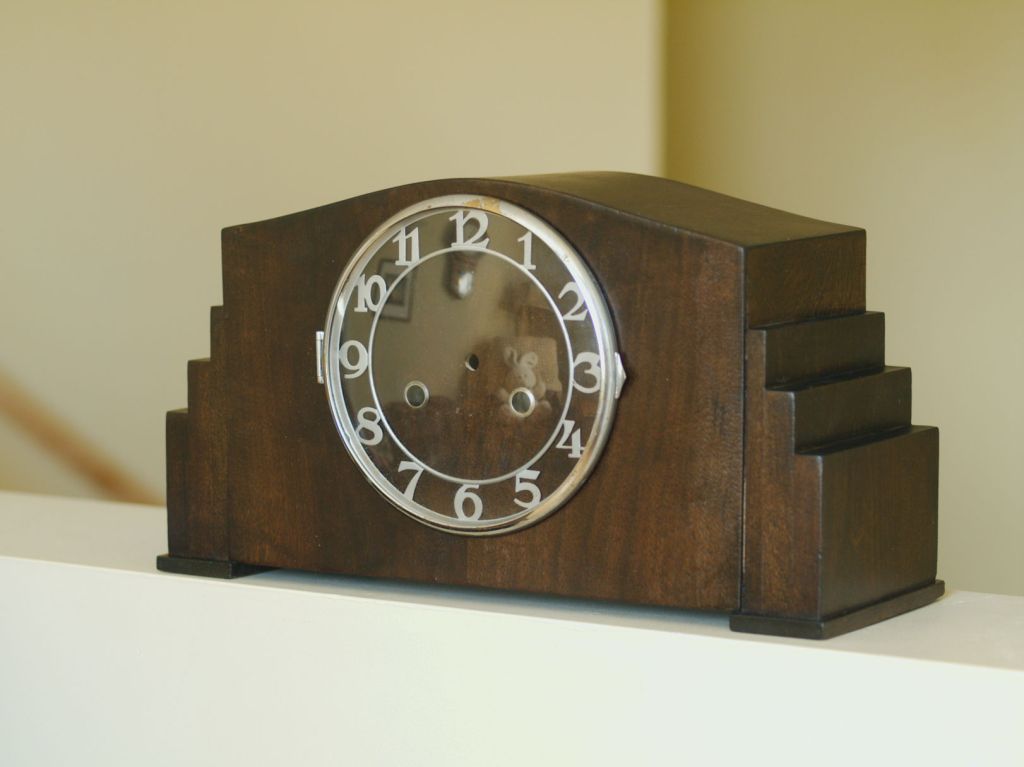
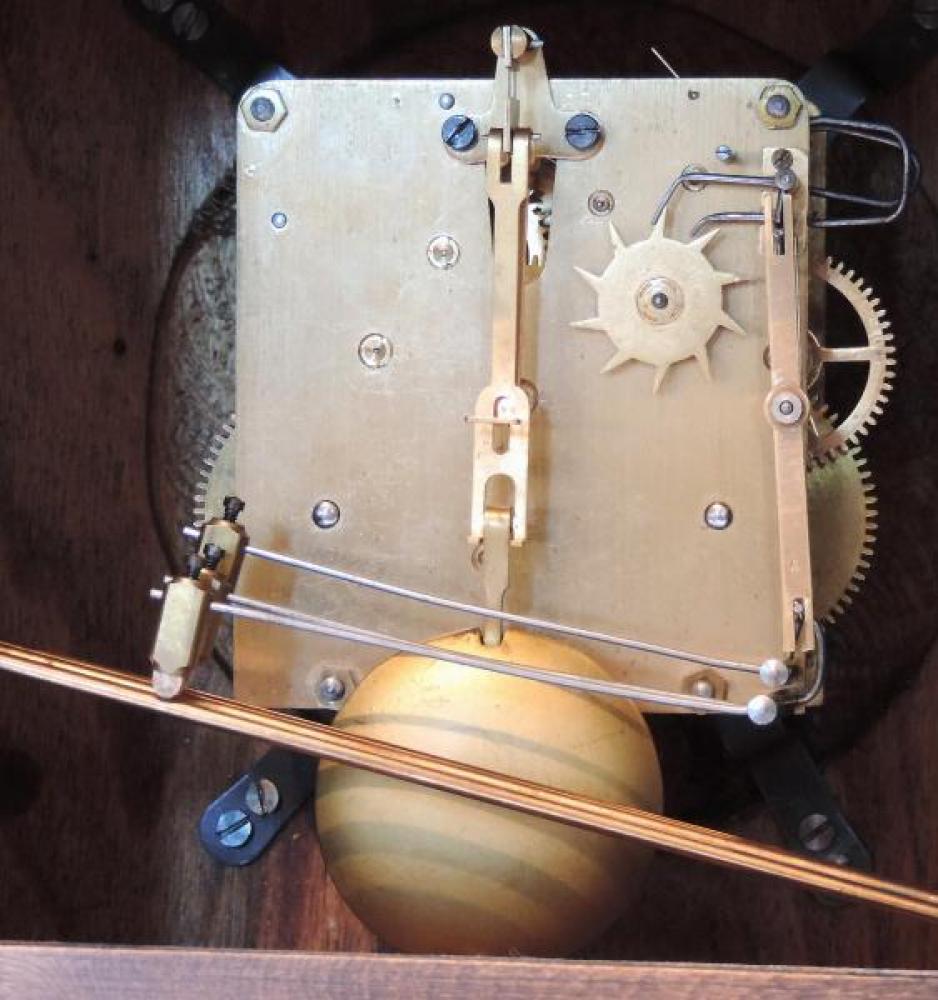
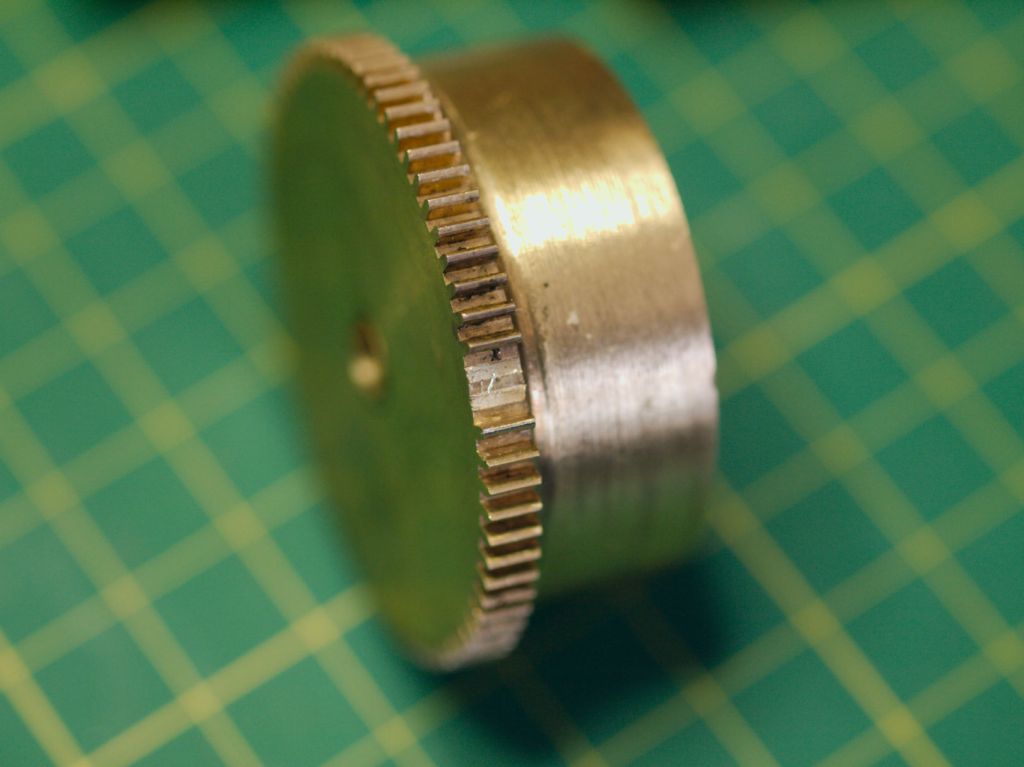

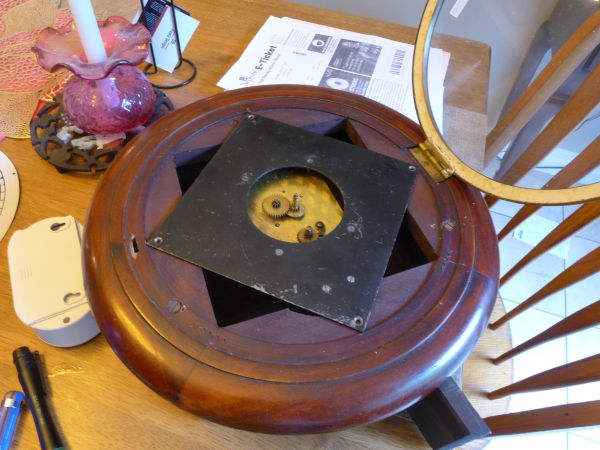
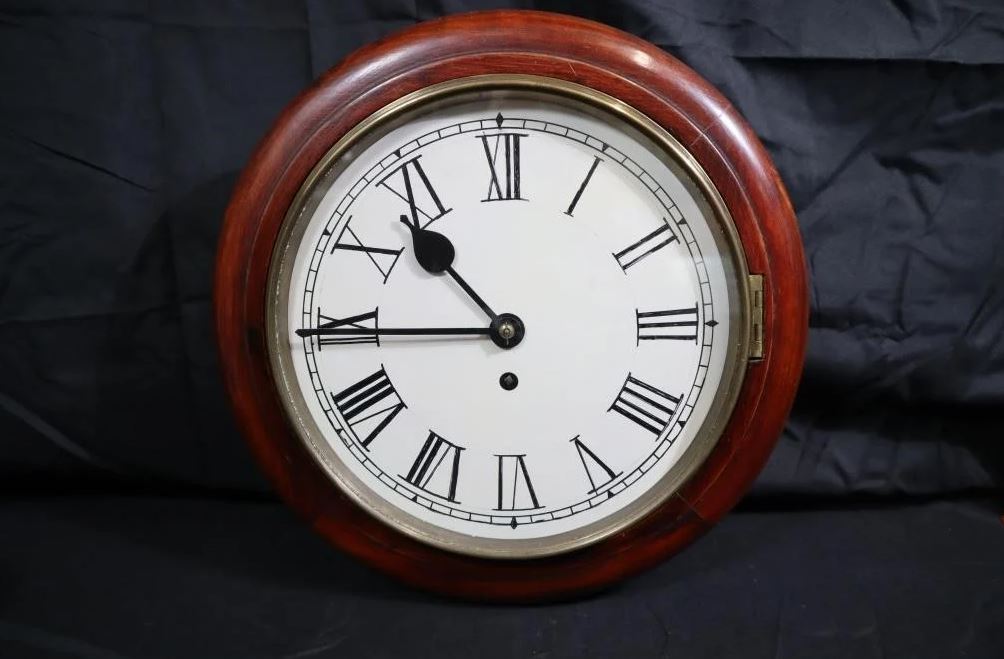

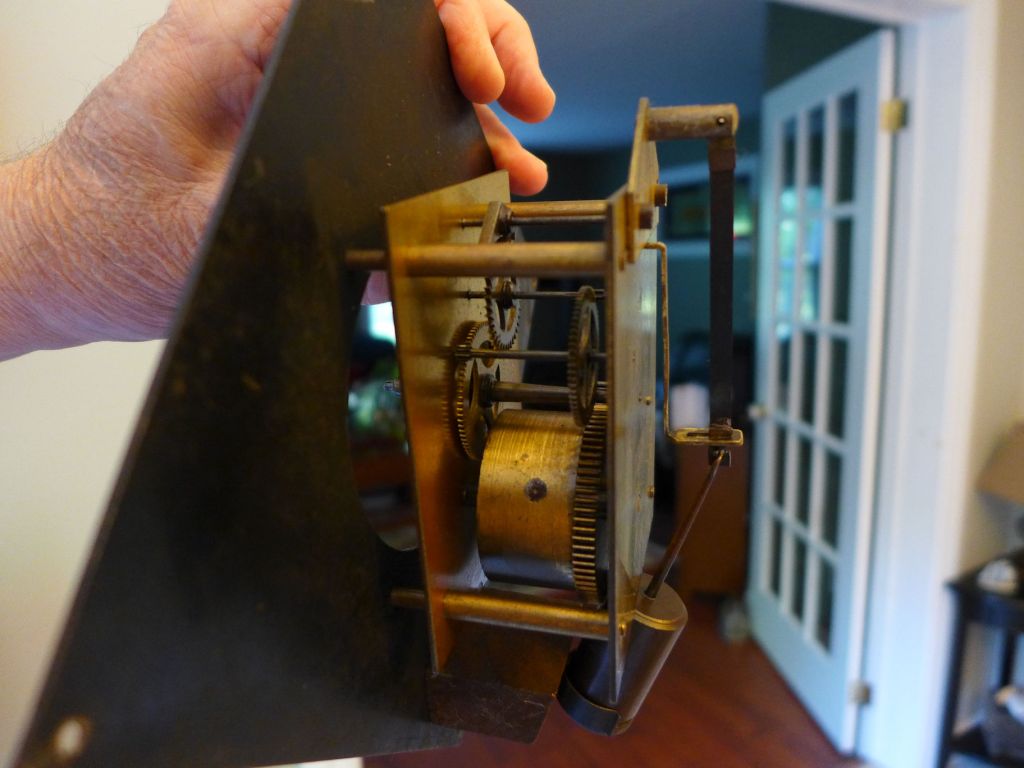
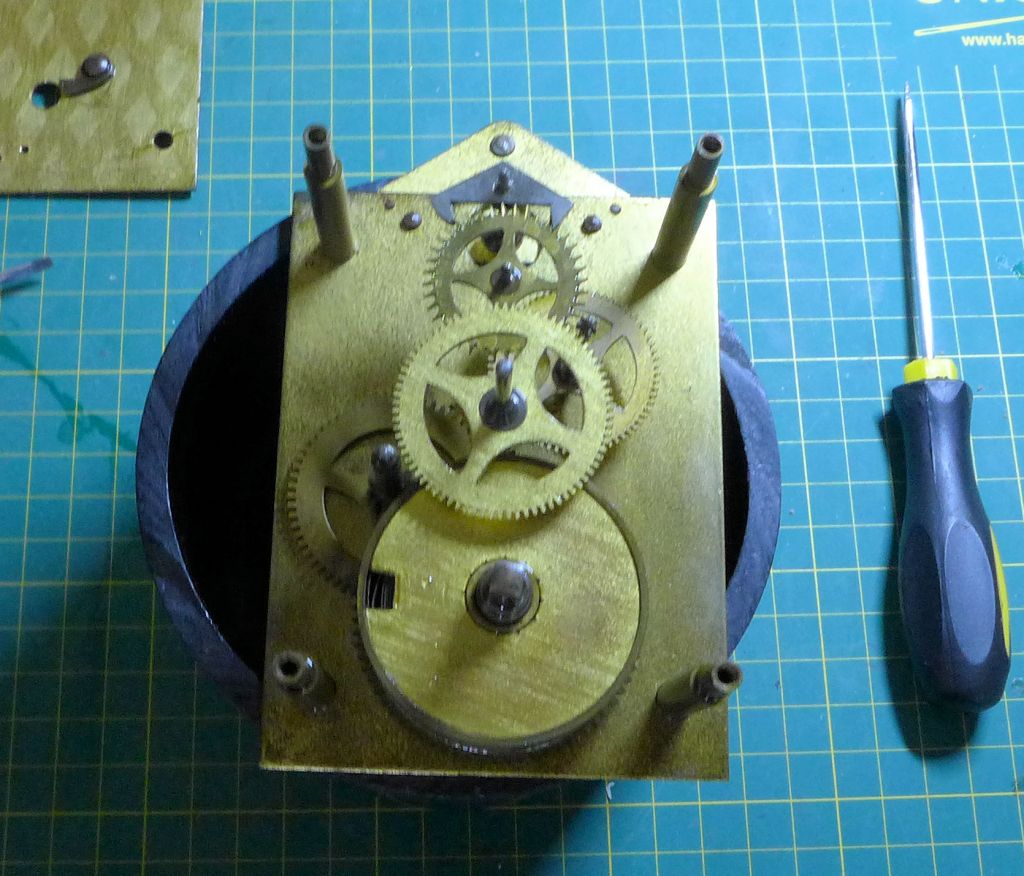
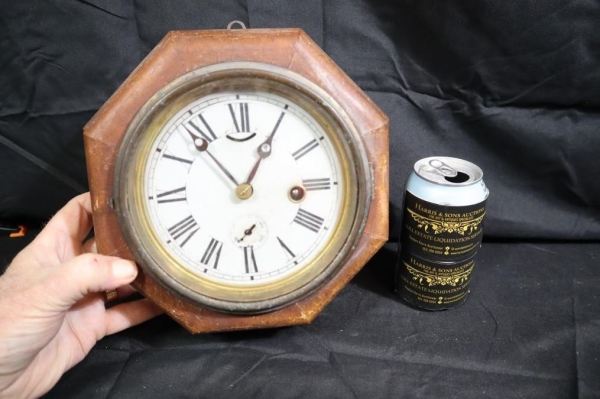


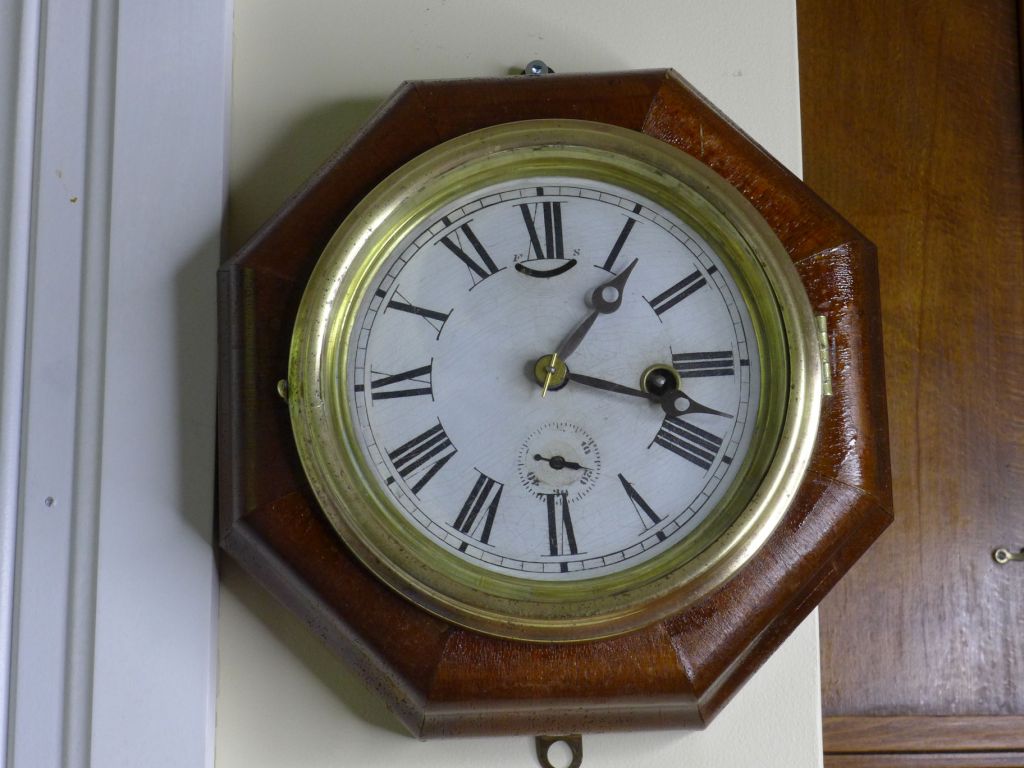

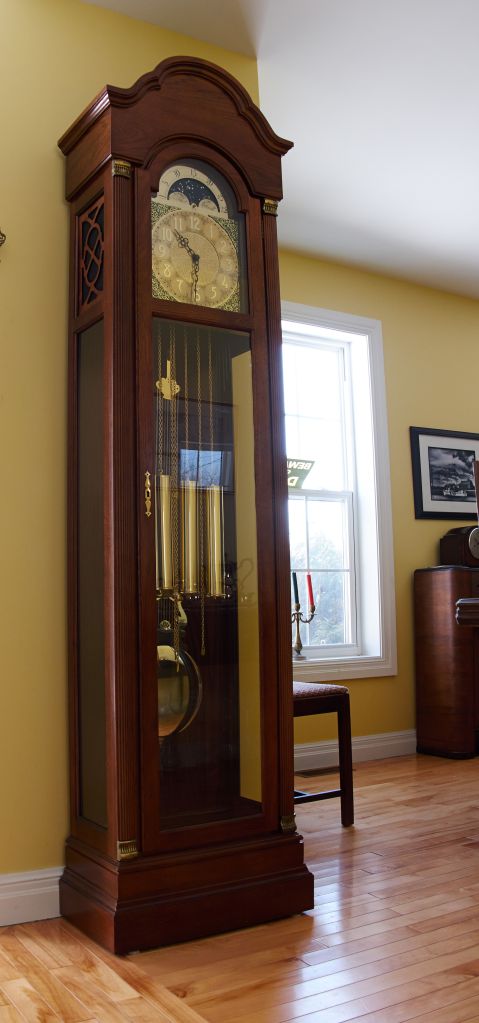


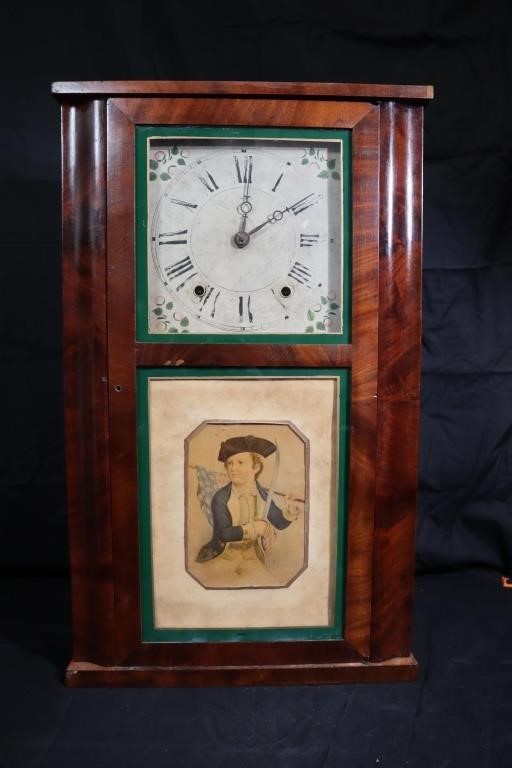


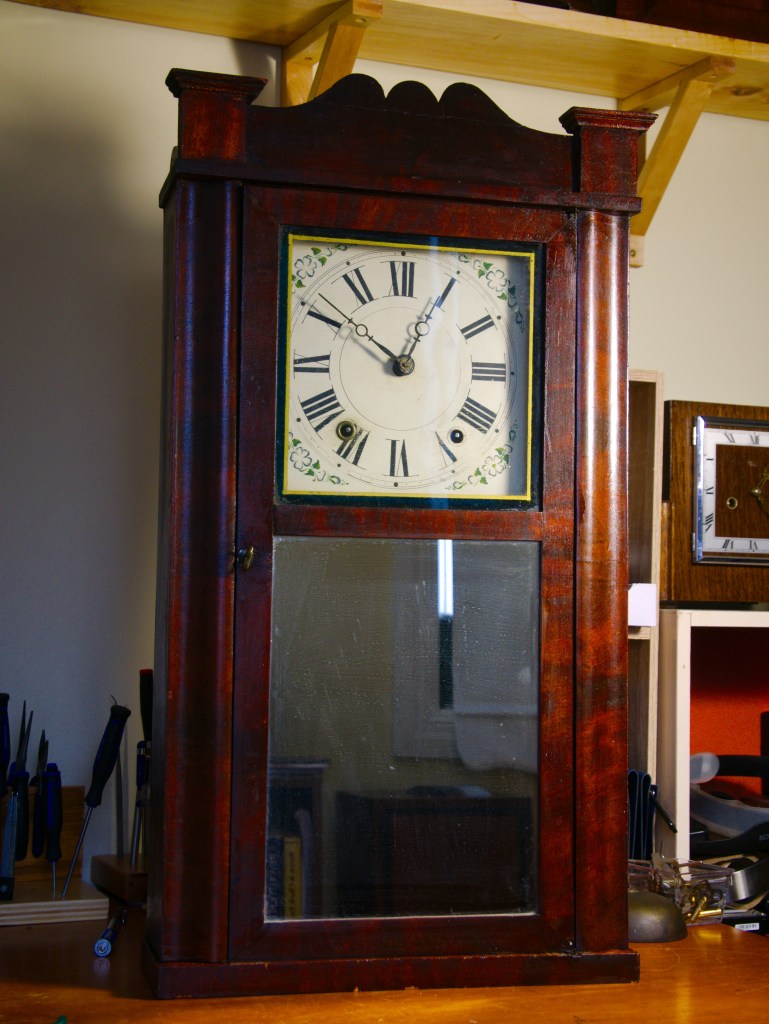






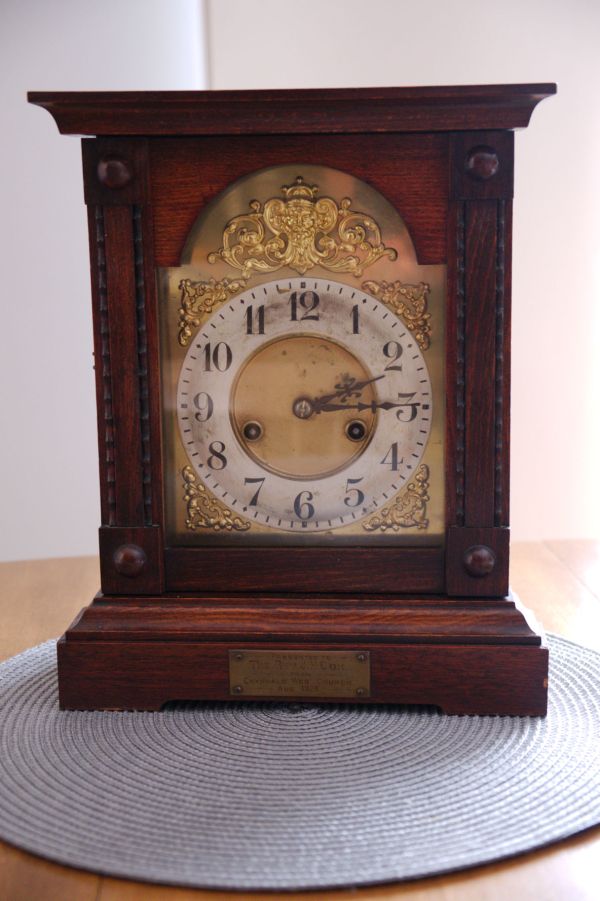
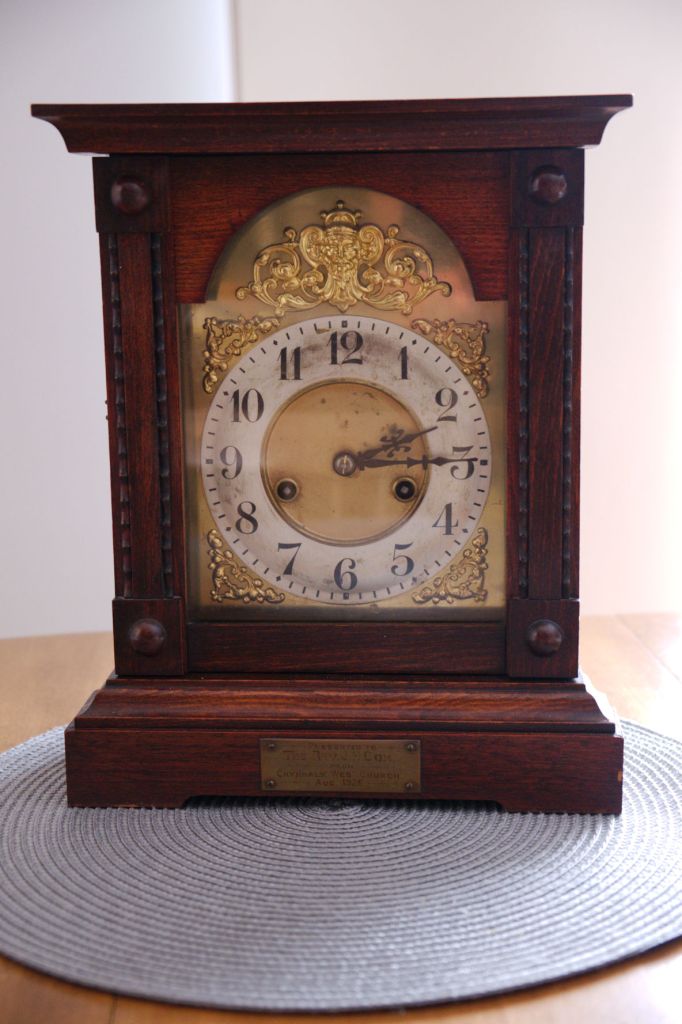


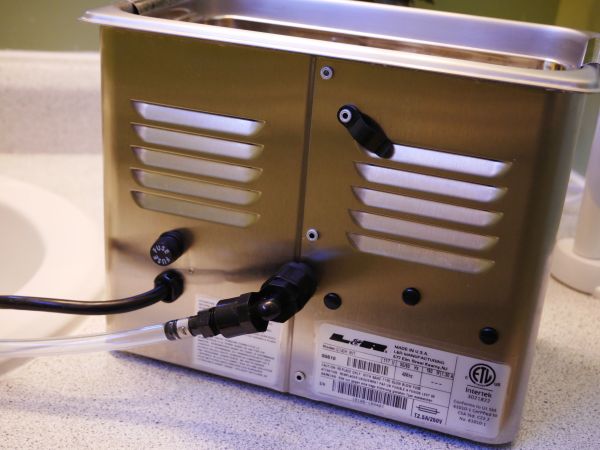

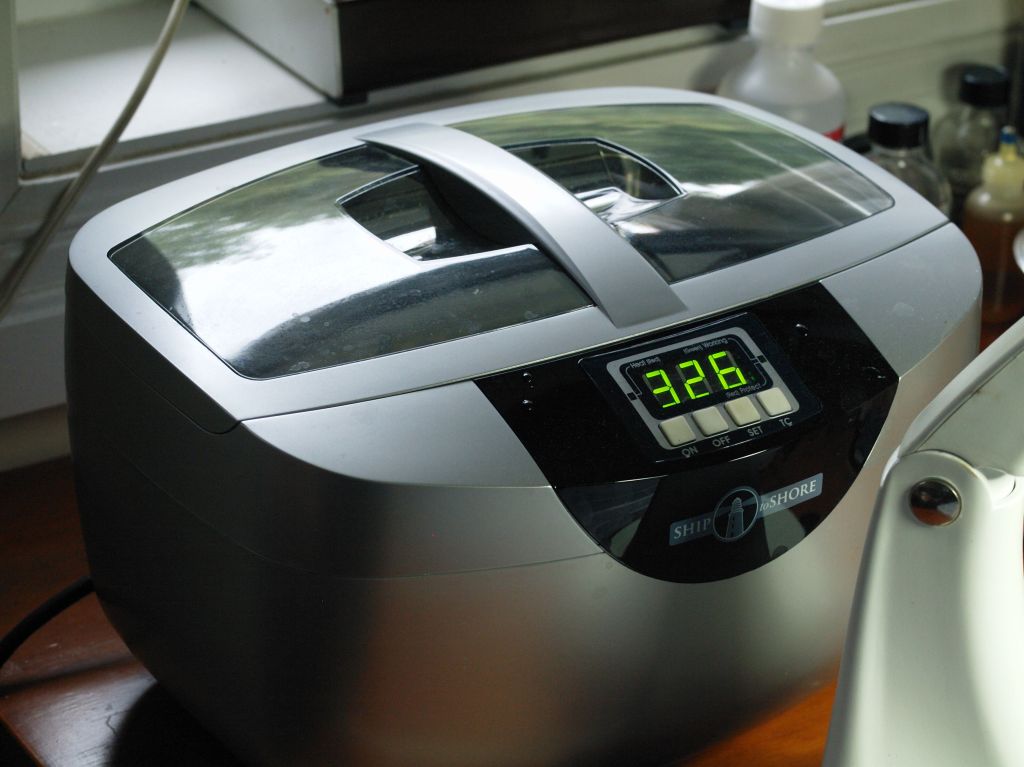


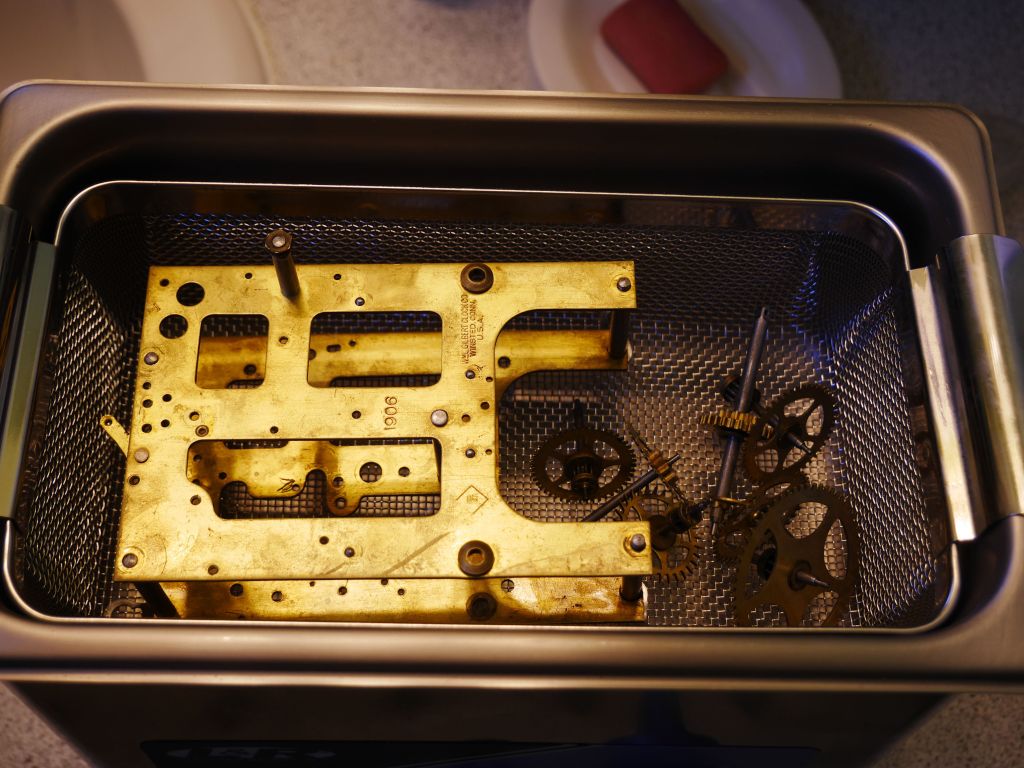
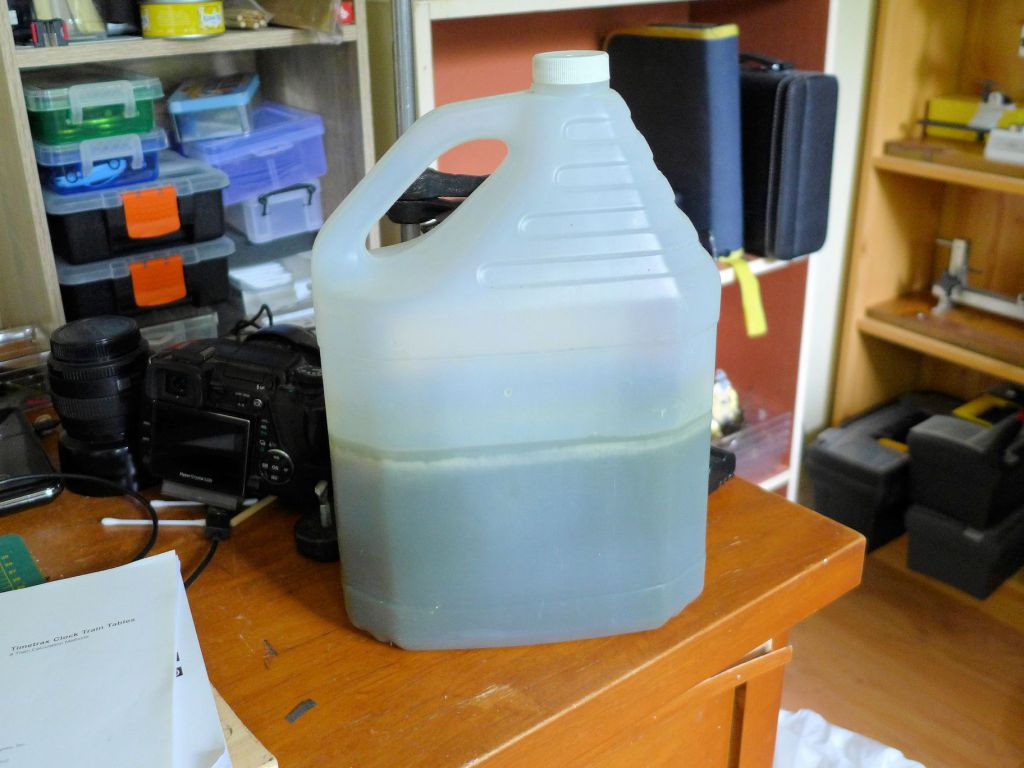


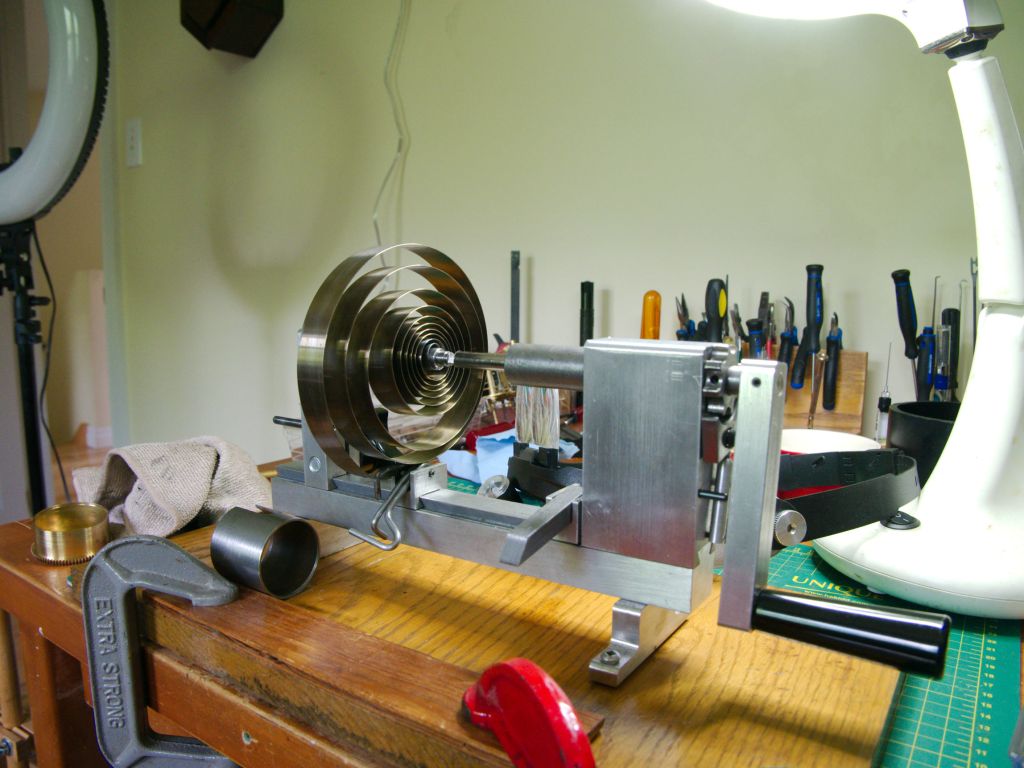
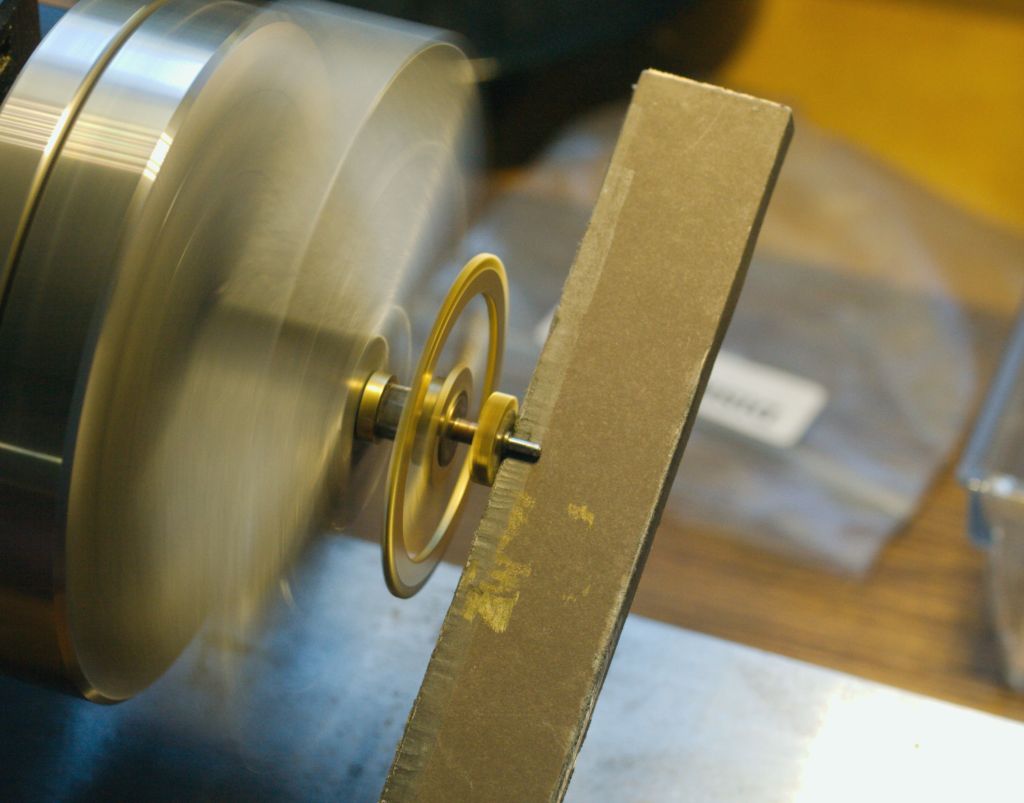
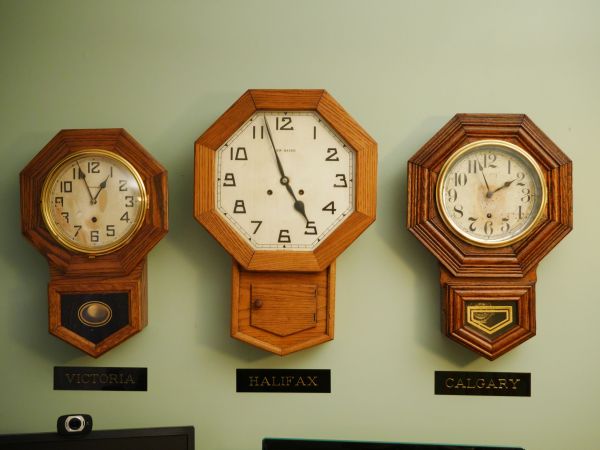
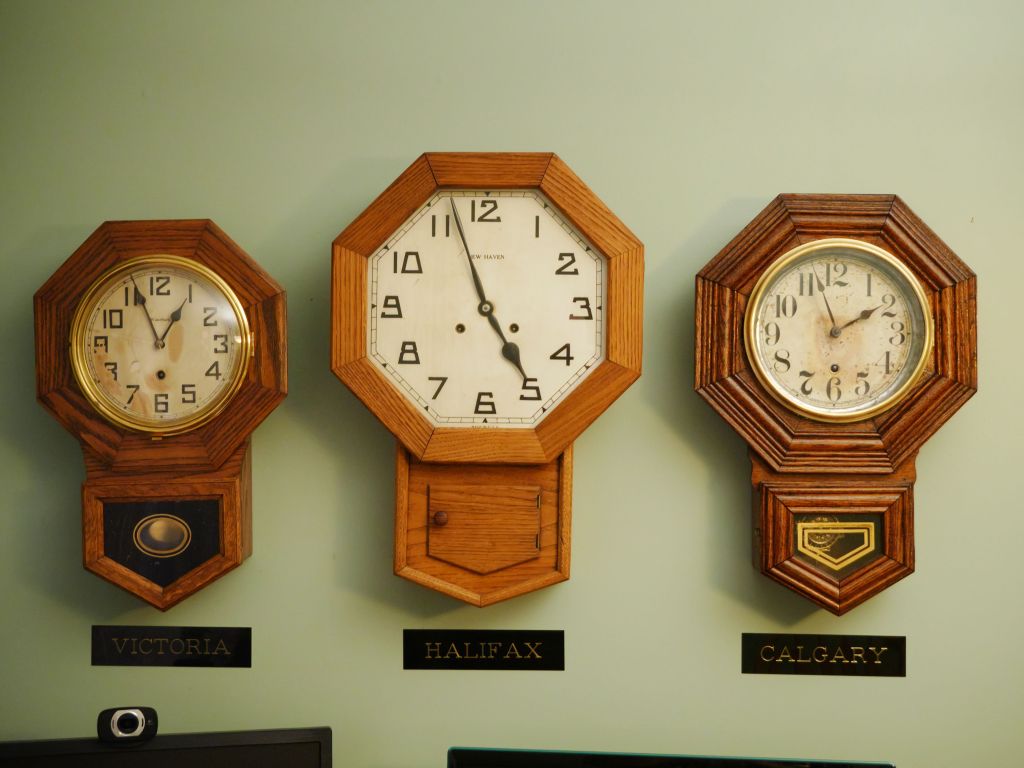
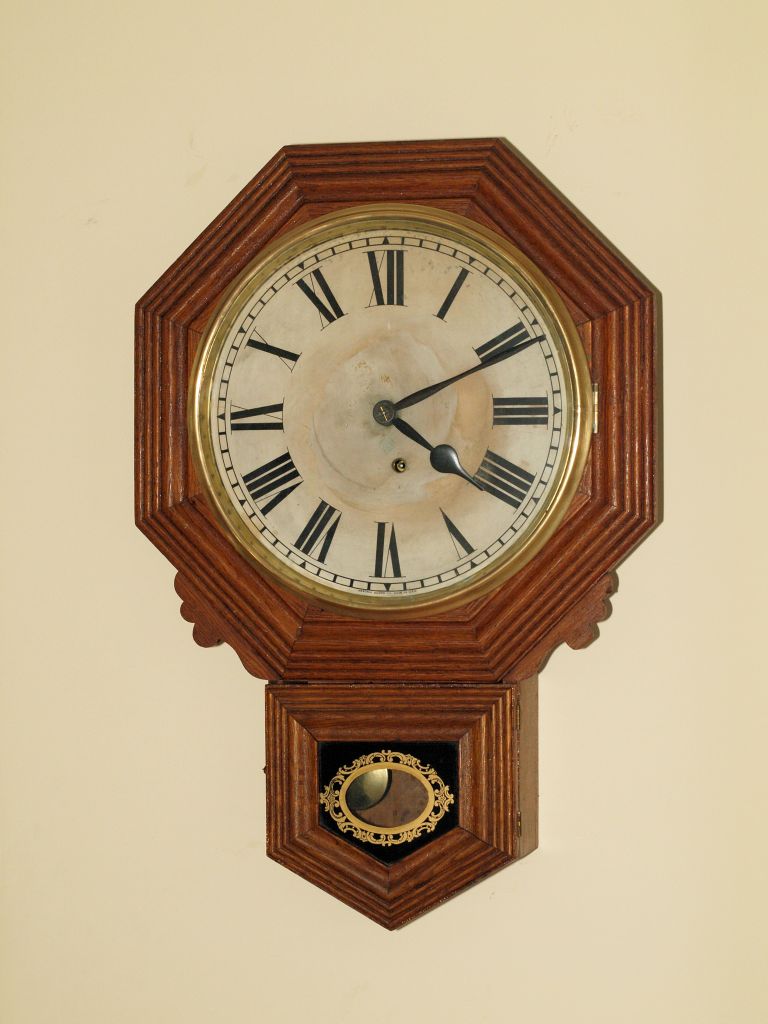
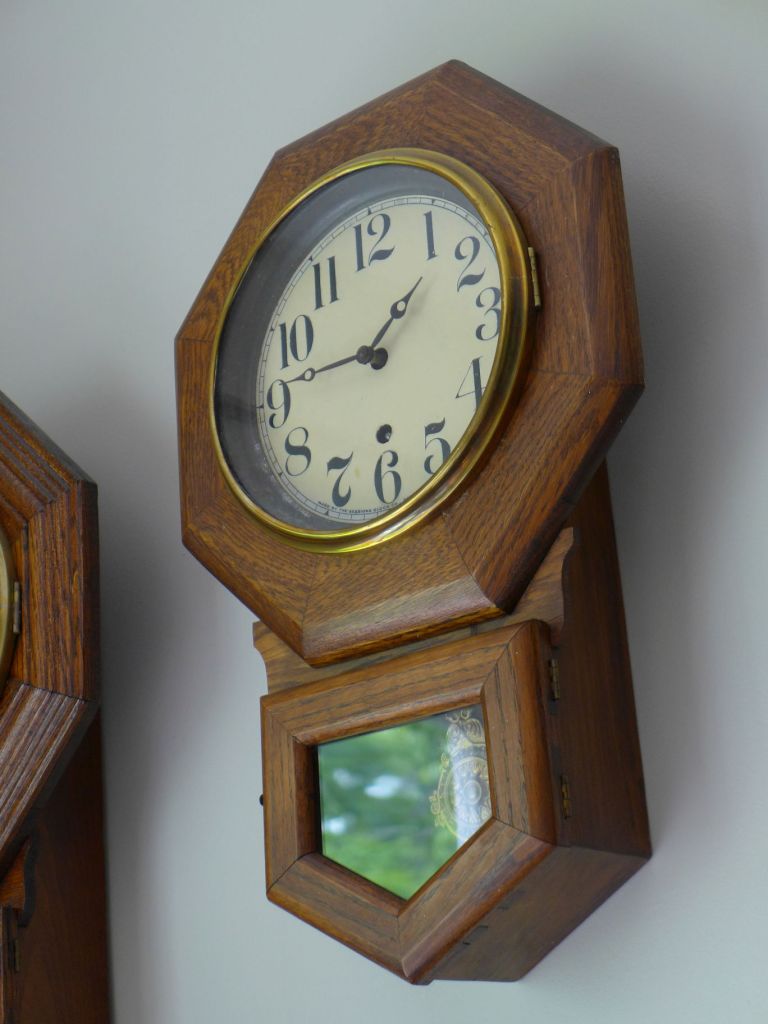

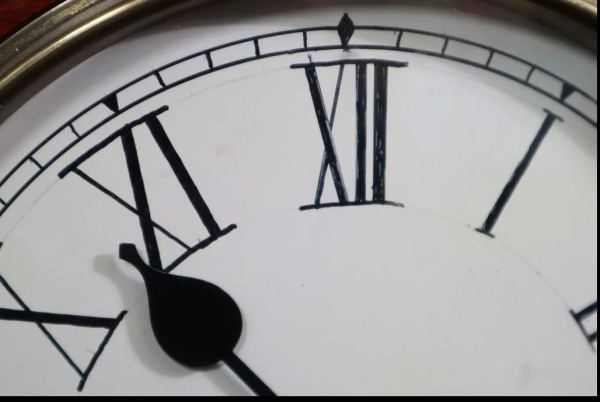
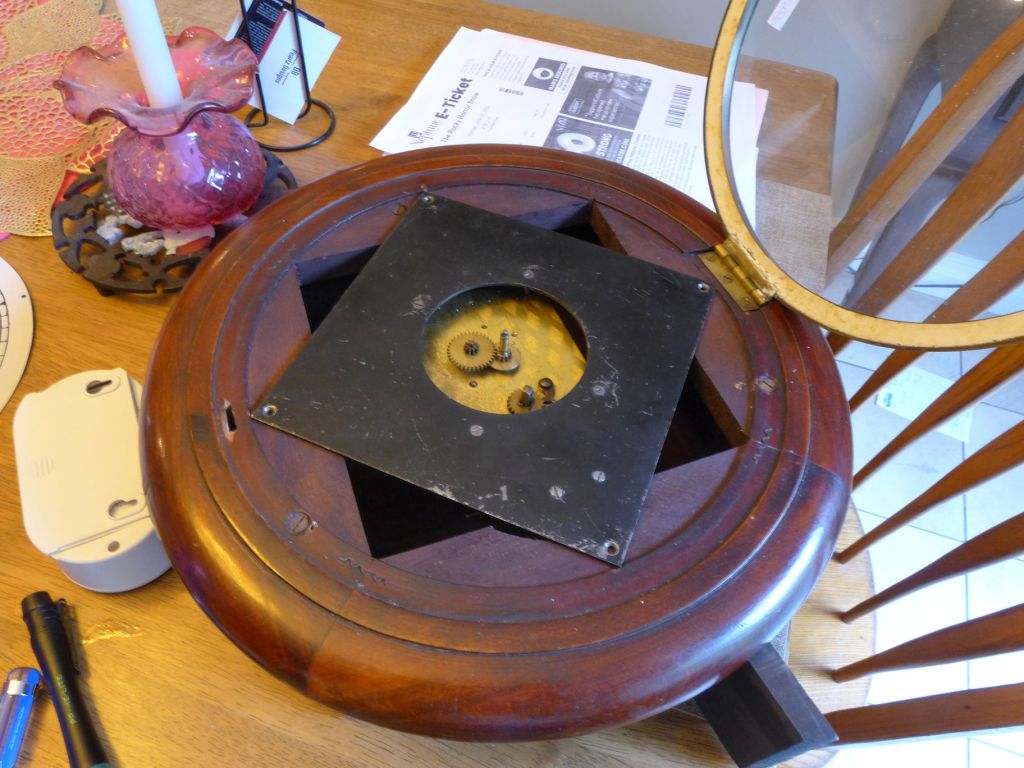
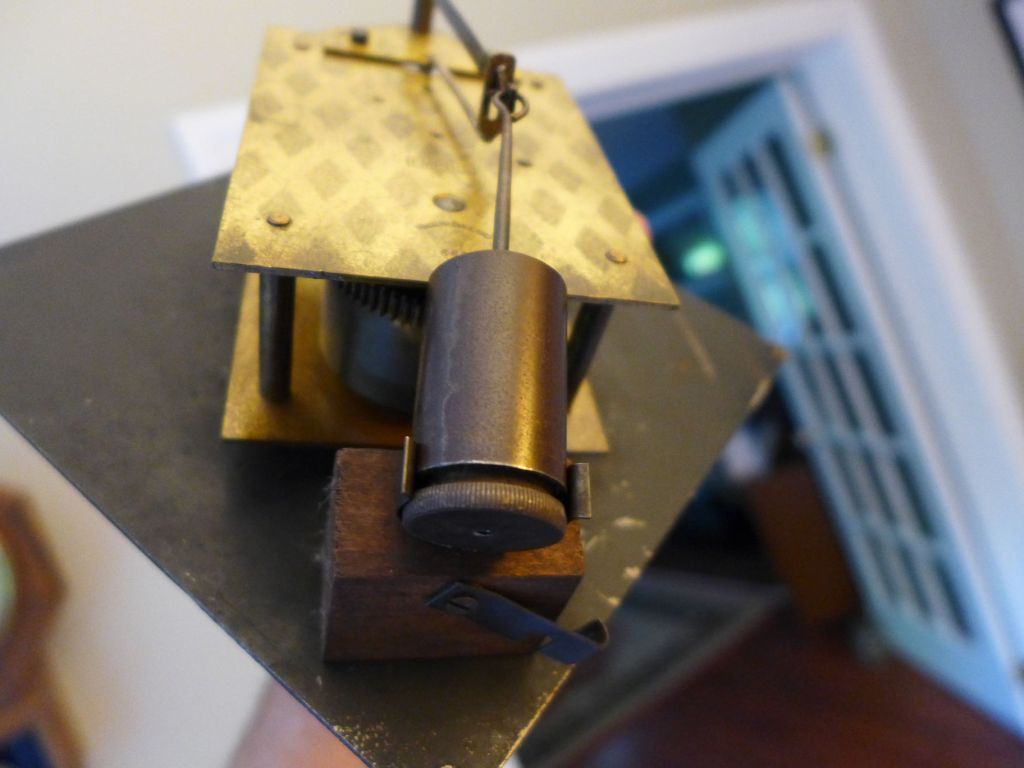
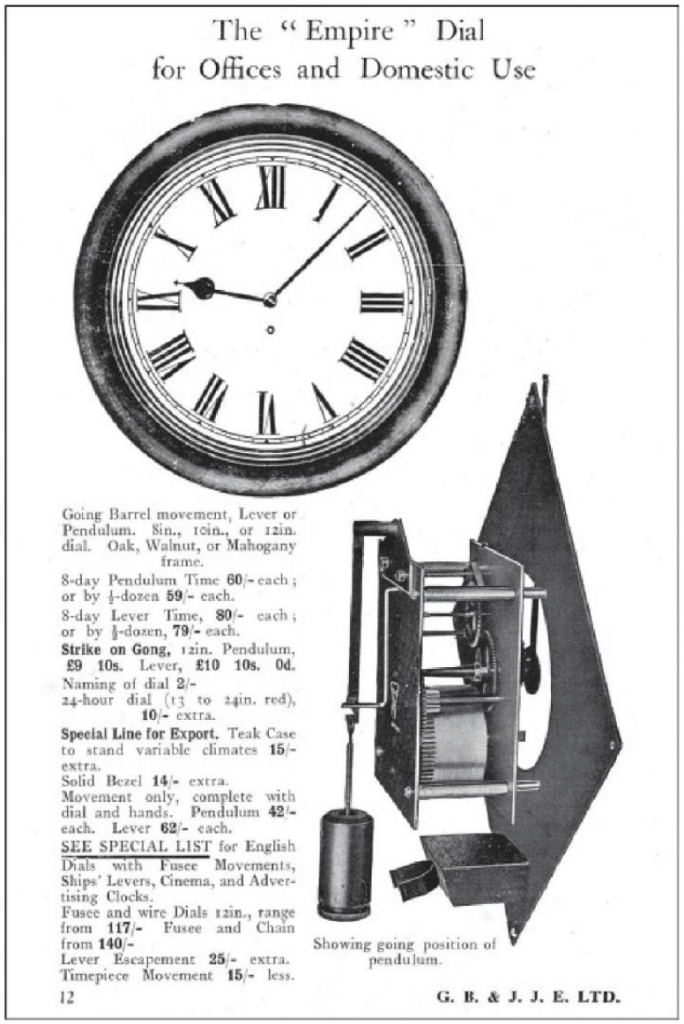
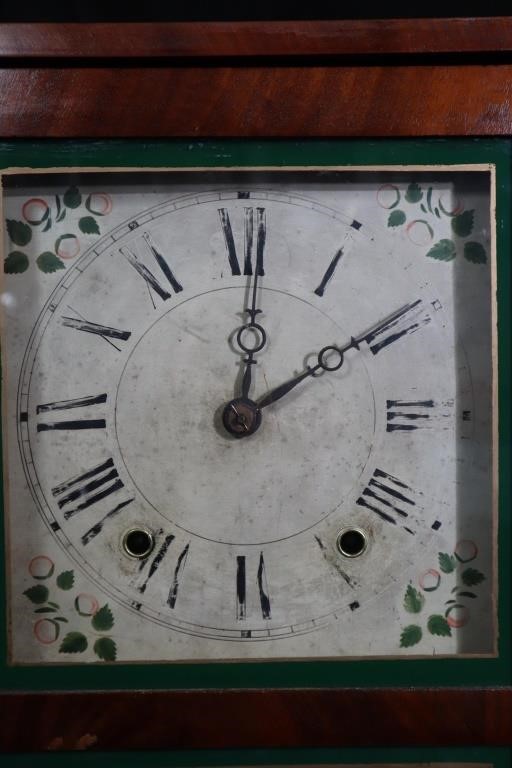





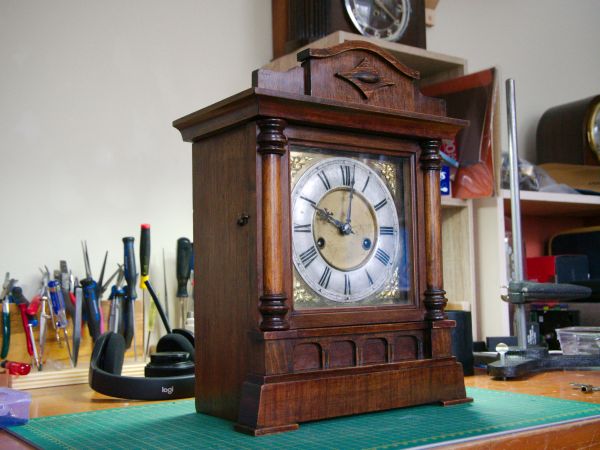

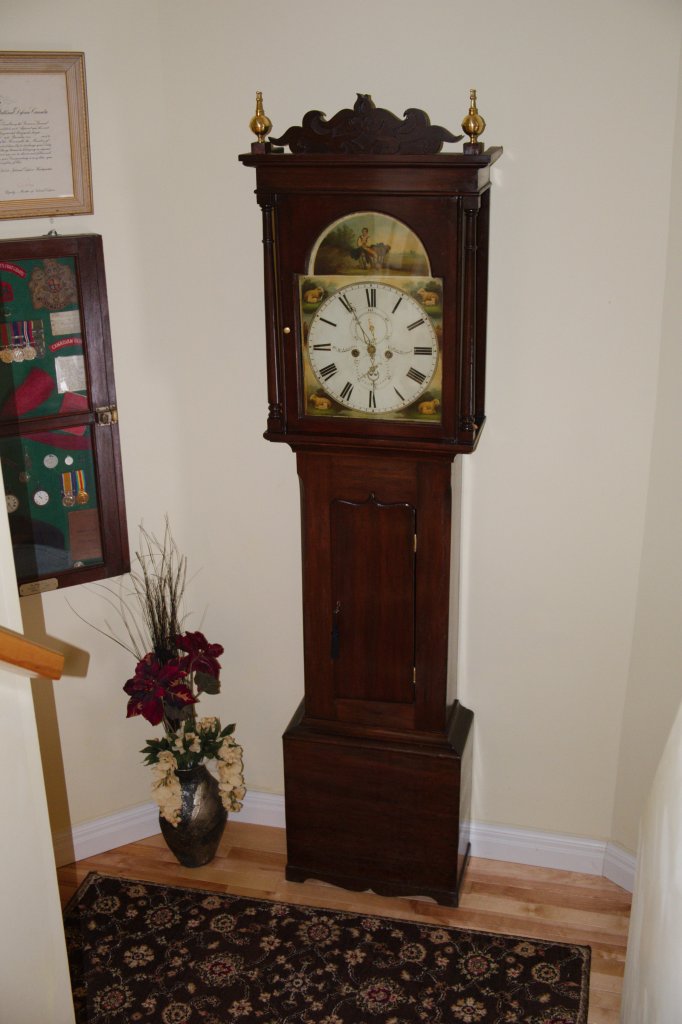

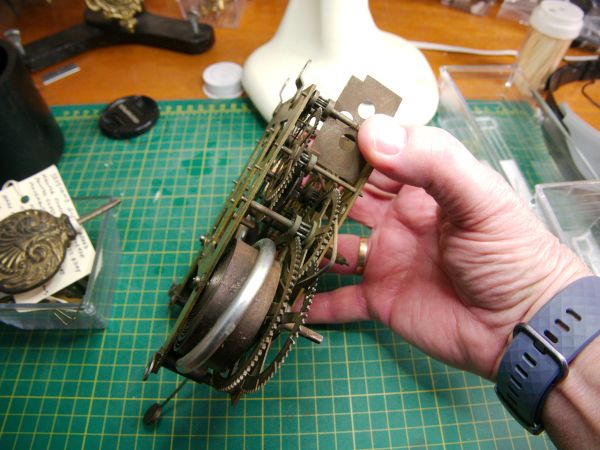

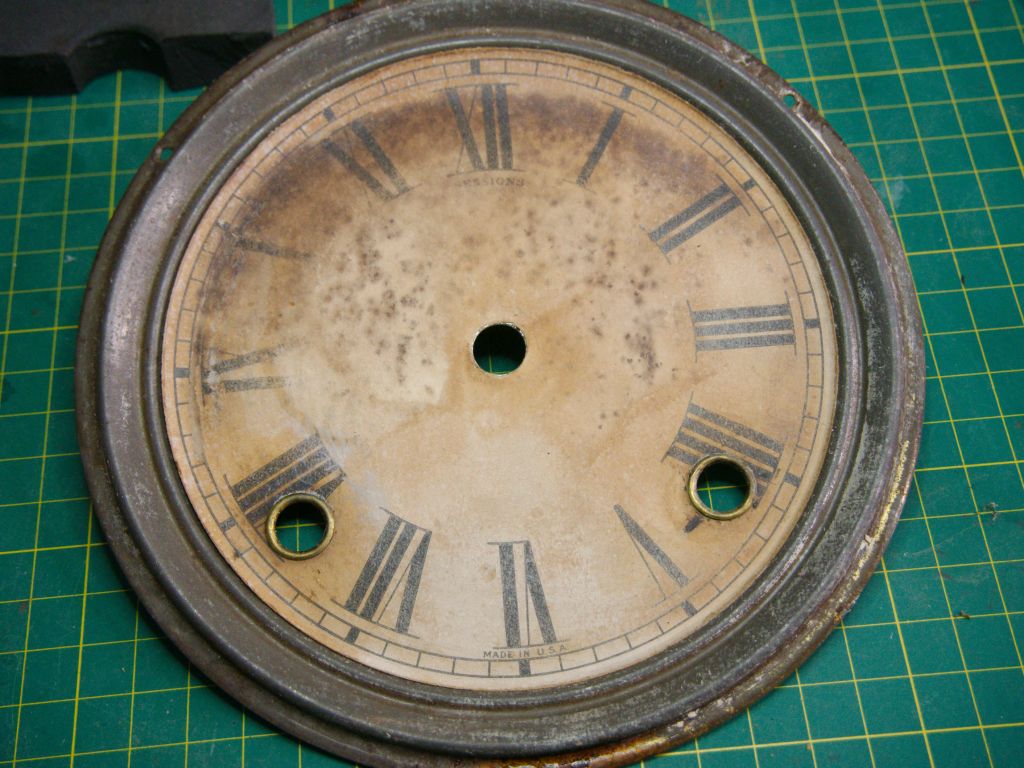
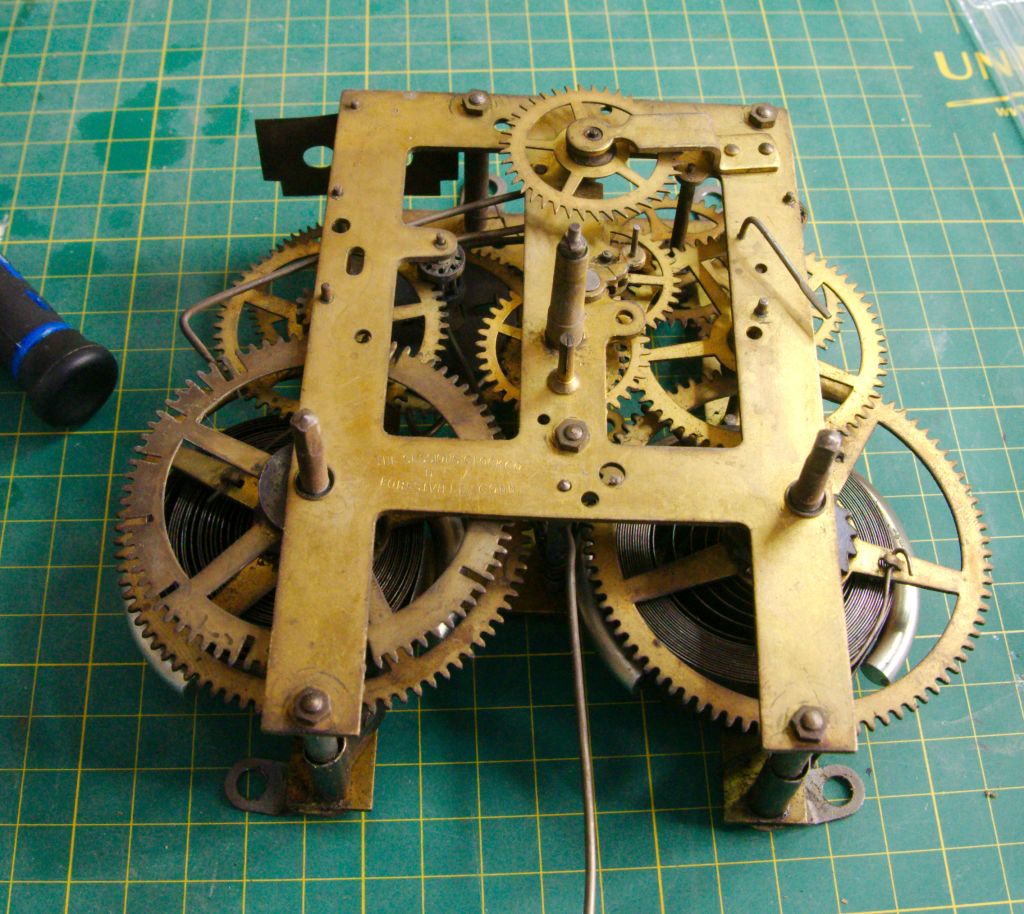
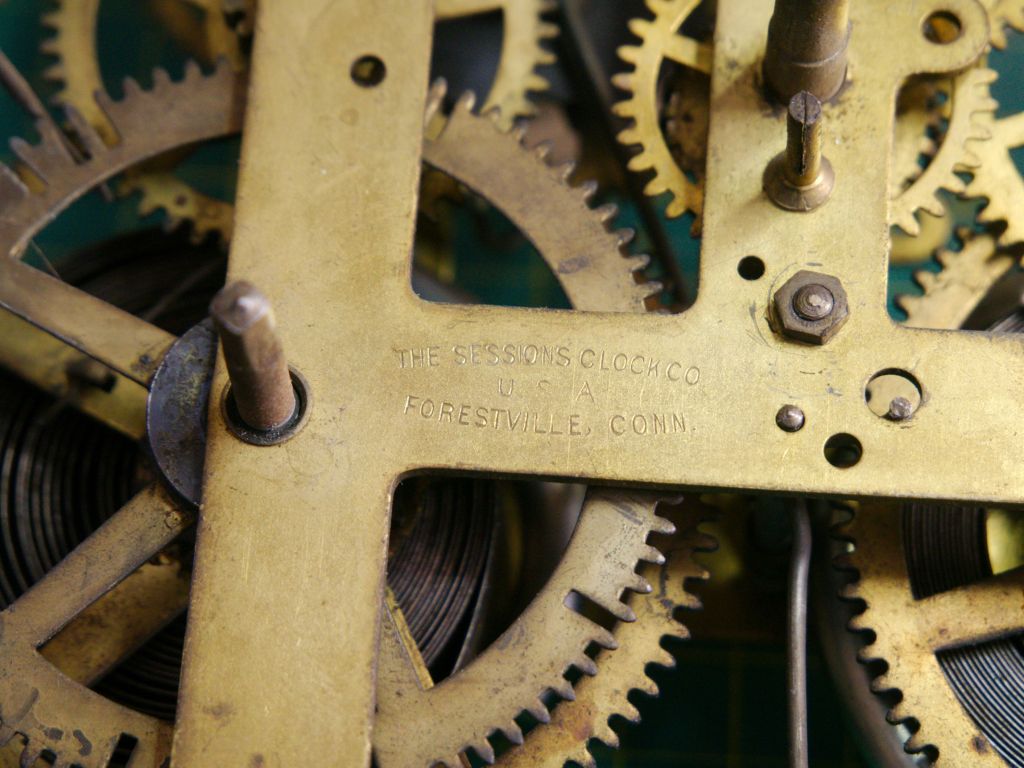
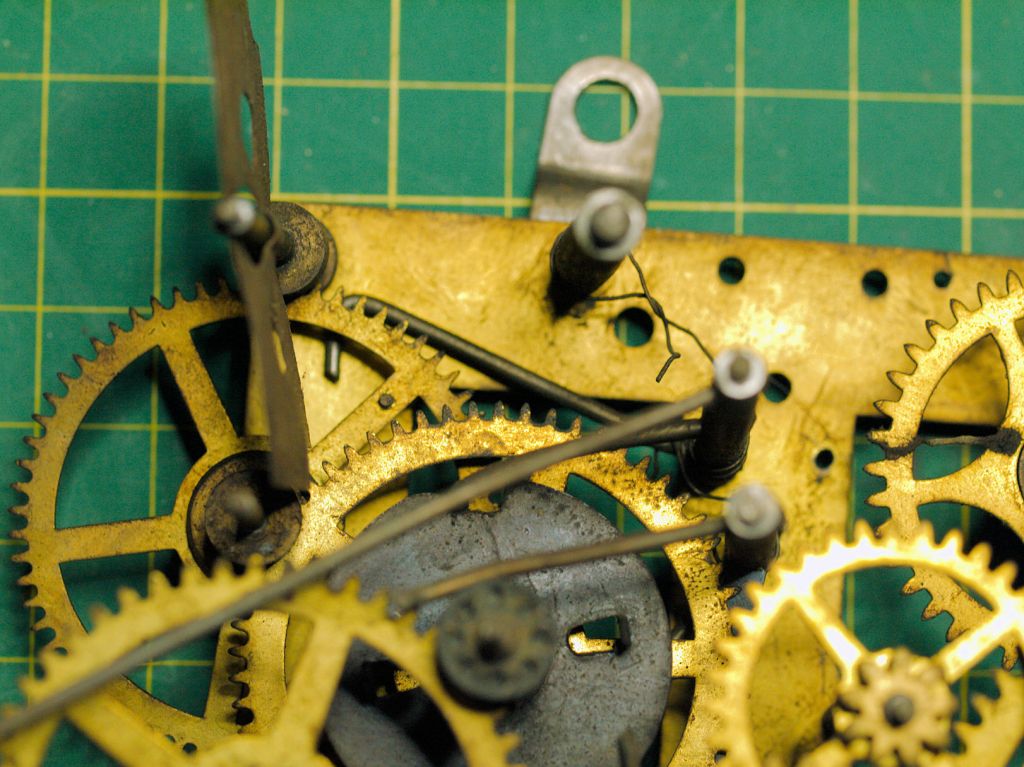
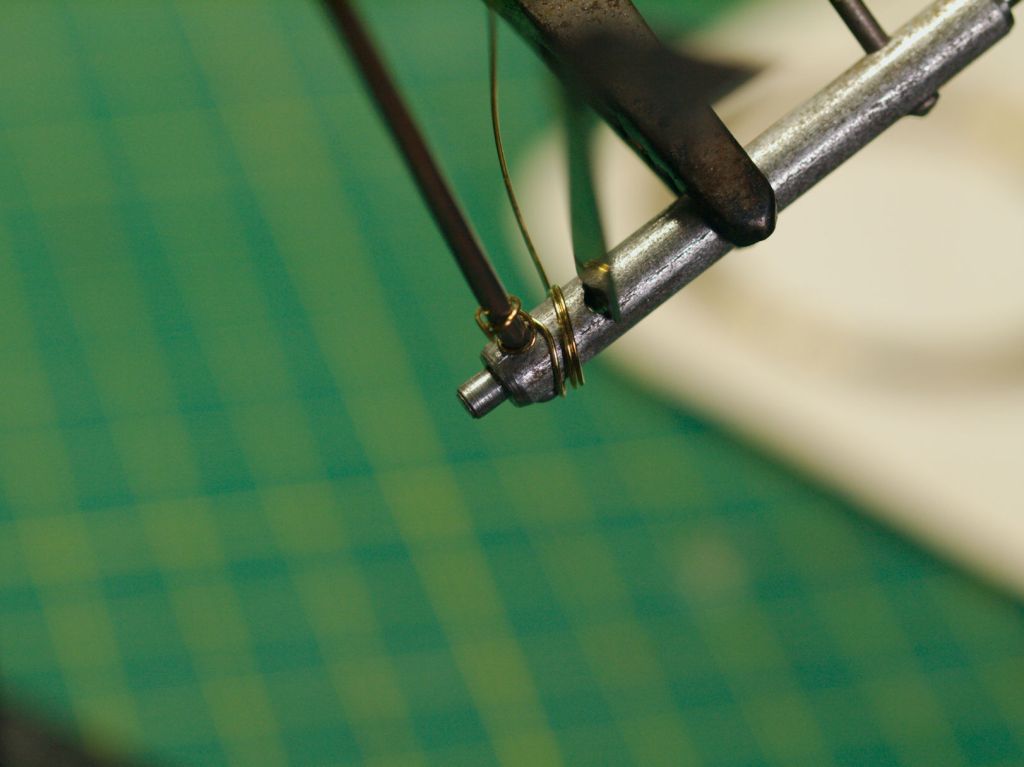
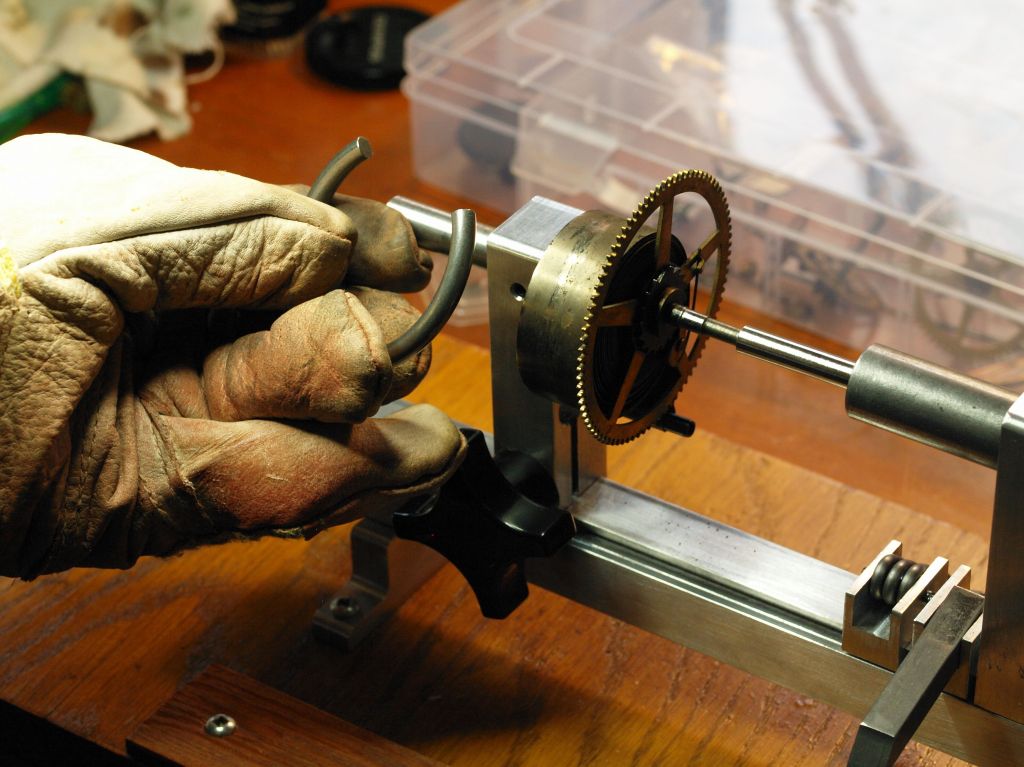
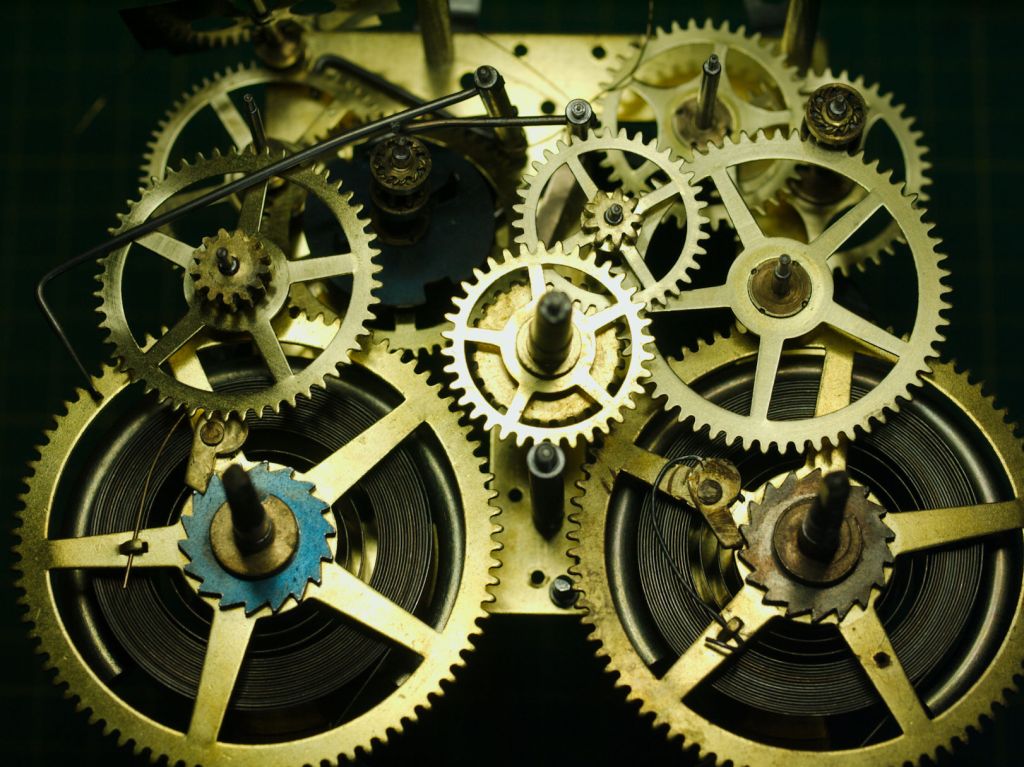
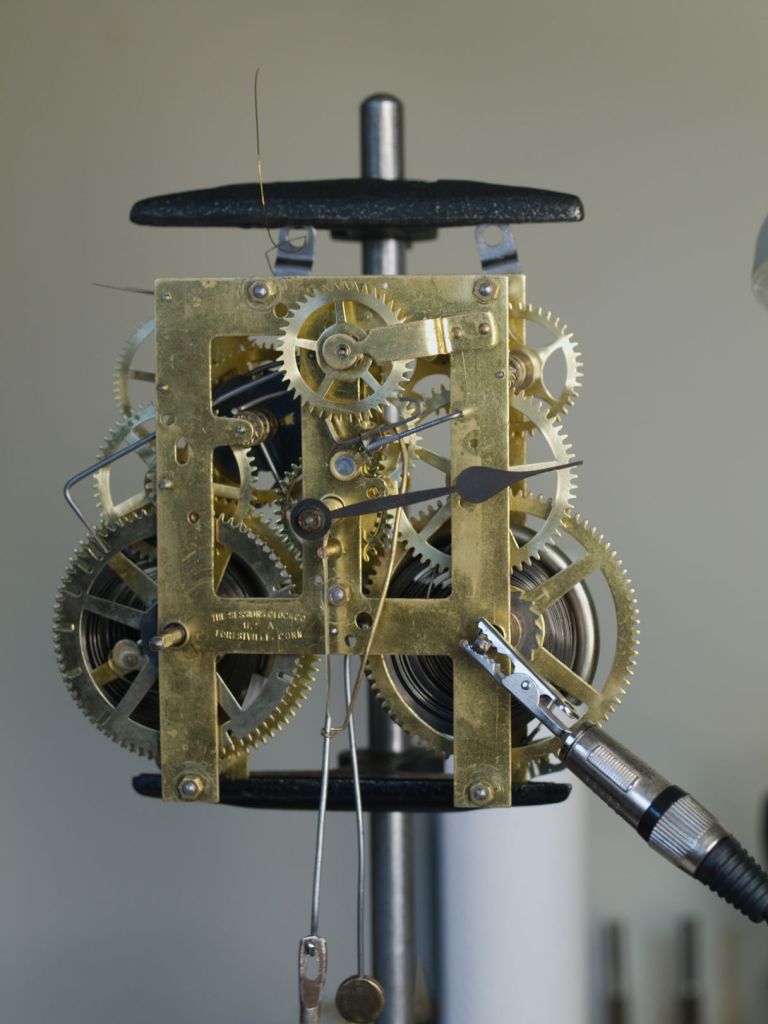
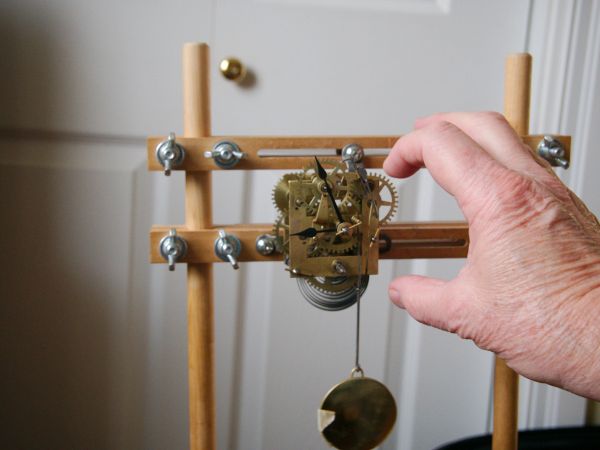
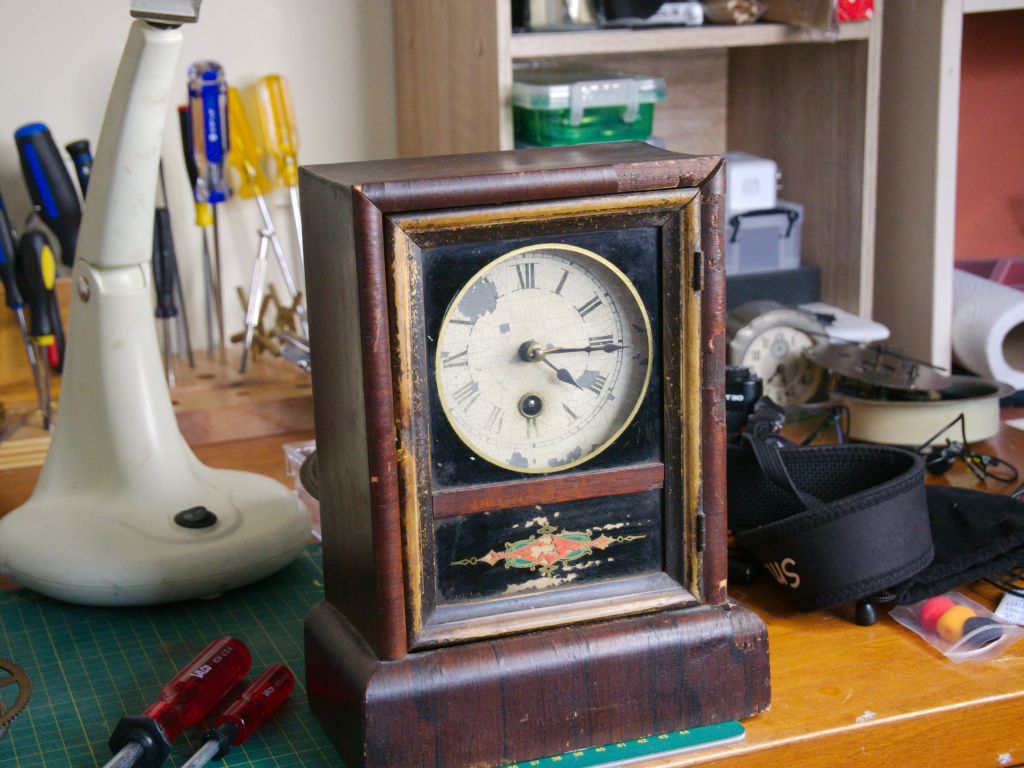
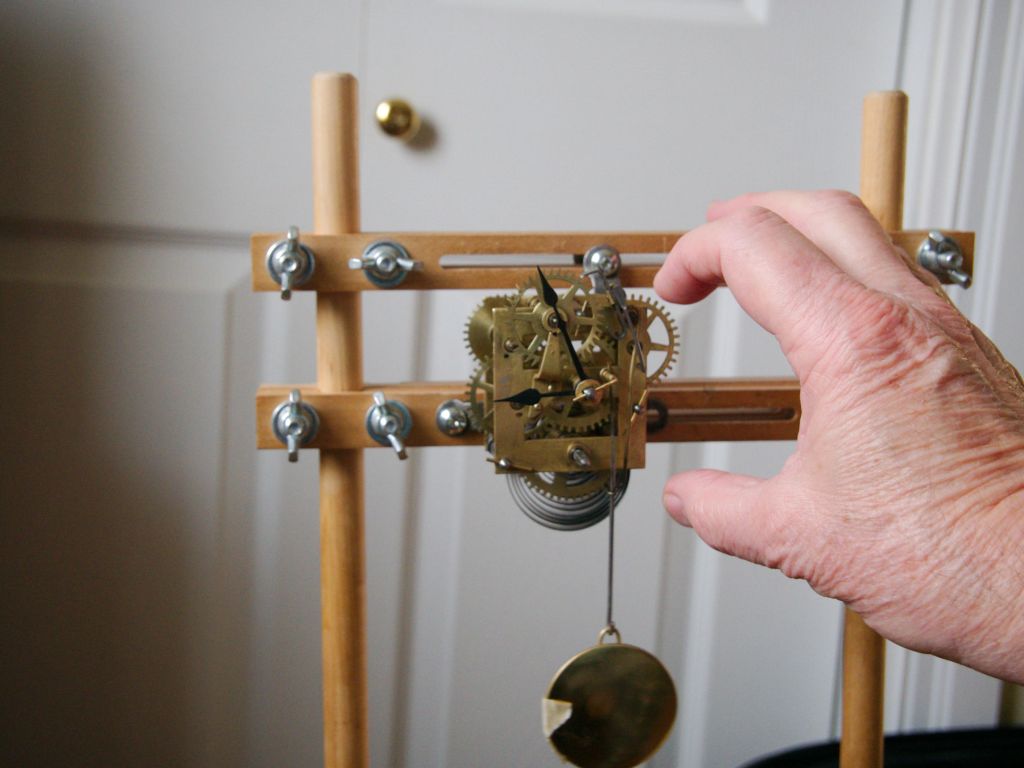
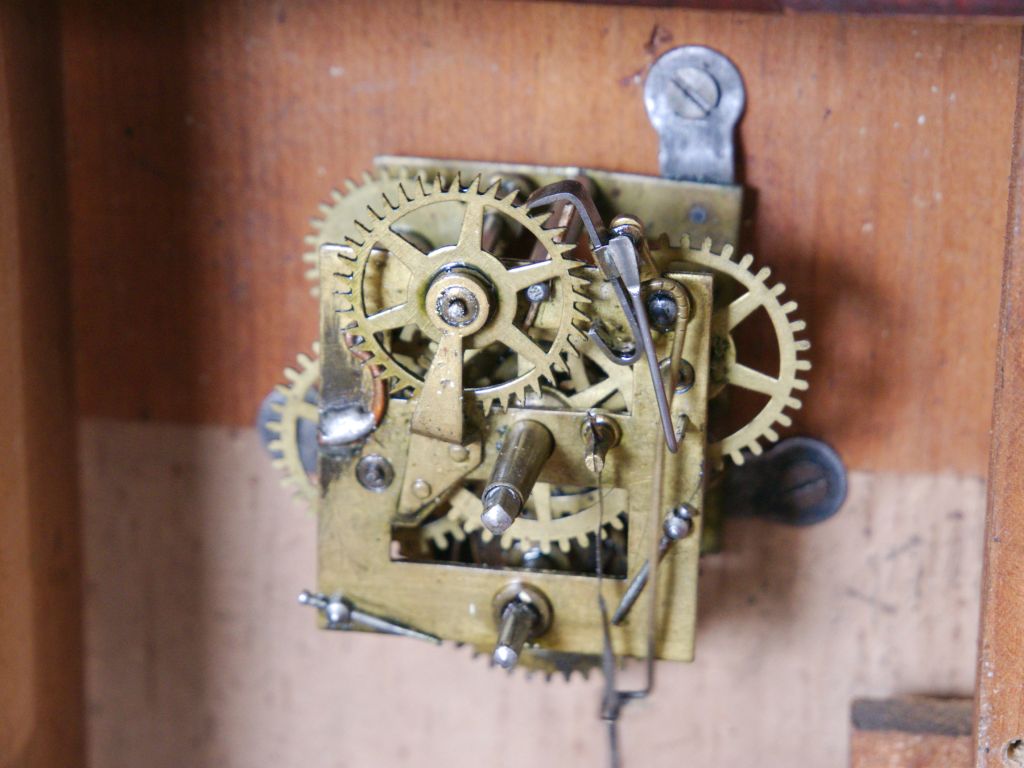
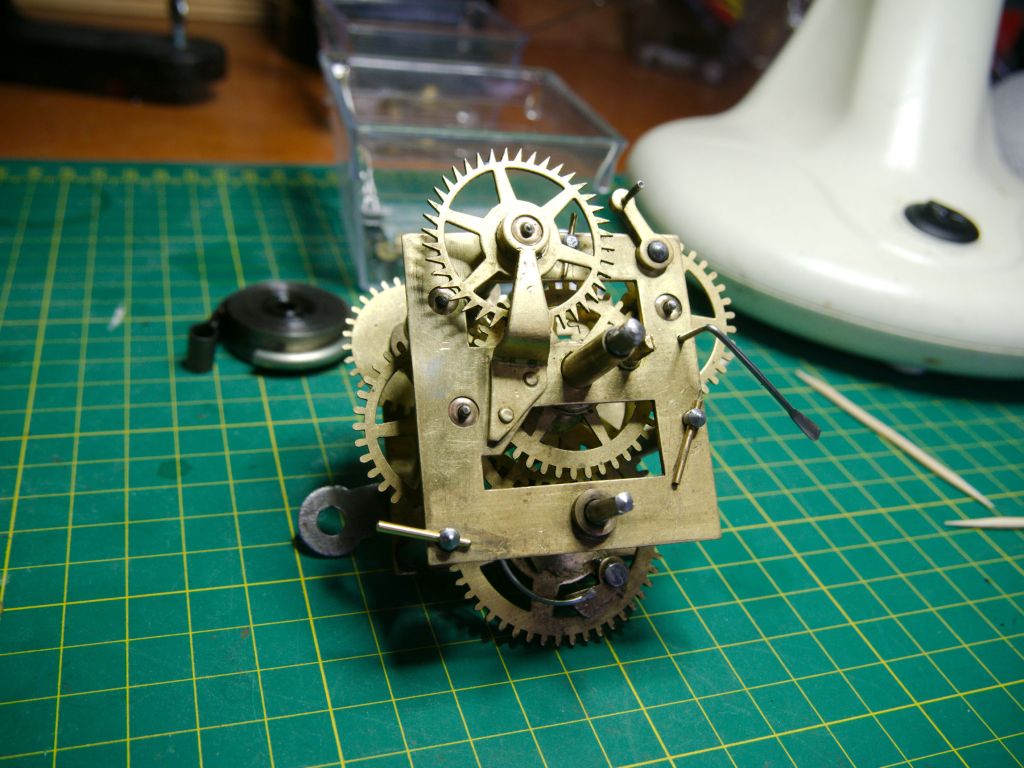
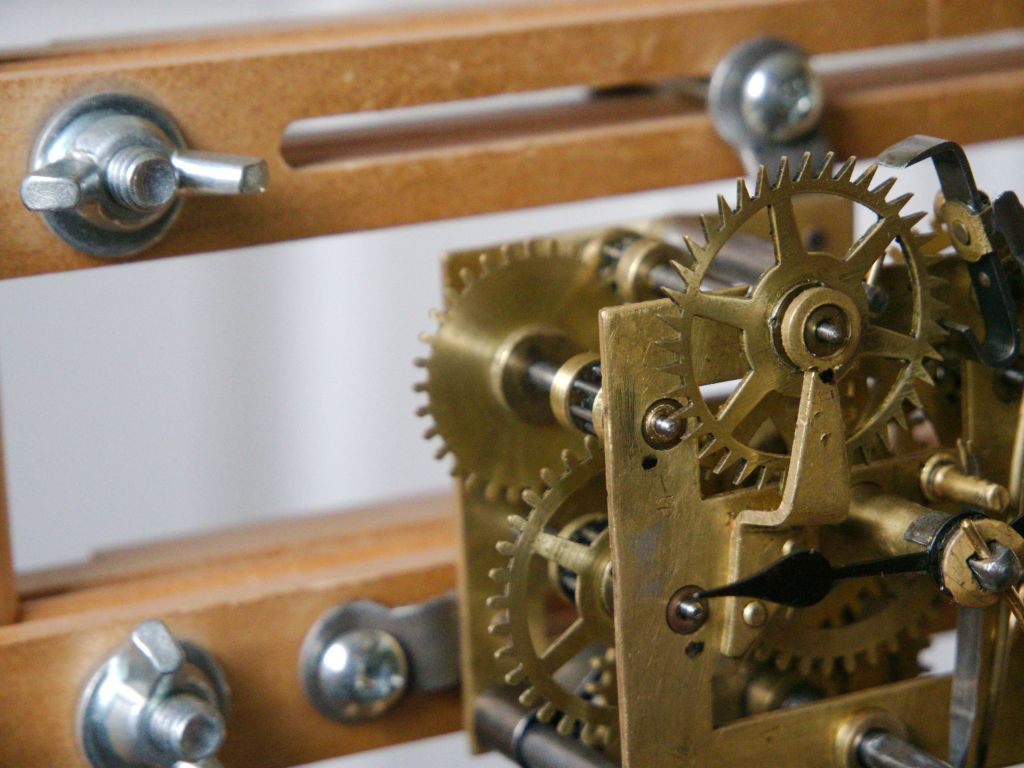
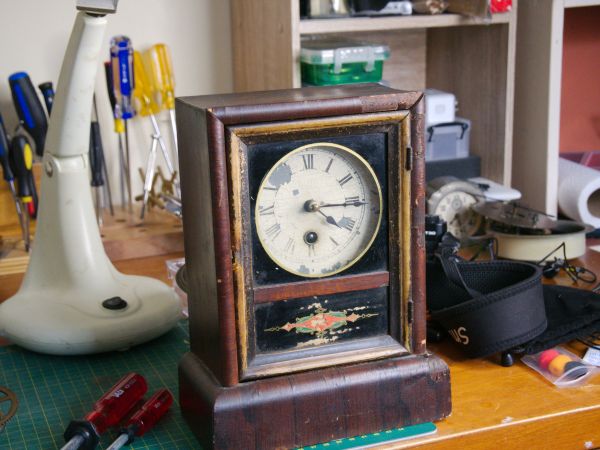

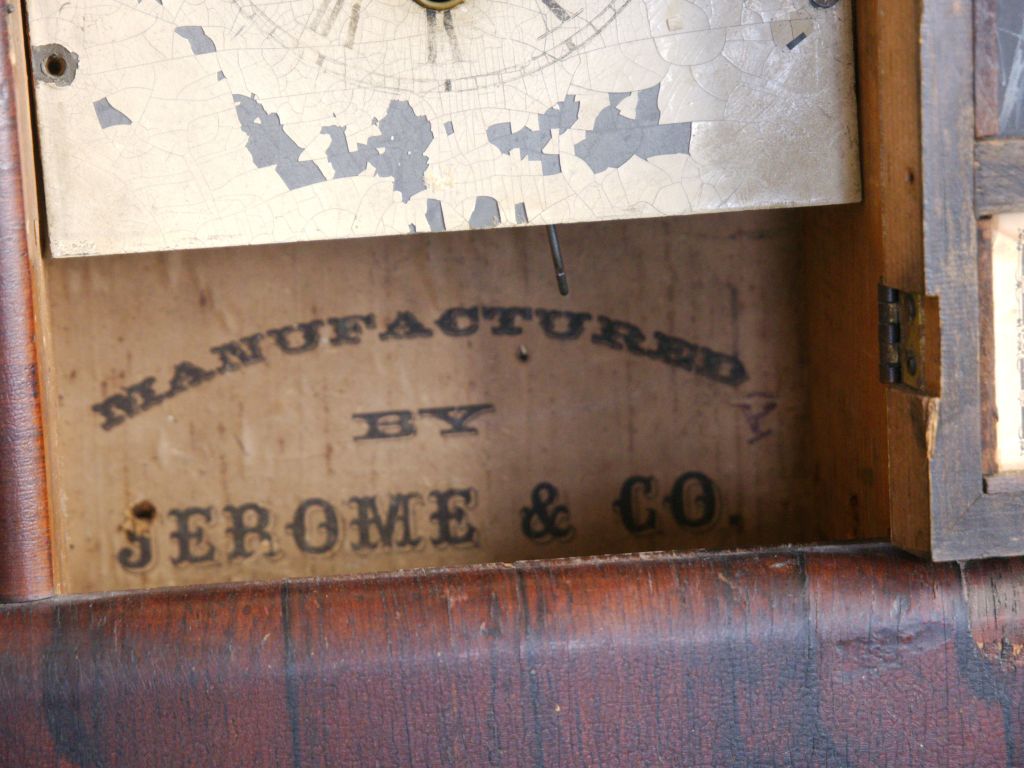
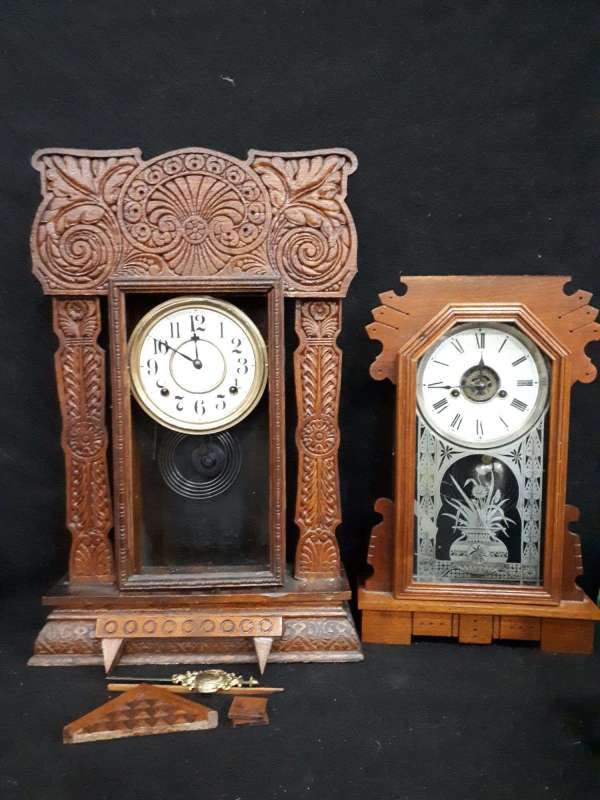
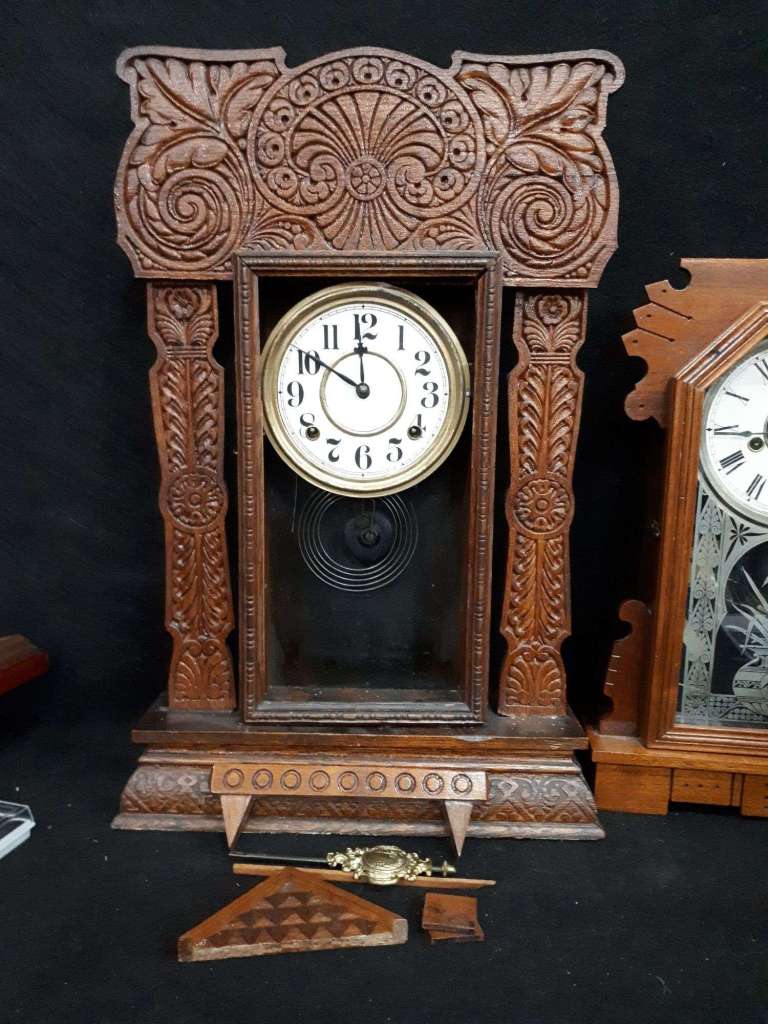


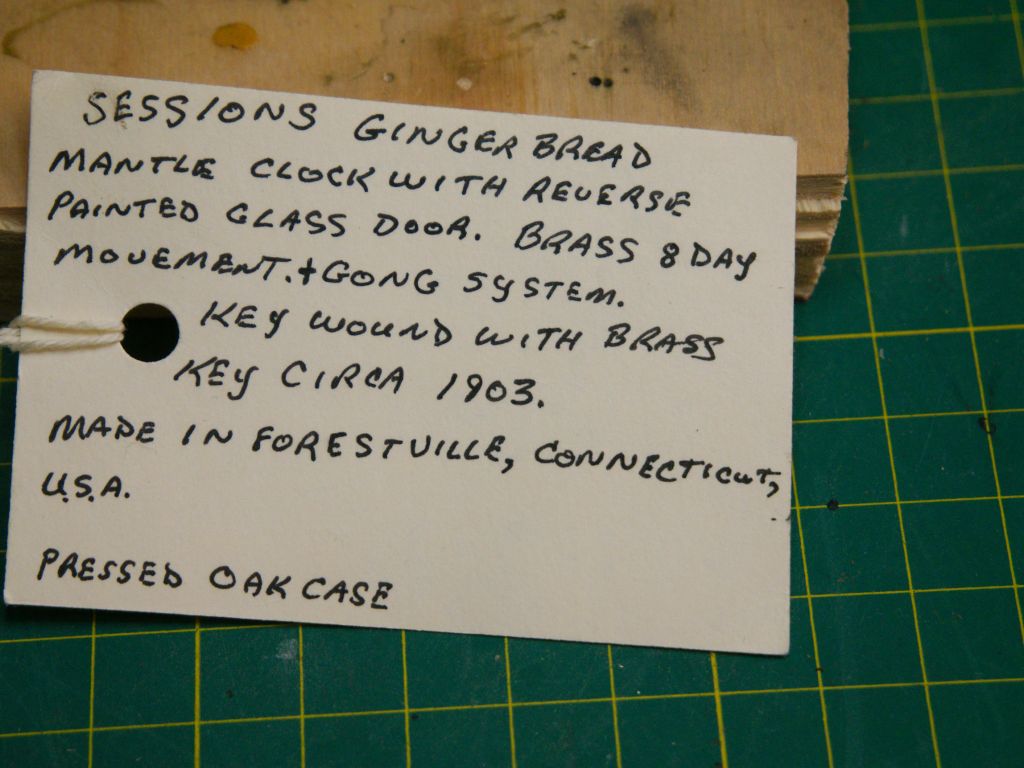
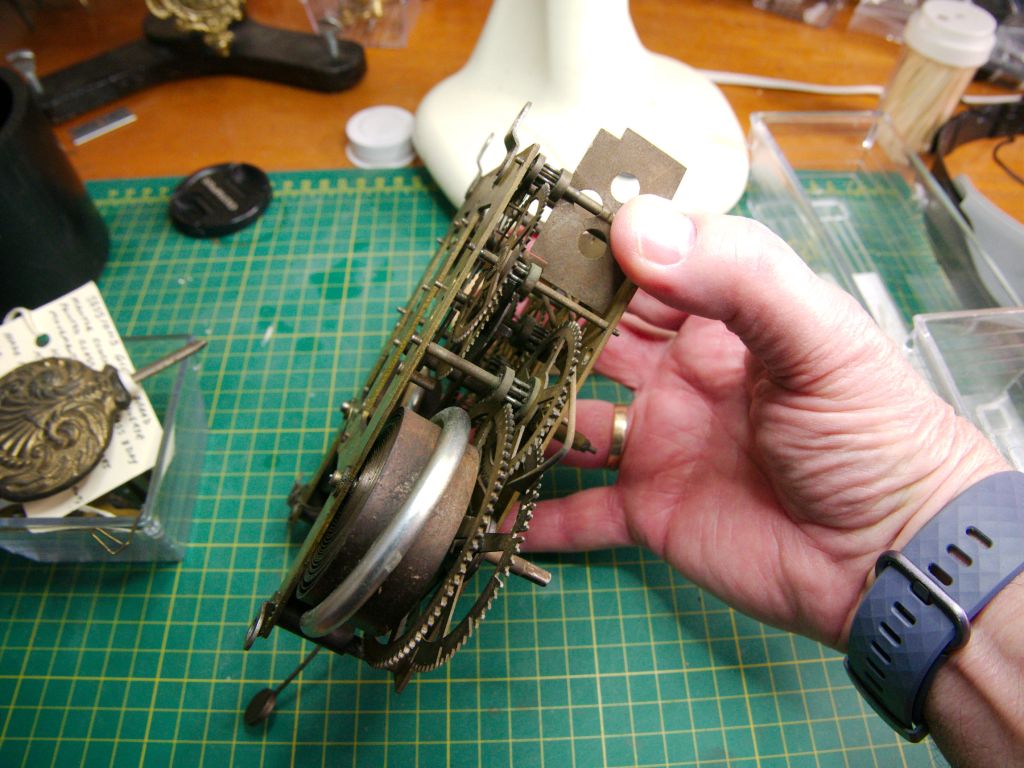
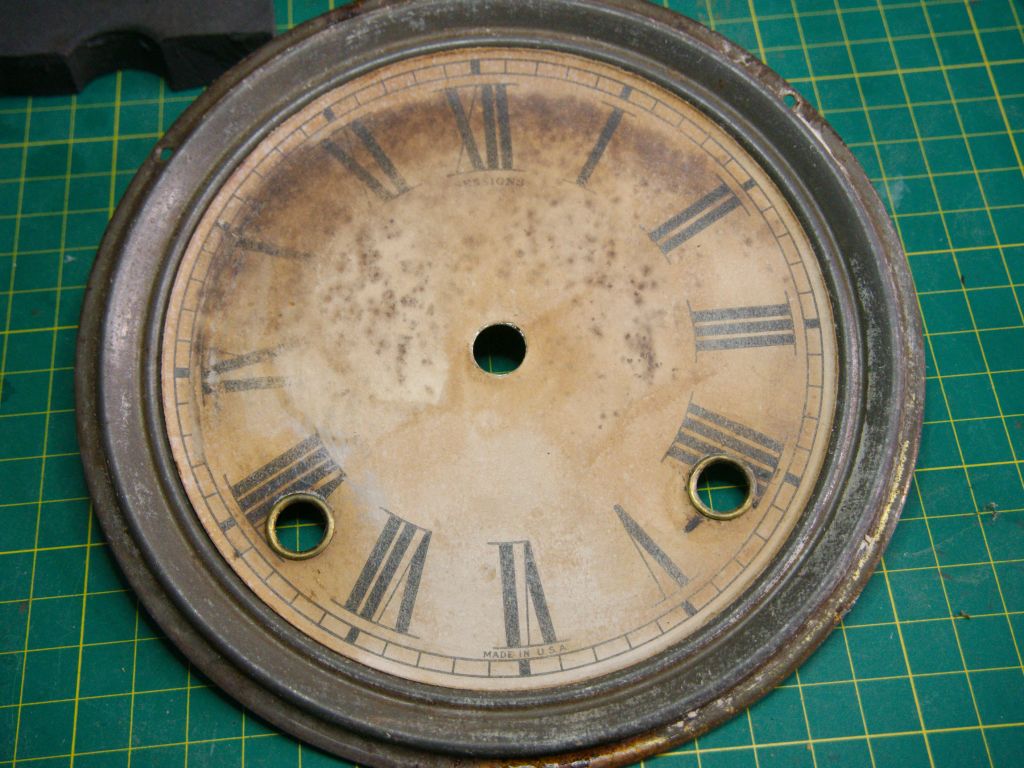
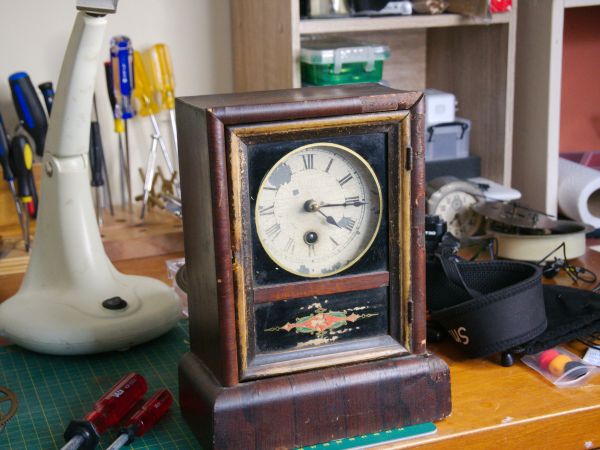


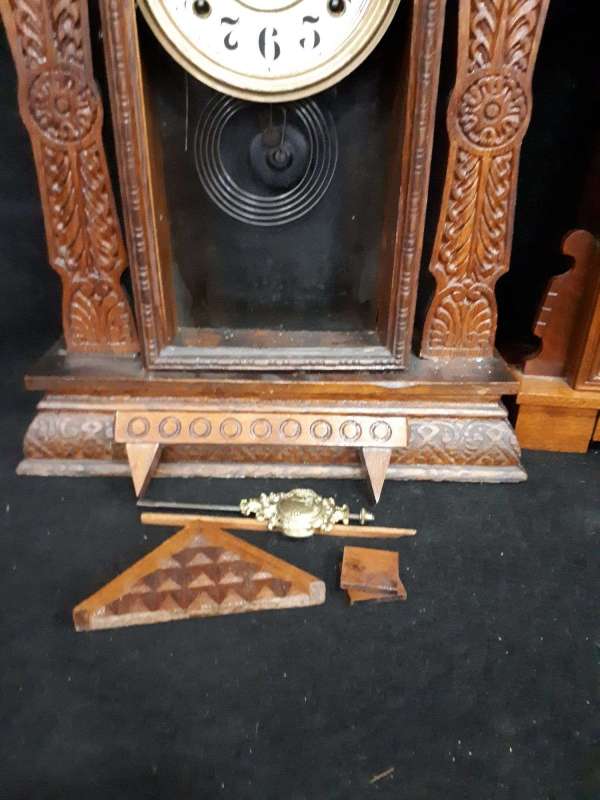
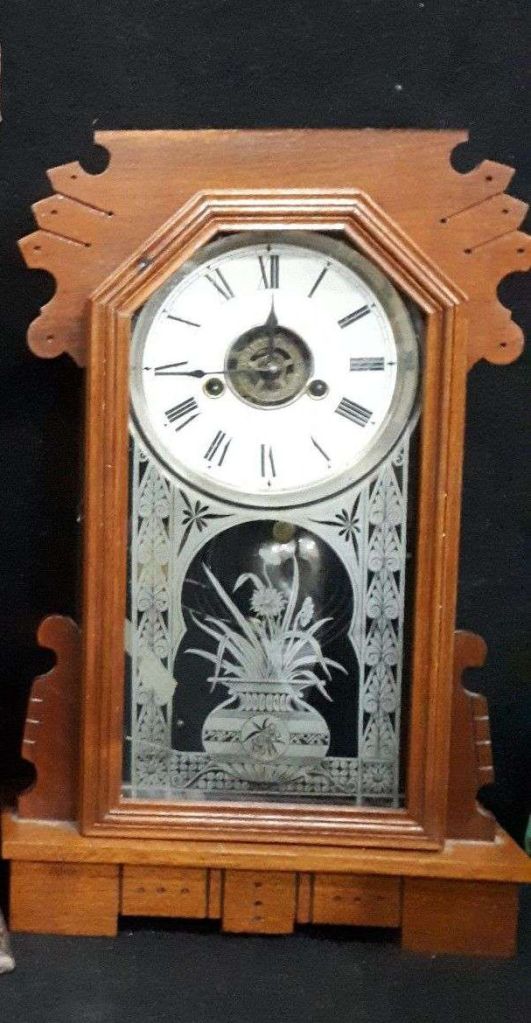
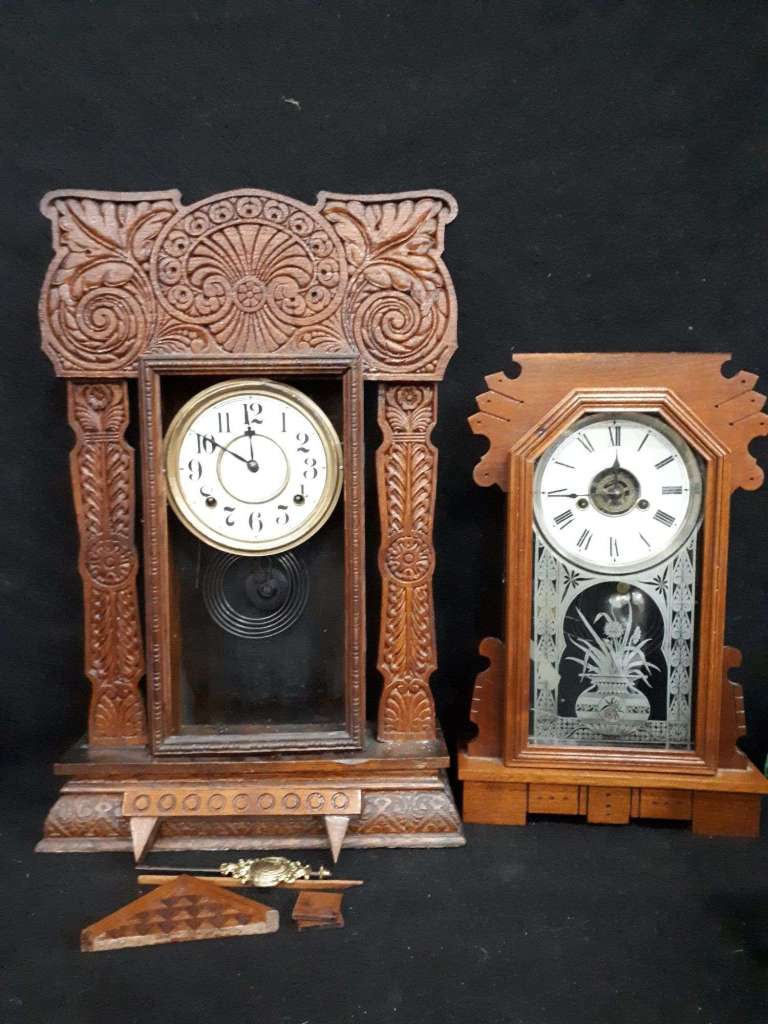
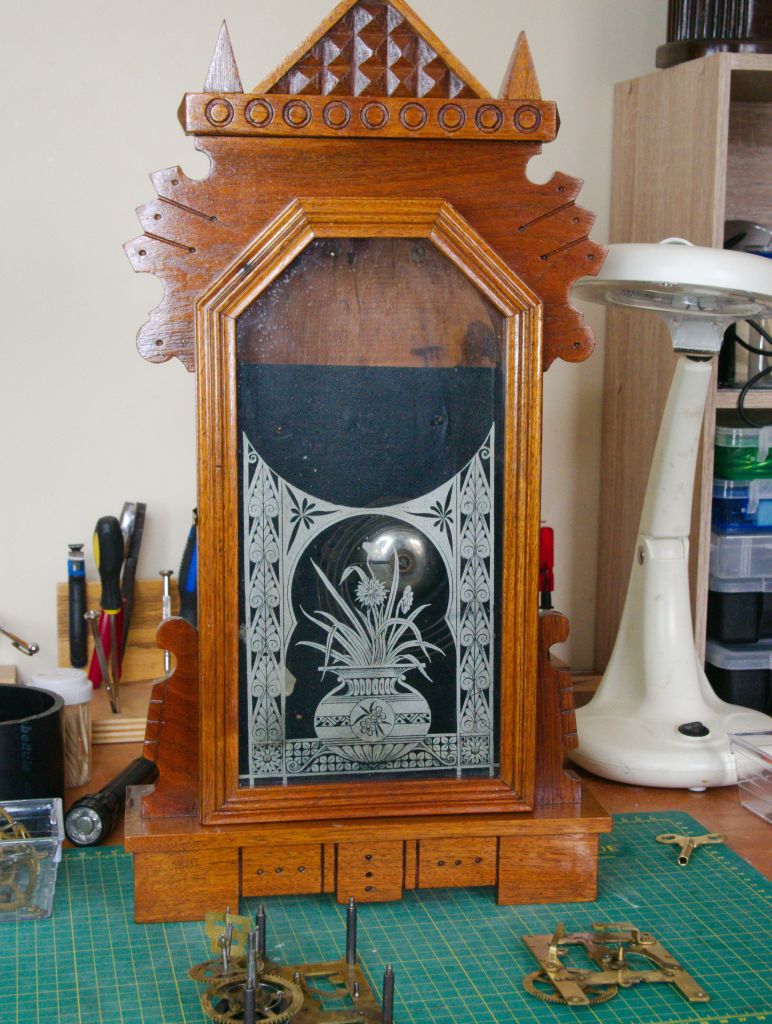
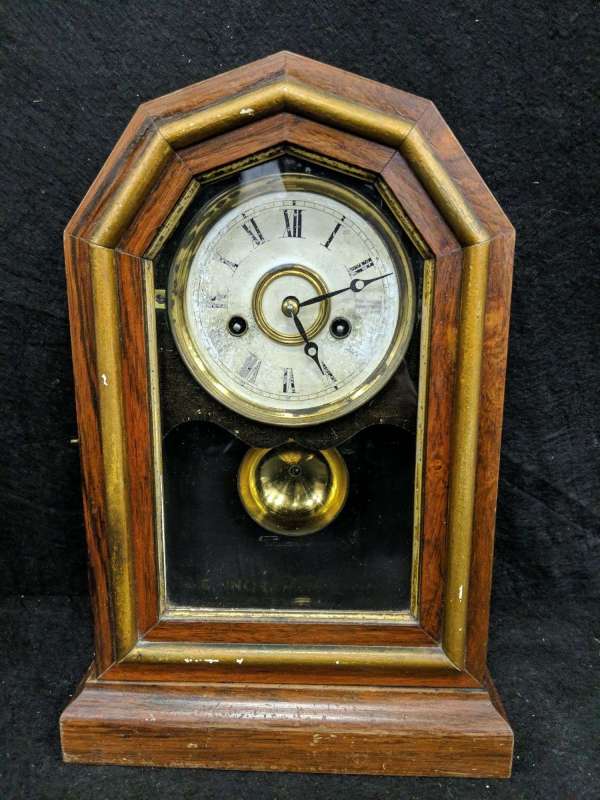
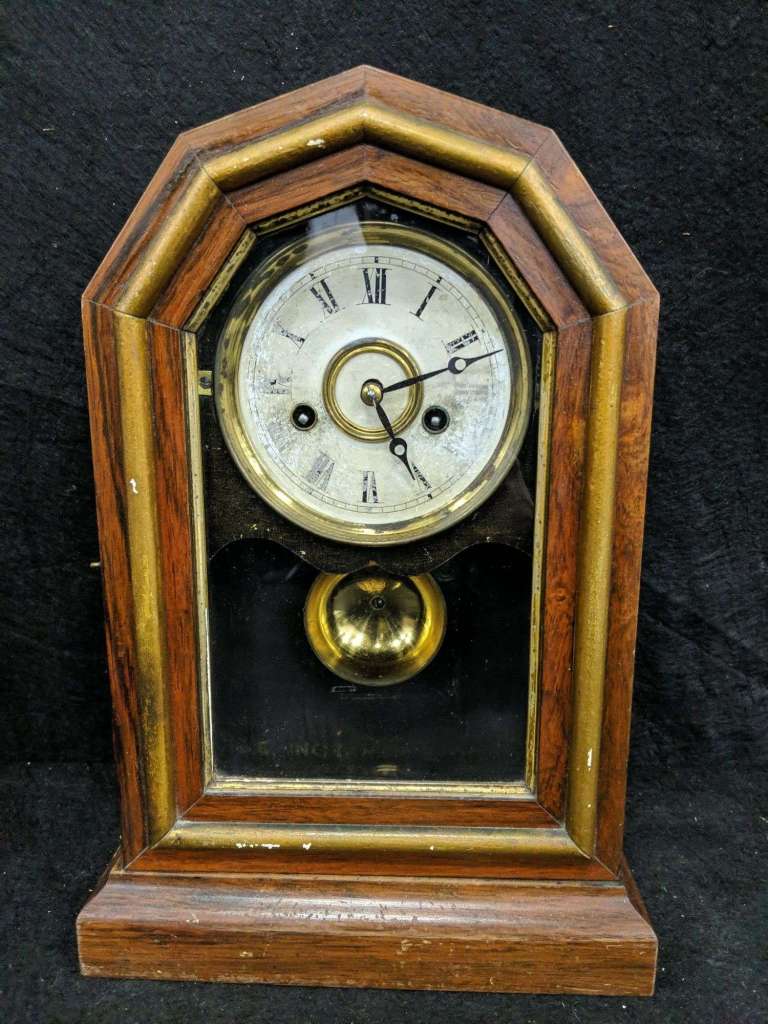

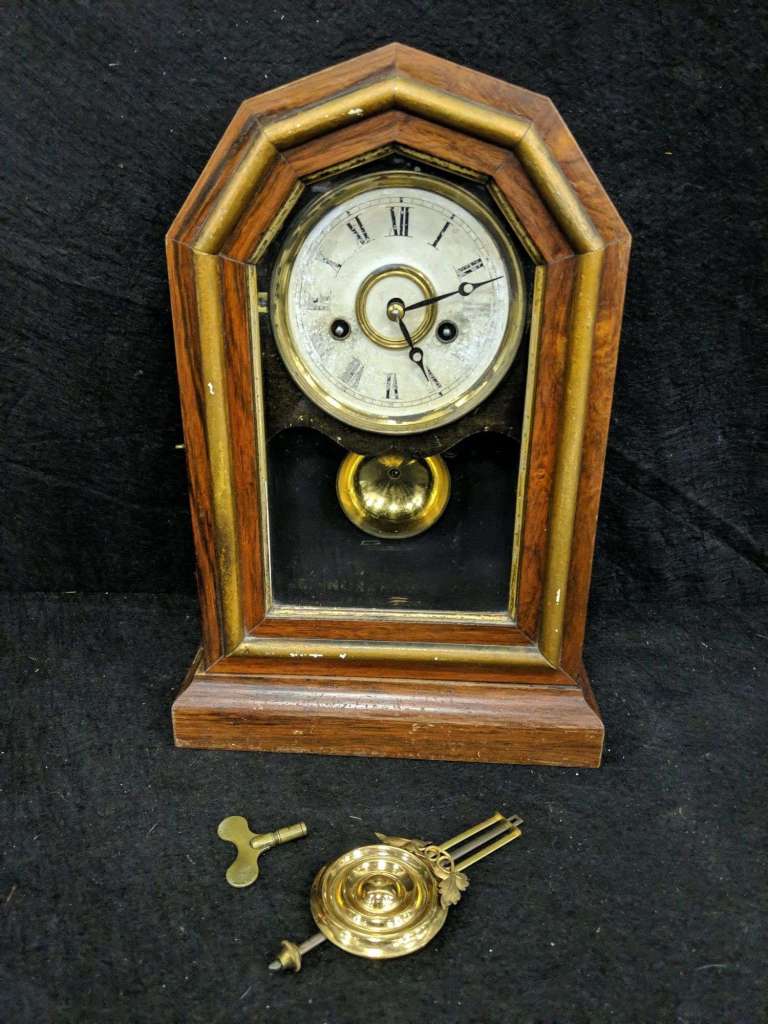
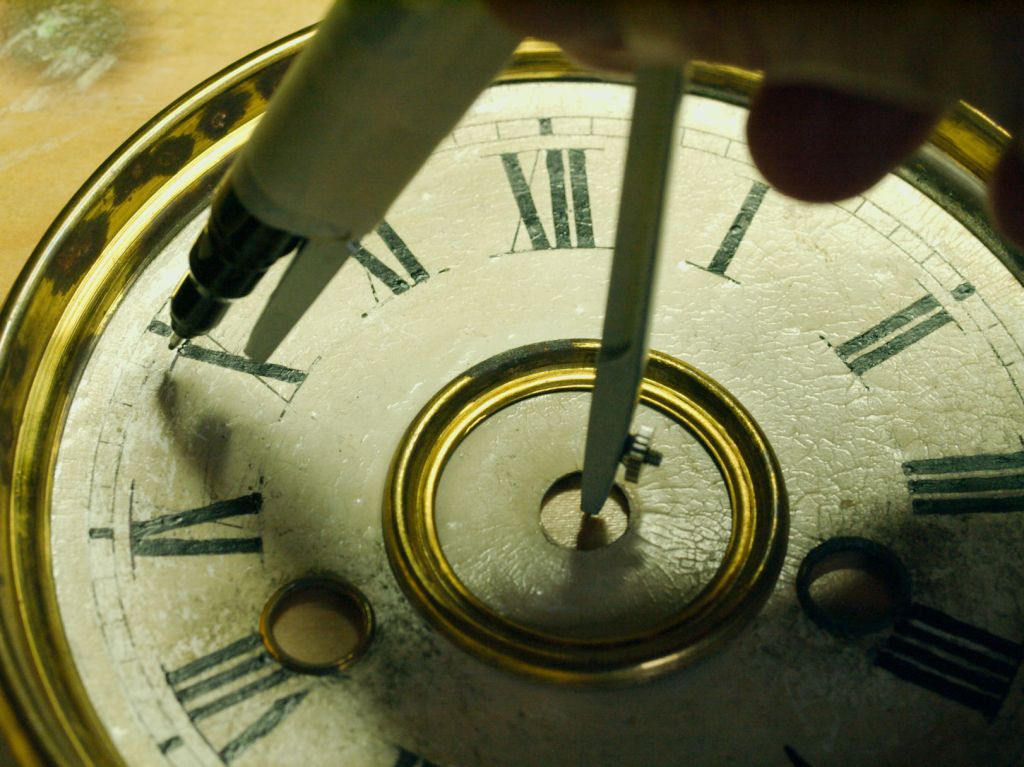

 Antique and Vintage Mechanical Clocks
You must be logged in to post a comment.