This is my first experience with a tall case clock from the 1850s and my first venture into English bell strike movement servicing.
Let me explain. Although the case was made in Scotland, the movement, dial and weights are all from Birmingham, England made at or before 1850. The clock was in fair condition when I bought it from an estate auction early in 2020, though I knew almost immediately that structural repairs and cosmetic fixes were necessary.
In this Part I, I will address case age cracks, a cracked backboard and attaching the backboard to the waist.
In Part II, I will continue with new door pins, replacing a missing right rear foot, cleaning the case, overall finishing & attending to various trim pieces.
Although modern adhesives were used for the main structural repairs, some trim pieces were attached using traditional hot hide glue
The first question is how to address present structural issues. Should I utilize materials and techniques that would have been available at the time or select a modern method that would ensure that the part(s) will continue to provide strength, rigidity and service for many years to come? I used both approaches and my apologies to the purists.
As found, standing in a corner of the auction hall
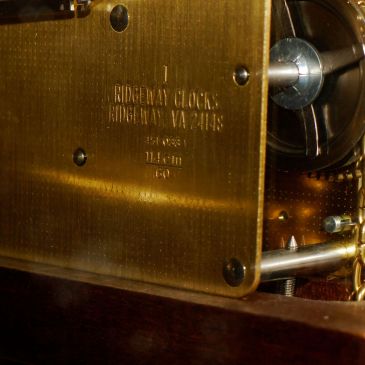
The disassembly of an antique tall case clock need not be a daunting task. When I bought this clock at auction at the beginning of 2020 I put into practice some of the things I had learned when transporting a Ridgeway grandfather clock in 2013. My advice is to work slowly and methodically but think about what you are doing at each step of the process.
Why disassemble? A move across town, across the country, or even redecorating are three of many reasons. Even if you wish to move the clock from one area of your home to another disassembly is required. Yes, moving it a few inches requires disassembly.
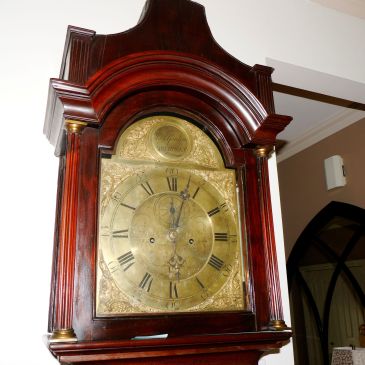
Scottish tall case clock from the 1850s
An antique tall case clock, such as this weight-driven Scottish tall case clock from the 1850s with an English brass bell strike, can be easily disassembled by one person. In this blog, I will walk you through the steps required to safely disassemble an antique tall case clock.
Similar American tall case clocks from the same period are disassembled in the same manner.
For the past several years my wife and I have been searching for an authentic antique tall case clock. I finally found one at an estate auction an hour down the road from where I live and seized the opportunity to purchase a clock I knew practically nothing about. In this blog article, I will describe first impressions and the results of my preliminary research.
I have had only one tall clock in my collection, a Ridgeway Westminster chime clock from the mid-1990s. It is stately with handsome lines but it is a modern clock with a contemporary German-made movement and certainly not an antique.
Tick-Talk Tuesday is about the letters and comments I have received from you, the reader, concerning your clock, issues you might have had, challenges you face or a clock you would like me to profile and my responses to your questions with advice on your particular clock concern. For those comments and questions that stump even me, I consult within my clock circles for the best possible answer
CT asks, “Could you tell me if the attached is worth anything? Thank you.”
My reply, “It certainly looks old but it may not be. There are a number of questions that must be asked to determine its value. You may or may not have the answers.
Does it have provenance; is there a particular history that might give it a value such as previous owners, a prominent location?
Does it have unique features that make it rare or desirable?
Who is the maker of the clock, where was it made (country of origin) and when was it made?
What condition is it in and is the clock complete; are all parts original?
Does the clock have a label, trademark, or name? Clocks that have an identifying label or trademark are more desirable than those that do not.
Unfortunately, in this unpredictable market, it is almost impossible to determine the value of a clock. What you think your clock may be worth may not align with what the experts say and what others are willing to pay.
Without knowing anything about the clock, one such as this that is in fair condition, of unknown origin, parts or pieces missing is not worth much more than something in the $200-300 range.”
The eagle on the clock face suggests that it is likely a low cost, mass-produced American clock.
I have been to Middleton, Nova Scotia many times. I have even passed the Macdonald Consolidated School where the clock museum is located without realizing what treasures lay inside. The clock museum represents a small section of the museum, the remainder of which is dedicated to the history of the area.
In the Spring of 2018 my wife and I set off on one of our many mini staycations. On my agenda was a visit to this museum and I was not disappointed.
Macdonald Museum main clock exhibit area
Holbeck made tall-case clock
It certainly ranks as the best exhibit in Atlantic Canada
Off highway 1 on School Street, Middleton, Nova Scotia stands the Macdonald museum. I had some expectations because I had been to two well respected clock museums, the NAWCC museum in Columbia PA. and the Canadian Clock Museum in Deep River, Ontario. Though not on the same scale as these two, it certainly ranks as the best exhibit in Atlantic Canada.
The Annapolis Valley Macdonald Museum is home to the Nova Scotia Museum’s collection of over 150 antique clocks and watches. This permanent exhibit showcases items collected by the late Norman Phinney and was one of the primary reasons for establishing the Macdonald Museum. Many of the clocks are in working condition. There are a wide variety of clocks and watches on display, with some dating back to the late 17th century. Anyone interested in clocks would do well to see this exhibit – one of the best in Eastern Canada.
The museum is well laid out with enough information on each of the clocks on display to satisfy the general public and clock enthusiasts alike. Each display highlights its significance as an important development in horological history. We were alone as we walked though the main exhibit area and an adjacent room which contained a fascinating old clock-maker’s shop and a well laid out and informative interactive display on how mechanical clocks work.
Clock-maker’s shop
How mechanical clocks work
At least one example from the Baird Clock Co. of Montreal and five examples from the Arthur Pequegnat Clock Co. of Berlin (now Kitchener) Ontario were on display including the Arthur Pequegnat Regulator #1, that the company once advertised as “The finest clock made in America”.
Baird clock from Montreal
Arthur Pequegnat Regulator #1
None of the clocks were running, however. Though the clocks appeared to be in excellent condition, the sound of ticking clocks make for a more authentic experience. All other clock museums make a practice of running some clocks on a rotating basis at any given time.
At the entrance to the clock collection there is a simple plaque dedicated to Norman D. Phinney. Learning more about Norman D. Phinney, his contribution to the Macdonald Museum and the story of how the museum received his clock collection would add to the experience.
Norman D Phinney
If you are a clock fan or even if you only have a casual interest in the world of horology, this small clock museum may surprise you
Though perhaps not within the scope of Phinney’s original collection, examples from the Canada Clock Co. and the Hamilton Clock Co. or more peddlers clocks from Nova Scotia and New Brunswick would have provided an enhanced Canadian horological perspective.
Steeple or sharp Gothic clocks
However, these are minor quibbles and should not detract you from appreciating the high quality of the exhibits which contained British, American, French and Canadian examples or the many styles that included Pillar and Scroll, tall-case, shelf, beehive, steeple, drop octagons, mantel, alarm clocks and Ogee clocks, all of which were well represented.
If you are a clock fan or even if you only have a casual interest in the world of horology, this small clock museum may surprise you.
Oh, and while there, visit the rest of this fascinating museum.
Clocks have been more than just timekeepers throughout history; they are reflections of art, culture, and technological innovation. Whether for practical use or decorative appeal, clock styles have evolved to match the tastes, craftsmanship, and technologies of their times. Here’s a look at some of the most iconic and varied clock styles.
The clock is an instrument designed to keep and indicate time. It is one of the oldest human inventions. The clock has evolved through the ages from sundials in ancient times to early tower clocks of the 14th century weight-driven clocks and finally spring-driven clocks from the 1840s to the 1970s.
The world of mechanical clocks encompasses a wide variety of styles, and distinguishing between them can often be confusing—such as understanding the difference between a shelf clock and a mantel clock. In this article, I’ll navigate through these terms and highlight the most common styles or types, using examples from my own clock collection to illustrate them.
Mantel Clock
Many auction sites and even professional websites use the word mantle. The correct terminology is “mantel”. A mantle is a shawl or coat worn by women, an important role passed on from one person to another or the earth’s crust. A mantel is the top framing of a fireplace or a shelf above a fireplace opening.
A mantel clock is designed to fit on top of a fireplace or shelf. A mantel clock can be time only, time and strike, or a chiming clock. Generally, if there are 2 winding arbours it is a time and strike clock, if the clock has 3 winding arbours is it a chiming clock that is, it will play a tune on the quarter hours, the most common being the Westminster chime.
Mantel clocks might also be referred to as shelf clocks or buffet clocks.
Kitchen Clock
Arthur Pequegnat kitchen clock
Kitchen clocks are often referred to as gingerbread clocks or parlour clocks. At times, it can be difficult to differentiate between a kitchen clock and a parlour clock. Gingerbread clocks are distinctive because their designs are typically created by steam-pressing the wooden front face. However, some clocks, like the one above, are made using a powered cutting saw but are still classified as kitchen clocks. Additionally, some of these clocks included alarm mechanisms. The terms gingerbread, kitchen, and parlour are often used interchangeably.
Another type of kitchen clock is shown below. This is an 8-day time-only delft wall clock made by Forestville.
Delft Clock from ForestvilleE. N. Welch Whittier model
A parlour clock is generally considered more ornate than a kitchen clock, although it may still be referred to as a kitchen clock. It is placed in front hallways, entryways, and so on. The designs are always cut and there may be finials, a mercury-filled pendulum or very ornate design, garish trim pieces, and a decorative tablet.
Vienna Regulator
Gustav Becker two-weight Vienna regulator
There are many styles but most are of the single-weight or two-weight variety. The definition of a Vienna regulator is always open to debate but the consensus among collectors is that they are weight-driven, made in Austria/Germany, ornate in design, have porcelain dials, decorative crowns, large pendulums, and finials on the top and bottom.
The broad definition of Vienna Regulator includes those that are spring-driven. Though not defined as “regulators” it is acceptable among collectors to refer to them as a Vienna style.
Cottage Clock
Canada Clock Co Hamilton Cottage Extra
Sometimes called a mantel clock or a shelf clock, they are usually diminutive in size to occupy a smaller space. They are found in bedrooms and kitchens and are sturdily built since they are often designed to be portable. They come in time only, time and strike, or may have an alarm function.
Carriage Clock
French Carriage Clock
Carriage clocks are portable and were very popular around the turn of the 20th century. French-made carriage clocks are more collectible and fetch generally higher prices although American ones can be quite desirable. Carriage clocks are designed to be portable and are time-only but some are time and strike (with a repeater function) while others may have an alarm function.
Crystal Regulator
Ansonia Crystal Regulator
Crystal Regulator clocks are identified by a brass case with 4 crystals or glass panels. Porcelain dials, Roman or Arabic numerals, ornate in design but sometimes quite garish. Most are 10-12 inches in height though some are smaller. Makers are American and French though French crystal regulators are called four-glass clocks and tend to have higher value. Distinctive by their mercury or faux mercury pendulums. Some have visible Brocot escapements and the time and strike movements are always visible.
Cuckoo Clock
Cuckoo clock
These clocks are pendulum-regulated and make an automated sound like a cuckoo when it strikes the hours. Some can be very intricate with several animated characters. Desirable ones are antiques from the Black Forest region of Germany. Modern ones are generally frustrating to repair, cheaply built, and are poor timekeepers.
Lantern Clock
Converted lantern clock
A lantern clock is a type of antique weight-driven wall clock, shaped like a lantern. They were the first type of clock widely used in private homes. They probably originated before 1500 but only became common after 1600 and in Britain, around 1620. They became obsolete in the 19th century. The one pictured above has been converted into a fusee movement.
Alarm Clock
Baby Ben alarm clock with seconds hand
Alarm clocks are wound once per day and designed to do two things, wake you and display the time. They are cheap, and are average timekeepers but have long-lasting and reliable movements.
Desk Clock
Kienzle World Time clock
These sat on fancy office desks or credenzas in office locations. They are either time-only or time-and-strike. Most were time-only to minimize distractions in the office environment. Some are very attractive and have unique designs and are more decorative than utilitarian. This one above is called a World Time Clock by Kienzle.
Wall Clock
German Mauthe Box clock
A wall clock is broadly defined as any clock designed to be hung on a wall, making it a practical and visible timekeeping solution. Wall clocks come in various styles, from simple and functional designs to highly decorative pieces. This one by Mauthe is often described as a German “box” clock which became popular after the First World War and made into the 1940s.
Schoolhouse Clock
Ansonia schoolhouse clock
They are known as schoolhouse clocks because they hung in many schoolrooms in North America. Usually distinctive by their octagon shape and short or long drop feature with a glass door displaying a swinging pendulum. Many thousands were made; they had cheap mass-produced softwood cases and robust movements. Most were time-only though some were time and strike and others even included a calendar function.
When they were marketed years ago they were not called “schoolhouse clocks” but rather, clocks made for the schoolroom.
Novelty Clock
Chairman Mao Zetong waving as the clock ticks
These clocks are designed for the tourist trade with interesting features. In the case of the above clock, a smiling Mao Zedong has his little red book in hand and is waving “to the masses” as the clock ticks.
Ogee Clock
Waterbury OG clock
It is so-called because of the curved molded wood case. It might also be referred to as an OG clock. The design originated in the United States in the 1830s, distinguished by a case (usually pine) the front outer edges of which are curved into an S-shape (Ogee). This shape is formed by the union of a convex and a concave line. A mass-produced variant of the shelf clock, the Ogee clock typically stands about 30 inches (75 cm) high and is usually weight-driven. The movements were generally made of brass (earlier ones were made of wood) and ran for 30 hours or eight days. This is a 30-hour weight-driven version from the 1870s.
Tall Case Clock
Ridgeway Hamilton Country, Westminster chime
Tall case clocks are known by various names depending on the region. They are referred to as tall-case clocks in American terminology, long-case clocks in British terminology, hall clocks in Canada, and sometimes as floor clocks. However, the most commonly used term is “grandfather clock.”
They are usually weight-driven, with the weights on chains or cables, and are distinctive by their obvious height. They are always 6 feet or over but can be as high as 8 feet high (1.8 to 2.4 meters). They often feature elaborately carved ornamentation on the hood (or bonnet), the frames, the throat, and the dial or clock face. Older ones have 30-hour movements but all modern grandfather clocks run on an 8-day cycle.
Smaller clocks are called grandmother and granddaughter clocks. They are under 6 feet.
Anniversary Clock
Kundo standard size 400-day clock
These clocks are also called torsion clocks or 400-day clocks. 400-day clocks are torsion driven having a long suspension spring to which a weight oscillates back and forth. Typically these clocks operate at 8 beats per minute and run for long cycles on a single wind, up to 400 days. These clocks were popular as wedding gifts or gifts to mark special occasions. They are relatively simple to repair but can be finicky to set up. The newer quartz clocks are very accurate but do not replace the charm and curiosity of the older mechanical ones.
Some might call them purely decorative.
Tower Clock
Tower clock in Holguin, Cuba
In the early 14th century large mechanical clocks began to appear in the towers of Italian cities. There is no record of any working models preceding these public clocks that were weight-driven and regulated by verge-and-foliot escapements. They are referred to as Turret clocks in the UK.
In conclusion, while there are sub-categories for some of the clocks described above, this overview provides a general understanding of the commonly used terms. Having this knowledge can be especially helpful when shopping for a special gift or identifying the style of clock you may have in your possession.
Ridgeway Hamilton Country, now owned by the Howard Miller group of companies
You’ve decided on a new location for your grandfather clock. Now it is time to set it up.
Before you do anything ensure that the clock is level and preferably on a hard surface. Wood floors are great but carpeted floors are not optimal. There are 4 leveling wheels or points on the bottom of the clock. Using a spirit level spin the leveling wheels or points counterclockwise or clockwise to achieve a perfectly levelled clock. If you wish to screw the case to the wall to stabilize it, this can now be done as long as it is standing straight up and not leaning backwards. Stabilizing the case also reduces sympathetic vibration.
Steps for setting up your clock
Release the chains or cables that were bundled during transport.
Hook the weights. If you had marked them or if they have location direction on the bottom (L, C, R; “L” for left, “C” for centre and “R” for right) ensure that the correct weight goes where it should. The weights are not the same although they may look identical. On most modern grandfather clocks each weight provides the motive power necessary to operate the time, chime and strike trains of your grandfather clock. The manufacturer has determined that a weight powered by an exact number of lbs will affect how the clock will run. For example, the chime train requires a specific weight. If the weight is too light the chimes will run slowly or not at all. Generally speaking, the heaviest weight goes on the far right side chime train, as it needs more power to run the chime hammers.
Pull the weights up if your clock has chains or use a winding crank to bring the weights up if equipped with cables. For a properly striking and chiming grandfather clock the weights will more or less descend at the same time. Check through the side vents that the cables are not tangled. A tangled cable will stop the clock.
For cables: not only check to make sure that the weight is hooked but the cable is also in the cable pulley.
Release the chiming rods by carefully pulling off the protective Styrofoam or cardboard.
Return the side vents or access panels that slot in from the inside. They will drop into their channels.
While holding the pendulum guide with one hand (using cotton gloves), slip the pendulum in through the front door with your other hand an place the pendulum hook over the pin or through the slot on the pendulum guide, and lower the pendulum until it is hanging securely on the pendulum guide.
The pendulum rod hooks onto the suspension springLyre pendulum
Let the Grandfather Clock operate for ten minutes until the pendulum settles into an even swinging motion. An even swinging motion means that there is an equal time between the tick and the tock. In clock terms, it means that the clock is in beat.
Reinstall any decorative ornaments such as finials that friction fit into their respective holes.
If your clock has a moon phase dial: To set the moon dial, apply slight pressure with your fingers to the front of the moon dial. Rotate the moon dial clockwise until the moon is positioned according to the current moon phase. Never force it, it should move easily. If the moon dial will not rotate wait 6 hours and try again. As long as the grandfather clock operates it will display the correct moon phase. If the clock stops for more than a day the moon dial will have to be reset.
Moon phase dial is adjustable by carefully moving it clockwise
Although some grandfather clock instructions say that you can move the hands backwards, it is not a method I would advocate. Never move the hour hand. The hour hand will move with the minute hand. The hour hand is a friction fit and moving it will knock the hourly strike out of sequence. By moving the minute hand Clockwise it is not necessary to wait for the Grandfather Clock to chime as the minute hand passes each quarter-hour. The movement has a self-correcting feature that synchronizes the chimes with the time. If the clock does not synchronize, give the clock an hour or so before making any further adjustments.
If the clock does not strike or chime, make sure that the silencer lever switch is in the “chime” position.
Allow the clock to acclimatize to the new environment before regulating the movement. A clock that is regulated keeps the correct time. Regulation is achieved by turning a screw on the bottom of the pendulum bob. Turning the screw clockwise will make the clock go faster and turning the screw counterclockwise will make it run slower.
Close and lock the front access door.
Ridgeway cabinet key
Consult your owner’s manual for setting special features not covered above.
Tick-Talk Tuesday is about the letters and comments I have received from you, the reader, concerning your clock, issues you might have had and challenges you face and my responses to your questions with advice on your particular clock concern and of course, my general comments. For those comments and questions that stump even me, I consult within my clock circle for the best possible answer.
NV writes about her Arthur Pequegnat Nelson hall (tall-case) clock.
“I have an antique, oak ‘hall’ clock that’s been handed down in my family. I read in an article you wrote that you collect them.
This clock was in my home growing up and my grandmother, now 96, reminds me of its history and knows whose home it was originally from in our family.(my grandfather’s grandparents, I believe). I’ve started to look into the history of these clocks. I’m interested to know what your thoughts are if you are interested in sharing them.
I can tell you that it’s in beautiful condition, however although it had always worked and sounded well (still sounds beautiful) when it was shipped here to BC in the 90s, it was never restarted and the finial became dislodged, but it is not cracked or broken. So it’d since been stored at my grandmother’s but she never got it going after it arrived and needs to ‘be started’ as the weights are still off (or possibly a repair?) Also the key was lost.
I’ve just recently brought it to my apartment (Gramma wanted the space!) And she supports me in whether I decide to keep it or not.Please contact me if you are interested as I am considering selling but regardless I will need to determine value/appraisal if I do keep it, at least for insurance. ”
My reply.
“You have a real Canadian treasure. Though it is called a hall clock it’s actual name is the “Nelson”. There is one on display at the Canadian Clock Museum in Deep River Ontario. Unlike many tall case clocks that decline in value yours is actually increasing since it is continually sought after by collectors. If it says Berlin on the lower part of the dial it was made before 1917. Clocks made after that simply said, “The Arthur Pequegnat Clock Company of Canada”. The Arthur Pequegnat Clock Company closed its doors in 1941.
The Nelson is in the middle
You can easily find a replacement key. Perrins would have the key although off hand I do not know the correct size. The finial on top is a friction fit.
It would be in the neighbourhood of $2000. You should keep it not only because it has strong sentimental value but it is an important part of Canadian history. It would also be worth repairing.
NV cannot keep the clock and has plans to sell it.
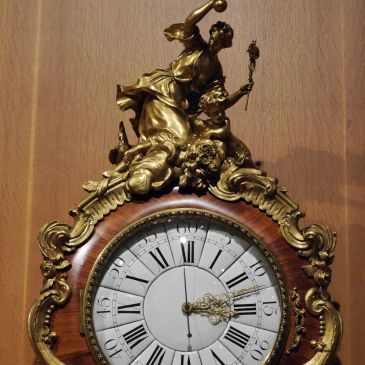
In 2014 during a visit to Portugal I had a chance to visit one of the country`s premier museums in Lisbon.
They had a magnificent collection of antique clocks but this particular clock attracted my attention. This weight driven “Regulador” was made by Burgh, Bernard (II) van Risenburgh in Paris between 1745-50. It is made of oak with exotic woods and bronze. The style is Rococo or late baroque, very ornate with elaborate though balanced and a less angular asymmetrical design.
Ridgeway Hamilton Country, Westminster Chime, 1996
How did we get the name grandfather clock?
Most serious clock collectors and enthusiasts do not use the term grandfather clock when conversing with each other.
Firstly, most clock collectors and enthusiasts do not use the term grandfather clock when interacting with each other. I tend to use the word when conversing with family and friends because they know exactly what I am talking about. The name first appeared in a song. In 1876, a song called My Grandfather’s Clock by Henry C. Work popularized the term grandfather clock and the name has stuck to this day. You can listen to Work’s famous song here.
Twiss Canadian tall clock circa 1890
Secondly, depending on where you are in the world this style of clock may have a different name. In England it would be referred to as a “long-case clock” while Americans prefer the term “tall clocks.” During the 20th and 21st centuries, some writers, including those writing for museum-sponsored publications, have combined regional names into one term,“tall case clock.” It is also referred to as a “floor clock”. These clocks have the following features in common. They are a tall, freestanding, made from a variety of wood, are time and strike though all modern clocks include a chime, weight-driven pendulum with the pendulum held inside the waist or throat of the case. The case often features elaborately carved ornamentation on the hood (or bonnet), which surrounds and frames the dial, or clock face.
A trio of Arthur Pequegnat tall clocks, circa 1912
Let’s go further back in history
Let’s go back in history. In the 16th and 17 century English lantern or chamber clocks were popular but they had serious limitations. Lantern clocks used a verge and foliot escapement and were notoriously inaccurate and unreliable, in fact, some had to be wound two and three time a day and were limited to a 12-15 hour run time. Many of the verge escapement with pendulums had a very wide pendulum swing.
It is widely accepted that the anchor escapement was invented by Robert Hook around 1657. An escapement is basically a speed regulator on a clock. At about the same time the pendulum was invented. The anchor escapement made for shorter pendulum swings, and heavier and longer pendulums. Since the pendulum had a lower beat a clock with an anchor escapement required less power and could run longer, up to 8 days. Only then did cabinetmakers get involved in building a case around the weights and pendulum. For an excellent article on the origin and evolution of the anchor escapement go here.
Hugh Gordon long-case clock circa 1740
As long-case clocks became popular regional styles began to emerge.
Hugh Gordon, clock-maker worked in Aberdeen, Scotland from 1748-90. He had previously worked in Edinburgh and London. Although a very proficient maker little of his work seems to have survived.
Hugh Gordon tall-case clock
This is a friend’s clock and I was asked to research it. Unfortunately, I have discovered very little so far.
Hugh Gordon tall-case clock
This time and strike clock is an excellent example of Scottish style and was likely made between 1760 to 1770 judging by the design of the spandrels.
Hugh Gordon face, hands and spandrels
Hugh Gordon pagoda hood and face
It features a second hand just below the 12 o’clock position and a single date aperture just beneath the hour pipe. It is a nicely proportioned clock with a tall centre throat and pagoda-styled top bonnet; the centre engraving is a typical feature of the Scottish clocks of the latter part of the 18th century as is the box calendar opening (date aperture), side glass on either side of the hood and doped canvas top cover. These clocks are not overly tall at about 7′.
It is missing three finials; one on top and on the left and right front corners. The mounting holes were evidently covered up by a later canvas re-application. The chapter ring and dial centre would have been silvered at one time and rubbed clean by over-polishing through the years. The hour hand looks correct but the original minute hand would have had a serpentine design in keeping with the hour hand.
Hugh Gordon face and hands
This clock has been in my friend’s family since 1850 having been brought over by ship when his ancestors immigrated to Canada. It has survived quite well and it has been well taken care of.
It is not in running order. I suggested that my friend seek a clock repair person (horologist) who is knowledgeable in the repair of antique tall-case clocks particularly with clocks of this era as special care and attention is required if parts need to be rebuilt/repaired to remain consistent with the period.
Have you ever stayed at an inn or B&B? If you have you might have noticed those that have some sort of historical significance with furniture dating back a 100 years or more, have the odd antique or vintage clock. However, it frustrates me to no end to see them not running.
In the summer of 2014 my wife and I stayed at a beautiful century-old inn in Ganonoque, Ontario, Canada. There were at least 8 clocks in various locations within the inn. They were quite nice and appeared to be in good shape but none were running. A shame! Perhaps there are a number of reasons; clock(s) need(s) servicing / does not run, broken for whatever reason, laziness; staff cannot be bothered to keep them running, unsure how they work or fear of breaking the clock if staff attempt to wind or regulate it (them). I did not inquire.
I’m going to tell you about a pleasant exception we found on our travels. My wife and I were in Bar Harbor, Maine, USA in early June (2016) and I am delighted to say that I discovered that at the Bar Harbor Inn which is, I might add, a beautiful and stately inn prominently located on the village harbor(!), antique and vintage clocks inside the front room of the inn that were actually running.
Bar Harbor Inn, Bar Harbor, Maine
I was so amazed that I stopped to examine the clocks without touching them, of course, and while doing so was approached by an elderly gentleman who identified himself as the bell captain. At the time (pun unintended) I was looking at what might be a German Mauthe long case round top, time and strike clock (please tell me if you know otherwise). He mentioned that it was brought over at the end of the Second World War by an American serviceman. Despite working at the inn for over 30 years and maintaining the clock on a weekly basis, he could not tell me the maker. He was no doubt enamored with the clock and obviously not concerned who made it.
Possibly Mauthe tall case
He showed me another clock, a Seth Thomas time and strike which for some strange reason he was not permitted to wind or even touch for that matter. That duty was obviously left to a specially designated person since the clock must have had some particular relevance. Now, it doesn’t take much to wind a clock but some familiarity with how these old clocks work certainly goes a long way to preserving them.
American Seth Thomas time and strike tambour style shelf clock
If you are, like myself, a clock person, the next time you are in an inn or B&B praise the owner / staff if the antique and vintage clocks are running or politely question why they are not. They deserve to be running.
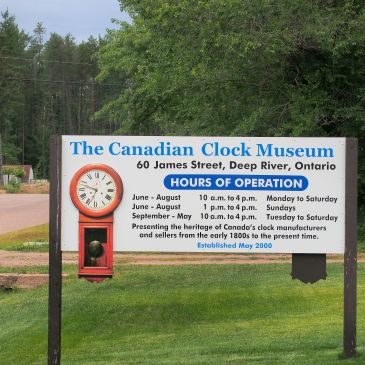
Every museum I have ever been to has allowed me to walk away with the feeling that I have learned something new. All museums document interesting histories that are intended to educate and inspire visitors. The Canadian Clock Museum at 60 James Street, Deep River, Ontario, operated by curator Allan Symons is one such example.
The Canadian Clock Museum
The Canadian Clock Museum in Deep River, Ontario is a 2 1/2 hour drive from the nation’s capital, Ottawa, Ontario. I have visited it twice and I found myself learning even more on my second tour. It has a fascinating collection of clocks that are largely from North America. However, it has the most extensive collection of Arthur Pequegnat clocks that I know of outside a private collection.
A collection of Pequegnat mantel clocks found at the museum
The Arthur Pequegnat Clock Company made clocks in Kitchener, Ontario (called Berlin, Ontario up to 1917) to 1941 when the company ceased production. Pequegnat clocks were wholly made in Canada while their counterparts built and assembled cases in Canada and imported movements from the US, England, France and Germany. The Canada Clock Company and Hamilton Clock Company had a 12 year span also made both cases and movements but not at the volume of Arthur Pequegnat.
I have written about Arthur Pequegnat clocks in previous posts and I have been slowly building a modest collection for myself.
Prince of Wales parlour clock, Canada Clock Company circa 1880
Three tall case Arthur Pequegnat clocks
Many manufacturers are represented at this museum and even if you have only a passing interest in clocks you would no doubt find the displays both interesting and thought provoking. Companies represented are the Western Clock Company, Walter Clocks, the Snider Clock Corporation, Seth Thomas that operated a factory in Peterborough from the 1930’s to the 80’s, Breslin Industries, the Hammond Company of Canada Ltd to name just a few. Canadian Clock Maker Martin Cheney who briefly made high quality wall and floor clocks in Montreal in the early 1800’s is not represented, unfortunately.
Twiss tall case early 1800’s
There are even some special clocks such as this Synchronome electrical impulse master clock from the 1930’s.
Master clock mechanism
Master clock with slave clock at top
So, spend time at the museum talking to its knowledgeable curator or avail yourself of the manuals and documents at hand and conduct your own research into a specific clock.
This museum is modest by museum standards and not quite up to the scope and scale of the National Association of Watch and Clock Collectors Museum located in Columbia, Penn, USA but don’t let its compact size fool you. There is plenty to see.
If you have any interest in clocks I strongly urge you visit this one if you are at or near the Deep River area. Outside Canada? I encourage you to seek out clock museums in your own country and take the time to understand the history of clocks from around the world. Its about time!
A Martin Cheney clock is on my wish list though I doubt I will ever see one let alone buy one, they are that rare. So who is this clock-maker from Montreal, Quebec?
Could this be a Martin Cheney tall-case clock?
My wife and I were staying at an historic Inn in downtown Halifax (Nova Scotia, Canada) in the spring of 2016. We discovered a fully restored long-case clock in the front room of the inn. The inscription “Canterbury” on the dial face suggested that is was an English clock or would it be a Canadian clock made by Montreal clock-maker Martin Cheney almost 200 years ago? I should have asked.
Upon returning home I did some research. I posed the question on a clock forum site and the response was “who is Martin Cheney?” In clock collecting circles the name is not exactly commonplace. Not a lot is written about this man despite many of his clocks surviving to this day.
Barely readable numerals
Martin Cheney – an American born clock-maker
In 1778, Martin Cheney was born into a well-known and established American clock-making family. He was one of four clock-makers born to Benjamin Cheney 1725-1815 and Elizabeth Long Cheney in East Hartford, Connecticut. Benjamin most likely trained all four of his boys in the art of clock-making. Asahel was the oldest and was born in 1759. He then moved to Vermont. Elisha was born in 1770 and died in 1847. He settled in Berlin, Connecticut. Russell was the youngest. It appears he moved north to Putney, Vermont. Martin also had an uncle, Timothy 1731-1795. He became a well-known clock-maker in East Hartford and worked closely with Benjamin. By 1803, Martin Cheney moved up the Connecticut River to Windsor, Vermont. While in Vermont he advertised that he has fine English Watches, watch keys, chains and seals for sale.
Political events in the United States sent a group of families to the British territory (as Canada was known prior to 1867) in the early 1800s. Martin moved to Montreal in 1809. He remained in Montreal for some twenty years. In 1817 he formed a partnership with J. A. Dwight and advertised this business as Cheney & Dwight at 104 St Paul Street, Montreal (now a show-bar!). He made both movements and cases, wall and tall case clocks and banjo clocks. The partnership with Dwight lasted until 1830. In 1827, Martin placed an advertisement in Burlington, Vermont newspaper for a journeyman clock-maker to work with him in Montreal. Although Cheney continued to make clocks into the 1830s there is no information on Cheney beyond 1830, however, it appears that he spent the remainder of his days in Montreal.
What is a Cheney clock?
What is intriguing about a Martin Cheney clock? His clocks featured outstanding inlaid mahogany reflecting both high style and workmanship. The cases were well proportioned; this long-case clock has a long and narrow waist and a large rectangular waist door that is fitted with an applied molding. The center of this door also features a selection of mahogany veneer. Open this door and one can access the inside of the case. The sides of the waist are fitted with quarter round columns. These terminate in brass quarter capitals. The bonnet features a New England style raised centre brass inlay top piece. It is surmounted by three brass balls and spiked finials. The molded arch is supported by fully turned and fluted bonnet columns. They are mounted in brass capitals. These columns flank the sides of the arched bonnet door. This door is line inlaid and it opens to access the dial of the clock. Had I looked at the movement it would have confirmed the fine craftsmanship of this 19th century timepiece.
This clock at the historic inn I described above certainly fits the style and detail of a Martin Cheney clock, so is it a Cheney clock? Some day I will have to find that out!
You must be logged in to post a comment.