
Hamburg Amerikanische Uhrenfabrik | Servicing an 8-day Countwheel Strike Movement – Part II

I am currently working on a mantel clock from the Hamburg American Clock Company. This is Part II in a two-part series. For Part I go here.

The Hamburg American Clock Company is otherwise known as Hamburg Amerikanische Uhrenfabrik or HAU and in many parts of the world, it is simply known as HAC.

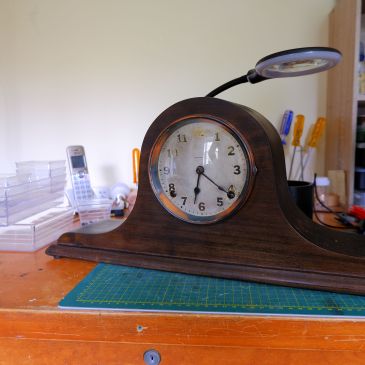
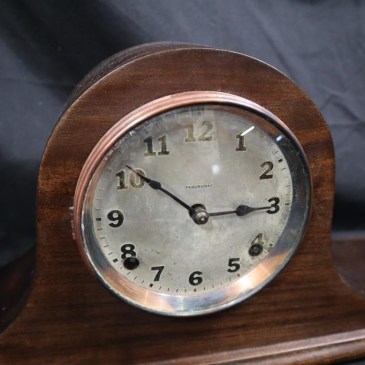
HAC mantel clock circa 1926

In Part I, I described the steps taken so far which are disassembly, inspection, cleaning of the parts, and polishing of all pivots. The next steps are bushing work, reassembly, oiling (the mainsprings were oiled in a previous step), and finally, testing.

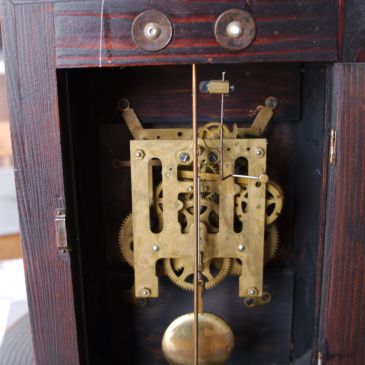
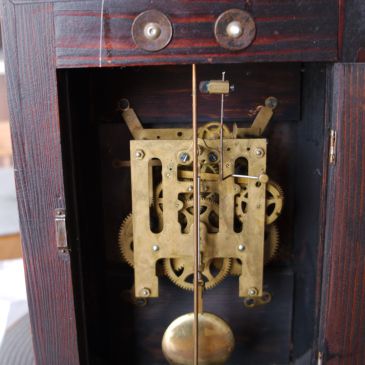
I believe this is the No. 36 movement by HAC.

HAC clock movement
HAC clock movement #36

The wheels that spin the fastest typically show the most bushing wear, but wear can also appear in other areas, such as the main wheels, which endure significant torque. For instance, I observed punch marks on the cap side of each mainspring barrel. While punching around any bushing hole is generally poor practice, it appears this was done at some point in the clock’s history and can’t be reversed. Nonetheless, the repair seems to have held up well.

Bushing Work

I have seen similar movements with much more wear than this one, but I felt that some bushing work was necessary to extend the clock’s lifespan.

Bergeon Bushing Machine

Six Bergeon brass bushings were installed in total. For the time side (T), bushings were placed at T1 (front and back) and T3 (back). For the strike side (S), bushings were installed at S3 (back), S2 (front), and S4 (front). The numbers indicate the wheel location in the train beginning from the bottom. A couple of pivot holes were borderline, but I decided to leave them as they are.

Reassembly

It pays to be patient and methodical during reassembly. Rushing can lead to mistakes, such as missing steps or improperly aligning parts, which could cause malfunctions or even damage later. Taking the time to carefully double-check the placement of parts, and ensure everything is in its correct place will help ensure the reassembly is smooth and successful.

An older HAC movement, without the barrel cutouts

Once the wheels are in place the lever and there is only one multi-arm ever that resides between the plates. Position it such that the long arm rests in one of the deep slots of the count wheel while a short arm is placed in the cut out of the cam wheel (as above).

Positioning the pivots is a delicate process, and any forceful handling can result in a bent or broken pivot. In this, as in all cases when aligning pivots, a pivot locator is your best tool.

Pivot locator

My usual practice is to position all the wheels and the lever(s) on the plate with the movement posts, first. Once the wheels are correctly located, I lower the front plate onto the back plate. I secure two nuts to the mainspring end which prevents the movement plates from coming apart as I position the upper wheels in the train.

The pin-wheel, which is uppermost and one wheel removed from the fly on the strike side, is placed in approximately the 12 o’clock position, the warning position. At the same time the hammer paddle is positioned between two of the points on the star wheel. More than once I have had to go back in to make minor adjustments when the paddle hangs up on one of the star points. It looks like this one is also a candidate for that very adjustment.

A Timetrax machine is used to adjust the beat and the rate of the movement.

The movement has been placed on a test stand and the time side Is in beat and running as it should according to my Timetrax machine. Curiously, the Timetrax manual lists only one HAU/HAC movement, a three-train one but this one is likely similar to Junghans bracket clock movements which runs at 164 bpm. Junghans is mentioned for comparison because, by 1930, the company had successfully taken full control of HAC.

Testing

The testing phase is crucial in the process of servicing a clock, often taking the most time because it ensures that the clock is functioning properly before it is reunited with its case.

On the test stand

During this phase, the clock is put through various operational checks to simulate real-time performance, which helps in identifying any issues that may not have been apparent during the initial servicing or cleaning process. Issues such over-tightened or loose components can present themselves as well as problems with the escapement mechanism.

The testing phase serves as an important diagnostic step to identify what further repairs or adjustments may be needed.

This concludes the servicing of an 8-day HAU/HAC movement. If you have any comments or feedback on any of the steps in the process, please feel free to share!

Hamburg Amerikanische Uhrenfabrik | Servicing an 8-day Countwheel Strike Movement – Part I

Among clock collectors and admirers, the Hamburg American Clock Company is a well-known German company. It is otherwise known as Hamburg Amerikanische Uhrenfabrik or HAU and in many parts of the world, it is simply known as HAC.

Time and strike mantel clock, shown without the crown and as purchased

About the Company

The company was formed in Germany in 1873 by Paul Landenberger and Phillipp Lang. Originally called Landenberger and Lang, it became the Hamburg Amerikanische Uhrenfabrik in 1891. The company was very active from 1885 onward, became a cooperative in the mid-1920s, and eventually merged with Junghans, one of the world’s largest clock companies, in 1930.

Original investors insisted that “American” be in the company name but “American” also refers to the manufacturing system adopted from America. The name of the company adds confusion to the novice repair person who might assume that what they are working on is an American-made clock.

HAU adopted the cross arrows as their trademark in 1892, and it became synonymous with the brand.

HAC trademark
HAC trademark

In 1925, a few years before its merger with Junghans, the company had a workforce of 2,200 individuals. Junghans remains a successful and thriving company today, specializing in high-end watches.

Condition of Case and Remarks

The case is in very good condition but was missing the crown when I purchased the clock in 2021. Since then, I have sourced a crown, and based on the research I have conducted online, it appears to be the correct “topper” for this clock.

A crown was sourced and it definitely improves the look

The dial face is in good condition and shows some wear but not like the heavily worn dials I have seen on similar HAC clocks.

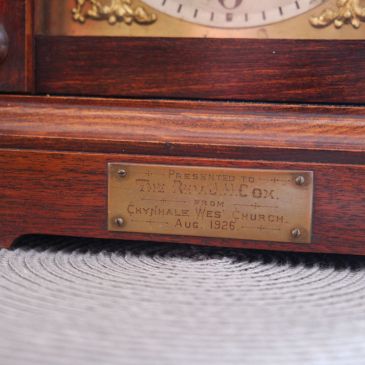
A commemorative brass plaque at the base reads: “The Rev. J. H. Cox Chyndale Wes’ Church Aug. 1926.” I assume this church is in the UK, but my online search yielded no information about this person. However, this inscription helps date the clock to no later than 1926. It is possible the clock may have been on a retailer’s shelf for several months or even up to a year or more before that date.

The Movement | Notes and First Steps in Servicing

In typical HAC fashion, the movement is robust and compact and it is a countwheel strike. The spring barrels are capped in the usual manner but feature four holes that make the mainspring visible. Earlier HAC movements had fully enclosed barrels—perhaps a cost-saving measure to use less brass! Otherwise, everything else is standard HAC.

Four nuts hold the movement plates. Once separated I removed the parts and divided the time and strike wheels.

Take careful note of two wires protruding from the rear plate. They act as tension springs, one for the strike hammer and on the opposite side of the movement, another for the lifting lever. These can easily break off, so handle the movement with care.

After disassembling the movement, it was cleaned in an ultrasonic cleaner. My aim wasn’t to achieve the shiniest brass possible but to ensure the brass and steel parts were thoroughly cleaned. There was some rust on two movement posts, which I removed using emery cloth. All parts were thoroughly dried.

The process may vary, but I moved on to polishing the pivots next. Since pivots are quite delicate, especially the fly, it’s important to handle them with care. Avoid applying excessive pressure on the pivot when using a metal lathe for polishing.

Polishing a pivot
Polishing a pivot with an emery board

I know some repairers prefer to avoid servicing mainsprings due to the difficulty of extracting them. However, it is essential to do so for several reasons. Clean and lubricated mainsprings ensure consistent power, enhancing the clock’s accuracy and performance. Additionally, it provides an opportunity to inspect for defects, cracks, and rust and replace them if necessary.

Once cleaned and lubricated, the springs are returned to their barrels using a spring winder such as the one made by Olie Baker.

Mauthe Horse Crown spring barrel in Olie Baker spring winder
Spring barrel in Olie Baker spring winder, with an appropriately sized collar ready to be inserted in the barrel to extract the spring

Since brass is softer than steel pivots one should expect some wear on the bushing holes. There are parts of a clock movement that exhibit more wear than other parts.

For instance, the wheels that spin the fastest are often the areas that show the most bushing wear but wear can show up in other places as well. I noticed punch marks on the cap side of each mainspring barrel. While punching around any bushing hole is generally poor practice, it appears this was done at some point in the clock’s history and can’t be reversed. Nonetheless, the repair seems to have held up well.

Next Steps

After inspecting and cleaning the movement, and polishing the pivots, the next step is to install new bushings. In my next article, I will focus on this process, along with the reassembly and testing of the movement.

Three Canadian Antique Clocks Won at Auction

About a year ago, I shifted my focus to collecting clocks made in Canada or those with a Canadian connection. Of course, there are exceptions if a particularly interesting clock comes along. In keeping with my goal, I won three Canadian clocks this week at auction: an Arthur Pequegnat Hamilton “Tall”, an Arthur Pequegant Dandy, and an ogee crafted by the Canada Clock Company of Ontario. All are shelf or mantel clocks. Two are spring-driven while the third is powered by weights.

Since the bidding was online, I don’t have the clocks yet, but I expect them to arrive within the next week or so.

Arthur Pequegnat Hamilton “Tall

I’m not sure what inspired me to take a photo of the Hamilton during my visit to The Canadian Clock Museum in Deep River, Ontario this past summer—but I did! Maybe it was a secret wish to own one someday.

Pequegnat Hamilton shelf clock

The clock I photographed features a piecrust dial, while the one I won at auction has a plain dial. Both styles were available in the early 1900s.

Auction photo http://www.harrisandsonsauctions.com/

The Arthur Pequegnat Hamilton “tall” shelf clock is a classic piece from one of Canada’s most renowned clockmakers. Named after the city of Hamilton, Ontario, this model is part of Pequegnat’s line of shelf and mantel clocks and showcases the craftsmanship that made the company famous.

Auction photo http://www.harrisandsonsauctions.com/

The Hamilton “Tall” features a distinctive upright design, making it stand out among other Pequegnat clocks. It had either a piecrust or plain dial (as I mentioned), adding to its collectible nature. The clock is typically housed in a sturdy wooden case often made with quarter-sawn oak, with half columns and capitals, an attractive crown, making it a simple yet elegant style.

The Hamilton “Tall” features an 8-day time and strike movement with distinctive nickel-plated movement plates, powered by a spring-driven movement. It strikes on both the hour and half-hour.

The Arthur Pequegnat Clock Company, founded in 1903, was one of the few successful clock manufacturers in Canada, with the Hamilton model being one of its many iconic designs. As Pequegnat clocks were made exclusively in Canada (Berlin, later Kitchener, Ontario), they hold significant value for Canadian clock collectors, and owning a Hamilton “tall” shelf clock is like holding a piece of Canadian horological history.

It’s often challenging to determine a clock’s condition from auction photos, but this one seems to be in good shape. Unfortunately, it lacks a label, which is a minor disappointment.

Arthur Pequegnat Dandy

The Dandy is a compact and attractive mantel clock, featuring a solid wooden case, often crafted from oak. The case design is simple yet elegant, with clean lines and minimal ornamentation, giving it a classic, timeless appeal. The dial is plain with black Arabic numerals, making it easy to read.

Auction photo http://www.harrisandsonsauctions.com/

The Dandy is also powered by an 8-day time and strike spring-driven movement. It strikes the hour and the half-hour. The movement is well-known for its durability and precision, hallmarks of Pequegnat craftsmanship.

Auction photo http://www.harrisandsonsauctions.com/

Although not as grand as some of the larger models like the “Hamilton,” it has its own charm, particularly for collectors who appreciate smaller, more understated clocks.

From the auction photos, I can tell the clock is in average condition, which is reflected in the relatively low price I paid for it.

Canada Clock Company 30-hour ogee with Alarm

The Canada Clock Company’s 30-hour ogee clock is a significant piece in the history of Canadian clockmaking. The ogee clock design itself was popular in North America during the 19th century, and the Canada Clock Company produced their own version during their brief existence.

Auction photo http://www.harrisandsonsauctions.com/

The ogee clock is named for its case design, which features the distinctive “S” or double curve molding along the front, giving it an elegant and classic appearance.

The Canada Clock Company’s ogee clocks were typically made with wooden cases, often finished in mahogany or rosewood veneer. The clock has a large rectangular face, featuring Roman numerals, and a clear glass lower panel that reveals the pendulum.

Auction photo http://www.harrisandsonsauctions.com/

This model is equipped with a 30-hour movement, which means it needs to be wound daily. The movement is powered by weights, which descend slowly as the clock runs. The clock only strikes the hour. The use of a 30-hour movement made this a more affordable option for consumers at the time compared to clocks with 8-day movements. This clock also has an alarm feature.

Auction photo http://www.harrisandsonsauctions.com/

The auctioneer advised that there is an issue with the coil or rod gong, something I will look into once I receive the clock. The case, I am told, has been refinished.

The Canada Clock Company operated in Ontario during the 1870s and early 1880s. It was one of Canada’s first significant clock manufacturers, aiming to compete with the American clock industry. Although the company’s existence was short-lived, their clocks are highly valued by collectors today for their historical importance and their role in establishing Canadian clockmaking. The 30-hour ogee clock is a prime example of a typical mid-19th-century clock that found its way into many Canadian homes.

It was a very successful auction day. For each clock, my wife and I adhered to our strategy of setting a maximum bid well beforehand, which helped us secure all three pieces effectively.

In sum, the Hamilton is a classic shelf clock with a distinctive upright design, a quarter-sawn oak case. Though lacking a label and with condition difficult to assess from photos, it appears to be in good shape.

The Dandy is a compact mantel clock with a simple, elegant oak case and plain dial. Its condition is average, reflecting the modest auction price.

The 30-hour Ogee is a classic 19th-century ogee clock with “S” curve molding and a 30-hour movement. It features an alarm and has a refinished case, with a noted issue with the gong.

Each clock adds a unique piece of Canadian horological history to my collection.

Mechanical Clocks Guide | Tips for Selecting the Ideal Antique or Vintage Clock Gift

Are you searching for a unique gift for a friend or family member? Have you ever considered giving an antique or vintage clock? It is the perfect, memorable gift.

Whether you’re familiar with antique and vintage clocks or completely new to the world of horology, you will need guidance in finding the right clock for that special someone. Here are a few pointers, along with explanations of some common terms you face.

Why Choose an Antique or Vintage Clock?

Last year, I sold a clock to a young woman looking for a unique gift for her father. She told me it was exactly what she wanted because it reminded her of a clock they had when she was a child. Sentimental value, a love for antiques, a return to our simpler past, or the unique charm of an old mechanical clock are reasons why people are drawn to these timeless clocks.

Antique, Vintage or Collectible

Determining the age of a clock can be challenging, especially since listings often don’t specify the exact year the clock was made. However, you might come across phrases like “mid-century”, antique, collectible, or vintage which can give you a general sense of its age. A quick search online can also help you narrow it down.

As a rule of thumb, an antique is something that is over 100 years old, while a vintage item is between 30 and 100 years old. Anything less than 30 years old may sometimes be considered vintage, but it’s often labeled as collectible instead.

Choosing the Right Type of Clock

Space is a key consideration.

Seth Thomas Mantel clock

With the trend toward smaller homes, not everyone has room for a large clock. Mantel clocks, for instance, require a shelf or table. Some are small, time-only pieces, while others have more complex movements like Westminster chimes and are housed in larger cases. Alarm and desk clocks are the most compact.

German wall box clock

Wall clocks are easier to place and come in a wide range of sizes, from small cuckoo clocks to large box clocks and Vienna regulators.

Ridgeway grandfather clock

Floor clocks, also known as grandfather or grandmother clocks, tall-case, long-case, or hall clocks, are the hardest to accommodate. Unless the recipient has sufficient floor space and an appreciation for such a clock, it will not be the best choice.

What About a Non-Working Clock?

A working clock that has been recently serviced by a skilled clock repairer is ideal. However, if the clock is intended more as a decorative piece, a non-working clock may be less expensive. Just be cautious if it has a replacement quartz movement and know what you’re buying.

Tips for Buying a Clock

Here are a few tips to keep in mind:

  • Look for a working clock; it’s more likely to have been well cared for.
  • Consider sources like Facebook Marketplace, eBay, local online for-sale sites (in Nova Scotia, we have Kijiji), reputable estate auctions, antique stores, and word of mouth.
  • Most common clocks are reasonably priced because they are plentiful though rare or historically significant ones can be more expensive.
  • Meet the seller in person if you can. You can check the condition of the item firsthand, which might reveal issues not visible in photos or descriptions. You can ask the seller questions directly about the item’s history, usage, and any other details that might be important. You can verify the authenticity of the item, which is particularly important for valuable or collectible items and you can often negotiate the price more effectively in person.
  • Avoid clocks made in China or Korea, especially those with directional arrows around the winding points. They look inexpensive and are made with cost-saving in mind. The powerful mainsprings of a 31-day movement can be dangerous if they break.
  • The brand of the clock isn’t necessarily important. Many American clockmakers produced both high-end and budget-friendly models.
  • Consider whether it matters to you if the clock has been altered. For example, many old ogee clocks have had their movements replaced when the original failed. In the clock world, these are called marriages, and they may or may not be important to you.
  • Whenever possible, carefully inspect the clock in person before purchasing. Surprises are rarely pleasant when your online purchase doesn’t meet expectations.

A little research goes a long way, but knowing nothing is worse than knowing just a little.

I hope these tips give you something to consider as you search for that perfect clock. While I’m not in the business of selling clocks, I do occasionally sell one locally to keep my collection manageable.

How to Determine the Age of an Antique Clock: Strategies and Tips

Determining the age of a clock can be challenging, especially since listings often don’t specify the exact year the clock was made. However, you might come across phrases like “mid-century”, antique, collectible, or vintage which can give you a general sense of its age. If the description is accurate, it provides a good starting point for determining the age of the clock.

As a rule of thumb, an antique is something that is over 100 years old, while a vintage item is between 30 and 100 years old. Anything less than 30 years old may sometimes be considered vintage, but it’s often labeled as collectible instead.

Mauthe clock from the 1950s

Dating a clock can indeed be challenging, but it’s an essential part of understanding its history, value, and significance. Here are some thoughts and strategies to help narrow down the age of a clock:

Identifying Maker’s Marks and Signatures

One of the most reliable ways to date a clock is by identifying the maker’s mark or signature. Some clockmakers stamped or engraved their name, logo, or serial number on the movement, dial, or case. Researching the history of the maker may not offer an exact date but will often provide a time frame for when the clock was produced.

McLachlan tall-case clock with painted dial was made in Newton Stewart, Scotland in 1848

Some manufacturers used serial numbers that can be cross-referenced with production records or databases maintained by collectors or horological societies. Having a serial number doesn’t always guarantee that it can be cross-referenced with a database, as clock databases are often not accessible online.

This Tompion tall case clock can be accurately dated

Analyzing the Style and Design

The design of the clock case can provide clues to its age. For example, Gothic Revival designs were popular in the mid-19th century, while Art Deco styles were prevalent in the 1920s and 1930s. Recognizing these stylistic trends can help you estimate the clock’s production period.

Another example is the German box clock, which gained popularity after Vienna-style clocks fell out of fashion in the early 20th century, remaining in vogue until around 1935.

Vienna-style time and strike clock by Mauthe C. 1900

The style of the clock’s dial can also be indicative of its age. Painted dials were common in the early 19th century, while enamel and porcelain dials became more popular later on. The use of Roman versus Arabic numerals can also offer hints, with Arabic numerals becoming more common in the 20th century.

Logos can be used to date a clock. Trademark logos are typically stamped on the clock movement. Manufacturers modified their trademark design from time to time. As companies grew and evolved, their branding shifted to reflect new values, target markets, or aesthetic trends.

Evolution of the Mauthe brand

Movement Type

The type of movement inside the clock can also be a good indicator of its age. For example, early mechanical movements with verge escapements date back to the 17th and 18th centuries, while spring-driven movements became common from 1840 onward.

The introduction of electric movements in the early 20th century marked a significant shift in clockmaking.

Sessions electric clock from the early 1920s

If the clock has a pendulum, its design can also be telling. Early pendulums were often long and ornate, while later ones might be shorter and simpler.

The introduction of the torsion pendulum, used in anniversary clocks, dates to the late 19th century.

Many clocks made after 1950 used an adjustable floating balance escapement that was less sensitive to variations in temperature and external influences. This stability results in more accurate timekeeping compared to traditional escapements.

Materials Used

The type of wood or veneer used in the clock’s case can help date it. Certain woods were more popular in specific eras, such as oak in the late 19th century or walnut in the early 20th century. Rosewood veneer was particularly popular in the mid-19th century, often used to create an elegant and luxurious finish on clock cases.

The materials used in the clock’s movement and case can also provide clues. For example, brass was widely used in clock movements from the 18th century onwards, while cheaper metal alloys became common in the 20th century.

Patent Dates

Some clocks, especially those from the late 19th and early 20th centuries, include patent dates on the movement or case. While the patent date itself doesn’t indicate when the clock was made, it provides a “no-earlier-than” date. For example, if a patent date of 1915 is stamped on the movement, the clock was made after that year.

Labels and Documentation

Many clocks, especially those from the 19th and early 20th centuries, came with paper labels on the back or inside the case. These labels often include the maker’s name, the place of manufacture, and sometimes even the model or patent date. For American-made clocks, the address of the label printer often provides a clue to the clock’s manufacturing date as shops often relocated.

Hamilton Clock Company label

The country of origin can also influence the style and dating of a clock. For instance, certain types of clocks were more prevalent in specific regions, like the tall-case (grandfather) clocks in England during the 18th century, or the ornate mantel clocks popular in France in the 19th century.

If the clock has been in the same family for generations, old sales receipts, repair records, or original packaging can provide valuable information about its age.

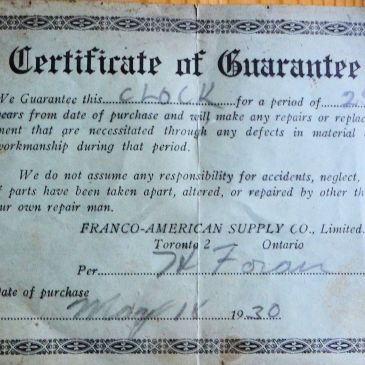
Any accompanying documentation with the clock could offer some valuable clues. The certificate of guarantee from the retailer [see below] indicates a sale date of May 18, 1930, meaning the clock was manufactured before this date. It could have been made several months or even a year or two prior, though the exact date of manufacture remains unknown.

Research and Expert Consultation

There are many reference books and catalogs dedicated to specific types of clocks, makers, and periods. These resources can be invaluable in identifying and dating a clock.

Clock magazines provide well-researched insights into clocks

Tran Duy Ly is a well-known author and expert in the field of antique clocks and horology. He is particularly renowned for his extensive series of reference books on antique clocks, which are highly regarded by collectors, dealers, and enthusiasts. His books typically feature detailed information, photographs, and pricing guides for various types of clocks, including those by specific manufacturers like Seth Thomas, Ansonia, and Gilbert.

Ly’s works have become essential resources for those looking to identify, appraise, and learn more about antique clocks, and his name is synonymous with authoritative clock references in the horological community.

If you’re uncertain about the age of a clock, consulting with a professional appraiser or horologist can provide you with a more accurate assessment. Experts can often recognize subtle details and variations that indicate the clock’s age.

Conclusion

Dating a clock requires a combination of research, observation, and sometimes expert consultation. By examining the maker’s marks, design, movement type, materials, and other characteristics, you can often narrow down the clock’s age to a specific period or even a precise year. Understanding these details not only enhances the clock’s historical significance but also helps in determining its value and collectibility.

The Myth of Over-Winding: Clarifying a Common Misconception

In the fascinating world of horology, many terms and expressions are often misunderstood or misused. A classic example is the frequent confusion between the words “mantel” and “mantle” to describe certain types of clocks. While “mantel” refers to a shelf over a fireplace, “mantle” is something you wear, like a cloak.

Another pervasive myth is the notion of “over-winding” a clock. How many times have you heard, “It was running fine until I over-wound it”? This phrase is commonly found on clock forums, Facebook groups, and among enthusiasts. However, attributing clock malfunctions to over-winding is a misunderstanding of how clocks operate.

American time and strike clock movement

While it is technically possible for a mainspring to be damaged by excessive tightening—winding it until it’s tight and then continuing to wind it further—this is not the primary cause of most clock failures. The real issues often stem from different sources.

Consider the spring barrel, as shown in the photo below.

When the spring is wound, it coils tightly around the winding arbor, with the other end hooked to a small stud inside the barrel. This hook can become fatigued over time due to repeated excessive winding or the riveted stud can break free, but this is not the typical cause of a clock stopping.

In American open mainspring clocks, what appears to be “over-winding” is often a result of old oil, rust, and dirt accumulating in the mainspring coil. These contaminants can cause the coil to stick and seize somewhat like the action of an adhesive, making it “seem” as though the clock is “over-wound.”

This spring is re-useable

When I receive a clock that is said to be “overwound”, I use a let-down tool to release the mainspring partially or completely, apply mainspring oil generously, and then rewind the clock. This step will help in some cases, but it’s important to note that it doesn’t replace a thorough cleaning or address other potential issues that might be causing the clock to stop.

The letdown key
The letdown key

Disassembling the movement and removing the mainspring allows for a proper inspection. Dirt and old oil can be cleaned, light rust can be removed with emery paper or steel wool, and heavy rust necessitates the replacement of the mainspring. The spring should also be checked for cracks or breaks. Often, a mainspring in good condition can be salvaged with proper care even if there are minor problems with the connecting section of the spring.

I frequently reuse mainsprings in my clock repairs, as long as they are not “set.” A mainspring is considered “set” when it has developed permanent deformations or has lost its original flexibility and strength due to repeated use or overstressing. In such cases, reusing the mainspring compromises the clock’s reliability and shortens its operational cycle.

When a mainspring is “set,” I typically replace it to ensure the clock functions optimally and to avoid potential issues. If I were operating a clock repair business, I would replace the mainsprings as a standard practice and pass the cost onto the customer.

“C” clamps used to contain the power of the mainspring

Another potential issue is the click mechanism. In some clocks, such as those made by Sessions for example, the click rivets can become fatigued and fail. Inspecting and repairing/replacing this component is a common procedure in clock servicing.

Worn click on Sessions movement

When buying a new clock, do not assume it has been recently serviced unless the seller can confirm it. If there’s no assurance of recent servicing, plan to have the movement serviced as soon as possible either by yourself or a competent professional.

Regular maintenance is crucial for any mechanical clock to ensure its longevity and proper function.

“Over-winding” is a myth that often misguides clock enthusiasts. The real causes of clock issues are typically related to dirt, old oil, or mechanical wear, not the act of winding the clock. Understanding this can help in better troubleshooting and maintaining your cherished antique or vintage clock.

Tick talk Tuesday #55 | Mauthe wall clock runs fast

Tick-Talk Tuesday is a special time when I respond to readers’ letters and comments about clock issues, challenges, and recommendations for specific clocks. When the comments and questions are especially complex, I consult with fellow clock enthusiasts within my circle to ensure I offer the most precise and helpful answers possible.

RK writes:

I am working on an almost identical clock movement as the one shown on your website above. It was made by Frederick Mauthe. I have restored the movement, inserted many bushings, etc., and during testing have realized that the movement is gaining an hour a day.  I don’t think the pendulum is original and I suppose I am on a quest for a replacement.

Mauthe wall clock

Here is the case.  The finial has been re-glued and altered at the top, and that is another story. Here is the current pendulum: it weighs 0.139 kilos; the distance from the top hook to the bottom of nut under the pendulum is 220 mm. The diameter of the bob 100 mm.  I believe this is too light and too short, but there is no more room in the case.

Mauthe movement showing 2 critical numbers

Do you know what the correct dimensions are for the original pendulum? (Weight and length)

This movement is now working so well and it would be a pity not to be to use it just because I cannot find a replacement pendulum.

Front of Mauthe movement

Thanks for your time.

RK

My reply:

Hi and thanks for your email, RK. On the back of the movement, on the lower left of the last photo, are two numbers. 34 refers to the measurement in centimeters from the top of the suspension spring post to the bottom of the pendulum regulating nut. The second number refers to the beats per minute. Measure the pendulum you have and compare it to the first number.

Regarding the pendulum’s bob weight, I won’t have access to the clock until mid-September. However, I can get the measurements you need at that time if they’re still required.

Thomas Tompion: The Father of English Clockmaking

Thomas Tompion (baptized July 25, 1639– died, November 20th, 1713) was an English clockmaker and watchmaker, often referred to as the “Father of English Clockmaking.” He is renowned for his exceptional craftsmanship and significant contributions to the development of clockmaking during the late 17th and early 18th centuries.

In fact, Tompion is the most celebrated of all English clockmakers.

Thomas Tompion

Born in Bedfordshire from a family of blacksmiths he moved to London in 1671 and was soon employed by the physicist Robert Hooke. Hooke was credited as one of the first scientists to investigate living organisms at the microscopic level. Hooke introduced him to leading scientists and royalty and as a result, Tompion received commisssions from Charles II, William III, and Queen Anne.

His business was based on Water Lane, Fleet Street, and he built a reputation for quality and ingenuity across Europe.

Tompion tall case clock at the Britsh Science museum

Tompion’s clocks and watches were known for their accuracy, elegance, and innovative design. He played a key role in advancing the precision of timekeeping, particularly through his work on escapements and the introduction of the balance spring in watches, which greatly improved their accuracy.

Thomas Tompion time and strike tall case clock – the British Museum

Tompion produced a wide range of timepieces, including table clocks, longcase clocks, bracket clocks, and pocket watches.

His clocks were often highly decorative, featuring intricate engravings and fine materials.

Table or bracket clock made by Tompion for Queen Anne, British Science Museum

He was also a mentor to several important clockmakers, including George Graham, who later became a prominent figure in the field. Graham invented the deadbeat escapement, a crucial improvement over previous escapement designs, allowing for greater accuracy in clocks. Two clocks in my collection, an Arthur Pequegnat Moncton and a Seth Thomas #2 have Graham deadbeat escapments.

Tompion was also Master of the Clockmakers’ Company from 1703 to 1704 (London). He made regulators for Greenwich Royal Observatory – one of the most prestigious commissions of his career.

While visiting the UK this spring, I stopped by Westminster Abbey, where Tompion is laid to rest.

Westminster Abbey

It is fitting that Graham is also buried in the same place.

Located at Westminster Cathedral

Tompion’s work is highly prized by collectors, and many of his clocks are now housed in museums and private collections around the world.

Having a Tompion clock would be a real treasure, but it’s far beyond my budget. The nearest I’ll get to a Tompion clock is seeing one in a museum.

Right to Repair: Countering our Throwaway Culture

Most mechanical clocks even those over a hundred years old or more are repairable. On rare occasions, a major part may be broken, but with the right tools and skills, it can still be fixed.

With a bit of knowledge and a few basic tools, the family clock could be repaired without needing to send it back to the manufacturer.

Time and strike clock movement

In today’s world, any mechanical device that lasts even a few years would be considered a rarity.

Screw drivers, clock tools
Common tools

It’s a fact that we live in a very different world today!

Some time ago, my wife and I had an issue with our dishwasher. Believing it was a simple fix, we called a service technician. It turned out that the main circuit board was shot. I suggested we replace it, but the technician advised that the repair cost would be several hundred dollars. However, he advised us for just a few more dollars, we could get a brand-new dishwasher. We were aghast!

Appliance makers have devised innovative tactics to make repairs costly and inconvenient, while simultaneously offering replacement programs at significantly reduced prices. Repairing items today is often impossible or more expensive than buying new ones, a frustrating and expensive dilemma for the consumer.

Moreover, in today’s throwaway society, repair is often not an option. “Honey, this is broken”; “Just throw it away, it can’t be fixed”. And we complain that our landfill sites are full!

Clock manufacturers years ago designed their clocks to be fixable and did not employ underhanded strategies to make them impossible to repair. I’m convinced that clock companies didn’t see these challenges as obstacles and instead chose to take the moral high ground. A clock that could be repaired with just a few tools was a true mark of a quality company.

The fact that fewer people are fixing their personal possessions today places an environmental and economic burden on our society. We need to shift our thinking, or we are all doomed.

The Right to Repair

Owners of products should have a right to repair them as a matter of “moral justice”. Wikipedia covers this topic extensively under the term “Right to Repair,” and the concept is gaining momentum.

It will take time to make the shift but in the meantime, the situation appears to be worsening rather than improving.

I recently read an article describing how manufacturers are designing digital locks into their products. For example, using a third-party ink cartridge can render your printer inoperable, and attempting to use a third-party battery in your new electric trimmer can result in a battery error.

The same article described a farmer who replaced a filter in his tractor. A company representative had to inspect the part to verify its authenticity and activate the software so that the tractor could operate, causing the farmer to lose productive use of the machinery for some time.

A certain phone manufacturer, who shall remain unnamed, refuses to allow third-party repairs or places strict limits on the type of repair. Such repairs void the warranty, it says. The alternative is a costly repair using genuine parts, a situation that not everyone can afford.

In reflecting on the current state of product repair, it’s clear that we’ve moved away from the principles of repairability that characterized earlier times. Historically, clock manufacturers designed their products with repair in mind, avoiding deliberate strategies to hinder fixes.

When a clock finally comes to the end of its life wouldn’t you want another Seth Thomas, Waterbury, or Ingraham?

Unfortunately, the landscape has shifted dramatically. My own experience with a dishwasher underscores this change. In today’s throwaway culture, the default response is often to discard broken items rather than seek repair.

This change not only devalues durable craftsmanship but also fuels a growing culture of waste. And that’s too bad.

Optimizing Care for a Vintage Mauthe Clock: Inspection and Oiling

It’s time to inspect the movement on this mid-thirties German box clock. Purchased at an antique mall in Peterborough, Ontario, in May of 2017, it was serviced in 2020.

Mauthe time and strike box clock

This clock is part of a small collection at our family cottage and runs for about three months each year. However, the cottage environment can be harsh. Before we converted the screened-in porch to an enclosed sunroom, the clock was exposed to the elements for three years, so I expect some dust, dirt, and debris.

Mauthe movement back plate
Mauthe movement back-plate

One hint tells me this clock is made by Mauthe of Germany, even though there is no trademark stamp on the movement plates. The gong block is made by Divina, a subsidiary parts maker for Mauthe.

In the 1930s and 1940s, the clock was sold in Canada under the Forestville or Solar name in department stores from coast to coast. An appliqué of a maple leaf on the crown of the case suggests it was made for the Canadian market.

Divina gong block

Removing the movement

Removing the movement from its case is a relatively simple procedure. Open the front door and release the two thumbscrews under the movement seatboard, then slide the movement forward from its side channels.

Both plates are a robust 1.8 mm brass. The backplate is solid while the front plate is open. It is a robust movement that was evidently designed to last.

Removing the movement from the case is the best way to check the condition of the movement. Once out all you see is the back plate with the dial concealing the front of the movement. To inspect the front of the movement, the dial and hands must be removed. The hands come off easily by pulling the center cannon pin that attaches the minute hand. The hour hand is a friction fit and can be pulled out with minimal effort. Remove four brass pins on pillars to detach the face from the movement.

Once the dial face is detached both the front and back of the movement can be inspected.

Movement with attached seatboard

There is also no need to remove the seatboard to inspect the movement.

Of course, the only true measure of the condition of any movement is to take it apart, but in this case, I saw no need.

The clock has been working well, keeping good time and striking as it should.

What to look for

I always look for dirty oil around the pivots, which indicates possible wear. As oil ages, it gradually interacts with worn brass, creating a black abrasive paste. Here the pivots looked good but I did notice that some bearings had dried up. While at it I inspected the barrels for bulges and cracks, finding none. The lantern pinions, gear teeth, and levers looked clean. The suspension spring also looked good. In fact, I saw nothing that would cause me to take the next step: disassembly.

The movement is in excellent condition and will need no attention since its last servicing in 2020.

Oiling

All that is required is an oiling before it is returned to the case. Periodic inspections ensure that the oil is clean and appropriately applied, preventing friction and wear. In this case, the oil was clean but some pivots required additional oil.

Oil and applicator which has a spooned end

I keep it simple as far as my oiler and dipper container are concerned.

Periodic inspections

Periodically inspecting a mechanical clock movement is important. Regular inspections can identify potential issues before they become serious problems, helping to prevent major repairs or damage.

Over time, the movement parts can wear down, and identifying and addressing wear ensures the clock runs smoothly.

Dust, dirt, and other debris can accumulate in the movement, affecting performance. Regular inspections {and disassembly and cleaning if needed} can keep the clock running accurately.

Clocks exposed to varying environmental conditions, such as humidity or temperature changes at our cottage, may require more frequent inspections to prevent damage. My fears that this movement was dirty because it was in a harsh environment proved unfounded.

Mauthe movement front plate

If the clock starts losing or gaining time, an inspection can identify the cause and allow for adjustments. Inspecting the movement helps to ensure that all components, such as springs and gears, are in good condition and properly aligned.

Finally, by addressing these aspects through regular inspections, you can extend the life of your mechanical clock and ensure it continues to function properly.

How to Safely Operate and Maintain Mechanical Clocks: Tips and Hazards

Mechanical clocks, especially older or larger ones, can pose various dangers during operation and maintenance. In this post, we will cover some of the risks and hazards.

Mainsprings

Do not underestimate the power of a clock with mainsprings. Mechanical clocks often use powerful mainsprings to drive their mechanisms. If these components are mishandled, they can release a significant amount of stored energy suddenly (potential energy), with the risk of causing serious injury.

Mainsprings restrained with “C” clamps

Without the right knowledge and tools, attempting to disassemble or reassemble a mechanical clock can result in damage to the clock and potential injury. When working on a clock and particularly when disassembling clock movements ensure that the mainsprings are safely secured. The best way is to use a specially designed mainspring clamp.

“C” clamps or a strong wire are considered safe methods in clock repair.

Even the simple act of winding a clock can produce a nasty surprise since the sudden release of tension in a mainspring can be dangerous.

I almost lost my thumb when the click let go on the strike side of a Mauthe wall clock while winding it.

Damaged thumbnail but I survived

If I am unsure of the mechanical condition of a clock particularly one that I have recently acquired, I always wind it with my letdown key set. That way I can control it if the click lets go. If I follow that simple rule I don’t get hurt.

A letdown set used to safely wind a newly acquired clock

Gears and sharp components

The gears, escapements, and other moving parts can cause pinching injuries. These parts may also be sharp or have pointed edges, increasing the risk of cuts.

The delicate nature of some clock components, such as thin gears or escapement wheels, can break easily. Working on them without proper knowledge or tools can damage the clock and possible injury from sharp, broken pieces may result.

Mercury

Some antique clocks may contain materials known to be hazardous, such as mercury in pendulums or lead-based solder. Exposure to these materials can pose health risks. For example, most American-made crystal regulator clocks have nickel slugs in glass vials for the pendulum that resembles mercury at first glance. They are completely safe to handle.

Note the pendulum bob in this clock

In contrast, French-made four-glass clocks often contain actual mercury pendulums, which if handled can pose a poisoning risk. The purpose of mercury is to maintain accurate timekeeping despite temperature variations.

The degree of mercury toxicity depends on how much contact one has with it. Here is an excellent article I found on the risks involved and precautions when handling mercury.

Electric clocks

Early electric clocks can pose a significant risk of electric shock if not properly handled or if the wiring is faulty. These clocks are often improperly grounded, and may have worn cords with exposed wire. Those that run hot to the touch when operating are particularly dangerous. Switches and knobs and other components are designed according to past standards and lack the safety protocols of today’s designs.

The danger of electric shock may increase during maintenance or operation.

Sessions 3W electric table clock
Sessions 3W electric table clock C.1930

Electric clocks are best handled by individuals knowledgeable about electrical components and their operation.

Radium

Clocks, especially older alarm clocks with luminous dials can pose a significant risk. The culprit is radium. Even a clock that has lost its luminescence may still have traces of radium on its dial or particulate matter that has fallen from the clock-face making them equally dangerous.

As much as you may be curious about how these clocks work, leave them alone and appreciate them as decorations or alternatively, safely dispose of them.

Baby Ben, made in China
Baby Ben, made in China (a later design with safe luminous material)

It must be emphasized that Inhalation or ingestion of flakes or dust containing radioactive materials is extremely dangerous.

Clock tools and equipment

When working on clock springs or components when there is a potential risk of injury or with tools like a lathe, consider wearing leather gloves, and an apron, along with face/eye protection as needed.

Gloves and safety goggles are an important consideration when working with mainsprings. A winding arbor breaking in a mainspring winder or a mainspring letting go while winding it up might result in the spring, wheel, and arbor flying around the room and possibly toward the repair person.

Thick leather gloves used for spring maintenance

Using a Dremel machine without proper eye protection, especially with wire brushes that rotate at high speeds, can easily lead to serious eye injuries if a piece of wire breaks off.

In sum

To mitigate all risks, it is important to have a good understanding of the clock’s mechanism, use appropriate tools, follow safety procedures, and possibly seek training or assistance from an experienced clockmaker. If you ignore common sense, accidents are sure to follow.

A dirty clock movement ready to be serviced


Those new to clock repair may be eager to dive in and take things apart. However, a slow and cautious approach with a focus on safety will reap benefits in the long term.

A Collection of Antique Clocks at Our Summer Refuge

My collection of clocks is divided between my home in Nova Scotia and our cottage in Central Canada. Part of my collection is there because I am not the type of person who abandons a hobby; I make it a part of my everyday life.

Although not an even split, about 15% of the collection is at our summer cottage in central Canada. The clocks at the cottage, though not particularly special, add a charming ambiance to the space. They often serve as great conversation starters when guests are over, contributing to the cozy and inviting atmosphere.

Let’s begin in the sunroom, the focal centre of our cottage. In this room are two German box clocks, a Mauthe and a Kienzle, which has been a recent acquisition. Joining the two box clocks is a 30-hour Ansonia cottage clock.

Mauthe time and strike box clock (the wall to the left is under construction)
Kienzle time and strike box clock

Check out this recently posted article for more information on the Kienzle clock.

Ansonia 30-hour cottage clock

Inside the main part of the cottage which comprises the kitchen, dining, and living area are 3 clocks, a Hemle time and strike weight-driven wall clock, passed on by my wife’s uncle, known as a wag-on-a-wall clock, an Empire time-only gallery-style clock from England, and a 30-hour New Haven miniature ogee.

Hermle wag-on-a-wall clock
Empire time-only gallery clock

This New Haven clock might look good from a distance, but closer inspection reveals that the front veneer has been stripped, likely due to significant loss or damage. This condition is not common with old veneered cases but unfortunately, it is what it is.

New Haven mini ogee clock

In our bedroom is one clock, and one clock only, and it is placed there for a reason. It is a time-only GIlbert gallery clock. Gallery clocks, in other parts of the world, may be known pub-clocks, canteen clocks, or office clocks.

Gilbert gallery clock

This time-only gallery-style clock made by the Gilbert Company of USA is nondescript and quite ordinary looking. There is nothing special or distinctive about it but it is in excellent condition.

Check out this article on how having a clock in the bedroom can aid in getting a restful night’s sleep. The article describes how providing a gentle reminder of the time helps regulate your sleep patterns and creates a more restful environment.

So, there you have it—time flies at my summer cottage with these clocks. They may not be particularly special, but they surely tick all the boxes to enhance my summer experience!

1930 Kienzle Box Clock | A Heartfelt Gift and Memorable Encounter

Occasionally I have clocks gifted to me as in the case of this lovely Art Deco-style German round-top wall clock made by Kienzle. The gift was greatly appreciated, although there was a small condition attached, which I will explain later.

Kienzle box clock in classic oak

There are times when people consider gifting me a clock but hesitate because of the high shipping expenses. When I tell them I’m willing to accept the clock, they often balk upon discovering how much it would cost to send it to me. Consequently, I have missed out on some interesting clocks due to shipping constraints.

Earlier this year, DN from central Canada was researching his grandfather’s vintage clock online and found a similar one, which led him to my blog. We exchanged emails about the history and condition of his grandfather’s clock and he asked about its resale potential. Based on the current market, I provided him with an estimated value.

I suggested several methods for selling the clock and offered to consider purchasing it myself if he could not find a buyer. Unaware that I would hear from DN again, it was four months later when he reached out and offered to gift me the clock, confident it would be cherished by a collector like myself. The condition was that I make a donation to a charity.

A well-protected clock

While traveling to central Canada to spend the summer, I had the opportunity to meet DN. With military precision, we arranged to meet in a small village 1/2 hour from our summer cottage. The well-packaged clock went from one car to the next. Afterward, we talked on the roadside, discussing the clock and, of course, sharing our cottage experiences. I said my thanks and drove off.

I know more about this clock than almost anything in my collection thanks to DN and the well-preserved clock owned by his grandfather and carefully stored for approximately 25 years following his passing. DN‘s grandfather, an engineer, appreciated the intricacy of the German-made clock and kept all the documentation. Nothing is missing from the clock; all the parts are intact.

Raised relief applique

There is a “certificate of guarantee” from the Franco-American Supply Co. with a purchase date of May 18, 1930. The Franco-American Clock Co. became the Franco-American Supply Co. in 1918/1919. Their business eventually expanded to musical instruments, including gramophones. They operated as a distributor rather than a manufacturer, specializing in supplying clocks at a mid-level scale to retailers.

Franco-American Supply Co.

In addition, there is a factory control slip and instructions for the gong protector. There are two stand-offs (upper right, photo below), but I could not find the screw holes in the back of the case to accommodate them. Perhaps they were offered as optional at the time, otherwise, why were they kept? And of course, the original key.

It is rare to buy a clock with any documentation

Overall, it is in exceptional condition for a 96-year-old clock. I could not see any tell-tale signs that the movement had been worked on, and in its assembled state, I did not observe any appreciable wear. Of course, once disassembled and cleaned, I will have a clearer understanding of any wear issues.

My immediate task is to determine if the clock can run and strike as it should. I removed the movement from its case, applied a drop of oil to the pivots, reinstalled the movement, and gave the pendulum a push. It runs well. Next, I will prioritize thorough cleaning and attend to any signs of wear.

Finally, I am making my donation to the St. Vincent de Paul Society in memory of my mother-in-law, who passed away this spring. The Society of Saint Vincent de Paul is a lay “Catholic organization whose mission is to help shape a more just and compassionate society by providing food assistance, material help for the needy, emergency relief, and addressing housing challenges across Canada”.

German Box Clock Restoration | A Family Heirloom

When my wife’s parents sold their home in a small town in Nova Scotia in 1996, they passed on a wall clock, which had been given to my father-in-law by a patient and had hung on the wall in the main hallway of their home, to his son, my wife’s brother. It has been in storage ever since then.

I hadn’t seen the clock in nearly 30 years though I have vivid memories. In the 1980s and 1990s, my wife and I would bring the kids to visit their grandparents on weekends. The clock would resonate throughout the house. It was unforgettable, by its loud ticking and the four-hammer strike marking the hour and half-hour.

Made by Mauthe, it is a 1930s-style German box clock, dark in color, reminiscent of one in my own collection. In fact, except for minor details on the case, it’s almost identical to mine.

German "box" clock by Mauthe
German “box” clock by Mauthe, in my collection

My father-in-law loved the clock and had it for years, winding it without fail once a week. When it stopped, he would have someone local service it for him. He cherished it deeply, though I’m not entirely sure why. Perhaps, as a doctor, he valued it as a thank-you gift from one of his patients, or maybe he simply had a passion for clocks.

Sadly, my father-in-law passed away in 2012, and my mother-in-law passed away this year. While settling the estate, my wife and her brother started communicating on a deeper level, and the subject of the clock came up. Would I fix it?

Mauthe movement back plate
Not this clock but a similar Mauthe movement

The clock has now been passed to me for repair. I picked it up in mid-June, and my first impression was that the case was in excellent shape for its age. While the case has minor nicks and scratches that can be easily addressed, the dial is rough. Otherwise, the movement appears intact with no missing or damaged parts.

Overall, I believe the clock is definitely worth restoring. Once I evaluate the clock further I can determine what needs to be done, make any necessary repairs to the movement, and the case, test the movement, and return it to my wife’s brother. To have it displayed prominently on a wall and running again would be a testament to my father-in-law’s memory.

Although I have other projects on the go and cannot tackle this project until the fall, I am pretty excited about working on this clock. It is a perfect candidate for restoration but more importantly, it has great sentimental value.

In future posts, I will describe a step-by-step process of revitalizing the case and another on servicing the movement.

Troubleshooting a Time-Side Mainspring Issue in a Kienzle Wall Clock

Kienzle might not ring a bell for many clock enthusiasts, but it was a major German producer of clocks for the general public.

Kienzle Uhren GmbH, was founded in 1822 by Johannes Schlenker in Schwenningen, in Black Forest region. Jakob Kienzle joined the family by marriage in 1883 and became the sole owner in 1897. He revolutionized clock production through mass production, leading to significant expansion. By 1939, the company employed over 3,500 people and produced around 5 million clocks annually. Kienzle eventually transitioned to wristwatch production and continues to operate as a watchmaker.

Kienzle wall clock C. 1930

This Kienzle wall clock was bought at auction in 2021. It was my second Kienzle, the first, an attractive desk clock from the early 1950s. But in general, I was unfamiliar with the maker. I later learned that the clock was missing some details: a case decoration above the number 12, both standoffs and the pendulum rod retainer was broken. However, the case itself is in relatively good condition.

The time and strike movement in this round top box clock is compact, with a 43 cm pendulum length and a beat rate of 104 per minute.

Kienzle movement

I serviced this movement in 2021 shortly after acquiring it. At the time I found It exhibited typical wear for its age, with the time side running relatively freely and the strike side being somewhat sluggish. After disassembly, an assessment revealed that the movement required 10 bushings: 6 on the backplate and 4 on the front. The work was completed without issues, the movement was reassembled and tested and the clock ran reliably until this year.

Front of movement

Now it has stopped. In short, I’m not entirely sure what caused it to stop.

Suspecting a power issue, I removed the movement from its case and took off the hands and dial face. I also let the mainsprings down but left enough tension to supply power. I unscrewed the crutch bridge to remove the pallets which allowed the escape wheel to run freely. So, not a power issue. I continued to inspect the wheels and pinions and found nothing amiss. While out of the case, I re-oiled the movement.

The issue seems to be with the time-side mainspring. Looking back at my notes, I serviced both mainsprings in 2021 and didn’t observe anything unusual about them at the time.
However, I’ve noticed that if I fully wind the time side, the clock is reluctant to start. This issue has happened more than once. Releasing the tension of the time-side mainspring with a wind-down key allows the movement to start running again. If I don’t wind the time side mainspring completely, the clock seems to run without any problems.

I can only conclude that I did not clean the mainsprings as thoroughly as I should have. Residual dirt and grime on the inner part of the coil seem to cause the spring to seize when wound tightly. In the meantime, the solution is not to wind the time-side mainspring fully.

Unfortunately, the mainspring barrels cannot be removed separately as in the case of some German movements, necessitating the complete disassembly of the movement to replace/inspect the mainsprings in case of an issue. If it were feasible to remove the mainspring barrel independently, I would have taken the opportunity to remove the mainspring from the barrel and clean it more thoroughly.

Testing the Kienzle movement on a makeshift test stand
Kienzle movement on the test stand

I am not about to disassemble the clock again as I have more pressing projects on the go but in the meantime, it will run as long as I do not wind the time-side spring too tightly.

Castle Combe’s Clock: Unveiling A 17th-Century Turret clock in the Cotswolds

Old clocks often have rich histories that reflect the technological advancements and craftsmanship of their time. Exploring these clocks provides a unique perspective on the history of timekeeping, engineering, and artistry in the UK. Many of these clocks are tied to significant historical events or figures, offering a tangible connection to the past.

High street in castle Combe
The village of Castle Combe

Many old clocks, especially those in historical buildings like churches or cathedrals, are masterpieces of design and craftsmanship. These clocks often feature intricate mechanisms and beautiful decorative elements that showcase the high level of skill and artistry of their makers. Exploring these clocks allows one to appreciate the aesthetic and technical achievements of the past.

St. Andrews church
St. Andrews church

While on vacation in the UK, I discovered an old clock in the charming village of Castle Combe, nestled in the Cotswold region of England. Visiting Castle Combe feels like stepping back into the 17th century. The village is located around 8 km northwest of Chippenham. Our tiny tour bus made it into the village, dodging the ban on large coaches that flood the area with tourists.

St Andrews church spire

No new houses have been built in the historic area since about 1600. Interestingly, the village takes its name from the 12th century castle which stood about 500m to the north. The site where the castle once stood contains the old earthworks and masonry, from the 12th century. Tourists seeking a castle might find themselves sadly disappointed.

The altar area inside St Andrews
The altar area

The clock is housed within St. Andrew’s Church, which can be reached by a pathway leading from the main street. Part of the chancel is 13th-century. In 1850–51 nearly all of the building, except the 15th-century tower, was taken down and reconstructed to the same plan. The church is very active, holding services every Sunday and serving as a hub for various activities and festivals throughout the year.

Surprisingly, instead of in the clock tower which one would expect, the clock is located inside the church itself and remains operational.

The turret clock in operational condition
The turret clock is in operational condition

The clock was converted to an anchor escapement and required the movement to be turned upside down consequently the striking train is at the bottom and the going train is at the top. This necessitated a redesign of the countwheel. The addition of the anchor escapement reflected new technology as old clocks were made more accurate and efficient.

This is one of the earliest working clocks in England and was likely installed when the tower was completed in 1500. Naturally worn parts notably the escapement have been replaced.

It is not the oldest in the UK. The turret clock at Salisbury Cathedral predates this one, dating back to 1386.

Salisbury Cathedral
Salisbury Cathedral, photo by Phil Ledwith on Pexels.com

There is no face on the St. Andrews clock for a good reason. In those days men working in the fields need only to know the hours; the hour is struck on a large bell. In 1984 the clock was brought down from the tower and now resides within the church walls. Prior to that, a person climbed the tower every day to wind it. At the same time in 1984, an electric winding mechanism was fitted.

In Summary

Searching for old mechanical turret clocks can be intriguing for several reasons.

For those interested in mechanics and clockwork, studying old turret clocks provides opportunities to understand their intricate mechanisms and how they were constructed and operated in different eras. These clocks offer insights into the technological advancements of their time periods and their roles in communities.

Most importantly, many turret clocks have fascinating stories and legends associated with them, adding to their allure and making the search for them even more compelling.

The Pequegnat Jewel and the Simcoe – similar yet subtly different

The newest addition to my collection of Pequegant clocks is the Jewel. That marks a total of nine Pequegnat clocks in my modest collection. I was not actively seeking a new clock. In fact, I haven’t purchased one in months, and mantel clocks weren’t even on my radar.

Arthur Pequegnat Simcoe
Arthur Pequegnat Simcoe, note the legs and side details

I bought the Simcoe (above) in 2018 from a shop in Victoria, British Columbia (Canada) and I think, at the time, I paid close to $200 for it. I located the Jewel in an antique shop about 20 minutes from where I live. I recognized it almost instantly, even though it was placed on a shelf nearly out of my reach.

The Jewel’s price was significantly lower so, why pass it up?

Was the seller confused about the maker?

The two clocks boast strikingly similar case designs. In fact, the dimensions of the quarter-sawn oak case are identical, although the Simcoe model is slightly taller due to its corner feet and wider due to the addition of lion-head handles on each side. Both contain the same 8-day time and strike movement.

Pequegnat Jewel time and strike mantel clock

Made in Canada before 1916, this clock has an 8-day, spring-driven time and strike movement with signature Pequegnat nickel-plated plates. Initially, I thought there might be brass bushing inserts on steel plates. However, upon passing a magnet over the plates, I discovered that the plating was not on steel but on brass. Plating over brass may not be the most practical solution, but aesthetically, it offers a pleasing appearance.

Although the movement bears the stamp “The Arthur Pequenat Clock Co., Berlin, Canada” there is no maker’s name typically found on the lower section of the dial face, a peculiarity I’ll delve into shortly.

Pequegnat Simcoe dial face
Simcoe dial with cracked and lifting paint

Both “Berlin” Simcoe and Jewel models feature pie-crust dials, setting them apart from later clocks with plain brass bezels.

Why are they called “Berlin” clocks? In 1916, the town of Berlin, Ontario faced considerable backlash due to the ongoing war in Europe, with its name being associated with the enemy of the time. These wartime tensions prompted the town to undergo a name change to Kitchener, Ontario. While Pequegant clocks lack a specific date stamp, the town’s name change serves as a useful reference point for dating these clocks. The company had a relatively short lifespan, being founded in 1903 and ceasing production in 1941.

Showing the time and strike movement of the Pequegnat Jewel
Jewel movement

The case is in excellent condition but I was drawn to the dial immediately. Something is certainly amiss. At first, I suspected the dial had been replaced, but upon closer examination, I realized that a previous owner had scraped off the paint from the dial, leaving the numbers intact. It’s not unexpected. With time, the paint on these dials tends to degrade, and it’s likely that it had deteriorated to such an extent that the decision was made to remove it altogether.

Should I overlook this issue and simply accept it as is, or address it by repainting the dial?

Paint scraped from the Jewel dial
Paint scraped from the dial

The most interesting aspect of this clock is the price. Although antique clock prices have been depressed in the last several years, Canadian-made Pequegnat clocks seem to hold their value quite well. A quick perusal of auction sites reveals that realized prices for the Jewel hover between $100 and $250 with the Berlin-made clocks commanding a higher price.

While the movement, unfortunately, does not run, based on my experience with other Pequegnat clocks in my collection, I suspect it may be gummed up with dirt and could potentially require a bushing or two to have it run as it should.

A worthwhile acquisition at an excellent price point.

Scottish tall-case clock five years later

From time to time, I enjoy reflecting on the progress of my projects after a certain period.

Five years ago I acquired a Scottish clock at auction, fulfilling my long-held desire to add an antique tall-case clock to my collection. Reflecting on it now, the decision to purchase the clock proved to be a wise one, as it has operated almost flawlessly except for a minor issue which I will detail later in this article.

The clock proudly graces a landing in our home. The location is interesting because it faces six steps that ascend to the upper level of our home. Four years ago, when I shared a photo of it on a clock forum site, someone warned me about the possibility of tripping on the stairs one early morning and colliding with the clock. Although it hasn’t occurred, the thought occasionally crosses my mind.

Scottish tall case clock circa 1848
Scottish tall-case clock

A description of the clock

It boasts a classic Scottish design dating back to the late 1840s. Its removable bonnet spans 23 inches at its widest point, while the waist measures 15 3/4 inches wide, and the base is 20 inches wide. Tapered columns adorn either side of the bonnet, with the dial access door covering the entire bonnet and swinging to the right. The solid wood access door on the waist measures 9 x 24 inches.

Standing just under 90 inches tall, the clock nearly reaches the height of our 8-foot ceiling so placing it on the landing means there is plenty of clearance above it.

The well-preserved sheet iron white dial features painted spandrels depicting ewes with lambs, and a painted arch top showing a man resting on a rock with two working horses behind him, telling me that it might have been made for a wealthy Scottish sheep farmer.

A well-preserved dial

The cast-iron weights are 10 lbs 11oz and 11 lbs 3oz, with the heavier weight hung on the strike side. The pendulum and rod weigh 2 lbs 6oz, and the sheet iron dial is hefty at 5 lbs 3oz.

Although the movement plates are over 3mm thick, there is no visible maker’s mark. The robust movement, crafted in the Guild style, features an anchor escapement. These movements are commonly known as an “English bell strike”. Common in 19th-century England they were made by craftsmen who were members of guilds, such as The Worshipful Company of Clockmakers which exercised strict control over clock-making within a certain radius.

time and strike movement made in Birmingham England
Time and strike movement (the spring on the lower left has been replaced)

The clock has a “false plate,” a cast-iron skeleton frame fastened to the front plate of the brass movement, with the dial attached to this frame. Stamped on the plate is “BIRMm,” referring to Birmingham, England, the birthplace of this time and strike movement.

The dial bears the names Wm McLachlan, Newton Stewart. Newton Stewart is a former burgh town in the historical county of Wigtownshire in Dumfries and Galloway, southwest Scotland. 

William (Wm) McLachlan, a clock and watchmaker in Newton-Stewart, Wigtownshire, advertised his business for sale on May 25, 1852, as listed in David Whyte’s book, “Clockmakers & Watchmakers of Scotland 1453 to 1900.” That is the extent of my research on Wm McLachlan. Of course, I would love to learn more about this clockmaker.

McLachlan also worked as an assembler, sourcing cases, dials, and movements for his customers according to their preferences. Rather than constructing clocks entirely in his shop, McLachlan purchased necessary parts from various manufacturers, finishing and assembling them before placing his name on the dial. He might have either crafted the cases himself or commissioned craftsmen to provide them as needed. This was a common practice during that era.

Since McLachlan operated a clock business he along with apprentcies/assitants, undoubtedly provided servicing for clocks within the local area.

Tall case clock on a landing with morning sun reflecting on the dial
The morning sun reflecting on the dial

One curiosity eludes me to this day. Despite featuring a calendar hand on the clock face, there is no functional calendar mechanism integrated with the movement. This suggests two potential scenarios: firstly, that the movement and dial were paired and assembled without a calendar function, or secondly, that the movement itself is a replacement.

All is not perfect

While the clock is reliable and has been an excellent timekeeper it suffers from one small flaw. On day six of the weekly cycle, the clock stops. As the weights descend to the level of the pendulum a harmonic phenomenon occurs. A harmonic phenomenon is defined as “a vibratory body responding to external vibrations to which it has a harmonic likeness”.

When the weights on a tall clock descend to the point where it’s at about the same height as the pendulum, the weights swing slightly. Since the power that drives the pendulum is now swinging the weights as well, the pendulum is robbed of its share of power and eventually stops. While this problem typically doesn’t arise with a new tall case clock, it’s a common issue when a clock ages. Despite a thorough cleaning and servicing of the movement, it’s apparent that some wear still persists.

To minimize sympathetic vibrations, I have secured the upper part of the clock case to the wall behind using a cable and additionally, I have inserted two small sponge blocks between the back of the case and the wall, aligning them with the pendulum bob’s height.

Nevertheless, after months of continuous vibration from the strike side, the sponge blocks slowly descend below the bob’s level, leading to the clock’s aforementioned behaviour. I might have to consider permanently securing the blocks in place with glue, although I am not particularly enthusiastic about this solution.

Despite the minor inconvenience, the clock has proven to be a reliable timekeeper and retains its pristine appearance, just as it did when I completed its restoration in my workshop five years ago.

Will I crash into it someday. I hope not!

Hamburg Amerikanische Uhrenfabrik: The Clock Company with an Alias

This article traces the historical journey of a significant German clock manufacturer, ultimately absorbed by the Junghans Clock and Watch Company in the late 1920s. After providing a brief overview of its history, the article will delve into the specifics of the clock movement that is next on my workbench.

Among clock collectors and admirers, the Hamburg American Clock Company is a well-known German company. It is otherwise known as Hamburg Amerikanische Uhrenfabrik or HAU and in many parts of the world, it is simply known as HAC or HAU.

The company was formed in Germany in 1873 by Paul Landenberger and Phillipp Lang. Originally called Landenberger and Lang, it became the Hamburg Amerikanische Uhrenfabrik in 1891. The company was very active from 1885 onward, became a cooperative in the mid-1920s, and eventually merged with Junghans, one of the world’s largest clock companies, in 1930.

HAC 14 day time and strike
HAC 14 day time and strike, a relative’s clock

Original investors insisted that “American” be in the company name but “American” also refers to the manufacturing system adopted from America. The name of the company adds confusion to the novice repair person who might assume that what they are working on is an American-made clock.

HAC trademark, crossed arrows
HAC trademark

HAU adopted the cross arrows as their trademark in 1892, and it became synonymous with the brand.


In 1925, a few years before its merger with Junghans, the company had a workforce of 2,200 individuals. Junghans remains a successful and thriving company today, specializing in the production of high-end wristwatches.

Before I embark on servicing a clock from my collection, I make an effort to gather information about the clock’s history. If details about the clock prove elusive, my fallback is to delve into the broader history of the company behind it.

Two Hamburg Amerikanische Uhrenfabrik clocks

The two HAC clocks in my collection are mantel or shelf clocks.

HAC mantel clock
HAC mantel clock

The clock pictured above was acquired several years ago.

HAC clock movement
HAC clock movement, with solid backplate

It has an earlier version of a HAC production movement because of the solid front and backplates. It is quite possible that this clock was made in or around 1900 or a little later.

HAC clock movement with solid front plate

Now, turning our attention to the second HAC clock in my collection, the one I will be working on next. The clock was acquired about two years ago from a clock collector in Ottawa, Ontario. The previous owner knew nothing about the clock but a plaque on the clock case gives a glimpse into the clock’s history.

This clock is a later production model because of the construction of the plates which I will explain further.

HAC clock number #2, model unknown, a later production
HAC clock number #2, model unknown, with a dedication plaque

While the wheel positions, levers, and movement size remain identical, there exists a noticeable difference between the two clock movements as can be seen by the solid front and back plates on the first clock movement and the various cutouts in the front and the back of the second movement.

Open plate, a later production movement

The use of open plates typically indicates a cost-saving decision made by the company. This choice is often driven by the aim to reduce manufacturing expenses by minimizing the amount of brass used in a movement.

HAC clock #2, #36 movement
HAC #2 movement

Aside from the four brass mounting straps and the slight difference in the positioning of one “V” shaped lever springs, HAC movement #2 has all the characteristics of the #36 movement pictured below.

No. 36 HAC time and strike clock movement

The story of two clocks made at different times in the company’s history is both captivating and compelling.

And finally, who is The Rev. J.H. Cox? A search online reveals nothing at this point.

Plaque mounted to the clock case

Before concluding that the clock was manufactured in 1926, it’s important to note that relying solely on plaques for dating may not always be accurate. The clock might have spent time on a retailer’s shelf, or it could have been acquired second-hand, introducing questions as to its actual production date. However, there is a 5,25 number on the upper left of the back plate which might be a date code. HAC was known to have begun dating their movements in the 1920s.

Now, on to servicing the clock movement the details of which will be covered in a forthcoming post.

Servicing a HAC Clock Movement

Among clock collectors and admirers, the Hamburg American Clock Company is a well-known German company. It is otherwise known as Hamburg Amerikanische Uhrenfabrik or HAU and in many parts of the world, it is simply known as HAC.

In this post, I will outline the procedures involved in servicing the movement of a HAC mantel clock produced circa 1925. It’s worth noting that HAC crafted clocks for international markets, and in the case of this particular clock, it spent a period in England after its initial manufacturing.

Time and strike mantel clock made by the Hamburg American Clock Co. known as HAC or HAU

Disassembling the movement

After removing the clock hands and releasing the six screws that attach the movement to the front dial board the movement can be maneuvered carefully around the bronze rod gong without having to remove the gong itself.

Front of type 36 HAC movement

Once out of its case, the first step is to remove the suspension spring and pendulum leader. A taper pin secures the spring onto the suspension post.

Next, safely let down the mainsprings using a letdown tool. On this movement, and I have not seen it elsewhere, there is a small pin on each rachet. Once the letdown tool is placed in the arbour, it is a simple matter of pushing the pin on the click with a small screwdriver and allowing the rachet to run freely, under control, of course.

The pin on the click is indicated by an arrow
The pin is indicated by an arrow

At this point, the two exterior wheels, both rachets with their retainers and the click springs can be removed as well as the “V” shaped stop lever.

On the front of the movement, two screws hold the pallet arbour plate, and with it comes the crutch. Note the position of the small pallet arbour plate for future reference. This is also a good time to remove the hammer from its arbour but the plates can be separated with the hammer still attached.

At this stage release the 4 nuts holding the movement and the back plate can be removed. There are two springs which look like stiff wire, one is for the count lever and the other for the hammer. Do not break these springs and be careful handling the plate once it is separated. The wire springs can be repaired if they break but it adds more work to servicing.

Plate is removed exposing wheels and levers
Plate is removed

Once the plate is lifted from the movement, the wheels and levers can be removed. Strike and time side wheels are then separated into containers. I like working from the top down and carefully removing each wheel one at a time. The centre cannon is the last wheel to be removed. The half-hour cam, a star wheel with two points, is on a tube which can be pulled off the arbour and the centre wheel easily lifts out. Once the centre cannon is removed the mainspring barrels can be extracted and put aside for servicing.

Assessing wear

Identifying whether a movement has undergone previous work can be challenging, but scratch marks around pivot holes typically suggest past work. An unmistakable sign of prior servicing is the presence of punch marks, as observed around the mainspring barrel on the time side. The aggressive punching suggests that the arbour hole was enlarged considerably. However, the arbour’s fit through the barrel appears sufficiently tight, indicating no immediate concern.

Time-side mainspring barrel showing punch marks

While it’s not approved today, punching pivot holes was a common practice in the past.

The movement is relatively clean but over-oiled the result of simply lubricating the clock over the years without actually checking to see if it required new oil.

There are very few issues with the movement with a potential need for two new bushings on the strike side and just one on the time side.

Cleaning the movement parts

Cleaning a clock movement’s parts is a fundamental step in the maintenance and restoration process. It not only improves the immediate performance of the clock but also contributes to its long-term durability and accuracy.

Cleaning a mechanical movement’s parts before reassembling a clock movement is crucial for several reasons, to remove dirt and debris, prevent wear and damage, optimize performance identify and any perfomance issues. Cleaning is often accompanied by the application of fresh lubrication to key components. Lubrication reduces friction between moving parts, minimizing wear and ensuring smoother operation. This step is vital for maintaining the health of the movement.

Milestones in Horology

The clock is one of man’s greatest achievements. The development of instruments to tell time is the unwavering toil of brilliant minds from many disciplines who, for over 800 years, worked tirelessly to create, innovate, and improve methods for telling the time.

Horology is not only the study of time but the synergy of art, joinery, fashion, design, décor, physics, engineering, metallurgy, and mathematics. Indeed, the study of the mechanical clock is a microcosm of our society.

Banjo clock Ca. 1940
Banjo clock Ca. 1840

While not claiming to be an exhaustive guide, the following dates are noteworthy in the history of the clock and compiled from various sources. The challenges in pinpointing precise dates arise from disparities among sources.

Kundo standard size 400 day clock
Kundo standard size 400-day clock

Advancements in horology preceding the advent of the mechanical clock are omitted. (Clepsydra) and sundial clocks from the Middle Ages, as well as ancient Chinese astronomical clocks, warrant a separate discussion and are not encompassed in this account.

Important Dates in Horological Development

  • Around 1300 – The first mechanical verge clock in Europe
  • 1364 – Astronomical clock idea by Giovanni de Dondi, Italy
  • 1386 – Tower (turret) clock at Salisbury Cathedral, England
  • Around 1400 – Fusee power was invented by Jacobs, Czechoslovakia
  • Around 1450 – A table clock with spring and fusee by Phillip the Good of Burgundy, France
  • Around 1500 – The mainspring was invented in Germany
  • Around 1510 – The watch was invented by Peter Henlein, Germany
  • Around 1560 – A spring-driven portable clock, in Germany
  • Around 1570 – The oldest known clock with a second hand, Orpheus clock, Germany
  • Around 1620 – The production of lantern clocks in Britain increased
  • 1637 – Galileo conceives pendulum control for swinging temple lamp, Italy
  • Around 1650 – The first tower clock in America
  • 1656 – Huygens devises pendulum clock, Holland
  • 1657 – Verge and foliot replaced by pendulum control, Huygens, Holland
  • 1658 – Fromanteel adapts long-case prototype from lantern clock, England
  • 1660 – Hooke conceives balance wheel, England
  • Around 1675 – Richard Towneley invented dead-beat escapement, in England
  • 1675 – Huygens invents the balance wheel with spiral spring, Holland
  • Around 1675 – Hooke and Clement collaborated to invent recoil escapement and crutch, in England
  • 1676 – Barlow develops rack striking, England
  • 1680 -1700 – Notable horologists of this era were Arnold, Earnshaw, East, Graham, Knibb, Compion, and Windmills of England; Berthoud, Breguet, and LeRoy of France
  • 1701 – St Sulpice seminary tower clock (imported from France), Montreal, Canada
  • 1713 – Harrison invents marine chronometer, in England. For more see Dava Sobel’s, Longitude, Harrison’s struggle against the establishment to get recognition for his chronometer.
  • Around 1715 – The break-arch dial introduced
  • 1715 – Graham perfects deadbeat escapement, regarded as the “father” of the dead-beat escapement
  • 1717 – First tower clock in America, Benjamin Bagnall, Boston
  • 1726 – Graham invents Mercurial pendulum (temperature compensating pendulum), in England
  • 1726 – Thomas Bennett makes wall clock, 8-day brass, weight-driven, in America
  • 1736 – Harrison’s marine chronometer tested at sea (accurately ascertaining longitude), in England
  • 1770 – White dials appear in English longcase clocks
  • 1776 – Pouzait invents independent seconds train for the watch, Switzerland
  • 1790 – Vienna regulator-style case emerges in Austria
  • 1790 – American woodworks clocks begin to appear
  • 1802 – Willard patents banjo timepiece, America
  • 1806 – Terry introduces the Pillar and Scroll clock, America
  • 1809 – Martin Cheney sets up a clock-making shop in Montreal, Canada
  • 1810 – Breguet introduces Carriage clock (Pendule De Voyage), France
  • 1818 – Heman Clark makes wrought brass movement for Pillar and Scroll case, America
  • 1825 – Rolled brass production begins in America
  • 1836 – Tempered brass mainsprings introduced in America
  • 1837 – Noble Jerome’s 30-hour brass movement patent approved, America
  • 1840 – American brass movements in mass production
  • 1842 – Chauncey Jerome exports American brass movement clocks to England
  • 1845 – Woodworks movement production ends, America
  • 1847 – Tempered steel mainsprings begin to be manufactured in America
  • 1850 – Lord Grimthorpe designs the Westminster tower clock made by Dent, England
  • Around 1850 – Brocot (pin-wheel) escapement and pendulum suspension were introduced, France
  • Around 1850 – American mass production of watches begins. The Waltham Watch Company leads the charge
  • 1860 – Junghans technicians were sent to America to study American mass production techniques, Germany
  • 1870 – Decline in English long-case clocks
  • 1874 – Mantel and wall clock mass production begins in Whitby, Canada
  • 1900 – American clock production peaks; makers are Ansonia, Ingraham, Gilbert, Howard, New Haven, Seth Thomas, Waterbury, and Welch
  • 1904 – Arthur Pequegnat begins clock production in Berlin, Canada
  • 1906 – The Eureka electric clock was introduced, America
  • 1908 – Big Ben alarm clock enters production, in America; Baby Ben follows in 1910
  • Around 1910 – The torsion pendulum clock (400-day) introduced, in Germany
  • 1920-40 – General decline in American mechanical clock production, increase in electric clock production
  • 1927 – The quartz clock is invented but not in widespread use until the 1970s
  • 1928 – Atmos clock by Jaeger LeCoultre – perpetual motion clock powered by temperature and atmospheric pressure changes
  • 1941 – Arthur Pequegnat ceases production, Kitchener Canada
  • Around 1960-70 – End of mass-produced mechanical clocks, America (cheaper Japanese, Korean & Chinese mechanical clocks flooded North America)
  • Present day – Movement and clockmakers remain but become a fringe market; Howard Miller (Ridgeway), Keininger, Hermle, Chelsea, Jaeger LeCoultre among others
Antique Sessions Electric clock

These milestones highlight our constant quest for accurate timekeeping and showcase the human spirit’s ingenuity.

As we look back, the ticking of the clock is more than just tracking time; it symbolizes our ongoing journey to understand the essence of time. Horology serves as a testament to our commitment to precision and symbolizes our continuous efforts to enhance the quality of our lives.

(Please share any errors or omissions)

The Steeple Clock – function combines with design

A steeple clock is a type of clock designed to resemble a miniature church steeple or spire. This style of clock is often characterized by its tall and narrow structure.

These clocks gained popularity in the mid-19th century and were often produced in various styles. The design was influenced by the Gothic Revival architecture that was prevalent during that period.

Steeple clocks are relatively common in North America as thousands were produced in America particularly but rare in other parts of the world.

New haven Gothic Steeple clock
New Haven Gothic Steeple clock

In my collection, I own three steeple clocks – the first, crafted by the American manufacturer Elisha Manross, the second by the Hamilton Clock Company of Hamilton, Ontario, and the third by The New Haven Clock Company of America, made for export and sold by Thomas Spike Jewelers in Halifax, Nova Scotia in the 1880s.

All three share a commonality with their time and strike 30-hour spring-driven movements.

The Elisha Manross steeple clock stands out with its distinctive use of tempered brass mainsprings, marking a period between 1836 and 1847 when this material was the motive force for spring-driven clocks. It represents a technological glimpse into an important era in American clockmaking.

Alisha Manross steeple clock

However, it is the steeple clock from the Hamilton Clock Company that holds a special place in my collection. Being a Canadian collector, the clock not only adds historical charm to my collection but also carries significance because it is Canadian-made.

Crafted in Hamilton, Ontario, it embodies a piece of Canadian horological heritage, making it more than just a clock but a connection to the craftsmanship and legacy of clockmaking in Canada.

Hamilton Clock Co Gothic steeple clock

The Hamilton Gothic steeple clock stands out because of a religious inscription, “Cling to the Cross,” delicately etched onto the lower glass tablet. It is a rare clock from the Hamilton Clock Co., which manufactured a variety of clocks of every style over a very short period.

The historical weight of this 30-hour steeple clock is underscored in Jim Connell’s description in a video he produced several years ago. Connell, a figure renowned in Canadian clock circles, whose acknowledgment of the clock’s rarity adds an extra layer of importance to this find. Fun fact, Jim Connell invented salt and vinegar potato chips.

This clock carries whispers of a bygone era, a testament to the Hamilton Clock Co. which, between 1876 and 1880, made a valiant though short-lived attempt to compete with the growing number of common clocks coming from the USA.

Steeple clock discussion

The term “Gothic steeple clock” specifically refers to clocks that incorporate Gothic design elements, such as pointed arches, into their structure.

An unusual "ribbed" style steeple clock
An unusual “ribbed” style steeple clock

Steeple clocks can vary in features, including different types of movements.

A trio of steeple clocks with an 8-day fusee clock in the middle

The vast majority were relatively simple designs that were spring-driven but there are some very rare examples of steeple clocks that are weight-driven and ones that incorporate fusee movements.

Unknown double steeple clock

R. Blakeslee, Jr. in or around 1850 made a 30-hour weight-driven clock with a lyre movement (not pictured). His clock also featured a compound pulley configuration on the time side, the time side weight being heavier than the strike side.

A fusee movement, unknown maker

Even more unusual are double-steeple clocks, a noteworthy example being a Birge and Fuller 8-day fusee-powered brass movement clock (not pictured) made in the mid-1840s.

During the same period, Elisha Manross made a double steeple shelf clock that had an 8-day time and strike strap brass fusee movement with a 12″ pendulum (not pictured). It features the original stenciled and painted tablets by William B. Fenn of Plymouth. William Fenn was one of the more prolific tablet makers of the mid-19th century. 

By comparison to a conventional steeple clock that stands at about 20 inches, double steeples are over 6 inches taller.

Jerome & Co. New Haven, Conn, 1850 steeple with portrait of Andrew Jackson
Jerome & Co. New Haven, Conn, 1850 steeple with the portrait of Andrew Jackson

Jerome & Co. of Chauncey Jerome fame also produced a double steeple in 1850. The one pictured above features a portrait of the seventh President of the USA, Andrew Jackson.

Gallery-style gothic clock, a variation of a steeple theme

Steeple clocks are appreciated by collectors for their historical charm and unique aesthetic, reflecting the craftsmanship and design of the era in which they were produced. They also stand as tangible expressions of the artistry and cultural influences of their respective historical periods.

How Common Are Brass Mainsprings in Clocks?

Elisha Manross, though less commonly known compared to American clockmakers such as Seth Thomas, New Haven, or Waterbury, played a significant role in the development of Connecticut clocks. In his book American Shelf and Wall Clocks Robert Ball listed Elisha Manross as being in business from 1827 -1849. 

He was a prolific clockmaker and produced a variety of clocks but one of his more desirable clocks is a “double steeple” shelf clock with an 8-day time and strike spring strap brass fusee movement with a 12″ pendulum.

Manross was known as the clockmaker’s clockmaker because his products were used by many clock-manufacturing firms such as Boardman and Wells, Sperry and Shaw, and other well-known makers. Although my clock is a 30-hour version, Manross made 8-day weight-driven movements as well.

However, the focus of this article is a 30-hour gothic steeple made in the early 1840s that came to me as part of a collection of old clocks found in a barn 20 minutes drive from my home.

The completed Manross steeple clock, the hour, and minute hand are replacements
The completed clock, the hour, and the minute hand are replacements; the original ones would have been spade and spear

There were thousands of steeple clocks made by many American manufacturers at that time but it is unusual to find one with its original brass mainsprings intact as many have undergone replacements with steel mainsprings. The brass mainsprings in this clock have not only remained but also seem to be in excellent condition.

brass mainsprings
Cleaned brass mainsprings, notice how tight the brass is in the centre

Brass springs were developed in the E.C. Brewster shop in Bristol sometime around 1833-35 and patented in 1836. They were used by Seth Thomas, Brewster & Ingraham, and others.

Brass mainsprings were uncommon in American clocks, having a brief period of use from 1836 to about 1850. Domestically manufactured mainsprings were not available in the US until 1847. In 1847, the widespread adoption of tempered steel mainsprings began and soon replaced the use of brass mainsprings in clockmaking so ending the era of brass springs. Brass springs were used in Manross miniature Ogees, and shelf clocks.

The goal of servicing

Preserving the movement with the least intervention possible is the primary goal. There is a temptation to replace them with steel counterparts and put the brass springs aside. However, to maintain the historical authenticity of this clock, they will remain in the movement.

Elisha Manross 30 hour movement, as found. It is very dirty
Elisha Manross movement, as found: Type S5.1 30-hour movement with centre mount count wheel

Working with brass mainsprings and addressing wear

Working with brass mainsprings requires careful handling; unlike steel, they cannot be stretched out for cleaning. After cleaning in an ultrasonic cleaner, and meticulous drying using strips of terry cloth worked into the coil, the results are impressive.

Upon inspecting the movement as a whole, I noticed certain pivot holes with punch marks around them. Punching was commonly used to close pivot holes then but is not considered an acceptable practice today. Despite being punched, they continued to function effectively.

To address the most significant wear, only the problematic pivot holes underwent bushing. Four bushings were added on the strike side, where wear tends to be more pronounced—a commonly encountered issue in clock restoration. There were no new bushings required on the time side.

Punch marks to close a hole on a clock plate
Punch marks to close a hole

A past tooth repair resulted in a sturdy albeit somewhat rough appearance. It could have been filed down and polished but I left it as-is because it is part of the clock’s history.

Main wheel tooth repair

The final step involved returning the clock to its case, preserving not just its functionality but also its historical integrity.

Continue reading “How Common Are Brass Mainsprings in Clocks?”

Thrift Shop Treasure for $1.65 – will it sell for more!

Jauch had ties to one of the oldest clock-maker families in the Black Forest. The Gerbrueder Jauch company, known for manufacturing hall, wall, and mantel clocks, faced challenges in late 1979 due to export restrictions, ultimately leading to bankruptcy in 1986.

Jauch schoolhouse-style clock

Renowned for providing affordable yet attractive clocks for average households, Gerbrueder Jauch GmbH produced clocks like the drop octagon schoolhouse-style clock, reminiscent of classic American designs. However, within the realm of German clockmakers, I would not place this particular maker among the elite. In terms of comparison to American counterparts, it aligns more closely with companies like the Sessions Clock Company, the company that provided clocks for the average home.

Measuring 23 inches in height, 15 inches in width, and nearly 5 inches in depth, this clock very closely resembles the dimensions of schoolhouse clocks from over a century ago. Unlike antique American clocks with oak cases, this one features a more cost-effective pine case.

Jauch wall with calendar clock with flip-up dial bezel
Jauch clock with flip-up dial bezel

Its bezel adopts a flip-up design for winding, distinguishing it from clocks with right-swinging dial bezel doors.

The clock bears the inscription “Western Germany” on the dial and movement, with the movement stamped with a production date of July 1979. For history enthusiasts, it’s noteworthy that German reunification took place in 1989, simplifying the dating of clocks from this era.

Jauch wall clock with a faux regulator case
Another Jauch wall clock with a faux regulator case, a customer’s clock

This clock requires a very long #7 key for winding, which may pose a challenge even for some collectors that have an abundance of spare keys.

The clock’s issues, suspected to be related to the anchor escapement or potential bushing wear in the top part of the train, present an interesting repair challenge.

Despite being a non-functional find, purchased for a mere $1.65 at a local thrift shop, the clock has some potential for restoration. Thrift shops often price items low for quick turnover, and this vintage mechanical clock, though uncommon among donated goods, offers promise. While the case may show signs of wear, a thorough cleaning and a fresh clear-coat finish can easily revive its appearance.

Given the absence of basic issues, apart from a scuffed-up case, restoring this Jauch clock to working order should be a manageable task, making it worthy of a price of more than $1.65, I would think.

While clock sales aren’t my usual trade, occasionally, I part with clocks to cover supplies and fund additions to my growing collection.

Trouble Strikes Thrice: The Notion of Bad Luck in Threes

The belief that bad luck happens in threes is a common folk belief that suggests that if you experience one bad event or stroke of bad luck, two more are likely to follow in quick succession. While this adage is not grounded in any scientific or empirical evidence, it has persisted for years.

In this blog post, I will recount a series of unfortunate events I’ve experienced with one specific clock, a German-made mahogany-cased Junghans Hansruck time and strike mantel clock from the latter part of 1913.

While my bad luck didn’t unfold rapidly it seems that I was destined to have problems with this clock from the outset.

Junghans Hansruck time and strike mantel clock
Junghans Hansruck time and strike mantel clock when first received

Some time ago, I purchased the clock through an online auction. Emerging as the successful bidder, I arranged for the clock to be shipped to my location. It arrived intact and undamaged.

Setback Number One

After unpacking the clock, I immediately set out to test its functionality. I wound up both the strike side and the time side, ready to set the correct time when the minute hand unexpectedly snapped off. It wasn’t an ideal beginning, to say the least. While the minute hand was repairable, it added another layer of frustration to contend with.

Okay, I can deal with the hand later. Back to the clock. The clock wasn’t working after all, but a good cleaning and addressing any wear issues should get it running again.

Showing the face of a Junghans mantel clock and the repaired minute hand
Soldered minute hand

I managed to solder the hand and put it aside while I addressed the movement.

Setback Number Two

I serviced the movement, reassembled it, and placed it on the test stand. It ran smoothly for a few days on the time side, but the strike side had issues. While investigating the malfunction I identified a small stamped metal part on the movement had bent. In an attempt to straighten it, I inadvertently applied too much force, causing the piece to snap off. I’ll call the part an actuator.

The strike actuator when activated lifts a lever to begin the strike process. The actuator is attached to the front plate with a small machine screw and is free to move.

On the center arbor is a star cam. The 2 points on the star cam rotate every 30 minutes until a star point pushes the strike actuator to begin the strike sequence. A protruding piece of metal, the contact piece for the star point on the actuator, is the part that broke as I was attempting to unbend it.

Soldered piece above the centre cannon on a Junghans Hunruck movement..
Soldered actuator

As the actuator does not apply much pressure on the lever above it, soldering should do the trick. Back to more soldering.

The actuator is repaired and the hand has been soldered. Both are functioning like new and the movement is running well on the test stand.

Setback Number Three

Satisfied that everything was working correctly after the testing phase and the movement was keeping good time I then proceeded to mount the movement into its case.

Here’s how I think the third mishap occurred.

When mounting the movement into its case, I positioned the case glass side down without any padding. My attempts to secure the movement into the case might have inadvertently stressed the dial glass, leading it to break. I didn’t hear the crack, and the second possibility is that it occurred earlier, possibly getting kicked accidentally on the floor next to my desk.

The bottom line is, that the glass is now cracked, necessitating either replacing it or salvaging the dial bezel from another clock. I don’t suppose anyone has a magical resin that will hide the crack.

I thought so!

Cracked dial glass on a Junghans mantel clock
Cracked dial glass

Most errors in clockwork are fixable, but a damaged dial glass is an exception—it cannot be repaired.

Cracked glass aside it is a very nice clock and it runs well.

Are setbacks a good thing?

I don’t often publish my mistakes but in the spirit of transparency and the unpredictable nature of clock restoration, it seems fitting to share this series of setbacks with my audience.

So, does bad luck happen in threes? From a statistical perspective, events occurring in threes are not more likely than any other numerical pattern but it happened.

Setbacks are a natural part of the process and should not deter anyone from passionately pursuing a hobby they love. Not every restoration or service of a clock goes according to plan and it’s normal to face unexpected issues when restoring or servicing clocks that are over 100 years old.

Yes, of course, there are lessons learned. But it just seems very strange that all of this happened to me with this one clock.

Website Powered by WordPress.com.

Up ↑