Regular readers might have followed my progress on this 1927 Sessions tambour style clock.
After installing 10 bushings, replacing the pendulum bob and suspension spring and reassembling and oiling the clock and the springs I am now in the process of regulating this old clock. I am finding that despite all the work I have put into this clock, it will run for only 6 days and it does not seem to want to run the full eight day cycle. Perhaps there is other wear that I am not detecting or the springs are weak.
I wound the clock again this morning and we will see how long this cycle will go before stopping. Everything is synchronized thanks to Steven Conover’s helpful book on striking clocks. Is it a success since it was a non-running clock when I acquired it last fall.
This clock has been sitting on my workbench for a couple of months. It is an attractive little Sessions tambour style mantel clock, very popular in the 1930s. I spent a little time refurbishing the case, have had good success making it look presentable compared to when it first arrived. The case was marred and it looked like it had been kicking around in a basement or a busy street (LOL) for a number of years. After a thorough ultrasonic cleaning and polishing of the pivots it is time to re-assemble the movement.
It was very inexpensive clock and a great one to hone my skills in clock repair and case restoration. One of my tasks was to use it for bushing practice but my Bergeon bushing machine is back ordered and it does not look like it will arrive until April. I really do not want to learn how to hand bush, I will leave that to the traditionalists. The bushings are in good shape and I am confident it will run but eventually it will need bushing work.
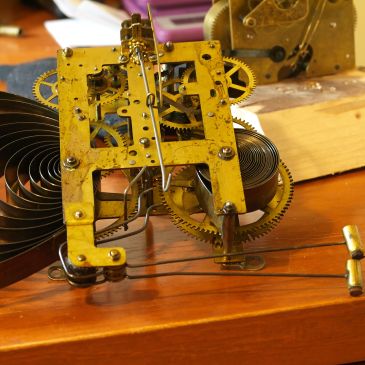
The first challenge after dis-assembly was to clean the movement and the springs. When I first pulled it out of the case, the time spring had completely let go as a result of a click failure. You can see the retracted spring in the photo below. Click failures are a common problem with Sessions movements. In fact, I have another Sessions Westminster chime clock with the same issue.
I cleaned and lubricated both springs. Everything went well until I tried to hook one of the springs to the winding arbor. After many tries I managed to massage the spring around the arbor with needle-nosed pliers and it finally hooked. The other spring was fine. Let’s hope it stays put and lets hope my click repair is successful.
Click failed and time side will not wind
The next photo shows everything in place on the bottom plate. You will see some strange looking wires which appear to be added to the movement but they are actually helper wires installed at the time the clock was made, essential to allow retraction / movement of some of the levers.
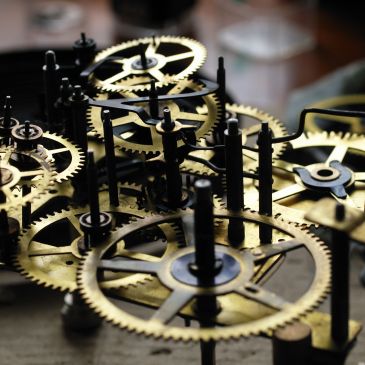
All gears in place and ready for the top plate
Getting the top plate on can be frustrating without the proper tool. One such tool is a pivot locator. It is a hooked device about 8 inches long that allows one to position the pivots into the bushings with minimal fuss.
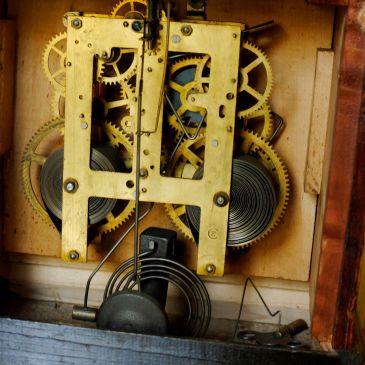
Here is the assembled movement with the springs clamped for safety. You will notice the top plate appears to be dirty. In fact, this is some kind of lacquer residue. I am not into aesthetics and have chosen not to buff out the plates. A repair shop might for appearance-sake. The important things is that the mechanism is clean, which, of course, it is.
Assembled movement
As I have others things on the go I have not tested this movement yet though I checked the action of the time side and the count wheel and they seem to be moving without restriction.
The next phase is testing and if necessary, minor adjustments.
This is a Sessions Tambour style clock that I have been working on for the past two months. I bought it as a non-working clock. As I said in a previous post it is a fairly attractive mantel clock featuring a mahogany finish with faux inlay just south of the dial. It was made in the late 1920s or early 1930s. The case is finsihed and now for the re-assembly of the movement after a good cleaning.
The clock has a few issues aside from the missing pendulum bob. Once the movement was out I inspected the click on the time side and sure enough it had slipped off the teeth. These clicks were poorly designed and often fail. However I think one for the reasons why the click failed was because the arbor hook detached from the spring somehow, I don’t know for sure. I feel that two are connected. I filed the click, gave the rivet a gentle bang with a hammer to set it more firmly in place and now it seems to work as it should.
I recently bought an Ollie Baker spring winder and this was it’s first test. I had a heck of a time getting the main wheel arbor to hook onto the spring and really had to muscle with the inner part of the spring to get the curvature just right so that it could hook. At first I thought that the hook was the problem but as you can see the hook looks fine. Then I thought the spring was the problem but as I said, perseverance paid off. User interface error I suppose.
Mainspring arbor and hook
As others have said that is one of the common frustrations of working with clocks. But in the end I managed to get it to hook. The two springs are coiled and secured and are now waiting to be put back onto the movement. But not today! One victory today is enough. I will keep the reader informed as to my further progress with this clock which I am determined to get working.
Top plate and springs are missing in photo
It all seems to be coming together although like most things worth doing, it takes time. Let me know what you think and if you have a chance I have a poll that you can respond to. Thanks.
I did not pay much for this Sessions tambour style clock (circa 1927) though my first thought when I picked it up was that I paid a little too much, such was the work that awaited me. This was obviously a non-working clock when I received it and it did not take much to discover why. It also came without a key and a pendulum bob. Not a problem since I have an extra bob and a universal key set.
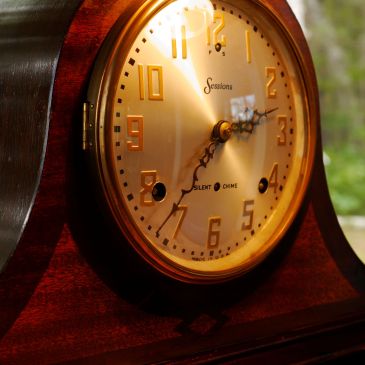
Refinished clock case
I suspected a problem when I first saw it advertised. When I finally picked it up I noticed that the strike side spring was fully wound while the time side was completely unwound.
Spring is in good shapea clamp is holding the strike side spring in place
A turn of the key on the time side told me that nothing was engaging . I suspected three things; a broken spring, broken click or unhooked spring. It turned out to be a broken click. Here it how I found the time side mainspring wheel (see photo below). The click engaged very poorly and ultimately slipped quite a bit making it impossible to wind. Sessions are great clocks but they have a dubious reputation for their click design and the clicks quite often fail over time.
click is loose and worn
and the repair.
Click is filed and tapped firmly into place
The click was filed down and the rivet was made secure by tapping the back lightly with a ball pean hammer on a vice. Brass is pretty soft and easy to work with.
The clock was disassembled and the parts were first cleaned by hand and then placed in an ultrasonic cleaner. The bushing holes were pegged and the pivots were polished. I did not detect any serious bushing wear though at some time in the next year or two the clock will probably require some bushing work.
I test fit the movement but have not put on the top plate just yet since I am waiting for my spring winder to arrive.
Test fitting of wheels and parts
The case was in poor shape and as mentioned in a previous post I stained, used steel wool and applied 3 clear coats to bring the case back to a presentable condition. I am pretty confident that once everything is all back together the clock should run nicely and be a fine addition to my collection.
This is a Sessions Tambour style clock that, according to the label on the inside back access door is a Beveled Number 2. Seems like an odd name for a clock. It is a fairly attractive mantel clock featuring a mahogany finish with faux inlay just below the dial. It is a time and strike clock, two hammers striking on rods. I would put the date of manufacture at the late 1930s or early 1940s. I have 2 other Sessions clocks with a very similar movement so it looks very familiar. This one came without a pendulum bob so I will have to order one from Timesavers. I am not sure at this point whether the bob is a 2.3 oz or 3 oz so I will order both.
The clock has a few issues aside from the missing pendulum bob. I noticed right away that the time side arbor turned freely and therefore it was impossible to wind the time arbor as the click was not engaging the time spring teeth properly. Once the movement was out I inspected the click on the time side and sure enough it had slipped off the teeth.
The time side click is barely engaged
This is a common problem with this type of movement and a repair is definitely in order. The movement itself is very oily and dirty having been sprayed with some sort of lubricant at one point in its life. There was back gunk (old caked oil) on some of the pivots but there was not as much play in the bushing holes than I would have expected. The spring issue probably arose early in its life. One thing which I first thought was an issue turns out not to be. As the photo shows there are helper wires between the escapement and the fly.
Helper wires
They keep the strike levers from bouncing and assure better operation of the striking mechanism. They are in factory installed condition.
Very dirty movement, time side on left
The case was a little banged up. I did a little sanding with 0000 steel wool, removed dozens upon dozens of white paint drops, filled gouges in the veneer with a red chestnut stain and applied the same stain over the entire finish and it seems to pass for mahogany.
Case refresh
A little Brasso metal polish was applied to bring the shine up on the bezel and I Windexed the dial glass inside and out. The results, I think, are impressive. As a final stage I will apply a clear coat on the case.
Can I get this clock to work? I am convinced that if I can fix the time side click, give it a thorough cleaning, this clock will run fine for a long time.
I acquired my Sessions Raven clock about a year ago. It had been serviced by someone knowledgeable about clocks and arrived in excellent condition. The movement had clearly been disassembled, oiled, tested, and the case carefully reconditioned. Interestingly, it also came with a set of instructions from the person who had worked on it.
Ebony in colour and very attractive Detailed operating instructions
I imagine he wanted to ensure the clock found a good home—and it certainly did! The only drawback was the absence of a label, which is always a consideration when purchasing antique clocks. Otherwise, everything appeared to be in order. According to Tran’s book, the leading authority on American clocks, the Sessions Raven dates to the 1920s. It is a time-and-strike clock, featuring a bell for the half-hour and strike rods on the hour. I suspect it was named the Raven because of its deep ebony color—quite striking, in fact.
Time and strike movement showing the bell
The Sessions Clock Company emerged from the E.N. Welch Clock Company in the early 1900s and was once one of the most recognized American clock manufacturers. However, like many others, it struggled to compete with the rise of electric clocks. Despite its efforts to adapt, the company persisted until the late 1960s before ultimately being forced into liquidation in 1969—a bittersweet end to a once-prominent name in horology.
My clock holds a prominent place in my family room. Its simple design reflects the style of its era and blends seamlessly into any space.
This is a recently acquired Sessions time and strike mission style mantel clock. Aside from cleaning up the case with diluted Murphy’s Soap, my standard cleaner for clock cases, I applied clock oil to the movement and reset the verge in order to get the proper beat. It is running well and keeps very good time. There is a speed adjuster at the 12 o’clock position which is helpful in regulating the speed.
Sessions time and strike movement
There are some issues, the glass clips are broken and the glass is loose in it’s bezel but putty will fix that. It came without a double-sided key but I have enough spares that I have one that fits and the clock needs a thorough cleaning.
Before bezel is cleaned
After it is running for a week or so, I will tear it down and address any bushing issues.
This article describes my latest mantel clock find, an American tambour style time, strike and chime clock that has some very interesting features.
Weak clicks, a common Sessions problem
It is a Sessions Westminster A mantel clock made in Forestville Conn. The first year of production for this model was 1927. Between 1903 and 1933 Sessions produced 52 models of mechanical clocks, ranging from Advertisers, large and small clocks with logos of various businesses, to wall, or regulator clocks, and shelf or mantel clocks, designed for the home. Some of the Sessions clocks from this period are prized by collectors.
Inlay adds to the charm of this clock
This case is 21 inches long and 10 inches high, has a mahogany finish with a faux wood inlay and raised metal gold-coloured numerals. It has an 8-day Westminster quarter-hour chime movement. The strike and the chime are on the same train. This clock has 2 gear trains to perform what is usually done with three gear trains in most clocks. Rare but not unique.
Although made in the 1920’s, Sessions had to compete with every other American clock company as chime clocks became very popular. Movements with 3 gear trains were the norm; three arbours, one for each train. Sessions chose a radical approach, and designed the two-train Westminster movement with only two mainsprings. Economies of scale meant that the dial fit other time & strike mantel clocks as well.
Drum and pin chime arrangement
This particular clock was sold in 1931, an inscription testifies to the date. The sale price in 1931 was $29.95, a working man’s salary in the 1930’s. This is a $20 flea market find.
The time side runs well but the chime and strike side is not working. It has either a broken or a disconnected mainspring or perhaps some other major issue is lurking within.
This clock has a reputation for being difficult to work on. Some horologists will not touch it because of its quirkiness and the amount of time it takes to repair but I plan to give it a shot, not now but once I gain moire experience in clock repair.
You must be logged in to post a comment.