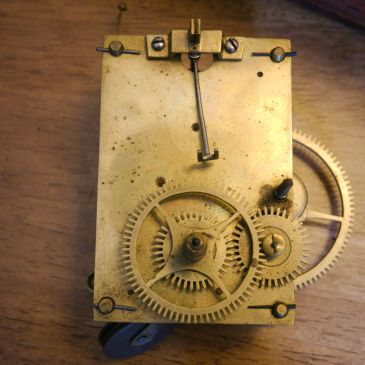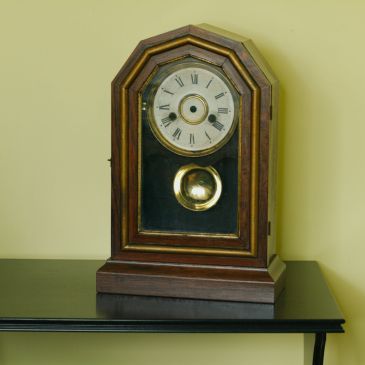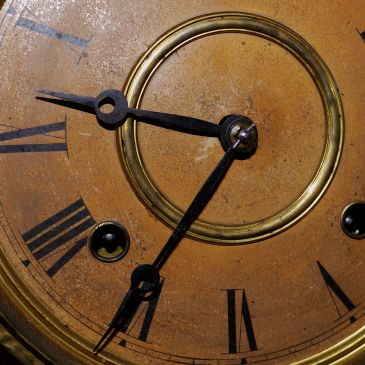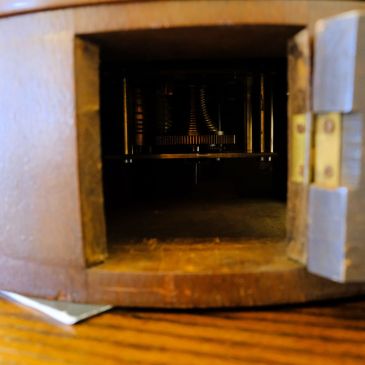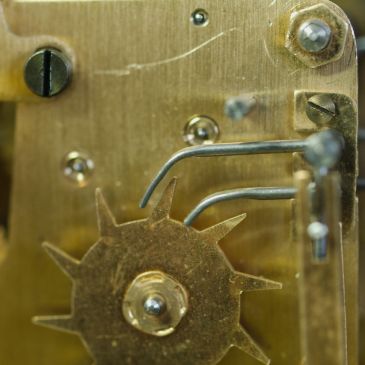

A fusee clock movement is a type of mechanical clock mechanism that uses a conical pulley (the fusee) and a chain or cable to provide a more consistent driving force to the clock’s gear train. The fusee mechanism was commonly used in early pocket watches and large clocks to compensate for the decreasing tension of the mainspring as it unwound.
As a typical mainspring winds up, its tension is strongest, which leads to the clock running too fast. As the mainspring unwinds, its tension weakens, causing the clock to run slower. The fusee counteracts this by gradually changing the ratio of the force applied to the gears, ensuring a steady, regulated power supply. This innovation helps the clock maintain accuracy throughout its entire run.
Fusee movements are often considered an important step in the evolution of horology, showcasing the ingenuity of early clockmakers in solving the problem of maintaining consistent timekeeping. Today, they are still highly valued by collectors and horologists for their craftsmanship and historical significance.
Fusee movement in run-down condition
Most fusee movements were equipped with anchor escapements, though some featured lever or deadbeat escapements. Earlier fusee movements often had decorative sculpted pillars and pins to secure the plates, while later models used plain pillars with screws. This difference in design is one way to determine the age of the clock.
Jacob Zech is credited for inventing the fusee in 1525 although drawings of a fusee appear in Leonardo De Vinci’s notebooks.
Fusee in its run-down condition
Parts of a Fusee Movement
a) Spring drum
b) Winding arbour
c) Fusee
d) Main wheel
e) Chain (or gut or wire)
Of course, the above diagram does not show the wheels above the main wheel and merely illustrates the essential components of the fusee section.
A chain-driven fusee is the norm although wire and gut are common. Gut was used at first but around 1650 chains began to be used, which lasted longer.
How does it function?
The spring drum’s axis is parallel to the axis of the fusee. Around the drum is wound a chain that is attached to the fusee at its largest diameter. An attached mainspring is coiled inside the drum that sits next to the fusee.
When the key is inserted into the arbour of the fusee it pulls the chain causing the drum to rotate. Because the inner end of the spring is attached to the drum, the drum rotates until the spring is completely coiled. The spring is then at its maximum tension. At full winding, the chain is completely wound onto the fusee.
As the spring begins to uncoil the chain is on the smallest diameter of the fusee. The pull on the spring drum becomes less as the diameter of the fusee increases. The diameter of the fusee becomes larger giving greater leverage.
The greater turning moment provided by the larger radius at the fusee compensates for the weaker force of the spring, keeping the drive torque constant and that is why fusee clocks are better timekeepers than conventional spring clocks.
Fusee movements are generally more expensive than conventional spring drive movements. Double and triple fusees add to the cost and complexity.
Disadvantages of fusee movements include their difficulty in adjusting. If the fusee chain or cable breaks, the force of the mainspring can send the end whipping around inside the clock, potentially causing damage. Any collateral damage, if present, must be repaired as part of the restoration. Additionally, if a replacement mainspring is needed, it must be an exact match; otherwise, the fusee will need to be adjusted to accommodate the new spring.
To sum up, the fusee mechanism transforms the uneven force of a mainspring into a more constant driving power, improving timekeeping across the full run of the clock. Though later innovations would offer simpler solutions, the fusee stands as a remarkable example of early mechanical engineering. Its complexity may present challenges in maintenance, but its effectiveness and historical significance ensure its continued appreciation among horologists and collectors alike.
Once the Sessions Clock Co acquired E. N. Welch assets in 1902 (for more on the history of E. N. Welch Clock Co. go here) the company was well on its way to becoming one of the biggest clock producers in America. Production began in 1903 and between that time and 1933 Sessions produced 52 models of mechanical clocks, ranging from Advertisers, large and small clocks with logos of various businesses, to wall, or regulator clocks, and shelf or mantel clocks, designed for the home.
The vast majority of Sessions clocks are generic types that have limited value today. I do not know one particular clock made by Sessions that is highly sought after by collectors today although if there is one, please let me know. Found in many homes across North America, they were robust and strong runners despite being inexpensive and plentiful. You might call them the Chevrolet of American clocks.
Of those, I have worked on, the one Achilles heel is the flimsy click design.
I did not have a Mission-style clock in my collection so, this is a long overdue acquisition. Items missing on this clock are the winding key, a #6, and a label which is normally affixed to the backboard. Hence I do not know the model’s name.
In the below photo, the minute hand is missing. I have it but it snapped in two when I attempted to set the time and it will need to be repaired.
Sessions Mission style wall clock
The mainsprings were wound tight. Rather than let the springs down I ran the time side of the clock during the summer. The time side appeared to be fine, a small matter of putting it in beat but the strike side was erratic and struck either at will or incessantly. Something is amiss on the strike side and that means servicing is in order.
I noticed almost immediately that there is what looks like homemade bushing on the second wheel strike side much like a Rathburn bushing but obviously done by a home handyman. It likely works okay but I will remove it to see what issues I find.
Looking over the movement I can see that it has been serviced several times. The pillar nuts are chewed up and there are X marks besides most of the bushing holes and of course one or two bushings with punch marks. I also see a bit of soft solder on the movements in various places such as the third wheel strike side, and time side main wheel arbor which tells me that the repairs were not professional.
I will have a more detailed description of the movement when I dive deep into cleaning and repairing it in the days to come.
Whether you are working on your first clock movement or have repaired dozens, resources, I believe, are essential. There is only so much information gained from a YouTube video, antique clock information site or how-to instructional resources online. Sadly some information is just plain wrong.
There comes a point in time when you simply must have more detailed information that one can reference without painstakingly plowing through a frustrating Google search.
My clock resource library
Opinions vary as to what constitutes an essential clock repair library but I believe a combination of instructional manuals, clock identification guides, and historical horology should be at the heart of any clock library.
I will begin with what I determine to be essential resources and additional resources I have recently added to my library.
But first, here are a few I recommend.
My go-to set of books for American clocks is a series of working manuals authored by Steven G. Conover.
Conover books
Working with Anniversary or 400-day clocks requires the Horolvar 400-day Clock Repair Guide. 400-day clocks can be quite finicky and you are asking for trouble if you do not have this resource. The perfect companion is Mervyn Passmore’s book entitled Anniversary Clock Adjusting. It is a little short on depth but simple and to the point.
Horolovar 400 Day Clock Repair Guide
Next are three books by Philip E. Balcome.
Balcomb clock books
The Clock Book– An Overview of Heirloom and Contemporary Clocks in the American Home (not a repair book per se but a guide to identifying clock parts, types, styles, and trends)
The Clock Repair First Reader – Second Steps for the Beginner
The Clock Repair Primer– The Beginners Handbook
Balcome books are easy reads and are targeted at beginners and more advanced repairers.
John Plewes focuses on Canadian Made clocks. This is a good how-to manual though not as detailed as the Conover books mentioned above.
Solid information on Canadian clocks
Now, for my newest books and how I came to be in possession of them.
The Heritage Clock shop in Brockville, Ontario went out of business on May 28, 2022, after 29 years of serving the community of clock lovers. There is a chance that new owners will step in but not yet, so far. Sadly many of these mom-and-pop shops have now disappeared and with it the knowledge and expertise of antique and vintage clocks.
My newest collection of books is as follows. The photos should be self-explanatory.
Price and identification guidesThese I would rarely useA good source of historical background informationLimited use but I might regret throwing these away some dayPerhaps the best books of the new bunchGood information from the two Candain books on the left
Fortunately, a member of the Ottawa Valley Watch and Clock club was able to pick up the books which were free to a good home. Naturally, that person selected what they wanted and passed the remainder to me through another member.
Most of the books are price guides from the 1980s and 90s though some are helpful guides and manuals. The estimated values of the clocks in the identification guides are outdated as clock prices have dropped precipitously in the past decade but they provide a handy resource for types and models from various manufacturers.
Most of my work up to now has been with American and Canadian clocks, though some are German, French, and of course, British.
What I am missing are instructional manuals for foreign clocks (French, German, etc.), and historical information for Canadian Clock companies. The new books I have brought into my collection do not address this issue but if one is in the process of expanding a clock library it is always a work in progress.
All successful blogs grow and develop. With development comes transformation and better ways of managing communications and so, I have decided to make a change in the way that you, the reader, can communicate with me more effectively.
Up to now, I have used my personal email account for your letters. It has worked well to a point. Along with many other emails I receive it sometimes becomes difficult to find your particular email. Sometimes they get lost in the junk pile only to be discovered days and weeks later. As a result, I may be somewhat late in replying to you and for that, I apologize.
basic clock terminology
Previously all emails from this blog went to my Gmail account. From this day going forward, my new email address is ronjoiner@antiquevintageclock.com
Please continue to read my articles and use the search box on the right to find specific articles of interest. I typically post twice per week usually on Monday and Friday but occasionally on a Tuesday. If you like what you see, hit “like” at the end of each article.
Please leave a comment or question on my site in the comments section following each post. Those of you not comfortable with their names “out there” may contact me with your clock issue or general questions/comments privately at ronjoiner@antiquevintageclock.com
If you would like to know more about your clock or have challenges with a clock you are working on, please include pictures (of a reasonable size – under 1MB per photo) in your email to me.
Junghans Sydney cataslog photo
All blog comments are moderated, and will not appear until the author has approved them. Expect a few days to a week for a reply sent privately.
Whether you are a novice clock collector or are a little deeper into the world of horology, I will answer all emails promptly although there are times in the year when I am traveling there may be a slight delay in responding to you.
For those comments and questions that stump even me, I consult within my clock circle for the best possible answer.
Seven clocks in my collection have family connections, not necessarily with my own family but clocks that I am able to trace back through families mostly in Nova Scotia (Canada). No names are mentioned. The stories are sad in some cases but interesting nonetheless.
Let’s begin.
Waterbury wall clock
When I was a child back in the 1950s my grandparents had one clock in their home, a Waterbury drop octagon located in the kitchen above the sink. It was the only mechanical devcie that made a sound in their home.
Waterbury shot dropwall clock, homemade case
My grandfather was a veteran of the First World War and suffered from shell shock (PTSD) long after the war. His home had to be stone quiet with the exception of the time and strike Waterbury clock in the kitchen.
Not knowing much if anything about case constructionmy cousin decided to screw the bezel into the case
After he died my grandmother sold the house and moved in with one of my aunts. The clock went to one of my uncle’s kids. The original case was painted yellow to match my grandfather’s kitchen walls and either it was in poor condition or broken, and a new case was constructed by my cousin. He knew almost nothing about case construction but did the best he could. Because he did not know how to repair the movement the clock was stored in a barn for a number of years (chicken pecks on the dial face!). In 2020, he gave the clock to another cousin who was breaking up their home and asked if I would have it.
Rather than take the movement out of its homemade case and put it into something more appropriate I decided to leave it as is as the case with all its warts is part of the history of the clock.
Sawin Banjo clock from a collector in Wolfville NS
My wife found this weight drive time-only banjo clock on Facebook Marketplace. The photos were quite poor and I imagine the seller was not getting much traction on the ad. Knowing that it might be something special I made an offer, sight unseen.
Banjo clockby John Sawin or one of his associates
It had a few minor issues such as broken glass, and veneer losses but otherwise, the clock was intact including the original acorn finial.
Timepiece
I always ask the seller about a clock’s origin and in this case, the clock was from a collector in Wolfville, Nova Scotia. The seller said that her uncle had this clock as well as a number of quality clocks for as long as she could remember, perhaps 60 years or so but could not recall where the clock originally came from.
After researching this clock I discovered that it was made in or around 1840, in Boston and although unsigned has all the markings of a clock made by John Sawin (or one of his associates) an apprentice to the famous inventor of the banjo timepiece, Simon Willard.
Gilbert mantel clock Shawville
What attracted me to this clock was the condition of the case. For a 100+-year-old clock, it is in remarkably good condition.
Gilbert time and strike mantel clock
The design is simple but graceful and of course, it would have been one of the cheaper clocks in the Gilbert line.
Gilbert movement
Despite the pandemic, people were still engaged in the buying and selling of clocks. This was another Facebook ad. The price was very reasonable. The clock was bought from a family in Shawville Quebec. A family member had passed away and all household items were sold off. The seller said her mother loved the clock and polished it weekly though it had not run for years.
Because the seller did not wish to have physical contact with me the clock was placed in a recycle container on the side of the highway for me to pick up.
Mauthe Horse crown
Most would call this a Vienna-style springer. Made in or about 1885 it had been in a family since I bought it from a former superintendent of schools about 6 years ago.
In the early 1980s, his wife brought the family clock over from Holland in a suitcase. It had been in his wife’s family for several generations previously. The gentleman’s wife passed away 10 years ago and had she been alive today I would certainly have learned a lot more about its history.
Mauthe Horse Crown with replacement bottom center finial
The seller was reluctant to let this clock go since it was a happy reminder of his past life. But he was moving into the next phase of his life with a new partner and that meant divesting of furniture and other items. Like him, I think of life in phases.
Mauthe Horse Crown movement
The only issue was a missing bottom finial. I can only imagine that the finial had to be removed so the clock could fit in the suitcase.
Junghans wall clock Crispi
What happens when you get a clock in a box? Call it a collection of parts, pieces, and dust. To some, a box of clock pieces is discouraging but to me, it was a challenge.
Junghans clock in pieces
This is an antique German Junghans time and strike spring-driven clock made in the style of a Vienna Regulator. There is no serial number on the movement which dates the clock to 1899 or earlier (in 1900 Junghans began to number their movements).
Fully restored Junghans Crispi wall clock
This clock is a witness to the day of the Halifax Explosion in 1917. The result of the explosion from a munitions ship in the Bedford basin was apocalyptical.
This clock, owned by the seller’s wife’s mother caught the brunt of the blast.
Catalog photo of the Crispi, second from left
The blast not only shattered the glass panels but heavily damaged the box frame. Most of the parts sat in a box for 100 years. Since the box frame was damaged beyond repair, the seller, an amateur woodworker, built a new frame made of oak some 35 years ago. He was at a loss as to how to repair the movement, put the project aside, and lost interest.
Wag on a wall
The style of the clock is a “wag on the wall”. It is a strange name but basically, it is a clock with the movement enclosed in a small case and with a pendulum and weights exposed. It is so named because the pendulum appears to wag on the wall like a dog’s tail.
Wag on a wall, unknown maker
My wife’s uncle was an internist (internal medicine specialist) in Newfoundland and practiced for many years but dementia and its attendant complications finally got the best of him. He spent the last 5 or so years in a locked ward of a residential facility for the elderly.
The pendulum wags like a dog’s tail
As part of his practice, he set up a home office where he would receive patients and consult with colleagues. In his office was a wall clock given to him by a former patient.
When he passed away his possessions were distributed among his family members with the clock going to his brother who, himself passed away this past year. Unfortunately, there was not much interest in the clock and it spent 15+ years in a Rubbermaid container in the basement of his brother’s home.
His wife is currently in the process of moving to a smaller home, giving away what she could and since I have a keen interest in antique and vintage clocks she determined that the best place for the clock was in the hands of someone who would appreciate it.
Ingraham Huron
The clock is Rosewood “Huron” Shelf Clock, by E. Ingraham & Co., Bristol, Connecticut circa 1878.
Rare E Ingraham Huron found on a local online for-sale site
It has a paper-on zinc dial with a round glazed door and a lower glass access panel. It is a brass eight-day spring-powered movement, with a height of just under 41 centimeters.
Ingraham Huron balloon-style shelf clock
I asked the seller who was about 70 years old at the time, “what do you know about this clock?”. He extended his hand palm down out to about a meter from the floor and said, “I was this tall when I can first remember it in my grandmother’s home”. There is a penciled marking just inside the case indicating that it had been serviced by a person by the name of Hebb in 1944. The seller recalls a Hebb family who at one time lived in the Bridgewater area of Nova Scotia near where I purchased the clock.
He and his wife were in the process of dissolving their marriage and were selling off everything they own including many sentimental items.
Conclusion
I always make it a point to ask about the history of any clock I purchase. Sometimes, in the cases above I learn interesting things about the clock. In other cases, the seller knows nothing.
I wish I knew more about other clocks in my collection. Unfortunately many were passed on from seller to buyer and the history has been lost forever, but what stories some of them could tell.
Earlier this year I bid on an English-made Empire gallery clock at an online estate auction and won the bid. When I collected the clock I had hoped I had bought a clock with a fusee movement but it turned out to be one with a conventional spring-driven time-only movement. No matter, it was not an expensive clock.
Empire time-only gallery clock
A fusee clock has been on my wish list for several years and now I finally have one. A good friend was trimming his collection and offered me a time-only gallery clock with a fusee movement for a good price.
Time only clock with fusee movement
English fusee gallery clocks, also referred to as dial, school, office, railway, or wall clocks, are a must-have for any serious collector.
The heyday of the English gallery clock was between 1860 and 1930. Gallery clocks were made in the thousands to service the needs of industry and government. The gallery clock was a common sight in schools, offices, hospitals, rail stations, and businesses in the United Kingdom.
Gallery clocks with fusee movements vary greatly in size, style, and in construction. Despite being over 100 years old, they retain their original attributes of good timekeeping and reliability. Fusee movements are rugged in construction, and their success rests with the fusee, a conical-shaped component that evenly regulates the power output of the spring.
Chain-driven fusee movement
The gallery clock came in all sizes but still retained its basic design and shape. The most popular size was 12 inches (diameter of the painted dial). Generally, the smaller the dial, the rarer and more expensive the clock. This clock is among the group of common gallery clocks and has a 12-inch dial. The next smallest size would be a 10-inch dial and then an 8-inch one.
The majority of cases (back box and surround) were manufactured in mahogany; however, oak and rosewood were used. Mahogany examples are the most expensive. Oak cases are generally slightly cheaper. Ebonized cases are cheaper still. My new acquisition appears to be made of oak.
It has all the attributes of a classic gallery clock. Four pegs connect the two constituent parts through “rails” or “cleats.” To inspect a movement, it is just a matter of laying the clock face down and pulling out four wooden pegs, lifting the dial, bezel, and movement out of the rectangular box case. Later clocks were made without pegs with access to the movement via the dial.
The backplate of the fusee movement
However, to remove the movement entirely the hands must be removed and three screws holding the dial are removed as well. There is also a movement pan that is held by pins that must be taken off.
Most movements had anchor escapements, some had lever escapements and some had deadbeat escapements. Later models had plain pillars with screws. This clock has an anchor escapement and plain pillars so, not so old but still an antique.
This clock has a chain-driven fusee although wire and gut are quite common.
The maker is unknown.
Special care must be taken to service a fusee movement so, I will be treading carefully as I service this movement but for now I will run it to see if it lives up to expectations.
I often get letters from my readers that begin with something like, “I picked this up in a thrift store” and marvel at what they find for next to nothing. Quite often the item they snagged at an unbelievable price needs a little love but that is to be expected.
Sessions wall clock
While on our summer jaunts my wife occasionally drags me into the odd thrift store because as she says, you’ll never know what we’ll find” and quite often she’s right. Over the past two or three years, we have bought a few jazz and classical CDs for next to nothing (yes, CDs are back).
Recently we stopped in a small town in an adjacent province to look around. We found a couple of classical CDs and were content to leave when my wife pointed out a mission-style clock hanging behind the cash.
“What’s the price on that? “, I asked. “I don’t know, the boss is in the back” I found him throwing items into a dumpster, obviously things that could not even be given away. “I’m interested in a clock”. “Show me”, he said. We both walked to the front of the store, he looked up at the clock, rubbed his chin, and said, “how about 10 bucks”. I mean, why dicker!
I don’t have a Mission-style clock in my collection and hoped that it was a Canadian-made Arthur Pequegnat, but I knew the hands were not the type used on Pequegnat clocks. Upon first inspection, the only things missing are the winding key and a label which is normally affixed to the backboard.
Sessions time and strike movement
I thought perhaps it was an Ingraham or Sessions. Once back at home I unscrewed the back panel and identified it immediately as a Sessions movement. Still a good deal. It also tells me that it was made after 1903 the year the sessions Clock Company was formed after a group of investors bought out the assets of the EN Welch Clock Co.
The mainsprings were wound tight. Rather than let the springs down I ran the clock. The time side was fine, a small matter of putting it in beat but the strike side needs a little work. There is nothing wrong with the passing strike on the half-hour but complete silence on the hour. Something is amiss on the strike side. I‘ll give it a nudge and see what happens.
It is a $10 cottage clock my sister picked up in a yard sale several years ago and gave to me after I serviced one of her ogee clocks. There is a label on the inside that says it is made by Ansonia Brass Co. and I would date it to around the early 1880s.
It likely cost no more than 50 cents in its day, the most inexpensive of mechanical clocks but enough to provide for a family of modest needs.
Ansonia cottage clock
Not many survive to this day as they were tossed out when they stopped working. When they do survive they are often in poor condition such as this one. So, it is not surprising that time-only cottage clocks, in very good condition, are sometimes worth more and have greater collector value than larger American time and strike parlour or kitchen clocks.
A very simple time-only movement
So, why is this clock not worth much more than my sister paid for it? It’s had a hard life and has likely been altered in several ways. Original movement? It’s hard to say as there are no markings on it. Well worn? Yes! Pendulum, crutch, the mainspring, pallets; probably replacements. And why the notches on the rear of the access door?
Notches on either side of door
My wife and I love the sound of a ticking clock when we sleep at night. We both find it very soothing. And this one ticks just loud enough to be heard over our window air conditioner.
Unfortunately, the movement cannot quite run its intended 30 hours, and either the mainspring is too weak, or it needs a good cleaning. It is certainly not worth replacing a mainspring that would exceed the value of the clock so, a good cleaning is what it will get.
Time-only movements are the simplest to work on. There is only one train with three wheels plus the escape wheel. It is a matter of letting down the mainspring (a clamp is not necessary) releasing the 4 pins that hold the plates together which exposes the wheels and then taking the parts out.
Bent and worn main wheel teeth
Two issues immediately tell me that this movement does not have a lot of time left. The main wheel and the centre cannon teeth are slightly bent and it is only a matter of time when one or more break. There is not a lot of stress produced by the mainspring on the wheels of a 30-hour clock so it could take years, or perhaps even tomorrow. In any event, a repair of the wheel teeth is just not worth it.
The movement is not especially dirty but there is blackened oil in some of the pivot holes necessitating remediation. A clean in the ultrasonic followed by rinsing the parts, drying them, and then reassembly, oiling, and testing. That is it.
It is clean and I hope it will run 30 hours after the cleaning. Will it last? Well, for as long as the wheel teeth hold out. Let’s hope they do!
This wall clock was gifted to me in the spring of 2022. I have no idea who made the clock, there are no markings on the case or the movement. It was likely sold by the Forestville Clock Company of Toronto in the 1960s and my guess, a Hermle movement. I could find nothing else about it online. I wrote an article in August with first impressions.
Wag on a wall time and strike clock
The style of the clock is a “wag on the wall”. It is a strange name but basically describes what it looks like it is doing, wagging its tail. A Wag on a wall clock is a clock with the movement enclosed in a small case with a pendulum and weights exposed.
From 1660 to about 1870, the wag-on-the-wall was a very common clock style. It is so named because the pendulum appears to wag on the wall like a dog’s tail. It is also a derivative of the English lantern clock (more closely to a converted one with a pendulum). It was eventually deemed not attractive enough to hang on the wall in many upscale homes, so wooden or glass and wooden cases were added. The long-case or grandfather clock evolved from this early wags-on-the-wall. Wooden cases were used to hide the unsightly weights and cast-iron pendulum.
The style did not disappear as many manufacturers continued making the wag-on-a-wall style clock to this day.
There were several clock assemblers operating in Canada up to the mid-1970s, and it was likely imported and assembled by the Forestville Clock Company of Toronto.
It is a rack and snail movement possibly made by Hermle. The second wheel teeth are larger than one would expect so, a lot of thought went into the design of this movement. I have worked on similar movements in the past though this one is a bit different, specifically the arrangement of the hammer assembly, one main wheel is the reverse of the other, and of course, it is a weight-driven time and strike clock.
Hammer assemblyReverse chain wheels
Based on my initial observations the movement looks fairly clean despite the tarnished brass but I am expecting minor wear issues commensurate with a 60-year-old mechanical clock.
Disassembly
I took a number of photos prior to disassembly. This is my regular practice and although I have worked on many similar movements though there are always minor intricacies that differ from manufacturer to manufacturer.
To remove the movement from its case, two slotted screws holding the movement to the seat board are released plus, the weight chains must be pulled out. To release the chains the weight hooks must be removed.
The rack and snail assembly, minute wheel, hammer assembly, escapement, and pendulum leader were removed initially and placed in a collection tray. What remained were the wheels and the lifting lever between the plates secured by four pillar nuts.
The gathering pallet arbour and the main arbour are pressure fit. So, when I separated the plates most of the wheels fell out, of course. It can be a challenge for first-time clock repairers but when one works on a few there is a certain logic to the placement and orientation of the wheels.
Assessment of the movement
Because there was generally little wear, I made three decisions. I elected not to separate the central arbour and did not pull the gathering pallet from its arbour. As a result, the plate with two arbours attached was placed in the ultrasonic. I did not disassemble the main wheels which were held together with pressure washers. The main wheel ratchets and chain teeth are in very good condition and the ratchet assembly worked as it should and there was no need to take them apart.
I cleaned up residual oil and dirt around the pivot holes, removed excess oil from the pates, inspected the pivots for wear, and placed all parts in the ultrasonic cleaner. Since I was using a smaller machine than my regular US cleaner, the parts were cleaned in three batches which took a little longer.
Older, less efficient ultrasonic cleaner
I took special care drying the main wheels assemblies and ensured they were operating correctly after they were completely free of any moisture
My wife’s hair dryer came in handy but after cleaning and drying all the parts it fell off the table and broke. Sigh!
The pivots, which are in very good condition, are polished, the pivot holes pegged out and the next step is bushing work. Two bushings are required, the second wheel front plate and the centre wheel, back plate. There is minor wear on those two holes but why not address them while the movement is apart.
Reassembly
As with many rack and snail movements, most adjustments are made after the wheels are installed within the plates but three minor adjustments make the job easier and that is ensuring the gathering pallet is free of the rack, the stop wheel is in the 12 o’clock position and the hammer actuators are free of the star wheel. They must be between the star tips, if not, one of the hammers will catch on a star tip and stall the strike.
Time and strike movement
Testing
Once fully assembled the next step is installing the chains, weights, pendulum, and testing/adjustment. A small adjustment to the height of the pallets was made after which the clock ran well and continued to run well after 5 days. It is keeping very good time, as expected of a weight-driven movement as any clock that is powered by weights releases its power uniformly through its rated cycle.
Yes, it is a very plain-looking clock that reflects the style of the time (the 1960s) but it might grow on me.
There was a time in the 1970s and 1980s when every family of sufficient means had a grandfather clock in their home. It was a symbol of success but today, nobody wants them.
clock face
Two years ago my daughter bought a new home in a large western Canadian city. There were a couple of pieces of furniture in the house during the process of the sale.
Craftline grandfather clock
One item, a grandfather clock was offered for sale, my daughter consulted me and I advised her to lowball the offer. So, she bought it far below the asking price. It was clear the seller had no interest in taking it with them and they quickly agreed to the lower price.
Weights and pendulum
It is a Craftline grandfather (or tall-case) clock from about the mid-1980s. I have seen a few modern grandfather clocks and to me, this was a top-of-the-line model with selectable chimes, seconds bit, beveled glass lower access door, 12-inch pendulum bob, moon phase, crank weights, beautiful solid wood (Cherry?) case with selected veneers.
Craftline clock
The trouble is that I cannot find one darn thing about the company during an online search.
I do know that Craftline was a Canadian company that made clock cases and sourced Hermle and possibly Urgos movements, plus faces, pendulums, and weights from Germany. When they ceased production (presumably in the early 1990s) and how long the company was in business is a mystery. However, judging from the quality of this clock, they were able to compete successfully with Howard Miller, Ridgeway, and others.
However, it is a fine-looking clock that represents a time when every home had to have one.
June 2025 update: The definitive source on Craftline Industries is an article I authored earlier this year.
Tick-Talk Tuesday is about the letters and comments I have received from readers concerning clock issues, challenges faced, a clock you would profiled or advice on your particular clock concern. For those comments and questions that stump even me, I consult within my clock circles for the best possible answer
CC writes:
Hi Ron, are you still answering questions about antique clocks? I came across this (Sessions Westminster A mantel clock) at a garage sale last weekend. I need to get a replacement key, and I need to know if it is worth having it cleaned and does it need to be repaired. I think it’s really beautiful and I would love to hear how it strikes and if it has a chime. I have attached some photos, hopefully, they can help. Thank you for your time I really enjoyed reading your articles online. Sincerely, Carla. Ps, yes I have the weight I only removed it because I’ve been moving it around to clean it up and polish the wood but I have not touched the mechanisms.
Sessions Westminster chime circa 1931
My reply:
I had some difficulty downloading all the images but I saw enough to tell you that what you have is a Sessions Westminster C made in the early 1930s. Chiming clocks usually have three winding points but although yours has only two winding points it is a chiming clock since one mainspring controls the striking and chiming functions of your clock while the other operates the time train. It would take a #6 key.
Because of the complexity of the movement and you may find that some repairers will not accept this clock for repair. Be prepared to pay more than this clock is worth for a repair. You also may have a part or two missing on the pin drum which might be problematic.
When working correctly they are a nice sounding clock.
Sessions Westminster chime drum on writer’s clock
CC replies:
Hey Ron I cannot tell you how excited I am to know that this clock is working thanks to you! I ordered the size 6 key and wound it up and it just took off. My next question is how do I or what do I need to get the chime to work there is another hole a small one at the very bottom of the face and I don’t know how to turn it off or on. Any suggestions.? I hope my video comes through… The scratchy sound in the background is my pug sorry about that but this SOB is ticking and I love it!
My reply:
Clocks such as yours came with double-ended keys. One end for winding the arbors and the other for the speed regulator, at 12 o’clock and for silencing the chimes. The “silence” may be in the off position and to turn it on one would require the small end of the double-ended key.
The other more serious issue is that the chimes/strike require servicing which is not fun because these clocks are a challenge to work on.
Sessions clock face
CC replies:
Thank you, Ron. I don’t think I’m gonna be able to have it repaired I couldn’t afford it this time. And it didn’t take very long maybe a couple days. Oh well, at least it’s pretty. I know you don’t sell or hook people up with sellers but if you know anyone who might be interested in buying it… Or where I might be able to sell it, other than eBay let me know, please. If not that’s OK and thank you for your time and expertise. Sincerely CC.
My wife’s uncle was an internist (internal medicine specialist) in Newfoundland and practiced for many years but dementia and its attendant complications finally got the best of him. He spent the last 5 or so years in a locked ward of a residential facility for the elderly.
As part of his practice, he set up a home office where he would receive patients and consult with colleagues. In his office was a wall clock given to him by a former patient.
When he passed away his possessions were distributed among his family members with the clock going to his brother who, himself passed away this past year. Unfortunately, there was not much interest in the clock and it spent 15+ years in a Rubbermaid container in the basement of his brother’s home.
His wife is currently in the process of moving to a smaller home, giving away what she could and since I have a keen interest in antique and vintage clocks she determined that the best place for the clock was in the hands of someone who could have it working once again. I did not have a clear idea of what she was giving me though I knew that it was a mechanical wall clock.
Quickly mounted on the wall to check things out
The style of the clock is a “wag on the wall”. It is a strange name but basically, it is a clock with the movement enclosed in a small case and with a pendulum and weights exposed.
In the years between 1660 and 1870, the wag-on-the-wall was a very common clock. It is so named because the pendulum appears to wag on the wall like a dog’s tail. It was eventually deemed not attractive enough to hang on the wall in many upscale homes, so wooden or glass and wooden cases were added. The long-case or grandfather clock actually evolved from early wags-on-the-wall clocks. Wooden cases were used to hide the unsightly weights and cast-iron pendulum.
The style did not totally disappear as many manufacturers continued making the wag-on-a-wall style clock to this day.
There are no maker’s marks on the dial or the movement but it appears to have a Canadian connection. There were several clock assemblers operating in Canada up to the mid-1970s, and it was likely assembled by the Forestville Clock Company of Toronto from parts sourced from West Germany but I will learn more as I continue my research.
The only markings on the movement are a serial or production number ending with 65 behind the pendulum leader and UW 7/29 (a date or other measurement) just above the aforementioned number. The year 1965 seems about right judging from the two-tone case tinting popular in the 1960s, The clock case is not particularly attractive today but such was the style at the time. I don’t think it will ever be my favorite wall clock.
It is a weight-driven rack and snail time and strike movement possibly made by Hermle, Mauthe or Urgos. I have worked on similar movements in the past though this one is a bit different, specifically the arrangement of the hammer assembly and the main wheels are reversed from each other.
The weights and pendulum are polished
It is not apparent upon first inspection if the movement has ever been serviced. Rather than run the risk of further wear I plan to test it briefly before servicing the movement. The movement looks robust and well made but I am expecting minor wear issues commensurate with age when I open it up.
While it is largely intact the bottom middle finial is missing. Otherwise, the case is in very good condition for its age. I mounted it on the wall to check things out and yes, it does wag!
In an upcoming article, I will go over the steps in servicing this movement.
In our quest to have our antique mechanical clocks run accurately the immediate response is to regulate the clock, but have you thought about calibrating your mechanical clock? It is not as difficult as it sounds.
This is not the same as regulating your clock. A properly regulated Anerican-made spring-driven clock will show the correct time at the beginning of the week but will run fast through the week and may gain as much as 3 or 4 minutes mid-week and lose time at the end of the week.
Seth Thomas spring driven round top 8-day clock
Let’s use a spring-driven mantel clock with an 8-day cycle for our example.
Mainsprings release their peak power at the beginning of their cycle. As the mainspring winds down power is gradually released until the spring unwinds completely and the clock stops.
Gilbert spring driven wall clock
On some antique clocks, one might find “stop works” (otherwise called a Geneva stop) which is a clever star-shaped brass add-on to the main wheel that reduces the full release of power initially by flattening the mainspring’s power curve over its rated cycle (8-days) and thus maintain some level of accuracy through the week.
Geneva stops as indicated by the white arrows
But most clocks I have come across don’t have this ingenious device.
Weight-driven clocks are a different kettle of fish because the release of power is constant throughout the week. Once a weight-driven clock is regulated it should not require calibration.
Gustav Becker Vienna Regulator with weights
Calibration makes the assumption that your spring-driven clock will never accurately tell the time at any one given point in its cycle and essentially means setting your clock so that it loses no more than a couple of minutes at any given time through the week.
Sessions mainsprings, one for the time train and the other for the strike train
According to the Canadian Oxford dictionary to calibrate means “to correlate readings of an instrument with a standard”. If the standard is plus or minus two minutes per week, without the use of “stops” or other means to flatten the power curve, setting the clock two minutes slow at the beginning of the week will ensure that it is never off by more than a minute or two through the week.
According to noted horologist Robert H. Croswell, “If the clock is regulated such that it has a zero net gain or loss of time from the start to the end of the week, then take ½ the maximum fast error during the week and set the clock that many minutes “slow” when the clock is wound.” If the maximum is 6 minutes, then, half would be three minutes.
One could use a complex mathematical formula to determine the precise amount of time to set the clock at the beginning of the week but setting it two minutes slow for a clock that loses 4 minutes each week should suffice for most purposes.
Having trouble getting that newly acquired clock to run continually. It may be as simple as a clock that is out of beat.
Here is a quick guide for setting the beat on your mechanical clock.
30-hour parlour clock with a pendulum
This quick guide refers to a mechanical clock with a pendulum. 400-day clocks, clocks with a balance wheel or lever escapement require a specific procedure to set the beat.
This movement has a balance type escapement requiring a very different procedure to set the beat
A pendulum clock is in beat when its ticks and tocks are even….tick…tock…tick…tock…, and is out of beat when they are uneven…ticktock…ticktock…ticktock…or tick…tocktick…tocktick…
When a clock is out of beat, either it will not run at all, or it will run for a few minutes and stop.
There are two ways to put a clock in beat. The first, and simplest, is to tilt the clock sideways, one way or the other, and listen for the beat to even out. When the beat is even, prop the clock to stay tilted that way. Now it will run, but it will look funny while tilted. If it is a wall clock the tilt may not be as noticeable but a tilting mantel clock will always look a little strange.
The second way is to adjust the crutch to one side or the other until the beat is even. The crutch is the rod that extends down from the pallets and the pallets are the things that rock back and forth. The pendulum rod passes through either a loop (called a crutch loop) or a forked foot at the end of the crutch.
If the crutch is a simple rod or wire, it is adjusted by bending it to one side or the other. If it attaches to the pallets with a friction joint, it is adjusted by holding the pallets still with one hand, and shifting (pushing) the crutch right or left on the friction joint.
Which way to tilt it? Rich Jones, a master clock repairer, has formulated a simple rule, known here as Arjay’s Maxim:
Sessions Drop Octagon with a pendulum
Tilt her till she ticks with pride Then adjust the crutch toward the high side
First, use the tilting procedure to make the beat even. Note which side is the high side. Now, straighten the clock so it’s vertical, and adjust the crutch toward the side that was the high side.
How much to adjust it? Trial and error. Adjust the crutch, then start the pendulum swinging and listen to see if it’s in beat. If it isn’t, repeat the procedure. If it goes out of beat the other way, you have adjusted it too much. Adjust it back a little. You should get it right in one or two tries.
Using toothpicks to set the beat on a 400 day clock
Now the beat is adjusted and the clock does not look strange.
A beat amplifier will amplify the beat
A clock that will not run because it is out of beat is one of the most frustrating experiences for a new clock owner. Why would your newly purchased antique mantel clock be out of beat? Because it was adjusted for the last surface it was on.
Inflation seems to be everywhere. The continuing decline in purchasing power is reflected in increased prices on almost everything.
The other day my wife and I bought a container of spray from a garden store. We thought the price was high at almost $25 but when we got to the cash, the clerk charged us $6 more. We showed her the sticker price and she said it was old stock and the computer had already adjusted the price for the new stock coming in. I understand supply chain issues and rising fuel costs but a 25% increase is a bit much. We argued and did not pay the extra $6. Needless to say we will not be buying that product again.
Everything seems to have risen in price as a result of inflation except perhaps antique and vintage clocks!
I don’t actively pursue high end clocks so, there could be movement price-wise for rare and highly collectible clocks but not for garden variety antique clocks. This completely anecdotal but I have been observing the clock market for some time and I do not see a lot of change in prices and if you are into buying and selling clocks this is not a great time to make a profit. Perhaps one day in the future but I believe that day is far off.
$12 cottage clock, unrestored
So, it has been a buyer’s market for the last number of years and it doesn’t look like things will change any time soon. There are many great bargains to be found everywhere and it doesn’t take much looking.
$40 Chauncey Jerome 30-hour ogee
Antique and vintage clocks have flooded the market in the past several years with prices tumbling even further downwards. The new generation of millennials have little interest in antiques and find it pointless to collect antique and vintage clocks. Their loss is our gain, meaning those of us who appreciate the finer things in life.
In addition, modern homes do not have the room for clocks as floor and wall space is limited. In an age when families are living in 800 square foot apartments space is at a premium though there is a hint that things could change as the migration from dense cities to smaller communities continues.
When space is at a premium grandfather clocks or any clock occupying floor or wall space are not items many would consider as necessary for the modern family home. Sentimental reasons aside, the cost of servicing far exceeds the value if the desire is to have a working clock.
$75 Junghans Crispi wall clock
Of course, I don’t have a crystal ball but judging from prices in the past few years I can comfortably predict that things will continue to be much the same this year and next. I do not expect a significant change in the months to come and that $20 bargain clock you discovered today at a flea market will not be worth much more next year.
It is a buyer’s market and there are some terrific bargains out there. Knowledge is power and no doubt there are some great clocks to be found but shop carefully and do your research.
The example is a Fleet time and strike mantel clock from the 1930s. Fleet Time Company of Montreal, a company that was operating four short years, sourced movements from Germany prior to the Second World War. It was a very common mantel clock sold through department stores across Canada.
I like the step side design and the general simplicity of the clock.
Fleet Time case, refinished
The case was in need of refreshing but the movement looked to be in reasonably good condition and required a good cleaning and I was expecting some wear.
The movement was completely serviced with several new bushings installed. The mainsprings were removed, cleaned, and returned to their barrels.
Fleet time movement
In this movement, the mainsprings can be removed without disassembling the movement, handy for such things as replacing a broken mainspring assuming, of course that nothing else has been damaged.
During the testing phase, the mainsprings were partially wound. The intent was to see if the clock would run well. Once satisfied that the movement was running as it should I returned it to its case.
I wound the strike side fully and then wound the time side. Just as I was feeling resistance, CLUNK, the arbour turned freely. If it was a broken click or broken mainspring, either one could easily be replaced.
It has nothing to do with the force of winding a movement. Having a mainspring go bad with winding force from a key is rare, in my view.
But mainspring barrel teeth do not simply fall off.
Fleet time barrel
At times it is a mainspring but sometimes something far worse occurs.
It is not uncommon to find secondary damage to the movement, secondary or collateral damage due to the extreme shock that broke or bent the teeth and teeth cannot be straightened.
The main problem area beyond the barrel itself will be the second wheel and possibly the third wheel arbors, leaf pinions and pivots and/or damaged or missing teeth on the second and third wheels and bent or broken pinions.
Fleet second wheel, a bent leaf cannot be unbent
Is it fixable? Yes, but weighed against the value of the clock, it is just not worth it. It is much more cost effective to harvest parts from another movement.
Given the right equipment, it can be repaired. Once repaired a mainspring must be sourced and although the barrels may be identical, the mainsprings will likely be different.
The solution is locate a donor movement. In the meantime the clock has been put aside.
An attractive gallery clock made by the Empire Clock Co. of England was bought at auction this past spring. It has a very conventional time-only movement and as with most time-only movements there are only a few wheels to worry about when servicing. The minute and hour wheel are outside the front plate.
Empire gallery clock
The movement is rather large for a time-only movement and is well built. It is attached to a heavy steel plate that is screwed onto the front of the movement. The whole assembly mounts just under the dial. It has a very German look to it, though it is definitely English-made.
To access the movement the dial must be removed which is a relatively simple process of removing the hands and three small screws.
Hour and minute wheel
Four slotted screws secure the movement to the steel plate.
Time-only movement made by Empire
An curious feature is a cylindrical pendulum with a large rotating adjustment screw on the bottom. The pendulum clips into a two piece caddy system for easy transport.
Conventional wheel arrangement
For a fairly modern (1920s) movement I was surprised to find taper pins used to secure the plates. The spring barrel is no larger than one would ordinarily find in the average time and strike clock made in England or Germany.
As the movement was drenched in oil all the parts had to be wiped down before going into the ultrasonic cleaner.
I did not expect the plates and wheels to brightly shine after the ultrasonic but all the parts cleaned nicely just the same. After polishing the pivots and pegging out the holes the movement was assembled and tested.
After working with a number of American movements in the past months the pivots on this movement are comparatively tiny. This is not a movement one muscles to put back together, the pivots must be carefully guided into their holes.
A couple of weeks back I featured this Welch marine style wall clock. A marine clock can also refer to a ships’ bell clock. Ship’s bell time originated in sailing ship days, when the crew of a vessel was divided into Port and Starboard Watches, each on duty four hours, then off four hours. One stroke of the ship’s bell indicates the first half hour of the watch. Then an additional bell is struck for each succeeding half hour for a total of 8 bells.
E. N. Welch marine clock
This is not a ship’s bell clock. However, this is a clock that can be used at sea or in a rail car that simply tells the time. Lever and balance wheel escapement clocks are ideal for ship or train applications because pendulum clocks on do not work in those environments.
The movement was made for the E. N. Welch Clock Co. and I would date it around 1860, so, a 162 year old time-only clock with a balance wheel escapement and a seconds bit running off the second wheel.
The clock was bought at auction earlier this year.
The case is dirty but there are no veneer issues
From the photo above the case appears to be very stressed but under that grime and blackish tarnish could be a jewel of a clock.
Tarnished brass
The exterior of the clock has probably not been cleaned in decades or perhaps not at all.
In the old days folks cared for their furniture with weekly or monthly waxing/wiping/dusting or polishing of brass. That was simply the accepted practice. Items were not designed to be thrown-away and it was common to hold onto possessions as long as practicable.
This little clock has certainly been neglected over the years although there is nothing missing, the movement runs just fine and the open spade hands are likely original. Yes, it is dirty! You might call it patina and many collectors would accept the wear and tear over the years as part of the character of the clock. I take the view that it was meant to be shown and a little bit of intervention is perfectly acceptable.
I don’t have time to service the movement and it can wait till later this year but I was able to clean the case and polish the brass.
The brass took a lot of elbow grease and I am sure I went through half a bottle of Brasso but I like the final result. The case required cleaning with Murphy’s soap and one coat of traditionally prepared shellac.
Before
Since it is a 30-hour clock I doubt I will be running it much and servicing the movement can wait.
After
In the meantime I have an Empire gallery clock that I would like to service for summer cottage duty.
Tick-Talk Tuesday is about the letters and comments I have received from readers concerning clock issues, challenges faced, a clock you would profiled or advice on your particular clock concern. For those comments and questions that stump even me, I consult within my clock circles for the best possible answer
PS writes;
I have a 35+ year old Ridgeway Tall Case “Sussex” clock that was severely damaged in transit. It is my parents 35th wedding anniversary gift to themselves from back in the mid 80’s. They have both passed and I inherited it. It was shipped from Chicago to Phoenix where I live last month and when it arrived it was crushed pretty severely. All of the weights are dented and scuffed, the face is detached from the case and the case itself was all but destroyed.
Similar to the Sussex
The carrier is requiring me to get a detailed repair estimate, which I am more than happy to pay you for. The insurance on the freight was $3500.00 and was one of the highest policies available. Now they want a detailed breakdown estimate for repairs, which will likely exceed the 3500.00 it is insured for.
Can you please help me with this? And if you could, I would be happy to pay for your estimating services.
Please let me know so I know how to proceed.
My reply:
As I am not a professional appraiser all I can do is give some advice.
I am sorry to tell you that while your Sussex clock may have cost your parents $3500 in the 1980s it is worth far less today. I have a similar model in my dining room. It is in excellent condition but it is worth no more than $500CDN. They are simply not collectible and grandfather clocks generally are not sought after unless they have historical value or a special provenance. You will be paying many more times what it is worth to repair it. Although for sentimental reasons the cost may not be important.
I have two suggestions. One, take whatever money you can get from the carrier without having to justify a breakdown of the cost. The carrier is engaging in a stall technique and may not even agree with any appraisal you submit to them. In other words take the money and run.
My second suggestion is to find another Ridgeway Sussex (or similar model) and marry the best parts of the two clocks. Chances are you will have good weights, and good glass etc. from the replacement clock. A replacement Sussex (or similar model) should not cost more than $500 and may well be much cheaper. It will take some looking around but they do come up on auction or for-sale sites occasionally.
Clock face showing moon dial
I have another bit of advice. Your grandfather clock movement (the mechanical works) is at the end of or near the end of its service life. The movements in these clocks were generally designed to last about 25 years. It may last longer but it is living on borrowed time. They can be repaired ($$$) but replacing the movement is more cost effective.
Marine movements were in high demand by the 1850s as boat and rail traffic increased. The marine movement is a specific type that does not have a pendulum. Pendulum clocks do not work on a ship or train because they require a stable base. A marine clock has either a balance wheel or lever escapement and were the perfect choice at sea.
This is an E. N. Welch 30-hour marine clock.
Many makers including E.N Welch would buy ready made movements from other shops, assemble them and sell the finished product under their name.
A short history of E. N. Welch. The E. N Welch company was formed on July 6, 1864. Elisha N. Welch (1809 to 1887) had been making clocks at a factory site on East Main Street at Forestville, Conn. since taking over the bankrupt business of J. C. Brown in or about 1856.
Marine style clock by E. N. Welch
The Welch firm was well known for its handsome rosewood cases, though in 1885, with changing styles in furniture, the surviving firm began to introduce new models with solid walnut cases and discontinued some of the older rosewood veneered cases.
After the death of Elisha Welch in 1887, the firm steadily declined, selling off some of its assets and issuing new stock to raise much needed capital. In May of that year the factory was closed down and a receiver was appointed. The receiver spent nearly two years selling off stock and settling the debts of the firm. It was not until 1896 that the firm resumed production.
But the company continued to struggle, would not survive and in 1902 its assets were bought by the Sessions Clock Co.
This movement was not made by E. N. Welch but was sourced from Laporte Hubbell. There were many variations of this movement but the basic two plate layout was identical. In this particular movement the minute wheel is in the two o’clock position and there is the addition of a seconds arbour running off the second wheel just above the “maker’s” stamp. From 1857 to 1863 the E. N. Welch Co. used this 2-plate, 30 hour marine movement. The exact year? Certainly no later than 1863. (source, NAWCC Watch & Clock bulletin, Nov-Dec 2013)
Otherwise, the case is in good condition with two small veneer chips, the brass bezel is very dirty, almost black from years of grime, the dial has minor losses and the movement is running well at this point though at its fastest speed it is running slow.
The plan is to service the movement, and refresh the case. It should be a fun little project.
Won at auction this spring is a Daniel Pratt Jr. reverse ogee with splat although this one is missing the splat, the decorative piece on top of the case.
According to the label it was made in or after 1843.
It was also missing the suspension spring and pendulum rod and the wire with regulating screw for the pendulum bob.
Daniel Pratt Jr reverse ogee clock
There are a few other things that are not quite right. The green banding that frames the upper and lower glass looks a little strange and likely added later and the card stock which would have replaced either a mirror or reverse painted tablet looks out of place. The picture of a young soldier holding a sabre and an American flag looks quite old.
But it actually works and works well.
It has a time and strike 30-hour woodworks movement. Wood-works movements were introduced in American at the end of the 18th century and the high point of woodworks movement production was prior to the depression of 1837. During the depression most clock production was shut down and small companies began to consolidate into larger ones.
Wood-works movement
With the invention of the 30-hour brass movement by Noble Jerome, clock making began to boom again in 1838. Inexpensive woodworks movements continued to be made but by the mid 1840s the woodworks movement production had begun to phase out.
Count wheel on left, escape wheel in the middle
This movement works
The weight cord on the right side looks like it would let go at any time but what the heck, let’s see if this thing works. The green one for the strike side looks sturdy. I will restring the clock later.
I removed the verge and determined there was no power getting to the escape wheel. I felt underneath and although the weight had been wound to the top of the case the cord was binding on the main wheel. It took a little encouragement to bring the weight further down but the adjustment did the trick. I then fashioned a new suspension rod/spring from my supplies along with a pendulum wire, gave the pendulum a gentle push and success!
About 3 hours later as the weight on the time side was descending I noticed the cable had broken at some point and a past owner had simple tied the two ends together. I believe the knot was causing the power issue.
I had already tested the strike side and it was working perfectly.
I have one other Daniel Pratt Jr. clock in much better condition but the movement will not run for more than a few minutes. This one has a splat.
So, one Pratt with a not-so-good case and a working movement and the other with a stunning case but a non-working movement. Should I do a swap?
Daniel Pratt Jr with woodworks movement
I have never disassembled a woodworks movement in my years of clock repair and I doubt that many clock repairers have much experience with one. It is one of the few movement types I have zero experience with but I may have to bite the bullet some day because this clock will not run forever.
The past two years has been like nothing we have ever experienced in our lifetime. Things are improving day by day, folks are re-establishing their routines, the country is opening up and everything will no doubt return to normal in the months to come. Some would say we are in a “new world”?
How will future generations judge this dark period of our lives?
The lake our Shanghai-La
It is time to relax, slow down and for my wife and I that means a change of scenery as we travel to our cottage in central Canada to spend the summer season with friends and family. Our get-away plan for the summer is to relax with a few good books, do a little fishing, swimming, hiking and exchange stories with friends and neighbours over a glass (or two, or three) of wine.
Since many of my articles have been written well in advance of the summer months there will be NO interruption in blog posts through the summer months. I will continue to maintain a steady output of 7 to 9 clock blog articles per month.
An Ansonia cottage clock with the dial removed for testing and spaghetti for lunch
Keep those cards letters coming as 1960s TV variety host Dean Martin once said. There may be a slight delay returning your email inquiry or responding to blog post comments but rest assured that question(s) about your clock or comments regarding any of my posts are important to me and will be answered.
Roasting marshmallows
This blog profiles my own clock collection, the challenges of maintaining and repairing clocks, the joys of finding new and interesting vintage and antique clocks plus many articles of horological interest.
As we explore central Canada I will no doubt find interesting clocks as we scour antique stores, flea markets and junk shops. New clock stories, new repair challenges and perhaps the next major restoration project will also be part of my journey this summer.
Canadian Clock Museum, Deep River Ontario
Included will be a trip to The Canadian Clock Museum in Deep River, Ontario to discover new and interesting clocks added to their collection and chat with curator Allan Symons.
Use the search box to browse past articles and/or click “follow” to have clock articles brought to your mailbox every three to four days. I hope you enjoy reading them as much as I enjoy researching each and every article.
The National Day of Canada is observed as a statutory holiday on July 1st.
This post has nothing to with clock collecting or repair but why not take the time to celebrate Canada’s 155th birthday.
How it started
On June 20th 1868, a proclamation signed by the Governor General, Lord Monck, called upon all Her Majesty’s loving subjects throughout Canada to join in the celebration of the anniversary of the formation of the union of the British North America provinces in a federation under the name of Canada on July 1st 1867, with the passing of the British North American Act of 1867. This was when four colonies united.
Photo by Erik Mclean on Pexels.com, showing the Peace Tower on Parliament Hill
The July 1st holiday was established by statute in 1879, under the name “Dominion Day”.
It was not until 1917 that larger scale and more extravagant celebrations commenced. Remember this was during the war years (WWI) when Canada needed an event to lift it from the stresses of overseas conflict.
Since 1958, the government has arranged for an annual observance of Canada’s national day. The format provided for a Trooping the Colours ceremony, by the Ceremonial Guard on the lawn of Parliament Hill in the afternoon, a sunset ceremony in the evening followed by a mass band concert and fireworks display.
The format changed in 1968 with the addition of multicultural and professional concerts.
In 1981 celebrations with the addition of fireworks displays were held in 15 major cities across the nation.
On October 27th 1982, the year Canada’s Constitution was repatriated from Britain, July 1st which was known as “Dominion Day” became “Canada Day”.
Other than the interruption caused by the Pandemic the ceremony on the Hill has been held every year since 1958.
Happy Canada Day everyone and all the best to those of you who celebrate your country’s independence day.
I knew when I first laid eyes on the clock that it was missing something, the crown.
It’s too bad because it is very attractive Hamburg American Company or HAC 8-day time and strike mantel or parlour clock.
HAC mantel clock
The little plaque on the base references 1926 the year it was presented to a pastor in England presumably for years of faithful service. I think the clock was made a few years earlier. Back in those days clocks like this might have sat on a Merchant’s shelf for years.
The chap I bought it from said it was an English clock but I knew right away that it was German. It has that distinctive German look and style of a clock made after 1900. Since he was a clock collector he should have known by looking at the trademark on the back of the movement. Oh well!
Time and strike movement
Okay, back to the crown. I have another HAC time and strike with a crown.
HAC mantel clock
I am willing to bet that the crown on my new acquisition was either very similar or exactly like the one on a HAC I bought a year ago. It fits exactly into the slot on the top.
Now with a crown
A crown makes a difference. You can see that adding a crown transforms the clock. It made be subtle but there is a difference. The problem I have now is, should I leave on this clock or the other?
Let’s clear something up right away: I am not a “Dunkin Swish” enthusiast. If you’ve been researching the clock-collecting world for a while, you might have come across this term. If you haven’t, consider yourself lucky—it’s something best avoided at all costs.
“Dunkin Swish” (apologies to those named Duncan) refers to the practice of placing an assembled movement into a cleaning solution or an ultrasonic cleaning machine, drying it off, and then declaring it “clean.” This is the absolute worst method for cleaning a clock movement and is never a good way to clean mainsprings within their spring barrels.
Why? Only by disassembling the movement can you properly inspect parts, polish pivots, peg holes, and thoroughly remove the dirt and grime that accumulate in the small crevices of a movement—buildup that will accelerate wear over time.
There is only one method to properly clean a clock movement, and complete disassembly, which includes removing mainsprings from their barrels/arbours.
Here are the steps I always follow when cleaning clock parts.
Hermle movement parts after cleaning
In most cases, clock parts can be safely cleaned using an ultrasonic cleaning machine. However, in rare instances, when working with something very old and delicate, hand cleaning may be the only viable option.
For the purposes of this article, I will assume that most clocks you work on are standard common-place brass mechanical movement types found worldwide.
Let’s get started.
Pre-cleaning
Once I have the movement disassembled, I clean any stubborn stains and wipe off excess oil from the parts beforehand. From experience, I’ve learned that while an ultrasonic cleaner works remarkably well, it’s not a magic solution—tough stains don’t always come off easily in the cleaner.
Pre-cleaning has an additional benefit: it extends the life of the cleaning solution. The solution can be reused multiple times, but once it becomes too dirty or cloudy to see through, I dispose of it. Proper disposal can be a challenge, which is why I always opt for a non-ammoniated, biodegradable solution.
I also clean all the pivot holes with peg wood or toothpicks and remove oil from the pivots beforehand. Additionally, I wipe away excess oil and dirt from the mainsprings.
The ultrasonic cleaner
In the early days of my clock repair work, I used an inexpensive ultrasonic cleaning machine. It was adequate for small jewelry items and acceptable for clock parts, but as I could afford something better, I decided to invest in a commercial-grade product.
Ultrasonic cleaner
I came across many Chinese-made ultrasonic cleaners on Amazon and eBay. While some may have had positive experiences with these machines, and the prices are certainly appealing, I was looking for something of higher quality and with a solid warranty. I have no issue with Chinese ultrasonic machines, but I would only consider them if they offered a reliable return policy and warranty.
I chose L&Rfor two main reasons: their reputation and warranty. I get no credit for mentioning this company, but the link will allow you to explore their product line to find the right size for your needs. After four years of continuous use, my L&R cleaning machine has performed flawlessly. L&R meets all of my requirements.
L&R Quantrex Q140, 3.2L with heater
The Q140 with heater is the size I opted for. It will hold one complete movement but is a tight fit for larger movements. Its smaller size means less cleaning solution is used and quicker heat-up times.
A high-quality ultrasonic cleaner will not disappoint. While there may be other brands that are equally good or even better, you generally get what you pay for.
Using an Ultrasonic Cleaner
Ultrasonic cleaners use cavitation, generated by ultrasonic waves, to clean objects made of non-absorbent materials. Ultrasonic cleaning effectively removes dirt, grease, and other contaminants from delicate components without causing damage. Just look at how bright and shiny this 30-hour movement looks after ultrasonic cleaning. That said, achieving an absolutely shiny movement is not the goal.
30-hour movement after cleaning in Ultrasonic
Should everything go into the ultrasonic cleaner? Avoid mixing metals beyond brass and steel in the cleaner as they may react with each other. I also avoid placing anything plastic in it. Some modern clock movements with plastic or nylon gears and parts should be cleaned separately and not placed in the ultrasonic cleaner. Hammer heads made of leather should not be placed in an ultrasonic.
Use your own judgment with friction-fit parts, such as a center gear and pinion, as there is a risk of damaging them if you’re not confident they can be reassembled easily. Otherwise, disassemble as much of the movement as possible.
Choose the Right Cleaning Solution
Avoid using flammable substances such as alcohol, gasoline, or other volatile liquids. These can vaporize, potentially causing a fire or explosion, and release harmful gases into the workspace. Inhaling these toxic fumes is never safe.
Only solutions that are specifically designed for an ultrasonic cleaner should be used. Among acceptable cleaners is Polychem Deox 007 as a cleaning solution that works effectively. The mix is 5 to 1 ratio with water and it is free of odour. According to their product brochure Deox-007 is “an environmentally friendly, non-ammoniated concentrate cleaner. It is mildly alkaline for the efficient removal of oils, grease, tarnish, stains, corrosion, and oxidation from brass, bronze, copper, gold, and silver”. Once it has outlived its usefulness it can be safely dumped down the drain.
Wire basket holding an American-style movement in the ultrasonic before thesolution is added
Many cleaners have a safe fill line, typically about 1 inch from the top of the tank. Whether you’re cleaning one part or several, always ensure the solution reaches this fill line.
A stainless steel wire basket is also necessary as it is not advisable to place parts directly on the bottom of the cleaning tank. A stainless steel wire basket is necessary because placing parts directly on the bottom of the cleaning tank can cause them to become damaged. The basket keeps the parts elevated, allowing the ultrasonic waves to clean them evenly without contact with the tank surface.
Not quite dirty enough to throw away
Although I always drain the solution after each use, I understand for the sake of convenience why some repairers leave it in the tank if the ultrasonic cleaner is used daily.
No cleaning method I’m aware of is as effective at cleaning lantern pinions as an ultrasonic cleaner. The results are truly remarkable.
The Ultrasonic Session
I pre-heat the solution which involves pouring in the solution, turning on the heater, and allowing the ultrasonic to come up to temperature. It takes about 10 minutes.
Green heater switch
I typically run the ultrasonic for 20-30 minutes, which is usually sufficient for most jobs. On rare occasions, I’ve run parts through a second time.
Next is drying all the parts and this is where speed is essential. It is surprising how quickly rust forms on the steel parts. I use shop towels and for difficult locations such as lantern pinions, I use a hair dryer. Occasionally, if my wife is baking I will put the parts in the oven during its cool-down phase.
Years ago, some repairers salvaged parts from discarded hot-air popcorn machines, but I don’t see those around anymore. Additionally, in the past, some repairers designed heat boxes using a light bulb, but today’s LED bulbs run far too cool.
Sessions mainsprings are cleaned and ready to be re-installed in the movement
If you choose to place mainsprings in the ultrasonic cleaner, it’s important to dry them as quickly as possible.
There are two reasons why you might prefer to clean them by hand. First, they can be easily cleaned on a spring winder, and second, the solution will become dirty very quickly, shortening its lifespan.
Cleaning a mainspring
One could clean in phases—first the time side, then the strike side—if drying is a concern. Ultimately, it’s up to personal preference.
Using a small metal lathe to buff the Wheels
To buff the wheels using a small metal lathe, securely mount the wheel on the lathe’s spindle and gently apply an emery board to the wheel. Run the lathe at a low speed, applying light pressure to achieve a smooth, shiny finish.
Next, clean the pivots with an emery board. To clean the pivots with an emery board, lightly hold the board against the pivot while moving the emery board up and down at a low speed. Use gentle, consistent pressure to remove any grime or oxidation without altering the pivot’s shape or surface. Use a soft cloth to wipe off any excess residue from the pivots.
Polishing a pivot
Next Steps
Once everything is dry, the next phase involves any necessary bushing or pivot work, followed by reassembly and testing.
So, that’s the method I follow. If you have a different technique or additional steps that you include in your process, I’d love to hear about them.
You must be logged in to post a comment.