The Myth of Over-Winding: Clarifying a Common Misconception

In the fascinating world of horology, many terms and expressions are often misunderstood or misused. A classic example is the frequent confusion between the words “mantel” and “mantle” to describe certain types of clocks. While “mantel” refers to a shelf over a fireplace, “mantle” is something you wear, like a cloak.

Another pervasive myth is the notion of “over-winding” a clock. How many times have you heard, “It was running fine until I over-wound it”? This phrase is commonly found on clock forums, Facebook groups, and among enthusiasts. However, attributing clock malfunctions to over-winding is a misunderstanding of how clocks operate.

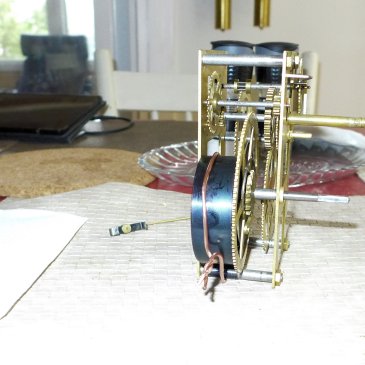
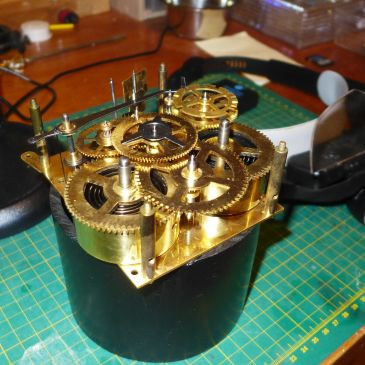
American time and strike clock movement

While it is technically possible for a mainspring to be damaged by excessive tightening—winding it until it’s tight and then continuing to wind it further—this is not the primary cause of most clock failures. The real issues often stem from different sources.

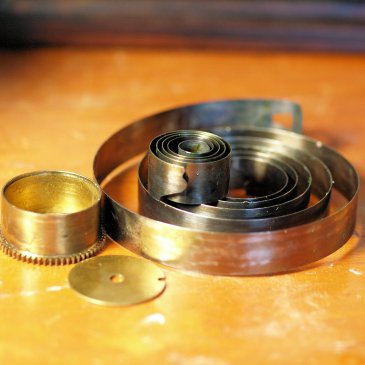
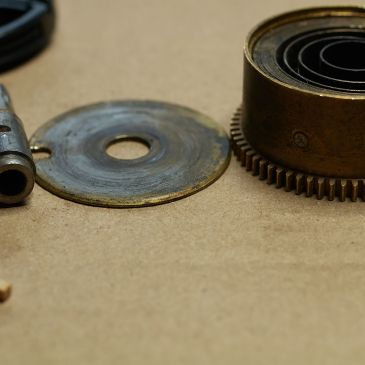
Consider the spring barrel, as shown in the photo below.

When the spring is wound, it coils tightly around the winding arbor, with the other end hooked to a small stud inside the barrel. This hook can become fatigued over time due to repeated excessive winding or the riveted stud can break free, but this is not the typical cause of a clock stopping.

In American open mainspring clocks, what appears to be “over-winding” is often a result of old oil, rust, and dirt accumulating in the mainspring coil. These contaminants can cause the coil to stick and seize somewhat like the action of an adhesive, making it “seem” as though the clock is “over-wound.”

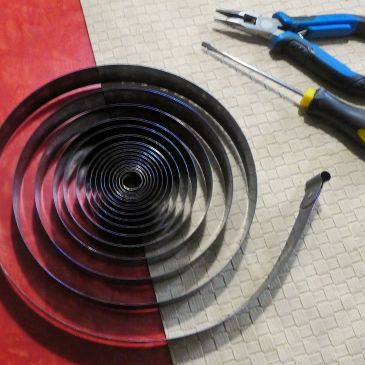
This spring is re-useable

When I receive a clock that is said to be “overwound”, I use a let-down tool to release the mainspring partially or completely, apply mainspring oil generously, and then rewind the clock. This step will help in some cases, but it’s important to note that it doesn’t replace a thorough cleaning or address other potential issues that might be causing the clock to stop.

The letdown key
The letdown key

Disassembling the movement and removing the mainspring allows for a proper inspection. Dirt and old oil can be cleaned, light rust can be removed with emery paper or steel wool, and heavy rust necessitates the replacement of the mainspring. The spring should also be checked for cracks or breaks. Often, a mainspring in good condition can be salvaged with proper care even if there are minor problems with the connecting section of the spring.

I frequently reuse mainsprings in my clock repairs, as long as they are not “set.” A mainspring is considered “set” when it has developed permanent deformations or has lost its original flexibility and strength due to repeated use or overstressing. In such cases, reusing the mainspring compromises the clock’s reliability and shortens its operational cycle.

When a mainspring is “set,” I typically replace it to ensure the clock functions optimally and to avoid potential issues. If I were operating a clock repair business, I would replace the mainsprings as a standard practice and pass the cost onto the customer.

“C” clamps used to contain the power of the mainspring

Another potential issue is the click mechanism. In some clocks, such as those made by Sessions for example, the click rivets can become fatigued and fail. Inspecting and repairing/replacing this component is a common procedure in clock servicing.

Worn click on Sessions movement

When buying a new clock, do not assume it has been recently serviced unless the seller can confirm it. If there’s no assurance of recent servicing, plan to have the movement serviced as soon as possible either by yourself or a competent professional.

Regular maintenance is crucial for any mechanical clock to ensure its longevity and proper function.

“Over-winding” is a myth that often misguides clock enthusiasts. The real causes of clock issues are typically related to dirt, old oil, or mechanical wear, not the act of winding the clock. Understanding this can help in better troubleshooting and maintaining your cherished antique or vintage clock.

Dive into Antique Clocks: Restoration, History, and Reader Engagement | as per ChatGPT

My daughter asked ChatGPT for the most popular antique clock websites, and it provided a top ten list. Antiquevintageclock.com ranked number 9.

I found the description of the site description interesting and accurate, so I’ll quote ChatGPT’s findings.

The author at work on a clock movement

The Antique and Vintage Clocks Blog (found at [antiquevintageclock.com](http://antiquevintageclock.com)) is a dedicated resource for enthusiasts interested in the history, restoration, and maintenance of antique and vintage clocks. This blog is run by a passionate collector and restorer who shares detailed insights into various clock models, repair techniques, and the historical significance of different timepieces.

Key Features of the Blog:

1. Restoration Projects: – The blog frequently features detailed posts about clock restoration projects, showing before-and-after photos, and explaining the processes involved in bringing an old clock back to life. These posts are valuable for anyone interested in learning how to restore their own clocks.

Repairing a clock dial

2. Historical Context: – In addition to technical advice, the blog provides historical background on various clockmakers, styles, and movements. This context helps readers appreciate the cultural and technological significance of the clocks they own or wish to purchase.

3. Step-by-Step Guides: – The author often publishes step-by-step guides on topics such as cleaning, oiling, and repairing clock mechanisms. These guides are written in a clear and accessible manner, making them useful for both beginners and more experienced collectors.

A barrel is opened up to prepare for mainspring maintenance

4. Clock Reviews: – The blog includes reviews and analyses of specific clock models, highlighting their unique features, historical value, and what to look for when buying similar pieces.

5. Reader Engagement: – The blog encourages interaction with its readers through comments and questions, creating a community of clock enthusiasts who share tips, advice, and experiences.

The Antique and Vintage Clocks Blog is particularly useful for individuals looking to deepen their understanding of antique and vintage clocks and how to care for them, offering a blend of technical knowledge and historical appreciation.

I was delighted to see how accurate and thorough the description was. It perfectly captures the essence of my blog and the dedication I put into each post. The detailed breakdown of the site’s features truly reflects my passion and knowledge that make it such a valuable resource for antique and vintage clock enthusiasts.

Tick talk Tuesday #55 | Mauthe wall clock runs fast

Tick-Talk Tuesday is a special time when I respond to readers’ letters and comments about clock issues, challenges, and recommendations for specific clocks. When the comments and questions are especially complex, I consult with fellow clock enthusiasts within my circle to ensure I offer the most precise and helpful answers possible.

RK writes:

I am working on an almost identical clock movement as the one shown on your website above. It was made by Frederick Mauthe. I have restored the movement, inserted many bushings, etc., and during testing have realized that the movement is gaining an hour a day.  I don’t think the pendulum is original and I suppose I am on a quest for a replacement.

Mauthe wall clock

Here is the case.  The finial has been re-glued and altered at the top, and that is another story. Here is the current pendulum: it weighs 0.139 kilos; the distance from the top hook to the bottom of nut under the pendulum is 220 mm. The diameter of the bob 100 mm.  I believe this is too light and too short, but there is no more room in the case.

Mauthe movement showing 2 critical numbers

Do you know what the correct dimensions are for the original pendulum? (Weight and length)

This movement is now working so well and it would be a pity not to be to use it just because I cannot find a replacement pendulum.

Front of Mauthe movement

Thanks for your time.

RK

My reply:

Hi and thanks for your email, RK. On the back of the movement, on the lower left of the last photo, are two numbers. 34 refers to the measurement in centimeters from the top of the suspension spring post to the bottom of the pendulum regulating nut. The second number refers to the beats per minute. Measure the pendulum you have and compare it to the first number.

Regarding the pendulum’s bob weight, I won’t have access to the clock until mid-September. However, I can get the measurements you need at that time if they’re still required.

Right to Repair: Countering our Throwaway Culture

Most mechanical clocks even those over a hundred years old or more are repairable. On rare occasions, a major part may be broken, but with the right tools and skills, it can still be fixed.

With a bit of knowledge and a few basic tools, the family clock could be repaired without needing to send it back to the manufacturer.

Time and strike clock movement

In today’s world, any mechanical device that lasts even a few years would be considered a rarity.

Screw drivers, clock tools
Common tools

It’s a fact that we live in a very different world today!

Some time ago, my wife and I had an issue with our dishwasher. Believing it was a simple fix, we called a service technician. It turned out that the main circuit board was shot. I suggested we replace it, but the technician advised that the repair cost would be several hundred dollars. However, he advised us for just a few more dollars, we could get a brand-new dishwasher. We were aghast!

Appliance makers have devised innovative tactics to make repairs costly and inconvenient, while simultaneously offering replacement programs at significantly reduced prices. Repairing items today is often impossible or more expensive than buying new ones, a frustrating and expensive dilemma for the consumer.

Moreover, in today’s throwaway society, repair is often not an option. “Honey, this is broken”; “Just throw it away, it can’t be fixed”. And we complain that our landfill sites are full!

Clock manufacturers years ago designed their clocks to be fixable and did not employ underhanded strategies to make them impossible to repair. I’m convinced that clock companies didn’t see these challenges as obstacles and instead chose to take the moral high ground. A clock that could be repaired with just a few tools was a true mark of a quality company.

The fact that fewer people are fixing their personal possessions today places an environmental and economic burden on our society. We need to shift our thinking, or we are all doomed.

The Right to Repair

Owners of products should have a right to repair them as a matter of “moral justice”. Wikipedia covers this topic extensively under the term “Right to Repair,” and the concept is gaining momentum.

It will take time to make the shift but in the meantime, the situation appears to be worsening rather than improving.

I recently read an article describing how manufacturers are designing digital locks into their products. For example, using a third-party ink cartridge can render your printer inoperable, and attempting to use a third-party battery in your new electric trimmer can result in a battery error.

The same article described a farmer who replaced a filter in his tractor. A company representative had to inspect the part to verify its authenticity and activate the software so that the tractor could operate, causing the farmer to lose productive use of the machinery for some time.

A certain phone manufacturer, who shall remain unnamed, refuses to allow third-party repairs or places strict limits on the type of repair. Such repairs void the warranty, it says. The alternative is a costly repair using genuine parts, a situation that not everyone can afford.

In reflecting on the current state of product repair, it’s clear that we’ve moved away from the principles of repairability that characterized earlier times. Historically, clock manufacturers designed their products with repair in mind, avoiding deliberate strategies to hinder fixes.

When a clock finally comes to the end of its life wouldn’t you want another Seth Thomas, Waterbury, or Ingraham?

Unfortunately, the landscape has shifted dramatically. My own experience with a dishwasher underscores this change. In today’s throwaway culture, the default response is often to discard broken items rather than seek repair.

This change not only devalues durable craftsmanship but also fuels a growing culture of waste. And that’s too bad.

How to Service an Open Mainspring Without a Spring Winder – Step-by-Step Guide

In a previous article on servicing this clock, I mentioned the challenge I faced with the mainspring. With only minimal tools at my disposal and no spring winder, I was determined to find a solution and successfully service the mainspring.

This clock was manufactured by New Haven and boasts a classic design with a twelve-inch Roman Numeral dial and a distinctive short drop style.

The softwood case is veneered in Rosewood veneer accents. The clock’s case must have been quite elegant at one time, but now it is showing much wear and tear.

Given the condition of the case, I anticipated that the movement would be just as well-worn. It was in better condition than I thought.

New Haven 8-day time-only movement

Let me point out that the servicing is being done under less-than-ideal conditions. I am at our summer cottage with only the basic tools for clock repair, so I must either improvise or skip certain procedures.

No spring winder | no problem

The movement had already been restrained with a heavy copper wire.

A heavy copper wire contains the mainspring

First, partially reassemble the movement with only the main wheel and second wheels. Reattach the front plate and secure the movement with the 4 pillar nuts.

Attaching the second wheel allows the main wheel to be stabilized while the spring is wound using the ratchet.

Safety first

I strongly recommend wearing leather work gloves and eye protection. Handling mainsprings under tension can be hazardous, so prioritizing safety is crucial. Precautions are essential to protect yourself from potential injuries.

Next steps

The key is to hold onto the second wheel while winding the clock. Once fully wound the copper restraining wire can be removed. In the photo below the screwdriver is arresting the wheel while I take the photo.

Then, using a letdown tool, release the click by popping out the click spring from the rachet and allowing the mainspring to unwind. The main wheel with the relaxed spring can now be safely removed from the movement.

The letdown tool is on the right

Servicing involves carefully removing the main wheel from the spring, manually inspecting and cleaning the spring, re-oiling it, and reconnecting it with the main wheel.

The mainspring is removed from the main wheel for cleaning

Reassembly

After cleaning the main wheel and the spring, simply reverse the procedure. Reattach the click spring, join the main wheel and the mainspring, place them back in the movement along with the second wheel, wind the spring, and secure it again with the copper restraining wire. Once this is done, you can continue to reassemble the movement.

May not be suitable for all applications

This approach allows the main wheel to be cleaned in the ultrasonic cleaner along with all the other movement parts.

While this method may not be suitable for all open mainspring designs, it might be the solution for you.

Servicing a mainspring without a spring winder isn’t ideal, it can still be done safely and effectively.

Servicing this movement is reminiscent of days gone by when Dad (or Mom) would gather tools from the shed to fix the family clock. The repair might not have been perfect, but the goal was always to keep the clock running reliably until the next time it needed attention.

Challenges of DIY Antique Clock Repair with Minimal Tools | Lessons and Limitations

My collection of wall clocks includes several schoolhouse models and I am continually impressed by their resilience despite their age.

While many of these clocks spent their lives in school rooms, some ended up in commercial establishments and offices, often neglected until they stopped working. I’ve seen clocks with bushing holes so enlarged it’s a miracle they still ran at all.

This particular clock, manufactured by New Haven, boasts a classic design with a twelve-inch Roman Numeral dial and a distinctive short drop style.

The softwood case is veneered in Rosewood veneer accents. The clock’s case must have been quite elegant at one time, but now it is showing much wear and tear.

Given the condition of the case, I anticipated that the movement would be just as well-worn.

Let me point out that the servicing is being done under less-than-ideal conditions. I am at our summer cottage with only the basic tools for clock repair, so I must either improvise or skip certain procedures.

Removing the movement

After removing the hour and minute hands, you will find that three screws hold the dial in place. Once these screws are removed, the next step is to take out two movement blocks that secure the movement. This is done by unscrewing the blocks (each held by two wood screws) and then pulling out the movement. Once out the blocks can be removed.

The movement is held by movement blocks

Disassembly and inspection

The first step is to contain the power of the mainspring. Since I did not have access to my standard equipment, I had to improvise. I would normally use a C-clamp to restrain the mainspring, but with none available, I used a stiff piece of copper wire and wrapped it around the mainspring. Not ideal but it works.

Safely restrained mainspring

The movement is in surprisingly good condition.

The top (front) plate is removed

Once the wheels are out it is time to visually inspect the components including the gear teeth, pivots, escape wheel pallets, the condition of the manispring, and lantern pinions.

The parts are laid out for inspection

Before placing the parts into the ultrasonic cleaner, I clean the pivot holes with toothpicks and wipe off any excess dirt and oil. Since I plan to reuse the ultrasonic cleaner several times, putting excessively dirty parts into the cleaning solution can shorten its lifespan.

Opinions vary on whether mainsprings should be cleaned in an ultrasonic cleaner. I believe it’s a matter of judgment. If I am not planning to reuse the cleaning solution (mainspring oil can render the solution unusable) and can thoroughly dry the springs, I have had good results by placing them in the ultrasonic cleaner.

In this situation, I have opted not to clean the mainspring in a solution.

Next is the reassembly of the movement leaving out the main wheel and mainspring. Without tension on the wheels, this is a simple way of determining wear.

Wheels that move laterally suggest enlarged pivot holes. Lateral movement affects the meshing of the gears and with enough wear the gears do not mesh properly and the clock will stop.

Checking for lateral movement

In this movement, the third-wheel front plate shows the most wear. However, it is not worn enough to require a new bushing at this time. If I were in the clock repair business and this was a customer’s clock, I would definitely address the need for a new bushing. This is compounded by the fact that I do not have bushing tools with me.

The pivots exhibit no significant wear, as confirmed by the fingernail test, which revealed no ridges. If you feel any ridges, grooves, or irregularities, it indicates wear on the pivot. A smooth pivot suggests minimal or no wear. Although I had to use a portable power drill for cleaning/polishing, the cleaning process was satisfactory despite it not being the ideal method.

My main challenge is the mainspring. I’m currently working with minimal tools and would like to service the mainspring, but I don’t have a spring winder.

Mainspring and first wheel

I am determined to service the mainspring and will find a solution within the next day or so, reporting on the procedures as I go. In the meantime, this is as far as I can proceed with this movement.

New Haven schoolhouse clock | The case is in poor condition but what about the movement?

Accepting the schoolhouse clock as a restoration project, I was prepared for the inevitable wear and tear it had endured over time. Despite its condition, I wondered what it would look like if the case was rejuvenated.

Decisions, decisions.

My collection of wall clocks includes several schoolhouse models and I am continually impressed by their resilience despite their age.

These clocks, renowned for their durability, keep time reliably, even in well-worn condition.

While many of these clocks spent their lives in school rooms, some ended up in commercial establishments and offices, often neglected until they stopped working. I’ve seen clocks with bushing holes so enlarged it’s a wonder they still ran.

This particular clock, manufactured by New Haven, boasts a classic design with a twelve-inch Roman Numeral dial and a distinctive short drop style. Its standout feature is the reverse painted glass on the access door, allowing the decorative pendulum bob to be seen in motion.

The softwood case is veneered in Rosewood veneer accents. The clock’s case must have been quite elegant at one time, but now it is showing much wear and tear.

Is it even worth fixing? However, let’s look at the movement.

The movement

I am impressed by the size and construction of the movement. The plate measures 5 inches tall and 3 inches wide, but it extends to 5 1/2 inches wide when including the main wheel and the third wheel. It is one of the larger time-only movements I have seen in an antique clock. Two wood blocks secure the movement to the case.

Movement in the case

It has been challenging to determine the date of manufacture of the movement, even though the trademark design should provide some clues. Despite searching through antique clock forums, the best match I found was an identical movement in a Cambria wall clock, which had no trademark but featured pins instead of nuts to hold the plates together.

Cambria wall clock

According to this site New Haven began using this trademark style in 1890.

New Haven trademark, 9 3/4 refers to the pendulum length

Although it looks clean, my plan is to take it apart and assess what needs to be done. Join me in my next article as I guide you through servicing the movement.

Optimizing Care for a Vintage Mauthe Clock: Inspection and Oiling

It’s time to inspect the movement on this mid-thirties German box clock. Purchased at an antique mall in Peterborough, Ontario, in May of 2017, it was serviced in 2020.

Mauthe time and strike box clock

This clock is part of a small collection at our family cottage and runs for about three months each year. However, the cottage environment can be harsh. Before we converted the screened-in porch to an enclosed sunroom, the clock was exposed to the elements for three years, so I expect some dust, dirt, and debris.

Mauthe movement back plate
Mauthe movement back-plate

One hint tells me this clock is made by Mauthe of Germany, even though there is no trademark stamp on the movement plates. The gong block is made by Divina, a subsidiary parts maker for Mauthe.

In the 1930s and 1940s, the clock was sold in Canada under the Forestville or Solar name in department stores from coast to coast. An appliqué of a maple leaf on the crown of the case suggests it was made for the Canadian market.

Divina gong block

Removing the movement

Removing the movement from its case is a relatively simple procedure. Open the front door and release the two thumbscrews under the movement seatboard, then slide the movement forward from its side channels.

Both plates are a robust 1.8 mm brass. The backplate is solid while the front plate is open. It is a robust movement that was evidently designed to last.

Removing the movement from the case is the best way to check the condition of the movement. Once out all you see is the back plate with the dial concealing the front of the movement. To inspect the front of the movement, the dial and hands must be removed. The hands come off easily by pulling the center cannon pin that attaches the minute hand. The hour hand is a friction fit and can be pulled out with minimal effort. Remove four brass pins on pillars to detach the face from the movement.

Once the dial face is detached both the front and back of the movement can be inspected.

Movement with attached seatboard

There is also no need to remove the seatboard to inspect the movement.

Of course, the only true measure of the condition of any movement is to take it apart, but in this case, I saw no need.

The clock has been working well, keeping good time and striking as it should.

What to look for

I always look for dirty oil around the pivots, which indicates possible wear. As oil ages, it gradually interacts with worn brass, creating a black abrasive paste. Here the pivots looked good but I did notice that some bearings had dried up. While at it I inspected the barrels for bulges and cracks, finding none. The lantern pinions, gear teeth, and levers looked clean. The suspension spring also looked good. In fact, I saw nothing that would cause me to take the next step: disassembly.

The movement is in excellent condition and will need no attention since its last servicing in 2020.

Oiling

All that is required is an oiling before it is returned to the case. Periodic inspections ensure that the oil is clean and appropriately applied, preventing friction and wear. In this case, the oil was clean but some pivots required additional oil.

Oil and applicator which has a spooned end

I keep it simple as far as my oiler and dipper container are concerned.

Periodic inspections

Periodically inspecting a mechanical clock movement is important. Regular inspections can identify potential issues before they become serious problems, helping to prevent major repairs or damage.

Over time, the movement parts can wear down, and identifying and addressing wear ensures the clock runs smoothly.

Dust, dirt, and other debris can accumulate in the movement, affecting performance. Regular inspections {and disassembly and cleaning if needed} can keep the clock running accurately.

Clocks exposed to varying environmental conditions, such as humidity or temperature changes at our cottage, may require more frequent inspections to prevent damage. My fears that this movement was dirty because it was in a harsh environment proved unfounded.

Mauthe movement front plate

If the clock starts losing or gaining time, an inspection can identify the cause and allow for adjustments. Inspecting the movement helps to ensure that all components, such as springs and gears, are in good condition and properly aligned.

Finally, by addressing these aspects through regular inspections, you can extend the life of your mechanical clock and ensure it continues to function properly.

How to Safely Operate and Maintain Mechanical Clocks: Tips and Hazards

Mechanical clocks, especially older or larger ones, can pose various dangers during operation and maintenance. In this post, we will cover some of the risks and hazards.

Mainsprings

Do not underestimate the power of a clock with mainsprings. Mechanical clocks often use powerful mainsprings to drive their mechanisms. If these components are mishandled, they can release a significant amount of stored energy suddenly (potential energy), with the risk of causing serious injury.

Mainsprings restrained with “C” clamps

Without the right knowledge and tools, attempting to disassemble or reassemble a mechanical clock can result in damage to the clock and potential injury. When working on a clock and particularly when disassembling clock movements ensure that the mainsprings are safely secured. The best way is to use a specially designed mainspring clamp.

“C” clamps or a strong wire are considered safe methods in clock repair.

Even the simple act of winding a clock can produce a nasty surprise since the sudden release of tension in a mainspring can be dangerous.

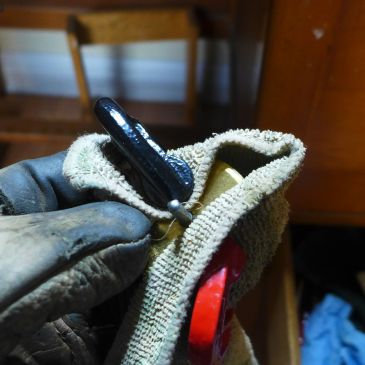
I almost lost my thumb when the click let go on the strike side of a Mauthe wall clock while winding it.

Damaged thumbnail but I survived

If I am unsure of the mechanical condition of a clock particularly one that I have recently acquired, I always wind it with my letdown key set. That way I can control it if the click lets go. If I follow that simple rule I don’t get hurt.

A letdown set used to safely wind a newly acquired clock

Gears and sharp components

The gears, escapements, and other moving parts can cause pinching injuries. These parts may also be sharp or have pointed edges, increasing the risk of cuts.

The delicate nature of some clock components, such as thin gears or escapement wheels, can break easily. Working on them without proper knowledge or tools can damage the clock and possible injury from sharp, broken pieces may result.

Mercury

Some antique clocks may contain materials known to be hazardous, such as mercury in pendulums or lead-based solder. Exposure to these materials can pose health risks. For example, most American-made crystal regulator clocks have nickel slugs in glass vials for the pendulum that resembles mercury at first glance. They are completely safe to handle.

Note the pendulum bob in this clock

In contrast, French-made four-glass clocks often contain actual mercury pendulums, which if handled can pose a poisoning risk. The purpose of mercury is to maintain accurate timekeeping despite temperature variations.

The degree of mercury toxicity depends on how much contact one has with it. Here is an excellent article I found on the risks involved and precautions when handling mercury.

Electric clocks

Early electric clocks can pose a significant risk of electric shock if not properly handled or if the wiring is faulty. These clocks are often improperly grounded, and may have worn cords with exposed wire. Those that run hot to the touch when operating are particularly dangerous. Switches and knobs and other components are designed according to past standards and lack the safety protocols of today’s designs.

The danger of electric shock may increase during maintenance or operation.

Sessions 3W electric table clock
Sessions 3W electric table clock C.1930

Electric clocks are best handled by individuals knowledgeable about electrical components and their operation.

Radium

Clocks, especially older alarm clocks with luminous dials can pose a significant risk. The culprit is radium. Even a clock that has lost its luminescence may still have traces of radium on its dial or particulate matter that has fallen from the clock-face making them equally dangerous.

As much as you may be curious about how these clocks work, leave them alone and appreciate them as decorations or alternatively, safely dispose of them.

Baby Ben, made in China
Baby Ben, made in China (a later design with safe luminous material)

It must be emphasized that Inhalation or ingestion of flakes or dust containing radioactive materials is extremely dangerous.

Clock tools and equipment

When working on clock springs or components when there is a potential risk of injury or with tools like a lathe, consider wearing leather gloves, and an apron, along with face/eye protection as needed.

Gloves and safety goggles are an important consideration when working with mainsprings. A winding arbor breaking in a mainspring winder or a mainspring letting go while winding it up might result in the spring, wheel, and arbor flying around the room and possibly toward the repair person.

Thick leather gloves used for spring maintenance

Using a Dremel machine without proper eye protection, especially with wire brushes that rotate at high speeds, can easily lead to serious eye injuries if a piece of wire breaks off.

In sum

To mitigate all risks, it is important to have a good understanding of the clock’s mechanism, use appropriate tools, follow safety procedures, and possibly seek training or assistance from an experienced clockmaker. If you ignore common sense, accidents are sure to follow.

A dirty clock movement ready to be serviced


Those new to clock repair may be eager to dive in and take things apart. However, a slow and cautious approach with a focus on safety will reap benefits in the long term.

1930 Kienzle Box Clock | A Heartfelt Gift and Memorable Encounter

Occasionally I have clocks gifted to me as in the case of this lovely Art Deco-style German round-top wall clock made by Kienzle. The gift was greatly appreciated, although there was a small condition attached, which I will explain later.

Kienzle box clock in classic oak

There are times when people consider gifting me a clock but hesitate because of the high shipping expenses. When I tell them I’m willing to accept the clock, they often balk upon discovering how much it would cost to send it to me. Consequently, I have missed out on some interesting clocks due to shipping constraints.

Earlier this year, DN from central Canada was researching his grandfather’s vintage clock online and found a similar one, which led him to my blog. We exchanged emails about the history and condition of his grandfather’s clock and he asked about its resale potential. Based on the current market, I provided him with an estimated value.

I suggested several methods for selling the clock and offered to consider purchasing it myself if he could not find a buyer. Unaware that I would hear from DN again, it was four months later when he reached out and offered to gift me the clock, confident it would be cherished by a collector like myself. The condition was that I make a donation to a charity.

A well-protected clock

While traveling to central Canada to spend the summer, I had the opportunity to meet DN. With military precision, we arranged to meet in a small village 1/2 hour from our summer cottage. The well-packaged clock went from one car to the next. Afterward, we talked on the roadside, discussing the clock and, of course, sharing our cottage experiences. I said my thanks and drove off.

I know more about this clock than almost anything in my collection thanks to DN and the well-preserved clock owned by his grandfather and carefully stored for approximately 25 years following his passing. DN‘s grandfather, an engineer, appreciated the intricacy of the German-made clock and kept all the documentation. Nothing is missing from the clock; all the parts are intact.

Raised relief applique

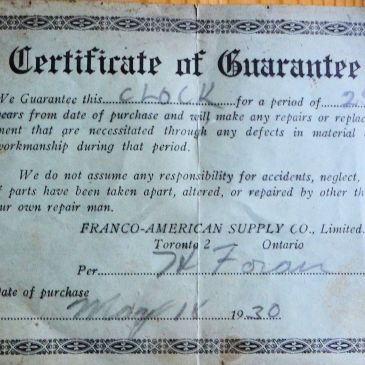
There is a “certificate of guarantee” from the Franco-American Supply Co. with a purchase date of May 18, 1930. The Franco-American Clock Co. became the Franco-American Supply Co. in 1918/1919. Their business eventually expanded to musical instruments, including gramophones. They operated as a distributor rather than a manufacturer, specializing in supplying clocks at a mid-level scale to retailers.

Franco-American Supply Co.

In addition, there is a factory control slip and instructions for the gong protector. There are two stand-offs (upper right, photo below), but I could not find the screw holes in the back of the case to accommodate them. Perhaps they were offered as optional at the time, otherwise, why were they kept? And of course, the original key.

It is rare to buy a clock with any documentation

Overall, it is in exceptional condition for a 96-year-old clock. I could not see any tell-tale signs that the movement had been worked on, and in its assembled state, I did not observe any appreciable wear. Of course, once disassembled and cleaned, I will have a clearer understanding of any wear issues.

My immediate task is to determine if the clock can run and strike as it should. I removed the movement from its case, applied a drop of oil to the pivots, reinstalled the movement, and gave the pendulum a push. It runs well. Next, I will prioritize thorough cleaning and attend to any signs of wear.

Finally, I am making my donation to the St. Vincent de Paul Society in memory of my mother-in-law, who passed away this spring. The Society of Saint Vincent de Paul is a lay “Catholic organization whose mission is to help shape a more just and compassionate society by providing food assistance, material help for the needy, emergency relief, and addressing housing challenges across Canada”.

Clock Parts Supplier Perrin Supply Ltd Resumes Operations in Vancouver

This is very good news for clock lovers in Canada.

I have not ordered clock supplies in some months and reported in an earlier post that W. H. Perrin and company had ceased operations as a clock parts supplier to Canadians. The company has been reborn as Perrin Supply Ltd (new owners). Instead of Toronto as a longtime base, they will move to Vancouver, BC (Canada), and resume operations on July 1, 2024.

They intend to carry out the same level of service and delivery of products as the old company.

Steady rest clock tool
Steady rest clock tool, available at a clock supply store

This is certainly good news to myself and clock enthusiasts and repair specialists across Canada. Given that they are now on the west coast of Canada the only difference I can foresee is slightly higher delivery costs and perhaps price increases on selected products otherwise it should be business as usual.

Clock supply services provide replacement mainsprings

Although they are in the process of moving online services are unaffected and should you have any clock and watch supply needs they are there to help.

AI-generated clock repair manuals and other clock repair book discoveries

Exploring Amazon’s selection of clock repair manuals presents several appealing options. However, purchasing these manuals can be intriguing, as it’s often challenging to know exactly what you’re getting until they arrive at your door.

I bought three such clock repair manuals this spring. The “Antique Clocks Repair Manual” by Phoenix Publishing, “Clock Repairing for Beginners – The Ultimate Guide on How to Care and Repair Clocks from Scratch without Prior Knowledge or Experience” by Angless Juliana, and The Clock Repairer’s Bench Manual by D. Rod Lloyd. Only one of these purchases has any real value for the clock repairer. Read on to find out which one is worth the purchase.

Antique Clocks Repair Manual

The “Antique Clocks Repair Manual” by Phoenix Publishing

The “Antique Clocks Repair Manual” by Phoenix Publishing is an AI-generated manual with no author. While AI-generated content can be useful for producing a large volume of material rapidly, it often lacks originality, has no creative nuances that come from human authors, and lacks detailed processes.

The manual is 130 pages long and consists of 39 chapters, covering topics from the history of antique clocks to teaching clock repair to others. Unfortunately, none of the chapters is particularly detailed. For instance, the chapter on disassembling the movement merely instructs you to take it apart without providing specific steps. It advises, “Once the movement is out, you can begin taking it apart. Make a note of the order in which parts are removed and carefully place them on a soft cloth to avoid scratching or damaging them. Be extra careful of any delicate components such as springs and gears.” This is not very helpful advice!

Clock Repair for Beginners

“Clock Repairing for Beginners – The Ultimate Guide on How to Care and Repair Clocks from Scratch without Prior Knowledge or Experience” by Angless Juliana.

“Clock Repairing for Beginners – The Ultimate Guide on How to Care and Repair Clocks from Scratch without Prior Knowledge or Experience” by Angless Juliana. At first glance, an intriguing title.

If I were looking for a manual on clock repair for beginners, this seemed to be it, judging from the title. For $8.95, it seemed like a bargain until I opened the book to page one.

The book’s cover suggests a reference to mechanical clocks when in fact, it is about caring for your battery clock. The pages are not numbered, contain no photos or diagrams, is 40 pages in length in a large font (80 words per page).

There are no number pages and all advice pertains to battery clocks

There are six chapters. In chapter four, “Why do clocks stop When They Do?”, I will quote the entire chapter, “Connections to the battery that are loose or unclean. Low battery warning. Battery pips are insufficiently long. Due to the accumulation of dirt and grime in the mechanism, there was an excessive amount of friction”. It’s puzzling why a manual would be dedicated to battery-operated clocks, as these are typically disposed of rather than repaired in our throwaway society.

The book title is very misleading. I’m surprised that an author would attach their name to such deceptive content. I would not want to be associated with a publication of such low quality.

The Clock Repairer’s Bench Manual

The Clock Repairer’s Bench Manual by D. Rod Lloyd

I have saved the best for last because the third purchase has real value, in my view. The Clock Repairer’s Bench Manual by D. Rod Lloyd is a large 8X10 manual, and at 378 page,s it covers a broad range of topics on the repair of mechanical clocks. For instance, page 73 begins with general comments on making repairs and covers topics such as pivot polishing, using a bushing machine, addressing bent pivots, replacing a pivot, repairing broken teeth, and so on, with plenty of photos and diagrams, and walk-through descriptions. It is a comprehensive manual that will be useful for anyone in clock repair, from the beginner to the expert, and it is the only one of the three I would recommend.

Unfortunately, none of these books can be found in a bookstore, where you can easily decide whether to buy them with just a quick glance.

For other clock repair books in my collection and those that I highly recommend, please navigate here and here.

German Box Clock Restoration | A Family Heirloom

When my wife’s parents sold their home in a small town in Nova Scotia in 1996, they passed on a wall clock, which had been given to my father-in-law by a patient and had hung on the wall in the main hallway of their home, to his son, my wife’s brother. It has been in storage ever since then.

I hadn’t seen the clock in nearly 30 years though I have vivid memories. In the 1980s and 1990s, my wife and I would bring the kids to visit their grandparents on weekends. The clock would resonate throughout the house. It was unforgettable, by its loud ticking and the four-hammer strike marking the hour and half-hour.

Made by Mauthe, it is a 1930s-style German box clock, dark in color, reminiscent of one in my own collection. In fact, except for minor details on the case, it’s almost identical to mine.

German "box" clock by Mauthe
German “box” clock by Mauthe, in my collection

My father-in-law loved the clock and had it for years, winding it without fail once a week. When it stopped, he would have someone local service it for him. He cherished it deeply, though I’m not entirely sure why. Perhaps, as a doctor, he valued it as a thank-you gift from one of his patients, or maybe he simply had a passion for clocks.

Sadly, my father-in-law passed away in 2012, and my mother-in-law passed away this year. While settling the estate, my wife and her brother started communicating on a deeper level, and the subject of the clock came up. Would I fix it?

Mauthe movement back plate
Not this clock but a similar Mauthe movement

The clock has now been passed to me for repair. I picked it up in mid-June, and my first impression was that the case was in excellent shape for its age. While the case has minor nicks and scratches that can be easily addressed, the dial is rough. Otherwise, the movement appears intact with no missing or damaged parts.

Overall, I believe the clock is definitely worth restoring. Once I evaluate the clock further I can determine what needs to be done, make any necessary repairs to the movement, and the case, test the movement, and return it to my wife’s brother. To have it displayed prominently on a wall and running again would be a testament to my father-in-law’s memory.

Although I have other projects on the go and cannot tackle this project until the fall, I am pretty excited about working on this clock. It is a perfect candidate for restoration but more importantly, it has great sentimental value.

In future posts, I will describe a step-by-step process of revitalizing the case and another on servicing the movement.

Troubleshooting a Time-Side Mainspring Issue in a Kienzle Wall Clock

Kienzle might not ring a bell for many clock enthusiasts, but it was a major German producer of clocks for the general public.

Kienzle Uhren GmbH, was founded in 1822 by Johannes Schlenker in Schwenningen, in Black Forest region. Jakob Kienzle joined the family by marriage in 1883 and became the sole owner in 1897. He revolutionized clock production through mass production, leading to significant expansion. By 1939, the company employed over 3,500 people and produced around 5 million clocks annually. Kienzle eventually transitioned to wristwatch production and continues to operate as a watchmaker.

Kienzle wall clock C. 1930

This Kienzle wall clock was bought at auction in 2021. It was my second Kienzle, the first, an attractive desk clock from the early 1950s. But in general, I was unfamiliar with the maker. I later learned that the clock was missing some details: a case decoration above the number 12, both standoffs and the pendulum rod retainer was broken. However, the case itself is in relatively good condition.

The time and strike movement in this round top box clock is compact, with a 43 cm pendulum length and a beat rate of 104 per minute.

Kienzle movement

I serviced this movement in 2021 shortly after acquiring it. At the time I found It exhibited typical wear for its age, with the time side running relatively freely and the strike side being somewhat sluggish. After disassembly, an assessment revealed that the movement required 10 bushings: 6 on the backplate and 4 on the front. The work was completed without issues, the movement was reassembled and tested and the clock ran reliably until this year.

Front of movement

Now it has stopped. In short, I’m not entirely sure what caused it to stop.

Suspecting a power issue, I removed the movement from its case and took off the hands and dial face. I also let the mainsprings down but left enough tension to supply power. I unscrewed the crutch bridge to remove the pallets which allowed the escape wheel to run freely. So, not a power issue. I continued to inspect the wheels and pinions and found nothing amiss. While out of the case, I re-oiled the movement.

The issue seems to be with the time-side mainspring. Looking back at my notes, I serviced both mainsprings in 2021 and didn’t observe anything unusual about them at the time.
However, I’ve noticed that if I fully wind the time side, the clock is reluctant to start. This issue has happened more than once. Releasing the tension of the time-side mainspring with a wind-down key allows the movement to start running again. If I don’t wind the time side mainspring completely, the clock seems to run without any problems.

I can only conclude that I did not clean the mainsprings as thoroughly as I should have. Residual dirt and grime on the inner part of the coil seem to cause the spring to seize when wound tightly. In the meantime, the solution is not to wind the time-side mainspring fully.

Unfortunately, the mainspring barrels cannot be removed separately as in the case of some German movements, necessitating the complete disassembly of the movement to replace/inspect the mainsprings in case of an issue. If it were feasible to remove the mainspring barrel independently, I would have taken the opportunity to remove the mainspring from the barrel and clean it more thoroughly.

Testing the Kienzle movement on a makeshift test stand
Kienzle movement on the test stand

I am not about to disassemble the clock again as I have more pressing projects on the go but in the meantime, it will run as long as I do not wind the time-side spring too tightly.

Understanding Clock Pivot Wear and Bushing: Part II of Two-Part Series

In Part I, I explained the importance of bushing to mitigate wear on a mechanical clock movement.

In summary, bushing involves replacing worn brass around a pivot by drilling a new hole and inserting a new bushing, either using a bushing machine or hand tools. Severely worn pivots may need re-pivoting, which involves installing new pivots using a lathe. Minor wear can be managed with filing, polishing, and burnishing. Proper bushing and pivot work are crucial for maintaining clock movements, extending their lifespan, and ensuring reliable operation.

Now that we understand bushing wear, it is time to proceed with the bushing process.

The process of bushing a mechanical clock plate involves several steps to restore the worn pivot holes to their original condition. Here’s a detailed description of the process:

Disassembly: The clock movement is carefully disassembled, and the clock plates are removed to access the worn pivot holes. Resist the temptation to immerse the entire movement in a cleaning solution. Although this might offer a temporary fix, it prevents proper assessment of the pivots and pivot holes for wear.

indicating wjehere bushings will be installed
Wood picks identify where bushings will be installed

Cleaning of all parts: While manual cleaning with a solution is satisfactory, using an ultrasonic cleaner and a solution specifically designed for such a machine, yields better results by ensuring all dirt and grime are thoroughly removed from the brass and steel parts. The cleaning process also includes thoroughly drying all the parts.

Ultrasonic cleaner by L&R

Identifying Worn Holes: Each pivot hole is inspected for wear. Worn holes are typically oval-shaped due to the pivot’s repeated movement. I use a marking pen to identify those pivot holes that require a new bushing. I generally work on one train at a time, leaving the main wheels out during this process. I reassemble all the wheels of one train between the two plates, checking for wear by turning and pushing on the wheels. This allows me to observe any lateral movement and see how the gears mesh with each other.

A marking pen identifies a worn bushing hole

Centering and Drilling: A bushing machine with a centering tool is used to precisely center the worn pivot hole.

Centering prior to drilling
Centering tool Centering is used to center the pivot hole

A new, round hole is then drilled into the clock plate. This hole must be accurately positioned to ensure the clock’s gears will mesh correctly.

Drilling a hole with Bergeon bushing machine
Using a cutter to enlarge a hole in the plate

Selecting the Bushing: An appropriately sized bushing is chosen to fit the newly drilled hole. The bushing is usually made of brass and should match the original hole dimensions but is made larger than the hole to ensure a tight fit. For the Bergeon Bushing Machine, Bergeon brass bushings are used.

Pressing or punching the Bushing: The selected bushing is pressed or punched into the newly drilled hole. This can be done using a bushing machine, which ensures the bushing is inserted straight and flush with the plate. If done by hand, reamers and smoothing broaches are used to achieve a similar result. A chamfering bit, which does not come with the Bergeon Machine, is used to gently cut the edge of the bushing hole to ensure that the bushing is punched or pressed in neatly.

Punching the bushing home
Positioning the bushing prior to punching the bushing home

Reaming the Bushing: Once the bushing is in place, it is reamed to the correct internal diameter to fit the pivot. Reaming is achieved by using a five-sided reaming broach sized to fit the hole. Following the reaming process, a smoothing broach is used to smooth the walls of the bushing hole. A toothpick is then used to clean the hole and remove any debris left behind by the broaches. This entire process ensures that the pivot will rotate smoothly without excessive play.

Swiss made smoothing broaches
Swiss-made smoothing broaches

Polishing and Burnishing: The pivot that will run in the new bushing is polished and burnished to reduce friction and wear. A metal lathe is an indispensable tool for this procedure. This step is crucial for the longevity of the repair.

Taig lathe with 1/4 hp motor

Reassembly: The clock movement is reassembled, with the newly bushed pivot holes ensuring proper alignment and smooth operation of the gears. Clock oil is applied before the testing phase.

Testing: The reassembled clock is tested to ensure that it runs accurately and reliably. Any final adjustments are made to fine-tune the movement.

The process of bushing a mechanical clock plate involves disassembly, identification of worn bushing holes, precise centering and drilling, selection and insertion of appropriately sized bushings, followed by reaming, polishing, and burnishing of the pivot. Finally, the clock movement is reassembled and thoroughly tested to ensure accurate and reliable operation.

By following these steps, the worn pivot holes are restored, improving the clock’s performance and extending its lifespan.

Understanding Clock Pivot Wear and Bushing: Part I of Two-Part Series

Is your mechanical clock experiencing issues such as intermittent stopping or simply not running at all? This might be due to several issues with the movement, one of which could be pivot wear.

This is a two-part series. In Part I, I will explain why it is necessary to bush a clock movement, and in Part II, I will describe my method for bushing.

What are pivots?

Pivots are the ends of the axles, known as “arbours” in horology, that rotate in small holes drilled into the clock plates as the clock runs. They are the turned-down ends of the arbour. These, along with the holes they rotate in, can wear down over time causing enlarged holes that will contribute to poor running or stopping. The pivot hole must be perfectly round, and the pivots need a mirror-like polish to minimize friction within the train of gears. To protect the surfaces and reduce friction, approved clock oil acts as a barrier between the pivot and the pivot hole.

Worn pivots or pivot holes can cause the wheel to drift away from the pinion, eventually stopping the clock as the gears fail to mesh properly. Clocks in need of bushings may run erratically or stop altogether.

Worn Pivot hole
A very worn pivot hole

Oiling a dirty or worn movement

If a clock movement isn’t routinely serviced (cleaned and oiled), the plates of the movement will experience wear at the pivot points. Applying new oil over old oil can free abrasive dirt and provide a temporary solution but accelerate wear on the steel pivot and brass bushing holes because the contaminated oil acts like a grinding paste.

Worn pivots are often found in clocks repeatedly oiled without proper cleaning. Proper servicing requires disassembling the movement, cleaning the parts, addressing wear issues, reassembling, and testing.

Punch marks

From time to time, there is evidence of punch marks located around the pivot hole which is an attempt to close worn pivot holes. While a common practice in the past, this is no longer considered an acceptable repair practice.

Bent pivot
A pivot – in this photo, the pivot is slightly bent
Punch marks on a movement

Pivots need periodic cleaning and polishing to turn freely in the clock movement plate hole. Worn pivot holes are easy to identify as they appear oval-shaped rather than round.

Close-up of bushing wear
Bushing wear – the left portion of the hole is elongated

What is bushing?

“Bushing” is the process of replacing worn brass around the pivot so that the hole is round again. A new hole is drilled into the plate, and a new, appropriately sized bushing is pressed into place using a bushing machine like the Bergeon Bushing Machine.

Bergeon Bushing Machine

Some clockmakers prefer to hand-bush using reamers and smoothing broaches, producing satisfactory results, though a machine simplifies the task and is more accurate.

Severely worn steel pivots must be replaced with new ones, a process called re-pivoting. This involves using a watch or clock lathe to drill into the end of the wheel arbor to install a new pivot made from pivot wire.

Minor wear is expected over a clock’s life and can be managed with careful filing, polishing, and burnishing.

In summary, bushing is an integral part of movement servicing. Well-maintained clocks may show minimal wear and may not require new bushings, while others, due to neglect or improper servicing, may require many bushings.

Proper pivot and bushing work can extend a clock movement’s lifespan, ensuring reliable operation for years.

In Part II of this two-part series, I will describe my method for bushing a clock movement

An ordinary schoolhouse clock that had an ordinary life in an ordinary shoolhouse continues its ordinary life

Eight years ago I came across an intriguing find not far from where I reside—an antique Ansonia octagonal short drop, commonly referred to as a schoolhouse clock. While I estimate its manufacturing date to be around the turn of the 20th century, pinpointing the exact year eluded me.

Ansonia time only schoolhouse clock
Ansonia Schoolhouse Clock

The movement bears the stamped number “12,” which could denote the year “1912” or possibly the month of a particular year. Additionally, the letters “TT” are inscribed on the movement. 1912 would sound just about right.

Although not my only Ansonia clock I encounter the Ansonia name less frequently compared to other American clock manufacturers.

Ansonia clock face showing the name of the maker
Ansonia Clock Co., Made in the U.S.A.

To retreive the clock, my wife and I travelled to the small town of Berwick, nestled in the Annapolis Valley region of Nova Scotia. Berwick is best known as the centre of the province’s apple industry. We set out for a day trip eager to soak in the local scenery and make various stops at roadside stands/gardens along the way, fully aware that the clock we were about to acquire would come with no surprises. Well, it was not perfect!

The gentleman from whom I purchased the clock shared that it had been in his family for over 50 years, yet he had never seen it run. He parted with it during the estate liquidation process following his mother’s passing, as it held sentimental value for her but evidently not for him.

Number 12 and TT on the movement plate
The number 12 and TT stamped on the movement

It originated from a schoolhouse in Ontario, Canada, although the specific location eluded the seller. Despite minor issues, such as paint applied around the minute/hour pipe to conceal stains from years of handling, the softwood case remains in very good condition.

However, it was missing a bushing for the hour hand, an easy fix. Remarkably, I discovered remnants of rotted elastic banding on the pendulum rod just below the suspension spring, though its purpose remains a mystery to me.

Nevertheless, following several adjustments, including bending the crutch to ensure proper alignment, the clock functioned but a servicing was necessary. I found the need for 3 new bushings in the spring-driven time-only movement. While the wear wasn’t severe, it warranted attention. A new hour and minute hand, sourced from a supplier completed the servicing.

bushing wear on an Ansonia movement
The most worn bushing hole, highlighted to illustrate the wear

The Ansonia Clock Company’s storied history adds an intriguing layer to this find. Unfortunately, the company, formed in 1851, had a long history of supplying clocks to the masses but its demise prior to the 1929 stock market crash serves as a poignant reminder of shifting economic tides.

The clock is now gone but to a good home. Approximately three years ago, when my daughter was setting up an office in her new home, she expressed interest in acquiring the clock, which she considered the perfect decoration for her new workspace. “Certainly,” I replied, and now it proudly occupies a prominent spot in her office.

Antiquevintageclock.com all time best 10 list

Every blogger understands that building a successful blog takes time, often requiring months or even years to cultivate a loyal following. Challenges, patience, determination, and hard work eventually lead to finding a successful rhythm.

The author at work

With over 825,000 page views since 2015, and an average of 24,000 monthly views, I recently reviewed my blog’s statistics to identify the top 10 most popular posts of all time. Most entries on the list align with my expectations, catering to visitors seeking basic advice on clock acquisition, winding keys, or determining the value of their clocks. However, some are more unexpected.

Without further ado:

1. How to wind a mechanical clock – a How to Guide

2. Dating an Antique or Vintage Clock Part I

3. An 8-day clock – what does that mean?

4. Oiling Your Mechanical Clock – a Quick Guide

5. Cleaning an antique/vintage clock movement – Ron’s method

6. What is my clock worth?

7. Horolovar guide and how to determine the correct spring for your 400-day clock

8. Regulating your mechanical clock – it’s easier than you think

9. My antique clock stopped – what do I do?

10. Dating an Antique or Vintage Clock – Part II

More importantly, analyzing the top articles reveals that the majority of visitors to my blog are either newcomers to clock collecting or repair, recent owners of antique clocks seeking information, individuals with some knowledge looking to expand their expertise, or enthusiasts deeply engaged in the clock repair hobby seeking additional insights.

My office, and where I compose my twice-weekly articles

Experts in the field may seek information elsewhere, which aligns with my blog’s intended audience. My blog was never aimed at those operating clock repair businesses, involved in the antique clock market, or pursuing extensive restoration projects, but I provide a way for those dabbling into antique clocks for the first time or those seeking answers to common questions all in one easy-to-navigate place.

The Role of Macro Photography in Clock Repair

While explaining any process on paper serves its purpose, nothing quite replaces the effectiveness of a sequence of detailed still images that, in essence, tell a story. As the saying goes, “A picture is worth a thousand words.”

punch marks around a mainspring barrel
A shot of punch marks around a mainspring barrel arbour

First, what is macro photography?

Macro photography is a specialized form of photography that focuses on capturing extreme close-up images of small subjects, revealing intricate details that might not be visible to the naked eye. It typically involves using specific macro lenses to achieve high levels of magnification, allowing photographers to capture subjects at a 1:1 ratio or greater. Careful attention to lighting, focus, and depth of field will achieve the best results.

For best results, I recommend a dedicated camera paired with a quality macro lens. While cell phones can capture impressive images, they are a compromise since they often struggle with foreground-background isolation and fail to deliver clear macro shots. For shots that necessitate a low shutter speed, maintaining absolute stillness is crucial, making a tripod an essential accessory.

For me, photography seamlessly integrates into my various hobbies, so, taking pictures of clocks, movements, parts, and so on is a natural extension of my photography hobby. It goes without saying that having a reliable camera is indispensable for clock repair.

getting ready to punch a bushing into a clock plate
A brass bushing awaits punching into a clock plate

My preferred camera/lens/tripod combination

I own several cameras by Panasonic, Fuji, and Olympus. Although the former two are great cameras and have their uses, an Olympus E-330 camera manufactured in 2006 remains my preferred choice for macro photography.

Olympus E330 with 50 mm macro lens on a tripod
Olympus E330 with 50mm F2 macro lens on a Manfrotto ball head tripod

With its 7.5 megapixels, the Olympus E-330 interchangeable lens camera boasts ample resolution for my needs, especially when downsizing files for blog posts, ensuring detailed yet compact images—ideal for conserving server space on a blog platform.

An improvised click spring

No camera will perform well without a good lens. Paired with an Olympus 50mm F2 macro lens, it excels in capturing those extremely close clock shots and enables me to isolate my subject while maintaining a pleasing background blur.

Polishing a pivot

While artificial lighting is occasionally necessary, I predominantly rely on the natural light streaming in from a west-facing window in my workspace. When artificial illumination is necessary, I turn to a continuous studio light (with colour temperature adjustment), using the on-camera flash for rare occasions.

While the camera uses an older CF memory card, I can still procure these cards and even aftermarket BLM-1 replacement batteries. The camera will run until it fails and that day looks far off though perhaps it’s already telling me something. The memory card door clasp broke recently, so I must now keep the door closed with velcro tape otherwise I get an on-screen error message.

A distinctive feature of the E330 is its live view switch allowing the transition from automatic to manual focus mode through this switch, securely locking focus on extremely close subjects.

Live view A/B switch for manual and auto-focus

A tripod such as the Manfrotto 785B Compact is necessary for macro photography because it helps to stabilize the camera, ensuring sharp and clear images, especially when using slow shutter speeds or working with extremely close subjects where even the slightest movement can result in blur.

With any repair task, I meticulously capture dozens of photos from various angles. These images serve as invaluable references, particularly when encountering challenges during reassembly or when puzzled about the positioning of specific components like wheels, levers, washers, or springs. Furthermore, I diligently organize and catalog these photos for easy retrieval, years later, if necessary.

An arrow points to a kink in a movement hairspring

My advice is straightforward: Invest in a quality new or used camera equipped with a dedicated macro lens for clock repair. You don’t have to spend thousands; any older camera of good quality will suffice, although finding a compatible macro lens may be the biggest challenge. It should be capable enough to deliver satisfactory results. I was searching eBay today and found an E330 with 50 mm macro lens well under $450. Add about $100 or so for a decent tripod, $30 for a CF card and a CF card reader and you have everything you need for macro photography.

A very worn pivot on a Gilbert movement

Trust me, you’ll appreciate the benefits it brings to your craft.

A smoothing broach completes the bushing process

Clock movements often require bushing for several reasons. Over time, the original brass bushings can wear out due to friction and other factors. When this occurs, the holes in the clock plates become enlarged and misshapen, resulting in a poor fit between the components that interact with each other. This wear and tear can lead to excessive play in the gears, causing the clock to run erratically or not at all.

Close-up of bushing wear
Close-up of a worn bushing hole

Bushing involves inserting new brass bushings into the worn-out holes of the clock plates. These bushings provide a precise and snug fit for the pivots, ensuring the gears move smoothly. Bushing prolongs a clock’s lifespan and maintains its accuracy over time.

Bergeon Bushing Machine

This proactive approach to maintenance can help preserve the integrity of the clock movement and prevent more costly repairs in the future.

Drilling a hole with Bergeon bushing machine
Cutting into a plate with a Bergeon bushing machine

The smoothing broach – what it does and how it’s used

When bushing an antique clock movement, the bushing machine, such as the Bergeon 6200 bushing machine, enlarges the pivot holes using a cutter. This cutter is responsible for creating a hole large enough to accommodate a bushing of the appropriate size, which is then pressed or punched into the clock plate.

When choosing a bushing It is advisable to select a bushing that has a slightly smaller inside diameter for optimal performance. Once the bushing is installed, a cutting broach is employed to enlarge the hole just enough to ensure the smooth movement of the pivot.

Installing or punching a bushing
Punching or pushing a bushing into the plate

A cutting broach typically resembles a slender, tapered metal rod with flutes or grooves along its length and is usually 5 sided. It is designed to remove material as it is rotated within a hole. The removal of the material enlarges the hole. The size of the cutting broach corresponds to the desired diameter of the hole being created or enlarged.

cutting and smoothing broaches

The final step is the smoothing process.

Smoothing broaches offer several advantages. Firstly, these broaches are designed to finish the holes in the clock plates, ensuring proper fitment of the bushings.

Smoothing broaches help to remove any remaining burrs, irregularities, or minor debris from the interior of the bushing holes, promoting the smoother operation of the gears and other components. This contributes to the overall performance and longevity of the clock.

Swiss made smoothing broaches
Swiss-made smoothing broaches

Needless to say, smoothing broaches are specifically designed for clockmaking purposes, meaning they are engineered to withstand the demands of the job and provide consistent results when used time and time again. This reliability is essential when working on valuable and delicate antique timepieces. Investing in high-quality smoothing broaches is advisable to ensure the best results, particularly when working on valuable and delicate antique movements.

Smoothing broaches are available in various sizes, so it’s crucial to select the one that matches the inside diameter of the new bushing. Once the cutting broach has completed its task of creating a hole of the correct size, the smoothing broach takes over as a finishing tool. Carefully twist or rotate the smoothing broach while gently cleaning the hole, inserting it from the inside of the plate and then the outside to ensure the hole is cleaned thoroughly and evenly. After the broaching process, the last step in preparing the new bushing hole for the pivot involves cleaning the inside of the hole with a toothpick to eliminate any minute debris left from the smoothing process.

Overall, the use of smoothing broaches when bushing an antique clock movement ensures proper fitment, smooth operation, precision, and reliability, all of which are crucial for preserving the integrity and functionality of a clock movement.

Proper clock servicing requires a comprehensive arsenal of equipment, with smoothing broaches being just one essential component.

Servicing a HAC Clock Movement

Among clock collectors and admirers, the Hamburg American Clock Company is a well-known German company. It is otherwise known as Hamburg Amerikanische Uhrenfabrik or HAU and in many parts of the world, it is simply known as HAC.

In this post, I will outline the procedures involved in servicing the movement of a HAC mantel clock produced circa 1925. It’s worth noting that HAC crafted clocks for international markets, and in the case of this particular clock, it spent a period in England after its initial manufacturing.

Time and strike mantel clock made by the Hamburg American Clock Co. known as HAC or HAU

Disassembling the movement

After removing the clock hands and releasing the six screws that attach the movement to the front dial board the movement can be maneuvered carefully around the bronze rod gong without having to remove the gong itself.

Front of type 36 HAC movement

Once out of its case, the first step is to remove the suspension spring and pendulum leader. A taper pin secures the spring onto the suspension post.

Next, safely let down the mainsprings using a letdown tool. On this movement, and I have not seen it elsewhere, there is a small pin on each rachet. Once the letdown tool is placed in the arbour, it is a simple matter of pushing the pin on the click with a small screwdriver and allowing the rachet to run freely, under control, of course.

The pin on the click is indicated by an arrow
The pin is indicated by an arrow

At this point, the two exterior wheels, both rachets with their retainers and the click springs can be removed as well as the “V” shaped stop lever.

On the front of the movement, two screws hold the pallet arbour plate, and with it comes the crutch. Note the position of the small pallet arbour plate for future reference. This is also a good time to remove the hammer from its arbour but the plates can be separated with the hammer still attached.

At this stage release the 4 nuts holding the movement and the back plate can be removed. There are two springs which look like stiff wire, one is for the count lever and the other for the hammer. Do not break these springs and be careful handling the plate once it is separated. The wire springs can be repaired if they break but it adds more work to servicing.

Plate is removed exposing wheels and levers
Plate is removed

Once the plate is lifted from the movement, the wheels and levers can be removed. Strike and time side wheels are then separated into containers. I like working from the top down and carefully removing each wheel one at a time. The centre cannon is the last wheel to be removed. The half-hour cam, a star wheel with two points, is on a tube which can be pulled off the arbour and the centre wheel easily lifts out. Once the centre cannon is removed the mainspring barrels can be extracted and put aside for servicing.

Assessing wear

Identifying whether a movement has undergone previous work can be challenging, but scratch marks around pivot holes typically suggest past work. An unmistakable sign of prior servicing is the presence of punch marks, as observed around the mainspring barrel on the time side. The aggressive punching suggests that the arbour hole was enlarged considerably. However, the arbour’s fit through the barrel appears sufficiently tight, indicating no immediate concern.

Time-side mainspring barrel showing punch marks

While it’s not approved today, punching pivot holes was a common practice in the past.

The movement is relatively clean but over-oiled the result of simply lubricating the clock over the years without actually checking to see if it required new oil.

There are very few issues with the movement with a potential need for two new bushings on the strike side and just one on the time side.

Cleaning the movement parts

Cleaning a clock movement’s parts is a fundamental step in the maintenance and restoration process. It not only improves the immediate performance of the clock but also contributes to its long-term durability and accuracy.

Cleaning a mechanical movement’s parts before reassembling a clock movement is crucial for several reasons, to remove dirt and debris, prevent wear and damage, optimize performance identify and any perfomance issues. Cleaning is often accompanied by the application of fresh lubrication to key components. Lubrication reduces friction between moving parts, minimizing wear and ensuring smoother operation. This step is vital for maintaining the health of the movement.

A challenge to anyone who can help unearth the history of the Craftline Clock Company

Who is Craftline and why do we know so little about a company that sold fine clocks that adorned the living rooms of many Canadian homes from coast to coast?

In the 1970s through the 1980s and into the 1990s, having a grandfather clock in the home was a symbol of success, and many families of means proudly displayed these elegant clocks in their homes much like having a Cadillac in the driveway.

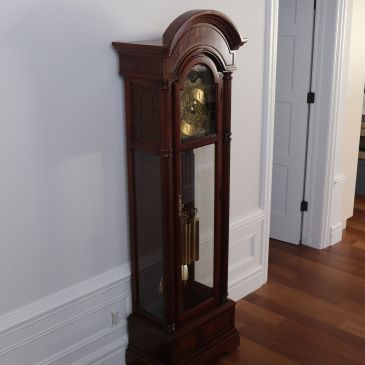
My daughter’s Craftline grandfather clock

Two years ago, my daughter purchased a new home in a large city in western Canada. As part of the sale, a few pieces of furniture, including a grandfather clock, were left behind and offered for sale. Recognizing the seller’s disinterest in taking the clock along with them, my daughter made an appropriate offer, successfully acquiring the clock.

What they acquired was a Craftline grandfather clock purchased by the original owner in the 1990s. This model boasts impressive features and at one time would have been considered a high-end model within its range. It included selectable chimes, a seconds bit, a beveled glass lower access door, a 12-inch pendulum bob, a moon phase display, crank weights, and a beautiful solid wood (possibly Cherry) case with carefully chosen veneers.

Catalog page

It is a beautiful clock but not something that most folks would choose to furnish their home today.

Unfortunately, information about the Craftline company is elusive. What is known is that it was a Canadian company that made furniture but it also specialized in crafting clock cases, sourcing movements from Germany, possibly from Hermle and Urgos, as well as faces, pendulums, and weights.

The timeline of their production and when they ceased operations, likely in the early 1990s, remains a mystery. Nevertheless, the clock’s craftsmanship suggests that Craftline was a formidable competitor to renowned US brands like Howard Miller and Ridgeway.

In the end, while the era of every home having a grandfather clock may have passed, the presence of such a finely made clock serves as a reminder of a bygone era when these clocks were considered essential elements of a well-appointed home.

Catalog page

Online searches suggest that the company encountered obstacles in maintaining its copyright brand name due to numerous other businesses also operating under the Craftline name, resulting in search efforts leading to many dead ends. Join me in a challenge to uncover information about this company. With enough bits of information perhaps we can piece together a profile of this fine Canadian company.

We deserve to know more about the Craftline Furniture Company of Canada.

June 2025 update: The definitive source on Craftline Industries is an article I authored earlier this year.

Trouble Strikes Thrice: The Notion of Bad Luck in Threes

The belief that bad luck happens in threes is a common folk belief that suggests that if you experience one bad event or stroke of bad luck, two more are likely to follow in quick succession. While this adage is not grounded in any scientific or empirical evidence, it has persisted for years.

In this blog post, I will recount a series of unfortunate events I’ve experienced with one specific clock, a German-made mahogany-cased Junghans Hansruck time and strike mantel clock from the latter part of 1913.

While my bad luck didn’t unfold rapidly it seems that I was destined to have problems with this clock from the outset.

Junghans Hansruck time and strike mantel clock
Junghans Hansruck time and strike mantel clock when first received

Some time ago, I purchased the clock through an online auction. Emerging as the successful bidder, I arranged for the clock to be shipped to my location. It arrived intact and undamaged.

Setback Number One

After unpacking the clock, I immediately set out to test its functionality. I wound up both the strike side and the time side, ready to set the correct time when the minute hand unexpectedly snapped off. It wasn’t an ideal beginning, to say the least. While the minute hand was repairable, it added another layer of frustration to contend with.

Okay, I can deal with the hand later. Back to the clock. The clock wasn’t working after all, but a good cleaning and addressing any wear issues should get it running again.

Showing the face of a Junghans mantel clock and the repaired minute hand
Soldered minute hand

I managed to solder the hand and put it aside while I addressed the movement.

Setback Number Two

I serviced the movement, reassembled it, and placed it on the test stand. It ran smoothly for a few days on the time side, but the strike side had issues. While investigating the malfunction I identified a small stamped metal part on the movement had bent. In an attempt to straighten it, I inadvertently applied too much force, causing the piece to snap off. I’ll call the part an actuator.

The strike actuator when activated lifts a lever to begin the strike process. The actuator is attached to the front plate with a small machine screw and is free to move.

On the center arbor is a star cam. The 2 points on the star cam rotate every 30 minutes until a star point pushes the strike actuator to begin the strike sequence. A protruding piece of metal, the contact piece for the star point on the actuator, is the part that broke as I was attempting to unbend it.

Soldered piece above the centre cannon on a Junghans Hunruck movement..
Soldered actuator

As the actuator does not apply much pressure on the lever above it, soldering should do the trick. Back to more soldering.

The actuator is repaired and the hand has been soldered. Both are functioning like new and the movement is running well on the test stand.

Setback Number Three

Satisfied that everything was working correctly after the testing phase and the movement was keeping good time I then proceeded to mount the movement into its case.

Here’s how I think the third mishap occurred.

When mounting the movement into its case, I positioned the case glass side down without any padding. My attempts to secure the movement into the case might have inadvertently stressed the dial glass, leading it to break. I didn’t hear the crack, and the second possibility is that it occurred earlier, possibly getting kicked accidentally on the floor next to my desk.

The bottom line is, that the glass is now cracked, necessitating either replacing it or salvaging the dial bezel from another clock. I don’t suppose anyone has a magical resin that will hide the crack.

I thought so!

Cracked dial glass on a Junghans mantel clock
Cracked dial glass

Most errors in clockwork are fixable, but a damaged dial glass is an exception—it cannot be repaired.

Cracked glass aside it is a very nice clock and it runs well.

Are setbacks a good thing?

I don’t often publish my mistakes but in the spirit of transparency and the unpredictable nature of clock restoration, it seems fitting to share this series of setbacks with my audience.

So, does bad luck happen in threes? From a statistical perspective, events occurring in threes are not more likely than any other numerical pattern but it happened.

Setbacks are a natural part of the process and should not deter anyone from passionately pursuing a hobby they love. Not every restoration or service of a clock goes according to plan and it’s normal to face unexpected issues when restoring or servicing clocks that are over 100 years old.

Yes, of course, there are lessons learned. But it just seems very strange that all of this happened to me with this one clock.

Clock Repair Essentials: Trusted Suppliers for Quality Parts and Tools – a revisit

Clock repairers depend on reputable suppliers for quality parts, tools, and accessories, ensuring durability and customer satisfaction. Trusted suppliers offer a diverse selection of compatible components, expert knowledge, timely delivery, and warranty support. Efficient logistics and ample stock levels from reliable suppliers benefit repairers with waiting customers.

The suppliers mentioned below, none of whom sponsor this author, are my preferred choices based on my extensive experience in procuring parts from them over the years. I’ve also included some suppliers known for their reputation, although I haven’t personally dealt with them.

The original blog post regarding clock repair resources was published last year. However, I’d like to update the list and welcome any additional recommendations. At the request of a reader, I have added an addendum section with a description of the lever setup for the strike train.

An assortment of Bergeon bushings #5288
An assortment of Bergeon bushings

Notable suppliers, with a short description of their services and with links to each one, include:

Timesavers: According to their site, “TimeSavers is a worldwide distributor of clock parts and repair material. We have been in business since 1975.” Their extensive inventory contains thousands of parts. Timesavers is the best-known clock parts supplier in North America.

Cousins; Cousins is a UK parts supplier I have sought them out for specialty items such as brass feet for a bracket clock and parts for long case clocks and parts not readily available from North American suppliers.

Perrin: Perrin is Canada’s leading supplier of clock parts. Residing in the eastern region of Canada, I rely on Perrin as my primary supplier. NOTE: Perrin will be closing its doors in May 2024

Butterworth: I am not certain if Butterworth has a dedicated site but they can be reached on Facebook. I have ordered a pivot polishing kit from them in the past but they are also known for their unique Butterworth bearing.

Merritts: While their parts inventory may not be as comprehensive as that of other suppliers, they offer a diverse range of antique clocks available for online purchase at reasonable prices.

Meadows and Passmore: Some restrictions apply on the purchase of clock parts and it is best to check with the company before ordering.

Mile-high Clock Parts: The repairer’s source for Keystone tools, staking sets, spring winder, bushing machine as well as other parts.

Clockworks: The clock repairer’s principal source for new Hermle movements as well as other supplies and parts.

Black Forest Imports: A distributor for clock movements and supplier for case parts, tools, repair supplies, etc.

Somal Watch Supply in Toronto, Ontario, Canada is a source for Watch Movements, Watch Tools, Batteries, Mineral Glasses, Crowns, Spring Bars, and more.

Ronell: Ronell is a worldwide provider of clock repair parts and supplies.

Steady rest tool for Tiag metal lathe

A reader suggested Griffens Clocks and they can be reached here. The company acquired R&M Imports in 2019. R&M was well-known to clock enthusiasts and began as a mail-order business in 1968. Griffens also acquired the inventory and assets of the Herschede Clock Company. They are located in Portland Oregon.

ACDP: “offers professional service for all your clock parts and clock repair needs”. This site was recently passed on to me by a reader, a company in the Netherlands called ADCP. On their site, I found difficult-to-locate clock parts of antique German movements among other interesting items.

Comments about pricing

The past two years have witnessed notable price increases that might unsettle newcomers, in the field of horology. In my experience dealing with suppliers, the costs of essential items such as bushings, files, and specialized tools like bushing machines and spring winders have seen significant spikes since the global pandemic, with some prices surging by 50% to 75%.

Tool for working on escapement bridges

For hobbyists venturing into horology, there are opportunities to find bargains in the used market. However, without developed expertise in locating quality parts and tools in good condition, there’s a risk of falling prey to unscrupulous sellers.

TimeTrax model 185 clock timing machine

While the initial prices of parts may seem attractive, always consider additional factors like taxes, shipping costs, document processing fees, and potential import duties. Some suppliers also impose minimum order requirements. Certain suppliers extend their offerings beyond the clock and watch parts, including antique clocks, repair manuals, and novelty items.

The reliability and quality maintained by these suppliers not only ensure the authenticity of repairs but also contribute to preserving the art of horology so that we can enjoy our clocks today and well into the future.

Wrapping up the servicing of a Seth Thomas type 89 movement

Seth Thomas is a well-known American clock manufacturer with a long history, and they produced a variety of clock movements over the years. The Type 89 movement is one of the many clock movements produced by Seth Thomas between 1900 and 1938.

Seth Thomas mantel clock from the 1930s
Seth Thomas mantel or shelf clock

The mantel clock in question features the Type 89 movement. Acquired in the summer of 2023, this clock boasts a simple and straightforward design.

In the first part of this two-part series, I discussed the disappointments I encountered with the clock’s case.

Seth Thomas type 89 movement showing dirt and rust
Seth Thomas type 89 movement, dirty and rusty

The focus then shifted to the disassembly process and my examination of the widely-used Seth Thomas Type 89 clock movement.

My observations highlighted a replaced mainspring on the strike side, the necessity for bushing work, and indications of rust, all of which posed challenges that I committed to addressing in subsequent stages such as cleaning, bushing, oiling, and reassembly.

The focus of this blog post is the completion of servicing of this type 89 clock movement.

The front plate of a type 89 Seth Thomas movement
Front of the type 89 movement before disassembly

Cleaning of the mainsprings

There is always the temptation to do nothing with the mainsprings if they look acceptable. However, cleaning the mainsprings is an essential part of clock servicing. Uncoiling and wiping the dirt and grime from the mainsprings with a cloth is the preferred method, but cleaning them with an ultrasonic cleaner is also an option.

In Part I, I cleaned the mainsprings in my ultrasonic cleaner and provided a rationale for this decision. Before I go any further, I’d like to emphasize a crucial point regarding the cleaning of mainsprings in an ultrasonic cleaner. This practice is not recommended and should only be considered as a last resort.

While cleaning mainsprings in an ultrasonic cleaner has little impact on the surfaces or mechanism of the cleaner itself the oil removed from the mainsprings generates a black liquid that contaminates the cleaning solution, rendering it ineffective for future use.

Seth Thomas type 89 mainsprings, note the replacement spring on the right

Clamps have been applied to secure the mainsprings after oiling, and they’ve been set aside. Now, we move on to the next step: the bushing phase.

The back plate is removed on a type 89 Seth Thomas movement
Backplate removed

Bushing the movement

As the movement is fully disassembled this is the stage where bushing work can be done.
I commend individuals who choose to bush by hand, but personally, It is not for me.

Various systems exist for bushing, with KWM and Bergeon being the two most widely adopted. It’s worth noting that neither system is inherently superior to the other, as preferences tend to vary among enthusiasts. When referring to a “system,” it’s important to understand that the bushings from one system are not interchangeable with those from the other.

That said I use the Bergeon system.

Bergeon 6200 Bushing Machine
Bergeon Bushing Machine

Before bushing, I identify all the locations requiring attention and mark them with a Sharpie. There is no permanent mark as rubbing alcohol will easily remove all traces of ink.

I have an excellent assortment of bushings and have all the required ones for this project.

An assortment of Bergeon bushings, assortment #5488
An assortment of Bergeon bushings, #5488

Using cutters each hole is drilled out and chamfered, that is, removing the sharp edges to allow the pushings to be pressed in smoothly. As I insert each new bushing I test the fit by assembling the wheels to check how freely they move. This allows me to make small adjustments in the event the pivot is too tight in the bushing hole.

Cutting into the bushing hole with Bergeon bushing machine
Cutting into a brass plate

Based on my initial assessment, the bushings for both the front and back plates of the escape wheel were the most worn. The next new bushing is the fourth wheel front plate, the one adjacent to the escape wheel. After three bushings everything looks good and the wear further down the train does not look too bad. A fourth bushing for the fourth wheel should be enough.

A cutting broach is used to enlarge any holes that are a tight fit for a pivot followed by a smoothing broach. To prepare for the wheels to go back in place all bushing holes are cleaned with pegs/toothpicks.

Test fitting the time-side wheels during the bushing process, type 89 Seth Thomas movement
Test fitting the time-side wheels during the bushing process

In the photo above, the plates and gears look shinier after a session with the ultrasonic cleaner. However, it’s important to note that the main goal in clock repair isn’t to make everything as shiny as possible. The focus is on reducing wear and tear. Some dirt and grime on the plates might not come off completely during the cleaning process in every case and it is not something the clock repairer should be overly concerned with.

Back to bushing. There is a little bit of play on the second and third wheels but it is tolerable so, I think I will stop at this point.

Punching a 3.5 mm Bergeon bushing into a clock plate
Punching a bushing into the plate

Were I in the clock repair business I would bush everything on the time train, or the entire movement for that matter, but since I usually inspect movements in my collection every 2-3 years I can address any additional wear at that time.

On to the strike train. In the first article, I mentioned that there was not much wear on the strike side which might be attributable to that side not being wound as often. The only hole that must be addressed is the cam wheel bushing on the front plate. Why this bushing hole is worn much worse than the others is a bit of a mystery.

Okay, all the work is done for a total of five new Bergeon bushings. The holes have been pegged, and the movement is now ready to be reassembled.

The one hiccup encountered during the bushing process was the malfunction of my caliper tool. Fortunately, this isn’t a major problem, as all the Bergeon bushings are uniform at 3.5mm outside diameter, with inside diameters of either 1.4mm or 1.5mm so I knew what size to grab first.

Reassembly

When dealing with American 8-day time and strike movements, there are challenges in configuring the strike mechanism accurately. Occasionally, luck is on my side, and I manage to place the paddle in the deep slot, position the lever in the lowest part of the cam wheel, and align the warning wheel just right on the first attempt.

A useful tip. If the lever is in the lower part of the cam wheel and the paddle is not in the deep slot, simply move the toothed count wheel sideways so that it does not engage the pinon and reposition the wheel till the paddle finds the deep slot.

No luck setting up the strike this time! If the strike train does not lock correctly it will simply keep on running and you will know that soon enough.

The plates can be partially pried open without the risk of all the wheels and levers springing out. Repositioning the warning wheel involves moving the fly aside, carefully extracting the 4th wheel from its pivot hole, and rotating it a quarter turn or so to ensure the warning pin aligns with the stop lever.

Seth Thomas movement on the test stand

A minor issue with the hammer lever surfaced as it was not aligning correctly with the strike pins on the cam wheel. No disassembly of the movement is required for this adjustment. Simply loosen the bottom two nuts by the mainsprings, and the strike hammer can be removed to straighten it. After having been bent multiple times over the years, straightening it out resolved the issue.

Next, the movement is oiled with Keystone clock pivot oil and mounted on a test stand. After a week it is running and striking as it should.

And lastly, my new caliper arrived just as I was concluding the servicing on this clock.

Addendum

To properly configure the strike side, pay attention to the positioning of the levers as pointed out by the arrows.

Seth Thomas movement
ST movement

In the above photo, the lower arrow shows the paddle in the deep slot, and the upper arrow shows the drop lever in the indent of the cam.

Seth Thomas movement

The upper arrow shows the position of the stop pin on the stop wheel. The lower arrow shows the locking lever.

Website Powered by WordPress.com.

Up ↑