Pendulum bob weight – should it make a difference?

Welch movement on test stand
E. N. Welch movement on test stand

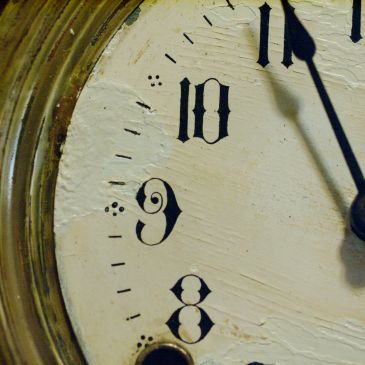
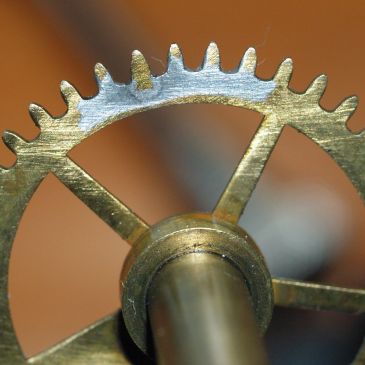
I was working on a E. N. Welch (ca. 1875) mantel clock movement in the late fall of 2019, giving it a thorough cleaning during which I installed 6 bushings.

Continue reading “Pendulum bob weight – should it make a difference?”

Pub clocks of Ireland

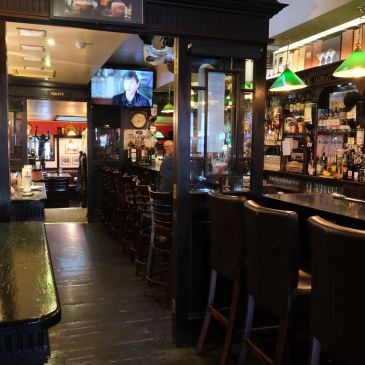
During our recent trip to the southern part of Ireland including the capital city of Dublin, I expected to see antique mechanical clocks in some of the pubs and I was not disappointed.  I tried to visit as many pubs as possible to search for clocks, of course, and while there I sampled the local ales and lagers though no Irish visit is complete without a pint or two of Guinness stout.

Continue reading “Pub clocks of Ireland”

A veneer repair can make a difference on a Seth Thomas shelf clock

Among the most respected and prolific American clockmakers is the Seth Thomas Clock Co. of America. Every collector I know has at least one Seth Thomas clock in their collection.

My modest collection consists of six Seth Thomas clocks representing several styles, all unique and from the period 1865 to 1930.

This is a Seth Thomas time and hour strike large round top (model name or number unknown) made in the 1870s. For first impressions of this clock, go here.

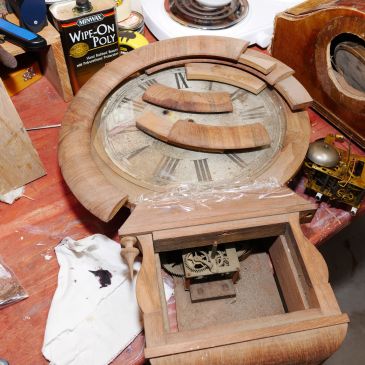
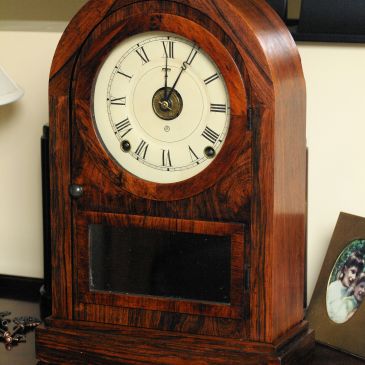
Seth Thomas round top shelf clock, veneer missing top left of the door frame

This shelf clock was purchased at the National Association of Watch and Clock Collectors conference in Springfield Ma. in June of 2019.

The clock case is in such remarkable condition it would be a shame to ignore that one small blemish and once you see the missing veneer the eye is always drawn to it

The clock measures 15 inches in height, 10 inches wide at the base and 4 inches deep. The attractive Rosewood veneered case has a mirrored rectangular lower tablet. The grain of the Brazilian Rosewood is bold and nicely textured. However, a sliver of the veneer is missing between the 9 and 12 o’clock position of the dial bezel which, in my view, is repairable. My wife did not notice this until I pointed it out.

A previous owner attempted to hide the missing veneer by tinting the exposed area.

Continue reading “A veneer repair can make a difference on a Seth Thomas shelf clock”

The Maritime Association of Watch and Clock Collectors – Join Today

If you live in the Maritimes provinces of Canada and are keenly interested in vintage and antique clock and watch collecting and repair this will be of interest to you.

On November 2-3, 2019 the Maritime Association of Watch and Clock Collectors held its inaugural meeting. Five members came together from various parts of the Maritimes to meet in Prince Edward Island (Canada) to form a club of like-minded individuals.

After months of planning and discussions in preparation for the inaugural 2-day meeting the response from all present was very positive

Although the skill level varied among participants, all who attended have a keen interest in horology and are willing to share their knowledge and experiences with others.

A educational component of the meeting, a lesson in bushing

After months of planning and discussions in preparation for the inaugural 2-day meeting the response from all present was very positive.

Demonstration of the cleaning of a mainspring

The goal of this new group is to gather individuals from across the Maritime provinces (PEI, New Brunswick and Nova Scotia) to share experiences, mentor each other, learn new techniques, provide opportunities to acquire clocks and watches and foster social interaction.

Inspecting an antique pocket watch

During our first meeting we discussed the name of the new association. We also discussed the format of our meetings, the venue, whether it be in one location or throughout the Maritimes, the frequency of meetings, outreach through social media, resource books, the training component within our meetings and what we can offer to each other both inside and outside our regular meetings.

A collection of clock movements in need of repair

We agreed that the new organization should be called MAWCC, the Maritime Association of Watch and Clock collectors. We agreed to no less than 2 meetings per year but that sub-groups would meet more frequently. At this point in time we are not affiliated with the NAWCC (National Association of Watch and Clock Collectors).

If you are from the Maritime region of Canada (Prince Edward Island, New Brunswick, Nova Scotia) and you have a keen interest or wish to advance your skills in horology and would like to  connect with like-minded individuals feel free to email me at ronjoiner@gmail.com.

10 weight driven clocks in my collection

I am a big fan of weight driven clocks and will add them to my collection when time, opportunity and finances allow.

There are generally 2 categories of motive power for mechanical clocks. The energy required to run a clock is provided either by a spring or a weight. Most of my collection is spring-driven but 10 clocks are driven by weights and they represent the broad period from 1835 to 1996.

here are some interesting facts about my ten weight driven clocks:

  • Eight are American,
  • Two are Austro-German,
  • Three are Ogee style,
  • Five are thirty-hour or one-day,
  • Two are column style
  • One is woodworks, and
  • Three have deadbeat escapements with maintaining power

Rather than describe each one I will let the photos (with captions) speak for themselves.

Continue reading “10 weight driven clocks in my collection”

Will antique clock prices go up or down in 2020?

About three years ago I wrote a piece on clock prices. At that time antique and vintage clock prices had taken a tumble. Where are we now? Have things changed in 2020? Are antique and vintage clock prices going up or down? Is this the time to buy or sell?

Let me come quickly to the point. Anyone who shops today for an antique or vintage clock is well aware that the clock market has been depressed for quite some time and continues on a downward spiral.

Follow me as I explore how clock prices are set, factors that affect the sale of a clock and the reasons why prices are dropping.

Two very desirable clocks from the American Clock and Watch Museum, Bristol Conn.
Informed buyers always make much better choices
30-hour Ogee shelf clocks, as nice as this one, can be found for a lot less than you think

Pricing is as volatile as it was three years ago. The pricing of a clock on an online site or a paper ad is just as murky and as confusing as ever. There is no true “standard” pricing for any vintage or antique clock. As with most objects, there is a price range that most would consider reasonable.

How are prices set?

Sellers use a number of metrics to set prices;

Continue reading “Will antique clock prices go up or down in 2020?”

Clock lovers – take a break and enjoy the holiday season with family and friends

Without the establishment of the railroad, we would not have Standard Time

Every day, it seems, I am involved in the pursuit of learning more and more about the world of horology.

If I am not actually working on an antique or vintage clock I am researching information about a clock issue, taking photos/videos of clocks, online shopping for clocks or writing for my blog. But I also know that at certain times of the year I must put down my tools, close my books, step away from the keyboard and spend precious time with friends and family. Christmas is important to me.

Remember the simpler things in life
Christmas is a special time of the year

Gift-giving? My kids stress every year over what to get dad for Christmas. However, it is the little things I always appreciate in my Christmas stocking. Kids, if you want to stuff my stocking, a new pair of cloth gloves, a box of toothpicks, cotton swabs, or an artist paintbrush will do just fine.

Christmas is a time of joy, not of giving, unless the giving is in the form of love and appreciation for friends, family and colleagues.

So, if you are looking for that special gift for the clock lover in your family remember the simpler things in life.

Merry Christmas and Happy Holidays everyone.

Jerome and Co. mantel clock – success at last

How you ever wondered what keeps antique mechanical clocks going? It’s a miracle they work at all when they are as worn as this one.

Jerome & Co. time and strike movement with front plate removed, minus the escape wheel

Most old clocks I come across have common issues, dirty, oily movements and worn pivot holes here and there. Generally, all they need is a bushing or two and a good cleaning to put right.

Last week I wrote about a Jerome & Co. time and strike mantel clock I bought in Springfield Mass. during the annual convention of the National Association of Watch and Clock Collectors in June 2019. However, no amount of encouragement would make it run reliably.

Continue reading “Jerome and Co. mantel clock – success at last”

Waterbury York parlour clock servicing – a few surprises but ultimately a disappointment

This attractive parlour clock, a Waterbury York, circa 1900, was bought at auction in the spring of 2019. Though inexpensive it is certainly worth servicing which is the subject of this article.

The time side was running but the strike side did not function at all. Usually these sorts of problems amount to simple lever adjustment issues but there were other surprises awaiting me.

The auction tag is still on the clock, the day I bought it

The Waterbury Clock Company was incorporated in the city of Waterbury, Connecticut, on March 5, 1857. Until the Great Depression, Waterbury had been quite prosperous, but like so many companies, most of the profits lined the pockets of its Directors instead of being reinvested in new equipment and updated facilities. In 1932 the company was bought and re-organized under the name Ingersoll-Waterbury.and in later years the company morphed into the Timex Corporation. If you peruse the Timex site today you will see a line of Timex watches called the Waterbury collection.

Continue reading “Waterbury York parlour clock servicing – a few surprises but ultimately a disappointment”

Servicing a 3-train Girod clock movement – not the most fun but a satisfying result

Girod Westminster chime mantel clock

This is a 3-train Westminster chime mantel clock with Girod movement from France in a Canadian made Art Deco case.

Girod was a clockmaker based in the Morbier-Jura region of France and produced clocks from the 1930’s into the 1960’s. The firm of Girod was founded by brothers Leon and Auguste Girod.

The clock was manufactured after the war years, presumably the late 1940s. It has a pendulum movement which predates mantel clocks with balance wheel escapements that arrived in the 1950s.

The frustrating part was not making directional marks on some of the parts prior to disassembly

I have very little experience with 3-train movements and this movement was part adventure and part learning.

The movement has five hammers, four of the five carry the Westminster chime and three of the five for the top-of-the-hour strike. There are two levers on the left side of the movement looking through the access door. The uppermost is a repeater and the one below it is a chime/strike silencer.

The movement is a conventional design and once assembled all adjustments are made externally. Girod used the split back plate design for their 3-train movements which makes servicing simpler than the classical one plate design.

It is a conventional 3-train movement with a dedicated gear train for each function. Looking at the back, the centre train is the time, the left train is the strike while the right is the chime.

Continue reading “Servicing a 3-train Girod clock movement – not the most fun but a satisfying result”

Tick Talk Tuesday #23 – Forestville clock with electromechanical movement

Tick-Talk Tuesday is about the letters and comments I have received from you, the reader, concerning your clock, issues you might have had, challenges you face or a clock you would like me to profile. I offer my responses to your questions with advice on your particular clock concern. For those comments and questions that stump even me, I consult within my clock circles for the best possible answer

Not the most attractive clock in the world but a curiosity nonetheless. It is a mechanical clock but it is not wound in the conventional manner.

Continue reading “Tick Talk Tuesday #23 – Forestville clock with electromechanical movement”

Preserve, restore and/or consume – A clock owners perspective on intervention: Part II

Mauthe wall clcok CA. 1895

This is Part II of a 2 part series on a clock collectors predicament: preserve or restore and consume

In Part 1, I put forward the argument that if we acquire a clock that has been changed from its original state are we adding or subtracting from its value if we make further changes?

The solution to preserve or restore might not be the only factor to consider when addressing your newly acquired antique clock. Technical limitations of the collector (owner) must also be considered. Cost and time are other factors. A decision now might not be the same decision someone else might make or I would make at a different time.

Let’s now consider the movement and the case.

The movement

Beginning with the movement; should it be in running condition? Should the movement be untouched as a historic object? If it has not been altered and if there have been no changes during its life, doing nothing is an option. If changes have been made to the movement over the years which may include gear teeth repair, bushing work or new pivots or pinions, should these changes be considered in preservation or restoration? Should bad repairs be reversed?

Continue reading “Preserve, restore and/or consume – A clock owners perspective on intervention: Part II”

Preserve, restore and/or consume – A clock owners perspective on intervention: Part I

Little changes adding up over time as the ship moved from what it had been to what it would be next
James S. A. Corey, Babylon’s Ashes

This is Part I of a 2 part series on a clock collectors predicament: preserve or restore and consume

This quote from Babylon’s Ashes (The Expanse) sums up the theme of this 2-part blog post. If we acquire a clock that has been changed from its original state are we adding or subtracting from its value if we make further changes?

Part I explores whether we should make any changes to our newly acquired clock if its condition is less than desirable and in Part II, later this week, I explore the movement and the case.

If your newly acquired antique or vintage clock is in excellent shape count yourself lucky but often it may either need major remediation or at least minor adjustments. The impulse is to do something to make it better but not enough to change it in a significant way.

Let’s consider what you have. Is it a clock or a historical object? Should it be changed in any way? And if changed how different would it be from what it had been? Should it be preserved or restored? It may represent an important part of horological history but if value is important will restoration or preservation have a  positive or negative effect on its worth?

Fully restored Mauthe wall clock CA. 1895

To preserve or restore is one of the fundamental questions concerning collectors. Preservation means halting further deterioration. Restoration, on the other hand, involves returning the object to its former state or period-correct condition.

Continue reading “Preserve, restore and/or consume – A clock owners perspective on intervention: Part I”

Top ten blog articles of all time – my blog, of course

Mauthe Mantel clock, circa 1938

Every blogger knows that it takes time to build a popular blog and unless you have a surefire winning formula right off the mark it takes months if not years to build a loyal following.

Many blogs fail within the first few months out of frustration yet patience, determination and some hard work is all it takes to find a rhythm that works.

Daniel Dakota wall clock

With over 130,500 page views since 2015, upwards of 4000 average monthly views and over 900 views per week I recently checked my stats to find the 10 most popular blogs of all time.

The experts are going elsewhere and that is fine with me because this blog was never intended to appeal to those running a repair business or involved in the commerce of antique clocks

Here they are. Click on the links to see what all the fuss is about.

Continue reading “Top ten blog articles of all time – my blog, of course”

Daylight savings Time – let’s end this nonsense

Daylight savings Time; let’s follow the province of British Columbia’s (BC) lead and get rid of DST.

In the meantime set your clocks back one hour if still you live in an area where the convention is still followed.

Waterbury drop octagon dial

Typically, regions that use daylight saving time adjust clocks forward one hour close to the start of spring and adjust them backward in the autumn to standard time. In Canada we have a little expression, “Spring ahead, Fall behind” to make it easy to remember what to do twice a year. In Canada, it is the second Sunday in March and the first Sunday in November.

Vienna Regulator dial

As mentioned there has been a push to scrap the time-switch in Canada. British Columbia (western-most province of Canada) petitioned to end daylight saving time in the province back in 2015. Tens of thousands supported the move to end daylight-savings time.

Continue reading “Daylight savings Time – let’s end this nonsense”

Seth Thomas round top cottage clock

Seth Thomas round top shelf clock

Among the most respected American clockmakers is the Seth Thomas Clock Co. In my collection are 6 Seth Thomas clocks representing several styles all of which are unique representing the period between 1865 and 1930.

I acquired this clock at the National Association of Watch and Clock Collectors conference in Springfield Ma. in June of 2019.

Continue reading “Seth Thomas round top cottage clock”

Tick Talk Tuesday #21 – What is my Ansonia schoolhouse clock worth?

Ansonia clock project is complete
Ansonia schoolhouse clock

Tick-Talk Tuesday is about the letters and comments I have received from you, the reader, concerning your clock, issues you might have had, challenges you face or a clock you would like me to profile and my responses to your questions with advice on your particular clock concern. For those comments and questions that stump even me, I consult within my clock circles for the best possible answer

JM says, “I have an Ansonia Octagonal Schoolhouse clock dated 1878 exactly like the one featured here. I also have the pendulum and key. It’s in good working order, but I am looking to sell it. I don’t know its value. I paid $500 for it in 1975. It’s a darker wood, the face is in good condition, and the description label in the pendulum area is intact. What would you suggest for a sale price?”

My reply. “First of all, I am not an appraiser but I have several years experience buying and selling clocks.

Continue reading “Tick Talk Tuesday #21 – What is my Ansonia schoolhouse clock worth?”

Antique clock shopping experience

Although I did not buy any clocks during my trip to the west here are examples of what you might find in some of the better quality antique shops. The three shops these clocks are from are located on Vancouver Island, British Columbia, Canada.

Let the photos speak for themselves. captions identify some of the clocks.

Trio of clocks, the middle one is a Grand Assortment by Sessions

Continue reading “Antique clock shopping experience”

The quest for an authentic banjo clock

Searching for a weight driven time-only banjo clock can be a challenge and acquiring an authentic example would go a long way to completing my collection. Securing an authentic Willard would certainly be the icing on the cake.

The style was widely copied by other members of the Willard family of clock makers and many others clock-makers

I was fortunate to have seen several Willard banjo clocks during my visit to the Willard Museum in Grafton Mass. in June 2019.

Banjo clock, circa early 1800s, Macdonald Museum, Middleton, Nova Scotia. Notice the location of the winding arbour

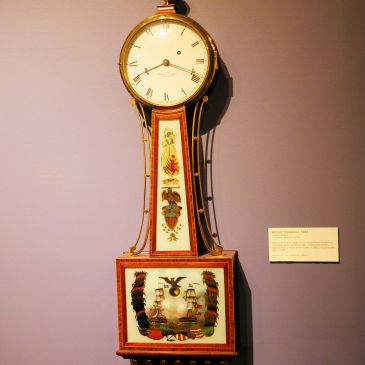
Few American clock-makers at the beginning of the 18th century were innovative. One of the most notable achievements was the small 8-day, weight-driven clock developed by Simon Willard. The Willard clock is a uniquely American wall clock with a banjo-shaped case designed and constructed by Simon Willard. Willard was originally of Grafton, Massachusetts, later of Roxbury, Massachusetts, and patented his unique clock in 1802.

The Willard banjo clock has no striking mechanism and indicates time only by its hands and dial. It is correctly defined as a timepiece.

Continue reading “The quest for an authentic banjo clock”

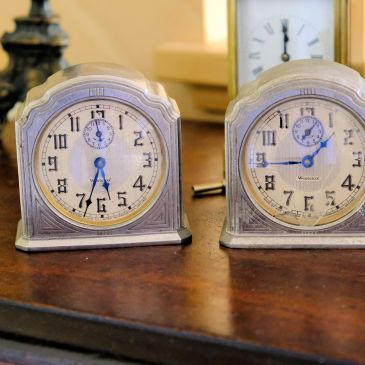
2 Westclox LaSalle 61C clocks combined to make one working clock

Reader EW asked me if I wanted a second Westclox LaSalle 61C alarm clock. Yes, I said, of course. I was advised of the condition of the clock beforehand so there was no surprise when it arrived in the mail.

The important distinction between my clock and the new arrival is that the new one actually works. My LaSalle may have run at one time but not now. I can hear it briefly ticking but once placed on a flat surface it stops. There is not a lot wrong with it but it definitely requires a good cleaning and perhaps some bushing work.

Gee, our old LaSalle ran great….those were the days
                                                         Archie Bunker

Westclox alarm back of clock
Westclox alarm clock; winding keys and adjustments

The Westclox Clock Company is better known for various versions of Big Ben and Baby Ben windup alarm clocks produced from 1900 to the mid 1980s. But there were other windup models one of which is the Art Deco styled LaSalle series. Both of these clocks are the model 61-C (401) otherwise known as a Dura clock because they have nickel-plated, die-cast zinc cases made by The Dura Casting Corporation in the United States. There are 6 models in the LaSalle series and all use the Westclox type 61 Baby Ben, one day movement.

Continue reading “2 Westclox LaSalle 61C clocks combined to make one working clock”

New Haven Sharp Gothic (Steeple) clock – Part II – a poor solder repair is the culprit

This is Part II of a two Part series on a New Haven Sharp Gothic (Steeple) clock. This blog-post is about servicing the movement.

My recently acquired New Haven Gothic Steeple 30-hour clock is an online auction win.

New haven Gothic Steeple clock
New Haven Gothic Steeple clock

The case is in very good condition apart from minor veneer issues on the base and the columns. The clock is missing the tip of the right finial although it might be hard to tell from the photo. It measures 20 1/2 inches tall with a 5-inch dial. The movement appears to be original to the case.

The dial is original and has some loss that would be expected in a 135-year-old clock. The tablet, likely original, features a sailboat against Greek (?) temples surrounded by gold foliage on a black background. The design of the tablet was used in other New Haven clocks of the time. Though intended for European export the clock found its way to Canada.

Servicing the movement

Continue reading “New Haven Sharp Gothic (Steeple) clock – Part II – a poor solder repair is the culprit”

New Haven Sharp Gothic (Steeple) clock – Part I – history unearthed

New haven Gothic Steeple clock
New Haven Gothic Steeple clock

This is Part I entitled History Unearthed. It is the first part of a two part series. Part II concerns servicing the movement.

My recently acquired New Haven Gothic Steeple 30-hour clock is an online auction win.

The case is in very good condition apart from minor veneer issues on the base and the columns. The clock is missing the tip of the right finial although it might be hard to tell from the photo. It measures 20 1/2 inches tall with a 5-inch dial. The movement appears to be original to the case.

Continue reading “New Haven Sharp Gothic (Steeple) clock – Part I – history unearthed”

Clocks running in my office – a short video

I have an upstairs office in my home where I work on most of my clocks. I also have a small workshop in my basement where I work on clock cases; gluing, painting, reconstruction and other odd jobs.

In the spring of this year (2019) my wife asked me how many clocks are running in my office at any given time. I said, “I’m not sure”.

I put together a video to show how busy my office can be. Someone (not my wife) asked me if the sounds of ticking clocks bothered me and my reply was, “I find the sounds very soothing”. Allow me to take you on a tour.

I hope you enjoyed the tour. Let me know if you have any general comments or ones you would like more information about.

Inpainting a Seth Thomas clock dial – Part II

And now for the exciting conclusion.

This is Part II of a two part series. Part one covers the first three steps in renewing a Seth Thomas clock dial. In this, Part II, the decorative design is restored on the corners.

The Seth Thomas clock as found

Inpainting is the process of reconstructing lost or deteriorated parts of a clock dial. In the museum world, in the case of a valuable painting, this task would be carried out by a skilled art conservator or art restorer. Inpainting, as opposed to repainting and restoring the entire dial, addresses the degraded areas of the dial using a few simple techniques.

Inpainting is cost effective and can be done on the home work bench

Inpainting certainly does not meet the higher professional standards of a service such as The Dial House, which perform exemplary work but I will not have a dial professionally restored if the cost is twice what the clock is worth. There will always be occasions when a professional restoration is justifiable, however.

Inpainting is cost effective and can be done on the home work bench.

Continue reading “Inpainting a Seth Thomas clock dial – Part II”

Inpainting a Seth Thomas clock dial – Part 1

This is Part I of a two part series. Part one covers the first three steps in renewing a Seth Thomas clock dial. In Part II the decorative corner design is restored.

Seth Thomas column and cornice “Empire” style time and strike weight driven shelf clock, as found

Inpainting is the process of reconstructing lost or deteriorated parts of a clock dial. In the museum world, in the case of a valuable painting, this task would be carried out by a skilled art conservator or art restorer. Inpainting, as opposed to repainting and restoring the entire dial, renews the dial using a few simple techniques.

Some of the methods can be found in T. E. Temple’s excellent resource book entitled Extreme Restoration.

Continue reading “Inpainting a Seth Thomas clock dial – Part 1”

Website Powered by WordPress.com.

Up ↑