Beyond the basics – more advanced tools for clock repair

See this article for basic tools for clock repair

Let’s assume you have decided to take the plunge and you are at the beginning stages of building an essential tools list for clock repair. Let me help you with your journey.

In the fall of 2022, I wrote about the five essential tools for clock repair. The sidebar will bring you to that article. Tools for clock repair need not break the bank, in fact, you can begin for less than a $100 investment.

The five basic tool groups included the screwdriver, the letdown tool, the pivot locator, the box wrench, and the pliers. If you are ready to move forward with more challenging repairs here are the next set of tools you will require. Assuming you have already purchased the basic tools the 16 additional tools you will require are relatively inexpensive and are the prelude to making your first big jump to specialized and advanced tools.

This time our budget is less than $400 (all prices quoted in US funds).

Let’s begin.

Optivisor or eye loupe

The closer you can see the better. I prefer opti-type visors. I cannot get used to an eye loupe but it is certainly cheaper.

Opti-type visors are more expensive but hinged so that they can be pushed upward and out of the way. I have had a couple of visors in the past but the set I use now is the Magnivisor pro series from Carson which is about $60. The little light at the top goes through batteries fast and sometimes I forget to turn it off, so I don’t use it but you might find it helpful for those dark spaces.

$10 will get you a set of three eye loupes on Amazon.

Magnivisor by Carson

Movement test stand

A test stand is very helpful when disassembling a movement reassembling it and testing it before it is reinstalled in the case.

I have several types for different purposes but I think the one to start with is Gene’s test stand which is under $70. If you are handy in the workshop it is a relatively simple one-day woodworking project that you can build for half the cost.

Clock movement stand
Clock movement test stand

Clock movement work stand

I use two types. The first is movement plate standoffs and the second is a simple 4-inch high stand cut from a PVC pipe. The standoff set is anchored to the bottom plate by screwing brass end pieces to the four corners of the bottom plate (you can use three if you wish). The standoffs are sometimes called assembly posts and are around the $25 range in cost.

If you have 5-inch PVC pipe lying around simply cut off a 3 or 4-inch section.

Standoffs
Standoffs; either three or four can be used
Movement on standsoffs

The PVC is easy to work with and does not leave screw marks on the movement plates if you are particular about that sort of thing.

The movement is sitting on a piece of PVC pipe

Magnifier light

Florescent or LED. A color temperature of 6500k is the best compromise. Newer LED magnifying lights have custom color temperature settings. I see them on Amazon for about $50. Florescent bulbs have a shorter life than LED. Recently mine burned out and the replacement cost for the circular light itself is around $40 (for a $50 lamp!).

Worklight
Work-light

Clock oil and oil applicator

I have not had much luck with pen-type applicators and the few I have had have split with repeated use. Plus I am not sure the oil contained within is of very high quality. I am a bit old-school and use a cupped dipper and oil reservoir. Mobius and Keystone are good brands.

Count on spending $10 to $20 for quality clock oil. Motor oil, WD40, and 3-in-1 oil are not suitable substitutes and for me, the jury is still out on synthetic oil.

clock oil applicator
Clock pivot oil
Clock pivot oil

Movement clamps

When working with mainsprings, spring clamps are an absolute must for safety reasons. More than one beginner in clock repair has injured themselves by not restraining the mainsprings. A set of flat clamps (my preference) are around $17. If you wish to save money heavy steel wire will do.

Assorted clamps
Assorted clamps; flat clamp on the upper left

Tweezers

Useful for encouraging tiny pivots into place, picking up small clock parts, and a hundred other uses. A set will set you back $10. Bergeon will happily sell you a set for a few hundred dollars but cheaper blunt nose and needle nose tweezers will do.

Tweezers
Tweezers

Micrometer

Measurement in clock repair is important and a micrometer is essential. They are relatively cheap and can be had for under $20 at your local hardware store.

Using a micrometer to check pivot
Using a micrometer to check the pivot diameter

Cotton swabs

A general all-purpose probing cleaner for those tight crevices and corners. You will be surprised how quickly you can use up a box of 400. Under $3. Also useful for cleaning out your ears when determining whether or not your clock is in beat.

Cotton swabs
Cotton swabs

Toothpicks

There is no substitute for cleaning clock bushing holes. Buy them in the hundreds, you will need a lot of them. Get them at the checkout counter for under $2.

Toothpicks
Toothpicks

Mini level

A level surface is required to have a clock in beat. This one by Starrett is over $50 but you need not spend that much. Count on about $10.

Level
Spirit level

Spider key sets

The 4 and 5-prone sets in even and odd sizes will be enough for a vast number of clocks. As you move along in your hobby you will accumulate box loads of keys but a spider set is handier. Count on about $15.

4 and 5 prong keys and singles

Organizing trays

These are dollar-store items. Great for organizing clock parts (and not losing them). You can pick up a wide variety of sizes for under $10 total.

Organizing trays

Screw head holding screwdriver

I have a set by Klein Tools and find it a time-saver, especially when returning a movement to its case and holding and guiding that finicky screw in place. The gripping action holds, starts, and drives slotted screws in awkward, hard-to-reach places. A word of caution; they can be easily ruined if used to torque a screw in place.

I wish they can be purchased separately for a reasonable cost because I never have used the large one. About $60

Flashlight

Great for locating that nut that mysteriously flies through the air and lands on your floor sometimes never to be seen again. There are many other uses as well. The fancy ones are flexible but I have a penlight which is less than $10.

Flexible flashlight

Set of Single-Ended Scaler Probes

Okay, they are the same ones used by dentists to pick at your teeth but they are perfect for pulling that helper wire into position, guiding a pivot in place, or just about any time you need to pick at something, probe an area, de-scale a tooth (clock teeth, I mean), and so on. I bought mine at a dollar store but a set can be had for around $15.

Scalers

Concluding remarks

And there you have it.

For the next level, the costs begin to escalate but after purchasing these tools, and becoming familiar with clock movements through practice you will want to explore your hobby further. In a future article, I will describe how you spend big money on more specialized tools but also how you can get away with advanced repairs on the cheap.

Tick Talk Tuesday #44 – What can you tell me about this clock?

Tick-Talk Tuesday is about the letters and comments I have received from readers concerning clock issues, challenges faced, a clock you would profiled or advice on your particular clock concern. For those comments and questions that stump even me, I consult within my clock circles for the best possible answer

ED writes

Good morning, 

I recently bought a house and the previous owners left this clock behind. It ticks and chimes and seems to be in working order. I’m wondering if you could tell me more about it like what time period it is from and if it is of any value. 

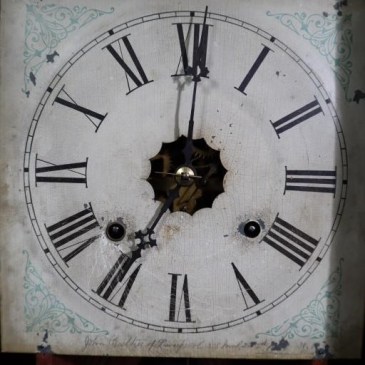
Dial face of the Westminster C

Thank you in advance for your time!

My reply

Hi and thanks for your email.

The Westminster C is an unusual clock because it has 2 gear trains to perform what is usually done with 3 gear trains in most clocks, rare but not unique.  In most chiming clocks there are three trains or three winding points, one for time, one for strike and one for the chimes.

Two train patented movement

This model is based on patent designs filed in 1926 and 1930. Production of the patented movement began in 1927 so, your clock would be around that time and possibly a year or two later. There is a date stamp on the label but I cannot make it out. Could it be 2912, December 1929?

Possibly manufactured in December 1929

The sale price in 1931 was $29.95, a working man’s weekly salary at the time.

It is a very complicated movement that few repairers enjoy working on, because it is difficult to set it up correctly to have it run reliably. If your clock is running well, you are quite lucky because a repair can be very expensive.

They are uncommon enough that they can still fetch a good price on auction sites ($300-$400 or so).

Hope this helps.

ED write back

This is absolutely fascinating! Thank you for your quick reply. I am now looking at that clock through different eyes. 

I appreciate your help, and I hope you have a wonderful weekend. 

Tick Talk Tuesday #43 – Is this a Simon Willard banjo clock?

Tick-Talk Tuesday is about the letters and comments I have received from readers concerning clock issues, challenges faced, a clock you would profiled or advice on your particular clock concern. For those comments and questions that stump even me, I consult within my clock circles for the best possible answer

TM writes, “We have had a banjo clock in our family for multiple generations, and knowing my family’s history it would not surprise me if it was a Simon Willard original. I understand that is a long shot but it is so hard to find information about banjo clocks or reputable people to deal with. It is in relatively good condition, not knowing when my family acquired it exactly, but it is original to us. I am attaching a picture and would greatly appreciate your opinion.”

The family banjo clock

I am not an expert on Willard banjo clocks but have seen and read enough to inform me that Simon Willard clocks have distinctive features that separate his clocks from others.

My reply was, “Hi, and thanks for your email.

It may or may not be a Willard patent banjo. It would have to go through a process of authentication. An expert would identify the classic hallmarks of a Willard clock which would include movement design and construction, distinctive case features, door catch characteristics, construction of the dial, how the movement is mounted, design of the throat and lower tablets, and so on.

However, two things immediately strike me as odd. First, I have never seen a Willard patented timepiece (banjo clock) with an Arabic dial. Secondly, Willard banjo clocks have simple barbed spear hands, none as ornate as the ones on your banjo clock. Your clock could be a variant or the dial and hands could be replacements or the clock could have been crafted by another maker altogether.

Again, an expert in Willard clocks would provide the answer you are looking for.”

Simon Willard Patented Timepiece, C.1810; photo taken at the Simon Willard Clock museum in 2019

Simon Willard did little to protect his patent and as a result, many copies were made during the Federal period in Boston and in New England. Associates of Willard and apprentices to Simon and his brother Aaron produced clocks by the hundreds. Some of the copies were of high quality though they did not have the desired cache of a Simon Willard clock. And of course, many are fakes.

Willard clock; photo was taken at the American Watch and Clock Museum 2019

According to Robert C. Cheney, executive director and curator of the Willard House and Clock Museum proclaimed that the timepiece is “probably the most faked American clock found today.” Is TM’s clock an original, another maker, or a fake? An expert would immediately determine if it is real.

The photo at the beginning of the article is the only one sent to me and one photo is really not enough to make any kind of definitive judgment but I don’t believe TM has a Simon Willard Patented Timepiece.

Mainsprings – should they be replaced every time a clock is serviced?

A short while ago I received a letter from one of my readers. The writer asked if I knew the size of a Junghans B11 mantel clock spring. That was it. No mention that the spring was weak or broken, just one sentence with no explanation.

My reply: “I do not have the mainspring size”.

I went on to say: “I rarely if ever replace mainsprings in a German clock or any clock for that matter, especially ones that were made over 100 years ago. I do not measure the springs unless I plan to replace them. The reason is that the steel used for the mainsprings at the time the clock was made is of higher quality than the mainsprings sold today.”

Junghans movement work
Junghans B11 movement with top plate removed

And then I said, “you don’t mention if the mainspring is broken or not. If you suspect it is weak, it may not the mainspring but there may be friction losses up the train preventing the clock from running its designed cycle, so, the reason for the poor performance must be found, plus the movement needs to be cleaned and bushed, if necessary.”

Junghans Corner feet finished
Junghans bracket clock with B11 movement

The reply stunned me. “That’s the strangest thing I’ve ever heard come from a clock repair person. You cannot expect a 100-year-old mainspring to still have the proper power. ANY proper clock repair person would be replacing mainsprings. It’s crucial to proper service.” I replied that if the customer requests that the springs be replaced or if they are broken, they are replaced.

He replied back, “No it’s because it is needed, bud. Spring steel loses its power after so many years. Springs also become set. I have countless pictures showing this and there is irrefutable evidence of this from clock masters worldwide. Sorry but you not replacing mainsprings is doing clock repair a disservice.”

“Bud”, you say!

I refused to be drawn into a protracted argument that would resolve nothing and the correspondence ended at that point but that got my blood boiling.

My take on mainspring replacement

Way back in clock repair circles and I am talking 15 to 25 years ago it was a general rule to replace all “set” mainsprings and the cost was passed on to the customer. And what is the definition of “set”? A real “set” spring is a defective spring that can no longer power the clock. Few mainsprings actually fall into that category, in my view.

Demonstration of the cleaning of a mainspring

But if we acknowledge that mainsprings can become set, a lot of good old original springs will be replaced and then in a few weeks the original problem resurfaces, and it was not the set mainspring after all.

Sessions mainsprings are cleaned and ready to be re-installed in an American mantel clock movement

Some clock repair persons replace the mainsprings as a matter of course because the additional cost of a spring is nothing (or very little) compared to the cost to disassemble the movement and redo the installation if something goes wrong after servicing. If you are in the business of clock repair perhaps and that is your standard practice, there is nothing fundamentally wrong with that approach. It is insurance against a potential future problem.

A broken mainspring that cannot be repaired

Unless the mainspring is broken the mainspring is probably good if the clock runs for the period it is supposed to run when and only if the rest of the clock is in good order.

If there are fractures or cracks along the spring, yes replacement is prudent and necessary but if the fracture is very close to the outer end loop, it can sometimes be repaired. 

Any cracking or serious rust pitting along the spring and I call it defective and replace it but surface rust is rarely anything to be concerned about.

Furthermore, the poor quality of some new springs makes the decision even more difficult today. But if a new spring is required I avoid anything from India or Asia.

When a clock fails to run a lot of people, especially beginners, assume that if everything else looks good to them that the mainspring must be “weak” or “set”, but unless the spring is actually broken or defective, it is probably fine. Mainsprings generally do what they are supposed to do and often take the blame for non-running clock movements

Mainspring servicing
Using an Olie Baker spring winder to servide a mainspring

Many years ago manufacturers installed springs that were more powerful than they needed to be so that the movement could power through inevitable wear over time. If the main wheel teeth are burring out it is generally the result of a replacement mainspring that is too powerful. Re-using original springs if the spring is in good shape is the better course of action. New more powerful springs may make things worse.

I have been acquiring junk American movements and using them for spare parts and a supply of old loop mainsprings. Usually, the cost of old movements is lower than the cost of new mainsprings.

Final thoughts

I am a collector and repair my own clocks. I do not generally view mainspring replacement as necessary unless issues such as those I mentioned above raise their ugly head.

Many people write to me for advice on their clock issue and I am happy to provide what answers I can. They are kind-hearted folks looking for solutions to their antique or vintage clock problem but every now and again I get tested by somebody who thinks they know everything.

There will be as many opinions as there are clockmakers. However, I believe I echo the view of most clock repairers today regarding mainspring replacement, and perhaps dear letter writer, it is you that is doing clock repair a disservice.

The grandfather clock that never was – a personal journey

In 1981 my wife and I decided to buy a grandfather clock. We were newly married, living in Calgary, Alberta (Canada) at the time, and thought a grandfather clock would look perfect in our spanking new condominium.

Grandfather clocks were all the rage back then and every home had to have one. Indeed, it was the heyday of the grandfather clock and thousands were sold throughout Canada and the US. Folks spent thousands on a clock and like the old upright piano they cannot be given away today, nobody wants them!

We selected a clock within our price range and put down a deposit which was several hundred dollars, a considerable amount of money at the time. Unfortunately, we had to cancel the order a month later so that we would have enough money for a down payment on our next home.

We regret having canceled the order but had to be realistic. Today neither of us can remember what the clock actually looked like back then and any brochure we had is long gone but it would have been a standard Howard Miller or Ridgeway clock.

In 2013 we noticed a Ridgeway grandfather clock for sale on a local online for-sale site. “Isn’t that something like the clock we ordered many years ago”, my wife said. We made a call, spoke to the seller, and enquired about the condition of the clock. The seller replied, “you’ve got to see it to believe it, it is in perfect condition”, and it was. The price was $500, firm.

Ridgeway grandfather clock

In the years since I have attempted to identify the model name or number and the closest model names I can find is the Hamilton Country or possibly the Sussex made by Ridgeway then owned by the Pulaski Furniture Company in 1996. There was an option at the time for cable drive weights but this one has the more inexpensive chains.

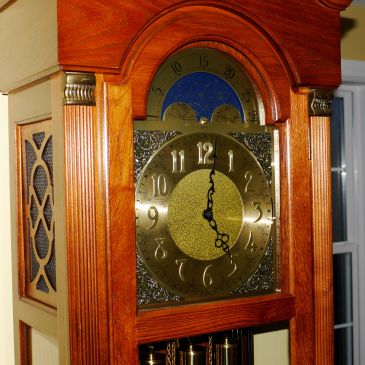
Clock face showing moon dial

The clock has a Westminster chime, a blue moon phase with a constellation, and although the movement is stamped Ridgeway it is, in fact, made by Hermle, model #451-033 with 114 cm pendulum.

The clock has a scalloped bonnet crown, brass dial with raised Arabic numerals, brass lyre pendulum with polished bob, reeded pilasters with brass capitals, and wooden grill access panels, all within a mahogany case (combination of solids and veneers).

Hermle three train movement

This clock is very much like the clock we almost bought in the early 80s.

Back then we would have paid $2000 or more. $500 in 2013 seemed like a fair price but we would be hard-pressed to get even a fraction of that today. Young people today are not interested and with the move to smaller homes, there is no room for them anymore. Perhaps these clocks will make a comeback but I doubt it.

Occasionally, sellers on online for-sale sites ask far more than they are worth not realizing that the price of these things has plummeted in recent years.

There is a certain sentimentality attached to ours and we’ll keep it.

My first antique clock – a Seth Thomas Adamantine mantel clock

I have been collecting clocks for over twenty years and for the past 11 years I have been building my collection of vintage and antique clocks, repairing them, and restoring them.

I often reflect back to that first “real” antique clock that my wife and I purchased at an antique store in Blockhouse, Nova Scotia in the fall of 2000. Blockhouse is about 2 hours from our home and during our Saturday excursion in the area, we stopped at various craft and antique stores to see what we could find.

The store is long gone but I remember the day we browsed through the store, looked at several antique clocks, and decided upon a Seth Thomas mantel clock.

The first photo of the clock was taken in December 2000

At the time we thought we were happy with the price we paid though as my knowledge of antique clocks grew I discovered that we paid far more than what it was worth. Still, no regrets.

It sat on an old Willis upright piano for a number of years and since then it has moved to our dining room where it is on prominent display.

The clock in 2016

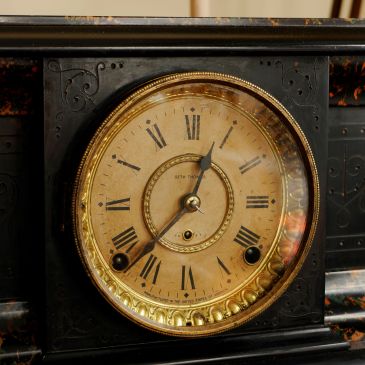
The clock is an 8-day Seth Thomas time and strike. It is in an ebony case with adamantine features. These clocks are known to collectors as “Black Mantel Clocks”, and were popular from 1880 to 1931. The date on this clock is 1907.

Adamantine veneer was developed by the Celluloid Manufacturing Company of New York City and was covered by U.S. Patent dated September 7, 1880. Seth Thomas Clock Company purchased the right to use the Adamantine veneer in 1881. At that time Seth Thomas stamped the year of manufacture on the bottom of each case.

Type 89 time and strike movement

The movement had to be cleaned but it was in surprisingly good condition with one issue, a stripped regulating gear. Because the gear is stripped the clock cannot be regulated by inserting the small end of a 2-ended key into the front dial. However, it has an adjustable pendulum and I will stick with that until I find a donor movement.

Regulating gear cannot be saved

We ran it for a number of years until 2016 when I took the clock apart, cleaned it, and installed 4 new bushings.

It is not a clock that I keep running continuously but every month or so I wind it up and run it since antique clocks need to be “exercised” occasionally.

The clock today with gold scrolling restored

Given its sentimental value, it will stay in my collection.

Fusee gallery clock – finally on the wall but who made it?

This unnamed fusee clock was acquired from a friend this past summer and after a few months, I am finally able to hang it on the wall. Unfortunately, after having been involved in the extensive cleanup following the devastating hurricane Fiona here in Nova Scotia, there was little time for clock repair. But, now that the dust has settled it’s time to get back to clock collecting and repair.

Unknown fusee time-only gallery clock

It is the first fusee clock in my collection. I have waited a while but this is an excellent acquisition.

This time-only gallery-style clock with a fusee movement is non-descript and quite ordinary and there is nothing special or distinctive about it. It has a 12″ dial and is 15 1/2″ across with a spade hour hand and spear minute hand with a heavy brass dial bezel.

A 12-inch dial is considered the standard size for a gallery clock and a 12-inch dial would have been the maximum size for a domestic environment. Larger 14″ and 16″-inch” gallery clocks would have been found in public areas, factories, and post offices.

Side view showing the rear box

I am not an expert when it comes to identifying wood types but I would say a solid mahogany bezel surround with veneers on the rear access box.

Although fairly heavy it is designed to be quickly removed from the wall by pulling out 4 wooden pegs (two on each side of the back box), very handy for periodic inspection/maintenance. The pendulum leader literally hangs on a notch on top of the escapement bridge so, disconnecting by means of opening up a side door on the right and reaching in is pretty simple.

It has a conventional anchor escapement, a robust bridge, and a sturdy crutch. The plates are held together with screws but pinned to the back of the dial.

There is a trademark on the movement which I cannot identify. Perhaps a reader might identify this English company. I can make out T, an S, an O, and something else. Atson, AT & Son or something with a “z”?

I posted the question on a popular antique clock forum site and expected a response but got nothing.

A trademark that I cannot identify

Is it an antique (over 100 years old)? Perhaps, but it could be as late as the 1920s. The plates are thick, the gears are machine cut, cut pinions throughout, a hefty pendulum bob, thick but plain movement pillars, and a generally robust feel all around. It was certainly designed for longevity and reliability. The screwed pillars are a good sign that it was made after 1900.

This fusee has a cable drive. It is unknown whether it originally had a chain as most did many years ago or if it was converted to cable as many were when taken in for servicing. Chains are difficult to source and wire/cable is much more cost-effective.

An advantage of a brass cable is that if it should snap there would be less collateral damage than a chain flailing all over the place. When a chain releases very suddenly the potential for taking out gear teeth and other parts is much higher.

The cable is wrapped around the large spring barrel

Fusee advantages

Constant torque and in theory, more accurate timekeeping are its chief advantages. It works like this. As the spring begins to uncoil the cable is on the smallest diameter of the fusee. The pull on the spring drum becomes less as the diameter of the fusee increases. The diameter of the fusee becomes larger giving greater leverage.

The larger radius at the fusee compensates for the weaker force of the spring, keeping the drive torque constant which is why fusee clocks are better timekeepers than conventional spring clocks.

Accuracy cannot be compared to a quartz clock today but keeping time within a minute or two a week in an industrial/office/domestic setting was perfectly acceptable in an age when the exact time was unimportant.

View of fusee cone

The plan

I am not going to tackle this project just yet but fortunately, it has seen servicing. I can identify at least three newer bushings. There does not appear to be significant play in the movement which is always a good sign so, there should not be a problem if the servicing is delayed for a while.

The rear of the movement shows an escapement bridge and crutch

The movement is not particularly dirty so, I oiled the movement, mounted it on the wall, attached the pendulum, and put it in beat.

Taking the movement apart and addressing any wear issues does not concern me but I must learn more about how to set the preload on the mainspring, which has its own winding arbour (not accessible through the dial) before I dive deeper into servicing this movement.

The clock came without a key and I had to order one, a very large #11 key.

In the meantime, the clock is happily ticking away on my office wall.

The time-only clock – simplicity without the noise

People often tell me that they could never have an old-fashioned antique clock in their home because of the noise. And by noise, they are not so much disturbed by the ticking sound as they are about the sound a clock makes on the quarter, half, or on the hour, in other words, a striking or a chiming clock.

But, the ticking sound might also be bothersome. Some of my clocks are loud tickers, they can easily be heard in the next room. Some, on the other hand, are silent tickers, and the only way to determine if they are running is to approach them or observe the movement of the minute hand.

I completed work on a German Jauch time-only clock the other day and could not believe how quiet it was. This is not an expensive clock by any means. So cheap in fact that I only paid $1.65 for it, but that’s another story. It is not rare either, thousands were made but it was engineered to be very quiet.

Jauch calendar clock CA.1979

Of the 90+ clocks I have in my collection, 20 are time-only, that is they are not striking or chiming clocks, they simply tell the time. And it is their simplicity that intrigues me. Many are wall clocks, a couple are calendar clocks, most are antiques and some are vintage. Clocks in and around bedrooms are time-only and all 4 kitchen clocks are time-only as well.

Three clocks located in our kitchen that are set to 3 time zones

Here are eight of my time-only clocks (starting with the Jauch above) and a story behind each one.

This is probably one of the more expensive wall clocks in my collection. It is an unnamed Vienna-style regulator.

Miniature Vienna Regulator
Miniature Vienna Regulator CA.1880

It is in its original finish. The finials on top might have been added but it is difficult to tell. Otherwise, the clock is complete. It was found on a local online for-sale site and the seller did not budge much from his asking price but it is one of my favorite clocks. Sadly, I do not know anything about its history.

Lexington banjo clock CA. 1927

I picked up this clock while on vacation in the USA. It was found in an antique mall in Michigan. A very simple clock, cheap and it runs very well though because it is spring driven it is not one of my better timekeepers. The ticking is just soft enough to be soothing which is why it is the only clock running in our bedroom.

Federal-style banjo clock, possibly John Sawin CA.1840

This Federal-style weight-driven banjo clock was discovered at a yard sale near my home. The seller was trying to steer me toward a 30-hour clock for an outrageous price that I knew was worthless but they obviously did not know the value of this Federal-style banjo clock so I bought it instead for a ridiculously low price.

It was a family clock held by a collector in Wolfville, Nova Scotia (Canada) for a number of years until he passed away. It is a weight-driven clock, very accurate, very well constructed, and very well preserved. The dial glass was broken and other than that, it came as you see it in the photo.

Seth Thomas #2
Seth Thomas #2 CA.1920

This 8-day time-only clock came from a business establishment in Toronto, Ontario (Canada). It was well cared for, serviced regularly, and very accurate. The Seth Thomas Regulator #2 was also a popular choice for train stations across North America.

Arthur Pequegnat Moncton
Arthur Pequegnat Moncton; 15-day clock CA.1930

This mahogany-cased gem is an Arthur Pegugant Moncton 15-day double spring time-only clock that was a popular choice for business establishments. It is also from the Toronto area.

Gilbert Admiral with calendar CA.1895

Found in a local antique shop locally this Gilbert Admiral calendar clock looks great on any wall. Unfortunately, I know nothing about it. It could have been either an office or a schoolhouse clock.

Kienzle World Time clock
Kienzle World Time clock; CA.1949

Highly sought after this Kienzle World Time clock commands high prices on auction sites. This example is in pristine condition and runs but has not been serviced. It was found in an antique shop in Kazabaszua, Quebec. The clock was designed by Heinrich Möller, chief designer for Kienzle Clock Co. of Germany, and it was considered a higher-end big desk office clock that displays world time zones. I can only imagine an important import-export dealer with this on their desk barking orders to send things here and there.

From a repairer’s point of view, time-only clocks are the simplest clocks to work on since there is not much to them. There is only one train and any repairs are straightforward and far less complicated than clocks with two or three trains. On the whole, they are more accurate, particularly weight-driven varieties because they lack the complexity of all those additional wheels and levers which only serve to add friction to any movement. Perhaps its simplicity is its greatest attraction.

My advice. If you are looking for an antique clock and plan to run it but might be bothered by the noise, consider a time-only clock. You will thank me.

Simplicity without the noise.

Five essential tools for antique and vintage clock repairers on a budget

Thinking about clock repair? Does the high cost of tools keep you from diving deeper into the hobby? Here are a few basic tools to get you started on clock repair.

These are also the five tools that I use almost every day in clock repair. The tools together are well under $100 and are essential when working on antique and vintage mechanical clocks. The most expensive is a letdown set which can cost anywhere from about $45 for a 4-piece set or approximately $65 for a 6-piece set. The other tools are less than $10 each.

So let’s begin.

The let-down set

The letdown set’s main use is to wind or release mainsprings in clock movements. It can be used on its own or in combination with a spring winder. It can also be used as a key gauge The 4-piece set includes a plastic handle and 3 chucks in sizes: #5-6, #7-8, and #10-12.

Broom handle let down tool

If you don’t mind sweeping the kitchen floor with a shorter broom handle you can make one of these and save even more money.

Letdown set
Four-piece letdown set

The safe release of powerful springs on any clock will save you from broken and bruised fingers, trust me!

The letdown key
The letdown key in action: letting mainsprings down on a German movement

The pivot locator

This tool is 8″ long with a knurled handle. The business end is the pivot locator which is used to gently push and pull pivots into their holes lining up wheel pivots between the plates when assembling clocks. It is long enough to go deep between the movement plates and is useful when working on either small or large movements.

Never try to muscle pivots into their bushing holes since it will lead to disastrous results such as broken and bent pivots. This tool is designed to allow you to carefully position pivots into their holes without the risk of damage to the wheels and gears. Every clockmaker I know has this tool.

Pivot locator

Flat nose smooth pliers

Below is an assortment of pliers, always good to have but the green handle one (center) has a spring action, a flat nose, and smooth jaws to prevent the marring of surfaces and is the first one you should buy. Smooth jaw pliers are also useful for releasing taper pins on clock minute hands. Others include needle-nose and wire clippers.

Assorted pliers
Assorted pliers but the flat nose type (centre) are the ones used the most

Box wrench

The photo below shows the small size of the box wrench among other tools. It is used for releasing nuts on movements. It grips better than pliers and spares the nuts from unnecessary abuse.

Screwdrivers and box wrench
Screwdrivers and box wrench; the blue handle slotted screwdriver is one of my top tools

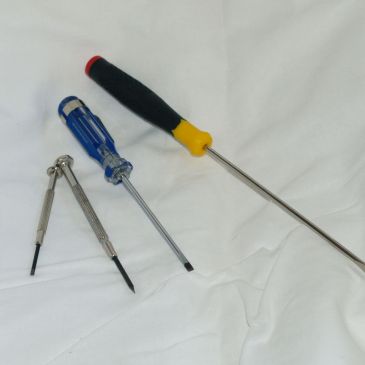
Screwdriver

The blue handle screwdriver is of the slotted type. Before the days of the Robertson or Phillips screw, flat head or slotted screws were used in clock making, especially case construction. Begin with the small size and gradually acquire an assortment for all your clock needs.

Beyond the basic tools, it all depends on how far you want to pursue clock repair as a hobby or a vocation. Obviously, the costs begin to escalate as you acquire more complex tools but follow my advice; determine the need for the tool first before you put down your money, establish a budget, avoid buying everything at once, and become an expert on each tool you acquire and shop on the used market when possible.

Sessions Mission style clock – an interesting challenge to what should have been a routine servicing

This is the only mission-style clock in my collection. Made by the Sessions Clock Co. of America in or about the 1920s it reflects classic Mission design and is rather attractive. I was not searching for this clock but a $10 find in a Pembroke, Ontario thrift shop is hard to pass up.

Though this clock is a non-running Sessions movement they are simple enough to work on. The time side was easy to get running with a simple crutch adjustment but there was a good reason the strike side had not been working in many years. After servicing the movement I now understand why it ended up in a thrift shop.

Mission-style clock by Sessions

The case is in reasonably good condition requiring a light cleaning and there is nothing missing overall save the winding key which can be easily sourced. The minute hand fell apart while I was setting the time, probably as a result of being bent so many times but it can be easily repaired.

The movement is a conventional Sessions design with a between-the-plates escapement setup as opposed to earlier Sessions movements that had outboard escapements. The movement is complete and everything is there including a few extra parts thrown in for “good” measure.

Movement issues

I observed a number of “X” marks around bushings but absent are punch marks or replacement bushings. Was there a plan to install new bushings?

An X mark beside a bushing hole and why the mysterious drilled hole adjacent to the escape wheel bushing hole

An “X” mark usually indicates a bushing hole that requires remediation, and why is the mysterious hole perilously close to the escape wheel bushing hole?

The cam wheel pegs for the strike lever have both been soldered and although it is not the neatest work the repair seems solid.

Soldered cam wheel pegs

The actuator arm for the hour strike had been bent so many times that it snapped off when I tried to test the clock before disassembly. This can also be repaired.

The real fun begins

I make it a point to label the mainsprings so that the time and the strike mainspring return to the same location. At times it makes little difference but, at other times, as in the case of this movement, the difference is significant.

In this movement, there is a slight difference in the strike mainspring arbour design so that the arbours cannot be reversed. Because of the slight variation in the strike side mainspring arbour the gears do not mesh correctly if the arbour is reversed. A past repairer switched the two mainspring arbours, time to strike side and strike to time side, and bent wheels to make them fit.

The count wheel is shaped into a bowl to force it to engage the second wheel arbour

Because the mainspring arbours were switched, a previous repairer had screwed a small brass piece into the plate to push the arbour to the right and enable the second wheel to engage the count wheel.

Brass “fix”
A brass piece (left) was screwed into the plate to push the second wheel toward the count wheel

A piece soldered onto the arbour to prevent lateral movement was unnecessary because the abours had been switched.

Brass piece soldered onto the time side mainspring (below hammer) to prevent the arbour from moving too much

It took a couple of assembling and disassembling tries to discover the problem, which is valuable time wasted on the bench.

In short, a past repairer did not understand what they were doing and made unnecessary changes complicating what would otherwise be a routine service. Home-cooked repairs are at times functional but often they are an absolute disaster and sometimes the most challenging part of clock repair is fixing other people’s shoddy repairs.

The remainder of servicing went as expected. There was some movement of the pivots in the pivot holes but not enough to justify bushing work at this time. As expected there is less wear on the strike side.

Minute hand fixed, hands, bob, and numerals polished and now on display

So, another clock was brought back to life and a satisfactory repair despite the challenges.

Do reproduction parts devalue a clock?

Nothing is perfect. Antique and vintage clocks often suffer the ravages of time and neglect and a neglected old clock is far more difficult to bring it back to life if it is missing crucial parts or repairs have been crude and haphazard. Improper restoration can significantly decrease or destroy the value of some pieces. However, the repair of a botched restoration might be the right choice in certain circumstances.

A complete clock is always the first thing I am looking for when adding new clocks to my modest collection. Dealbreakers are usually broken and irreplaceable tablets, replacement movements, missing crowns or toppers, and unreadable (ruined) dials. A clock that is complete and not altered is always preferable to a clock that someone has “worked on”.

Junghans Crispi wall clock: A ground-up restoration with many new parts, however, it is a functioning clock that shows well

I may consider clocks that have a refinished case if the standard of refinishing is high. I am almost never opposed to cleaning a clock of grime and dirt and applying a coat of traditional shellac (if needed) if that was the original finish or remediating minor veneer issues. A missing finial can always be replaced with a suitable alternative, clock hands can be replaced and some clock movement parts that have worn out can be purchased from a variety of sources.

Does the total restoration of a Junghans Crispi wall clock (above) with many new parts some of which are not faithfully reproduced have value? Perhaps not, but the buyer might be pleased with the end result.

One might argue that any change can devalue a clock but most collectors I know are content with making subtle alterations to the clocks they work on if it means improving the look of the clock, putting it in running order, and presenting it as more desirable for resale.

I recently read a very interesting article (no link due to a paywall) that posited that in select cases reproduction parts may not devalue an antique clock and in fact, might enhance its value if the parts were made exactly the same with the original machinery.

Not the $20k clock but a clock made by Ithaca Clock Co. C.1865 (NAWCC clock museum Columbia Penn.)

The clock mentioned in the article is an Ithaca double-dial calendar clock that sold at auction for close to $20,000 despite eleven “new” reproduction parts. The photo above shows an example of another clock made by the Itaca Co. in the 1860s.

I was intrigued by the repair and the article went on to mention the work of Joel Warren. Mr. Warren operates a business called Ithaca Calendar Clocks Co. The company specializes in making reproduction pieces for Ithaca clocks. Mr. Warren has a past association with the Ithaca company and possesses the original circa 1895 shaping machine, knives, and tooling from the company. He can reproduce arches, circles, and ovals of varying lengths and widths.

Back to the question: do reproduction parts devalue a clock? The answer as you would expect is yes, no or it depends. Two experts looking at the same clock might agree that the quality of the restoration might enhance a clock’s value but disagree as to the extent of restoration particularly if the restoration goes too far when most or all of its original components are replaced. Is it then the same object?

Case in Point

In what circumstances is the repair of a botched restoration the right choice? A bad repair or restoration of the case might be irreversible but structural repairs should be addressed.

I won a Scottish tall-case clock at auction 3 years ago. It was a relatively inexpensive acquisition but the clock came with a number of issues. I won’t go into the repair of the movement but a lot of work went into rectifying the strike side.

There were issues with the case but the main problem was a detached backboard. The broken backboard (held on by crudely applied modern finishing nails) certainly made it easier to transport the clock in my station wagon because it fell off when I attempted to move the clock. I knew that it had to be repaired otherwise the bonnet would not be stable.

Scottish tall-case clock with broken backboard

I first had to strengthen the side mounts with high-strength hide glue and slotted screws salvaged for an old clock case. It was not enough to screw the backboard which was in two sections into the side rails so, I fashioned a cross brace of salvaged pieces from an old 140-year-old ogee clock.

Re-attached backboard with cross bracing

The structural repair was necessary because a previously unstable backboard is now much stronger and able to support the bonnet.

Other than cleaning the case and dial and applying two coats of traditional shellac to the wood surfaces the front of the case is as found.

On display

Nothing is perfect but some flaws can be addressed with minimal intervention without taking too much away from an antique clock and might even enhance its value.

Daylight Savings Time – time to say goodbye to the Dark Ages

Daylight Savings Time in Canada begins on March 13th and ends on Nov. 6, 2022.

But, do we really need it! Daylight Savings Time has no place in our modern world. Of 195 countries in the world, approximately 70 countries observe Daylight Saving Time in at least a portion of the country. Japan, India, and China are the only major industrialized countries that do not observe any form of daylight saving.

At 2:00am Sunday, set your clocks behind one hour if you live in an area where the convention is still followed.

Regions that typically use daylight saving time adjust clocks forward one hour close to the start of spring and adjust them backward in the autumn to standard time.

In Canada, we have a little aide-memoire, “Spring ahead, Fall behind” to make it easy to remember what to do twice a year. In Canada, it is the second Sunday in March and the first Sunday in November.

How to safely adjust your mechanical clock(s)

  • The simplest and safest method is to stop the clock and wait for the correct time, then, restart it,
  • Move the minute hand slowly clockwise to the correct time, stopping briefly for the quarter-hour on chiming clocks and the half-hour for striking clocks. If you have a movement with a rack and snail you can move the minute hand quickly through the hours as rack and snail movements are auto-correcting.
  • Do not move the minute hand backward unless the instructions that come with the clock specifically say that it is safe to do so otherwise, damage to the movement will result. As a general rule, I always advocate moving the hands of any clock forward.

This time change convention is a scourge, it is very wasteful and unnecessary in our modern world.

Gustav Becker 2-weight Vienna Regulator – 6 years later

One of my retirement gifts in 2016 was a 2-weight time and strike Gustav Becker wall clock. My wife had thoroughly searched eBay and picked what she determined to be the best gift for me considering a Gustav Becker wall clock had always been on my wish list. It was everything I had hoped for but the clock came with one hiccup and a pretty big one at that.

It was badly damaged in shipment. Finials snapped off, all glass was broken, weights were dented, trim pieces fell off, the brass dial bezel was bent, a bent gathering pallet and the movement was missing critical strike side rack and snail parts. I managed to obtain a few pieces from the seller which was not everything I required and also put in a damage claim with the postal service but received nothing from them.

The main case was largely untouched at least

It was a good learning experience that taught me that one should avoid shipping a clock unless the shipper knows exactly what they are doing.

Where to start? At the time I was not sure how to approach rebuilding the clock. Do I set it aside for a later project or just dive into the deep end and learn as I go?

The original movement from 1902 is missing strike-side parts

I decided to have a go at it. After gluing the parts back on, replacing the glass, sprucing up the case, and sourcing a new movement (the original 1902 movement was replaced with a 1917 movement made in the same Braunau factory) the clock was finally coming together and at the end of the three-month project, it taught me a few things about movement servicing, sourcing of parts and case repair.

My wife took a look at this clock the other day and suggested I write an update. She said that it still looked impressive years after. I put a lot of work into this clock and it appears to have paid off as it still looks great on my living room wall.

Gustav Becker: taken October 2022

So, here it is, six years later.

Jauch time only calendar clock – a closer look

I am all in for a bargain and one cannot buy a clock any cheaper. A friend spotted this German-made Jauch time-only calendar clock in a thrift shop for $1.65.

Schoolhouse clock made in Western Germany by Jauch

The date stamped on the movement is July 1979 which is no surprise since the clock has a number of modern features such as a magnetic lower door clasp and lift-up hinged dial bezel.

Jauch time-only movement, PL42, length of pendulum in cms, date7/79

The clock is certainly a nostalgic return to the oak-cased schoolhouse clocks found in many schoolrooms 100 years ago like the Gilbert Admiral calendar clock (pictured below) from the late 1890s, but the case is a cheaper pine instead of oak.

Glbert Admiral time-only wall clock with calendar

The clock looks good on any wall and to many, this vintage clock would appear, at first glance, to be an antique.

In an earlier post, I noted that there is not a lot wrong with this clock. The case needs a little tender loving care which is easily remedied and the movement looks very clean.

I removed the movement from its case since it was not running, mounted it on a movement test stand, and made an anchor adjustment by moving the pallets slightly. The movement was now in beat. I oiled the movement and it has been running for several days.

The movement is on a test stand and running in beat

Two vertical pieces that looked like wallboard or laminate flooring hold the movement in place. The two sides are secured with 2 Robertson screws. I doubt the manufacturer would have used Roberton screws since this type of screw is widely used in Canada but seldom elsewhere.

When I removed the movement I noticed additional screw holes. So, it seems to be a later fix, but why? Is the movement a replacement? If so, why bother with such a cheap clock? A mystery to be sure.

The movement looks very clean and looks to have had little running.

Next is taking the movement apart. I wonder if any surprises await me.

Jauch time only calendar clock – first look

Jauch was related to one of the oldest Black Forest clock-maker families. The Gerbrueder Jauch company manufactured hall, wall, and mantel clocks and movements for the trade including those that were spring and weight operated. In late 1979, the company fell victim to a curtailed export limiting production. Gerbrueder Jauch GmbH eventually went bankrupt in 1986. The remaining stock was purchased by a leading clock/watch supply house in the USA.

The company was a respected supplier of relatively inexpensive but attractive clocks for the average home. This drop octagon schoolhouse-style clock is a prime example of an inexpensively made clock for the masses.

Drop octagon wall clock with the back panel removed

The clock is 23 inches high, 15 inches across, and almost 5 inches deep, dimensions that are very close to the classic American schoolhouse clock made over 100 years ago. Rather than an oak case which is typically found in antique American clocks, the case for this one is a much cheaper pine.

This clock’s bezel is hinged at the top with a flip-up design rather than one that swings to the right which makes winding the clock a two-handed operation.

Flip-up bezel

The clock has “Western Germany” on the bottom part of the dial and the movement which is also stamped July of 1979.

Magnetic catch

For all you history buffs, the Berlin wall was erected in 1961, and Germany was finally unified in 1989.

Standard Jauch time-only movement with calendar feature

I have worked on Jauch time-only movements in the past but never one with a calendar feature. One interesting aspect is the distance from the dial face to the winding arbour necessitating a long #7 key which I do not have.

This one is not in working order. Laying it down flat will cause the escape wheel to run but once on the wall, it abrupting stops after a swing or two of the pendulum. I suspect the anchor escapement is way off or there is serious bushing wear in the top part of the train.

A friend spotted this clock in a local thrift shop for $1.65. Why so little? Thrift shops deal with a constant flow of donated items so any price charged is pure profit. Vintage quartz clocks usually wind up at the thrift shop but not many mechanical clocks do. This is a good find since there isn’t anything fundamentally wrong with the clock save for a scuffed-up case which can be easily remedied with a cleaning and a fresh clear-coat finish.

Western Germany; why not simply “West Germany”

Unless there is something seriously wrong with the movement such as spring barrel bushing wear that I have seen on other Jauch movements, it should be an easy task to have this clock running again.

A hobby takes second place during a weather emergency

Well, it has been hectic this past week or so (late September and early October 2022). Some of you were affected by Hurricane Ian in Florida (USA) which was incredibly devasting but we had a bit of weather here as well when Hurricane Fiona passed very slowly over Nova Scotia (Canada).

Photo by Pixabay on Pexels.com

It was largely a wind and felled tree event for us as the storm lasted almost 24 hours but it also meant that our electric infrastructure took a serious beating as 4 out of 5 people were without power at the peak of the hurricane.

As a result, we were without power for 8 days. Fortunately, some years ago we had our house wired for a standby generator. We were able to stay warm, keep our food refrigerated, and enjoyed hot showers every day. Some of our neighbors were not so lucky. We provided water and kept items of theirs in our fridge/freezer during the outage.

I usually spend many hours a week with my hobby repairing and restoring old clocks and generally performing periodic inspections of the clocks I have on display throughout my home and of course, adding new and interesting clocks to my collection. But not lately!

Attending to storm damage on our property was the number one priority. We live on a treed lot and unfortunately quite a number of our trees went down but none threatened our house, thankfully. Of course, we were chainsawing and picking up branches daily and as of this writing, we are still in the process of cleaning up our property. After 30-plus downed trees the property looks quite different.

Photo by eberhard grossgasteiger on Pexels.com

However, all is not lost. I have managed to keep up with my blog, stealing what time I can, and so there has been no interruption in my posts. I have even managed to reply to your letters.

We have made progress on the cleanup and things are slowly getting back to normal so that now I can get back to what I enjoy most, clock collecting and repair.

Selling your antique clock – some simple and effective strategies

So, how to sell your antique clock?

Unless a clock has a distinctive provenance or, is rare, it is difficult to make any sort of profit on an antique clock today. Some unique clocks, ones with a special history or, those made by famous clockmakers (those in the clock world know who they are) have retained their value and are highly desired by collectors.

Just because something is old does not necessarily mean it has value. A 100-plus-year-old common antique clock is worth very little today because thousands were made by many manufacturers over the years and quite a few have survived to this day. For example, there was a time before the internet came along that ogee clocks sold for $300 or more but are much cheaper now thanks to online for-sale sites that have depressed their value. It’s all about supply and demand.

Selling an antique clock can be a challenge but a few simple rules to follow will make it easier to part with your clock.

Does it run?

If the clock is running and was recently serviced by a competent repair person, state it as such. If the clock is running but the movement needs to be cleaned, state that it requires cleaning and possible issues that might need to be addressed such as running too slow or too fast or stops after a while. If the clock is not running say why or simply state you do not know the reason.

Describe excessive wear, damage, or missing pieces such as crowns, finials, keys, glass, and trim pieces.

Ogee style clock

Preparing the clock for sale

A clock in running condition will be worth more than one that is not running. If you are handy and know your way around clock movements, and can service a clock yourself, a serviced clock will command a higher price. A clock case cleaned of grime will present better than a dirty one unless you are a stickler for “patina”.

Missing hands or dial glass will adversely affect the price. Items such as these are not costly to replace and parts are typically available from clock suppliers but it means the buyer assumes that expense.

Mantel clock

Disclosure

Honesty is the best policy when selling your clock and if it has issues it is better to let the buyer know beforehand. It is therefore important to let the prospective buyer know as much as possible about the clock so that surprises can be avoided. A clock that is a marriage, a case with a similar but with a replacement movement, should be stated as such. Disclose issues such as replaced glass, newer dial, replacement crowns and finials, case repairs, or full case restoration.

Wall clock, known as a schoolhouse clock

Determining a price

Setting a price requires a little research on your part. What you paid for it originally may not be the best indicator of its value. What you think it might be worth may be far removed from the price you will finally realize.

Check eBay, Facebook Marketplace, and other for-sale sites for clocks that are similar and price yours within that range. Pricing too high will discourage inquiries but price the clock lower if you are eager to get rid of it.

Woodworks clock with a missing crown or topper

Where to advertise

There are various methods of selling a clock. Word of mouth is certainly the most rudimentary while the internet provides many more selling advantages. Facebook for-sale sites, local online for-sale sites like Kijiji, eBay, flea markets, consignment shops, and auction houses are popular places to sell a clock. Setting up an account for most online sites is a prerequisite.

For national or international sales, factor shipping into the price. Advertising locally and delivering the clock to the new owner avoids the hassle of shipping and the potential for breakage and of course other headaches.

Grandfather clock

Photographing your clock

Few cell phones are capable of capturing a detailed image but for most purposes, it is enough. Out-of-focus images are a no-no and will put off prospective buyers.

Several images from different angles as well as a photo of the inside of the clock case are much more helpful than simply one photo. During daylight, place the clock near a window and position yourself between the window and the clock to take a series of photos in natural light. If there is damage or wear take closeup photos of those areas.

If you have a dedicated camera experiment with artificial light take the best angles to get optimum results.

Description of your clock

Crafting an ad is an art in itself. You must be concise and accurate and not too wordy. There is a delicate balance between too little and too much information. Too much information or very little information means fewer inquiries from prospective buyers.

State the clock’s maker if possible, the model if possible, the year it was made or a reasonable estimate, the type, (time-only, striking clock, chiming clock), and the style of clock, whether it be a mantel, wall, shelf, parlor, Ogee, tall-case, and so on as well as any distinctive features.

A steeple clock with an alarm function or a clock with a second hand or calendar are examples of features that might attract specific buyers.

Well, there you have it. I think I have covered the most important points and if I have missed any, let me know. Good luck with your sale!

Sessions Mission style wall clock – past shoddy repairs make servicing a challenge

Between 1903 and 1933 the Sessions Clock Company of America produced 52 models of mechanical clocks ranging from simple mantel clocks and shelf clocks to wall or “regulator” clocks all designed for the home or small businesses.

Found in many homes across America Sessions clocks were regarded as relatively inexpensive, simple in design, and decently constructed aside from one noted design flaw, the clicks. After a hundred years many Sessions clocks are still running.

Mission style clock by Sessions

This is the only mission-style clock in my collection. I was not particularly looking for this one but a $10 find in a thrift shop is hard to pass up. Though this clock is non-running Sessions movements are simple enough to work on.

As there is no maker’s label I can’t tell you the model name or number of this wall clock but I assume that it was made in the early part of the 20th century.

The movement

The case is in very good condition and there is nothing missing save the winding key which can be easily sourced. The minute hand broke while I was setting the time, probably as a result of being bent so many times. That can be repaired.

Sessions movement with front plate off

The movement is a conventional Sessions design with a between-the-plates escapement setup as opposed to earlier Sessions movements that had inboard escapements.

I noticed many “X” marks around bushings but I did not see punch marks or replacement bushings. Was it meant to have had the bushings replaced?

Servicing the mainsprings

The cam wheel pegs for the striking lever have both been soldered and although it is not a very neat job the repair seems strong enough.

There is a hole adjacent to the escape wheel arbor which might have been made through manufacture but it is oddly close to the escape wheel bushing hole.

One more issue. The actuator arm for the hour strike had been bent so many times that it snapped off when I tried to test the clock before disassembly. This can also be repaired.

In short, this is a clock that has been worked on in the past and I would think, not by a professional. Sometimes home-cooked repairs are strong and functional and other times they leave a lot to be desired.

All is not lost and I think this movement can be saved.

The fusee movement – just what is it exactly?

A fusee clock movement is a type of mechanical clock mechanism that uses a conical pulley (the fusee) and a chain or cable to provide a more consistent driving force to the clock’s gear train. The fusee mechanism was commonly used in early pocket watches and large clocks to compensate for the decreasing tension of the mainspring as it unwound.

As a typical mainspring winds up, its tension is strongest, which leads to the clock running too fast. As the mainspring unwinds, its tension weakens, causing the clock to run slower. The fusee counteracts this by gradually changing the ratio of the force applied to the gears, ensuring a steady, regulated power supply. This innovation helps the clock maintain accuracy throughout its entire run.

Fusee movements are often considered an important step in the evolution of horology, showcasing the ingenuity of early clockmakers in solving the problem of maintaining consistent timekeeping. Today, they are still highly valued by collectors and horologists for their craftsmanship and historical significance.

Fusee movement in run-down condition

Most fusee movements were equipped with anchor escapements, though some featured lever or deadbeat escapements. Earlier fusee movements often had decorative sculpted pillars and pins to secure the plates, while later models used plain pillars with screws. This difference in design is one way to determine the age of the clock.

Jacob Zech is credited for inventing the fusee in 1525 although drawings of a fusee appear in Leonardo De Vinci’s notebooks.

Fusee in its run-down condition

Parts of a Fusee Movement

a) Spring drum

b) Winding arbour

c) Fusee

d) Main wheel

e) Chain (or gut or wire)

Of course, the above diagram does not show the wheels above the main wheel and merely illustrates the essential components of the fusee section.

A chain-driven fusee is the norm although wire and gut are common. Gut was used at first but around 1650 chains began to be used, which lasted longer.

How does it function?

The spring drum’s axis is parallel to the axis of the fusee. Around the drum is wound a chain that is attached to the fusee at its largest diameter. An attached mainspring is coiled inside the drum that sits next to the fusee.

When the key is inserted into the arbour of the fusee it pulls the chain causing the drum to rotate. Because the inner end of the spring is attached to the drum, the drum rotates until the spring is completely coiled. The spring is then at its maximum tension. At full winding, the chain is completely wound onto the fusee.

8-day time-only Fusee with12-inch (dial) gallery clock

As the spring begins to uncoil the chain is on the smallest diameter of the fusee. The pull on the spring drum becomes less as the diameter of the fusee increases. The diameter of the fusee becomes larger giving greater leverage.

The greater turning moment provided by the larger radius at the fusee compensates for the weaker force of the spring, keeping the drive torque constant and that is why fusee clocks are better timekeepers than conventional spring clocks.

Fusee movements are generally more expensive than conventional spring drive movements. Double and triple fusees add to the cost and complexity.

Disadvantages of fusee movements include their difficulty in adjusting. If the fusee chain or cable breaks, the force of the mainspring can send the end whipping around inside the clock, potentially causing damage. Any collateral damage, if present, must be repaired as part of the restoration. Additionally, if a replacement mainspring is needed, it must be an exact match; otherwise, the fusee will need to be adjusted to accommodate the new spring.

To sum up, the fusee mechanism transforms the uneven force of a mainspring into a more constant driving power, improving timekeeping across the full run of the clock. Though later innovations would offer simpler solutions, the fusee stands as a remarkable example of early mechanical engineering. Its complexity may present challenges in maintenance, but its effectiveness and historical significance ensure its continued appreciation among horologists and collectors alike.

Related Articles

Clock books added to the library

Whether you are working on your first clock movement or have repaired dozens, resources, I believe, are essential. There is only so much information gained from a YouTube video, antique clock information site or how-to instructional resources online. Sadly some information is just plain wrong.

There comes a point in time when you simply must have more detailed information that one can reference without painstakingly plowing through a frustrating Google search.

My clock resource library

Opinions vary as to what constitutes an essential clock repair library but I believe a combination of instructional manuals, clock identification guides, and historical horology should be at the heart of any clock library.

I will begin with what I determine to be essential resources and additional resources I have recently added to my library.

But first, here are a few I recommend.

My go-to set of books for American clocks is a series of working manuals authored by Steven G. Conover.

Conover books

Working with Anniversary or 400-day clocks requires the Horolvar 400-day Clock Repair Guide. 400-day clocks can be quite finicky and you are asking for trouble if you do not have this resource. The perfect companion is Mervyn Passmore’s book entitled Anniversary Clock Adjusting. It is a little short on depth but simple and to the point.

Horolovar 400 Day Clock Repair Guide

Next are three books by Philip E. Balcome.

Balcomb clock books
  • The Clock Book – An Overview of Heirloom and Contemporary Clocks in the American Home (not a repair book per se but a guide to identifying clock parts, types, styles, and trends)
  • The Clock Repair First Reader – Second Steps for the Beginner
  • The Clock Repair Primer – The Beginners Handbook

Balcome books are easy reads and are targeted at beginners and more advanced repairers.

John Plewes focuses on Canadian Made clocks. This is a good how-to manual though not as detailed as the Conover books mentioned above.

Solid information on Canadian clocks

Now, for my newest books and how I came to be in possession of them.

The Heritage Clock shop in Brockville, Ontario went out of business on May 28, 2022, after 29 years of serving the community of clock lovers. There is a chance that new owners will step in but not yet, so far. Sadly many of these mom-and-pop shops have now disappeared and with it the knowledge and expertise of antique and vintage clocks.

My newest collection of books is as follows. The photos should be self-explanatory.

Price and identification guides
These I would rarely use
A good source of historical background information
Limited use but I might regret throwing these away some day
Perhaps the best books of the new bunch
Good information from the two Candain books on the left

Fortunately, a member of the Ottawa Valley Watch and Clock club was able to pick up the books which were free to a good home. Naturally, that person selected what they wanted and passed the remainder to me through another member.

Most of the books are price guides from the 1980s and 90s though some are helpful guides and manuals. The estimated values of the clocks in the identification guides are outdated as clock prices have dropped precipitously in the past decade but they provide a handy resource for types and models from various manufacturers.

Most of my work up to now has been with American and Canadian clocks, though some are German, French, and of course, British.

What I am missing are instructional manuals for foreign clocks (French, German, etc.), and historical information for Canadian Clock companies. The new books I have brought into my collection do not address this issue but if one is in the process of expanding a clock library it is always a work in progress.

Reach me at my new email address

All successful blogs grow and develop. With development comes transformation and better ways of managing communications and so, I have decided to make a change in the way that you, the reader, can communicate with me more effectively.

Up to now, I have used my personal email account for your letters. It has worked well to a point. Along with many other emails I receive it sometimes becomes difficult to find your particular email. Sometimes they get lost in the junk pile only to be discovered days and weeks later. As a result, I may be somewhat late in replying to you and for that, I apologize.

basic clock terminology

Previously all emails from this blog went to my Gmail account. From this day going forward, my new email address is ronjoiner@antiquevintageclock.com

Please continue to read my articles and use the search box on the right to find specific articles of interest. I typically post twice per week usually on Monday and Friday but occasionally on a Tuesday. If you like what you see, hit “like” at the end of each article.

Please leave a comment or question on my site in the comments section following each post. Those of you not comfortable with their names “out there” may contact me with your clock issue or general questions/comments privately at  ronjoiner@antiquevintageclock.com

If you would like to know more about your clock or have challenges with a clock you are working on, please include pictures (of a reasonable size – under 1MB per photo) in your email to me.

Junghans Sydney
Junghans Sydney cataslog photo

All blog comments are moderated, and will not appear until the author has approved them. Expect a few days to a week for a reply sent privately.

Whether you are a novice clock collector or are a little deeper into the world of horology, I will answer all emails promptly although there are times in the year when I am traveling there may be a slight delay in responding to you.

For those comments and questions that stump even me, I consult within my clock circle for the best possible answer.

7 Clocks in my collection that have family connections

Seven clocks in my collection have family connections, not necessarily with my own family but clocks that I am able to trace back through families mostly in Nova Scotia (Canada). No names are mentioned. The stories are sad in some cases but interesting nonetheless.

Let’s begin.

Waterbury wall clock

When I was a child back in the 1950s my grandparents had one clock in their home, a Waterbury drop octagon located in the kitchen above the sink. It was the only mechanical devcie that made a sound in their home.

Waterbury shot drop wall clock, homemade case

My grandfather was a veteran of the First World War and suffered from shell shock (PTSD) long after the war. His home had to be stone quiet with the exception of the time and strike Waterbury clock in the kitchen.

Not knowing much if anything about case construction my cousin decided to screw the bezel into the case

After he died my grandmother sold the house and moved in with one of my aunts. The clock went to one of my uncle’s kids. The original case was painted yellow to match my grandfather’s kitchen walls and either it was in poor condition or broken, and a new case was constructed by my cousin. He knew almost nothing about case construction but did the best he could. Because he did not know how to repair the movement the clock was stored in a barn for a number of years (chicken pecks on the dial face!). In 2020, he gave the clock to another cousin who was breaking up their home and asked if I would have it.

Rather than take the movement out of its homemade case and put it into something more appropriate I decided to leave it as is as the case with all its warts is part of the history of the clock.

Sawin Banjo clock from a collector in Wolfville NS

My wife found this weight drive time-only banjo clock on Facebook Marketplace. The photos were quite poor and I imagine the seller was not getting much traction on the ad. Knowing that it might be something special I made an offer, sight unseen.

Banjo clock by John Sawin or one of his associates

It had a few minor issues such as broken glass, and veneer losses but otherwise, the clock was intact including the original acorn finial.

Timepiece

I always ask the seller about a clock’s origin and in this case, the clock was from a collector in Wolfville, Nova Scotia. The seller said that her uncle had this clock as well as a number of quality clocks for as long as she could remember, perhaps 60 years or so but could not recall where the clock originally came from.

After researching this clock I discovered that it was made in or around 1840, in Boston and although unsigned has all the markings of a clock made by John Sawin (or one of his associates) an apprentice to the famous inventor of the banjo timepiece, Simon Willard.

Gilbert mantel clock Shawville

What attracted me to this clock was the condition of the case. For a 100+-year-old clock, it is in remarkably good condition.

Gilbert time and strike mantel clock

The design is simple but graceful and of course, it would have been one of the cheaper clocks in the Gilbert line.

Gilbert movement

Despite the pandemic, people were still engaged in the buying and selling of clocks. This was another Facebook ad. The price was very reasonable. The clock was bought from a family in Shawville Quebec. A family member had passed away and all household items were sold off. The seller said her mother loved the clock and polished it weekly though it had not run for years.

Because the seller did not wish to have physical contact with me the clock was placed in a recycle container on the side of the highway for me to pick up.

Mauthe Horse crown

Most would call this a Vienna-style springer. Made in or about 1885 it had been in a family since I bought it from a former superintendent of schools about 6 years ago.

In the early 1980s, his wife brought the family clock over from Holland in a suitcase. It had been in his wife’s family for several generations previously. The gentleman’s wife passed away 10 years ago and had she been alive today I would certainly have learned a lot more about its history.

Mauthe Horse Crown with replacement bottom center finial

The seller was reluctant to let this clock go since it was a happy reminder of his past life. But he was moving into the next phase of his life with a new partner and that meant divesting of furniture and other items. Like him, I think of life in phases.

Mauthe Horse Crown movement

The only issue was a missing bottom finial. I can only imagine that the finial had to be removed so the clock could fit in the suitcase.

Junghans wall clock Crispi

What happens when you get a clock in a box? Call it a collection of parts, pieces, and dust. To some, a box of clock pieces is discouraging but to me, it was a challenge.

Junghans clock in pieces

This is an antique German Junghans time and strike spring-driven clock made in the style of a Vienna Regulator. There is no serial number on the movement which dates the clock to 1899 or earlier (in 1900 Junghans began to number their movements).

Fully restored Junghans Crispi wall clock

This clock is a witness to the day of the Halifax Explosion in 1917. The result of the explosion from a munitions ship in the Bedford basin was apocalyptical.

This clock, owned by the seller’s wife’s mother caught the brunt of the blast.

Catalog photo of the Crispi, second from left

The blast not only shattered the glass panels but heavily damaged the box frame. Most of the parts sat in a box for 100 years. Since the box frame was damaged beyond repair, the seller, an amateur woodworker, built a new frame made of oak some 35 years ago. He was at a loss as to how to repair the movement, put the project aside, and lost interest.

Wag on a wall

The style of the clock is a “wag on the wall”. It is a strange name but basically, it is a clock with the movement enclosed in a small case and with a pendulum and weights exposed. It is so named because the pendulum appears to wag on the wall like a dog’s tail.

Wag on a wall, unknown maker

My wife’s uncle was an internist (internal medicine specialist) in Newfoundland and practiced for many years but dementia and its attendant complications finally got the best of him. He spent the last 5 or so years in a locked ward of a residential facility for the elderly.

The pendulum wags like a dog’s tail

As part of his practice, he set up a home office where he would receive patients and consult with colleagues. In his office was a wall clock given to him by a former patient.

When he passed away his possessions were distributed among his family members with the clock going to his brother who, himself passed away this past year. Unfortunately, there was not much interest in the clock and it spent 15+ years in a Rubbermaid container in the basement of his brother’s home.

His wife is currently in the process of moving to a smaller home, giving away what she could and since I have a keen interest in antique and vintage clocks she determined that the best place for the clock was in the hands of someone who would appreciate it.

Ingraham Huron

The clock is Rosewood “Huron” Shelf Clock, by E. Ingraham & Co., Bristol, Connecticut circa 1878.

Rare Ingraham Huron found on a local online for-sale site
Rare E Ingraham Huron found on a local online for-sale site

It has a paper-on zinc dial with a round glazed door and a lower glass access panel. It is a brass eight-day spring-powered movement, with a height of just under 41 centimeters.

Kienzle clock on display with Ingraham Huron
Ingraham Huron balloon-style shelf clock

I asked the seller who was about 70 years old at the time, “what do you know about this clock?”. He extended his hand palm down out to about a meter from the floor and said, “I was this tall when I can first remember it in my grandmother’s home”. There is a penciled marking just inside the case indicating that it had been serviced by a person by the name of Hebb in 1944. The seller recalls a Hebb family who at one time lived in the Bridgewater area of Nova Scotia near where I purchased the clock.

He and his wife were in the process of dissolving their marriage and were selling off everything they own including many sentimental items.

Conclusion

I always make it a point to ask about the history of any clock I purchase. Sometimes, in the cases above I learn interesting things about the clock. In other cases, the seller knows nothing.

I wish I knew more about other clocks in my collection. Unfortunately many were passed on from seller to buyer and the history has been lost forever, but what stories some of them could tell.

Second gallery clock bought this year – this one has a fusee movement

Earlier this year I bid on an English-made Empire gallery clock at an online estate auction and won the bid. When I collected the clock I had hoped I had bought a clock with a fusee movement but it turned out to be one with a conventional spring-driven time-only movement. No matter, it was not an expensive clock.

Empire time-only gallery clock

A fusee clock has been on my wish list for several years and now I finally have one. A good friend was trimming his collection and offered me a time-only gallery clock with a fusee movement for a good price.

Time only clock with fusee movement

English fusee gallery clocks, also referred to as dial, school, office, railway, or wall clocks, are a must-have for any serious collector.

The heyday of the English gallery clock was between 1860 and 1930. Gallery clocks were made in the thousands to service the needs of industry and government. The gallery clock was a common sight in schools, offices, hospitals, rail stations, and businesses in the United Kingdom.

Gallery clocks with fusee movements vary greatly in size, style, and in construction. Despite being over 100 years old, they retain their original attributes of good timekeeping and reliability. Fusee movements are rugged in construction, and their success rests with the fusee, a conical-shaped component that evenly regulates the power output of the spring.

Chain-driven fusee movement

The gallery clock came in all sizes but still retained its basic design and shape. The most popular size was 12 inches (diameter of the painted dial). Generally, the smaller the dial, the rarer and more expensive the clock. This clock is among the group of common gallery clocks and has a 12-inch dial. The next smallest size would be a 10-inch dial and then an 8-inch one.

The majority of cases (back box and surround) were manufactured in mahogany; however, oak and rosewood were used. Mahogany examples are the most expensive. Oak cases are generally slightly cheaper. Ebonized cases are cheaper still. My new acquisition appears to be made of oak.

It has all the attributes of a classic gallery clock. Four pegs connect the two constituent parts through “rails” or “cleats.” To inspect a movement, it is just a matter of laying the clock face down and pulling out four wooden pegs, lifting the dial, bezel, and movement out of the rectangular box case. Later clocks were made without pegs with access to the movement via the dial.

The backplate of the fusee movement

However, to remove the movement entirely the hands must be removed and three screws holding the dial are removed as well. There is also a movement pan that is held by pins that must be taken off.

Most movements had anchor escapements, some had lever escapements and some had deadbeat escapements. Later models had plain pillars with screws. This clock has an anchor escapement and plain pillars so, not so old but still an antique.

This clock has a chain-driven fusee although wire and gut are quite common.

The maker is unknown.

Special care must be taken to service a fusee movement so, I will be treading carefully as I service this movement but for now I will run it to see if it lives up to expectations.

Sessions wall clock found in a thrift store

I often get letters from my readers that begin with something like, “I picked this up in a thrift store” and marvel at what they find for next to nothing. Quite often the item they snagged at an unbelievable price needs a little love but that is to be expected.

Sessions wall clock

While on our summer jaunts my wife occasionally drags me into the odd thrift store because as she says, you’ll never know what we’ll find” and quite often she’s right. Over the past two or three years, we have bought a few jazz and classical CDs for next to nothing (yes, CDs are back).

Recently we stopped in a small town in an adjacent province to look around. We found a couple of classical CDs and were content to leave when my wife pointed out a mission-style clock hanging behind the cash.

“What’s the price on that? “, I asked. “I don’t know, the boss is in the back” I found him throwing items into a dumpster, obviously things that could not even be given away. “I’m interested in a clock”. “Show me”, he said. We both walked to the front of the store, he looked up at the clock, rubbed his chin, and said, “how about 10 bucks”. I mean, why dicker!

I don’t have a Mission-style clock in my collection and hoped that it was a Canadian-made Arthur Pequegnat, but I knew the hands were not the type used on Pequegnat clocks. Upon first inspection, the only things missing are the winding key and a label which is normally affixed to the backboard.

Sessions time and strike movement

I thought perhaps it was an Ingraham or Sessions. Once back at home I unscrewed the back panel and identified it immediately as a Sessions movement. Still a good deal. It also tells me that it was made after 1903 the year the sessions Clock Company was formed after a group of investors bought out the assets of the EN Welch Clock Co.

The mainsprings were wound tight. Rather than let the springs down I ran the clock. The time side was fine, a small matter of putting it in beat but the strike side needs a little work. There is nothing wrong with the passing strike on the half-hour but complete silence on the hour. Something is amiss on the strike side. I‘ll give it a nudge and see what happens.

In any event, servicing is in order.

Yes, I picked this up in a thrift store!

Ansonia cottage clock servicing but is the end near for this old clock?

It is a $10 cottage clock my sister picked up in a yard sale several years ago and gave to me after I serviced one of her ogee clocks. There is a label on the inside that says it is made by Ansonia Brass Co. and I would date it to around the early 1880s.

It likely cost no more than 50 cents in its day, the most inexpensive of mechanical clocks but enough to provide for a family of modest needs.

Ansonia cottage clock

Not many survive to this day as they were tossed out when they stopped working. When they do survive they are often in poor condition such as this one. So, it is not surprising that time-only cottage clocks, in very good condition, are sometimes worth more and have greater collector value than larger American time and strike parlour or kitchen clocks.

A very simple time-only movement

So, why is this clock not worth much more than my sister paid for it? It’s had a hard life and has likely been altered in several ways. Original movement? It’s hard to say as there are no markings on it. Well worn? Yes! Pendulum, crutch, the mainspring, pallets; probably replacements. And why the notches on the rear of the access door?

Notches on either side of door

My wife and I love the sound of a ticking clock when we sleep at night. We both find it very soothing. And this one ticks just loud enough to be heard over our window air conditioner.

Unfortunately, the movement cannot quite run its intended 30 hours, and either the mainspring is too weak, or it needs a good cleaning. It is certainly not worth replacing a mainspring that would exceed the value of the clock so, a good cleaning is what it will get.

Time-only movements are the simplest to work on. There is only one train with three wheels plus the escape wheel. It is a matter of letting down the mainspring (a clamp is not necessary) releasing the 4 pins that hold the plates together which exposes the wheels and then taking the parts out.

Bent and worn main wheel teeth

Two issues immediately tell me that this movement does not have a lot of time left. The main wheel and the centre cannon teeth are slightly bent and it is only a matter of time when one or more break. There is not a lot of stress produced by the mainspring on the wheels of a 30-hour clock so it could take years, or perhaps even tomorrow. In any event, a repair of the wheel teeth is just not worth it.

The movement is not especially dirty but there is blackened oil in some of the pivot holes necessitating remediation. A clean in the ultrasonic followed by rinsing the parts, drying them, and then reassembly, oiling, and testing. That is it.

It is clean and I hope it will run 30 hours after the cleaning. Will it last? Well, for as long as the wheel teeth hold out. Let’s hope they do!

Website Powered by WordPress.com.

Up ↑