Every blogger knows that it takes time to build a popular blog and unless you have a surefire winning formula right off the mark it takes months if not years to build a loyal following.
Many blogs fail within the first few months out of frustration yet patience, determination and some hard work is all it takes to find a rhythm that works.
Daniel Dakota wall clock
With over 130,500 page views since 2015, upwards of 4000 average monthly views and over 900 views per week I recently checked my stats to find the 10 most popular blogs of all time.
The experts are going elsewhere and that is fine with me because this blog was never intended to appeal to those running a repair business or involved in the commerce of antique clocks
Here they are. Click on the links to see what all the fuss is about.
My wife’s aunt lives in a quaint home near a small town in the south of Ireland. During our recent visit to Ireland we were invited to her home, had tea and cake and had a long talk about family history.
While there I was asked to take a look at the family clock which had not been running for a number of years. Aunt Theresa and her husband (now deceased) received the clock from his brother, an amateur antique collector, many years ago.
HAC’s are good quality movements with well-made cases
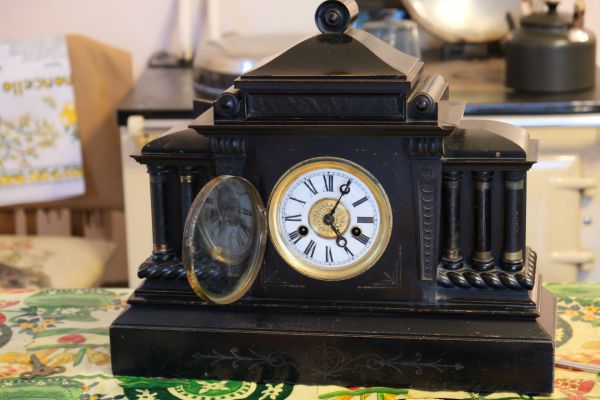
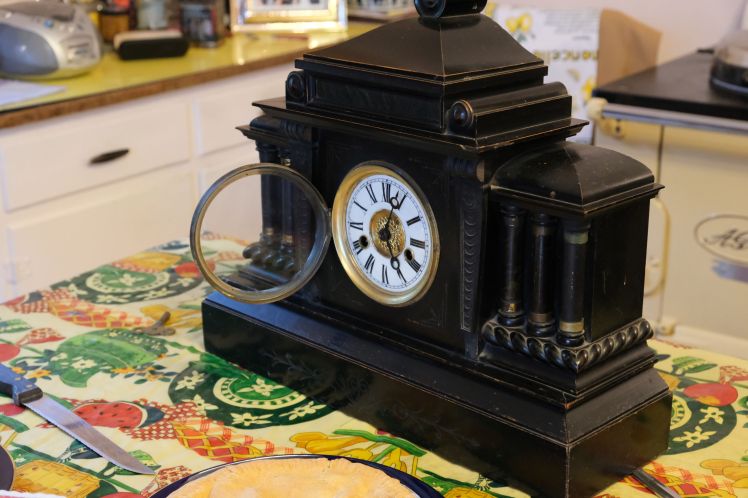
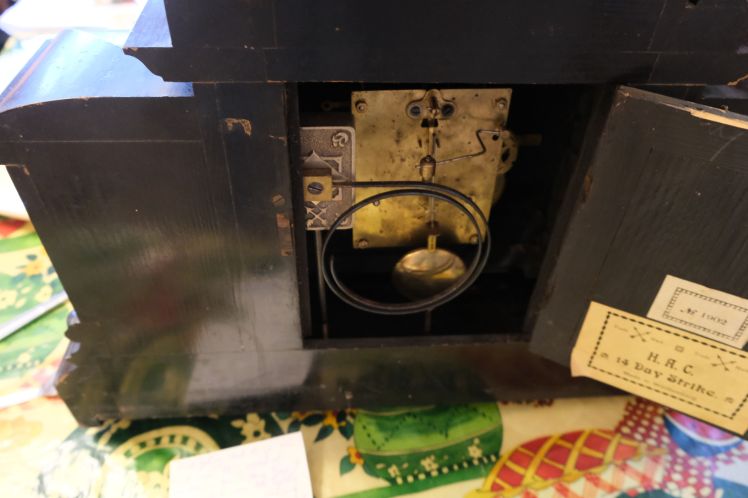
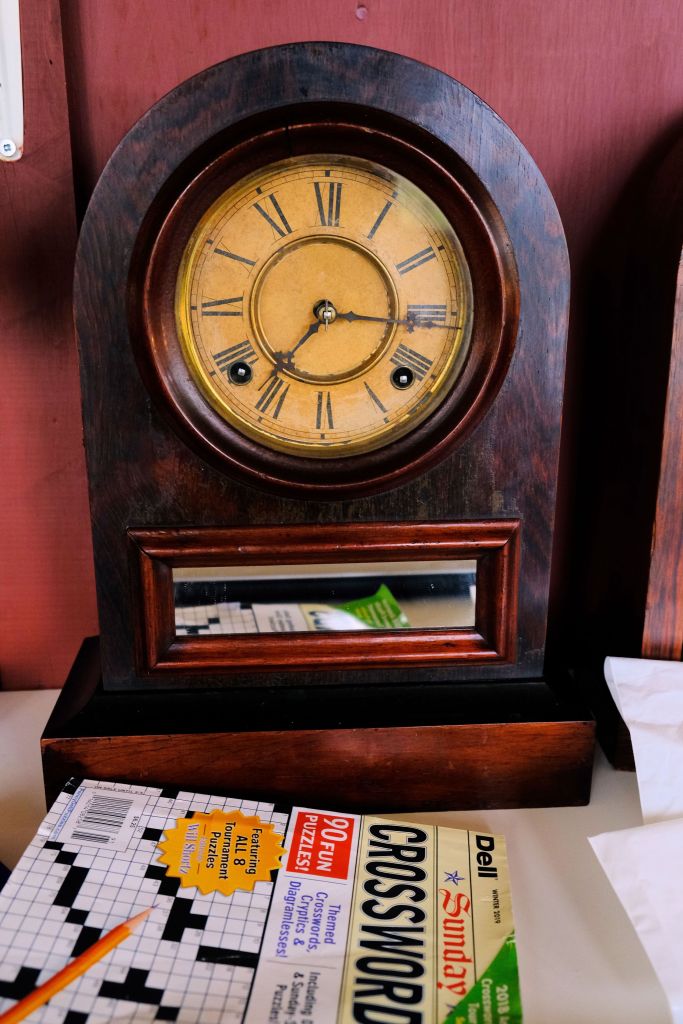
The clock is an attractive and somewhat large 6-column Victorian-style 14-day time and strike mantel clock with Roman Numeral dial made by the Hamburg American Clock Company. It is model #1902 probably made on or about that date. Hamburg American clocks are known for good quality movements with well-made cases.
I will take a look at it, I said, but without my tools, there is not much I could do. I wound both arbours and determined that the mainsprings had plenty of power. I gave the pendulum a push and immediately observed that there was power going to the escapement but there was an uneven tick-tock, so, the clock was out of beat. I propped up one side of the clock sufficiently to find the correct beat and it not only ran but dutifully struck on the half-hour. It works!
In the clock case was a note.
A note found inside the case
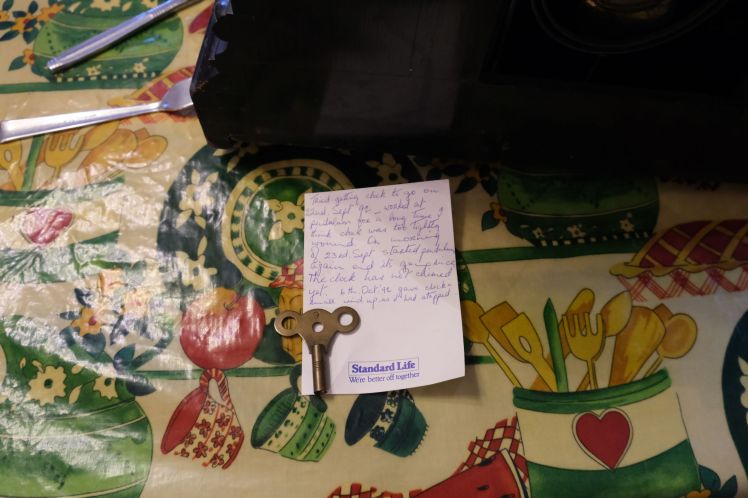
The note said,
Tried getting the clock to go on 22nd Sept ’92- worked at pendulum for a long time. I think the clock was too tightly wound. On morning of 23rd Sept, started pendulum again and it’s going since. The clock has not chimed yet. 6th Oct 92 gave the clock a small wind up as it had stopped
I admire aunt Theresa’s tenacity but the clock refused to run after the second winding way back in 1992, 27 years ago.
Time and strike movement with coiled gong
Here is what I discovered about the Hamburg American Clock Company.
In 1875, Paul Landenberger together with his partner, Philipp Lang, founded the Landenberger & Lang clock factory and although he had taken some know-how with him from Junghans (a noted German clockmaker), the company was bankrupt by 1882/1883. It was converted to a stockholding firm and with new investors, the company was re-named Hamburg-Amerikanische Uhrenfabrik (Hamburg-American clock factory).
The name might suggest that they had American made movements but that is far from the case. Hamburg is in the name because that is where the investors came from and “Amerikanische” referred to the movements which were made according to the “new” American mass-production methods.
Among clocks circles, the company is simply known as HAC.
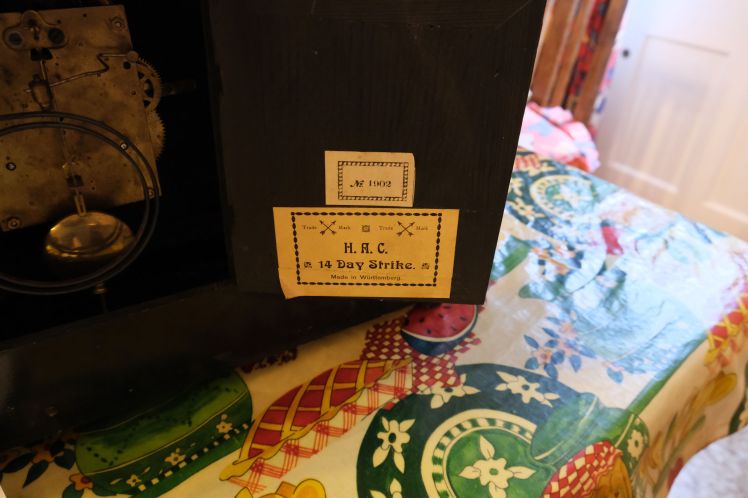
Nice label with model number above
The familiar crossed arrows trademark mark found on the coiled gong was registered in 1891. The “Lux” trademark, which this clock does not have, was added in 1905 so, it places this clock between those years. Model #1902 might even suggest the year it was made. Junghans eventually gained influence over the company and by 1930 was able to take over HAC completely.
The good news is that the clock runs and that there is nothing fundamentally wrong with it but after all these years it needs a good servicing and that means disassembly and cleaning by a qualified clock repair person.
Gilbert Admiral calendar clock ready for servicing
When I bought this clock I was not sure what I had. There is no label, no makers name on the dial and an unsigned movement. I thought, Gilbert or perhaps a Sessions? It did not take me long to find out that the clock is a No. 3027 Gilbert, otherwise known as the Admiral.
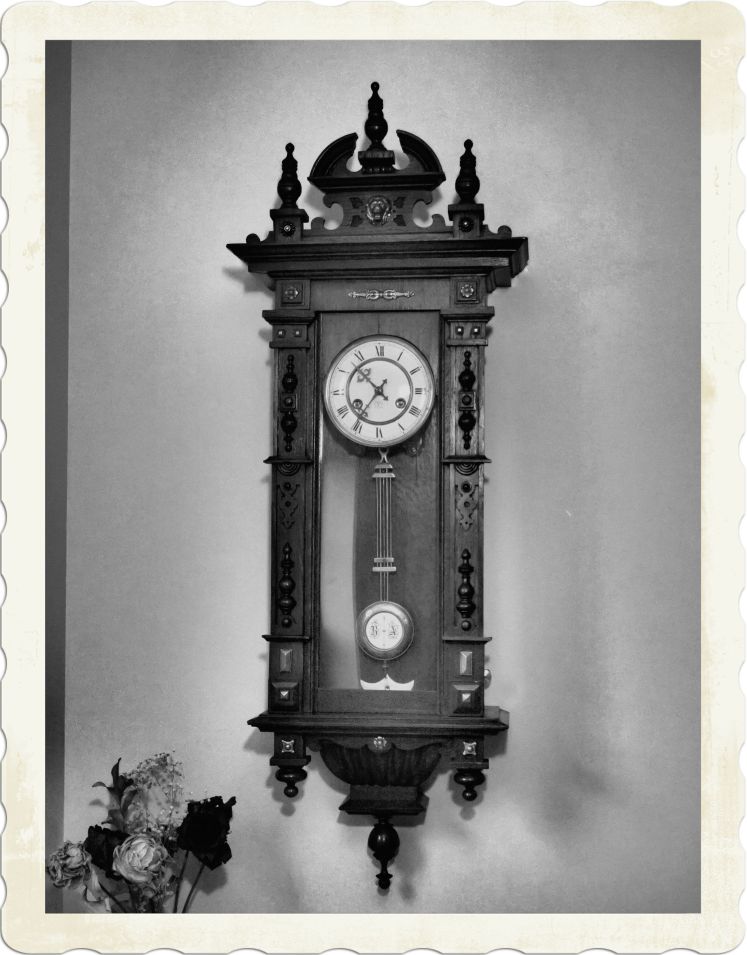
Junghans Crispi time and strike wall clock; my oldest daughter has her name on this one
“I have a sterling silver collection”, she said, “that my son will melt down and sell for cash” once I am gone
My sister, who is a couple of years younger and “was” an avid antique collector, remarked the other day that she has stopped collecting antiques. Why, I asked. There is no one to leave them to and no one to appreciate them, she replied. “I have a sterling silver collection”, she said, “that my son will melt down and sell for cash once I am gone”.
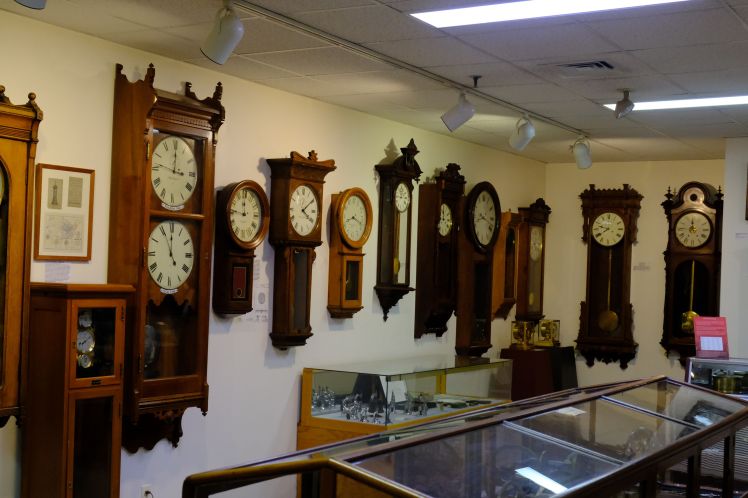
During our stay in Springfield Ma. to attend a NAWCC annual clock convention in June 2019 we stopped in Bristol, Connecticut about 45 minutes drive south of Springfield. In Bristol, Connecticut is the American Clock and Watch Museum. The non-descript white clapboard New England styled salt-box is what first greets the visitor.
Although the museum is dedicated to American clock and watch makers it is a must see for any clock enthusiast
I admit I was a little disappointed after visiting the stately edifice of the NAWCC museum in Columbia, Pennsylvania but once I entered the side entrance door my disappointment evaporated. I was immediately impressed with the friendly and knowledgeable staff, the quality of the displays and the vast, well-organized collection of American clocks and watches. The following photos tell the story.
Chauncey Jerome along with his brother Noble introduced the first mass-produced brass movement in 1839 two years after the depression of 1837 knocked out 90% of factories in the Northeast (New England States). The 30-hour brass movement was rugged, cheap to repair and not subject to swelling found in wood movement clocks. Despite business ups and downs Chauncey able was able to maintain a viable clock business until 1868 but later died penniless.
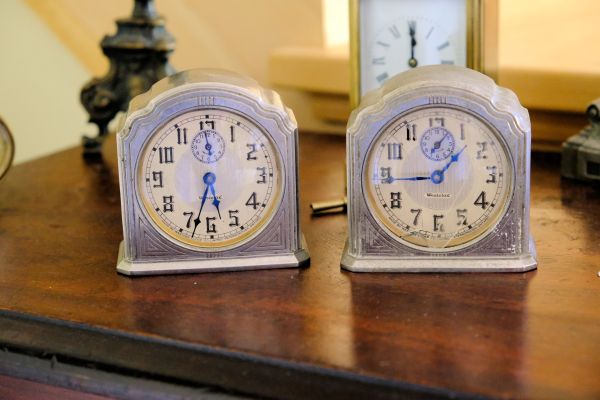
Reader EW asked me if I wanted a second Westclox LaSalle 61C alarm clock. Yes, I said, of course. I was advised of the condition of the clock beforehand so there was no surprise when it arrived in the mail.
The important distinction between my clock and the new arrival is that the new one actually works. My LaSalle may have run at one time but not now. I can hear it briefly ticking but once placed on a flat surface it stops. There is not a lot wrong with it but it definitely requires a good cleaning and perhaps some bushing work.
Gee, our old LaSalle ran great….those were the days
Archie Bunker
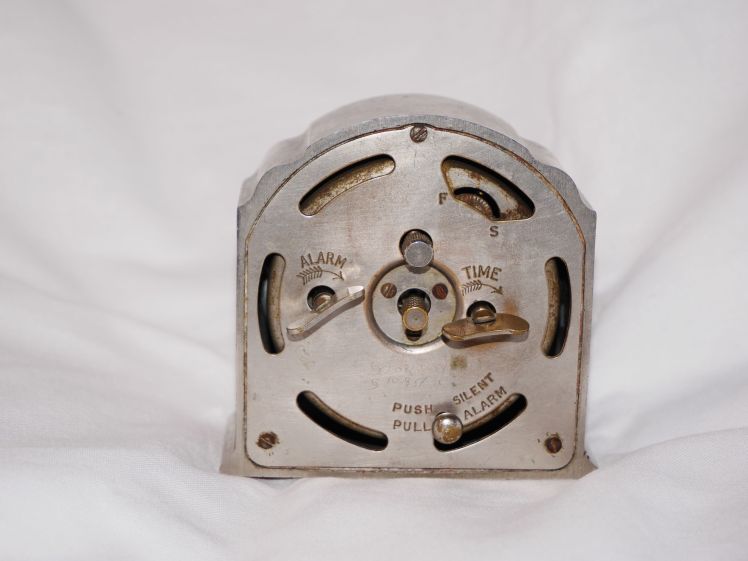
Westclox alarm clock; winding keys and adjustments
The Westclox Clock Company is better known for various versions of Big Ben and Baby Ben windup alarm clocks produced from 1900 to the mid 1980s. But there were other windup models one of which is the Art Deco styled LaSalle series. Both of these clocks are the model 61-C (401) otherwise known as a Dura clock because they have nickel-plated, die-cast zinc cases made by The Dura Casting Corporation in the United States. There are 6 models in the LaSalle series and all use the Westclox type 61 Baby Ben, one day movement.
After having attended a NAWCC (National Association of Watch and Clock Collectors) May 2019 chapter meeting in Ottawa and the 2019 NAWCC National Convention in June of this year I began to wonder why there is no NAWCC representation in the Maritime provinces of Canada (Nova Scotia, New Brunswick and Prince Edward Island) or even an informal clock and watch club.
The closest NAWCC chapter is Montreal, Canada and there are at least 3 active chapters in Ontario alone. There has never been an active NAWCC chapter in the maritime provinces.
I believe there are a fair number of clock enthusiasts (horologists) in my region who would love to meet in order to share experiences and expertise.
This blog reaches clock lovers all over the world and I encourage any of you who have an interest in mechanical clocks to seek out those with similar interests in your local community but if you are living in the Maritime provinces of Canada; Nova Scotia, New Brunswick and Prince Edward Island, contact me directly at ronjoiner@gmail.com if you are interested in getting together to talk about clocks and watches, share experiences, share repair techniques or boast about your collection.
If the numbers grow and there is sufficient interest we can form a club, and later on we might even be able to explore charter membership with NAWCC.
This is Part II of a two part series. Part one covers the first three steps in renewing a Seth Thomas clock dial. In this, Part II, the decorative design is restored on the corners.
The Seth Thomas clock as found
Inpainting is the process of reconstructing lost or deteriorated parts of a clock dial. In the museum world, in the case of a valuable painting, this task would be carried out by a skilled art conservator or art restorer. Inpainting, as opposed to repainting and restoring the entire dial, addresses the degraded areas of the dial using a few simple techniques.
Inpainting is cost effective and can be done on the home work bench
Inpainting certainly does not meet the higher professional standards of a service such as The Dial House, which perform exemplary work but I will not have a dial professionally restored if the cost is twice what the clock is worth. There will always be occasions when a professional restoration is justifiable, however.
Inpainting is cost effective and can be done on the home work bench.
This is Part I of a two part series. Part one covers the first three steps in renewing a Seth Thomas clock dial. In Part II the decorative corner design is restored.
Seth Thomas column and cornice “Empire” style time and strike weight driven shelf clock, as found
Inpainting is the process of reconstructing lost or deteriorated parts of a clock dial. In the museum world, in the case of a valuable painting, this task would be carried out by a skilled art conservator or art restorer. Inpainting, as opposed to repainting and restoring the entire dial, renews the dial using a few simple techniques.
Some of the methods can be found in T. E. Temple’s excellent resource book entitled Extreme Restoration.
Time to relax with a few good books, clock books, of course
It is time to take a little break.
I typically maintain a steady output of 7 to 9 clock themed articles per month. A number of articles have been prepared in advance of the summer months which means that there will be NO interruption in blog activity.
In Part I, I wrote why I collect, repair and restore clocks. In this, Part II are 9 reasons why clock collecting and repair is a great hobby for just about anyone.
9 Reasons why clock collecting and repair is a great hobby
Arthur Pequegnat Regulator #1, an example of one of the clocks offered for sale
I do not normally promote auctions sales and derive no benefit from mentioning them however something special is happening on June 8th 2019. It is not often that so many clocks from one maker are on sale at one specific time. In New hamburg, Ontario (Canada) 200 Arthur Pequegnat clocks are on the auction block. All styles of clocks are being offered, wall, hall, mantel, shelf and so on including some variants.
At least three Monctons are offered for sale
This is a unique opportunity for Canadian collectors and anyone else interested in antique clocks. Were I closer I would certainly be there to enjoy the frenzy of an auction sale. Here are the clocks being offered.
This is the only true gingerbread clock I have in my collection, temporarily. By this summer (2019) it will be returned to a family relation.
Dial and movement has been removed; notice the 4-colour tablet design
Can you get this thing working, my sister said? Sure, I said. Grand Assortment is an odd name for a Sessions clock, I said. The name certainly lacks imagination, but this particular clock is one of three in a series and sold for $4.00 in 1915 and could be configured with alarm and/or cathedral bell. This particular clock is Grand #3.
Mechanical clocks do not last forever and every now and then a movement should be inspected for wear and to address any other issues if required. A cycle of 2-4 years is a good rule for checking on the health of your mechanical clock.
In the case of this clock perhaps 5 years is a little long but it has not been in a harsh environment. Although I had it professionally serviced I have built up my clock repair skill-sets in the last 4 years and can now do the work myself.
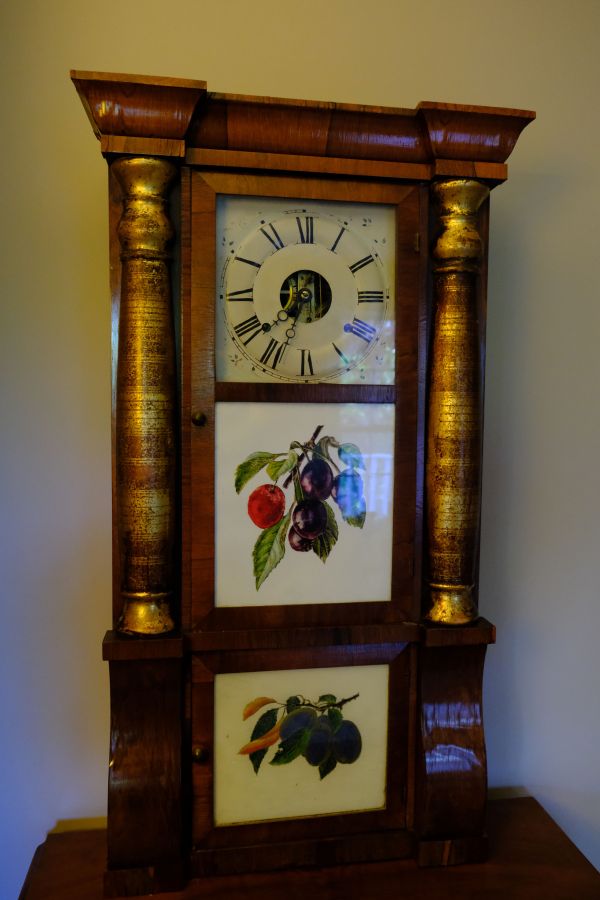
The four free-standing turned columns of the New York style Sperry and Shaw clock immediately drew my attention. The style reflects the decorative period of the Empire style popular in the mid 1850s. In a previous blog post I discussed servicing the movement. I thought long and hard about what to do with the case and decided that a refresh was what it needed.
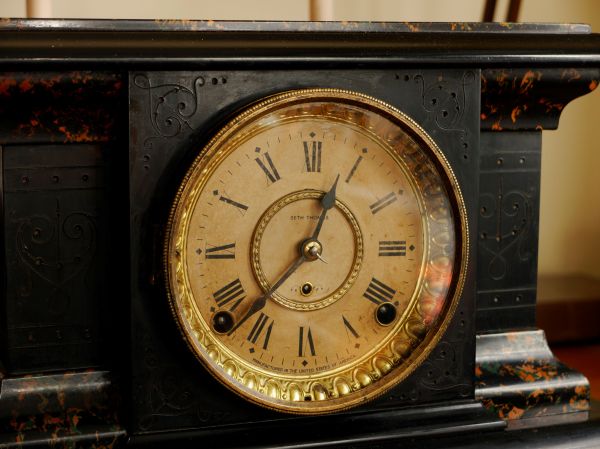
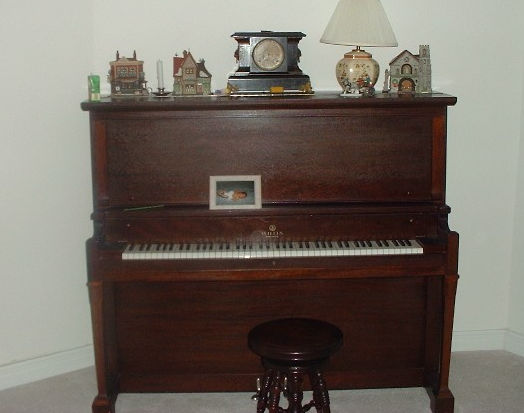
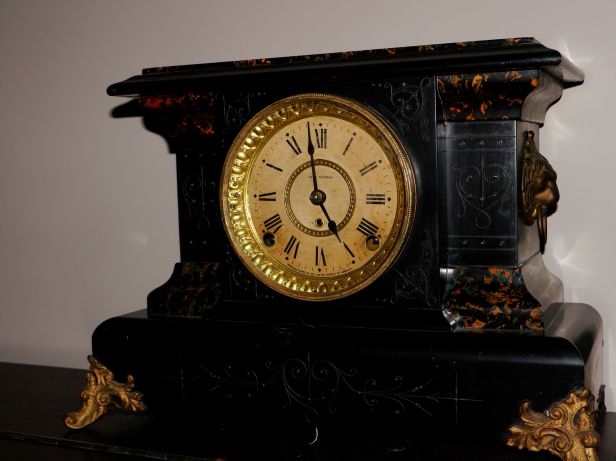
This Victorian period Seth Thomas mantel clock was in very good condition when I bought it close to 20 years ago. It sat on an upright piano until it was serviced in December 2017.
Image from October 2000, atop a Willis upright piano
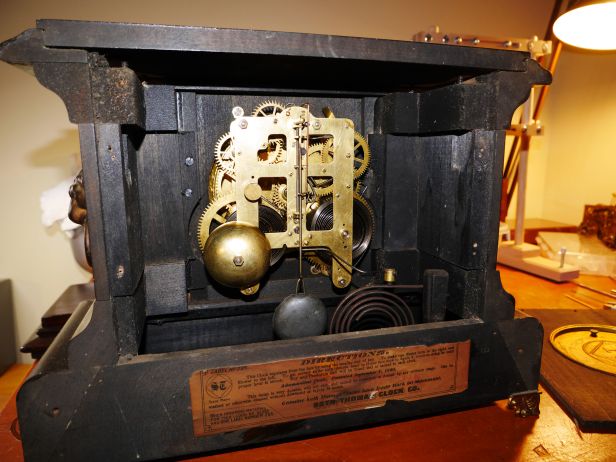
During servicing 4 bushings were installed. The clock was then relocated to another room.
The clock would certainly benefit from detailing
The model is not actually called the Adamantine. Adamantine is a chemical process applied to the clock case and it was meant to be an inexpensive alternative to onyx or marble. An expensive looking clock for the masses! Adamantine veneer was developed by the Celluloid Manufacturing Company of New York City in 1880 and the Seth Thomas Clock Company purchased the rights to use Adamantine veneer in 1881.
Rear showing time and strike movement
I have seen many Adamantine clocks on online sites and antique shops and on some the scroll detailing is visible which leads me to think that the gold coloured paint that once filled the detail on this clock case and others has been long gone.
I was on a Facebook clock collector page recently and I was intrigued by the work someone had done on a clock that was surely destined for the garbage bin. The transformation was given an apt phrase, “Trash to Treasure” and so I thought I would write about my own experiences resurrecting old clocks.
Preserving the original patina is always the principle goal and I do as much as I can to keep things as they are. However, when the finish has been adversely affected by environmental damage, heat, cold, humidity over the course of many years, as in a couple of examples below, the only course of action is refinishing.
There are times when the only course of action is complete restoration
One of the few clocks that I have had professionally serviced is an Arthur Pequegnat kitchen clock (Fan Top). In the early days of clock collecting and repair I had not acquired the necessary skills and experience to perform my own work and had some of my special clocks serviced by a skilled clock-maker. I consider this Arthur Pequegnat “fan-top” kitchen clock, a special clock.
The following comments are not a reflection of the work done by a professional clock repair shop. I consider the clock-maker who performed the service on this clock to be highly competent and I would recommend them to anyone but mechanical clocks can be very temperamental at times.
Arthur Pequegnat kitchen clock commonly known as a “Fan Top”
Two years after the clock was serviced, it stopped. It shouldn’t have! I considered all of the possibilities including weak mainsprings, bushing issues, bent, twisted or torn suspension spring and bent wheels to name a few.
This is Part III of a three (3) part series. In Part I I discuss disassembly and servicing the mainsprings. In Part II, the movement and in this, Part III we will look at restoring the brass case.
This is Part II of a three (3) part series. In Part I, I discuss disassembly and servicing the mainsprings. In this, Part II, the movement and in Part III we will look at restoring the brass case.
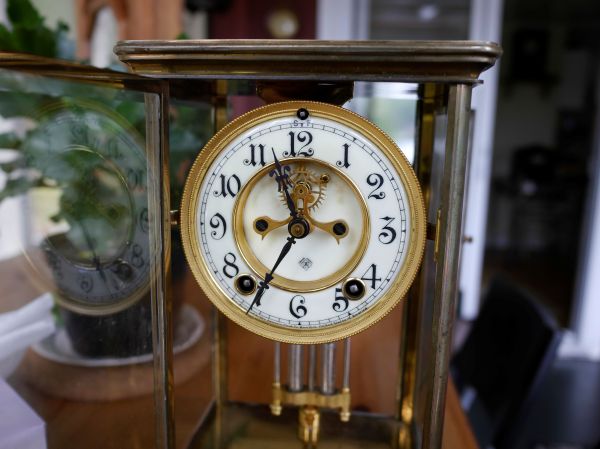
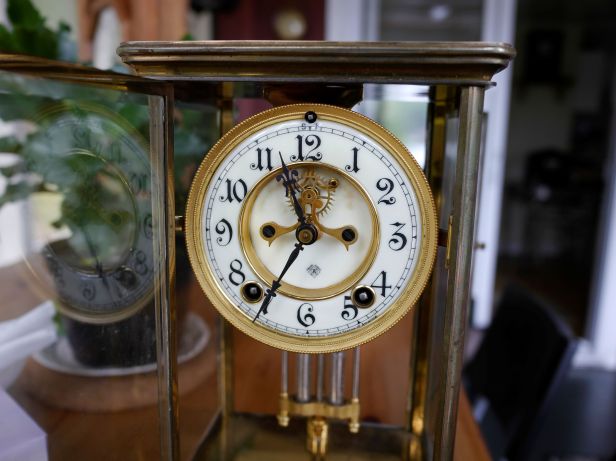
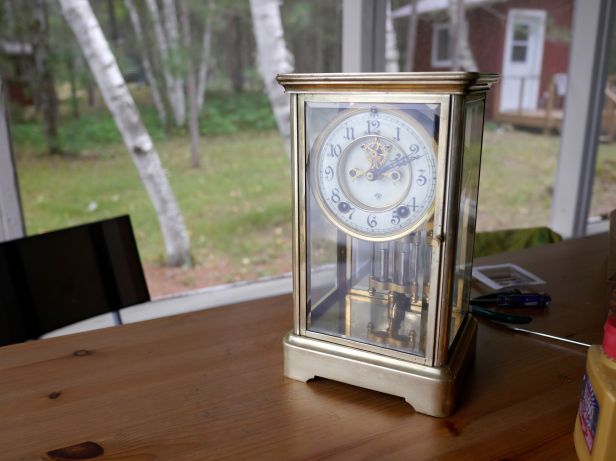
My wife found this 1910 Ansonia Crystal Regulator in the late summer 2018 while antique shopping. What a great choice! We were in a hurry and despite a price reduction we should have asked the proprietor to show us that it worked. We returned home and to our dismay, it was not running.
In Part I of this two part series I discuss disassembly and the big question; how to service the mainsprings.
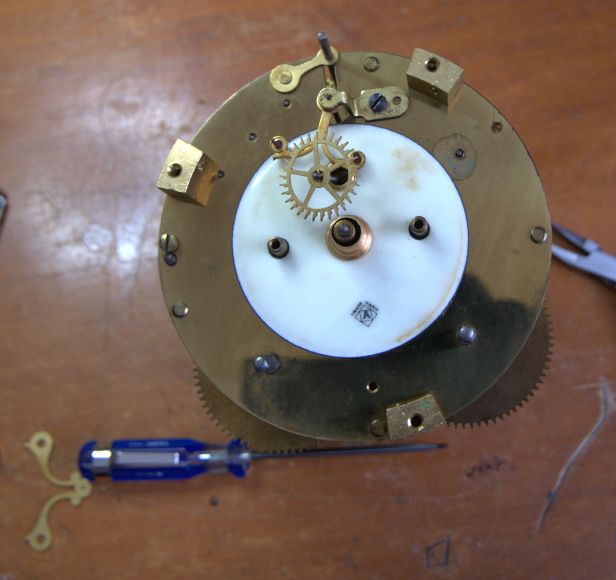
Front of movement showing visible escapement
The movement
There are 4 screws that release the plates. The 3 pin gathering pallet and hour gear must be removed to facilitate servicing. It is possible to re-assemble the movement without removing those two parts but it is very frustrating. To remove them assemble the plates. Using two small blades (small screwdrivers) positioned 180 degrees apart from one another will work. As these movements are visible, any scratches will show, so, placing masking tape on the plate will prevent scratches. Wedge both screwdrivers and the parts should pop off. The gathering pallet flew across the room (not ideal) but it worked.
Twisting the top regulator pivot bracket on the front plate upwards allows the pallets and crutch to come out from between the movement plates.
Clean parts in the usual way but do not put the pallet assembly in the ultrasonic if the pallets are jeweled. The ultrasonic machine will loosen the pallets.
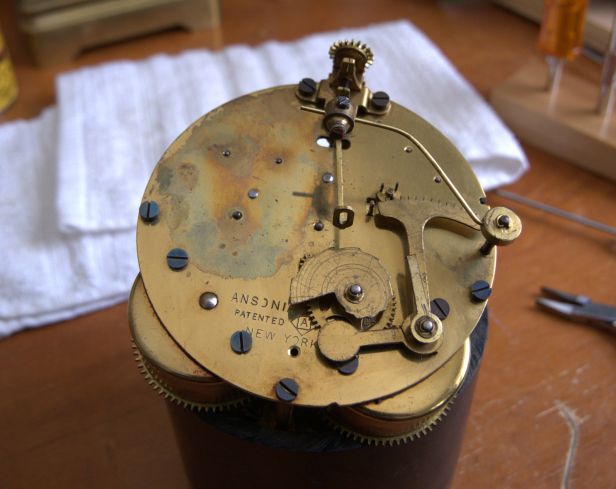
Rack and snail assembly on the back plate
The movement required 5 bushings and all on the front plate; S2, S3, T2, T3, and T4. Unusual but understandable given the placement of the gears.
Getting it all back together
Putting the plates together with gears in place is fairly straightforward. It takes a gentle twisting to get the pallet assembly in position however, there is no need to force anything.
Most of the strike assembly is on the outside but it is important to set up the warning correctly. There are two wheels with stop pins.
Thanks to reader Bob G. for explaining the following. The wheel with the stop pin closest to the outside of the plate is the stop wheel. That is held back by the tab coming through the plate from the back of the movement. The next wheel that has a stop pin is the warning. As the hour arbor lifts the lever to begin the strike sequence, the warning pin holds everything back until the correct moment. That second stop pin should be at about the four o’clock position when looking at the movement from the front.
If the stop pins are in the correct position, you must adjust the position of the pins on the gathering pallet. If you hold the wheel next to the fly, you can grip the pallet with a needle nose pliers and turn it until the pins clear the rack. Otherwise, the pins on the gathering pallet will lock the rack and the clock will only strike once on the hour and half hour.
All adjustments have been made and the movement has been fully assembled and now onto the movement test stand.
This is Part I of a three (3) part series. In Part I I discuss disassembly and servicing the mainsprings. In Part II, the movement and in Part II restoring the brass case.
My wife found this 1910 Ansonia Crystal Regulator in the late summer 2018 while antique shopping. In the 1905 Ansonia Crystal Regulator catalogue it is listed as the Prism at a price of $29.00 which would have been a hefty sum at that time. (Flash is required to open the catalogue)
What a great choice! We were in a hurry and should have asked the proprietor to show us that it worked. We returned home and to our dismay, it was not running. As I said in an article published in Dec 2018:
A gentle push of the pendulum produces a few ticks and then it stops. I am not familiar with Brocot escapements and before I do anything I will research the movement before I disassemble it and give it a thorough cleaning.
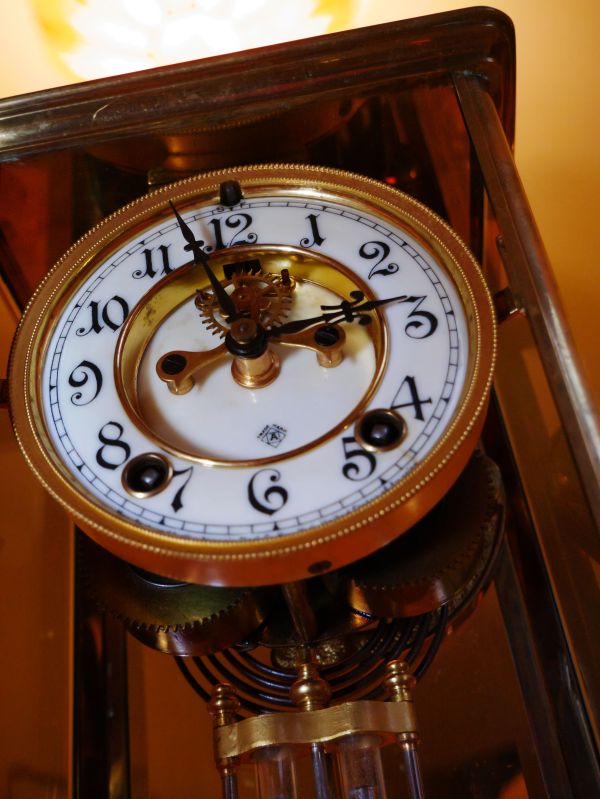
Brocot visible escapement; in this photo, the brass is very tarnished
Just days old but I thought I would polish the brass
This is a truly beautiful clock with a visible escapement. What I have learned is this; don’t mess with a Brocot escapement. The stone pallets, which are made of garnet are very delicate and breaking one or both is a huge issue. The pallets are held together by melted shellac and cleaning them in an ultrasonic will loosen them as they are position sensitive.
It is now April (2019) and I have put this project off long enough. So let’s begin.
This not a particularly easy clock to work on. The pivots are smaller than a typical American time and strike movement which means closer tolerances. The strike side is rack and snail, that is, there are no helper springs and only one combination lever between the plates. Most strike parts are located outside the plates and the final assembly for the Brocot escapement also occurs outside the plates. There are two wheels with stop pins for the strike side. Setting them up can be a challenge.
Dissembling the case
To disassemble the case I wrapped two strips of painters tape on all four sides. Doing so prevents the glass from falling out. Beveled glass panels are difficult to replace and exercising care when working with the case will prevent accidents. Each glass panel can be as much as $75 by the time shipping is included and turnaround time can be as much as 2 months.
The first to come out is the gong assembly. One large nut secures the gong to the case and is accessible from underneath the base.
I chose to disassemble the entire case though it is possible to remove the movement without doing do. There are three screws at the 1-2, 10-11 and 6 o’clock positions though a long skinning screwdriver is required to get at them.
There are 4 large screws on the bottom and 4 on top. Unscrew the bottom 4 screws first. Once the base is off you will quickly realize the importance of the painter’s tape. To access the top screws there is one small screw underneath the top plate that must be released to access the 4 top corner screws. Patience is key if you work slowly the chance of error is reduced. Put the brass pieces and the glass panels in a safe place while working on the movement.
Mainsprings
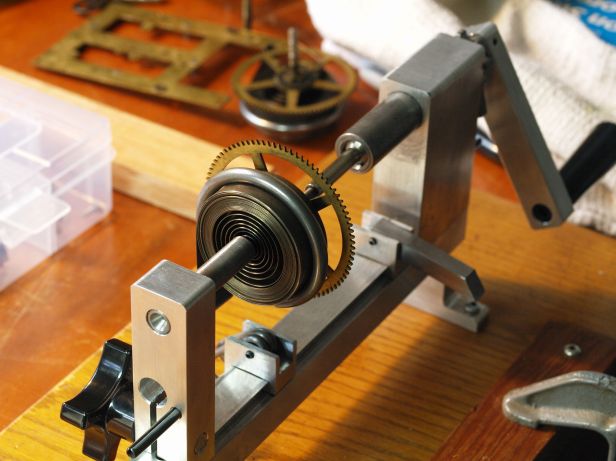
The mainsprings are in barrels. The barrels are secured to the movement plates with 4 screws. The great wheel and the arbour are one piece. With a twist, the arbour can be removed from the mainspring.
There are three ways to service the mainsprings.
1) Find a temporary winding arbor and use it to unwind the mainspring on a spring winder.
2) Hold the barrel in one hand and pull the spring out with the other being careful not to kink or bend the spring. Once the spring is released from the barrel, unhook it and you are free to clean the spring. To put it back together, use a thick leather glove to hold the barrel, hook the hole end, and carefully rewind the spring back into the barrel.
3) Partially disassemble the great wheel and use the arbour without the gear in place. Special tools are required to separate the arbour from the wheel.
Olie Baker spring winder
Front of movement showing visible escapement
Back of movement showing rack and snail, hammer and rate adjuster
In Part II I discuss servicing the movement and in Part III, restoring the brass case.
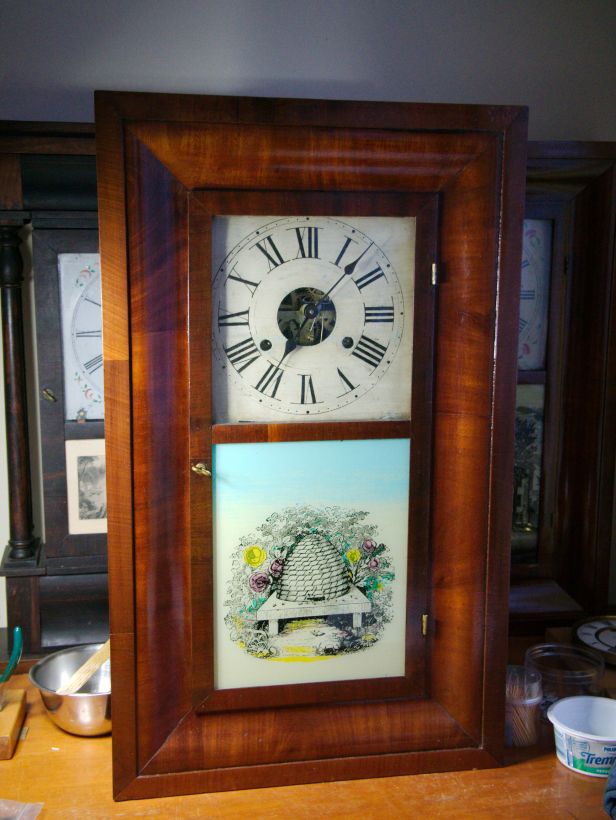
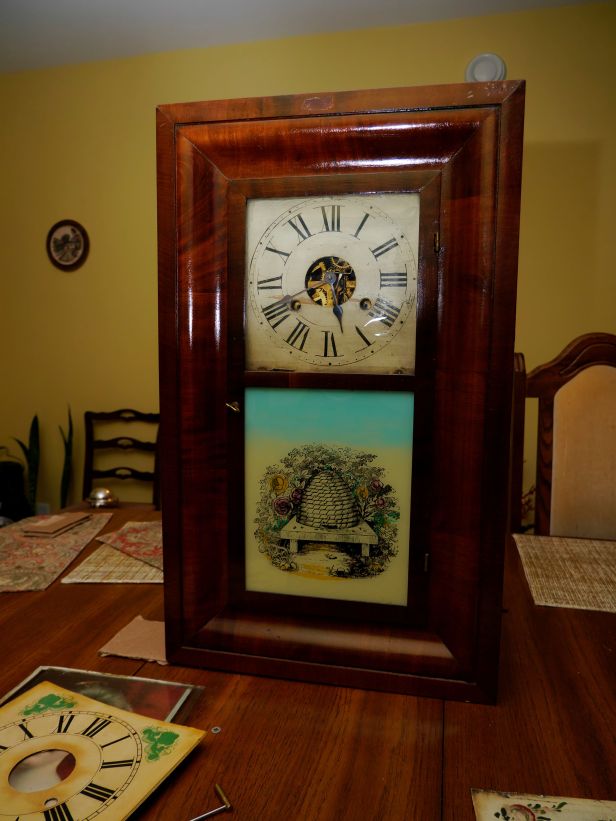
One cannot deny the classic style of an American Ogee clock. This one is in great shape and required almost nothing to get it to top form. 30-hour shelf clocks are abundant but not many cases survive years of wear and tear.
Dial removed to show the 30 hour movement
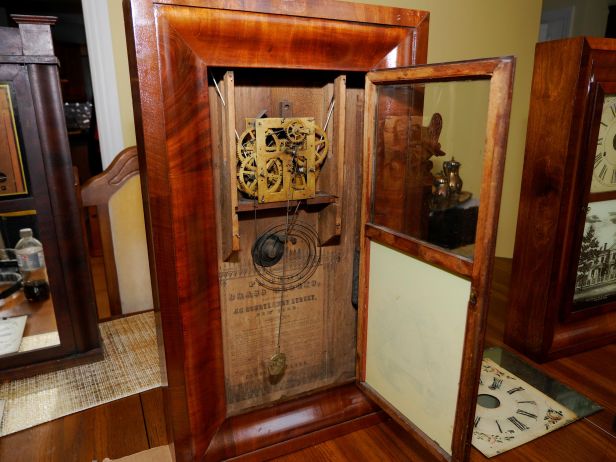
This George H. Clark 30-hour shelf clock is a very good example of Connecticut form. The case form is called an “og” or “ogee”, a mathematical term that describes the “S” curve shape in the primary molding that surrounds the door.
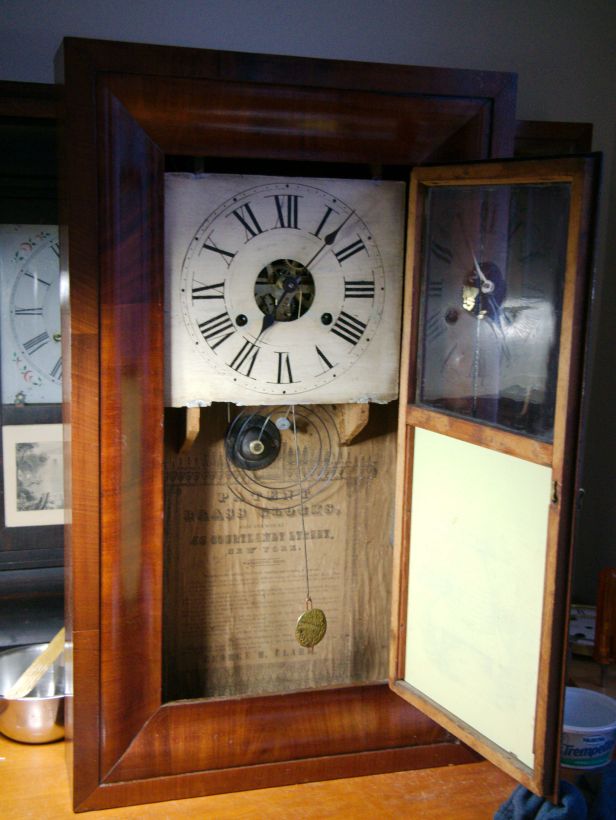
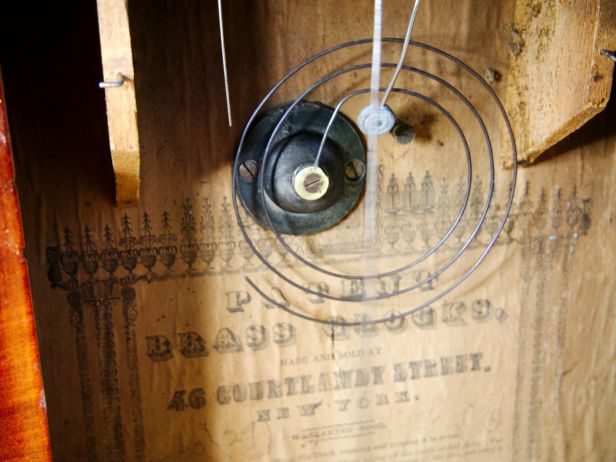
The clock has a brass time and strike, weight driven movement with an excellent original printed paper label on the interior reading in part “Made and Sold at/46 Courtlandt St/New York…. George H. Clark”. It measures 28 x 17 x 4.5”. This rectangular shaped case is decorated with nicely grained mahogany veneers. The veneer has very little if any losses.
The dial face
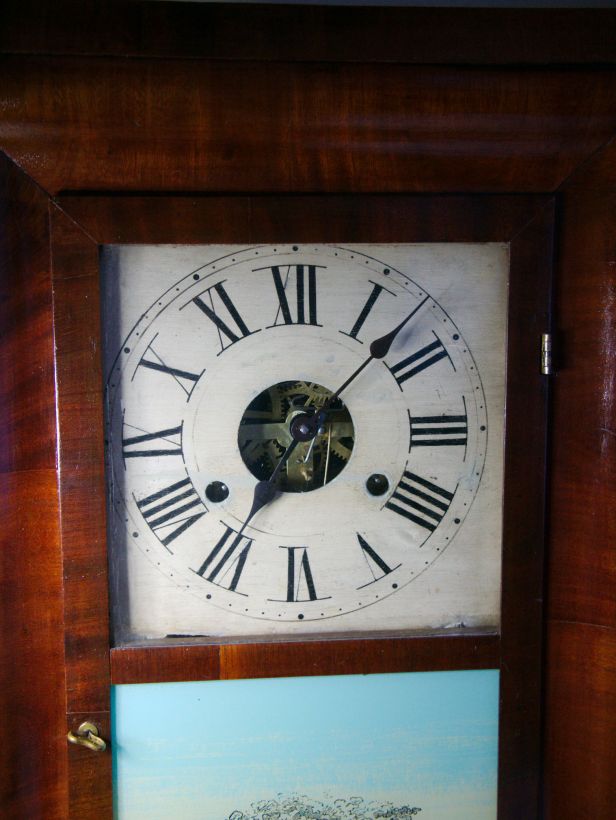
The upper section of the door is fitted with clear glass. Through this one can view the painted wood dial. The wood dial tells me that it is an early pre-1850 clock. This dial is formatted with a Roman numeral time track.
It is always a challenge matching 100+-year-old paint but by combining white. brown and yellow acrylic paint I was able to approximate the original colour. Some Roman Numerals were touched up with black acrylic paint.
The wood dial before touch-ups
And after numerals and face given a matching paint; you can see the difference in the number 4
I also glued two small blocks under the left and right “L” pins to centre the dial correctly.
The door is open showing the gong coil and the pasted label in very good condition
The lower section features a beehive painted tablet. The tablet is a replacement but fairly close to what would have been there at the time.
Beehive design; not original but in keeping with the style
Observations regarding the movement
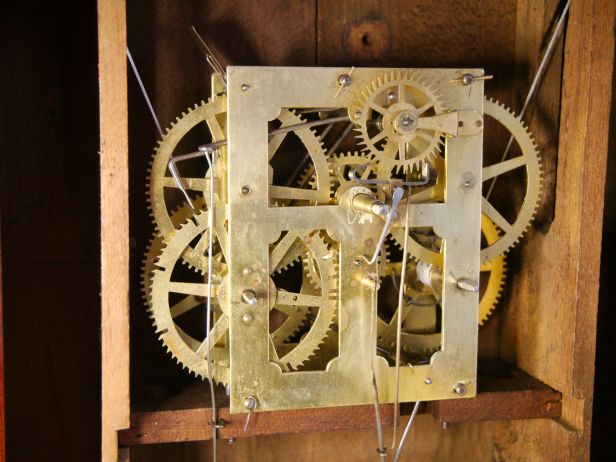
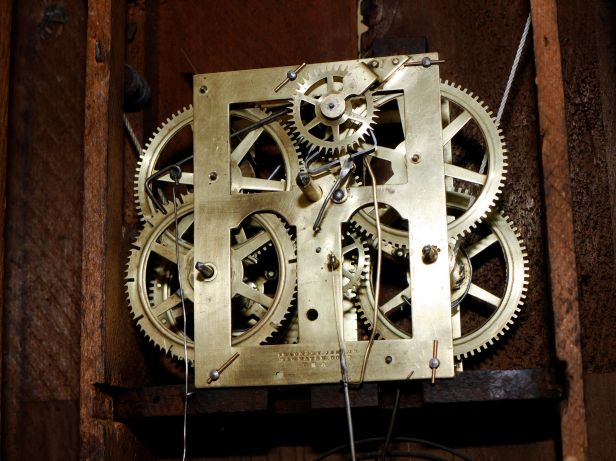
The movement looks like an early (unmarked) Waterbury, ca. 1860 type 2.411. Waterbury movements have “quarter-round” corners, while most other ogee movements tend to have the “tombstones” or plain rectangles. The movement could have been swapped but It is difficult to tell.
A clean Jerome style movement
Everything except the movement points to a period between 1840-50. If the movement is a replacement it was likely an early replacement.
30-hour movements will run surprisingly well with horrible pivot wear. However, regarding repair, my view is this: I do not normally install new bushings in every single pivot hole on the movement. If a bushing hole is passable I will leave it as-is but if the hole is quite oblong I will install a new bushing to mitigate potential gear meshing issues in the future.
Addressing the movement
I will also ignore some past repairs. For example, in this particular movement I noticed 4 punch marks around the escape wheel bridge pivot hole. As most clock repairers know using a punch to close a pivot hole was an acceptable practice many years ago though it is not considered a good practice today. In this particular case, the pivot hole was in good shape and I decided to leave it as-is. After assessing the movement further, I installed one bushing on the second wheel front plate strike side (S2) and the second on the second wheel strike side rear plate (T2). Just two bushings. As to the three lantern pinions, they were in very good condition.
Reassembly was routine. The time side ran fine.
Adjusting the strike side was not easy and should have been a simple procedure. The problem was not only correctly positioning the warning pin on the fly but ensuring that the warning hook lever could actually meet the warning hook. The levers in this clock had been bent every which way making it a real challenge to find the correct angles. It did not strike correctly before servicing. Trial and error combined with colourful language certainly helped correct the strike.
The finished clock
The gong block and coil were also cleaned up. Tip; it helps to put the same screws back in the same holes. Seems trivial but it is a good practice. Not all screws are the same.
Gong block removed and cleaned
Little time was spent on this clock and I was fortunate to have an almost perfect case. The previous owner knew how to take care of the case but the movement neede work. When many of these clocks stopped they simply became decorations but I am sure that this one will run reliably for many more years to come.
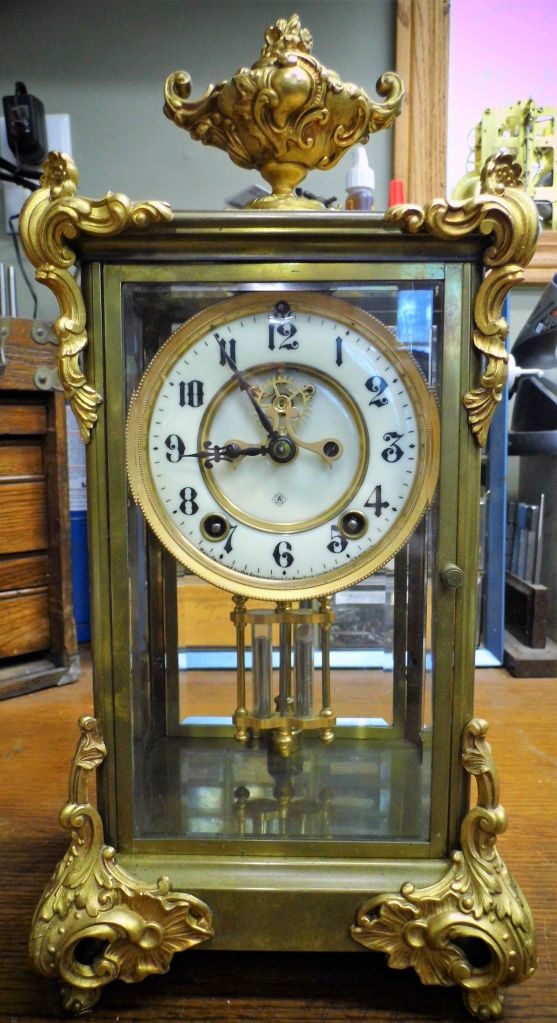
I asked reader and fellow horologist Bob G. if he could kindly give me permission to profile one of his favorite clocks, an Ansonia Marquis crystal regulator circa 1904. This is a very impressive clock that showcases the best of Victorian style at the turn of the twentieth century.
The photos are Bob’s and I will let them largely speak for themselves. But first some information about the company.
Much has been written about the Ansonia Clock Company. The company’s history can be found here. Formed in 1844 the Ansonia Clock Company had a relatively long life but went into receivership just prior to the infamous stock market crash of 1929. The machinery and dies were sold to a Russian holding company thus ending the long reign of one of Americas best known clock companies.
“…there came an order to supply the Soviet union with men and machines to make watches and clocks, neither of which products ever had been manufactured there. Representatives of Amtorg went to the Ansonia Clock Company in Brooklyn and to the Duber Hampden Watch Company of Canton, Ohio, and bought them lock, stock and barrel. Then they hired most of the skilled employees of the plants to go to Russia and operate the familiar machines. These have been installed in a new, many-windowed building in Moscow, where Russian apprentices are beginning to master the trade.”
An inglorious end to a fine clock-maker. Now to Bob’s clock.
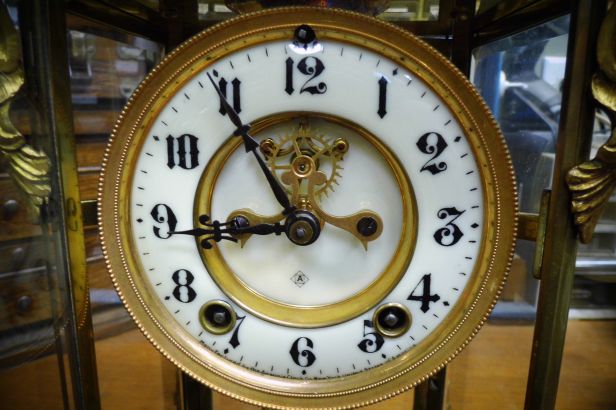
Clock face showing Brocot “open” escapement
Bob writes:
the Ansonia “MARQUIS” crystal regulator mantel clock is an eight-day time and strike with open escapement, jeweled pallets, porcelain dial, thick beveled glass and a brass bezel. The hands and pendulum appear original and it came with an old key which is probably a replacement. There are no hairline cracks or chips that I could see in the dial or the beveled glass. The pendulum is the same as the one shown in the 1904 catalog.
Pendulum bob showing faux mercury in two glass tubes
Ansonia listed the MARQUIS in its 1904 catalog. It may have been produced a couple years either side of that date. The original price in 1904 was a whopping $40.00, not cheap for that time period. $40.00 in 1904 is equivalent in purchasing power to $1107.48 in 2019.
The clock measures 15½ inches high and 7½ inches wide with a 4-inch porcelain dial. The case is listed in the catalog as polished brass, “rich gold” ornaments.
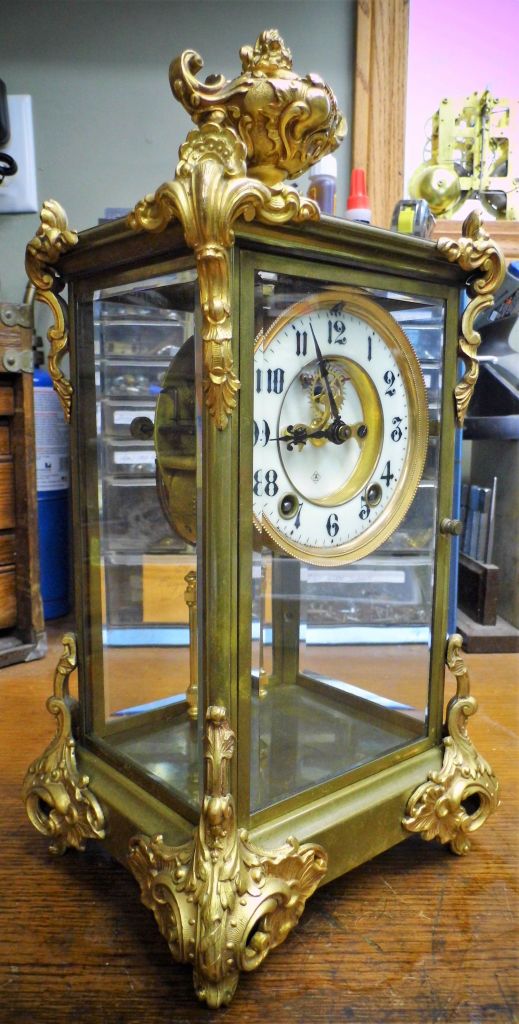
Side view of the Marquis
I purchased this clock as part of a large collection. The owner had passed away, and his grandson was settling the estate. The grandfather had opened a jewelry store and clock shop over 73 years ago and the store is still in operation today.
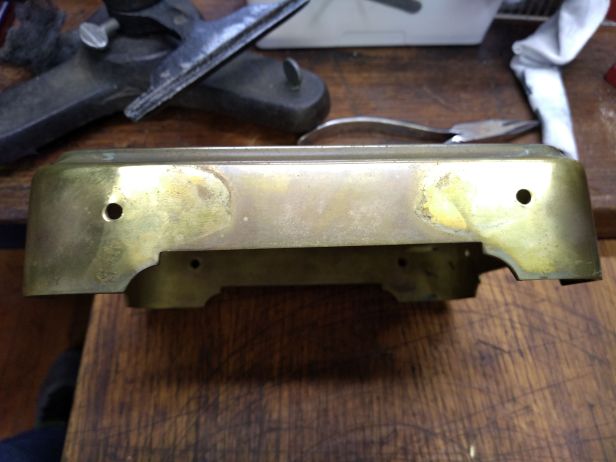
This clock needed a good cleaning, and the brass was badly tarnished.
Tarnished brass base
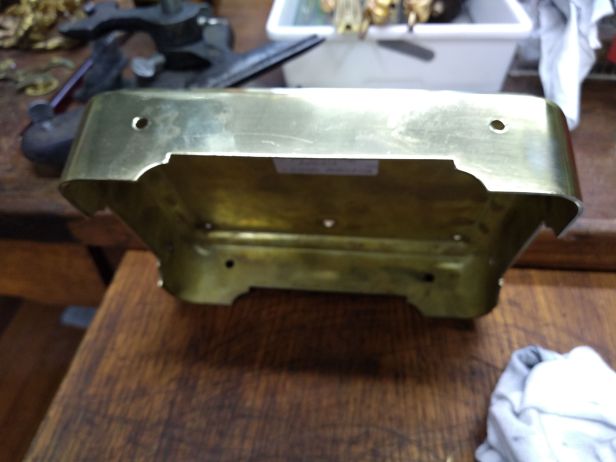
After cleaning and polishing
The gold ornaments were left intact to preserve the rich patina.
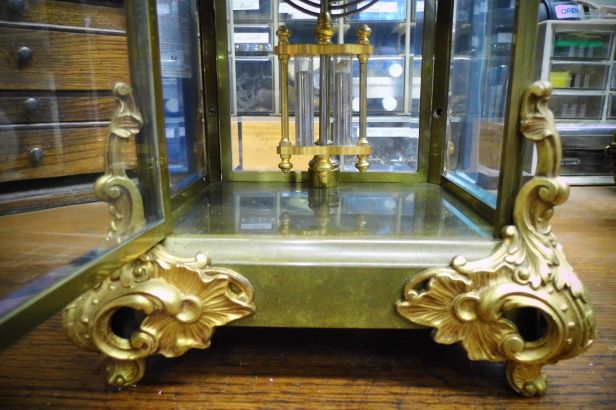
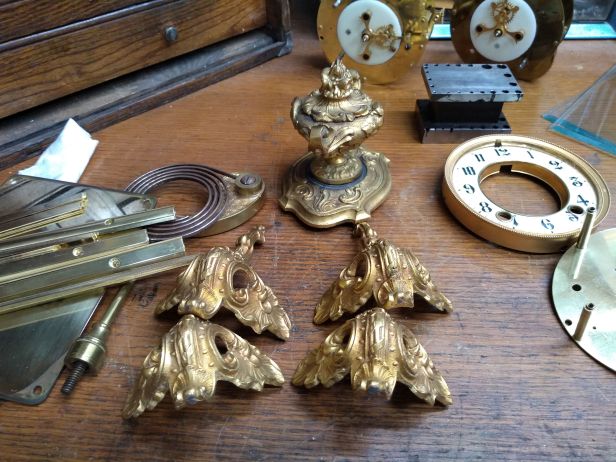
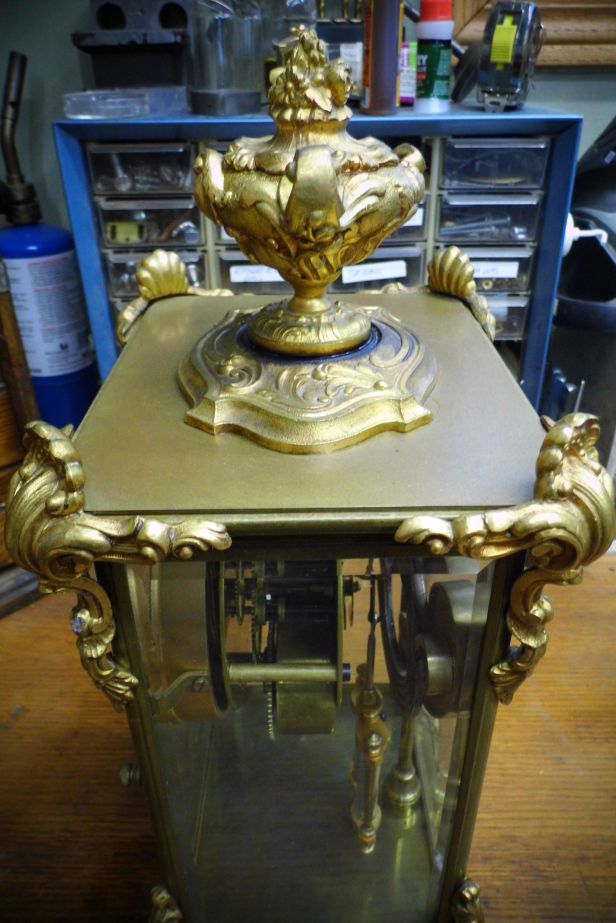
Ornamental features, the legs and crown
The entire clock was disassembled, and the brass parts were run through an ultrasonic cleaner, then polished.
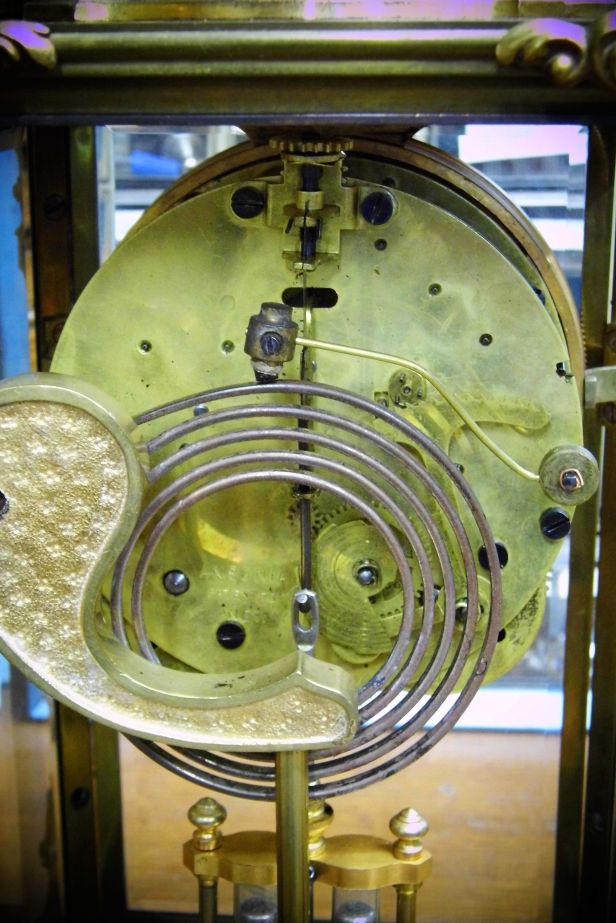
Back plate, coiled gong and hammer
The movement was also taken apart and cleaned. All the bushings and pivots were in good condition. One of the jeweled pallets needed to be adjusted and reset with shellac.
Trim pieces in place
It took about a week to get this beauty all back together and running again, but it was worth the effort to see it ticking away and keeping great time.
Thank you Bob. A most impressive clock.
The jeweled pallets are made from garnet, a precious stone consisting of a deep red vitreous silicate mineral. Here is an interesting 1905 catalog showing Ansonia’s collection of crystal regulators. Page 24 shows the Marquis with a price increase to $41.80. As Bob pointed out, a hefty price for a clock in its time.
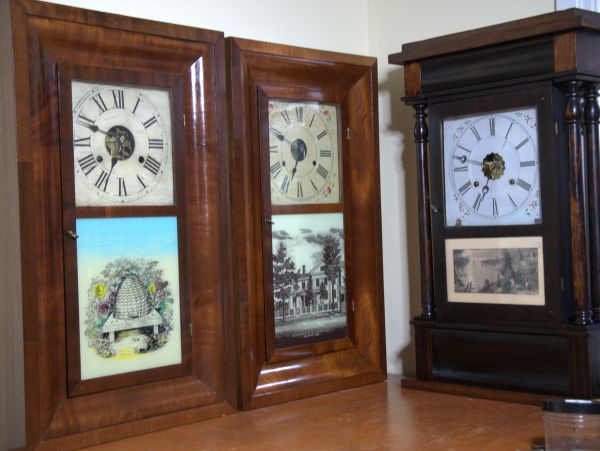
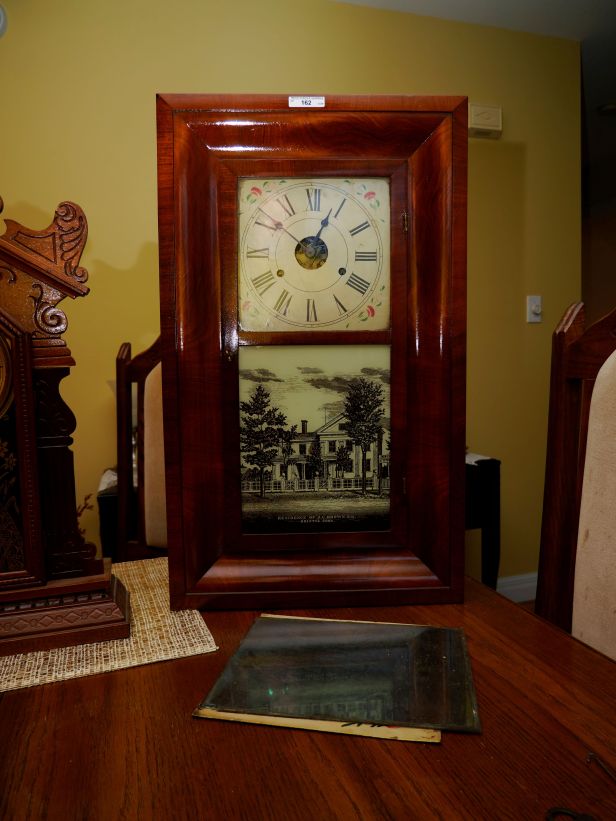
These three 30 hour clocks in the opening photo were serviced in the fall of 2018. The fourth (shown next) is a Waterbury Ogee from about 1870.
It was never my intention to collect 30-hour clocks but I am attracted to this style of clock. Thousands were made, they are surprisingly cheap and come up often on online for-sale sites. Many have the cases that have suffered the ravages of time though these are in very good condition. However, buyers and collectors tend to stay away from 1-day clocks because of the hassle of winding them every day.
I marvel at the engineering and innovative technology of clocks made over 150 years ago and how popular these clocks were in their day.
Waterbury 30-hour Ogee clock
On the left in the opening photo (and below) is a George H Clark, pre-1850. It features a Jerome-like movement and a wood dial.
George H. Clark 30 hour Ogee
All of the clocks on this page have similar movements to this Jerome
Touch-ups to nicks and scratches were all that were required to improve the look of the case but the movement required a good cleaning as well as a couple of bushings.
The middle clock (also seen below) is a Chauncey Jerome Ogee clock. The label dates the clock to about 1855-56 just prior to the company’s bankruptcy.
Chauncey Jerome 30 hour Ogee clock
Eight bushings were installed on this clock. Some of these clocks need a lot of work while others require a good cleaning.
On the far right (and blow) is a Sperry and Shaw 30 hour New York style 4 column shelf clock. The movement was disassembled and cleaned but did not require bushing work. The case was also freshened up.
Sperry & Shaw 4 column clock with a Canada Clock Co 30-hour steeple to the right
I am fascinated with 30 hour clocks. Yes, they require winding every day but I enjoy it and it has become one of my daily rituals. The sound of the gong is not particularly pretty but it is distinctive. You always know when an Ogee clock is striking in a house.
What other mechanical devices keep running after 150+ years?












 Antique and Vintage Mechanical Clocks
You must be logged in to post a comment.