Top 9 Antique Clock Myths Debunked for Collectors
If you’ve been around antique or vintage clocks for any length of time, as I have, you’ve probably heard a few “truths” that get passed along like family recipes. Some have a sprinkle of fact in them, others are pure folklore, and a few can actually cause more harm than good. So, let’s sit down, pour a cup of coffee on this fine Monday morning, and bust a few of the most common myths I hear all the time.

Myth #1 – Overwinding A Clock

Let’s start with the big one: the infamous “over-winding” myth. I can’t tell you how many times I’ve heard, “It was running fine until I over-wound it!” Here’s the reality — you can’t hurt a healthy clock just by winding it all the way. If it stops when fully wound, the culprit is likely dried oil, dirt, or worn parts. Old, dried-up oil can turn into a sticky glue that causes the mainspring coils to cling to each other, thereby stopping a clock.

When I bring home an old spring-wound clock, the very first thing I do is let the springs down completely, give them just a small wind, and then see if the movement runs. If it does, that’s my cue that the springs need a proper cleaning and lubrication, right along with the rest of the movement.

Myth #2 – More Oil Is Better

Then there’s the advice some give to oil a clock every single year. I get it — we want our clocks to run smoothly. But adding fresh oil without cleaning first is like pouring new motor oil into an engine without changing the filter. You’re just mixing clean oil with grime and making an abrasive paste that speeds up wear. Most clocks are perfectly happy with a proper cleaning and oiling every four to five years. The only exception is that, after an inspection at the two-year mark, if it’s clear the pivots are dry and there is no residue around the pivot holes, a light oiling is a prudent step, provided only a small amount of clock oil is applied.

Myth #3 – A pendulum Clock “Adjusted for level” Will Work On Any Surface

Placement is another overlooked detail. I’ve seen pendulum clocks happily ticking away on a sturdy wall, and I’ve seen others struggle just because they’re sitting on a wobbly shelf. Uneven or unstable surfaces throw the clock out of beat and mess with its timing.

When someone says a pendulum clock was “adjusted for level,” it means that during servicing, the clock was placed on a level surface and its beat was adjusted accordingly. If the clock is later moved to an uneven or non-level surface, the beat will need to be readjusted to match the new position.

Get a clock with a floating balance escapement; it will work nicely on just about any uneven surface.

It is easy to place a mantel clock with a floating balance

Myth # 4 – A loud Ticking Clock Is An Unhealthy Clock

And while we’re on the topic of how a clock sounds — louder doesn’t always mean healthier. A good clock doesn’t need to shout; an even, crisp tick is a much better sign than a booming one.

However, keep in mind that some clocks are loud because of case acoustics, or they are located in areas where the sound is amplified, a hallway or a small room with hard surfaces, perhaps. Some surfaces can even act like acoustic amplifiers.

Arthur Pequegant Brandon II
Arthur Pequegant Brandon wall clock, a loud ticker

I also believe that the type of escapement is a factor. Due to their mechanics, recoil escapements are always louder than all others. I have an Arthur Pequegnat Brandon wall clock with a recoil escapement in a room with six other clocks — and which one is the loudest? The Brandon, of course! It’s almost as if it’s saying, “Look at me, I’m the loudest in this room.”

Myth # 5 – WD-40 Works Well As A lubricant

One myth that makes clock repairers wince? WD-40. Yes, it might make a sticky clock run for a little while. But it also strips away proper lubrication and leaves a sticky film that attracts dust like a magnet. It’s the short-term fix that leads to long-term headaches.

What does the WD in WD-40 stand for? WD in WD-40 stands for “Water Displacement.” The product was originally designed to repel water and prevent rust, and the “40” refers to it being the 40th formula the chemists tried before they found one that worked effectively. Who knew?

Now, please don’t tell me it worked for you!

Myth # 6 – The Older the Clock, The More Valuable It Is

And while we’re setting the record straight, let’s talk value. Not every old clock is a gold mine. Age is only part of the story — rarity, maker, originality, and condition matter much more. Old is not gold, as they say. An 1850 Ogee clock might have stood the test of time, but it was made in the thousands, so it’s actually not all that rare.

George H Clark 30-hour Ogee shelf clock, circa 1850, for a ridiculously low price at auction

Of course, there are always exceptions. Well-preserved French clocks, such as a Louis XIV cartel clock of the 17th century, prized for their exquisite craftsmanship, ornate gilt bronze (ormolu) cases, and fine enamel dials, can be quite valuable.

However, many are often surprised to find out that their 100-plus-year-old clock is worth next to nothing.

Myth # 7 – Don’t Assume Black Forest Means “Made in Germany

Also, don’t assume the words “Black Forest” mean German-made. Some Canadian and American makers used the name simply because it sounded exotic and marketable. For example, the Blackforest Clock Company of Toronto (which became the Forestville Clock Company in 1941) produced reliable clocks for the home. While the cases were made in Canada, the movements were sourced from England, France, and, more typically, Germany.

Myth # 8 – It’s Running Fine, So It Doesn’t Need A Service

Another one I hear often: “It’s running fine, so it doesn’t need service.” The truth? Even a clock that’s keeping time can be quietly wearing itself out if it’s running on dry bushings or worn pivots. A thorough inspection should reveal any issues with the clock’s movement.

Myth # 9 – An Antique Clock Should Always Look “Like New”

And please, don’t feel you have to polish away every bit of patina. That gentle wear tells the story of your clock’s journey through the decades.

When we think of antiques, there’s often a temptation to restore them until they look spotless and brand new. But with antique clocks, that shiny, polished look isn’t always the goal, and here’s why.

Patina is the natural aging and mellowing of a clock’s surfaces over time. It’s the soft glow on wood, the subtle tarnish on brass, and the gentle wear marks that tell a story. This “aged finish” is like a fingerprint of the clock’s life, showing decades, sometimes centuries, of use, handling, and care.

Stripping away that patina by over-polishing or refinishing can actually damage the clock’s historical value. Collectors and experts often prize original finishes because they preserve the clock’s authenticity and character. A well-preserved patina connects us directly to the past, making the clock not just a timekeeper but a piece of living history.

Having said all that, I’ll admit I’m certainly guilty of refinishing the odd old clock now and then. After all, I keep many of them for my personal collection, and refinishing is a great way to learn new restoration techniques.

It also allows me to bring out the original beauty that may have been hidden under years of dirt and wear, which I believe is a good thing in certain situations. Plus, sometimes a carefully done refinishing can help stabilize fragile wood or finishes, ensuring the clock can be enjoyed for many more years.

And I will throw in two bonus myths.

Bonus Myth #1 – Serial Numbers Always Tell A Clock’s Date of Manufacture

Lastly, serial numbers. While they can sometimes pinpoint a clock’s date of manufacture, this only works for certain makers with complete records. Unless you can match the serial number to a verified database or understand the dating system the maker used during production, it’s merely an educated guess as to when the clock was made.

Clock company catalogs are an excellent resource for dating an antique clock—if you can find them! For example, if you have a clock made by Junghans of Germany, they offer an excellent catalog archive on their website.

Many of the serial number charts floating around online are best taken as educated guesses, not hard facts.

That said, many movements have no numerical markings beyond the trademark.

Bonus Myth #2 – A Quick Bath Is All A Movement Needs To Run Properly

One common myth I come across is that you can clean a clock simply by dunking the whole movement into a cleaning solution without taking it apart first. It sounds like a quick fix, but in reality, this can cause more harm than good. Clock movements are made up of delicate parts that need to be carefully disassembled, cleaned individually, and then properly lubricated.

Dunking the entire mechanism risks damaging pivots, bushings, and other components, not to mention leaving grime trapped in places you can’t see or reach. Proper cleaning takes time and patience, but it’s the only way to ensure your clock runs smoothly.

Duncan Swish was NOT a famous clockmaker!

At the end of the day, part of the joy of collecting clocks is hearing the stories — and sometimes, debunking them. Myths may be fun to repeat, but knowing the truth will help you keep your clocks in good health and their history intact. After all, a well-cared-for clock doesn’t just tell the time… it tells its own story.

If you know of any other clock myths or stories that deserve a closer look, I’d love to hear them—drop a comment below and let’s keep the conversation ticking!

Navigating the Challenges of Clock Collecting

Over the past 12 years, time has flown by, and just recently, while cleaning a clock I serviced over five and a half years ago, I realized that I have been immersed in this hobby for a long time—and loving every moment of it.

Three years into my journey, I started blogging, a passion that’s been going strong for almost 9 years. Writing not only allows me to track my progress as I delve deeper into the world of clock collecting, repair, and restoration, but it also provides an opportunity to blend my photography hobby with my love for storytelling.

It has been a fascinating journey, one filled with countless lessons. Here are some of my thoughts and reflections on what I have learned along the way.

From Quantity to Quality

In my early days of clock collecting, I acquired nearly any clock I could find—some for as little as $5—mainly to practice repairing cases and movements. However, the collection quickly grew, and I soon found myself running out of space—a common challenge for many collectors.

I eventually settled on a comfortable number of around 80 clocks. I aim to follow a “one in, one out” rule to keep the collection manageable. It’s not always easy, though, as there’s always something tempting that catches my eye.

Over time, I have become more selective, focusing on specific types such as wall clocks and weight-driven models or clocks that are unique and interesting. At present, my primary focus is Canadian-made clocks and those with a strong Canadian connection.

Patience Yields Rewards

Restoration projects take time, and I have learned to embrace a slow, methodical process. My last major project, an antique 1840s banjo clock, took almost a year to complete after I acquired it in 2021. I worked on it in stages, researching new techniques and patiently waiting for the right tools to make the job easier. For example, a band clamp turned out to be indispensable for the wood bezel repair.

sawin banjo clock

A movement will often sit on my bench for weeks as I work through the various stages of servicing. This gives me time to carefully consider any problem areas, mitigate them, and document my progress on my blog.

Tools: Invest Wisely and Gradually

As with any hobby that involves mechanical work, tools can be expensive. In the beginning, I used whatever I had on hand, which consisted mainly of household tools, but as my commitment grew, I began investing in specialized equipment.

In my view, a bushing machine, a lathe, and an ultrasonic cleaner are essential tools I acquired over time—spreading out these costs to make them more manageable.

Olie Baker spring winder. Cleaning the strike side mainspring
Olie Baker spring winder

Although buying used equipment is always an option for some, living in a less populated area of Canada, the East Coast, means fewer opportunities to find pre-owned tools.

I always consider pre-owned tools first but used tools are not always in the best condition because they are heavily used, improperly maintained, or simply worn out over time. Tools can suffer from wear and tear, rust, dull blades, or misaligned parts, all of which can impact their effectiveness. This can make it difficult to rely on used tools for precise work, especially in a hobby like clock repair where accuracy is crucial.

For instance, a used Bergeon Bushing Machine might seem like a great deal at 950 CAD on eBay, but if the cutters are dull or damaged, replacing them can cost 300 CAD or more.

The Changing Values of Antique & Vintage Clocks

Not all old clocks are valuable, despite their age. Old is not gold as one of my readers has said. In fact, a glut of antique clocks on the internet has driven prices down and that trend is unlikely to change in the next several years.

For example, Ogee clocks that once sold for $200–$300 are now worth a fraction of that. 30-hour Ogee clocks also are not wanted by most collectors resulting in a significant decline in their value. Mantel, wall, and tall-case clocks have also seen a similar price drop.

I have bought $40 clocks that are still worth… well, $40. With the advent of the Internet, a vast majority of antique and vintage clocks flooded the market, leading to reduced demand and lower prices. Inexpensive clocks are generally in poor condition, require significant repairs, or are lower in quality or craftsmanship, making them less desirable. Shifts in collector interest have also influenced prices, with clocks that were once popular losing their appeal over time, which has affected their value.

On the other hand, prestigious clocks, especially those that are highly intricate or come with documented provenance, tend to have higher values, and their prices continue to remain elevated.

Balancing Passion, Skills & Knowledge

It’s important to avoid diving too deeply into a hobby beyond your current skills and knowledge. Stick to what you know and what you’re capable of handling, and remain conscious of your level of expertise.

By focusing on your strengths, you can enjoy the process and make steady progress without becoming overwhelmed. Trying to tackle projects or techniques that are beyond your abilities can diminish your enthusiasm for the hobby.

Setting realistic goals and gradually expanding your skills can enhance your experience. As you become more comfortable and knowledgeable, you can take on more challenging projects at your own pace. Continuous learning while respecting your limits allows you to grow in this hobby without losing your passion.

There’s strength in recognizing what I can’t do and in acknowledging when something is beyond my expertise. For example, deciding not to offer clock repair as a service shows that I know what brings me joy without overcommitting.

By knowing my limits, I avoid turning enjoyable activities, like collecting or maintaining clocks, into a source of stress. Setting limits allows me to concentrate on what truly matters—like focusing on Canadian-made clocks or curating a meaningful collection.

We all make mistakes but it is not a time to give up after one mistake. Pushing on despite setbacks is equally important. It helps build resilience and determination, essential qualities for any hobbyist. Challenges should reinforce your commitment to the craft. When faced with a challenge, my strategy is to step back temporarily and focus on something else until a solution presents itself.

Having said that, It is also beneficial to recognize when it is time to seek help or advice from more experienced collectors or professional repair persons.

Navigating Repair Advice

When it comes to clock repair, not all advice is good advice. I have learned to be selective about where I seek guidance. As a member of the NAWCC (National Association of Watch and Clock Collectors) and the Ottawa Valley Watch and Clock Collectors Club, I have access to a wealth of reliable resources. I also follow a few respected clock repair experts on YouTube.

On the flip side, Facebook clock groups are often a mix of tinkerers and experts, which can lead to misinformation. Well-meaning hobbyists frequently provide misguided advice to novice clock repairers.

I maintain a library of clock repair books and prefer consulting them over seeking solutions on social media.

Profit Should not be the Motivation

For some, clock collecting might be about turning a profit, but that is not my motivation. I do occasionally sell a clock to offset the cost of tools, but for me, the real joy lies in the nostalgia, the design, and the marvel of a 150-year-old machine that still works perfectly today.

Each clock tells a story, connecting me to the craftsmanship and history of its time. It is incredibly rewarding to restore old clocks and witness them spring back to life, just as they were intended over a century ago without seeing profit along the way.

Sometimes Walking Away is the Best Strategy

Over the years, I have walked away from many clocks. Whether it’s an auction price that’s gone beyond my budget or a clock with too many issues, I have learned to let go. Some clocks would have been great additions to my collection, but I’m not willing to compromise when something feels off—whether it’s the price or the condition.

Trusted Auction sites are easily accessible today, and many clocks are available on their platforms. I make it a habit to establish my maximum bid at the start of the auction and stick to my plan. While I have missed out on a few clocks, I deemed them overpriced.

Connecting with Fellow Horological Travelers

One of the highlights of this journey has been connecting with other collectors, especially through my blog. As clock enthusiasts, we form a unique community—many of us are introverts, yet we thrive when discussing our shared passion. The friendships I’ have built and the knowledge I have gained from these connections have been invaluable.

Looking back, it’s been an incredible period of learning, collecting, and connecting with others. I have acquired some fascinating clocks and met wonderful people, and I look forward to the next chapter in this ongoing adventure.

If you found this article helpful or have any follow-up questions, feel free to share your thoughts in the comment section below.

After veneer repairs, the Hamilton ogee case is finished

Just before Christmas 2022, I published an article on a Hamilton Clock Co. 30-hour ogee that I won at auction earlier in 2022. I had been delaying repairs on the case for months and finally found the time to tackle the veneer work.

I seem to be strangely attracted to ogee clocks, this is my fifth acquisition over the past 6 years and I think that’s it, no more except for that seemingly rare-ish eight-day version from any American maker.

The Hamilton Clock Co is in no way associated with any American company or companies and is a wholly home-grown Canadian Company that made clocks in the late 1880s. in Hamilton, Canada that were styled after American ogee clocks of the time.

December 2022 article

The clock was complete with weights, pendulum bob, original hands, dial, and even the top dust caps which are often missing from these old clocks. The movement was in good shape and other than installing 5 new bushings to address enlarged pivot holes there was no significant wear. The cables were replaced with braided nylon and the pendulum suspension spring/leader was also replaced.

The case needed veneer remediation, particularly the top corners. The entire side trim piece required a considerable amount of work and the bottom veneer strip was missing altogether.

The next photos showed how hopeless the top right and bottom sections appeared when I first received the clock and had a good look.

Poor veneer repairs
The bottom piece missing altogether

Some might argue that the case should be left as-is since the repairs however poorly are part of the history of the clock. This is the never-ending conservation/restoration argument that arises. Preserving some clocks as they are is certainly important but this was not an expensive clock and in this situation, I take the view that a repair will not only improve the appearance of the clock but enhance its desirability if completed correctly.

Step 1 – cleaning

The case is solid and no structural repairs are required.

My go-to cleaner is Murphy’s Soap which I cut half and half with water. I begin by cleaning the case which unfortunately means removing some of the shellac. This is unavoidable but there is enough shellac remaining that the case would not be stripped in the true sense of the word. I removed the right side trim completely to work on it separately. The plan was to glue it and the bottom trim piece back on when I was finished with the veneer repair.

Step II – veneer work

I usually keep a supply of veneer harvested from old clocks. I am not the best judge at identifying wood types and find myself confusing Rosewood with mahogany at times but I make a comparison based on what I have and what seems to look the best by comparing colouring and grain and for the most part, it looks acceptable when the job is completed.

I have also learned recently that makers will occasionally use different types of wood veneer on the case surfaces at the time of manufacture and simply dye/tint them to match. In fact, while cleaning the dust caps a bit of colouring transferred to the rag and it looked very much like ocher.

Hide glue on a heating pad to maintain the temperature

Medium-strength hide glue is mixed prior to the project. The working temperature is about 160-170 degrees Fahrenheit.

Marking the piece to cut

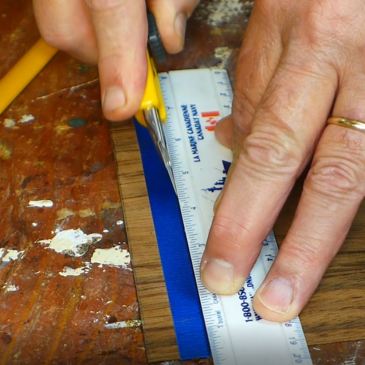
Painter’s tape is used to ensure that the ends are not damaged during the cutting of the veneer.

Cutting the veneer

An artist’s or carpenter’s blade is used. Ensure it is good and sharp, you don’t want the blade pulling on the veneer as you cut.

Gluing the veneer to the trim piece

Depending on the bonding strength of the hide glue you have a limited amount of time to secure the veneer in place.

Clamping the veneer to the trim strip

Have plenty of clamps large and small on hand.

Attaching the veneer strip to the case

Once the veneer is attached to the trim piece and allowed to dry for 24 hours it is time for gluing and clamping the right and bottom border strips to the case.

Step III- – the shellac finish

Once the case has dried for 24 hours the shellacking can begin. I use an artist’s brush for the application of shellac using long and even strokes. For larger areas, one might opt for a French polish technique which is essentially a piece of cloth shaped into a ball and wrapped into another piece of cloth and dipped into the shellac. The main idea is to dip and apply the shellac using smooth even strokes.

I generally apply 2-3 coats of shellac, and between coats smooth the surface with 4-zero steel wool.

Final thoughts

I am certainly not the foremost expert in veneer repair but along the way, I have mastered the fundamentals. Each project offers its unique challenges and this one was no exception.

I was somewhat surprised that after cleaning the left and right trim pieces and shellacking both that the right side and bottom trim piece were somewhat lighter than the left side. However, the new pieces added to the right trim section matched quite nicely. This shows up more dramatically in a photograph. But I think the lighting had a lot to do with the contrast. The light and shadows of the clock combined with the sun coming in from the right side of the clock seem to make the difference more pronounced.

The final result

It is also possible that the right side was tinted to match at one time and cleaning removed the tint. Comparing it to other ogee clocks in my collection for some there is a slight variation from side to side and top to bottom but not as striking as on this clock case.

Light source from the left, the contrast is not as striking

At the end of the day, I am pleased with the final result. I would imagine that in time the new or lighter sections of the case will darken somewhat.

I can now add it to other Canadian clocks in my collection.

Hamilton Clock Co. ogee – a dull and tired case needs help

Should antique clock cases be refinished or rejuvenated? It can be a judgement call. I am all for patina and preserving an old clock case but there are times when certain amount of intervention is practical from an aesthetics and resale point of view.

There is a certain philosophical argument among collectors who believe on the one hand that any intervention is sacrilegious while others feel that some amount of intervention may be necessary to preserve an antique clock.

Auction photo

I won this Hamilton Clock Company 30-hour ogee clock at auction in the spring of 2022 and only now have had a chance to work on it.

I was not specifically looking for a 30-hour ogee as I have 6 already (and who needs another 30-hour clock) but as this clock was made in Hamilton Ontario, Canada it is special to me as adding Canadian clocks is a prime goal as a collector.

Auction photo showing the lower acid etched tablet

A brief history

The company was established in 1876, after the failure of the Canada Clock Company (version 1) in Whitby, Ontario. Using a new factory building and the original production machinery the second company, the Hamilton Clock Co. was formed by three principles, James Simpson, George Lee, and J. F. Collins.

The Hamilton Clock Company made a valiant effort to provide clocks for the Canadian market, in competition with the huge U.S. clock factories in Connecticut that already dominated the market. 

Ogee clocks were manufactured at Hamilton, and these were identical in construction to those that had been made at Whitby with veneered pine cases. After four years the company went bankrupt but was shortly resurrected as the Canada Clock Company (version 2), again using the same Hamilton production facilities. Clock production ended in the mid-1880s and it was not until a new Canadian-owned clock company emerged in 1904 (the Pequegnat Clock Co.) in Berlin, Ontario that Canadian-made clocks resumed production.

It is tempting to group the three companies into one, but the design focus of each company separated them from each other, the early company focused on 30-hour movements and simply styled mantel clocks while 8-day wall clocks and more ornate mantel clocks were a feature of the later company.

The case

Yes, it is dulled and tired and it has had a rough life. These clocks are handed down from one owner to the next and in the process they undergo changes. Some of the changes are reversible and some are not. Luckily this clock can be revived and brought back to life.

There are veneer losses, particularly on the two upper corners and the trim strip along the right side. The bottom strip is missing completely. So the challenge is to replace missing veneer with new and old stock but the end result is not always perfect.

Let’s see what I can do with the case.

Clock prices – a great time to buy despite crazy inflationary times

Inflation seems to be everywhere. The continuing decline in purchasing power is reflected in increased prices on almost everything.

The other day my wife and I bought a container of spray from a garden store. We thought the price was high at almost $25 but when we got to the cash, the clerk charged us $6 more. We showed her the sticker price and she said it was old stock and the computer had already adjusted the price for the new stock coming in. I understand supply chain issues and rising fuel costs but a 25% increase is a bit much. We argued and did not pay the extra $6. Needless to say we will not be buying that product again.

Everything seems to have risen in price as a result of inflation except perhaps antique and vintage clocks!

I don’t actively pursue high end clocks so, there could be movement price-wise for rare and highly collectible clocks but not for garden variety antique clocks. This completely anecdotal but I have been observing the clock market for some time and I do not see a lot of change in prices and if you are into buying and selling clocks this is not a great time to make a profit. Perhaps one day in the future but I believe that day is far off.

$12 cottage clock, unrestored

So, it has been a buyer’s market for the last number of years and it doesn’t look like things will change any time soon. There are many great bargains to be found everywhere and it doesn’t take much looking.

$40 Chauncey Jerome 30-hour ogee

Antique and vintage clocks have flooded the market in the past several years with prices tumbling even further downwards. The new generation of millennials have little interest in antiques and find it pointless to collect antique and vintage clocks. Their loss is our gain, meaning those of us who appreciate the finer things in life.

In addition, modern homes do not have the room for clocks as floor and wall space is limited. In an age when families are living in 800 square foot apartments space is at a premium though there is a hint that things could change as the migration from dense cities to smaller communities continues.

When space is at a premium grandfather clocks or any clock occupying floor or wall space are not items many would consider as necessary for the modern family home. Sentimental reasons aside, the cost of servicing far exceeds the value if the desire is to have a working clock.

$75 Junghans Crispi wall clock

Of course, I don’t have a crystal ball but judging from prices in the past few years I can comfortably predict that things will continue to be much the same this year and next. I do not expect a significant change in the months to come and that $20 bargain clock you discovered today at a flea market will not be worth much more next year.

It is a buyer’s market and there are some terrific bargains out there. Knowledge is power and no doubt there are some great clocks to be found but shop carefully and do your research.

Clocks won at auction – at a fair price

I never actually went to this auction but participated online. It is not quite the same as the rush of bidding in a live auction hall but exciting in its own way.

This particular auction had quite a number of clocks but I would say that most were in rough or what I would call “hobby-ready” condition.

I was looking at one particular clock but three more grabbed my attention. A total of four clocks, two shelf clocks, and two wall clocks.

My budget was $300CDN and I stuck to it. I set the maximum I would pay for each item and placed all bids within the last minute of the auction and walked away from the computer. For two of the clocks, I was prepared to let them go if bidding got too high but at the end of the day I won all four. With fees and taxes, the final invoice was $379 (a little over $300US and 240BP).

Bidding online is always a gamble. What the photos reveal does not always tell you what you are getting and I have been surprised more than once. I have a number of other photos from the auction but these are a good representation.

Hamilton Clock Co.

30-hour Ogee clock

Clock number one is a 30-hour weight-driven ogee made by the Hamilton Clock Co. based in Hamilton, Ontario in the late 19th century. This was a clock I was anxious to have since I am in the process of building a small collection of Canadian-made clocks.

I have one other clock from The Hamilton Clock Co., a 30-hour time and strike steeple clock, and one from the Canada Clock Co., a 30-hour time and strike cottage clock.

I am grouping the two companies together because one essentially grew from the other and made clocks within the same factory and with the same machinery.

Those two have etched lower tablets as on this new acquisition.

Canada Clock Co. Hamilton Cottage Extra
Hamilton Clock Co Gothic steeple clock

The Hamilton Clock Co was formed in 1876 and went out of business in 1880, a very short run for a clock company, unfortunately. The exact year of manufacture is unknown but I may know more when I receive the clock.

This clock looks like every 30-hour ogee ever made and that was the original intent, a familiar clock style that appeals to the masses. The dimensions of this Canadian-made ogee are very similar to American-made ogees and the movements, though made in Canada, are essentially indistinguishable (minor differences aside) from 30-hour ogee time and strike movements made by a number of American manufacturers of the time.

The clock appears to be intact, has its own weights and the lower etched glass tablet seems to be in fine shape judging from the auction photos but the case will need a thorough cleaning and some veneer work.

Daniel Pratt Jr

Clock number two is a Daniel Pratt Jr which I’d like to call a reverse ogee with a splat top but the splat top is missing.

I have just one Daniel Pratt Jr clock in my collection and it has an early woodworks movement. The older Pratt clock shows what the splat should look like.

Daniel Pratt Jr with woodworks movement
Reverse ogee and “splat

According to the label on which the date 1843 is inscribed, one can assume that this is the date of manufacture, approximately.

In any event, it may have a woodworks movement. There were still a few companies who continued with the cost-effective woodworks movement but by that time the rolled brass plate movements were becoming more common.

The loss of the splat top certainly makes the clock less desirable but it was one of the cheaper clocks in this grouping and, who knows, I might have a splat made, we’ll see.

Label, weights and pendulum bob

The green banding on the upper and lower glass sections looks somewhat suspicious and could have been added later. This clock also comes with weights and what looks to be an authentic-looking pendulum bob.

The lower tablet might just be a card-stock image, again, likely not original but old nonetheless. The dial has some losses but what there is of the case looks good.

Unknown gallery clock

Clock number three is an unknown gallery clock. I have no idea of the maker and cannot even guess. I took a chance and I hope the gamble pays off.

Gallery clock

The auction information describes it as 14 inches in diameter so I am assuming the clock face is about 10 inches or so. The hands look very interesting, the case looks well-made (mahogany?) and the clock definitely has a mid to late 1800s English look.

The centrally located winding arbour tells me that it has a time-only mechanical movement.

Back of the clock

The dial looks to have been redone but I am more curious about the movement inside.

A shot of the movement from the bottom

I am not sure what I am seeing in the photo above. Certainly, a homemade door catch on the left and a large gear (perhaps a mainspring barrel), and cylinder-shaped pendulum bob. Fusee movement? I doubt it. I think it has a conventional spring-driven time-only movement but I will know in a few days.

Six-inch gallery or ships style clock

The last is a smaller gallery, ships, or marine-style clock which is spring-driven with a balance wheel. The speed adjsutment lever below the 12 is the give-away.

It is 8 1/2 inches in diameter (6-inch dial), key wound time-only 30-hour clock with a seconds bit. I cannot even guess who the maker is but could be a Waterbury, E N Welch, or some other American manufacturer.

The chunky oak case needs some attention but with a good cleaning and a coat or two of shellac, it should show nicely. Apparently, it is in working order.

Okay, so, two clock makers I am familiar with and two unknowns. I wonder what surprises await me when I open up the two unknown clocks.

In a day or so we shall see what we get. We are driving down to the auction house in the next couple of days but we will make something of our 3+ hour journey and enjoy the sites, have lunch in Annapolis Royal (Nova Scotia) and do some antiquing along the way.

Dating an Antique or Vintage Clock – Part II

Honestly, an entire book could be devoted to the topic of dating clocks. Some time ago, I published an article titled “How to Date an Antique or Vintage Clock – Part I,” in which I used specific examples from my own collection.

I’d like to explore this topic further, and this post will discuss additional methods for dating an antique or vintage mechanical clock. While there is no one definitive method for dating an antique or vintage clock, there are often clear clues in some cases and more subtle hints in others that can help pinpoint when a clock was made.

Occasionally, the exact month and year are displayed somewhere on the case, and in other instances, the clock by way of serial numbers, date stamps on the movement, style of hands, spandrels, dial design, case design, and so on, establishes the date to within a certain period.

After 1896 foreign clocks (Europe, England) were mandated to have the country of origin on the case, usually on the dial. Any clock made after that date will have the country of origin.

Duration of manufacture

A bit of research into the history of a clockmaker can help you narrow down the timeframe for dating your clock. For instance, the E.N. Welch Clock Company, an American manufacturer, produced clocks until 1903, when it was acquired by the Sessions Clock Company, which continued making clocks until 1970. The E.N. Welch Clock Company made clocks for a 50-year period until its acquisition by Sessions in 1903.

By 1903 German-based clock manufacturer Junghans was the largest clock maker in the world and continued in its quest to bring more companies into the fold. Gustav Becker, founded in the 1860s, and Hamburg American Clock Company, founded in 1883 were absorbed by Junghans in the late 1920s. Although those companies were folded into Junghans in 1926 the Gustav Becker name lived on for another 9 years.

Gustav Becker regulator C.1907, Braunau factory

Clocks with Steel vs Brass plates vs Woodworks movements

Smaller shelf clocks with 1-day (30-hour) wooden movements were produced in fairly large quantities from around 1810 to 1845, after which most clockmakers changed over to brass movements. Wood dials were also popular during this period.

Daniel Pratt woodworks movement with dial removed C.1832-38

By 1860 iron weights were being replaced by springs as the power source, and smaller clocks, many of them 8-day, were becoming increasingly popular. Early American spring-driven clocks used brass springs (late 1830s) until steel became cost-effective.

This information is important for dating a clock because it highlights key transitions in clockmaking technology and design, which can help pinpoint the era in which a clock was made. For example, the use of wooden movements and wood dials can indicate a clock was produced between 1810 and 1845. The shift from iron weights to springs by 1860 helps us understand why spring-driven clocks became popular, which is crucial for narrowing the period of manufacture. Additionally, the switch from brass springs to steel in the early 1840s can provide a more precise date range for early spring-driven clocks.

Understanding these technological changes allows you to make more informed judgments about a clock’s age based on its features.

Brass mainsprings for Manross clock
Brass mainsprings from a Manross steeple clock C.1837

During periods when brass was in short supply such as the World Wars (WWI and WWII), makers often made steel plate movements with brass bushing inserts. However, some companies such as Arthur Pequegnat used either steel plates or brass-plated steel plates throughout their operating years (1902 to 1941).

Steel plates on a Pequegnat time and strike clock

Other clock companies switched to steel as a cost-cutting measure when brass prices were high, not necessarily during wartime.

Screws and nails, chime rods, coiled gongs

In older clocks, nails, and screws were made of iron and hand-forged, with screw heads being slotted. Hand-forged nails can be found in clock cases dating from the earliest examples up to the mid-19th century, after which machined screws and nails started to replace them.

An ogee clock, like this example made by George H. Clark in 1865, was constructed with hand-forged nails.

George H Clark 30-hour Ogee shelf clock

Robertson and Phillips head screws were introduced in the first part of the twentieth century. Since the Robertson head was invented in 1906 and Phillips screw heads only began to be widely used in the 1930s screws of these types found in older antique clocks are later additions.

Since these screw types were introduced in the early 20th century, their use in a clock that dates from an earlier period suggests that the screws were likely replaced or added during a later restoration or repair. Recognizing these screws helps refine the clock’s dating and can provide insight into its history and any modifications it may have undergone.

The first rod gong, a single striking rod, dates back to patent designation DRGM 108469, granted to Johann Obergfell on December 23rd, 1899. The introduction of the rod gong, as opposed to earlier bell or strike systems, represents a key development in the evolution of mechanical clocks, especially in terms of sound quality and the technology used.

Understanding when this innovation occurred can help date a clock more accurately, particularly those with rod gongs, as it indicates they were likely made after 1899. Rod gongs are typically made from a copper or nickel alloy and are press-fitted into a block.

Coiled gong - a replacement?
Thick coiled gong

There are two types of coils: the thick coils, which spiral only a few times and produce a deep, rich tone, and the thinner coils, which spiral many times and often have a higher-pitched, tin-like sound. Thick coils were used well before the mid-1800s. These coils are typically mounted onto a fitting, which is then attached to an iron block. Smaller, thicker coils became more common towards the end of the 19th century.

On the American front, thin wire coils were very common. Some examples had the coil mounted to a dome-shaped base which was said to improve the tone considerately.

Commemorative plaques

Commemorative plaques which display dates are often a good indicator of the age of a clock. However, the clock may have been on a seller’s shelf for years before the date on the plaque. This nevertheless places the clock within a certain range of dates. This photo shows a plaque on a HAC (Hamburg American Clock Co.) time and strike shelf clock.

HAC shelf clock with the date 1926 on a plaque

Type of escapement

Recoil (anchor), half deadbeat, Graham deadbeat, pinwheel, Brocot types are found in older antique clocks while, hairspring, floating balance, lever type escapements are found in newer vintage (less than 100 years old) clocks.

For example, floating balance movements began appearing in mechanical clocks in the early 1950s. The floating balance will tolerate being out of level, unlike pendulum clocks which must be on a level surface, an attractive marketing feature.

This is important because the type of escapement mechanism used in a clock can provide key insights into its age and technological development. Older clocks with recoil (anchor), half deadbeat, Graham deadbeat, pinwheel, or Brocot escapements reflect the horological practices of earlier periods, while newer clocks featuring hairspring, floating balance, or lever type escapements indicate a more modern design, typically found in clocks less than 70 years old.

For example, the introduction of the floating balance in the 1950s was a signifcant advance because it allows for clocks that are less sensitive to being off-level, a feature that made them more convenient for consumers. Recognizing these mechanisms helps in accurately dating a clock and understanding the technological shifts over time.

Sspriral spring for floating balance escapement
floating balance escapement C. 1950

Style of case

The style of the case, such as ogee, box clock, steeple, cottage, or gingerbread, can help date the clock to a specific period.

The style of a clock case can offer valuable clues about its age, as different case styles were popular during specific periods in history. Here’s a breakdown of some common clock case styles and their associated timeframes:

  1. Ogee Clocks: These clocks, named for the distinctive curved, “S”-shaped design of their cases, were popular from the early 19th century, especially between 1825 and 1850 but continued to be made into the 1880s. They typically have a simple, symmetrical shape, often with a painted or paper dial, and were mostly made with wooden movements in the early years.
  2. Box Clocks: This style features a simple, rectangular or square case, often with a hinged door or glass front. Box clocks were common in the early to mid-19th century (1920s to 1940s), with their plain, functional design making them relatively inexpensive to produce.
  3. Steeple Clocks: Steeple clocks are characterized by their pointed, “steeple” shape at the top of the case. This design became particularly popular from the 1840s through the 1870s. Steeple clocks were typically more decorative and were often used in homes and churches, with some having more ornate carvings or decorative elements.
  4. Cottage Clocks: Cottage clocks, with their simple and rustic designs, emerged in the mid-19th century, around the 1840s and 1850s. Often smaller in size, these inexpensive clocks were popular in rural homes. They are sometimes characterized by a more casual, handcrafted appearance, with wooden cases and floral or geometric motifs.
  5. Gingerbread Clocks: This style, which features intricate carvings and decorative elements like scalloped edges, ornate moldings, and small, detailed pieces, gained popularity in the mid- to late-19th century (around 1860 to 1880). Gingerbread clocks are often associated with the Victorian era and were typically mass-produced.

The case style is a strong indicator of the clock’s approximate age because clockmakers and manufacturers often adapted their designs to reflect contemporary tastes. By identifying the specific features of a clock’s case—such as the materials used, shape, and any distinctive decorative elements—you can narrow down the period in which it was made, which can then aid in dating the clock more precisely.

Rare Ingraham Huron found on a local online for-sale site
E Ingraham Huron C.1878

Knowing the period when a case was made provides a reliable indicator of the clock’s age. Although there are earlier patent dates stamped on the movement of this E. Ingraham Huron time and strike 8-day shelf clock, this style of case was made for only 2 years, 1878 to 1880.

Date stamps on movements or cases & searchable databases

Some makers stamp date their movements or display the date elsewhere on the clock case. The Gilbert Clock Company often date-stamped their movements. Sessions put dates on the door labels.

Some makers such as Junghans stamp a date code on their movements. For example, B19 stamped on the back plate of a Junghans movement refers to a movement made in the latter half of 1919.

Serial numbers stamped on movements can be compared to a database to determine the exact year the clock was made. The Ridgeway clock company used 4-digit codes. For example, serial number 4981 refers to a Ridgeway clock made in 1981.

Gustav Becker clocks were made in both Silesia and Braunau factories, both of which produced clocks but each had a unique serial number convention. The serial number on a Gustav Becker clock will give the exact year of production assuming you know where it was made, Silesia or Braunau.

An online databases such as ClockHistory.com provides invaluable information on companies and models made by them, the years the clock company was in business, and how long the company was in operation.

Searchable databases like Mikrolisk, the horological trademark index help date a clock by comparing a trademark. Some companies revise or restyle their trademarks over the years allowing one to date a clock within a certain period.

At Antique-horology.org keywords or text can be used to search trademarks and identify years they were used.

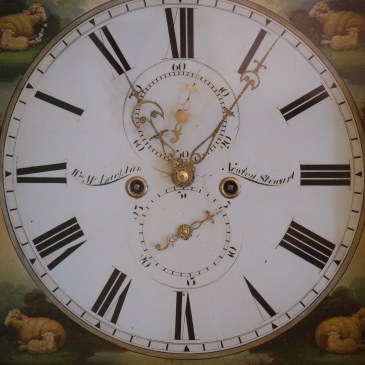
Scottish tall case clock
Scottish tall case clock C.1848

The date 1848 is attributed to the clock above. I arrived at this date because it was made by William McLachlan of Newton Stewart, Scotland. According to an English clock database, Mr. McLachlan was a clock assembler and ran a clock-making business in Newton Stewart until his death in 1848. While the clock could have been assembled as early as 10 years prior, 1848 serves as a conservative estimate.

Other miscellaneous indicators

Plywood began to be used in clock cases starting in 1905. One of the clocks in my collection, a Junghans bracket clock, made around 1913, features a plywood back access door.

Seth Thomas made clocks in marble cases for a short time, from 1887 to about 1895. They also made clocks in iron cases finished in black enamel, from 1892 to about 1895.

Adamantine clocks were most popular through to 1915. Seth Thomas is best known for their “Adamantine” black mantel clocks, which were made starting in 1882. Adamantine is a celluloid veneer, glued to the wood case. Adamantine veneer was made in black and white, and in coloured patterns such as wood grain, onyx, and marble.

Seth Thomas Adamantine clock circa 1911

Final thoughts

My goal for this two-part article was to provide a broad, generalized overview. Each of the sub-topics mentioned above could be explored in much greater detail, and I hope this serves as a useful reference for some of you. I welcome any corrections to the dates, and if there’s anything I’ve missed or other information that should have been included, please feel free to leave a comment.

As I’ve outlined, there are many ways to date a clock—some methods are quite obvious, while others are more subtle and require a bit of research to pinpoint.

For some collectors and clock fans, dating a clock is crucial, as it adds historical context and value to the piece. For others, however, it may not be as important, especially if the clock serves primarily as a decorative item rather than a functional or collectible piece. In such cases, the aesthetic appeal might take precedence over its exact age.

Tick Talk Tuesday #38 – Swigart replacement dial

Tick-Talk Tuesday

Tick-Talk Tuesday is about the letters and comments I have received from readers concerning clock issues, challenges faced, a clock you would profiled or advice on your particular clock concern. For those comments and questions that stump even me, I consult within my clock circles for the best possible answer

GB writes:

Yesterday I pick up another strange clock and the dial has a monogram/mark: EJS, after searching it turns out to stand for E. J. Swigart but that company, from what I read, didn’t make clocks, just replacement parts so am I to assume the clock, images below, has a replacement dial/face? Does it diminish its esthetic value? I was told it is 1840 ogee. Miraculously enough it works!

Ogee clock
Swigart replacement dial

My reply:

You are correct. E. J. Swigart made parts for jewelers and watchmakers but they are best known for their replacement dials. Their logo is often confused with the Sessions Clock Co. or Seth Thomas. Swigart are respected for their dials and their commitment to making them as original as possible. They operated into the 1970s (the trademark was registered in 1896). I don’t believe it would diminish the value of your clock, after all, the replacement dial might be over 100 years old!

GB writes back;

Splendid! Thank you again. Your help and advice are priceless. 

Traditional shellac may provide the ideal finish for your antique clock

Traditional shellac may provide the ideal finish you are looking for when deciding whether or not to finish that newly acquired antique clock.

A modern polyurethane finish is not a substitute for traditional shellac. Polyurethane is tough and easy to work with but not reversible. Unfortunately, many people resort to using modern finishes on antique and vintage clocks because they are easily available, simple to apply, and cost-effective. However, in order to preserve the authenticity of a clock when the finish must be addressed, traditional methods are the best course of action.

Modern vintage clocks will often have a lacquer finish but for much older clocks shellac is the finish that would have been used at the time it was made. It is the best finish for most antique clocks. Shellac has been around for ages, began to be used extensively in the early 19th century, and remains a preferred wood finish to this day.

What is traditional shellac and how is it made?

What is it, exactly? Shellac is a resin secreted by the female lac bug on trees in the forests of India and Thailand. It is processed and sold as dry flakes and dissolved in alcohol to make liquid shellac, which is used as a wood finish.

Shellac flakes

Traditional shellac is preferred over canned shellac. Canned Shellac does not produce the same results and has a limited shelf life. Traditional shellac also has a limited shelf life but you need only prepare a little at a time. If you have no access to shellac flakes, check the expiry date on the liquid shellac can before using it.

Instructions for making shellac

Advantages

Shellac is non-toxic with no fumes, and it’s safe for surfaces children and pets will be exposed to. It is easy to work with because it dries very quickly and can be applied by spraying or brushing. Intervals between coats can be a little as 15 minutes or less depending on the cut. Shellac also provides a hard finish and doesn’t yellow like varnish. If you must make repairs on shellac, you can simply apply a new topcoat of shellac over the old finish to get rid of scratches or blemishes. It comes in a variety of colors and can be stripped off wood surfaces with alcohol. Shellac does start to deteriorate after it sits in the alcohol mixture for a period of time.

Disadvantages

Heat softens the shellac, so it is best if you avoid putting anything hot on or near the surface. If someone sets a glass down, the condensation may leave a white ring especially if the finish has a higher wax content. Having said that I don’t think many would put anything hot on a clock case although it is best to avoid heat sources, radiators, space heaters, etc.

Preparation and application

I use a 1 lb cut which is an 8 to 1 mixture, that is, 1 oz of flakes to 8 oz of denatured alcohol or commercially sold Shellac/Lacquer thinner. The instructions on the photo above describe the different cuts. The shellac dries very quickly and many coats can be applied in a relatively short period of time. I generally allow about an hour between coats, again depending on the cut.

Shellac comes in a number of shades but amber shellac, which I prefer, employs a warm glow to the finish. I will use either a broad artist’s brush or a French polish to apply the shellac. Each has its advantages. A ball fashioned out of terry cloth is the most effective method of applying shellac. French polishing consists of building up layers of shellac. Moisten the pad in shellac, wipe off the excess and apply in long strokes. A brush, on the other hand, is better when getting into tight spaces and wood cases with a lot of detail. Either way results in a glossy surface, with a deep colour.

Shellac thinner from Lee Valley

400 grit sandpaper is used for rougher sections prior to the first application of shellac. A damp cloth is then used to clean off the residue from sanding. Allow drying. After the first and subsequent application of shellac, 0000 steel wool is all that is required to rub out any imperfections.  Repeat the process two times and allow for drying time between coats.

Three coats are more than enough. More coats will produce a darker finish if that is your objective. If the finished result is too glossy and unnatural, dull it down with 0000 steel wool until you have the effect you want. However, there may be some situations where one coat is sufficient.

How long does it last?

Shellac in its liquid form has a limited shelf life of about 6 months much like canned shellac. In flake form, and stored properly in a cool dark place, shellac has a shelf life of about 3 to 5 years. I store leftover liquid shellac in a sealed glass container. I would advise against a metal container as the alcohol will react to the metal.

Let’s use my ogee clock as an example

This ogee clock is a fairly recent acquisition. The veneer is in remarkably good shape although the finish was dirty, dull, and lifeless. Many 150+-year-old clocks have missing veneer usually on four corners of the case and the door frame as a result of years of wear and tear but this clock is a rare exception. Veneer repairs must be completed before the finish coat is applied.

Ogee clock as found

Once the movement is out of the case I lay the case on its back to begin the process of cleaning.

After cleaning the case and one application of shellac

Murphy’s Soap is an excellent cleaner. Some may react to Murphy’s soap and a suitable alternative is Dawn or similar dish detergent. I use a light coloured cloth so that I can visualize how much dirt is being removed. Quite often the old shellac finish has worn off but if there is old shellac left there is a good chance it will be removed during the cleaning process. This is unavoidable particularly if the objective is deep cleaning.

Following the cleaning, 400 grit sandpaper is used for rougher sections. Clean off any residue with a damp cloth and wait for the finish to dry. Sandpaper is optional as I find it unnecessary in some situations.

Shellac is applied to the clock case while on its back using long broad strokes from an artist’s brush or a French polish pad. To avoid an overly glossy finish and maintain the light tone of the case one coat is all that is required as in the case of this ogee. Finally, 0000 steel wool is used to lightly “sand” out any imperfections.

To complete the effect Minwax Finishing Paste Wax is applied. It is a quality furniture paste wax that will protect the finish.

A custom test stand for weight driven ogee style clocks

A few weeks back I published an article on clock testing stands. While a single clock stand would be ideal for all movement testing purposes there are so many different types and styles of movements that one size does not fit all.

The one stand I was missing was for testing weight-driven ogee style clocks whether they be 30-hour or 8-day or select clocks that would require a pulley system for the weights.

Aside from an easy setup and quick mounting of a movement for testing it allows me to inspect the movement from all sides

Tall case clock stand

Rather than construct a stand-alone ogee test stand I decided to make it a companion to my tall-case clock stand. Mounting atop the tall-case stand means that it is at the optimum height for making adjustments.

I also wanted something I could easily remove if I needed the long-case stand for testing and it is simple to set up.

Salvaging case parts from an old ogee simplifies the construction of the stand. It can be done without ogee case parts but it means devising a pulley system and making rails with slots for the movement seat board.

The ogee clock was purchased along with three others for $20 but the ogee clock case was in such poor condition it could not be restored.

A movement came with the case which I use for spare parts. The veneer has been harvested and used for other projects. The remaining wood pieces are stored and ready for use in future projects.

The tall-case stand is 48 inches high and will accommodate more than one movement although I generally work on one movement at a time. It is square-shaped and very stable though when used to test grandfather clock movements it is anchored to a wall to eliminate or reduce sympathetic vibration.

The tall-case stand is braced on all sides and the framing around the 4 legs adds additional stability and strength.

Clock stand two rails off
Taking the rails out

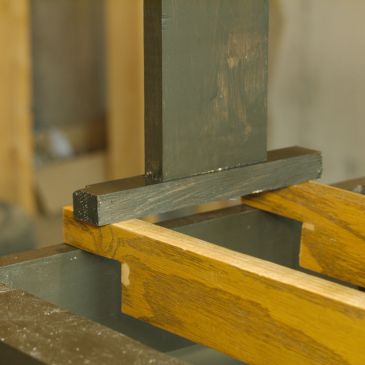
The rails, made of yellow oak, a hardwood, chosen for their strength.

The two pieces I am holding are the oak rails that are designed to fit into the top of the stand and are fully adjustable width-wise depending on the size of the movement.

Close-up of the top

The ogee stand is 10 inches high and has stabilizing rails under each side that rest on the oak rails. There is a cross brace in the front and back to give it strength and lateral stability. The top from an old ogee case is ideal because the pulleys are in the correct position for the weights.

The rails easily take the weight of a 30-hour movement which is about 7 1/2 lbs total. Will it take the 13 lb+ weight of an 8-day ogee? Yes. There is no need to screw or nail the ogee stand to the oak rails as the combined weight of the movement plus weights are enough to anchor the stand in place.

Test stand rest on the two rails

I painted the stand to match the tall-case stand.

I chose Espresso latex paint because it does a great job of hiding my carpentry errors.

Testing the time side of a Waterbury ogee movement

Aside from an easy setup and quick mounting of a movement for testing purposes it allows me to inspect the movement from all sides.

It works as expected and now I can use the stand instead of the case for testing.

I know there is another ogee clock in my future!

Chauncey Jerome 30-hour movement – two unusual issues during servicing

I was not really looking for an ogee clock to add to my collection. But there it was sitting in a lonely corner of an antique shop calling me, “buy me”; and I did.

It is probably the oldest one in my collection of 4 other ogee clocks. It was made in or about 1845. Now, being old does not necessarily make it valuable. In fact, millions of these clocks were produced and many found their way to online auction sites in recent years contributing to a huge drop in value. You can find them online for a little more than I paid for mine but they are pretty cheap nonetheless. This one was $54.

As found

The case label located on the backboard inside the clock case was printed by John Benham in 1845. Comparing the movement in this case with one found on a popular Jerome database site tells me that it is a type 1.311 Jerome movement. Jerome movements were typically marked though some, like this one, were unmarked which is not unusual.

So, the case and the movement are near enough in time to tell me that the movement is very likely original to the case. That is always a good sign as many ogee cases had worn movements replaced over the years. In some cases, there was little intertest in matching the maker of the case to the movement especially if a customer’s only wish is to have a working clock and since the movements were interchangeable it made it that much easier. Many of these clocks are over 180 years old and one can expect some subtle and not-so-subtle changes over the years.

While very attractive and running well this clock (below), a “marriage”, is an EN Welch case with a Waterbury movement. When considering the purchase of an ogee clock, if it is important to you, check that the movement and case are from the same maker though that is not an absolute guarantee they started their lives together.

EN Welch and Waterbury marriage

What is original and what has been replaced?

Typically parts that have been lost/damaged or replaced over the years include the verge, suspension spring/leader, the pendulum bob, the weights, the hands, and case parts like pulley dust caps. In some cases, the lower tablets have been removed altogether because of breakage or severe paint loss, replaced by a clear glass panel, a mirror, a photograph, or a picture (often from a discarded calendar).

The leader and suspension spring are missing. The verge appears to be a replacement, the weights look original as do the hands and pendulum bob. There is a missing top movement block that secures the movement to the backboard and that is about it.

I am reserving judgment on the frosted glass tablet; it may or may not be original. It would be pretty exciting if it were a Fenn design but I doubt it. William Fenn was one of the more prolific tablet-makers of the mid-19th century. The dabs of red paint are certainly added later.

The clock dial, likely original, is signed C. Jerome below the twelve o’clock.

Assessment of the movement

This is a typical 30-hour or one-day time and strike movement.

I found some wear and I was expecting some past repairs. There is a repair date of 1863 on the inside of the access door but I can’t make out what was done at that time.

There are two bushings installed on the front plate, the second wheel, and the hour gear. On the back, there are four replacement bushings, evidence that it has had acceptable servicing. One seldom finds replacement bushings on an ogee clock. Most movements I have come across have punch marks around the bushing holes, a common practice by past clock repairers to close elongated holes.

Type 1.311 Jerome movement

Three of the replacement bushings will have to be redone and new bushings are required for the back-plate time side main wheel and the strike side back-plate main wheel for a total of five.

The pressure washer for the time side main wheel is completely worn out. Had I not separated the wheel and ratchet for cleaning I would not have discovered the problem but it tells me that it could fail at some future point.

To the right is the pressure washer with centre worn through

I have a donor New Haven 30-hour movement that will provide the replacement washer.

The lantern pinions have some wear but are quite acceptable. One trundle is loose on the escape wheel. Rather than take it apart and re-seat the troublesome trundle, a dab of Loctite Red should fix it in place.

These are two unusual issues but not insurmountable.

A lantern pinion with a loose trundle

Because the movement was so oily and dirty I pre-cleaned the parts prior to putting them in my ultrasonic. This helps extend the life of the solution. I used a medium bristle nylon brush to clean the stubborn areas.

After cleaning and drying the parts, the pivots are polished and I was pleased to find almost no wear on any of them.

Next is the bushing work. My only concern was pushing out what remained of the bushing material in the replacement bushings after drilling. I went slowly and did not apply pressure on the cutter, letting it do its work. As I suspected the Bergeon bushings are marginally smaller but each bushing fit snugly. Although I planned on five bushings, I installed six, adding a bushing for the second wheel on the time side front plate which was a little more worn than I thought. I left the escape wheel as-is, the wear is acceptable.

Next is restringing the weights, re-assembly, and testing. All went as expected.

I have worked on a few of these movements over the years but unique issues always seem to come up. Nonetheless, they are fun to work on.

Following the movement servicing, I will move on to refreshing the case.

Circa 1845 Chauncey Jerome Ogee Clock

An ogee clock is so-called because it is a 19th century U.S. shelf clock with a distinctive S-curve (convex above and concave below) molding.

30-hour ogee clocks were very popular from the early 1840s to as late as the 1890s, a good run for a distinctive style of clock. Before the days of the Internet, these clocks fetched hundreds of dollars at auctions houses and antique stores. Along came eBay and prospective buyers quickly learned that large numbers of these clocks were produced in their day and the supply of clocks flooded the net and prices dropped accordingly. I have 5 ogee clocks among my collection of over 100 clocks and have never paid more than $60 for any of them.

Of course, there are exceptions to the rule. The distinctive case has housed movements other than the 30-hour time and strike commonly found and some are quite desirable. Fusee, single weight 8-day time-only, calendar models, minis, Gesso fronts, 8-day time and strike clocks, and a few unusual ones have good value.

As found

30-hour clocks are worth collecting and if you a new to clock repair, they are a great clock to begin your journey.

This is a Chauncey Jerome 30-hour or one-day clock from about 1844-1845 and based on my research, the movement is from the same period. So, an excellent chance that the case and movement started life together. The pendulum bob looks very old and hard to say if original as pendulums often go missing during a clock’s life. But I’m not sure a modern pendulum bob would have similar detail.

Original (?) bob cleaned with Brasso

The dial is in good condition with attractive Gesso spandrels although the Jerome name under the twelve is barely readable and the chapter ring has faded. The moon hands also look original and the clock came with the correct weights. The mahogany veneer, while very dirty is almost flawless.

The name Jerome is just readable

Not original is the strike bell as the clock would have had a coil gong. The suspension spring and leader are missing. A top wooden block that attaches the movement to the case is also missing and the label, printed by John Benham, though readable, has some losses. The suspension spring and leader can be easily sourced, the block fashioned from old stock and I have a spare Jerome style coiled gong in my parts bin.

30-hour unmarked Jerome movement

The tablet design did not look original at first glance but after removing a piece of cardboard (first photo) and Christmas wrapping paper behind the glass I discovered a frosted tablet with thistles and flowers. The red paint might have been added and it is very possible that it was not painted originally.

Original tablet?

The plan is to service the movement, source missing parts, and refresh the case.

I am not a strong believer in maintaining the original patina which one reader opined is just another word for dirt. The case will be cleaned with Murphy’s Soap and a coat of shellac will be applied.

Original materials and techniques will be used when working on the case. This includes the use of traditional shellac (flakes mixed with shellac lacquer), and fasteners like old slot head screws, old wood, and square nails. The replacement coil gong is very similar to other Jeromes I have seen and will come out of a donor ogee case. There are a few stray pieces of label at the bottom of the case that will be glued back in place.

John Benham label is in rough shape

There is not a lot of demand for ogee clocks today as reflected in their asking price. Perhaps the 30-hour ones are considered a hassle for some as they must be wound once per day, nevertheless, I find them very appealing.

Coming soon will be an article on servicing the movement and later on, refreshing the case.

Chauncey Jerome 30-hour ogee has stopped – the trouble with trundles

My Chauncey Jerome 30-hour Ogee weight driven time and strike clock has stopped for no obvious reason. Let’s see if we can get it going again.

Chauncey Jerome 30 hoir Ogee clock
Chauncey Jerome 30-hour Ogee clock

But first, no-one can deny that Chauncey Jerome had made a historic contribution to the American clock industry in the 18th century when he substituted brass works for wooden works and was said to be “the greatest and most far-reaching contributor to the clock industry.” Although he made a fortune selling his clocks, and his business grew quickly his company ultimately failed in 1856.

After researching Mike Baileys excellent site on Jerome clocks I was able to determine that my clock is a number 11 Ogee made just before the Jerome bankruptcy, 1855. The patent 30-hour brass movement is the number 1.314 which is likely in its original case.

C Jerome 30 hour movement testingin the case
C Jerome 30 hour movement testing in the case

The only time I serviced the movement was in February 2018. It was dirty as expected and it appeared that no work had been done for quite some time. It was well worn. At that time 8 bushings were installed, 4 in the front and 4 on the backplate. Most of the wear was on the strike side and lower in the trains.

C Jerome movement right out of the case in 2018

It ran very well for 3 years and now (May 2021) it has stopped.

Preliminary checks

I performed the usual checks prior to taking the movement out of its case. I inspected the time-side cable for kinks and that it was not binding. A binding cable will definitely stop a clock. It was fine.

I checked the crutch loop clearance and found nothing seriously amiss. It should have run. It did not.

While it was running I noticed that it was drifting in an out of beat and it ran no longer than a minute or so before stopping. This indicates a number of issues; a bent escape wheel teeth, damage/wear to its lantern pinion, a bent escape wheel arbour or an enlarged pivot hole. I suspect the last one is the culprit.

The strike side is fine and it is functioning as it should, but without the time side running correctly the clock is just an ornament.

Next, taking it out of the case

I checked it over and determined that the movement required two new bushings, one for the escape wheel bridge and the other for the hour wheel in the motion works. I did not have a multi-level bridge tool when I serviced this clock the first time three years ago so, it came in very handy. The hour wheel pivot hole looked fine then but now there is enough wear that it justifies being done. I checked the escape wheel arbour and it was straight.

Ingraham Grecian
Multi level bridge tool

With those two wear issues addressed I put the movement back together for testing and assumed that the clock would run. Unfortunately the clock stopped after less than a minute. Something else was amiss.

The trouble with trundles

I adjusted the beat but still nothing. I noted where the second wheel, time side, was stopping as it would stop about every eighth of a turn. Since the second wheel gear teeth are in excellent condition, it could only be one thing, worn trundles in the escape wheel lantern pinion that prevent the second wheel from meshing correctly with escape wheel.

Lantern pinion on escape wheel

As you can see in the above photo the trundles are in terrible condition and there is little doubt that this is what stopped the clock. Wear such as this cannot be ignored. Without a repair the clock will not run.

Trundles are often replaced by drilling out the shroud end where the trundles are inserted, taking the worn trundles out, replacing them with new ones made from pivot wire and staking the holes to ensure they stay in place. On this escape wheel the cap must be removed to access the trundles. This is common on ogee movements such as this and it means a different approach for the repair.

End cap for lantern pinion

I secured my crow’s foot to my bench vice, inserted the top cap of the lantern pinion into the V part of the foot and gently tapped on the pivot end to release the cap. It released easily. The trundles should have literally fallen out but two of the 6 were firmly in place and had to be cut and drilled out. Not fun.

crows foot

I have a good assortment of pivot wire, selected a .95mm wire for the trundles and cut each one to length with a Dremel cutting disk.

I used a hollow staking tool to push the cap back in place and the trundles into their respective holes but the cap was loose. This is when Loctite is your best friend. Using a toothpick I dabbed a small amount onto each end of the trundles, secured the trundles in place and waited 24 hours for the Loctite to cure.

The next day for testing purposes I left out the strike side levers and wheels.

On the test stand the movement ran a couple of 30-hour cycles and the issue has now been addressed. The remaining gears and levers were assembled into the movement and the movement was placed into the case for a final test of both the time and strike side.

It should run reliably for years to come.

From time to time a repairer will have to deal with worn trundles.

New trundles made from pivot wire

If a clock stops and there is a gear meshing issue, then it is time to replace the trundles but if they are a little worn and the clock runs well, I tend to leave them as-is knowing that at some future date if the clock stops it is one of many issues I will address.

I have mentioned this before but if you are just beginning your journey into clock repair, the 30-hour ogee, because of the large gears, the overall simplicity and the absence of mainsprings make this a great place to start.

George H Clark Ogee clock – movement and dial work

One cannot deny the classic style of an American Ogee clock. This one is in great shape and required almost nothing to get it to top form. 30-hour shelf clocks are abundant but not many cases survive years of wear and tear.

Dial removed to show the 30 hour movement

This George H. Clark 30-hour shelf clock is a very good example of Connecticut form. The case form is called an “og” or “ogee”, a mathematical term that describes the “S” curve shape in the primary molding that surrounds the door.

The clock has a brass time and strike, weight driven movement with an excellent original printed paper label on the interior reading in part “Made and Sold at/46 Courtlandt St/New York…. George H. Clark”. It measures 28 x 17 x 4.5”. This rectangular shaped case is decorated with nicely grained mahogany veneers. The veneer has very little if any losses.

The dial face

The upper section of the door is fitted with clear glass. Through this one can view the painted wood dial. The wood dial tells me that it is an early pre-1850 clock. This dial is formatted with a Roman numeral time track.

It is always a challenge matching 100+-year-old paint but by combining white. brown and yellow acrylic paint I was able to approximate the original colour. Some Roman Numerals were touched up with black acrylic paint.

The wood dial before touch-ups

And after numerals and face given a matching paint; you can see the difference in the number 4

I also glued two small blocks under the left and right “L” pins to centre the dial correctly.

The door is open showing the gong coil and the pasted label in very good condition

The lower section features a beehive painted tablet. The tablet is a replacement but fairly close to what would have been there at the time.

Beehive design; not original but in keeping with the style

Observations regarding the movement

The movement looks like an early (unmarked) Waterbury, ca. 1860 type 2.411. Waterbury movements have “quarter-round” corners, while most other ogee movements tend to have the “tombstones” or plain rectangles. The movement could have been swapped but It is difficult to tell.

A clean Jerome style movement

Everything except the movement points to a period between 1840-50. If the movement is a replacement it was likely an early replacement.

30-hour movements will run surprisingly well with horrible pivot wear. However, regarding repair, my view is this: I do not normally install new bushings in every single pivot hole on the movement. If a bushing hole is passable I will leave it as-is but if the hole is quite oblong I will install a new bushing to mitigate potential gear meshing issues in the future.

Addressing the movement

I will also ignore some past repairs. For example, in this particular movement I noticed 4 punch marks around the escape wheel bridge pivot hole. As most clock repairers know using a punch to close a pivot hole was an acceptable practice many years ago though it is not considered a good practice today. In this particular case, the pivot hole was in good shape and I decided to leave it as-is. After assessing the movement further, I installed one bushing on the second wheel front plate strike side (S2) and the second on the second wheel strike side rear plate (T2). Just two bushings. As to the three lantern pinions, they were in very good condition.

Reassembly was routine. The time side ran fine.

Adjusting the strike side was not easy and should have been a simple procedure. The problem was not only correctly positioning the warning pin on the fly but ensuring that the warning hook lever could actually meet the warning hook. The levers in this clock had been bent every which way making it a real challenge to find the correct angles. It did not strike correctly before servicing. Trial and error combined with colourful language certainly helped correct the strike.

The finished clock

The gong block and coil were also cleaned up. Tip; it helps to put the same screws back in the same holes. Seems trivial but it is a good practice. Not all screws are the same.

Gong block removed and cleaned

Little time was spent on this clock and I was fortunate to have an almost perfect case. The previous owner knew how to take care of the case but the movement neede work. When many of these clocks stopped they simply became decorations but I am sure that this one will run reliably for many more years to come.

Website Powered by WordPress.com.

Up ↑