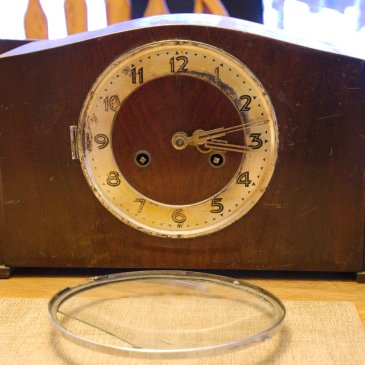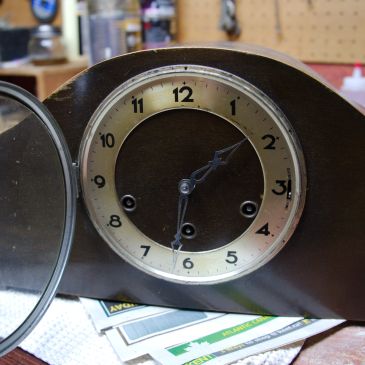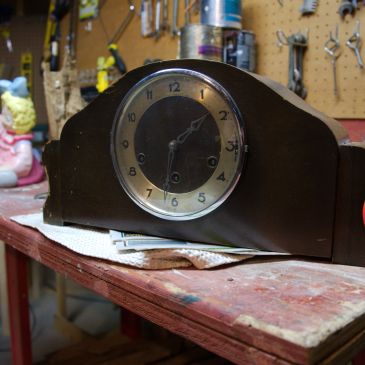
The example is a Fleet time and strike mantel clock from the 1930s. Fleet Time Company of Montreal, a company that was operating four short years, sourced movements from Germany prior to the Second World War. It was a very common mantel clock sold through department stores across Canada.
I like the step side design and the general simplicity of the clock.
Fleet Time case, refinished
The case was in need of refreshing but the movement looked to be in reasonably good condition and required a good cleaning and I was expecting some wear.
The movement was completely serviced with several new bushings installed. The mainsprings were removed, cleaned, and returned to their barrels.
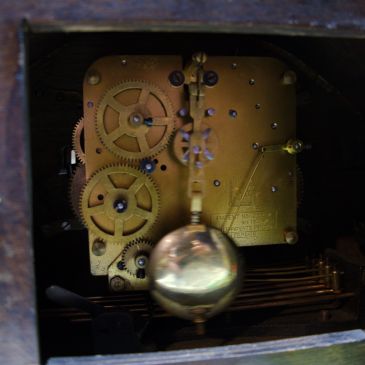
Fleet time movement
In this movement, the mainsprings can be removed without disassembling the movement, handy for such things as replacing a broken mainspring assuming, of course that nothing else has been damaged.
During the testing phase, the mainsprings were partially wound. The intent was to see if the clock would run well. Once satisfied that the movement was running as it should I returned it to its case.
I wound the strike side fully and then wound the time side. Just as I was feeling resistance, CLUNK, the arbour turned freely. If it was a broken click or broken mainspring, either one could easily be replaced.
It has nothing to do with the force of winding a movement. Having a mainspring go bad with winding force from a key is rare, in my view.
But mainspring barrel teeth do not simply fall off.
Fleet time barrel
At times it is a mainspring but sometimes something far worse occurs.
It is not uncommon to find secondary damage to the movement, secondary or collateral damage due to the extreme shock that broke or bent the teeth and teeth cannot be straightened.
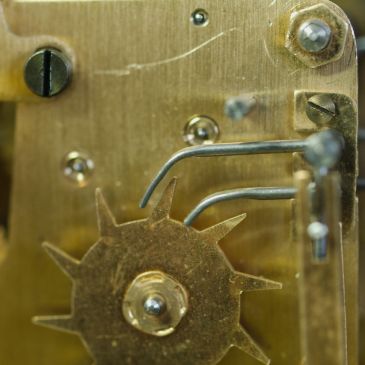
The main problem area beyond the barrel itself will be the second wheel and possibly the third wheel arbors, leaf pinions and pivots and/or damaged or missing teeth on the second and third wheels and bent or broken pinions.
Fleet second wheel, a bent leaf cannot be unbent
Is it fixable? Yes, but weighed against the value of the clock, it is just not worth it. It is much more cost effective to harvest parts from another movement.
Given the right equipment, it can be repaired. Once repaired a mainspring must be sourced and although the barrels may be identical, the mainsprings will likely be different.
The solution is locate a donor movement. In the meantime the clock has been put aside.
This Fleet Time mantel clock is a generic mantel clock with a walnut finish, flat front, a slightly domed top, and step-side features. Simple but attractive. Fleet assembled clocks sourced from German parts in the Montreal area for 4 years prior to WWII.
While the case looks great after refinishing, I was oh so close to having a fully functioning clock when disaster struck.
This is a call-out for anyone who can sell me or donate a replacement movement or otherwise direct me to where I can locate one. I am in need of a mainspring barrel and second wheel on the time side. As much as possible I would like it to be exactly the style of movement that came with the clock.
Fleet Time case, refinished
My clock passion is collecting clocks made or assembled in Canada and I would love to see this clock in working order
Fleet second wheel, a bent leaf cannot be unbent
Here is my story
The movement looked to be in reasonably good condition but needed a good cleaning.
Fleet time barrelFleet time movement
The mainsprings can be removed without disassembling the movement, handy for such things as replacing a broken mainspring.
The movement was completely serviced with several new bushings installed. The mainsprings were removed, cleaned, and returned to their barrels.
Through the testing phase, the mainsprings were partially wound. Once I was satisfied that the movement was running well I installed it back into its case. I then wound the strike side fully and then wound the time side. Just as I was feeling resistance, CLUNK, and then the arbour turned freely.
Hoping it was only a broken mainspring I was not prepared for what I discovered when I opened up the movement. There were three broken/bent teeth on the mainspring barrel, a broken mainspring, and a damaged leaf pinion on the second wheel.
Broken mainspring
When a mainspring breaks at the teeth end of the barrel it tries to unwind but the loose end provides sufficient resistance, that is, a slower release of the energy, and is less likely to cause major damage. A broken mainspring results. A break at the winding arbour end or close to it as in this case results in the sudden release of energy and the result is damage not only to the mainspring but clock parts up the train; this is known as collateral damage.
A clock colleague advised me that although the barrel teeth and leaf pinion can be fixed it is usually not cost-effective because the process is so time-consuming. His solution is to collect movements that are used as donors for times such as this.
The plan, at this point, is to source a donor movement and harvest parts for what I hope would result in a successful repair.
So, here I am asking if anyone has a spare movement they can part with.
My clock passion is collecting clocks made or assembled in Canada and I would love to see this clock in working order.
The time has come to determine the best clock acquisition of the past year. As a clock hobbyist, I have had little difficulty locating interesting clocks over the years, and despite the seemingly never-ending pandemic, I have scored a few in 2021 though the past year has been leaner than most.
In the early days of collecting, simple time and strike vintage mantel clocks were my principal focus so that I could take them apart, repair them if necessary, and generally advance my learning. Many of those clocks have been either sold or gifted. For the past three years, I have shifted my focus toward collecting interesting clocks, rare clocks, or clocks that have a special provenance that even includes the odd mantel clock.
My wife is my best clock finder. Our discussions often go something like this; “did you see that wall clock on Facebook?”. “Let me see. Yeah, it looks good, what do you think? Make an offer?” and off we go. Sometimes I will accept the offer from the seller without negotiating because I feel it is a fair price and other times there is some wheeling and dealing prior to firming the sale.
At the end of the post, you will have an opportunity to vote on what you think is the best in 2021.
In no particular order, here are my finds for 2021.
Sawin banjo clock
This is a garage sale find and even though it was purchased in the spring of 2021 it is still a work in progress. The clock is over 180 years old and in pretty decent shape.
Sawin weight driven banjo clock
It is a weight-driven banjo but it has no markings. An educated guess is that it was made by John Sawin of Boston or one of his associates on or close to 1840. I have completed minor veneer work on the case and have replaced the broken glass dial. The movement has been serviced but I am now looking at clock parts supply sources to replace a badly bent suspension spring. I want to avoid paying an outrageous price for the complete assembly; suspension spring, leader and spike.
Gilbert mantel or Shawville clock
I call this the Shawville clock because it spent most of its life in Shawville, Quebec (Canada).
It was a family clock for many years and following a death in the family, all possessions were either sold off or given away, a very common practice today. It has a time-and-strike Gilbert movement in a mahogany tinted case that has led a kind life since its manufacture in 1917. It is simple and unadorned and that’s what I love about it. I serviced the movement, cleaned the case, replaced a broken hour hand and now it is on prominent display in our home.
Gilbert time and strike
New Haven tall-case clock
An interesting $90 acquisition is this New Haven tall-case clock with a secret. Wow, a tall-case clock for $90, you say. Despite the look of a weight-driven clock, it is, in fact, a spring-driven clock. I was unaware of this until I walked through the door of the seller. I bought it anyway.
New Haven tall case clock
The weight cans are empty shells and they are simply there for show. The movement is quite large, eight-day, of course, and looks to be very robust. Despite my best efforts to determine if it was originally weight driven it had to have been spring-driven from the start, in other words, no evidence of a seat board or any additional holes for mounting the movement to the case. This appears to be an early “kit clock”, i.e. movement, dial face, hands, pendulum, “weights”, and ladder chains bought from the New Haven Clock Company and fitted to a pre-made case.
The case was very dark from years of accumulated dirt and grime and vigorous scrubbing revealed a wonderful red oak finish.
Waterbury Wren mantel clock
Ansonia Syria
Another clock with a secret is actually a disappointment. I found it in an antique store and it reminded me of an Ansonia Syria I had worked on for a friend last year, so, I was drawn to it.
Waterbury Wren mantel clock
It has a Waterbury case and what I thought was a Waterbury movement, but no.
It is missing the brass bezel and glass which is easily replaced but what is most disappointing is the mismatched movement, a Seth Thomas time and strike, which obviously replaced the original movement presumably because it was worn out. The movement is well-made and runs well but at the end of the day, the clock is destined to be sold.
Schatz Schatz carriage clock
This is a Schatz carriage clock made by August Schatz and Sohne of Germany. Thousands of these were sold and given as gifts through the 60s and 70s. It has an interesting lower visible escapement and an exposed movement.
Schatz carriage clock
Although it is working and keeping time it runs for about 4 days and stops. A cleaning is called for (on my list). It has a wind-up key in the back much like a typical alarm clock. It says West Germany on the dial and made, I would say, in the 1970s. August Schatz and Sohne closed in 1985, a victim of slow sales and a shift to quartz clocks by other makers.
Chauncey Jerome ogee clock
This clock is original in many ways, with a nearly flawless case made of mahogany veneer over softwood, moon hands, a wood dial, and a movement that matches when the case was made. Even the pendulum bob looks original. It was missing the suspension spring and rod and a wooden movement block, all easily sourced.
Chauncey Jerome 30-hour ogee clock
It cleaned up nicely and was a good candidate for a fresh coat of traditionally prepared shellac. I have three other 30-hour ogee clocks and this one is the most original of the bunch.
E. Ingraham Grecian shelf clock
This is a very nice shelf clock from an estate auction. It is an Ingraham Grecian clock with an alarm feature. If you have ever used the alarm on an old antique clock your first impulse is to throw it through a window, it is so loud and it goes on and on till the spring winds down.
Ingraham Grecian 8-day shelf clock
It came with incorrect hands and I had the darnedest time sourcing them but searching various suppliers in Canada and the US paid off. The case has been cleaned and the movement serviced including the infuriating alarm.
Fleet Time Co. mantel clock
An inexpensive clock that had huge potential but left me frustrated. Fleet Time Co. of Montreal had a short life of 4 years before the Second World war when they lost their source of German movements.
Fleet Time clock
I stripped the case and re-glued some sections, applied a walnut stain and I was very pleased with the final result. I serviced the movement, wound the time side completely, and BAM, kerplunk! the sound of a mainspring exploding. Sometimes you can get away with just replacing a mainspring and other times, like this, it took out the barrel teeth and a leaf pinon on the second wheel. I placed it in a plastic bag and it is now on a shelf in the basement awaiting donor parts.
Hamburg American Clock Company. (HAC) mantel clock
This German-made mantel clock has an interesting 14-day movement, an early production type from HAC. HAC is short for the Hamburg American Clock Company, a German company which had a long history up to the time it was absorbed by Junghans in the late 1920s. This clock was made in or around 1895.
HAC 14-day mantel clock
It was another estate sale find. The case is nondescript and nothing special, but quite elegant.
So…..
Tell me what you think and I will reveal what I believe is my best acquisition this year in the next post. Let’s see if we agree.
The Fleet Time Co. was a short-lived Canadian clock company that operated between the years 1936 and 1940 producing a range of two and three-train mantel clocks with movements sourced from Germany. All clocks had pendulums and were spring-driven. According to the Canadian Clock Museum in Deep River, Ontario, the company was listed as an importer of clocks and watches. The locations were 440 McGill and then 303 St. Paul West, Montreal (Canada).
The Second World War took a heavy toll on this company as the source of movements dried up and so the future prospects of this small company. Why they did not source movements from France and Germany like the Forestville Clock Co. of Toronto and others during the war years and beyond is anyone’s guess. Perhaps the margins were slim or alternate suppliers could not be found. That and the increasingly popular electric clock doomed the company.
Wood cases were made in Canada for some models while other cabinets were imported from Germany.
Of the two Fleet clocks in my collection one is this two-train clock with an unknown German movement and the other a Westminster chime mantel clock with a German Gufa movement. For more on the Gufa clock go here.
This clock is in much the same condition as my first Fleet clock, dents, gouges and scratches everywhere. Unfortunately, the tinted lacquer finishes on these old clocks do not survive well over time. It is one reason they attract little attention and sell for almost nothing despite having movements that are relatively strong runners.
Fleet Time time and strike mantel clock, broken glass
It is a plain, generic mantel clock with a walnut finish, flat front, a slightly domed top, and step-side features on outboard feet. The dial is heavily tarnished and the glass bezel that should be soldered to the chapter ring has detached. These bezels often go missing. At least it came with the clock.
Fleet time movement
The clock strikes on 3-rods producing a bim-bam sound, just loud enough so as not to be too intrusive.
The location of the star striking wheel on the movement is somewhat unusual. Commonly found between the plates, the star wheel is on the outside of the rear plate.
Damaged Fleet Time barrel
As I have said in a previous articlethe barrel and second wheel on the time side were damaged during servicing. I don’t know who the maker is and I would appreciate any information to aid me in my search for a donor movement. The case has been reconditioned, with the addition of a dial and bezel from an old Blackforest Clock Co. clock.
Fleet Time case ready for repaired or replaced movement
It is a nice piece of Canadian horological history that I would like to see running.
About a year ago I picked up two clocks. I had my eye on one, an Arthur Pequegnat Canuck shelf clock, and the other was “thrown in” as part of the deal. We completed the transaction on the Pequegnat clock and the seller asked me if I wouldn’t mind looking at a mantel clock stored on a shelf in his garage. He said, “for $10 more you can have this”. I did not know the make at the time but for $10, why not! It was in sad condition as you can see in the next photo.
Fleet clock with a worn finish
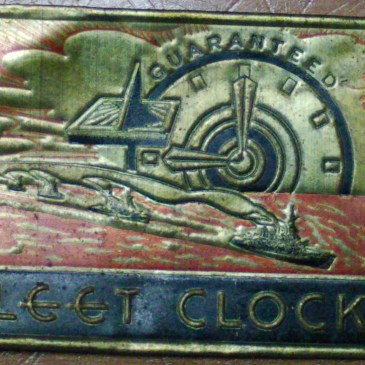
A tin plate affixed on the back of the clock told me what it was made by the Fleet Time Company of Montreal (Canada).
Many of these clocks were sold at department stores across Canada during the pre-war (WWII) era. However, this little-known Canadian clock company had a brief life span. Between 1936 and 1940 the company produced a range of two and three-train mantel clocks with movements sourced from Germany but were forced to end their operations when the war began.
Fleet Time Co. label
The Second World War took a heavy toll on this company as the source of movements dried up and so did the company’s fortunes.
Wood cases were made in Canada for some models while other cabinets were imported from Germany.
Servicing the movement
I had completed work on the case a few months ago and now it is time to service the movement.
3 train Fleet movement by Gufa
The clock has a Gufa Westminster chime movement. Gufa is the Guetenbacher Uhrenfabrik, located in Gütenbach, Germany. They manufactured 400-day clocks, cuckoo-clocks and later they became the “Jahresuhrenfabrik” (August Schatz & Sons in Triberg, Germany). Gufa is not a name horologists come across very often in North American. There is a chime gear patent date number ending in 34 which likely refers to the year 1934 indicating manufacture between 1935 and 1939. It is a solid, well-built movement.
Assessment of the movement
I had replaced the time mainspring shortly after I bought the clock but I knew that I would eventually have the movement on the workbench. As is typical of German clocks of this period in that the mainspring barrels can be removed without dismantling the movement, so, replacing the time mainspring was an easy fix.
The clock was running, though not well. On the fourth or fifth day, the chimes (and strike) would stop though the time train would soldier on a few days more. Wear issues on the strike and chime train had to be addressed.
I disassembled the movement, put the parts into the ultrasonic cleaner, and discovered afterwards that the plates had been lacquered. With the ultrasonic heat setting on, the lacquer stripped off but not uniformly. As it is a $10 clock I am not concerned about aesthetics.
Fleet movement wheels tied together according to location
To eliminate the chance that I would mix up the wheels for the 3 trains, I tied each set together. Once out of the ultrasonic cleaner I untied them and placed them in their respective trays. Westminster chime movements have similar-looking gears in the three trains and it is best to separate them to avoid frustration during re-assembly.
After inspecting the movement I determined that new bushings were required on the second wheels plus the motion works arbour. Three of the second wheels on the backplate, one bushing for the strike side second wheel front plate, and one for the motion works for a total of 5 new bushings; not bad for a 3-train movement. These are the typical wear points on three-train movements as the second wheels handle the greatest load.
Bushing work
Once the pivot holes were pegged out and the wheels rechecked in their locations, the bushing begins. Aside from the second wheels, most other pivot holes were in good shape. I don’t often use bushings with an outside diameter of 4.50mm but this movement required 4 in total. All bushings had to be reamed out with a cutting broach followed by a smoothing broach. All wheels were test fit with the plates together and things looked good.
Reassembly
Next is reassembly. With so many wheels it is a bit trickier than a two-train movement but it is important to work slowly and carefully to avoid a bent pivot. Once the wheels are positioned, test each train to check that everything is in place. After the nuts are tightened, the remaining parts such as the locking plate, chime locking lever, warning lever, rack snail, mainspring barrels and so on are installed/attached.
Testing
Of all movements, three trains are the most difficult to set up correctly. Although all three trains spin independently they are interconnected by levers. In order for everything to function in unison, careful attention must be paid to the job of each lever, what it does and how it performs its function every 15 minutes.
Gufa movement, front plate showing rack, snail, levers, and so on
Everything went fairly smoothly. Both the strike side and chime side go into warning as they should, the locking plate stops the chime at each quarter-hour including the hour, which is a good sign the locking hook on the chime train is in the correct position.
Gufa movement on the test stand
The chime strike lever is, however, sticking on the strike warning pin. Without taking the movement apart I used 1600 grit memory paper to smooth the hook end surface where it meets the strike warning wheel pin. The polishing allowed it to function a little better but continued testing revealed that that solution did not work. I finally had to remove the chime strike lever and polish the hook. the polishing was successful.
The next issue is the strike paddle which is ending the strike sequence hanging off one of the star points. The plates on the strike side must be opened up and the paddle repositioned. For safety reasons and to preserve the mechanism should things go awry, the power is let down on all mainsprings. Adjustments such as these come with the territory as nothing should be expected to work perfectly the first time.
Gufa movement, the upper wheel is the main chime wheel
After the aforementioned adjustments are made, next is the chime sequence and that means loosening the set screw for the main chime wheel and rotating the drum till the quarter strike is at the 1-2-3-4, the beginning of the sequence.
Once the adjustments have been made it is back to the test stand.
Okay, my strike paddle adjustment did not work but in the meantime, the testing of the movement proceeded and everything looks very good at this point. I will give it a few days and return to re-adjusting that paddle.
Everything is working now.
I’ll be honest, 3 train movements are not my favorite type to work on for 4 reasons. One, they often need major work only after a few years. Secondly, it is often not enough to install new bushings for worn pivot holes lower in the trains but to address other worn holes up the trains, as well. Thirdly, they are labour intensive and finally, except for modern movements, parts are almost impossible to find.
In many cases, certainly as far as a modern Hermle is concerned, it is often more cost-effective to simply replace the movement rather than repair it.
This Fleet Time, time and strike mantel clock is essentially a plain, garden variety clock with a walnut finish, flat front, a slightly domed top, and step-side features on corner feet. The dial is heavily tarnished and the glass bezel that should be soldered to the chapter ring is detached. These bezels often go missing and at least this one came with the clock.
The clock has some issues, none of which are insurmountable. The plan is to refinish the case, attach the bezel, clean-up the dial or replace it, install new glass, and service the movement.
In this post servicing the movement is the focus.
The movement looked reasonably good when I received it and it may have had some bushing work done in the past but once apart it was clear to me that it might never have been worked on beyond a cleaning. It ran when I got it and one is tempted to leave it as is but it was dirty, had some wear and long overdue for a good cleaning.
Servicing the movement
Fleet time movement
Disassembly and testing for wear
I discovered two troubling issues when I had it apart. I put the wheels together to check for wear and I noticed the escape wheel was a fair distance along the arbour from its correct position adjacent to the leaf pinion (no photos, sorry). The pallets were contacting the very edge of the wheel. My staking set comes in handy from time to time and it was needed to close the gap between the wheel and the pinion.
staking set
Using light taps from a hammer and an appropriately sized punch I drove the wheel closer to the pinion. The pallets now contact the middle of the wheel as they should. Odd!
Fleet time movement, dirty and in need of a good cleaning
The second was an erratic beat during the testing phase of the time side. With a beat amplifier connected, I could hear the movement go ever so slightly in and out of beat, yet the movement continued to run. There are a number of possibilities but one is a bent escape wheel arbour which, in this case, was the culprit. Bent arbours are not difficult to straighten but care must be taken to bent them carefully so as to prevent a break. A broken arbour can be a very frustrating clock problem.
Once the 2 issues were out of the way it is on to cleaning the parts, inspecting and polishing the pivots, pegging the pivot holes, followed by bushing work. Most of the bushings that were installed were on the strike side. In fact, 4 of six, 3 on the backplate and one on the front plate, strike side, and the two on the time side were on the second wheel. Two were 2.5 OD bushings. I work on a lot of American and European clocks and cannot recall using bushings that small.
Testing
After cleaning and bushing work is completed the rack, snail, levers, and strike hammers/levers are attached.
Since the star wheel is on the outside of the plate I thought attaching the strike hammers would be simple. Not so much!
Fleet Time movement, star wheel paddles
Again as in all movements with star wheels, the strike paddles must sit between the star points. One was fine, the other hung on the tip of a point. Rather than attempt to force the star into position, the strike side was partially disassembled and the star wheel was re-positioned. Yes, it meant removing wheels on the strike side to change the orientation of the star wheel but it is best to do it correctly rather than risk damage to the gear.
On this movement, the mainsprings can be removed without disassembling the movement. Handy for such things as replacing a broken mainspring and making the above adjustment.
Fleet time movement
The movement was on the test stand for two eight-day cycles and now it is time to return it to its case.
Just when everything seemed to go well – disaster
I polished the 3-rod gong and mounted it and the movement within the case. I wound the strike side fully and then wound the time side. Just as I was feeling resistance, CLUNK, and then the arbour turned freely. Did the mainspring slip off the winding arbour or, did the mainspring break?
Sourcing a mainspring is not a problem but when I removed the barrel I discovered two broken and one bent tooth on the mainspring barrel plus a broken mainspring. Make that three broken teeth since a bent tooth cannot be straightened.
Broken and bent teeth
I do not have the specialized equipment to make and install new teeth and sourcing a 60 tooth barrel that is the exact height and depth would be a challenge. Worse, the catastrophic shock of the broken mainspring took out one leaf of the second wheel pinion.
When the mainspring breaks on the arbour end, which occurred in this case, the power is released uncontrolled, and causes damage to the barrel, the second wheel or both. When the mainspring breaks at the other end it tries to unwind and the loose end provides sufficient resistance, that is, a much slower release of the energy, and is less likely to cause major damage. In the latter case the mainspring is the only thing that is damaged and it can be easily replaced. In the former, both the barrel and second wheel need to be repaired or replaced.
This is an unusual situation, but it happens.
Fleet second time wheel with bent pinion leaf which cannot be straightened
The movement was aside to consider next steps. In the meantime, the plan is to locate a donor movement. The power was let down on the strike side, and everything was placed in a sealed plastic bag and marked for storage.
I’ll be honest, this situation bummed me out and it took a week to return to servicing another movement.
The clock case
The plan, after servicing the movement, was to devote a separate post on the case but since the movement is non-functional there is not much point. While the movement was on the test stand, I spent hours on the case, stripping, finishing, and polishing including swapping out the dial and broken glass with one from a Blackforest clock from the same period (both companies used the same suppliers). The case came out better than expected but now there is no movement to put in it.
Fleet Time refinished case and replacement bezel and dial
The most disappointing part? I was at the very end of the project. The movement and rod gong were installed in the beautifully reconditioned case and I was preparing it for its first run after having tested it for two weeks. I did not expect it to go out with such a destructive bang.
Broken time-side mainspring
I asked a clock friend for some advice. He says that although the barrel teeth and leaf pinion can be fixed it is usually not worth it because the process is so time consuming. “What do you do?”, I said. “I collect movements that are used as donors for times such as this”, he replied.
2020 was a very trying year for us all and I suppose that applies to clock collectors generally when it comes to acquisitions. Despite the pandemic, I managed to purchase a few clocks though obviously, not as many as in other years.
The contenders for the year are clocks from Solar, Junghans, Sessions, Arthur Pequegnat, and Fleet, leading up to the big winner of the year, a Scottish tall case clock.
Solar
First on the list is an attractive German-made Solar time and strike mantel clock, sold by the Eatons Department store chain in Canada during the 1960s and 70s.
Solar mantel clock, 1965
It has a Hermle type 141 movement and strikes the half-hour on a bell. It was a non-working clock when I bought it for $20 but it was simple enough to service and now runs like a charm. I will likely sell it locally for a few dollars more.
Junghans bracket clock
For $40 I could not possibly go wrong with this bracket clock even though it was a non-working clock and need some serious TLC. I serviced the movement, refreshed the case, polished the brass, added new feet and the clock now occupies a prominent location in my family room.
Junghans time and strike bracket clock, 1911
Sessions 3W electric clock
The diminutive Sessions desk clock has a Synchron motor (60 cycles per second) and the only repair is to replace the plug. I like the simplicity and style. It has some issues consistent with an 87-year-old electric clock but it is in pretty good shape for its age.
Sessions desk clock, 1934
Arthur Pequegnat
Next is an Arthur Pequegnat Canuck time and strike gingerbread or kitchen clock as it is otherwise known. This was another inexpensive find, $50 on an online for-sale site, and for $10 more, another clock completed the deal.
Arthur Pequegnat canuck, inset shows the dial before restoration, 1918
I spent a considerable amount of time on this clock, refreshing the case, inpainting the dial, and refurbishing the movement. I was very satisfied with the results and this clock will join my collection of 7 other Arthur Pequegnat clocks. A nice find for a very good price.
Fleet Time Company
Next is a Fleet Westminster chime mantel clock from the late 1930s, made by the Fleet Time Company of Montreal. Fleet assembled clocks for 4 short years before World War II sourcing movements from Germany with locally made cases. It is the $10 clock that was combined with the deal above.
Fleet Westminster time mantel clock, 1937
The clock as received
I refurbished the case and replaced the time side mainspring but did nothing to the movement except re-oil it. The case was completely stripped down to the bare wood followed by the application of a medium oak stain and a clear satin topcoat. This is a lovely mantel clock with a rich Westminster chime and I will probably keep this one in my collection since it was assembled in Montreal and represents a small but important piece of Canadian horological history.
McLachlan tall case clock
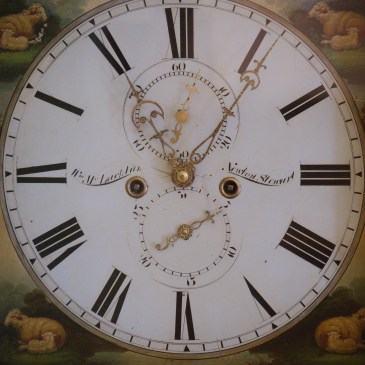
Finally, let’s come to my prize for the year, bought at a live auction in February 2020, a Scottish tall case clock assembled by William McLachlan of Newton, Steward in 1848. Completely restored were the dial, movement, and the case, which required extensive structural repairs.
Scottish tall case clock, 1848
With an English bell strike movement, tall, stately mahogany case, beautiful hand-painted dial and heavy 13 lb weights, this clock has a commanding presence in my home. If you have ever heard the sound of an antique bell strike clock you will understand that is it as loud as it is because it was designed to echo through a stately Scottish manor. It is a conversation piece and those who have seen it marvel at its condition and age.
Despite a difficult year, I was pleased with my purchases. I am confident that 2021 will be a better year for me as a clock collector and a better year for us all.
While refreshing the case of this relatively nondescript mantel clock assembled by a short-lived Canadain clock company I ran into two interesting surprises.
Here is a garden-variety vintage Westminster chime mantel clock from the Fleet Time Company of Montreal (Canada). Many of these clocks were sold at department stores across Canada during the pre-war (WWII) era. However, this little known Canadian clock company had a brief life. Between 1936 and 1940 the company produced a range of two and three-train mantel clocks with movements sourced from Germany but were forced to end their operations.
The Second World War took a heavy toll on this company as the source of movements dried up and so did the company’s fortunes.
Wood cases were made in Canada for some models while other cabinets were imported from Germany.
This particular clock has a Gufa Westminster chime movement and I assume most of their 3-train clocks had a similar if not the very same movement. Gufa is the Guetenbacher Uhrenfabrik, located in Gütenbach, Germany. They manufactured 400-day clocks, cuckoo-clocks and later they became the “Jahresuhrenfabrik” (August Schatz & Sons in Triberg, Germany).
Rather than advertise the maker, many Fleet Time clocks simply had the word “Foreign” stamped on the movements.
This is a clock that could easily have been thrown in the garbage and I am fairly sure that is where it was headed. While I was in the city of Halifax (Nova Scotia, Canada) to pick up an Arthur Pequegnat Canuk kitchen clock the seller took me into his garage, pointed to a clock sitting on a shelf, and said. “for $10 more you can have this one”. “Why not”, I said!
Refinishing the case
I thought I would tackle the case first. While the front of the clock looks okay, the finish on the side sections were down to the bare wood plus scratches on top really detracted from the general appearance of the clock. It was a real mess. On top of that, the left side shoulder section was completely detached and had to be re-glued. Hot hide glue was used for this repair.
The finish was badly worn on both sides
Surprise #1
Rather than reproduce the dark lacquer finish I chose to sand the case down to the bare wood to see what lay beneath. To my surprise, I discovered a nicely grained, and beautifully textured grain. Enhancing the veneer with a light walnut stain is the way I chose to go because I did not want to go as dark as the original finish. Special Walnut, which has a light tone is perfect for the case and if I did not like it I could apply a darker walnut stain over it later.
Choosing the right stain; part of the case is still drying off from a wipe down with a damp cloth
The special walnut is very pleasing to the eye.
Special walnut stain
And the top of the clock.
Top of clock
After two coats of stain (above), here is the result.
After two coats of stain and two coats of shellac
The Special Walnut stain produced a very pleasing result. I applied one more coat of shellac, let it dry, and topped it off with Minwax Polishing Wax to produce a satin finish. Not the finish that came from the factory but it wlooks good.
Surprise #2
After cleaning the chapter ring, polishing the chrome bezel I was ready to return the movement to its case but what I should have done was test the movement beforehand.
When I received the clock I confirmed that the strike and chime functioned as they should and I assumed the time side was fine.
Broken mainspring which is not reparable
I inserted the winding key into the centre arbour and found no resistance. Hmm!
On these movements the barrels can be pulled out without disassembling the movement which certainly simplifies repairs. I pulled out the barrel, popped the back cap off, and discovered a broken mainspring. Using needle-nose pliers and heavy gloves, I pulled the mainspring out with for closer examination. No part of this mainspring is reusable and a new one must be ordered.
Occasionally when a mainspring breaks it takes a few other components with it like broken teeth, broken leaf pinions or bent arbours referred to as collateral damage. I inspected the gear teeth, pinions and arbours on the time train, gave the wheels a few spins and found everything moved smoothly, so, no damage this time. The broken mainspring is the only issue keeping this vintage mantel clock from striking and chiming again.
Mainsprings care easily sourced from a clock supplier. I waited until I built up a list of supplies for other projects then submitted the order online. German and American mainsprings are best and avoid those made anywhere else particularly India.
The movement was placed in a plastic bag along with nuts, hands, screws etc. and stored safely away until the mainspring arrived.
Two weeks later
Two weeks later, out come all the parts from storage.
Using my Olie Baker spring winder and mainspring retention collar I installed the mainspring into its barrel.
Fitting the barrel back into the movement involves moving the strike rods out of the way which is a bit of a pain, then, the barrel slides into a channel on the plate. The movement was returned to its case and the hands attached.
Fleet Time Westminster chime
The strike hammers were re-positioned for the best possible sound and my guess is that the clock is running and chiming for the first time in many years. As of this writing, it has completed a number of 8-day cycles. And to top it off, it looks great!
Let’s see, $10 for the clock $19.50 for the mainspring and less than a few dollars for stain, glue, etc. A satisfying project combined with a piece of Canadian clock history.
In light of current world events the antiquevintageclock.com family wish to convey our sympathy and condolences to those effected by Covid 19
Here we have a nondescript mantel clock from the Fleet time Company of Montreal. This little known Canadian clock company had a short life between the years 1936 and 1940 producing a range of two and three-train mantel clocks with movements sourced from Germany. All clocks had pendulums and were spring-driven. According to business records, the company was listed as an importer of clocks and watches. The locations were 440 McGill and then 303 St. Paul West, Montreal (Canada).
The Second World War took a heavy toll on this company as the source of movements dried up and so the future prospects of this small company (information obtained from the Canadian Clock Museum, Deep River Ontario). One wonders why they did not diversify and source movements from France and Germany like the Forestville Clock Co. of Toronto during the war years.
Wood cases were made in Canada for some models while other cabinets were imported from Germany.
Gufa chime movement
This clock has a Gufa movement and one can assume most of their 3-train clocks had this movement although some movements are marked “Foreign”. Gufa is the Guetenbacher Uhrenfabrik, located in Gütenbach, Germany. They manufactured 400-day clocks and cuckoo-clocks and later they became the “Jahresuhrenfabrik” (August Schatz & Sons in Triberg, Germany).
Battered company plate, simply says “Fleet Clocks”
Close-up of foil plaque
The movement does not work because the time side mainspring is broken. The case is in bad shape and I am not sure how I will proceed but it is beyond simply cleaning, touching up and polishing. At this point, the only option is stripping. I am always reluctant to strip the finish from an old clock unless it is the only option. In any event, the case will be a late spring (2020) project.
The case needs a lot of work
This is another Canadian clock added to my clock collection although the fact that it was assembled and sold on Canadian soil is its only real qualification.
You must be logged in to post a comment.