Unravelling the Various Names of the grandfather clock

The tall clock that may be gracing your hallway or living room belongs to a bygone era. That sense of history and tradition seems to be missing in our modern world. In an era defined by fast-paced technological advancements and fleeting trends, the tall clock stands as a reminder of an earlier era when craftsmanship and longevity were paramount.

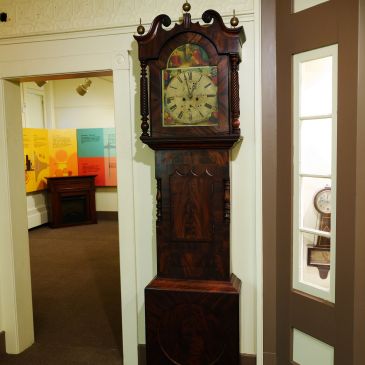
A grandfather clock

The Grandfather Clock

A tall case clock is commonly referred to as a “grandfather clock” due to a story that dates back to the 19th century. The term “grandfather clock” is said to have originated from the song “My Grandfather’s Clock,” written by Henry Clay Work in 1876. This song tells the tale of a clock owned by the songwriter’s friend, and it played a significant role in popularizing the term.

Henry Clay Work was an American songwriter and composer known for capturing the spirit and emotions of the time. His greatest hit was “Marching Through Georgia” in 1865, a cheerful marching song.

The lyrics of My Grandfather’s Clock narrate the story of a long-case clock, or a tall case clock, that belonged to the songwriter’s friend’s grandfather. The clock worked perfectly throughout the grandfather’s lifetime but stopped working when he passed away. The song’s lyrics reflect the sentiment that the clock’s ticking was synonymous with the grandfather’s life, and the clock’s stillness upon his death was seen as a representation of his passing.

Over time, this sentimental and catchy song contributed to the popularization of the term “grandfather clock” as a synonym for a tall case clock. The term stuck, and now, tall case clocks are commonly referred to as grandfather clocks in many parts of the world.

Scottish tall case clock
Scottish tall-case clock

Tall Case and Long Case Clocks

However, horologists generally prefer using the terms “tall case clock”, “long case clock” or hall clock instead of “grandfather clock”. The difference in terminology between “tall case clock” in America and “long case clock” in England primarily arises from regional linguistic variations and historical usage.

  1. Tall Case Clock (America): The term “tall case clock” is commonly used in the United States to describe this type of clock. This name emphasizes the clock’s design, which features a tall, vertical case that houses the clock’s movement and the pendulum. The term “tall case” is descriptive of the clock’s physical appearance, highlighting its height and elegant proportions.
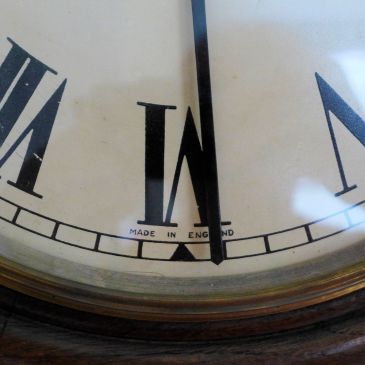
  2. Long Case Clock (England): In England, the term “long case clock” is more commonly used. This name also relates to the clock’s appearance, particularly its elongated and vertical shape. The term “long case” emphasizes the clock’s form, again highlighting its height and the distinctive design of the case. On the other hand, a Long case Regulator (Chronometer) is a precision clock known for its accuracy. It often features a simpler, more functional design with a focus on precision rather than ornate decoration.
Clock (Chronometer) (1941) by William by National Gallery of Art is licensed under CC-CC0 1.0

The names simply reflect different ways of describing the same type of clock. Over time, these regional differences have become firmly established.

Hall clock (image by Openverse)

The Hall Clock

The term “hall clock” is also used in some parts of the world as an alternative to “grandfather clock,” “tall case clock,” or “long case clock.” This term, “hall clock,” emphasizes the placement of the clock in a hallway or entrance hall, which is a common location for these impressive and stately clocks.

While the “hall clock” might not be as widely recognized or used as the “grandfather clock” or “tall case clock,” its origin and usage can be traced to the same concept of describing these tall, freestanding clocks with long cases.

The term “hall clock” is descriptive and straightforward. The term continues to be used in some contexts, particularly in regions where the emphasis is on the clock’s placement and role within the home.

Tall Clock by The Metropolitan Museum of Art is licensed under CC-CC0 1.0

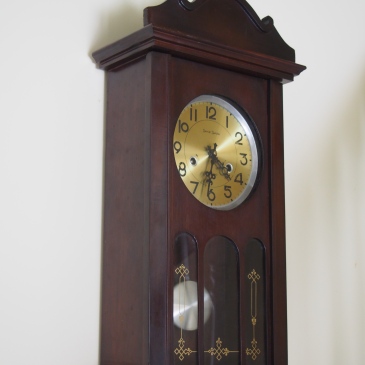
The Grandmother Clock

And lastly, a “grandmother clock” is a type of clock that is smaller than a “grandfather clock”.

Similar in design and functionality to its larger counterpart, the grandfather clock, a grandmother clock typically features a pendulum-driven movement enclosed within a vertical wooden case. The main distinction between a grandmother clock and a grandfather clock lies in their size. Grandmother clocks are generally shorter than grandfather clocks, standing around 5 to 6 feet tall, making them more suitable for spaces with limited room.

Despite their smaller size, they often retain the same elegant appearance and decorative features as their larger counterparts.

The term “grandmother clock” is less commonly used than “grandfather clock,” but it serves to describe this intermediate-sized clock that is more compact than the towering grandfather clock.

Different Phrases Express the Same Concept

The various terms used to describe this type of clock—such as “grandfather clock,” “grandmother clock”, “tall case clock,” “long case clock,” and even “hall clock”—all refer to the same basic type of clock: a freestanding weight-driven device with a tall vertical case housing the clock movement and pendulum.

The Therapeutic Art of Clock Repair in Retirement

Engaging in a fulfilling hobby like clock repair and restoration can offer immense benefits for the soul, especially during retirement. Horology provides a respite from life’s pressures and allows individuals to use their time constructively.

Working on a time-only movement

Here are several compelling reasons why having a hobby like clock-making is invaluable for retirees and those approaching retirement.

Boosts self-esteem

Each small achievement in pursuing the hobby leads to a sense of accomplishment and success. These positive experiences build a strong foundation of self-confidence, which can be applied to handle other life challenges effectively.

Learning the components of a chiming movement

Eliminates boredom

Hobbies prevent boredom and deter individuals from indulging in destructive behaviours. Rather than spending hours mindlessly watching TV, constructive engagement with a hobby brings immense satisfaction and rewards.

Broadens perspective

Engaging in a hobby fosters continuous learning and personal growth. Taking on new challenges opens up fresh perspectives, facilitating personal development and resilience in overcoming adversity.

Promotes youthful vitality

Hobbies contribute to brain health and help maintain cognitive abilities, making them a valuable investment in both present and future well-being. Cultivating hobbies early in life ensures lasting benefits, much like a wise investment.

Examining a rusty time and strike movement

Integrates with other interests

Hobbies can be beautifully combined with other passions, such as photography, travel, or writing. This harmonious integration enhances the overall experience and enriches life’s journey.

Sparks curiosity and interest

Having a unique and captivating hobby, like collecting historical clocks with intriguing stories, makes one more interesting to others. Sharing these experiences enthralls attention and sparks engaging conversations.

A clock hobby is more than the movement

Provides stress relief

A hobby becomes a refuge in trying times, offering solace from the world’s stresses. It creates moments of tranquility and relaxation, promoting overall mental well-being.

Learning new techniques

Break Problems Down to improve problem-solving abilities

When confronted with a complex problem such as a complicated three-train movement, break it down into smaller, manageable parts. This approach allows you to analyze each component separately, find solutions more effectively and promote personal growth.

A feeling of satisfaction when things work correctly after servicing a movement

In challenging times, the dedication and effort invested in a hobby like clock repair and restoration bring immense joy and fulfillment.

It’s never too late to explore new hobbies and discover one’s own oasis of happiness and relaxation during retirement.

A clockmakers lament: The Decline of Antique Clock Collecting in a Modern World

Recently, my sister, who was an avid antique collector, confided in me that she has given up her passion. When I asked her why, she explained that there’s no one to inherit her collection and appreciate its value. She lamented that her son might end up melting down her cherished sterling silver collection for cash after she’s gone.

German bracket style clock by HAC

This got me thinking about the younger generation’s lack of interest in preserving the past, especially when it comes to antiques like clocks. While my three children have shown some interest in a few of my prized timepieces, when have departed this earth most will probably end up being auctioned off for minimal prices, which saddens me.

Ogee clock C.1876

However, this trend of disregard for preserving history isn’t new. I recall a trip to Boston in 2019, where my wife and I listened to a play at the State House about a slave’s connection to the John Hancock family. Despite its historical significance, the original Hancock house had been torn down in the 1860s, showing how past generations also failed to recognize the importance of preserving such landmarks for the future.

Scottish tall case clock C.1848

Part of the problem may be that the mechanical clocks that held nostalgic value for my generation are not present in the homes of today’s youth, except for iconic pieces like Grandfather and cuckoo clocks. Before my time, mechanical clocks were discarded in favour of electric ones when they wore out, further disconnecting younger generations from the charm of antique mechanical timepieces.

Trying to gift a mechanical clock to a millennial often leads to the response, “Thanks, but I have no space for one.” It’s evident from visits to antique stores or clock fairs that the average age of visitors and traders tends to be on the older side, reflecting the dwindling interest in these historic items among the youth.

Table clock C.1875

As a consequence, many valuable clocks are being sold for considerably low prices, despite the high asking prices seen on online selling platforms. With the current trend, it’s likely that clock prices will continue to decline for years to come.

The disinterest in preserving the past and the declining value of antique clocks are issues that continue to plague our society. While some special interest clocks may still hold value, the overall market for antique timepieces seems to be on a downward trajectory and it doesn’t look like that will end in the foreseeable future.

Perhaps it’s time for us to cherish and appreciate these pieces from the past before they become forgotten relics of history.

German Box Clocks: A Journey into Clockmaking History

The popularity of Vienna Regulator clocks began to wane towards the early part of the 20th century. The more modern and less ornate design of the box clock appealed to changing tastes and preferences after World War I, leading to the gradual replacement of Vienna Regulators with box clocks. The box clock design stood the test of time, enduring for over 30 years.

Gustav Becker weight-driven Vienna Regulator

The German “box clock” is a type of antique clock that became popular in the early 20th century, particularly in the period following World War I. These clocks are sometimes also referred to as “box wall clocks” or “wall box clocks” due to their design and placement on walls.

German "box" clock by Mauthe
German box clock by Mauthe

Key features and characteristics of German box clocks are its design and appearance since the box clock represents a departure from the designs of the Vienna Regulator clocks. Instead, box clocks embraced a more minimalist and utilitarian design. They typically have a simple rectangular or square wooden case with clean lines, a simple crown, glazed features and often lack the intricate carvings and embellishments seen in earlier clock styles.

Numerous German manufacturers, such as Mauthe, Gustav Becker, The Hamburg American Clock Company, Muller, Hermle, and Kienzle, were involved in the design and construction of box clocks.

U M Muller box clock

Box clocks employ a weight-driven mechanical movement or a spring-driven movement. For the cost conscious, spring-driven box clocks were within the budget of most households.

Whether the movements use weights or springs to power the clock’s operation, they require periodic winding to keep accurate time. The run times were typically 8 days though some were made to run for 14 days. The movement is always housed within a wooden case and is typically viewable through glazed side ports.

Kienzle time and strike box with round top

The clock dials on box clocks are typically white or silvered dials with either Arabic or Roman numerals to indicate the hours. Most box clocks have simple black spear or spade hands for better contrast and easy readability.

$299 Mauthe wall clock
Mauthe box clock

A prominent feature of box clocks is the pendulum, which might be quite plain or ornate, which swings beneath the clock’s dial and is visible thorough a bevelled glass panel. The pendulum’s length is adjusted to regulate the clock’s timekeeping accuracy.

Some box clocks include a chime feature that makes a musical tone on the quarter hour while other have a strike feature that rings the hour or half-hour. A clock face with three winding arbours signifies a chiming clock, whereas a clock with two winding points indicates a striking clock. This adds a pleasant sound to mark the passing of time.

The vast majority of box clocks were produced in Germany. German clock-makers were renowned for their precision and craftsmanship, making Germany a hub for clock manufacturing during that era.

Box clocks were widely used in homes, offices, schools, and other public spaces. Their minimalist design made them versatile and suitable for various interior styles.

Daniel Dakota box clock from the 1960s

Caution should be exercised against copies. In the 1960s, the Chinese reintroduced the box clock design and inundated the market with numerous 31-day clocks, sold under various names, with Daniel Dakota being the most widely recognized brand. However, these clocks did not match the quality and craftsmanship of the traditional German box clocks. During the same vintage period, certain Korean and Japanese clocks demonstrated acceptable quality standards but most are to be avoided.

Today, German box clocks are sought after by collectors and antique enthusiasts for their historical significance, craftsmanship, and unique design. They serve as reminders of a bygone era and continue to captivate people with their appeal.

If you are interested in acquiring a box clock, it’s essential to verify its authenticity and condition, as well as consult with experts or appraisers to ensure its value and authenticity.

Clocking In: Three Simple Rules for Navigating the World of Antique Clock Buying

If you’ve always dreamt of owning a special antique clock, follow these three straightforward rules to ensure a successful purchase:

Identify the Ideal Antique Clock

Begin by determining the style and type of antique clock that best suits your personal preferences. Whether you favour wall clocks over mantel clocks, parlour designs over gingerbreads, or Ogees over cottage clocks, understanding your preferences will help narrow your search. I have a strong preference for wall clocks, and whenever I come across something intriguing on an auction or online sales platform, I can’t resist taking a closer and more detailed look.

Be cautious when considering clocks advertised as “31-day” clocks from Chinese or Korean origin, as these are not genuine antiques and often not worth repairing.

Daniel Dakota is one of many Chinese clocks to avoid

Should you find the clock through a local online inquiry, make an effort to meet with the seller in person to finalize the sale. However, if the clock is available in an shop or antique mall, keep in mind that you might not be dealing directly with the seller and may encounter someone with limited knowledge about the clock.

Inquire Extensively

Before making a purchase, ask the seller a series of essential questions:

  • Does the clock currently run? A running clock holds more value than a non-functional one, so request a demonstration from the seller.
  • Who is the manufacturer? Different manufacturers produce clocks of varying quality and value. Don’t solely rely on the name; research the brand’s reputation and desirability among collectors.
  • Has the clock been altered in any way? Modifications like newer case pieces, decorations, refinished cases, or replacement movements can significantly diminish its value.
  • If the clock doesn’t run, are all the parts intact? Ensure all components are present and consider whether you or a skilled repair person can restore it. Quite often minor adjustments are all that is necessary to have the clock running again even if the seller says that it has not run in years.
  • How old is the clock? Determine if it qualifies as a vintage or antique piece. Generally, clocks made before 1923 are now considered antiques.
  • Does the clock come with provenance—a verifiable and interesting history? Such a clock may hold more sentimental and monetary value particularly if has been owned by someone famous.
  • How long has the seller owned the clock? An item passed down through generations often carries greater value than one acquired recently for profit.
  • Would the seller accept a lower price? If there are missing pieces or the clock is in poor condition, negotiate a reduced price based on these factors.
Avoid these tall case clocks as many of the movements are at end of life

Engage Directly with the Seller

Opt to deal directly with the seller in person, providing you the opportunity to assess the clock firsthand and have the flexibility to walk away if unsatisfied with the purchase.

Remember that not all antique clocks are rare or valuable. A 150-year-old 30-hour Ogee clock may not hold as much value as a younger vintage French figural style clock. Patience and diligent research will lead you to the specific type or model of antique clock you desire, resulting in a satisfying acquisition.

A rare find, a weight driven banjo clock at a very decent purchase price

Final thoughts

Fulfilling your dream of owning a special antique clock is an exciting journey that requires careful consideration and a discerning eye. By following the three straightforward rules outlined above, you can increase your chances of making a successful purchase.

Over the years, I’ve had the opportunity to discover fascinating clocks; however, there have been instances where I ended up paying more than I should have. But it is a learning journey that often leads to a deeper understanding of the market, a sharpened eye for value, and a greater appreciation for the unique beauty each clock possesses. Each experience, whether successful or not, has contributed to refining my collecting skills, making every new find all the more rewarding.

With these guidelines in mind, your journey to find that special antique clock will be both rewarding and satisfying. Embrace the thrill of discovery and cherish the timeless beauty that only an antique clock can bring into your life. Happy hunting!

A gifted clock is always appreciated

During my visit to a fellow enthusiast of antique and vintage clocks, I was graciously presented with a complimentary schoolhouse clock.

New Haven time-only schoolhouse clock

Although I wasn’t anticipating it to be in pristine condition, I gladly accepted the schoolhouse clock as a project, knowing that it would require some restoration work.

I own multiple wall clocks, among them are several schoolhouse clocks, and am amazed that they run so well after many decades. These clocks, known for their durability, continue to function reliably even in well-worn condition.

The clock’s manufacturer is New Haven, and it is a time-only clock featuring a twelve-inch Roman Numeral dial and a short drop design. What makes it particularly interesting is the reverse painted glass that allows the moving pendulum bob to be visible.

As for the construction, the clock’s case is crafted from softwood, elegantly adorned with Rosewood veneer on all the visible sections.

A robust time-only movement

During my holiday, I had limited time to work on the clock, but I did take the opportunity to inspect its movement and clean the case. I found the movement to be in very good condition with minimal wear. However, I did notice that there was an absence of lubricating oil. To ensure the clock’s optimal performance and to minimize further wear, I took the necessary step of re-oiling it before placing it back into its case.

The clock does have some veneer issues, especially noticeable in the bottom section of the short drop. I plan to address and repair these veneer problems when I have both the time and the necessary resources to do so properly.

Additionally, there are minor losses on the dial face, but I’ve decided to leave them as they are for now. While they may be imperfections, they also add character and a sense of history to the clock, so I believe preserving them in their current state will maintain the clock’s unique charm.

As my holiday schedule didn’t allow for a comprehensive repair, I made a mental note of wear issues that require attention. Upon my return when I have more time available, I intend to address these wear issues, particularly focusing on one or two bushings that need immediate attention. This approach will help maintain the clock’s accuracy and prevent any further damage.

Once I have the opportunity and means to address these repairs and restorations, I will ensure the clock regains its original beauty and functionality while retaining the traces of its past that make it special.

Antiquvintageclock visitors come from all over the world

The dashboard that forms part of the WordPress package offers a fascinating array of statistical information. It empowers me to track the viewership of my articles and gain insights into readers’ interests, as indicated by the number of clicks, which serves as a valuable measure of engagement.

Kienzle World Time clock

So far in the year 2023, antiquevintageclock.com has received an impressive total of 67,875 visitors, who collectively generated 124,006 page views. On average, each visitor explored the site with 1.83 views, indicating a significant level of interest and engagement.

Visitors came from a diverse range of 162 countries. So, let’s take a closer look at the top ten countries that contributed to the website’s viewership:

  1. USA
  2. United Kingdom
  3. Canada
  4. Australia
  5. India
  6. South Africa
  7. New Zealand
  8. Ireland
  9. Netherlands
  10. Germany

Google Analytics also enables the author to monitor real-time activity. For example, in a snapshot taken as this article was being written, there were visitors from America, France, Kazakhstan, and Australia.

It’s interesting to note that the website’s origin in the beautiful province of Nova Scotia, Canada, has attracted a significant portion of its visitors from English-speaking countries. This likely indicates a shared interest in exploring the world of antique and vintage clocks.

To encourage a global audience, this blog features a convenient language translation applet on its front page, enabling visitors to explore its content in the language of their choice. This user-friendly feature fosters a more inclusive and enjoyable experience for readers from diverse linguistic backgrounds.

Clocks at our summer retreat

At our seasonal cottage located in central Canada, we enjoy displaying a small selection of clocks, during the summer months.

The first clock, displayed for a number of years, was a Danial Dakota time and strike clock, which we had converted to a quartz movement. This clock, originating from the 1960s, incorporated Chinese design elements that were inspired by American clocks of that era. It required minimal maintenance and provided very good accuracy.

To operate, it relied on a “C” cell battery. This chiming clock offered both Westminster and Whittington chimes, with my wife and I favouring the Whittington chime.

Converted quartz Daniel Dakota

However, after a period of time we grew weary of the clock’s artificial electronic musical tone, and thus we decided to replace the Danial Dakota clock with a proper mechanical clock.

The Mauthe time and strike box clock we acquired as a replacement at the cottage features a raised maple leaf on its crown. This detail leads me to believe that it was likely sold under a Canadian brand, possibly marketed specifically for a department store or jewellery store. The distinctly Canadian touch with the maple leaf emblem, adds to its charm and appeal in our Canadian cottage setting.

Mauthe box clock
Mauthe box clock with maple leaf emblem on the crown

Next to the box clock is a captivating oak-cased gallery clock produced by the Empire Clock Co. of England. It was acquired through an auction in Nova Scotia and boasts a unique feature — a 10-inch dial instead of the more common 12-inch dial seen in similar gallery clocks.

Despite its resemblance to a fusee clock, it operates with a conventional spring-driven mechanism, which means its timekeeping performance is average at best.

Box clock and gallery clock

Adorning the wall of our sunroom is a familiar time-only schoolhouse clock that was recently gifted to me. It features a sizable 12-inch Roman Numeral dial and a pendulum visible through reverse-painted glass.

Although it has a few minor veneer imperfections that I plan to address later this year, I have already examined the movement and confirmed its excellent condition. After re-oiling it, I carefully placed the movement back into its case.

Schoolhouse clock

Displayed in our family room is a Hermle clock that harkens back to a nostalgic design known as the “wag-on-a-wall” style. This clock operates on a weight-driven mechanism and includes both timekeeping and striking functions. It emits a delightful bim-bam sound by striking on three rods.

The design aesthetic of this clock strongly resembles the clocks manufactured in the 1960s, which aligns with its likely production period. While it possesses a plain and unadorned appearance, it carries a certain charm and serves as a reminder of that era.

Wag on a wall

Among our collection of cottage clocks, we have a New Haven ogee-style clock that operates on a 30-hour time and strike mechanism. It is smaller than a conventional ogee clock and might be referred to as a mini ogee standing at just 18 inches high.

From afar, it presents an appealing appearance, capturing one’s attention. However, upon closer examination, it becomes apparent that the clock has undergone a removal of its veneer at some point in its history. The absence of the veneer adds a touch of character and reveals the clock’s journey through time, offering a glimpse into its past.

New Haven ogee clock

Finally, a well-worn 30-hour cottage Ansonia clock graces a bedroom dresser.

A cottage clock at the cottage

Despite its visible signs of use, this clock continues to perform well, a testament to the remarkable engineering employed by the clock’s manufacturers. Craftsmen at the time anticipated the rigours of wear and tear, and their foresight in creating such durable movements showcases their longevity.

Clocks at our summer cottage not only serve as functional timekeepers but also carry with them a unique charm and nostalgia.

Each clock tells its own story, displaying the marks of time and the craftsmanship of its makers. Whether it’s the captivating gallery clock with its distinctive dial or the familiar schoolhouse clock with its endearing imperfections, these clocks create a harmonious blend of functionality and aesthetics within the cottage.

As their hands tick away the hours, they remind us to slow down, appreciate the present moment, and savour the timeless tranquility of a summer retreat.

How to Display an Antique Clock in Your Home

In this blog post, we’ll share practical tips on how to incorporate antique clocks into your interior decor. We’ll discuss strategic placement, creative styling techniques, and ways to create an eye-catching focal point.

Make your antique clock the star of the show by displaying it in a prominent location where it can take center stage. Surround it with complementary decor pieces such as vintage books, elegant candle holders, or framed photos to create an enchanting vignette that enhances the clock’s charm.

Kienzle clock on display with Ingraham Huron
Kienzle World time clock on left and Ingraham Huron balloon style shelf clock on right

It’s best to limit the number of antique clocks in a room to one or two to avoid clutter and maintain a visually pleasing space. By creating a focal point for your antique clock, you’ll effortlessly draw the eye and showcase its timeless beauty.

However, some clock collectors understand the importance of presentation when displaying their collections. While it’s generally recommended to avoid placing multiple clocks in one location, some collectors choose to showcase their entire collection together. In such cases, grouping the clocks based on maker, style, type, vintage/age, or country of origin can create a cohesive and visually appealing arrangement. Thoughtful and well-planned presentations with a distinct theme running through them tend to be more successful than haphazard and confusing displays.

A museum display

It’s common for collectors to set limits on the number of clocks displayed and running at any given time. Some clocks may be allowed to stop for a “break” while others continue to run continuously. Occasionally changing the location of clocks can add variety, but it’s important to consider the sensitivity of certain clocks to being moved.

Trio of clocks
Trio of clocks representing 3 time zones

For example, in one photo, there are three prominently displayed clocks in a large room, including a 2-weight Gustav Becker clock from 1902, a Seth Thomas round-top cottage clock, and an Ansonia short-drop octagon clock. The arrangement allows the clocks to command attention without overcrowding the space.

Front room collection
Clocks displayed in the living room

Another option is to confine the collection to one room, while others prefer to have clocks distributed throughout the house. The choice depends on personal preference and the tolerance of one’s partner.

In an entrance hallway, the Ridgeway tall case clock shares space with an Arthur Pequegnat Canadian Time wall clock. The limitations of the hallway restrict the number of clocks displayed.

Ridgeway grandfather clock
Arthur Pequegnat Canadian Time clock

The kitchen features a U.M. Muller time and strike wall clock, which serves as a reliable timepiece for the household.

U M Muller box clock

Lastly, a Mauthe Westminster chime mantel clock sits atop a 1947 Stromberg Carlson console radio in the dining room, adding a touch of elegance to the space.

Mauthe mantel clock

Arranging a clock collection requires thoughtful consideration, care, and attention. It’s essential to find a balance between showcasing the clocks and maintaining a visually pleasing and harmonious environment. Each placement decision contributes to the overall aesthetic and impact of the collection within the home.

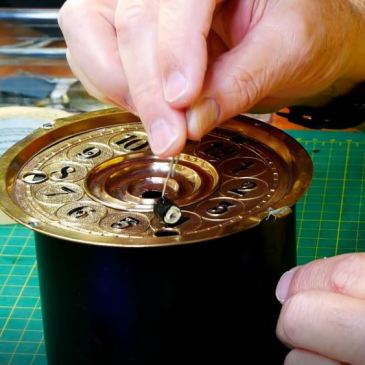
Getting a stubborn hand to fit correctly on an hour wheel

Approximately two years ago, I stumbled upon a weight-driven banjo clock listed on Facebook Marketplace. Before finalizing the purchase, I engaged in a conversation with the seller, who appeared to have limited knowledge about the clock’s value. The clock was among several items that the seller’s family was parting with, and it was evident that they didn’t have any sentimental attachment to it, despite it being in their possession for several decades.

To my surprise, the clock was remarkably intact, with only minor veneer issues. Apart from routine servicing of the movement, the clock required repairing the small sections of veneer and mounting it securely on the wall.

Banjo clock attributed to John Sawin of Boston 1840


I only needed to replace one bushing in the movement, and that resolved the only wear issue.

New bushing

However, the hands of the clock posed some challenges on a couple of occasions. Firstly, the minute hand became loose and wouldn’t advance properly. Upon investigation, I discovered that the hand was not securely attached to the minute wheel. I resolved this by using a slightly larger taper pin to tighten it.

Banjo clock

Later on, the hour hand started causing problems as well. It became loose and wouldn’t advance correctly. The minute hand, the hour hand doesn’t have a collar as you would find on a conventional mass-produced American clock and relies on friction to fit onto the top section of the hour pipe. There isn’t much room to work within this area, and it’s either too tight or too loose. Tightening the hour hand requires carefully punching the inside of the hole to make it smaller. Once again, due to the limited space available, this was a challenging task.

The hands stayed in place and now to test the movement for any issues.

The Schoolhouse Clock: Unveiling its History

The origin of the name “schoolhouse clock” is not well-documented, and it appears that the term was not used during the time these clocks were made. Instead, it was later coined by collectors to describe a particular style of clock commonly found in school settings.

Gilbert Admiral with calendar function

Schoolhouse clocks were the standard design for early North American schoolhouses due to their larger, easy-to-read dials. They were widely hung in schoolrooms across Canada and often had simple time-only movements, although some versions included a calendar function or time and strike movements. These clocks had a utilitarian look and were known for their durability.

Ansonia Schoolhouse Clock with 12-inch dial

The design of schoolhouse clocks is believed to be influenced by English drop dial fusee clocks, which were produced in the late 18th and 19th centuries. Drop dials closely resembled schoolhouse clocks and featured conical constructions with a chain or gut line pulled by a mainspring barrel, providing even power release for improved accuracy. Complicated movements such as these did not find their way into inexpensive mass-produced American and Canadian schoolhouse clocks.

When purchasing a clock, the author always asks the seller about its history and provenance.

Sessions Drop Octagon
Sessions Drop Octagon time only schoolhouse clock

In the case of the Sessions Drop Octagon wall clock pictured above, the seller had acquired it from a decommissioned one-room schoolhouse in Springhill, Nova Scotia. The clock, dating back to the 1920s, features a solid oak case, original hands, a pressed brass pendulum bob, a solid brass bezel, and a tin dial pan with stenciled lower glazing. While the paper dial showed signs of discoloration and wear, the clock was in reasonably good condition for its age.

Upon bringing the clock home, the author discovered that it ran for only a short time before stopping. A rubbing sound around the pendulum area indicated that the pendulum bob was hitting the inside of the case. After correcting a bent crutch rod, cleaning the movement, and making some adjustments, the clock started running properly. The author considered replacing the paper dial, which had brownish spots from prolonged exposure to moisture but decided to keep it as part of its history.

Time-only movements, like the one in this schoolhouse clock, are relatively easy to work on, making them suitable for beginners in clock collecting and repair.

While the exact origin of the term “schoolhouse clock” remains uncertain, it has become a permanent part of the clock collector language. These clocks, with their distinct style and large dials, were commonly found in early North American schoolhouses and have since gained sentimental value and recognition among collectors.

Exploring Factors Behind the Recent Increase in Clock Equipment Prices

While there has been a minimal uptick in clock prices, at least as far as the garden variety of common antique clocks is concerned, the cost of clock repair equipment had increased dramatically.

The increase in the cost of clock repair equipment can be attributed to several factors that may contribute to the significant rise in prices. Following a discussion of the factors I will present a case in point.

Rarity and Specialization

Clock repair equipment, especially those designed for antique and specialized clocks, may have limited production or availability at any given time. However, during the Covid years demand for specialized equipment virtually evaporated. Given the lull in manufacturing the restart costs of producing new equipment have increased. Scarcity and specialization will drive up prices. The relatively small market size can contribute to higher prices as manufacturers may need to recover their expenses with a limited number of sales.

Manufacturing Costs

The cost of raw materials, labour, and overhead expenses involved in producing clock repair equipment has risen over time. Factors such as inflation, increased demand for certain materials, the scarcity of raw materials, and changes in manufacturing processes contribute to the overall increase in costs.

Technological Advancements

As technology advances, new tools, and equipment are developed to cater to modern clock repair techniques. These advanced tools often come with higher price tags due to research and development costs, as well as the incorporation of improved functionality.

Import Costs and Tariffs

Clock repair equipment may be sourced from various regions or countries. Fluctuations in import costs, including tariffs, taxes, and shipping expenses, can impact the final price of the equipment. Changes in trade policies and international relations have influenced the cost of importing these products.

Bergeon Bushing Machine
Bergeon Bushing Machine model 6200

A case in Point

While browsing a Canadian clock supplier’s website in June 2023, I couldn’t help but notice a significant increase in the cost of the Bergeon 6200 Bushing Machine that comes with a toolset. Comparing prices from my previous purchase in 2016, the difference is striking. Back then, I was able to purchase a brand new Bergeon machine with hammers and cutters for around $1200, whereas today, the same machine is priced at $2126, a 77% increase (the 6200 has not been changed significantly), which also includes the reamers and hammers. One might be found at a reduced price of around $1900 on eBay, still a significant jump in price.

Similarly, a box of Bergeon bushings that cost $150 in 2016 now carries a price tag of $325. These price increases have made sourcing a used machine with a toolset at around $700, a more appealing option for someone entering the field of clock repair. However, if the reamers are worn and need replacement, the cost alone would be several hundred dollars if purchased new (all Canadian prices).

Drilling a hole with Bergeon bushing machine
Enlarging a hole using a Bergeon reamer

When evaluating pricing trends in the clockmaking industry, clockmakers and enthusiasts must take into account the changing market dynamics to stay updated.

Restoring Antique Clocks according to Customer wishes


While I do not operate a clock business I have, in the past, worked on other people’s clocks.

The customer’s perspective and preferences are always paramount when it comes to repairing and restoring antique clocks. As an antique clock blogger and clock repairer, I believe it is crucial to respect and understand the wishes of the clock’s owner. Each customer may have their own unique vision for their clock, and it is important to provide them with options while also offering expert advice.

When working on a customer’s clock, it is customary to present various options for repairing the movement and addressing any case issues. While some clocks may have significant provenance or historical value, necessitating minimal intervention, others may benefit from repairs and cleaning to bring out their full potential. However, it is ultimately the customer’s decision on how they want their clock to be treated.

In a recent experience, I had the opportunity to work on a clock with a non-functioning movement and a beautifully designed case. When discussing the options with the customer, they expressed a desire to prioritize making the clock run and replacing the broken hands, while leaving the case untouched. Although I believed that cleaning the case and applying a fresh coat of shellac would enhance its appearance, I respected the customer’s wishes and proceeded accordingly.

1-day Ogee from the 1860s

In the realm of antique clocks, the customer’s satisfaction is of utmost importance. While as a clock restorer and enthusiast, I may have my professional opinions and recommendations, it is essential to remember that the customer’s vision and preferences take precedence. By offering different choices and providing expert guidance, we can ensure that the customer’s clock not only functions well but also aligns with their aesthetic sensibilities and personal attachment to its history.

Customer clock

The customer’s desires should be respected when working on antique clocks. While expert advice can be offered regarding repairs and restoration, the final decision lies with the customer.

By presenting various options and considering their input, a functional clock that meets their expectations and preserves the integrity of the clock’s history and design while preserving the relationship between the repairer and the customer is the ultimate goal.

A time of celebration for American readers

As a Canadian clock blogger, it’s essential for me to recognize and appreciate readers in the United States who are celebrating Independence Day, July 4th. In the spirit of unity and shared appreciation for history and tradition, this article aims to acknowledge and honour my American readers as they commemorate their significant day.

Photo by Brett Sayles on Pexels.com

A Common Thread of Independence

Just as Canada Day symbolizes the birth of a nation, Independence Day serves as a reminder of the extraordinary courage and resilience displayed by the American people throughout their history. Antique clocks, with their enduring craftsmanship, mirror the tenacity and independence that have shaped the United States. By acknowledging this common thread, we can celebrate the shared appreciation for freedom and self-determination that unites us all.

American Heritage

Independence Day is an occasion for Americans to honor their country’s rich heritage and the values upon which it was founded. As an antique clock blogger, I acknowledge the significance of American clockmaking traditions and the contributions made by skilled artisans throughout their nation’s history. By recognizing and showcasing the unique heritage of American clockmaking as much of my collection consists of American-made clocks, we can celebrate the ingenuity and craftsmanship that have made a lasting impact on the world of horology.

Connecting Through Time

Antique clocks have a remarkable ability to transcend borders and connect individuals across time and space. Those connections consist of many letters received from my American friends.

On American Independence Day, we can reflect on the profound impact that historical events have had on shaping both nations. By acknowledging our American readers and their celebration of independence, we foster a sense of unity and understanding, forging a connection that transcends geographical boundaries and embraces the collective appreciation for history and heritage.

Celebrating Freedom and Progress Together

Independence Day is a time for Americans to celebrate the hard-fought freedoms they enjoy today. It is also an opportunity to acknowledge the progress made over the years and to envision a future that upholds the values of independence, equality, and unity, values that are cherished in my country, Canada. By celebrating both the freedoms gained and the advancements achieved, we pay homage to the spirit of independence and progress that define our shared human experience.

As our neighbour observes Independence Day, I extend my appreciation to our American readers and acknowledge the significance of their celebration.

Celebrating Canada Day with family and friends

Finding a way to tie in antique clock collecting and repair to Canada Day celebrations on July 1st is an interesting challenge so I came up with some oddball thoughts the reader might find amusing. So here goes.

Canada Day, at one time known as Dominion Day, marks the anniversary of the Confederation of Canada on July 1, 1867. It’s a day when Canadians honor their country’s rich history and express their patriotism.

As the nation of Canada prepares to celebrate its special day on July 1st, it’s a time for Canadians to come together, reflect on their history, and embrace their shared heritage. And what better way to commemorate this occasion than by exploring the fascinating connection between Canada Day and the timeless beauty of antique clocks?

What is the connection you say!

Antique clocks possess an inherent ability to transport us back in time, evoking a sense of nostalgia and reminiscence. Just like a vintage clock reminds us of eras long gone, Canada Day encourages Canadians to reflect on their roots and appreciate the sacrifices made by those who came before. The celebration of Canada’s multicultural heritage and diverse traditions aligns beautifully with the stories antique clocks hold within their aging wooden cases.

Cherishing our past

Antique clocks remind us that time is a valuable resource, urging us to cherish our past, live in the present, and build a brighter future. Canada Day serves as a reminder to honor the progress made as a nation and strive for continuous growth, just as the gears of an antique clock works in harmony to mark the passing of time.

A clock that is older than our Confederation

To restore and preserve

Antique clock enthusiasts understand the importance of restoration and preservation. Similarly, Canada Day encourages Canadians to safeguard their cultural heritage, preserve historic landmarks, and protect the stories that shaped their nation. Both antique clocks and Canada Day represent the value of cherishing the past and ensuring its vitality for future generations.

The symbolism of time and a promising future

Whether it’s the meticulous craftsmanship, the nostalgic charm, or the symbolism of time, antique clocks and Canada Day share a deep connection that honors the past, celebrates the present, and looks towards a promising future.

So, as you commemorate Canada Day, take a moment to reflect on the timeless beauty of antique clocks and the remarkable story they tell.

And, there you have it.

As for me relaxing with friends and family is the only way to celebrate our most important day of the year.

Tick Talk Tuesday #49 – a well-preserved column and cornice clock

Tick-Talk Tuesday is dedicated to addressing readers’ letters and comments related to clock issues, challenges, and recommendations for specific clocks. In cases where the comments and questions are particularly challenging, I seek advice from my fellow clock enthusiasts to provide the most accurate and helpful response.

DS writes

Morning, Ron –

I’ve wanted to let you know how much I’ve enjoyed these blog posts.

What a nice work area you have there, too.

I’ve had my eyes on a marvelous Wm. Van Tassel sleigh-front, or “Triple Decker” Seth Thomas manufactured for the Canadian market for some time. I’ve been fascinated with these old clocks for many years, and in particular the triple-deckers.
I’ll attach an image or two of the Van Tassel I’m interested in.
It is perhaps the finest sleigh-front I’ve ever seen, in terms of condition & originality.

I only have a modest collection of some cottage clocks of the various Connecticut makers, and several “Ogees.” My only real “Problem” is finding time enough to spend with them!

Thanks again for these interesting, well-written articles.

Take care…

Image preview
Wm. Van Tassel sleigh-front

I write

Thanks for your email, DS

That is a very nice clock. Some would call it a column and cornice but as you said often referred to as a triple-decker. I like the two-door feature. I have a similar Seth Thomas. My only thought is whether or not the tablets (or at least one of them ) are original. The cornice and the base are often beat up with wear and tear and it is nice to see one so unmolested. It is a clock I would take a serious look at.

I appreciate your comments on my blog.

Ron

Seth Thomas column and cornice shelf clock
Seth Thomas column and cornice clock

My very similar Seth Thomas clock

Taking a break

It’s time for us to unwind, slow down, and embrace a change of scenery. My wife and I are heading to our cottage in central Canada for the summer season, where we plan to relax, read good books, indulge in fishing, swimming, and hiking, and share stories with friends and neighbors while savoring a glass (or two) of wine.

The lake

Even though many of my blog articles have been written well ahead of the summer months, there will be no interruption in posts throughout this period. I will continue to maintain a consistent output of two articles a week.

Just as Dean Martin used to say at the end of his TV variety show, “Keep those cards and letters coming!” While there might be a slight delay in responding to your email inquiries or blog post comments, please rest assured that your questions about your clock or comments on any of my posts are significant to me and will be addressed.

Mission style clock found in a thrift shop in the Quebec area

This blog primarily showcases my own clock collection, delves into the challenges of clock maintenance and repair, shares the joys of discovering new and intriguing vintage and antique clocks, and covers various horological topics of interest.

A Gilbert clock found on Facebook marketplace and a summer project

As we explore central Canada, I anticipate stumbling upon fascinating clocks in antique stores, flea markets, and other unique shops. Alongside documenting new clock stories, I’ll also face fresh repair challenges and perhaps undertake the next major restoration project during my summer journey.

Canadian Clock museum
The Canadian Clock Museum

Additionally, I’m excited to revisit The Canadian Clock Museum in Deep River, Ontario, where I’ll discover new and captivating clocks added to their collection and engage in conversations with curator Allan Symons.

Feel free to use the search box to explore past articles or click “follow” to receive clock-related articles directly in your mailbox. I sincerely hope you enjoy reading them as much as I relish researching each and every article.

Pendulum clocks and Temperature compensation

In this post I will acquaint the reader with temperature compensation and what it means for maintaining the accuracy of a mechanical clock.

Almost all materials expand noticeably with heat and contract when cooled.

Temperature compensation is a critical factor to consider when it comes to the maintenance and repair of antique mechanical clocks. Clocks are precision instruments that rely on a delicate balance of mechanical components to keep accurate time. Any changes in temperature can cause the metal components of the clock to expand or contract, leading to inaccuracies in timekeeping.

Pendulum with dissimilar metal rods

To combat these fluctuations, many antique clocks were designed with temperature compensation mechanisms. These mechanisms are intended to counteract the effects of temperature changes on the clock’s accuracy. One common method of temperature compensation is the use of a bi-metallic strip, which is a strip of two different metals that are bonded together. As the temperature changes, the metals expand and contract at different rates, causing the strip to bend and adjust the balance of the clock.

Wood was a commonly used material for antique clock pendulum rods because it has a low coefficient of thermal expansion, meaning it is less likely to expand or contract with changes in temperature, which is crucial for maintaining the accuracy of timekeeping in clocks. Wood is relatively lightweight and easy to work with, making it a practical choice for clockmakers.

Seth Thomas Regulator #2
Seth Thomas Regulator #2 with wood pendulum rod

However, not all antique clocks were designed with temperature compensation mechanisms.

Clocks that have no temperature compensation may need seasonal adjustments

For those that lack these features, it’s important to keep the clock in a stable environment with minimal temperature fluctuations. However seasonal changes in heat and humidity may require periodic adjustments. Exposure to extreme temperatures or rapid changes in temperature can cause damage to the clock’s components and negatively impact its accuracy.

Gustav Becker Vienna Regulator with wood pendulum

Temperature compensation is a critical factor to consider when it comes to antique mechanical clocks. While some clocks were designed with built-in temperature compensation mechanisms, others may require more careful maintenance and storage to ensure accurate timekeeping over time.

Having said the above not every pendulum design that appears to provide temperature compensation actually serves that purpose. In certain instances, pendulum rod designs may be purely decorative (such as the Mauthe wall clock below) and lack temperature compensation functionality altogether.

Mauthe wall clock circa 1895


If your clock is experiencing inaccuracies in timekeeping, there are various adjustments that can be made. However, if you lack the necessary expertise, it is advisable to consult a professional clock repairer. They can thoroughly examine the clock’s mechanisms, identify any problems, and make the necessary adjustments to ensure precise and accurate timekeeping.

If I had to take one antique clock from a “burning house” which one would it be

We have been facing a challenging spring here in Nova Scotia, as the threat of wildfires has been looming over us.

In May 2023, our community in Nova Scotia has been devastated by the occurrence of two uncontrolled wildfires. The dire consequences of these fires include the evacuation of thousands of individuals and the tragic loss of hundreds of homes.

Residing in a rural area with our house nestled amidst beautiful trees, we can’t help but have a constant awareness of the potential for fire.

While it’s crucial to prioritize safety and well-being in emergency situations, it’s understandable that certain personal belongings/items hold significant value to us. They include ID, cell phones, credit cards, vehicle titles, keys, flashlights, passports, a portable hard drive containing all personal photos, and essential clothing but if I find myself with a moment to select just one antique clock during a speedy evacuation what would it be?

My wife prompted this discussion when she asked, “What clock would you take?

Selecting a specific antique clock to save from a “burning house” is a subjective decision based on personal preferences, sentimental value, and the uniqueness of each clock. However, here are a few factors I might consider when making my decision:

  1. I might choose a clock that holds special meaning to me or my family. It could be a clock that has been passed down through generations or one that has sentimental value attached to it.
  2. I would consider the rarity and historical significance of the clock in question. If a clock’s origins is significant or it is known for its craftsmanship or historical importance, I might prioritize saving such a clock.
  3. If one clock is in better condition or has the potential for easier restoration, it might be a good choice to save.

Here are 5 clocks that would be high on my list and the reasons why. But in the end, I could only take one!

Pequegnat Canadian Time

Pequegnat Canadian Time

I have had this clock for a number of years, and have serviced it twice. The clock’s case, on the other hand, has remained untouched and remains in exceptional condition. This particular clock holds a special place in my collection as one of the earliest examples of the eight Pequegnat clocks I own. It spent its life in the waiting area of a train station located 1/2 drive from my home.

Sawin Banjo Clock

Sawin banjo clock

Dating back to the 1840s, this exceptional timepiece exemplifies the pinnacle of meticulous movement craftsmanship. While the case and movement do not bear any explicit “Sawin” markings, various indicators strongly suggest that it was crafted by John Sawin himself or one of his associates or apprentices. Notably, this clock stands out for its straightforward construction, lacking side rails or ornate embellishments such as painted tablets or gilt decorations. It is precisely this simplicity in design that captivates me, as it allows the clock’s elegance and craftsmanship to take center stage.

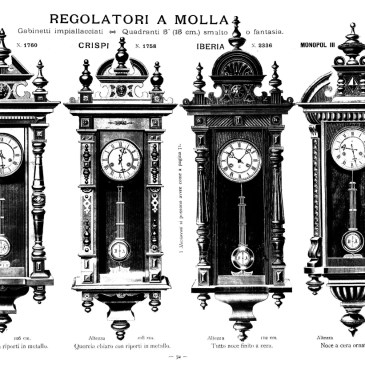
Junghans Crispis time and strike wall clock

Junghans Crispi

This clock underwent a comprehensive restoration process involving countless hours of work, including disassembling, creating new components, servicing the movement, and refinishing the case. The restoration required a significant amount of labor and attention to detail. The clock holds a captivating story as it was rescued from a house that endured severe destruction during the Halifax Explosion in 1917.

Single-weight Vienna Regulator

Single-weight Vienna Regulator

The sheer beauty of this clock makes it incredibly challenging to part with. Its design epitomizes the finest qualities of the 1880s Vienna style. Unlike the later Viennese clocks, which often leaned towards ornate and ostentatious features, the clocks from this particular period maintain their elegance and embrace a more refined and understated aesthetic. The clock’s classic, simple lines are a testament to the enduring allure of the Vienna style during that era.

Arthur Pequegnat Canadian Time

Arthur Pequegnat Moncton

It is quite possible that this clock was located in a train station or some other commercial setting, given its robust construction and durability designed to withstand potential mistreatment. Additionally, its timeless design features are reminiscent of the classic lines commonly associated with the 1920s era. The clock’s sturdy build and elegant aesthetics perfectly capture the spirit of that period, adding to its overall charm and appeal.

E. Ingraham Huron

Rare Ingraham Huron found on a local online for-sale site
E Ingraham Huron

This clock resided in the charming vicinity of Bridgewater, Nova Scotia. It came into our possession during a challenging period for a couple undergoing a difficult separation, as sentimental items often find their way to new homes in such circumstances. Among the clocks in my collection, this one stands out as one of the few that underwent professional servicing, ensuring its optimal functionality. Notably, this clock holds a relatively rare status, being produced by the E. Ingraham Clock Co. during the brief span of two years, between 1878 and 1880.

And now it boils down to the one to choose?

Although I hold great admiration for all of these clocks, if I were constrained by space and could only choose a single one to take with me, it would have to be the Junghans Crispi. As mentioned earlier, this clock embodies the qualities that I value, such as its exceptional craftsmanship and timeless appeal. Its unique design, combined with the renowned Junghans brand, makes it a standout choice in the collection. Given the limited space, the Junghans Crispi would be the clock I couldn’t bear to leave behind, as it represents the epitome of my preferences and holds a special place in my heart.

An unusual issue with a Vienna Regulator time-only clock

In this post, I describe an unusual issue when relocating my mini Vienna Regulator clock. But first some background information on Vienna Regulators.

The Vienna Regulator clock, also known as the Vienna wall clock, is a type of precision pendulum clock that originated in Vienna, Austria, in the late 18th century.

One-weight Vienna Regulator, unknown maker, C.1875

The development of the Vienna Regulator clock was influenced by several factors. One of the key factors was the rising demand for accurate timekeeping during the Industrial Revolution. Vienna, as a center of craftsmanship and technological innovation, played a vital role in meeting this demand.

They typically had a slender wooden case, which housed the pendulum and the clock mechanism. This design allowed for a longer pendulum, resulting in greater accuracy. The pendulum was often enclosed in a glass door or window, allowing the movement to be admired from the side panels while protecting it from dust.

The cases, made of various types of wood such as walnut, oak, or mahogany, were often finely crafted with decorative inlays, carvings, or veneers. The clocks featured a white enamel or porcelain dial, usually adorned with Roman numerals and ornate hands.

Vienna regulator movement

The movement of the Vienna Regulator clock was powered by weights suspended on cables or cords. The weights (up to three) were typically wound up once a week, providing the necessary power for the clock to run accurately.

During the 19th century, the Vienna Regulator clock underwent several design changes. The earlier models, known as “Vienna Regulators of the Biedermeier period,” were characterized by a simpler and more classical style. Later models, influenced by the emerging Victorian and Rococo revival styles, featured more elaborate ornamentation and decorative elements.

Vienna Regulator dial
A well-preserved Vienna Regulator dial

The style and craftsmanship of Vienna Regulator clocks are often associated with exceptional quality and precision.

While the popularity of the Vienna Regulator clock declined in the early 20th century with the advent of more modern timekeeping devices, it remains highly valued by collectors and enthusiasts today.

The issue

During an unseasonably warm winter, we unexpectedly experienced a sudden drop in temperature, causing a significant plumbing issue that led to a major leak of the pipes in the ceiling of our family room on the first floor of our two-story home. The extent of the damage necessitated replacing the pipes and removing and replacing the gyprock ceiling. While the repairs were underway, we took the opportunity to revamp the room’s decor and make a few changes, including relocating some clocks to that area.

Some clocks can be temperamental and a clock that works fine in one location may not work at all in another. Such was the case of a miniature Vienna Regulator that once moved from an upstairs bedroom refused to run in the family room.

Suspecting a tangled cable issue the result of which would rob power to the movement, I took the movement out of its case and carefully rewound the cable onto its take-up reel. No change.

Could it be a wear issue? I proceeded to carefully remove the movement from its case and meticulously disassembled it, thoroughly inspecting for any signs of bent arbors, or damaged or worn teeth. However, to my surprise, I found no such issues. In fact, the movement was remarkably well-preserved, and the oil in the pivots appeared to be in excellent condition.

After carefully reinstalling the movement into its case and reattaching the weight and pendulum, I observed an interesting issue. I noticed that the bottom of the case protruded farther out than the top, indicating that the wall was not perfectly vertical. Suspecting a connection between this misalignment and the movement’s inability to run, I decided to investigate further.

Left Stabilizer

I adjusted the stabilizers, one on each side, stepping them back slightly, and to my surprise, I discovered the root cause. The escapement pallets, responsible for regulating the movement, were not engaging with the escape wheel correctly. This misalignment was likely the reason for the movement’s previous failure to function properly. It also made me realize that the wall where the clock was previously located was not vertically level.

While achieving horizontal leveling is undoubtedly crucial, it is important that vertical leveling can make a significant difference when it comes to the functionality of a clock. In fact, proper vertical alignment can be the determining factor between a clock that runs smoothly and one that fails to operate at all.

At the end of the day the exercise was worthwhile as it allowed me the clean the movement, reoil the pivots, and polish the brass pendulum and weight.

The State of the Antique and Vintage Clock Market: Buy or Sell in 2023?

will antique and vintage clock prices go up or down in 2023? Is this the time to buy or sell? Allow me to share my insights and observations.

According to the United States Government, the term “antique” is reserved for items that are over a century old. Webster’s dictionary defines an antique as a work of art, piece of furniture, or decorative object made at an earlier period and according to various customs laws at least 100 years ago. Wikipedia defines antiques as applying to objects at least 100 years old.

Vienna Regulator C. 1870

On the other hand “vintage”, according to most sources, is a period that is less than 100 years but more than 30 years. Definitions of vintage may vary. In the jewelry business, for instance, vintage may be considered as anything 10 to 20 or more years.

There is no true “standard” pricing for any vintage or antique clock. As with most objects, there is a price range that most would consider reasonable. Similar to many other items, vintage or antique clocks do not have a set standard price. Instead, there exists a range of prices that most people would view as reasonable. Having said that, prices for common antique clocks have largely stagnated over the past several years while rare and highly prized clocks appear to have retained their value.

People who frequently purchase antique or vintage clocks are likely aware that the clock market has been experiencing a decline in prices for some time. Is 2023 a good time to sell or buy? Of course!

McLauchlin tall case clock, Scotland, C. 1848

How are clock prices set?

Setting the price for an antique or vintage clock is not a straightforward process. It involves various factors, such as the condition of the clock, its history, and the seller’s personal experience in the market.

Some sellers may price their clocks higher than their actual value to leave room for negotiation, while others may count on buyers’ lack of knowledge about the true value of the clock. However, a well-informed buyer can use their knowledge to find a great deal, by looking for prices consistent with reputable auction houses and online marketplaces.

Junghans Corner feet finished
Junghans Sydney C. 1913

Factors affecting the sale of clocks

As said, high-end and truly rare clocks, such as those with historical significance or exceptional craftsmanship, have managed to retain their value in the market. However, even for these clocks, sales are still largely based on market conditions and demand. For example, if there is a sudden influx of similar clocks on the market, it could drive down the demand and price for those clocks. Therefore, while rare clocks may be more likely to hold their value, they are not completely immune to market fluctuations.

But what conditions influence the sale of run-of-the-mill antique and vintage mechanical clocks and those of slightly better quality?

Two factors have influenced the decline in prices. Common antique and vintage clocks have flooded the market in the past several years driving prices steadily downwards. Secondly, the new generation of millennials has little interest in antiques and finds it pointless to collect antique and vintage clocks. Sentimental reasons aside, the cost of servicing an antique or vintage clock far exceeds its value.

U M Muller box clock C. 1930

Moreover, modern homes do not have room for clocks as floor and wall space is limited. In an age when families are living in 800-square-foot apartments space is at a premium. That could change as people migrate from dense cities to smaller communities.

And when space is at a premium grandfather clocks and jeweler’s regulator clocks though finely crafted and cost thousands when new are not items many would consider appropriate for the modern family home.

While I cannot predict the future with certainty, based on the prices observed over the past few years, I anticipate that the antique clock market will remain largely unchanged in 2023 and beyond. Currently, it appears to be a buyer’s market, and there may be excellent deals available for those who are knowledgeable and take the time to shop carefully and do their research.

It’s important to remember that knowledge is power when it comes to purchasing antique clocks. Doing your homework can help you identify the most valuable and unique pieces, and can also help you avoid overpaying for items that may not hold as much value. While there may be some great clocks out there, it’s crucial to approach the market with a discerning eye to ensure that you get the most value for your money.

My most recent Hunsruck Clock evokes memories of my first Junghans clock

While working on one of my latest acquisitions, a Junghans Hunsruck mantel clock, memories flooded back to the first Junghans clock I ever owned, a Junghans Crispi wall clock, that I still have to this day.

Junghans Hunsruck C. 1913

It was a humble box of parts when it first came to me, but I was determined to bring it back to life.

Junghans clock in pieces
Junghans clock in pieces, not unlike a jigsaw puzzle

The restoration process was a hands-on experience where I had to fashion new parts, source missing pieces, and master the art of staining and gluing. Through this ground-up restoration process, I developed a deeper understanding of the craftsmanship and artistry that went into creating these old clocks.

Piece by piece, I painstakingly assembled the clock, learning about the inner workings and mechanics along the way. It required both patience and dedication, but in the end, it was worth it. The clock not only became a functional piece, but a treasured symbol of my passion for antique wall clocks.

A first examination of the movement

As I worked on my latest Junghans mantel clock refreshing the case and servicing the movement, I couldn’t help but reflect on the journey that led me to this point. Each clock I restore holds a special place in my heart, but that first Junghans clock will always hold a particularly special place. It was an affirmation of a lifelong passion for the timeless elegance of antique clocks.

The fascinating story behind the Crispi wall clock

The story behind the Junghans Crispi clock is the enduring power of objects that connect us to the past.

Junghans Crispi time and strike wall clock

In the midst of tragedy, there can be glimmers of hope and resilience. Such was the case with a Junghans Crispi wall clock that fell off a wall on Princess Court in North End Halifax on the fateful day of December 6, 1917. Despite the chaos and destruction caused by the Halifax Explosion, this clock managed to survive, albeit in a state of disrepair.

Following its century-long journey, the clock that had been treasured by the Halifax family for generations finally found its way into the hands of an avid antique clock collector.

Over the course of two months, I worked tirelessly to piece together the various components and restore the clock to working condition. It was no easy feat, but the end result was a stunning tribute to both the clock’s history and the resilience of the people of Halifax.

In a series of articles documenting the restoration process, I shared not only the technical details of the restoration but also the personal connection to this piece of history.

The Future of Antique Clocks and Relevance in a Digital Age?

Antique clocks have been an integral part of human history, and they continue to be cherished by collectors and enthusiasts alike. However, in a world where digital timekeeping is more prevalent, what does the future hold for antique clocks?

Sawin banjo clock C. 1840

While it’s true that the digital age has brought about significant changes in the way we keep time, it’s important to note that antique clocks still hold a unique place in our culture. These clocks not only tell time but also serve as pieces of art, heirlooms, and historical artifacts. They offer us a glimpse into the past and provide a tangible connection to our ancestors.

Despite the rise of digital timekeeping, antique clocks are still with us, and their popularity continues to grow. The beauty and craftsmanship of these clocks are unmatched, and many people appreciate the time and effort that went into creating them. While there is a growing market for antique clocks, and collectors are willing to pay top dollar for the most unique pieces, prices for common antique clocks have stagnated over the past several years as many clocks have flooded the market.

Fusee gallery clock

However, a factor contributing to the future of antique clocks is the growing interest in vintage and retro styles. More and more people are seeking vintage and antique items to decorate their homes, and antique clocks fit perfectly into this trend. Antique clocks are not only functional but also add a touch of class and sophistication to any room.

In addition to their aesthetic appeal, antique clocks also offer a sense of nostalgia and tradition. They remind us of a time when life moved at a slower pace and things were simpler. For many people, owning an antique clock is a way to connect with the past and honour their family’s heritage.

Hamburg American Clock Co. C. 1910

So, what does the future hold for antique clocks? While it’s true that digital timekeeping will continue to be the norm, there will always be a place for antique clocks in our culture. These clocks offer something that digital clocks can’t: a physical connection to the past and they serve as a reminder of the rich history and traditions that have shaped our world.

With the constant advancement of technology, it is very likely that antique clocks will progressively increase in value and become even more highly desired by collectors and enthusiasts alike. As people feel more disconnected from the physical world, the value of tangible objects like antique clocks will only increase.

Photo by Isabella Ibraim on Pexels.com

I believe the future of antique clocks is bright. Antique clocks offer us a tangible connection to the past and provide a way to honour our heritage. They are not just the marriage of brass and wood but also works of art, heirlooms, and historical artifacts. As long as people continue to appreciate the beauty and craftsmanship of antique clocks, their future is secure.

Tick Talk Tuesday #48 – What to do with my husband’s old clocks

Tick-Talk Tuesday is dedicated to addressing readers’ letters and comments related to clock issues, challenges, and recommendations for specific clocks. In cases where the comments and questions are particularly challenging, I seek advice from my fellow clock enthusiasts to provide the most accurate and helpful response.

JZ writes

I ran across your website trying to find info on some old clocks. My husband passed away in February and left me several. I have no desire to keep them but also have No knowledge of what to do with them.

I’m sending you pics of a few. I realize it’s difficult from pics to provide much but anything is more than I have at the moment.

U/K parlour clock

My reply

I am sorry for your loss. I’ll begin by saying that I have no interest in any of the clocks.

With respect to the clocks left behind by your husband, there are a few options you might consider.

American time and strike clock with a French look

First, consider selling the clocks. If you have no desire to keep them you might be able to sell them to a collector as a lot or individually. You can also locate a reputable auction house or sell them online through websites like eBay or Etsy. Selling them locally through Facebook Marketplace avoids the hassle of packaging and shipping a clock to its new owner.

Donating the clocks to a local museum or historical society is another option. The clocks can be appreciated by those who have a passion for clocks.

Having the clocks appraised is another avenue to pursue but you run the risk of paying more for the expert opinion than the clocks are worth.

Antique items can certainly be worth a lot of money, but it is important to note that just because something is old or antique does not automatically make it valuable.

Electric clock from the 1940s

I am not a clock valuation expert and cannot physically inspect their construction, repair status, and overall condition and any estimate I offer from information provided to me by email regarding the clock’s value would be approximate.

Likely a Hermle Westminster chiming clock

If any of the clocks have a distinct history (provenance) or the maker is highly regarded, its value will be significantly higher but you have not provided enough information to suggest that.

The value of an antique clock depends on various factors such as rarity, condition, historical significance, the reputation of the maker, and finally market demand. Unfortunately, the market for antique clocks is not as strong as it once was though certain rare or highly sought-after antique clocks can still hold significant value in the market.

Judging from the photos alone I do not believe that any one of these clocks is worth more than $200, and some significantly less.

Hope this helps in your decision-making.

Updated description for “Why Come Here”

The following is revised and updated text for “Why Come Here” located on the right side top banner of the main page and repeated below for the benefit of new readers

Welcome to my blog, where we dive deep into the fascinating field of horology, the world of antique and vintage mechanical clocks. If you’re passionate about uncovering the intricate workings of these timeless treasures while reveling in their rich historical significance, then you’ve come to the right place.

My blog is an important hub for anyone seeking to learn more about these wonderful mechanical devices. With a treasure trove of information and insights on everything related to antique and vintage clocks, I guarantee that you’ll be hooked from the very first post.

Whether you have recently inherited your grandmother’s mantel clock or have acquired a captivating vintage or antique clock and want to learn more about it, you might find the articles on this blog to be of interest.

Clock movement with plate removed

Over the past decade, I have taught myself the art of horology and gained extensive knowledge and experience working on a diverse range of old clocks. In addition, I have a keen interest in cabinet and case restoration. While I do not operate a clockmaking business and am not involved in the commerce of clocks, I occasionally sell clocks locally to manage my personal collection.

What is horology?

Horology is a field of study that approaches the concept of time scientifically, much like geology studies the earth or biology studies life. It involves the design and construction of clocks, watches, and other time-measuring devices, making it a highly practical discipline. Those who specialize in horology are known as horologists. Through the study of horology, we gain a deeper understanding of the intricacies and history of timekeeping, as well as the skills and techniques required to create and maintain these fascinating devices.

1840s Scottish clock capturing the morning light

My mission

As a blog author, I publish an average of 7-9 articles per month, with new content released every 4 days. My articles cover a wide range of topics related to clocks, including specific repairs, my experiences shopping for clocks, my perspectives on the history of antique clocks, and interesting finds on the internet. I also profile my growing collection of clocks.

Since I live in Canada, there is a focus on clocks made or sold in North America. However, if you browse my collection, you’ll see that I have included clocks from other parts of the world as well.

A message to professionals

If you are a professional horologist who regularly uses a lathe to cut gear teeth, re-pivot arbors, bush mainspring barrels on a weekly basis, fashion new wheels from raw stock, or make advanced repairs on complicated movements and cases, then this blog may not be the most suitable for your needs. However, you are welcome to browse my articles and share any comments or suggestions you may have.

Project area
Elements of a clock dial

And finally

If you have a specific question about a clock, please feel free to write to me, as I may have the answer you are seeking. Whether you are a novice clock collector or have a deeper understanding of horology, I welcome all emails and will do my best to provide a helpful response.

In cases where your question may require additional expertise, I will consult with my clock circle to ensure that you receive the best possible answer. So don’t hesitate to reach out to me with any inquiries you may have.

Please note that there may be times throughout the year when I am traveling, which results in a slight delay in my response to your inquiries. However, I will do my best to get back to you as soon as possible and appreciate your patience during any such periods of travel.

Contact me at ronjoiner@antiquevintageclock.com

Website Powered by WordPress.com.

Up ↑