9 reasons why you should buy a mechanical clock
The world is changing and sadly, we are living in an increasingly throw-away society. We are taught at an early age that not many things are meant to last and using a throw-away product “guarantees” that the new product will function much better, but does it? I read a news article recently that Norway plans to introduce lower taxes on items that have been renewed or refurbished encouraging its citizens to reuse rather than dispose. Many would consider it a small but important step. It prompted me to write this article.

Here are 9 reasons why you should buy a mechanical clock.

1) Great for the environment. Clocks do not depend on electricity. We all agree that cutting your carbon footprint is always a good thing. Yes, you might think that a quartz clock is great for the environment since it lasts a long time and is both dependable and reliable when the power goes out but what happens when that battery fails. Where does that battery go? The landfill site, of course! Think about it, every part of mechanical clock is fully recyclable, the wood, the metal and the glass.

2) Prompts you to reconsider our disposable society: We are living in an increasingly disposable society. Collecting antique clocks may cause you to think about how you view other things in life, your place as a consumer in our society and how you can do your little bit to further the cause of preserving our environment. In this age of excessive over consumption it is refreshing that some things like a clock can be re-used, repaired and renewed.

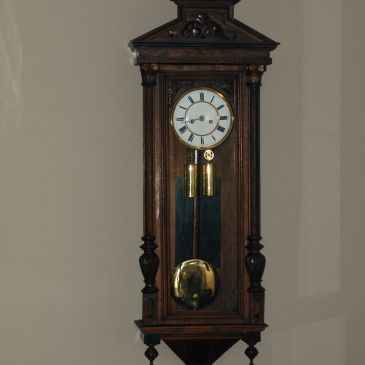
one-weight Vienna wall clock
One-weight Vienna miniature wall clock, unmarked, circa 1870

3) Great in a power outage; During power outages your mechanical clock will keep on ticking. And tick it will as long as you wind it regularly. And during that power failure you will also notice that the only thing you will hear will be the sound of your ticking clock above the eerie silence of the house.

4) Exercises the brain; Your curiosity about a particular clock might prompt you to research it’s history, or the era that the clock was made. Or, curiosity has led you to maintaining your own clocks. No one can argue that expanding your knowledge of mechanical things, learning new skill-sets, exploring new areas of interest, and learning something from the past is great for healthy brain development.

Centering prior to drilling
Learning to bush a clock plate

5) When it breaks it is something you can actually fix: When it breaks you fix it rather than throwing it out which you would likely do for most other items around your home. That means learning new skills when fixing it yourself or helping the local economy by buying repair tools/equipment or searching out a clock repair person (horologist) in your community.

6) An heirloom; pass it on to your children. Clocks are memories by association. Children love receiving clocks from their parents not only because of their collectible and intrinsic value but as a keepsake, a reminder of good times and happy memories. Yes, they are timeless gifts!

Gustav Becker two weight regulator
Gustav Becker, a retirement gift that I will pass on to my children

7) A soothing sound in a room. Intoxicating to some, annoying to others. Some clocks have beautiful tones and melodies. I always ask guests who stay over whether they mind a clock ticking in their bedroom. A striking or chiming clock might be considered an annoyance when one is not accustomed to the sound. If they suggest stopping the clock I always comply without question. The exception, of course, is the anniversary clock which emits no sound whatsoever. My sister has a number of vintage and antique clocks, she has very little idea how they work but loves the look and the sounds they make.

rs-kundo
You would have to have exceptional powers to hear this 400 day clock in any room

8) Gets you out of the house; My wife and I are into antiquing and that means getting in the car and driving around our beautiful province. We get some exercise, discover new places, meet new people, exchange stories and bring back memorable articles including our cherished clocks.

9) A conversation starter; It is a conversation starter; I have two clocks that are over 140 years old and many that are at least 100 years old. Can’t think of a thing to say when company is over? Well, I can tell you fascinating stories about many of my clocks. I often tell stories of our clock hunting adventures throughout Nova Scotia and other parts of Canada and some of the characters we meet along the way.

Go out and buy a mechanical clock! Clocks are not only good for the environment but they are good for the soul.

One weight Vienna Regulator miniature

My quest for a one-weight Vienna Regulator ended this past week and I am now in possession of a miniature rather than a traditional antique Vienna wall clock. Here are first impressions back in 2016.

Top showing face and crown detail
Top showing face, hands and crown detail

This attractive unmarked Vienna Regulator one-weight (time-only) clock is 34 inches long 4.75 inches deep and 11 inches at it’s widest point and 8.5 inches at the waist. There are no markings on the movement. My research tells me that very few Austrian clocks have markings on the back plates. There are indications that the lines and style suggest Austro-Hungary, about 1870. The maker, however is unknown.

I believe that this clock is a transitional clock that forms the link between the simplicity of the earlier styles and the extravagance of the latter.  Where the earlier pieces rarely have columns on the side of the door, the transitional clocks have either broken columns (tops and bottoms of columns with hanging finials) or slender, elegant columns.  In comparison, the hallmarks of the Alt Deutsch clocks were full, and typically fluted columns with Corinthian pediments and rectangular panels at the base. The four-posted keyhole mounts were common throughout the transitional period. Most dials are two-piece porcelain with spun-brass bezels.

Transitional Vienna Regulators typically have wooden pendulum rods and brass bobs with zinc backs. The cases were typically made with walnut, cherry and other fruit wood veneers. There are not as many ebonized or faux (false-grained) finishes in the transitional style cases.

one-weight Vienna wall clock
Grain in two directions

This is a high quality clock housed in a beautiful walnut wood veneered case. The case is in excellent condition save for a few scratches near the door catch from the small brass hook moving back and forth and two small pieces of veneer missing on the uppermost right side that are not visible when looking at the clock head on.

The case is adorned with an attractive crown that is part of the clock unlike similar clocks that have removable toppers. Two finials finish the top. The finals do not appear to be original but are consistent with the style and age of the clock. The twin pillared tapered columns on either side start at the top and narrow towards the bottom of the case, an unusual feature and evidence of skilled craftsmanship. Curiously the left corner rectangular column piece is slightly longer than the right piece. The case is correctly finished on the bottom with a middle and corner finials. On the sides are two brass screws (or standoffs) for leveling adjustment.

rs-miniature-vr_24
One of two standoffs
Bottom finial is notched
Top finial might have been larger originally
Top finials originally might have been larger

Inside the case is a porcelain beat scale and large pendulum. All of the glass is original and in good shape. The interior glass clips used to secure the glass to the inside of the frame appear to be a later addition. The front glass which shows characteristic waviness and small imperfections are consistent with the age of the clock.

Bottom showing beat plate and finial detail
Bottom showing beat plate and finial detail, notice waviness of glass
rs-miniature-vr_8
Bottom finials

The simplicity of the time-only movement is what makes them last so long and remain easy to maintain. The four-posted key-hole mount is typical of a Germanic or Austrian clock.  The Graham deadbeat escapement assures accurate timekeeping.

rs-miniature-vr_39
Four-posted key-hole mount
rs-miniature-vr_43
Side view of movement showing deadbeat escapement and gear train
Escapement
Escapement
Escapement closeup
Escapement closeup
Case showing mounting bracket
Case showing mounting bracket and suspension spring slot
Back board
Back board

The brass weight is hung from a brass pulley by mean of catgut cable. The dial is a two piece porcelain with inner and outer brass bezels surrounded by roman numerals with bold but delicately styled hands. The winding arbour is framed in brass. There is some crazing on the dial consistent with aging.

rs-miniature-vr_45
Slight crazing on the porcelain dial

The original clock key is a winding type with wooden handle.

vr-prospect-7
Winding crank

There are stylistic elements that suggest that the clock is Germanic or Austrian such as the elaborate clock hands, the tapered pillars, and integrated crown. So, is this clock a Germanic, Austrian or Austro-Hungarian regulator? I am very pleased with my purchase and I believe that I bought a quality clock that, according to my research, was made in or about 1870. If you know the answer or can point me in the right direction I can be one step closer to solving this mystery.

A Pig in a Poke

“A pig in a poke” is an old expression but it still has relevance in the clock world today. What does it mean? It means something that is bought or accepted without knowing its value or seeing it first. Or, another way of putting it, a deal that is foolishly accepted without being examined first. If you have been to a live auction you might have experienced winning a bid on that seemingly expensive hall table, for example, only to find it was made in Indonesia.

My own personal example. I bought an antique wall clock (100+ years old) on EBay a year ago and from the write-up it looked great. I was eager to see it. When it arrived I began to notice a few things right away and little details later on despite the description that it was “all original”. The glass on all three sides was said to be original, clearly it was not. The clock hands were off of an Ogee clock and poorly attached, The movement was made during the same period the clock was made however the pendulum sits very low in the case leading me to believe that it (the movement) may not be original. The rod gong was probably added later. Normally the gong is in back of the pendulum. There are two different styles of weights though the differences are almost imperceptible. I could go on but the point is this: do not trust any seller absolutely in your online dealings. Luckily for me the clock works and shows well.

Gustav Becker two weight regulator
Gustav Becker two weight “Vienna Regulator”

Typically sellers will describe just about everything they feel the buyer needs to know but leave out essential details. This is called omission. It means that something in the description is deliberately left out for whatever reason. Is it unethical? Perhaps. However, sellers do not have an obligation to tell you everything about an item you are interested in since there are no disclosure laws in online dealing. That is why it is important to ask questions, lots of questions prior to any purchase.

The other day I followed postings on Facebook regarding a clock purchase. The person was quite proud of the fact that he had an attractive Art Deco clock coming in the mail. He provided only one photo of the clock showing its face and base. The style was similar to this clock.

Kienzle World Time clock

It was the only photo provided by the seller and with good reason. It was advertised as an 8-day clock because that is what it said on the clock face. It arrived several days later. This individual thought he was getting a mechanical clock but discovered when it arrived that the original movement had been taken out and replaced with a cheap quartz movement. Naturally he was dismayed. Caveat Emptor some would say but in this case the seller could have been more forthright. However, let me reiterate, the time to ask key questions is before the purchase.

The other day, again on Facebook, a fellow had bought a German box clock very similar to this one from my collection. When it arrived he proudly showed off his new acquisition.

after a good cleaning (4)
U M Muller German “box clock”, time and strike

The clock was keeping great time though the pendulum was very high up in the box and could barely be seen through the front glazing. It looked very odd. When he presented a photo of the inside of the clock it was clear that the seat board was handmade and it was obvious that the movement was originally mounted within a much smaller case.

Some weeks ago I was looking for banjo clock and I saw a couple on a local for-sale site. One was very intriguing. The only photo was of the outside of the clock; nothing showing the movement. I thought if it is weight driven it would be an excellent deal. I contacted the seller by email and  I asked if it were weight driven and he said he thought so but he also mentioned that it came with a winding key for the spring. Thanks I said.

Let the buyer beware. If you buy something you take responsibility to make sure it is what you intended to buy. Ask enough questions so that you are absolutely satisfied you know what you are getting otherwise you may be getting a pig in a poke.

Let me know if you have had similar experiences.

8500 views and climbing

Clock hands Vienna Regulator
Clock hands for a Gustav Becker wall clock

In the year or so I have been running this blog I never imagined that it would have achieved so much. It is at 8500 and climbing page-views.

In the late spring of 2015 I attended a workshop on WordPress blogging. I was impressed how a powerful blog tool it is. I had already had some experience blogging and still maintain my Blogspot site though it was always intended to be a general interest blog only. However, I had been collecting antique and vintage clocks for about 4 years and I wanted to narrow the focus to clock collecting / repair so this was a good time to start a brand new blog and explore something more in line with my current interests.

Like any blog the first 2-3 months was a little discouraging. I was getting very few page-views, struggled with the content and tried to improve my writing style. I am sure that many out there become frustrated to the point of quitting but I was determined to press on.

Things began to pick up in the fall of 2015 with a steady increase in daily page-views. Obviously someone out there in cyberspace was interested in what I had to say. It is a lot of work and I also discovered that to improve traction to the site I had to reach a wider audience and use social media more effectively. I slowly learned that I had to not only appeal to those with a modest interest in antique clocks but those with a deeper knowledge thereby striking what I think is a comfortable balance.

Because my own knowledge about clocks was expanding I was more at ease with the content and I was developing a writing style that felt more like me. I also learned that in writing one has to edit often to ensure that the message is exactly what you intend it to be. I often save up to 20+ drafts before I publish (yes, WordPress has a really nice “save draft” feature.

I have received many comments in the last few months. Some offer suggestions and advice on projects I am working on while others are looking for direction on their particular clock problem. As for for advice given to me, I do what I can within the limits of my knowledge. Even those readers with more extensive knowledge graciously comment which I appreciate. Suggestions and the critiquing my work is all part of my learning.

As for some of my stats. My best day was in February of this year when I hit 109 page-views. On a good day I receive 45 or more page-views while the average is 32 per day with roughly 257 per week. Monday is my most active day. I have 259 followers and a few who comment regularly. I have been viewed in 88 countries.  The top 6 are; USA, Canada, United Kingdom, Australia, Romania and South Africa. I am sure that there are a great many sites which do far better but I am encouraged by the steady rise in interest from those from around the world from month to month as I make continued improvements.

Since I am an amateur photographer, clocks and photography have become a happy marriage, especially the area of macro photography. Below is an example of a floating balance from a Dugena mantel clock taken with a 50mm Olympus Zuiko lens. I am using a 10 year old (old by digital standards) Olympus E330 as my go-to clock camera.

Dugena floating balance
Floating balance from a Dugena mantel clock

I am also producing short YouTube videos with a Panasonic G6 which you can see on this blog from time to time.

G6
Panasonic G6 interchangeable lens camera

Is blogging fun? Of course it is, but it is also a lot of hard work.

Let me know what blog experiences you have had that have been positive or negative


What is my clock worth?

Every clock owner wants to know what their clock is worth and every clock seller wants to know what price they can ask for. This article will provide a guide to buying or selling an antique or vintage clock.

I will attempt to answer the following questions beginning with comments about the unpredictable clock market.

  • What factors are considered when assessing the value of a clock?
    • Is it original?
    • What type or style of clock is it?
    • Does the clock have a label, trademark, or prominent name?
    • Is it from the correct period or is it a “knock-off” or “re-issue”?
    • Does the clock have provenance?
    • What is the age and condition?
    • Is the clock collectible?
    • What is the mechanism type?
  • It all comes down to research

The unpredictable clock market

Unfortunately, in this unpredictable market, it is almost impossible to determine the value of a clock. What you think your clock may be worth today may not align with what the experts say and what others are willing to pay. What has value today may not have value tomorrow. Many factors influence the buying and selling of clocks and the clock market can be a battlefield with many casualties.

Recently, I saw a mid-1990s Howard Miller grandfather clock listed for sale on a Facebook site. I tracked the ad over the course of several days. The owner originally wanted $3000 but later stated they would take “no less than $1500” when it became obvious to them that the ad was not attracting attention. Personal value tends to be subjective and while the owner might have paid $3000 or more for a beautifully carved oak grandfather clock, its present value is not anywhere near what he thinks it is worth. I stopped following the ad but the seller likely withdrew it from sale.

Even an appraised value is the subjective opinion of an expert assessment based on condition and collectibility which is always subject to shifts in the market. My Ridgeway grandfather clock is in excellent condition, runs well, and has a command presence in my home but it is not worth much in today’s market.

Ridgeway Grandfather clock, Hamilton Country

What factors are considered when assessing the value of a clock?

Is it original? Original clocks attract buyers. The value of a clock decreases if some or many parts have been changed out. Determining whether or not a clock is original can often be difficult to determine unless viewed by an expert. The many “Vienna Regulator” clocks found on eBay and other online for-sale sites are missing parts, have had parts added such as crowns, finials, dial faces, hands, and even movements, and have weights that are not original to the clock. Back in the 1960s, many Vienna Regulators came to America in wooden crates consisting of loose movements and cases which were then married, assembled, and sold.

Would you expect a 100% original clock when the seller suggests that it is complete and original while at the same time admitting that they know nothing about clocks? Reputable auction houses have more accurate descriptions of the clocks they offer for sale when they describe condition and state if parts are missing or questionable. Moreover, they do not exaggerate the condition of a clock if they value their reputation.

Check out this article on my experience with a clock that did not have original parts
OLYMPUS DIGITAL CAMERA
Gustav Becker 2 weight regulator clock. It looks good but many parts have been replaced over the years.

What type or style of clock is it? Many mantel clocks in my collection are worth almost nothing since thousands were made and few good ones have survived. That said, some American mantel clocks are desirable and command high prices such as the Patti line of clocks from E N Welch or Sonora clocks from Seth Thomas. An 18th-century English bracket clock, an ornate French Cartel clock, or an American jeweler’s regulator are styles and types that are sought after by collectors and have retained their value over the years. On the other hand, tall-case or grandfather clocks, some as old as 200 years, can be had for a fraction of their value. Wall clocks tend to command higher prices than mantel clocks.

Does the clock have a label, trademark, or prominent name? Clocks that have an identifying label or trademark are more desirable than those that do not. Collectors often ask if the label is intact or if the movement is marked. Replacement labels are frowned upon by collectors and unmarked movements are less desirable as they may be replacements. Clocks made by prominent clock-makers add value. Old English bracket clocks with subsidiary dials, made by prominent clockmakers come to mind. A marked E. Howard or an authentic Willard banjo clock has more value than an un-named/unmarked clock similar in style and age.

RS Pequegnat fan top (8)
The rear panel of an Arthur Pequegnat kitchen clock showing the label

Is it from the correct period or a “knock-off”? Is it original or a reproduction? There are excellent examples of reproduction wall clocks that look very much like period clocks from the early 1900s that are no more than 30-40 years old. Seth Thomas made a reissue of the iconic Regulator #2 in the 1970s which is not as desirable as the original #2. Often the differences are very obvious and sometimes quite subtle.

Does the clock have provenance? Does the clock have a story or does it have historical significance or can it be placed within a historical context? This Arthur Pequegnat Canadian Time clock spent most of it’s life in a train station waiting room not 30 minutes drive from my home. In the early nineties when the station was decommissioned it was purchased by a collector and was in his hands until I bought it from him about a few years ago. This is a key selling point and may add value. The history of the clock may be an important element in a sale.

OLYMPUS DIGITAL CAMERA
Canadian Time clock by Pequgnat C.1929

The Ingraham Huron shelf clock (below) had been with a Bridgewater, Nova Scotia family since the 1890s. Balloon clocks, as they are called, seldom come up for auction and are valued by collectors because of their interesting design and limited production. In the case of this clock, This model was made between 1878 to 1880.

RS April 12th
Ingraham Huron shelf clock C.1878

What is the age and condition? Many people think their clock is worth a lot of money when they see a similar clock by the same maker sell for a high price at auction. If their clock is missing case pieces, large sections of veneer, the hands are broken and so on, the value will be adversely affected. If the dial has been badly repainted or there have been poor repairs, the clock is not considered as valuable.

The age of a clock does not always mean that it has more value. A clock may be a style, or by a maker, who, regardless of age is not popular with collectors. Sperry and Shaw 4-column New York-style 30-hour clocks, while attractive, and over 125 years old, are not sought after by collectors as Sperry and Shaw, retailers rather than clock-makers, were clock merchants who used questionable assembling methods and dishonest selling practices.

Sperry & Shaw 4 column clock
172-year-old Sperry & Shaw 4 column clock

Thousands of gingerbread or kitchen clocks were made during the period 1885 to 1915. Despite their age, few have any value.

Is the clock collectible? Rare clocks are rare because few exist or rare because few owners want to sell them. OG (Ogee) clocks are clearly antiques, some more than 150 years old, but because thousands were made they are not as collectible as a one-of-a-kind 17th century English lantern clock. 30-hour Ogee clocks are also tough to sell because of the hassle of winding them every day.

Desirability is also region-specific. Of the many parlour clocks made in Canada, those made by the Hamilton Clock Company in the 1880s (Hamilton, Ontario, Canada) are very desirable by Canadian collectors. Arthur Pequegnat clocks, wall clocks, hall clocks, mantel clocks, or kitchen clocks fetch higher prices than similarly styled clocks because they are actively sought after by collectors in Canada. Outside of Canada, they are worth far less.

Martin Cheney clocks (1810) made in Montreal (Canada) are highly collectible, of exceptional quality, and are very rare. True Vienna Regulator clocks such as those from the Biedermeier period made prior to 1850 and authenticated as original are very desirable, reflect high asking prices, and are valued more than contemporary versions.

The key is research. Check eBay, reputable auction houses, local buy-and-sell sites, clock shops, antique stores and online message boards to get a feel for the range of prices and bear in mind that markets are very volatile

Cartel clocks are exceptional 18th-century French clocks and those fabricated by clock-makers such as Joseph de Saint-Germain or Duponchel à Paris command prices in the many thousands of dollars.

What is the mechanism type? Generally, three train clocks (time, strike, and chime) are mechanically more complex and are normally valued higher than two trains (time and strike) clocks. Three-weight Vienna Regulator Grande Sonnerie clocks generally command higher prices than a single or two-weight Vienna Regulator.

American clock company Sessions sold inexpensive clocks for the masses and produced many thousands. The Sessions Westminster-A tambour style clock has an unusual 2-train chime movement (chiming clocks generally have three trains) and fetch higher prices on auction sites than other Sessions mantel clocks.

Weight-driven clocks generally command higher prices than spring-driven varieties.

RS Sessions Westminster chime circa 1931 (12)
Sessions Westminster A mantel clock, C.1927

It all comes down to research

Do your research: Check eBay, reputable auction houses, your local buy-and-sell sites, clock shops, antique stores, and online message boards to get a feel for prices. Keep in mind that markets are extremely volatile. Do your homework prior to making any purchase. What may have sold for several hundred dollars years ago (30-hour Ogee clocks) are worth much less today.

Ask questions before you purchase your next clock and if you are a seller, provide an honest description of your clock and disclosures (new pendulum, new mainsprings, etc.). Chinese, Korean, and most Japanese clocks are not particularly collectible or desirable. If you firmly believe your prized Chinese-made Daniel Dakota family heirloom is worth over $150, potential buyers may not be beating down your door but a fair price of $40-50 might result in a quick sale.

Converted Daniel Dakota
This 1960s vintage Daniel Dakota wall clock is worth almost nothing

Clock prices are all over the map and we will not see a stabilization of prices any time soon. With the advent of the internet, many clocks thought to be rare have flooded the market depressing prices. The law of supply and demand applies. As demand increases, supply decreases, and prices rise. As supply increases and demand decreases, prices drop. The only constant is high-end clocks, sought after by serious collectors that have managed to retain their value. But how many of us can afford them?

Now is a good time for that special clock. There are certainly bargains to be had if you search carefully, learn as much as you can along the way, and tread lightly into the buyers arena or if you are placing a value on your clock to prepare it for sale.

Is Your Clock a FrankenClock? Key Insights for Collectors

This article is about a curious term that you might have heard concerning clocks and clock collecting. The term is FrankenClock. Let me explain.

Have you ever bought a clock and as much as you hoped that every mechanical part, finial and piece of trim is original and you later found out through experience, research or knowledge that it is not, how then do you feel about your purchase? Obviously you might feel disappointed, even cheated. So if a clock has parts that are not original what would it be called? Some would call it a FrankenClock.

RS GB April 8
Gustav Becker 2 weight Vienna Regulator

Let me explain further. Here is my Vienna regulator clock as it is today. It shows well, keeps excellent time after a replaced movement, a thorough cleaning, oiling and case repairs. It is original? Well, mostly. As I said in a previous post this clock was sold as a “project” clock and the seller made no pretense that everything was absolutely original and that is fair game. Here is a summary of what I have discovered so far.

Clock glass panels

Let’s begin with the side and front glass panels which I believed were original when I recieved the clock. The glass was broken during shipment and had to be replaced. In fact, the case was broken is several parts, but that is another story. Although I thought I was replacing the original glass I found out that the broken glass was likely not original to the case. When I brought the case into a glass installer I was asked two simple questions. Why is the side glass thicker than the front glass and why are finishing nails used to anchor the glass? Good points. So, just how many times was the glass replaced on this clock?

GB weights
GB weights

Weights

The weights at first glance looked identical but closer inspection reveals that one weight has a slightly different hook design than the other. I doubt the factory would have provided dissimilar weights.

The movement

The movement appears to be a match for the case and it is appropriate to the period but is it original? The movement had parts missing which the seller kindly disclosed when the clock was advertised for sale. Parts missing were the star wheel/snail and the strike hammer and rod. The gathering pallet for the rack was bent and therefore could not advance the rack. In any event the strike side did not function at all. Thus began my search for a donor movement.

I was specifically searching for a Gustav Becker “Braunau” factory movement to provide the correct parts for my clock. The donor movement came from Poland. From the serial number on the donor movement I was able to determine that it was made 16 years after the movement that came with the clock. Minor differences were expected. The plates were thinner, the lever springs were a different design, the minute arbour shaft was slightly thicker and the star wheel/snail, gathering pallet and hammer/rod and were not a good fit for my old movement. A disappointment, the parts were not interchangeable. Out went the old movement and in went the new movement.

NOTE: I kept the old movement and if I sell the clock in the future I will disclose that change and others.

On to other issues

The spun brass dial bezel is a replacement though correct for the period.

trim piece
Upper left side trim piece

There are a couple of trim pieces that I suspect were probably added later on though when, I do not know.

Bottom finial
Bottom centre finial

The bottom centre finial appears to be a replacement though probably correct for the period. The bottom finial has wormwood holes but the clock case itself does not have one bit of worm damage.

Sowing hour hand on clock dial
showing hour hand on dial
Minute hand
Minute hand missing it’s centre bushing

The clock did not have Vienna regulator hands. They are Ogee clock hands. I searched the supply houses in Canada, the US and Britain and was surprised at the limited selection of Vienna regulator hands. The photo below shows replacement hands with the correct measurements. The hands are also from Poland. There must be quite a successful business in Poland parting out clocks and selling the pieces. The hands have not arrived yet.

Clock hands Vienna Regulator
Vienna clock hands

i later discovered that they are not the correct hands but they look good and they will do for now.

Are there other parts of the clock that are not original? Yes, but it does not change how I feel about this clock. It has provided me with an excellent learning experience and it allows me to view future purchases with a much more critical eye.

Caveat Emptor

There are many examples of FrankenClocks and you may even have one or two in your collection. There is a popular expression that I always find appropriate in these cases. It is Caveat Emptor (let the buyer beware), the principle that the buyer alone is responsible for checking the quality and suitability of goods before a purchase is made. Reputable auction houses will disclose repairs and replacement or questionable parts on a clock but do not depend on what the seller says on most popular online auction sites. It’s a jungle out there!

Gustav Becker March 2016 update part 2

As I mentioned in a previous post my Gustav Becker two weight regulator arrived with some issues. I was aware beforehand that there would be some problems as it was advertised as a ‘project” clock and that is what it has become, but not in an entirely negative way. It is all good learning.

Clock movement
New movement from Poland

My donor GB clock movement arrived from Poland this week. As mentioned previously the original movement came without a star wheel/snail (not disclosed by the seller), a hammer assembly and a couple of non-operational parts which necessitated the acquisition of another movement. The gathering pallet which I originally thought was bent on the original movement has a piece broken off as I discovered when I compared it with the newer movement.

At a glance the two movements look identical but I am learning that there are key differences between the movement made in 1902 and the donor movement, made in 1918. The “newer” movement has thinner plates. The centre arbor is thicker on the new movement but the star wheel/snail is an exact fit. The escape wheel is slightly smaller. The fan on the new movement created an obstruction when I tried to install it on the old movement so out it came and replaced by the old fan. I was also able to transfer the gathering pallet as well. This time it works correctly as it advances the rack. The escape wheel is smaller on the new movement and I gather that the pendulum for the newer movement is a little shorter i.e faster rate. I am also able to salvage the hammer and hammer rod on the replacement movement though I have not attached it as yet. It would need some adjustment.

Clock part
New star wheel

clock part
Broken gathering pallet

During the testing phase the clock is running without its dial face and hands. I am checking and calibrating the hour and half hour strike while observing the action of the strike side specifically the advance of the star and snail. All seems to be working as it should. The time and strike weights are also descending at the same rate so I am assuming that the clock is going through its correct cycle on the hour and half hour.

More testing in the next few days after which I will install the hammer assembly, the face and hands and string new cable for the weights.

Website Powered by WordPress.com.

Up ↑