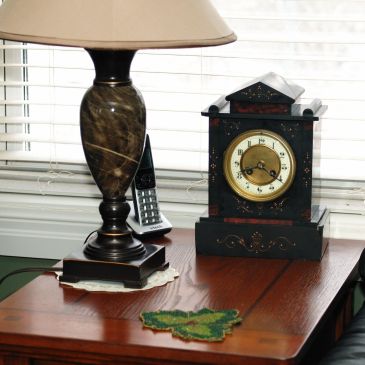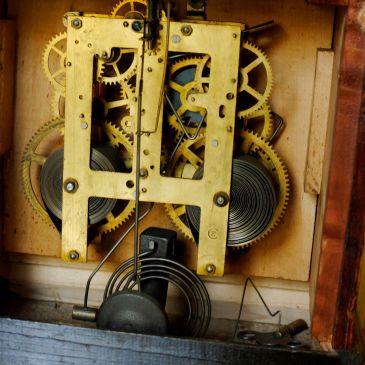
Profile My Clock: Seth Thomas Column and Cornice clock
Carole Ann Bennett of Ottawa, Canada asked me to profile her latest clock acquisition which was bought at auction and advertised as a triple-decker clock. It is, in fact, a column and cornice clock.

Seth Thomas column and cornice

This lovely Seth Thomas time and strike eight-day weight-driven column and cornice clock with hour strike features a mahogany veneer case with cove molded crest, ¾ columns in painted gold and two reverse painted doors opening to the interior clock works which reveals a tin painted dial and the original printed and illustrated Seth Thomas clock makers label. It is 32″ tall, 18″ wide and 5“ deep.

The painted tin Roman Numeral dial has hand-decorated flower spandrels in all four corners with the centre portion of the brass lyre movement visible though the dial.

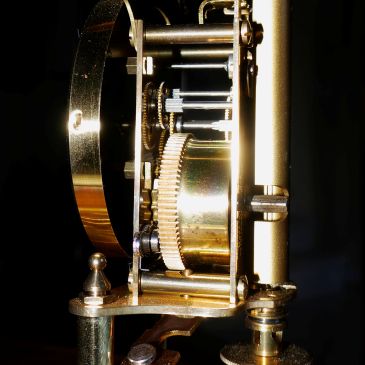
Brass lyre movment
Brass lyre movment

There is a small amount of chipping around the winding holes and face mounts. The hour and minute hands are in an Ogee style and original to the clock. The movement is clean and running well.

Painted tine dial face

The upper tablet has a hand-painted fruit bowl framed within a clear rectangular section with an onion top surround by a gold laurel design. The lower tablet shows a headless eagle framed in an clear oval centre with clustered gold berry spandrels in all 4 corners and encircling the oval section is a gold wreath made of berries and leaves. The headless eagle has clawed feet, one holding a sheaf of arrows while the other holds what appears to be a holly bush. There are 13 stars above the wings presumably representing the original 13 colonies. There is the expected amount of flaking consistent with the age of the clock which seems to disappear when the doors are closed. The missing paint areas blend into the remaining design and look good in spite of the minor issues.  A red banner runs through the centre. It appears to be a very loose interpretation of the eagle on the presidential seal.

Upper tablet
Upper tablet
Lower tablet

My first impression is that the top and bottom tablets are not a match because of the different themes on each panel however the blue paint is identical.

It has a very good interior label with the name J. M. Paterson, Hamilton, Canada West which appears to have been pasted over an original label.

Canada West, previously known as Upper Canada, formed one-half of the British colony of the Province of Canada. The region was governed jointly along with Canada East (formerly Lower Canada) from 1841 to 1867, when Canada West became the province of Ontario under Confederation. This would put the clock between 1841 and 1867.

More research is required. Below the added label are instructions for the operation of the clock. It has newer 6 ¾ lb cast iron replacement weights which are correct for an eight-day clock. The pendulum is a replacement as the original would have had a rate adjustment screw as per the last line of the instructions.

Clock instructions and label

Minor areas of paint around the main designs on the top and lower tablets are beginning to flake, however most of the original paintwork shows very well. The case has some scuffs and a little veneer chipping as one would expect. The deep grained mahogany veneer adds to the overall look of this big and beautiful shelf clock.

There are newer softwood strips attached by Robertson screws on the top and very bottom of the back of the case which appear to have been added either as a repair or to strengthen the case. There are 4 holes on the backboard just below the movement which may indicate the presence of an alarm mechanism at one time.

All in all it is a good looking clock that reflects the period and a fine acquisition.


Is my clock in beat?

You bought a clock. It ran when you first saw it but you bring it home, display it in that very spot you imagined and now it won’t run. 99% of the time this is caused by a clock not being in beat. All mechanical clocks must be set in beat before they will run properly.

Sessions time and strike

I make no attempt to explore the idiosyncrasies of various designs of clock movements. Much of the following information can be found at the forum site of the National Association of Watch and Clock Collectors, NAWCC . At this site there are additional tips on adjusting the beat of 400 day clocks, weight driven Vienna style clocks and so on.

When a clock is out of beat, it will either not run at all, or it will run for a short time and then stop

What does the term “beat” mean?

Make sure your clock is on a level surface. Listen to the tick and the tock of your clock. Try to minimize the sounds in the room you are in so that you can listen closely to it’s rhythm. It is in beat when its ticks and tocks are even….tick…tock…tick…tock…, and is out of beat when they are uneven, either, ticktock…. or tocktick…… Put another way, there will be an equal amount of time between the ticks and the tocks. When a clock is out of beat, it will either not run at all, or it will run for a short time and then stop. It is worth repeating that a clock’s beat must be regular to work properly.

Gilbert calendar clock, the Admiral

There are two ways to put a clock in beat. The first is to tilt the clock sideways, one way or the other, and listen for the beat to even out. When the beat is even, prop the clock to stay tilted that way. Now it will run in beat but it will obviously not look good.

The second way is to adjust the crutch to one side or the other, until the beat is even. The crutch is the rod that extends down from the pallets which rock back and forth on the escape wheel. The pendulum rod passes through either a loop (called a crutch loop) or a forked foot at the end of the crutch as indicated in the photo below. Incidentally, that rod needs to be in the middle of the crutch loop and can’t be tight inside the loop nor too loose. The crutch is attached to the pendulum leader which is then attached to a post with a suspension spring.

Mantel clocks have rear access doors that allow you to adjust the crutch, however for wall clocks you will have to remove the hands (the minute hand is released by a screw or a pin, the hour hand simply pulls off) and the dial face, also attached by screws that come off to reveal the movement. However,minor adjustments to the beat of a wall clock can be preformed by simply moving the clock off-level. It may not be noticeable if the clock is not quite level.

There is no need to take the movement out of its case to perform this procedure.

OLYMPUS DIGITAL CAMERA
American New Haven time and strike movement taken out of its case

If the crutch is a simple rod or wire as in the photo, it is adjusted by bending it to one side or the other (left or right). The brass rod is quite pliable allowing you to re-adjust if necessary. Listen to the beat as you make the adjustments and when you have a steady tick-tock the clock is in beat.

There us nothing as pleasant or soothing as the sound of a ticking mechanical clock in a room.

If it attaches to the pallets with a friction joint, it is adjusted by holding the pallets still with one hand, and shifting (pushing) the crutch right or left on the friction joint. The adjustment may be very slight in either direction.

plate-clock-movement_6-labels
Time only German movement for a Blackforest shelf clock

You need only to do this once. Whether your clock is a wall clock, a mantel clock, time and strike, time-only or time, strike and chime, the principles are exactly the same. There is no need to take your clock to a professional to have it “fixed”. This is definitely a do-it-yourself procedure. It’s that simple!

There is nothing as pleasant or soothing as the sound of the rhythmic ticking of a mechanical clock in a room especially if it is in beat.

Jaeger LeCoultre musical alarm clock – not bought yet but I have questions

Jaeger LeCoultre clocks are a favorite among collectors

Jaeger Lecoultre alarm clock
Jaeger LeCoultre alarm clock

Jaeger LeCoultre clocks are a favorite among collectors of high-end luxury timepieces, often bringing in hundreds of thousands of dollars at auction. Jaeger LeCoultre to this day produces high quality desk clocks and watches in addition to their famous line of Atmos clocks.

I was in an antique shop in Victoria, BC recently and I must confess that I have never seen so many antique and vintage clocks in one place outside a museum. (I’ll cover those in a future blog article)

There were so many French and American mantel and wall clocks that I went by this diminutive clock twice before stopping to take a more careful look. On the clock face it says LeCoultre and underneath the base there is a label that says Faust Waltz, the musical tone of this alarm clock.

It is small but substantial in weight. It is an authentic 8-day gilt or lacquered bronze Swiss made clock from about the 1960s to 1970s though it may be earlier. There are no obvious dents or scratches on the case and no marks on the glazing although I did not have enough time to examine it more closely. I have no idea whether or not it is in complete working order but the fact that music box functions is encouraging.

Rear of clock showing winding key for the music box on the lower left

Unfortunately I was taking shots with low light and using a flash would have attracted too much attention from the owner. The quality is not up to my usual standards.

I am in the process of deciding whether or not to make the decision to buy this clock. In the meantime I have several questions:

  • The seller is asking CDN199; a fair price?
  • Is it collectible?
  • I would like to narrow the vintage, the year it was made, thoughts?

There are plenty of different styles of LeCoultre alarm clocks on the net but I could only find one photo of this particular clock. Either it is rare and desirable or uncommon and not worth considering. I hope it is the former.

Let me know what you think.

How to buy a clock on Craigslist, Kijiji, Gumtree and so on…..And this is what I bought

Unknown French clock

It is a French mantel or shelf clock. I have no idea of the maker but it is an antique (over 100 years old), possibly 1890 to 1900. It has “Marque Deposse” stamped on the back plate but that simply means “trademark” in French. It is not a maker’s name. The clock is 11 inches high by 8 inches wide by 5 inches deep.

Access door
Rear access door

It is a time and strike movement on a coil gong. Unfortunately, the strike side does not work though the seller disclosed that to me before I bought the clock. I can feel the tension of the spring when I turn the key in the arbor but the spring does not engage the click, so, a broken or disconnected click I presume. The previous owner described it as having a melodious sounding gong. I would love to hear it. I wondered if the spring barrels could be taken out without separating the plates but further research has revealed that the movement must be dis-assembled.

Clock face
Clock face

The clock dial face is in two sections. The brass inner pan is surrounded by a porcelain dial with painted numbers. The dial door is flat glazing in a brass bezel with a high quality “hidden” hinge. A taper pin holds the delicately crafted hands. There is a smaller arbor, a speed regulator above the 12, which allows more precise tuning in concert with a speed adjustment on the pendulum.

Pendulum back showing stamped numbers

Aside from numbers on the back plate, an identical batch number on the pendulum and the Marque Deposee stamping, there is no makers mark. There may be a mark on the gong block but I won’t know until I release the nut on the base panel to take it out from underneath the clock. The numbers on the back plate are 3851-55. The number 5 5 is the pendulum length as in 5 and 5/12 French inches.

Adjustable pendulum
Front side of pendulum
Time and Strike movement

The movement appears to be of superior quality though common in a number of higher end French clocks. From what I can determine, the movement can be taken out of the case by undoing the two screws that go through the back bezel into the brass straps that protrude through the case from the front bezel. The movement should come out through the front once the two screws are released. The movement looks clean and there is sufficient oil in the pivots (no black or green gunk). I have other projects on the go so it might take me some time to take the movement out for inspection but for the time being I will let it run to regulate it.

The Corinthian style case is very heavy and is quite possibly Dinant Belgian Black Marble. Aside from the non-functioning strike side there are other issues. One is a very noticeable chip on the bottom right corner of the base which you can see in the photo below and the other is a small chip in the top left corner which is less visible. Close-up that larger chunk out of the corner looks ugly; from a distance it is hardly visible.

The worst of two chips
The worst of two chips, bottom right corner

Despite the slight damage the overall look is impressive. Most of what I see is well preserved. Indeed, it is a very attractive and stately antique French mantel clock that now occupies a prominent place in our family room.

Who made it? Unless there is a maker’s mark on the gong block or somewhere else on the movement, I may never know.

Buying an antique or vintage clock on Craigslist, Kijiji, Gumtree etc. – a how to

“Life is a box of chocolates….you never know what you are going to get”, Forest Gump

Buying a clock without actually touching and inspecting it is always a gamble and making a judgement based on images, many of which are poor quality, complicates the decision-making even further. There are stories of people buying clocks online only to find that the clock they thought had a antique mechanical movement arrived with a quartz one.

There are many challenges facing the clock shopper in today’s online world. Once your interest is piqued you may ask yourself these questions:

  • Did I get my money’s worth? Will I be “ripped off”?
  • Will it work when I get it home?
  • What do I have to do to fix whatever might be wrong?
  • What did the seller not disclose?

There are accepted rules about buying clocks on online for-sale sites. Online for-sale sites are ubiquitous and in many countries in the world. Here is an example of rules that are found on a particular site that I frequent.

  • All transactions should take place in person with cash. Do not ship items and do not accept other payment methods.
  • Never click links in an email that ask you to sign in to xxxx. All “Your xxxx account has expired” emails are fakes.
  • xxxx, eBay and PayPal do not offer buyer or seller protection for xxxx items. Such emails are fakes.

But for more specific rules on how to buy that special clock you were always looking for, see Ron’s Rules at the end of this post.

Follow this exchange between myself and the seller and consider my thoughts on this and other online clock purchases later in the article.

The clock

Unknown mantel or shelf clock.

Ad photo
Actual Ad photo

The exact words of the ad

Wind up alabaster clock. Very heavy. $80.00

The email exchange between myself and the seller

NOTE: This particular online for-sale site has an encrypted email service, therefore in my exchange I do not know the seller’s actual email address. This is a necessary protection for both parties.

Me

Do you know the company that made the clock and how old it is? Thanks

From the wording of the ad I am assuming at this point that the seller knows very little about the clock

Seller

Sorry I don’t know who made or how old it is. I bought it in an auction a few years back. Thanks xxxx

Me

Since you do not know the maker and I would have to drive from xxxxx, would you accept $60 for the clock.

Seller

Before you decide to drive from xxxxxx I would like you to know that the chimes do not work. I know that the clock would be worth more but 60.00 is fine if you would like to have it. Thanks xxxx. Let me know .

Me

If the chimes don’t work it is not a huge problem. Does it look like all the parts are there or is anything missing? I am still interested if the parts are there.

Seller

Everything is in tact. It was last serviced a few years back and worked great, but went to wind the chimes and they seemed to slip on the spring… However the clock still works just had it put away for a couple of years.

Me

For $60 I will buy it. How does 2pm today sound?

Seller

Yes we will make sure we are at home. Will you find the place OK? If not we could meet you part ways.

Later

I provided the seller with my telephone number. He subsequently calls to give me his address. The call is important because I suspect he wants to get a feel for who he is dealing with and that is the correct way to approach sales such as this.

Thoughts

It is important to be ready to pick the item up ASAP. You do not want to allow too much time for the seller to have second thoughts or to have someone else move in ahead of you. I often suggest meeting that same day, in a neutral place or at their home but most suggest meeting at their home. A neutral place is an option and I had to do this only once in over 2 dozen purchases.

My preliminary analysis based on the limited information that I have is that it is an French or English made time and strike shelf clock and judging from the problem on the “chime” side it might just be a bad click although it is possible that parts of the movement have been damaged. It is impossible to know until I see it and bring it home.

You might suggest I ask more questions about the clock or have the seller send additional photos of the movement or even a closeup of the clock face. It is only a $60.00 clock! In my experience once you attempt to have the seller take extra steps to sell their clock especially a clock at this price, the chances of a loss of sale increases. Were I to shell out hundreds of dollars I would definitely ask for more information and detailed, higher resolution photos.

Ron’s Rules

  1. Locate the clock you are looking for online and try to avoid Chinese or Korean clocks often advertised as “31 day” clocks. (For some reason people think they are worth a lot of money and they are garbage – usually!)
  2. Communicate by email and ask questions but not too many as to scare the seller off. Suggested questions might be:
    • Does the clock run?
    • Who is the maker (manufacturer)?
    • If it does not run, are all the pieces intact?
    • How old is it?
    • How long have you had it?
    • Would you accept a lower price because…….(justify reason(s))?
  3. Arrange final meeting details by phone.
  4. Meet the same day if possible.
  5. Meet the seller in person.
  6. Meeting at their home is preferred but a neutral location such as in front of a public building or in a mall is an option
  7. Pay in cash.
  8. Thank him/her for the sale.

Final thoughts

  • Check the dates on the listings. The longer they are listed the more the seller is inclined to sell for a better price.
  • Once, I gave the seller a day or two to think about my offer. I took a chance but got the clock for a decent price. (see first image)
  • Meeting the same day is crucial; you don’t want the seller to get cold feet and you don’t want someone coming behind you to buy the clock.
  • Only once did the seller accept a cheque from me because of past dealings with him. Cash is the rule.
  • If you cannot negotiate a final price by email suggest talking it over on the phone
  • Be courteous and polite at all stages of the deal

My wife and I are in the mood for a road trip. Now, with cash in hand, let’s get into the car and go for a drive.

Check back in 3-4 days to see how we did.

Timely Treasures – Gifting a Mechanical Clock

This year I decided to part with three of my vintage clocks. Rather than sell them which would have offset tool purchases, I decided that there is no better way than gifting them. I have three adult children (is that an oxymoron?) and it was a matter of allowing them to choose what clock they wanted out of several choices.

My oldest chose a vintage Sessions American No 2 shelf clock seen here.

Sessions American No 2 time and strike shelf clock
Sessions American No 2 time and strike shelf (or mantel) clock

She loved the natural mission oak style and the simple lines. This clock required a little work before it was handed over to my daughter. A thorough cleaning of the movement as well as 5 new bushings and a new click on the strike side were required. There is similar American model made by Sessions, the No 1, which did not have the fluted columns. This one was made was around 1922 and was a very popular model for Sessions.

My second daughter chose a Sessions Raven time and strike mantel clock pictured here. It is also from the early 1920s.

Sessions Raven time and strike shelf clock

She liked the ebony finish, the sound of the strike, the simplicity of the lines as well as the 4 delicate columns and added that it would go great with her furniture as you can see in the photo below. I agree. This clock was serviced just before I received it about a year ago but I took the movement out, inspected it, oiled it and returned it to its case.

On display in my daughter's living room
On display in my daughter’s living room

My son chose one of my earlier clocks, a Daniel Dakota time and strike wall clock circa 1960s. It was in very good condition for a Chinese clock though I took it apart, cleaned it and oiled it. Made in China clocks are practically bullet proof though due to their cheap construction they are prone to explode. Not the prettiest clock around but these things last a long time if you given them just a little care and attention.

Daniel Dakota time and strike wall clock (bottom piece missing)
Daniel Dakota time and strike wall clock (bottom ornamental piece missing)

If you are a collector, why not gift your clocks to friends and family? Clocks are endearing memories by association. Children love receiving clocks from their parents not only because of their collectible value (perhaps) but as a keepsake, a reminder of good times and happy family memories. I am sure that every time they wind the clock they will think about that one or more happy occasions and if something goes wrong with their clock it provides an excellent excuse for dad and mum to visit! And we certainly will with tools in hand!


2016 – Time to reflect, a year in summary

I am a retired college professor based in Nova Scotia Canada, live in a little village just outside Truro and collect vintage and antique clocks that I repair and maintain. I also write about horological areas of interest and of interesting clocks and clock stories that I encounter on my travels.

In the spring of 2015 I decided to write a blog about clocks. The first few months were a struggle to decide what material would be of interest to those who not only collect antique and vintage clocks but those few with just a passing interest. As the months went by I began to realize that the world of clock collecting and repair is incredibly vast and I discovered that there is a lot for me to learn. As I expand my knowledge of clock and collecting and repair I am also realizing that there is a lot I do not know.

This blog has given me an opportunity to profile my own clock collection, walk the reader through the challenges of restoring and repairing my clocks and the learning I have gained from the experience as well as talking about horological areas of interest.

My office showing clock repair tools
My office showing tools and my work area

Let’s review 2016.

Some statistics. As I write this article my blog has exceeded 17,000 views, 33% of which are from United States, 17% are from Canada and the remainder are from around the world including the United Kingdom, Australia, Romania, Germany, India, The Netherlands, South Africa, Malaysia and 80 other countries, even 5 visitors from Cuba (and I thought they did not have access to the internet). I receive between 40-50 comments per month on average. The top 5 articles this year were:

  1. Mauthe Mantel Clock
  2. Daniel Dakota Wall Clock
  3. Sessions Westminster A Mantel Clock
  4. Forestville Mantel Clock
  5. U.M. Muller Box Clock

As most bloggers know the key to building a successful blog is not only attracting new visitors but keeping existing ones interested enough to come back.

As most bloggers know the key to building a successful blog is not only attracting new visitors but keeping existing ones interested enough to come back. My visitors view an average of 1.8 articles per visit and I have 50-60 views on a typical day. I am now receiving as many views per month as I did in the first 8 months of the blog. My goal is to to provide enough stimulating content so that visitors want to return. I post 8 articles a month, usually spaced 4-5 days apart, on various topics of interest. I also attempt to appeal to all facets of clock collecting and repair from profiling my own acquisitions and experiences restoring and repairing my clocks to articles of general interest usually with some historical horological context.

Time side spring is removed
Servicing an American clock, removing the time mainspring

Centering prior to drilling
Bushing a movement using a centering tool

I have welcomed all comments and inquiries. I have received a number of fascinating comments from people who typically ask me how much their clock is worth, particular problems they have with their clock, information about the history of their clock and suggestions for improving my workflow. I answer all questions to the best of my ability but I make no pretense that I am a trained professional though my general knowledge of clock collecting and repair is growing exponentially. I have also received comments from those who more knowledgeable than I am and I welcome their expertise and perspective. I especially welcome the wisdom and insights from popular commenters such as JC and Catalin at Blog Timbrofil.

$_57e
Regulator weights

If you are a regular reader you will continue to see a number of what I hope are interesting clock articles in the months to come

Now it is time to look to 2017. My intent is to write interesting articles about clocks in general as well as continuing to profile my modest but expanding collection of antique and vintage clocks. I also intend to explore special areas of interest particularly my growing fascination with lantern clocks and crystal regulators. If you are a regular reader you will continue to see a number of what I hope are interesting clock articles in the months to come.

Stay tuned and if there is an area of interest you would like to see me to explore, drop me a quick note.

Thanks for your support.

Minimal Invasive intervention – repair, restore or conserve? The Ingraham Huron | A Case in Point

How Far Do You Go to Repair or Restore a Clock?

How far should one go to repair, restore, or conserve a clock without changing it in a significant way? Minimal invasive intervention is a term I “borrowed” from a clock forum I frequent. Some collectors argue that any work done on an antique clock detracts from its value—much like replacing the motor on an antique car. It may look nice, but it’s ultimately less desirable.

At the end of this article, I’ve included several questions that collectors might consider when faced with this dilemma.

When does performing too much work on a clock affect its collector value? If you go too far, does it lose its attraction as a collectible item? A true collector is often more interested in a movement that has never been touched than one that has been repaired or restored. But just how far should one go with a non-working vintage or antique clock? While it’s always desirable to have a running clock, most understand that getting a movement to actually function requires at least some invasive intervention—such as bushing or pivot reconstruction.

Repair implies correcting faults or poor servicing that may alter a clock from its original form.
Restoration involves rebuilding parts of the movement or case to return it to an “as-new” condition.
Conservation focuses on protecting and preserving a clock using effective methods to maintain its originality for as long as possible.

Some degree of intervention is not only necessary but, for some collectors, even desirable.


The Case of the Ingraham Huron Shelf Clock

To illustrate, let’s look at my 1878 Ingraham Huron time-and-strike shelf clock, an American-made piece with a uniquely designed rosewood case. For a 147-year-old clock, the case is in remarkable condition and always draws attention. The hands, pendulum, sash, and bezel hardware are all original. There are no cracks, breaks, or missing pieces. The case was cleaned with Murphy’s Oil Soap and water, followed by a light coat of shellac. The dial shows a natural buildup of grime that, while some may see it as unsightly, contributes to its authentic character—and that, I will not touch.

RS April 12th
Ingraham Huron shelf clock circa 1878

The movement is original but bears evidence of poor past repairs. In small-town Nova Scotia, access to professional clockmakers was limited, so people often relied on local tinkerers to get their clocks running again. In those days, a clock was an appliance—something that needed to work, not a collector’s treasure. Quick and inexpensive fixes were the goal, and as a result, questionable methods were sometimes used. This movement shows plenty of solder, with misaligned gears and new pivot holes drilled into the plates. The soldering was likely done in the 1940s, when soldering guns became common.

RS Ingraham movement (2)
This lantern pinion has plenty of solder

When I got it, the clock ran for two or three days on a full wind before stopping. A gentle nudge of the pendulum gets it going again, but it soon stops once more. From the front, little seems wrong, but once the movement is removed from the case, the problems become clear—particularly the invasive solder repairs.


Repair, Restore, or Conserve?

I brought the clock to a certified horologist, and we discussed which approach to take: repair, restore, or conserve? He shared a story about a customer who brought in a kitchen clock (also known as a “gingerbread” clock)—a family heirloom they wanted running again. These clocks are common today; thousands were made, and few have significant market value. Yet sentimental value often outweighs monetary worth. In such cases, he repairs the clock to the customer’s satisfaction but if the movement is beyond repair, he recommends replacing it with a period-correct one. Most customers accept this solution, but collectors recognize that a clock with a replacement movement holds little or no collector value.

RS Ingraham movement (4)
Piece added to the plate, second arrow shows new pivot hole

In my case, the horologist advised that my Ingraham Huron’s movement should not be replaced. Instead, it should be carefully restored to its original condition.

Collectors are always on the hunt for untouched examples, but finding an antique clock that has never been altered is rare. Using this clock as an example, a repair might reduce its originality—and thus its value—while a proper restoration could increase both its appeal and desirability.


Questions for the Collector

When deciding how to approach an antique or vintage clock that needs work, I ask myself the following:

  • Is undoing the “damage” caused by an earlier poor repair considered an overly invasive procedure?
  • If the repair was done shortly after the clock was made and clearly documented, should it be left untouched?
  • Is a poor repair part of the clock’s historical provenance, and should it remain as-is?
  • Would bringing the movement back to its original state be considered a restoration or a repair?
  • In the case of the Ingraham Huron, does removing all the solder qualify as minimal invasive intervention?
  • Will the repair enhance or diminish the clock’s value?
  • Would choosing not to repair or restore it be considered conservation?

In my view, conservation represents the least invasive form of intervention, while repair and restoration involve progressively greater degrees of change.

So, how far would you go?

In the end, the question of how far to go in repairing or restoring a clock echoes the ancient Ship of Theseus paradox. When every part of a clock has been repaired, replaced, or renewed, does it remain the same clock? Perhaps the answer lies not in its parts but in its essence—the story it tells, the hands that have wound it, and the generations who have listened to it mark the passing of time. Whether we choose to repair, restore, or conserve, each decision reflects our own philosophy of preservation: what we value more—the clock’s originality, or its ability to keep time once again.


Antiquing on a Sunday afternoon

Carriage clock with Jeweler's inscription
Carriage clock with Jeweler’s inscription

Sadly the number of antique shops in Nova Scotia is dwindling. We were antiquing in the city of Halifax (Nova Scotia, Canada) this past spring and one of the store owners remarked that there used to be dozens of antique shops in the city, now only a few remain. There are still a few antique shops left in the rural areas and one of our favorites is located in Great Village, Nova Scotia. We decided on a little drive to Great village on a sunny fall Sunday. We were not disappointed in the variety of clocks we discovered. Although I saw all the following clocks during our day of antiquing I bought only one, the Kern “diamond face” 400 day clock (see photo below).

rs-great-village-antiques_3
Window display

Unknown French clock

I want to give readers a sense of what is out there if you are collector like myself  or you are new to collecting. Now is an excellent time to buy. There are certainly deals to be found and plenty of clocks in the shops. My personal experience is that the antique stores are great places to buy clocks but it can be bit of a gamble. For example, the Kern 400 day clock was advertised for a very fair price complete with glass dome. I asked the store owner if they knew anything about clocks and they said “no, nothing at all”. Sometimes that is a very good answer! The tag on the clock said “as is”. The owner evidently thought the pendulum balls were seized. Prior to the purchase I discovered, that they were, in fact, in their locked position. I got the clock home, unlocked it, gave a little push and it has been running for the past week.

Stamps for sale
Stamps for sale

You can get a “steal” of a deal, a clunker or something in between in an antique shop. In this same shop two years ago I bought an Arthur Pequegnat Brandon wall clock for under $200. The case is in excellent shape as is the dial but the movement, though barely running, required servicing. Even though I had to put a little more money into the clock I still consider it a great deal!

Having some knowledge of clock models, styles and types in particular is an advantage. Or, perhaps you might have a good sense that what you are looking at is a good deal. In the case of the Kern 400 day clock I inspected it beforehand and found that it was not only complete but in excellent condition. The $58 Garrard time and strike (photo below) might be a good deal but if it is missing the pendulum you are going to have to search long and hard for a replacement or buy one which adds to the cost. You might ask yourself, what else is missing and how much more money would I have to put into it? The Garrard was missing the front glass and I could not figure out how it was attached so I passed on it. Those are some of the factors to consider when you see something at an attractive price.

A doomed Ogee
A doomed Ogee

In the case of the carriage clock (first photo) the seller wants $120 but the day I was there they were offering a 20% discount which works out to $96. There is a jewelers inscription on the front which says Ryrie Bros. Toronto. Ryrie Bros was a jeweler in Toronto and was incorporated in 1905 with James Ryrie as president and W.M. Birks as vice president. In 1924 the firm changed it’s name to Ryrie Birks and finally in 1933 became Birks. As any Canadian knows Birks (Maison Birk) is one of the premier jewelers in this country. One could comfortably date this clock at between 1905 and 1924. Although the tag says that it is French it is likely American. It might be desirable however there are two bothersome issues that I could see right away with this carriage clock. One, the left side beveled glass panel has a chip in the lower back corner and two, there are noticeable hairline cracks in the upper two corners of the face. The tag said it was in working order. $96 may not be a bad price when you consider that comparable clocks fetch upwards of $130 or more + shipping on Ebay. If it is still there before Christmas I might take a second look.

Unknown "marble" desk clock
Unknown “marble” desk clock

This unknown “marble” desk clock was very interesting and quite heavy. It had an alarm clock style movement with a key wind and an adjustment for the time, and what appears to be brass bird (duck?) on it’s right side.

Kern diamond face 400 day clock

As I mentioned I bought this Kern 400 day “diamond face” clock. It is in excellent condition; unlocked the pendulum, oiled the movement, gave it a gentle push of the pendulum and now running very well.

Could be Session, Ingraham, Ansonia
Could be Sessions, Ingraham, Ansonia

In decent shape, 1873 it said on the label, but the seller wanted too much, $450 if I recall. The seller claims it is running, according the tag. Is it a Sessions, Ingraham, Ansonia or …..?

Sessions shelf clock
Sessions shelf clock in oak case

This clock looked to be in decent shape, the strike side appeared to be working properly. The case is oak but when I picked it up to examine it more closely, the construction, fit and finish had a cheap feel. There was a card inside describing a servicing performed in 1994. $68 – a little high, I thought but there may not be a lot wrong with it.

20161120_1451511416

I like this clock but know very little about crystal regulators. What I do know is that most American companies made them, from simple brass and glass cases to elaborate cases with cast and gilt ornaments. Equivalent French examples seem to be more valuable than American ones. They can be highly expensive. Generally, the more elaborate the case, the more expensive the clock, even though the simple cases could easily be considered more tasteful. I remember seeing a very ornate one on Antique Roadshow which was valued at $8000. Condition is very important with these clocks, including the condition of the beveled glass, dials, and original finish (generally gilt) on the case ornaments. Is the pendulum supposed to be filled with anything? Mercury? These cylinders looked empty. The seller claims the clock is running and wants $365. A fair price? I don’t know. It needs a thorough cleaning though.

Garrard mantel clock

This English Garrard clock had a well constructed case and appeared to have a well-made, robust movement but was missing its front glass. I have been to this particular shop several times and nobody seems to be interested in the clock though the price has not changed.

rs-great-village-antiques_6
Seth Thomas made by Talley Industries

I noticed a Seth Thomas mantel clock in a dark corner. This particular example is one that I would not recommend to anyone unless you are a fan of Talley Industries. It is a Seth Thomas Westminster chime mantel clock made by Talley Industries, Peterborough, Ontario in the early seventies with what appears to be an imported West German Hermle movement. This clock was cheaply constructed (corners were chipped), likely has the dreaded plated pivot problem and has absolutely no collector value. Those in the clock collecting world familiar with Seth Thomas know that it was a reputable clock maker for many years and produced many fine clocks but the Talley Industries era must have been a very dark period for the company!

rs-great-village-antiques_8
A unique clock design

I hope this blog article gives the reader some ideas when it comes to antique shop clock shopping. It certainly pays to do your research. Although I love browsing the shops I do not limit my shopping to them. I acquire many of my clocks from a variety of sources including Ebay, Kijiji, and word of mouth but I like browsing through antique shops because there are always other interesting items that catch the eye.

Mystery clock – if you know the maker, let me know

If you know the maker, let me know or direct me to where I can find out.

I was in an antique shop in a small village in the Annapolis Valley, Nova Scotia lately and came across this unusual box-type wall clock. I glanced at the back of the clock and noticed that the wall anchor hook had been detached suggesting that a past owner determined that it was to be a shelf clock. What else did the previous owner(s) do to alter this clock, I wondered?

The clock measures about 24 inches tall (60 cm), about 14-15 inches wide (40 cm) and about 6 inches (15 cm) deep. The dial is about 10 inches (25 cm) in diameter. The tag on the top of the clock says, “$145 – probably English, 1920s to 1940s, needs some adjustments”. The shop owner could not say whether it would run or not.

At first glance it appears to be a conventional clock but there are a few features which I find very intriguing. I discussed the clock with the owner of the antique shop and she said that it is a railway clock which I doubt for two reasons, one, the clock dial face is too small to be seen at a distance and two, it appears to be a time and strike clock given the two winding arbors. Railway clocks usually have dials that are 12 inches (30 cm) in diameter or more and normally do not strike. Striking clocks would not be heard amid the cacophony of a typical train station.

Now, it is quite conceivable that it is not a strike clock at all but a time-only clock that has two winding arbors. Double spring clocks were not uncommon during that period and if so, it would probably make this a 15 day (or more) clock similar to this double-spring Seth Thomas railway clock pictured here. That could be the case in this instance.

Double sporing 15 day Seth Thomas
Double spring 15 day American Seth Thomas

The spade hands look original as does the clock dial pan, oak case and oak rod with what appears to be a spun brass pendulum. What appears to be missing is an oak piece (or other wood I assume) that surrounds the dial pan and hides the four dial pan mounting screws. The dial face might be a little newer. The hands are attached by a nut which would put it in the period the tag suggests.

Mystery clock
Mystery clock

rs-annapolis-royal-oct-16-2nd-set_12_1-3

The winding arbors are exceptionally large and would require an unconventional key. I should have put something beside the arbors to show just how large they actually are. While the owner of the shop had a number of clock keys she did not have one to fit this particular clock.

Very large winding arbors
The clock has very large winding arbors

The bezel should have a cover for the screws
The bezel should have a surround to hide the screws

The next feature I noticed is that the clock appears to have a Graham dead-beat escapement or something very similar though I could only see the top part of the escapement. The Graham deadbeat escapement has been the escapement of choice in almost all finer pendulum clocks.  It might also be another type of escapement but it is impossible to say without a closer examination. Normally one would associate a recoil escapement with a cheaper spring driven clock but accuracy must have been a priority in this case.

rs-annapolis-royal-oct-16-2nd-set_12_1-1
Beat scale

It is indeed a mystery. I would love to see what the original clock looks like. The price is not unreasonable but I wonder what else is missing besides the bezel surround and the wall anchor hook.

If you can point me in a direction, leave a reply.

Smiths Enfield Art Deco mantel clock


Smiths Enfield time and strike clock

I absolutely love Art Deco clocks. They are understated, elegant, have great collector value and are timeless, of course (!).

Although we tend to throw the term around loosely Art Deco is actually derived from the phrase Arts Décoratifs which was a dominant decorative art style of the 1920s and 1930s, it’s heyday. This unique form is characterized by precise, bold geometric shapes and strong contrasting colors, used most notably in household objects, and, of course, in clock design as we see here. Style Moderne (as Art Deco was otherwise known) originated in France and was centered in Paris, just before World War I and became very popular after the Great War (World War I). Perhaps the most visible example of Art Deco architecture is the Chrysler Building in New York City in this photo taken from the Empire State Building in 2014.

Chrysler Tower
Chrysler Tower, New York City

The Art Deco style had a far reaching influence and permanency that went far beyond the 20s and 30s through to articles, objects, architecture, furniture and yes, even clocks to this very day.

This is a Smiths Enfield Art Deco style clock. The Enfield Clock company was started by two German brothers in Enfield, North London, in the early twentieth century. During the Second World War (1939-1945) they were the major UK supplier for essential aircraft clocks and instruments. After the war the company vigorously resumed clock and watch production. No doubt most homes in Britain at that time had a Smiths clock. The Smiths Clock Co. became Smiths Enfield in 1949 and the Smiths Enfield name first appeared in catalogs from 1950 onward.

Smiths Enfield
Smiths Enfield clock

Smiths Enfield shelf clock
Smiths Enfield clock on a shelf

This elegant Smiths Enfield oak case time and strike shelf clock was made somewhere between 1949 and 1955. I know little of the provenance of this particular clock suffice to say that it came from overseas where it likely spent it’s life in someone’s home prior to coming to Canada about a year or two ago. The clerk at the antique shop located in Halliburton, Ontario this past summer (2016) told me that the owner of the shop purchases the bulk of his antiques from Ireland and judging from the store contents he imports a quite a lot of antiques and a lot of clocks.

The oak cabinet is made up of veneers and solids and is well constructed. The case is in excellent condition with nary a nick or scratch; required a soap and water cleaning and a little lemon-based furniture polish to bring the shine up. The clock runs well and keeps relatively good time although it certainly requires a thorough cleaning.

Floating balances were introduced by Smiths Enfield in 1956. Since this clock has a pendulum it was manufactured during the period I mentioned above (1949 to 1955). The inverted numbers on the lower clock face, which at first look strange, are actually very common on clocks with Roman Numerals.

OLYMPUS DIGITAL CAMERA
Movement showing coiled gong

It has a coiled gong and a nice pleasant strike if I can get the hammer to strike the gong as it should. A trial and error approach ensuring that the hammer is above but not quite touching the gong or replacement of the hammer leather are two possible solutions.

This is one of two cottage clocks I have. By that I mean they are literally at my summer cottage, and since it remains at my cottage a cleaning will have to wait until next summer.


Servicing a Sessions American No. 2 mantel clock Part III

Sessions American No. 2

The movement is disassembled and now it is time for further inspection, cleaning, servicing the mainsprings, pegging the pivot holes, polishing the pivots and installing bushings where needed. In this, Part III we will cover cleaning and mainspring servicing.

Ultrasonic cleaner
Ultrasonic cleaner

I have a small ultrasonic cleaner so I tend to clean parts in batches since this one does not have a large capacity. An ultrasonic cleaner is not an absolute must as you can easily clean by hand but having one certainly helps.

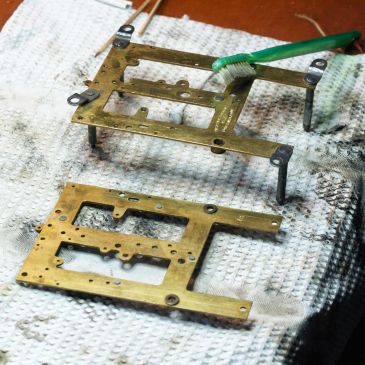
Front and back plates

Old toothbrushes are great for getting into the crevices and I use one especially for the lantern pinions as a lot of dirt and old oil tend to accumulate in those particular areas.

indicating wjehere bushings will be installed
indicating where bushings will be installed

This photo shows a couple of bushings that I will install. I realize that some prefer to install bushings by hand and I applaud them as it does take considerable skill but I use a Bergeon Bushing Machine which I believe simplifies the task (for me, at least). More on bushing in the next part of this series.

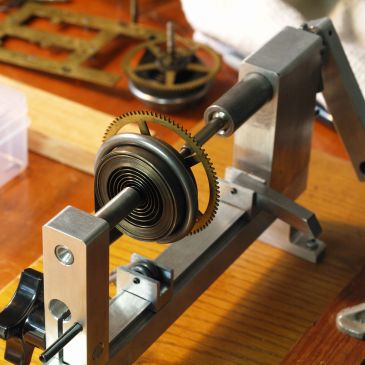
Olie Baker spring winder

An Olie Baker spring winder is an indispensable tool. You can easily make one of your own to save a little money if you are handy with building things. A spring winder permits you to inspect for cracks or breaks, clean and oil the springs before reinstalling them. The photo shows a C-clamp securing the mainspring prior to cleaning.

OLYMPUS DIGITAL CAMERA
leather gloves are used to secure the spring on the winder

I have never lost an eye or a finger but I believe in safety first especially when working with mainsprings. Always wear leather gloves and eye protection. You never know when a 100 year old spring will break and fly across the room.

Click replaced
Click replaced

I discovered that one click had to be replaced as it was almost slipping off the ratchet. As some clock repair folks know, Sessions clocks have a reputation for bad clicks. I had a Sessions click in my supply box, fortunately. It is an easy job; just take the old one out with pliers, secure the new click and bang the rivet (supplied) into the existing hole with a ball peen hammer.

Serviced springs
Serviced springs

The springs have been cleaned and oiled with Keystone Mainspring Oil and are completely serviced including the installation of one new click. Now comes the bushing work, re-assembly and testing. Stay tuned to Part IV of this series.

Sessions clock final thoughts

Sessions movement
Sessions movement in the process of repair

Regular readers have followed my progress on this 1927 Sessions tambour style clock.

Better news this time. After installing 10 bushings, repairing the strike click, replacing the pendulum bob and suspension spring and reassembling and oiling the clock and the springs I am having excellent success regulating this fine old clock. On a full wind I am getting upwards of 9 days and typically eight days through the summer. Though it sits inside our cottage in Quebec it has suffered through all manner of outside weather including high humidity and cool nights and despite these conditions it has performed admirably.

Although originally intended as a cottage clock I will be taking this clock back with me and placing it in a prominent place in my home.

All in all a great learning experience and a satisfying result.

How to oil your mechanical clock

Oiling your mechanical clock is an essential part of its maintenance, ensuring smooth operation and longevity. Proper lubrication reduces friction between moving parts, preventing wear and tear while keeping the movement running smoothly over time.

During the summer of 2016, my wife and I were traveling through the Muskoka area of the province of Ontario and stopped at a quaint village called Halliburton where we happened upon the only antique shop in town. There were a large number of clocks in the store that the proprietor had brought over from Ireland and each one was interesting.

Though there were plenty to choose from we settled on a Smiths Enfield Art Deco style oak cased mantel clock pictured below.

Smiths Enfield
Smiths Enfield time and strike

It was sold as-is and non-working, with the clerk noting that the pendulum bob was missing, which explained a lower price. However, when I got the clock home, I discovered the bob wrapped in brown paper along with the key, tucked inside the clock. After attaching the pendulum bob to the rod and a bit of adjustment, I found the correct beat, and the clock started running.

At my summer place, I do not have the necessary tools to service clocks but decided to take the movement out to oil it.

Once out of the case, I discovered that someone had oiled the movement by spraying it with an unknown lubricant. Spraying a clock with any lubricant is a bad practice. Indiscriminate oiling attracts dust and grime that will accelerate wear and eventually lead to stoppage.

Given the indiscriminate use of oil, there was no sense in operating the clock so I decided to put it aside until I got home where I could disassemble, clean, and properly service the movement.

Oiling Your Mechanical Clock

Lubrication is essential to the good running of any clock movement. Oiling a movement without first dissembling and cleaning it is normally a bad practice. The addition of new lubricant to old will mix with the dirt and grime to form a paste which acts as an abrasive that will hasten pivot and pivot hole wear.

The purpose of lubrication is to reduce wear, and applying the correct amount of oil is crucial. The only exception to this is when the oil sinks are dry— in such cases, oiling the movement without disassembling it is acceptable.

Apply only as much oil as required, a tiny drop goes a long way. Clock oil should occupy about one-half the capacity of the oil reservoir. Use an approved clock oil and a pin-type oiler to apply the oil.

Clock pivot oil
Clock pivot oil

Key Points Regarding Oiling

Lubricant: clock oil has the correct viscosity and has a low tendency to evaporate, spread or react adversely to various metals. Pivot oil is for pivots and spring oil is for springs; there is a difference! Clock suppliers such as Timesavers or Perrin will shave the correct oil for your clock. Do not uses household lubricants and especially WD 40 which is not a lubricant but a water dispersing agent. Synthetic oil is preferred since it retains its properties for a longer period but I work with mineral oil which is cheaper and just as effective.

When to oil: Some say that one should apply oil only after disassembling and cleaning. Others say that a clock’s service cycle might be an average of 5 years or more and oiling every two or three years without a thorough cleaning is acceptable. If there is a visible build-up of black, contaminated oily sludge in the pivot holes, a disassembly and thorough cleaning is necessary prior to oiling. A clock’s the environment will play a significant role since dusty, smoky environments contribute to accelerated wear. A sealed case will also keep out dust and lengthen the cycles between oiling.

How much oil: After oiling there should be a visible presence of oil in the oil sinks around the pivot holes. Oil running down the plates is to be avoided and is a indication that too much oil has been applied. I use a clock oiler with dispenser. Oil cup reservoirs are also very helpful as they prevent any foreign material from getting into the oil bottle when dipping with a pin type applicator. Long case clocks with larger pivot holes will require more oil than a small carriage clock.

clock oiler with dispenser

What to oil: While looking at a clock plate (front or back) work from the top to the bottom. First and foremost are the pivot holes in the plate, then the points of contact between the pendulum and the crutch, escapement pallets faces and centre and motion works arbours. I generally do not apply lubricant to the mainsprings unless I have unwound them. Once out of the clock and assessed as to their condition and cleaned, I apply Keystone mainspring oil prior to re-installation. Do not oil the gear teeth.

Mainspring winder

This short primer on oiling your clock is not meant to be a definitive guide but will give you enough information to get you started if you have just found that mechanical clock you have always wanted.

In conclusion, a properly oiled clock, combined with regular servicing, is key to maintaining its functionality and extending its lifespan. Regular lubrication helps reduce friction between the moving parts, ensuring smooth operation and minimizing wear and tear. By performing periodic maintenance, such as cleaning and oiling, you can keep the clock running efficiently for many years, preserving both its accuracy and its value.

For more information on clock lubrication, I suggest the forum site at the National Association of Watch and Clock Collectors where you can find many expert opinions.

Sessions Beveled Number 2


mantel clock
Sessions tambour style mantel clock

Regular readers might have followed my progress on this 1927 Sessions tambour style clock.

After installing 10 bushings, replacing the pendulum bob and suspension spring and reassembling and oiling the clock and the springs I am now in the process of regulating this old clock. I am finding that despite all the work I have put into this clock,  it will run for only 6 days and it does not seem to want to run the full eight day cycle. Perhaps there is other wear that I am not detecting or the springs are weak.

I wound the clock again this morning and we will see how long this cycle will go before stopping. Everything is synchronized thanks to Steven Conover’s helpful book on striking clocks. Is it a success since it was a non-running clock when I acquired it last fall.

The Bracket Clock

Let me take you on a brief journey as we explore the history of the bracket clock. If you’re already familiar with them, perhaps I can offer some additional insights into what exactly defines a bracket clock.

RS Hermle bracket clock (4)
Hermle Bracket clock, circa 1990

So, what exactly is a bracket clock? A bracket clock is a type of shelf or mantel clock.

Bracket clocks date back to the 1600s, with the earliest examples being weight-driven clocks crafted by skilled artisans. These clocks were designed to hang on wall brackets, allowing the weights to descend freely. The movement was typically plated, meaning it consisted of plates with bearing or pivot holes, connected by horizontal pillars. Early bracket clocks used verge escapements, a mechanism dating back to the 13th century, which remained in use until the late 17th century, when the recoil anchor escapement was introduced.

As time progressed, bracket clocks transitioned to spring-driven movements, making them portable and easier for homeowners to move from room to room. Given their high cost, their portability was highly valued, as most owners could not afford to have multiple clocks in their homes.

These clocks were often striking clocks, with many featuring silencers that allowed the owner to turn off the striking mechanism at night, especially in the bedroom. Additionally, bracket clocks were commonly repeaters, meaning they could repeat the last hour with the pull of a chord or lever. As spring-driven movements became more common in the 1700s, the term “bracket” continued to be associated with this style of clock.

RS Hermle bracket clock (9)
Bracket clock with ornate dial face, cast feet, and carrying handle

Bracket clocks were a reflection of the design trends of their time, often featuring intricate and ornate details. These clocks typically had wood cases, with finishes like oak or mahogany burl and walnut, adorned with floral decorations. The dials were often engraved, cast, or silvered, and many featured subsidiary dials, spandrels around the main dial, molded bases, and sculpted brass feet, adding to their visual appeal.

Antique bracket clocks are among the most elegant timepieces you can find for a home. The first two photographs showcase a modern Hermle bracket clock with Westminster chimes and a moon phase feature. Although this clock is 20 years old, a similar model from Hermle, called the Debden, is still available for purchase. The Debden includes side windows (which mine does not) and offers additional details, all for under $800.00.

Bracket clocks are timeless pieces that blend functionality with exquisite craftsmanship, reflecting the design styles of their eras. Whether antique or modern, these clocks remain a beautiful and elegant addition to any home, offering both aesthetic appeal and the charm of fine clockmaking.

Inns and B&Bs – why don’t the clocks work?

Have you ever stayed at an inn or B&B? If you have you might have noticed those that have some sort of historical significance with furniture dating back a 100 years or more, have the odd antique or vintage clock. However, it frustrates me to no end to see them not running.

In the summer of 2014 my wife and I stayed at a beautiful century-old inn in Ganonoque, Ontario, Canada. There were at least 8 clocks in various locations within the inn. They were quite nice and appeared to be in good shape but none were running. A shame! Perhaps there are a number of reasons; clock(s) need(s) servicing / does not run, broken for whatever reason, laziness; staff cannot be bothered to keep them running, unsure how they work or fear of breaking the clock if staff attempt to wind or regulate it (them). I did not inquire.

I’m going to tell you about a pleasant exception we found on our travels. My wife and I were in Bar Harbor, Maine, USA in early June (2016) and I am delighted to say that I discovered that at the Bar Harbor Inn which is, I might add, a beautiful and stately inn prominently located on the village harbor(!), antique and vintage clocks inside the front room of the inn that were actually running.

RS June 2016 (23)
Bar Harbor Inn, Bar Harbor, Maine

I was so amazed that I stopped to examine the clocks without touching them, of course, and while doing so was approached by an elderly gentleman who identified himself as the bell captain. At the time (pun unintended) I was looking at what might be a German Mauthe long case round top, time and strike clock (please tell me if you know otherwise). He mentioned that it was brought over at the end of the Second World War by an American serviceman. Despite working at the inn for over 30 years and maintaining the clock on a weekly basis, he could not tell me the maker. He was no doubt enamored with the clock and obviously not concerned who made it.

RS June 2016 (128)
Possibly Mauthe tall case

He showed me another clock, a Seth Thomas time and strike which for some strange reason he was not permitted to wind or even touch for that matter. That duty was obviously left to a specially designated person since the clock must have had some particular relevance. Now, it doesn’t take much to wind a clock but some familiarity with how these old clocks work certainly goes a long way to preserving them.

RS June 2016 (129)
American Seth Thomas time and strike tambour style shelf clock

If you are, like myself, a clock person, the next time you are in an inn or B&B praise the owner / staff if the antique and vintage clocks are running or politely question why they are not. They deserve to be running.

Searching for a donor movement pays off

Last summer (2015) I bought a Blackforest time-only shelf clock for $10 at a small antique store in Kazabazua, Quebec which you see pictured below. To be fair it did not look like this when I bought it. It was quite beaten up and a case refresh was sorely needed which included stripping and re-staining.

RS together but not working (2)
Blackforest shelf clock #1

It’s a relatively simple 8-day time-only movement commonly known as a “plate clock” movement. To avoid any confusion let me say this shelf clock is Canadian made by the Blackforest Clock Company of Toronto (known as the Forestville Clock Company after the second war). The movement is likely German; the clock was made in the mid 1930’s when Canadian companies imported German movements for a variety of mantel and long case clocks.

Despite my best efforts I could not get Blackforest shelf clock #1 to run reliably. It would typically run 5-10 minutes and stop. The movement had a couple of bad teeth on the escape wheel; not an easy fix and I assume the source of the stoppage. I decided that I would wait until I found a donor movement to scavenge any parts I needed so I put #1 aside.

I scoured the net looking for an identical movement. I found one from a clock parts company in Ontario but sadly the company, despite having an online presence, was no longer in business. My numerous emails were not answered. I was getting a little discouraged until February 2016 when my wife and I were making our regular pilgrimage to a popular antique store in Great Village, Nova Scotia. I came upon Blackforest shelf clock #2, a clock not much different from the one I found in 2015 but more importantly it had an identical movement. I particularly like this one because it commemorates King George VI and Queen Elizabeth’s Royal Visit in 1939 (the coronation was in May 1937) making this vintage clock almost 78 years old.

RS shelf clock number 2 (12)
Royal Visit to Canada1937

RS Refinished case (7)
Blackforest shelf clock #2 circa 1938-39

No problem I thought. Between the two of them I should get one clock running reliably. I paid $20.00 for the newer one with a total of $30.00 for two clocks; a minimal outlay for the total project.

Blackforest shelf clock #2 ran for a while but I could not get it to run much past two days without it stopping. The sudden stop seemed like a power issue or perhaps it was just plain gummed up and dirty. A thorough cleaning was one solution to the stoppage. This was also a good opportunity to decide which clock was worth salvaging. In the end the newer one won out. However, two parts had to come from the older movement, the pendulum bob (the newer one had a cracked bob) and the spring / click / ratchet assembly which I will now discuss further.

Blackforest shelf clock #2 had a partially stripped ratchet (see photo with white arrow) which I thought was rather unusual; not very surprising since brass is a very soft metal and does not stand up to much abuse, a product of rough treatment in the past I suspect. While winding it I could feel the click slipping on the ratchet and feared that it would let go if I was not careful enough. This critical issue could have led to a unpleasant outcome at some point in the future so I determined that it was only prudent to replace the spring / click / ratchet assembly.

RS Blackforest mantel clock (63)
White arrow is pointing to a stripped ratchet

Pendulum
Pendulum assembly with rotating bob adjustment

Spring barrel
Open spring barrel, ratchet and click assembly

clock gears
Gears assembled on the front plate

The two replacement parts fit perfectly. Now for a thorough cleaning. All the parts were put into an ultrasonic cleaner, dried, inspected and polished. The pivots were inspected and polished. The pivot holes which were in very good condition were pegged out and once re-assembled the movement was oiled and briefly tested. As any clock enthusiast who has had experience with time-only movements, they are certainly the easiest to work on.

The final step is the long-term testing phase to see how it runs on a full wind.

Postscript: five days later there is no stoppage. It will take a little longer to regulate the clock but so far so good.

Blackforest shelf clock #2 now has a replacement spring, click and ratchet as well as a new pendulum bob. Does it make it original? Considering that it has parts from a clock that was likely made at the same time it is original enough as far as I am concerned.

What is my clock worth?

Every clock owner wants to know what their clock is worth and every clock seller wants to know what price they can ask for. This article will provide a guide to buying or selling an antique or vintage clock.

I will attempt to answer the following questions beginning with comments about the unpredictable clock market.

  • What factors are considered when assessing the value of a clock?
    • Is it original?
    • What type or style of clock is it?
    • Does the clock have a label, trademark, or prominent name?
    • Is it from the correct period or is it a “knock-off” or “re-issue”?
    • Does the clock have provenance?
    • What is the age and condition?
    • Is the clock collectible?
    • What is the mechanism type?
  • It all comes down to research

The unpredictable clock market

Unfortunately, in this unpredictable market, it is almost impossible to determine the value of a clock. What you think your clock may be worth today may not align with what the experts say and what others are willing to pay. What has value today may not have value tomorrow. Many factors influence the buying and selling of clocks and the clock market can be a battlefield with many casualties.

Recently, I saw a mid-1990s Howard Miller grandfather clock listed for sale on a Facebook site. I tracked the ad over the course of several days. The owner originally wanted $3000 but later stated they would take “no less than $1500” when it became obvious to them that the ad was not attracting attention. Personal value tends to be subjective and while the owner might have paid $3000 or more for a beautifully carved oak grandfather clock, its present value is not anywhere near what he thinks it is worth. I stopped following the ad but the seller likely withdrew it from sale.

Even an appraised value is the subjective opinion of an expert assessment based on condition and collectibility which is always subject to shifts in the market. My Ridgeway grandfather clock is in excellent condition, runs well, and has a command presence in my home but it is not worth much in today’s market.

Ridgeway Grandfather clock, Hamilton Country

What factors are considered when assessing the value of a clock?

Is it original? Original clocks attract buyers. The value of a clock decreases if some or many parts have been changed out. Determining whether or not a clock is original can often be difficult to determine unless viewed by an expert. The many “Vienna Regulator” clocks found on eBay and other online for-sale sites are missing parts, have had parts added such as crowns, finials, dial faces, hands, and even movements, and have weights that are not original to the clock. Back in the 1960s, many Vienna Regulators came to America in wooden crates consisting of loose movements and cases which were then married, assembled, and sold.

Would you expect a 100% original clock when the seller suggests that it is complete and original while at the same time admitting that they know nothing about clocks? Reputable auction houses have more accurate descriptions of the clocks they offer for sale when they describe condition and state if parts are missing or questionable. Moreover, they do not exaggerate the condition of a clock if they value their reputation.

Check out this article on my experience with a clock that did not have original parts

OLYMPUS DIGITAL CAMERA
Gustav Becker 2 weight regulator clock. It looks good but many parts have been replaced over the years.

What type or style of clock is it? Many mantel clocks in my collection are worth almost nothing since thousands were made and few good ones have survived. That said, some American mantel clocks are desirable and command high prices such as the Patti line of clocks from E N Welch or Sonora clocks from Seth Thomas. An 18th-century English bracket clock, an ornate French Cartel clock, or an American jeweler’s regulator are styles and types that are sought after by collectors and have retained their value over the years. On the other hand, tall-case or grandfather clocks, some as old as 200 years, can be had for a fraction of their value. Wall clocks tend to command higher prices than mantel clocks.

Does the clock have a label, trademark, or prominent name? Clocks that have an identifying label or trademark are more desirable than those that do not. Collectors often ask if the label is intact or if the movement is marked. Replacement labels are frowned upon by collectors and unmarked movements are less desirable as they may be replacements. Clocks made by prominent clock-makers add value. Old English bracket clocks with subsidiary dials, made by prominent clockmakers come to mind. A marked E. Howard or an authentic Willard banjo clock has more value than an un-named/unmarked clock similar in style and age.

RS Pequegnat fan top (8)
The rear panel of an Arthur Pequegnat kitchen clock showing the label

Is it from the correct period or a “knock-off”? Is it original or a reproduction? There are excellent examples of reproduction wall clocks that look very much like period clocks from the early 1900s that are no more than 30-40 years old. Seth Thomas made a reissue of the iconic Regulator #2 in the 1970s which is not as desirable as the original #2. Often the differences are very obvious and sometimes quite subtle.

Does the clock have provenance? Does the clock have a story or does it have historical significance or can it be placed within a historical context? This Arthur Pequegnat Canadian Time clock spent most of it’s life in a train station waiting room not 30 minutes drive from my home. In the early nineties when the station was decommissioned it was purchased by a collector and was in his hands until I bought it from him about a few years ago. This is a key selling point and may add value. The history of the clock may be an important element in a sale.

OLYMPUS DIGITAL CAMERA
Canadian Time clock by Pequgnat C.1929

The Ingraham Huron shelf clock (below) had been with a Bridgewater, Nova Scotia family since the 1890s. Balloon clocks, as they are called, seldom come up for auction and are valued by collectors because of their interesting design and limited production. In the case of this clock, This model was made between 1878 to 1880.

RS April 12th
Ingraham Huron shelf clock C.1878

What is the age and condition? Many people think their clock is worth a lot of money when they see a similar clock by the same maker sell for a high price at auction. If their clock is missing case pieces, large sections of veneer, the hands are broken and so on, the value will be adversely affected. If the dial has been badly repainted or there have been poor repairs, the clock is not considered as valuable.

The age of a clock does not always mean that it has more value. A clock may be a style, or by a maker, who, regardless of age is not popular with collectors. Sperry and Shaw 4-column New York-style 30-hour clocks, while attractive, and over 125 years old, are not sought after by collectors as Sperry and Shaw, retailers rather than clock-makers, were clock merchants who used questionable assembling methods and dishonest selling practices.

Sperry & Shaw 4 column clock
172-year-old Sperry & Shaw 4 column clock

Thousands of gingerbread or kitchen clocks were made during the period 1885 to 1915. Despite their age, few have any value.

Is the clock collectible? Rare clocks are rare because few exist or rare because few owners want to sell them. OG (Ogee) clocks are clearly antiques, some more than 150 years old, but because thousands were made they are not as collectible as a one-of-a-kind 17th century English lantern clock. 30-hour Ogee clocks are also tough to sell because of the hassle of winding them every day.

Desirability is also region-specific. Of the many parlour clocks made in Canada, those made by the Hamilton Clock Company in the 1880s (Hamilton, Ontario, Canada) are very desirable by Canadian collectors. Arthur Pequegnat clocks, wall clocks, hall clocks, mantel clocks, or kitchen clocks fetch higher prices than similarly styled clocks because they are actively sought after by collectors in Canada. Outside of Canada, they are worth far less.

Martin Cheney clocks (1810) made in Montreal (Canada) are highly collectible, of exceptional quality, and are very rare. True Vienna Regulator clocks such as those from the Biedermeier period made prior to 1850 and authenticated as original are very desirable, reflect high asking prices, and are valued more than contemporary versions.

The key is research. Check eBay, reputable auction houses, local buy-and-sell sites, clock shops, antique stores and online message boards to get a feel for the range of prices and bear in mind that markets are very volatile

Cartel clocks are exceptional 18th-century French clocks and those fabricated by clock-makers such as Joseph de Saint-Germain or Duponchel à Paris command prices in the many thousands of dollars.

What is the mechanism type? Generally, three train clocks (time, strike, and chime) are mechanically more complex and are normally valued higher than two trains (time and strike) clocks. Three-weight Vienna Regulator Grande Sonnerie clocks generally command higher prices than a single or two-weight Vienna Regulator.

American clock company Sessions sold inexpensive clocks for the masses and produced many thousands. The Sessions Westminster-A tambour style clock has an unusual 2-train chime movement (chiming clocks generally have three trains) and fetch higher prices on auction sites than other Sessions mantel clocks.

Weight-driven clocks generally command higher prices than spring-driven varieties.

RS Sessions Westminster chime circa 1931 (12)
Sessions Westminster A mantel clock, C.1927

It all comes down to research

Do your research: Check eBay, reputable auction houses, your local buy-and-sell sites, clock shops, antique stores, and online message boards to get a feel for prices. Keep in mind that markets are extremely volatile. Do your homework prior to making any purchase. What may have sold for several hundred dollars years ago (30-hour Ogee clocks) are worth much less today.

Ask questions before you purchase your next clock and if you are a seller, provide an honest description of your clock and disclosures (new pendulum, new mainsprings, etc.). Chinese, Korean, and most Japanese clocks are not particularly collectible or desirable. If you firmly believe your prized Chinese-made Daniel Dakota family heirloom is worth over $150, potential buyers may not be beating down your door but a fair price of $40-50 might result in a quick sale.

Converted Daniel Dakota
This 1960s vintage Daniel Dakota wall clock is worth almost nothing

Clock prices are all over the map and we will not see a stabilization of prices any time soon. With the advent of the internet, many clocks thought to be rare have flooded the market depressing prices. The law of supply and demand applies. As demand increases, supply decreases, and prices rise. As supply increases and demand decreases, prices drop. The only constant is high-end clocks, sought after by serious collectors that have managed to retain their value. But how many of us can afford them?

Now is a good time for that special clock. There are certainly bargains to be had if you search carefully, learn as much as you can along the way, and tread lightly into the buyers arena or if you are placing a value on your clock to prepare it for sale.

The 400 day anniversary clock

My wife and I were at a little antique shop just outside Truro, Nova Scotia on a typical Sunday drive. I found a lovely Black Forest time-only shelf clock that was reasonably priced and bought it because it had a simple plate movement I was looking for. My wife on the other hand wandered through the same antique store and noticed a Kundo anniversary clock. Kundo was a well known German clock make and is otherwise known as Kieninger & Obergfell. Although we were not really in the market for an anniversary clock the price was right.

I noted at the time that it was not functioning but all it took when I got it home was a winding to get it running again and two weeks to regulate the time. Compared to those I have seen on EBay this one is in excellent condition and cleaned up well. The photos were taken prior to cleaning.

RS Kundo
Kundo anniversary clock

A 400 day anniversary clock is otherwise known as a torsion pendulum clock. The torsion clock is a mechanical clock which keeps time with a mechanism called a torsion pendulum. This is a weighted disk or wheel, often a decorative wheel with 3 or 4 chrome balls on ornate spokes, suspended by a thin wire or ribbon called a torsion spring (also known as suspension spring).

RS Kundo detail (2)
Without glass dome

The torsion pendulum rotates about the vertical axis of the wire, twisting it, instead of swinging like an ordinary pendulum. The force of the twisting torsion spring reverses the direction of rotation, so the torsion pendulum oscillates slowly, clockwise and counterclockwise. The rotation is generally 270 to 360 degrees and takes about 7-9 seconds. Mine has a little bit of over-swing which is not problematic.

The clock’s gears apply a pulse of torque (provided by a winding spring) to the top of the torsion spring with each rotation to keep the wheel going. Because they are running so slowly and require little energy, they are capable of running for long periods but are not as accurate as weight driven or other spring driven clocks due to the fact that they are subject to temperature and humidity changes and the long run periods between windings augment any inaccuracy. Mine runs within 2-3 minutes a month and most would consider that to be acceptable.

RS Kundo detail (3)
Movement and pendulum with speed adjustment dial on top of 4 spokes

An adjustment allows the balls to move in and out of its axis thereby controlling the rate of the clock. The closer the balls are to the centre of the axis the faster they will spin and further from the axis results in a slower rotation. Torsion clocks were popular gifts because they would run a year between windings thus marking an important occasion or anniversary.

Torsion clocks are usually delicate, ornamental, spring wound shelf clocks which typically stand between 9 and 12 inches in height. The polished clock mechanism is usually exposed under a plastic or glass case or dome (need not be, however), to allow one to watch the torsion pendulum turn.

RS Kundo detail (1)
Movement showing spring barrel

This particular torsion clock was made in the 1970s. Shortly thereafter production of torsion clocks began to decline. There was a minor resurgence of electronically switched electro-mechanical (battery) torsion clocks but otherwise the age of the torsion clock was coming to an end.

Torsion clocks have a long history which I will explore in a future article.

A curious little Blackforest shelf clock

RS shelf clock number 2 (6)
Black Forest Clock Company of Toronto, clock in as found condition

Shelf clocks such as the one pictured have always been hard to find though I did stumble upon this one very recently (April 2016) at an antique store in Great Village, Nova Scotia. Why, because of their cheap construction and inexpensive movements, not many of these clocks have survived over the years.

This one might have had a special meaning to someone at one time because it is a memento of the King George VI coronation of 1937 which nicely dates the clock. He became King George VI of England in December 1936 following the death of his father George V and the abdication of his brother. He had been a heavy smoker and in 1951 had his left lung removed then died suddenly in the winter of 1952. Elizabeth became queen later that year.

RS Refinished case (6)
Black Forest shelf clock after case restoration

RS Refinished case (7)
Another view of refinished case

This Blackforest shelf clock is only slightly larger than the first Blackforest clock I picked up last summer (2015) and like the other, is time-only.

RS shelf clock number 2 (4)
Company plate on rear of clock

The time-only movement is very simple in design. The pendulum rod, bob and pallets are one piece.

Pendulum
One piece pendulum assembly

To adjust the beat rate you either rotate the bob left for slower rate or right to make the clock run faster or slower. Outside the back plate sits the mainspring which is housed in an open barrel and there are 5 gear wheels plus the escape wheel between two solid plates. This is an identical movement as found in my other Blackforest shelf clock  but unlike this clock it was in very poor condition. The movement is German and could have been made by a number of companies at the time; Keinzle, Mauthe, Hermle or Junghans. There are no stamps or markings on this so-called “plate” movement to give any indication of the maker. Typically many Canadian companies such as the Blackforest Clock Company of Toronto (the Forestville Clock Company after the war) imported German movements before the Second World War and installed them in Canadian made cases.

RS shelf clock number 2 (2)
Plate clock movement

RS shelf clock number 2 (12)
Commemorative Edition – 1937 Coronation of King George VI

To refinish the case I cleaned it thoroughly using Murphy’s Soap, applied three coats of dark walnut stain taking care to wipe the stain with a cotton cloth 5-10 minutes after each application. My intent was to fill in the scratches and abrasions rather than radically alter the colour. I then rubbed the cabinet with 0000 steel wool between coats and applied two top coats of clear polyurethane satin finish. I cleaned the numerals but decided against repainting rather preserving the original patina, though I applied Brasso to bring back the finish on the key wind bushing. In the end the case is a little darker but likely closer to its original finish.

shelf clock number 2 (10)
Original winding key

I haven’t quite figured this out yet but I think the winding key has a “bottle opener” design to allow the pendulum to be locked during travel. Ideas?

This clock would make a great addition to a any bedroom. It is small enough for a dresser or even a side table, quiet enough (for a mechanical clock) and is still attractive in design after all these years. Heck, you can even wind the clock in the 6 o’clock position.

Website Powered by WordPress.com.

Up ↑