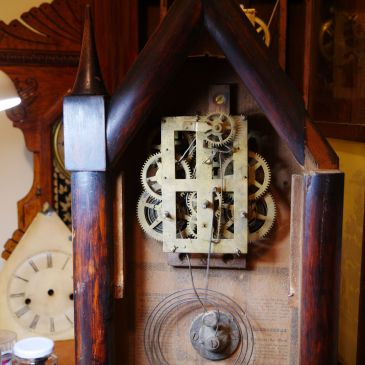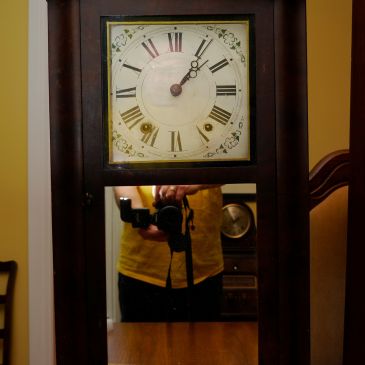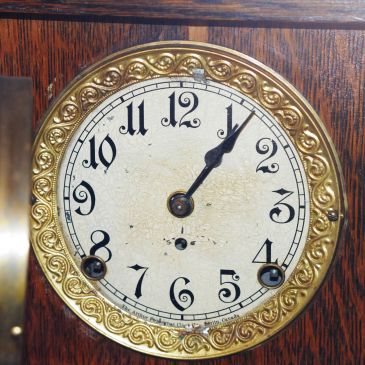

Elisha Manross Steeple Clock – addressing spire issues and other things

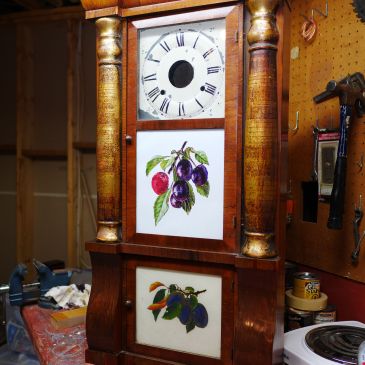
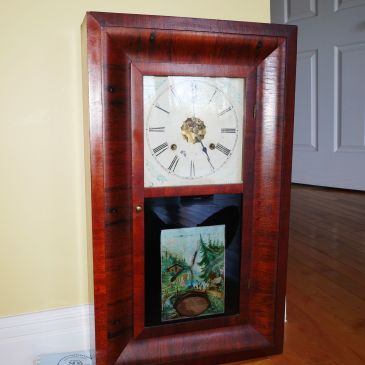
Elisha Manross 30 hour steeple clock
Elisha Manross 30 hour steeple clock, as found

I am not a huge collector of steeple clocks but I was intrigued by one I found in an old barn. I bought 4 clocks as part of a barn find this past winter (2018). Two including this one are salvageable. The two others are for case and works parts only.

$5 for a clock is a real bargain. This antique American Elisha Manross 30 hour time and strike steeple clock is an interesting variant of the sharp Gothic steeple clock. It looks fairly plain today but it was a striking style for its time. The early Steeple clocks of the 1840s influenced the design of later steeple clocks which were produced in large numbers up to the end of the 19th century.

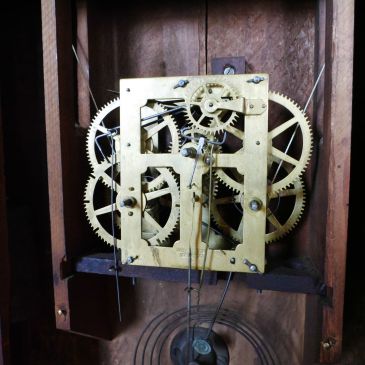
A unique feature is the 30 hour brass movement with 2 brass mainsprings. Brass mainsprings were used in American clocks between 1836 and 1850. When affordable steel mainsprings arrived the brass mainspring disappeared into history. This clock was made in the Elisha Manross factory in Bristol, Connecticut (USA) August of 1843. 30 hour movements are immediately recognizable because of the proximity of the winding holes to the centre cannon. Eight day movements, which are taller, would have much lower winding arbours.

The dial faces is in good shape with some losses
The dial face is in reasonably good shape with some losses on the edges and corners

The good and the bad

The good: the movement, coil gong and dial face are original as is the pendulum bob. The label is in very good condition for the age of the clock. The upper glass tablet is original and shows the waviness you would expect with visible imperfections. The movement works but needs a thorough cleaning. The movement looks good though I will know more once I disassemble it for cleaning.

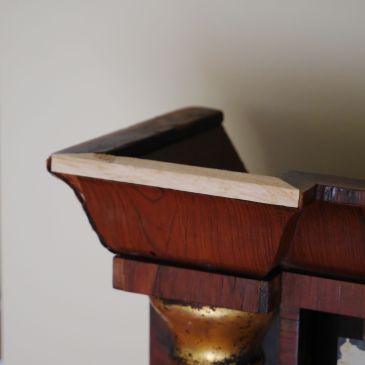
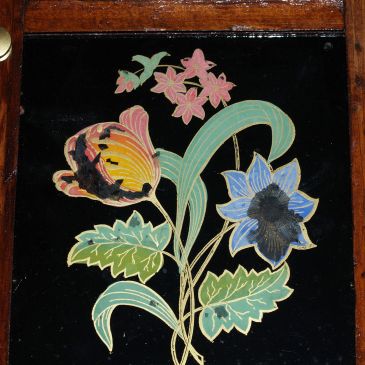
The bad: the mahogany veneered case is in poor condition with nicks, scratches and gouges on the entire surface. The very tip of the left steeple is broken off. There is a large piece of veneer missing on the right side on the clock base but that piece was found inside the clock and later glued in place. The most critical issue is the missing right steeple and base. The lower tablet is missing. There would have been a Fenn or similar design. Clear glass has been installed in its place. It is also missing the minute hand.

This side piece of veneer was found inside the case but there is still a small section that needs veneer
This side piece of veneer was found inside the case glued in place but there is still a small section that needs veneering

Work to be done

My first task is to clean the case and determine how I should approach finishing the clock case. I decided not to strip the case because there is a certain patina I would like to preserve.

My goal is the have a running clock in presentable condition and that includes replacing the right steeple. Ordering the missing parts from a clock supply house would seem to be a simple solution but unfortunately these parts must be hand made. To address the steeple base and spire I had some decisions to make. I took careful measurements of the left steeple base, cut a piece of pine stock to the same dimensions and clad it in crotch mahogany.

Pine cut and test fit
Pine cut and test fit for right steeple base

A relatively simple task of veneering took three days as I had to veneer each side, clamp, wait till it dried and trim off the excess before tackling the next side. Hide glue was used for this project. Hide glue is appropriate because it is an organic adhesive and it is the type of glue that would have used at the time.

The steeple base is the middle block of wood
Sides and top are done, now to do the front
Sides and top are veneered, now the front

Once all sides were completed the spire was next. I have never made a finial before so this was a very interesting learning experience. The spire was somewhat more challenging since it involved patterning it off the left spire. As I discovered it is much harder than it looks. I do not have a wood lathe so my metal lathe had to do. I bought a set of wood lathe chisels at my local hardware store at a reasonable price though I discovered that they require sharpening prior to use.

Taig lathe with 1/4 hp motor

The result was something closer than I expected. Not perfect but until I improve my skills this will do for now. Working with softwood is relatively easy but working with hardwood would be a much greater challenge would think.

Steeple and base but how to get rid of the wood grain!
This is the first application of red mahogany stain on the steeple but how to get rid of the distracting wood grain!

The grain in the spire is certainly distracting and it is something I did not anticipate. One more application of stain concealed some of the grain but it is still visible at certain angles. Will a clear coat over the stain bring me the result I am looking for? Hmm!

Second application of red mahogany stain
Second application of red mahogany stain, grain is disappearing

After thoroughly cleaning the case with Murphy’s soap and Orange Oil I applied a very thin coat of red mahogany stain on the entire case, left it on for only one minute and wiped off all the excess residue. Again, my aim was to preserve the original patina as much as possible but hide numerous scratches. The stain filled in the scratches and I am satisfied with the end result. With the addition of the right final base and spire, the clock now looks complete.

Now to address the spire one more time. I decided that Minwax Poly Wipe was not working very well.  The clear coat absorbed into the wood after two applications and still left a dull finish. I then selected a clear spar varnish and it finally gave me the results I was looking for.

The screws holding the movement were so loose they had to be replaced with bolts. The coil gong and base were cleaned and stripped of years of rust. I then oiled the movement, put the clock in beat and attached the dial face. The moon hands look good but are not original to the clock. While I have the hour hand the original needle type minute hand is long gone.

The clock is assembled and running

With the cased cleaned and with the addition of the right spire base and steeple the clock now looks presentable. Although I was able to make the spire on a metal lathe it it has certain limitations and I now see the value in using a wood lathe. I am also pleased that the movement is running but at some point it must be cleaned and properly serviced. At the moment there are just too many other projects standing in the way.

A great little project and a test of my veneering and woodworking skills.

I have good luck finding a great deal on a clock

I seem to be one of those people who manage to find a great clock deal. I don’t think it takes a special talent but patience, research, and timing are three key elements in finding a bargain.

I often cruise the online for-sale sites for interesting clocks. In Canada, we have something called Kijiji. In the States Craig’s List is quite popular and I am sure other countries have something very similar.

What makes Kijiji (and similar sites) interesting and fun is that you can connect with people locally or in my case our province of Nova Scotia. There are a wide variety of sellers. Some know what they are selling and price items accordingly. Some have really no idea and either price items clearly for much more than they are worth or conversely for far less than their actual value.

It is nice to be able to meet the seller, find out the history of the clock, learn something about the seller, and their motivation for selling, negotiate a price, and bring the item home. There is no post office or courier service to “screw” things up. No “oh crap” sigh when you open the package. With online auction sites, you often get a “pig in a poke” which means that something is sold or bought without the buyer knowing its true nature or value, especially when buying without inspecting the item beforehand. This does not happen with Kijiji. You find the item advertised, connect with the seller several times electronically or personally if necessary, see the item beforehand, ask questions about it, inspect it for any immediate issues or potential problems and you have the choice to walk away if you are not completely satisfied. All transactions are cash with no pesky sales tax.

Clocks are interesting items to collect and prices are all over the map as you would expect. However, I have found a few gems in the last few years. Let me tell you about my latest experience.

A few weeks ago I saw this clock advertised on Kijiji (photo below). Now, this looks like any ordinary Gothic steeple clock but what grabbed my attention was the unique tablet inscription. The acid-etched glass tablet says “Cling to the Cross”, a religious expression not often found on this style of clock. I knew immediately that this was a very special Canadian-made clock.

Seller's photo
Seller’s photo

Why, because several months ago I watched a video presentation by Jim Connell. Jim Connell is well known in Canadian clock circles. According to the introductory remarks found at the aforementioned site “He has amassed a large collection of clocks of all types with an emphasis on those with a Canadian origin. As his collection and knowledge grew, Jim prepared and presented numerous articles, talks, and displays on Canadian clocks and their history.  He is the respected author of the Charlton Standard Catalogue of Canadian Clocks and he co-authored Early Canadian Timekeepers and The Canada and Hamilton Clock Companies with Jane Varkaris.”

In his presentation, he described this exact clock and mentioned in his presentation that there were very few copies left, a very rare Canadian clock indeed.

I wanted to confirm that this was the clock I thought it was and asked the seller to photograph the label. He did so and sent this to me.

Seller's photo of the label affixed on the back of the clock
Seller’s photo of the label affixed on the back of the clock

I attempted to negotiate a price. The seller wanted 100CDN and I offered 80CDN. He replied that he would not accept anything less than 100CDN. In the meantime, I checked with the curator of The Canadian Clock Museum to confirm its authenticity. Upon discovering that this was a Hamilton Clock Co. clock made between 1876 and 1880 I decided that, yes, this was a good find and in my email reply to the seller I said, “100CDN it is”.

It is what I would consider one of those happy win-win situations. The seller got more than he thought the clock was worth and I got a clock that is worth much more than I paid for it. My motivation, however, was not to celebrate a great deal at a great price but to acquire a piece of significant Canadian horological history at an affordable price.

Hamilton Clock Co Gothic steeple clock
Hamilton Clock Co. Gothic steeple clock
30-hour time and strike movement with clock company inscription on the bottom of the front plate
30-hour time and strike movement with company inscription on the bottom of the front plate

We met and settled the deal. I am now the owner of a Canadian-made 30-hour time-and-strike Hamilton Clock Co. Gothic steeple clock.

In a later blog article, I will profile this clock and describe my strategy to address some of its issues.

Daniel Pratt Jr. reverse ogee and splat clock with mirrored tablet

Daniel Pratt reverse ogee and splat clock
Daniel Pratt reverse ogee and splat clock with mirrored tablet

This Daniel Pratt Jr. reverse Ogee shelf clock was made in Reading, Massachusetts, c. 1832-38. It has a splat-top mahogany case with half (?) reverse Ogee moldings flanking the door, painted wooden Roman numeral dial and mirrored lower tablet.

Clocks, manufactured and warranted by Daniel Pratt Jr

The label inside states in part.

Clocks manufactured and warranted by Daniel Pratt Jr. Reading Mass, U.S. Sold in any quantities on reasonable terms

The label is a ink drawing of a clock merchants shop and is printed by Dickinson and Co. 52 Washington St. Boston.

Wooden movement, time and strike

Wooden Roman numeral dial
Wooden Roman numeral dial with missing grommet on right arbor hole

Daniel Pratt (1797-1871), Jr., clock-maker, banker, town clerk, legislator, lived in the town of Reading, Massachusetts, in the 1800s. Reading is a suburb twelve miles north of Boston. Pratt did not contribute much to clock-making and was regarded as an entrepreneur rather than an innovator. He made wooden movements in his plant, as well as wooden cases. The clocks they sold during the 1832-35 period were typically wooden movement, weight driven, 30 hour, wood-cased, “looking glass” shelf clocks.

This Pratt clock measures 28 inches high, 14 3/4 inches wide, and has a depth of 5 inches. It is covered with mahogany veneer over pine. The square dial is of painted wood, 9 inches wide by 8 1/2 inches tall, with Roman numerals with floral spandrels. The dial is in good condition for the age of the clock. This clock was produced during the heyday of wood movements which were eventually phased out when cheaper but more reliable brass movements were introduced after 1839.

The memory of this successful man is continued by the quiet, even beat of his many clocks which have survived to this day — truly a great honour indeed.

antiquevintageclock.com – a new name

From this day onward the new domain for this site is antiquevintageclock.com.

I have been thinking about name change for some time. My reasons are fourfold, to increase viewership, make my site more accessible using search engines, gain more storage space for my photos and have more creative freedom in the design of the site.

In the months to come I hope you, the reader, will appreciate the changes as I offer more content and features.

There may be some growing pains for the first while as I experiment with new templates so I ask for a little patience as I make the new transition to an improved site.

My email address will continue to be ronjoiner@gmail.com although I will explore the benefits of aligning my email address with the site.

Let me know what you think.

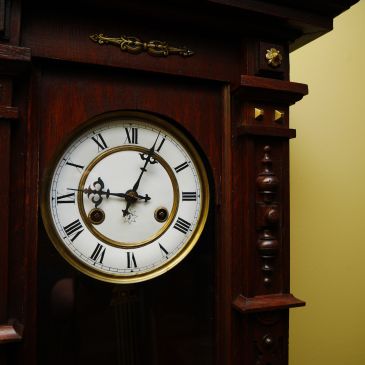
IIII or IV on a clock dial face? Why the difference

Clocks historically have numbers on the dial to help people accurately tell time and organize their daily activities. Early mechanical clocks were developed to standardize timekeeping. Adding numbers made it easier for people to read and interpret the time at a glance, particularly as public clocks were placed in town squares and churches for communal use.

Early clockmakers borrowed design elements from sundials, which often had marked divisions for hours. Numbered dials mirrored this system, making mechanical clocks intuitive for users transitioning from sundials.

Roman numerals were commonly used on early clock dials because they were familiar to people during the Middle Ages and Renaissance. Adding numbers also balanced the clock’s aesthetic appeal with its functional purpose.

So, let’s look at a specific difference concerning Roma Numerals. Some clocks with Roman numerals have ‘4’ as ‘IV,’ while most use ‘IIII‘. Why?

There is no definitive answer. There are a handful of competing theories and one of the following seven might just be the correct one.

Possible Scenarios

Theory 1: When Roman numerals were used by the Roman Empire, the name of the Romans’ supreme deity, Jupiter, was spelled as IVPPITER in Latin. Reluctant to put a god’s name on a sundial, IIII became the preferred representation of four.

9:04am - 100 years ago
The number IIII

Theory 2: IV, instead of IIII, which represents four didn’t become the standard until well after the fall of the Roman Empire. It’s likely, then, that IIII was used on sundials (and everywhere else) simply because that was accepted convention at the time, and not for fear of divine retribution.

Which do you prefer , IV or IIII?
Which do you prefer, IV or IIII?

In the years to follow every clock-maker had to decide whether to adopt IV because it was the new standard, or hang onto the traditional IIII.

Theory 3: IIII might have stuck around because it’s easily recognizable as four. IV involves a little math. it’s a simple subtraction operation. Though subtractive notations really caught on in the Middle Ages, the majority of people were not literate or numerate and IIII was simply easier to visualize. Subtraction involves conscious thought. IV and VI might also have been easily confused by the uneducated.

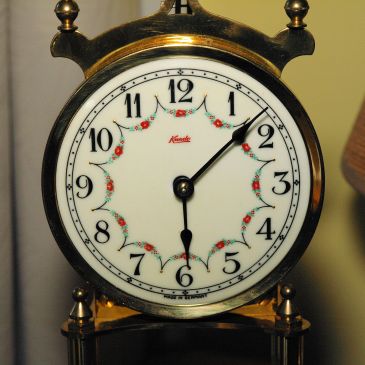
Kienzle World Clock with the four as IV

Theory 5: Using IIII may have also made work a little easier for certain clockmakers. If you’re making a clock where the numerals are cut from metal and affixed to the face, using IIII means you’ll need twenty I‘s, four V‘s, and four X‘s. That’s one mold with a V, five I‘s, and an X cast four times. With an IV, you’d need seventeen I’s, five V‘s, and four X‘s, requiring several molds in different configurations. Or, did they really think in those terms?

Clock face in good condition
Parlour clock with Roman Numerals

Theory 6: King Louis XIV of France preferred IIII over IV, perhaps for the same reasons Jupiter would not want two letters from his name on a sundial, and so ordered his clock-makers to use the former. Some later clock-makers followed the tradition, and others did not. Other monarchs might have felt the same way, and IIII was used also in areas where there was no king with an IV in his title to object to the subtractive notation.

Theory 7: Lastly, IIII creates more visual symmetry with VIII on the opposite side of the clock face than IV does. Using IIII also means that only I is seen in the first four hour markings, V is only seen in the next four markings, and X is seen only in the last four markings, creating radial symmetry.

The tradition of numbered dials persists today because of its practicality and historical significance, even as digital timekeeping has become the norm,

Which theory do you prefer?

Elisha Manross Steeple Clock – the early days of the American clock

I acquired four old clocks in a barn find. Two, a 30 hour ogee and a mantel clock were salvageable only that I was able to take veneer, case parts, one movement and a few pieces.

The two other clocks are worth preserving. Though it is missing some case parts one of them is an Ansonia Drop Extra wall clock. It is the subject of a future article.

Steeple clocks of the 1840s signaled the design of later steeple clocks

Ansonia Extra short drop wall clock
Ansonia Drop Extra wall clock

The fourth clock is an American Elisha Manross 30 hour steeple clock which is the subject of this article.

Elisha Manross 30 hour steeple clock
Elisha Manross 30 hour steeple clock on right

This is an interesting variant of the sharp Gothic steeple clock. These early Steeple clocks though simple in style, influenced the design of later steeple clocks.

Veneer could use some cleaning
Veneer could use some cleaning, right steeple is missing, door is off

The clock has accumulated years of dust and grime. The movement though dirty runs remarkably well. The case is scuffed, has a myriad of marks and scratches and one or two deeper gouges. This clock has seen its share of abuse and neglect over the years.

I took the access door off and found the bottom door pin to be original but the top pin has been replaced with a finishing nail. A piece of pinion wire was fashioned and glued in place. It is missing the right side steeple base and the spire. It is also missing the minute hand which appears to have been snapped off at some point and lost. Also missing is the bottom tablet with plain glass fixed in its place. The pendulum bob appears to be original as is the coil gong. The dial face has a nice patina and is in good condition with some losses. It has readable Roman numerals but covered with shellac or varnish at one point. The numerals have also been touched up.

Exotic woods were used to cover the pine case. Elisha Manross clocks were either clad in Rosewood veneer or Mahogany. The Mahogany veneer on this clock is much thicker than the veneers typically used today. Manross clocks are produced with the Mahogany veneer in a vertical orientation and Rosewood veneer in a horizontal orientation. Manross made two steeple clocks. One is 20″ high and 10″ wide, the other is 19 1/2 inches high by 9 1/2 inches wide. The larger case would have made for other labels but the smaller size (this is the smaller mahogany clock) was produced in the Manross factory.

Nice aged patine, numbers have been touched up

On the back of the door, left side of the upper tablet is the inscription 8/43, not once but twice. My first thought was an inventory or part number but if this is the month and date the clock was made it would be consistent with the brass mainsprings on the movement which makers used between 1836 and 1850. The label on the clock is in remarkable condition for a 175+ year old clock. However, the date (8/43) is inconsistent with the label which was printed by Elihu Geer at his shop on 10 State Street, Hartford Conn. According to one source Elihu Geer operated the print shop at this location after 1850. Perhaps but it seems reasonable that the clock was made in 1843.

8/43 inscribed on the back door

Although Elisha Manross had been active in Bristol clock-making since 1812 or earlier he shows in the Bristol tax records as making clocks from 1842-1851. His business was dissolved in 1854 and the factory was purchased in 1855 by E.N. Welch.

Well preserved label

Brass springs were invented and first used in 1836 by Joseph Shaylor Ives. Brass for mainsprings was evidently cheaper and more accessible than steel in the mid 1830s and 1840s. Silas B. Terry developed steel springs for clock use in the Bristol area circa 1847, and as steel improved and became cheaper brass springs quickly disappeared. In the history of the American clock brass springs had a very short life. The brass springs on the movement have survived a very long time which is unusual since most clocks of this age have had replacement steel springs.

The movement will be cleaned up and the case will be reconditioned including the replacement of the right steeple and base. I do not foresee the clock as being a daily runner.

Have you brought an old antique back to life be it a clock or a piece of furniture? Leave a comment about your own experiences.

If clocks could tock – the stories they could tell

I wish I knew the stories of all of my clocks.

Antique and vintage clocks evoke a time when life was simpler than the hectic times we live in today. Those nostalgic times when the things we bought and cherished were living memories of people and places that are gone but not forgotten. Antique clocks should be passed down from one generation to the next. Judging from the online marketplaces unfortunately many are not handed from father to son at all as so many have left their original owners. Is sentimentality lost on this generation?

Two such clocks have a story

Not including the the nine clocks I have in my home office there are 35 clocks displayed throughout our home. It saddens me to think that for many of my clocks I know absolutely nothing about them though I wish they all could talk. What stories they could tell.

Two such clocks have a story.

One of my clocks survived the Halifax Explosion in 1917. I know this because the people I bought it from had the clock in their family for over 100 years. It was certainly not in the condition you see here. It was a box of parts and I imagine they felt they had held onto it long enough and it was time to let it go. After I restored the clock I called back the previous owner and told him what I had done with the clock and would I kindly send him a photo of it restored to its former glory. I did and heard nothing afterwards. Sellers remorse, perhaps. I often look at the clock and try to imagine that fateful day when it fell of the wall in a modest home in North Halifax on December 6, 1917.

Junghans Crispi wall clock

Story number two. You have to feel something for some of the previous owners. This Ingraham Huron shelf clock (circa 1878) is a real gem and fairly rare, you just do not see it come up for sale very often. Some would call it a balloon clock. It was bought in a little village outside Bridgewater, Nova Scotia. My wife and I are about 2 hours away and we decided to make a trip out of getting the clock, having lunch nearby and doing a little shopping.

Do you know anyone who wants Jeff Gordon memorabilia?

Rare Ingraham Huron found on a local online for-sale site

We arrived at the sellers home, a modest nondescript bungalow. I was greeted at the door by an elderly couple. They had previously told me on the phone a day earlier that after consultation with their son they had decided on a fixed price for the clock and the price seemed very fair to us.

I asked how long they had the clock and the gentlemen who I would say was in his early seventies said that he could remember the clock in this grandmother’s home when he was quite young. He extended his hand palm down to about a meter from the floor and said, “I was this tall when I can first remember it in my grandmother’s home”. After a conversation with the couple I had discovered that they were parting ways, an amicable separation it seemed and the wife had decided to live in an apartment minutes away in Bridgewater. The husband was left with the home and his workshop in the back of the property. “He spends a lot of time out there anyway and besides, we need to get rid of stuff”. “Do you know anyone who wants Jeff Gordon memorabilia?” “No”, I said and left with the clock. It is sad that they had to part with such a memory but people change.

Seth Thomas column and cornice "Empire" style time and strike shelf clock
Seth Thomas column and cornice “Empire” style time and strike shelf clock

I guess sentimentality has a dollar value or people live with things so long that they eventually tire of having them. Deciding to get rid of things is about relieving yourself of all the stuff you’re hanging onto from past relationships and past memories. Secondly, our desire to hold onto piles and piles of old mementos can often be blamed on nostalgia. That’s because reminiscing about the past makes us feel good. It can lead to increased feelings of familial or social connectedness. If I have an old clock, looking at it can elicit positive emotions. Or, perhaps it was not an especially happy memory and getting rid of it expunges that memory.

I often wonder what will happen to my collection when I meet my fellow clock-makers in the sky. My wife knows that I have no real attachment to some of my clocks since I merely purchased them to learn how to repair them and to grow my hobby. Yes, you can have too many mantel clocks!

However, there are about ten clocks in my collection that I hope will be passed down to my kids. My four Arthur Pequegnats, two Vienna regulators, a Seth Thomas Empire style clock, my Sessions Beveled No. 2, my Ingraham Huron shelf clock and my Junghans Crispi wall clock. For some I appreciate their history and admire the folks who had them and for others they have become sentimental attachments because I spent so much time restoring them.

Pequegnat Canadian Time office clock

I think my kids will appreciate them.


Chauncey Jerome 30 hour Ogee – a 156 year old American clock that is a tribute to the man himself

I bought four wonderful clocks at an estate auction several weeks ago, this and three other Ogee clocks plus a parlour clock. This clock is no less interesting than the other three but I was lucky enough to research its maker and date the manufacture to within a year or two.

Noble Jerome’s invention showed that with the one-day brass movement, clocks could be mass produced economically and in great quantities

I wish I knew its provenance, how many hands it passed through, where it has been, what homes it has been in and even its last owner. All that is a mystery to me, nonetheless this clock is an excellent example of the classic Ogee weight driven shelf clock and a well-cared-for time-keeper.

Chauncey Jerome 30 hoir Ogee clock
Chauncey Jerome 30 hour Ogee clock with J.C. Brown house in lower tablet

Chauncey Jerome: The greatest and most far-reaching contributor to the clock industry

Chauncey Jerome 30 hour Ogee weight driven time and strike clocks are not a rarity. Thousands upon thousands were made. However, no-one can deny Chauncey Jerome’s historic contribution to the American clock industry in the 18th century when he substituted brass works for wooden works. He was “the greatest and most far-reaching contributor to the clock industry.” Although he made his fortune selling his clocks and his business grew quickly his company eventually failed in 1856.

Chauncey Jerome (1793–1868) was one of many pioneer American clock-makers. Jerome began his career in Waterbury, Connecticut (USA), making dials for long-case clocks. Jerome learned what he could about clocks, particularly clock cases, and went to New Jersey to make seven-foot cases for clocks. In 1816 he went to work for Eli Terry making “Patent Shelf Clocks,” and learned how to make previously handmade cases using machinery. His venture into business for himself eventually led to making cases and trading them to Terry for wooden movements.

In 1822 Jerome moved his business to Bristol, Connecticut opening a small shop with his brother Noble, producing 30-hour and eight-day wooden clocks. By 1837 Jerome’s company was selling more clocks than any of his competitors. A one-day wood-cased clock with wood movement sold for six dollars and had helped put the company on the map. A year later his company was selling that same clock for four dollars. As profits began falling combined with a general malaise in the manufacturing sector, it was not long before Noble Jerome’s patented clockwork innovation, the 30 hour brass weight driven movement introduced in 1839 changed clock making in America. The design was proposed by Chauncey in response to the 1837 nationwide depression that closed many clock factories. Noble’s invention showed that with the one-day brass movement, clocks could be mass produced economically and in great quantities.

Jerome also made clocks according to what he termed the “systematic approach” where selected workers made one part of a clock while other workers simultaneously constructed other parts in the same factory, a precursor to the assembly line method of manufacture.

Coil gong
Coil gong, polished, incorrect position in this photo

In 1842 Jerome moved his clock-case manufacturing operation to St. John Street in New Haven, Connecticut. Three years later, following a fire that destroyed the Bristol plant, Jerome relocated the entire operation to Elm City. Enlarging the plant, the company soon became the largest industrial employer in the city, producing 150,000 clocks annually. In 1850 Jerome formed the Jerome Manufacturing Co. as a joint-stock company with Benedict & Burnham, brass manufacturers of Waterbury. In 1853 the company became known as the New Haven Clock Co., producing 444,000 clocks and timepieces annually. Jerome’s future should have been secure but in 1855 he bought out a failed Bridgeport clock company controlled by P.T. Barnum, (a good read, it is a very tangled story) which wiped him out financially, leaving the Jerome Manufacturing Co. bankrupt in 1856. Jerome never recovered from the loss. By his own admission, he was a better innovator and inventor than a businessman.

In the years following he traveled from town to town and took jobs where he could, often working for clock companies that had learned the business of clock making using Jerome’s inventions. Returning to New Haven near the end of his life, he died, penniless, in 1868 at age 74.

The ticking of a clock is music to me, and although many of my experiences as a business man have been trying and bitter, I have satisfaction of knowing that I have lived the life of an honest man, and have been of some use to my fellow men
Chauncey Jerome 1860

This the number 11 Ogee was the last of the Jerome clocks made no later than the fall of 1855 when Jerome Manufacturing Co. failed. Mike Bailey, a Chauncey Jerome clock collector has an excellent blog in which he meticulously details and dates Jerome cases and movements. After researching his site I was able to determine that my clock is a number 11 Ogee made just before the Jerome bankruptcy in 1855. It is the Jerome patent 30 hour brass movement number 1.314. The movement appears to be original to the case.

Chauncey Jerome one-day movement type 1.314
Chauncey Jerome one-day movement type 1.314, yes, very dirty

The clock has a zinc dial and an image of JC Brown’s house in the lower tablet. Jerome was the first to introduce the zinc dial. It might have originally had a mirrored lower tablet. However it now features the JC Brown’s home. The J.C. Brown home in Forestville was featured on the tablet of many of his (Brown) Ogee clocks and it is unclear why it is on this clock. From 1847-1855 Brown conducted business without partners as the Forestville Manufacturing Company or the Forestville Clock Manufactory.

Rear of zinc dial
Rear of zinc dial

On the back of the zinc dial are inscriptions that I can barely make out. It says 1860 April 9???  on the top of the dial and 1866, Feb 2 and UPO 477 on the bottom. I tried to enhance it as best I could. Could this dial be a later replacement?

Overall the veneer is in excellent condition though it has been covered at some point with a clear coat of varnish. The weights appear original with the strike side having the slightly lighter weight as one would expect. The pendulum bob is consistent with the age of the clock and the label is largely intact. This was the last label Jerome used before his company went bankrupt.

Label showing Benham Printer, 56 Orange Street, New Haven
Label showing Benham Printer, 55 Orange Street, New Haven at bottom center

The movement is not running reliably. It is very dirty and long overdue for a cleaning, plus, the movement has had some poor repairs over the years.

Much of the information for this post is from Chauncey Jerome’s autobiography entitled History of the American Clock Business for the Past 60 Years, a free copy which you can find here.

Next up is servicing the movement which I will cover in a separate post.

Mauthe mantel or “buffet” clock – can you tell me more about the maker?

Mauthe Westminster chime mantel clock
Mauthe Westminster chime mantel clock similar to LL’s clock

Tick-Talk Tuesday is about the letters and comments I have received from you, the reader, concerning your clocks, issues you might have had and challenges you face and my responses to your questions with advice on your  particular clock concern(s). For those comments and questions that stump even me, I consult within my clock circles for the best possible response to your question

LL writes, “I just had my Mauthe 3-train Tambour mantel clock cleaned and repaired. This is the first I’ve heard it chime in decades! I know my brother bought in England in the eighties but that is all I know about it. Can you tell me any more about the maker?”

Mauthe would have called your mantel clock a “buffet clock”.

Mauthe clocks have an interesting history. In 1844 Friedrich Mauthe and his wife Marie founded a company in Schwenningen, Germany to produce watch parts. At the end of the 1860’s Mauthe began to produce their own wall clocks (and movements). Some have been produced by home-work by so called “Gewerblern”, others have been produced in a more “industrial” way.

The Mauthe sons Christian (1845-1909) and James (1847-1915) took over in 1876. In 1886 Mauthe began manufacturing its own spring mechanism.

Around 1900, alarm clocks, pendulum wall clocks, grandfather clocks, office clocks and so called “Buffet Uhren” “Buffet clocks” were offered. The number of employees at that time went up to about 1,100 people. In 1904 the 3rd generation took over (Eugene Schreiber (1877-1939) – son of Christian Mauthe, Dr. Fritz Mauthe (1875-1951) – son of Jacob and Mauthe Alfred (1879-1911) – son of Jacob Mauthe.

In 1925 Mauthe announced a new trademark. It shows a right-looking eagle with outstretched wings, holding in its talons a three-part round plate with the letters F, M and S. My Mauthe mantel clock is unmarked. Early in 1930 the company produced about 45.000 clocks per week (with 2000 employees). About 60% were produced for export markets, England for example was one of those export markets.

Mauthe mantel clock sitting atop a Stromberg Carlson console radio

In the mid-1930’s Mauthe started to manufacture their first wrist watches, some were even supplied to the German Army (“Wehrmacht”).

From 1946 on Mauthe re-started with the production of wrist watches. Though largely successful during the post war years, sales began to decline and the company eventually declared bankruptcy closing in 1976.

These precision German movements keep very good time and are certainly worth keeping and repairing. Enjoy yours now that it chimes.

The art of veneering – Part III – staining and finishing

This is Part III and the final part of a three part series on my first venture into veneer repair on an antique clock. Prior to beginning this project I spent many hours researching veneer repair, watching YouTube videos and seeking advice from my knowledgeable colleagues at NAWCC.

A recent acquisition, this is an 8-day Seth Thomas column and cornice time and strike shelf clock with sleigh front. It has a Plymouth (Hollow) lyre movement with a Thomaston Conn. label which means that the clock was made shortly before the incorporation of Thomaston in the early 1870s.

ST column and cornice , as found
ST column and cornice, as found

An example of veneer loss

I assessed this clock in Part I and described the steps in preparation for the veneer repair. In Part II I described the process of  applying veneer. Part III concerns the final finishing. Once the case work is complete I will focus my attention on servicing the movement, addressing the dial issues and replacing the clear glass with a floral pattern in the upper tablet.

The lighter coloured sections in the next photo are new veneer pieces. New veneer is found on the top of the cornice, the left cornice base, the right column support and sections of the bottom base.

Veneer repairs are complete
Veneer repairs (light areas) are complete

Finishing is the final phase of this project. In many respects this can be the most challenging phase of the project because once the hard work of applying veneer is complete the job means nothing if the new veneer does not match the old veneer. Although it can never be a perfect match the goal is to come as close as possible.

One finish seemed to stand out above the others

I conducted an experiment on leftover Brazilian Rosewood.

I selected three stains/finishes, Minwax Rosewood gel stain, Wipe-On Polyurethane satin clear coat and yellow shellac. I utilized various light sources to see the effect colour temperature had on the results and came to the conclusion that there was one finish that seemed to stand out above the others.

In the photo below there are three swatches on a piece of leftover veneer; Rosewood gel stain on the left, Wipe-On Polyurethane in the middle and on the right is yellow Shellac. Wipe-On Poly initially struck me as the best of the three; it is subtle while bringing out the character of the Brazilian Rosewood veneer while keeping that “aged” look but it is too muted. Rosewood gel is reddish and quite dark and looked very striking compared to the original Rosewood.

I concluded that yellow shellac was the best choice. Shellac darkens the veneer and accentuates the red tones nicely. Shellac would have been been the original finish when the clock was made and it is still the finish of choice today.

Comparing three stains
Comparing the three stains

Although veneering is a challenge, it is very rewarding work and I eagerly await my next project

New veneer above cornice, base of cornice is original though it looks like it was replaced
New veneer above cornice. The base of right cornice is original though it looks newer

Most of the base was replaced with new veneer
After two coats of shellac

After three coats of shellac, the case is complete

With dial and doors re-attached
With dial and doors re-attached, movement is out of the case at this stage

Although veneering is a challenge, it is very rewarding work and I eagerly awaiting my next veneering project.

Movement serviced and oiled
Lyre movement serviced and oiled

With the veneer repairs completed and the movement serviced there is still work to be done on this clock. I have decided that the gesso columns will stay as-is. Next is perfecting a tablet design for the access door to replace the clear glass, and finally, making a decision regarding the dial face; whether to leave as-is, find a suitable replacement or buy a new one from a clock supplier.

Seth Thomas column and cornice "Empire" style time and strike shelf clock
Seth Thomas column and cornice “Empire” style time and strike shelf clock

Lessons learned:

  • Allot a significant portion of time for the project, it is time-consuming and meticulous.
  • For an authentic repair hide glue must be used; avoid white or yellow carpenters glue though I would think there are rare times when it would be considered.
  • Hide glue:
    • must be a certain consistency to work properly. It should drip off the brush like honey. My hide glue was too thin at the start of the project.
    • will last a while in the fridge. Don’t cap the glue while it cools; condensation will hasten mold growth
  • Stay away from plastic based modern stains and finishes and go with shellac or any finish that would have been used at the time.
  • Some use filler to smooth the gaps between pieces of veneer, I did not use filler for this project; it is something I might consider next time.
  • A light sanding of the veneer is all you need, aggressive sanding will destroy the veneer (lesson learned).
  • Apply painters tape on the veneer before cutting; doing so eliminates ripping and tearing.
  • Use a sharp hobby knife
  • In future I would consider replacing larger sections rather than a patchwork of small pieces though that largely depends on how much veneer you have to work with.
  • Clamps are essential. Get various sizes of clamps and use wax paper between the clamp and the veneer, you will thank me!
  • Leave the area clamped for 24 hours. Although hide glue bonds quickly clamping for a day will ensure maximum adhesion.

This was a great project and I am confident that my next veneer project will be even better. Time, patience and perseverance are keys to a successful veneering project.

The art of veneering – Part II – veneer work

This is Part II of a three part series on my first venture into veneer repair on an antique clock. Prior to beginning this project I spent many hours researching veneer repair, watching YouTube videos and seeking advice from my knowledgeable colleagues at NAWCC.

This is an 8-day Seth Thomas column and cornice time and strike shelf clock with sleigh front. It has a Plymouth Lyre movement with a Thomaston Conn. label. The clock was made in the early 1870s.

Part I explores the steps in preparation for veneer repair.

The focus of this, Part II, is the selection of the correct veneer, working with hide glue, as well as cutting, applying and trimming the veneer.

Although one is tempted to use readily available yellow or white carpenters glue the only authentic product to use is hide glue

The veneer

I am not an expert in wood finishes and determining the type of veneer was my first major task. To do this I had to rely on expertise to tell me that I had Rosewood veneer. Once I discovered the type of veneer, I had to determine the quantity and the specific repairs that are required for this clock. My research revealed that the veneer used at the time was Brazilian Rosewood. An exotic wood, Rosewood would have been used extensively by clock-makers of that era and it is the correct veneer for this project. A clock friend (thanks JC) sent me two 7 X 8 inch pieces of Rosewood veneer, more than enough for the job.

The very worst sections were the top and bottom of the case and the column bases as one would expect given wear and tear over the years. Most of the cornice veneer is in good shape as are the door sections, door surrounds and the sleighs just above the feet.

Hide glue

One is tempted to use readily available yellow or white carpenters glue but the only authentic adhesive for clock case applications is hide glue. Hide glue is the glue of choice and it would have been utilized at the time the clock was manufactured. I chose pearl hide glue which is a type of hide glue rated at 150g Bloom strength. It takes takes a little longer to gel and with the longer working time it is better for applications like this when you need time to fit, but where high strength is not absolutely essential.

If you have never worked with hide glue, it is best to start with a small batch. My first batch was larger than I needed and too thin. Simply put 2 tablespoons (30ml) of glue in a heat-resistant glass container, cover with 1 tablespoons (15ml) of cold water and let soak for about an hour or until the glue softens and becomes gelatinous. Less is more and I recommend making small quantities. For about 20CDN you can buy a supply that will last a long time.

Place the container with the gelatinous glue in a bath of water in a pot especially designed for hide glue or a double boiler which I found worked just as well. Heat to approximately 140°F (60°C) and maintain the temperature. A candy thermometer is ideal to keep the glue at an even temperature.

Home-made double boiler with temperature maintained on a hot plate

Tools

Clamps, weights, tweezers, wax paper, a sharp knife, a metal straight-edge, painter’s tape, a micrometer, sand paper, palm sander and whatever you choose to use as a double boiler complete the list of tools.

A micrometer is an indispensable tool for accurate measurements. Accurate measurements ensure a good fit, minimize the use of fillers and lessen waste.

A micrometer ensures an accurate cut

Cutting, trimming & clamping

Cutting veneer can be tricky. Veneer is thin, brittle and can easily tear. Veneer today is different than veneer used 100+ years ago, it is very thin. On some clocks you may need to double-up, that is layer the veneer to approach the height of the original veneer.

Cutting can be a challenge since you must follow the grain and those narrow strips can break very easily. Painters tape is a true friend since it prevents tearing and it is easily removed from the veneer prior to application.

Painters tape ensure a rip free cut

Painters tape easily peels off

You will never have enough clamps

I chose to work one area at a time moving from the bottom of the case to the top. The next photos shows veneer sections glued and clamped into place. Clamps are essential for veneer repair but when clamps do not work other methods such as weights can be employed. You will never have enough clamps! Although a clamp need only be in place for a few hours, having it on for a 24 hours is best for maximum adhesion.

Clamping cornice veneer

Door piece and corner base piece is clamped

The upper left cornice presented a unique challenge. A section was missing just above the cornice. Fashioned out of softwood it was glued in place.

A piece of pine was cut to fit

strip of veneer applied
Strip of veneer glued in place;  prior to trimming and sanding

In this photo the piece for the curved part of the veneer is applied. The top area of the front cornice is now ready for staining and finishing.

Small angular cornice piece on left is glued in place

Top section almost complete and ready for staining
Top section is almost complete except for a left side cornice section (not visible in this shot)

As with any other project there will always be a slight colour variance as one would expect over the course of a century or more but the goal is to come as close to the original finish as possible

As mentioned the worst areas were the very top and very bottom of the case, expected after years of wear and tear. Another area which had veneer loss were the column bases. When possible I used old veneer to repair small areas but I found it very brittle and hard to work with. From my research I discovered that there are methods of softening old veneer but that can wait until the next project.

Right column base
Right column base, prior to sanding and trimming

After many hours the veneer work is now complete The next step is colour matching the new to the existing veneer. As you can see in the following photo the chip held by green tape shows that Rosewood Minwax Gel stain is a close match to the older veneer. My experimentation did not end. Part III explores other finishing options.

As with any other project such as this there will always be a slight colour variance as one would expect over the course of a century or more. The goal is to be as close as possible to the original finish.

Colour matching test: the green tape is holding a chip that has one coat of Rosewood stain

Now that the veneer work has been applied the next and final stage is finishing. Stay tuned for Part III in a few days time.

What and the shipping is how much?

Look at the shipping cost

Okay, there are 9 hours left on the bid for this Vienna striking clock and it is at 104GPB (178CDN) so it could go a lot higher. But 257CDN for shipping!!! Factor in the exorbitant shipping cost and import duties (~40CDN) you are now looking at close to 300CDN + the clock. I suppose as a seller you gotta make your money somehow!

New Haven Ogee clock – attractive but not without issues

Ogee New Haven clock
Mini Ogee by New Haven, the gaps in the door indicate that the front was once veneered and later stripped

This spring driven 30 hour New Haven Ogee clock is a loud ticker and rapid striker so distinctive that I can hear the ticking outside the room it is in like a mischievous puppy who wants to remind you where it is.

Judging from other New Haven clocks I have researched from this period, 1875 seems to be the approximate date of manufacture. The case measures 18 1/2 by 11 3/4 inches (47cm X 30cm) and the movement measures 3 1/2 by 5 inches (9cm X 12.7cm); a small ogee styled clock some would call a mini.

The clock is a mere reflection of its former self but not unattractive

The New Haven clock Co. has had a long and illustrious history. In 1853 the Haven Clock Company was founded in New Haven, Connecticut by Hiram Camp (1811‑1892) and other clock-makers. The company’s mission was to mass produce inexpensive brass clock movements for use in clocks. In April, 1856 The New Haven Clock Company bought out a competitor’s company, the Jerome Clock Company. They moved their production to the former Jerome factory and New Haven began making clocks under their own trademark. In 1870 some of New Haven’s clocks were marketed under the Jerome & Co. brand.

In 1885 the company stopped selling clocks other than their own New Haven brand. In 1890 the company developed serious financial problems and efforts were made to keep it solvent until 1897 at which time the company emerged after reorganization. In 1902 Walter Chauncey Camp (1859-1925) began to turn the company around. In 1923 Walter Camp stepped down as head of the company and is succeeded by Edwin P. Root.

In 1929 Richard H. Whitehead replaced Root as president of the company but New Haven again faced financial difficulties compounded by the Great Depression in November, 1929. Whitehead was able to keep the company afloat during these troubled times and the firm regained profitability. From 1943 to 1945 the company turned to the war effort, producing products almost exclusively for military use. In March of 1946 The New Haven Clock and Watch Company became the new name of the firm after it reorganized once again. It returns to what it did best before the War, making clocks and watches.

The 1946 reorganization eventually leaves the company vulnerable to foreign investors and it lost control to a consortium of Swiss watchmakers. The man who had successfully shepherded the company through the hard times of the Depression years, resigned as president. In 1956 the New Haven Clock and Watch Company filed Chapter 10 bankruptcy in a U.S. court. Its fortunes have declined precipitously since Whitehead’s departure and it never recovered. In 1960 the company went out of business and the production lines closed. The facilities were sold through a combination of public auction and private negotiation in March of 1960.

Coiled gong - a replacement?
Coiled gong – a replacement from an E. N. Welch or a Gilbert.

This 30 hour New Haven Ogee looks good from a distance but closer inspection reveals a number notable issues. The movement appears original to the case and the case is in fair condition having been reconditioned at one time. Although the sides of the clock are veneered, the veneer on the front has been stripped off presumably because there was too much loss/damage. There is also some veneer loss on the top right side. Crude chisel marks on the left front indicate that the veneer in that area might have been more difficult to strip off. Unfortunate, but I have no intention of re-veneering the front. From a distance it still looks good and the casual observer will hardly know the difference.

The coil gong is a replacement and is in a slightly different location than the original gong judging from screw holes to the right. I can only surmise that the original gong somehow broke. This gong is probably from an E. N. Welch or a Gilbert.

New Haven 30 hour movement
New Haven 30 hour movement, back plate

30 hour movement - front plate
30 hour movement – front plate showing factory installed oil cups

There are oil sinks on the front but not the back plate. The sinks on the front plate are stamped by the factory and were made to look like a more expensive clock since most would not see the rear plate. An odd decision by the manufacturer but a common practice.

Side view of 30 hour movement
Side view of 30 hour movement showing count wheel and cam wheel

The plates are pinned (rather than the newer bolts or screws) and there are two solid gear wheels suggesting that it is an earlier version of this particular 30 hour movement. The suspension spring and leader are a replacement as expected given the age of the clock. The pendulum bob is a replacement and so is the dial face.

I took the movement from its case, inspected it for wear and applied clock oil. The clock is running well and does not require immediate servicing.

The clock is a mere reflection of its former self but not unattractive.

Mercedes clock – not made by the car folks

Mercedes makes a great car. Do they make clocks? No! Is this Mercedes novelty timepiece a great clock? Read on.

Attractive Porcelain clock
Attractive ceramic clock with time-only movement

This very attractive 30-hour Mercedes ceramic mechanical shelf clock of the Baroque Meissen style (debatable) from the 1970s is more of a novelty item than a clock.

It is a time-only alarm clock movement made by Gebrüder Hauser and marketed under several names one of which is Mercedes. Ceramic clocks on eBay or any other auction sites will reveal the Mercedes name as well as other retail names on similar-looking clocks. For example here is a similarly styled Alana clock. Same casting sans gold detailing.

The Alana, similar to Mercedes but without the gold coloured accents
The Alana, similar to Mercedes but without the gold-colored accents

This Mercedes novelty clock is in excellent condition with no chips, cracks or any sign of wear. But is it worth anything? Not a lot.

History of the company

The Gebrüder Hauser clock factory (Die Uhrenfabrik Gebrüder Hauser) was founded in 1923 by Otto and Josef Hauser in Weigheim, Germany. Josef Hauser resigned in 1926 and moved on to form his own company. The company name Gebrüder Hauser then received an additional owner, Otto Hauser. Aside from alarm clocks, clocks with pendulums and chess clock works were produced.

Winder and time set screw on rear of the clock
Spring winder, time set screw and speed lever on rear of the clock

In 1951, the son, Eduard Hauser joined the company. From 1955 onward small affordable alarm clocks and chess clockworks were manufactured. In 1965 Norbert Hauser joined the company and the company name was changed to KG.

The Gebrüder Hauser KG clock factory in Weigheim was eventually closed on 31 July 1998.

Are they common?

There are a number of variants of this clock, mechanical, electrical, and quartz. The mechanical version will command higher prices and is more desirable. Unfortunately, they are throwaway clocks and the cost of servicing would be far more than they are worth.

Nevertheless, it makes for an attractive mantelpiece and as a gift, it is likely the recipient will not keep it wound.

Waterbury 30 hour Ogee clock – servicing Part II

Waterbury OG clock
30-hour Waterbury Ogee with a beautiful veneered case

This 30 hour Ogee clock was purchased in the fall of 2017. I was eager to add this clock to my collection as it is the one particular style of clock that I do not have. From my research on Waterbury clocks I determined that it was made in or around 1870.

I decided to turn the worn trundles inward and seal them with Permatex (medium strength thread-locker) so they are fixed rather than rolling; not ideal but reversible

While the case is in remarkable condition for the age of the clock the movement has suffered the ravages of time.

Simple 30 hour movement, top plate removed

Testing over the course of a day or so revealed that clock would not run for more than a few minutes. The movement was taken out of its case and inspected to determine what needed to be done to get it to running condition.

I expected punch marks and there were a number. In the old days clock-makers would attempt to address pivot wear by closing the pivot holes with a stake or punch. Not ideal but a common practice. Bushing work was definitely required. The pivots, on the other hand, were in very good shape and polished up nicely.

Punching the bushing home

My first task was to address the bushings. Ten bushings were installed, 5 on each plate. The front bushing work included the escape wheel bridge, always a challenging spot to bush. Next I addressed the other serious wear issue – the trundles on all of the lantern pinions.

Lantern pinions on the escape wheel

The trundles on the lantern pinions were in bad shape as you can see in the photo above. The wear seen here was identical on all 4 lantern pinions. Notched trundles were not what I expected.

The trundle work was certainly the most interesting part of the repair. My experience with lantern pinion work is zero. After some research the method I selected was to hand drill through the top shroud to release the worn trundles.

Drilling through the shroud to release worn trundles
Drilling through the shroud to release worn trundles; I used a smaller bit than the one pictured here

After releasing the worn trundles I used 1.10mm pivot wire which is ideal for this purpose and matched the worn trundles precisely.

Test fitting of pivot wire before the wire is cut to proper length

I began with the fly. I drilled into the top shroud. I then cut 1.10mm pivot wire into the required lengths then rounded the ends with a cut-off disc on a  Dremel. After the fly was completed I addressed two more lantern pinions in the same way. I staked the shroud ends to seal the trundles inside.

With three done the escape wheel lantern pinion was next and that is when I ran into a snag. The escape wheel shroud is reversed (see photo below), so I cannot drill into the top shroud without a lot of guess work. Using needle nose pliers I decided to turn the worn trundles inward and seal them with Permatex (medium strength thread-locker) so they are fixed rather than rolling. This is not ideal but it is reversible.

There does not appear to be a definitive answer as to whether the trundles should be free-moving or fixed although I suppose they are designed to roll with the gear teeth. At some future point the trundles on this wheel will need to be replaced.

So, how do you get at those trundles?

The clock did not come with a pendulum bob so, a new one was attached. The suspension spring and leader was replaced to address a crimped spring that resulted in a wobbling pendulum bob. I used .09mm suspension spring in the correct length. The clock now runs well and it has completed a number of 30-hour cycles.

I suspect that this will be a clock that will not be run daily, the inevitable hassle of constantly winding a 30 hour clock but I am pleased that it is back in running order and I will ensure that is runs on special occasions.

Waterbury 30 hour Ogee clock – servicing Part I

My hope was that it would be a relatively straight forward exercise

This is Part 1 of servicing this 30 hour Waterbury time and strike movement. I honestly thought it would be relatively straight forward exercise. Dis-assemble, clean the parts, polish the pivots, do a little bushing work and voila! Not so.

I have worked on many clock movements but I have never seen quite the extent of wear that I found on this movement. 150 years certainly takes its toll.

Ogee clock showing replacement pendulum bob

Some time ago I profiled this Ogee clock. To reiterate, in 1839 the first prototype movement was produced for Chauncey Jerome by his brother Noble in Connecticut, USA. Jerome thought that a simple one-day clock could be produced far more cheaply than those with wooden movements at the time. Brass movements were more robust, could be transported easily and were unaffected by humidity. The simple case added to the movement was the Ogee named for its “S” shaped moldings. The success of the Ogee clock convinced other makers that there was money to be made in clock production.

This particular 30 hour time and strike Waterbury Ogee clock was produced at the height of Ogee clock production (1870s) and many thousands were sold. This is a very fine example. Absolutely nothing needs to be done to the case; it is in exceptional condition. The movement, well, that’s another story. This was not a working clock when I got it.

Waterbury clock movement

After disassembling the movement I discovered two things. One, there was evidence that it had been worked on before – as expected. There were punch and stake marks on the movement plates to close pivot holes and there was considerable wear in the lantern pinions.

Front plate has been removed

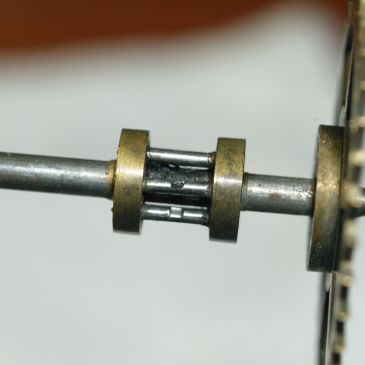
Four of the wheels have lantern pinions, with 5 trundles apiece. Trundles are the loose wires within the 2 shrouds. Dust and dirt as well as misalignment of wheel and pinion due to worn pivot holes can exacerbate the wear issue. The trundles on all 4 lantern pinions are very worn as you can see in the next two photos. I discovered why this clock does not run. When the gear teeth hits two worn trundles at precisely the right angle it locks the gear and stops the clock.

Worn trundles within lantern pinion

Another wheel with worn trundles within the lantern pinion

Professional clock-makers encounter these issues fairly regularly. Indeed, one of the most common operations in clock repair is replacing bent, broken or worn trundles. There are different methods of performing this service and the method I will employ is to drill into the shroud, extract the worn trundles, cut new ones out of pivot wire, insert them and re-knurl the shroud.

In the meantime bushing work was performed; 10 bushings were installed, 5 on the back plate and 5 on the front, including one on the escape wheel bridge. I re-assembled the movement knowing that the trundles had to be replaced, but despite new bushings the movement ran only marginally better.

Part II (Jan 2nd) details the procedure I followed to replace the trundles in the lantern pinions. Stay tuned.

Halifax Explosion – December 6, 1917

Halifax (Nova Scotia, Canada) was devastated on 6 December 1917 when two ships collided in the city’s harbour.

Taken from the Dartmouth side

Results of the deadly blast

Today marks the 100th anniversary of the Halifax Explosion.

On Dec. 6, 1917, the Belgian relief ship Imo rammed into the French munitions vessel Mont-Blanc, which was carrying TNT through the narrowest part of Halifax harbour. A fire on board the French ship ignited her cargo, causing a devastating explosion. The Mont-Blanc exploded at 9:04:35 a.m., sending out a shock wave in all directions, followed by a tsunami that washed violently over the Halifax and Dartmouth shores. More than 2.5 square km of Richmond were totally levelled, either by the blast, the tsunami, or the structure fires caused when buildings collapsed inward on lanterns, stoves and furnaces.

Two thousand people were killed in the Halifax Explosion and another 9,000 were injured. The explosion is the worst man-made disaster in Canadian history.

Seconds later a Junghans Crispi wall clock fell off a wall in a house on Princess court, North End Halifax. The following is the story of that clock.

I bought the remains of the clock from a gentleman in Halifax who related the story of how this clock was passed down to him through his wife’s family. It was important to him that someone who had a love and an appreciation of old clocks should continue with the restoration after he had rebuilt the frame some 30 years ago.

Thus began the six month journey of restoring the clock to its former glory. During the restoration I was able to obtain an old catalog image (supplied by a member of NAWCC) to guide me through the rebuilding process. Some of the smaller trim pieces were missing and because they are impossible to locate they had to be either purchased from a clock supply house or handcrafted.

Junghans clock in pieces
How the clock came to me

Four Junghans clocks, the Cripi is second from the left

Junghans Crispi wall clock

It is now a wonderful tribute to that terrible tragedy on December 6, 1917.

Waterbury Ogee (OG) 30 hour weight driven clock and why they are so undervalued

Why are these clocks so cheap? Discounting the wild prices some seem to be asking on online for-sale sites, a good example can be had for almost nothing. Why? Allow me to explain.

This 30 hour time and strike Waterbury Ogee clock was discovered at an antique store an hour’s drive away. The store has a well-deserved reputation for pricing items for a quick sale and each time we visit there is always a new selection of interesting clocks as well as plenty of other fascinating antiques.

Ogee clock showing replacement pendulum bob
30-hour Ogee clock by Waterbury

Ogee clock, clock design that originated in the United States in the 1830s, distinguished by a case (usually pine) the front outer edges of which are curved into an S-shape (ogee). This shape is formed by the union of a convex and a concave line. A mass-produced variant of the shelf clock, the ogee clock stands about 30 inches (75 cm) high and is usually weight-driven. The movements were usually made of brass and were made to run for 30 hours or eight days. (Brittanica.com)

The Ogee clock – the beginning

In 1839 the first prototype movement was produced for Chauncey Jerome by his brother Noble in Connecticut, USA. Jerome thought that a simple one-day clock could be produced far more cheaply than those with wooden movements at the time. Brass movements were more robust, could be transported easily and were unaffected by humidity. The simple case added to the movement was the Ogee named for its “S” shaped moldings. The success of the Ogee clock convinced other makers that there was a lot of money to be made in clock production.

My new acquisition

The seller knew nothing about clocks and his only interest was to move the item. The proprietor said it was not working. Just as well, I bought the clock for almost nothing. In my opinion these clocks are terribly undervalued.

It came with a winding crank and both weights but no pendulum. A 2.2oz pendulum bob was later fitted to the movement.

The dimensions are 4 1/4 deep X 15 1/4 wide X 25 3/4 inches high. The clock strikes on the hour to conserve the weight drop. The coiled gong on the Waterbury stamped base is loud, and the striking is frantic.

The movement will run and stay in beat (relatively!) but stops after about 15 minutes. That is to be expected and a thorough servicing is in order. Stake and punch marks throughout the movement tell me that the movement has been worked on more than once.

Ogee clock label
Ogee clock label shown with a 2.7 oz pendulum, also testing with a 1.7 oz pendulum

The Rosewood veneer is in remarkably good condition though the outside four corners have been compromised. The label is in very good condition with two small pieces missing at the bottom edge and water staining on the right side. The painted zinc dial with Roman Numerals has some flaking and the numbers are somewhat faded but it otherwise looks very good for the age of the clock. Both spade hands and Ogee hands are on similar dials I have seen so I do not know if these are correct/original. The lower reverse painted tablet is silk screened, looks to be marred around the centre area and the entire scene has minor crackling but it is vivid and largely intact.

Veneer in excellent condition


This is a Type 2.411 movement introduced by the Waterbury Clock Co. when Chauncey Jerome worked for them briefly in 1856-1857 after he went bankrupt. Found in Chauncey Jerome-labeled clocks with movement stamped, “C JEROME.” and also stamped “Waterbury Clock Co. CT” in later (1870) Waterbury clocks. This movement has the Waterbury stamp.

Waterbury clock movement

There is a Canadian connection to this movement. The Canada Clock Co. of Whitby, Ontario 1872-76 made 30 hour weight driven, time and strike movements based on an American design. Research indicates that the Collins Brothers (there were three: William, John, and Edward Collins) made a close copy of the OG movement used by the Waterbury Clock Company in Connecticut, a testament to the excellent design of this movement.

Ogee clock top showing cable pulleys

Why are these clocks so undervalued?

  • The economic collapse of 2008-09 prompted many to sell their clocks and glut the market.
  • The generation of folks who cherished these clocks are dying off.
  • The newer generation consider them irrelevant and are not interested in them.
  • 30 hour clocks are a tough sell because of the hassle of winding them daily.
  • Winding them daily means that most have considerable wear and the cost of repair exceeds the value of the clock
  • Lastly, many tens of thousands were made so they are not especially rare.

Ten years ago an Ogee in good condition would easily sell for $200 to $300. Today I see prices all over the map but none close to the prices they once commanded.

Expect a report on the servicing of this 30 hour Waterbury Ogee in the weeks to come.

Kundo 400 day clock and why I love anniversary clocks | Part I

The 400-day anniversary clock, also known as long-duration clocks, is a fascinating category of clock known for its ability to run continuously for a full year without needing to be wound. These clocks, often featuring intricate designs and beautifully crafted mechanisms, were first introduced in the late 19th century and have since become a beloved collectible.

Kundo standard size 400 day clock

In this article, we’ll explore the history, mechanics, and appeal of these interesting clocks. This is a two-part series. The first part describes my most recent purchase, a 400-day Kundo anniversary clock. Part II involves the installation of the suspension spring, cleaning, testing, and post adjustments.

400-day clocks are known for their inaccuracy, although they are undeniably beautiful and fascinating to observe. A minute lost each day adds up over the course of a year, potentially totaling many minutes—or even hours—by the end. Despite this, I still find great joy in owning and appreciating them.

A brief history

400 day clocks have been with us since about 1900. There were torsion clocks produced before 1900 but in limited numbers from about 1894 onward but the real push was after 1900. The Kundo model you see here was made in the late 1950s or early 1960s, probably the peak and subsequent decline of the anniversary clock era.

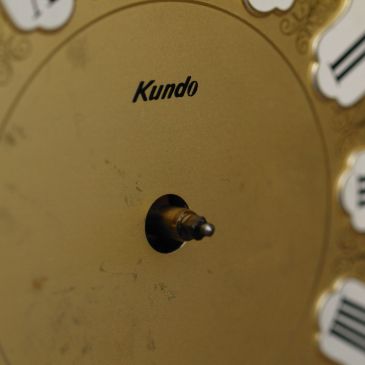
Dial face Kundo Clock

Once quartz clocks were introduced mechanical versions declined precipitously. Kundo is one of many companies making anniversary clocks in the 1950s and 60s. Kundo is a combined form of Kieninger and Obergfell. The company exists to this day as Kieninger, a subsidiary of Howard Miller which is part of a larger company.

This particular clock is a good example of a typical anniversary clock of the period. There are signs of wear as one might expect, dents on the base where an unrestrained pendulum did its damage and a snapped suspension spring but all the parts are there, complete with its dome.

Dents from weights bouncing around during transit

The clock was purchased at a local antique store. It is not in running condition. These clocks typically sell for around $50 to $100 or more on online marketplaces. Domes are often chipped or missing entirely. The glass dome on this one is free of chips.

I have ordered a Horolovar spring  (.0032″) and will report on the installation, cleaning, and testing of this 400-day clock. Look for the second part of this series.

Canada Clock Co. – a cottage clock from the early 1880s

Case is in fair condition, dial face has some flaking
Case is in fair condition, dial face has some flaking, piece broken on left side of base

We have a couple of antique stores in our small town. Calling them antique stores is a bit of a stretch because there is usually more junk inside than actual antiques. We were shopping in the area of one of those “antique” stores and my wife turned to me and said, “Let’s go in”. I replied, “You know, all they have is junk”.

I thought, I might have found something important

I acquiesced. While she continued her shopping I went on ahead to look around the store and in the very back I saw a very sad looking clock that at I took for an old Sessions or a Waterbury.  As I neared the clock it piqued my interest and I began to see that it was quite old. I picked it up, looked for any markings on the dial face, found none then checked the back of the clock and discovered most of an intact label revealing a what I consider to be a significant find.

Back label in good condition for the age of the clock

It is a clock from the Canada Clock Company. The Hamilton Cottage Extra was one of a range of clocks in their Metropolitan line.

This is an important discovery. The owner of the store knew nothing about clocks. He was asking $99 but after a bit of haggling, we settled on $40. I knew that it was worth much more.

Here is an excerpt on the Canada Clock Co. found at the Canadian Clock Museum in Deep River Ontario (Canada).

This company was the last of three sequential attempts to produce clocks by factory methods in Canada during the 1872 – 1884 period.  The original effort by the Canada Clock Company in Whitby, Ontario was basically unsuccessful and only limited production was achieved.
 
In 1876, the equipment was relocated to Hamilton, Ontario to begin a second attempt as the Hamilton Clock Company, with new investors.  This attempt was more successful and a fairly wide range of clocks was produced.  However, sales were not very large and some of the investors left the company by 1879.  At that point the president, James Simpson, ended production and proceeded with a major reorganization.
The company subsequently became the Canada Clock Company using the old Hamilton Clock Company factory and resumed production in 1880 but as a result of poor sales closed its doors in 1884.
For more go to this page at the museum site.
Clocks from the Canada Clock Co.are sought after by collectors. For international readers this represents a rare find because the 1870s to the mid 1880s was a very important period for clock production in Canada. Apart from several independent clock-makers in Quebec and eastern Canada two notable companies made wholly Canadian clocks, The Arthur Pequegnat Clock Co. of Kitchener Ontario made clocks up to 1941 and Martin Cheney of Montreal made finely crafted clocks in the early 1820s. This clock was made at the Hamilton, Ontario factory which produced clocks from 1880 to 1884.

Original time and strike 30 hour movement
Original count wheel time and strike 30 hour movement

The 30-hour time and (bell) strike movement is in remarkably good condition and fairly clean. The back label in good condition for the age of the clock and there is a stamp on the top of the label which says, “…A Hill &Co.”. If any Hamiltonians are reading this I would be grateful if you could make inquires about this small retailer.
My preliminary examination reveals that this clock has had very few repairs over the years. I have not taken the movement out of its case to check bushing/gear wear and other issues but I am initially encouraged. The case reflects the age of the clock but I would judge the clock to be in just fair condition. There is a wooden piece that needs to be re-attached on the right side of the base. Fortunately that piece was tucked inside the clock case.

Right side needs work

Left side looks good

100+ years of grime came off easily
100+ years of grime came off easily; etched glass on the bottom part of the tablet is distinctive

The crudely made case is not overly decorative and reflects a muted Victorian style of the times. The lower part of the tablet has an etched glass floral design typically found in Canada Clock Company clocks. The door clasp is original. The dial face is flaked in places and not in the best of condition though the 2 floral designs on each bottom corner are nicely preserved. The hands are original. The case is not heavy and made of pine with a deep walnut stained finish. It was grimy and dirty as expected. It cleaned it up nicely with Murphy’s soap and a sharp hobby knife was used to remove the numerous paint drops on the clock. Why folks do not put something over the clock when painting a room amazes me.

I will put the clock aside until I can determine my next steps. Do I pursue a full restoration including renewing the dial face or leave the clock largely in as-found condition? In the meantime I will re-attach the wood piece on the left side of the base.

What would you do?


Is clock collecting part of the counter-technology revolution?

Is clock collecting (and repair) part of the counter-technology revolution?

Many years ago, social scientists predicted with the onset of modern technology it would sap us of our knowledge. Our brains would simply melt away. Concentration and initiative would be sucked out of us. Why would you need to know anything if it is readily available at your fingertips? How often do you hear the phrase, “just google it”. Sadly, it has become an integral part of our lexicon.

People are embracing old technology and returning to the fulfillment of doing things for themselves

The term counter-technology is not a term I invented. I found it mentioned in a car magazine article some time ago. Many people are collecting and repairing antique cars more than ever. Why? Reliving past memories? Getting your hands dirty. Rejecting the modern world?

Has the analogue world returned? Yes and no. Wine and beer making has become a huge industry and there seem to be mom and pop microbreweries everywhere, antique furniture purchases have increased dramatically, backyard chicken coops are popping up everywhere, fountain pen collecting is a “new” thing, vinyl records are spinning back and stamp collecting is returning with renewed vigor.

Retro is in. But is is not just that! It is a statement. People are embracing old technology and returning to the fulfillment of doing things for themselves. We all know the value and satisfaction of pursuing a simpler way of life but at the same time we still want to feel connected to our busy modern world. We want both. This is our inevitable response to the new digital world. We are pushing back but just enough to satisfy our needs by remaining connected with the past but we still feel the need to be plugged in.

However, every now and then we feel the need to dis-engage. Digital detoxification. It’s a thing. Somehow we want to wash the digital world from our lives, however briefly. I spend summers at our family cottage in Quebec (Canada). There is no Internet and I am totally fine with that. But what’s the first thing I do when I return home? You got it!

You too can be saved

Simplicity breeds complexity

To truly embrace the analogue world the mechanical clock is my personal statement. Not only do I collect antique and vintage clocks I repair them as well. As readers know I am not a trained horologist but I love the challenge of repairing a clock and I love accumulating knowledge in the pursuit of my hobby. Needless to say I am not always successful and my office has a few notable failures. I am fine with that. Failure breeds learning. It is my response to the increasing pressures of the digital world. It is my response to our increasingly complicated world. Simplicity breeds complexity.

Like the juggler who can keep all the balls in the air at once

It took years to learn the skills necessary to repair this Sessions Westminster A Westminster chime clock
It took 2 years to learn the skills necessary to repair this Sessions Westminster A chime clock

Analogue verses digital. It is a question of balance, like the juggler who can keep all the balls in the air at once. I admire people who have “analogue” hobbies but I especially admire those who remain connected to our modern world by maintaining a delicate balance between both.


E. N. Welch Whittier model parlor clock Part II – a description

E. N. Welsh Whittier model

The Whittier Model

This is the Whittier model from Welch’s Authors series. Tran’s 2d ed. shows it from the 1893 catalogue. It is a half-hour strike clock. Though an alarm could be ordered this clock came without one.

It is solid walnut in construction, deep brown in colour and darkened by age.  It stands 22 inches tall by 14 ½ inches wide and 5 inches deep. The crown is an ornate machine-cut design with a single bulls-eye. The Roman numeral dial face with inner brass ring is original but has been covered with a clear varnish.

Clock face in good condition

The spade hands with circular cut-outs also appear to be original. The tablet is in remarkable condition and features an embossed gold colored scene of two female child warriors on each side presumably guarding an older female warrior (laurel and spear), reminiscent of Greek or Roman mythology.

Barely readable label

Bottom label with running instructions

There are two labels on the back panel, the top designates the model name which is barely readable; the bottom label has generic operating instructions for several types of clock models. Both labels appear to have been varnished over at some point. The upper area of the back panel has a hook for hanging the clock, added by a previous owner. However, this is a shelf or mantel clock, not meant to be hung on a wall. I doubt that the pendulum bob was this colour originally.

Though incorrectly termed a kitchen or gingerbread clock it is commonly referred to as a parlor or hall clock. Since the company last produced clocks in 1902 I would comfortably date this clock at between 1893-96 or perhaps a little later, 1901-02. The E. N. Welch Clock Company has a fascinating history (detailed in Part I of this series) and unfortunately not many of these well-made American clocks are still around.

Time and strike movement

In Part III I will describe the challenges of servicing the clock movement.


E. N. Welch Whittier model parlor clock Part I – E. N. Welch history

Among the most common parlor clocks, E.N. Welch clocks are relatively scarce. A key reason is that the company was absorbed by Sessions in 1903. The history of Welch is intriguing, as Welch, Spring & Co. initially focused on producing high-end clocks but eventually shifted to manufacturing cheaper, heavily discounted mass-market clocks—a move that likely contributed to its decline.

E. N. Welsh Whittier model

This time-and-trike American clock with a count wheel strike is an antique store find. I  found it at what I would call a higher-end antique store in a small village in Quebec during one of our day travels from our summer cottage. I liked it so much I bought it. Because the strike side did not function there was a slight reduction in price.

The clock ran for several days and kept good time, but it was in desperate need of a cleaning. I was unable to get the strike side to run, though I hoped to fix it eventually. All the strike-side parts appeared to be present, but someone had clearly tampered with the levers, bending them significantly. It’s impossible to fully assess the situation until I take the movement apart.

Barely readable label
Barely readable label and someone determined that this clock should be hung on a wall

History of E N Welch

The E. N. Welch Mfg. Co. was formed on July 6, 1864 to succeed an older private firm making clocks under the name of E. N. Welch. Elisha N. Welch (1809 to 1887) had been making clocks at a factory site on East Main Street at Forestville, Conn. since taking over the bankrupt business of J. C. Brown in about 1856.

A movement shop was established in 1869, adding to the two factories already in use by the firm. Between 1868 and 1884, a subsidiary firm called Welch, Spring & Company was formed to produce a more expensive line of clocks. The company was formed by three clock enthusiasts; Welch, Solomon Crosby Spring and Benjamin Bennet Lewis. The Welch firm was well known for its handsome rosewood cases, though in 1885, with changing styles in furniture, the surviving firm began to introduce new models with solid walnut cases and discontinued some of the older rosewood veneered cases.

Elisha Welch was enamored of a lovely (but very liberal-thinking) diva of the day from Spain by the name of Adelina Patti. He named his best quality movement after her, called the “Patti” movement. Clocks with this movement are highly sought after by serious collectors. However, Examples of “Patti” clocks at any of the international auction sites are rare.

After the death of Elisha Welch in 1887, the firm steadily declined, selling off some of its assets and issuing new stock to raise much needed capital. A new line of clocks was introduced for 1893, which were cheaper in quality than their already discounted line. In May of that year the factory was closed down and a receiver was appointed The receiver spent nearly two years selling off stock and settling the debts of the firm. It was not until 1896 that the firm resumed production.

In 1899, two fires, one in March and a second in December reduced most of the Welch manufacturing complex to ashes. Despite the completion of a new brick factory in 1900, the company could not meet its liabilities. Meanwhile, members of the wealthy Sessions family were buying out former stockholders and eventually took control of the firm in 1902. They changed the name to the Sessions Clock Company on January 9, 1903.

E. N. Welch clocks made before 1880 are considerably more desirable as these represent the height of the company’s clock-making. Clocks made before 1880 generally command higher auction prices. Compared to companies like Seth Thomas and Waterbury instances of E. N. Welsh clocks coming up on auction sites are becoming quite uncommon.

Stay tuned for more! In Part II, I will describe the Whittier and highlight some of its interesting features. In Part III, I will share my progress and discuss any challenges I encounter while servicing the movement.

A tale of two similar but very different carriage clocks

At first I thought they were identical

While at an antique store in Kazabazua, Quebec my wife made an offer on one of these two carriage clocks. The other clock was found at an antique barn just outside of Campbell’s Bay, Quebec, literally an hour’s drive apart and about a week between the two purchases.

I was surprised to find two seemingly identical clocks not far from each other. At first I thought they were identical.

 Italian made versus German made carriage clock
German versus Italian made carriage clocks

The one immediate difference is readily apparent. The dial on the left has Arabic numerals whereas the one on the right has Roman Numerals. They have similar dimensions but if you look closely the bases are not the same height. Both are alarm clocks. Both have a “second” hand at the top and a set-time indicator at the bottom section of the dial. Both have seemingly identical carriage style cases made of very similar materials. Both I believe, are 30 hour clocks. There is an access panel on the back of each clock for winding and adjusting. However, that is where their similarities end.

Musical alarm on the left and bell strike on the right

Musical versus bell strike

I would estimate that they were both made sometime after the First War

The one on the right is made by Junghans or Kienzle, both German clock companies with long and illustrious histories. I tried comparing the plate design and dimensions to a database found here and the closest I could find was Kienzle. However, it is also very similar to Junghans “Joker” style clocks that I have seen for sale on EBay. At one time (around 1905) Junghans had a branch in Venice (Italy) likely a delivery depot for clocks made in Germany. But it is also possible that some assembly may have been done there hence, no definitive markings. I would estimate that they were both made sometime after the First War.

Side views
Side views

Back access panels
Back access panels

The one on the right is made by an Italian maker, Fratelli Borletti. Fratelli Borletti was the only clock factory in Italy prior to WWI and produced only alarm clocks. Fratelli Borletti was later renamed “Veglia Borletti” and produced many car instruments for Fiat, Lancia, Daimler and so on. Today, Veglia Borletti belongs to Magneti Marelli.

The Junghans or Kienzle clock is a musical alarm clock while the Fratelli Borletti clock has a bell type alarm with a striker, though the striker on this particular clock is missing.

One (the musical alarm clock) is working and remarkably clean, the other needs a lot of work. Two very unusual clocks found not far from each other.

A pretty little Delft clock by Forestville

Purchased earlier this year (2017) I thought it would make the perfect cottage clock. A relative attended an estate auction in Ottawa while I simultaneously bid online in Nova Scotia for the clock. She brought it to her home and it was months later before I actually got to see it. But for one low resolution auction photo, it was bought unseen and as-is.

Delft style clock, auction photo

It is a Delft style, triangle shaped front-wind 8-day time-only porcelain clock with a lever escapement similar to those found in marine/alarm clock movements. It is marked Forestville. While Forestville is a Canadian company the clock is not Canadian made. The Forestville Clock Company is often confused with clocks made in Forestville, Connecticut. According to the following historical information they are not the same.

The Forestville Clock Company of Toronto began its life as the Blackforest Clock Co. of Toronto headed by its founders, Leopold and Sara Stossel in 1928. Both movements and complete clocks were imported from Germany and sold through department and jewelry stores across Canada. Their son, Ed Stossel started working part-time with his parents company in the 1930s and later became a full time employee in the 1940s.

Some assembly work was carried out in their Wellington Street factory but most clocks were imported fully assembled. At first, imported mantel and grandfather clock movements were installed in cases made in Kitchener, Ontario but later complete mantel clocks were imported from Germany. This arrangement was interrupted by the Second World War which also led to a change of the company name to Forestville Clock Company in 1941. During the war years the company imported their movements from England, the United States and even France. Starting in the early 1950s German companies resumed production with Mauthe being a major supplier.

Clocks with a Dutch motif reflected a popular trend in the 1950s and 60s perhaps in recognition of Canada’s close relationship with the Dutch people since the war years

The Forestville Clock company was quite successful during the middle decades of the 20th century and many Canadian homes proudly displayed time-only, time and strike and chiming clocks retailed by Forestville. When Ed Stossel retired in 1979 the company survived just a few years without his guidance and leadership.

Clocks with a Dutch motif reflected a popular trend in the 1950s and 1960s perhaps in recognition of Canada’s close relationship with the Dutch people since the war years. Canadian troops liberated Holland at the end of the Second World War, the Dutch holding a particular fondness with Canadians since that time.

It is an attractive but a simple design. There is one scene on each “point” of the “squared off” triangle; a woman in traditional dress carrying water and accompanied by a child on the right, three single-mast sail boats (one large and two small ones) on the left and a Dutch windmill beside a small house on top. The violin bow styled hour and minute hand design is shared with other Forestville clocks.

Mother and child
Mother and child

Windmill and house
Windmill and house

Sailboats
Sailboats

The clock ran slowly for the first day or so. On the back of the movement is a speed regulator that one would typically find on an alarm clock, an easy method of making small adjustments.

Speed adjustment
Speed adjustment

There are no chips, cracks or blemishes on the face. It appears to be in excellent condition and runs well.

It is a welcome addition to our cottage kitchen.

Website Powered by WordPress.com.

Up ↑