Having a professional service your clock

Is it worth the time and expense to have a clock professionally serviced?

That is the question of the day.

I receive many letters from people who ask whether a clock handed down to them is worth repairing/preserving. It is not an easy question to answer. Shared history and stories connected with the clock can be passed down from generation to generation and it is fond memories that keep it alive and consequently, there is a desire to have a clock in running condition. Sometimes it is better to do nothing and simply remember the stories associated with the clock.

If the decision is made to do something, the first consideration is whether or not the cost of preserving or restoring the clock is worth it. If the clock has deep sentimental value, the cost of repair cannot be compared to its resale value.

In the early days of clock collecting, I sent out clocks to be serviced and happily absorbed the cost. I knew then that some clocks cost more to repair than they are worth but I wanted to preserve some and have them operate daily, so, professional repairs were necessary.
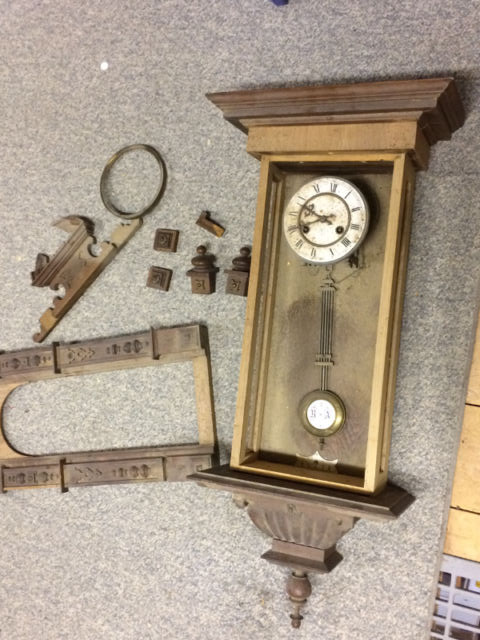
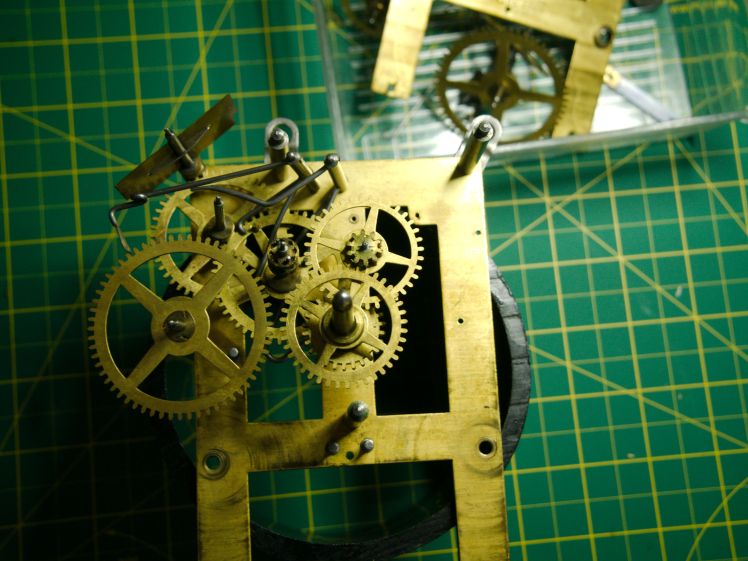
Junghans clock in pieces
Junghans clock before restoration

A case in point

In January 2017 I bought a box of old clock parts (above photo). I was determined to make my German-made circa 1895 Junghans Crispi wall clock into what it is today. It was my first huge restoration challenge. It was a steep learning curve for me but in the end, I was pretty happy with the results.

During the course of restoration, I attempted to repair the movement, which hadn’t run in over a hundred years and made some rookie errors. I had no other course of action than to bring it to a professional in order to correct my mistakes. At the end of the day, the total cost was $475 for the initial purchase plus the servicing.

Last year, after 4 years of reliable running the clock developed an errant strike which required investigation and disassembly (and a good cleaning while I was at it) but I would not blame that on the professional repair. Perhaps it is the nature of that particular Junghans movement requiring the odd adjustment every now and then.
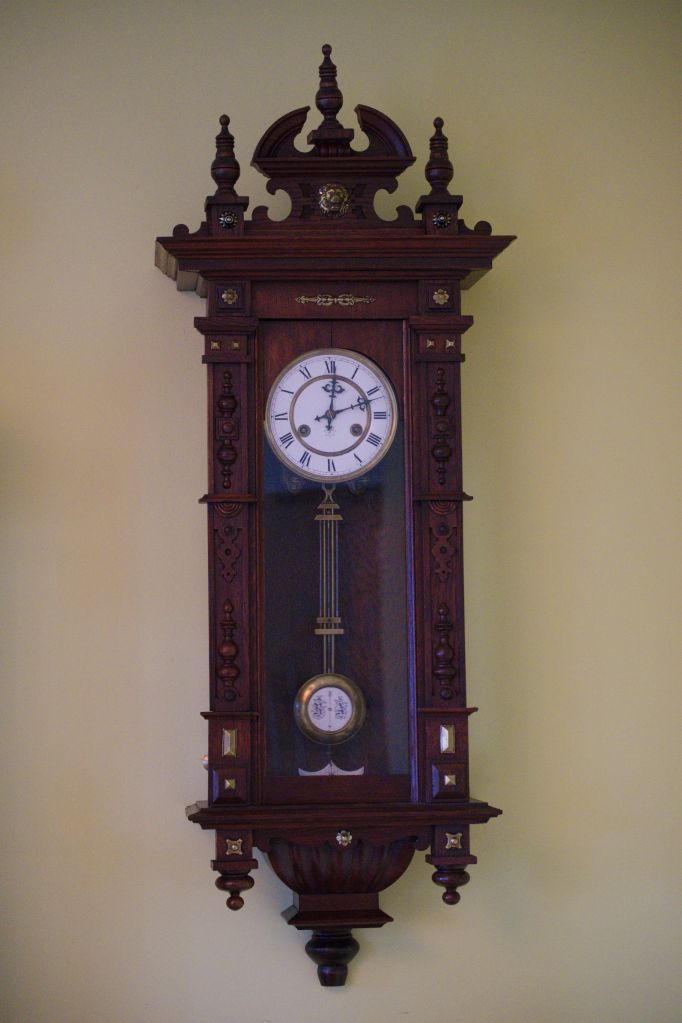
Junghans Crispi wall clock

In the years since then, I have acquired the skills and necessary equipment to perform my own repairs.

Twenty-three of the clocks in my collection are daily runners, all serviced from time to time by myself over the years. I am not a professionally trained clock-maker and some procedures are clearly beyond my capabilities, things such as teeth replacement and repair and fashioning new parts from stock brass. 95% of repairs I can comfortably handle on my own.

Rare Ingraham Huron found on a local online for-sale site
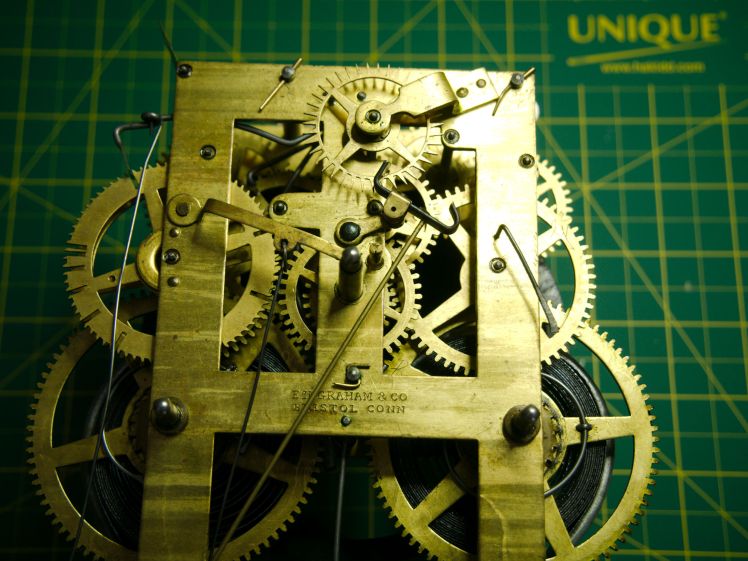
Rare E Ingraham Huron professionally repaired

Should you bring your clock to a professional? This is a decision you will have to make after weighing all factors. Know that by relying on a professional you can be assured that years of knowledge and experience go into the repair of your precious clock which becomes part of the cost.

Reputable repairers have the correct equipment to tackle just about any repair, offer a warranty period, and will correct any problems that arise after servicing, often without an additional fee.

Clocks are machines and machines do not last forever, parts will wear and from time to time they, like any machine, require attention. If, after some years, the clock that you had professionally repaired stops, I would have no hesitation suggesting that you return to the same repairer for servicing unless, of course, you had a negative experience.
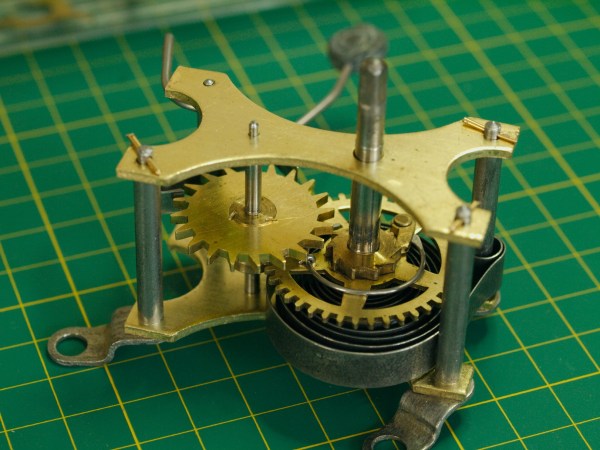
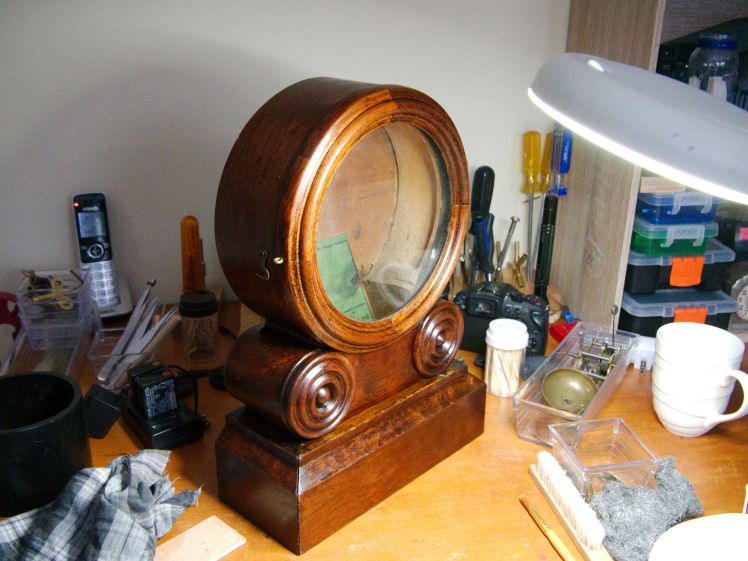
Ingraham Grecian – servicing the movement

After having completed work on the case and dial pan of the Ingraham Grecian time and strike shelf clock it is now on to servicing the movement.

Ingraham Grecian
Ingraham Grecian refreshed case

Assessing the movement

The movement is in surprisingly good condition for its age. It has been serviced in the past, when, I don’t know. Here’s what I discovered during the inspection.

  • In an early servicing, 3 bushing holes were punched. Many years ago clock repairers used a punch to close pivot holes that had elongated after years of wear and it was considered an acceptable practice at that time. Not today!
  • The mainsprings and alarm spring appear to be original and the alarm mechanism showed no evidence of wear.
  • At a later point a clock repairer installed 3 brass bushings, 1 on the front plate and 2 on the backplate. 
  • Pivots had been replaced on one end of the warning wheel and one end of the third wheel time-side.
  • The thin brass strap that trips the alarm has been re-riveted.
Ingraham Grecian
Ingraham Grecian, a replaced pivot, a very good job by a past repairer

The repairs were neat and professional.

But there were problems

While there were some decent repairs, someone attempted a homemade fix and it became a non-working clock. I suppose that is to be expected from a clock that is 149 years as it passes through several hands. 

It appears that the clock was eventually passed on to someone who had little knowledge of things mechanical. It might have been simply out of beat and an attempt was made to adjust the crutch by twisting the crutch loop around the pendulum leader. I can only assume that in their attempt to access the mechanism to “fix” it, the dial and brass bezel were damaged in the process.

Without impulse the clock would run a minute and stop and would never run in that condition.

I reshaped the crutch loop and bent the crutch slightly to achieve a healthy beat and the clock began to run. 

While the clock was running I discovered a bent escape wheel tooth. It was running despite this issue, but the verge would occasionally skip the bent tooth. A bent tooth is often the direct result of transporting a clock without removing the pendulum bob.

Servicing the alarm

There is not much to the alarm mechanism. Three pins hold the 2 small plates. I doubt this alarm was used much, It was taken apart, parts cleaned in the ultrasonic, reassembled and oiled.

Ingraham Grecian
Ingraham Grecian, the alarm mechanism

Servicing the movement

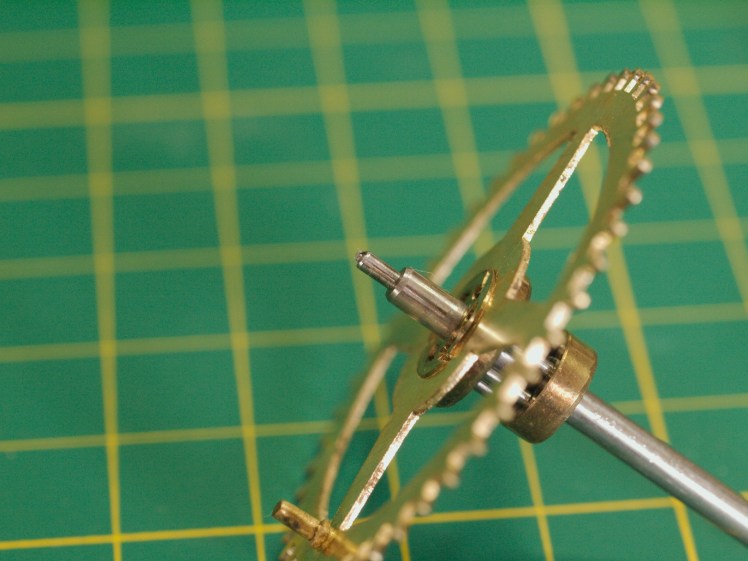
After letting down the mainsprings and disassembling the movement the first order of business is to straighten the bent escape wheel tooth. The trick is to “draw out” the tooth out with a pair of smooth flat jawed pliers. It is important not to stretch the tooth as this will introduce other escapement issues. Unbending the tooth is a simple procedure but a disaster if things go wrong.

Ingraham Grecian
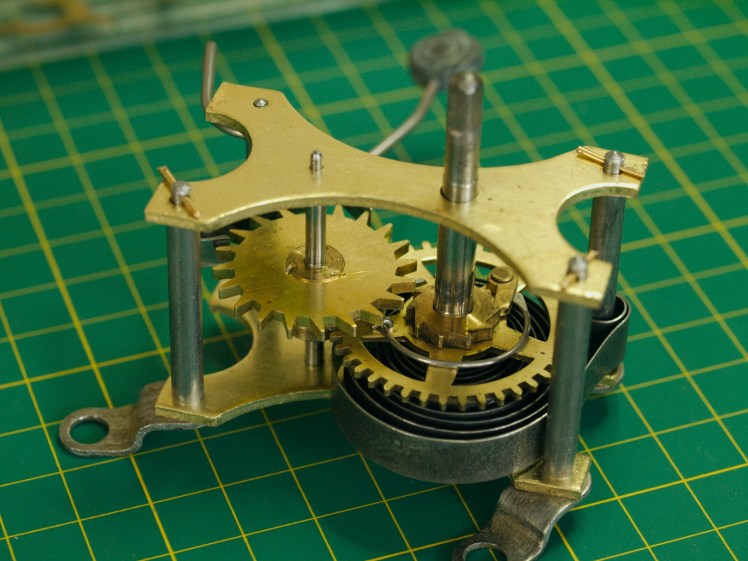
Ingraham Grecian, a clean movement with a small amount of wear

Next is the inspection of pivots, lantern pinions, wheel teeth, arbours, cut pinions, of which there are two in the motion works. All looked good. The gears were meshing well on both time side and the strike side.

Ingraham Grecian
Ingraham Grecian, checking the strike side for wear

Following the inspection is parts cleaning in the ultrasonic machine. Once the parts are dry I inspected the movement more closely for any issues I might have missed. Next is polishing the pivots.

Once the pivots are polished it is time for bushing work if required. In the case of this movement 2 are required for the front plate and 3 for the back. On the backplate, one of the bushings is the escape wheel bridge.

Ingraham Grecian
Ingraham Grecian, bushing the escape wheel bridge

There were two other pivot holes that were iffy and okay for now but since I am keeping the clock it will be inspected in 3 or 4 years for wear.

Reassembly comments

The third wheel on the strike side is a combined locking and pin wheel with 2 locking pins and 2 hammer pins. There is no cam, unlike many other American movements. The spaces between the pins allow for the drop lever to descend.

The fourth wheel is the warning wheel only and it is not used for locking.

Unlike later Ingraham movements that have a passing strike on the half-hour, this is an hour strike only.

Ingraham Grecian
Ingraham Grecian, the inside pins are for the strike hammer

The count wheel is advanced by two protruding pins on the third wheel lantern shroud, another unusual feature. It is important to ensure that the count wheel is firmly in place, not loose but not too tight, so the third wheel pins can advance the count. The stiffness can be adjusted by bending the brass clip on the count wheel.

During reassembly, the warning wheel is set about half a revolution to prepare for the strike. Also during reassembly one of the two lock pins is placed on the locking lever, the end of which has a hook. This is to permit the count lever to go into one of the deep slots.

Ingraham Grecian
Ingraham Grecian movement on the test stand

Sometimes it takes a couple of tries to get it right. Usually, I must make an adjustment or two after the plates are together but I was lucky the first time. 

Ingraham
Ingraham Grecian shelf clock C.1871

When I finished servicing the movement the new hands arrived from a supplier. So, here it is with new hands attached and the movement back in the case.

The clock has been returned to its former glory. 

E Ingraham Mystic parlour clock

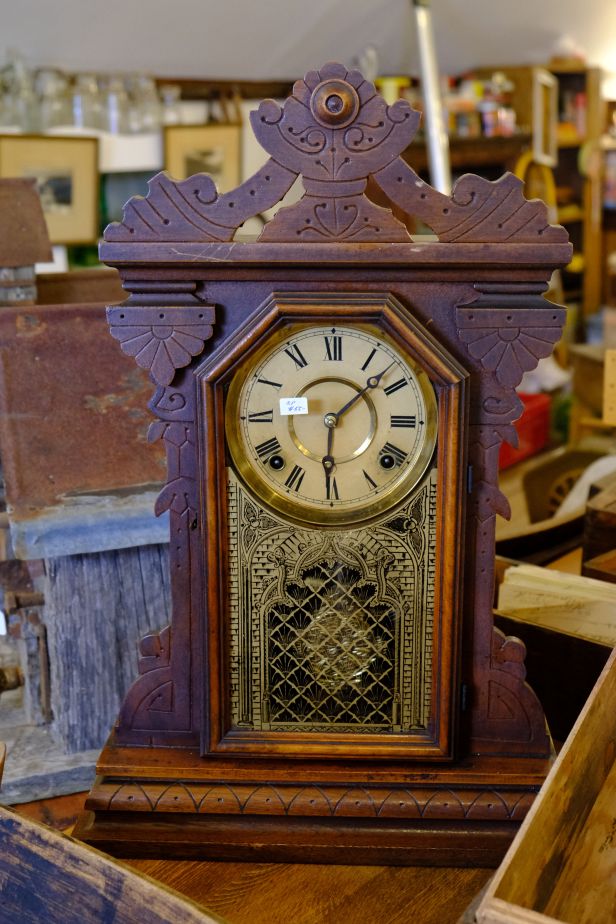
I do not come across many antique E Ingraham & Co. clocks and have just one other in my collection, the Huron from 1878, but I came across another recently that I found in a local antique shop. The price was right so, I snapped it up. The”S” shaped logo on the dial led me to assume it was a Sessions, but it was not – I’ll get to that later.

Rare Ingraham Huron found on a local online for-sale site
Rare Ingraham Huron balloon style clock in Rosewood

This is a parlour clock. It might have been described in company advertising as a kitchen clock. Some even refer to it as a gingerbread. There are a number of terms used when describing clocks of this style and the three names are used interchangeably by sellers on online for-sale sites and antique stores.

E Ingraham parlour clock circa 1897, sitting in an antique shop

Continue reading “E Ingraham Mystic parlour clock”

Website Powered by WordPress.com.

Up ↑