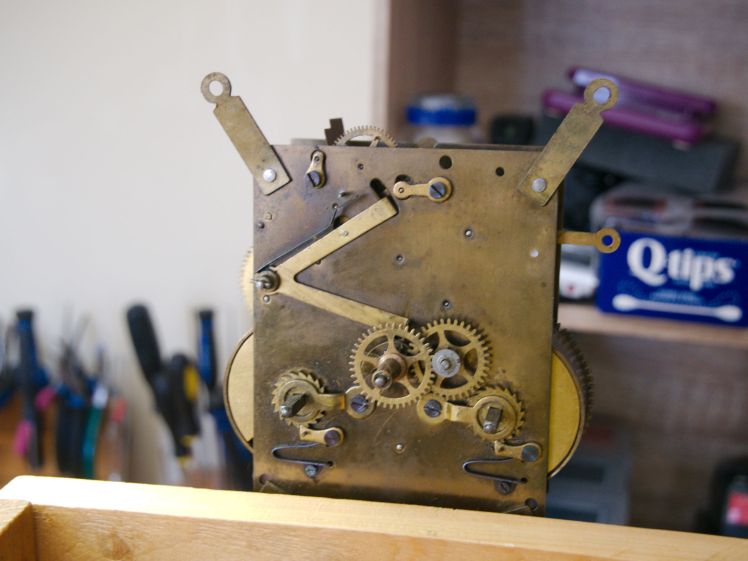
The arrangement of the gears should be familiar to anyone working on German clocks made in the first quarter of the twentieth century
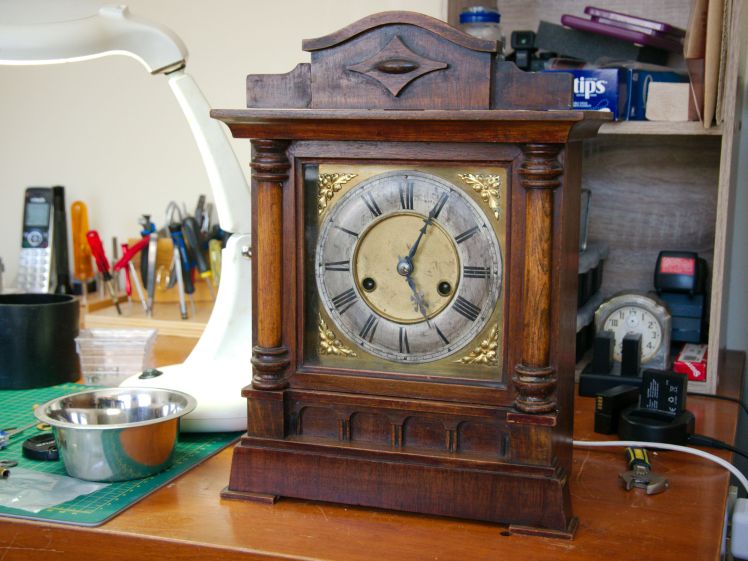
Bought on an online estate auction site earlier this year, servicing the movement is the subject of this post. Once the movement is serviced, the next step is to address dirt and grime on the case and see what I can do to improve the look of the dial although I am not very hopeful that I can do much to improve it.
For those unfamiliar with the HAC acronym, it stands for Hamburg American Clock Company, a well known German company acquired by Junghans in the late 1920s. It is otherwise known as Hamburg Amerikanische Uhrenfabrik or HAU. Kind of a strange name for a German clock company but that is how the original investors wanted it named.
I have a number of German clocks including familiar makers such as Junghans, Mauthe, Hermle, Jauch, Gufa, and Gustav Becker but this is the first HAC clock in my collection.
HAC clock circa 1900-1910
Assessment of the movement
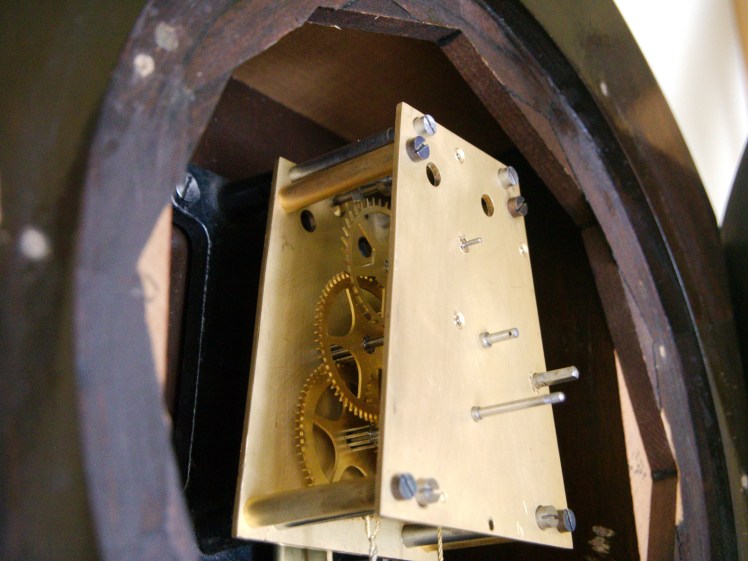
It is a typical 14-day German time and count-wheel strike circa 1900 to 1910. It is a robust and almost industrial looking movement and perhaps made early in this series of movements. It could be the type #21 although I can find nothing to confirm it.
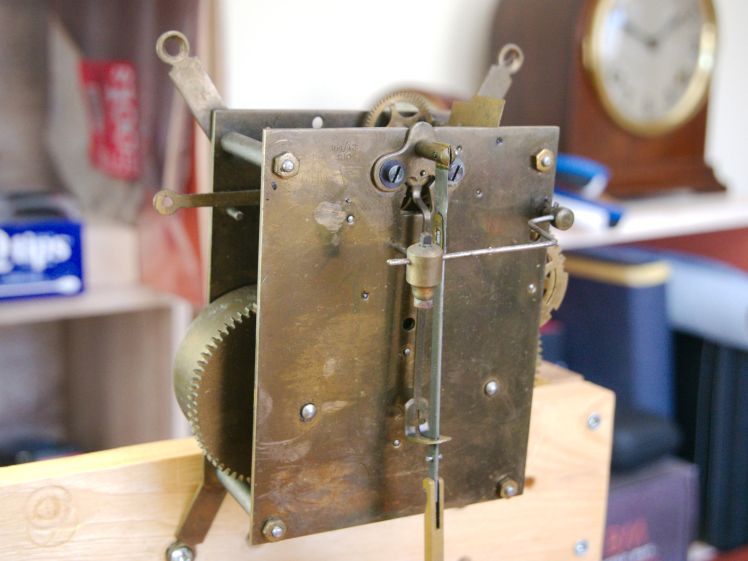
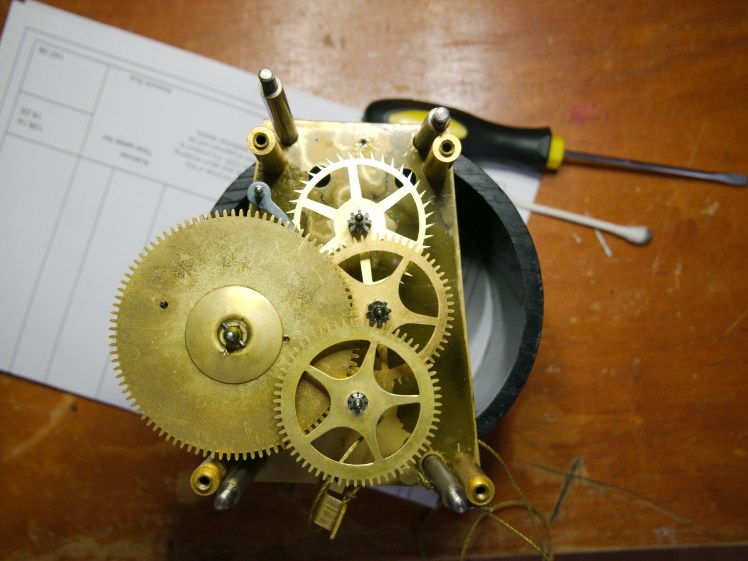
The arrangement of the gears should be familiar to anyone working on German clocks made in the first quarter of the twentieth century. This movement has slightly thicker plates, no cutouts, and no extraneous holes and looks sturdy.
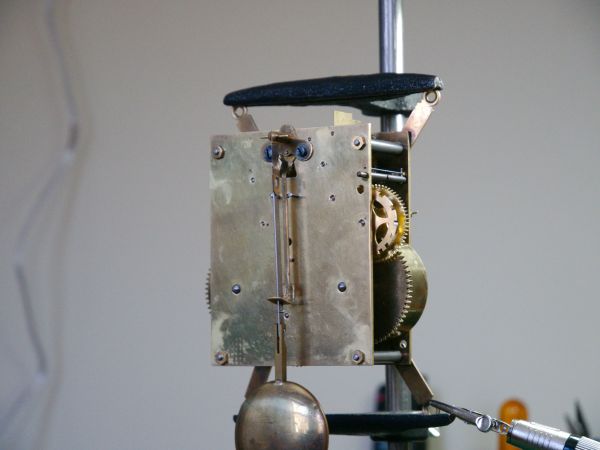
HAC clock movement, dirty and very tarnished
It has been worked on in the past, the strike side mainspring having been replaced at some point in the clock’s life. The time side has the HAC cross arrows stamped on the mainspring and appears to be original.
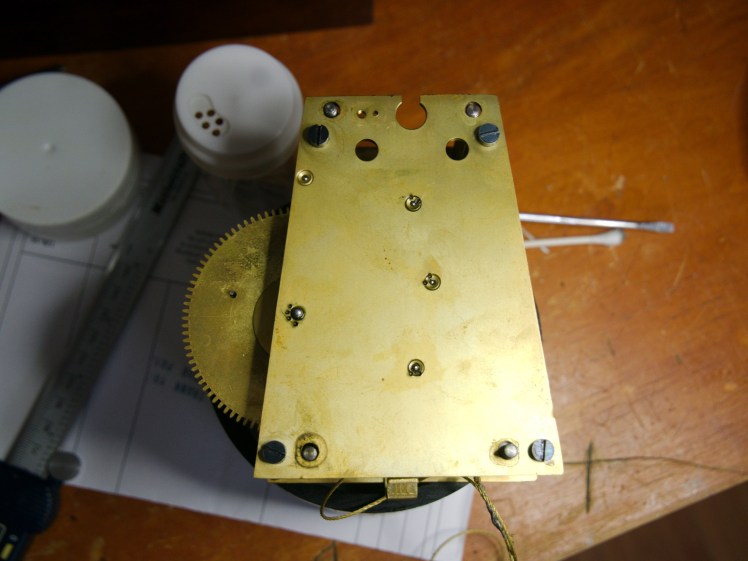
HAC clock movement, no cutouts
It doesn’t look as though there were issues at the time when the mainspring was replaced, no punch marks around the pivot holes or new bushings, for example, but there are wear issues now and that is to be expected in a 100+ year old clock movement.
In total the movement required 9 bushings, 6 on the strike side and 3 on the time side; 4 on the backplate, and 5 on the front plate. A couple of pivot holes are questionable and exhibit some wear and out of an abundance of caution I bushed them and why not while I have the movement apart. As expected there is more wear on the lower parts of the trains.
The bushing work went as expected. Some of the pivots are quite small and required 2.50mm OD bushings which I don’t often use but have plenty of them in my supply.
Ultrasonic cleaning did not do much to brighten up the brass plates, but to me aesthetics is unimportant. My goal, as always, is simply to have a properly serviced movement that runs well.
Assembly and testing
The movement was assembled and oiled. Both the strike and the time side are running well. There were no particular problems setting up the strike side other than a couple of attempts setting up warning before I got it right.
HAC movement on the test stand
It continued to run well during the next couple of weeks.
It is a 14-day movement but I find with these German movements that winding them once per week ensures more accurate timekeeping.
There is enough confusion among clock collectors and owners of antique and vintage items that it prompts a discussion.
The terms vintage and antique are often used interchangeably, and often incorrectly.
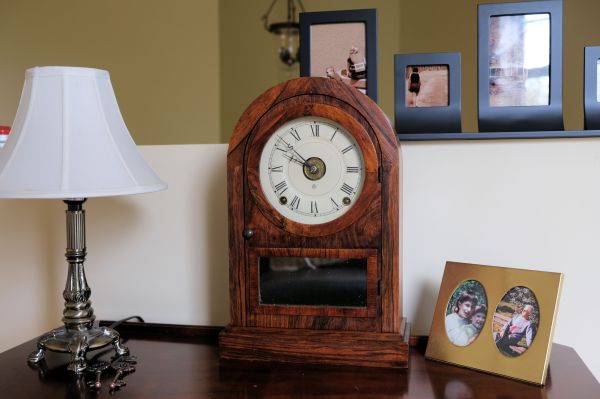
Vintage or antique, Seth Thomas adamantine mantel clock C.1911
According to the United States Government, the term “antique” is reserved for valuables that are over a century old. Webster’s dictionary defines an antique as a work of art, piece of furniture, or decorative object made at an earlier period and according to various customs laws at least 100 years ago. Wikipedia defines antique as applying to objects at least 100 years old. Therefore, most sources define the term “antique” as items that are 100 years or more.
The word “vintage”, according to eBay, is a defined period that is less than 100 years but more than 30 years. To many, vintage often means anything that is not new, is dirty, worn, or looks like it might be old if nothing is know about its provenance.
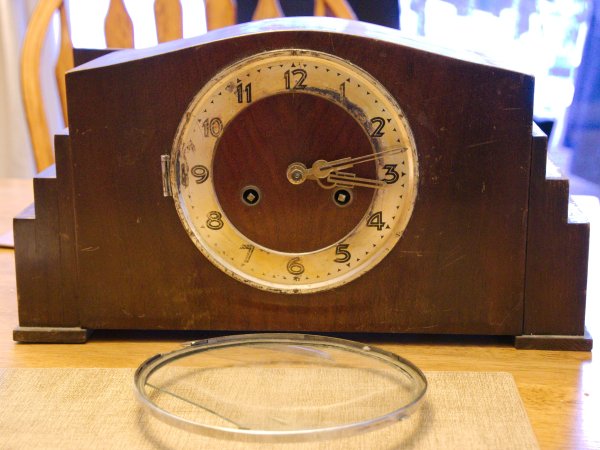
Vintage Fleet Time mantel clock C. 1936
The word vintage is as overused, and misused, as the word “antique”.
The use of the word vintage in auctions is becoming used more. Most often the seller who knows nothing about what they are offering for sale will use the term vintage or even “rare” and hope the buyer is convinced.
Some items that were considered rare many years ago are common today. Take the 30-hour ogee clock which was once considered rare but with the advent of the internet thousands were offered for sale and prices dropped accordingly. “Rare” then became “antique”. What is truly rare today are one-of clocks that have an significant provenance.
The word “collectible” is another clever marketing term, and like the word vintage, has been misused. It presumes that the item offered must be added to what you already have and because it is the one piece you need the most, it will cost you more.
Jewelry is an interesting example. Anything over twenty years old is considered vintage. Some terms like “near” vintage and “true” vintage are often used. I assume any number of years can be assigned to “near” or “true” although “near” seems to mean “almost new” and sounds better than the word “used”.
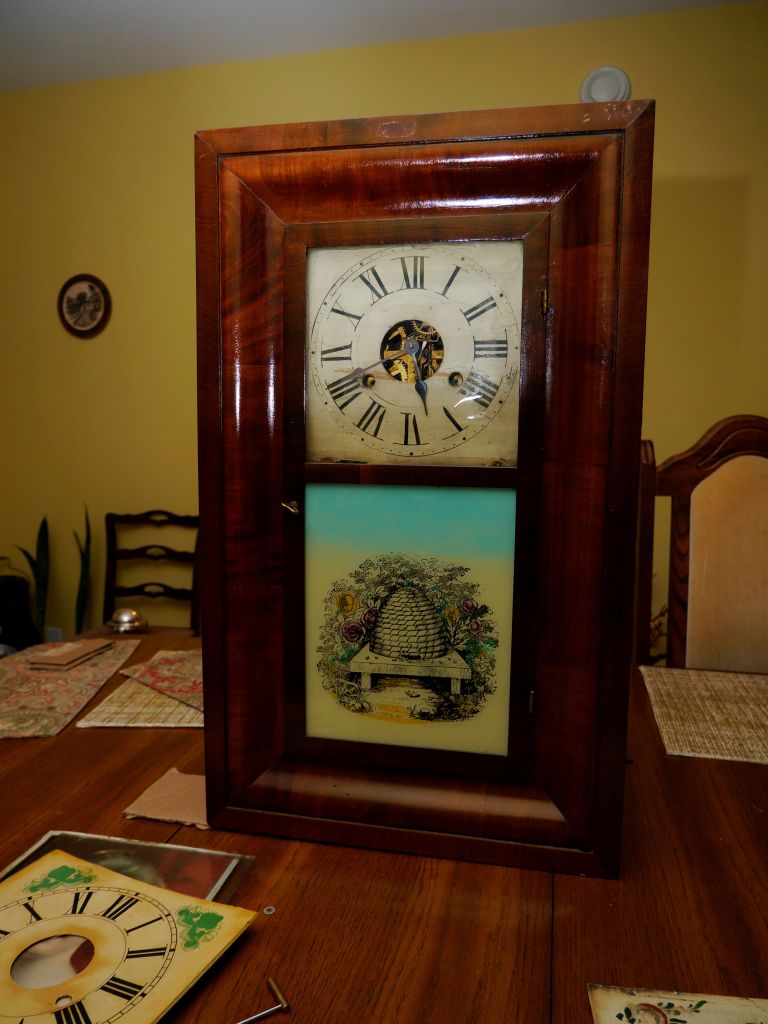
Antique George H Clark 30-hour ogee clock
In my view no quartz clock has any value. However, in 1970, Junghans invented the Astor-Quartz wristwatch which entered series production in 1972. Watch collectors everywhere would consider the Junghans quartz watch to be a highly collectible vintage timepiece even though it is quartz.
Take the time to research your prospective purchase by consulting various sources which will inform you of the age of the clock you are shopping for.
Some clocks can be dated precisely by serial number, patent date or date stamps on the movements. Many clocks can be dated with some accuracy but often it is a challenge at times to determine the age of a particular clock unless you compare the style and movement type with others of the same period.
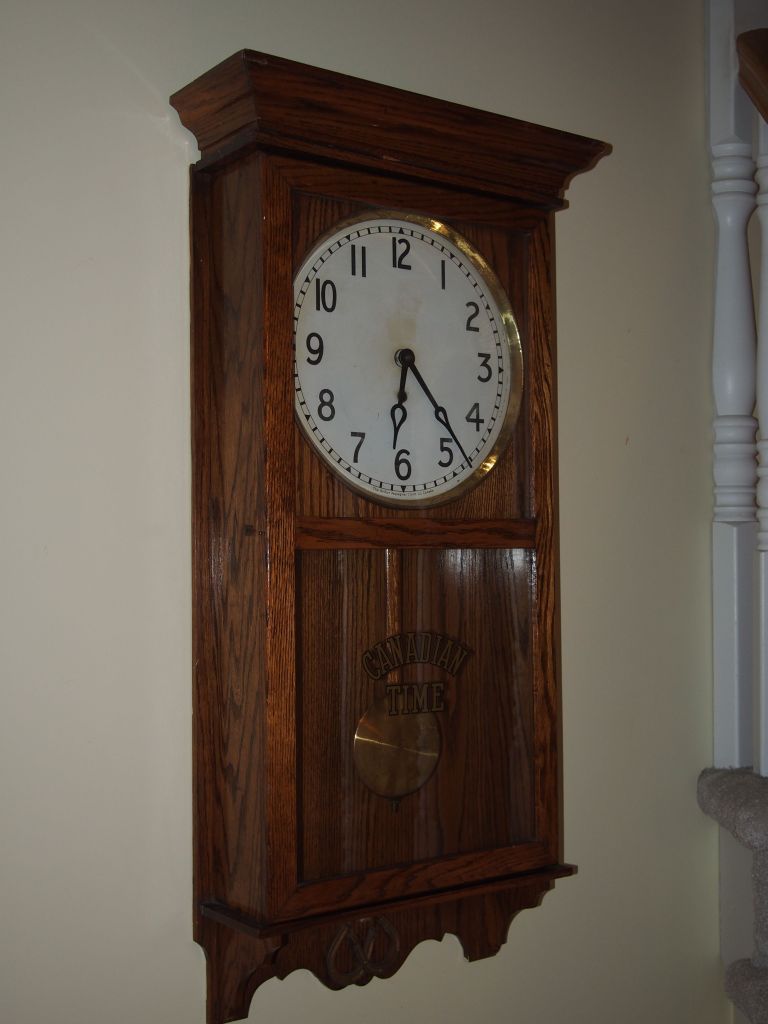
Vintage or antique Canadian time wall clock
In my collection is an Arthur Pequegnat Canadian Time clock which is quite old but I do not know it’s exact year of manufacture but I can place it within a range of dates. It was made by the company between 1917 and 1941. There is nothing noteworthy about the movement or style of the case that determines the year it was made.
Whether antique, vintage or collectible, if you enjoy your clock nothing else truly matters.
But, if you are selling a clock it is important to inform your prospective buyer and give them the best information possible to help them make a decision.
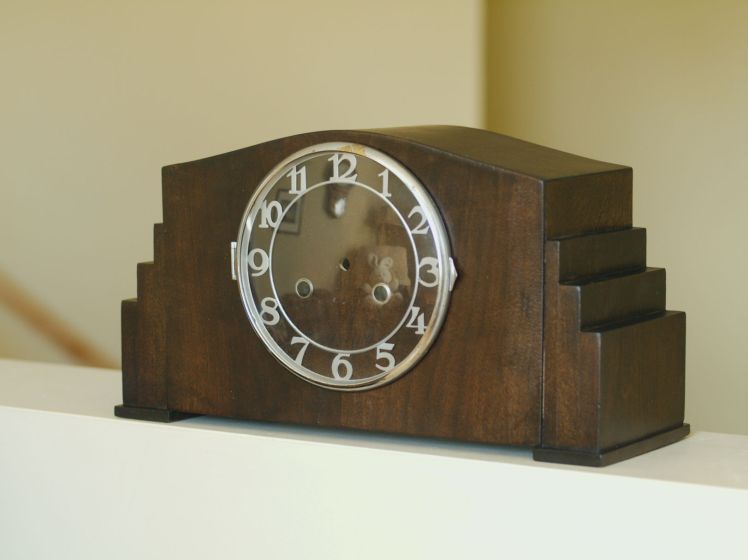
This Fleet Time, time and strike mantel clock is essentially a plain, garden variety clock with a walnut finish, flat front, a slightly domed top, and step-side features on corner feet. The dial is heavily tarnished and the glass bezel that should be soldered to the chapter ring is detached. These bezels often go missing and at least this one came with the clock.
The clock has some issues, none of which are insurmountable. The plan is to refinish the case, attach the bezel, clean-up the dial or replace it, install new glass, and service the movement.
In this post servicing the movement is the focus.
The movement looked reasonably good when I received it and it may have had some bushing work done in the past but once apart it was clear to me that it might never have been worked on beyond a cleaning. It ran when I got it and one is tempted to leave it as is but it was dirty, had some wear and long overdue for a good cleaning.
Servicing the movement
Fleet time movement
Disassembly and testing for wear
I discovered two troubling issues when I had it apart. I put the wheels together to check for wear and I noticed the escape wheel was a fair distance along the arbour from its correct position adjacent to the leaf pinion (no photos, sorry). The pallets were contacting the very edge of the wheel. My staking set comes in handy from time to time and it was needed to close the gap between the wheel and the pinion.
staking set
Using light taps from a hammer and an appropriately sized punch I drove the wheel closer to the pinion. The pallets now contact the middle of the wheel as they should. Odd!
Fleet time movement, dirty and in need of a good cleaning
The second was an erratic beat during the testing phase of the time side. With a beat amplifier connected, I could hear the movement go ever so slightly in and out of beat, yet the movement continued to run. There are a number of possibilities but one is a bent escape wheel arbour which, in this case, was the culprit. Bent arbours are not difficult to straighten but care must be taken to bent them carefully so as to prevent a break. A broken arbour can be a very frustrating clock problem.
Once the 2 issues were out of the way it is on to cleaning the parts, inspecting and polishing the pivots, pegging the pivot holes, followed by bushing work. Most of the bushings that were installed were on the strike side. In fact, 4 of six, 3 on the backplate and one on the front plate, strike side, and the two on the time side were on the second wheel. Two were 2.5 OD bushings. I work on a lot of American and European clocks and cannot recall using bushings that small.
Testing
After cleaning and bushing work is completed the rack, snail, levers, and strike hammers/levers are attached.
Since the star wheel is on the outside of the plate I thought attaching the strike hammers would be simple. Not so much!
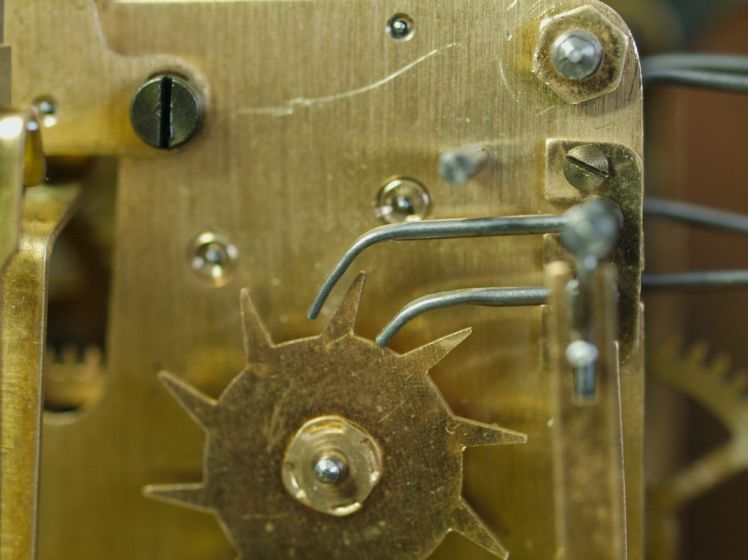
Fleet Time movement, star wheel paddles
Again as in all movements with star wheels, the strike paddles must sit between the star points. One was fine, the other hung on the tip of a point. Rather than attempt to force the star into position, the strike side was partially disassembled and the star wheel was re-positioned. Yes, it meant removing wheels on the strike side to change the orientation of the star wheel but it is best to do it correctly rather than risk damage to the gear.
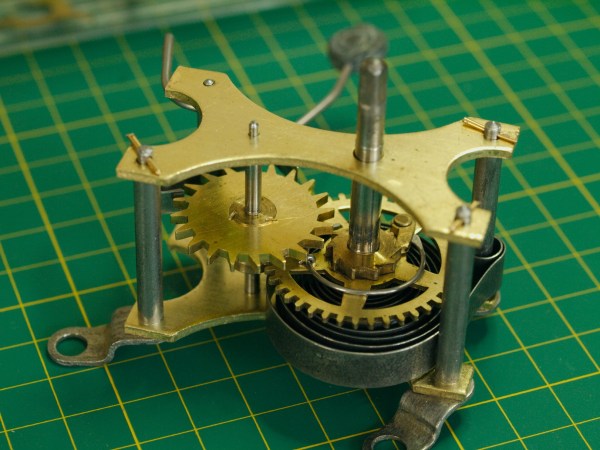
On this movement, the mainsprings can be removed without disassembling the movement. Handy for such things as replacing a broken mainspring and making the above adjustment.
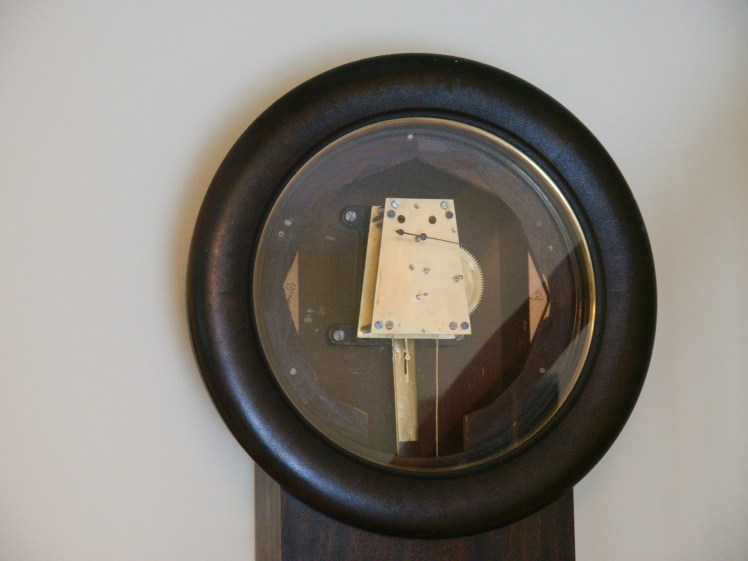
Fleet time movement
The movement was on the test stand for two eight-day cycles and now it is time to return it to its case.
Just when everything seemed to go well – disaster
I polished the 3-rod gong and mounted it and the movement within the case. I wound the strike side fully and then wound the time side. Just as I was feeling resistance, CLUNK, and then the arbour turned freely. Did the mainspring slip off the winding arbour or, did the mainspring break?
Sourcing a mainspring is not a problem but when I removed the barrel I discovered two broken and one bent tooth on the mainspring barrel plus a broken mainspring. Make that three broken teeth since a bent tooth cannot be straightened.
Broken and bent teeth
I do not have the specialized equipment to make and install new teeth and sourcing a 60 tooth barrel that is the exact height and depth would be a challenge. Worse, the catastrophic shock of the broken mainspring took out one leaf of the second wheel pinion.
When the mainspring breaks on the arbour end, which occurred in this case, the power is released uncontrolled, and causes damage to the barrel, the second wheel or both. When the mainspring breaks at the other end it tries to unwind and the loose end provides sufficient resistance, that is, a much slower release of the energy, and is less likely to cause major damage. In the latter case the mainspring is the only thing that is damaged and it can be easily replaced. In the former, both the barrel and second wheel need to be repaired or replaced.
This is an unusual situation, but it happens.
Fleet second time wheel with bent pinion leaf which cannot be straightened
The movement was aside to consider next steps. In the meantime, the plan is to locate a donor movement. The power was let down on the strike side, and everything was placed in a sealed plastic bag and marked for storage.
I’ll be honest, this situation bummed me out and it took a week to return to servicing another movement.
The clock case
The plan, after servicing the movement, was to devote a separate post on the case but since the movement is non-functional there is not much point. While the movement was on the test stand, I spent hours on the case, stripping, finishing, and polishing including swapping out the dial and broken glass with one from a Blackforest clock from the same period (both companies used the same suppliers). The case came out better than expected but now there is no movement to put in it.
Fleet Time refinished case and replacement bezel and dial
The most disappointing part? I was at the very end of the project. The movement and rod gong were installed in the beautifully reconditioned case and I was preparing it for its first run after having tested it for two weeks. I did not expect it to go out with such a destructive bang.
Broken time-side mainspring
I asked a clock friend for some advice. He says that although the barrel teeth and leaf pinion can be fixed it is usually not worth it because the process is so time consuming. “What do you do?”, I said. “I collect movements that are used as donors for times such as this”, he replied.
After having completed work on the case and dial pan of the Ingraham Grecian time and strike shelf clock it is now on to servicing the movement.
Ingraham Grecian refreshed case
Assessing the movement
The movement is in surprisingly good condition for its age. It has been serviced in the past, when, I don’t know. Here’s what I discovered during the inspection.
In an early servicing, 3 bushing holes were punched. Many years ago clock repairers used a punch to close pivot holes that had elongated after years of wear and it was considered an acceptable practice at that time. Not today!
The mainsprings and alarm spring appear to be original and the alarm mechanism showed no evidence of wear.
At a later point a clock repairer installed 3 brass bushings, 1 on the front plate and 2 on the backplate.
Pivots had been replaced on one end of the warning wheel and one end of the third wheel time-side.
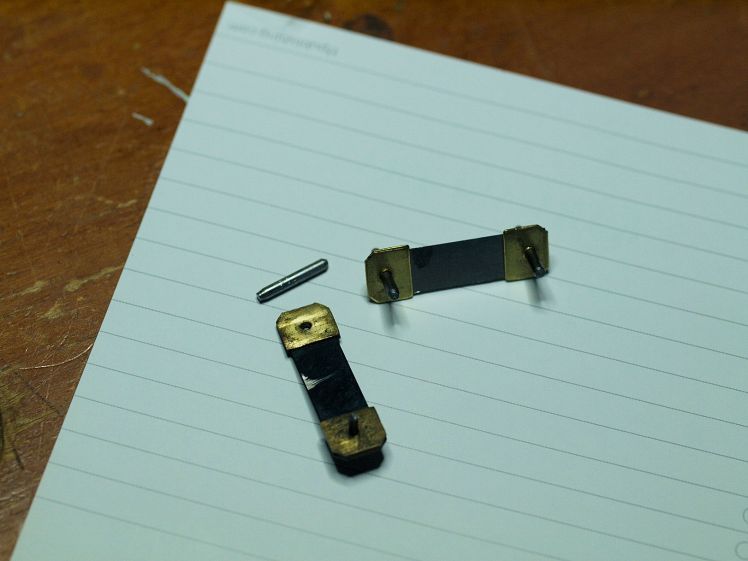
The thin brass strap that trips the alarm has been re-riveted.
Ingraham Grecian, a replaced pivot, a very good job by a past repairer
The repairs were neat and professional.
But there were problems
While there were some decent repairs, someone attempted a homemade fix and it became a non-working clock. I suppose that is to be expected from a clock that is 149 years as it passes through several hands.
It appears that the clock was eventually passed on to someone who had little knowledge of things mechanical. It might have been simply out of beat and an attempt was made to adjust the crutch by twisting the crutch loop around the pendulum leader. I can only assume that in their attempt to access the mechanism to “fix” it, the dial and brass bezel were damaged in the process.
Without impulse the clock would run a minute and stop and would never run in that condition.
I reshaped the crutch loop and bent the crutch slightly to achieve a healthy beat and the clock began to run.
While the clock was running I discovered a bent escape wheel tooth. It was running despite this issue, but the verge would occasionally skip the bent tooth. A bent tooth is often the direct result of transporting a clock without removing the pendulum bob.
Servicing the alarm
There is not much to the alarm mechanism. Three pins hold the 2 small plates. I doubt this alarm was used much, It was taken apart, parts cleaned in the ultrasonic, reassembled and oiled.
Ingraham Grecian, the alarm mechanism
Servicing the movement
After letting down the mainsprings and disassembling the movement the first order of business is to straighten the bent escape wheel tooth. The trick is to “draw out” the tooth out with a pair of smooth flat jawed pliers. It is important not to stretch the tooth as this will introduce other escapement issues. Unbending the tooth is a simple procedure but a disaster if things go wrong.
Ingraham Grecian, a clean movement with a small amount of wear
Next is the inspection of pivots, lantern pinions, wheel teeth, arbours, cut pinions, of which there are two in the motion works. All looked good. The gears were meshing well on both time side and the strike side.
Ingraham Grecian, checking the strike side for wear
Following the inspection is parts cleaning in the ultrasonic machine. Once the parts are dry I inspected the movement more closely for any issues I might have missed. Next is polishing the pivots.
Once the pivots are polished it is time for bushing work if required. In the case of this movement 2 are required for the front plate and 3 for the back. On the backplate, one of the bushings is the escape wheel bridge.
Ingraham Grecian, bushing the escape wheel bridge
There were two other pivot holes that were iffy and okay for now but since I am keeping the clock it will be inspected in 3 or 4 years for wear.
Reassembly comments
The third wheel on the strike side is a combined locking and pin wheel with 2 locking pins and 2 hammer pins. There is no cam, unlike many other American movements. The spaces between the pins allow for the drop lever to descend.
The fourth wheel is the warning wheel only and it is not used for locking.
Unlike later Ingraham movements that have a passing strike on the half-hour, this is an hour strike only.
Ingraham Grecian, the inside pins are for the strike hammer
The count wheel is advanced by two protruding pins on the third wheel lantern shroud, another unusual feature. It is important to ensure that the count wheel is firmly in place, not loose but not too tight, so the third wheel pins can advance the count. The stiffness can be adjusted by bending the brass clip on the count wheel.
During reassembly, the warning wheel is set about half a revolution to prepare for the strike. Also during reassembly one of the two lock pins is placed on the locking lever, the end of which has a hook. This is to permit the count lever to go into one of the deep slots.
Ingraham Grecian movement on the test stand
Sometimes it takes a couple of tries to get it right. Usually, I must make an adjustment or two after the plates are together but I was lucky the first time.
Ingraham Grecian shelf clock C.1871
When I finished servicing the movement the new hands arrived from a supplier. So, here it is with new hands attached and the movement back in the case.
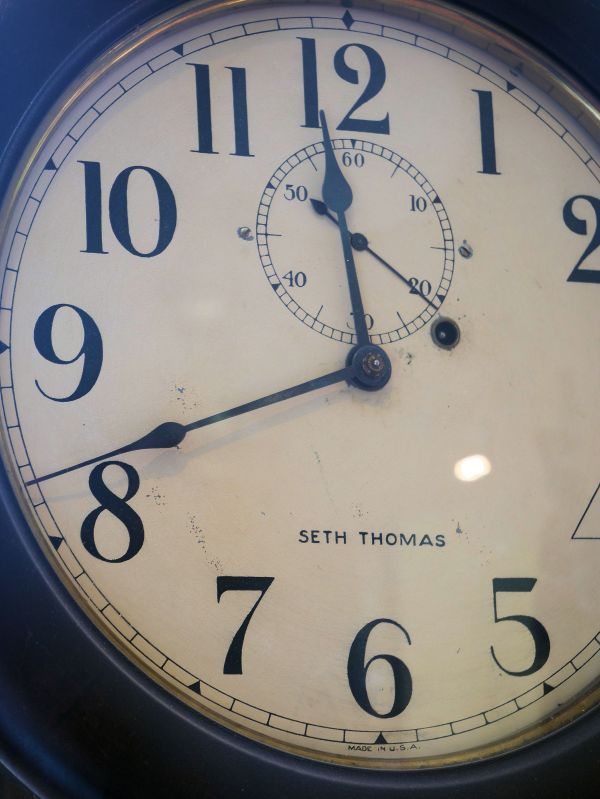
Perhaps recognizable as one of the most common regulator clocks in America, the Seth Thomas Regulator #2 was found in many railway stations, offices. libraries and other public places across America during the last century, a testament to its accuracy and dependability. It is a robust, accurate, well-engineered, and dependable timepiece that was made by Seth Thomas from 1860 to 1950, a run of 90 remarkable years. Few clocks can claim that kind of longevity.
It is an iconic American clock and every serious clock collector wants one.
Seth Thomas Regulator #2
This particular clock was made between 1922 and 1929 and has a base reminiscent of the earlier 1860 version of the #2. It has Arabic numbers with spade hands. The bow-tie between the wood dial bezel and the drop is one piece while earlier versions had a 3-piece “bow-tie”. It has a seconds hand 2 inches above the center cannon. However, it is not a true seconds hand and runs off the escapement taking 80 beats to complete the “minute”. All but the earliest #2s had the pendulum mounted in the rear.
It is 36 ½ inches tall and veneered in mahogany. It has 77A stamped on the bottom right of the movement with the letter “K” underneath and has a small ST stamp near the middle of the front plate. Some versions of the 77 have lantern pinions while this has cut or leaf pinions.
Seth Thomas Regulator #2
It has stopped – it needs a cleaning and perhaps a bushing or two
Lately, the clock has been stopping intermittently. I would nudge the clock along and it would run 5-10 minutes at a time and stop. I replaced the suspension spring and all seemed good as the clock ran for a couple of weeks. I thought I had addressed the issue but it began to stop again!
I bought the clock three years ago. It was oiled shortly after I received it but it has not been serviced and now it is telling me that servicing is long overdue.
Seth Thomas #2 suspension spring, old on left
The movement is relatively simple in that it has 4 wheels. I disassembled the movement, pegged the pivot holes, and re-assembled it. There is wear but I have seen far worse in clocks that continue to run well. However, It appears that this movement does not tolerate wear.
Very disturbing are the aggressive, deep punch marks around most of the pivot holes. Punching around pivot holes to close them might have been an acceptable practice many years ago, but not today. The repair is crude and unprofessional.
Seth Thomas #2, aggressive punch marks around all four wheels on the backplate
The leaf pinions are in very good condition, wheel teeth look good and the verge has minimal wear.
Servicing the movement
In total up to 6 bushings are required.
I also discovered a slightly bent third-wheel arbour that did not take much effort to straighten.
Seth Thomas #2, very simple with just 4 wheels
Despite its apparent simplicity the parts are made to close tolerances and any wear has the potential to stop the clock. I don’t think this is a good movement for the novice clock repairer.
I installed three bushings on the backplate; the second, third wheels, and the escape wheel, and two on the front; third wheel, the escape wheel, and the verge pivot hole front plate.
Seth Thomas #2, minus the motion works
The movement is clean, shiny, and mounted in the case for testing and minus the motion works gears.
Seth Thomas #2, test phase; the second hand is on to give me a quick visual as I pass by the clock
Despite the fact that I have 4 movement test stands, none are appropriate for this movement because of the iron bracket onto which the movement and pendulum are mounted. I suppose I could probably adapt something. For now, into the case it goes for testing.
After three weeks the clock is running very well.
Seth Thomas #2
While the movement was out of the case I replaced both the maintaining power spring and the old cable with 3/64 inch brass weight cable. The brass cable has one feature I really like, a nylon core that prevents it from coiling. I also gave the pendulum bob and weight a polishing.
Cleaning and bushing work put the clock right. After the wear issues were addressed the clock not only runs better but polishing the brass improves its appearance.
Ingraham Grecian Harris and Sons auction photo (with permission)
This attractive shelf clock was bought on an online auction in early January 2021. From the auction photos, I expected a clock that required attention and now, having received it, I am pleasantly surprised that it is in better condition than I thought.
Under the auction studio light (first photo), the case might appear to look reasonably good. Closeup, there is a lot of oily dirt and grime. Servicing the movement will wait for another day. Restoring the case and dial is first.
The vibrant grain of rosewood is there, underneath the grime
Restoration of the case and dial pan
The design of the E. Ingraham Grecian 8-day time and strike shelf clock is neoclassical. It is not only aesthetically pleasing to patrons of the nineteenth century but remains so today. it is timeless.
The age-old debate about what to do with a clock case often arises. Some say, “leave it”, the finish, however grimy is part of a clock’s history. I am not of that camp. If I found the perfect classic car in an old barn I would not leave the dirt and grime on the finish to preserve its patina? Rather, I would polish it to show it off to the world.
This clock is not a candidate for stripping the finish. Stripping is a last resort. Good old fashioned soap and water work is perfect for a project such as this.
Old clocks especially those that are over 100 years old are generally very dirty and the grime is layered. The home environment was a very different place a century ago. Smoking in the home was common, many homes had wood and coal fires for heat, humidity varied because of poor insulation and anything in suspension landed on the furniture. This Ingraham clock is no exception. The rosewood veneer deserves to be shown off and that can only be achieved by peeling off the dirt to reveal the texture of the grain underneath.
Ingraham Grecian Harris and Sons auction photo (with permission)
For cleaning, I prefer a light coloured microfiber cloth so that I can visualize how much dirt I am removing as I proceed with the cleaning. I use several during the course of the project. Diluted Murphy’s soap is used for the case and full strength for the stubborn areas.
Rubbing is required but I don’t want to get too carried away as the cloth might snag a piece of the veneer on a corner. I start with a discreet area first to see what effect the cleaning is having. Working one section at a time, I clean down to the veneer. Any shellac that remains will be removed during the cleaning.
The case looks bleached after the cleaning but a damp cloth will show the grain, the effect shellac will have once the cleaning stage is complete.
I let the case dry thoroughly before applying the first coat of shellac. Shellac is prepared in the traditional manner, flakes and lacquer thinner and mixed to a one pound cut allowing fast drying.
For this project, I applied 2 coats of shellac. Between coats, I used 4X0 steel wool to smooth out any imperfections. After the second coat, I use steel wool to take away the glossy look of the shellac.
Next is the dial.
Ingraham Grecian shelf clockIngraham Grecian clock, the dial is detached from the bezel
Above is a photo of the dial when I received the clock. It is off-center because nothing is securing the dial face to the brass bezel.
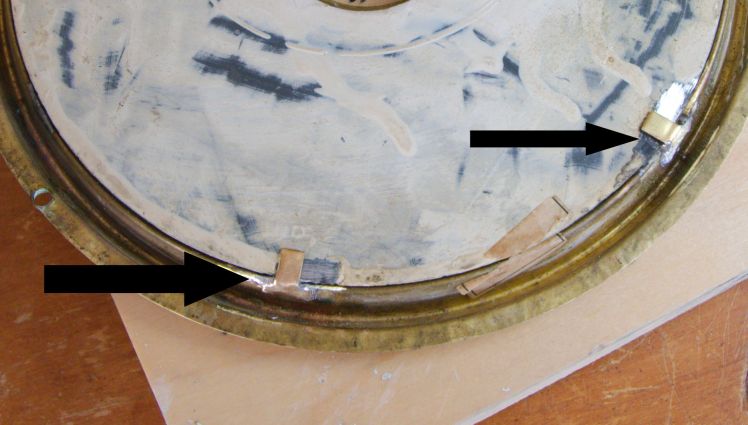
The rear of the dial, 2 new dial tabs
Two of the four tabs securing the dial face on the rear of the brass bezel were broken. The arrows show the two new tabs. I am not a whiz with a soldering iron and did the best I could but the results, to me, are acceptable. The thin brass tabs were sourced from a supplier. The tabs, once secured, are bent to secure the dial in place.
Ingraham Grecian
The numerals were in-painted. The dial was in generally good condition though there were losses outside the chapter ring. I mixed and matched paint to touch up the areas of paint loss, and installed a new grommet to replace the missing time-side one. The brass bezel, inner brass ring, and strike side grommet were polished with Brasso as the last step.
E. Ingraham Grecian shelf clock
The case and dial part of the project is complete and in a future post I will address servicing the movement.
There’s something deeply satisfying about winding a mechanical clock—feeling the tension build in the spring or watching the weights slowly rise as you turn the key. That simple ritual connects you to generations past, when timekeeping was both a science and a daily habit. Among the many types of mechanical clocks, the 8-day clock holds a special place. Wound just once a week, it blends convenience with craftsmanship, offering the perfect balance of tradition and practicality.
An 8-day clock is a mechanical clock that requires winding only once every seven days. While that may sound simple, there’s more to it than just the winding schedule.
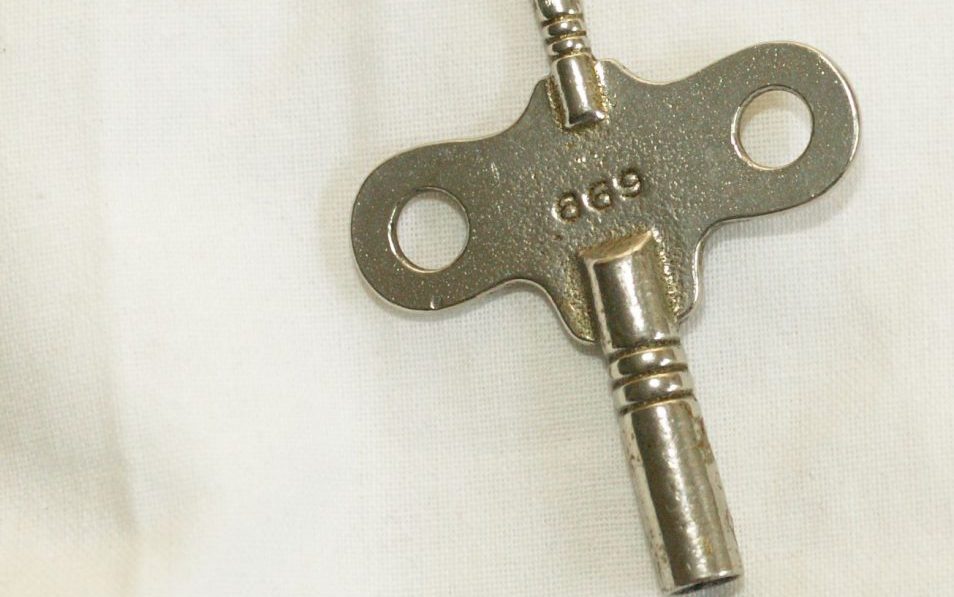
Double-sided winding key
Types of Mechanical Clocks
Mechanical clocks vary in their run times. A 30-hour clock—often called a 1-day clock—needs daily winding. Many ogee weight-driven and alarm clocks fall into this category. Others, especially those with Chinese or Korean movements, can run up to 31 days. You’ll also find clocks rated for 14, 15, or even 60 days, and anniversary clocks, known as 400-day clocks, which run for more than a year on a single wind. The number of days simply refers to how long the clock will run before needing to be rewound.
Arthur Pequegnat Moncton 15-day clock
Why Regular Winding Matters
If you don’t wind a clock near the end of its run time, it will stop when the mainspring or weight no longer provides power. A serviced 8-day spring-driven clock might run a day or two beyond its rated cycle, but eventually, it will stop once the power is depleted.
Junghans 14-day time and strike mantel clock
When an 8-day clock consistently fails to run its full cycle, it’s a clear sign that servicing is needed. Dirt, worn bushings, or tired pivots can all cause power loss. Fresh oil alone won’t solve the issue—mixing new oil with old, dirty oil can actually worsen wear.
Professional clock servicing involves fully disassembling and cleaning the movement, repairing worn areas, reassembling and lubricating it, and testing for accuracy. Though servicing can be costly—and sometimes exceed the clock’s market value—it’s well worth it for pieces with sentimental or historical importance.
It’s normal for an 8-day spring-driven clock to lose a bit of time toward the end of the week. As the mainspring unwinds, the stored energy gradually decreases, slightly slowing the movement.
Speed Variations and Clock Design
Seth Thomas round top 8-day clock
Some clocks include a device called a stopwork or Geneva stop, which limits the spring’s range to its most consistent section of power. This improves timekeeping but is relatively uncommon today—many clocks that once had stopworks have had them removed by repairers over the years.
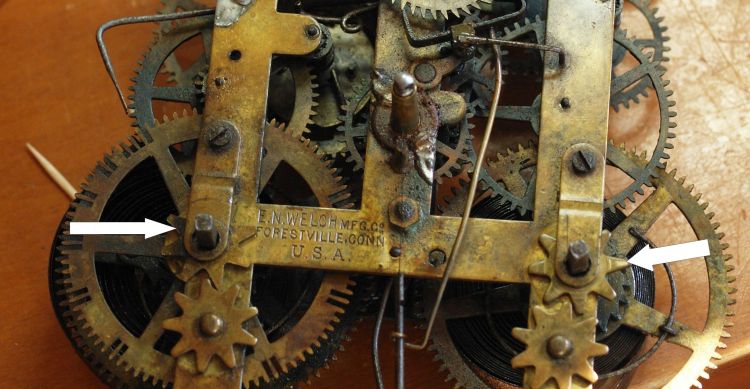
Arrows showing Geneva stops or stop works
My Personnel Collection and the Variety of Run Times
Of the more than 80 clocks in my collection, about 30 are running at any given time. Five are 1-day ogee clocks, three have 14-day run times, and the remainder are 8-day models. Most antique and vintage clocks you find in shops or online are also 8-day clocks—the classic “once-a-week winders.”
Keeping a Regular Winding Schedule
Weight-driven 8-day clocks tend to be more accurate than spring-driven ones because their power source—a descending weight—delivers a constant force. They typically need only minor time corrections.
Final Thoughts
Winding your clock at the same time each week ensures steady performance. I make it a Sunday morning ritual to wind my clocks and make any necessary time adjustments.
Like any precision instrument, a clock rewards consistent care. With proper handling, regular maintenance, and timely servicing, an 8-day clock will live up to its name—keeping time faithfully, week after week.
Feel free to share your comments or questions below!
I am sure some of you have noticed that I have been switching between theme templates for my blog. I recently upgraded to a better plan and with the plan comes more choices for themes. I had been using the Rosalie theme for the past few days and have discovered some things I like about it and some that I don’t.
I have therefore switched back to the Gateway theme.
This should not have affected readability and navigation as everything is where it is supposed to be and I apologize for the confusion.
I am still exploring the look of the blog and you may or may not see changes in the coming weeks.



















 Antique and Vintage Mechanical Clocks
You must be logged in to post a comment.