ChatGPT is a sophisticated computer program that is designed to understand natural language input from users and generate appropriate (my underline) responses. It uses a form of artificial intelligence called a deep neural network to analyze the input it receives and generate text that mimics human language. The program has been trained on a vast amount of data, including books, articles, and websites, so it can provide information on a wide range of topics. ChatGPT is an advanced technology that aims to provide human-like interactions in a digital space.
Regarding William McLachlan, here is what AI came back with:
“William McLachlan was a well-known Scottish clockmaker who lived and worked in Newton Stewart in the 1800s. He was born in 1803 and began his career as an apprentice to John Smith, a clockmaker in the nearby town of Wigtown.
In 1826, McLachlan moved to Newton Stewart, where he opened his own clockmaking shop. He quickly gained a reputation for producing high-quality clocks, and his business grew steadily over the years. McLachlan was known for his precision and attention to detail, and his clocks were particularly prized for their accuracy and reliability.
In addition to making clocks, McLachlan also produced barometers, thermometers, and other scientific instruments. He was particularly interested in developing new designs and technologies, and he was constantly experimenting with new materials and techniques.
McLachlan was a respected member of the Newton Stewart community, and he was involved in many local organizations and charities. He was also an active member of the local Masonic Lodge, and he served as its Master in 1861.
William McLachlan passed away in 1872 at the age of 69, but his legacy lived on through his work. His clocks and other instruments are highly prized by collectors and are considered some of the finest examples of Scottish clockmaking from the 19th century.”
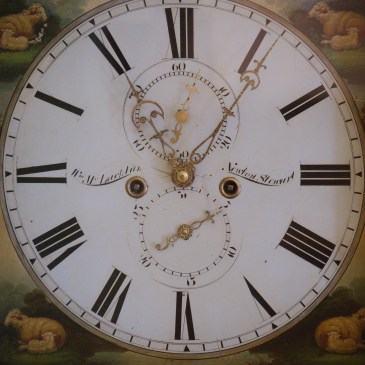
Early morning light on the clock face
I decided to ask the question in a slightly different way and this is what I found:
“William Maclachlan, a clockmaker from Newton Stewart, Scotland, was born in 1803. Here is some information that I was able to find about his life:
William Maclachlan was born in 1803 in Newton Stewart, a small town in the historical county of Wigtownshire in southwestern Scotland. He was the son of James Maclachlan and his wife Agnes. In 1823, William Maclachlan married Janet Hannah, and the couple had at least six children.
William Maclachlan worked as a clockmaker, and he is known to have produced a variety of clocks and timepieces during his career. Some of his clocks are still in existence today, and they are highly prized by collectors. For example, in 2017, a William Maclachlan longcase clock was sold at auction for over £20,000.
Maclachlan was also involved in local politics and community affairs. He served as a councilor on the Newton Stewart town council in the mid-19th century, and he was also involved in the establishment of the local savings bank. He was known for his philanthropy, and he supported various charitable causes throughout his life.
William Maclachlan died on March 6, 1876, at the age of 73. He is buried in Penninghame Kirkyard in Newton Stewart. His legacy as a skilled clockmaker and community leader lives on, and his clocks continue to be admired and sought after by collectors today.”
Back to the database search
In any event, armed with the “information” generated by AI I went back to a Scottish website calledScotlands People, a government-operated site to input new data.
As for information on deaths, I found a William McLachlan age 68 who died in 1871 in Rhu, Scotland which is 105 miles from Newton Stewart. For marriages I found nothing. However, records begin in 1855 which means he might have married earlier. Regarding the 1871 census, I found a William McLachlan who was age 67 in Renfrew County where Newton Stewart is located. On the whole, not definitive and really nothing to support the AI-generated data.
Is information from ChatGPT to be trusted?
Generating intelligible responses simply results in responses being “appropriate”. Note the spelling of McLachlan (Maclachlan) in the second query despite inputting the name correctly. Varying the words in each new query yields a different result because ChatGPT gathers information from a number of sources and constructs facts in an intelligible dialog based on the question asked.
In my view, ChatGPT can be a dangerous tool. It looks very impressive though sadly some people will not question the information generated. A plague of misinformation and propaganda will flow from AI, no doubt, and whether we like it or not robot reporters in the news media are already a thing. Therefore, generative AI can be transformative and yet potentially destructive.
For the researcher, AI might provide a starting point but it is too easy to go down the rabbit hole. I see some value in ChatGPT as a blog writer if I am searching for a generic opening paragraph or explaining how something works. For instance, I asked ChatGPT “How does a clock escapement work?” and the response, to me, is pretty impressive. Having said that, I am now aware of its limitations, so, a little caution is necessary going forward.
And since I have no way of verifying the AI information that leaves me at square one.
For now, I am standing by the information in a previous post which you can access above.
Oh, the answer to “how does a clock escapement work?’.
“A clock escapement is a mechanism that converts the rotational motion of a clock’s gear train into a series of evenly spaced ticks that move the clock’s hands. The escapement consists of an escape wheel and a pallet fork.
Here is how the escapement works:
The power source, such as a weight or spring, applies force to the escape wheel, causing it to rotate.
The pallet fork, which is connected to the clock’s pendulum or balance wheel, engages with the escape wheel and stops it from rotating.
As the pendulum or balance wheel continues to swing back and forth, it moves the pallet fork, which then releases the escape wheel.
The escape wheel rotates a small amount before being stopped by the pallet fork again, and the cycle repeats.
Each time the escape wheel rotates, it moves the clock’s gear train forward by one tooth, which in turn moves the clock’s hands.
The ticking sound of a clock comes from the sound of the escape wheel teeth clicking against the pallet fork as the escapement mechanism advances the gear train one tooth at a time. The swinging motion of the pendulum or balance wheel helps regulate the rate at which the escapement mechanism ticks, keeping the clock running at a consistent pace.”
Since winning this tall-case clock at auction in the spring of 2020 I have been intrigued about its origin. The information provided at the time was that it was made in Scotland or England in or around the mid-1800s but it could not have been made after 1852 as I will explain later.
Its features suggest the mid-1800s although there is nothing on the clock that tells me anything about the exact year it was made.
It is a classic Scottish design from the era. It is fairly nondescript and lacks the fine craftsmanship of other tall-case clocks of the period but it has attractive lines.
It has an English rack and snail bell strike movement. The removable bonnet is 23 inches at its widest point, the waist is 15 3/4 inches wide and the base is 20 inches wide. The bonnet has tapered columns on either side. The dial access door which covers the entire bonnet swings to the right. The solid wood access door on the waist measures 9 X 24. The weights are 10 and 11 pounds as one would expect.
To appreciate the size of the clock at almost 90 inches, it just about reaches our 8-foot ceiling.
The day it was brought home
On the dial is the name Wm McLachlan, and the town, Newton Stewart. William (Wm) McLachlan is a clockmaker. In his book, Clockmakers & Watchmakers of Scotland 1453 to 1900 David Whyte lists McLachlan, William, clock & watchmaker in Newton-Stewart, Wigtownshire as a business advertised for sale on 25 May 1852, with no reason why it was offered for sale and nothing more about his life.
Newton-Stewart is a former town in the historic county of Wigtownshire in Dumfries and Galloway, southwest Scotland.
Perhaps rather than a clockmaker per se, McLachlan was an assembler/retailer and sourced cases, dials, and movements for his customers according to their wishes. Rather than build a clock from the ground up in his own shop, it was more cost-effective, even in the mid-1800s, to locate parts from various sources.
For example, the dial, hands, and movement were made in Birmingham, England and the case was very likely locally made by a joiner or wood craftsman. It is also quite possible that the painted dial originated in Birmingham as Birmingham was well-known at the time for its dial painters.
The clockmaker then assembled the parts, completed the final finishing, added finials, lock and knobs, weights, and pendulum, fine-tuned the movement, and placed his name and the location of the town on the dial.
What does the shepherd and sheep theme on the dial mean? The clock was presumably made for a well-to-do Scottish sheep farmer. I can only imagine the magnificent striking sound of this clock in a farmers’ home during the 1850s or so and the stories it could tell.
The tombstone of William McLachlan, (appears to be a more modern one erected by family?)
More about McLachlan
William McLachlan was born in 1799 in Penninghame, Wigtownshire, Scotland, and presumably operated a clockmaking business or clock shop in Newton Stewart in his thirties and forties, and finally while in his early fifties sold his business in 1852.
I had assumed that he either retired in the Newton Stewart area or passed away prior to the sale date but I have recently discovered that he emigrated to the USA prior to 1861. His tombstone is located in Jersey City, New Jersey, USA. He was 77 when he passed away on December 8th, 1876 and his wife Mary Crichton died in 1891 at age 84.
Scottish tall case clock restored and on display in my home
McLachlan’s wife was 7 years younger so let us assume they married when he was in his late twenties and she in her late teens or early twenties. Could he have been operating a business at that time? Did they have children? If so, why was the business not carried on by a son? And why the newer tombstone? Family, sons, daughters?
According to Scottish birth records McLachlan was living in Penninghame, Scotland in 1841. A William McLachlan from the same area is listed in the 1851 census but at 57 years old (an error perhaps?) and I cannot find a William McLachlan (who would have been 62) in the 1861 Scottish census. Did he and his wife leave for the USA sometime during the 10-year period between 1851 and 1861?
Whether he carried on clockmaking in the USA after his arrival is a mystery. If he did, there may be American sources I can explore further.
Many tall case clocks came over the ocean from Scotland and England but how this particular clock made its way to Canada is also a mystery.
Free records databases have their limitations and I am not willing to pay for a subscription for what might lead to a dead end but I will continue to do a little more digging and we’ll see what I can unearth.
Honestly, an entire book could be devoted to the topic of dating clocks. Some time ago, I published an article titled “How to Date an Antique or Vintage Clock – Part I,” in which I used specific examples from my own collection.
I’d like to explore this topic further, and this post will discuss additional methods for dating an antique or vintage mechanical clock. While there is no one definitive method for dating an antique or vintage clock, there are often clear clues in some cases and more subtle hints in others that can help pinpoint when a clock was made.
Occasionally, the exact month and year are displayed somewhere on the case, and in other instances, the clock by way of serial numbers, date stamps on the movement, style of hands, spandrels, dial design, case design, and so on, establishes the date to within a certain period.
After 1896 foreign clocks (Europe, England) were mandated to have the country of origin on the case, usually on the dial. Any clock made after that date will have the country of origin.
Duration of manufacture
A bit of research into the history of a clockmaker can help you narrow down the timeframe for dating your clock. For instance, the E.N. Welch Clock Company, an American manufacturer, produced clocks until 1903, when it was acquired by the Sessions Clock Company, which continued making clocks until 1970. The E.N. Welch Clock Company made clocks for a 50-year period until its acquisition by Sessions in 1903.
By 1903 German-based clock manufacturer Junghans was the largest clock maker in the world and continued in its quest to bring more companies into the fold. Gustav Becker, founded in the 1860s, and Hamburg American Clock Company, founded in 1883 were absorbed by Junghans in the late 1920s. Although those companies were folded into Junghans in 1926 the Gustav Becker name lived on for another 9 years.
Gustav Becker regulator C.1907, Braunau factory
Clocks with Steel vs Brass platesvs Woodworks movements
Smaller shelf clocks with 1-day (30-hour) wooden movements were produced in fairly large quantities from around 1810 to 1845, after which most clockmakers changed over to brass movements. Wood dials were also popular during this period.
Daniel Pratt woodworks movement with dial removedC.1832-38
By 1860 iron weights were being replaced by springs as the power source, and smaller clocks, many of them 8-day, were becoming increasingly popular. Early American spring-driven clocks used brass springs (late 1830s) until steel became cost-effective.
This information is important for dating a clock because it highlights key transitions in clockmaking technology and design, which can help pinpoint the era in which a clock was made. For example, the use of wooden movements and wood dials can indicate a clock was produced between 1810 and 1845. The shift from iron weights to springs by 1860 helps us understand why spring-driven clocks became popular, which is crucial for narrowing the period of manufacture. Additionally, the switch from brass springs to steel in the early 1840s can provide a more precise date range for early spring-driven clocks.
Understanding these technological changes allows you to make more informed judgments about a clock’s age based on its features.
Brass mainsprings from a Manross steeple clock C.1837
During periods when brass was in short supply such as the World Wars (WWI and WWII), makers often made steel plate movements with brass bushing inserts. However, some companies such as Arthur Pequegnat used either steel plates or brass-plated steel plates throughout their operating years (1902 to 1941).
Steel plates on a Pequegnat time and strike clock
Other clock companies switched to steel as a cost-cutting measure when brass prices were high, not necessarily during wartime.
Screws and nails, chime rods, coiled gongs
In older clocks, nails, and screws were made of iron and hand-forged, with screw heads being slotted. Hand-forged nails can be found in clock cases dating from the earliest examples up to the mid-19th century, after which machined screws and nails started to replace them.
An ogee clock, like this example made by George H. Clark in 1865, was constructed with hand-forged nails.
George H Clark 30-hour Ogee shelf clock
Robertson and Phillips head screws were introduced in the first part of the twentieth century. Since the Robertson head was invented in 1906 and Phillips screw heads only began to be widely used in the 1930s screws of these types found in older antique clocks are later additions.
Since these screw types were introduced in the early 20th century, their use in a clock that dates from an earlier period suggests that the screws were likely replaced or added during a later restoration or repair. Recognizing these screws helps refine the clock’s dating and can provide insight into its history and any modifications it may have undergone.
The first rod gong, a single striking rod, dates back to patent designation DRGM 108469, granted to Johann Obergfell on December 23rd, 1899. The introduction of the rod gong, as opposed to earlier bell or strike systems, represents a key development in the evolution of mechanical clocks, especially in terms of sound quality and the technology used.
Understanding when this innovation occurred can help date a clock more accurately, particularly those with rod gongs, as it indicates they were likely made after 1899. Rod gongs are typically made from a copper or nickel alloy and are press-fitted into a block.
Thick coiled gong
There are two types of coils: the thick coils, which spiral only a few times and produce a deep, rich tone, and the thinner coils, which spiral many times and often have a higher-pitched, tin-like sound. Thick coils were used well before the mid-1800s. These coils are typically mounted onto a fitting, which is then attached to an iron block. Smaller, thicker coils became more common towards the end of the 19th century.
On the American front, thin wire coils were very common. Some examples had the coil mounted to a dome-shaped base which was said to improve the tone considerately.
Commemorative plaques
Commemorative plaques which display dates are often a good indicator of the age of a clock. However, the clock may have been on a seller’s shelf for years before the date on the plaque. This nevertheless places the clock within a certain range of dates. This photo shows a plaque on a HAC (Hamburg American Clock Co.) time and strike shelf clock.
HAC shelf clock with the date 1926 on a plaque
Type of escapement
Recoil (anchor), half deadbeat, Graham deadbeat, pinwheel, Brocot types are found in older antique clocks while, hairspring, floating balance, lever type escapements are found in newer vintage (less than 100 years old) clocks.
For example, floating balance movementsbegan appearing in mechanical clocks in the early 1950s. The floating balance will tolerate being out of level, unlike pendulum clocks which must be on a level surface, an attractive marketing feature.
This is important because the type of escapement mechanism used in a clock can provide key insights into its age and technological development. Older clocks with recoil (anchor), half deadbeat, Graham deadbeat, pinwheel, or Brocot escapements reflect the horological practices of earlier periods, while newer clocks featuring hairspring, floating balance, or lever type escapements indicate a more modern design, typically found in clocks less than 70 years old.
For example, the introduction of the floating balance in the 1950s was a signifcant advance because it allows for clocks that are less sensitive to being off-level, a feature that made them more convenient for consumers. Recognizing these mechanisms helps in accurately dating a clock and understanding the technological shifts over time.
floating balance escapementC. 1950
Style of case
The style of the case, such as ogee, box clock, steeple, cottage, or gingerbread, can help date the clock to a specific period.
The style of a clock case can offer valuable clues about its age, as different case styles were popular during specific periods in history. Here’s a breakdown of some common clock case styles and their associated timeframes:
Ogee Clocks: These clocks, named for the distinctive curved, “S”-shaped design of their cases, were popular from the early 19th century, especially between 1825 and 1850 but continued to be made into the 1880s. They typically have a simple, symmetrical shape, often with a painted or paper dial, and were mostly made with wooden movements in the early years.
Box Clocks: This style features a simple, rectangular or square case, often with a hinged door or glass front. Box clocks were common in the early to mid-19th century (1920s to 1940s), with their plain, functional design making them relatively inexpensive to produce.
Steeple Clocks: Steeple clocks are characterized by their pointed, “steeple” shape at the top of the case. This design became particularly popular from the 1840s through the 1870s. Steeple clocks were typically more decorative and were often used in homes and churches, with some having more ornate carvings or decorative elements.
Cottage Clocks: Cottage clocks, with their simple and rustic designs, emerged in the mid-19th century, around the 1840s and 1850s. Often smaller in size, these inexpensive clocks were popular in rural homes. They are sometimes characterized by a more casual, handcrafted appearance, with wooden cases and floral or geometric motifs.
Gingerbread Clocks: This style, which features intricate carvings and decorative elements like scalloped edges, ornate moldings, and small, detailed pieces, gained popularity in the mid- to late-19th century (around 1860 to 1880). Gingerbread clocks are often associated with the Victorian era and were typically mass-produced.
The case style is a strong indicator of the clock’s approximate age because clockmakers and manufacturers often adapted their designs to reflect contemporary tastes. By identifying the specific features of a clock’s case—such as the materials used, shape, and any distinctive decorative elements—you can narrow down the period in which it was made, which can then aid in dating the clock more precisely.
E Ingraham Huron C.1878
Knowing the period when a case was made provides a reliable indicator of the clock’s age. Although there are earlier patent dates stamped on the movement of this E. Ingraham Huron time and strike 8-day shelf clock, this style of case was made for only 2 years, 1878 to 1880.
Date stamps on movements or cases& searchable databases
Some makers stamp date their movements or display the date elsewhere on the clock case. The Gilbert Clock Company often date-stamped their movements. Sessions put dates on the door labels.
Some makers such as Junghans stamp a date code on their movements. For example, B19 stamped on the back plate of a Junghans movement refers to a movement made in the latter half of 1919.
Serial numbers stamped on movements can be compared to a database to determine the exact year the clock was made. The Ridgeway clock company used 4-digit codes. For example, serial number 4981 refers to a Ridgeway clock made in 1981.
Gustav Becker clocks were made in both Silesia and Braunau factories, both of which produced clocks but each had a unique serial number convention. The serial number on a Gustav Becker clock will give the exact year of production assuming you know where it was made, Silesia or Braunau.
An online databases such as ClockHistory.com provides invaluable information on companies and models made by them, the years the clock company was in business, and how long the company was in operation.
Searchable databases like Mikrolisk, the horological trademark index help date a clock by comparing a trademark. Some companies revise or restyle their trademarks over the years allowing one to date a clock within a certain period.
At Antique-horology.org keywords or text can be used to search trademarks and identify years they were used.
Scottish tall case clock C.1848
The date 1848 is attributed to the clock above. I arrived at this date because it was made by William McLachlan of Newton Stewart, Scotland. According to an English clock database, Mr. McLachlan was a clock assembler and ran a clock-making business in Newton Stewart until his death in 1848. While the clock could have been assembled as early as 10 years prior, 1848 serves as a conservative estimate.
Other miscellaneous indicators
Plywood began to be used in clock cases starting in 1905. One of the clocks in my collection, a Junghans bracket clock, made around 1913, features a plywood back access door.
Seth Thomas made clocks in marble cases for a short time, from 1887 to about 1895. They also made clocks in iron cases finished in black enamel, from 1892 to about 1895.
Adamantine clocks were most popular through to 1915. Seth Thomas is best known for their “Adamantine” black mantel clocks, which were made starting in 1882. Adamantine is a celluloid veneer, glued to the wood case. Adamantine veneer was made in black and white, and in coloured patterns such as wood grain, onyx, and marble.
Seth ThomasAdamantine clock circa 1911
Final thoughts
My goal for this two-part article was to provide a broad, generalized overview. Each of the sub-topics mentioned above could be explored in much greater detail, and I hope this serves as a useful reference for some of you. I welcome any corrections to the dates, and if there’s anything I’ve missed or other information that should have been included, please feel free to leave a comment.
As I’ve outlined, there are many ways to date a clock—some methods are quite obvious, while others are more subtle and require a bit of research to pinpoint.
For some collectors and clock fans, dating a clock is crucial, as it adds historical context and value to the piece. For others, however, it may not be as important, especially if the clock serves primarily as a decorative item rather than a functional or collectible piece. In such cases, the aesthetic appeal might take precedence over its exact age.
2020 was a very trying year for us all and I suppose that applies to clock collectors generally when it comes to acquisitions. Despite the pandemic, I managed to purchase a few clocks though obviously, not as many as in other years.
The contenders for the year are clocks from Solar, Junghans, Sessions, Arthur Pequegnat, and Fleet, leading up to the big winner of the year, a Scottish tall case clock.
Solar
First on the list is an attractive German-made Solar time and strike mantel clock, sold by the Eatons Department store chain in Canada during the 1960s and 70s.
Solar mantel clock, 1965
It has a Hermle type 141 movement and strikes the half-hour on a bell. It was a non-working clock when I bought it for $20 but it was simple enough to service and now runs like a charm. I will likely sell it locally for a few dollars more.
Junghans bracket clock
For $40 I could not possibly go wrong with this bracket clock even though it was a non-working clock and need some serious TLC. I serviced the movement, refreshed the case, polished the brass, added new feet and the clock now occupies a prominent location in my family room.
Junghans time and strike bracket clock, 1911
Sessions 3W electric clock
The diminutive Sessions desk clock has a Synchron motor (60 cycles per second) and the only repair is to replace the plug. I like the simplicity and style. It has some issues consistent with an 87-year-old electric clock but it is in pretty good shape for its age.
Sessions desk clock, 1934
Arthur Pequegnat
Next is an Arthur Pequegnat Canuck time and strike gingerbread or kitchen clock as it is otherwise known. This was another inexpensive find, $50 on an online for-sale site, and for $10 more, another clock completed the deal.
Arthur Pequegnat canuck, inset shows the dial before restoration, 1918
I spent a considerable amount of time on this clock, refreshing the case, inpainting the dial, and refurbishing the movement. I was very satisfied with the results and this clock will join my collection of 7 other Arthur Pequegnat clocks. A nice find for a very good price.
Fleet Time Company
Next is a Fleet Westminster chime mantel clock from the late 1930s, made by the Fleet Time Company of Montreal. Fleet assembled clocks for 4 short years before World War II sourcing movements from Germany with locally made cases. It is the $10 clock that was combined with the deal above.
Fleet Westminster time mantel clock, 1937
The clock as received
I refurbished the case and replaced the time side mainspring but did nothing to the movement except re-oil it. The case was completely stripped down to the bare wood followed by the application of a medium oak stain and a clear satin topcoat. This is a lovely mantel clock with a rich Westminster chime and I will probably keep this one in my collection since it was assembled in Montreal and represents a small but important piece of Canadian horological history.
McLachlan tall case clock
Finally, let’s come to my prize for the year, bought at a live auction in February 2020, a Scottish tall case clock assembled by William McLachlan of Newton, Steward in 1848. Completely restored were the dial, movement, and the case, which required extensive structural repairs.
Scottish tall case clock, 1848
With an English bell strike movement, tall, stately mahogany case, beautiful hand-painted dial and heavy 13 lb weights, this clock has a commanding presence in my home. If you have ever heard the sound of an antique bell strike clock you will understand that is it as loud as it is because it was designed to echo through a stately Scottish manor. It is a conversation piece and those who have seen it marvel at its condition and age.
Despite a difficult year, I was pleased with my purchases. I am confident that 2021 will be a better year for me as a clock collector and a better year for us all.
For the past several years my wife and I have been searching for an authentic antique tall case clock. I finally found one at an estate auction an hour down the road from where I live and seized the opportunity to purchase a clock I knew practically nothing about. In this blog article, I will describe first impressions and the results of my preliminary research.
I have had only one tall clock in my collection, a Ridgeway Westminster chime clock from the mid-1990s. It is stately with handsome lines but it is a modern clock with a contemporary German-made movement and certainly not an antique.
You must be logged in to post a comment.