
Why a Vienna Regulator clock is not a regulator

This article will explore the notion that a Vienna Regulator clock is not a true regulator. I realize that any discussion of regulator clocks produces a wide variety of conflicting opinions, nevertheless, here is my take subject of the Vienna Regulator and why it is not a true regulator.

The word “regulator” is  loosely defined but according to this definition it is a master clock, usually of great accuracy, against which other clocks are checked. Respected collectors like Derek Roberts tend to stay away from defining a regulator clock and instead refer to them as precision pendulum clocks. In this article I will present three examples for the reader to consider.

Every clock that has the word regulator on it is not a regulator

Every clock that has the word regulator on it is not a regulator. Think about it. Why would a clock manufacturer put the word “regulator ” on a clock? It is simply a marketing ploy. The term “regulator” is one that connotes accuracy but in the frantic world of clock marketing it is a word that sells plenty of clocks.

If it was expressly designed as a precision pendulum clock it can be called a regulator

Definition of a regulator

It is not difficult to define a “regulator” by its mechanical characteristics. Regulator clocks were invented in the late 18th century as a quest for greater timekeeping accuracy. If the clock was designed as a precision pendulum clock it can be called a regulator. The principle features of a regulator clock are:

  • Quality weight driven device,
  • With maintaining power,
  • A heavy pendulum (not necessarily mercury),
  • Generally eight-day movement, though some are more than 8 days,
  • Has some form of temperature control compensation,
  • Has a seconds dial,
  • Is 60 beats per minute,
  • Has one gear train
  • Features a deadbeat or pinwheel escapement and
  • Is expressly engineered to keep accurate time.

Complicated features like calendars and strike trains are omitted in the quest for accuracy. Regulators were (are) capable of extreme accuracy for a mechanical clock.

Does the addition of a strike train take a clock out of the regulator category? In theory, yes. The strike train takes some of the accuracy out of the clock, as the time train produces more friction when lifting the strike levers. If we accept the definition of a regulator as an extremely accurate clock to be used as a time standard, you will not find a strike train on these clocks.

Here are three examples

Example number 1. Arthur Pequegnat Regulator #1, A Handsome Clock, fitted with a Movement which is un-excelled”, Beautiful Finish on both Movement and Case, (Arthur Pequegnat advertisement)

The Arthur Pequegnat Regulator #1 clock is often compared to the Seth Thomas Regulator #2 as a precision regulator. Many Regulator #1 clocks found their way into offices and rail stations all across Canada. The Regulator #1 is the best timekeeper made by The Pequegnat Clock Company of Kitchener Ontario (Canada). The company states this in it’s advertising: “A Handsome Clock, fitted with a Movement which is un-excelled“, Beautiful Finish on both Movement and Case” and “The Finest Office Clock Made”!  They are weight driven, time-only, at 80 beats per minute, had a deadbeat escapement, with heavy pendulum, eight day movement with a brass weight hung on an iron bracket, maintaining power, a seconds dial and were designed to keep accurate time. It was a reasonably accurate clock used as a time standard.

However, some would argue that at 80 beats per minute it would not be considered a true regulator.

Arthur Pequegnat Regulator #1 wall clock
Is this Arthur Pequegnat Regulator #1 a regulator?

Example number 2. Mauthe “Horse Crown” time and strike spring driven wall clock.

The clock you see in the photo below is typically advertised on online for-sale sites as a “Vienna Regulator”. It is an attractively designed 1890s spring driven, time and strike clock made by Frederick Mauthe. Those individuals who sell these clocks have no hesitation in calling them Regulators. Let’s apply the definition above.

  • Is this a precision regulator?
  • A spring driven movement disqualifies it immediately.
  • Is it not capable of extreme accuracy.
  • It is 116 beats per minute
  • Was it conceived and designed as a precision clock? No!
RS Finial added (3)
Is this Mauthe horse crown wall clock a Vienna Regulator?

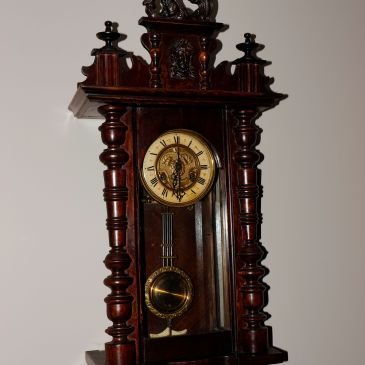
Example number 3. Miniature one-weight Vienna Regulator

This is an Austro-Hungarian era time-only weight driven clock made in the early 1870s. Many would accept this as a Vienna Regulator and would have no hesitation advertising it as such. It has a deadbeat escapement, it has one weight, is a time-only movement, has a heavy pendulum, with an eight day running time and has maintaining power.

one-weight Vienna wall clock
Is this one-weight miniature Vienna wall clock a regulator?

Let’s apply the definition above.

  • Is this a regulator? No!
  • There is no seconds dial, and, is
  • 80 beats per minute
  • Is it capable of extreme accuracy. No!
  • Was it specifically designed as a precision clock? No!

Granted, it is capable of some accuracy but it is not a reference timepiece. However, there is little doubt that some post office and rail clocks in the Vienna style such as this Wilhelm Bauer post office wall clock (below) were considered “regulators” in their day when common folk set their watches and clocks by them.

Wilhelm Bauer post office clock
Is this Wilhelm Bauer post office clock a regulator?

The Vienna Regulator clock and its characteristics

The Vienna Regulator is a particular style of clock made in Germania or the Austrian empire. They are characterized by finely crafted (ornate at times) cases with accurate movements. While they were capable of keeping good time, they were not designed as a precision instrument and were not capable of extreme accuracy. They have some but not all the characteristics of a regulator but they are not a true regulator. While the Vienna Regulator may not be true regulator it reflected not only the style and craftsmanship of the period they were made but the quest for accuracy. No one can argue that the best workmanship and attention to detail were put into the many clocks that were produced during what some might call the pinnacle of clock design and engineering.

As much as they are called regulators the three examples presented above are not true regulators. Regulators were (are) capable of extreme accuracy for a mechanical clock and nothing I have in my collection remotely qualifies as a regulator.

However, in the world of clock collecting and repair it is perfectly acceptable to continue referring to them as regulators since they are generally accepted as such. The word regulator has become part of the lexicon of collectors even if they do not strictly fall within the definition of a true regulator clock.

Copyright, what does it mean for you and me?

The other day, I was browsing through a local online for-sale site looking for antique and vintage clocks and saw a Mauthe Westminster chime mantel clock for sale. From the photo it looked great. But wait!

Here is one photo from the ad.

RS Mauthe mantle clock (11)
Mauthe mantel clock

Why would I post a photo from the ad? Simple. It is my photo. The seller had the identical clock for sale and thought he would use my image to promote the offering. In my view he committed two fundamental errors. First he used a protected image without permission and second he was misrepresenting the ad by using my image for a clock he was promoting.

I corresponded with the seller, told him that he could not use my photos because they are copyright protected. He argued that unless it expressly states that it is copy-protected he is free to use any image he wants. After I threatened to advise the site administrators of his use of my photos he took the photos down. Copyright law regarding photos can be vague though the simple rule of thumb is that it you have any doubts about the use of a photo don’t use it. Had the seller contacted me and asked for permission, that would have been a different story and at least I would have been able to exercise my right to grant permission or not.

From the time it is created, a photo or other image is automatically protected by copyright. Infringement can include the use of whole or part of a photo without permission as in this particular case. Just because an image is on the internet, it doesn’t mean the image is free to use. Many people do not fully realize this. If the image is free to use it will say “in the public domain”. The law is very clear on this.

Needless to say all images on this blog are owned by me and for good reason!

The shelf clock – what is it, exactly?

What is a shelf clock? If you have a number of clocks as I do it can be quite confusing to describe each specific type to the average person but it is really quite simple. Let me explain how you can identify the clock you might be looking at. The term shelf clock is a broad category but I believe it can be classified in the following ways.

Some 180 years ago the first shelf clocks were OG (Ogee) clocks. These were the first mass-produced American clocks, were inexpensive, and were made up to about the late 1870s. They represented the early years of American clock-making and the transition from more expensively produced wood movements to cheaper brass movement clocks. OG clocks are so named because of the double-curved molding on the front of the clock. The curved molding was designed to hide the weights. Many of these clocks were weight driven with 30-hour or 8-day movements and had mirrored or painted tablets. OG clocks were usually 25 inches in height and 15 inches wide and had hardwood veneers covering a softwood frame. They were surprisingly accurate and reliable.

Clocks
Spring-driven and weight driven 30 hour OG (Ogee) clocks, made by the Canada Clock Company, circa 1872-76 (Canadian Clock Museum)

Later, more stylish clocks could be found. These are called Column clocks because they would either have a half-column or full column on the left and right or even stacked half or full columns such as the one pictured below. Moldings on the top and bottom would be brought together by columns on each side of the clock with mirrored or painted tablets. Column clocks were almost exclusively weight driven with 30-hour or 8-day movements.

Column clock
Stacked Column clock, circa 1870 (Canadian Clock Museum)

At around 1840 Steeple clocks were introduced. They had a peaked centre section bordered by columns topped with finials and a peaked sash with a decorated (often hand-painted) lower tablet. They were spring driven with 8-day movements. Steeple clocks are very distinctive, stood about 15 inches high with veneered hardwood over softwood, often with reverse-painted scenes and are made by a number of well-known companies.

RS on display
Arthur Pequegnat Maple Leaf “fan top” Kitchen clock, circa 1905

Kitchen clocks (Gingerbread) were simple or ornate with carved or steam-pressed patterns made by quick-saws and heavy steel presses, stood 22-24 inches in height and about 15 inches wide, and had a decorated sash which could be a very simple design as you see here or a much fancier reverse-painted glass scene. These inexpensive, visually pleasing timepieces sat in the kitchens of lower and middle-class homes and were produced by the thousands. They were so named because of their likeness to the design of gingerbread houses at the time (early 1900s). They are usually made of oak, walnut or even walnut trimmings on oak with a metal clock face and many had a simple alarm mechanism. The Gingerbread clock you see here is the Maple Leaf “fan top” by Arthur Pequegnat. The Maple Leaf came in 4 unique styles all characterized by the maple leaf decal on the glass door.

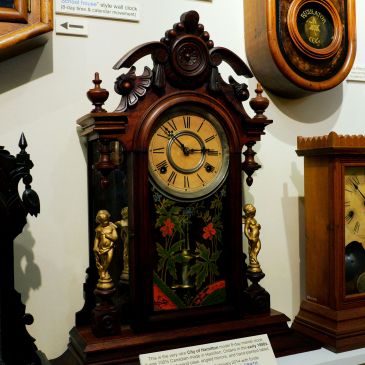
Some kitchen clocks had beautifully carved features and figurines such as this stunning clock made by the Hamilton Clock Company (Canada), though a clock such as this might be found elsewhere in the home and considered a parlor clock.

RS City of Hamilton Canada Clock Co
City of Hamilton, made by the Hamilton Clock Company, circa 1880 (Canadian Clock Museum)

When spring-driven clocks were introduced the Parlor clocks like this Hamilton Clock Company model became popular. They tended to be narrower than column clocks because they had spring-driven movements. These clocks mirrored the furniture styles of the time. This one reflected the Victorian era with its bold figurines, carved finials, elaborate patterns etched into its wooden frame, and the hand-painted floral design of the sash.

RS 45-175
Seth Thomas round top cottage clock, circa 1930

Cottage clocks are less than 15 inches high and typically 8 inches wide are small, simple in design, and take up very little space. Many have basic alarm mechanisms but have one feature that distinguishes them from other pendulum clocks. They have a clip or a clasp that secures the pendulum rod for travel. The “round top” you see here was sold by Henry Birks and Sons an upscale Canadian jeweler. Others had “beehive” tops, flat tops, or octagon tops.

Pendulum rod clip
Pendulum rod clip for Seth Thomas round top

Smaller clocks are often referred to as desk clocks. They are usually mainspring driven with a flat dial. This Kundo 400-day anniversary German clock is an example of a desk clock but it might also be described more specifically as a torsion clock. This one stands less than ten inches tall and has a glass dome, a weighted wheel with 4 balls suspended by a ribbon called a torsion spring, and an exposed movement. It was typically given as a wedding gift.

RS Kundo
Kundo 400 day anniversary clock, circa 1970

Finally, the mantel clock.

Mantel clocks can be ornate, larger, and the centerpiece in a room. This particular clock, a Mauthe pendulum mantel clock offers a precision-built sophisticated German Westminster chime movement in a relatively non-descript but attractive and well-built cabinet that is simple yet elegant.

RS Mauthe mantle clock (30)
Mauthe time. strike and chime, circa 1970

ASIDE: Is it mantel or mantle? I have always considered a mantle as something you wear, a garment or a part of the earth’s crust. A mantel on the other hand is a shelf above, say, a fireplace. I see this word interchanged so often when clocks are advertised or described that either word is universally accepted. I prefer the word “mantel”.

RS April 12th
Ingraham Huron shelf clock, circa 1878

Mantel clocks were inexpensive to make, occupied very little space, and were part decoration and part practical timepieces. Mantel clocks were made with brass, wood, porcelain, slate, Bakelite, and metal though for the most part they were designed to be lightweight (slate clocks and cast iron clocks would be the exception), simple in basic design, and very practical. Mantel clocks have lasted so long, over two centuries, because they are dependable, versatile, and work so well in many domestic situations.

The categories of shelf clocks also include carriage clocks and lantern clocks. One of the first clocks whose movement and external structure was made predominantly from brass instead of iron or wood was the lantern clock. Although the shape of the clock looks somewhat like a lantern, the derivation of the name probably stems from the French word “laiton”, meaning brass. The earliest lantern clocks had striking mechanisms; later in the 17th-century alarms were sometimes added. Some lantern clocks had pendulums and could be hung on the wall.

Carriage clocks were spring-driven clocks developed in 19th century France and are made of plain or gilt brass. They are often no more than 8 inches tall, designed to be portable, and are characterized by a rectangular shape, glass or porcelain panels, and a carrying handle on the top. If you have a Breguet carriage clock as part of your collection you are very lucky indeed!

This is by no means an exhaustive description of the types of shelf clocks. There are others such as swinging clocks, tambour clocks, pillar and scroll, and so on. Whether you are shopping for a clock as a gift or adding one to your collection or even describing what you have seen to a friend, it is important to understand the distinctions between one type and another.

A curious little Blackforest shelf clock

RS shelf clock number 2 (6)
Black Forest Clock Company of Toronto, clock in as found condition

Shelf clocks such as the one pictured have always been hard to find though I did stumble upon this one very recently (April 2016) at an antique store in Great Village, Nova Scotia. Why, because of their cheap construction and inexpensive movements, not many of these clocks have survived over the years.

This one might have had a special meaning to someone at one time because it is a memento of the King George VI coronation of 1937 which nicely dates the clock. He became King George VI of England in December 1936 following the death of his father George V and the abdication of his brother. He had been a heavy smoker and in 1951 had his left lung removed then died suddenly in the winter of 1952. Elizabeth became queen later that year.

RS Refinished case (6)
Black Forest shelf clock after case restoration

RS Refinished case (7)
Another view of refinished case

This Blackforest shelf clock is only slightly larger than the first Blackforest clock I picked up last summer (2015) and like the other, is time-only.

RS shelf clock number 2 (4)
Company plate on rear of clock

The time-only movement is very simple in design. The pendulum rod, bob and pallets are one piece.

Pendulum
One piece pendulum assembly

To adjust the beat rate you either rotate the bob left for slower rate or right to make the clock run faster or slower. Outside the back plate sits the mainspring which is housed in an open barrel and there are 5 gear wheels plus the escape wheel between two solid plates. This is an identical movement as found in my other Blackforest shelf clock  but unlike this clock it was in very poor condition. The movement is German and could have been made by a number of companies at the time; Keinzle, Mauthe, Hermle or Junghans. There are no stamps or markings on this so-called “plate” movement to give any indication of the maker. Typically many Canadian companies such as the Blackforest Clock Company of Toronto (the Forestville Clock Company after the war) imported German movements before the Second World War and installed them in Canadian made cases.

RS shelf clock number 2 (2)
Plate clock movement

RS shelf clock number 2 (12)
Commemorative Edition – 1937 Coronation of King George VI

To refinish the case I cleaned it thoroughly using Murphy’s Soap, applied three coats of dark walnut stain taking care to wipe the stain with a cotton cloth 5-10 minutes after each application. My intent was to fill in the scratches and abrasions rather than radically alter the colour. I then rubbed the cabinet with 0000 steel wool between coats and applied two top coats of clear polyurethane satin finish. I cleaned the numerals but decided against repainting rather preserving the original patina, though I applied Brasso to bring back the finish on the key wind bushing. In the end the case is a little darker but likely closer to its original finish.

shelf clock number 2 (10)
Original winding key

I haven’t quite figured this out yet but I think the winding key has a “bottle opener” design to allow the pendulum to be locked during travel. Ideas?

This clock would make a great addition to a any bedroom. It is small enough for a dresser or even a side table, quiet enough (for a mechanical clock) and is still attractive in design after all these years. Heck, you can even wind the clock in the 6 o’clock position.

A detail can make all the difference

on display (3)
Horse Crown Mauthe wall clock on display

I acquired this beautiful Mauthe Horse Crown Vienna style wall clock in the fall. I inspected it carefully enough before the purchase but it was not until I got it home that I discovered a finial or perhaps a trim piece missing from the base area on the bottom.

OLYMPUS DIGITAL CAMERA
Missing trim or finial

Once hung the clock did not look as balanced as it should. It did not look quite right and there was clear evidence of a piece missing when I inspected the bottom more closely.

I went to the usual clock parts sites to look for a finial or piece that would best fit the design of this turn of the century wall clock. There were a number of choices but I decided to get the base piece finial you see here. It is flat on one side and comes without a peg. It complements the style of the clock without making it look awkward and I think I struck the right balance. It may not be exactly like the original but it looks good enough to fool the casual observer or even an expert.

The trim piece came unfinished. I determined that the clock had an original walnut finish so proceeded to apply enough coats of stain on the trim piece to match the rest of the clock.

Here is the result.

RS Finial added (1)
Trim piece added to base of clock

Here is a shot of the clock from a couple of meters away. You can see that it is more “balanced” than before. it might even be period-correct judging from what I have seen on other Vienna style clocks.

RS Finial added (3)
A small detail makes a difference

72.9703-300
From Perrin Canada

This cost me $6.70 for the trim piece / finial I purchased from Perrin Canada, $4.99 for the dark walnut stain and $.79 for a length of 5/16 dowel. This small detail makes a huge difference.

Let me know what you think.

Mauthe Horse Crown Century-old Wall Clock

Another wall clock has joined my collection, so let’s take a closer look at what I’ve acquired and whether it was worth the price I paid.

Time and strike movement, 116 BPM

The clock was advertised locally in the Truro, Nova Scotia area. The seller knew little about it beyond its provenance, but what he did share was an interesting, albeit brief, story.

In the early 1980s, his wife brought the clock over from Holland, where it had been in her family for several generations. Sadly, his wife passed away three years ago. Had she been alive, I’m sure I would have learned much more about the clock’s history. The seller was understandably hesitant to part with it, as it served as a happy reminder of his past life. However, he was entering a new phase of his life with a new partner, which meant letting go of furniture and other possessions. Like him, I also view life as a series of phases. The clock was priced at $100, firm and non-negotiable.

This two-train (time and strike) spring-wound clock could be described as being in the style of a Vienna Regulator. As expected, the movement is quite dirty—a common issue for clocks like this that have often never been serviced. However, there are signs that adjustments were made at some point, evidenced by marks on several screws in the movement.

The clock is largely intact, except for a missing finial at the center of the bottom base. Why this particular part? According to the seller, the clock was brought over in a suitcase, and to make it fit, the bottom finial was snapped off and lost forever.

OLYMPUS DIGITAL CAMERA
Movement showing FMS Mauthe trademark

The clock is over 100 years old, with my research indicating it was made between 1895 and 1914, though the exact year of manufacture remains uncertain. The trademark—a Friedrich Mauthe of Schwenningen (FMS) emblem featuring three spokes with an eagle on top—is distinctive, as Mauthe trademarks are known to reflect the specific period during which the clock was produced.

Despite some benign neglect, the case is in good condition, and everything appears to be original, including the winding key.

OLYMPUS DIGITAL CAMERA
The crown

The crown fits into a slot at the top of the clock and can be easily removed if the clock needs to be relocated. The crown is made of wood, while the horse appears to be crafted from a casting material of some kind.

OLYMPUS DIGITAL CAMERA
The face

The dial is made of celluloid and has darkened with age. Inside the dial surround, there is a leaf-like emblem, a common design feature from this period.

OLYMPUS DIGITAL CAMERA
The base and bottom finials

The base is fairly plain, though the bottom center finial is missing. I plan to replace it.

OLYMPUS DIGITAL CAMERA
The coil gong

The coil gong and block with attached movement rails are characteristic of the period.

History of FMS Mauthe

Mauthe clocks have a long and distinguished history in Germany. In 1844, Friedrich Mauthe and his wife Marie founded the company in Schwenningen to produce watch parts. By the late 1860s, Mauthe began manufacturing its own wall clocks and movements. In 1876, Friedrich’s sons Christian (1845-1909) and James (1847-1915) took over the company. In 1886, Mauthe began producing its own springs. Around 1900, the company expanded its offerings to include alarm clocks, pendulum wall clocks, grandfather clocks, office clocks, and the so-called “Buffet Uhren” or “Buffet clocks.” In 1904, the third generation took charge: Eugene Schreiber (1877-1939), son of Christian Mauthe; Dr. Fritz Mauthe (1875-1951), son of Jacob Mauthe; and Alfred Mauthe (1879-1911), son of Jacob Mauthe, helped build upon the foundation of the company.

In 1925, Mauthe introduced a new trademark featuring a right-facing eagle with outstretched wings, clutching a three-part round plate inscribed with the letters F, M, and S. By the 1930s, the company was producing around 45,000 clocks per week, with approximately 60% destined for export markets like England. In the mid-1930s, Mauthe began manufacturing its first wristwatches, some of which were supplied to the German Army (“Wehrmacht”). After 1946, Mauthe resumed wristwatch production, but the company eventually entered a period of decline.

Was it worth $100? I would say yes, but it’s on the higher end of what I would typically pay for a clock like this.

Now, it’s time to clean the clock, install a new bottom middle finial, and add it to the queue for servicing.

Mauthe Mantel Clock – called a buffet clock by the marketing folks at Mauthe

Mauthe mantel clocks are widely available in various shapes and sizes, often appearing on online marketplaces, at garage sales, flea markets, and in antique shops. However, not all are well-preserved, with many showing signs of age and neglect. This particular round-top mantel clock stands out for its excellent condition, especially considering its age.

RS Mauthe mantle clock (30)
Mauthe buffet clock

While this is commonly called a mantel or shelf clock, in Mauthe marketing parlance it is referred to it as a “buffet clock”. In the mid-20th century, clocks of this style were often designed to sit on buffets, sideboards, or credenzas in dining rooms. This placement allowed the clock to serve both a decorative and practical purpose that complemented the room’s furnishings. The term “buffet clock” reflects its association with this specific setting, distinguishing it from mantel or shelf clocks, which were typically placed in living areas or on fireplaces.

This 3-train Westminster chime pendulum clock features a 5-rod gong block and plays a quarter-hour musical tone. I discovered it at an antique shop in Great Village, Nova Scotia (Canada) some time ago. The movement is unmarked, lacking a trademark, but bears the number 50089 on the bottom right of the rear plate. There is no doubt that the movement is original to the case.

RS Mauthe mantle clock (29)
Back of the clock showing the 3-train movement
RS Mauthe mantle clock (28)
Mauthe clock and Stromberg Carlson console radio

Mauthe – The Company

Mauthe clocks were produced in Germany by a company with a long and distinguished history, manufacturing thousands of wall, mantel, office, and hall clocks. Founded in 1844 by Friedrich Mauthe and his wife, Marie, in Schwenningen, Germany, the company initially focused on producing watch parts. By the late 1860s, Mauthe began making its own wall clocks and movements, some produced through the “Gewerblern” method, a form of cottage industry, while others were made in a more industrial, factory-based approach.

In 1876, the Mauthe sons, Christian and James, took over the business. A decade later, in 1886, Mauthe started manufacturing its own spring mechanisms.

By around 1900, Mauthe offered a range of clocks, including alarm clocks, pendulum wall clocks, grandfather clocks, office clocks, and “Buffet Uhren” (Buffet clocks). At this time, the company employed around 1,100 people. The third generation of the Mauthe family took control in 1904, with Eugene Schreiber, Christian Mauthe’s son, Dr. Fritz Mauthe, Jacob Mauthe’s son, and Alfred Mauthe, Jacob’s other son, joining the leadership.

In 1925, Mauthe introduced a new trademark featuring an eagle with outstretched wings, clutching a three-part round plate marked with the letters F, M, and S. By 1930, the company was producing approximately 45,000 clocks per week, with over 2,000 employees. Around 60% of their production was for export, with England being the primary market.

In the mid-1930s, Mauthe began manufacturing wristwatches, some of which were supplied to the German Army (Wehrmacht). After a brief pause during the war years, Mauthe resumed production in 1946, focusing on wristwatches. The company continued operations through the 1950s, 1960s, and 1970s, but ultimately declared bankruptcy and closed in 1976.

RS Mauthe mantle clock (11)
Clock face showing three arbour points

This clock runs a complete 8-day cycle and produces a very pleasant sound. The case features a simple yet attractive design, is in excellent condition, and the movement is clean, having been recently serviced.

This Mauthe buffet clock is a fine example of the company’s craftsmanship, combining reliable timekeeping with a pleasing chime. Its well-preserved condition and recent servicing make it a standout piece for any clock collector.

Website Powered by WordPress.com.

Up ↑