
Clocks at our summer retreat

At our seasonal cottage located in central Canada, we enjoy displaying a small selection of clocks, during the summer months.

The first clock, displayed for a number of years, was a Danial Dakota time and strike clock, which we had converted to a quartz movement. This clock, originating from the 1960s, incorporated Chinese design elements that were inspired by American clocks of that era. It required minimal maintenance and provided very good accuracy.

To operate, it relied on a “C” cell battery. This chiming clock offered both Westminster and Whittington chimes, with my wife and I favouring the Whittington chime.

Converted quartz Daniel Dakota

However, after a period of time we grew weary of the clock’s artificial electronic musical tone, and thus we decided to replace the Danial Dakota clock with a proper mechanical clock.

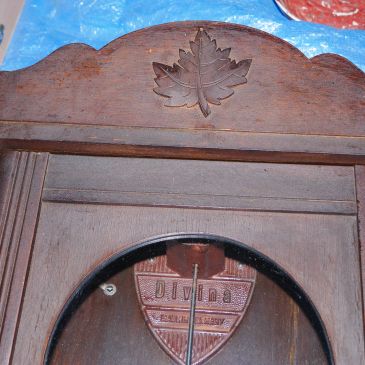
The Mauthe time and strike box clock we acquired as a replacement at the cottage features a raised maple leaf on its crown. This detail leads me to believe that it was likely sold under a Canadian brand, possibly marketed specifically for a department store or jewellery store. The distinctly Canadian touch with the maple leaf emblem, adds to its charm and appeal in our Canadian cottage setting.

Mauthe box clock
Mauthe box clock with maple leaf emblem on the crown

Next to the box clock is a captivating oak-cased gallery clock produced by the Empire Clock Co. of England. It was acquired through an auction in Nova Scotia and boasts a unique feature — a 10-inch dial instead of the more common 12-inch dial seen in similar gallery clocks.

Despite its resemblance to a fusee clock, it operates with a conventional spring-driven mechanism, which means its timekeeping performance is average at best.

Box clock and gallery clock

Adorning the wall of our sunroom is a familiar time-only schoolhouse clock that was recently gifted to me. It features a sizable 12-inch Roman Numeral dial and a pendulum visible through reverse-painted glass.

Although it has a few minor veneer imperfections that I plan to address later this year, I have already examined the movement and confirmed its excellent condition. After re-oiling it, I carefully placed the movement back into its case.

Schoolhouse clock

Displayed in our family room is a Hermle clock that harkens back to a nostalgic design known as the “wag-on-a-wall” style. This clock operates on a weight-driven mechanism and includes both timekeeping and striking functions. It emits a delightful bim-bam sound by striking on three rods.

The design aesthetic of this clock strongly resembles the clocks manufactured in the 1960s, which aligns with its likely production period. While it possesses a plain and unadorned appearance, it carries a certain charm and serves as a reminder of that era.

Wag on a wall

Among our collection of cottage clocks, we have a New Haven ogee-style clock that operates on a 30-hour time and strike mechanism. It is smaller than a conventional ogee clock and might be referred to as a mini ogee standing at just 18 inches high.

From afar, it presents an appealing appearance, capturing one’s attention. However, upon closer examination, it becomes apparent that the clock has undergone a removal of its veneer at some point in its history. The absence of the veneer adds a touch of character and reveals the clock’s journey through time, offering a glimpse into its past.

New Haven ogee clock

Finally, a well-worn 30-hour cottage Ansonia clock graces a bedroom dresser.

A cottage clock at the cottage

Despite its visible signs of use, this clock continues to perform well, a testament to the remarkable engineering employed by the clock’s manufacturers. Craftsmen at the time anticipated the rigours of wear and tear, and their foresight in creating such durable movements showcases their longevity.

Clocks at our summer cottage not only serve as functional timekeepers but also carry with them a unique charm and nostalgia.

Each clock tells its own story, displaying the marks of time and the craftsmanship of its makers. Whether it’s the captivating gallery clock with its distinctive dial or the familiar schoolhouse clock with its endearing imperfections, these clocks create a harmonious blend of functionality and aesthetics within the cottage.

As their hands tick away the hours, they remind us to slow down, appreciate the present moment, and savour the timeless tranquility of a summer retreat.

Mauthe box clock – In clock repair, fine-tune adjustments are part of the experience

Do you ever run into those situations working with clock movements when one little thing is so annoying? I recently serviced one of my box clocks, a Mauthe with a bim-bam strike. Everything went according to plan except for one small issue; the strike side was misbehaving. I’ll explain a little later but first something about the clock.

German "box" clock by Mauthe
German “box” clock by Mauthe

Nowhere on this clock German “box” clock by Mauthe does it have the Mauthe trademark or name, not on the clock face or any markings on the movement. However, an excellent clue is the two-rod gong, which was made by Divina, a subsidiary of Mauthe.

Divina rod gong
Divina rod gong

The clock was likely sold under the Forestville or Solar name in department stores across Canada in the 1940s. There is an applique of a maple leaf on the crown so, I would like to think it was made for the Canadian market. These are very good movements, are designed for long life and the sound of the gong is impressive.

So, what’s the problem?

The movement was taken out, cleaned, and one bushing installed. The movement is in very good overall condition despite having last seen a servicing in 1979 according to a date scratched on the front plate.

Mauthe movement front plate

Putting these German movements back together is not that difficult but one always must be mindful of the small pivots and the risk of bending or breaking one. How do I know that? Well, I might have bent or broken one or two along my journey through clock repair but not on this movement.

Mauthe movement back plate
Mauthe movement backplate

Two critical adjustments prior to assembling the plates are the placement of both the stop or warning wheel and the star wheel.

Mauthe movement and the star wheel

The stop or warning wheel requires about half a rotation to arrest the train during the warning phase by means of a stop pin. During dis-assembly I made a note of the location pin, at approximately the 12 o’clock position which saved time and frustration and it worked just fine once assembled.

What I missed was the correct positioning of the star wheel relative to the two hammer arbours. Because there are two actuators and two paddles, they must be placed between two star points on the wheel. Otherwise, one of the paddles will become hung up on a star point at the end of the strike.

For example, during the end of the strike, you might hear the bim part of the “bim-bam” strike and the bam part at the beginning of the next strike. Of course, there is always the risk that the hung up paddle will stop the train entirely.

It is a simple adjustment but the mainsprings must be let down for safety reasons and the plates pulled apart enough to relocate the paddle lever arbours so that both paddles are between the star points. In the process of repositioning the levers, one or two other wheels may or may not pop out. Once all the wheels are relocated, screw down the corner of the plate and test the strike side action.

After the adjustment, the strike side ran as it should. It is a little thing but pretty annoying especially when it is discovered after the movement is put together.

In clock repair, fine-tune adjustments are part of the experience.

Mauthe box clock movement servicing

It is time to service the movement on this mid-thirties German box clock. It was purchased at an antique mall in Peterborough, Ontario in May of 2017, and other than oiling, nothing has been done to it. While it has been running well since then, it is due for servicing. Plus, this little project is one of the many clock tasks that has kept me busy during the period of pandemic isolation.

There is nothing anywhere on this clock that tells me it is a Mauthe, not on the clock face or on the movement. However, the gong marked by the name Divina tells me that Divina was a subsidiary of Mauthe. It was likely sold under the Forestville or Solar name in department stores across Canada in the 1940s. There is an applique of a maple leaf on the crown so, I assume that it was made for the Canadian market.

German "box" clock by Mauthe
German “box” clock by Mauthe

As mentioned, this spring-powered rack and snail movement has no makers mark though 25226 is stamped on the front plate as well as the numbers 42 and 105; 42 the pendulum length in centimeters and 105 as beats per minute.

The front plate shows the rack and snail

CA 79/9 scratched in the lower right of the front plate is a clock-makers mark for servicing in September of 1979, presumably the last time it was taken apart for cleaning.

Dirty as expected but in good shape

Both plates are 1.8 mm brass. The backplate is solid while the front plate is open. It is a robust movement that was designed to last.

Spring-loaded weight on the governor

An unusual feature is a spring-loaded weight on the governor. Manufacturers sometimes used a special fly that has a small spring-loaded weight attached to try to even the power curve of the strike side. The faster the fly spins, the further out the weight, providing more resistance.

Day I – dis-assembly and servicing mainsprings

Safety is paramount; first and foremost, let down the mainsprings.

The rack, snail, lifting levers, and other assorted parts are separated from the movement before the plates are opened up. The strike hammers stayed attached to retaining pins as they were just too difficult to take out. Additionally, despite my best efforts to pull the gathering pallet off the arbour, it would not budge. I did not want to risk any damage to either part.

The movement was dirty, as expected, but I have seen much worse.

Once everything was apart I reinstalled the time side to check bushing wear and found the only suspect bushing to be T2, front plate. After taking out the time side gears I reinstalled the strike side gears and found that side to be in very good condition. The pivots likewise on both sides are in excellent condition.

The movement is in very good condition for an 80-year-old clock.

In the normal course of clock servicing I install more than one or two bushings

Different sized mainsprings for time and strike

The time mainspring is slightly shorter in height and length and therefore less powerful than the strike mainspring. On many movements, both sides have the same mainspring power but this movement is clearly different. Is it by design? There is more resistance pushing the strike gears through the train in that it has to work a little harder so, one would expect a strong mainspring.

Note the difference in the size of the cut pinions below. Both are second wheels. The one on the right with the larger leaf pinion is the strike side, the left is the time side.

Each time I work on German or English movements I make it a point to scratch a small “T” on both the time barrel and mainspring so as not to interchange them. Even if both sides have identical mainsprings I note the difference as a matter of practice. If the springs are different and they are switched, the increased power of the incorrect, more powerful strike spring might result in premature failure of the time side.

Second wheels and difference in the size of cut pinions

The other possibility is that during a repair in September of 1979, the time side mainspring was replaced by a smaller, and more than adequate, mainspring.

I took the springs out of their barrels and gave each a cleaning in the ultrasonic. Once dry I applied Keystone mainspring oil to each mainspring and returned the springs to their barrels. That’s it for day one.

Day 2 – bushing work

In the normal course of clock servicing, I install at least one or two bushings. On this movement, one bushing was required, T2F. The hole was marginally oblong and I am sure the clock would have functioned fine without it but as a precaution, a new bushing was installed.

Cutting into the brass to prepare for a new bushing
Ready for the top plate

I generally spread my clock cleaning and servicing over several days but the bushing work went so quickly that I decided to proceed with assembling the movement.

The only critical adjustment prior to assembling the plates is the stop wheel. The stop wheel requires about half a rotation to arrest the train during warning otherwise, all the other adjustments are made outside the front plate. During dis-assembly I made a note of the location of the wheel, at 12 o’clock, saving time and frustration and it worked just fine.

Rather than use a test stand I returned the movement to its case for further testing.

Website Powered by WordPress.com.

Up ↑