
Tick-Talk Tuesday is about the letters and comments I have received from you, the reader, concerning your clock, issues you might have had, challenges you face or a clock you would like me to profile or my responses to your questions with advice on your particular clock concern. For those comments and questions that stump even me, I consult within my clock circles for the best possible answer
Double-ended keys
TD says,
“Hi Ron, I’m TD. I purchased a Gilbert Clock from an antique store in xxxxxxx, Wis. It’s a Gilbert Tambour style mantel clock model 2041. It’s marked “Normandy Chime 2041.” The question I have is what is the keyhole under number 12 for? The clock sat in the store for a long time, that is till it found ME. I have a thing for old clocks. I feel they’re a living thing and it’s a shame if they’re not ticking away as long as they’re able to. Just like Us!”
Gilbert mantel clock 1925, small arbour below the 12 is for regulating the clockGilbert movement, the top centre is the regulating mechanism
My response,
Hi TD,
I have a Gilbert tambour 2038 with Normandy Chime which is similar in some ways. Look at the key that came with your clock. It should be doubled ended one like this one.
The small end fits into an arbor just below the “12”. This is for regulating the speed of your clock. You might see an “S” and an ”F” above the 12. Turning the key clockwise speeds up the clock and counterclockwise slows it down. If you have only a single-ended key, it is the wrong type for your clock although it will wind it up.
I also have a thing for old clocks. Be careful it is addictive.
Hope this helps.”
Whoops! Should have been published on Tuesday. My wife caught the error this morning.
It is that time of the year when you begin searching for that unique gift. Of course, there are a multitude of choices but have you considered a mechanical clock as a gift? Let me provide you with a few tips.
Gilbert mantel clock
Mechanical clocks harken back to the old days when life was simpler; no mobile telephones, no internet, and no streaming TV. Ah, those were the days!
Okay, so you are reasonably sure that a mechanical clock would be appreciated by the receiver. What to buy? There are a plethora of choices out there and certainly, clocks that would fit every budget from the simple and cheap American kitchen clock to a rare 19th century Boulle figural French mantel clock. Let me attempt to narrow your choices, not with a specific clock but a buying strategy.
Mechanical clocks appeal to those who enjoy the sound, the strike of a clock, or those who merely appreciate it as part of their decor. These factors will influence your choice as a gift.
Here are two examples of clocks I have gifted to my family. My son and his partner have a German Schatz W3 bracket clock in a custom case. It is in excellent mechanical in running condition but it stays quiet on their shelf. Nevertheless, it is the centrepiece for their fireplace mantel.
Schatz W3 in a custom made case
My daughter has a Sessions Raven 8-day mantel clock which sits atop a bookcase in their family room. It only runs when my wife and I visit.
Sessions Raven clock
But they love their clocks.
The following two categories might assist you in your decision to buy a clock for your loved one, a friend, or a business associate.
Category 1 – Those recipients who appreciate a running clock
You will want to avoid a non-working clock. Unless you have the skills in clock repair or know someone who can work on it, it is best to steer away from those. Many sellers use the phrase, “may need some adjustment” which is almost always a red flag for a clock that has issues. These are the cheapest clocks, and for good reason, they are simply worn out.
You may also get lucky and find that special mechanical clock that has been recently serviced and is in good running order but you will pay more because the seller is interested in recouping their investment in the clock.
Buying a clock from a reputable clock repair retailer is a good bet if the clock has been serviced and a warranty is provided but expect to pay significantly more.
Otherwise, there are many buy and sell online sites. I would shop locally and avoid eBay or other online auction sites. Auction sites are a real crapshoot complicated by high shipping costs and the risk that the clock might arrive broken. Yes, that has happened to me!
Arthur Pequegnat Moncton, 15-day, double spring time-only
The sound of a ticking and striking clock in a room is very soothing for some. For others., not so much
Most clocks are 8-day running which means that they must be wound once per week. There are some quality 15-day and 30-day clocks but they are few and far between.
Daniel Dakota wall clock, made in China
Of the 30-day clocks avoid anything made in China. While 1-day clocks such as Cuckoo clocks and antique Ogees are plentiful and look terrific, winding a clock every day wears thin after a while.
Category 2 – Those recipients who want a mechanical clock as a decoration
Then, there are the folks who are not really that interested if the clock runs or not but want something that fits their decor and is a good conversation piece. A non-working clock with a good case is perfect. If it has the original movement but it is not working there is always the option of fixing it later. Personally, I would shy away from any clock that has its mechanical movement replaced with a quartz one.
Focus on the condition of the case. Is it missing any parts, has recent work been done it, does it look authentic? Does it catch people’s attention?
For example, here is a very attractive Seth Thomas 8-day round top in a bold Rosewood case that has had only one minor veneer repair and a replacement dial face, but it looks great!
Seth Thomas round top
You bought the clock but the case is very dirty. Clean it! Some folks might argue that one should not clean a clock case so as to maintain it’s original patina. But, isn’t patina just another word for dirt? Soap and water with gentle scrubbing will make a huge difference. Check out this before and after photo of the cleaning of a clock face.
Junghans clock dial before cleaningJunghans clock dial after cleaning with soap, water, and Q-tips
And this before and after photo of a gingerbread clock. You need not want to go the extra distance in retouching the dial but soap and water is an easy and non-invasive method of improving the look of the case itself.
Very grimy clock case especially the base sectionAfter, showing a clean case and a retouched dial
Final words
A mechanical clock makes an excellent gift and it is something that can be passed down from one generation to the next. My kids appreciate a mechanical clock from their dad and I will gift them one that is in excellent mechanical condition but I am not bothered if they use it merely as a decoration.
Tick-Talk Tuesday is about the letters and comments I have received from you, the reader, concerning your clock, issues you might have had, challenges you face or a clock you would like me to profile and my responses to your questions with advice on your particular clock concern. For those comments and questions that stump even me, I consult within my clock circles for the best possible answer
Gilbert mantel clock
DG writes
“Hello again Ron,
Firstly, many thanks for your advice. It was extremely helpful. The clock is running, striking the right number of times and back in its case, adjusted for beat and now just getting it to keep reasonable time. I made up two pivot locators (a good suggestion) from wire, one heavy-duty to get the centre pillar in place (it always seemed out of alignment!) and another to adjust the pivots. I had trouble in getting some of the pivots to stay in place long enough to close the front and back plates as I went along so resorted to some Blu Tack on the bottom bush to hold them – not very professional but I couldn’t think of anything else. Getting the strike to work as it should was a total challenge and took me a long time but I got there in the end (probably the most satisfying part of the whole business). I am afraid it wasn’t a very professional restoration but I learnt a lot about Gilbert clocks in the process!
The date stamped on the movement is 1914. I’ve attached a photo of the front of the clock. It looks to me as though it had something attached to the bottom, front corners (there are two pin holes each side) which I am guessing were feet. Have you any idea what these might have looked like? Looking at pictures on the Internet there seem to have been slightly different styles as well as gold and a dark antique look, on Gilbert clocks. Any idea where I might find some – eBay?
Once again, many thanks.”
My reply
“It is certainly a good feeling putting a mechanical clock back together and have it in working order. If you can manage a Gilbert clock you can handle just about any American time and strike movement.
which has a piecrust dial instead of the plain dial on your clock. You are correct. It would have had feet at one time. If one went missing I suspect they were all discarded.
I have worked on several Gilbert clocks in the past few months which is unusual for me. Certain makes of clocks seem to come in bunches. This clock is a 6 column time and strike antique Gilbert mantel clock made in 1913, and reflects a period when every American maker had a similar style. Some parts of the case have an Adamantine finish but those particular areas are not in good shape.
A family relation asked me if I could get it running. Sure, I said.
Gilbert 6 column mantel clock,1913
History of the Gilbert Clock Company
The Gilbert Clock Company began making clocks in December of 1828 and produced clocks over a span of 130 years.
In 1837, John Birge joined the firm, and the name was changed to Birge, Gilbert, & Company. Shortly thereafter, Chauncey and Nobel Jerome and Zelotus Grant became partners with Gilbert, and in 1837 the company was know as Jerome, Grant, Gilbert, & Company. This company manufactured Jerome’s cheap brass-movement clocks.
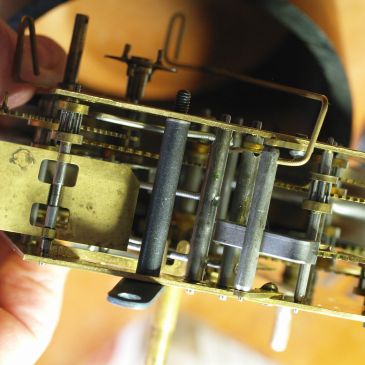
I have worked on Gilbert movements previously and each one has slight differences. This one has a rod gong with two striking hammers. Disassembly was routine but required the removal of some parts to separate the plates.
The Gilbert Clock Company began making clocks in December of 1828 and produced clocks over a span of 130 years.
Gilbert tambour style clock model 2038
This is the model 2038 with a bim-bam strike or what Gilbert in its marketing called a Normandy Chime. The model number along with the words “Normandy Chime” are stamped on the bottom of the case. The “Normandy Chime” was reminiscent of the old bells of Normandy (Corneville) in France.
In terms of nomenclature within clock circles, calling it a “Chime” certainly adds to the confusion as this would be considered a striking clock rather than a chiming one.
You must be logged in to post a comment.