
Tick Talk Tuesday #14 – Can you tell me something about my Forestville clock
Tick-Talk Tuesday is about the letters and comments I have received from you, the reader, concerning your clock, issues you might have had, challenges you face or a clock you would like me to profile and my responses to your questions with advice on your particular clock concern. For those comments and questions that stump even me, I consult within my clock circles for the best possible answer.
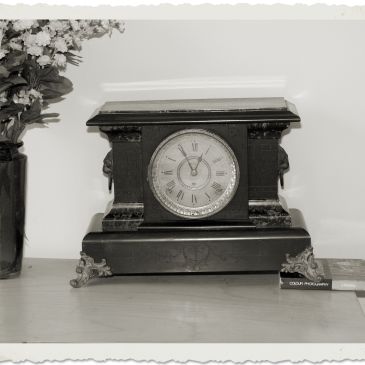
GGs Forestville Mantel clock

GG writes: “Hello there,,,I was wondering if you know much about my mantle clock and maybe it’s value?

I have attached some photos!”

My reply: “Thanks for coming to my blog. That is one of the nicest mantel clock cases I have seen on a Forestville and it appears to be in good shape.

Forestville is a Canadian Company based out of Toronto. They went out of business in 1979. They did not make their own movements instead sourcing them from England, France, the US and Germany though they made their own clock cases.

GGs clock showing German made movement and pendulum bob

You may or may not know that Forestville was called the Blackforest Clock company prior to WWII. So, you have a post war clock made in the late 1940s or early 50s. Later on In the 1950s Forestville went from using pendulums in their clocks to balance wheels (no pendulum). Forestville also sourced German movements exclusively after the war. Your movement (the brass works) was likely made by Mauthe or Hermle, both well known and well respected German companies.

You have what is known as a time and strike Bim-Bam clock. It strikes the respective hour and once on the half hour but makes a distinctive “Bim-Bam” sound as a result of one hammer striking one rod while the other two strikes two rods simultaneously.

Unfortunately there are thousands of similar clocks and Forestville clocks are not particularly distinctive but a clock such as this in good running condition might fetch about $100.”

GG writes back to explain that the movement is an Enfield from England which stands to reason if it was made immediately after the Second War.

Blackforest shelf clock (Canadian made) gives me grief but decides to run again

Blackforest shelf clock

The clock is a 1937 Blackforest Royal Tour commemorative edition shelf clock with an 8-day time-only “plate” clock movement. Plate clock movements are so-called because they were typically used on kitchen clocks with Dutch Delft plates such as this one in the next photo.

Delft Clock from Forestville
Delft Plate Clock from Forestville

The movement is likely German and could have been made by a number of companies. There are no stamps or markings on the movement to give any indication of the maker. Canadian companies such as the Blackforest Clock Company of Toronto (the Forestville Clock Company after the war) imported German movements before the Second World War and installed them in Canadian made cases.

Grimy movement prior to cleaning

This clock had been happily running for about a year and then last week it suddenly stopped after a winding. I nudged the pendulum in an effort to make it go, checked to see if it was in beat and level but no luck. I nudged the pendulum a few more times, left it for a day or so, tried it again and still no luck. I was at the point of disassembling the movement to investigate the problem. Two days later I wound it tight and gave the pendulum a push and it sprang to life. I think I know what happened.

I thought I did a good job of servicing the movement including the mainspring over a year ago but apparently not well enough. You may have heard the expression, “you overwound the clock so that’s why it stopped”. There is a grain of truth in the expression because if you wind the spring till it winds no further the mainspring is at it tightest. If there are dirt, grime and rust on the mainspring the mainspring will actually cease in place, hence the clock stops. I believe this is what occurred in this case. Although it is running now it will need to be properly cleaned. In the meantime, I will let it run and see if it completes its full 8-day cycle.

What style of clock do I have?

Clocks have been more than just timekeepers throughout history; they are reflections of art, culture, and technological innovation. Whether for practical use or decorative appeal, clock styles have evolved to match the tastes, craftsmanship, and technologies of their times. Here’s a look at some of the most iconic and varied clock styles.

The clock is an instrument designed to keep and indicate time. It is one of the oldest human inventions. The clock has evolved through the ages from sundials in ancient times to early tower clocks of the 14th century weight-driven clocks and finally spring-driven clocks from the 1840s to the 1970s.

The world of mechanical clocks encompasses a wide variety of styles, and distinguishing between them can often be confusing—such as understanding the difference between a shelf clock and a mantel clock. In this article, I’ll navigate through these terms and highlight the most common styles or types, using examples from my own clock collection to illustrate them.

Mantel Clock

Many auction sites and even professional websites use the word mantle. The correct terminology is “mantel”. A mantle is a shawl or coat worn by women, an important role passed on from one person to another or the earth’s crust. A mantel is the top framing of a fireplace or a shelf above a fireplace opening.

A mantel clock is designed to fit on top of a fireplace or shelf. A mantel clock can be time only, time and strike, or a chiming clock. Generally, if there are 2 winding arbours it is a time and strike clock, if the clock has 3 winding arbours is it a chiming clock that is, it will play a tune on the quarter hours, the most common being the Westminster chime.

Mantel clocks might also be referred to as shelf clocks or buffet clocks.

Kitchen Clock

Arthur Pequegnat kichen clock
Arthur Pequegnat kitchen clock

Kitchen clocks are often referred to as gingerbread clocks or parlour clocks. At times, it can be difficult to differentiate between a kitchen clock and a parlour clock. Gingerbread clocks are distinctive because their designs are typically created by steam-pressing the wooden front face. However, some clocks, like the one above, are made using a powered cutting saw but are still classified as kitchen clocks. Additionally, some of these clocks included alarm mechanisms. The terms gingerbread, kitchen, and parlour are often used interchangeably.

Another type of kitchen clock is shown below. This is an 8-day time-only delft wall clock made by Forestville.

Delft Clock from Forestville
E. N. Welsh Whittier model
E. N. Welch Whittier model

A parlour clock is generally considered more ornate than a kitchen clock, although it may still be referred to as a kitchen clock. It is placed in front hallways, entryways, and so on. The designs are always cut and there may be finials, a mercury-filled pendulum or very ornate design, garish trim pieces, and a decorative tablet.

Vienna Regulator

Gustav Becker two-weight Vienna regulator

There are many styles but most are of the single-weight or two-weight variety. The definition of a Vienna regulator is always open to debate but the consensus among collectors is that they are weight-driven, made in Austria/Germany, ornate in design, have porcelain dials, decorative crowns, large pendulums, and finials on the top and bottom.

The broad definition of Vienna Regulator includes those that are spring-driven. Though not defined as “regulators” it is acceptable among collectors to refer to them as a Vienna style.

Cottage Clock

Canada Clock Co Hamilton Cottage Extra

Sometimes called a mantel clock or a shelf clock, they are usually diminutive in size to occupy a smaller space. They are found in bedrooms and kitchens and are sturdily built since they are often designed to be portable. They come in time only, time and strike, or may have an alarm function.

Carriage Clock

French Carriage Clock

Carriage clocks are portable and were very popular around the turn of the 20th century. French-made carriage clocks are more collectible and fetch generally higher prices although American ones can be quite desirable. Carriage clocks are designed to be portable and are time-only but some are time and strike (with a repeater function) while others may have an alarm function.

Crystal Regulator

Ansonia Crystal Regulator

Crystal Regulator clocks are identified by a brass case with 4 crystals or glass panels. Porcelain dials, Roman or Arabic numerals, ornate in design but sometimes quite garish. Most are 10-12 inches in height though some are smaller. Makers are American and French though French crystal regulators are called four-glass clocks and tend to have higher value. Distinctive by their mercury or faux mercury pendulums. Some have visible Brocot escapements and the time and strike movements are always visible.

Cuckoo Clock

Cuckoo clock
Cuckoo clock

These clocks are pendulum-regulated and make an automated sound like a cuckoo when it strikes the hours. Some can be very intricate with several animated characters. Desirable ones are antiques from the Black Forest region of Germany. Modern ones are generally frustrating to repair, cheaply built, and are poor timekeepers.

Lantern Clock

Converted lantern clock

A lantern clock is a type of antique weight-driven wall clock, shaped like a lantern. They were the first type of clock widely used in private homes. They probably originated before 1500 but only became common after 1600 and in Britain, around 1620. They became obsolete in the 19th century. The one pictured above has been converted into a fusee movement.

Alarm Clock

Baby Ben alarm clock with second hand
Baby Ben alarm clock with seconds hand

Alarm clocks are wound once per day and designed to do two things, wake you and display the time. They are cheap, and are average timekeepers but have long-lasting and reliable movements.

Desk Clock

Kienzle World Time clock

These sat on fancy office desks or credenzas in office locations. They are either time-only or time-and-strike. Most were time-only to minimize distractions in the office environment. Some are very attractive and have unique designs and are more decorative than utilitarian. This one above is called a World Time Clock by Kienzle.

Wall Clock

Box clock
German Mauthe Box clock

A wall clock is broadly defined as any clock designed to be hung on a wall, making it a practical and visible timekeeping solution. Wall clocks come in various styles, from simple and functional designs to highly decorative pieces. This one by Mauthe is often described as a German “box” clock which became popular after the First World War and made into the 1940s.

Schoolhouse Clock

Ansonia clock project is complete
Ansonia schoolhouse clock

They are known as schoolhouse clocks because they hung in many schoolrooms in North America. Usually distinctive by their octagon shape and short or long drop feature with a glass door displaying a swinging pendulum. Many thousands were made; they had cheap mass-produced softwood cases and robust movements. Most were time-only though some were time and strike and others even included a calendar function.

When they were marketed years ago they were not called “schoolhouse clocks” but rather, clocks made for the schoolroom.

Novelty Clock

Chairman Mao Zetong waving as the clock ticks

These clocks are designed for the tourist trade with interesting features. In the case of the above clock, a smiling Mao Zedong has his little red book in hand and is waving “to the masses” as the clock ticks.

Ogee Clock

Waterbury OG clock
Waterbury OG clock

It is so-called because of the curved molded wood case. It might also be referred to as an OG clock. The design originated in the United States in the 1830s, distinguished by a case (usually pine) the front outer edges of which are curved into an S-shape (Ogee). This shape is formed by the union of a convex and a concave line. A mass-produced variant of the shelf clock, the Ogee clock typically stands about 30 inches (75 cm) high and is usually weight-driven. The movements were generally made of brass (earlier ones were made of wood) and ran for 30 hours or eight days. This is a 30-hour weight-driven version from the 1870s.

Tall Case Clock

Ridgeway Hamilton Country, Westminster chime

Tall case clocks are known by various names depending on the region. They are referred to as tall-case clocks in American terminology, long-case clocks in British terminology, hall clocks in Canada, and sometimes as floor clocks. However, the most commonly used term is “grandfather clock.”

They are usually weight-driven, with the weights on chains or cables, and are distinctive by their obvious height. They are always 6 feet or over but can be as high as 8 feet high (1.8 to 2.4 meters). They often feature elaborately carved ornamentation on the hood (or bonnet), the frames, the throat, and the dial or clock face. Older ones have 30-hour movements but all modern grandfather clocks run on an 8-day cycle.

Smaller clocks are called grandmother and granddaughter clocks. They are under 6 feet.

Anniversary Clock

Kundo standard size 400 day clock
Kundo standard size 400-day clock

These clocks are also called torsion clocks or 400-day clocks. 400-day clocks are torsion driven having a long suspension spring to which a weight oscillates back and forth. Typically these clocks operate at 8 beats per minute and run for long cycles on a single wind, up to 400 days. These clocks were popular as wedding gifts or gifts to mark special occasions. They are relatively simple to repair but can be finicky to set up. The newer quartz clocks are very accurate but do not replace the charm and curiosity of the older mechanical ones.

Some might call them purely decorative.

Tower Clock

Tower clock
Tower clock in Holguin, Cuba

In the early 14th century large mechanical clocks began to appear in the towers of Italian cities. There is no record of any working models preceding these public clocks that were weight-driven and regulated by verge-and-foliot escapements. They are referred to as Turret clocks in the UK.

In conclusion, while there are sub-categories for some of the clocks described above, this overview provides a general understanding of the commonly used terms. Having this knowledge can be especially helpful when shopping for a special gift or identifying the style of clock you may have in your possession.

The Cuckoo clock – A brief history

This weeks profile is about the cuckoo clock. I do not have one in my collection but I am always open to new additions. I  know almost nothing about them so I have to rely on knowledgeable people like Megan to fill in the blanks. Earlier this summer (2017) I received an email from Megan. Megan runs a site that specializes in Cuckoo clock products for sale. She asked me to profile her site and I said I would be happy to do so.

“I came across your clock blog and have really been enjoying it. I myself run a Black Forest cuckoo clock blog and I have an article about the history of the cuckoo clock that I think your audience might find useful. I have posted it below and should you find it useful, I would love to have it featured on your blog. If you want to check out my site, visit www.designedintime.com

Perhaps one of the greatest contributions to the Black Forest’s fame is the cuckoo clock. While it is easy to appreciate their charismatic beauty and charm, few realize how deeply rooted these clocks are in Black Forest history. It has been a long journey that has involved several hundred years and thousands of people in one small town.

The story of these incredible clocks starts several hundred years ago in Germany’s royal family. The first description of a cuckoo clock was in 1629 and made by a German nobleman, Philipp Hainhofer. He described a curious little clock that belonged to Prince Elector August von Sachsen. It was said to contain a bird that resembled a cuckoo and it was therefore called a cuckoo clock. Though these clocks were very primitive they did not make any noise.

Enter Franz Anton Ketterer! Ketterer was a clock maker from the Black Forest and is often credited with the invention of the cuckoo clock. It was one day in the 1730s, after pondering the mechanism of a church organ’s bellows that he was inspired to recreate the mechanism inside a clock that contained a cuckoo bird. Thus, the first cuckoo-calling mechanism was born.

Word spread of these fascinating little clocks and it wasn’t long before the cuckoo clock was on the rise in the Black Forest. Most of the villagers in the Black Forest were farmers, but as the eldest sons of the family often inherited the farm, it left the others with a need for supplemental income. Cuckoo clock making was, therefore, a wonderful opportunity for villagers to support their families. During the deep snowy winters, the villagers would toil away at their clock making skills and when the snow melted in the spring they would take their clocks to display in the town. These people, the early cuckoo clock makers from the Black Forest were given the name “Häuslers”.

At the time, hourglasses were the most commonly used timekeepers and the clocks became not only a much more accurate replacement but were also much more artistic. Germany, always a leader in the arts, once again did not disappoint. It wasn’t long before the villagers would have contests to see who could make the most unique and artistic cuckoo clock. People far and wide caught wind of these incredible timekeepers and it wasn’t long before there was an international demand for cuckoo clocks.

Therefore, in 1850, the Duke of Baden founded a clock-making school that offered classes in standard subjects such as math and writing, but also advanced clock-making.

As clock-making flourished a grand contest was offered by Robert Gerwig, the director of a Clock-making School in Furtwangen. It was open to any clockmakers who would compete for the best contemporary clock design. The winner would be funded to complete their design and the winning design was created by Friedrich Eisenlohr. Eisenlohr was an architect whose then-current project was building a new railway through the Black Forest and it was no surprise that the winning design was a cuckoo clock. This clock, however, resembled the rail houses and the design soon became a popular idea that would take over the early designs of the shield clocks. The box and roof style of the rail house design was the precursor to the modern day chalet clock that we see all over the world. Ironically though, there was only one difference between Eisenlohr’s design and the final product. This change would be that Eisenlohr’s design included a cuckoo, however, when the design was put into action, there was not sufficient funding to complete the cuckoo mechanism. Despite this, other Black Forest clockmakers soon figured how to merge both the cuckoo mechanism and the rail house design. Therefore Eisenlohr is still credited with the modern style.

Today, the Black Forest cuckoo clock is a world renowned treasure that has made the small, but beautiful Black Forest villages famous. It comes in a variety of sizes and styles including chalet and carved. While a true Black Forest cuckoo clock is mechanically operated, there are also battery operated clocks called quartz clocks. These can be made in the Black Forest and are often more affordable as they are not authentic like mechanically operated cuckoo clocks.

While visiting the Black Forest I strongly recommend stopping by some of the world-renowned clock makers, such as Hones, Rombach and Haas and Schneider. There are also a number of museums that contain some of the original shield and rail road clocks that are definitely worth checking out. Perhaps my favorite is the German Clock Museum in Furtenwagon as they contain some of the oldest cuckoo clock histories to date.

Next time you see a cuckoo clock, you can appreciate not only the skilled craftsmanship but also the hundreds of years of history that stand behind it!

Photos reproduced with permission. For more information on cuckoo clocks, visit Designed in Time, www.designedintime.com


Is my clock in beat?

You bought a clock. It ran when you first saw it but you bring it home, display it in that very spot you imagined and now it won’t run. 99% of the time this is caused by a clock not being in beat. All mechanical clocks must be set in beat before they will run properly.

Sessions time and strike

I make no attempt to explore the idiosyncrasies of various designs of clock movements. Much of the following information can be found at the forum site of the National Association of Watch and Clock Collectors, NAWCC . At this site there are additional tips on adjusting the beat of 400 day clocks, weight driven Vienna style clocks and so on.

When a clock is out of beat, it will either not run at all, or it will run for a short time and then stop

What does the term “beat” mean?

Make sure your clock is on a level surface. Listen to the tick and the tock of your clock. Try to minimize the sounds in the room you are in so that you can listen closely to it’s rhythm. It is in beat when its ticks and tocks are even….tick…tock…tick…tock…, and is out of beat when they are uneven, either, ticktock…. or tocktick…… Put another way, there will be an equal amount of time between the ticks and the tocks. When a clock is out of beat, it will either not run at all, or it will run for a short time and then stop. It is worth repeating that a clock’s beat must be regular to work properly.

Gilbert calendar clock, the Admiral

There are two ways to put a clock in beat. The first is to tilt the clock sideways, one way or the other, and listen for the beat to even out. When the beat is even, prop the clock to stay tilted that way. Now it will run in beat but it will obviously not look good.

The second way is to adjust the crutch to one side or the other, until the beat is even. The crutch is the rod that extends down from the pallets which rock back and forth on the escape wheel. The pendulum rod passes through either a loop (called a crutch loop) or a forked foot at the end of the crutch as indicated in the photo below. Incidentally, that rod needs to be in the middle of the crutch loop and can’t be tight inside the loop nor too loose. The crutch is attached to the pendulum leader which is then attached to a post with a suspension spring.

Mantel clocks have rear access doors that allow you to adjust the crutch, however for wall clocks you will have to remove the hands (the minute hand is released by a screw or a pin, the hour hand simply pulls off) and the dial face, also attached by screws that come off to reveal the movement. However,minor adjustments to the beat of a wall clock can be preformed by simply moving the clock off-level. It may not be noticeable if the clock is not quite level.

There is no need to take the movement out of its case to perform this procedure.

OLYMPUS DIGITAL CAMERA
American New Haven time and strike movement taken out of its case

If the crutch is a simple rod or wire as in the photo, it is adjusted by bending it to one side or the other (left or right). The brass rod is quite pliable allowing you to re-adjust if necessary. Listen to the beat as you make the adjustments and when you have a steady tick-tock the clock is in beat.

There us nothing as pleasant or soothing as the sound of a ticking mechanical clock in a room.

If it attaches to the pallets with a friction joint, it is adjusted by holding the pallets still with one hand, and shifting (pushing) the crutch right or left on the friction joint. The adjustment may be very slight in either direction.

plate-clock-movement_6-labels
Time only German movement for a Blackforest shelf clock

You need only to do this once. Whether your clock is a wall clock, a mantel clock, time and strike, time-only or time, strike and chime, the principles are exactly the same. There is no need to take your clock to a professional to have it “fixed”. This is definitely a do-it-yourself procedure. It’s that simple!

There is nothing as pleasant or soothing as the sound of the rhythmic ticking of a mechanical clock in a room especially if it is in beat.

2016 – Time to reflect, a year in summary

I am a retired college professor based in Nova Scotia Canada, live in a little village just outside Truro and collect vintage and antique clocks that I repair and maintain. I also write about horological areas of interest and of interesting clocks and clock stories that I encounter on my travels.

In the spring of 2015 I decided to write a blog about clocks. The first few months were a struggle to decide what material would be of interest to those who not only collect antique and vintage clocks but those few with just a passing interest. As the months went by I began to realize that the world of clock collecting and repair is incredibly vast and I discovered that there is a lot for me to learn. As I expand my knowledge of clock and collecting and repair I am also realizing that there is a lot I do not know.

This blog has given me an opportunity to profile my own clock collection, walk the reader through the challenges of restoring and repairing my clocks and the learning I have gained from the experience as well as talking about horological areas of interest.

My office showing clock repair tools
My office showing tools and my work area

Let’s review 2016.

Some statistics. As I write this article my blog has exceeded 17,000 views, 33% of which are from United States, 17% are from Canada and the remainder are from around the world including the United Kingdom, Australia, Romania, Germany, India, The Netherlands, South Africa, Malaysia and 80 other countries, even 5 visitors from Cuba (and I thought they did not have access to the internet). I receive between 40-50 comments per month on average. The top 5 articles this year were:

  1. Mauthe Mantel Clock
  2. Daniel Dakota Wall Clock
  3. Sessions Westminster A Mantel Clock
  4. Forestville Mantel Clock
  5. U.M. Muller Box Clock

As most bloggers know the key to building a successful blog is not only attracting new visitors but keeping existing ones interested enough to come back.

As most bloggers know the key to building a successful blog is not only attracting new visitors but keeping existing ones interested enough to come back. My visitors view an average of 1.8 articles per visit and I have 50-60 views on a typical day. I am now receiving as many views per month as I did in the first 8 months of the blog. My goal is to to provide enough stimulating content so that visitors want to return. I post 8 articles a month, usually spaced 4-5 days apart, on various topics of interest. I also attempt to appeal to all facets of clock collecting and repair from profiling my own acquisitions and experiences restoring and repairing my clocks to articles of general interest usually with some historical horological context.

Time side spring is removed
Servicing an American clock, removing the time mainspring

Centering prior to drilling
Bushing a movement using a centering tool

I have welcomed all comments and inquiries. I have received a number of fascinating comments from people who typically ask me how much their clock is worth, particular problems they have with their clock, information about the history of their clock and suggestions for improving my workflow. I answer all questions to the best of my ability but I make no pretense that I am a trained professional though my general knowledge of clock collecting and repair is growing exponentially. I have also received comments from those who more knowledgeable than I am and I welcome their expertise and perspective. I especially welcome the wisdom and insights from popular commenters such as JC and Catalin at Blog Timbrofil.

$_57e
Regulator weights

If you are a regular reader you will continue to see a number of what I hope are interesting clock articles in the months to come

Now it is time to look to 2017. My intent is to write interesting articles about clocks in general as well as continuing to profile my modest but expanding collection of antique and vintage clocks. I also intend to explore special areas of interest particularly my growing fascination with lantern clocks and crystal regulators. If you are a regular reader you will continue to see a number of what I hope are interesting clock articles in the months to come.

Stay tuned and if there is an area of interest you would like to see me to explore, drop me a quick note.

Thanks for your support.

Stubborn little plate clock movement

I prefer time-only clocks above anything else. They are simple to work on and because they are less complex they tend to be more accurate, relatively speaking. Most are easy to service but this little guy has me stumped.

Thousands of these relatively small German movements were made and some found their way into small shelf clocks like the ones I will be talking about in this article.

RS Blackforest mantel clock (64)
Time-only movement, German

Let’s not confuse these inexpensive clocks with better known and highly regarded Black Forest clocks of Germany

I acquired a couple of Blackforest shelf clocks about a year ago. Let’s not confuse these inexpensive clocks with better known and highly regarded Black Forest clocks of Germany. The clocks I will be discussing here were made by the Blackforest Clock Co. of Canada in the 1930s. Later on, during the war years (1941) the company felt compelled to change it’s name to the Forestville Clock Company of Canada. They sourced their movements from England during the war years and Germany prior to (and after) World War II. They are German time-only “plate-clock” movements. They are called plate clock movements because they were made to be placed behind decorative plates, commonly called delft porcelain wall clocks designed primarily for the kitchen. Many delft clocks had time-only movements just like the ones in these shelf clocks.

RS Refinished case (7)
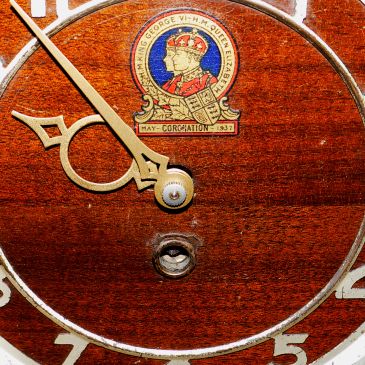
King George VI Commemorative visit 1937

RS together but not working (2)
Blackforest Shelf (mantel) clock circa 1935

They are easy to find. Antique stores, junk shops, and thrift stores all have them. They are very cheap, usually quite stressed having spent most of their lives in basements, attics and garages and probably the last clock to leave the store shelf. They are always passed over for the “better” clocks. I buy them because they are cheap and relatively easy to bring back to life. The pictures you see here are clock cases that have been significantly refreshed. Here’s a before shot.

rs-blackforest-mantel-clock-48
This is one very homely clock

 Those who are familiar with time-only movements know they are relatively simple to work on

Since the mainspring in one clock snapped in two places I have combined the best parts of each one in an attempt to have a working movement for the most attractive looking clock which for me is the 1937 commemorative edition King George VI clock. I might just throw in a quartz movement for the other clock unless I find another plate clock movement. For those who are familiar with time-only movements they are relatively simple to work on. You might call them fun and a good challenge for those new to clock repair. The gears are small and the pivots are tiny but they are easy to dissemble and put back together. No helper springs and levers to worry about. Here are some shots of the movement.

RS shelf clock number 2 (2)
Movement inside the case

rs-plate-clock-movement
Parts of two movements are combined to make a working one, back plate is off

rs-plate-clock-movement_5
All shined up and on the test stand

rs-plate-clock-movement_6
Showing unique one piece pallet, verge and pendulum assembly

OLYMPUS DIGITAL CAMERA
All in one pallets, verge and pendulum rod and bob.

I have been testing the movement with mixed results. I installed one bushing on T3 after which the movement ran better. It is in beat and will run but not for as long as I would like. Why can’t this little guy run a full eight days? The best it can do is 4 days. Perhaps a mainspring issue; too weak to give me a full eight day cycle? A pity because I truly wanted to have this thing running strong and reliably. Being a glutton for punishment I have another plate clock coming in the mail. I am not absolutely sure if it has the same movement but I am willing to bet that it does since it is another Forestville, this time a true delft clock.

These often neglected clocks are great fun to work on. Total outlay for all three clocks – $55. Not bad!

Searching for a donor movement pays off

Last summer (2015) I bought a Blackforest time-only shelf clock for $10 at a small antique store in Kazabazua, Quebec which you see pictured below. To be fair it did not look like this when I bought it. It was quite beaten up and a case refresh was sorely needed which included stripping and re-staining.

RS together but not working (2)
Blackforest shelf clock #1

It’s a relatively simple 8-day time-only movement commonly known as a “plate clock” movement. To avoid any confusion let me say this shelf clock is Canadian made by the Blackforest Clock Company of Toronto (known as the Forestville Clock Company after the second war). The movement is likely German; the clock was made in the mid 1930’s when Canadian companies imported German movements for a variety of mantel and long case clocks.

Despite my best efforts I could not get Blackforest shelf clock #1 to run reliably. It would typically run 5-10 minutes and stop. The movement had a couple of bad teeth on the escape wheel; not an easy fix and I assume the source of the stoppage. I decided that I would wait until I found a donor movement to scavenge any parts I needed so I put #1 aside.

I scoured the net looking for an identical movement. I found one from a clock parts company in Ontario but sadly the company, despite having an online presence, was no longer in business. My numerous emails were not answered. I was getting a little discouraged until February 2016 when my wife and I were making our regular pilgrimage to a popular antique store in Great Village, Nova Scotia. I came upon Blackforest shelf clock #2, a clock not much different from the one I found in 2015 but more importantly it had an identical movement. I particularly like this one because it commemorates King George VI and Queen Elizabeth’s Royal Visit in 1939 (the coronation was in May 1937) making this vintage clock almost 78 years old.

RS shelf clock number 2 (12)
Royal Visit to Canada1937

RS Refinished case (7)
Blackforest shelf clock #2 circa 1938-39

No problem I thought. Between the two of them I should get one clock running reliably. I paid $20.00 for the newer one with a total of $30.00 for two clocks; a minimal outlay for the total project.

Blackforest shelf clock #2 ran for a while but I could not get it to run much past two days without it stopping. The sudden stop seemed like a power issue or perhaps it was just plain gummed up and dirty. A thorough cleaning was one solution to the stoppage. This was also a good opportunity to decide which clock was worth salvaging. In the end the newer one won out. However, two parts had to come from the older movement, the pendulum bob (the newer one had a cracked bob) and the spring / click / ratchet assembly which I will now discuss further.

Blackforest shelf clock #2 had a partially stripped ratchet (see photo with white arrow) which I thought was rather unusual; not very surprising since brass is a very soft metal and does not stand up to much abuse, a product of rough treatment in the past I suspect. While winding it I could feel the click slipping on the ratchet and feared that it would let go if I was not careful enough. This critical issue could have led to a unpleasant outcome at some point in the future so I determined that it was only prudent to replace the spring / click / ratchet assembly.

RS Blackforest mantel clock (63)
White arrow is pointing to a stripped ratchet

Pendulum
Pendulum assembly with rotating bob adjustment

Spring barrel
Open spring barrel, ratchet and click assembly

clock gears
Gears assembled on the front plate

The two replacement parts fit perfectly. Now for a thorough cleaning. All the parts were put into an ultrasonic cleaner, dried, inspected and polished. The pivots were inspected and polished. The pivot holes which were in very good condition were pegged out and once re-assembled the movement was oiled and briefly tested. As any clock enthusiast who has had experience with time-only movements, they are certainly the easiest to work on.

The final step is the long-term testing phase to see how it runs on a full wind.

Postscript: five days later there is no stoppage. It will take a little longer to regulate the clock but so far so good.

Blackforest shelf clock #2 now has a replacement spring, click and ratchet as well as a new pendulum bob. Does it make it original? Considering that it has parts from a clock that was likely made at the same time it is original enough as far as I am concerned.

The shelf clock – what is it, exactly?

What is a shelf clock? If you have a number of clocks as I do it can be quite confusing to describe each specific type to the average person but it is really quite simple. Let me explain how you can identify the clock you might be looking at. The term shelf clock is a broad category but I believe it can be classified in the following ways.

Some 180 years ago the first shelf clocks were OG (Ogee) clocks. These were the first mass-produced American clocks, were inexpensive, and were made up to about the late 1870s. They represented the early years of American clock-making and the transition from more expensively produced wood movements to cheaper brass movement clocks. OG clocks are so named because of the double-curved molding on the front of the clock. The curved molding was designed to hide the weights. Many of these clocks were weight driven with 30-hour or 8-day movements and had mirrored or painted tablets. OG clocks were usually 25 inches in height and 15 inches wide and had hardwood veneers covering a softwood frame. They were surprisingly accurate and reliable.

Clocks
Spring-driven and weight driven 30 hour OG (Ogee) clocks, made by the Canada Clock Company, circa 1872-76 (Canadian Clock Museum)

Later, more stylish clocks could be found. These are called Column clocks because they would either have a half-column or full column on the left and right or even stacked half or full columns such as the one pictured below. Moldings on the top and bottom would be brought together by columns on each side of the clock with mirrored or painted tablets. Column clocks were almost exclusively weight driven with 30-hour or 8-day movements.

Column clock
Stacked Column clock, circa 1870 (Canadian Clock Museum)

At around 1840 Steeple clocks were introduced. They had a peaked centre section bordered by columns topped with finials and a peaked sash with a decorated (often hand-painted) lower tablet. They were spring driven with 8-day movements. Steeple clocks are very distinctive, stood about 15 inches high with veneered hardwood over softwood, often with reverse-painted scenes and are made by a number of well-known companies.

RS on display
Arthur Pequegnat Maple Leaf “fan top” Kitchen clock, circa 1905

Kitchen clocks (Gingerbread) were simple or ornate with carved or steam-pressed patterns made by quick-saws and heavy steel presses, stood 22-24 inches in height and about 15 inches wide, and had a decorated sash which could be a very simple design as you see here or a much fancier reverse-painted glass scene. These inexpensive, visually pleasing timepieces sat in the kitchens of lower and middle-class homes and were produced by the thousands. They were so named because of their likeness to the design of gingerbread houses at the time (early 1900s). They are usually made of oak, walnut or even walnut trimmings on oak with a metal clock face and many had a simple alarm mechanism. The Gingerbread clock you see here is the Maple Leaf “fan top” by Arthur Pequegnat. The Maple Leaf came in 4 unique styles all characterized by the maple leaf decal on the glass door.

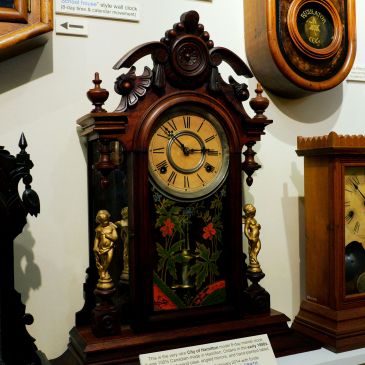
Some kitchen clocks had beautifully carved features and figurines such as this stunning clock made by the Hamilton Clock Company (Canada), though a clock such as this might be found elsewhere in the home and considered a parlor clock.

RS City of Hamilton Canada Clock Co
City of Hamilton, made by the Hamilton Clock Company, circa 1880 (Canadian Clock Museum)

When spring-driven clocks were introduced the Parlor clocks like this Hamilton Clock Company model became popular. They tended to be narrower than column clocks because they had spring-driven movements. These clocks mirrored the furniture styles of the time. This one reflected the Victorian era with its bold figurines, carved finials, elaborate patterns etched into its wooden frame, and the hand-painted floral design of the sash.

RS 45-175
Seth Thomas round top cottage clock, circa 1930

Cottage clocks are less than 15 inches high and typically 8 inches wide are small, simple in design, and take up very little space. Many have basic alarm mechanisms but have one feature that distinguishes them from other pendulum clocks. They have a clip or a clasp that secures the pendulum rod for travel. The “round top” you see here was sold by Henry Birks and Sons an upscale Canadian jeweler. Others had “beehive” tops, flat tops, or octagon tops.

Pendulum rod clip
Pendulum rod clip for Seth Thomas round top

Smaller clocks are often referred to as desk clocks. They are usually mainspring driven with a flat dial. This Kundo 400-day anniversary German clock is an example of a desk clock but it might also be described more specifically as a torsion clock. This one stands less than ten inches tall and has a glass dome, a weighted wheel with 4 balls suspended by a ribbon called a torsion spring, and an exposed movement. It was typically given as a wedding gift.

RS Kundo
Kundo 400 day anniversary clock, circa 1970

Finally, the mantel clock.

Mantel clocks can be ornate, larger, and the centerpiece in a room. This particular clock, a Mauthe pendulum mantel clock offers a precision-built sophisticated German Westminster chime movement in a relatively non-descript but attractive and well-built cabinet that is simple yet elegant.

RS Mauthe mantle clock (30)
Mauthe time. strike and chime, circa 1970

ASIDE: Is it mantel or mantle? I have always considered a mantle as something you wear, a garment or a part of the earth’s crust. A mantel on the other hand is a shelf above, say, a fireplace. I see this word interchanged so often when clocks are advertised or described that either word is universally accepted. I prefer the word “mantel”.

RS April 12th
Ingraham Huron shelf clock, circa 1878

Mantel clocks were inexpensive to make, occupied very little space, and were part decoration and part practical timepieces. Mantel clocks were made with brass, wood, porcelain, slate, Bakelite, and metal though for the most part they were designed to be lightweight (slate clocks and cast iron clocks would be the exception), simple in basic design, and very practical. Mantel clocks have lasted so long, over two centuries, because they are dependable, versatile, and work so well in many domestic situations.

The categories of shelf clocks also include carriage clocks and lantern clocks. One of the first clocks whose movement and external structure was made predominantly from brass instead of iron or wood was the lantern clock. Although the shape of the clock looks somewhat like a lantern, the derivation of the name probably stems from the French word “laiton”, meaning brass. The earliest lantern clocks had striking mechanisms; later in the 17th-century alarms were sometimes added. Some lantern clocks had pendulums and could be hung on the wall.

Carriage clocks were spring-driven clocks developed in 19th century France and are made of plain or gilt brass. They are often no more than 8 inches tall, designed to be portable, and are characterized by a rectangular shape, glass or porcelain panels, and a carrying handle on the top. If you have a Breguet carriage clock as part of your collection you are very lucky indeed!

This is by no means an exhaustive description of the types of shelf clocks. There are others such as swinging clocks, tambour clocks, pillar and scroll, and so on. Whether you are shopping for a clock as a gift or adding one to your collection or even describing what you have seen to a friend, it is important to understand the distinctions between one type and another.

A curious little Blackforest shelf clock

RS shelf clock number 2 (6)
Black Forest Clock Company of Toronto, clock in as found condition

Shelf clocks such as the one pictured have always been hard to find though I did stumble upon this one very recently (April 2016) at an antique store in Great Village, Nova Scotia. Why, because of their cheap construction and inexpensive movements, not many of these clocks have survived over the years.

This one might have had a special meaning to someone at one time because it is a memento of the King George VI coronation of 1937 which nicely dates the clock. He became King George VI of England in December 1936 following the death of his father George V and the abdication of his brother. He had been a heavy smoker and in 1951 had his left lung removed then died suddenly in the winter of 1952. Elizabeth became queen later that year.

RS Refinished case (6)
Black Forest shelf clock after case restoration

RS Refinished case (7)
Another view of refinished case

This Blackforest shelf clock is only slightly larger than the first Blackforest clock I picked up last summer (2015) and like the other, is time-only.

RS shelf clock number 2 (4)
Company plate on rear of clock

The time-only movement is very simple in design. The pendulum rod, bob and pallets are one piece.

Pendulum
One piece pendulum assembly

To adjust the beat rate you either rotate the bob left for slower rate or right to make the clock run faster or slower. Outside the back plate sits the mainspring which is housed in an open barrel and there are 5 gear wheels plus the escape wheel between two solid plates. This is an identical movement as found in my other Blackforest shelf clock  but unlike this clock it was in very poor condition. The movement is German and could have been made by a number of companies at the time; Keinzle, Mauthe, Hermle or Junghans. There are no stamps or markings on this so-called “plate” movement to give any indication of the maker. Typically many Canadian companies such as the Blackforest Clock Company of Toronto (the Forestville Clock Company after the war) imported German movements before the Second World War and installed them in Canadian made cases.

RS shelf clock number 2 (2)
Plate clock movement

RS shelf clock number 2 (12)
Commemorative Edition – 1937 Coronation of King George VI

To refinish the case I cleaned it thoroughly using Murphy’s Soap, applied three coats of dark walnut stain taking care to wipe the stain with a cotton cloth 5-10 minutes after each application. My intent was to fill in the scratches and abrasions rather than radically alter the colour. I then rubbed the cabinet with 0000 steel wool between coats and applied two top coats of clear polyurethane satin finish. I cleaned the numerals but decided against repainting rather preserving the original patina, though I applied Brasso to bring back the finish on the key wind bushing. In the end the case is a little darker but likely closer to its original finish.

shelf clock number 2 (10)
Original winding key

I haven’t quite figured this out yet but I think the winding key has a “bottle opener” design to allow the pendulum to be locked during travel. Ideas?

This clock would make a great addition to a any bedroom. It is small enough for a dresser or even a side table, quiet enough (for a mechanical clock) and is still attractive in design after all these years. Heck, you can even wind the clock in the 6 o’clock position.

Blackforest Shelf Clock Progress

I have dis-assembled this clock twice. After the first dis-assembly I cleaned and oiled it, found everything to be in order but once I assembled it, bench-tested it to find everything seemingly correct and set the beat  it would not run more that 5 to 10 minutes at a time. When it stopped it seemed to catch on the escape wheel.

OLYMPUS DIGITAL CAMERA
Shown with back plate off

It is now stripped down again. No need to have as through a cleaning as the first go-around but now is the time to investigate other factors. It is a pretty simple clock as the photo shows.

OLYMPUS DIGITAL CAMERA
Escape wheel showing worn teeth

What I see right away is the escape wheel teeth and how some are hooked or misshapened. My temptation is to file it down but others are suggesting that I use pliers to press the hooks back into shape. I have’t decided what to do just yet.

Others have suggested that I put more weight on the pendulum which I am reluctant to do since this clock was likely designed to run on a light bob.

OLYMPUS DIGITAL CAMERA
The pendulum showing the twist adjustment for speed regulation

Now back to further investigation.

Late note: I finally got this clock to work after taking it apart twice. The second time I concentrated on the pivots discovering the at least 2 had enough rust that them that they may have slowed the clock down. I also took a burr off the escape wheel but in the process damaged the escape wheel a little, so that while the clock runs there is a little clunking sound once with each rotation, but it works and keeps time! Live and learn.

Blackforest Shelf Clock Progress

OLYMPUS DIGITAL CAMERA
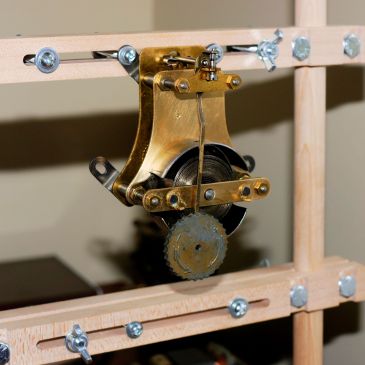
Blackforest Movement near anchor

If you are following this blog this is the same clock as the previous post. Since the movement was very dirty, I cleaned it up (ultrasonic cleaner) when all apart and reassembled and oiled it. It is a one-train movement, so not many gear wheels and pretty easy to work on. You can see by the size of the clock, a photo of which is in the last post, that the movement is quite small.

I thought with a cleanup and oiling it would be simple to get it going again but no such luck. I know that there is power getting to the escape wheel because when I disconnect the anchor it spins like a buzz saw. When I reconnect the anchor it runs for about 15 seconds and stops. I would like some ideas to get this clock running but in the meantime I have attached some photos. My question, it there anything missing here? This clock doesn’t have a suspension spring or a crutch which I find unusual. And what is that screw thing for? Comments and suggestions would be appreciated.

OLYMPUS DIGITAL CAMERA
Anchor and top of pendulum

OLYMPUS DIGITAL CAMERA
Unknown screw adjustment

OLYMPUS DIGITAL CAMERA
The movement itself

Blackforest shelf / kitchen / cottage clock

RS together but not working (2)
Finished case

This is a Blackforest shelf or kitchen clock made before the Second Word War. Blackforest is a Canadian clock company.  The Blackforest Clock Company of Toronto, Ontario was founded by Leopold and Sara Stossel in 1928.  Both clock movements and complete clocks were imported from Germany and sold through department and jewelry stores across Canada.  Their son Ed Stossel started working part time with his parents’ company in the 1930s, and later became a full-time employee in the late 1940s.

Some assembly work was carried out in their Wellington Street East factory.  Initially, imported mantel clock and grandfather clock movements were installed in cases made in Kitchener, but later the complete mantel clocks were imported from Germany.  This arrangement was interrupted by the Second World War, which also led to a name change to the Forestville Clock Company in 1941.  During the war years this company imported its clock movements from England, the United States, and even France.  However, starting in the mid nineteen fifties German factories again became the source of most Forestville clocks, with Mauthe being a major supplier. The company did not survive much past the late 1970s.

I found this in a antique shop in Kazabazua Quebec and it was in sad shape. This particular clock would have been the least expensive in the Blackforest catalog. I had an opportunity to go through the Blackforest catalog during my visit to the Canadian Clock Museum in Deep River this past summer and could not find a listing. I have no idea of the model name or number as there is no label on the clock. The only feature it shares with other Blackforest mantel clocks is the metal bezel, numerals and hands. Otherwise it is a one train time-only movement with a minimum number of gears and a unique twisting pendulum adjustment. The movement is as simple as it gets so it is easy to work on.

The photo shows the movement out of the clock and as you can see, it is quite dirty. I am in the midst of dis-assembly, cleaning (in my new Ultrasonic cleaner) and oiling. My initial observation is that the pivot holes, pivots and lantern gears are in good shape and the mainspring seems strong. Not a lot of wear for a 75+ year old clock.

RS Blackforest mantel clock (66)
Single train time-only movement

The next photos show the condition of the case when I bought it and the second is the first phase of stripping. You will notice that I did not disturb the decal; it would have been impossible to find a replacement. It was in terrible condition, likely sitting in a attic or garage for quite a few years. The spring was wound very tight and I am assuming at this point that dirt and grime caused it to cease. Although I paid $15 for it at the time it seemed too much after I got it home. Nonetheless, I went to work on it and if I can get it to function it might be worth more than I paid for it. As far as restoring this clock I used a latex dark walnut wood satin and a polyurethane top coat, not what would have been done at the time which likely would have been a dark lacquer finish. This method will be more durable. The first photo shows the case is in a restored condition and as you can seeing it is a striking little clock.

RS Blackforest mantel clock (48)
RS Blackforest mantel clock (77)

Website Powered by WordPress.com.

Up ↑