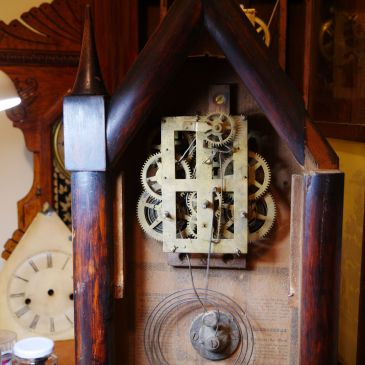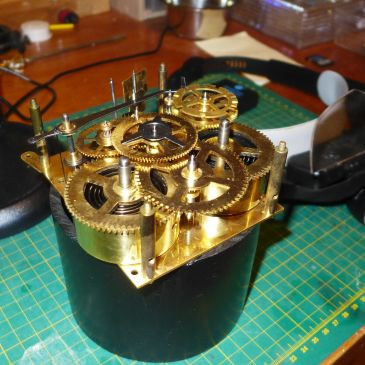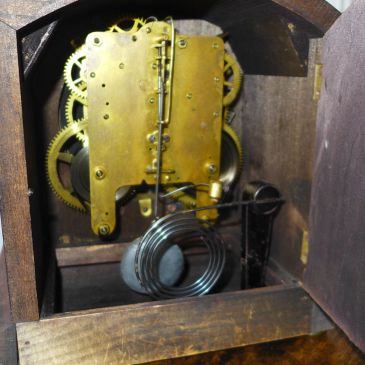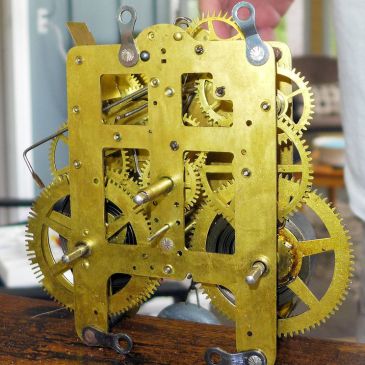
Is this a four-glass clock or a crystal regulator

During the winter months, I teach part-time in a justice program at our local community college. The other day, I had a former student visit this blog and she commented on her admiration for one of my clocks, specifically a time and strike crystal regulator by Ansonia.

Thanks, Cate for allowing me the opportunity to profile this clock once again!

American-made 4-glass clocks are commonly referred to as crystal regulators

First a history of how I acquired the clock and what I know about it. While exploring an antique shop in Bloomfield, Ontario, my wife came across an intriguing find – an antique glass-cased brass time-and-strike American-made clock with an open Brocot escapement, manufactured by Ansonia.

This particular clock, featured in the 1905 Ansonia catalog under the name “Prism,” was priced at $29.00, a substantial sum for its time. It was the simplest design in the crystal regulator line and the lowest-priced model.

Collectors in the clock world frequently have discussions regarding the proper name for these clocks. Are they four-glass clocks or crystal regulators?

Ansonia crystal regulator
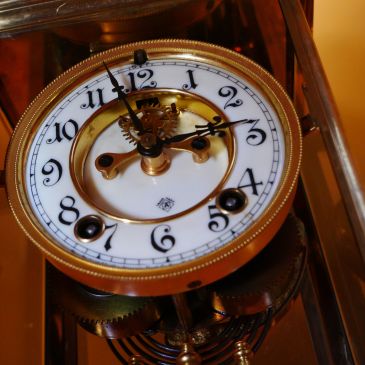
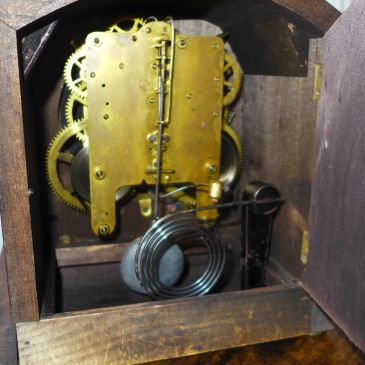
Ansonia Crystal Regulator showing the Brocot escapement with jeweled pallets

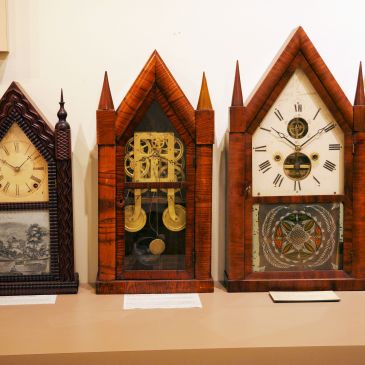
A “four-glass clock” is a broader term referring to clocks with glass panels on all four sides, while a “crystal regulator” is a more specific subtype of mantel clock known for its transparent glass panels and often associated with high-quality craftsmanship. The primary differences lie in the design, purpose, and origin. The term “crystal regulator” is used specifically for American clocks that fall under the broader category of four-glass clocks, distinguished by transparent panels on all sides. Conversely, a French-made clock with a similar appearance is generally referred to simply as a four-glass clock.

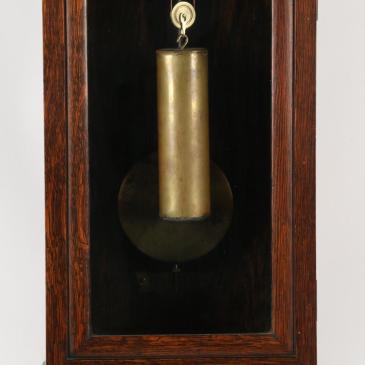
The pendulum vials contain nickel slugs

While both types typically feature Brocot escapements, there’s a notable distinction in the pendulum design. Many four-glass French clocks incorporated mercury-filled pendulum vials, whereas American crystal regulators utilized nickel slugs within transparent vials.

American Crystal Regulators were essentially replicas of French regulators, boasting similar design elements such as a stylistic gong block, visible Brocot escapements, round movement plates, and beveled glass panels. However, they were an economical alternative to the French clock.

French regulators, crafted by high-profile makers like Japy, Marti, Vincenti, and Mougin, were highly esteemed and often included mercury pendulums. In the American market, Ansonia and Seth Thomas were prominent manufacturers of such clocks. They were not built to the higher standards of a French clock and were priced accordingly. Nonetheless, American Crystal Regulators have become sought-after by clock collectors.

American-made 4-glass clocks are commonly referred to as crystal regulators

The four glass panels of this clock are in very good shape, with only a small corner chip on one panel, which I discovered a few days after purchasing the clock. Fortunately, the chip is not visible from the front. The glass was likely damaged during a servicing session.

Overall, the clock is in good condition for its age and was made somewhere between 1905 and 1910. The brass, though tarnished, cleaned up nicely with the use of a cleaner. The brass was also lacquered to maintain its shine and protect it from deterioration.

On the bench and before disassembly

Upon acquiring the clock, it was not in running order, and my initial evaluation suggested that all it might require was a thorough cleaning and some bushing work. There was certainly a small amount of wear and the movement required 5 bushings, all on the front plate.

After disassembling, cleaning, and addressing wear, it ran without issue. Now, it’s one of several clocks that run weekly.

I would have to say it is one of the more unique clocks in my collection.

Relocating a unique New Haven kit clock

For years, my wife and I have been on the hunt for an elusive Arthur Pequegnat Hall clock, a prized possession among Canadian collectors. Recently, I stumbled upon what seemed like the jackpot—a seemingly authentic piece advertised for a mere $100. However, as I explored the deal further, doubts crept in, casting a shadow over my potential bargain.

Join me on this intriguing journey as we uncover the secrets of a clock that may not be what it initially appeared to be.

It certainly looks like a weight-driven clock

The clock is closely reminiscent of Pequegnat’s craftsmanship. It was a tempting find but a closer inspection raised eyebrows. The clock hands seemed out of place (for a Pequegnat), and the overall workmanship did not quite match the renowned Pequegnat build quality. Could this have been a misstep in our quest, or was there more to this story?

Undeterred I made an over-the-phone offer of $90 and embarked on a 90-minute journey to claim what could be a gem in disguise. The seller warned of a non-functioning clock but sweetened the deal by mentioning that it had weights—only to reveal later that the weights were, in fact, fake. On top of that, a spring-driven New Haven mechanical movement lay beneath the surface.

New Haven time and strike movement

The weight cans were empty shells, and the decent-quality ladder chains with acorn pull ends were crudely strung to mimic a weight-driven movement.

Brass weight shells

Further investigation unveiled a raised platform supporting the movement, yet no traces of a seat board that usually accompanies weight-driven mechanisms. The clock’s peculiarities extended to a tied cord on the strike lever, adding to the mystery. As questions piled up, it became clear that this clock’s origins were far from conventional.

The movement is stamped 27. This could be a date stamp but it is more likely the length of the pendulum in inches. The movement plates are pinned rather than held with screws or nuts suggesting an older square-aperture type New Haven movement. Judging from the build of the movement I would say that it is earlier than 1927. The heavy, solid wood case which comes apart in three sections is certainly just as old.

I removed the movement from its case and mounted it on a test stand. The movement runs at 72 bpm, not quite the 60 bpm one would typically expect from a hall clock and the slower beat rate explains the long pendulum rod.

The only plausible explanation was clear: I had purchased a kit clock, where an independently crafted case had been paired with a New Haven movement, dial face, hands, accessory weight cans, and ladder chains with acorn pull ends. It was likely a more cost-effective means of acquiring a tall case clock back in the day.

In its new location

Despite the oddities, I had, after all, secured the clock at a reasonable price. Now, armed with the knowledge of its peculiarities, I am content with it. Servicing the movement and restoring the case have been completed and after having stood in my work area for a couple of years it was time to move it to its permanent location.

And it looks pretty good! The combination of the separately crafted case with the New Haven movement, dial face, hands, and the accessory weight cans and ladder chains with pull ends came together quite well, offering an appealing and budget-friendly tall case clock.

The lesson in all of this is that in the world of clock collecting, sometimes unexpected discoveries and not value and authenticity are the ones that leave a lasting impression.

Securing Clock Glass to a wood Bezel with Plaster of Paris: An easy Step-by-Step Guide

Antique wall clocks hold sentimental and aesthetic value, and preserving them often requires delicate restoration work. Purchasing replacement glass and securing it to a frame is one such restoration project.

Securing glass to the bezel of an antique clock can be achieved in several ways. It can be secured with tacks or clips or in the case of a metal bezel, brass tabs are soldered into the frame once the glass is in place. However, securing the glass to a wooden bezel can be more easily achieved by using Plaster of Paris.

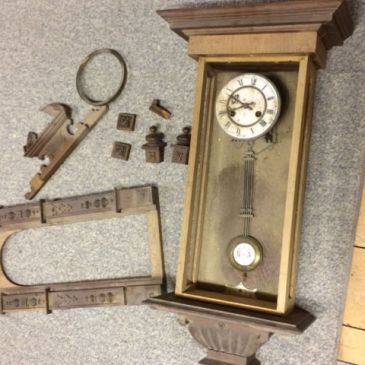
Ansonia Extra Drop time-only wall clock (pendulum removed)

This versatile material, which can be found in any hardware store, when mixed with water, creates a durable and easy-to-use bonding plaster. In this step-by-step guide, we’ll walk you through the process of using Plaster of Paris to secure glass to the bezel of an antique wall clock.

Upon acquiring my Ansonia Extra Drop time-only clock, crafted in the early 1880s by the Ansonia Brass and Copper Company, I faced the challenge of its restoration as you can see in the following photo.

Ansonia Extra short drop wall clock
Trash or treasure?

Despite its seemingly hopeless condition, the clock retained its essential components, with the sole exception of the brass dial bezel. Although the movement was encrusted with dirt, it remained intact and presented a salvageable opportunity for restoration.

Time-only movement

After considerable sanding, rust removal, freeing of seized wheels, and subsequent bushing work, the movement miraculously began to run.

After a thorough cleaning

However, the glass was not securely fixed in its bezel and was temporarily held in place by tacks. I needed a more lasting solution to ensure the glass was firmly secured so, I opted for Plaster of Paris.

Except for the Plaster of Paris and the custom-cut glass, all the materials needed for this project are common items found in any household.

Materials Needed:

  1. Plaster of Paris
  2. Cold water
  3. Mixing bowl
  4. Stirring stick, spatula, putty knife
  5. Correctly sized glass from a clock supplier
  6. Paper towels or soft cloth
  7. Sandpaper
  8. Paint and brushes

Step 1: Detach the wood bezel from the clock case. Prepare the clock bezel by removing the glass and cleaning the bezel thoroughly. Use a soft cloth to wipe away any dust or debris. If the bezel has any imperfections, lightly sand the surface to create a smooth and clean area for the plaster.

Remove bezel

Step 2: Mix the Plaster of Paris. The instructions on the Plaster of Paris package call for a two-to-one mixture (two parts plaster to one part water) which is far too thin. I have found that three to one or more is optimal to achieve the right consistency. Mix the dry plaster with cold clean water in a bowl; it should be the firmness of a thick paste. Stir the mixture thoroughly until you achieve a smooth, lump-free consistency.

Step 3: Secure the glass onto the cleaned bezel. If the glass moves too much, use painter’s tape or masking tape to temporarily secure it in place. This will prevent the glass from shifting while applying the plaster.

No special tools are required

Step 4: Use a spatula or a one-inch putty knife (preferred) to carefully apply the plaster by spreading the mixture around the edges of the glass and onto the bezel. Ensure that the plaster is evenly distributed and covers the entire edge of the glass. Take your time to avoid air bubbles and uneven application. You have six to eight minutes of working time before the plaster begins to set.

Do not mix more material than can be used during the six to eight-minute period. However, if you have any left, simply find a hole in a nearby wall to patch.

Application of the plaster

Step 5: Once the plaster is applied, use a wet finger or a damp cloth to smooth and shape the edges. Pay close attention to the corners and make sure the plaster forms a neat, even seal between the glass and the bezel.

Step 6: Remove excess plaster before the plaster fully sets, by using a wet cloth and a putty knife to trim the edges. This will give the restoration a professional and polished appearance.

Allow to thoroughly dry

Step 7: Plaster of Paris hardens in about 30 minutes. Avoid disturbing the clock during this time to ensure a secure bond between the glass and the bezel.

Mixing acrylic water-based multi-surface paint

Step 8: Plaster of Paris is paintable.

Sanding the plaster before applying the paint

Touch up the bezel with paint. Aim to replicate the subtle hue of aged putty for a more authentic appearance.

Cure the Plaster of Paris for 24 hours before applying paint. Sand the rough areas with 200-grit sandpaper. Wipe down with a damp cloth. Apply the paint with an artist’s brush or equivalent. Allow the paint to dry completely before reassembling the clock.

Plaster of Paris in the bezel will contribute to a slight increase in weight, but the trade-off is enhanced rigidity.

The plaster is tinted to resemble aged putty

Using Plaster of Paris to secure the glass to the bezel of an antique wall clock is a straightforward and cost-effective process that, when done correctly, can not only keep the glass securely in place but will add to the clock’s appearance with the added benefit of enhancing the structural integrity of the glass within its bezel.

Following these steps will go a long way towards preserving the beauty of your antique clock for years to come.

Happy New Year from antiquevintageclock.com

As we welcome the New Year, antique clocks stand as silent witnesses to the passage of time, marking the transition from one chapter of our lives to the next.

Photo by cottonbro studio on Pexels.com

Picture a room with an antique clock, its ticking ushering in the promise of a fresh start. Old clocks remind us that each second is a valuable gift, especially as we say goodbye to the old and embrace a new beginning.

On New Year’s Eve, the clock’s ticking becomes the soundtrack to reflecting on the ups and downs of the past year. Each tick seems to echo the shared heartbeat of collective experiences. Standing on the cusp of a new chapter, let’s carry forward the lessons learned, into the new year with its promises of growth, resilience, and the unwritten pages awaiting our stories.

The author

Amidst the celebrations and confetti, may the ticking of antique clocks symbolize the anticipation of new opportunities. Wishing you a Happy New Year, filled with hope, optimism, and the joy of being with loved ones.

Let me take a moment to thank you for supporting my blog. Your support not only fuels my passion but also plays a crucial role in shaping the content and direction of the blog. I’m grateful for the encouragement and look forward to continuing this journey with you.

Regulator #1 by Arthur Pequegnat

One clock that holds a special meaning and one that I would like to add to my collection someday is the Arthur Pequegnat Regulator #1, a single-weight eight-day clock. This clock is truly a rare find, though the prices I’ve encountered thus far are a bit steep for my budget.

Arthur Pequegnat Regulator #1
Arthur Pequegnat Regulator #1, photo taken at The Canadian Clock Museum in Deep River Ontario, Canada

The Arthur Pequegnat Story

The Arthur Pequegnat clock company was a formidable contender to American wall clock manufacturers. While their wall clocks often mirrored American models, some of their designs boasted a unique touch. The company favoured the heartwood of quarter-sawn white oak for their cases, showcasing the stunning visual appeal of this choice of wood.

The story of the Arthur Pequegnat clock company is one marked by distinction. Born in Switzerland in 1851, watchmaker Arthur Pequegnat immigrated to Berlin, Ontario, Canada, in 1874 with a substantial entourage of 18 family members. Initially establishing himself as a jeweler and watch repairman in the late 1870s, Arthur and his brother Paul operated a successful shop in Berlin, Ontario, by the mid-1880s. After a decade, the brothers pursued independent ventures, each managing prosperous jewelry shops in Southern Ontario.

In 1897, Arthur expanded his Berlin Jewelry shop to include bicycle manufacturing. However, as the demand for bicycles waned by 1904, he shifted focus back to the clock industry, manufacturing his clock movements at his Berlin Bicycle Manufacturing plant. Initially, wooden clock cases were sourced from local furniture makers, but over time, Arthur began crafting his own cases.

Despite Arthur’s passing in 1927, the company, guided by family members, persevered until 1941. The scarcity of brass during the war effort led to the company’s closure. The factory, where these exceptional timepieces were crafted, never produced another clock and was eventually demolished in 1964. Today, Kitchener pays tribute to this great clock manufacturer with a commemorative plaque.

The renaming of Berlin to Kitchener in 1916, amid World War I anti-German sentiments, serves as a helpful dating marker for Pequegnat clocks. Movements or dials marked “Berlin” indicate a clock dating to 1916 or earlier, while those marked “Kitchener” are from 1916 or later. Due to the long production life of many clocks, precise dating of Arthur Pequegnat clocks remains challenging.

For a fascinating journey into the world of Arthur Pequegnat clocks, The Canadian Clock Museum stands as a treasury, boasting the most extensive museum collection of Arthur Pequegnat clocks in Canada. Additionally, the Macdonald Museum in Middleton, Nova Scotia, offers a modest yet noteworthy collection of Pequegnat clocks—a worthwhile stop for those journeying through the Canadian province of Nova Scotia.

The Regulator #1

The Regulator #1 is frequently likened to the Seth Thomas Regulator #2. While the Seth Thomas counterpart found widespread use in offices and rail stations across America, the Arthur Pequegnat Regulator #1, though less prolific, met the demands of many businesses in Canada.

The dial removed showing the movement

Although sought after by collectors the Regulator #1 has interesting technical quirks according to Canadian clockmaker John Plewes, author of Repariring & Restoring Pendulum Clocks. Plewes cites three design issues with the clock. Two are minor quibbles but the third involves the weight. Despite its similarity to the Seth Thomas Regulator #2, it requires a heavier weight (1/2 lb more) to drive it reliably. A lighter weight such as the one found on the ST#2 causes the clock to stop after a short period particularly when the minute hand is rising. The hands are simply too heavy for the clock as they influence the force applied to the train.

Plewes, therefore, takes issue with Arthur Pequegnat’s claim that the #1 is the “finest office clock made”.

Lower section of the clock case

Regardless, the clock is highly sought after among Canadian collectors, and commands a premium, often doubling the price of similarly styled clocks from well-known American counterparts such as the Seth Thomas Regulator #2.

Ah, some day!

Merry Christmas from antiquevintageclock.com!

During the Christmas season, there’s a special charm to antique clocks, each holding onto time’s precious moments. Imagine a room lit by soft twinkling lights, featuring a tall case clock as a proud symbol of craftsmanship spanning generations.

Tall case clock C.1848

As we get into the Christmas spirit, these old clocks go beyond being mere decorations; they connect us to the past, marking the holidays of days gone by.

Lego train set

The clock’s ticking signals the arrival of Christmas morning, a shared experience through the ages. This Christmas, let’s take a moment to appreciate the history held by these antique treasures. They’re more than just artifacts; they have witnessed the laughter, love, and warmth that define the season. If they could talk!

Decorated and waiting for gifts

Amid carols and a crackling fireplace, may the ticking of antique clocks resonate with the essence of togetherness. Wishing you and your loved ones a Merry Christmas filled with the charm of past times and the anticipation of treasured moments yet to come.

Thank you for supporting my blog; it serves as a meaningful gift from you to me. Your support not only fuels my passion but also plays a crucial role in shaping the content and direction of the blog. I’m grateful for the encouragement and look forward to continuing this journey with you.

Idioms and Expressions With the Word “Clock” in them

Tis the season of merriment so rather than talk about serious stuff we’ll have fun with expressions. Here are some common sayings and idioms with the word clock in them. Idioms have a figurative meaning that is commonly understood within a culture or language.

A holiday clock perhaps?
  • Around the clock: Describes something that is in effect, continuing, or lasting 24 hours a day: “We worked around the clock to meet the deadline.” Also, Around-the-clock service: Continuous service is provided 24 hours a day, seven days a week: “The hotel offers around-the-clock service for its guests.”
  • Clean someone’s clock: To defeat someone decisively: “In the final match, our team cleaned their clock.”
  • Beat the clock: To finish something before a deadline: “We had to beat the clock to complete the project on time.” Also, Race against the clock
  • Against the clock: Working on a task that has a tight deadline: “The team is racing against the clock to finish the construction before the event.”
  • Watch the clock: To be mindful of the time: “During the meeting, I had to watch the clock to ensure we stayed on schedule.” Also, He’s (she’s) a clock watcher
  • Turn back the clock: To return to a previous time or state: “Sometimes, I wish I could turn back the clock and relive those carefree days.” Also, Wind back the clock
  • Keep an eye on the clock: To regularly check the time: “I need to keep an eye on the clock so we don’t miss our train.”
  • Winding the clock: Engaging in a time-consuming or repetitive task: “His job felt like winding the clock every day, doing the same thing over and over.”
  • Kill time (on the clock): To pass time while waiting for something: “I often read to kill time during my lunch break on the clock.”
  • Work like a clock: To perform with precision and reliability: “Once the new system was in place, everything worked like a clock.”
  • The clock is ticking: time is running out so act fast. also, The clock is running: Which indicates that time is passing, often with a sense of urgency: “We need to make a decision; the clock is running on this project.”
  • Run out (or down) the clock: deliberately use as much time as possible to preserve one’s advantage: “Facing a tie, he decided to run out the clock in the final moments
  • On the clock: you’re working or being paid for your time and labour: “Oh, don’t bother him, he’s on the clock”. Also, Clock in/clock out:
  • Your biological clock is ticking: time is running out to have a child so act now: “Lisa felt the pressure of her biological clock ticking as she approached her 30s, prompting her to seriously consider starting a family.”
  • Punch the clock: be employed in a conventional job with set hours: “After a long day at work, I’m always ready to punch the clock and head home for some much-needed relaxation.”
  • Stop the clock!: to remain young indefinitely or “As the final seconds ticked away in the championship game, the quarterback made a game-winning throw that seemed to stop the clock for a moment, sealing their victory.”
  • As regular as clockwork (or, running like clockwork); a machine that runs perfectly and needs no adjustment. “Every morning, without fail, Jim’s neighbour would start his day as regular as clockwork, going for a jog at exactly 6 a.m.”
  • Face that could stop a clock; A face that is strikingly or shockingly unattractive; or “Jane walked into the room with a look on her face that could stop a clock, causing everyone to pause and wonder what had happened.”
  • Five o’clock shadow; a slight growth of beard on a man’s face; “After a busy day at the office, Tom returned home with a noticeable five o’clock shadow, a sign of the long hours he had put into his work.”
  • Running like clockwork: Operating smoothly and efficiently, without any problems: “The event was running like clockwork, thanks to the meticulous planning.”
  • Two o’clock courage: The bravery or confidence that comes late at night, especially after consuming alcohol: “He had a bit of two o’clock courage and finally asked her out.”
  • When the clock strikes (a certain time): Referring to a specific time on the clock. For example, “We’ll meet at the cafe when the clock strikes noon.”

May the magic of the season wrap you in warmth, sprinkle a touch of wonder on your days, and may your clocks run smoothly in the year to come.

Here’s to a festive season that sparkles with happiness and lights up your world. Happy holidays

Care for inactive antique/vintage clocks

What to do with an inactive clock?

Having a clock serviced and letting it sit without running for long periods can have varying effects, influenced by factors like the environment it’s in. If the clock is stored in a clean, dust-free, and controlled humidity setting, it may require less frequent running. Considerations such as the presence of pets, whose hair can find its way into delicate clock mechanisms, dusty homes, and humid conditions play a role.

In controlled museum environments, clocks are inspected according to a strict schedule

Consider the indoor environment when storing clocks. High concentrations of indoor pollutants, such as particulates, tobacco smoke, and animal dander, can affect clock mechanisms. Proper sealing of access doors, replacing broken dial glass, and keeping clocks away from dusty or humid areas can help preserve their condition.

Storing your clock in an unheated attic, for instance, with the anticipation of having it operational at a later date, is a recipe for potential disaster.

Applying a generous amount of lubricant spray on a clock’s movement during extended storage is not advisable. This practice can lead to serious issues because excess lubricant will attract dust and debris, forming a sticky residue over the entire movement. Instead, a moderate and targeted application of a lubricant intended for clock pivot holes is recommended to ensure proper functioning without negative side effects.

A general recommendation is to check and service your clock(s) on a 3-4-year schedule. During these checks, assess the condition of the clock, add oil where necessary, and note any signs of wear. This approach can keep your clock or your clock collection in good shape with minimal intervention. If pets are present, more frequent inspections may be necessary.

There are occasions when a clock requires complete servicing

For a clock that’s been inactive for a year or more, refreshing the oil before running it is advisable, especially if there’s little or no evidence of oil in the pivot holes. Quality clock oil, designed for this purpose such as Keystone pivot oil, typically doesn’t break down over a year. If a clock is well-oiled before storage but not over-oiled, it should remain in good condition during this period.

Checking for the presence of sufficient oil in the pivot holes

It should be noted that to ensure proper oiling, the movement must be taken out of its case. Of course, the hands must be removed as the first step. However, for the majority of clocks, particularly those crafted in the USA, releasing the movement from its case typically involves taking out four slotted screws.

Some collectors choose to run clocks intermittently, perhaps once every two or three months, to keep the wheels moving without excessive wear. This is particularly true for specialized clocks that may be challenging to service, to extend the time between required maintenance.

Ultimately, proactive care and regular checks can prevent clocks from deteriorating to a point where repairs become costly. Taking these measures ensures that your cherished vintage or antique clock will provide years of reliable service.

A Vintage Seth Thomas Clock with a peculiar veneered case

The Seth Thomas Clock Company, renowned for its long history dating back to the early 19th century, produced a variety of clock movements over the years, and among them is the Type 89 movement found in this clock.

Despite the absence of a specific year stamp, the clock’s design and construction suggest a manufacturing date in the mid to late 1930s. Upon initial inspection, it was evident that the clock was not functioning, a common issue with old clocks that have not run in years.

From afar the wood finish is striking

Typically, clock movements face challenges related to low power output caused by wear and tear over time. The gradual deterioration of clocks during years of operation is often attributed to factors such as dirt accumulation, inadequate lubrication, and the lack of proper adjustments.

Although dirt accumulation can persist in a movement, causing friction and wear, I decided to see if I could get the clock to run. The process involved removing the hour and minute hands, releasing four screws securing the movement to the front of the case, removing the strike block, and taking the movement out of its case.

Type 89 movement

An initial inspection revealed no visible issues with either the time or the strike side. Both mainsprings were found to be wound tight and seemingly ceased, likely due to the accumulation of glue-like dirt between the coils that will prevent the clock from running.

Seth Thomas time and strike 8-day movement

To reduce tension on the mainsprings and provide the necessary energy for the clock to start running, an unwinding of the mainspring was performed using a let-down set. Oil was also applied to the pivots, as a temporary solution. Mixing new and old oil is never a good idea as a harmful abrasive paste is produced that could accelerate wear on the pivots and bushing holes. The plan, therefore, was not to run the clock for an extended period but merely to see if it could run.

While relaxing the mainsprings enabled the movement to run strongly, an issue persisted on the strike side, necessitating further investigation. Despite this, no major issues were anticipated, and the next steps will involve disassembly, thorough cleaning, any remediation, reassembly, and testing.

But first, let’s look at the case.

The case

This clock caught my eye at a thrift shop in Renfrew, Ontario, Canada, primarily due to its attractive appearance with what seemed to be rosewood veneer. Intrigued and encouraged by the reputable Seth Thomas trademark, I decided to make the purchase, especially given the appealing price.

However, upon closer inspection at home, I discovered that what I initially believed to be genuine rosewood was actually a thin layer of faux wood wrapping, and to my disappointment, some of it was peeling off in a couple of very visible areas, the worst by the bezel catch.

The worn and peeling section is adjacent to the bezel catch

There might be speculation about whether the movement was reinstalled in a newer case, but my inclination is that this is how it originally left the factory. What the Seth Thomas company might have considered new and improved and would likely fool most consumers was but a cheap imitation.

It is clearly a cost-cutting measure rather than a later modification. Many clock companies faced financial difficulties during the Depression Years of the 1930s, leading them to seek cost-saving measures but honestly, this discovery is rather disheartening.

Nevertheless, the clock holds value because of the movement, which still has many years left. Join me later as we dismantle the clock movement and address any required repairs.

A Practical Journey with an Unwanted Upright Piano

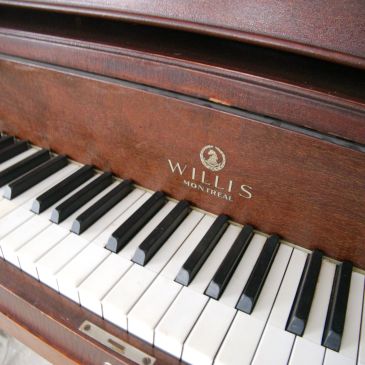
For 27 years, a piano made in Montreal, Canada in 1911 occupied a silent corner of our living room, a relic of bygone days. Years ago we inherited the piano when my wife’s parents downsized from their larger home to a smaller one. They did not want it then and we do not want it now!

Willis upright piano C.1911

Over the years the dust settled on its keys, it was seldom played and its once-grand presence faded into the background of our lives. In the fall of 2023, we made a decision to repurpose the room it was in and it and other pieces of furniture unfortunately had to go.

Despite numerous attempts over several months to find it a new home or a willing buyer, the piano remained an unwanted fixture, a stubborn reminder of the past. We contemplated tuning the piano and refinishing the cabinet, but the restoration far exceeded its actual value. And then, what use would it serve!

The beginning stage of dismantling the piano

Faced with the inevitability of its disposal, we decided to dismantle the piano, a task that turned out to be more challenging than expected. Disassembling it isn’t as straightforward as using a sledgehammer to smash it apart; it requires a systematic approach, considering which parts to remove first to access other sections. And, its considerable weight made the task of shifting it even a few inches from the wall a truly herculean effort.

As we hammered, pried apart, and unscrewed the piano over the course of four days, we expected to feel a mix of emotions, but nostalgia didn’t hit us as we thought it would.

The piano, once the center of musical gatherings, was scattered into hundreds of pieces destined for new purposes. We salvaged pieces of the aged mahogany veneered wood that would be useful for future projects.

Sections are set aside for future repurposing

All metal parts, the cast iron frame, piano wire, nuts, bolts, screws (and there are a lot), and every other bit of metal were donated to a local recycler who happily came by with his aged pickup truck to collect the pieces. What we could not keep or donate was sent to the curb as trash.

There are more parts than you can imagine on an old piano

Among the salvaged wood, a particular piece caught our attention. It was perfect as a clock shelf and it required no trimming or cutting.

A reclaimed shelf

As we affixed the reclaimed wood to the basement wall, our shelf now held several antique clocks, each with its own unique character. The irony of a 110-year-old discarded piano giving life to a shelf that now held clocks of varying ages, some younger than the shelf itself was not lost on us.

Displayed on the shelf from left to right is a Jerome & Company round top, a mantel clock from the Hamburg American Clock Company (HAC), a Seth Thomas marriage (the movement (ST) and case are from different makers), an E.N. Welch clock with alarm function, and another HAC from Germany. All are 8-day time and strike clocks and in top running condition.

Five mantel clocks

In the basement’s hushed atmosphere, the clocks ticked in sync with the faint echoes of the piano’s past, forming a connection between the past and present.

Do we have any regrets, not in the least.

Honouring History, One Tick at a Time – the Halifax Explosion Dec 6, 1917

In the heart of North End Halifax, on December 6, 1917, a Junghans Crispi clock fell off a wall in a house on Princess Court. Unbeknownst to it, this simple clock would become a silent witness to one of the worst man-made disasters in Canadian history – the Halifax Explosion.

The cloud produced by the explosion

As the Belgian relief ship Imo collided with the French munitions vessel Mont-Blanc, a catastrophic event unfolded in Halifax’s harbour. The explosion at 9:04:35 a.m. reshaped the landscape, claiming 2,000 lives with 9,000 injured, and left an indelible mark on Halifax’s history.

Since some case parts were missing, a catalog image of the clock served as a helpful reference
How the clock was received

Fast forward to 2017, a century later, and the remnants of that clock found their way into my hands. The following journey is about a box of clock parts, carefully preserved by a family for generations, passing through to a new owner to be revived and displayed as a connection to history.

Very dirty movement
The movement was very dirty but intact

The task of reviving the clock, and turning it into a connection to history is a process that took over two months.

The restoration unfolded step by step. The clock parts were carefully cleaned, new parts were fashioned, and the correct materials were found to restore the Junghans Crispi wall clock to renewed glory. The hands, frozen since that fateful day, started moving again – a symbol of human resilience.

The restored Junghans Crispi wall clock was finally unveiled in late 2017 and has been ticking away and gracing the wall of our dining room ever since then. Its polished wooden frame, bold brass accents, and rhythmic ticking resonated with the shared history of a city and a clock that refused to succumb to the ravages of time.

As we mark the 107th anniversary of the Halifax Explosion, my Junghans Crispi wall clock stands as a symbol of resilience, remembrance, and the power of restoration.

In the quiet corners of North End Halifax, it tells a story that transcends time – a tale of survival, renewal, and the enduring spirit of a community that rebuilt itself from that terrible moment.

Rise and Shine, Industrial Style

During the early stages of the Industrial Revolution, a peculiar practice persisted well into the 20th century. This era predated the availability of affordable and reliable alarm clocks, leading to a reliance on professions that we may find unconventional today.

One such profession was that of the “knocker-upper.” The primary responsibility of the knocker-upper was to ensure people arrived at work punctually. This occupation thrived in the industrial hubs of England and Scotland, where many individuals couldn’t afford personal timekeeping devices.

This practice lasted well into the 1940s

Knocker-uppers were often women, the elderly, or occasionally police constables seeking extra income. Armed with a long stick, they would tap on bedroom windows and swiftly move on to the next client without lingering. Some employed alternative methods such as rattles, soft hammers, or even pea shooters to rouse their clients from slumber.

Seth Thomas alarm clock
An early 20th-century Seth Thomas alarm clock

The challenge for the knocker-upper was to have as many customers as possible in as small a circle as possible and to cover ground as quickly as possible in the morning. It became a sprint race in the morning and the more agile you were the more customers you had.

The service costs but pennies per customer per week.

Today if someone knocked on our window in the morning you would be understandably alarmed but back in the old days it was the only way workers could be roused in the morning so that they could get to work on time.

Of course, the question remains; who knocked up the knocker uppers?

The Quirky Charm of a Vienna Regulator Clock

In this post, I describe an unusual issue when relocating my mini Vienna Regulator clock. Out of all my clocks, this one tends to be the most sensitive when I move it to a different location in my home. I’ve previously shared my experiences with this clock because it’s not the first time I’ve encountered issues.

Medium-sized Vienna Regulator C.1870

Exploring a brief history of Vienna Regulators provides insight into why this clock is a significant milestone in horological evolution.

The Vienna Regulator clock, also known as the Vienna wall clock, is a type of precision pendulum clock that originated in Vienna, Austria.

The style and craftsmanship of Vienna Regulator clocks are often associated with exceptional quality and precision.

The development of the Vienna Regulator clock was influenced by several factors. One of the key factors was the rising demand for accurate timekeeping during the Industrial Revolution. Vienna, as a center of craftsmanship and technological innovation, played a vital role in meeting this demand.

Vienna regulators are distinctive and typically have a slender wooden case, which houses the pendulum and the clock mechanism. This design allowed for a longer pendulum, resulting in greater accuracy. The movement was typically attached to a frame on the backboard of the case by a keyhole design which allowed the movement to be lifted and removed from the case for servicing. The pendulum was often enclosed in a glass door or window, allowing the movement to be admired from the front and side panels while protecting it from dust.

Vienna Regulator dial

The cases, made of various types of wood such as walnut, oak, or mahogany, were often finely crafted with decorative inlays, carvings, or veneers. The clocks featured a white enamel or porcelain dial, usually adorned with Roman numerals and ornate hands.

The movement of the Vienna Regulator clock was powered by weights suspended on cables or cords. The weights (up to three) were typically wound up once a week, providing the necessary power for the clock to run accurately. While the majority of these clocks were designed to operate as 8-day runners, some were specifically engineered to run for 30 days and longer.

During the 19th century, the Vienna Regulator clock underwent several design changes. The earlier models, known as “Vienna Regulators of the Biedermeier period,” were characterized by a simpler and more classical style. Later models, influenced by the emerging Victorian and Rococo revival styles, featured more elaborate ornamentation and decorative elements.

While the popularity of the Vienna Regulator clock declined in the early 20th century with the advent of more modern clocks, it remains valued by collectors and enthusiasts today.

It’s also worth noting that the term “Vienna Regulator” typically denotes a clock style commonly manufactured in Germany and Austria from approximately 1804 to the end of the 19th century, even if it wasn’t necessarily crafted in Vienna.

But let’s go on.

What is making this clock stop?


During an unusually cold winter day, a substantial plumbing problem caused significant leakage from a ceiling pipe in our family room. To address the damage, we had to replace the pipes and patch the ceiling. During the repairs, we decided to refresh the room’s decor, taking the opportunity to make a few changes. As part of the update, we moved our Vienna Regulator clock from upstairs to the family room to showcase its elegance.

After running flawlessly for a few days, the clock stopped. I checked the clock’s beat, adjusted it, and confirmed its proper vertical orientation. This resulted in the clock running for a few hours before encountering another stoppage.

Suspecting a tangled cable issue which could cause a loss of power to the movement, I took the movement out of its case and carefully rewound the cable onto its take-up reel but this did not resolve the issue.

Could the problem be related to wear? I removed the movement from its case and disassembled it, inspecting for any signs of wear including bent arbors, or damaged or worn teeth. However, I found no such issues. In fact, the movement looked very clean, and the oil in the pivots appeared to be in excellent condition.

Vienna regulator movement
Vienna regulator movement, very clean with no issues

After reinstalling the movement into its case and reattaching the weight and pendulum, I noticed a slight wobble in the pendulum, that was not visible from afar.

Out comes the movement which consisted of removing the weight and unhooking it from the frame posts. Upon reexamining the movement, everything appeared to be in proper order. In most clock movements the suspension spring is physically attached to the movement. In clocks of this type, the pendulum rod is attached by the suspension spring to the backboard frame, and there could be a tendency to overlook inspecting the suspension spring as the cause of the stoppage.

This time, the problem was identified as a slightly kinked suspension spring. Lacking a spare, instead of replacing it, I removed the pendulum assembly from its case and used the shaft section of a small screwdriver to smooth out the kink. A temporary fix, to be sure, till I source the correct spring for this clock.

Some clocks can be temperamental and a clock that works fine in one location may not work in another. However, it would appear that moving the clock from one location to another caused a deformity in the suspension spring. So, the fault was mine.

After smoothing out the suspension spring it runs better

My other Vienna Regulator keeps ticking without a hitch, unlike this clock which tends to act up when moved. It’s running fine now and will stay at its new location which is back upstairs.

My clock says 31 days – what does that mean?

Dropping in Facebook Marketplace from time to time is interesting because there’s always the possibility that an unknowing seller might list an antique clock without realizing its true value. Occasionally, I strike gold, however, the majority of listings mainly feature commonplace antique clocks, alongside an overwhelming abundance of quartz-driven ones.

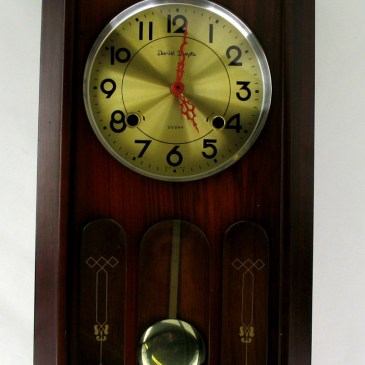
Daniel Dakota wall clock, one of Tempus Fugits more popular models
Daniel Dakota time and strike wall clock

On any typical day, it’s a common occurrence for me to find more than half a dozen 31-day clocks available for sale.

What is a 31-day clock

A 31-day clock is a type of mechanical clock that runs for about a month before it needs to be wound up again. It has a pendulum that swings back and forth to regulate the time. The name 31-day clock comes from the fact that it can operate for 31 days without stopping, but some clocks may run for a few days more or less depending on their level of wear.

A Chinese-made 31-day clock converted to a quartz movement

A significant number of these clocks are designed as spring-driven time-and-strike models, meaning they strike every half-hour announcing the time on the hour.

Most 31-day clocks originate from China or Korea, with trade names such as Citizen (not to be confused with the watch company), Daniel Dakota, Alaron, Olympia, Sabre, Beacon, and well, the list goes on. Directional arrows near the winding arbours typically give away the origin of the clock, with a common association being Chinese or Korean manufacture.

Daniel Dakota movement
The hallmark features of a 31-day movement are powerful mainsprings and thin plates

Acquiring a vintage 31-day wall clock manufactured in China or Korea will not set you back very much. These clocks were and still are widely available since they were produced in massive quantities during the 1960s through to the 1980s. It is a safe bet that a vast majority, around 99%, have never seen the inside of a clock repair shop. Their inexpensive movements appear remarkably resilient, enduring for long periods and finally meeting an unceremonious end in the trash or, popping up on online for-sale sites such as Facebook Marketplace.

Clockmakers typically prefer to avoid servicing these clocks and may encourage you to swap out the mechanical movement for a quartz one if the clock is not functioning. This is primarily due to the powerful and potentially hazardous mainsprings in 31-day clocks, which make working on them a risky task. Secondly, these clocks have such low value that any maintenance, even basic oiling, will cost many times more than the clock is actually worth. Thirdly, replacement parts are impossible to find and any repairs necessitate salvaging components from similar movements. Indeed, converting them to quartz movements is not such a bad idea.

The Distinction Between 31-day and 30-day clock

31-day clocks should not be confused with antique 30-day clocks, such as those produced over a century ago by companies like Seth Thomas, Welch, Waterbury, and makers of 30-day Vienna Regulators.

The latter boasted sturdy movements with deadbeat escapements, large cases, and dials, and a significant number were powered by weights. These clocks were more accurate than the average domestic clock of the time and were often found in public places such as post offices, libraries, business offices, retail establishments, and factories. Unlike 31-day clocks, collectors find these clocks desirable.

If you are fortunate enough to come across a 31-day clock at a remarkably low price, it’s important to temper expectations regarding its resale value. Despite being budget-friendly acquisitions, these clocks typically don’t appreciate significantly in value, and it’s wise to view them more as charming additions to your collection rather than lucrative investments.

Junghans round-top mantel clock – wrapping up servicing

In the past two weeks, my focus has been directed towards the servicing of a Junghans roundtop mantel clock. This particular time and strike mantel clock is the Hunsruck model manufactured in the second half of 1913 (stamped B13 on the rear plate). For first impressions and background information about the clock itself, you can go here. For a description of mainspring servicing, you can find that article here.

Junghans Hunsruck mantel clock C.1913

During this part of the servicing process, my attention will be focused on bushing work, reassembly (with some tips), final testing, and addressing the condition of the case.

Back of movement showing strike block and pendulum

My initial assessment revealed that the movement was generally in good condition. While some previous work had been done on it, limited to a basic cleaning, no substantial repairs were evident. Nevertheless, a conspicuous buildup of dirty oil was observed in most pivot holes, underscoring the need for a good cleaning.

Avoid using a taper pin for this lever (see arrow), as it would result in the lever being excessively tight; opt for a thin wire instead

Upon closer inspection, elongated pivot holes in three locations told me that new bushings were necessary: specifically, the third wheel time side, back plate, and both the front and back plates of the star wheel. The star wheel runs off the count wheel and it is the star points that move the tail that activates the hammer to produce the strike on the half hour.

The pivot holes were carefully cleaned out using toothpicks as the first step in the cleaning process. Subsequently, I examined the pivots on each wheel by running a fingernail across them to detect any ridges or imperfections, and they appeared to be in excellent condition. I also verified the integrity of the pins in each lantern pinion. Upon confirming that I had addressed all that I could at this point, the next phase involved cleaning the components in the ultrasonic cleaner.

Once everything was out of the ultrasonic cleaner all components were thoroughly dried to remove all traces of residual moisture.

Now to address the worn pivot holes.

A centering bit ensures an accurate cut

If you are accustomed to handling traditional time-and-strike American clocks, the small pivots on these German clocks might cause some unease. The diameter of each bushing measures just 2.47mm (Bergeon bushing size), whereas conventional bushings for an American clock are often 3.47mm and larger (again, Bergeon-sized bushings).

In the above photo, I use a centering bit to ensure a precise cut into the plate so that the bushing can be seamlessly inserted.

To ensure a precise fit the newly installed bushings are reamed using a cutting broach, followed by smoothing with a broach and cleaning with a toothpick. After each new bushing is in place, the wheels are test-fitted to ensure they spin freely plus sufficient end shake.

Given the delicate nature of the pivots, handling each one requires careful attention, as a broken pivot and its repair can be a challenging and intricate task on a German clock.

After the bushings are installed the movement is reassembled. Before attaching the back plate, all wheels, and levers are positioned in their respective locations.

Wheels and levers are ready for the rear place

To avoid having to remove the back plate to make further adjustments after assembly addressing four specific items will ease the process;

  • the count lever paddle must be in one of the deep slots of the count wheel,
  • the cam lever must be on the flat section of the cam,
  • the hammer tail must be positioned between two points of the star wheel (otherwise the tail contacts a star point, and the hammer will be left in the raised position preventing further striking)
  • and the pin on the warning wheel must be in the 12 o’clock position to catch the warning lever.

In my experience, the hammer tail contacting one of the star points is the most common of annoyances and calls for parting the plates. It is worth noting that the levers on clock movements of this specific type are not adjustable so, bending a lever to fit is not possible.

Pivot locator

Utmost attention must be paid to moving the pivots carefully into their respective holes as the risk of a broken pivot is very high at this point in the process. A “pivot locator” is an indispensable tool for safely moving pivots into their holes while working on the movement.

The pendulum is placed such that it can be seen through the front glass portal

Prior to mounting on the test stand, the movement is oiled using Keystone pivot oil. As with oiling any clock, the maxim is “less is more”.

The testing phase is one of the most crucial parts of the process, providing a chance to make minor adjustments and regulate the movement. I routinely ensure that the movement goes through at least two or three operational cycles while mounted on the test stand. Once I am satisfied that the movement is running well and needs no further remediation it goes back into its case.

While the movement is being tested I generally address any issues regarding the case. Little needed to be done to this attractive oak-cased roundtop and a general cleaning with Murphy’s soap and an application of paste wax preserved its patina while sprucing up its appearance.

Servicing an antique clock not only respects its history but also keeps its mechanism working for future generations to appreciate.

A running mechanical clock in a hotel lobby – now that’s something you don’t see every day

Every time I climb the stairs to the upper level of our residence, I find myself in awe of the clock perched on the landing. Crafted in 1848, it likely ticked away the hours for years in an upper-middle-class Scottish household, possibly owned by a farmer or landholder.

Scottish tall case clock
Scottish tall-case clock, Circa 1848

These old tall case clocks, which were built to withstand the test of time, stand in contrast to the throwaway culture of the modern world. They evoke a connection to a slower-paced past, providing a sense of calm.

A prominent dial

In November 2023 my wife and I traveled to Halifax, Nova Scotia (Canada) for an overnight stay and dinner out at a lovely Italian restaurant on Spring Garden Road followed by a play at the Neptune Center for Performing Arts.

La Frasca restaurant, Halifax, Nova Scotia

Upon our check-in at Lord Nelson Hotel and Suites, I observed an old stately clock tucked into a corner and commented to the front desk about the surprise of encountering a fully functional antique tall-case clock in a hotel lobby.

Unknown tall case clock

It’s noteworthy that this establishment, renowned for its classic allure, is recognized for serving a clientele that leans towards the more mature demographic, so an old antique clock did not seem out of place.

The clock face shows a three-train movement

Beyond their practical function, old clocks captivate us with their craftsmanship, and historical significance. They serve as links to the past, reflecting the artistry, engineering, and societal values of bygone eras. The mechanical simplicity offers a stark contrast to our complicated fast-paced digital age.

In the race to perfection we forgot about patina

Life is not perfect. Why should our antique clocks be any different? As we grow older, our possessions undergo a similar transformation. Just as aging imparts a unique character to metal through oxidation and rust, the term “patina” extends beyond its common association with metallic items to antique objects generally. It encapsulates the idea that our belongings, over time, develop distinctive qualities that result from reactions to various elements and the passage of time.

Hamilton Clock Co Gothic steeple clock
Hamilton Clock Co Gothic steeple

Although the hands of a clock move forward no one has figured out how to freeze time or better yet, turn it backward.

During my initial foray into clock collecting and clock repair, my goal was to resurrect non-functional vintage or antique clocks, restoring both their cases and movements to their original state.

While I was tempted to make changes to the case to improve its presentation my priority has now shifted somewhat and lies in ensuring that the fundamental purpose of the clock—accurately telling the time—is fully realized. While addressing structural concerns like a broken backboard hindering the hanging of a wall clock is essential and demands attention, the case, imperfections and all, can be left in its original state.

Arthur Pequegnat Maple Leaf kitchen clock
Arthur Pequegnat Maple Leaf kitchen clock: has its character been lost through restoration?

The purpose of a clock was to serve the original owner in any manner they deemed suitable, primarily by functioning and accurately displaying the time. Any scratches or blemishes on the case were secondary considerations compared to the clock’s primary function of timekeeping. 100 years ago a clock for the family home served as a common reference point for coordinating daily activities. It helped family members synchronize their schedules for meals, work, and social events. Daily household routines, such as waking up, going to bed, and managing chores, were often organized around specific times. A functioning clock (and oftentimes the only clock) was fundamental for maintaining order and structure within the home.

It can also be said that certain clocks were regarded as furniture pieces, receiving the same attention in terms of dusting, waxing, and overall care as any other furnishings of that era. Clocks such as these have survived quite well in their original state and its history has not been washed away with alterations.

The real attraction to unrestored original items is a relatively new phenomenon, perhaps stemming from a response to our modern throwaway society where nothing seems to last. We can point to an old clock and say, that object has lasted all these years despite its age-related scars.

The dilemma of restoration, yes or no to refinishing this clock case?

But does something that takes on a surface appearance that has grown old become a thing of beauty? The answer is, yes. Every bit of patina on a clock speaks to something from its past, things that have happened to a clock through the ages whether you can see the cause or not and that makes the clock more interesting.

A clock that attempts to go back in time through restoration, no matter how good the job is, for all intents and purposes is a facsimile, a replica, or a reproduction. Many might consider all restoration as fiction. However, some folks will take fictitious or like-new any day because new-looking and shiny is somehow “better” and it is their belief that condition always equates to increased desirability.

George H. Clark 30 hour Ogee
George H. Clark 30-hour Ogee, restored by the previous owner; is like-new better?

The concept of patina extends beyond its traditional association with oxidized metal, offering a broader perspective on the aging and transformation of old clocks. Patina embodies a unique character that evolves over time. It reflects a growing interest in preserving the enduring quality of items, a sentiment that contrasts with the disposable nature of our modern society.

Patina is the thing that humanizes an old clock.

Junghans round-top mantel clock – servicing the mainsprings

Last week I began working on a Junghans round top mantel clock. For first impressions and background information about the clock itself, you can find the article here.

During this segment of the maintenance process, my attention will be focused on the mainsprings.

Upon my initial assessment, it appeared that the movement was found to be in decent condition, overall. A noticeable accumulation of dirty oil in the majority of pivot holes told me that a thorough cleaning was necessary.

Junghans movement with the back plate removed

Upon closer inspection, elongated pivot holes in three locations tell me that new bushings need to be installed: specifically, on the third wheel time side, back plate, and both the front and back plates of the star wheel. The star wheel runs off the count wheel and it is the star points that activate the hammer for the strike.

But first, let’s focus on the mainsprings.

In my experience neglecting certain steps during clock servicing can result in potential future complications.

One side of the barrel is open

For example, there is a temptation to overlook the mainspring barrels, yet it becomes evident that unless one is confident about the absence of accumulated dirt and grime within the spring barrel, certainty can only be achieved through disassembly. Moreover, the open design of this particular barrel increases the likelihood of dirt penetrating the springs.

While mainsprings can be removed from their barrels by hand and subsequently coiled back in by hand, a mainspring winder, such as one made by Olie Baker, is an essential tool for the serious repairer.

Time side mainspring on an Olie Baker spring winder, an appropriately sized collar is on the right

Removing and reattaching the caps to any barrel can be quite cumbersome. With this particular barrel, a convenient and swift method involves using a small slotted screwdriver in one of the two small openings to easily pry open the cap.

A small slotted screwdriver is inserted in the opening to pry open the cap

The importance of wearing leather gloves for safety cannot be overstated.

Tightening the mainspring allows for the insertion of the collar

A firm grip on the barrel ensures a predictable and controlled process.

The collar is in place and the spring can be let down and removed from the barrel

During the removal of the mainspring, a thorough inspection is conducted to identify potential issues such as stress cracks, unusual wear, pitting, and the accumulation of rust. Subsequently, the spring undergoes a meticulous cleaning process to eliminate any dirty oil, followed by reoiling, before being reintegrated into the barrel.

Reattaching the cap to the barrels can be accomplished by employing two small clamps to gently guide the cap into position.

Two clamps help to guide the cap in place

Once more, the use of gloves guarantees safety.

Upon proper placement, the cap will emit a distinctive “snap” sound.

Both mainsprings have been serviced and the barrels cleaned in the ultrasonic machine

The springs in this particular clock appeared to be in excellent condition and are suitable for reuse.

Meanwhile, it is essential to inspect the barrel teeth for signs of wear, particularly focusing on any bent or damaged teeth during this stage. Worn teeth may result from a spring that is too powerful and not correctly rated for this clock, while broken or bent teeth could be indicative of a mainspring failure.

Next, we proceed with the remainder of the maintenance for this time and strike clock, moving on with the polishing of pivots and bushing work. Join me in a few days as we continue the servicing of this Junghans movement.

Thoughts on the Online Antique Clock Market: Tips for Smart Buyers

During my recent exploration of Facebook Marketplace, I came across many clocks at a variety of price points. It was no surprise to find many options, ranging from reasonably priced ones to some that seemed somewhat overpriced. The listings included quartz mantel clocks from the 1970s and 80s, vintage Chinese clocks from the 60s, as well as the typical assortment of Bulova and Howard Miller mantel and grandfather clocks. Some clocks were marketed as antiques, though clearly, they did not meet the criteria. However, none of these caught my attention enough to warrant a closer inspection.

30-hour time and strike mantel clock, similar to the Gilbert clock

One clock piqued my curiosity – a Gilbert model that bore a striking resemblance to one already in my collection though by a different maker. The seller had priced it at $225 and provided detailed photos showcasing different angles, including a shot of the movement. Interestingly, the final photo displayed a screenshot from eBay, where the same clock was listed for a whopping $925 by a different seller. The intent of course was to make it seem that the seller’s clock was a bargain by comparison.

So, being curious, I ventured onto eBay and came across several intriguing listings. However, I noticed that some of these listings did not accurately represent the actual value of the clocks being sold.

For instance, there was a Sessions mission-style mantel clock listed at a staggering price of $1092. Personally, I find it hard to believe that any Sessions clock ever made could command such a high value. A New Haven mantel clock touted as “rare” and painted in a “modern eye-catching” blue shade, is listed at $341. However, the cost is further escalated by a $95 shipping fee, making it a rather expensive purchase.

To be fair, I did come across some clocks on eBay that were reasonably priced. However, in general, it is becoming increasingly common to find clocks listed at prices that don’t align with their true value.

So why is this happening?

There are a number of reasons, some of which are:

  1. Sellers might overvalue their items, hoping to fetch a high price, especially if they believe their clock is rare or unique.
  2. Inexperienced sellers might set prices based on misinformation about the item’s market worth, leading to an inflated listing.
  3. Sellers may use misleading or exaggerated descriptions and photos, making the clock appear more valuable or rare than it actually is.
  4. eBay’s algorithm might suggest prices based on historical data, including past listings where sellers may have inflated prices. This can create a cycle of high listings.
  5. Established sellers with positive feedback may be able to command higher prices based on their reputation, even if the item’s value doesn’t align with the actual price.
  6. And finally, some sellers might attach sentimental value to their clocks, leading them to set prices higher than what the market might dictate.

While sellers may set higher listing prices, what many shoppers may not undersatnd is that the realized price, the amount the item actually sells for, is what truly matters. It’s essential for buyers to assess the realized prices of similar items to gauge the market value accurately and make informed purchasing decisions.

Advice for buyers and sellers

Buy antique clocks locally if you can. When purchasing locally, you can physically inspect the clock, assess its condition, and verify its authenticity. This hands-on approach minimizes the risk of buying misrepresented or damaged items. Local purchases eliminate the need for shipping, which can be otherwise costly. Dealing face-to-face with a local seller provides an opportunity for negotiation.

A local purchase, a time-only Vienna Regulator

Personal interactions can often lead to better deals and a chance to learn more about the clock’s history from the seller. And finally, purchasing locally allows you to take your antique clock home immediately after the transaction, without waiting for shipping and delivery times.

For sellers, look for similar antique clocks online or in specialized antique shops to see what similar pieces are being sold for. This will give you a baseline for comparison. Auction houses often publish realized prices on items sold. They can also offer insights into the current market demand and the prices similar clocks have fetched at recent auctions.

Attending antique shows and fairs can provide an opportunity to see a wide variety of antique clocks and gauge their prices. You can also talk to dealers and collectors, gaining valuable knowledge from their expertise. Online marketplaces other than eBay, such as Etsy, or specialized antique platforms can give you an idea of what similar clocks are listed for.

Antique-related magazines and publications that feature clocks can provide insights into current trends, notable sales, and expert opinions.

Joining local or online antique collector’s clubs can connect you with enthusiasts and experts who have extensive knowledge about specific types of clocks. These communities often share information about recent sales and market trends.

By consulting these various sources, buyers and sellers can gather a comprehensive understanding of the antique clock market, enabling them to make informed decisions about pricing their items.

Online antique purchases can be fraught with potential problems but preparation and thorough research are always a benefit to both the buyer and the seller.

Junghans round top mantel clock servicing

I first wrote about this clock in April 2023 after having won it at auction. With so many other projects on the go, I can finally allocate time to focus on servicing this captivating German time and strike mantel clock.

Auction photo

The 1915 Junghans catalog identifies the clock as the Hunsruck, named after a mountain range in Germany, and provides its specifications as 28.5 cm in height with a mahogany or oak case construction, a 14-day run time, and a silvered dial. This clock is the mahogany cased model.

Junghans Hunsruck model

The movement is a time-and-strike design that was a hallmark feature of numerous Junghans mantel clocks during that period. I have one other Junghans mantel clock with an identical 151 movement.

Junghans Corner feet finished
Junghans Sydney with the 151 movement

The Junghans trademark is boldly showcased on the gong block and inscribed on the back of the movement. On the back plate, it is stamped B13 which denotes the movement as having been manufactured in the latter part of 1913.

Removing the movement from the case is relatively straightforward. The movement, which rests on a wooden support board is held in place by two rather large 1 1/8 inch wood screws. After taking the movement out of the case, two brass thumbscrews are removed to release the seat board.

Assessment

Upon my initial assessment, it appears that the movement is in decent condition, overall. However, there is a noticeable accumulation of dirty oil in the majority of pivot holes, indicating a thorough cleaning is necessary.

Junghans movement with the back plate removed

Upon closer inspection, elongated pivot holes in three locations tell me that new bushings need to be installed: specifically, on the third wheel time side, back plate, and both the front and back plates of the star wheel. The star wheel runs off the count wheel and it is the star points that activate the hammer for the strike.

I use toothpicks to carefully clean out the pivot holes before immersing the plates in the ultrasonic cleaner as part of my standard practice. With a soft cloth, I clean and inspect the pivots on each wheel using a fingernail across the pivot to check for ridges and imperfections. I then check the integrity of the pins in each of the lantern pinions. Once satisfied that the inspection is complete the next step is cleaning the parts in my ultrasonic cleaner.

I will pause here and resume next week with the continuation of servicing the Junghans type 151 clock movement, including details about the necessary bushing work. Additionally, I will provide insights into the case’s condition. Stay tuned for the conclusion!

Three arguments for eliminating Daylight Savings Time

Here are three commonly cited reasons for eliminating the cursed Daylight Savings Time convention:

One of the main arguments against daylight saving time is its impact on human health. The abrupt shift in the clock can disrupt people’s sleep patterns, leading to sleep deprivation and increased stress. Studies have shown a rise in heart attacks, strokes, and even car accidents in the days following the time change. By eliminating DST, people would maintain a more consistent sleep schedule, promoting better overall health and well-being.

A made-in-Canada Pequegnat clock from the 1920s

Critics argue that the practice of changing clocks twice a year imposes economic costs on businesses and individuals. The process of adjusting various devices, systems, and schedules can be time-consuming and costly. Moreover, the disrupted sleep patterns of employees can lead to decreased productivity in the workplace. By eliminating DST, businesses would avoid these costs and potentially see a boost in productivity due to a more rested workforce.

Canadain made ogee style clock

One of the original reasons for implementing daylight saving time was to conserve energy by making better use of natural daylight during the longer days of summer. However, with advancements in technology and changes in energy consumption patterns, the energy-saving argument is now considered outdated. Modern studies have shown that the energy savings from DST are marginal, if any, and in some cases, it might even lead to increased energy usage due to higher air conditioning demands on hot evenings. Therefore, proponents of eliminating DST argue that the energy conservation rationale no longer holds, making it unnecessary to continue the practice.

30-hour shelf clock from the USA

These arguments, among others, have fueled ongoing debates about the relevance and effectiveness of daylight saving time, leading to discussions and policy changes in various regions.

But not in Nova Scotia, Canada. Prepare to set your clocks backward on November 5th at 2:am.

Time to service a Classic Sessions Schoolhouse Clock – cleaning & testing the movement

In the first segment of this two-part series, I detailed the assessment process of this Sessions time-only movement, which can be accessed here. This article explores the next steps in the servicing of this clock movement. I will also offer in-depth observations regarding the case’s condition and comment on any additional issues that have emerged subsequent to the assessment phase.

Sessions Schoolhouse clock

Two years ago, I acquired this Sessions schoolhouse clock at an auction with the intention of adding it to my collection of similar 19-inch clocks. The purpose behind this acquisition was to create a set of “time zone” clocks, as my children are scattered across the country. This setup allows me to easily glance up and determine the time in their respective areas.

The back of the movement


In the initial assessment of the movement, I anticipated no significant surprises or wear due to the prior work done on it.

To disassemble for inspection, I removed the movement from the case. Using a let-down key, I restrained the mainspring with a C-clamp and then removed the 4 bolts holding the movement together. After taking out the mainspring, I inspected the remaining parts for wear. I observed slight elongated wear on the second wheel bushing hole but found no major issues requiring remediation. Further examination revealed minimal grime in the pivot holes and a lack of lubricating oil. Overall, the movement showed little wear.

And now, on to servicing the movement.

Using an emery board to polish the pivots

Using my Taig lathe I polished each of the pivots. Polishing methods may differ but I prefer to use a fine-grain emery board. Emery boards are affordable and ideal for the task at hand.
I slide the emery board horizontally while the pivot rotates within the lathe and clean off any residue on the pivots with a soft cloth.

All components are immersed in the ultrasonic cleaner, and after approximately 15 minutes in the cleaning solution, the parts are removed and thoroughly dried using a gentle cloth and a hairdryer to eliminate any remaining water within the lantern pinions.

Since there’s no requirement for bushing work, the procedure remains straightforward, and the components are reassembled after the drying is completed.

Once all the parts are together the pivots, entrance & exit pallets, saddle pin, mainspring arbour, and crutch loop are oiled using Keystone clock oil.

After assembly, the movement undergoes a testing period, which may extend for days or even weeks. However, for this particular time-only movement, because of its simplicity, the testing duration is shorter.

The case and dial

The case is very well-preserved, devoid of the typical dents and marks often encountered on clocks from this time period. Cleaning with soap and water will suffice.

I only realized that the entire dial face, except for the chapter ring, had been repainted after I started loosening the screws for the dial bezel. I hadn’t noticed this previously and had assumed it was a replacement dial because it appeared to be in such good condition. Achieving this required a steady hand, and as a result, it looks very well done.

Repainted dial face

Despite the care and attention given to preserving the movement and case, it is noteworthy that the hands are incorrect. Sessions would have originally used solid spade hands instead of pierced ones, and, naturally, both the hour and minute hands are too short.

On the test stand

The test stand

While on the test stand, I had to make two adjustments to the recoil escapement. The entry and exit pallets were too far from the escape wheel which necessitated moving the saddle slightly in towards the escape wheel. This is the drop most often referred to and it can be visualized as the airspace between the leading corner of a tooth point and the part of the pallet it is about to fall on. The other is a crutch adjustment to bring the movement to the correct beat.

Two days on the testing stand prove to be adequate, and the final step involves reinstalling the movement back into its case.

Time to service a Classic Sessions Schoolhouse Clock – initial assessment

Two years ago, I acquired this Sessions schoolhouse clock at an auction with the intention of adding it to my collection of similar 19-inch clocks. The purpose behind this acquisition was to create a set of “time zone” clocks, as my children are scattered across the country. This setup allows me to easily glance up and determine the time in their respective areas.

Three time zone clocks. The centre clock is the subject of this article

In this blog series, I will first guide readers through the assessment process, providing a detailed account of my findings. In the second part, the next blog article, I will walk you through the movement’s servicing and testing phase.

This clock belongs to the schoolhouse clock style. The origin of the name “schoolhouse clock” is not well-documented, and it appears that the term was not used during the time these clocks were made. Instead, it was later coined by collectors to describe a particular style of clock commonly found in school settings.

Sessions Drop Octagon bob

Schoolhouse clocks were the standard design for early North American schoolhouses due to their larger, easy-to-read dials. They were widely hung in schoolrooms across Canada and often had simple time-only movements, although some versions included a calendar function or time and strike movements. These clocks had a utilitarian look and were known for their durability.

The design of schoolhouse clocks is believed to be influenced by English drop dial fusee clocks, which were produced in the late 18th and 19th centuries. Drop dials closely resembled schoolhouse clocks and featured conical constructions with a chain or gut line pulled by a mainspring barrel, providing even power release for improved accuracy. Complicated movements such as these did not find their way into inexpensive mass-produced American and Canadian schoolhouse clocks.

Label on the back of the clock

However, not all of these clocks spent their lives in schoolhouses. The back label bears the stamp “Office,” indicating that in addition to school settings, these clocks were also used by small businesses in retail areas or in office settings.

Assessing the condition of the movement

The clock was in working order when I received it. When I removed the dial which is held by 4 brass screws I was delighted to find the movement to be very clean and in very good condition overall.

The movement has been worked on in the past as there are 2 new bushings on the back plate, the number 3 wheel, and the escape wheel bushing. On the front, one bushing on the escape wheel bridge was replaced.

In addition the click spring, both click and wire have been replaced. A note to those working on Sessions time-only and Sessions time and strike clocks from this era: it’s important to be aware of the company’s history of poorly designed click springs. Therefore, it’s not unexpected to find this one replaced.

Back of movement

The suspension spring and pendulum leader have also been replaced. The mainspring has the letters MB stamped on the arbour loop which leads me to believe that it may be a replacement. In all, the work was completed by a competent repairer, in my view.

There is no oil remaining in the pivot holes as the oil has dried up completely. Further running of this movement as-is is a recipe for accelerated wear. Finding the right balance is crucial when applying oil. Excessive oil can attract dust and dirt, transforming it into grinding paste, whereas too little can lead to premature drying of the pivots. In general, however, the old adage holds true: less is more!

Disassembly

In view of the work done on this movement in the past, I am not expecting any further surprises or appreciable wear as I disassemble the movement.

To disassemble the movement, first remove the movement from its case. There are 4 screws holding the movement to the backboard and once released the movement easily comes out. Using a let-down key, the mainspring is restrained by a C-clamp and the 4 bolts holding the movement together can be easily removed with a slotted screwdriver. The mainspring is then taken out after which a further inspection takes place.

Next, I check for wear by removing the mainspring and reattaching the top plate with all wheels, including the escape wheel, in place. By spinning the wheels I can visualize how each wheel interacts with the adjacent one. There were no surprises but there is very slight elongated wear on the second wheel bushing hole, back plate but not enough to be concerned about at this point.

Before cleaning the movement in the ultrasonic machine I begin by pegging the holes using toothpicks. My objective at this point is to determine how much dirt and grime are present in the pivot holes. Not surprisingly there was very little grime but again the absence of any lubricating oil. I then checked each pivot for unusual signs of wear and in the case of this movement, there was little, if any, wear.

Well, that is all for now.

An upcoming article will delve deeper into the ongoing process of servicing this clock movement. Additionally, I will provide insights into the condition of the case and address any other issues that might have surfaced during the assessment stage.

A Guide to Choosing Antique and Vintage Clocks as Unique Gifts

As the holiday season approaches, the search for a unique and meaningful gift becomes crucial. Antique or vintage clocks, often overlooked, can make a delightful and “timely” present. Whether you’re knowledgeable about clocks or a novice, finding the right one requires some understanding, and I’m here to provide you with some helpful pointers and explanations.

Why Buy an Antique or Vintage Clock?

People are drawn to antique or vintage clocks for sentimental reasons, the desire to own something antique, or the allure of a unique old mechanical clock. These reasons often top the list for those considering such a purchase.

Antique, Vintage or collectible

Determining the age of a clock can be tricky but a well-informed seller can confidently provide accurate information about the clock’s age to potential buyers, ensuring a fair and transparent transaction. Moreover, a clock’s age can often be determined through a date stamp on the movement or labels, providing accurate dating information for both sellers and buyers.

Generally, anything over 100 years old is considered antique, while vintage refers to items less than 100 years old but more than 30 years old. Items younger than 30 years are often called collectibles.

A Mauthe vintage clock from the 1940s

Types of Clocks: Mechanical or Otherwise

While there is a wide variety of clocks available, this article focuses on mechanical clocks both vintage and antique. Quartz clocks are common but have limited value. Electro-mechanical and electromagnetic clocks, while intriguing, are best left to expert collectors. Electric clocks from the 1930s and 1940s might intrigue the buyer but can be difficult to maintain and a non-functional clock can be potentially dangerous to those with a limited knowledge of electrical devices.

Choosing the Right Clock and Placement

Consider the available space when selecting a clock. Mantel clocks need shelves or tables, while wall clocks come in various sizes and styles and placement is less of a challenge. Although wall clocks require minimal space, some are hesitant to puncture a wall with a nail.

Ingraham Grecian
Ingraham Grecian shelf or mantel clock

Grandfather clocks (otherwise known in some circles as tall case, long case, and hall clocks), particularly those with impressive craftsmanship require ample floor space and a keen appreciation from the recipient.

Scottish tall case clock
Know the recipient if you are gifting a tall case clock

Furthermore, gifting a grandfather clock to an appreciative recipient ensures that it becomes a cherished heirloom, to be passed down through generations.

Cottage clocks, alarm clocks, and novelty clocks are compact, allowing them to fit into small spaces and be placed virtually anywhere.

This Sessions cottage clock is only 9 inches tall

Working or Non-Working Clock?

Ideally, a working clock recently serviced by a professional is the best choice and has the highest value. If a functional clock is used purely for decorative purposes, it can later be sold without affecting its value.

Sessions American No. 2
Sessions American No. 2, a working clock gifted as a decoration

If the clock serves a primarily decorative purpose, non-working ones can still be considered. Clocks as decorations often add a touch of vintage charm to a space, enhancing its aesthetic appeal. They can also evoke a sense of nostalgia, reminding individuals of days gone by. In addition, antique clocks with intricate designs can be conversation starters, becoming focal points in a room and reflecting the owner’s unique style and taste.

Tips for Clock Buying:

  1. Give preference to clocks that are operational; they are typically better maintained and can be easily resold by the recipient.
  2. Explore platforms like Facebook Marketplace, eBay, or local online sale sites. Opting for local transactions is favored because it eliminates the inconvenience of shipping, and meeting the seller in person provides the buyer with the flexibility to reconsider the purchase.
  3. Common clocks such as mantel clocks from the 1930s and 1940s are affordably priced, while unique or rare pieces might come at a much higher cost. In the realm of clocks, the determining factor for pricing isn’t solely the age of the clock, whether it’s 120 years old or 50. Rarity plays a significant role in establishing the value of a clock instead.
  4. Steer clear of clocks featuring directional arrows at the winding points; many of these are mass-produced Chinese clocks that come with powerful mainsprings, posing risks if they malfunction.
  5. The clock’s manufacturer is only vital if you’re seeking an exceptionally unique piece and are willing to spend significantly; instead, concentrate on the overall quality of the clock and its visual appeal.
  6. Conducting research is crucial to making a well-informed purchase decision. Examples are online resources, realized auction sales, networking, antique store visits, and books/publications.
  7. Be wary of any alterations, as they not only impact the clock’s value but can also alter its historical and aesthetic integrity. Thoroughly understanding the clock’s originality through basic research ensures a more satisfying and meaningful purchase.
  8. Whenever feasible, examine the clock in person to prevent unexpected disappointment. During the inspection, pay attention to the clock’s condition, checking for signs of wear, damage, or repairs. Examine the clock’s movement, and listen for any unusual sounds. Assess the quality of the materials and craftsmanship, ensuring they align with the stated age and value of the clock. Confirm the presence of any original parts, as replacement parts (hands, dial face, pendulum bob, etc.) can affect its authenticity and worth. Finally, if possible, request a demonstration of the clock in action to ensure it operates smoothly and accurately.

I hope these insights help you find the perfect clock for your special someone. I want to emphasize that I am not engaged in the business of selling clocks. Although I occasionally sell clocks locally, it’s solely to manage my personal collection and not as a commercial endeavor. Please be aware that I do not have clocks available for sale.

A Gilbert Clock joins two other gallery clocks in my collection

Recently, I acquired a gallery clock in exchange for another clock. I favour wall clocks over other types due to their convenient wall placement, eliminating the need for a shelf or mantel. Additionally, they tend to draw more attention compared to other clock varieties.

The clock I traded, a rare Canadian cottage clock, held significant value, but overall, I am content with the exchange.

Gilbert gallery clock

Gallery clocks are often called pub clocks, canteen clocks, or office clocks.

Gallery clocks are often found in public galleries and exhibition spaces, where they serve both functional and decorative purposes. They are usually placed on prominent walls and are designed to be easily visible to visitors. These clocks can vary in style, ranging from antique designs with Roman numerals to more modern and contemporary styles with sleek, minimalist features.

This time-only gallery-style clock made by the Gilbert Company of USA is nondescript and quite ordinary looking. There is nothing special or distinctive about it.

The casing of the clock is relatively light in weight and based on the wood’s coloration, it seems to be made of cherry wood. A previous owner meticulously refinished the case, and while the result is impressive, it appears almost too flawless.

The clock has a 12″ Arabic dial and is 16 1/2″ across with spade hour hand and minute hand with a heavy brass dial bezel. The dial is constructed from paper and lacks a metal backing, clearly indicating a cost-saving measure.

A 12-inch dial is considered the standard size for a gallery clock and a 12-inch dial would have been the maximum size for a domestic environment. I own a smaller 10″ gallery clock, crafted in England, equipped with a conventional spring-driven movement, specifically designed for placement in a compact office setting. Larger 14″ and 16″-inch” gallery clocks on the other hand would have been found in public areas, factories, and post offices.

At first glance, it’s easy to mistake this conventional spring-driven pendulum clock for a fusee clock. Upon closer inspection, however, its features set it apart from the traditional fusee clock, revealing its true identity as an ordinary mass-produced spring-driven time-only American-made clock.

Movement as seen from the trap door

The winding arbour sits just below the central cannon, and above the centre cannon, you’ll find the Gilbert trademark. Interestingly, the winding arbour is positioned in the same location as that of a typical fusee gallery clock.

This specific movement is present in other Gilbert time-only clocks and is almost identical to the one used in the Gilbert Admiral calendar clock.

Time-only movement
Gilbert Admiral with calendar

A trap door on the bottom provides access to the pendulum. When the clock is hung on the wall, attaching the pendulum to the pendulum rod is nearly impossible. I discovered that laying the clock on its back, attaching the pendulum bob to the hook, and then carefully mounting the clock on the wall is a slightly easier method.

The trap door opens to reveal the pendulum bob

The previous owner found the clock in Virginia and brought it to Canada. The clock was lacking its original glass, but a replacement was included as part of the exchange deal. In addition, the clock was completely serviced, one bushing hole was found to be enlarged and a new bushing was installed.

Two other gallery clocks

The two other gallery clocks in my collection are a clock with a 10″ dial made by a British maker, Empire, and a 12-inch (dial) fusee clock, maker unknown but likely British.

12 ” Fusee clock
10″ gallery clock made in England by Empire

Given that the Gilbert clock underwent a thorough servicing and the missing glass was replaced, my only task remained to find a suitable spot to display it.

Website Powered by WordPress.com.

Up ↑

Antique and Vintage Mechanical Clocks

Collecting, Repairing and Restoring Antique/Vintage Clocks

Skip to content ↓