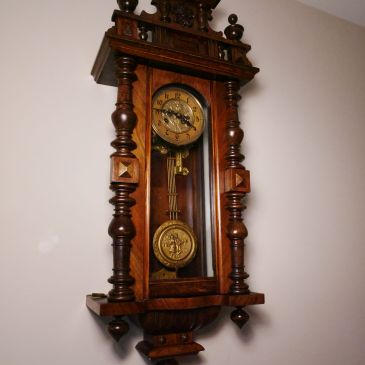
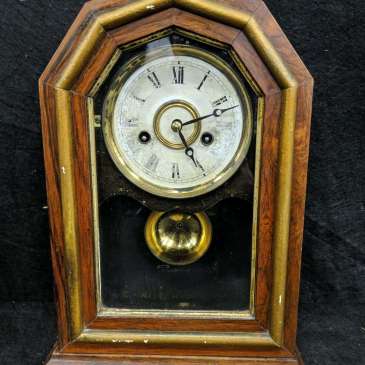
Tick Talk Tuesday #39 – Mauthe box clock

Tick-Talk Tuesday

Tick-Talk Tuesday is about the letters and comments I have received from readers concerning clock issues, challenges faced, a clock you would profiled or advice on your particular clock concern. For those comments and questions that stump even me, I consult within my clock circles for the best possible answer

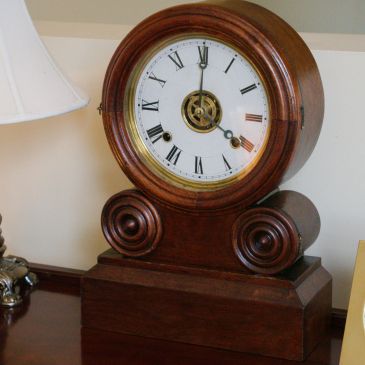
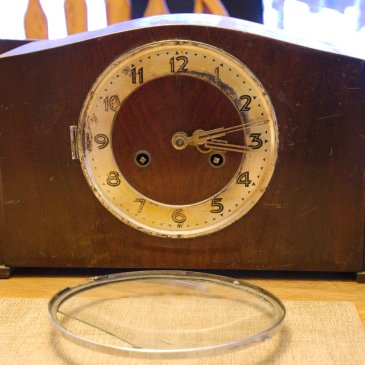
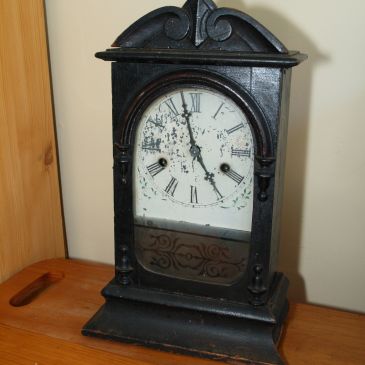
Mauthe box clock

NT writes:

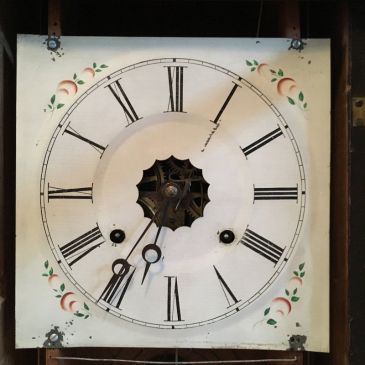
I was wondering if you could take a look a this clock for me. It belonged to my great grandmothers mothers. My great grandma recently passed at 108. I can only imagine the age and value of this clock. I know it’s called Mauthe.

My reply:

Hi and thanks for your email.

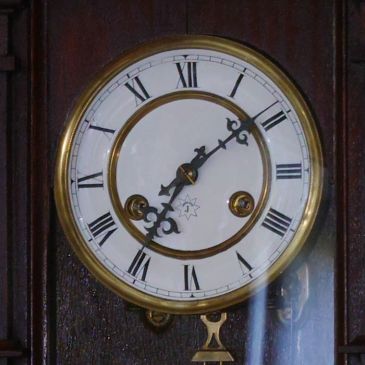
The clock looks to be in fair condition although I would remove the cement/putty(??) on the door frame. These clocks do not have a lot of value, probably the $100-150 range. It looks to be from the 1920s, or 1930s. Some were quite large and ornate with intricate wood carvings but your appears to be at the lower end of a model range.

They are known as box clocks because of their style. Mauthe and other makers made literally thousands of them and they sold very well but the company eventually went out of business in 1976.

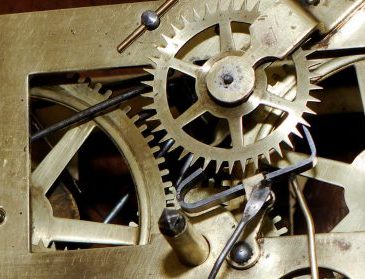
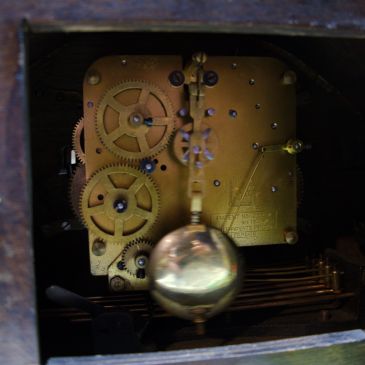
The movements are quite robust and they will last for years and are easily repairable unless there are serious problems as parts for them cannot be sourced.

If it has sentimental value I would keep it, have it cleaned and serviced and displayed in a prominent location. Most Mauthe clocks have wonderful sounding strike gongs but are not loud tickers.

Hope this helps.

Delft clock by Forestville – Let’s take it apart and see what we have

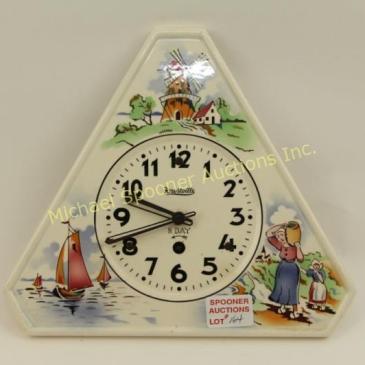
Delft Clock from Forestville

This clock was bought at auction in Ottawa, Ontario, and hung on the wall of the kitchen at our cottage in Quebec for 4 years. The clock was imported from Germany and sold by the Forestville Clock Co. of Toronto, Canada.

It was never a great timekeeper probably because it had never been properly cleaned. I brought it home to Nova Scotia to give it the attention in now deserves.

The word Delft is not a model name but refers to the design and composition of the dial face and surround. According to one source, Delft is “tin-glazed Dutch earthenware with blue and white or polychrome decoration”. Delft also refers to a place in the Netherlands, famous for the manufacture of pottery.

Delft clocks typically had a nondescript Dutch scene as one would expect but since this is not a delft clock by strict definition, it is, instead produced in a German factory (made in Germany stamped on the back) in the Delft style.

Mother and child

Many of these clocks were produced and were quite popular as kitchen clocks in Canada in the 1950s and 1960s perhaps a salute to Canada’s close association with Holland during the war years. There is a number stamped on the back (1054) which may refer to its year of make, 1954.

This clock is only required to run two months a year so, I am not concerned about future wear but a cleaning now will keep the clock running for several more years

Although this clock is from the Forestville Clock Co. other manufacturers produced similar styles. Most if not all of the movements are German-made and called, appropriately enough, “plate clock” movements.

A common Dutch scene

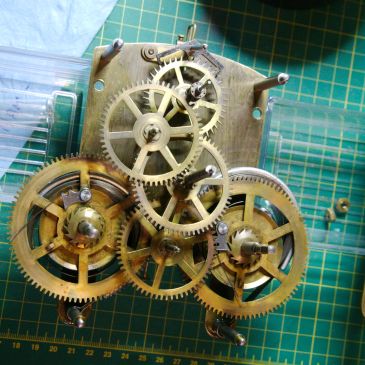
It is a small and simple time-only movement with a hairspring balance similar to what might be found on an alarm clock movement.

With tin dust cover removed

Some Delft clocks are pendulum driven and must be level on the wall to operate correctly whereas a hairspring escapement is more tolerant of placement.

Movement removed showing the mainspring

The mainspring may appear tiny by mechanical clock standards but it is as powerful as it needs to be in a movement this small and designed to run for 8 days.

Disassembly and cleaning

The front plate is affixed to a tin plate and the two cannot be separated unless the rivets are broken. This is a serious issue if bushing work is required on the front plate. To expose the bushing holes one must break the rivets with no guarantee that the tin plate and movement plate would be successfully pressed back together again.

There is some wear in the pivot holes but not enough to warrant concern at this point in time. There is also some pivot hole wear in the back plate but, again, not enough to require bushing work.

Back plate and mainspring removed

At some future point bushing work will have to be done and that would be a challenge for two reasons. One, the back-plate is difficult to access (as described above) and two, any bushings installed would be very tiny. I don’t have anything that small and they would have to be hand made. The designers may not have had servicing in mind when they made the clock and sadly, we are witnessing the beginnings of the throw-away generation.

All the parts, including the mainspring, are cleaned in the ultrasonic, dried thoroughly, inspected and pivots polished. Just a good cleaning and oiling this time around.

Since I decided not to do any bushing work, the movement was put back together. The wheels are installed plus the pallets leaving the escape wheel the last to position. There is an adjustment screw on the bottom plate for the escape wheel which can be Loosened allowing the escape wheel to be installed separately.

On the test stand

Feeding a very minuscule hairspring into its post is always a little tricky and quite often it takes several attempts. Manipulating small clock parts can be frustrating if you are used to working on American clocks with large wheels and pivots.

It is on the test stand and I will run it for about two weeks. If everything is satisfactory the remaining parts will be attached and the clock will be stored until the summer.

This clock is only required to run two months a year so, I am not concerned about future wear but a cleaning now will keep the clock running for several more years.

Dating a Hamburg Amerikanische Uhrenfabrik (HAU) shelf clock

During the Christmas season, we split our time between Calgary, Alberta, and Ottawa, Ontario to see our 2 daughters. While in Calgary my wife spotted an interesting item on an Ottawa Facebook Marketplace, an English time and strike clock.

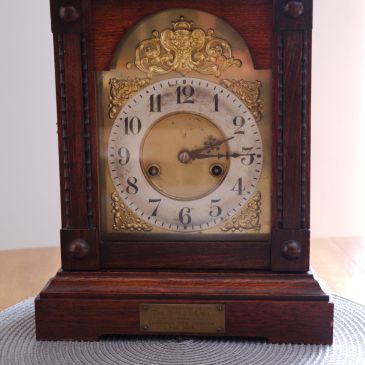
HAU shelf clock

She showed me the photo and I said, “that does not look like any English clock I am familiar with. The style is definitely German”. There is a commemorative plaque on the front base section which references an English church so, I am assuming the seller thought it was English.

When we picked it up from his home outside Ottawa I was surprised to learn that the seller is a clock collector and had no idea the clock he was selling was German. Occasionally I sell clocks to manage my collection and when advertising one for sale I make it a point to know the maker.

But, no matter, it was in very good condition and in working order.

The movement showing the single strike rod and pendulum bob

The maker is HAU or HAC. The familiar cross arrows trademark of the maker is stamped on the movement, in the middle of the backplate.

HAC was formed in Germany in 1873 by Paul Landenberger and Phillipp Lang and was originally called Landenberger & Lang Uhrenfabrik. The company changed its name to Hamburg Amerikanische Uhrenfabrik (HAU)/Hamburg American Clock Company (HAC) in 1883. The famous crossed-arrows

Crossed arrows trademark

became their trademark in 1892. In 1926 the company went into a cooperative with Junghans and in 1930 they finally merged with Junghans.

The date on the plaque says 1926. However, HAC/HAU clocks are difficult to date prior to Junghans acquisition of HAC/HAU in 1930. Once Junghans and HAC began their collaboration in 1926 some of the movements were date coded.

Plaques are a good but not foolproof method of dating a clock. A clock purchased as a gift in 1926 could very well have been sitting on the retailer’s shelf for two or more years.

Catalogs are another good but hardly foolproof method of dating a clock. A catalog confirms that a model was made in a particular year, but that same model was probably offered 5 years +/- from the year of the catalog.

I will probably not determine a more reliable date for my new clock than circa 1926. The movement, compared to an earlier model (below), also has many cutouts and additional holes that indicate that it was a late production model and confirms that is closer to the 1926 date.

HAC clock movement
Solid plates of an early HAC clock movement CA. 1895

The clock runs for a while and stops. It is in need of a service but I expected to clean it as many of these old clocks have rarely seen the inside of a clockmakers’ shop.

Readers pick for the best clock of 2021

The results are in. By a small margin, your pick for the best clock of the year is the Sawin banjo clock.

Sawin banjo clock

A great choice and one I would have picked had I not been frustrated with it during the restoration process but at the end of the day, my favorite is the Gilbert Shawville clock.

The Gilbert is an excellent example of a non-descript mantel clock found in thousands of homes in Canada and the USA in the 1920s. Seth Thomas, Sessions, and others made similarly styled models to appeal to those who could not afford the fancier, optioned-out upper range clocks that were offered by most manufacturers, including Gilbert, at the time.

I did not actually see the clock until we got home

The clock was offered on Facebook Marketplace in Quebec, Canada for $40 and had no takers over a three-month period. When the price was reduced, I snagged it. It was described as a non-running clock but the key, pendulum bob, and the movement are intact and I suspected I could get it running in a few minutes.

As an interesting aside, I found the clock in a recycle container by the side of the road, all prearranged, and never actually met the seller. It was boxed, sealed and wrapped in plastic, such is the fear the pandemic has produced.

Normally I stay away from American mantel clocks of the 1920s and 30s as I have had so many but for some reason, I was attracted to this clock because it looked like it had not been messed with.

There are no exotic veneers, appliques, fancy trim pieces, or finials, just a plain two-column, square-boxed-shaped, tinted mahogany lacquer hardwood case measuring 10 inches high by 5 ½ inches deep by 10 ½ inches wide at the base.

Gilbert shelf clock

The enamelled 5-inch dial with spade hands has Arabic numerals. On the top of the dial, within the number 12 is a regulating arbour used to adjust the speed of the clock.

On the front plate of the movement is the Gilbert trademark, a capital G within a diamond, and Wm Gilbert Clock Co, Winstead Conn. stamped on the right. The number 17 is in the lower centre, 1917 when the movement was made. The movement has steel plates with brass bushing inserts as brass was in short supply during the period of the First World War, 1914-1918.

A simple clock for the common folk and made by Gilbert is my pick for 2021.

Circa 1845 Chauncey Jerome Ogee Clock

An ogee clock is so-called because it is a 19th century U.S. shelf clock with a distinctive S-curve (convex above and concave below) molding.

30-hour ogee clocks were very popular from the early 1840s to as late as the 1890s, a good run for a distinctive style of clock. Before the days of the Internet, these clocks fetched hundreds of dollars at auctions houses and antique stores. Along came eBay and prospective buyers quickly learned that large numbers of these clocks were produced in their day and the supply of clocks flooded the net and prices dropped accordingly. I have 5 ogee clocks among my collection of over 100 clocks and have never paid more than $60 for any of them.

Of course, there are exceptions to the rule. The distinctive case has housed movements other than the 30-hour time and strike commonly found and some are quite desirable. Fusee, single weight 8-day time-only, calendar models, minis, Gesso fronts, 8-day time and strike clocks, and a few unusual ones have good value.

As found

30-hour clocks are worth collecting and if you a new to clock repair, they are a great clock to begin your journey.

This is a Chauncey Jerome 30-hour or one-day clock from about 1844-1845 and based on my research, the movement is from the same period. So, an excellent chance that the case and movement started life together. The pendulum bob looks very old and hard to say if original as pendulums often go missing during a clock’s life. But I’m not sure a modern pendulum bob would have similar detail.

Original (?) bob cleaned with Brasso

The dial is in good condition with attractive Gesso spandrels although the Jerome name under the twelve is barely readable and the chapter ring has faded. The moon hands also look original and the clock came with the correct weights. The mahogany veneer, while very dirty is almost flawless.

The name Jerome is just readable

Not original is the strike bell as the clock would have had a coil gong. The suspension spring and leader are missing. A top wooden block that attaches the movement to the case is also missing and the label, printed by John Benham, though readable, has some losses. The suspension spring and leader can be easily sourced, the block fashioned from old stock and I have a spare Jerome style coiled gong in my parts bin.

30-hour unmarked Jerome movement

The tablet design did not look original at first glance but after removing a piece of cardboard (first photo) and Christmas wrapping paper behind the glass I discovered a frosted tablet with thistles and flowers. The red paint might have been added and it is very possible that it was not painted originally.

Original tablet?

The plan is to service the movement, source missing parts, and refresh the case.

I am not a strong believer in maintaining the original patina which one reader opined is just another word for dirt. The case will be cleaned with Murphy’s Soap and a coat of shellac will be applied.

Original materials and techniques will be used when working on the case. This includes the use of traditional shellac (flakes mixed with shellac lacquer), and fasteners like old slot head screws, old wood, and square nails. The replacement coil gong is very similar to other Jeromes I have seen and will come out of a donor ogee case. There are a few stray pieces of label at the bottom of the case that will be glued back in place.

John Benham label is in rough shape

There is not a lot of demand for ogee clocks today as reflected in their asking price. Perhaps the 30-hour ones are considered a hassle for some as they must be wound once per day, nevertheless, I find them very appealing.

Coming soon will be an article on servicing the movement and later on, refreshing the case.

My Approach to Clock Restoration

Every clock enthusiast has their own way of doing things and each has a different approach to clock restoration. Am I different? Not really, but I have put some thoughts to paper that you might find interesting.

Like everyone I started out knowing virtually nothing about clock restoration but learned as I went. As I gained confidence and improved my skillset I took on greater challenges.

Not long ago I bought a nice 30-hour non-running Chauncey Jerome ogee. I would not consider this clock a huge challenge but it will help explain my approach to clock restoration.

The case is from the 1840s and based on my research, the movement is from the same period. There are a few things wrong with it and that is expected from a 176-year-old clock.

Four Options

The clock case and movement are very dirty and the clock certainly has some issues but I am happy to report that a lot is original. It is on my bench. Now, what do I do with it?

I have four options:

  1. Do nothing. Leave everything as-is, preserve the patina and display the clock without servicing the movement or cleaning the case.
  2. Service the movement so that it is in running order but do nothing to the case, again preserve the patina.
  3. Clean and refresh the case but leave the movement as-is.
  4. Service the movement and clean the case, making small repairs if necessary.

Option 1. There are very few clocks where I would do absolutely nothing. If the movement is beyond my capability or requires a complex repair and the case requires extensive repairs or any intervention on my part will potentially make it worse, I will leave it alone.

Option 2. Not a good option for me. There is no point in servicing a movement if is going back into a dirty case and risk the movement becoming contaminated with dirt and debris.

Option 3 If the movement is beyond my capability or requires a complex repair I will leave it alone and proceed with cleaning the case.

Option 4. This is my preference. My end goal is minimal invasive intervention which means that I will service a movement and address wear issues where necessary. I will refresh the case if it is grimy and requires a good cleaning. I am not a strong believer in patina which one reader opined is just another word for dirt. As much as possible, I use original materials and techniques when working on the case. This includes the use of hot hide glue, traditional shellac (flakes mixed with shellac lacquer), and fasteners like old slot head screws, and square nails.

In rare cases where I am met with a significant challenge, I will perform a complete restoration with the goal of bringing the clock back to its original condition. I call this extreme restoration.

Here are two examples. Both of these clocks are running daily.

Junghans wall clock before
Junghans wall clock – after
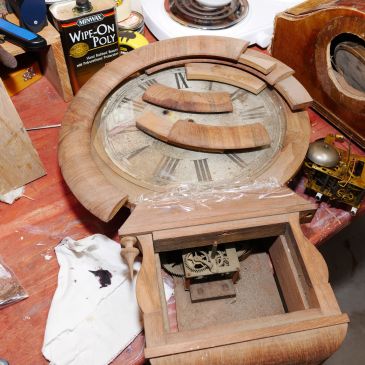
Mauthe wall clock – before
Mauthe wall clock – after

I believe that some amount of intervention is not only necessary but desired by collectors and I also believe that there are situations where a wholesale ground-up restoration is the only option.

In the case of this miniature Vienna Regulator cleaning and oiling the movement, and polishing the brass was the only intervention.

one-weight Vienna wall clock
Miniature one-weight Vienna wall clock

My position regarding changes to a clock

My end goal is a functional clock that presents well. As far as I’m concerned a non-working clock must become a working clock because that is the nature of its existence.

If a clock has important provenance and extensive repairs to the movement and/or case alter it in a negative way and I will leave it alone.

And what does the ogee clock i mentioned in the beginning of this article look like now?

Restored Jerome ogee

I am sure you will agree that it is not a dramatic change at all but it is now a working clock that presents well.

Sperry and Shaw 4 column clock back on the bench

The turned 4 columns of the New York style Sperry and Shaw clock drew my attention because it is so unlike many of the 30-hour shelf clocks of the time.

This clock was made between 1844 and 1851 when Henry Sperry and George Shaw were in the clock business together.

Sperry and Shaw label

The label, which is in superb condition, and affixed to the backboard says 10 Courtlandt Street, the company headquarters at the time. Sperry and Shaw were not clock-makers but business partners and were regarded as distributors and assemblers or as Carl Drepperd in “American Clocks and Clockmakers” put it, “apparently clock racketeers” as they sold clocks with fake labels. Who actually made the 4 column clocks? I ‘ll leave that to the horological history sleuths.

Sperry & Shaw 4 column clock

The company sourced cases and movements, affixed their own stamp on the movement and placed their labels sometimes overpasteing other makers, inside the case, clearly an unethical practice.

Weight channels on either side of movement

The movement is Jerome-like and stamped Sperry and Shaw, New Jersey. The plates are thinner than a Jerome, evidently a cost cutting measure. The hands are not original, nor is the dial though both appear to be period correct. The lower tablet contains an engraved copy of the Bay of Quinte (Ontario), there to replace the original reverse painted glass.

An interesting feature is the narrow brick-shaped wafer weights (4 3/4 inches X 1 inch) that fit neatly into channels on the left and right with little room to spare. The strike side weight is only slightly lighter than the time side.

Sperry and Shaw 30-hour movement

Service history

In January, 2019 the movement was disassembled and cleaned. All the parts were in good order.

The movement had been serviced perhaps more than once since there were punch marks around almost every pivot hole. Curiously there is only one replacement bushing on the escape wheel bridge, a later repair. Three or four pivots holes were slightly enlarged but not so much that they had to be done immediately. So, no bushing work at that time. I did not make any notes at the time regarding bushing wear but I suspect most of it is on the strike side.

The movement was re-assembled. The dial and hands were re-attached along with new braided nylon weight cords. After several days of testing the clock was running well.

May 2021

I have not been running this clock much in the past several months but I decided to wind both sides to see if everything was in order. As much as I love 30-hour clocks they are a hassle to keep running as they must be wound every day. Many years ago owners took this in stride as 8 day clocks were costlier.

The time side is now stopping after 5 minutes. At first I thought it might be a wear issue until I discovered the weight cord had, for whatever reason, slipped off the pully on the top of the case. It must have slipped off when I moved the clock recently. I repositioned the cable and ran the time side for a few hours just to be sure.

The other problem is the strike side. Lately the strike side has been running erratically. It either strikes the hour or runs continuously until the weight hits the bottom of the case.

The strike side needs an adjustment but there may be other issues. I won’t know until I take the movement apart. Once I have it apart I will address the wear issues I noted in 2019.

Disassembly

The movement was taken out of its case. The four retaining pins were removed and top plate taken off. After 3 years the movement is clean but the clock oil in the pivot holes is black.

I inspected the movement for wear. The lantern pinions have some wear but no more than I saw in 2019 and I have seen far worse in other 30-hour movements. As mentioned there had been a lot of punches around the pivot holes and from my inspection some bushings are now required. The ratchets and clicks look good and the gear teeth are in fine shape.

Sperry and Shaw 30-hour movement tested in the case

Bushing work

Three bushings are required; the time side second wheel front plate and the strike-side mainwheel and second wheel back plate. There is certainly wear on other pivot holes but not enough to justify more bushing work at this time. However, if this was a customer clock I likely would have bushed every pivot hole.

I did not like how bent and twisted the movement plates are. I am not sure whether this is the result of poor quality brass or the rough manipulation of the plates by a past repairer as they went about punching most of the pivot holes. I straightened the worst section so that I could have sufficient end shake for one gear but left the remainder of the plates as-is.

Reassembly and testing

These movements are relatively easy to reassemble. While everything went smoothly the strike side is still giving me grief and is no better than when I began.

However this time it is a simple adjustment issue. There is no need to take the movement out of the case to make the changes. I could see that the count and drop levers were not synchronized. The drop lever should be deep in the cam slot at the same time the count lever is in one of the deep slots of the count wheel. I slid the count wheel over to one side and repositioned it. The paddle should also be radial to the count wheel. I had to bent the paddle slightly to ensure that it pointed directly at the wheel hub.

These were subtle changes but made the difference between a working and non-working strike side. After 4 days of testing the dial and hands were reinstalled and the clock placed back on its shelf.

Sperry and Shaw 30 hour clock

It bears repeating that if you are just beginning your journey into clock repair, the 30-hour ogee, because of the large gears, the overall simplicity and the absence of mainsprings make this a great place to start. I love working on them.

Chauncey Jerome 30-hour ogee has stopped – the trouble with trundles

My Chauncey Jerome 30-hour Ogee weight driven time and strike clock has stopped for no obvious reason. Let’s see if we can get it going again.

Chauncey Jerome 30 hoir Ogee clock
Chauncey Jerome 30-hour Ogee clock

But first, no-one can deny that Chauncey Jerome had made a historic contribution to the American clock industry in the 18th century when he substituted brass works for wooden works and was said to be “the greatest and most far-reaching contributor to the clock industry.” Although he made a fortune selling his clocks, and his business grew quickly his company ultimately failed in 1856.

After researching Mike Baileys excellent site on Jerome clocks I was able to determine that my clock is a number 11 Ogee made just before the Jerome bankruptcy, 1855. The patent 30-hour brass movement is the number 1.314 which is likely in its original case.

C Jerome 30 hour movement testingin the case
C Jerome 30 hour movement testing in the case

The only time I serviced the movement was in February 2018. It was dirty as expected and it appeared that no work had been done for quite some time. It was well worn. At that time 8 bushings were installed, 4 in the front and 4 on the backplate. Most of the wear was on the strike side and lower in the trains.

C Jerome movement right out of the case in 2018

It ran very well for 3 years and now (May 2021) it has stopped.

Preliminary checks

I performed the usual checks prior to taking the movement out of its case. I inspected the time-side cable for kinks and that it was not binding. A binding cable will definitely stop a clock. It was fine.

I checked the crutch loop clearance and found nothing seriously amiss. It should have run. It did not.

While it was running I noticed that it was drifting in an out of beat and it ran no longer than a minute or so before stopping. This indicates a number of issues; a bent escape wheel teeth, damage/wear to its lantern pinion, a bent escape wheel arbour or an enlarged pivot hole. I suspect the last one is the culprit.

The strike side is fine and it is functioning as it should, but without the time side running correctly the clock is just an ornament.

Next, taking it out of the case

I checked it over and determined that the movement required two new bushings, one for the escape wheel bridge and the other for the hour wheel in the motion works. I did not have a multi-level bridge tool when I serviced this clock the first time three years ago so, it came in very handy. The hour wheel pivot hole looked fine then but now there is enough wear that it justifies being done. I checked the escape wheel arbour and it was straight.

Ingraham Grecian
Multi level bridge tool

With those two wear issues addressed I put the movement back together for testing and assumed that the clock would run. Unfortunately the clock stopped after less than a minute. Something else was amiss.

The trouble with trundles

I adjusted the beat but still nothing. I noted where the second wheel, time side, was stopping as it would stop about every eighth of a turn. Since the second wheel gear teeth are in excellent condition, it could only be one thing, worn trundles in the escape wheel lantern pinion that prevent the second wheel from meshing correctly with escape wheel.

Lantern pinion on escape wheel

As you can see in the above photo the trundles are in terrible condition and there is little doubt that this is what stopped the clock. Wear such as this cannot be ignored. Without a repair the clock will not run.

Trundles are often replaced by drilling out the shroud end where the trundles are inserted, taking the worn trundles out, replacing them with new ones made from pivot wire and staking the holes to ensure they stay in place. On this escape wheel the cap must be removed to access the trundles. This is common on ogee movements such as this and it means a different approach for the repair.

End cap for lantern pinion

I secured my crow’s foot to my bench vice, inserted the top cap of the lantern pinion into the V part of the foot and gently tapped on the pivot end to release the cap. It released easily. The trundles should have literally fallen out but two of the 6 were firmly in place and had to be cut and drilled out. Not fun.

crows foot

I have a good assortment of pivot wire, selected a .95mm wire for the trundles and cut each one to length with a Dremel cutting disk.

I used a hollow staking tool to push the cap back in place and the trundles into their respective holes but the cap was loose. This is when Loctite is your best friend. Using a toothpick I dabbed a small amount onto each end of the trundles, secured the trundles in place and waited 24 hours for the Loctite to cure.

The next day for testing purposes I left out the strike side levers and wheels.

On the test stand the movement ran a couple of 30-hour cycles and the issue has now been addressed. The remaining gears and levers were assembled into the movement and the movement was placed into the case for a final test of both the time and strike side.

It should run reliably for years to come.

From time to time a repairer will have to deal with worn trundles.

New trundles made from pivot wire

If a clock stops and there is a gear meshing issue, then it is time to replace the trundles but if they are a little worn and the clock runs well, I tend to leave them as-is knowing that at some future date if the clock stops it is one of many issues I will address.

I have mentioned this before but if you are just beginning your journey into clock repair, the 30-hour ogee, because of the large gears, the overall simplicity and the absence of mainsprings make this a great place to start.

Finial replacement on a Junghans wall clock

In January 2017 I took a chance, plunked down $75 and bought a project clock which consisted of a box of clock parts.

Junghans clock in pieces
Junghans clock in pieces (notice bottom finial)

I took it home, stared at the box for a while trying to figure out what to do and how far I would get with this project. I itemized the parts, arranging them on the case as best I could and put together a plan. At least I had something to go on when someone sent me the actual catalog image of the clock.

The clock is called the Crispi by Junghans, Ca. 1899. Junghans is a reputable German clock-maker that made all styles of clocks for over 100 years in Germany and continues in the watch business to this day.

There are subtle differences between my clock and the clock in the catalog but to the untrained eye it looks much the same.

What I did not change at the time was the bottom centre finial. Most who are familiar with clock case design would agree that the bottom centre finial is actually one of the top crown finials and was re-positioned in a previous repair. I left it as-is as I went about restoring the rest of the clock.

After completing a number of other clock projects during the Pandemic as well as addressing an errant strike issue with this clock, I decided it was time to replace the finial with something more in keeping with the original design.

Here is the clock (next photo) when I finished with the case. That bottom centre finial always bothered me but, as I said, I let it be.

This is a clock that I took to a professional clockmaker to have repaired in the days when I did not have the skills to service a clock.

It worked well for about two years or more and then the strike side became very erratic. It would either strike incorrectly on the half hour or strike until the mainspring wound down. I cannot blame the repairer as these movements can be finicky to work on but my knowledge of clock repair has improved such that I can better diagnose and repair most clock issues today.

The problem was twofold. One, the paddle was not quite in the correct position in the deep slot of the count wheel at the end of the strike and the strike paddle ended the strike sequence by hanging off one of the star points of the strike wheel.

It took several attempts through trial and error but eventually I was victorious and the movement now strikes correctly.

Crispi clock back from the horologist
Top finial placed on the bottom by a past repairer

Now, let’s get back to the case. As you can see the clock had been returned to its former glory and is quite faithful to the original except for that bottom finial.

I chose a flat back unfinished 2 1/2″ by 2 3/4″ hardwood finial that is available from most clock parts suppliers. I matched the stain to the case and applied three coats of shellac. Using a drill press I made a hole to accommodate a piece of dowel in the base and finial to secure it to the lower base section. I applied yellow carpenters glue to secure it and here is the result. The cost to rectify it was minimal.

The shape, size and style is now appropriately suited to the case.

The seller had the clock in his family for many years, perhaps as long as the clock is old. Anyway, he would not budge from the $75 but he asked me to send a photo of the clock when it was completed. I did, and received no acknowledgement. I don’t think he ever thought it would look quite like this.

I am very close to replacing the mainspring on a Ansonia time-only movement

One more shot is what it deserves. It had been running fairly well since I serviced it three years ago it but in the last few weeks it has decided to run for about 5 minutes and stop and I think I know the reason why.

Ansonia Drop Extra wall clock

This Ansonia Extra Drop time-only Rosewood veneered wall clock was manufactured in the early 1880s by what was then known as the Ansonia Brass and Copper Company.

The brass dial bezel is the only significant part missing. Minor items such as the verge, hands, pendulum bob, suspension spring/rod, and the drop access door were easily sourced. I made the drop access door later on.

Here is an article I wrote in 2018 wherein I assess the case and movement for the first time. At the time I was challenged by the prospect of putting a rusty old movement back in running condition and giving it a new life.

It was in poor condition when I bought since it literally came out of a barn and it is just pure luck that it runs at all.

The symptoms? If wound halfway it would run 3-4 days and stop. If wound tight it would not run at all because surface rust and other contaminants caused the coils to bind together. This is very typical of old clocks that have not been running for years. A movement that is “overwound” is a myth. It is the combination of old oil, rust and dirt that seizes the mainspring.

Rusty mainsprings

For some clockmakers any rust on a mainspring means that is it tossed it out because the mainspring is inherently weaker. This particular mainspring has surface rust on the outer two coils and rust on the edges of the spring. Otherwise, it has no cracks or splits and has plenty of power.

Yes, it was seized

Generally, to remove rust, repairers often apply a liquid gel, black tea, or even use electrolytic rust removal.

If I were in the business of clock repair, I would certainly replace the mainspring and pass the cost on to the customer. However, the original mainspring is part of the history of the clock and I don’t think the amount of rust is enough to prevent me from reusing as long as it is cleaned properly. As far as I am concerned, replacing a mainspring is the last resort.

Servicing yet again

Now that I have it apart why not throw the parts into the ultrasonic for a good cleaning. After everything was dry I inspected the parts, polished the pivots, and pegged the pivot holes.

I released the mainspring but this is how it came out of the case

I gave special attention to the mainspring. After inspecting it (yet again) I used a Brillo pad, steel wool and a microfiber cloth to eliminate the roughness as much as possible.

Ansonia mainspring cleaned up and ready for installation

Following the cleaning I applied a thin film of Keystone mainspring oil. I then reassembled the movement and oiled it prior to placing it on the test stand.

Ansonia movement on the test stand

While on the stand I gave the mainspring a few turns, put the movement in beat and it ran well for a couple of days which is what I expected.

On day 4, it was time for the ultimate test, to wind it fully till it winds no further. I was hoping for a good result and it ran the full 8-day cycle. The mainspring just might be “clean” enough that it will now run without stopping.

I will monitor the results of this little experiment for a while longer but for now things very good.

Another mainspring saved from the recycle bin.

Fleet Time Clock – servicing the movement and then disaster

Fleet Time clock
Fleet Time Co. mantel clock

This Fleet Time, time and strike mantel clock is essentially a plain, garden variety clock with a walnut finish, flat front, a slightly domed top, and step-side features on corner feet. The dial is heavily tarnished and the glass bezel that should be soldered to the chapter ring is detached. These bezels often go missing and at least this one came with the clock.

The clock has some issues, none of which are insurmountable. The plan is to refinish the case, attach the bezel, clean-up the dial or replace it, install new glass, and service the movement.

In this post servicing the movement is the focus.

The movement looked reasonably good when I received it and it may have had some bushing work done in the past but once apart it was clear to me that it might never have been worked on beyond a cleaning. It ran when I got it and one is tempted to leave it as is but it was dirty, had some wear and long overdue for a good cleaning.

Servicing the movement

Fleet time movement
Fleet time movement

Disassembly and testing for wear

I discovered two troubling issues when I had it apart. I put the wheels together to check for wear and I noticed the escape wheel was a fair distance along the arbour from its correct position adjacent to the leaf pinion (no photos, sorry). The pallets were contacting the very edge of the wheel. My staking set comes in handy from time to time and it was needed to close the gap between the wheel and the pinion.

staking set
staking set

Using light taps from a hammer and an appropriately sized punch I drove the wheel closer to the pinion. The pallets now contact the middle of the wheel as they should. Odd!

Fleet time movement
Fleet time movement, dirty and in need of a good cleaning

The second was an erratic beat during the testing phase of the time side. With a beat amplifier connected, I could hear the movement go ever so slightly in and out of beat, yet the movement continued to run. There are a number of possibilities but one is a bent escape wheel arbour which, in this case, was the culprit. Bent arbours are not difficult to straighten but care must be taken to bent them carefully so as to prevent a break. A broken arbour can be a very frustrating clock problem.

Once the 2 issues were out of the way it is on to cleaning the parts, inspecting and polishing the pivots, pegging the pivot holes, followed by bushing work. Most of the bushings that were installed were on the strike side. In fact, 4 of six, 3 on the backplate and one on the front plate, strike side, and the two on the time side were on the second wheel. Two were 2.5 OD bushings. I work on a lot of American and European clocks and cannot recall using bushings that small.

Testing

After cleaning and bushing work is completed the rack, snail, levers, and strike hammers/levers are attached.

Since the star wheel is on the outside of the plate I thought attaching the strike hammers would be simple. Not so much!

Fleet Time movement
Fleet Time movement, star wheel paddles

Again as in all movements with star wheels, the strike paddles must sit between the star points. One was fine, the other hung on the tip of a point. Rather than attempt to force the star into position, the strike side was partially disassembled and the star wheel was re-positioned. Yes, it meant removing wheels on the strike side to change the orientation of the star wheel but it is best to do it correctly rather than risk damage to the gear.

On this movement, the mainsprings can be removed without disassembling the movement. Handy for such things as replacing a broken mainspring and making the above adjustment.

Fleet time movement
Fleet time movement

The movement was on the test stand for two eight-day cycles and now it is time to return it to its case.

Just when everything seemed to go well – disaster 

I polished the 3-rod gong and mounted it and the movement within the case. I wound the strike side fully and then wound the time side. Just as I was feeling resistance, CLUNK, and then the arbour turned freely. Did the mainspring slip off the winding arbour or, did the mainspring break?

Sourcing a mainspring is not a problem but when I removed the barrel I discovered two broken and one bent tooth on the mainspring barrel plus a broken mainspring. Make that three broken teeth since a bent tooth cannot be straightened.

Broken and bent teeth

I do not have the specialized equipment to make and install new teeth and sourcing a 60 tooth barrel that is the exact height and depth would be a challenge. Worse, the catastrophic shock of the broken mainspring took out one leaf of the second wheel pinion. 

When the mainspring breaks on the arbour end, which occurred in this case, the power is released uncontrolled, and causes damage to the barrel, the second wheel or both. When the mainspring breaks at the other end it tries to unwind and the loose end provides sufficient resistance, that is, a much slower release of the energy, and is less likely to cause major damage. In the latter case the mainspring is the only thing that is damaged and it can be easily replaced. In the former, both the barrel and second wheel need to be repaired or replaced.

This is an unusual situation, but it happens.

Fleet second time wheel
Fleet second time wheel with bent pinion leaf which cannot be straightened

The movement was aside to consider next steps. In the meantime, the plan is to locate a donor movement. The power was let down on the strike side, and everything was placed in a sealed plastic bag and marked for storage.

I’ll be honest, this situation bummed me out and it took a week to return to servicing another movement.

The clock case

The plan, after servicing the movement, was to devote a separate post on the case but since the movement is non-functional there is not much point. While the movement was on the test stand, I spent hours on the case, stripping, finishing, and polishing including swapping out the dial and broken glass with one from a Blackforest clock from the same period (both companies used the same suppliers). The case came out better than expected but now there is no movement to put in it.

Fleet Time case
Fleet Time refinished case and replacement bezel and dial

The most disappointing part? I was at the very end of the project. The movement and rod gong were installed in the beautifully reconditioned case and I was preparing it for its first run after having tested it for two weeks. I did not expect it to go out with such a destructive bang.

Broken time-side mainspring

I asked a clock friend for some advice. He says that although the barrel teeth and leaf pinion can be fixed it is usually not worth it because the process is so time consuming. “What do you do?”, I said. “I collect movements that are used as donors for times such as this”, he replied.

A sad end to an otherwise satisfying servicing.

Solar mantel clock servicing – just one hiccup, well, a couple actually

Solar mantel clock
Solar mantel clock

For today’s post, we are looking at a German time and strike mantel clock with a Hermle movement and sold in Canada under the Solar name. It has a 6″ dial and dark walnut case that would have been around $50 or $60 when new in the 1960s. At about 13” wide by 7” high by and 4” deep it is small by mantel clock standards and would fit just about anywhere in a home or office.

Solar clock
Solar clock, just a little taller than a beer can

It has a type 141 German movement from Hermle with a recoil escapement and 11cm pendulum (200.8 bpm). The half-hour strike on a bell is pretty sound for a mantel clock but is loud enough to be heard across the house. As a testament to its design and durability, this movement is still being produced by Hermle today.

Solar Hermle movement

This was not a running clock when I bought it but I thought a good cleaning was all it required. Judging from mars and scratches on the backplate of the movement it has been worked on in the past.

I took the movement out of its case to examine it more closely and I was relieved when I saw that the pivots were not plated, the bane of Hermle movements from the 1970s to the late 1980s. In those days Hermle used soft steel pivots for their movements and plated them for hardness. The plating has been known to peel off and this requires repivoting which is a time-consuming process. When there is too much pivot work to be done the movement is simply tossed out. This movement predates the plated pivot period.

I did not see any evidence of bushing work on the movement but one or both mainsprings were replaced as the barrels had numerous scratch marks on them. As is typical of clocks of this period the mainspring barrels can be removed without disassembling the movement. The winding arbours simply pull out once the rachet is removed. Mainsprings on some German clocks are a known weakness.

Hermle movement
Hermle movement, you can see the S on the strike barrel

The movement was in very good condition with minimal wear.

Hermle movement, front plate removed

The movement was disassembled, parts cleaned in an ultrasonic cleaner, the pivot holes pegged, and the pivots polished. The warning wheel is plastic and did not go into the ultrasonic machine, a cost-savings measure by Hermle no doubt on a part that has almost no load.

Hermle stop wheel
Hermle plastic stop wheel

I assembled the parts to check for wear and found that the movement required two bushings, the star wheel, backplate, and the lower drive wheel rear plate, both quite worn. All other pivot holes were within acceptable tolerances.

Installing two bushings

The starwheel bushing installation was simple enough. The center cannon wheel had to be removed so that the backplate bushing hole could be accessed. Bushing work went without a hitch.

Now for putting that centre wheel back on. An oval tension spring just below it must be tight enough but allow the arbour to move. Attempting to reinstall the brass washer was frustrating and as you can see I made some nasty marks trying to get it back into place (below photo). After several tries, I just could not get it tight enough.

Hermle movement, washer and tension spring
Hermle movement, washer, and tension spring

I attempted to stake the washer but that did not work. None of my stock of brass tubes had the correct inside diameter and I was reluctant to put a lot of work into making a friction washer with my mini-lathe.

Solar washer
Solar center wheel friction washer, not reusable

However, I discovered a simpler solution, a brass Bergeon bushing.

Hermle movement new washer
Hermle movement’s new friction washer is a brass bushing

The arbour is roughly 2.6mm and a bushing with an inside diameter of 2.5mm provided a good friction fit. The bushing is also large enough to cover the tension spring underneath. Perhaps not the intended purpose of a brass bushing but it works! In many other German clocks, there is a pin through the arbour and it can be easily taken off but not on this one.

Reassembly and testing

After test fitting all the parts it is off to the next stage, resembling the movement. When reassembling a rack and snail movement there a number of things to consider but in my view, the three most important steps are ensuring the warning wheel pin is in the roughly 12 o’clock position to permit a half-turn to set up the strike, that the strike paddle is between two star points and not resting on the point of star wheel (a strike train that starts up under load may stall) and that the gathering pallet pin is well clear of the rack teeth. On a typical rack and snail movement, all other adjustments are done outside the plates.

Then comes the testing phase which generally lasts a couple of weeks or more depending on what issues may arise.

In the meantime, I took the opportunity to clean the case and touch up some small chips on the decorator piece under the dial.

The pandemic allowed time to service my clocks and help me understand “sympathetic vibration”

I know many of you did your best to adapt to isolation during what is now known as The Coronavirus Pandemic. It changed the way we think, the way we behave and the way we interact with each other. My condolences to those who suffered during this infamous chapter of our lives particularly those of you who lost loved ones.

I had already established my clock hobby long beforehand so the last few months meant that I was able to focus on tasks that I had planned to do but wondered whether I would ever have the time. Corvid19 changed that.

What was also very different was that I could no longer acquire new clocks to add to my collection. So, instead of searching for new ones, I serviced ones in my collection which is not a bad thing.

However, on day 6 of the weekly cycle, the clock would stop and always on day 6. Why?

I was very productive.

I have a small but growing collection of Arthur Pequegnat clocks and was able to service a good number of them and in the process learn the differences, some major and some minor, between early Pequegnat movements and later ones. I honed my skills as a clockmaker, meeting new challenges with each movement I worked on. Four of those clocks are:

Restored Athur Pequegnat Bedford mantel clock
Arthur Pequegnat Bedford shelf clock

Restored Arthur Pequegnat Bedford shelf clock; case and movement are now done.

Arthur Pequegnat Canuk, kitchen clock

Arthur Pequegnat Simcoe

As with the Bedford, Maple Leaf “pointed top” and the Simcoe the cases, including the dial and movement were done.

Maple Leaf kitchen clock, the “pointed top”

However, I was also able to focus on what I consider my most exciting clock acquisition in the last 3 years, my circa 1850 Scottish tall case clock.

I reconditioned and repaired the case and serviced what I would call the most frustrating movement I have encountered to date, an English bell strike. Plenty of patience is required for this one. It is all about small adjustments and in this case, mostly the strike side. Just when you think things are going well, another issue surfaces. I should have expected that working on a 170-year-old clock is not easy.

McLachlan tall case clock

English bell strike

I was unable to return the movement to the case immediately because it had to go through the testing process which meant constructing a clock stand. I have two other stands but they are too short and made specifically for wall and mantel clocks. Taking ideas from similar test stands online I constructed a 48″ high tall case test stand for my English bell strike movement.

A tall case test stand

The phenomenon of sympathetic vibration

However, during movement testing which lasted for weeks, I encountered a consistent problem. On day 6 of the weekly cycle, the clock would stop and always at about the same point in time. Why? It is something called “sympathetic vibration”. When the clock stops as the weights descended to the level of the pendulum a harmonic phenomenon occurs “wherein a formerly passive string or vibratory body responds to external vibrations to which it has a harmonic likeness”.

In practical terms, when the weights on a tall clock descend to the point where it’s at about the same height as the pendulum, the weights may begin to swing slightly. Since the power that drives the pendulum is now swinging the weight as well, the pendulum does not get its share of power and stops. Sometimes, despite the swinging of the weights the movement soldiers on but in the case of this movement there is insufficient over-swing of the pendulum to compensate for the loss of power.

It can generally be addressed in a tall case clock by fastening the upper part of the case to the wall, or by mounting the case on a solid foundation. For a free-standing clock stand placing a block of stiff foam rubber between the stand and the wall usually cures the problem.

Although the Scottish tall case project consumed a lot of time, it was very satisfying and it was a great learning experience.

More clocks

There are some other clocks I could have mentioned, two German time and strike clocks, a Mauthe and a Muller, a Gufa Westminster chime but suffice to say I made a lot of progress with my collection.

However, beyond the hours of time, it is self-satisfaction and a sense of accomplishment while engaged in productive activities that are the real intrinsic benefits. And folks, that’s what a hobby is all about.

What defines a successful clock day?

What defines a successful clock day? When everything goes according to plan, I’d say.

I ordered a number of parts from a clock supplier that finally arrived recently. Among the supplies was a good quality pivot oiler, a mainspring for the time side of a mantel clock, a set of better quality broaches and movement parts for my English bell strike.

I have a number of oilers but they are cheap and dispense far too much oil. A high quaility German made oiler is the right choice.

The broaches are made by Grobet and they are of excellent quality. The inexpensive broaches that I bought when I began my journey into clock repair will be put aside.

Success #1

In the fall of 2019 I picked up a clock made by the Fleet Time Company a short-lived Montreal-based company that lasted 4 years before World War II.

Fleet clock without the movement

The case had to be refinished but when I finally returned the movement to its case I discovered a broken time side mainspring. Some movements are designed such that the mainspring barrels can be removed without dis-assembly. I removed the barrel to take measurements for the replacement mainspring. Using needle-nosed pliers I pulled the mainspring out, measured the width, thickness, length and ordered one from my supplier. I had to put this project aside until the mainspring arrived.

Using my Ollie Baker spring winder I coiled the spring into a retention collar and inserted it into the spring barrel and once inside the barrel, it was capped and returned to the movement.

Broken time side mainspring, not reusable

It is finally nice to hear it chime.

Success #2

I recently serviced an Arthur Pequegnat Canuck time and strike kitchen clock. After installing 5 bushings and reassembling the movement I was not able to make the strike side run correctly. Today, I pulled the plates apart slightly to make an adjustment to re-locate the stop wheel.

The movement just before servicing

That was enough to allow the movement to go into warning. The clock is happily ticking and striking.

Success #3

I recently serviced a Waterbury York time and strike parlour clock. The strike side did not work when I bought it. I took the movement apart, cleaned it, installed several bushings and installed two missing helper springs. The movement ran well on the test stand but not when I returned it to its case.

In the case with the dial attached and the clock stopped. Today, I discovered that the crutch, a later replacement, is rubbing against the back of the dial, but just to be sure, I removed the dial and the clock ran without a problem. The solution; push the crutch loop further back into the movement.

Thoughts

These might seems like small victories but I’ll take them when they come. In the clock world some days are filled with challenges and frustrations but there are days like today where everything seems to go perfectly and that makes up for everything.

What is this clock thing for? #5 – the mainspring clamp

The only way you can safely disassemble a clock with an open mainspring is by using mainspring restraining clamps. 4 piece sets, which will accommodate various mainsprings sizes are available from all clock suppliers.

Wind the mainsprings tightly enough so that you can work the clamps around the springs. Move the rachet click aside and allow the let-down key to release the mainspring slowly into the clamp.

Mainspring contained in a clamp
Mainspring  restrained within in a clamp

With the mainspring safely clamped you can proceed with cleaning and servicing a clock movement.

A soft steel wire becomes a clamp

When a clamp may not fit or you do not have clamps, a soft steel wire will suffice.

This clamp on a time side mainspring

Round and flat mainspring clamps are available from suppliers. The above shows a flat clamp on a mainspring

Olie Baker spring winder
Applying a round mainspring clamp while using an Olie Baker spring winder

If you can afford it, a spring winder is one of several essential tools of a clockmaker.

Removing lever with helper spring
Assembling a movement with a mainspring restrained in a clamp

Safety is paramount when working with a clock.  If you are going to buy just one set, I would purchase flat clamps. They are easier to maneuver around the mainspring than a round clamp. Mainsprings are not to be fooled with. They are very powerful and all that power can cause damage not only to clock components but to your limbs as well.

Interesting clock repairs, some good, some not so good

While I admire the ingenuity and creativity of clock repairpersons many years ago some of the repairs are downright scary and dangerous. I say clock repairpersons because may were back yard mechanics with minimal clock skills that were paid to “just get his thing running”.

In this article, I will describe some of the strange repairs in clocks I have worked on over the years.

Let’s start with this interesting wheel repair.

Tooth repair on a 30-hour time and strike

I would call this a passable tooth repair. It is functional but it could have been dressed properly and filed down to improve its appearance. I left it as-is.

Continue reading “Interesting clock repairs, some good, some not so good”

Fleet Time company of Montreal – case refinishing and 2 surprises

While refreshing the case of this relatively nondescript mantel clock assembled by a short-lived Canadain clock company I ran into two interesting surprises.

Here is a garden-variety vintage Westminster chime mantel clock from the Fleet Time Company of Montreal (Canada). Many of these clocks were sold at department stores across Canada during the pre-war (WWII) era. However, this little known Canadian clock company had a brief life. Between 1936 and 1940 the company produced a range of two and three-train mantel clocks with movements sourced from Germany but were forced to end their operations.

The Second World War took a heavy toll on this company as the source of movements dried up and so did the company’s fortunes.

Wood cases were made in Canada for some models while other cabinets were imported from Germany.

This particular clock has a Gufa Westminster chime movement and I assume most of their 3-train clocks had a similar if not the very same movement. Gufa is the Guetenbacher Uhrenfabrik, located in Gütenbach, Germany. They manufactured 400-day clocks, cuckoo-clocks and later they became the “Jahresuhrenfabrik” (August Schatz & Sons in Triberg, Germany).

Rather than advertise the maker, many Fleet Time clocks simply had the word “Foreign” stamped on the movements.

This is a clock that could easily have been thrown in the garbage and I am fairly sure that is where it was headed. While I was in the city of Halifax (Nova Scotia, Canada) to pick up an Arthur Pequegnat Canuk kitchen clock the seller took me into his garage, pointed to a clock sitting on a shelf, and said. “for $10 more you can have this one”. “Why not”, I said!

Refinishing the case

I thought I would tackle the case first. While the front of the clock looks okay, the finish on the side sections were down to the bare wood plus scratches on top really detracted from the general appearance of the clock. It was a real mess. On top of that, the left side shoulder section was completely detached and had to be re-glued. Hot hide glue was used for this repair.

The finish was badly worn on both sides

Surprise #1

Rather than reproduce the dark lacquer finish I chose to sand the case down to the bare wood to see what lay beneath. To my surprise, I discovered a nicely grained, and beautifully textured grain. Enhancing the veneer with a light walnut stain is the way I chose to go because I did not want to go as dark as the original finish. Special Walnut, which has a light tone is perfect for the case and if I did not like it I could apply a darker walnut stain over it later.

Choosing the right stain; part of the case is still drying off from a wipe down with a damp cloth

The special walnut is very pleasing to the eye.

Special walnut stain

And the top of the clock.

Top of clock

After two coats of stain (above), here is the result.

After two coats of stain and two coats of shellac

The Special Walnut stain produced a very pleasing result. I applied one more coat of shellac, let it dry, and topped it off with Minwax Polishing Wax to produce a satin finish. Not the finish that came from the factory but it wlooks good.

Surprise #2

After cleaning the chapter ring, polishing the chrome bezel I was ready to return the movement to its case but what I should have done was test the movement beforehand.

When I received the clock I confirmed that the strike and chime functioned as they should and I assumed the time side was fine.

Broken mainspring which is not reparable

I inserted the winding key into the centre arbour and found no resistance. Hmm!

On these movements the barrels can be pulled out without disassembling the movement which certainly simplifies repairs. I pulled out the barrel, popped the back cap off, and discovered a broken mainspring. Using needle-nose pliers and heavy gloves, I pulled the mainspring out with for closer examination. No part of this mainspring is reusable and a new one must be ordered.

Occasionally when a mainspring breaks it takes a few other components with it like broken teeth, broken leaf pinions or bent arbours referred to as collateral damage. I inspected the gear teeth, pinions and arbours on the time train, gave the wheels a few spins and found everything moved smoothly, so, no damage this time. The broken mainspring is the only issue keeping this vintage mantel clock from striking and chiming again.

Mainsprings care easily sourced from a clock supplier. I waited until I built up a list of supplies for other projects then submitted the order online. German and American mainsprings are best and avoid those made anywhere else particularly India.

The movement was placed in a plastic bag along with nuts, hands, screws etc. and stored safely away until the mainspring arrived.

Two weeks later

Two weeks later, out come all the parts from storage.

Using my Olie Baker spring winder and mainspring retention collar I installed the mainspring into its barrel.

Fitting the barrel back into the movement involves moving the strike rods out of the way which is a bit of a pain, then, the barrel slides into a channel on the plate. The movement was returned to its case and the hands attached.

Fleet Time Westminster chime

The strike hammers were re-positioned for the best possible sound and my guess is that the clock is running and chiming for the first time in many years. As of this writing, it has completed a number of 8-day cycles. And to top it off, it looks great!

Let’s see, $10 for the clock $19.50 for the mainspring and less than a few dollars for stain, glue, etc. A satisfying project combined with a piece of Canadian clock history.

Waterbury York parlour clock – a fresh approach to addressing a non-functioning strike side

Back in December 2019, I wrote about the challenges of adjusting the strike side of this attractive parlour clock, a Waterbury York, circa 1900. Despite many attempts the strike side refused to work. Though I was close to a solution but I did not realize it at the time. I put it aside to think about it.

Attempt #2. Will I be successful? Read on.

A shot of the clock the day I brought it home.

The time side functioned perfectly but the strike side did not run at all when I first brought the clock home. Typically a good cleaning or a simple lever adjustment is all that is required though once I opened the movement up I saw it true colours. I detailed these surprises in my December post.

Continue reading “Waterbury York parlour clock – a fresh approach to addressing a non-functioning strike side”

Canada Clock Co. – a frustrating movement

In light of current world events the antiquevintageclock.com family wish to convey our sympathy and condolences to those effected by Covid 19

Original time and strike 30 hour movement

The movement in this Canada Clock Co. time and (hour) strike cottage clock from the late 1880s is a mess but fixable. Some past repairs are acceptable while other leave a lot to be desired.

I’ll begin with the issues. “Repaired” mainsprings, nuts on a copper wire fashioned as a gong hammer and string “helping” the helper springs are things you really don’t want to see on a movement. The time side runs reasonably well but the strike side does not function, likely the result of fiddling with levers too many times.

clever, but dangerosu way of repairing the mainspring

The second mainspring, another “iffy” repair

Home-made copper wire and two nuts serve as the gong

String used to connect a broken helper spring

In the clock business you must always expect the unexpected. While I awaited parts, I went about cleaning the parts and bushing work .

This is perhaps the most frustrating 30-hour movement I have ever worked on

The parts arrived and included a new gong hammer, two new mainsprings and brass wire for new helper springs.

New 30 hour mainspring

New hammer gong and lever with helper springs installed

I began by installing the new hammer. Using my mini lathe I drilled a new access hole in the hammer arbour. I measured the diameter of the hammer rod and used a HSS bit to drill through the centre of the arbour. It was a reasonably good fit but to ensure a permanent hold I applied a drop of thread-locker.

The levers look like a twisting mess but there is a logic to the arrangement

This is the first 30-hour shelf clock I have worked on without a discernible warning action and it made for tricky lever positioning. Perhaps there is warning but I just could not see it. Though the levers look like a twisted mess there must be some logic to the arrangement.

The above photo shows the left side lifting lever that must be precisely adjusted and curved for the centre cam to push the drop lever over the count wheel cam to actuate the strike. The count lever blade must also line up exactly with the centre of the count wheel and precisely in the middle of the deep slot. As far as I can determine the lifting lever is the only one of the two levers that require a helper spring but I will know more after further testing.

All in all, this is one of the most frustrating 30-hour movements I have ever worked on. The movement was taken apart several times for various adjustments. I worked at for a while, left it, thought about the next steps but despite my best efforts, that strike side continues to elude me. The time side, however, works perfectly.

Some day I will have it working but for now it is on display.

What is this clock thing for? #5 – the pivot locator

I want to talk about one of the most useful tools in clock repair, the pivot locator.

As an avid horology enthusiast for the past 9 years, I have been steadily building my knowledge of clock repair and with it a selection of essential clock tools.

Continue reading “What is this clock thing for? #5 – the pivot locator”

Gilbert 6 column mantel clock

I have worked on several Gilbert clocks in the past few months which is unusual for me. Certain makes of clocks seem to come in bunches. This clock is a 6 column time and strike antique Gilbert mantel clock made in 1913, and reflects a period when every American maker had a similar style. Some parts of the case have an Adamantine finish but those particular areas are not in good shape.

A family relation asked me if I could get it running. Sure, I said.

Gilbert 6 column mantel clock,1913

History of the Gilbert Clock Company

The Gilbert Clock Company began making clocks in December of 1828 and produced clocks over a span of 130 years.

In 1837, John Birge joined the firm, and the name was changed to Birge, Gilbert, & Company. Shortly thereafter, Chauncey and Nobel Jerome and Zelotus Grant became partners with Gilbert, and in 1837 the company was know as Jerome, Grant, Gilbert, & Company. This company manufactured Jerome’s cheap brass-movement clocks.

Continue reading “Gilbert 6 column mantel clock”

How long has my clock been running?

Has my 90 year old Gilbert clock been running continuously since it was first purchased? Not likely.

Gilbert time and strike mantel clock

Okay, you’ve made the plunge. For whatever reason you bought that mechanical clock you always wanted. Ask yourself; this is a 100 year old clock and it has been running all this time so what more do I need to do to take care of it. Why have it serviced or even oiled when it is running and striking as it should. The answer is complicated.

Continue reading “How long has my clock been running?”

Gilbert model 2038 8-day mantel clock with Normandy Chime

My wife was going through the online catalogue of an estate auction recently and found an attractive vintage Gilbert tambour style clock.

Gilbert mantel clock 1925

“Are you interested?” she said. “Sure”, I said, “put a maximum bid of $35”. We won the bid at $25 + tax and buyer’s premium, so, still under $35 CDN. Would I have paid more? Not likely. However, it is a handsome “Napoleon hat” styled clock but they were plentiful and cheap at the time and not particularly valuable or desirable today despite the fact that it is almost 100 years old.

Continue reading “Gilbert model 2038 8-day mantel clock with Normandy Chime”

Website Powered by WordPress.com.

Up ↑