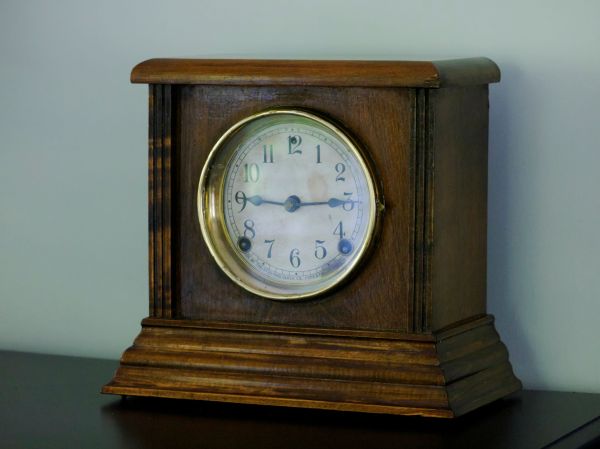
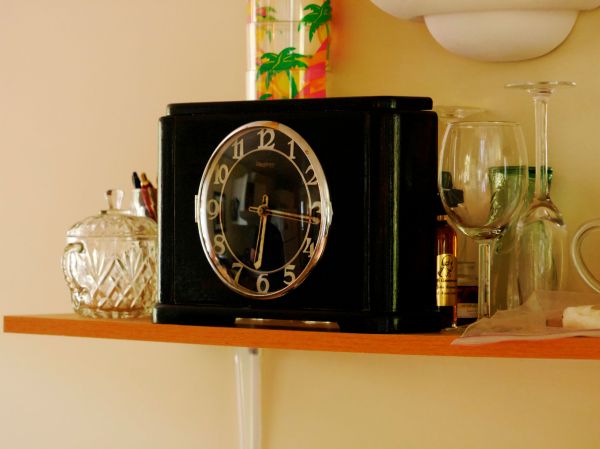
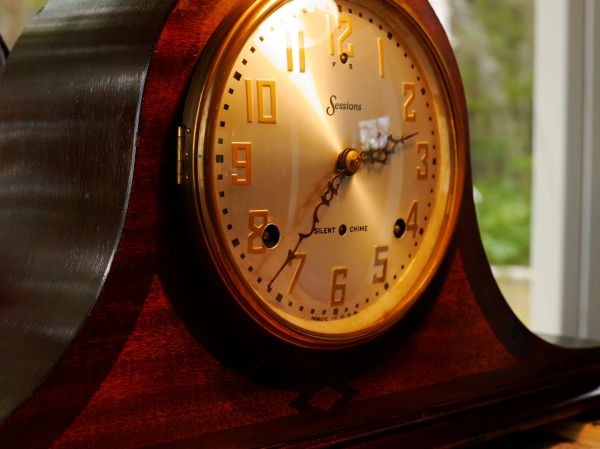
This is a recently acquired Sessions time and strike mission style mantel clock. Aside from cleaning up the case with diluted Murphy’s Soap, my standard cleaner for clock cases, I applied clock oil to the movement and reset the verge in order to get the proper beat. It is running well and keeps very good time. There is a speed adjuster at the 12 o’clock position which is helpful in regulating the speed.
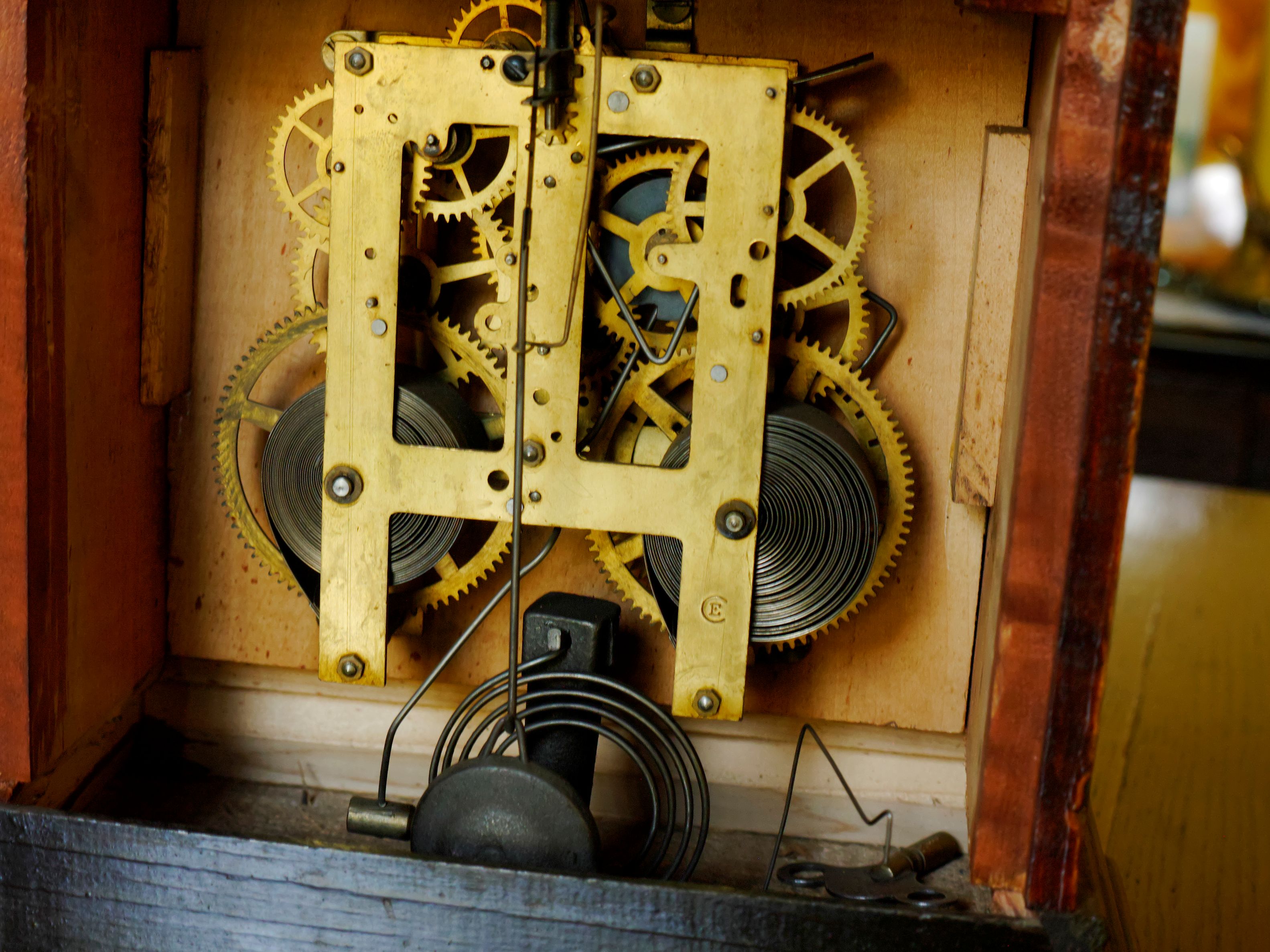
Sessions time and strike movement
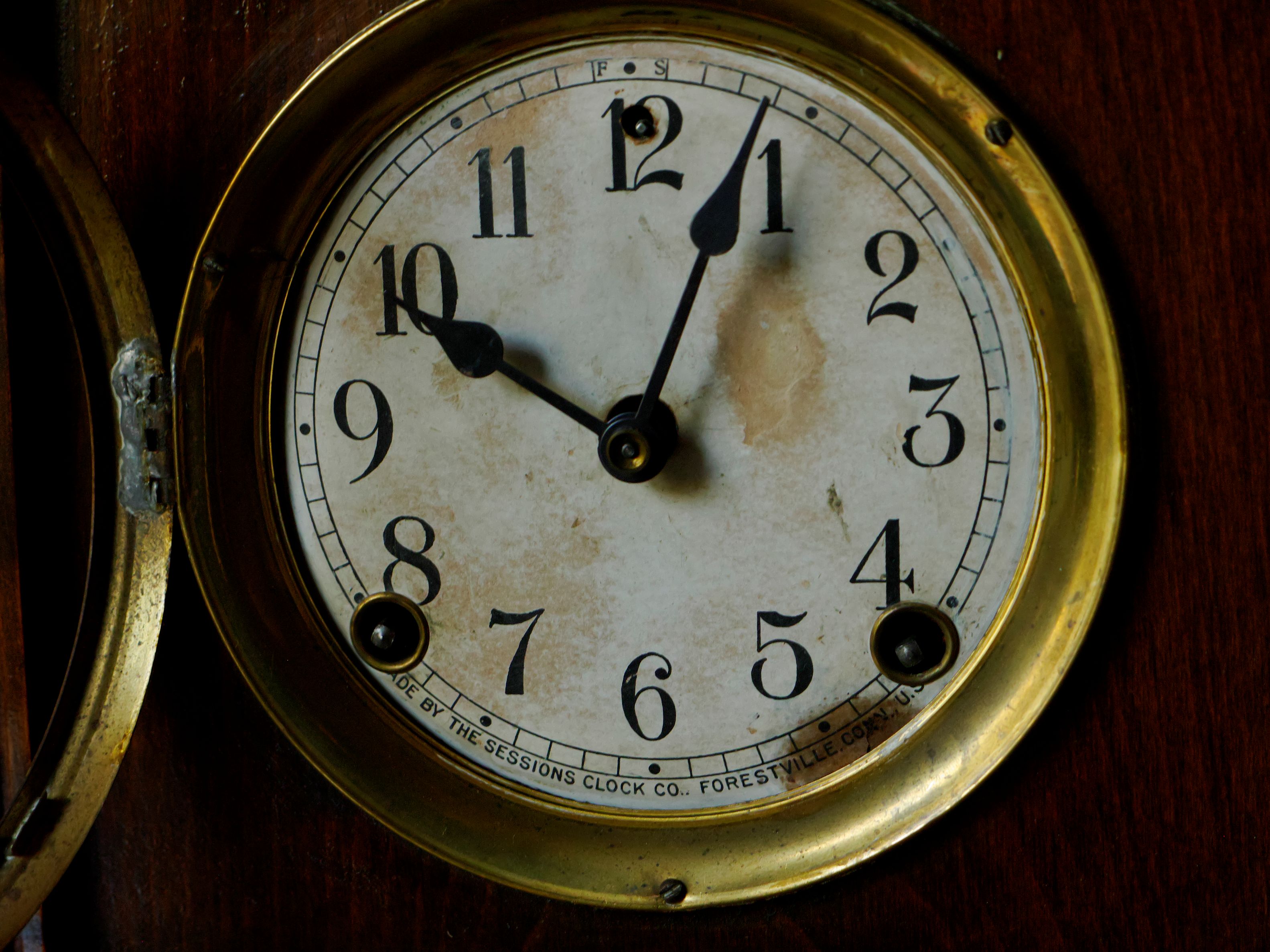
There are some issues, the glass clips are broken and the glass is loose in it’s bezel but putty will fix that. It came without a double-sided key but I have enough spares that I have one that fits and the clock needs a thorough cleaning.
Before bezel is cleaned
After it is running for a week or so, I will tear it down and address any bushing issues.
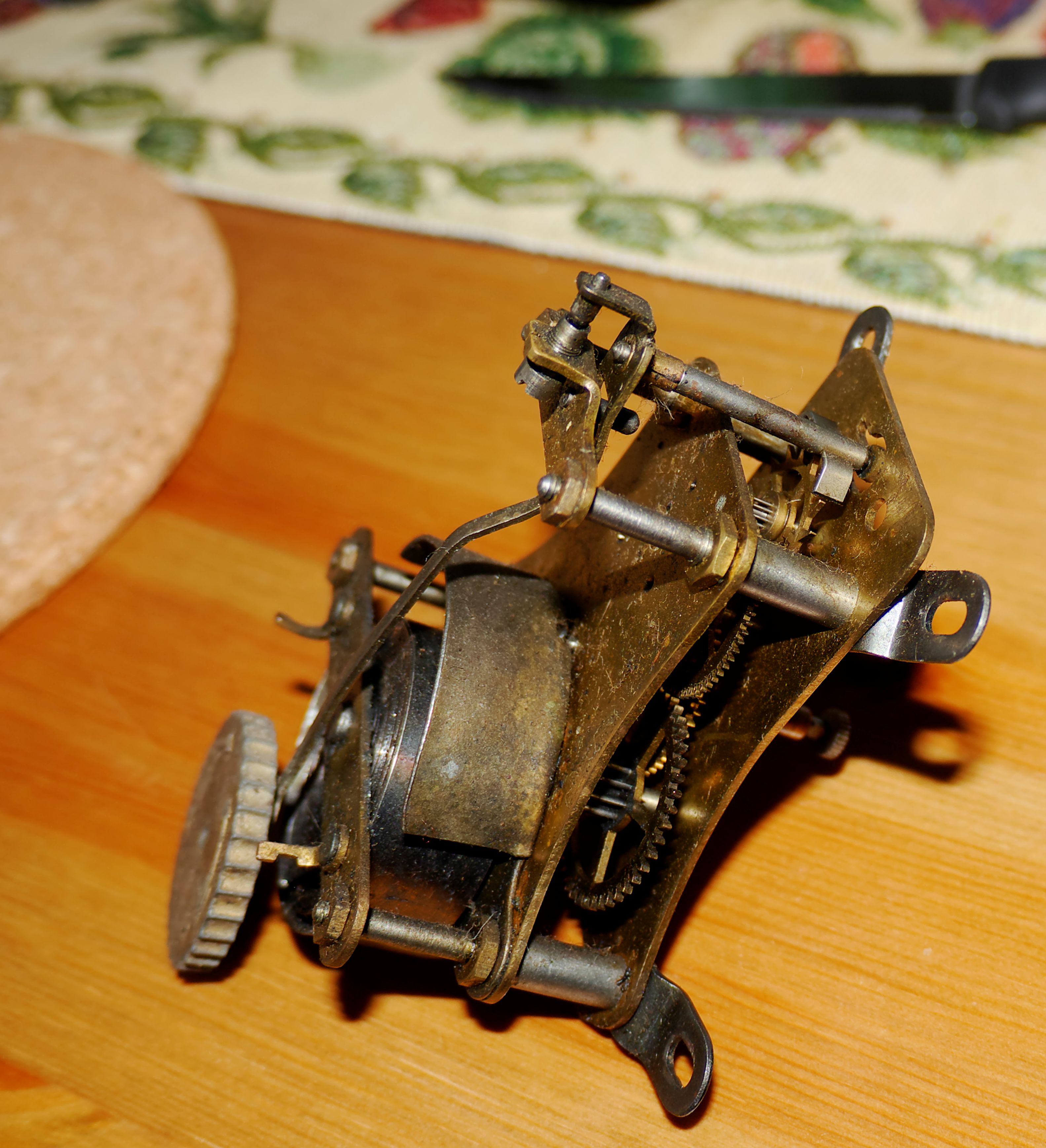
If you are following this blog this is the same clock as the previous post. Since the movement was very dirty, I cleaned it up (ultrasonic cleaner) when all apart and reassembled and oiled it. It is a one-train movement, so not many gear wheels and pretty easy to work on. You can see by the size of the clock, a photo of which is in the last post, that the movement is quite small.
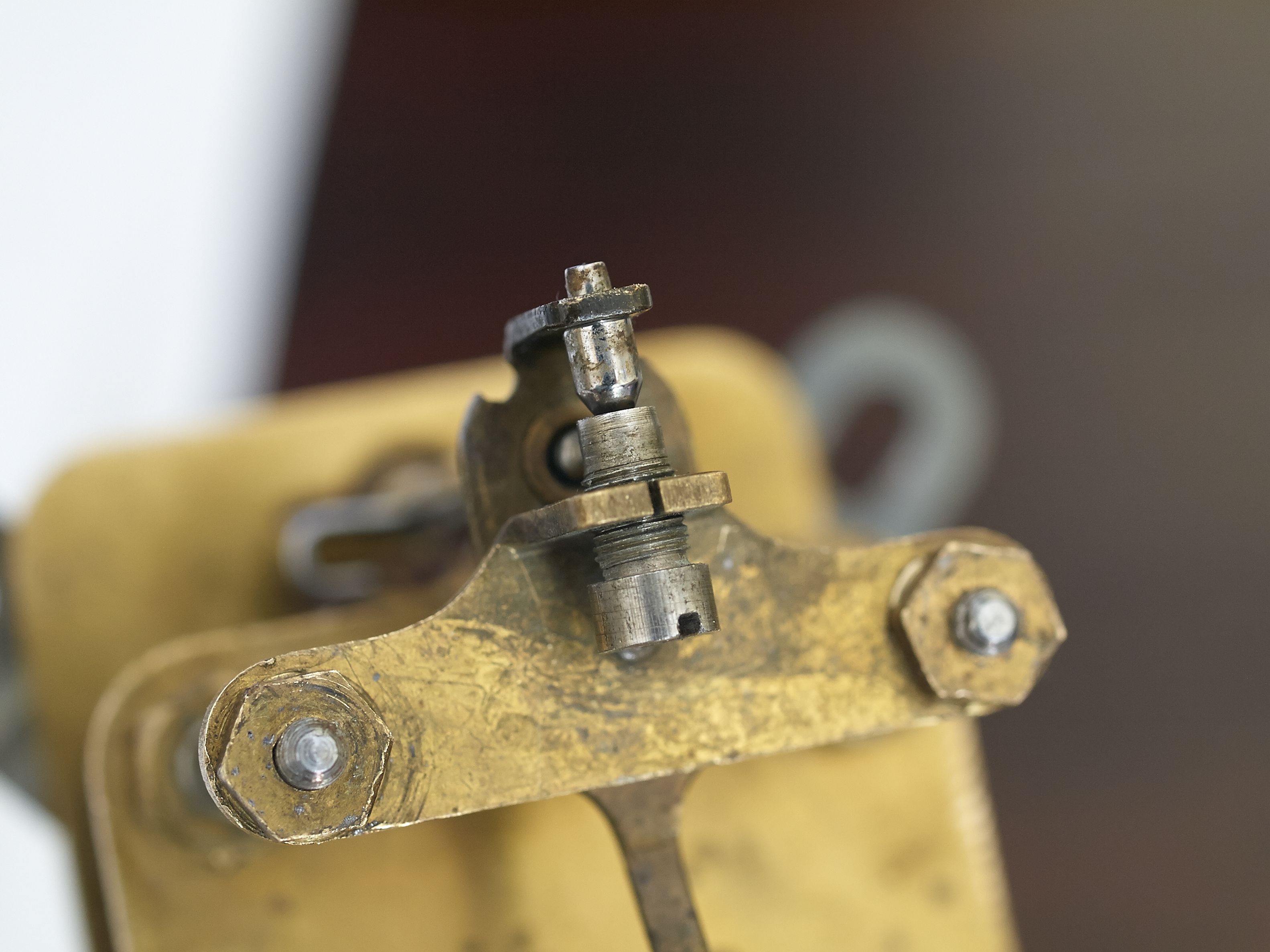
I thought with a cleanup and oiling it would be simple to get it going again but no such luck. I know that there is power getting to the escape wheel because when I disconnect the anchor it spins like a buzz saw. When I reconnect the anchor it runs for about 15 seconds and stops. I would like some ideas to get this clock running but in the meantime I have attached some photos. My question, it there anything missing here? This clock doesn’t have a suspension spring or a crutch which I find unusual. And what is that screw thing for? Comments and suggestions would be appreciated.
Anchor and top of pendulumUnknown screw adjustmentThe movement itself
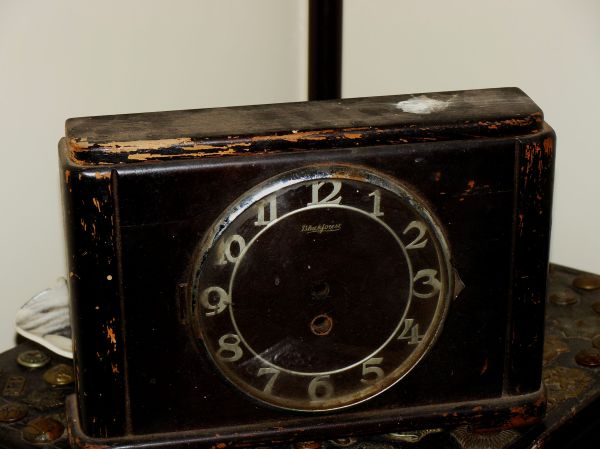
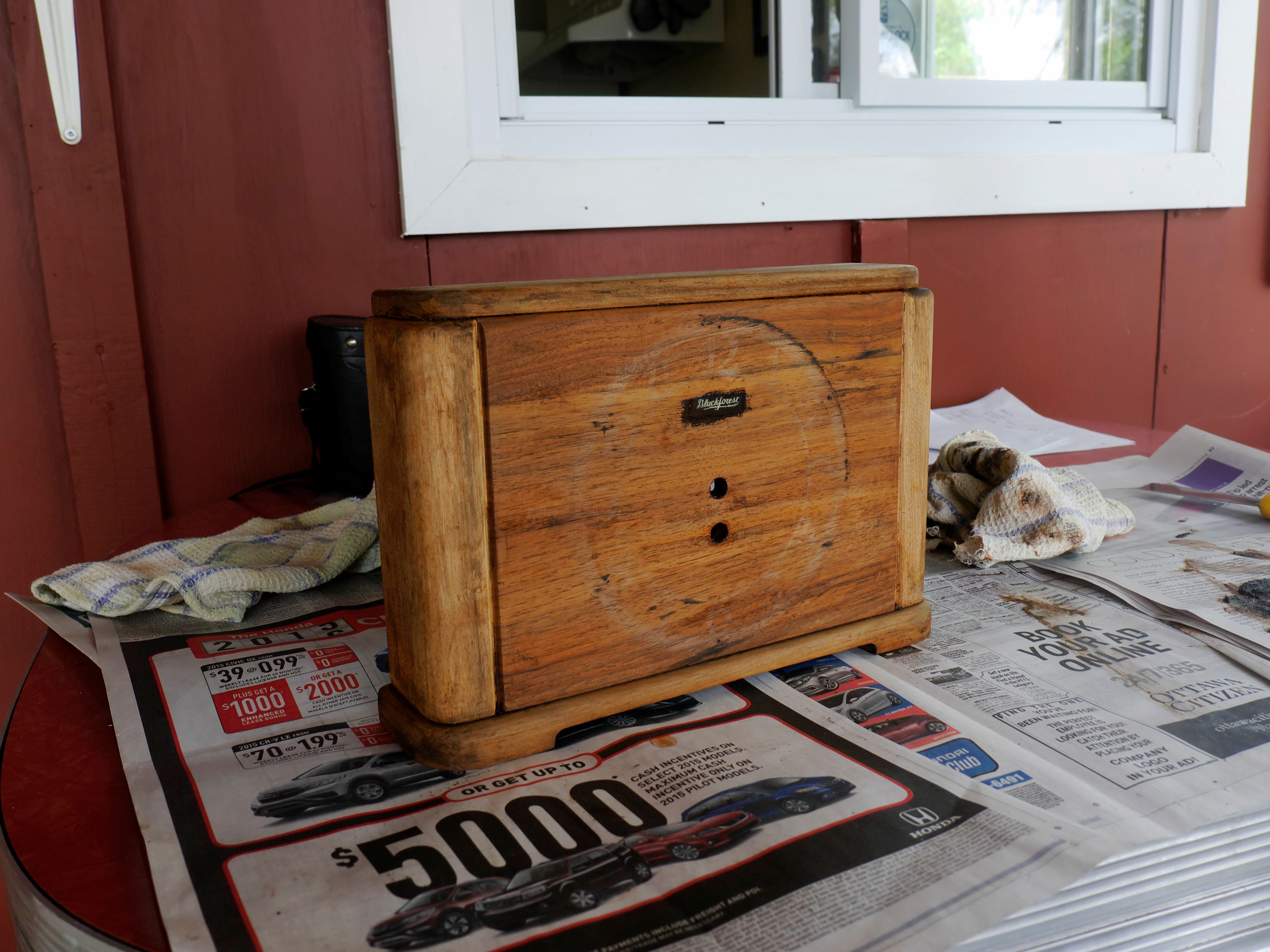
This is a Blackforest shelf or kitchen clock made before the Second Word War. Blackforest is a Canadian clock company. The Blackforest Clock Company of Toronto, Ontario was founded by Leopold and Sara Stossel in 1928. Both clock movements and complete clocks were imported from Germany and sold through department and jewelry stores across Canada. Their son Ed Stossel started working part time with his parents’ company in the 1930s, and later became a full-time employee in the late 1940s.
Some assembly work was carried out in their Wellington Street East factory. Initially, imported mantel clock and grandfather clock movements were installed in cases made in Kitchener, but later the complete mantel clocks were imported from Germany. This arrangement was interrupted by the Second World War, which also led to a name change to the Forestville Clock Company in 1941. During the war years this company imported its clock movements from England, the United States, and even France. However, starting in the mid nineteen fifties German factories again became the source of most Forestville clocks, with Mauthe being a major supplier. The company did not survive much past the late 1970s.
I found this in a antique shop in Kazabazua Quebec and it was in sad shape. This particular clock would have been the least expensive in the Blackforest catalog. I had an opportunity to go through the Blackforest catalog during my visit to the Canadian Clock Museum in Deep River this past summer and could not find a listing. I have no idea of the model name or number as there is no label on the clock. The only feature it shares with other Blackforest mantel clocks is the metal bezel, numerals and hands. Otherwise it is a one train time-only movement with a minimum number of gears and a unique twisting pendulum adjustment. The movement is as simple as it gets so it is easy to work on.
The photo shows the movement out of the clock and as you can see, it is quite dirty. I am in the midst of dis-assembly, cleaning (in my new Ultrasonic cleaner) and oiling. My initial observation is that the pivot holes, pivots and lantern gears are in good shape and the mainspring seems strong. Not a lot of wear for a 75+ year old clock.
Single train time-only movement
The next photos show the condition of the case when I bought it and the second is the first phase of stripping. You will notice that I did not disturb the decal; it would have been impossible to find a replacement. It was in terrible condition, likely sitting in a attic or garage for quite a few years. The spring was wound very tight and I am assuming at this point that dirt and grime caused it to cease. Although I paid $15 for it at the time it seemed too much after I got it home. Nonetheless, I went to work on it and if I can get it to function it might be worth more than I paid for it. As far as restoring this clock I used a latex dark walnut wood satin and a polyurethane top coat, not what would have been done at the time which likely would have been a dark lacquer finish. This method will be more durable. The first photo shows the case is in a restored condition and as you can seeing it is a striking little clock.
This article describes my latest mantel clock find, an American tambour style time, strike and chime clock that has some very interesting features.
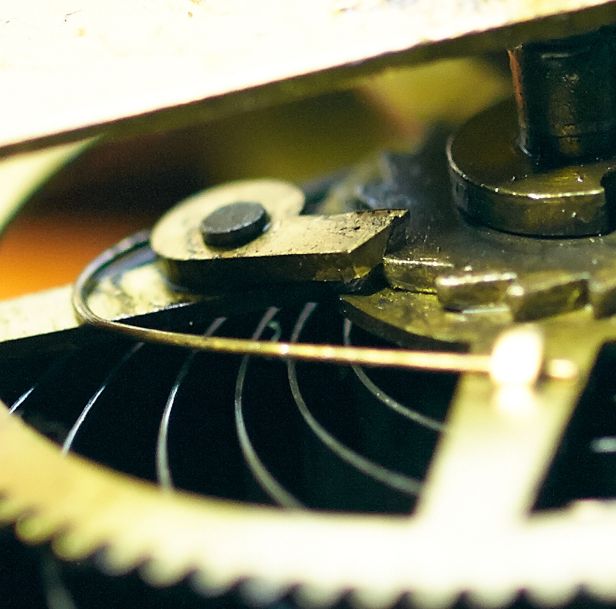
Weak clicks, a common Sessions problem
It is a Sessions Westminster A mantel clock made in Forestville Conn. The first year of production for this model was 1927. Between 1903 and 1933 Sessions produced 52 models of mechanical clocks, ranging from Advertisers, large and small clocks with logos of various businesses, to wall, or regulator clocks, and shelf or mantel clocks, designed for the home. Some of the Sessions clocks from this period are prized by collectors.
Inlay adds to the charm of this clock
This case is 21 inches long and 10 inches high, has a mahogany finish with a faux wood inlay and raised metal gold-coloured numerals. It has an 8-day Westminster quarter-hour chime movement. The strike and the chime are on the same train. This clock has 2 gear trains to perform what is usually done with three gear trains in most clocks. Rare but not unique.
Although made in the 1920’s, Sessions had to compete with every other American clock company as chime clocks became very popular. Movements with 3 gear trains were the norm; three arbours, one for each train. Sessions chose a radical approach, and designed the two-train Westminster movement with only two mainsprings. Economies of scale meant that the dial fit other time & strike mantel clocks as well.
Drum and pin chime arrangement
This particular clock was sold in 1931, an inscription testifies to the date. The sale price in 1931 was $29.95, a working man’s salary in the 1930’s. This is a $20 flea market find.
The time side runs well but the chime and strike side is not working. It has either a broken or a disconnected mainspring or perhaps some other major issue is lurking within.
This clock has a reputation for being difficult to work on. Some horologists will not touch it because of its quirkiness and the amount of time it takes to repair but I plan to give it a shot, not now but once I gain moire experience in clock repair.
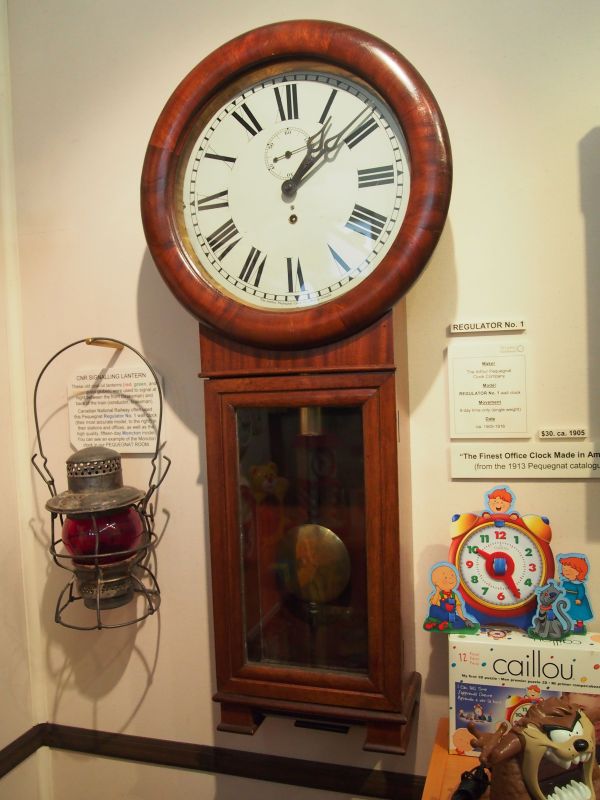
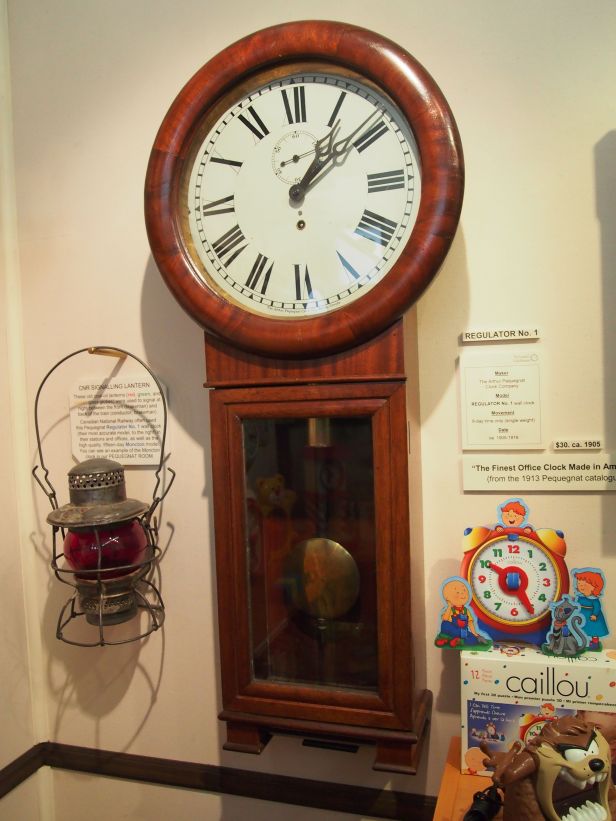
One of the clocks that I would like to add to my collection is the Arthur Pequegnat Regulator #1, single weight 8-day time only clock. A rare clock indeed and prices of the few I have seen are on the high side. Too rich for me at his time.
The company distinguished itself as a competitor for some of the better American wall clocks such as those made by Seth Thomas. Their wall clocks often looked like models made by Seth Thomas but some of their designs were unique. For their wooden cases, they favored the heart wood of quarter-sawn white oak that showed off beautiful ray flecks.
The regulator #1 is often compared to the Seth Thomas Regulator #2. Thousands of Seth Thomas Regulator #2s found their way into offices and rail stations all across America. The Arthur Pequegnat Regulator #1, though not as prolific, served the needs of many businesses in Canada. The clock is highly collectible in Canada and will command twice the price of similarly styled clocks by well-known American counterparts.
This photo of the Regulator #1 was taken at the Canadian Clock Museum in Deep River Ontario in 2013.
The Arthur Pequegnat clock company had an illustrious albeit short life. Watchmaker Arthur Pequegnat was born in Switzerland in 1851. Arthur immigrated to Berlin, Ontario Canada in 1874 with his wife, parents, brothers and sisters; a grand total of 18 family members.
By the late 1870’s Arthur was operating a jewelry store and watch repair in Southern Ontario. By the middle 1880’s Arthur and his brother Paul were operating a shop in Berlin, Ontario. After about ten years the brothers went their own way, both operating successful jewelry shops in Southern Ontario.
In 1897 Arthur expanded his Berlin Jewelry shop to include the manufacture of Bicycles. However, By 1904, with the decrease in the demand for Bicycles, Arthur began to re-focus on the clock industry, by manufacturing his own clock movements at his Berlin Bicycle Manufacturing plant. At first the wooden clock cases were made by local Furniture Makers, however in time he manufactured his own clock cases.
Berlin, Ontario was re-named Kitchener Ontario in 1916, due to anti-German backlash during WW I. The date becomes a useful tool when determining the age of Pequegnat clocks, Movements or Dials marked “Berlin” date the clock to 1916 or earlier and those marked “Kitchener” are 1916 or later. Since many clocks had a long production life it is difficult to date any Arthur Pequegnat clock with precision.
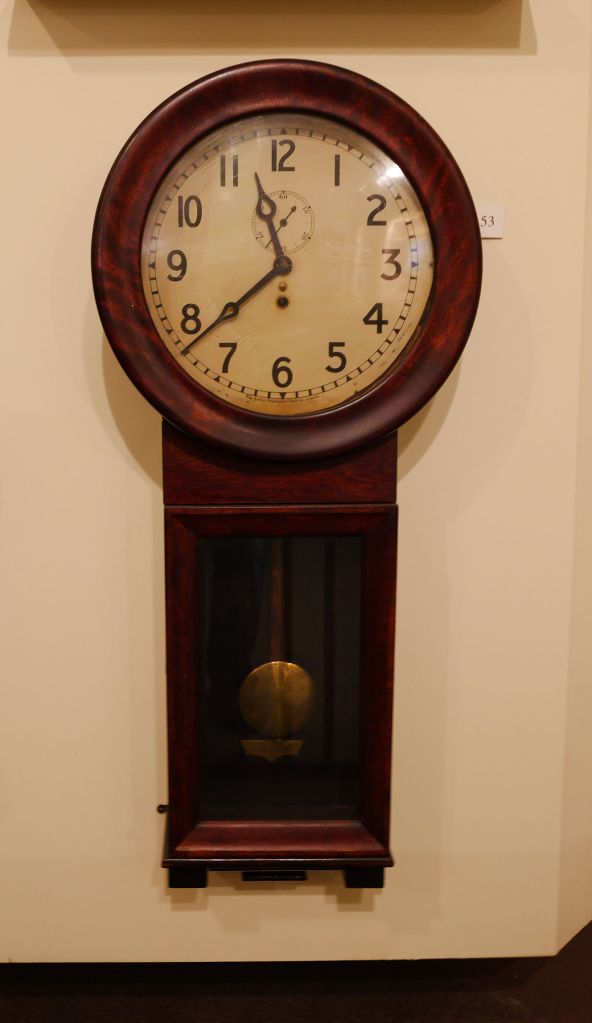
Regulator #1, hanging in the Macdonald Museum in Middleton, Nova Scotia, Canada
Arthur died in 1927, however, with family members in control, the company continued to operate until 1941. The war effort meant that brass became difficult to obtain and the company shut its doors. The factory never produced another clock, and was demolished in 1964. All that remains in Kitchener today is a plaque commemorating this great clock manufacturer.
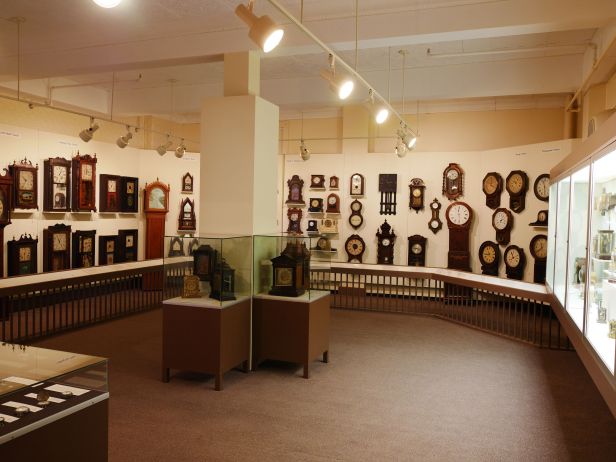
MacDonald Museum main exhibit area
The Canadian Clock museum contains the largest collection of Arthur Pequegnat clocks in Canada and it is certainly worth a visit. The Macdonald Museum in Middleton, Nova Scotia has a modest collection of Pequegnat and is worth visiting if you are traveling through the province of Nova Scotia.
Mauthe mantel clocks are widely available in various shapes and sizes, often appearing on online marketplaces, at garage sales, flea markets, and in antique shops. However, not all are well-preserved, with many showing signs of age and neglect. This particular round-top mantel clock stands out for its excellent condition, especially considering its age.
Mauthe buffet clock
While this is commonly called a mantel or shelf clock, in Mauthe marketing parlance it is referred to it as a “buffet clock”. In the mid-20th century, clocks of this style were often designed to sit on buffets, sideboards, or credenzas in dining rooms. This placement allowed the clock to serve both a decorative and practical purpose that complemented the room’s furnishings. The term “buffet clock” reflects its association with this specific setting, distinguishing it from mantel or shelf clocks, which were typically placed in living areas or on fireplaces.
This 3-train Westminster chime pendulum clock features a 5-rod gong block and plays a quarter-hour musical tone. I discovered it at an antique shop in Great Village, Nova Scotia (Canada) some time ago. The movement is unmarked, lacking a trademark, but bears the number 50089 on the bottom right of the rear plate. There is no doubt that the movement is original to the case.
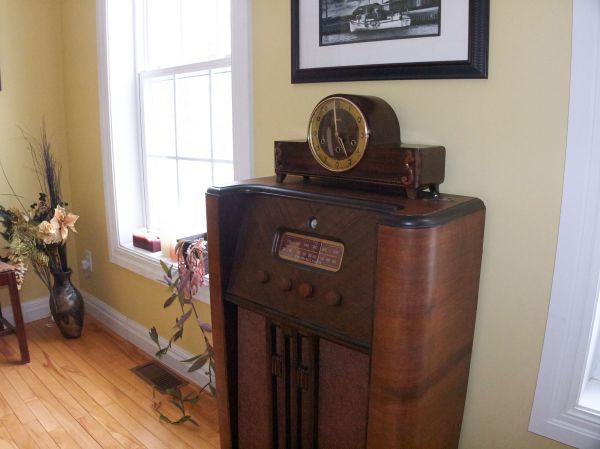
Back of the clock showing the 3-train movementMauthe clock and Stromberg Carlson console radio
Mauthe – The Company
Mauthe clocks were produced in Germany by a company with a long and distinguished history, manufacturing thousands of wall, mantel, office, and hall clocks. Founded in 1844 by Friedrich Mauthe and his wife, Marie, in Schwenningen, Germany, the company initially focused on producing watch parts. By the late 1860s, Mauthe began making its own wall clocks and movements, some produced through the “Gewerblern” method, a form of cottage industry, while others were made in a more industrial, factory-based approach.
In 1876, the Mauthe sons, Christian and James, took over the business. A decade later, in 1886, Mauthe started manufacturing its own spring mechanisms.
By around 1900, Mauthe offered a range of clocks, including alarm clocks, pendulum wall clocks, grandfather clocks, office clocks, and “Buffet Uhren” (Buffet clocks). At this time, the company employed around 1,100 people. The third generation of the Mauthe family took control in 1904, with Eugene Schreiber, Christian Mauthe’s son, Dr. Fritz Mauthe, Jacob Mauthe’s son, and Alfred Mauthe, Jacob’s other son, joining the leadership.
In 1925, Mauthe introduced a new trademark featuring an eagle with outstretched wings, clutching a three-part round plate marked with the letters F, M, and S. By 1930, the company was producing approximately 45,000 clocks per week, with over 2,000 employees. Around 60% of their production was for export, with England being the primary market.
In the mid-1930s, Mauthe began manufacturing wristwatches, some of which were supplied to the German Army (Wehrmacht). After a brief pause during the war years, Mauthe resumed production in 1946, focusing on wristwatches. The company continued operations through the 1950s, 1960s, and 1970s, but ultimately declared bankruptcy and closed in 1976.
Clock face showing three arbour points
This clock runs a complete 8-day cycle and produces a very pleasant sound. The case features a simple yet attractive design, is in excellent condition, and the movement is clean, having been recently serviced.
This Mauthe buffet clock is a fine example of the company’s craftsmanship, combining reliable timekeeping with a pleasing chime. Its well-preserved condition and recent servicing make it a standout piece for any clock collector.
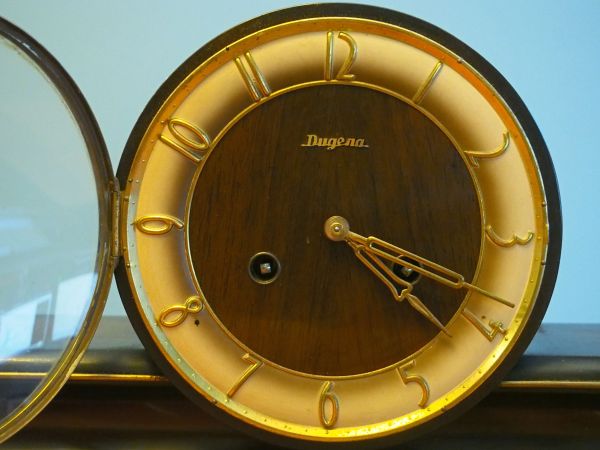
I am continuing work on my Dugena mantel clock with a Hermle movement. Everything seemed to go well after re-assembly but the strike barrel.
A serious problem or simple fix? The latter, thankfully. Something was definitely amiss since the winding arbor was not engaging on the mainspring. The spring was either broken or had not engaged the winding arbor sleeve.
Mainspring barrel
I had no choice but to open up the barrel but it was not much fun getting the cap off. Some suggestions I received on a clock forum site were to bang the arbor with a steel hammer or a rubber hammer and it would pop neatly into my hand. This did not work. Finally someone suggested that if it was really stubborn to find a piece of hardwood, hold the barrel in a gloved hand and bang it with some amount of force on the hardwood. It worked!
Once I got the thing apart I inspected the spring and arbour for possible damage. I initially thought the spring catch (see photo with black arrow) was broken but a member of NAWCC (National Association of Watch and Clock Collectors) assured me that this was quite normal. I re-positioned the catch onto the spring, tested it and snapped the cap back on.
Strike mainspring barrel on the left
The barrel can be easily slid back into the clock without taking the movement apart. Using the clock key I gave it a few turns, tested the action of the strike side and everything seemed to be working.
Arbor sleeve spring catch
Now for bench testing. I put a make-shift hour hand for the clock to see if it marked the hours properly. Testing for a week or so will reveal any issues and allows for finer adjustments before I install the movement back into its case. Everything looks good at this point.
Mainspring with barrel cap off
The original problem was that the clock was running too fast and no amount of adjusting would slow it down. I am hoping now that after a good cleaning it will run as it should.
If you are following the progress on my Dugena mantel clock project it seems to be going fairly well though there have been some minor issues.
I had no trouble taking the movement apart and cleaning all the parts to the best of my ability. Everything seemed to be in good order with minimal wear. My initial method months ago of dunking the assembled clock in a solution clearly did not work. The clock did not run at all after that procedure. So, I put the clock aside to decide what to do. Dis-assembly is the only way to do the job correctly as I am learning. After a thorough cleaning comes re-assembly.
I have learned from taking apart movements that getting it back together means that once the back plate is on it is better to work from the bottom up, by getting the barrels in place, the main wheel and then working up to the top of the clock. Once I have the barrels in place I put on the lower nuts. I am not sure if that is the correct procedure but it works for me. I then use a pair of tweeters to carefully move the pivots in their proper place.
The hammer assemblies are on the right side
The hardest part was re-aligning the hammer assemblies since the hammer wires are located outside the back plate. You can see this in the photo. I later learned that even when the clock is fully assembled the barrels will come out by simply removing the winding arbors and sliding them out. It’s all good learning!
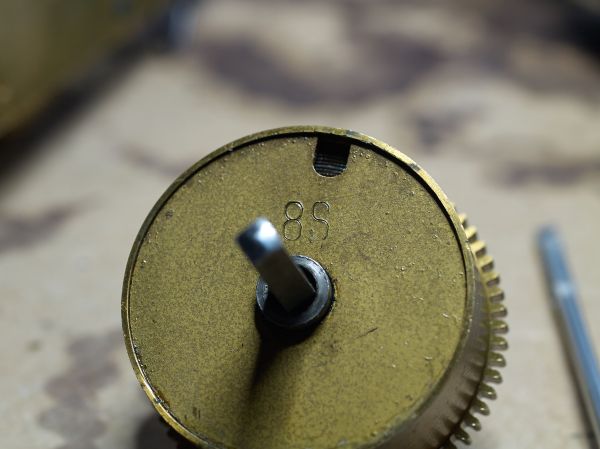
It took a lot of fiddling to position the hammer assembly properly. With time (no pun intended) it all came together. Once the back plate was on securely next came the balance wheel escarpment and aligning the fork correctly which I think I did. I then put the clock in beat, oiled it and started it up. It did not run. Whoops, it needs power and had to be wound. I immediately noticed that the time barrel spring would not wind at all. I am guessing that the spring had, at some point become un-clipped from the barrel. I say un-clipped because I did not hear a broken spring sound. I switched barrels (#8S spring barrel) since they are the same for both time and strike. Once I got the barrels switched I gave the spring a few turns with the key, gave the balance wheel a little shove and the clock has been running for 24 hours as of this writing.
Does it keep time, I have no idea at this point? I suspect it does with a little adjustment. As for the strike side, if I can re-attach the mainspring within the barrel I am on my way to re-installing the movement back into it’s case. I know the strike side is working properly because when I had the good spring on that side for a brief period the strike assembly seemed to be working as it should.
Should I try to fix the mainspring or buy a new (or NOS) barrel and mainspring? I am not keen on fixing a mainspring because of potential injury but if I can scour around and get a used 8S barrel and mainspring for a reasonable price that would be the better option in my view.
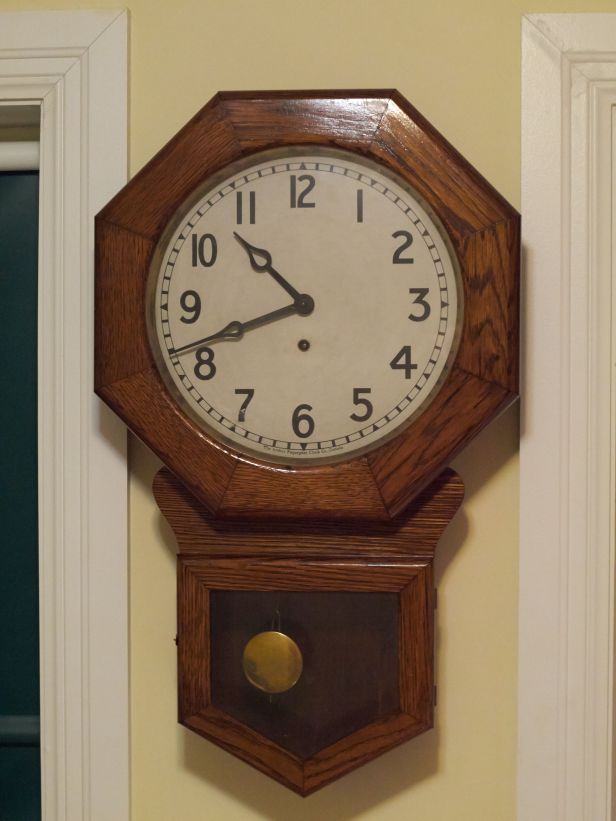
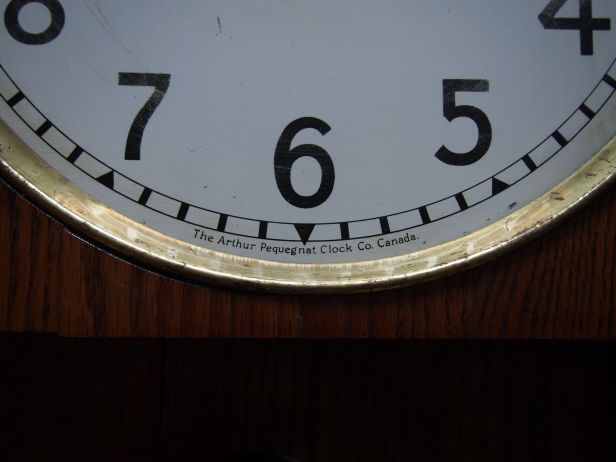
This my first Arthur Pequegnat clock and it is the Brandon II. The first edition was produced up to 1916. Though very similar in design, this second edition was made from 1917 to 1941.
Arthur Pequegnat Brandon II
The Arthur Pequegnat Clock Company made clocks in Kitchener, Ontario from 1903 to 1941.
Normally found in a Canadian schoolroom in the 1930s and 1940s or in an office setting it was one of Pequegnats more popular styles. It is an octagonal short drop, time-only schoolhouse clock. The first edition had the exact dimensions but with a more ornate frame around the dial bezel.
Schoolhouse clocks were generally time-only as there would be other methods, such as a bells or alarms, to mark key points in a typical school day. If situated in an office environment a strike train would be too distracting to the employees. Brandon clocks also came with calendars, a useful feature for both school or office.
Clock face Arthur Pequegnat Brandon clock
Both the case, which is made of quarter-sawn oak, and the brass movement were made by the Arthur Pequegnat Clock Company in their small Kitchener factory until 1941. Brass shortages during the Second World War caused the company to abruptly end production.
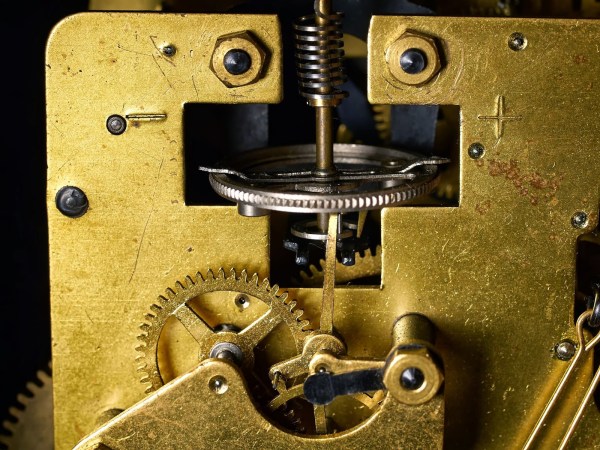
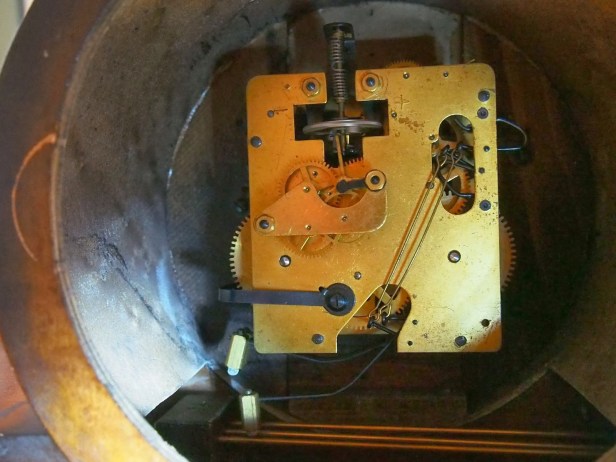
The time-only movement is relatively simple with few gears and little to go wrong. It was reliable, dependable and made to withstand the abuse of a school or office environment.
This clock was owned locally by an antique collector who after having it for a number of years decided to sell it in his antique shop in Great Village, Nova Scotia. The price was reasonable.
Arthur Pequegnat Brandon time=only movement
The case is in excellent condition, as is the face and bezel. Although the clock runs and keep reasonable time it has an annoying squeak suggesting that something is definitely amiss. I discovered that the first wheel had considerable pivot hole wear. This is the kind of repair I am unable to do at this time since I have neither the tools nor the knowledge. I brought the clock to a horologist in Halifax, Nova Scotia where the servicing was completed.
Five bushings were installed, the mainspring was cleaned and the movement was oiled. I believe it is a worthwhile investment and I expect it to be ticking away for years to come.
Dugena was a German retail clock company. The name Dugena still exists today, but whether or not it is related to the Dugena company of the 1950s is anyone’s guess. This particular clock has a Hermle floating balance movement, which is both reliable and dependable. Dugena, like many other clock companies at the time, contracted out to a number of movement manufacturers during it’s heyday.
I bought this Dugena mantle clock for very little money. The previous owner assured me that it was an old clock and not to expect it to be perfect. He was right, it is not perfect. It is a 2-train time and strike Bim-Bam clock. When I got it it had no trouble starting. However, I could not get the clock to keep time (ran too slow) despite numerous adjustments to the balance wheel, which was a little frustrating. I had to remind myself that the previous owner did say it was not perfect. There is also something amiss about the strike train side because it strikes incessantly till the clock winds down. No doubt something is either worn, broken or misaligned. Misaligned rack and snail, I hope!
Dugena clock movement showing floating balance escapement
Hermle movement showing balance wheel escarpment
My first attempt at cleaning the clock involved taking out the movement and placing it in an ammonia bath with some Murphy’s soap, the so-called Dunk and Swish method. The net result is that once I dried it completely, it functioned no differently than before, maybe even worse.
As mentioned, it has a balance wheel escarpment, and I am assuming the spring might be weak because the wheel does not spin more than 180 degrees. Either that or the darn thing is losing power from somewhere else. The bottom line is that it needed to be taken apart and cleaned properly. That is exactly what I am in the process of doing. My first assessment is that the clock is pretty tight and the pivots, pivot holes, pinions, and arbors are in pretty good shape with a minimum of oily gunk. The springs are in barrels, and at this point, I am not going to service them. Reason, I don’t have the tools.
I have taken clock movements apart in the recent past, and I have a pretty good understanding of what goes where and why as well as a basic set of tools to get me through. I can clean and oil, but I don’t (can’t) do bushings. My hope is that once I have finished cleaning, assembling, and oiling the clock, it should work correctly, though if it doesn’t, it is no great loss. Good learning though.
So, I have a couple of choices. I can get the clock to function, or I can investigate a replacement movement if it doesn’t. The replacement movement (last photo) is $128CDN for a pendulum movement or $198CDN for a balance wheel escarpment. I will go for the pendulum movement since it is easier to work on, has fewer parts, and makes that distinctive tick-tock sound. There is a third option: throw the movement into the parts pile and junk the case. We’ll see.
Balance wheel escarpment
possible replacement movement from Hermle
If I bought a new movement, the clock would likely run trouble-free for years. Is it worth it? I am not sure. The case is in pretty good condition for its age, and it would not take much to make a few cosmetic improvements to make it presentable, but obviously not brand new looking.


















 Antique and Vintage Mechanical Clocks
You must be logged in to post a comment.