
Wrapping up the servicing of a Seth Thomas type 89 movement
Seth Thomas is a well-known American clock manufacturer with a long history, and they produced a variety of clock movements over the years. The Type 89 movement is one of the many clock movements produced by Seth Thomas between 1900 and 1938.

Seth Thomas mantel clock from the 1930s
Seth Thomas mantel or shelf clock

The mantel clock in question features the Type 89 movement. Acquired in the summer of 2023, this clock boasts a simple and straightforward design.

In the first part of this two-part series, I discussed the disappointments I encountered with the clock’s case.

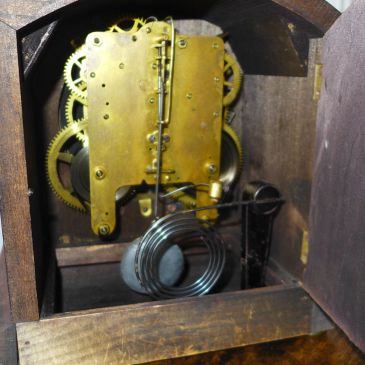
Seth Thomas type 89 movement showing dirt and rust
Seth Thomas type 89 movement, dirty and rusty

The focus then shifted to the disassembly process and my examination of the widely-used Seth Thomas Type 89 clock movement.

My observations highlighted a replaced mainspring on the strike side, the necessity for bushing work, and indications of rust, all of which posed challenges that I committed to addressing in subsequent stages such as cleaning, bushing, oiling, and reassembly.

The focus of this blog post is the completion of servicing of this type 89 clock movement.

The front plate of a type 89 Seth Thomas movement
Front of the type 89 movement before disassembly

Cleaning of the mainsprings

There is always the temptation to do nothing with the mainsprings if they look acceptable. However, cleaning the mainsprings is an essential part of clock servicing. Uncoiling and wiping the dirt and grime from the mainsprings with a cloth is the preferred method, but cleaning them with an ultrasonic cleaner is also an option.

In Part I, I cleaned the mainsprings in my ultrasonic cleaner and provided a rationale for this decision. Before I go any further, I’d like to emphasize a crucial point regarding the cleaning of mainsprings in an ultrasonic cleaner. This practice is not recommended and should only be considered as a last resort.

While cleaning mainsprings in an ultrasonic cleaner has little impact on the surfaces or mechanism of the cleaner itself the oil removed from the mainsprings generates a black liquid that contaminates the cleaning solution, rendering it ineffective for future use.

Seth Thomas type 89 mainsprings, note the replacement spring on the right

Clamps have been applied to secure the mainsprings after oiling, and they’ve been set aside. Now, we move on to the next step: the bushing phase.

The back plate is removed on a type 89 Seth Thomas movement
Backplate removed

Bushing the movement

As the movement is fully disassembled this is the stage where bushing work can be done.
I commend individuals who choose to bush by hand, but personally, It is not for me.

Various systems exist for bushing, with KWM and Bergeon being the two most widely adopted. It’s worth noting that neither system is inherently superior to the other, as preferences tend to vary among enthusiasts. When referring to a “system,” it’s important to understand that the bushings from one system are not interchangeable with those from the other.

That said I use the Bergeon system.

Bergeon 6200 Bushing Machine
Bergeon Bushing Machine

Before bushing, I identify all the locations requiring attention and mark them with a Sharpie. There is no permanent mark as rubbing alcohol will easily remove all traces of ink.

I have an excellent assortment of bushings and have all the required ones for this project.

An assortment of Bergeon bushings, assortment #5488
An assortment of Bergeon bushings, #5488

Using cutters each hole is drilled out and chamfered, that is, removing the sharp edges to allow the pushings to be pressed in smoothly. As I insert each new bushing I test the fit by assembling the wheels to check how freely they move. This allows me to make small adjustments in the event the pivot is too tight in the bushing hole.

Cutting into the bushing hole with Bergeon bushing machine
Cutting into a brass plate

Based on my initial assessment, the bushings for both the front and back plates of the escape wheel were the most worn. The next new bushing is the fourth wheel front plate, the one adjacent to the escape wheel. After three bushings everything looks good and the wear further down the train does not look too bad. A fourth bushing for the fourth wheel should be enough.

A cutting broach is used to enlarge any holes that are a tight fit for a pivot followed by a smoothing broach. To prepare for the wheels to go back in place all bushing holes are cleaned with pegs/toothpicks.

Test fitting the time-side wheels during the bushing process, type 89 Seth Thomas movement
Test fitting the time-side wheels during the bushing process

In the photo above, the plates and gears look shinier after a session with the ultrasonic cleaner. However, it’s important to note that the main goal in clock repair isn’t to make everything as shiny as possible. The focus is on reducing wear and tear. Some dirt and grime on the plates might not come off completely during the cleaning process in every case and it is not something the clock repairer should be overly concerned with.

Back to bushing. There is a little bit of play on the second and third wheels but it is tolerable so, I think I will stop at this point.

Punching a 3.5 mm Bergeon bushing into a clock plate
Punching a bushing into the plate

Were I in the clock repair business I would bush everything on the time train, or the entire movement for that matter, but since I usually inspect movements in my collection every 2-3 years I can address any additional wear at that time.

On to the strike train. In the first article, I mentioned that there was not much wear on the strike side which might be attributable to that side not being wound as often. The only hole that must be addressed is the cam wheel bushing on the front plate. Why this bushing hole is worn much worse than the others is a bit of a mystery.

Okay, all the work is done for a total of five new Bergeon bushings. The holes have been pegged, and the movement is now ready to be reassembled.

The one hiccup encountered during the bushing process was the malfunction of my caliper tool. Fortunately, this isn’t a major problem, as all the Bergeon bushings are uniform at 3.5mm outside diameter, with inside diameters of either 1.4mm or 1.5mm so I knew what size to grab first.

Reassembly

When dealing with American 8-day time and strike movements, there are challenges in configuring the strike mechanism accurately. Occasionally, luck is on my side, and I manage to place the paddle in the deep slot, position the lever in the lowest part of the cam wheel, and align the warning wheel just right on the first attempt.

A useful tip. If the lever is in the lower part of the cam wheel and the paddle is not in the deep slot, simply move the toothed count wheel sideways so that it does not engage the pinon and reposition the wheel till the paddle finds the deep slot.

No luck setting up the strike this time! If the strike train does not lock correctly it will simply keep on running and you will know that soon enough.

The plates can be partially pried open without the risk of all the wheels and levers springing out. Repositioning the warning wheel involves moving the fly aside, carefully extracting the 4th wheel from its pivot hole, and rotating it a quarter turn or so to ensure the warning pin aligns with the stop lever.

Seth Thomas movement on the test stand

A minor issue with the hammer lever surfaced as it was not aligning correctly with the strike pins on the cam wheel. No disassembly of the movement is required for this adjustment. Simply loosen the bottom two nuts by the mainsprings, and the strike hammer can be removed to straighten it. After having been bent multiple times over the years, straightening it out resolved the issue.

Next, the movement is oiled with Keystone clock pivot oil and mounted on a test stand. After a week it is running and striking as it should.

And lastly, my new caliper arrived just as I was concluding the servicing on this clock.

Addendum

To properly configure the strike side, pay attention to the positioning of the levers as pointed out by the arrows.

Seth Thomas movement
ST movement

In the above photo, the lower arrow shows the paddle in the deep slot, and the upper arrow shows the drop lever in the indent of the cam.

Seth Thomas movement

The upper arrow shows the position of the stop pin on the stop wheel. The lower arrow shows the locking lever.

Cleaning an antique/vintage clock movement – Ron’s method

Let’s clear something up right away: I am not a “Dunkin Swish” enthusiast. If you’ve been researching the clock-collecting world for a while, you might have come across this term. If you haven’t, consider yourself lucky—it’s something best avoided at all costs.

“Dunkin Swish” (apologies to those named Duncan) refers to the practice of placing an assembled movement into a cleaning solution or an ultrasonic cleaning machine, drying it off, and then declaring it “clean.” This is the absolute worst method for cleaning a clock movement and is never a good way to clean mainsprings within their spring barrels.

Why? Only by disassembling the movement can you properly inspect parts, polish pivots, peg holes, and thoroughly remove the dirt and grime that accumulate in the small crevices of a movement—buildup that will accelerate wear over time.

There is only one method to properly clean a clock movement, and complete disassembly, which includes removing mainsprings from their barrels/arbours.

Here are the steps I always follow when cleaning clock parts.

Hermle movement parts after cleaning

In most cases, clock parts can be safely cleaned using an ultrasonic cleaning machine. However, in rare instances, when working with something very old and delicate, hand cleaning may be the only viable option.

For the purposes of this article, I will assume that most clocks you work on are standard common-place brass mechanical movement types found worldwide.

Let’s get started.

Pre-cleaning

Once I have the movement disassembled, I clean any stubborn stains and wipe off excess oil from the parts beforehand. From experience, I’ve learned that while an ultrasonic cleaner works remarkably well, it’s not a magic solution—tough stains don’t always come off easily in the cleaner.

Pre-cleaning has an additional benefit: it extends the life of the cleaning solution. The solution can be reused multiple times, but once it becomes too dirty or cloudy to see through, I dispose of it. Proper disposal can be a challenge, which is why I always opt for a non-ammoniated, biodegradable solution.

I also clean all the pivot holes with peg wood or toothpicks and remove oil from the pivots beforehand. Additionally, I wipe away excess oil and dirt from the mainsprings.

The ultrasonic cleaner

In the early days of my clock repair work, I used an inexpensive ultrasonic cleaning machine. It was adequate for small jewelry items and acceptable for clock parts, but as I could afford something better, I decided to invest in a commercial-grade product.

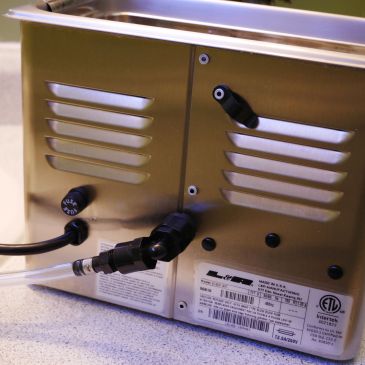
Ultrasonic cleaner
Ultrasonic cleaner

I came across many Chinese-made ultrasonic cleaners on Amazon and eBay. While some may have had positive experiences with these machines, and the prices are certainly appealing, I was looking for something of higher quality and with a solid warranty. I have no issue with Chinese ultrasonic machines, but I would only consider them if they offered a reliable return policy and warranty.

I chose L&R for two main reasons: their reputation and warranty. I get no credit for mentioning this company, but the link will allow you to explore their product line to find the right size for your needs. After four years of continuous use, my L&R cleaning machine has performed flawlessly. L&R meets all of my requirements.

Ultrasonic cleaner by L&R
L&R Quantrex Q140, 3.2L with heater

The Q140 with heater is the size I opted for. It will hold one complete movement but is a tight fit for larger movements. Its smaller size means less cleaning solution is used and quicker heat-up times.

A high-quality ultrasonic cleaner will not disappoint. While there may be other brands that are equally good or even better, you generally get what you pay for.

Using an Ultrasonic Cleaner

Ultrasonic cleaners use cavitation, generated by ultrasonic waves, to clean objects made of non-absorbent materials. Ultrasonic cleaning effectively removes dirt, grease, and other contaminants from delicate components without causing damage. Just look at how bright and shiny this 30-hour movement looks after ultrasonic cleaning. That said, achieving an absolutely shiny movement is not the goal.

30-hour movement after cleaning in Ultrasonic

Should everything go into the ultrasonic cleaner? Avoid mixing metals beyond brass and steel in the cleaner as they may react with each other. I also avoid placing anything plastic in it. Some modern clock movements with plastic or nylon gears and parts should be cleaned separately and not placed in the ultrasonic cleaner. Hammer heads made of leather should not be placed in an ultrasonic.

Use your own judgment with friction-fit parts, such as a center gear and pinion, as there is a risk of damaging them if you’re not confident they can be reassembled easily. Otherwise, disassemble as much of the movement as possible.

Choose the Right Cleaning Solution

Avoid using flammable substances such as alcohol, gasoline, or other volatile liquids. These can vaporize, potentially causing a fire or explosion, and release harmful gases into the workspace. Inhaling these toxic fumes is never safe.

Only solutions that are specifically designed for an ultrasonic cleaner should be used. Among acceptable cleaners is Polychem Deox 007 as a cleaning solution that works effectively. The mix is 5 to 1 ratio with water and it is free of odour. According to their product brochure Deox-007 is “an environmentally friendly, non-ammoniated concentrate cleaner. It is mildly alkaline for the efficient removal of oils, grease, tarnish, stains, corrosion, and oxidation from brass, bronze, copper, gold, and silver”. Once it has outlived its usefulness it can be safely dumped down the drain.

Wire basket holding an American-style movement in the ultrasonic before the solution is added

Many cleaners have a safe fill line, typically about 1 inch from the top of the tank. Whether you’re cleaning one part or several, always ensure the solution reaches this fill line.

A stainless steel wire basket is also necessary as it is not advisable to place parts directly on the bottom of the cleaning tank. A stainless steel wire basket is necessary because placing parts directly on the bottom of the cleaning tank can cause them to become damaged. The basket keeps the parts elevated, allowing the ultrasonic waves to clean them evenly without contact with the tank surface.

Not quite dirty enough to throw away

Although I always drain the solution after each use, I understand for the sake of convenience why some repairers leave it in the tank if the ultrasonic cleaner is used daily.

No cleaning method I’m aware of is as effective at cleaning lantern pinions as an ultrasonic cleaner. The results are truly remarkable.

The Ultrasonic Session

I pre-heat the solution which involves pouring in the solution, turning on the heater, and allowing the ultrasonic to come up to temperature. It takes about 10 minutes.

Green heater switch

I typically run the ultrasonic for 20-30 minutes, which is usually sufficient for most jobs. On rare occasions, I’ve run parts through a second time.

Next is drying all the parts and this is where speed is essential. It is surprising how quickly rust forms on the steel parts. I use shop towels and for difficult locations such as lantern pinions, I use a hair dryer. Occasionally, if my wife is baking I will put the parts in the oven during its cool-down phase.

Years ago, some repairers salvaged parts from discarded hot-air popcorn machines, but I don’t see those around anymore. Additionally, in the past, some repairers designed heat boxes using a light bulb, but today’s LED bulbs run far too cool.

Sessions mainsprings are cleaned and ready to be re-installed in the movement

If you choose to place mainsprings in the ultrasonic cleaner, it’s important to dry them as quickly as possible.

There are two reasons why you might prefer to clean them by hand. First, they can be easily cleaned on a spring winder, and second, the solution will become dirty very quickly, shortening its lifespan.

Olie Baker spring winder. Cleaning the strike side mainspring
Cleaning a mainspring

One could clean in phases—first the time side, then the strike side—if drying is a concern. Ultimately, it’s up to personal preference.

Using a small metal lathe to buff the Wheels

To buff the wheels using a small metal lathe, securely mount the wheel on the lathe’s spindle and gently apply an emery board to the wheel. Run the lathe at a low speed, applying light pressure to achieve a smooth, shiny finish.

Next, clean the pivots with an emery board. To clean the pivots with an emery board, lightly hold the board against the pivot while moving the emery board up and down at a low speed. Use gentle, consistent pressure to remove any grime or oxidation without altering the pivot’s shape or surface. Use a soft cloth to wipe off any excess residue from the pivots.

Polishing a pivot
Polishing a pivot

Next Steps

Once everything is dry, the next phase involves any necessary bushing or pivot work, followed by reassembly and testing.

So, that’s the method I follow. If you have a different technique or additional steps that you include in your process, I’d love to hear about them.

Website Powered by WordPress.com.

Up ↑