Optimizing Care for a Vintage Mauthe Clock: Inspection and Oiling

It’s time to inspect the movement on this mid-thirties German box clock. Purchased at an antique mall in Peterborough, Ontario, in May of 2017, it was serviced in 2020.

Mauthe time and strike box clock

This clock is part of a small collection at our family cottage and runs for about three months each year. However, the cottage environment can be harsh. Before we converted the screened-in porch to an enclosed sunroom, the clock was exposed to the elements for three years, so I expect some dust, dirt, and debris.

Mauthe movement back plate
Mauthe movement back-plate

One hint tells me this clock is made by Mauthe of Germany, even though there is no trademark stamp on the movement plates. The gong block is made by Divina, a subsidiary parts maker for Mauthe.

In the 1930s and 1940s, the clock was sold in Canada under the Forestville or Solar name in department stores from coast to coast. An appliqué of a maple leaf on the crown of the case suggests it was made for the Canadian market.

Divina gong block

Removing the movement

Removing the movement from its case is a relatively simple procedure. Open the front door and release the two thumbscrews under the movement seatboard, then slide the movement forward from its side channels.

Both plates are a robust 1.8 mm brass. The backplate is solid while the front plate is open. It is a robust movement that was evidently designed to last.

Removing the movement from the case is the best way to check the condition of the movement. Once out all you see is the back plate with the dial concealing the front of the movement. To inspect the front of the movement, the dial and hands must be removed. The hands come off easily by pulling the center cannon pin that attaches the minute hand. The hour hand is a friction fit and can be pulled out with minimal effort. Remove four brass pins on pillars to detach the face from the movement.

Once the dial face is detached both the front and back of the movement can be inspected.

Movement with attached seatboard

There is also no need to remove the seatboard to inspect the movement.

Of course, the only true measure of the condition of any movement is to take it apart, but in this case, I saw no need.

The clock has been working well, keeping good time and striking as it should.

What to look for

I always look for dirty oil around the pivots, which indicates possible wear. As oil ages, it gradually interacts with worn brass, creating a black abrasive paste. Here the pivots looked good but I did notice that some bearings had dried up. While at it I inspected the barrels for bulges and cracks, finding none. The lantern pinions, gear teeth, and levers looked clean. The suspension spring also looked good. In fact, I saw nothing that would cause me to take the next step: disassembly.

The movement is in excellent condition and will need no attention since its last servicing in 2020.

Oiling

All that is required is an oiling before it is returned to the case. Periodic inspections ensure that the oil is clean and appropriately applied, preventing friction and wear. In this case, the oil was clean but some pivots required additional oil.

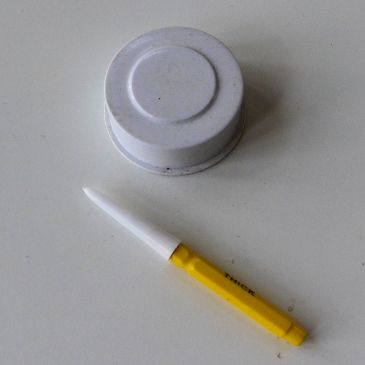
Oil and applicator which has a spooned end

I keep it simple as far as my oiler and dipper container are concerned.

Periodic inspections

Periodically inspecting a mechanical clock movement is important. Regular inspections can identify potential issues before they become serious problems, helping to prevent major repairs or damage.

Over time, the movement parts can wear down, and identifying and addressing wear ensures the clock runs smoothly.

Dust, dirt, and other debris can accumulate in the movement, affecting performance. Regular inspections {and disassembly and cleaning if needed} can keep the clock running accurately.

Clocks exposed to varying environmental conditions, such as humidity or temperature changes at our cottage, may require more frequent inspections to prevent damage. My fears that this movement was dirty because it was in a harsh environment proved unfounded.

Mauthe movement front plate

If the clock starts losing or gaining time, an inspection can identify the cause and allow for adjustments. Inspecting the movement helps to ensure that all components, such as springs and gears, are in good condition and properly aligned.

Finally, by addressing these aspects through regular inspections, you can extend the life of your mechanical clock and ensure it continues to function properly.

Tick-talk Tuesday #52 – My father’s Forestville advertising clock

Tick-Talk Tuesday is a special time when I respond to readers’ letters and comments about clock issues, challenges, and recommendations for specific clocks. When the comments and questions are especially complex, I consult with fellow clock enthusiasts within my circle to ensure I offer the most precise and helpful answers possible.

GF writes:

I inherited a custom-made Forestville Electric Wall Clock from my father. He owned a restaurant business on Manitoulin Island for 55 years. (Editors note: Manitoulin Island is an island in Lake Huron, located within the borders of the Canadian province of Ontario). When he decided to sell the restaurant he gave me this Clock that had been in the restaurant for 30+ years. He knew I had always loved that clock and one day hoped it would be mine. 

Forestville advertising clcok showing Conlon's Men's Wear on the dial

How he attained it was given to him by a friend who closed a men’s clothing store in the same town. After the closure of that store, my father proudly hung it in the dining lounge of the restaurant for many years until the closure. 

Forestville advertising clcok showing Conlon's Men's Wear on the dial illuminated

I am now in my 60s and have a member of the family who gave it to my father interested in buying it from me. I don’t know what price to tell him. It still lights up and movements work very smoothly and keeps good time. The cord was replaced about 25 years ago and very minimal rust on it. 

Forestville advertising clock back of clock

I am attaching a few photos of it and would like to know if you would be kind enough to provide a dollar value of what it might be worth. 

Forestville advertising clock showing maker's name

My response:

Hi GF and thanks for your email. There was a time when clocks such as yours were plentiful and not worth a great deal but there seems to have been a resurgence of interest lately in electric clocks of this era, especially advertising clocks.

Many of these clocks would be valued in the $300 to $500 range. Your clock appears to be in especially good condition. The maker or more correctly, the distributor of your clock is the Forestville Clock Company of Toronto. Your clock appears to have been made in the 1960s shortly before Forestville ceased production.

Delft clock by Forestville – Let’s take it apart and see what we have

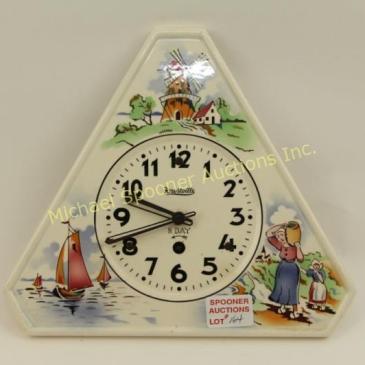
Delft Clock from Forestville

This clock was bought at auction in Ottawa, Ontario, and hung on the wall of the kitchen at our cottage in Quebec for 4 years. The clock was imported from Germany and sold by the Forestville Clock Co. of Toronto, Canada.

It was never a great timekeeper probably because it had never been properly cleaned. I brought it home to Nova Scotia to give it the attention in now deserves.

The word Delft is not a model name but refers to the design and composition of the dial face and surround. According to one source, Delft is “tin-glazed Dutch earthenware with blue and white or polychrome decoration”. Delft also refers to a place in the Netherlands, famous for the manufacture of pottery.

Delft clocks typically had a nondescript Dutch scene as one would expect but since this is not a delft clock by strict definition, it is, instead produced in a German factory (made in Germany stamped on the back) in the Delft style.

Mother and child

Many of these clocks were produced and were quite popular as kitchen clocks in Canada in the 1950s and 1960s perhaps a salute to Canada’s close association with Holland during the war years. There is a number stamped on the back (1054) which may refer to its year of make, 1954.

This clock is only required to run two months a year so, I am not concerned about future wear but a cleaning now will keep the clock running for several more years

Although this clock is from the Forestville Clock Co. other manufacturers produced similar styles. Most if not all of the movements are German-made and called, appropriately enough, “plate clock” movements.

A common Dutch scene

It is a small and simple time-only movement with a hairspring balance similar to what might be found on an alarm clock movement.

With tin dust cover removed

Some Delft clocks are pendulum driven and must be level on the wall to operate correctly whereas a hairspring escapement is more tolerant of placement.

Movement removed showing the mainspring

The mainspring may appear tiny by mechanical clock standards but it is as powerful as it needs to be in a movement this small and designed to run for 8 days.

Disassembly and cleaning

The front plate is affixed to a tin plate and the two cannot be separated unless the rivets are broken. This is a serious issue if bushing work is required on the front plate. To expose the bushing holes one must break the rivets with no guarantee that the tin plate and movement plate would be successfully pressed back together again.

There is some wear in the pivot holes but not enough to warrant concern at this point in time. There is also some pivot hole wear in the back plate but, again, not enough to require bushing work.

Back plate and mainspring removed

At some future point bushing work will have to be done and that would be a challenge for two reasons. One, the back-plate is difficult to access (as described above) and two, any bushings installed would be very tiny. I don’t have anything that small and they would have to be hand made. The designers may not have had servicing in mind when they made the clock and sadly, we are witnessing the beginnings of the throw-away generation.

All the parts, including the mainspring, are cleaned in the ultrasonic, dried thoroughly, inspected and pivots polished. Just a good cleaning and oiling this time around.

Since I decided not to do any bushing work, the movement was put back together. The wheels are installed plus the pallets leaving the escape wheel the last to position. There is an adjustment screw on the bottom plate for the escape wheel which can be Loosened allowing the escape wheel to be installed separately.

On the test stand

Feeding a very minuscule hairspring into its post is always a little tricky and quite often it takes several attempts. Manipulating small clock parts can be frustrating if you are used to working on American clocks with large wheels and pivots.

It is on the test stand and I will run it for about two weeks. If everything is satisfactory the remaining parts will be attached and the clock will be stored until the summer.

This clock is only required to run two months a year so, I am not concerned about future wear but a cleaning now will keep the clock running for several more years.

Tick Talk Tuesday #30 – a Forestville clock

Tick-Talk Tuesday is about the letters and comments I have received from you, the reader, concerning your clock, issues you might have had, challenges you face or a clock you would like me to profile or my responses to your questions with advice on your particular clock concern. For those comments and questions that stump even me, I consult within my clock circles for the best possible answer

JS writes;

“I found your blog online. I wasn’t sure if you were able to help. But I’m trying to find some information on a mantle clock I purchased.

Blackforest clock Co.
Blackforest Clock Co.

It is made by Black Forest Clock Company, which I know is Canadian. Just curious if you recognized the clock and a possible year.

My reply;

“Hi and thanks for your email, Joe. The company was first called the Blackforest Clock Company when formed in 1928 and changed its name to the Forestville Clock Co. In 1941. The same company just a change in the name. It was based in Toronto through its life right up to the late 1970s. If it is a Blackforest clock it was made prior to 1941. Is it a pendulum clock or does it have a floating balance escapement? If you are not sure, send me a photo of the movement.”

Which JS promptly sent:

Blackforest Clock Co.

Just purchased it at an auction. I look forward to picking it up and putting it on the mantle. Be safe and well and thank you again.

My reply:

“Looks like a nice pendulum clock.”

Website Powered by WordPress.com.

Up ↑