Relocating A Shelf Clock To A…Well, A shelf

For years, my Seth Thomas column and cornice clock rested atop an antique radio in our living room. However, after redecorating the space with hardwood flooring in place of the carpet, the radio and clock no longer suited the updated space.

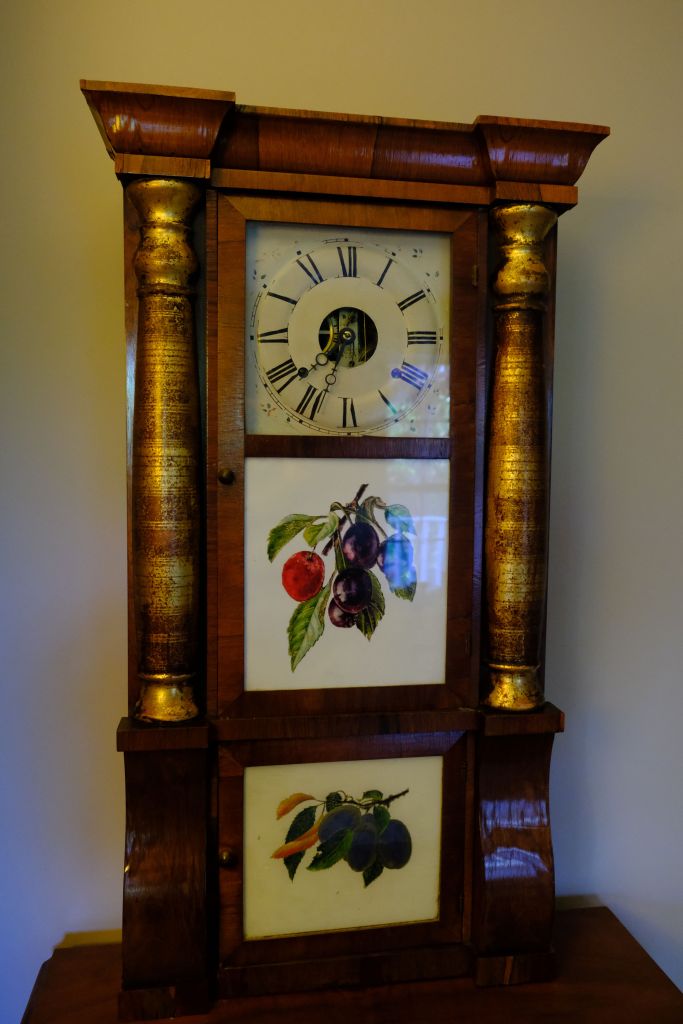
Seth Thomas column and cornice "Empire" style time and strike shelf clock
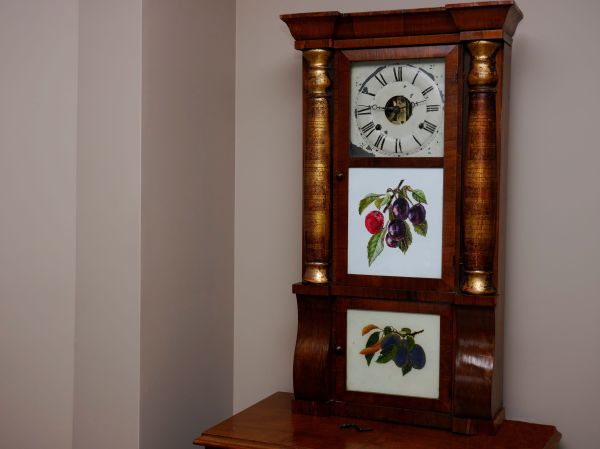
Seth Thomas column and cornice “Empire” style time and strike weight driven shelf clock

I did not want to relegate the clock to storage, so I opted to find it a new spot in our home. Since most of the other rooms already had plenty of clocks, I decided to display it in my office.

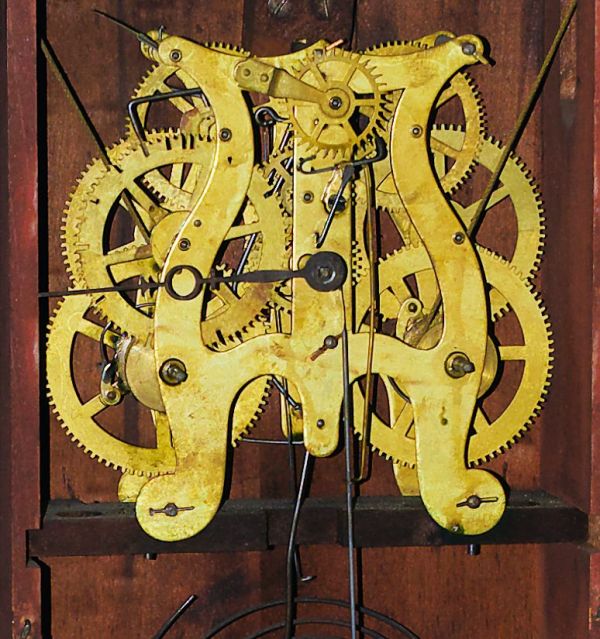
This lovely Seth Thomas time and strike eight-day weight-driven column and cornice clock with hour strike features an attractive veneer case with cove molded crest, lyre movement, three-quarter columns in painted gold, and two glass doors, one with a reverse painted design, opening to the interior clock works which reveal a tin painted dial and the original printed and illustrated Seth Thomas clock makers label. It is 32″ tall, 18″ wide and 5“ deep.
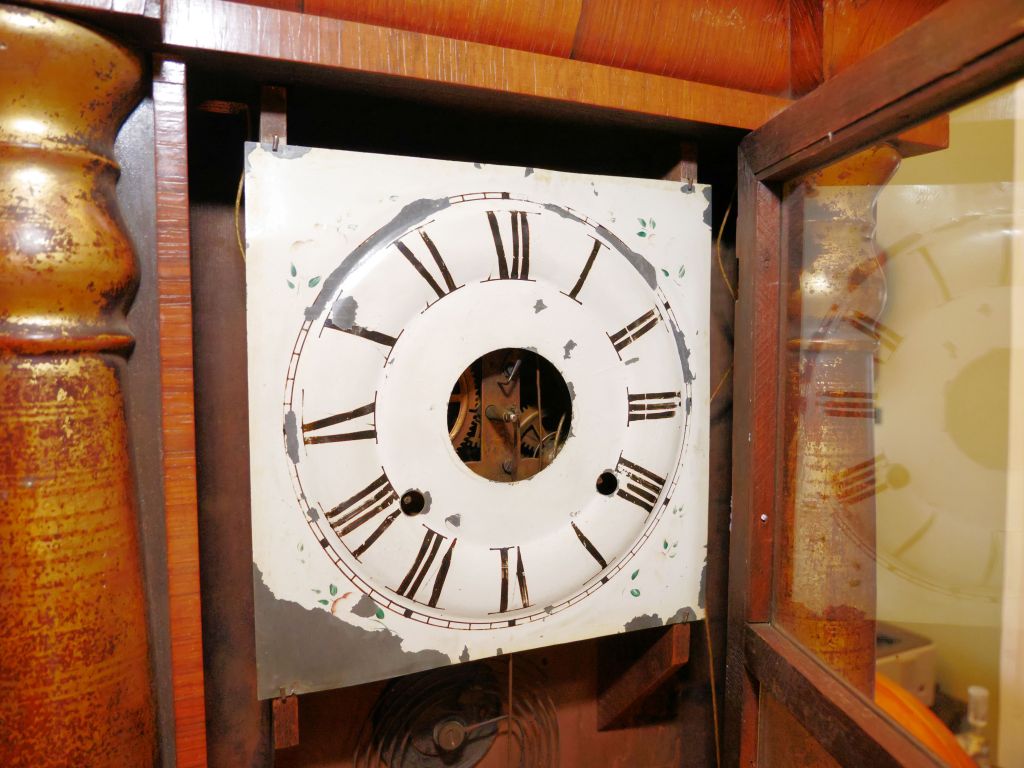
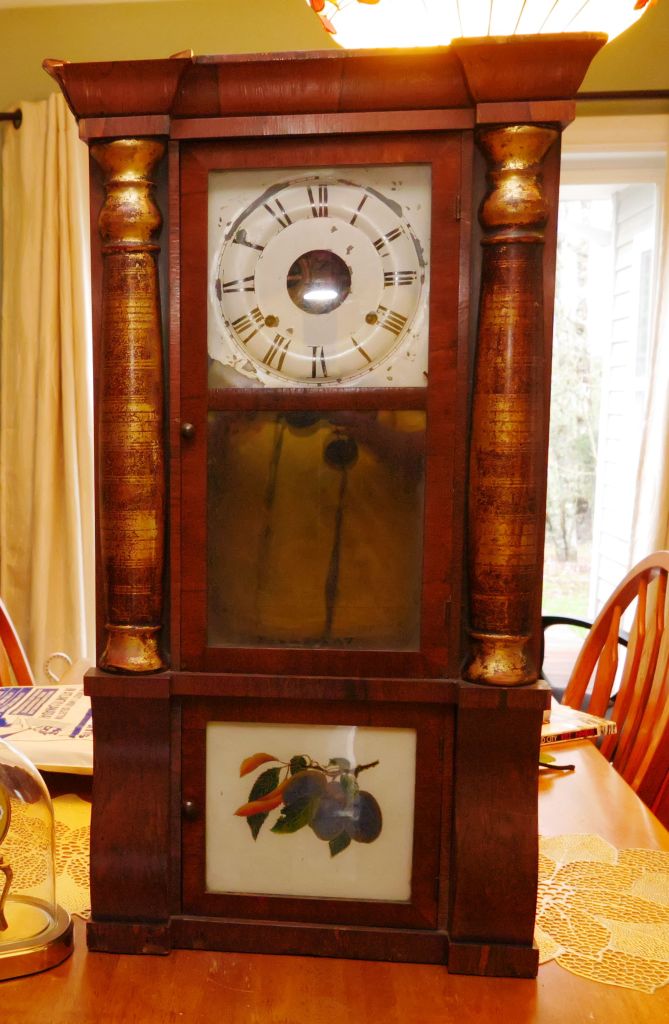
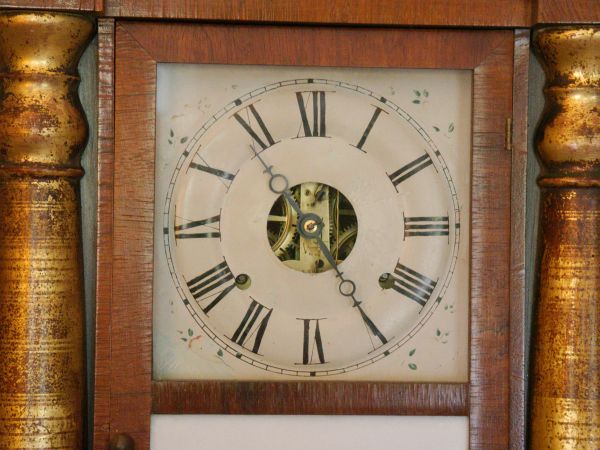
The dial had some losses

The clock has one unique detail: while the lower tablet is original, the upper tablet was recreated from a photograph of hanging fruit, modified to complement the design below. Additionally, the dial, which had suffered some losses in the corners and chapter ring, was repainted.

The painted tin Roman Numeral dial has hand-decorated flower spandrels in all four corners with the centre portion of the brass lyre movement visible through the dial.

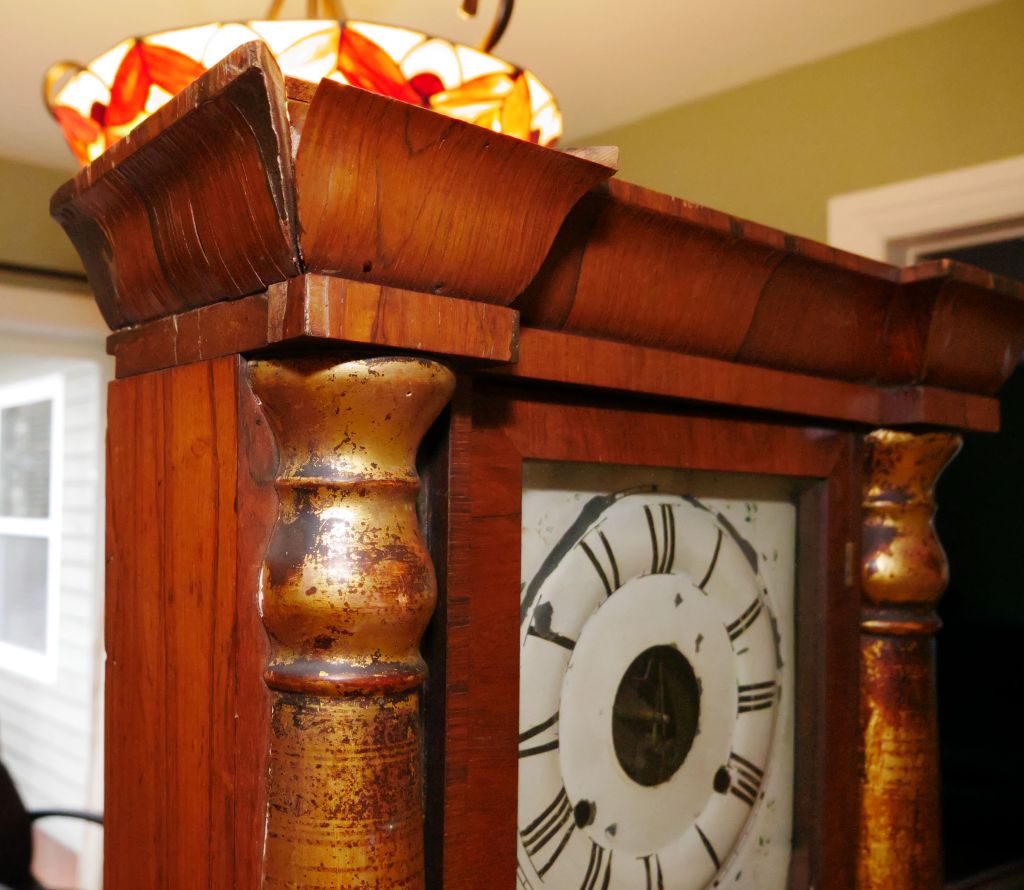
Among collectors an appropriate descriptor for this clock is “column and cornice” but it is also generally classified as a shelf clock. This particular clock features a hook on the top of its case, likely intended by a past owner for installation that way. While I have seen similar clocks mounted like this online, they were never originally designed to be hung.

However, the hook might serve an additional purpose. Given that these clocks can become top-heavy when fully wound, the hook could be an effective way to secure the clock to a wall, especially in areas where it might be easily bumped.

Building the Shelf

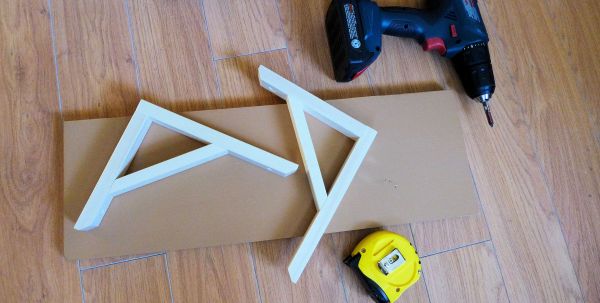
The first step was to build a shelf to accommodate the clock. I had some leftover 8-inch-deep pine boards from a previous project, which were ideal for this purpose. I purchased extra pine braces some time ago, and they turned out to be perfect for completing the project. I cut a piece about 22 inches long and painted it a shade of beige. The base of the clock is 18 inches leaving 2 inches on either side.
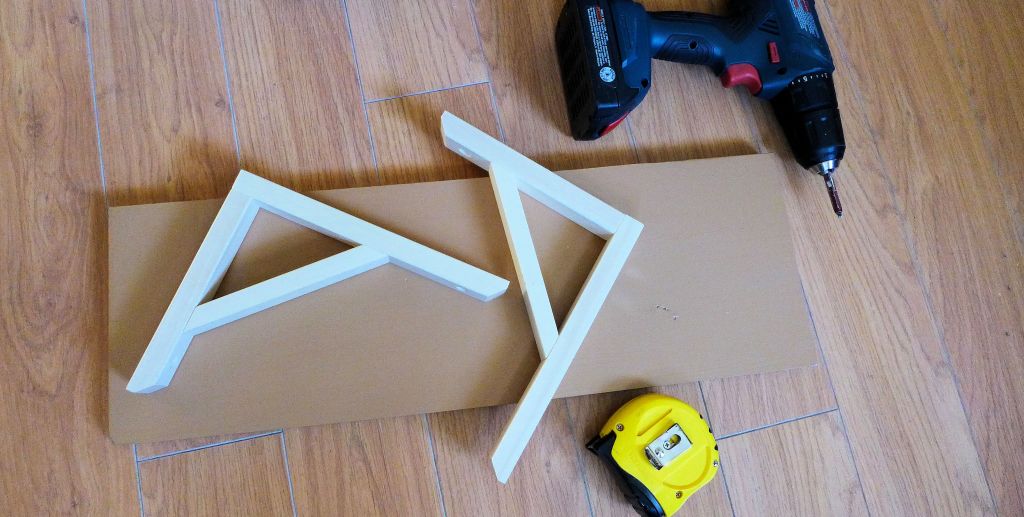
Pine board and braces

The next step was to mount the braces to the wall. Knowing the room had studs spaced 16 inches apart, I used a stud finder to locate the first stud and then measured 16 inches to find the second one.

Sixteen inches on centre

Once the braces were mounted and made level I installed the shelf using wood screws.

The clock is positioned on the shelf

Checking for the Correct Beat

Now to determine if the shelf is level and the clock is in beat. Using a Timetrax Clock Timing Machine I switched to the BAL feature to check the beat.

Timetrax microphone attached to the winding arbour

A beat adjustment was unnecessary as the clock was already leveled. If leveling were needed, it would simply involve slightly bending the crutch incrementally to find the beat. While checking the beat can easily be done by ear, it made sense to use my Timetrax device for greater precision.
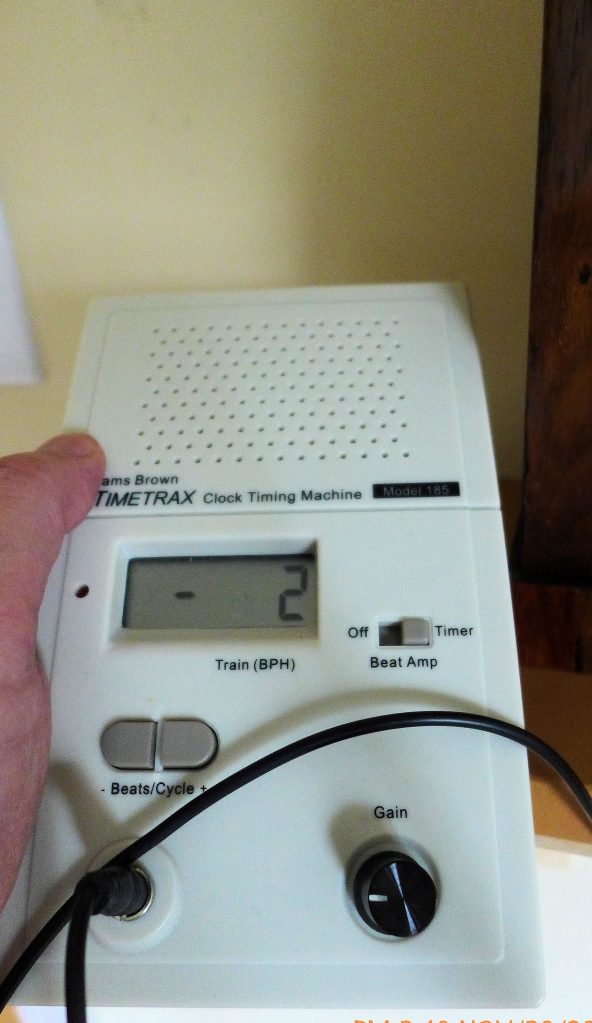
Timetrax Clock Timing Machine

According to the Timetrax instruction manual If the beat is within plus or minus 20 the clock is in beat. In this case, it was almost dead on.

Seth Thomas clock mounted on a shelf (note repainted dial)

Once the beat is confirmed, the weights are replaced, the hands and dial can be reattached, and the pendulum is given a slight push.

After confirming the beat the clock was ready to be displayed in its new spot. This Seth Thomas column and cornice clock, with its exquisite veneer case and distinctive features, now takes pride of place in my office, where it brings an added touch of elegance to the room. Moreover, since the room houses many spring-driven clocks, a weight-driven clock will provide a more accurate reference for timekeeping.

I’m pleased to have found a new location for it, as it truly deserves to be on display.
Tick Talk Tuesday #49 – a well-preserved column and cornice clock

Tick-Talk Tuesday is dedicated to addressing readers’ letters and comments related to clock issues, challenges, and recommendations for specific clocks. In cases where the comments and questions are particularly challenging, I seek advice from my fellow clock enthusiasts to provide the most accurate and helpful response.

DS writes

Morning, Ron –

I’ve wanted to let you know how much I’ve enjoyed these blog posts.

What a nice work area you have there, too.

I’ve had my eyes on a marvelous Wm. Van Tassel sleigh-front, or “Triple Decker” Seth Thomas manufactured for the Canadian market for some time. I’ve been fascinated with these old clocks for many years, and in particular the triple-deckers.
I’ll attach an image or two of the Van Tassel I’m interested in.
It is perhaps the finest sleigh-front I’ve ever seen, in terms of condition & originality.

I only have a modest collection of some cottage clocks of the various Connecticut makers, and several “Ogees.” My only real “Problem” is finding time enough to spend with them!

Thanks again for these interesting, well-written articles.

Take care…

Image preview
Wm. Van Tassel sleigh-front

I write

Thanks for your email, DS

That is a very nice clock. Some would call it a column and cornice but as you said often referred to as a triple-decker. I like the two-door feature. I have a similar Seth Thomas. My only thought is whether or not the tablets (or at least one of them ) are original. The cornice and the base are often beat up with wear and tear and it is nice to see one so unmolested. It is a clock I would take a serious look at.

I appreciate your comments on my blog.

Ron

Seth Thomas column and cornice shelf clock
Seth Thomas column and cornice clock

My very similar Seth Thomas clock

Veneer repairs on an 8-day Seth Thomas column and cornice clock

This 8-day Seth Thomas column and cornice time and strike shelf clock with sleigh front needed a little love. It has a Plymouth Lyre movement with a Thomaston Conn. label. The clock was made in the 1870s. and purchased five years ago and has been running since.

I will take you through my early days of veneer repair. It is probably not my best work but it was a fun and challenging project plus, there was good learning.

The Seth Thomas clock as found

A previous owner had applied brown paint on areas of veneer loss, it looked ugly and when I saw that I decided the case could use a little tender loving care. Many of these clocks are in decent condition for their age but if you are shopping for column and cornice clock from this era take note of veneer losses. You may want to reconsider your decision to purchase if you feel it is not worth the time, effort and expense or if there us so much loss that it is unsightly.

Of course, there is always the school of thought that advocates leaving things as-is and that is perfectly fine. But, a little veneer work is minimally invasive, in my view.

Veneer issues

The most troublesome sections were the top and bottom of the case and the column base, not surprising since those are the prime targets of wear and tear over the years. Most of the cornice veneer is in good shape as are the door sections, door surrounds, and the sleighs just above the feet. Although there is work to be done, I have seen worse.

The veneer used at the time was Brazilian Rosewood, an exotic wood. Rosewood would have been used extensively by clock-makers of that era and replacement Rosewood veneer would be the correct choice. I have two 7 X 8 inch pieces of Rosewood veneer, more than enough for this project.

Veneer losses on the base

Prep-work and other case issues

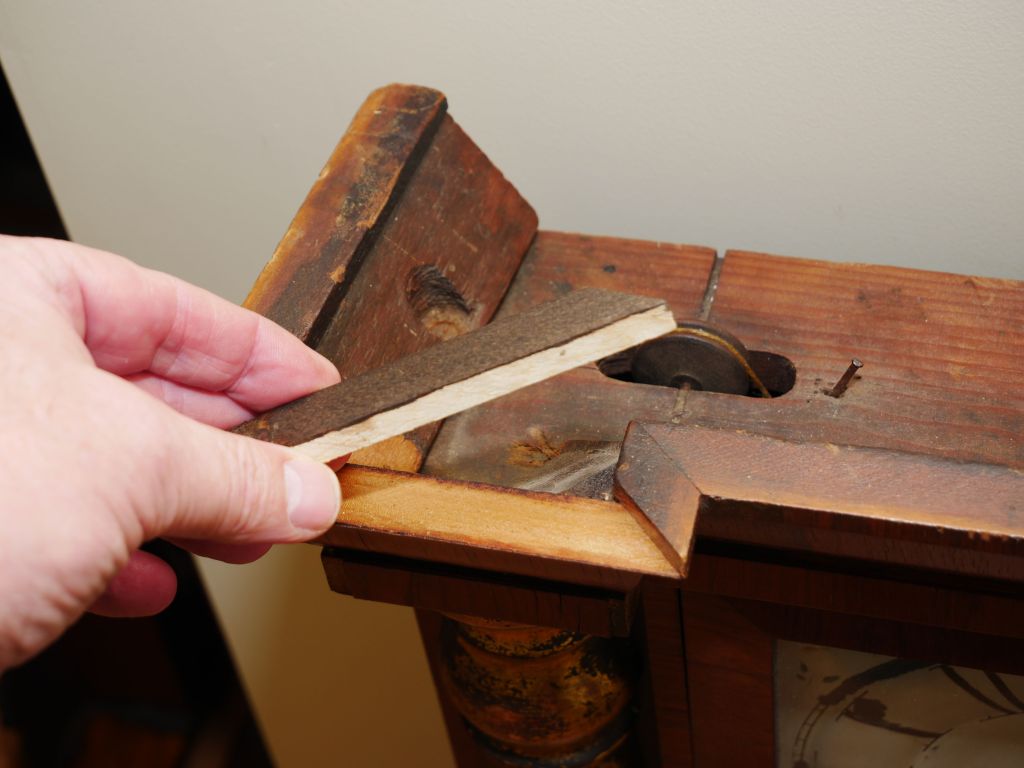
The cornice on the left side was missing a section and that had to be attended to before the veneer work began.

Losses on the cornice and its base

Using scrap softwood I made a small piece and trimmed it roughly to fit. In this photo, I am testing the piece and making minor adjustments for a snug fit. The section is then glued in place and allowed to dry for 24 hours.

Cornice trim piece
Cornice trim piece

The top area of the front cornice is now ready to be faced with veneer.

The sections with brown paint had to be sanded down to the bare wood to improve adhesion before gluing the new veneer.

Repairs made to left cornice

In selected areas, small sections of old veneer were removed to make way for larger replacement pieces.

I have decided not to tackle the columns. There are some losses but from a reasonable distance, they are fine.

Hide glue and Bloom strength

The one true adhesive for antique clock case applications is hide glue. Hide glue would have been utilized at the time the clock was manufactured.

I chose pearl hide glue which is rated at 150g Bloom strength (500g Bloom strength, the maximum, is not necessary for this type of repair). 150g hide glue takes a little longer to gel and adhere but with the slightly longer working time moving pieces around for best fit is easy.

Home-made double boiler

To ready the adhesive place the container with the gelatinous glue in a bath of water in a pot specially designed for hide glue or a double boiler which worked equally well for me. Heat to approximately 140°F (60°C), using a candy thermometer and maintain the temperature throughout. Heating the wood surface with a hair dryer before applying the glue is an option. Full strength is reached when it’s dry, and that can take 24 hours.

An excellent article on hide glue and its strength properties can e found here.

It is best to start with a small batch. Put 2 tablespoons (30ml) of glue in a glass container and cover with 1 tablespoon (15ml) of cold water and let soak for about an hour or until the glue softens and becomes gelatinous. To make a larger batch simply follow the 2 to one rule. I recommend making small quantities, to begin with. If there is glue left over I find that it can be frozen and reused later with no ill effect.

Tools

Clamps, weights, tweezers, wax paper, a sharp knife, a metal straight-edge, painter’s tape, a micrometer, sandpaper, palm sander, and whatever you choose to use as a double boiler complete the list of tools.

Clamps used for veneer work

A micrometer is an indispensable tool for accurate measurements. Accurate measurements ensure a good fit, minimize the use of fillers and lessen waste.

Cutting, trimming & clamping

The cutting of veneer can be tricky. Veneer is brittle, and can easily tear. Veneer today is quite different than veneer used 100+ years ago as it is very thin. On some clocks you must double-up or layer the veneer to approach the height of the original veneer. Another alternative, and a better option, is to harvest veneer from old clock cases. Old veneer is thicker, is very close to the look and feel of the original finish but just as brittle.

If old veneer is hard to work with, softening it with water will have a small and short-lived effect on a veneer’s flexibility. Another option is a product called Super-Soft 2, said to be ideal for softening veneer. For the little veneer work that I do I cannot justify the cost of a commercial softener and water is satisfactory for my purposes.

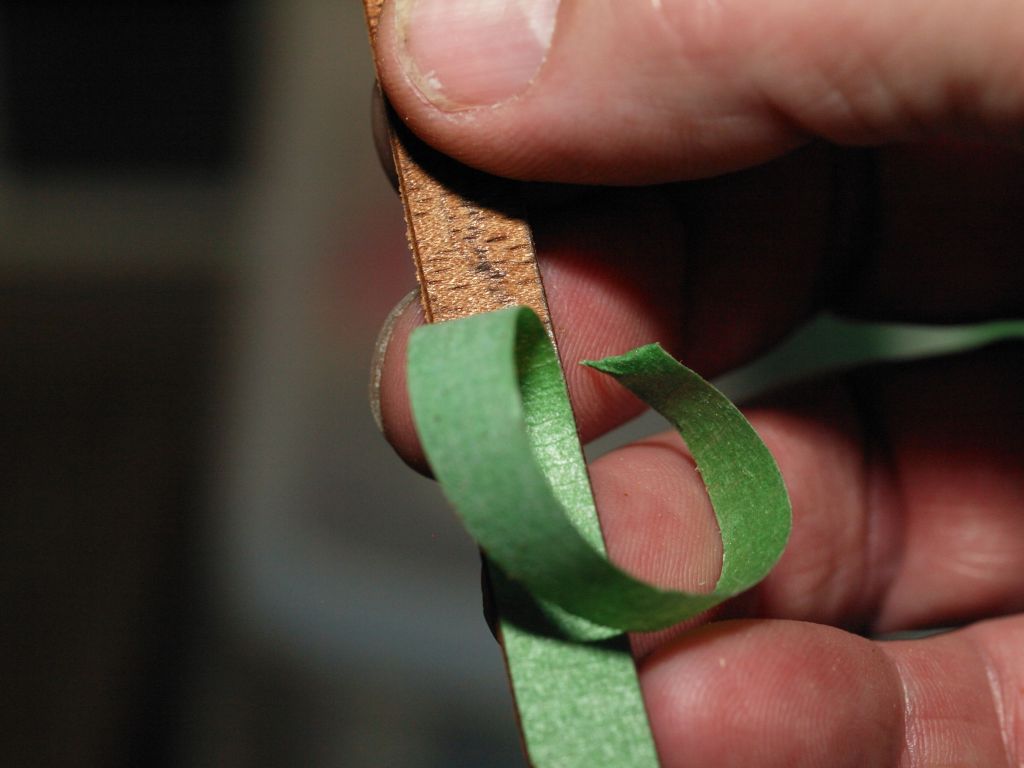
Painters tape easily peels off

The next photo shows a veneer section glued and clamped into place. Wax paper is used to prevent the glue from sticking to the clamp. Clamps are essential for veneer repair but when clamps do not work other methods such as weights can be employed. Leave the clamp on for 24 hours for maximum adhesion.

Clamping cornice veneer

Cutting can be a challenge since you must follow the grain and narrow strips can break very easily. Painters tape prevents tearing and is easily removed from the veneer prior to or after the application.

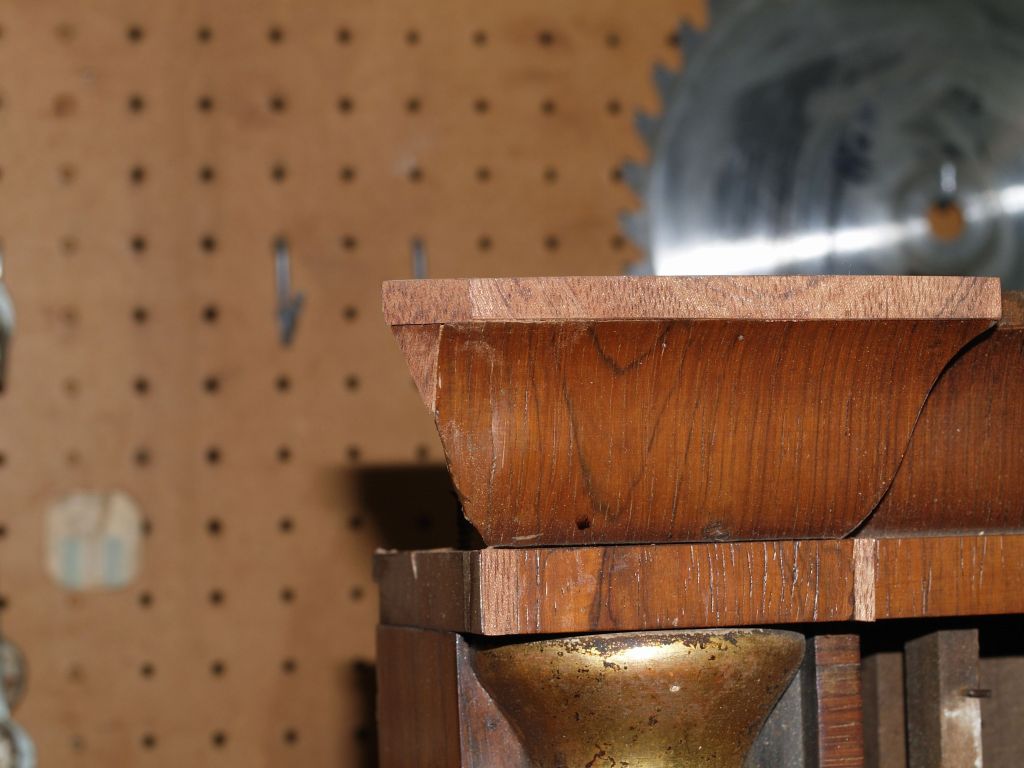
The most challenging areas were the very top and very bottom of the case and the column bases but after many hours the veneer work is now complete. The next step is colour matching the new to the existing veneer.

Top of cornice veneer with new veneer

Rosewood Minwax Gel stain is a close match to the older veneer but I would recommend experimenting with a coat of shellac first before applying a stain, in fact, a stain should be a last resort.

The base section is finished

There is always good learning resulting from each project and in retrospect, I should have replaced the entire section under the left sleigh rather than cut two pieces of veneer to fit either side of the existing piece.

The completed case includes a repainted dial and replacement upper tablet

As with any other project, there will always be a slight colour variance between old and new veneer and the goal, as always, is to come as close as possible to the original finish.

The last photo shows the completed clock with a repainted dial and a new middle tablet.

Inpainting a Seth Thomas clock dial – Part 1

This is Part I of a two part series. Part one covers the first three steps in renewing a Seth Thomas clock dial. In Part II the decorative corner design is restored.

Seth Thomas column and cornice “Empire” style time and strike weight driven shelf clock, as found

Inpainting is the process of reconstructing lost or deteriorated parts of a clock dial. In the museum world, in the case of a valuable painting, this task would be carried out by a skilled art conservator or art restorer. Inpainting, as opposed to repainting and restoring the entire dial, renews the dial using a few simple techniques.

Some of the methods can be found in T. E. Temple’s excellent resource book entitled Extreme Restoration.

Continue reading “Inpainting a Seth Thomas clock dial – Part 1”

Website Powered by WordPress.com.

Up ↑