Tick-Talk Tuesday is dedicated to addressing readers’ letters and comments related to clock issues, challenges, and recommendations for specific clocks. In cases where the comments and questions are particularly challenging, I seek advice from my fellow clock enthusiasts to provide the most accurate and helpful response.
JZ writes
I ran across your website trying to find info on some old clocks. My husband passed away in February and left me several. I have no desire to keep them but also have No knowledge of what to do with them.
I’m sending you pics of a few. I realize it’s difficult from pics to provide much but anything is more than I have at the moment.
U/K parlour clock
My reply
I am sorry for your loss. I’ll begin by saying that I have no interest in any of the clocks.
With respect to the clocks left behind by your husband, there are a few options you might consider.
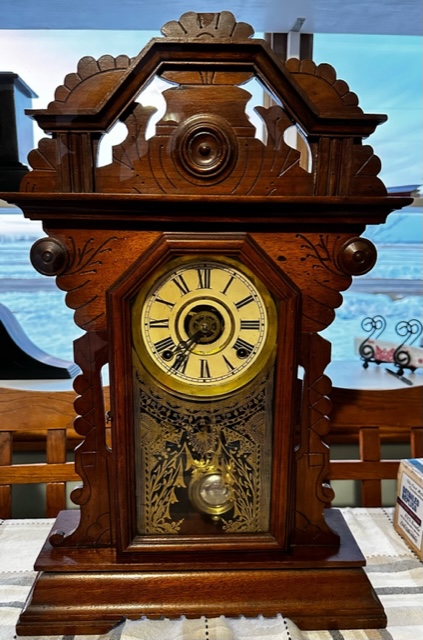
American time and strike clockwith a French look
First, consider selling the clocks. If you have no desire to keep them you might be able to sell them to a collector as a lot or individually. You can also locate a reputable auction house or sell them online through websites like eBay or Etsy. Selling them locally through Facebook Marketplace avoids the hassle of packaging and shipping a clock to its new owner.
Donating the clocks to a local museum or historical society is another option. The clocks can be appreciated by those who have a passion for clocks.
Having the clocks appraised is another avenue to pursue but you run the risk of paying more for the expert opinion than the clocks are worth.
Antique items can certainly be worth a lot of money, but it is important to note that just because something is old or antique does not automatically make it valuable.
Electric clockfrom the 1940s
I am not a clock valuation expert and cannot physically inspect their construction, repair status, and overall condition and any estimate I offer from information provided to me by email regarding the clock’s value would be approximate.
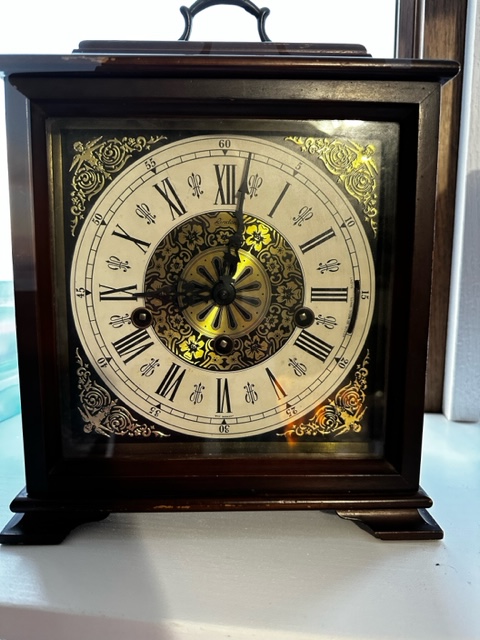
Likely a Hermle Westminster chiming clock
If any of the clocks have a distinct history (provenance) or the maker is highly regarded, its value will be significantly higher but you have not provided enough information to suggest that.
The value of an antique clock depends on various factors such as rarity, condition, historical significance, the reputation of the maker, and finally market demand. Unfortunately, the market for antique clocks is not as strong as it once was though certain rare or highly sought-after antique clocks can still hold significant value in the market.
Judging from the photos alone I do not believe that any one of these clocks is worth more than $200, and some significantly less.
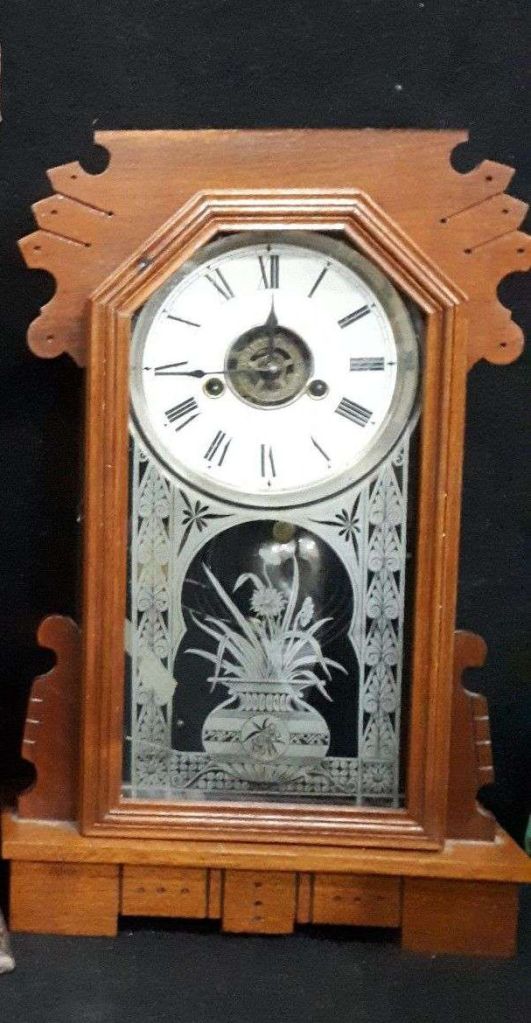
This attractive little clock was bought at auction earlier this spring.
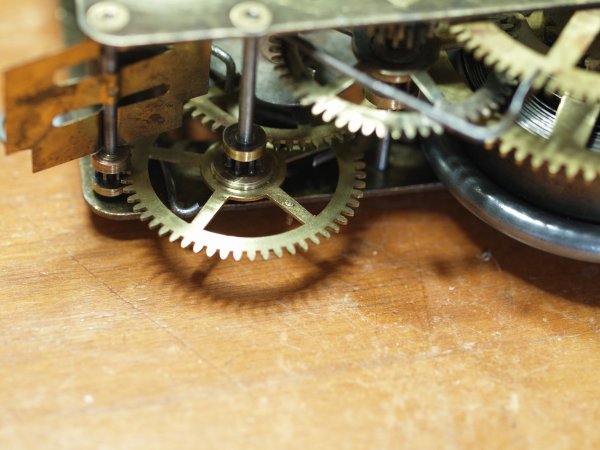
The walnut case is actually in good shape and the tablet looks not only original but is in decent condition as well. I expected a well-cared-for movement but to my surprise, it was in deplorable condition, a prime example of a clock that saw little servicing and was destined to fail.
Thanks to reader JC who identified the clock as the “Canada” found in Ansonia’s 1886 catalogue.
Auction photo
After installing 7 bushings and two pivots it now running as it should.
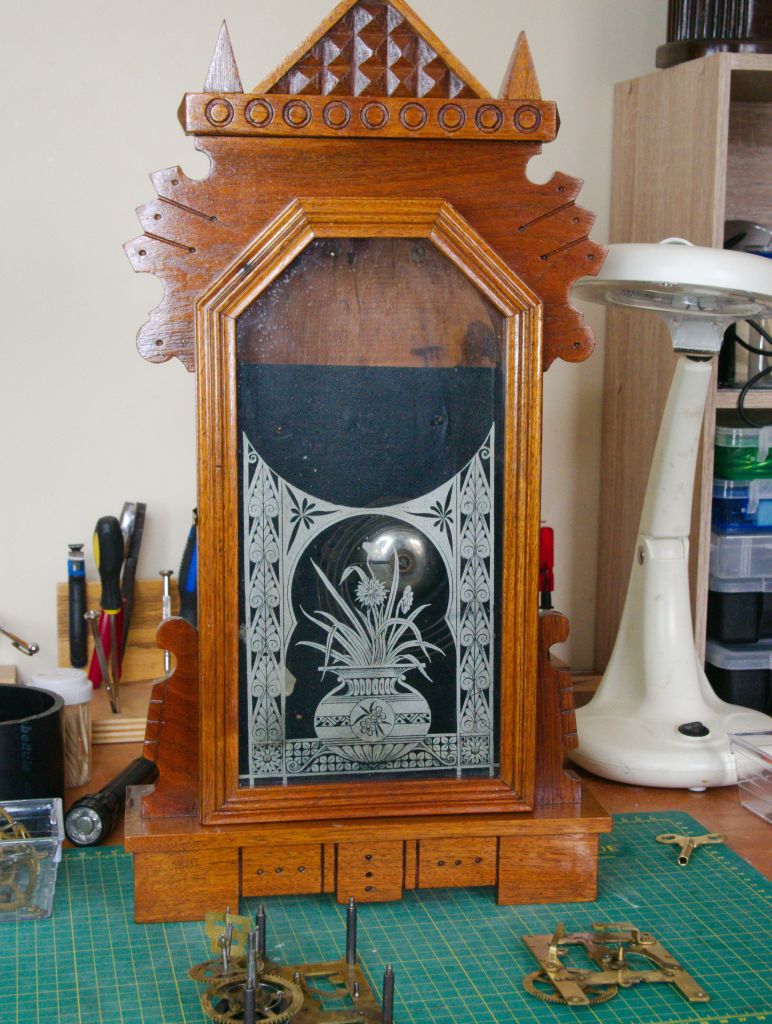
The case
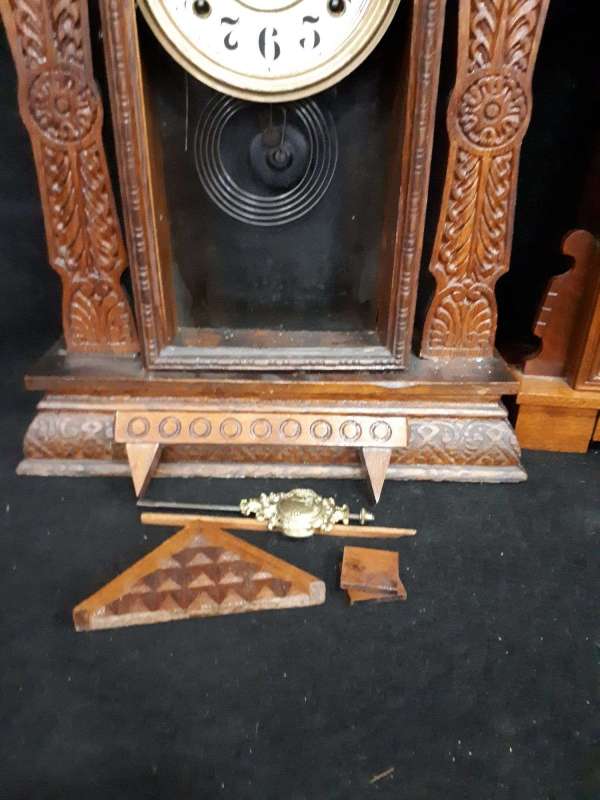
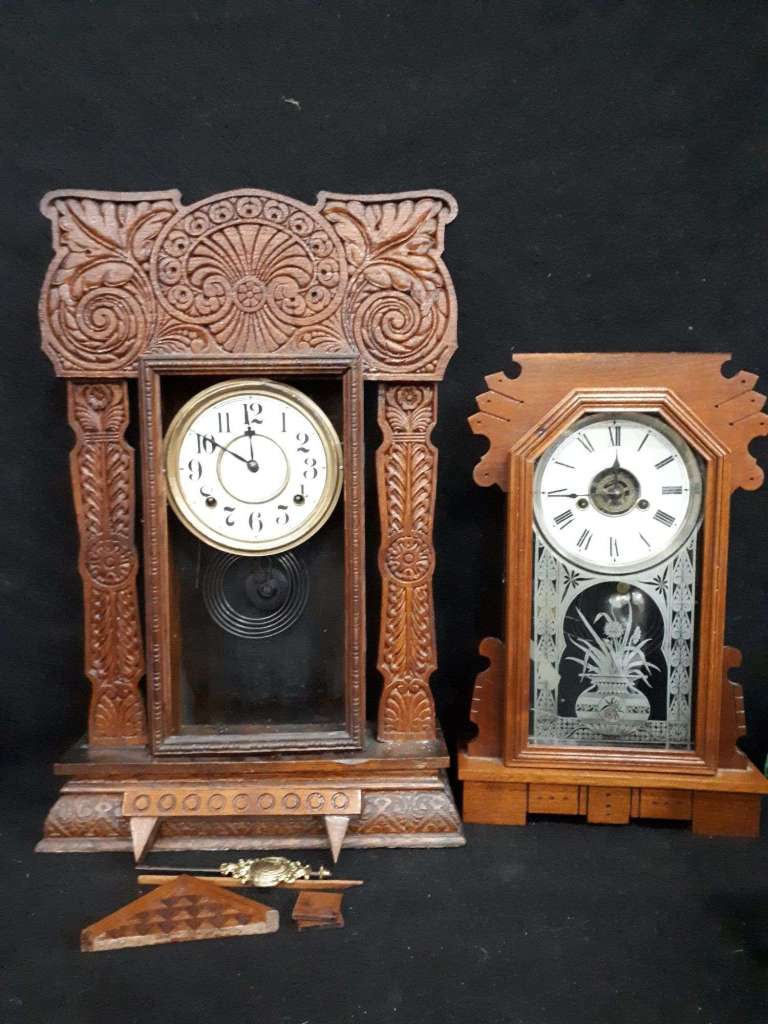
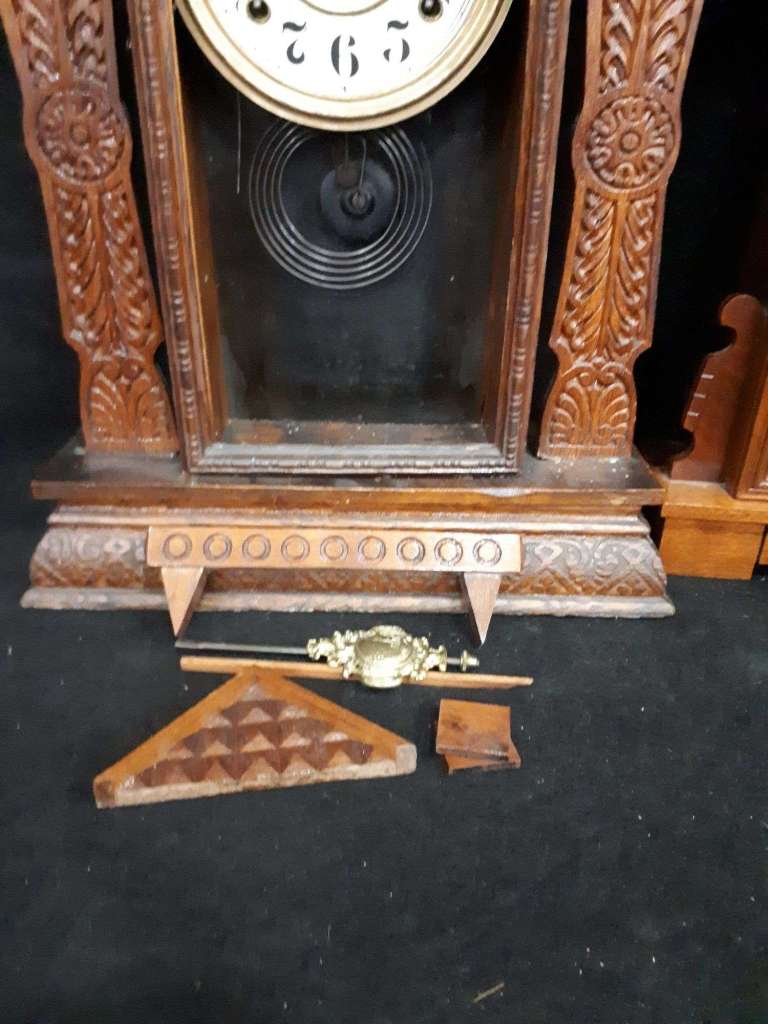
It is missing a few top pieces but surprisingly the pieces came with the clock. They are in front of the Sessions gingerbread clock in the photo below. The glue let go and of course, it is a matter of gluing them back in place.
I blame it on rough handling on the part of the auction house otherwise why would the parts come with it.
Sessions and Ansonia clocks were bought as a lot.The case after a coating of shellac
Once the parts were re-glued it was an opportunity to clean the case and apply one coat of traditional shellac.
The dial looks too new, though it looks great and was no doubt replaced at some point in the clock’s life. The spade hands look correct for the clock.
The case was surprisingly well preserved but it is unfortunate that the movement was in such poor condition but now has a new lease on life.
Here is the final result. The movement and alarm mechanism have been reinstalled back into its case. After several days it is running well and keeping good time.
A handsome clock that is even better after a refresh and minor repairs.
I am an avid collector of antique and vintage clocks which means I cruise the online auction sites regularly, about once or twice a week. This spring I checked out offerings from a local online auction site that deals with estate items, placed bids on 4 clocks (actually 5 since one lot had two clocks). The one I did not win was a 6 column Sessions mantel clock but no real loss there.
I won the bids on four clocks. CDN110 was the total though with buyers’ premium and taxes the price jumped to CDN147, still not bad for a small collection of antique clocks.
I do not have these clocks as of this writing since they are sitting at the auction house but I think can make a preliminary judgment based on what I see in the auction photos.
Although I am normally not in the business of selling clocks I will sell the odd one to keep my collection manageable. The plan is to fix these clocks and sell them to offset clock equipment purchases most notably an Adams Brown Timetrax 185, an electric clock timer, an amplifier that measures the rate of mechanical clocks by sensing escapement action and mechanical sounds of the escapement which I recently purchased. Here they are.
Unknown cottage clock
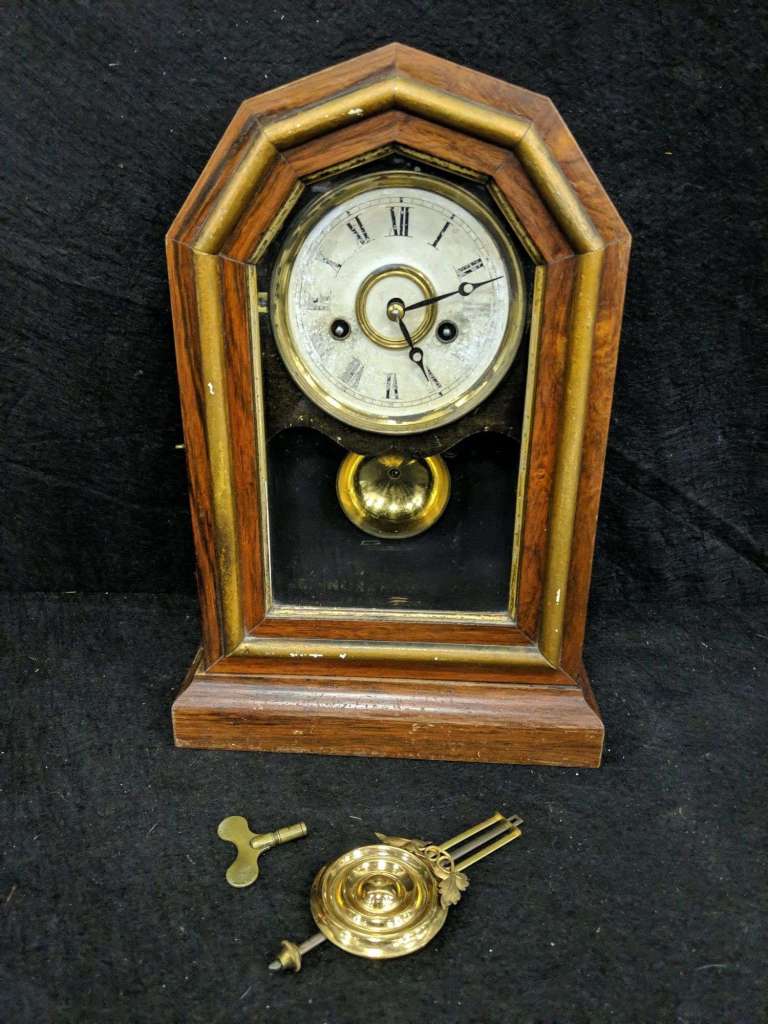
In no particular order of importance let’s start with an octagon cottage clock from the 1870s or 80s. It is a 30-hour clock judging from the placement of the winding points.
With pendulum and key
From the style of the pendulum bob and the case itself, I would say an E. Ingraham & Co. time and strike cottage clock. Some would have come with an alarm. This one does not.
Side view
It is in fair shape. The dial appears to have serious losses and there are nicks and scratches over a good portion of the case from what I see in the photos. I wonder if the tablet is a replacement and the original reverse painted?
It is difficult to tell with the harsh auction light but the case might be made of rosewood.
Decorative pendulum
It will be a good candidate for a mild refresh and should look very nice when completed.
Sessions Grand Assortment #3
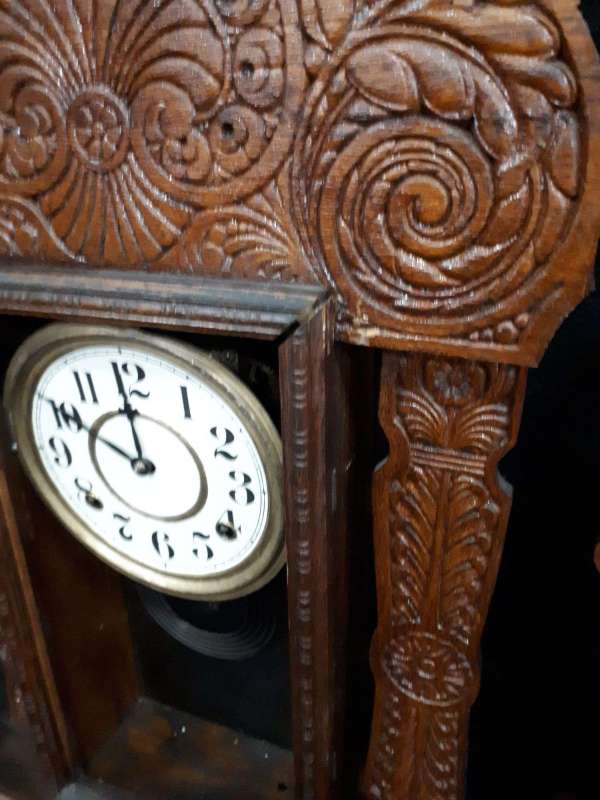
Next is a Sessions Grand Assortment #3. I have worked on one in the past. There are three models in the Grand Assortment series and despite the fact that it is a lowly gingerbread clock and thousands of similarly styled clocks were sold by every major American clock manufacturer, this model is surprisingly collectible.
It is an 8-day clock with a steam-pressed oak case. The case looks very “aligorated” a term applied to a shellac finish that has coagulated as a result of being stored in a hot, humid environment such as an attic or a garage.
The dial is in poor condition
The tablet looks good but the dial is very degraded. This is a paper-on-metal dial and when the metal below the paper rusts the stain bleeds through to the front. This is called “foxing”. These stains are very difficult to remove and cost-prohibitive for most clocks. This is a cheap clock and a dial replacement is the only option and as such, I am not sure what to do about it.
A note is attached to the key and it says 1903. It is doubtful it was actually made in that year and I am sure the previous owner went by the year Sessions Clock Co. acquired clock-maker E.N. Welch Co. though the clock is certainly from around that period.
With a note from the previous owner
Reconditioning the case might be a challenge. Is it a candidate for stripping down to the bare wood? I suspect it is but we’ll see. I also see a small crack just above the top of the dial, so it might have been broken off at one point and re-glued.
I am not sure about the pendulum bob which does not look quite right for this clock. More research should provide me with the answer.
E Ingraham Ocean and Ansonia kitchen/parlour clock
Next is a two-for-one deal.
A duo of clocks
The one on the left is an E. Ingraham steam-pressed 8-day gingerbread possibly from the Ocean series. Unfortunately, it is missing its decorative tablet and that will certainly affect its resale value.
The pendulum looks right for the clock and the case itself looks to be in decent shape but as I said, it is very unfortunate that the tablet is missing.
Pieces of a clock
The pieces at the foot of the gingerbread clock belong to the clock on the right. Usually, when I see pieces like this it tells me that it was handled roughly by the auction house.
What I like about this clock is its timeless design, almost Art Deco but made long before the Art Deco period.
So who is the maker of the clock on the right?
Unknown parlour clock
The auction description simply says, “unknown clock”. I believe it is an Ansonia 30-hour (position of the winding arbours) kitchen clock in Walnut from about the early 1880s. The tablet is bright and vivid, not a design I have seen before but likely original. Attaching the top pieces should be a fairly simple process and thorough cleaning of the clock case clock and movement should make it an ideal candidate for resale.
Of the four, two are 30-hour clocks. I have found that 30-hour clocks are a tough sell. Most casual collectors are looking for an 8-day clock since 1-day clocks are a hassle to wind but I think I can make both presentable enough to attract some buyers.
The auction notes do not say whether any of these are in working order. They are all “untested” which is typical auction-speak for “they may or may not work – the risk is yours!”.
American clocks are very tough and often work well despite being very worn. I suspect with a little encouragement I can get all of these clocks working again.
Now, to pick them up from the auction house.
Check for upcoming articles on each of these clocks.
Back in December 2019, I wrote about the challenges of adjusting the strike side of this attractive parlour clock, a Waterbury York, circa 1900. Despite many attempts the strike side refused to work. Though I was close to a solution but I did not realize it at the time. I put it aside to think about it.
Attempt #2. Will I be successful? Read on.
A shot of the clock the day I brought it home.
The time side functioned perfectly but the strike side did not run at all when I first brought the clock home. Typically a good cleaning or a simple lever adjustment is all that is required though once I opened the movement up I saw it true colours. I detailed these surprises in my December post.
Among common parlour clocks you will find few EN Welch clocks. There is a good reason for this. The company was absorbed by the Sessions Clock Company in 1903 so any Welch clock is 115 years old and older.
E N Welch Parlour clock, The Whittier circa 1897
This E N Welch time and strike parlour clock is the Whittier model. The clock was made some years after Welch established its reputation as a quality clock manufacturer with the Patti series. The Whittier model represents a period from 1897 onward when Welch re-organized following a bankruptcy and produced well made but inexpensive clocks for the masses.
I located the clock in an antique store in Kazabazua, Quebec in 2016 while my wife and I were on a day trip from our summer cottage. The seller said the strike side did not work and we negotiated a lower price.
The clock ran for several days but despite adjustments I was unable to get the strike side to run correctly. The stop/warning lever and the count/lifting lever were intact, so, I was puzzled; it should run. Straightening the levers might solve the problem.
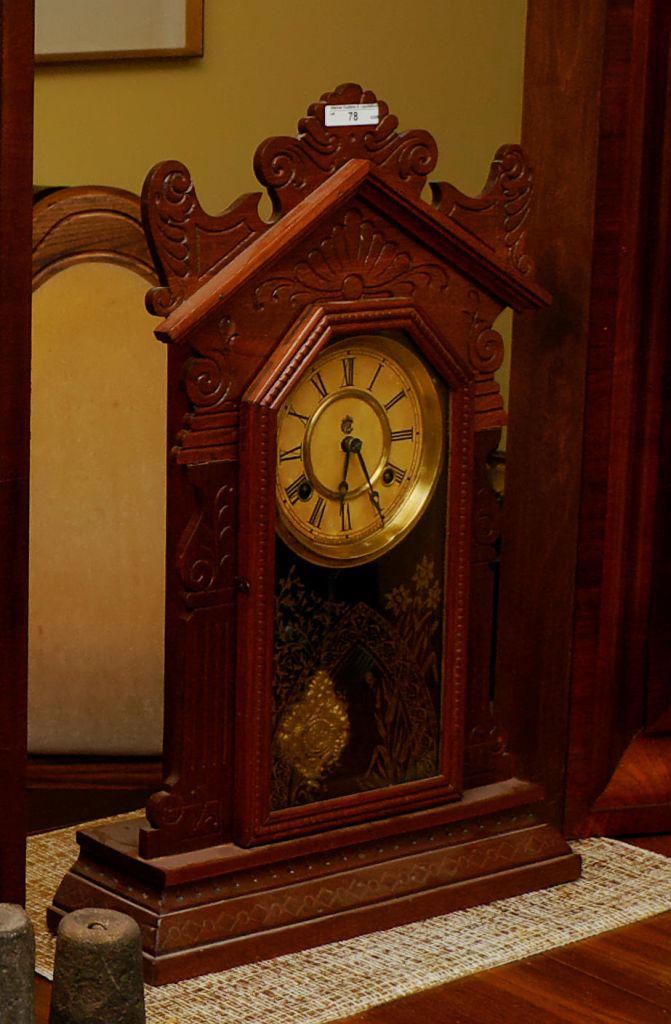
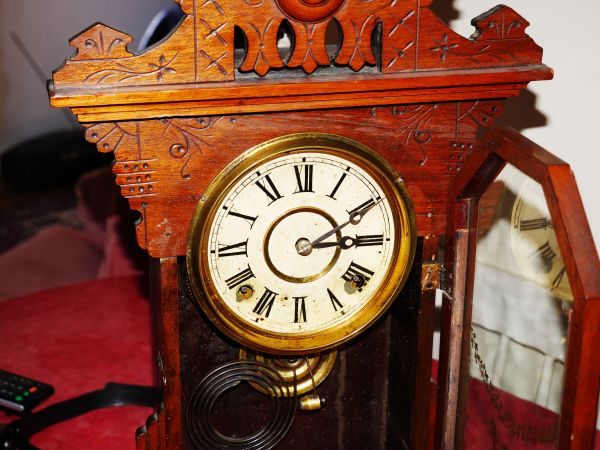
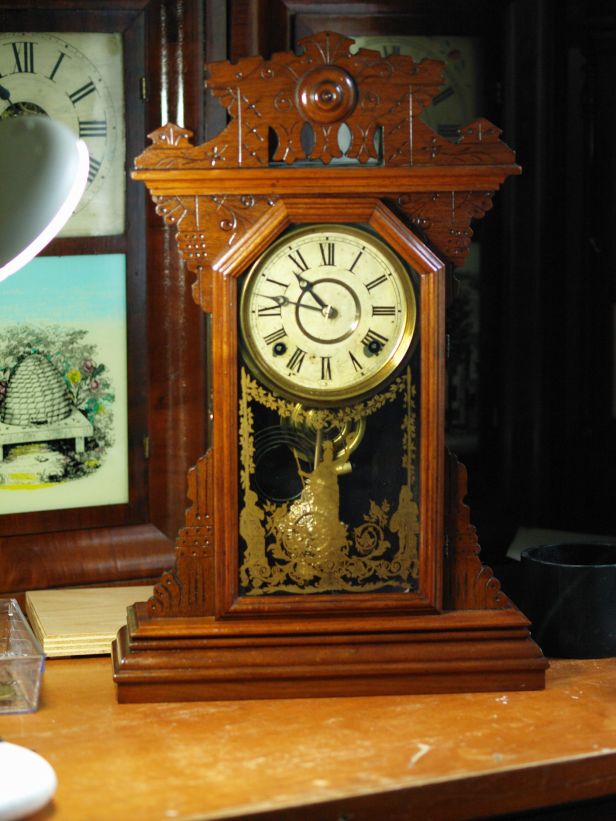
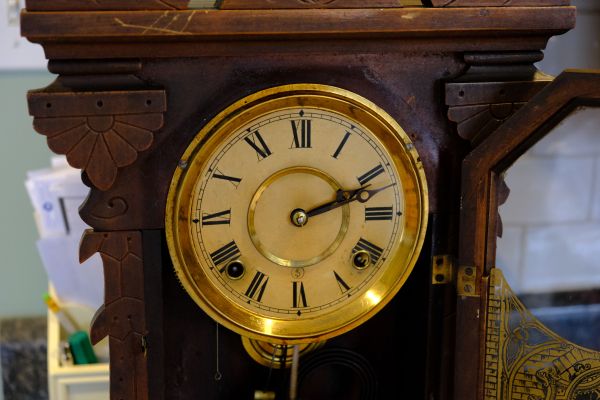
I do not come across many antique E Ingraham & Co. clocks and have just one other in my collection, the Huron from 1878, but I came across another recently that I found in a local antique shop. The price was right so, I snapped it up. The”S” shaped logo on the dial led me to assume it was a Sessions, but it was not – I’ll get to that later.
Rare Ingraham Huron balloon style clock in Rosewood
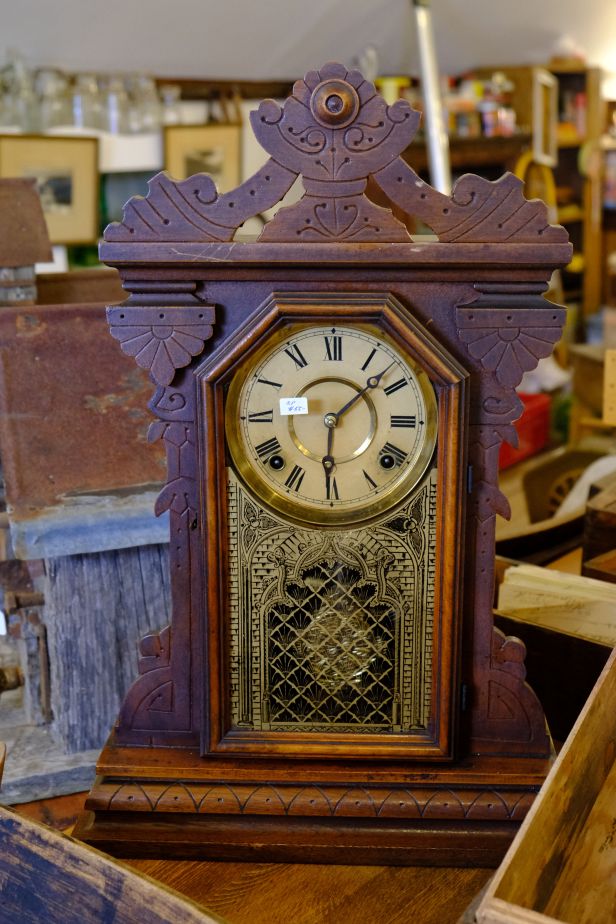
This is a parlour clock. It might have been described in company advertising as a kitchen clock. Some even refer to it as a gingerbread. There are a number of terms used when describing clocks of this style and the three names are used interchangeably by sellers on online for-sale sites and antique stores.
E Ingraham parlour clock circa 1897, sitting in an antique shop






 Antique and Vintage Mechanical Clocks
You must be logged in to post a comment.