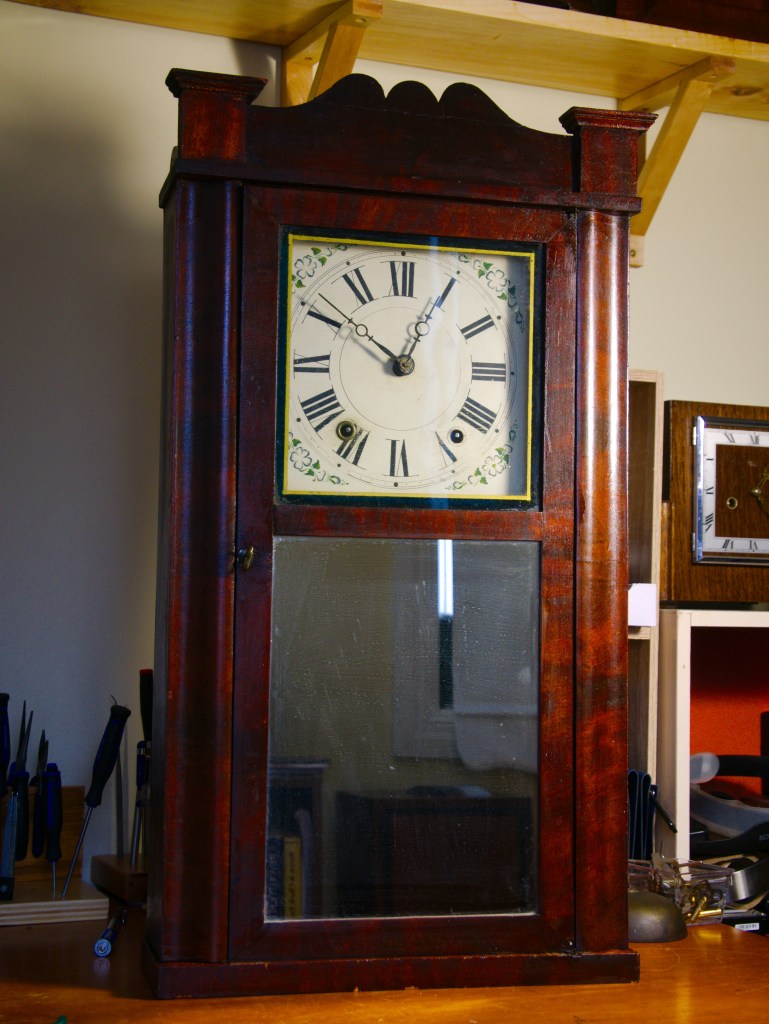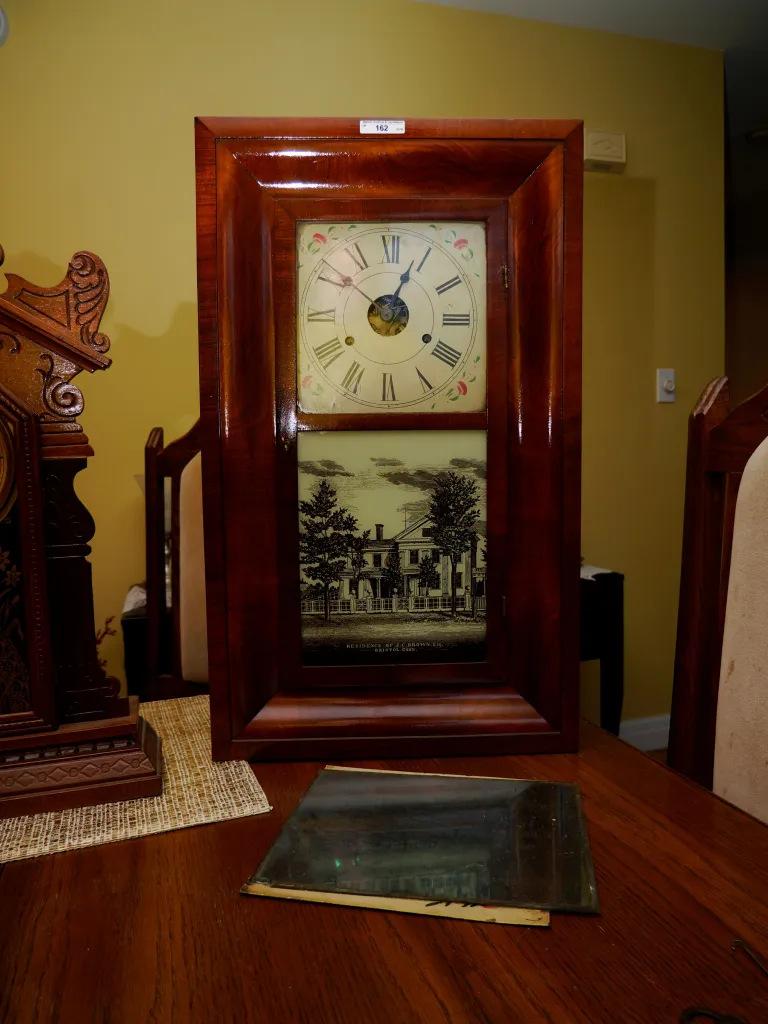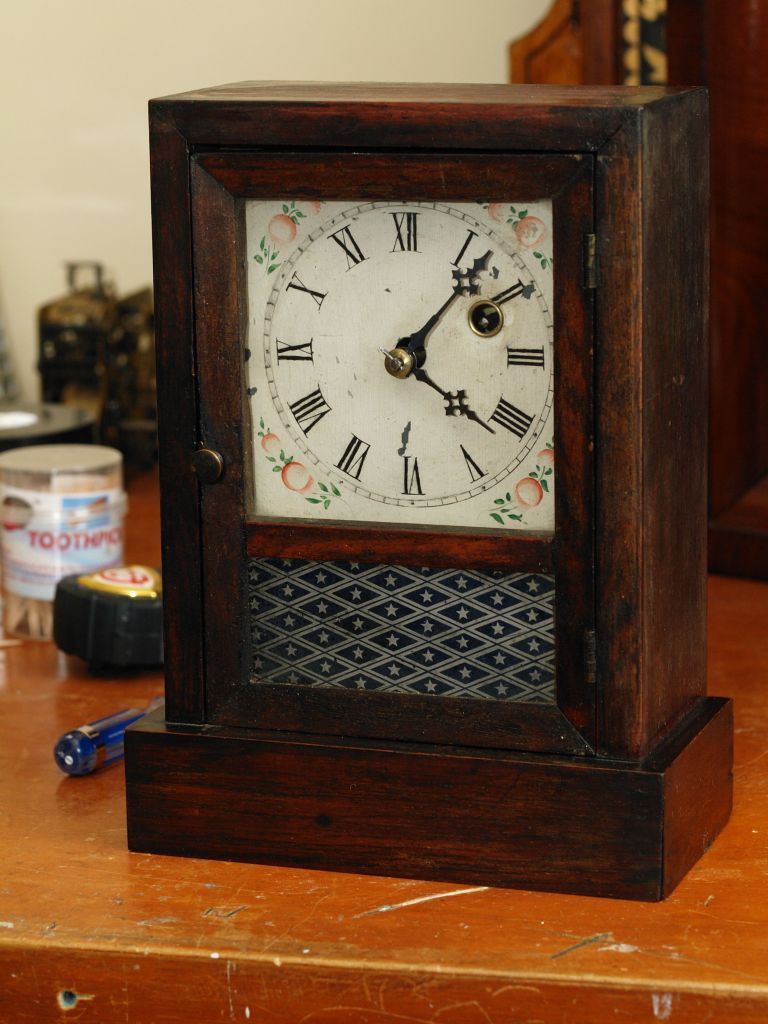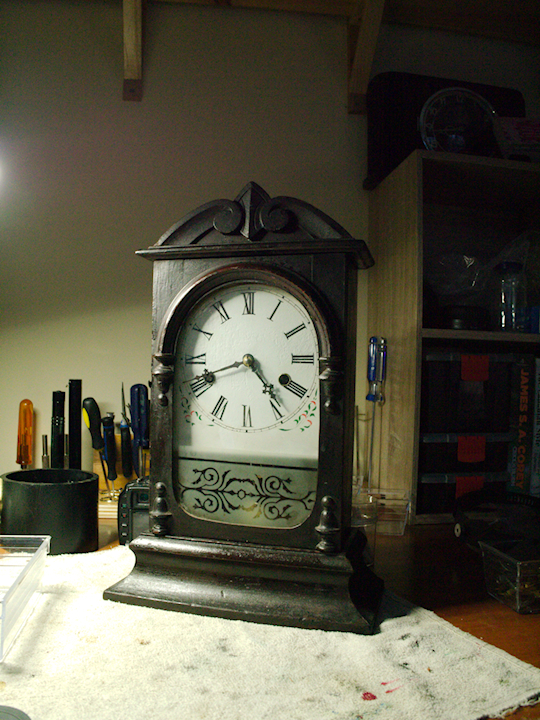
Reflections on a Year of Clock Collecting and Less Time Repairing

As we enter a new year it is time to look back on the adventures and milestones I’ve experienced in the world of antique and vintage clock collecting and repair in the past year. 2024 has been one of discovery, growth, and deepening appreciation for the art of horology.

Over the past year, I have been shifting the focus of my collection. While I have acquired clocks from various countries, my interest has increasingly centered on Canadian clocks and those with a Canadian connection. This focus is evident in my acquisitions of the following clocks this year.

Adding to the Collection

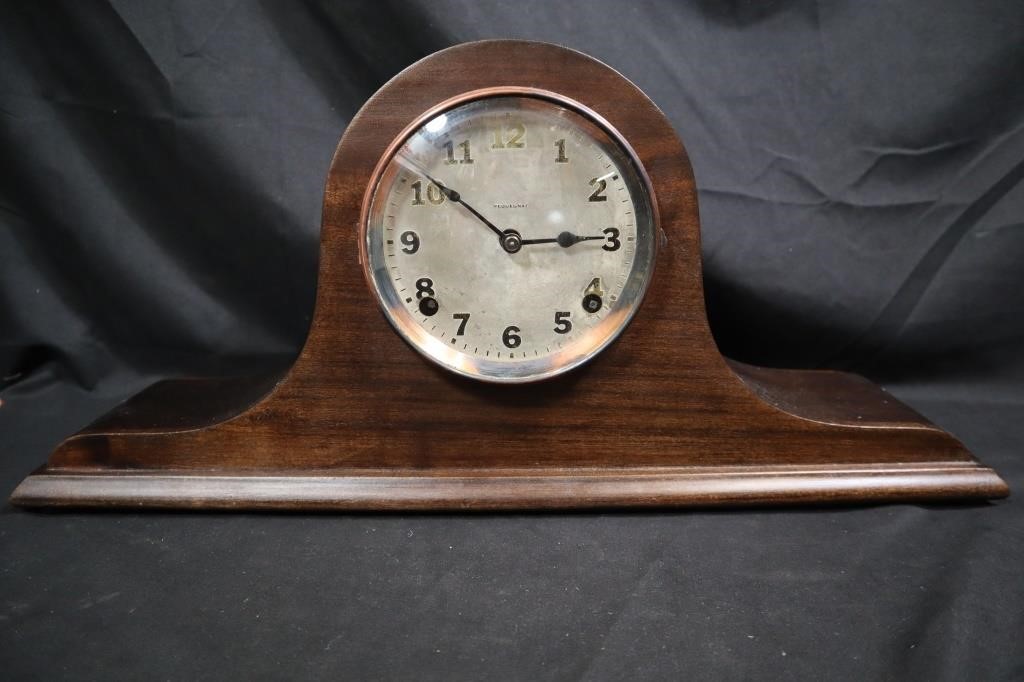
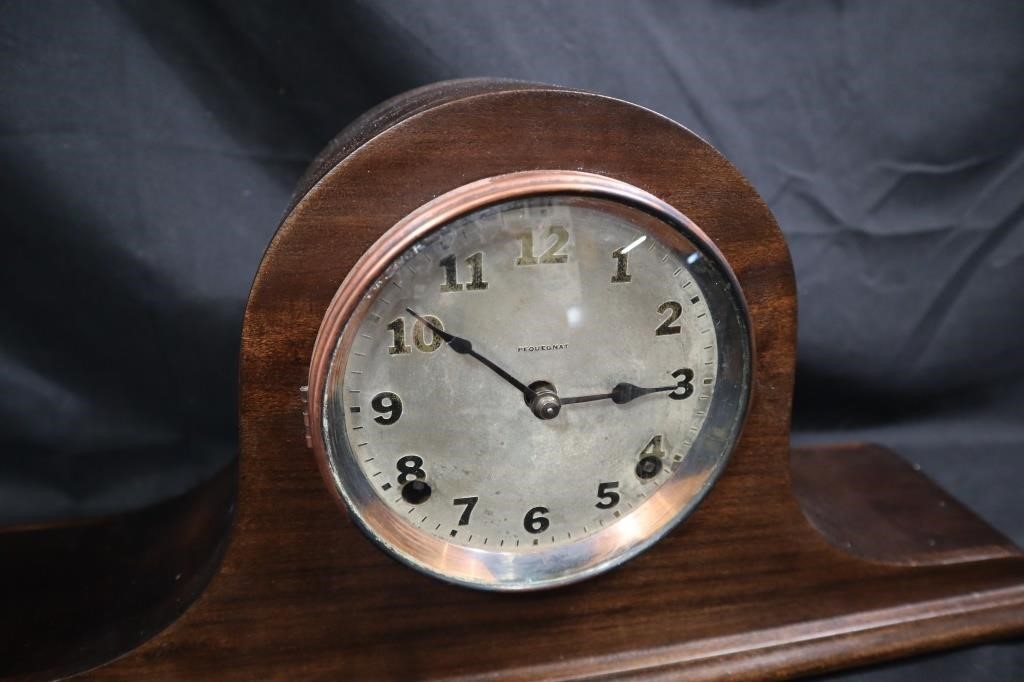
My collection of Arthur Pequegnat clocks grew significantly this year with the addition of some standout pieces.

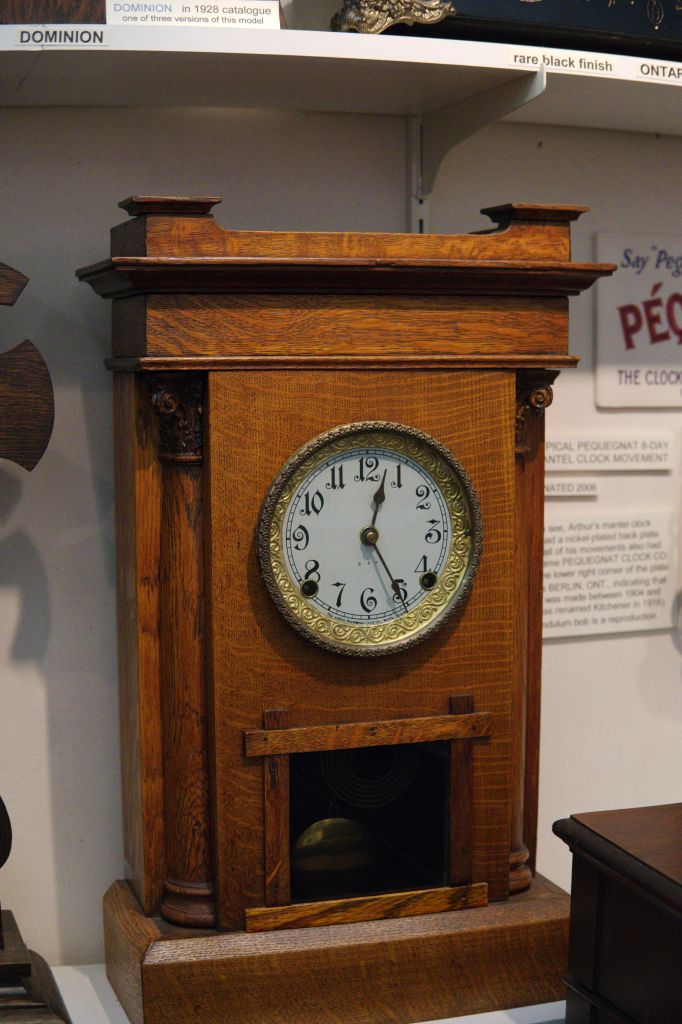
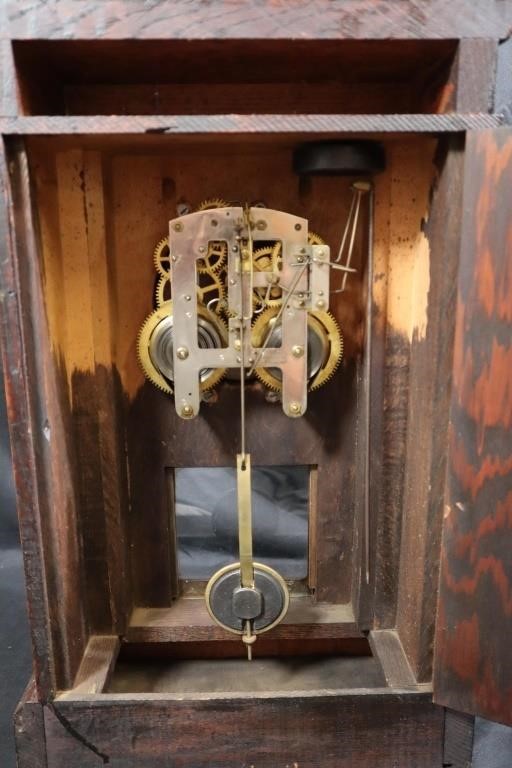
Arthur Pequegnat Hamilton Tall

The Dandy and Hamilton Tall models were particular highlights, each offering unique insights into the craftsmanship and history of the Pequegnat Clock Company.

Arthur Pequegnat Dandy

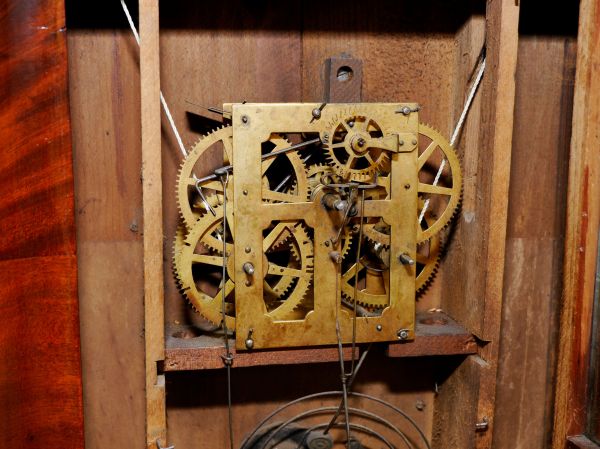
I also came across a rare find — a 30-hour Ogee clock by the Canada Clock Co., a true testament to Canadian clockmaking heritage. An interesting feature of this clock is the faux grain finish on the wood case, which was evidently a cost-saving measure by the company to make their prices competitive with American manufacturers at the time.

Canada Clock Co. Ogee

One of my most memorable acquisitions was an Arthur Pequegnat Simcoe clock (not pictured), purchased in 2018 from a shop in Victoria, British Columbia, for close to $200. This year, I added the Jewel model to my collection after spotting it on a high shelf at a local antique shop. Its price was surprisingly modest, coming in at less than a quarter the cost of the Simcoe making the find all the more satisfying. The addition of legs and side handles distinguishes it from the Simcoe.
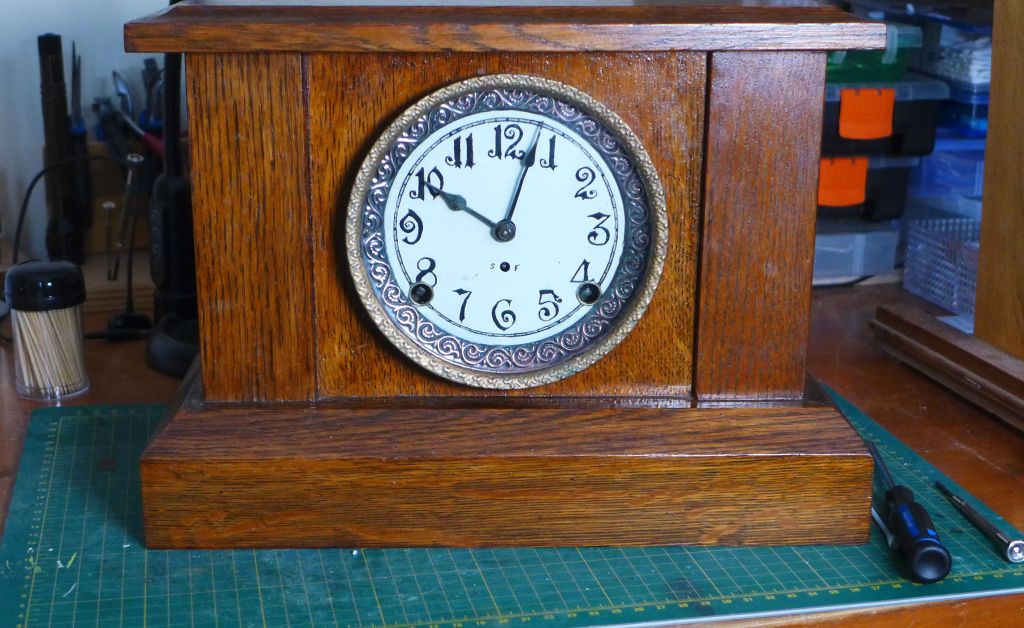
Arthur Pequegnat Jewel

My most interesting acquisition was not a Canadian clock but a German-made Kienzle wall clock, which was given to me by a gentleman in Ontario (Canada).

Kienzle time and strike wall clock

The clock had been passed down from his grandfather, and the seller hoped to find someone who would truly appreciate it. He contacted me for advice and asked about its value. I offered some insights and mentioned that if he was unable to sell it, I would be happy to take it off his hands. Honestly, I never expected to hear back from him after that.

Several months later, he reached out to tell me that he would be gifting it to me. We arranged a hand-off in a small village in Quebec, and it has since become part of my collection. It is a handsome clock with a resonant two-tone strike that is one of the most “complete” clocks in my collection (for more on this clock go here).

Repairing and Restoring

In 2024, I spent less time repairing and servicing clock movements, instead focusing on my blog, researching clocks and clock companies and their histories, and maintaining my collection.

On the repair front, I tackled several challenging yet rewarding projects, including a Seth Thomas Type 89 time and strike and a HAC/HAU time and strike movement. These were standard servicing tasks that presented minimal issues.

Generally, my servicing philosophy is to avoid replacing original components as much as possible but I always test and ensure they meet the clock’s functional requirements. This year reinforced my belief that preserving original parts is vital to maintaining a clock’s authenticity.
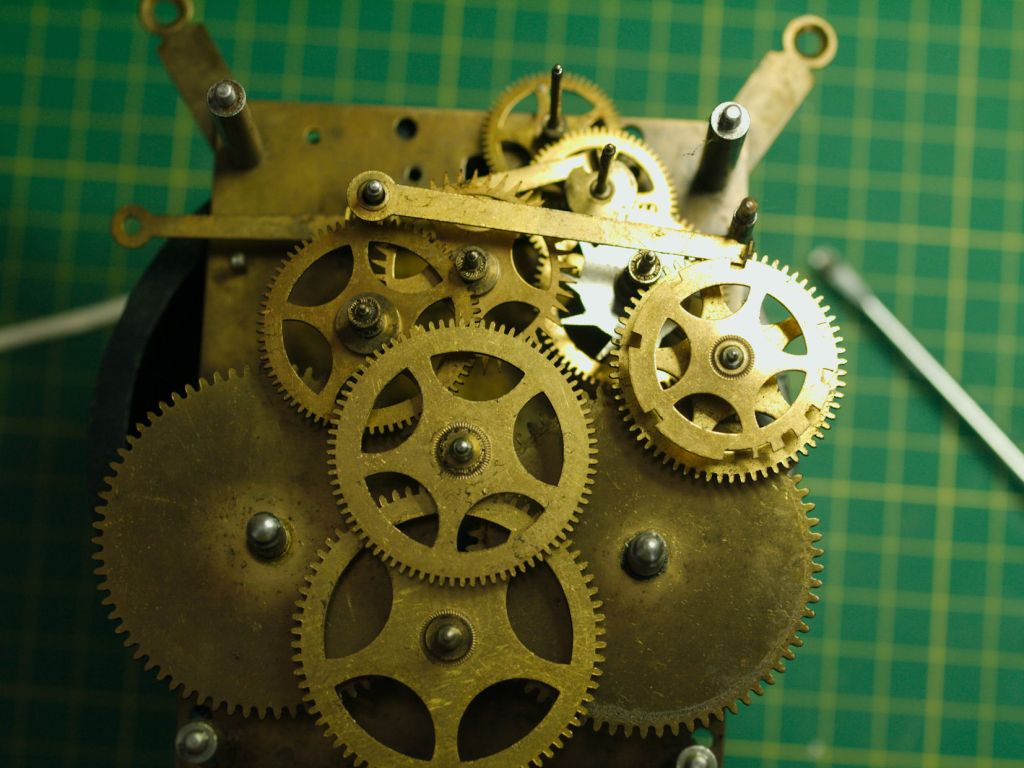
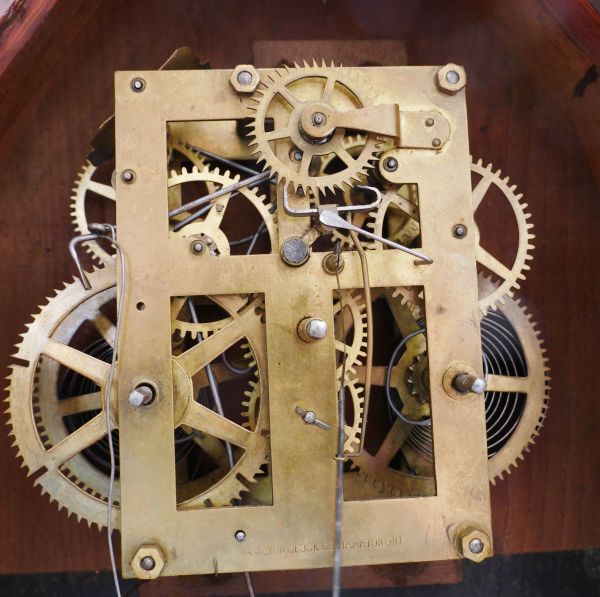
HAC (Hamburg American Clock Co.) movement with plate removed

Among the repairs waiting their turn is the Danby model by Arthur Pequegnat which has been placed on the back burner due to other priorities. With three other movements to finish first, the servicing of those clocks plus the Danby will be projects for later in 2025.
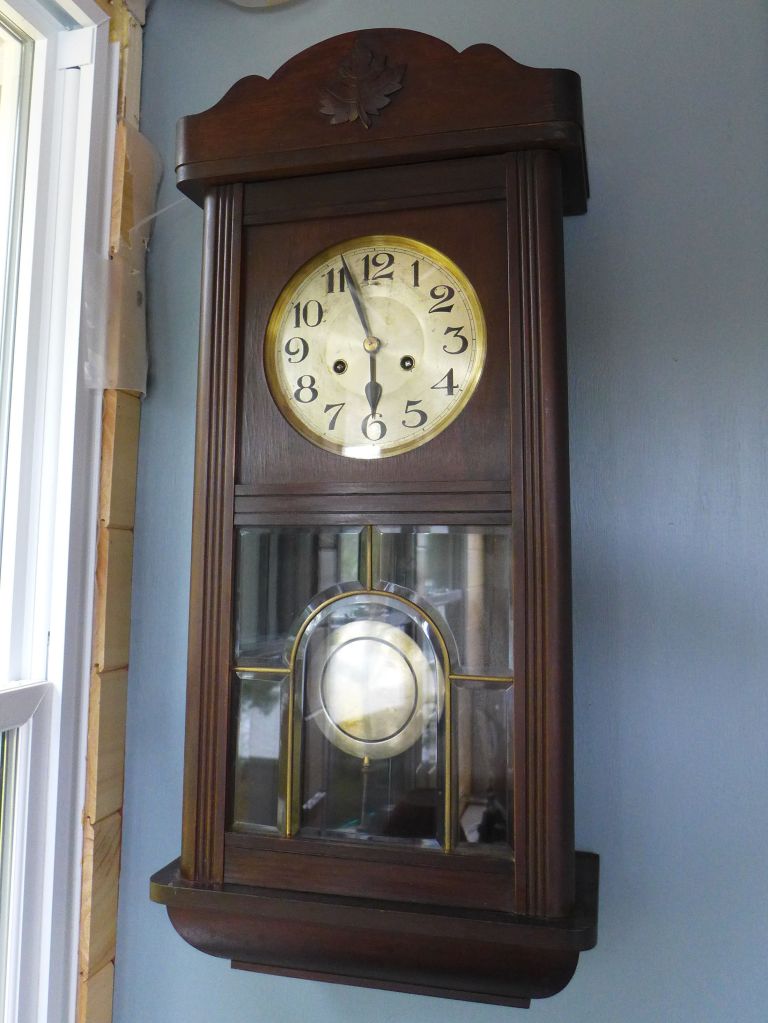
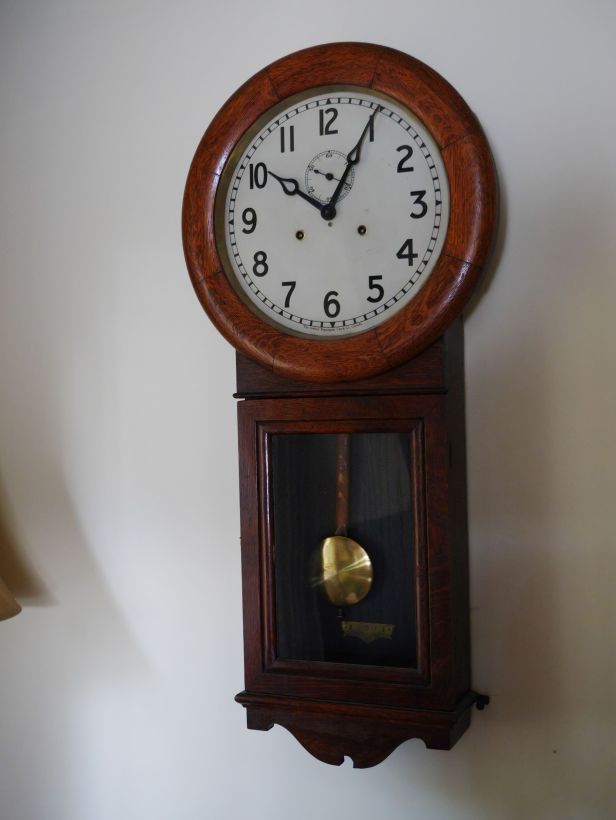
Mauthe wall clock

Another project I’ll be tackling in 2025 is a family clock. This past year, I received my father-in-law’s clock for repair. It was passed down to my wife’s brother and has been out of service for over 25 years. I plan to return it fully serviced, and I hope that this stately Mauthe wall clock will take a prominent place in my brother-in-law’s home as a sentimental reminder of my wife’s father.

Sharing the Passion

This year celebrates seven years of blogging about clock collecting, repairs, and restoration. My blog has become a platform to share knowledge and stories, blending my love of writing, photography, and horology. Though I took a break for the holiday season, I look forward to returning this year with fresh content and inspiration.

One of the goals of this blog is to introduce antique and vintage clocks to younger generations and inspire an appreciation for these remarkable mechanical devices from the past. In today’s modern age of a throw-away culture, how many items can you think of that still function flawlessly after more than a century? It is a short list indeed!

A Special Milestone

In 2025, I will celebrate the remarkable milestone of reaching 1 million views, and I’ll be publishing a special article to mark the occasion. This achievement highlights the significant impact and reach of my content, demonstrating that my blog has resonated with a broad audience and built a dedicated following over time. Reaching this level of engagement is a testament to the value and quality of the information I share, making it an incredibly rewarding accomplishment as a creator.

A Broader Perspective

My collecting journey has always been intertwined with a sense of history and nostalgia. Yet, I’ve also faced the reality that interest in antique clocks is waning among younger generations. While my children may not share my passion, I find joy in preserving my clocks for future collectors or enthusiasts who might rediscover their charm. I hope that a younger generation will emerge and find value in collecting these old treasures.

My tastes and collecting habits are evolving, and I am increasingly focusing on Canadian-made clocks or those with a significant Canadian connection. This year, I may sell some of my more common clocks, which will reduce my collection to a more manageable size while still preserving my collection of 15 Canadian-made clocks.

Looking Ahead

As the New Year is upon us, I’m excited about the possibilities. My trip to the UK in 2024 provided opportunities to explore horological treasures, visit museums, and reconnect with my British heritage. Whether acquiring new clocks or deepening my understanding of their history, I’m eager to see where future journeys take me.

To all fellow enthusiasts and readers of my blog: thank you for your support and shared passion for these timeless pieces of history. Here’s to another year of celebrating the art and craft of clocks!

Exploring a 30-hour Ogee clock from the Canada Clock Co. (Hamilton)

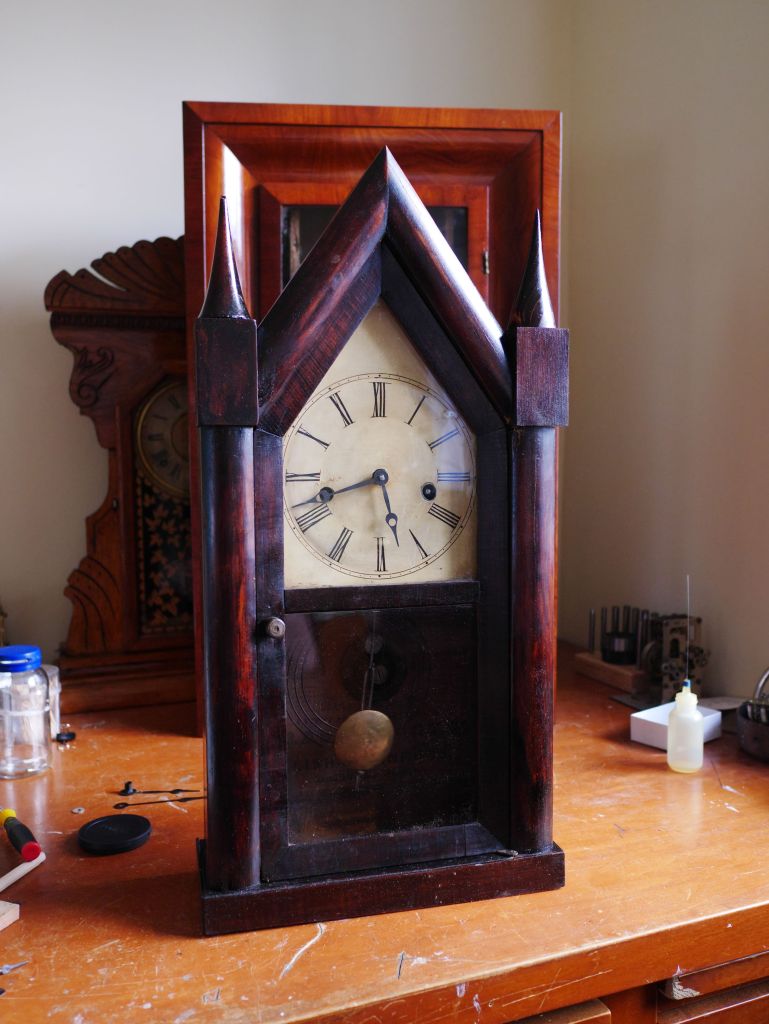
I recently had the opportunity to expand my collection with more Canadian-made clocks, including a 30-hour Ogee clock produced by the Canada Clock Co. at their Hamilton plant between 1880 and 1884.

Canadian clock companies have historically struggled to survive due to fierce competition from American manufacturers. Companies like Westclox in Peterborough survived largely due to their connections with U.S. parent companies, while smaller firms like Pequegnat persevered independently for as long as possible until the market and materials eventually declined.

Clockmaking in Whitby & Hamilton, Ontario

From 1872 to 1884, a group of Canadian clockmakers sought to compete with American companies by producing locally-made clocks designed for the Canadian market.

The Canada Clock Co. (Whitby, Ontario), the Hamilton Clock Co. (Hamilton, Ontario), and the Canada Clock Company (Hamilton, Ontario) faced significant challenges in the 19th century during a 12-year span as they sought to establish Canada’s presence in the clock-making industry.

The Canada Clock Co. was founded in Whitby, Ontario, in 1872, but its operations ceased after just four years, largely due to a catastrophic factory fire.

In 1876, key figures from the failed company, including manager John Collins, relocated to Hamilton to form the Hamilton Clock Co. Despite this renewed effort, the company folded after four years, halting production in 1880.

Later that year, another attempt was made to revive the industry with the creation of a new Canada Clock Co., reusing the old name and operating out of the former Hamilton Clock Co. factory. Unfortunately, success remained elusive, and the company declared bankruptcy in 1884, marking the end of a dozen turbulent years of clock production in the Canadian market.

Movements were made in Canada though they were essentially copies of American movements, most notably those manufactured by the Waterbury Clock Company. Case styles were also “borrowed” from Waterbury, Ansonia, and New Haven. Made in Canada, yes, original designs, no!
30-hour Ogee Clocks

Fortunately, many clocks from the three companies have survived to this day and occasionally they show up on online auction sites and other for-sale sites.

I have one other Ogee clock from this group of companies, one from the Hamilton Clock Company. It is exactly the same dimensions as a typical American Ogee of that time and mirrors the clock’s dimensions described in this article.

The brass movement of the Hamilton clock is a 30-hour time and strike and weight driven. Of particular interest is the use of an etched tablet that resembles a silk screen technique.

I have four other 30-hour Ogee clocks, two from Chauncey Jerome, a George H. Clark, and a Waterbury. All share the same dimensions as my two Canadian-made clocks.

Why were they so popular?

They were popular in the 19th century for a number of reasons. Most households did not need clocks with extended run times, and daily winding became a routine part of life, so the 30-hour duration was not seen as a disadvantage.

They were more affordable to produce and purchase, making them accessible to a broader audience. The weight-driven mechanism was simple, reliable, and required little maintenance. Unlike steel springs, which were expensive to manufacture in the early days, the weights were cheap to produce, further reducing costs.

Finally, the Ogee clock’s distinctive double-curved molding often made with exotic veneers was visually appealing and complemented the furniture styles of the period.

Canada Clock Company Ogee

My latest Ogee was made between 1880 and 1884 at the Canada Clock Co. factory in Hamilton, Ontario.

Auction photo

This clock has several intriguing features. First, it is the only one in my Ogee collection that includes an alarm function. Before the widespread availability of affordable alarm clocks or reliable pocket watches, many people relied on their household clock to wake them up in the morning. This was especially helpful in agrarian societies, where waking up early was essential for tending to livestock or starting farm work.

The brass dial sets the alarm

Second, the glass tablet showcases a unique cherub figure that differs from any designs I have encountered on similar clocks from the three companies. Unfortunately, the cherub has partially faded over time.

The grain is worn on the left side

Third, the clock features an imitation wood-grained finish that I have not encountered on other Ogee clocks. Genuine exotic or high-quality wood, such as mahogany or rosewood, was expensive. By using cheaper, locally available wood like pine or basswood and applying a faux wood grain finish, clockmakers could mimic the look of luxurious woods at a fraction of the cost.

Overall the imitation grain looks good

While most of the “grain” is still intact, some of it has worn away in the Ogee section on the right side. Although it requires cleaning, I must be careful to preserve the “grain.”

Fourth and final, it is one of the few Ogee clocks I have encountered that still has the dust blocks for the pulleys intact. There are two, one on each side located on the top of the case. These are frequently lost at some point in the clock’s life.

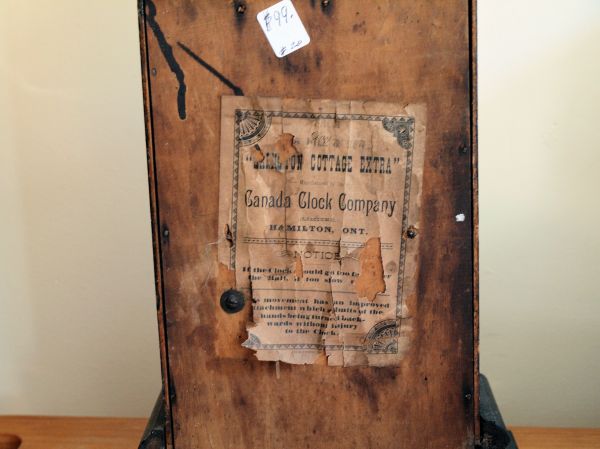
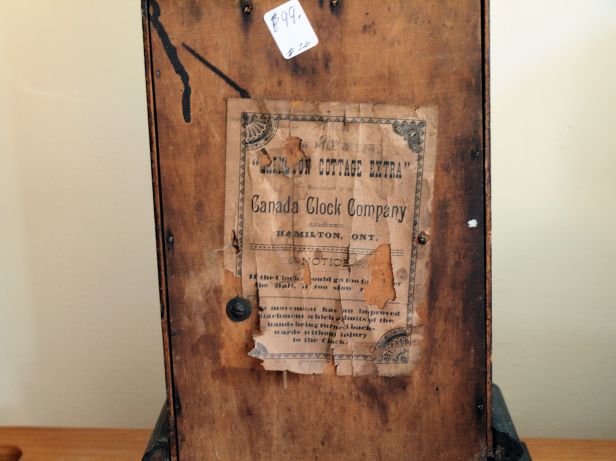
The label is mostly intact missing the bottom left-hand corner section. A clock’s label includes the name of the manufacturer. This helps identify where the clock was made and by whom, which is essential for authentication. This is particularly important when there is no maker’s stamp on the movement.

Servicing and Cleaning

This might turn into a winter project since I have several clocks waiting for servicing. However, I’d like to focus on the case first to preserve the faux grain. The plan is to give it a light cleaning and apply a coat or two of traditional shellac to help protect the finish.

I noticed that the hammer lever (strike-side) got stuck when I briefly ran the clock. It’s probably just a small adjustment, but I’ll need to disassemble the movement regardless. While I’m at it, I will also take care of any wear issues.

Three Canadian Antique Clocks Won at Auction

About a year ago, I shifted my focus to collecting clocks made in Canada or those with a Canadian connection. Of course, there are exceptions if a particularly interesting clock comes along. In keeping with my goal, I won three Canadian clocks this week at auction: an Arthur Pequegnat Hamilton “Tall”, an Arthur Pequegant Dandy, and an ogee crafted by the Canada Clock Company of Ontario. All are shelf or mantel clocks. Two are spring-driven while the third is powered by weights.

Since the bidding was online, I don’t have the clocks yet, but I expect them to arrive within the next week or so.

Arthur Pequegnat Hamilton “Tall

I’m not sure what inspired me to take a photo of the Hamilton during my visit to The Canadian Clock Museum in Deep River, Ontario this past summer—but I did! Maybe it was a secret wish to own one someday.

Pequegnat Hamilton shelf clock

The clock I photographed features a piecrust dial, while the one I won at auction has a plain dial. Both styles were available in the early 1900s.

Auction photo http://www.harrisandsonsauctions.com/

The Arthur Pequegnat Hamilton “tall” shelf clock is a classic piece from one of Canada’s most renowned clockmakers. Named after the city of Hamilton, Ontario, this model is part of Pequegnat’s line of shelf and mantel clocks and showcases the craftsmanship that made the company famous.

Auction photo http://www.harrisandsonsauctions.com/

The Hamilton “Tall” features a distinctive upright design, making it stand out among other Pequegnat clocks. It had either a piecrust or plain dial (as I mentioned), adding to its collectible nature. The clock is typically housed in a sturdy wooden case often made with quarter-sawn oak, with half columns and capitals, an attractive crown, making it a simple yet elegant style.

The Hamilton “Tall” features an 8-day time and strike movement with distinctive nickel-plated movement plates, powered by a spring-driven movement. It strikes on both the hour and half-hour.

The Arthur Pequegnat Clock Company, founded in 1903, was one of the few successful clock manufacturers in Canada, with the Hamilton model being one of its many iconic designs. As Pequegnat clocks were made exclusively in Canada (Berlin, later Kitchener, Ontario), they hold significant value for Canadian clock collectors, and owning a Hamilton “tall” shelf clock is like holding a piece of Canadian horological history.

It’s often challenging to determine a clock’s condition from auction photos, but this one seems to be in good shape. Unfortunately, it lacks a label, which is a minor disappointment.

Arthur Pequegnat Dandy

The Dandy is a compact and attractive mantel clock, featuring a solid wooden case, often crafted from oak. The case design is simple yet elegant, with clean lines and minimal ornamentation, giving it a classic, timeless appeal. The dial is plain with black Arabic numerals, making it easy to read.

Auction photo http://www.harrisandsonsauctions.com/

The Dandy is also powered by an 8-day time and strike spring-driven movement. It strikes the hour and the half-hour. The movement is well-known for its durability and precision, hallmarks of Pequegnat craftsmanship.

Auction photo http://www.harrisandsonsauctions.com/

Although not as grand as some of the larger models like the “Hamilton,” it has its own charm, particularly for collectors who appreciate smaller, more understated clocks.

From the auction photos, I can tell the clock is in average condition, which is reflected in the relatively low price I paid for it.

Canada Clock Company 30-hour ogee with Alarm

The Canada Clock Company’s 30-hour ogee clock is a significant piece in the history of Canadian clockmaking. The ogee clock design itself was popular in North America during the 19th century, and the Canada Clock Company produced their own version during their brief existence.

Auction photo http://www.harrisandsonsauctions.com/

The ogee clock is named for its case design, which features the distinctive “S” or double curve molding along the front, giving it an elegant and classic appearance.

The Canada Clock Company’s ogee clocks were typically made with wooden cases, often finished in mahogany or rosewood veneer. The clock has a large rectangular face, featuring Roman numerals, and a clear glass lower panel that reveals the pendulum.

Auction photo http://www.harrisandsonsauctions.com/

This model is equipped with a 30-hour movement, which means it needs to be wound daily. The movement is powered by weights, which descend slowly as the clock runs. The clock only strikes the hour. The use of a 30-hour movement made this a more affordable option for consumers at the time compared to clocks with 8-day movements. This clock also has an alarm feature.

Auction photo http://www.harrisandsonsauctions.com/

The auctioneer advised that there is an issue with the coil or rod gong, something I will look into once I receive the clock. The case, I am told, has been refinished.

The Canada Clock Company operated in Ontario during the 1870s and early 1880s. It was one of Canada’s first significant clock manufacturers, aiming to compete with the American clock industry. Although the company’s existence was short-lived, their clocks are highly valued by collectors today for their historical importance and their role in establishing Canadian clockmaking. The 30-hour ogee clock is a prime example of a typical mid-19th-century clock that found its way into many Canadian homes.

It was a very successful auction day. For each clock, my wife and I adhered to our strategy of setting a maximum bid well beforehand, which helped us secure all three pieces effectively.

In sum, the Hamilton is a classic shelf clock with a distinctive upright design, a quarter-sawn oak case. Though lacking a label and with condition difficult to assess from photos, it appears to be in good shape.

The Dandy is a compact mantel clock with a simple, elegant oak case and plain dial. Its condition is average, reflecting the modest auction price.

The 30-hour Ogee is a classic 19th-century ogee clock with “S” curve molding and a 30-hour movement. It features an alarm and has a refinished case, with a noted issue with the gong.

Each clock adds a unique piece of Canadian horological history to my collection.

30-hour clocks in my collection – a complete list

While I have over 85 clocks in my collection twelve are 30-hour or one-day clocks. One of the twelve is a relatively modern clock.

The history of mass-produced clocks in America began in the 1820s and 1830s with 30-hour clocks that had woodworks movements. While the clock business was booming with many companies selling clocks to the masses, an economic recession in the late 1830s brought clock production to a halt.

Pioneer clockmaker Chauncey Jerome, who was in the clock business at the time, considered his “business troubles and disappointments” and he along with his brother Noble formulated the idea that movements could be made from brass. Noble Jerome received patent number 1200 for his brass clock movement, issued June 27, 1839. Woodworks movements began to be phased out and replaced by brass movements which were made in the hundreds of thousands. 30-hour brass movements were made well into the 1860s and were eventually replaced by the 8-day brass movement.

Because 30-hour clocks were produced in the thousands many examples have survived to this day. Most clock aficionados today have at least one ogee clock in their collection.

Of the 12 in my collection 5 are running continuously. Yes, winding a clock everyday is a hassle but we often forget that at one time the thirty hour clock in the form of the bedside alarm clock was a fixture in every home but for this post I am excluding the dozen alarm clocks in my collection.

Half are weight driven, so let’s begin with those.

Sperry and Shaw

Sperry & Shaw 4 column clock

This, a four-column shelf clock designed in the “New York” style was made between 1841 and 1851. Sperry and Shaw were assemblers and distributors and sourced parts from various producers. The movements and cases could have been made by Silas Hoadley or Chauncey Jerome or both.

I bought the clock from student in Halifax, Nova Scotia in the fall of 2018 and he would not budge on the price. My only question to him prior to making the deal was whether or not the clock had the original wafer weights which would be almost impossible to source if missing.

Daniel Pratt and Son

This is the only clock I have with a woodworks movement. Daniel Pratt worked with others but eventually went out on this own in the 1830s. I would date this clock to around 1837. This clock was won at an estate auction for the price of $30 during a time when clock prices were hitting rock bottom. The clock has a wood dial and a mirrored lower tablet (may or may not be original) and the case is in very good condition for its age.

Daniel Pratt and Sons

Chauncey Jerome

Chauncey Jerome 30 hoir Ogee clock
Chauncey Jerome 30 hour Ogee clock

This clock is from around 1855, made just before Chauncey Jerome’s company went into bankruptcy. This was also bought at auction a few years ago. It came with an extra mirrored lower tablet and a “spare” dial. I am not sure if either the mirrored tablet or the JC Brown picture are original. The veneer, however, is in perfect condition.

George H. Clark

George H Clark 30 hour Ogee shelf clock

This is an ogee from around 1857. There is no makers mark on the works but it is a Waterbury type 2.411 movement. The case is well-preserved and in excellent condition, obviously well-cared for by a previous owner. The beehive tablet looks to be original.

Waterbury Clock Co.

This an ogee style clock from 1865. It was bought at an antique store in Halifax. There was no price on the clock. I asked the owner what he would sell it for. He said, name a price, I said $40 and he said, sold! Evidently it been in his shop for a while. It is the first clock on which I learned how to replace very worn trundles.

Cuckoo clock

Dave's cuckoo clock
Dave’s cuckoo clock

This is a 30-hour cuckoo clock with a Regula movement, made about 1976. A cheap German made mass-produced “tourist” clock that was given to me by a relation. It still works but it is on its 3rd movement.

And now for the spring driven clocks.

Ansonia Cottage clock

This cottage clock is from about 1895. This another clock that was given to me. These were probably dollar clocks at the time. They had cheap movements but were solid and reliable. Surprisingly, these command good prices on the auction sites since so few remain.

OLYMPUS DIGITAL CAMERA

Canada Clock Company

The Hamilton Cottage Extra is from about 1880. These are now very difficult to find since so few have survived. It is Canadian made and collectors will happily pay hundreds of dollars for one. It has a very cheap case made of softwood with no veneers. The acid etched lower tablet is quite unique. It was bought in a local junk store for $40. I could not believe my find.

Hamilton Cottage Extra

Elisha Manross

Elisha Manross gothic steeple

The Manross is a thirty hour time and strike and called a steeple clock. One interesting feature is that the Rosewood veneer is in a vertical orientation on the side columns unlike most that have a horizontal orientation. It is also the only clock in my collection that has brass mainsprings which were phased out in the early 1840s making the clock historically significant. Needless to say that in order to preserve the mainsprings I run this clock infrequently.

Hamilton Clock Company

The style is known as gothic steeple. The clock is from about 1876 and features a religious expression on the acid etched lower tablet, “Cling to the Cross”. There are some veneer losses but the clock is in decent shape. The steeple tips never seem to survive on these clocks.

Hamilton Clock Co. 30 hour time and strike

New Haven

This is a spring driven time and strike ogee from around 1875. Unfortunately the veneer has been stripped from the case and the softwood re-stained but it is an attractive little clock nonetheless. The dial is a replacement and the lower tablet has some losses.

Ogee New Haven clock

New Haven

This a called a Sharp Gothic according to the label. It is an American-made clock sold by a jeweler by the name of Thomas B. Spike in Halifax, Nova Scotia (Canada) in the 1880s. The lower tablet features a seaside Parthenon scene which might suggest it was one of many produced for foreign markets. There are some veneer losses but the clock is in running order and keeps reasonably good time. It has replacement mainsprings because it will run for 3 days on a wind. Not bad for a 30-hour clock!

New haven Gothic Steeple clock

I hope you enjoyed this little tour of a part of my collection of 30-hour or one-day clocks and please leave a comment. As for expanding my collection of one-day clocks I am not sure that I would continue acquiring them unless I came across something quite unique or if one were given to me.

Canada Clock Co. Hamilton Cottage Extra – dial in-painting

While waiting for movement parts I continued to work on the case of this antique Canadian cottage clock from the mid 1880s. The dial needs attention and in this article I will describe the procedures for in-painting the numerals and decorative elements.

Decorative hand-painted antique dials need attention from time to time. Through environment and use they become victims of wear and neglect. Stabilizing and restoring dials maintains the value of the clock. In-painting involves filling areas of loss, cleaning, colour matching, repairing graphics and decorative art work.

The Canada Clock Co.

The Canada Clock Company in its three iterations made clocks in Ontario, Canada between 1872 and 1884. The Canada Clock Co, the Hamilton Clock Co. and then Canada Clock Co. (redux) struggled over a 12 year period to put Canada on the clock-making map. Ultimately their efforts failed. Nonetheless, there are plenty of fine examples that have survived to this day.

I found this interesting example in an antique shop in downtown Truro, Nova Scotia. The model is called Hamilton Cottage Extra.

First look

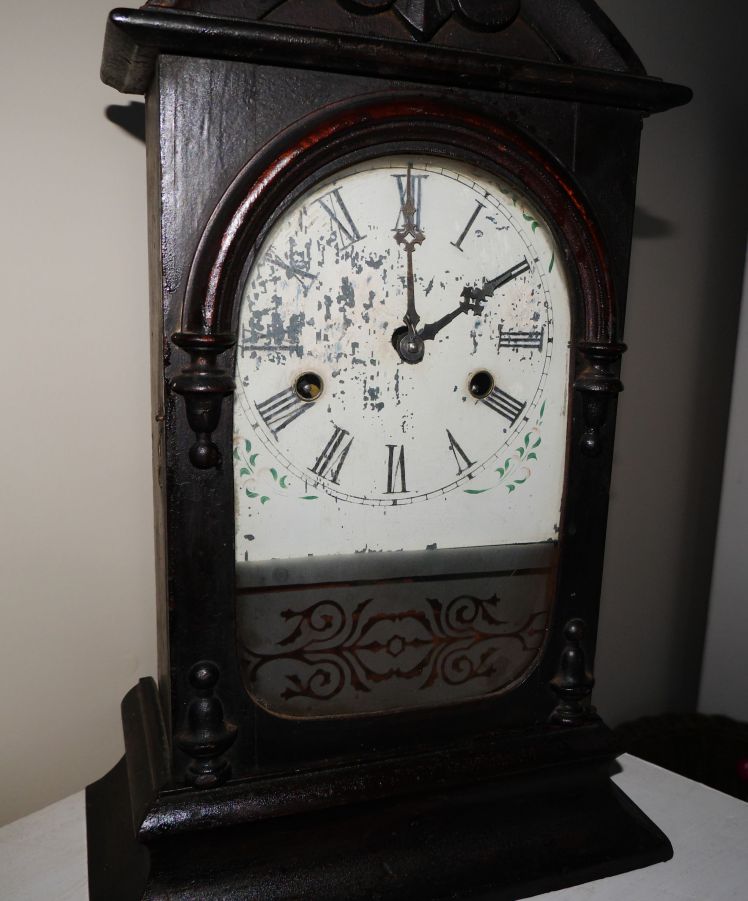
This is the dial when I first saw it. It is unsightly and distracting. Severe flaking over a good portion of the dial surface plus an attempt to repaint the numbers by a past owner presented a challenge for restoration.

Continue reading “Canada Clock Co. Hamilton Cottage Extra – dial in-painting”

Canada Clock Co. – 30 hour time and strike needs some love

Servicing this clock from the Canada Clock Company was a real challenge as I encountered many issues that conspired to slow my progress.

I found this clock in an antique shop in downtown Truro, Nova Scotia at basically a give-away price. The seller knew nothing about the Canada Clock Co. and that was fine with me.

So, what happens when amateurs and backyard mechanics get their hands on a movement. Read on.

But first, a little about the short-lived Canada Clock Co.

Canada Clock Co Hamilton Cottage Extra

The Canada Clock Company in its three iterations made clocks in Ontario, Canada between 1872 and 1884. The Canada Clock Co, the Hamilton Clock Co. and then Canada Clock Co. (redux) struggled over a 12 year period to put Canada on the clock-making map. Ultimately their efforts failed. Nonetheless, there are a number of fine examples that have survived to this day

Description 

The clock is a 30-hour time and strike movement on a bell. It is the “Hamilton Cottage Extra”, one of the least expensive in their line of cottage clocks.

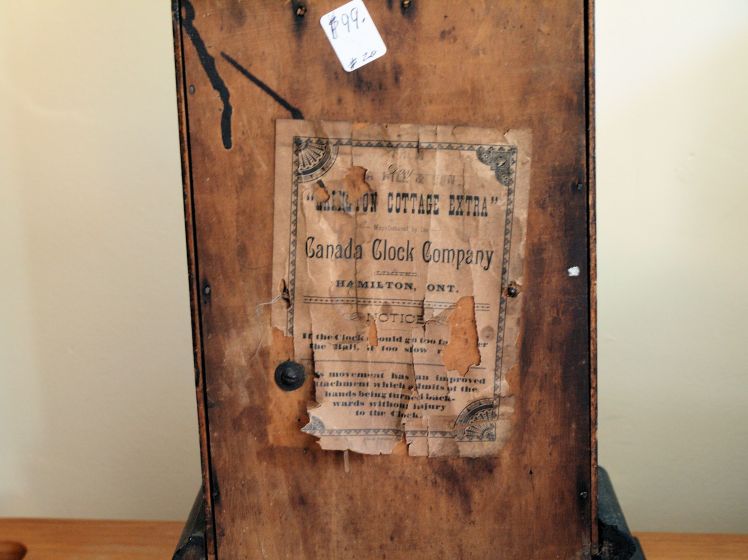
Back label in good condition for the age of the clock
The label is in fair condition but identifies the model name and yes I paid far less than the sticker price

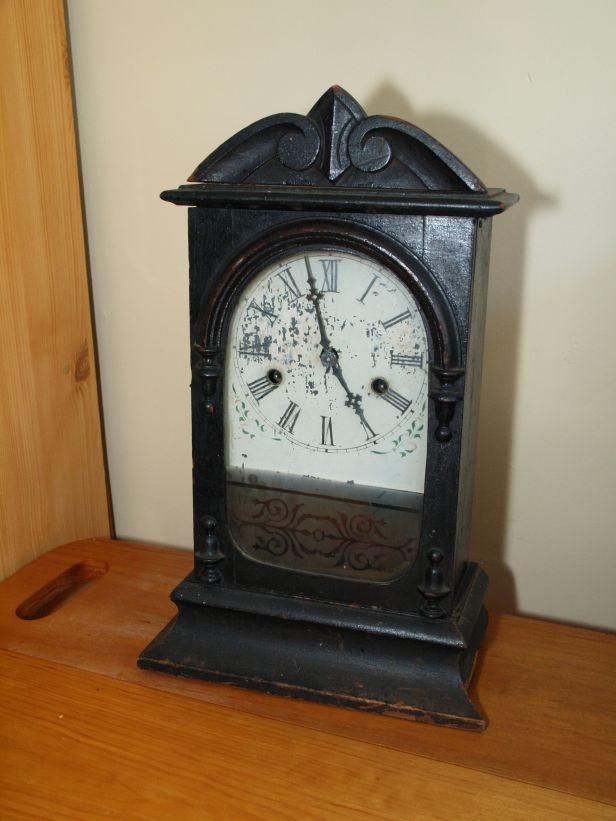
The case, which is in fair condition, reflects the age of the clock, grimy with numerous chips and scuff marks. Constructed of pine with a walnut stain finish the case has a minimum of decorative features and reflects the muted Victorian style of the times. The label is in fair condition and there is a stamp on the top of the label which says, “…A Hill &Co.”.

The lower part of the tablet has an etched glass floral design common on Canada Clock Company clocks. The dial face is flaked in places, has been “touched up” and will need attention.

The Maltese hands are original.

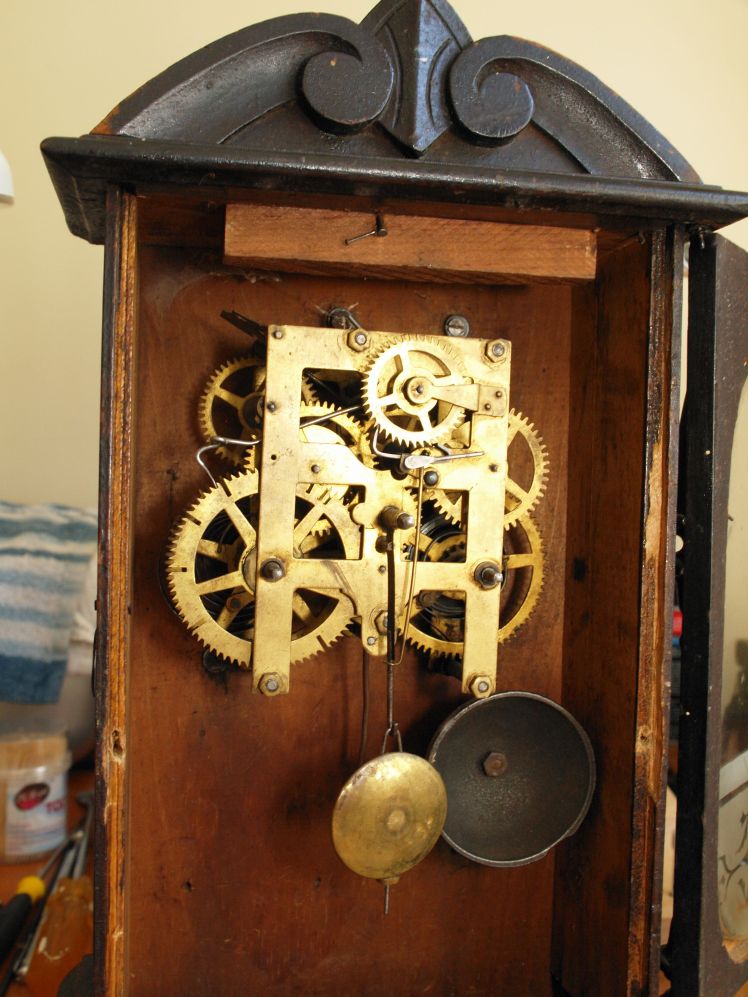
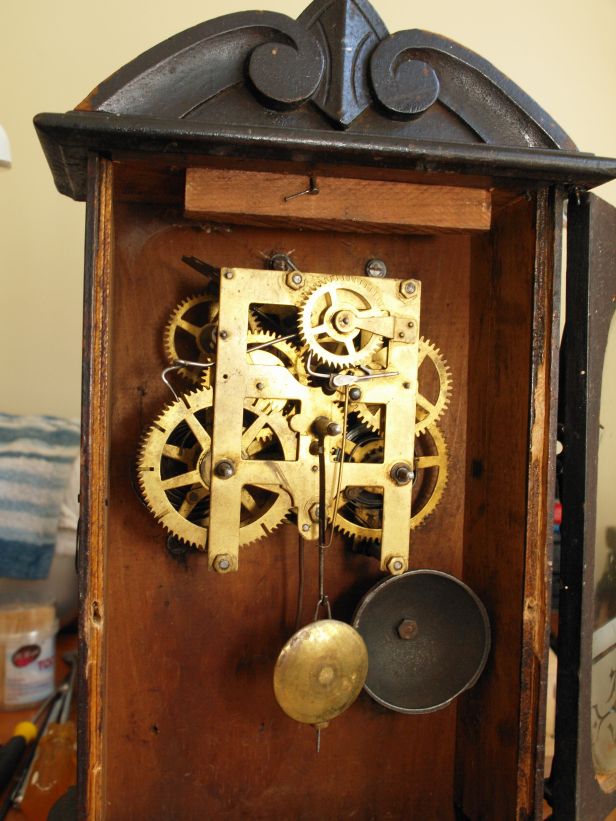
Original time and strike 30 hour movement
Original time and strike 30-hour movement

I tested the movement while in the case. The time side runs with a little encouragement while the strike side has the typical run-on strike when things fall out of adjustment.

Assessment of the Movement

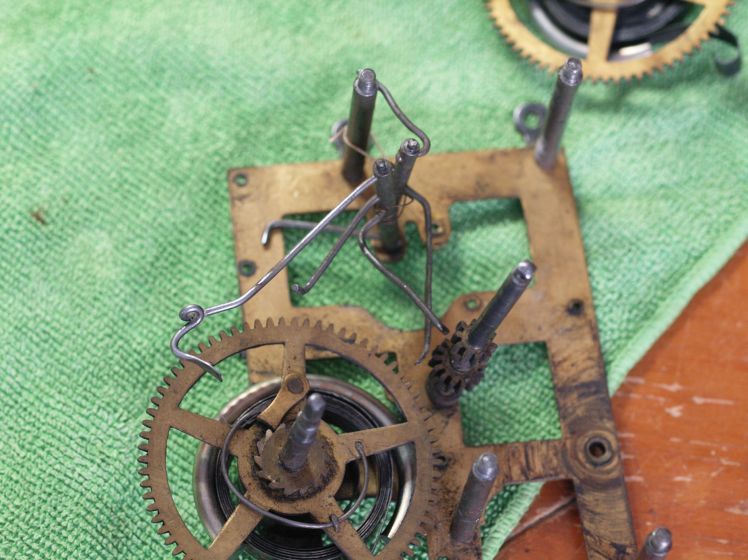
When I disassembled the movement there were a few unexpected surprises. I now have answers for a movement that is running poorly.

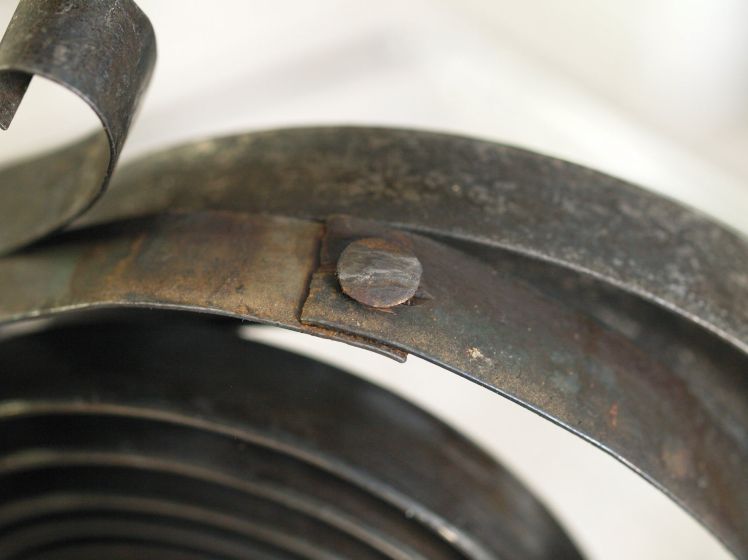
Strike side mainspring riveted together

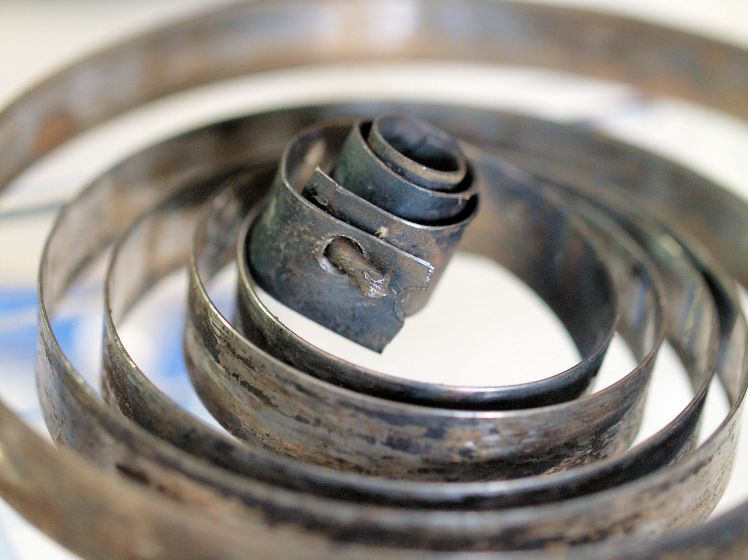
Both mainsprings had been modified, a very old repair. I try not to be judgemental when I see this and respect the folks that made every effort to keep their clocks running as best they could often with limited means. However, these look dangerous and must be replaced.

Time side mainspring with a nail holding parts of the mainspring together

Now on to other issues.

Levers bent in all directions

This is the strike side. What are the correct positions for the levers? Bent so many times it will take trial and error to find precisely where the levers should go.

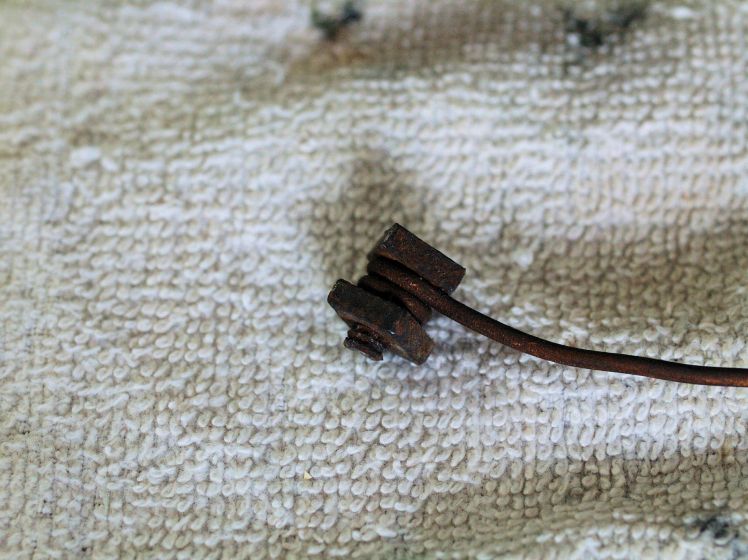
The “hammer”

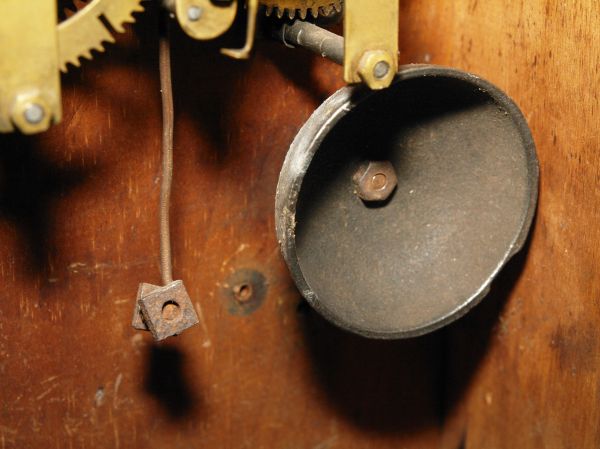
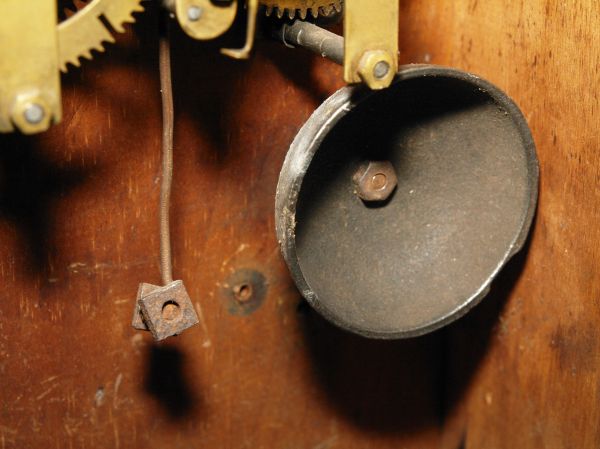
The hammer is actually a copper wire wound around 2 nuts and it is loose in the arbour.

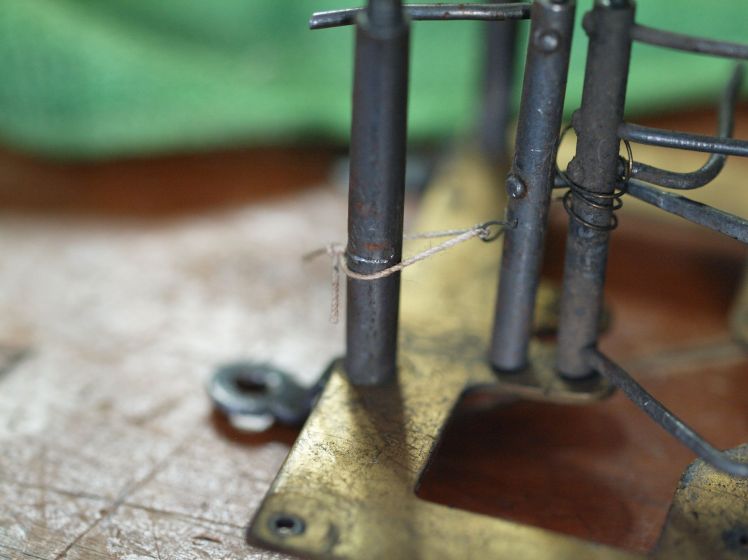
Helper “string” or helper spring

There is enough helper spring to wrap around the pillar but someone thought the string was necessary. It will be replaced with a new spring.

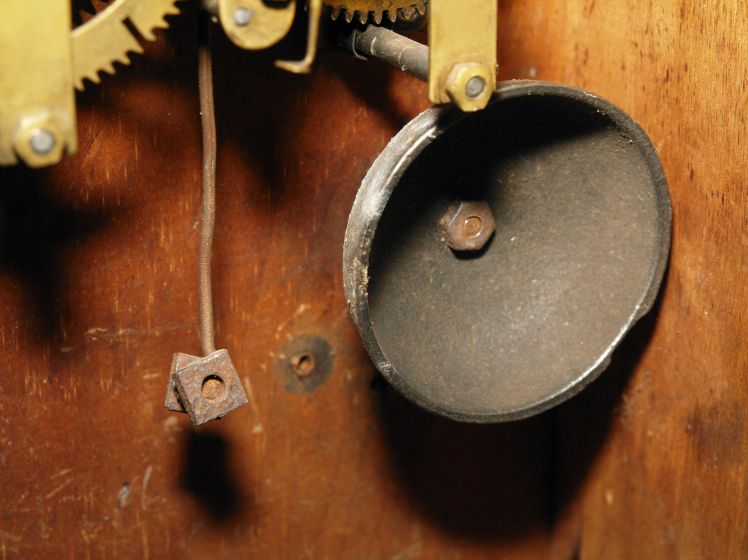
Nuts for a hammer and the bell has been repositioned

While the bell may be original, Judging from the number of holes, it has been relocated and raised to work with the home-made hammer.

The movement is a disappointing mess but not unfixable. In the clock business, you must expect the unexpected. In the meantime, I can clean the parts and perform pivot polishing and bushing work while I await parts.

I am determined to get this clock running so, stay tuned for the movement servicing and dial painting!

Monday, July 1 is Canada Day

July 1 is the national day of Canada the effective date of the Constitution Act of 1867 then called the British North American Act. This year we celebrate 152 years as a nation. Canada Day is often informally referred to as “Canada’s birthday”. Celebratory events take place on July 1.

Most communities across the country will host organized celebrations for Canada Day, typically outdoor public events, such as parades, carnivals, festivals, barbecues, air and maritime shows, fireworks, and free musical concerts.

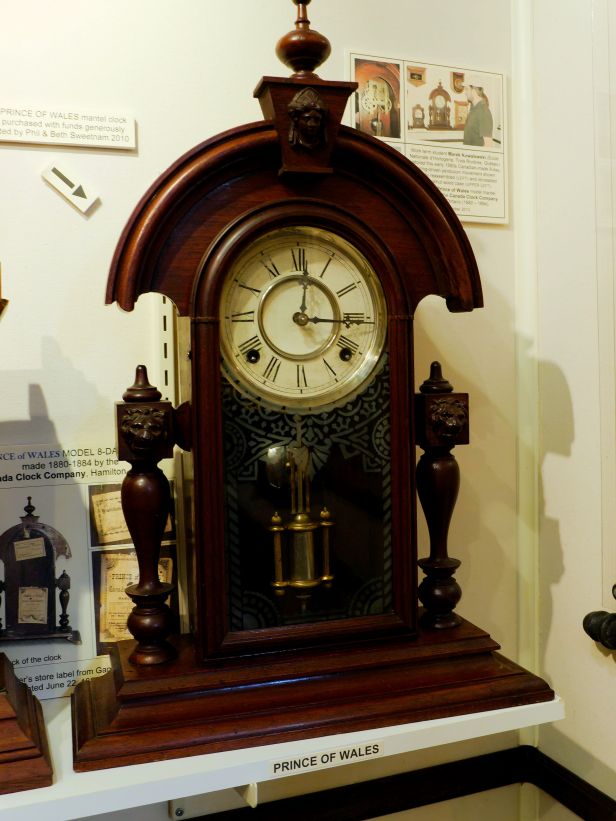
Prince of Wales parlour clock

Back when Canada was a young nation a small clock company known as the Canada Clock Company struggled to make its mark and produced some of the finest Canadian clocks that our country has ever seen. This is model called the Prince of Wales and it is a fitting tribute to this our nations birthday.

A new & exciting direction in clock collecting & repair

I have been collecting clocks for over 8 years. In that time I have enjoyed my hobby immensely and I am constantly on the lookout for new and interesting acquisitions. It is more like a daily passion.

However, I now realize that as my collection steadily grows I have more than I need or want. I cherish some of my clocks and intend to keep them for years; my Arthur Pequegnats, selected Seth Thomas clocks, clocks made by the Hamilton Clock Co. and the Canada Clock Co., my Vienna regulators and some of my German wall clocks. I don’t mind parting with other clocks now or in the foreseeable future. Some I will miss and others I will not.

A house can only hold so many clocks

My daughter correctly pointed out that I should adopt a one clock comes in another goes out approach. “One-in, one-out”, she says and it makes perfect sense.

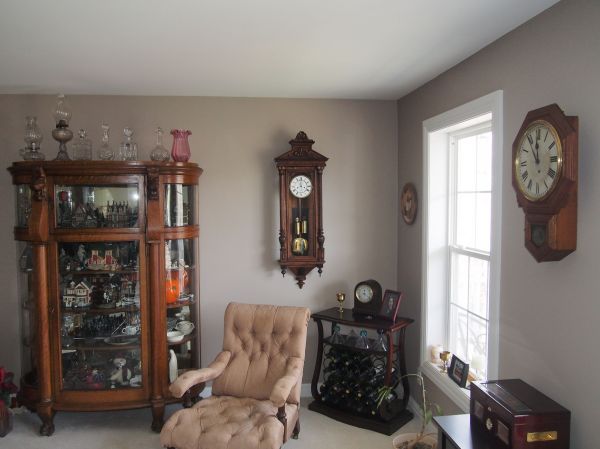
A house can only hold so many clocks. In my small office which is 10X12 I have a total of 15 clocks, 10 of which are running daily and the remainder in various states of repair. Outside my office, at any given time, there are 26 clocks in a number of rooms around the house. I am not one of those persons on YouTube who feel the need to cover their walls with clocks. I prefer to display them in a natural way, as an integral part of the decor of my home. The number is not all that important but I am trying to keep it manageable.

Kienzle clock on display with Ingraham Huron
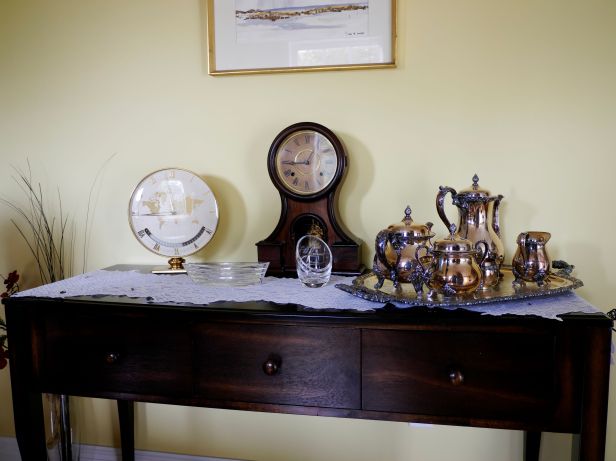
Kienzle World Time clock and Ingraham Huron balloon style shelf clock

I have decided that now is the time to sell some of my clocks. My objective is not to make money but to recover the cost of the original purchase plus my labour on each clock that I sell. These are the clocks that have left my collection recently.

I am making more critical choices when adding pieces to my collection
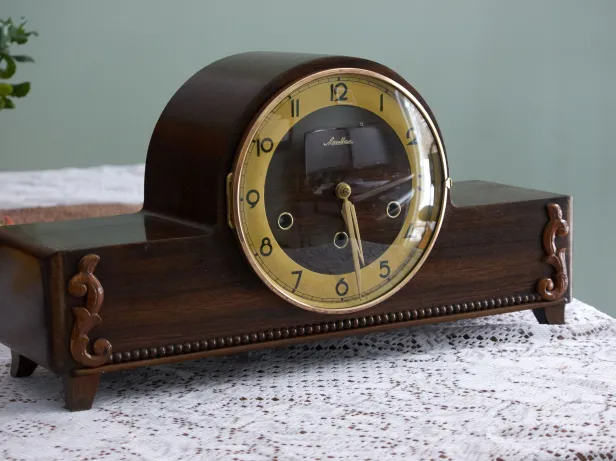
Mauthe Westminster chime mantel clock, circa 1950
Juba Schatz Bim-Bam mantel clock, circa 1948
Four spandrels surrounding the chapter ring
Hermle Westminster chime with moon phase circa 1985

I have also gifted eight clocks over the last 3 years and most have been mantel clocks. Antique and vintage clocks make wonderful gifts to friends and family. It is cool to see them displayed and running in their homes when I visit though I know darn well that they are wound just hours before my arrival.

On a clock forum site recently someone said’ “How many clocks do you need”. The answer, “Just one more”

As my knowledge of the clock world grows and my experience repairing and restoring them expands I am making more critical choices when adding pieces to my collection. However, those critical choices often translate into spending more money. For example, recent acquisitions have been a Seth Thomas Regulator #2 and an Arthur Pequegnat Moncton, both wall clocks.

Seth Thomas Regulator #2, time-only, weight driven clock Circa 1922
Arthur Pequegnat Moncton, double spring time only clock, Circa 1930

I believe my new approach is a natural progression and perhaps I have been subconsciously heading down that path for a year or more. Unless a clock has an interesting provenance, is rare, uncommon, unique and/or is a challenge to restore I will now shy away from most of the garden variety clocks one sees on online for-sale sites and yes, I still have a few of those.

On a clock forum site recently someone said’ “How many clocks do you need”. The answer, “Just one more”.

I knew during the course of collecting antique and vintage clocks combined with increased knowledge/experience that my hobby would evolve and continuing my horological journey in a slightly different way is about time,

The Canada Clock Company (Hamilton Clock Co.) – a brief history

If one were to ask those with a keen interest in Canadian antique clocks, the word Pequegnat would immediately come to mind. Pequegnat produced clocks for close to 40 years and left an indelible mark on Canadian culture.

Predating Arthur Pequegnat is a lesser known clock maker (or clock-makers) that made clocks between 1872 and 1884. The Canada Clock Co, and the Hamilton Clock Co. struggled over a 12 year period to put Canada on the clock-making map. In 1872 the Canada Clock Co. established itself in Whitby, Ontario (Canada) but lasted just 4 years before failing, though largely due to a devastating factory fire.

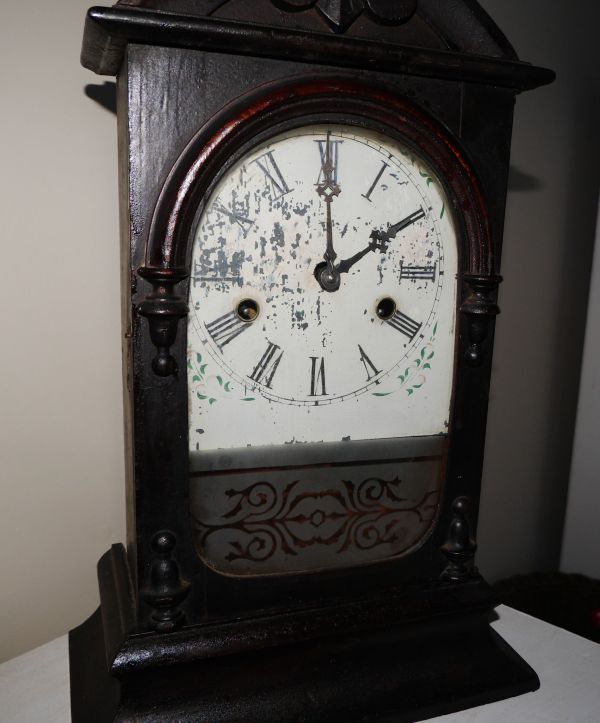
Case is in fair condition, dial face has some flaking
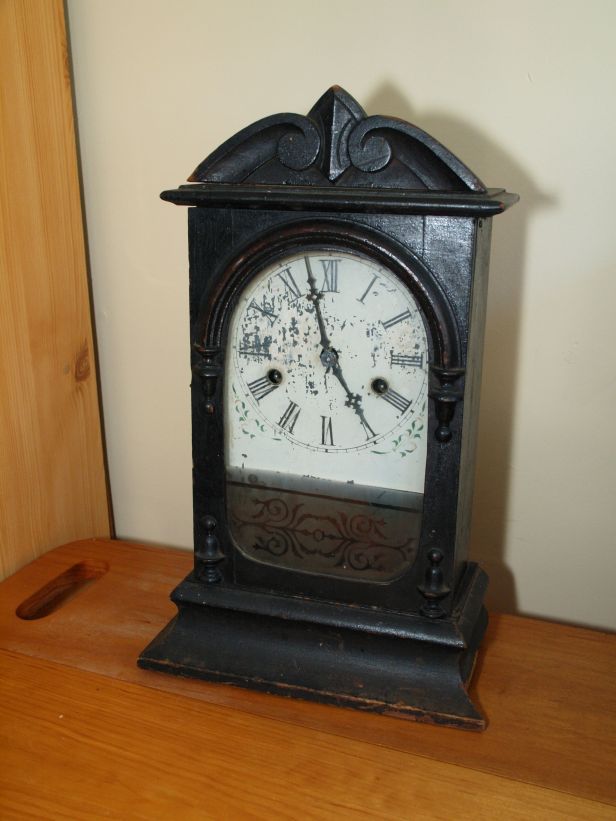
Canada Clock Company cottage clock

Out of the ashes came another attempt in 1876 and key principles including manager John Collins moved to Hamilton and set up the Hamilton Clock Company. After 4 years this new company also failed and production halted in 1880. In late 1880 one more attempt was made to establish a new company called the Canada Clock Company resurrecting the old name. It is still based in Hamilton at the old Hamilton Clock Co. factory. Success was short-lived as the company declared bankruptcy in 1884 ending a dozen years producing clocks for the Canadian market.

Although both movements and cases were made in Canada they were copies American styles

Canada Clock Company, Prince of Wales parlour clock

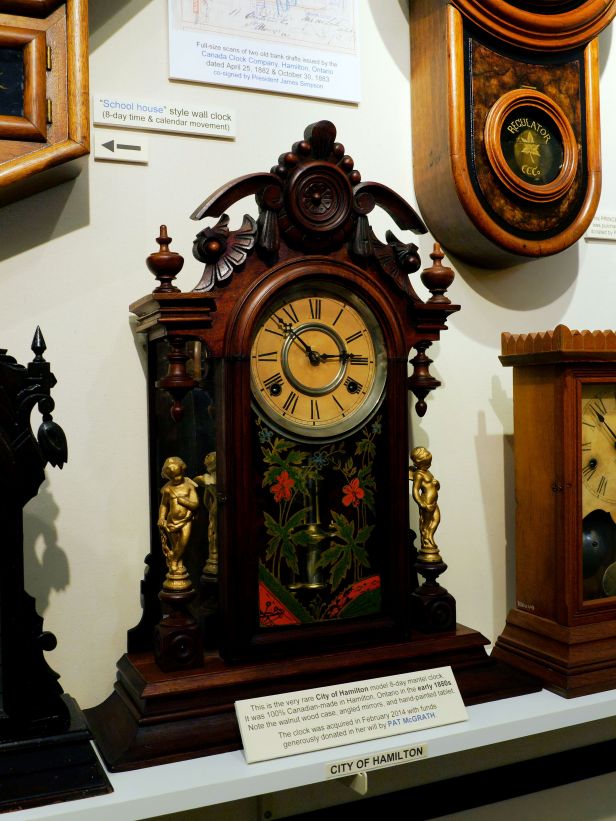
Canada Clock Company, City of Hamilton parlour clock

I have grouped the clocks from the three companies and these are their characteristics. The most common clocks found today are the weight-driven, thirty-hour “Ogee” style, with colourful birds or flowers surrounded by a black background on the glass tablet. At least five different labels are known, four have a beaver on them. The large printed paper label was located inside the case on the lower back. Spring-driven mantel clocks with plain cases were also made with thirty-hour movements. Although both movements and cases were made in Canada they were obvious copies of American styles.

Hamilton Clock Co Gothic steeple clock
Hamilton Clock Co Gothic steeple clock with etched glass tablet

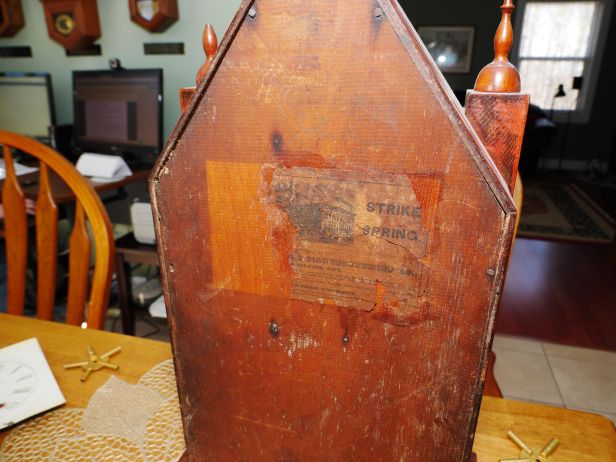
Loss on the clock label
Clock label showing the Hamilton Clock Company factory

Also produced was a spring-driven “school house” wall clock.

At least sixty models of spring-driven mantel clocks are known, with both thirty-hour and eight-day movements.  Most of the door tablets (Canada Clock Co.) have acid etched glass designs, unique to the two Hamilton-based companies and done in association with a local glass factory. Wall clocks are also found with the Canada Clock Company, Hamilton label.

The most desirable clocks are the ornate time and strike parlour clocks such as the City of Hamilton and Prince of Wales pictured above.

Unfortunately, a valiant attempt to grow a home-bred clock company failed miserably. However, the clocks of all three companies are highly sought after by Canadian collectors today.

Taking a summer clock break

The lake
The lake

It is time to take a little break.

As regular readers know I publish between 7 and 9 articles per month. I have been spending considerable time this spring putting ideas together and getting articles ready for the summer months so that there will be NO interruption in activity on this blog.

Since I spend quality time with friends and family and decompress at our summer get-away in central Canada I might be a tad slow getting back to you if you have questions about your clock or comments on any of my posts. I therefore apologize in advance.

Canada Clock Company Hamilton Cottage Extra
Canada Clock Company Hamilton Cottage Extra, circa 1880, an interesting find in a junk shop

On my blog I typically profile my own clock collection, the challenges of maintaining and repairing clocks in my collection plus many articles of general interest. I often write about my personal observations during my travels and I always look for unique and interesting clocks as I navigate through the fascinating world of horology.

I hope you enjoy reading them as much as I enjoy the researching each article. I invite you to browse through my archive; there is always something that will interest clock lovers of all ages.

Over the next two months you will find exciting new articles and some helpful information on various clock issues. No doubt my summer adventures will produce new clock stories that will be the source of future articles. So, stay tuned as they say and if you like what you see let me know.

The Macdonald Museum – if you are a clock fan, or even if you are not, this small museum may surprise you

I have been to Middleton, Nova Scotia many times. I have even passed the Macdonald Consolidated School where the clock museum is located without realizing what treasures lay inside. The clock museum represents a small section of the museum, the remainder of which is dedicated to the history of the area.

In the Spring of 2018 my wife and I set off on one of our many mini staycations. On my agenda was a visit to this museum and I was not disappointed.

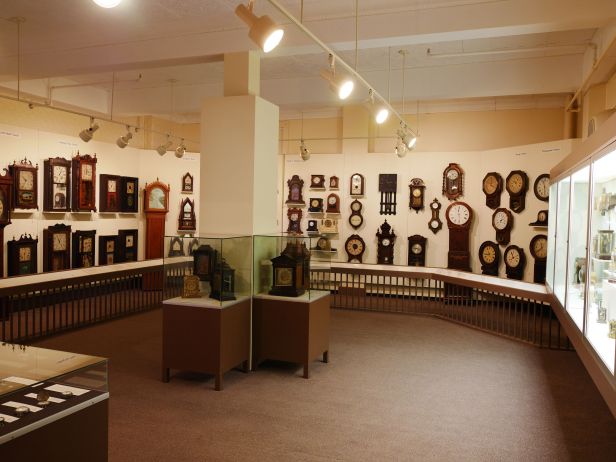
MacDonald Museum main exhibit area
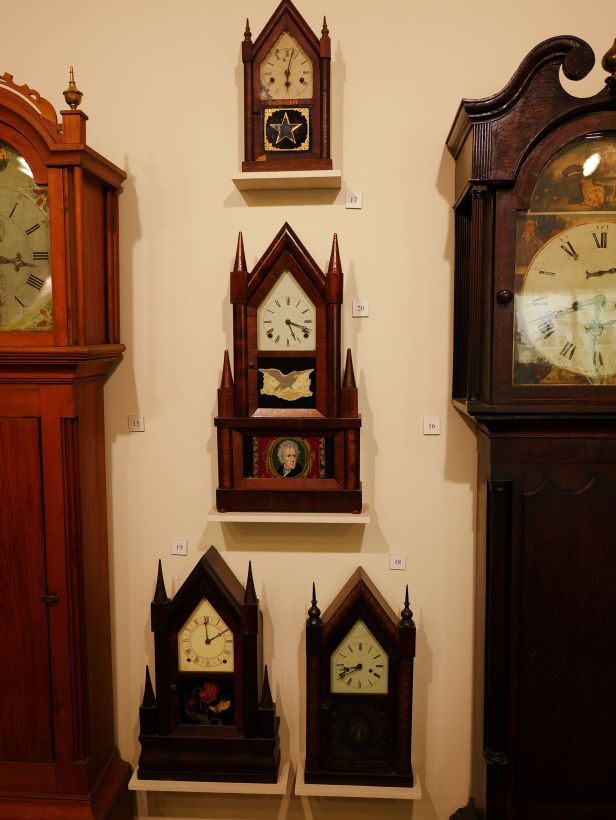
Macdonald Museum main clock exhibit area

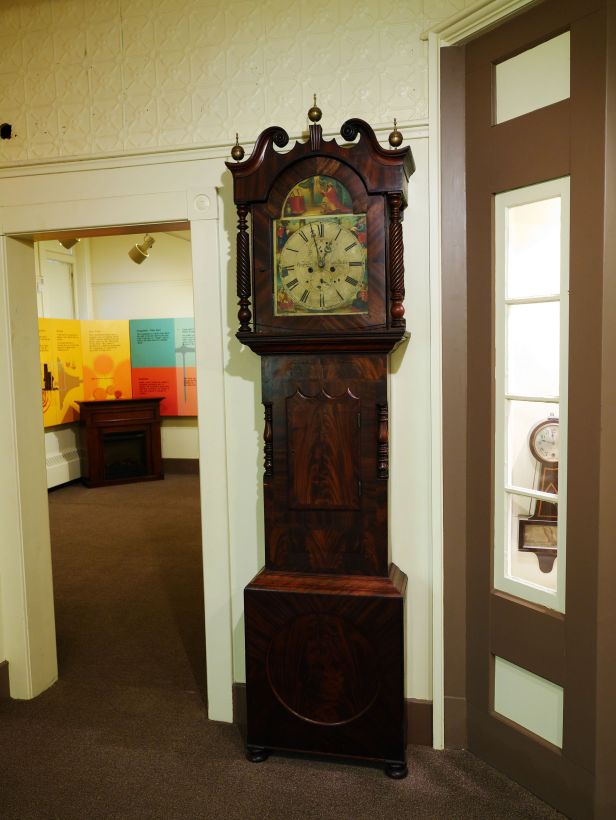
Tallcase clock
Holbeck made tall-case clock

It certainly ranks as the best exhibit in Atlantic Canada

Off highway 1 on School Street, Middleton, Nova Scotia stands the Macdonald museum. I had some expectations because I had been to two well respected clock museums, the NAWCC museum in Columbia PA. and the Canadian Clock Museum in Deep River, Ontario. Though not on the same scale as these two, it certainly ranks as the best exhibit in Atlantic Canada.

According to the web site

The Annapolis Valley Macdonald Museum is home to the Nova Scotia Museum’s collection of over 150 antique clocks and watches. This permanent exhibit showcases items collected by the late Norman Phinney and was one of the primary reasons for establishing the Macdonald Museum. Many of the clocks are in working condition. There are a wide variety of clocks and watches on display, with some dating back to the late 17th century. Anyone interested in clocks would do well to see this exhibit – one of the best in Eastern Canada.

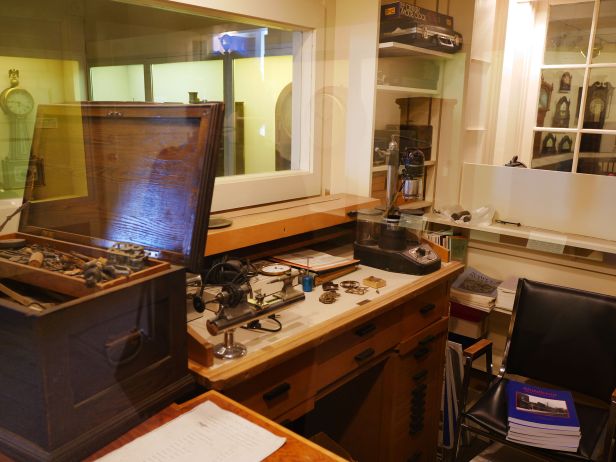
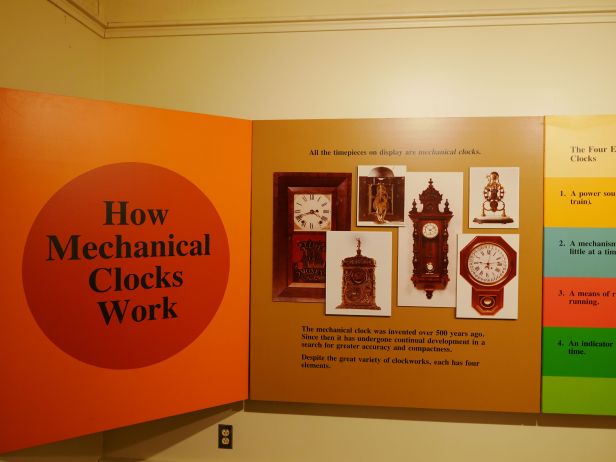
The museum is well laid out with enough information on each of the clocks on display to satisfy the general public and clock enthusiasts alike. Each display highlights its significance as an important development in horological history. We were alone as we walked though the main exhibit area and an adjacent room which contained a fascinating old clock-maker’s shop and a well laid out and informative interactive display on how mechanical clocks work.

Clockmaker's shop
Clock-maker’s shop

How mechanical clocks work

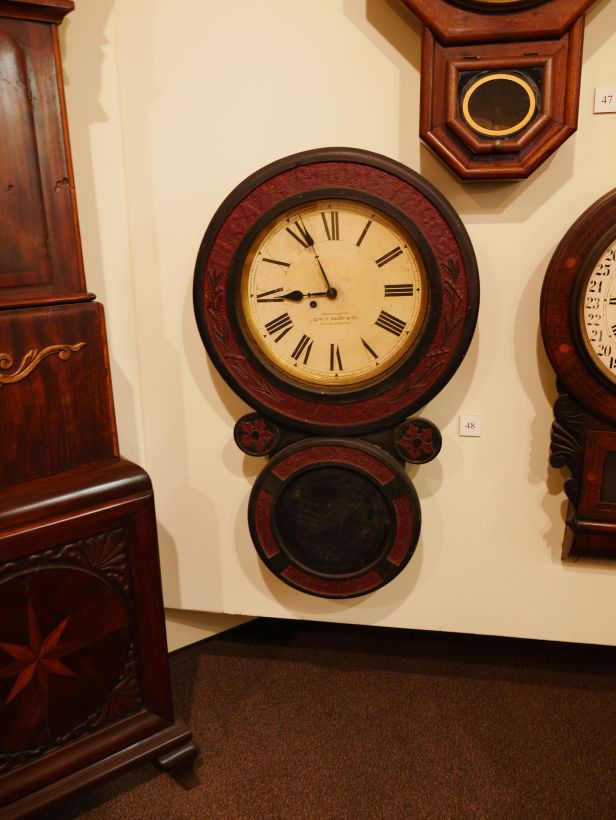
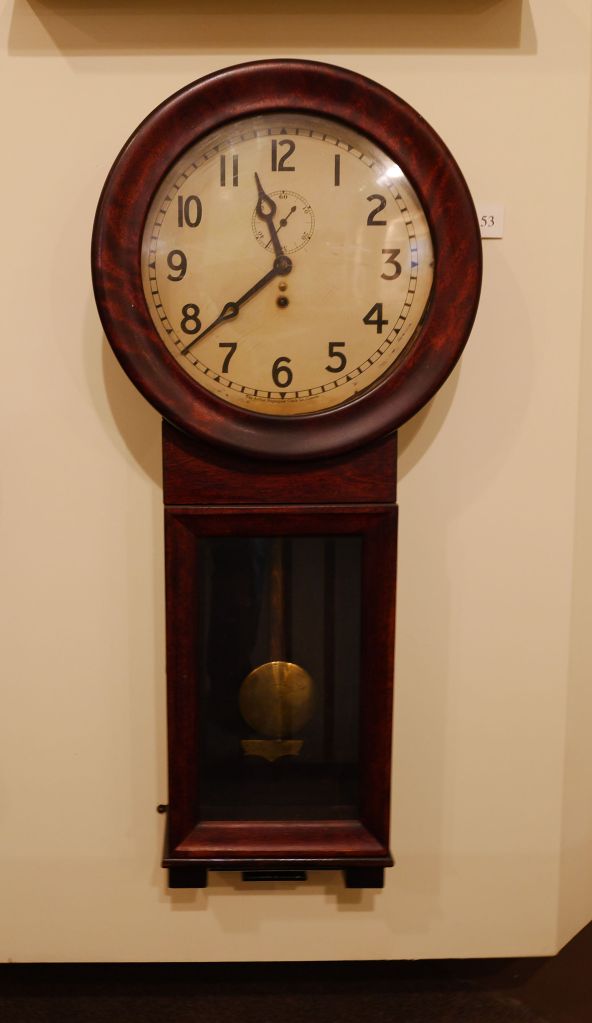
At least one example from the Baird Clock Co. of Montreal and five examples from the Arthur Pequegnat Clock Co. of Berlin (now Kitchener) Ontario were on display including the Arthur Pequegnat Regulator #1, that the company once advertised as “The finest clock made in America”.

Baird clock from Montreal

Arthur Pequegnat Regulator #1

None of the clocks were running, however. Though the clocks appeared to be in excellent condition, the sound of ticking clocks make for a more authentic experience. All other clock museums make a practice of running some clocks on a rotating basis at any given time.

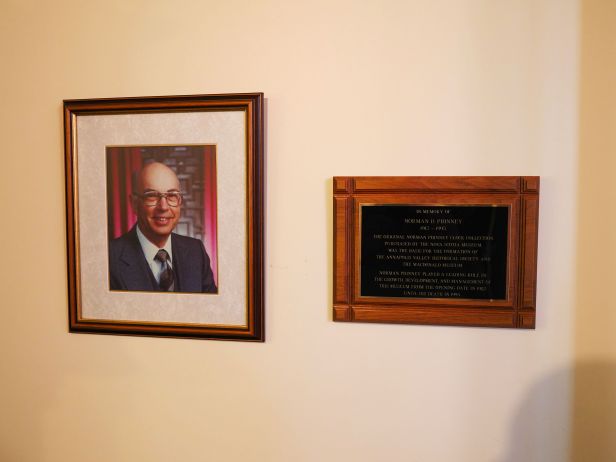
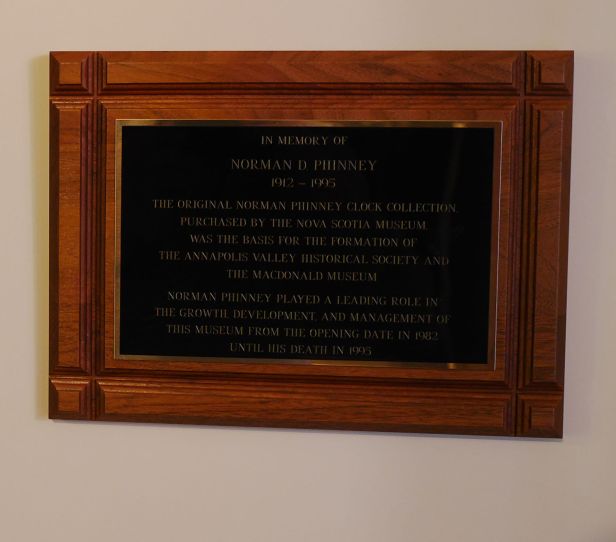
At the entrance to the clock collection there is a simple plaque dedicated to Norman D. Phinney. Learning more about Norman D. Phinney, his contribution to the Macdonald Museum and the story of how the museum received his clock collection would add to the experience.

Norman D Phinney
Norman D Phinney

If you are a clock fan or even if you only have a casual interest in the world of horology, this small clock museum may surprise you

Though perhaps not within the scope of Phinney’s original collection, examples from the Canada Clock Co. and the Hamilton Clock Co. or more peddlers clocks from Nova Scotia and New Brunswick would have provided an enhanced Canadian horological perspective.

Steeple or sharp Gothic clocks

However, these are minor quibbles and should not detract you from appreciating the high quality of the exhibits which contained British, American, French and Canadian examples or the many styles that included Pillar and Scroll, tall-case, shelf, beehive, steeple, drop octagons, mantel, alarm clocks and Ogee clocks, all of which were well represented.

If you are a clock fan or even if you only have a casual interest in the world of horology, this small clock museum may surprise you.

Oh, and while there, visit the rest of this fascinating museum.

Spring forward – fall back

At 2:00am Sunday morning!

If your country uses Daylight Saving Time (DST), you have to change your clocks twice a year.

Set your clocks forward 1 hour in the spring at the start of DST (Daylight Saving Time), and 1 hour back in the fall when DST ends. In North America the word “fall” is used to denote the season, while other English-speaking countries usually call it autumn. “Spring Forward – Fall Back” is therefore a phrase most often heard in the USA and Canada.

Records show that the phrase “spring forward, fall back” has been in use at least as far back as the early 20th century. It is the practice of advancing clocks during summer months so that evening daylight lasts longer, while sacrificing normal sunrise times.

Canada Clock Co. – a cottage clock from the early 1880s

Case is in fair condition, dial face has some flaking
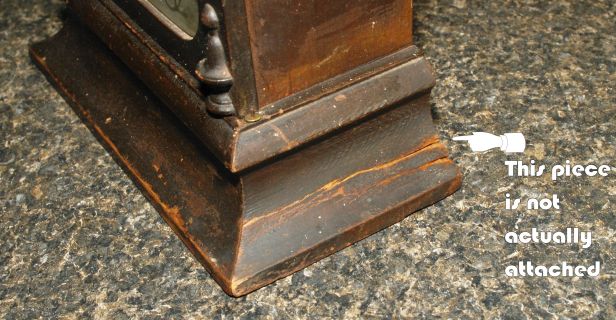
Case is in fair condition, dial face has some flaking, piece broken on left side of base

We have a couple of antique stores in our small town. Calling them antique stores is a bit of a stretch because there is usually more junk inside than actual antiques. We were shopping in the area of one of those “antique” stores and my wife turned to me and said, “Let’s go in”. I replied, “You know, all they have is junk”.

I thought, I might have found something important

I acquiesced. While she continued her shopping I went on ahead to look around the store and in the very back I saw a very sad looking clock that at I took for an old Sessions or a Waterbury.  As I neared the clock it piqued my interest and I began to see that it was quite old. I picked it up, looked for any markings on the dial face, found none then checked the back of the clock and discovered most of an intact label revealing a what I consider to be a significant find.

Back label in good condition for the age of the clock

It is a clock from the Canada Clock Company. The Hamilton Cottage Extra was one of a range of clocks in their Metropolitan line.

This is an important discovery. The owner of the store knew nothing about clocks. He was asking $99 but after a bit of haggling, we settled on $40. I knew that it was worth much more.

Here is an excerpt on the Canada Clock Co. found at the Canadian Clock Museum in Deep River Ontario (Canada).

This company was the last of three sequential attempts to produce clocks by factory methods in Canada during the 1872 – 1884 period.  The original effort by the Canada Clock Company in Whitby, Ontario was basically unsuccessful and only limited production was achieved.
 
In 1876, the equipment was relocated to Hamilton, Ontario to begin a second attempt as the Hamilton Clock Company, with new investors.  This attempt was more successful and a fairly wide range of clocks was produced.  However, sales were not very large and some of the investors left the company by 1879.  At that point the president, James Simpson, ended production and proceeded with a major reorganization.
The company subsequently became the Canada Clock Company using the old Hamilton Clock Company factory and resumed production in 1880 but as a result of poor sales closed its doors in 1884.
For more go to this page at the museum site.
Clocks from the Canada Clock Co.are sought after by collectors. For international readers this represents a rare find because the 1870s to the mid 1880s was a very important period for clock production in Canada. Apart from several independent clock-makers in Quebec and eastern Canada two notable companies made wholly Canadian clocks, The Arthur Pequegnat Clock Co. of Kitchener Ontario made clocks up to 1941 and Martin Cheney of Montreal made finely crafted clocks in the early 1820s. This clock was made at the Hamilton, Ontario factory which produced clocks from 1880 to 1884.

Original time and strike 30 hour movement
Original count wheel time and strike 30 hour movement

The 30-hour time and (bell) strike movement is in remarkably good condition and fairly clean. The back label in good condition for the age of the clock and there is a stamp on the top of the label which says, “…A Hill &Co.”. If any Hamiltonians are reading this I would be grateful if you could make inquires about this small retailer.
My preliminary examination reveals that this clock has had very few repairs over the years. I have not taken the movement out of its case to check bushing/gear wear and other issues but I am initially encouraged. The case reflects the age of the clock but I would judge the clock to be in just fair condition. There is a wooden piece that needs to be re-attached on the right side of the base. Fortunately that piece was tucked inside the clock case.

Right side needs work

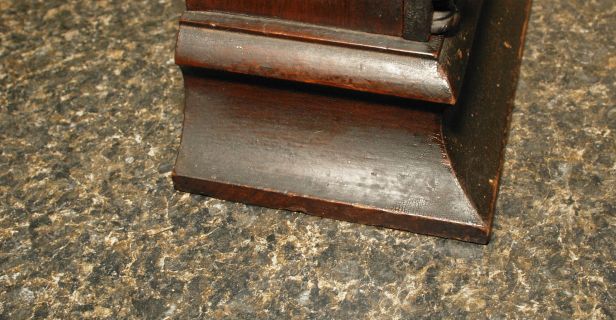
Left side looks good

100+ years of grime came off easily
100+ years of grime came off easily; etched glass on the bottom part of the tablet is distinctive

The crudely made case is not overly decorative and reflects a muted Victorian style of the times. The lower part of the tablet has an etched glass floral design typically found in Canada Clock Company clocks. The door clasp is original. The dial face is flaked in places and not in the best of condition though the 2 floral designs on each bottom corner are nicely preserved. The hands are original. The case is not heavy and made of pine with a deep walnut stained finish. It was grimy and dirty as expected. It cleaned it up nicely with Murphy’s soap and a sharp hobby knife was used to remove the numerous paint drops on the clock. Why folks do not put something over the clock when painting a room amazes me.

I will put the clock aside until I can determine my next steps. Do I pursue a full restoration including renewing the dial face or leave the clock largely in as-found condition? In the meantime I will re-attach the wood piece on the left side of the base.

What would you do?


Website Powered by WordPress.com.

Up ↑