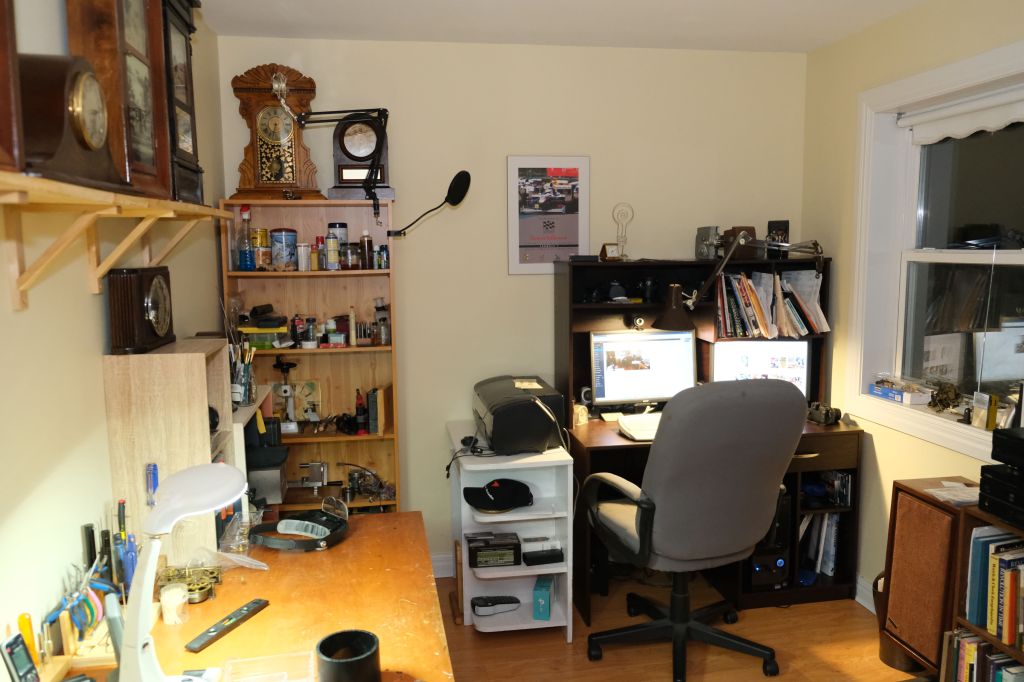
My wife calls it the clock office. It is, after all where I work on my clocks and where some are on display. It is also where I compose articles for this blog.
However, it has been getting very cluttered, and I am tired of how disorganized it looks.
We have 4 bedrooms in our 2-story home and my office is in the smallest one. It is also the one I prefer because of the afternoon sun and it is probably the brightest room in the house with two large windows facing west.
My office November 2018
In 2018 the office was manageable but as anyone who collects things or has a hobby, space runs out very quickly.
December 2022, getting very busy
By December 2022 the office was getting very crowded and it was at that point that I decided a major change was necessary. I was also getting tired of looking for places to put things and losing things amid piles of stuff.
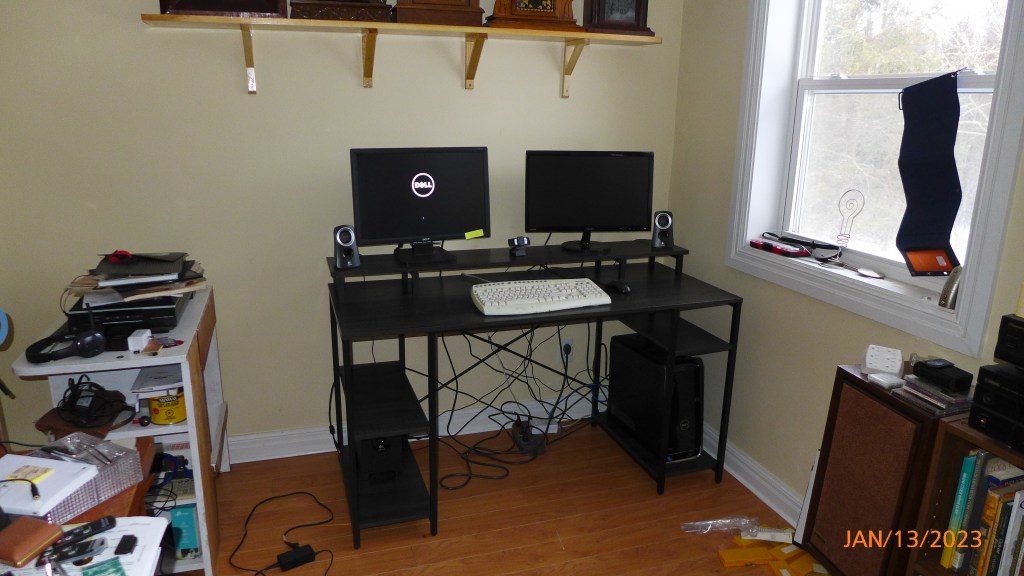
The small desk and hutch had to go. It is a real junk collector but more importantly, the hutch area limits the size of computer monitors I can use and I always work with two monitors. The computer desk and hutch will now go to the curb. The computer desk will remain in the same location, however. A new computer desk with a more open design and a back upper shelf for the monitors is replacing it.
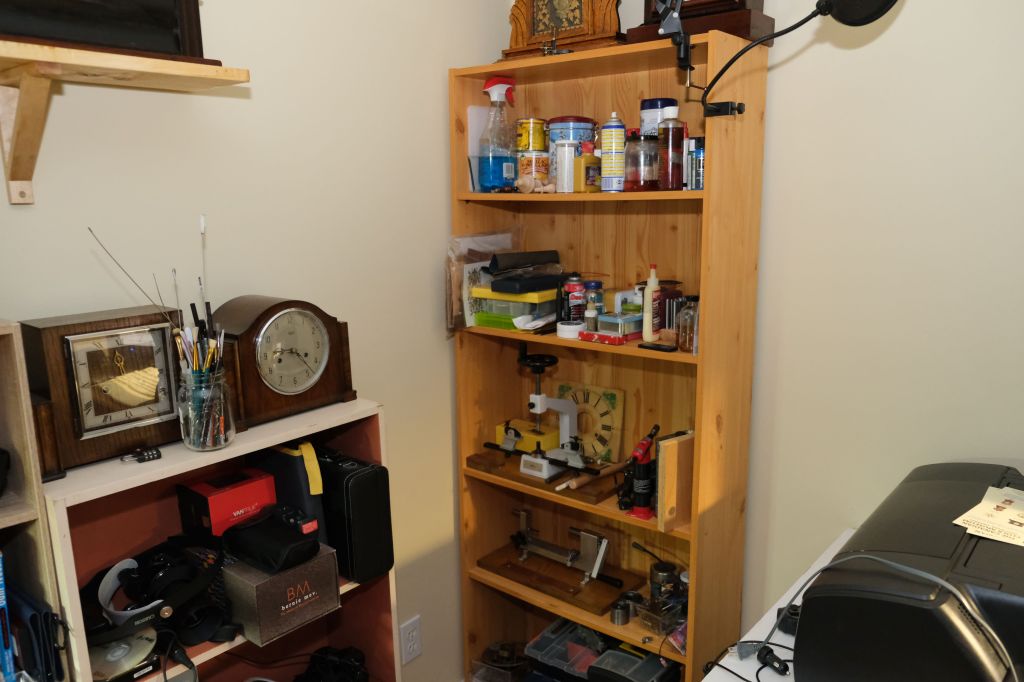
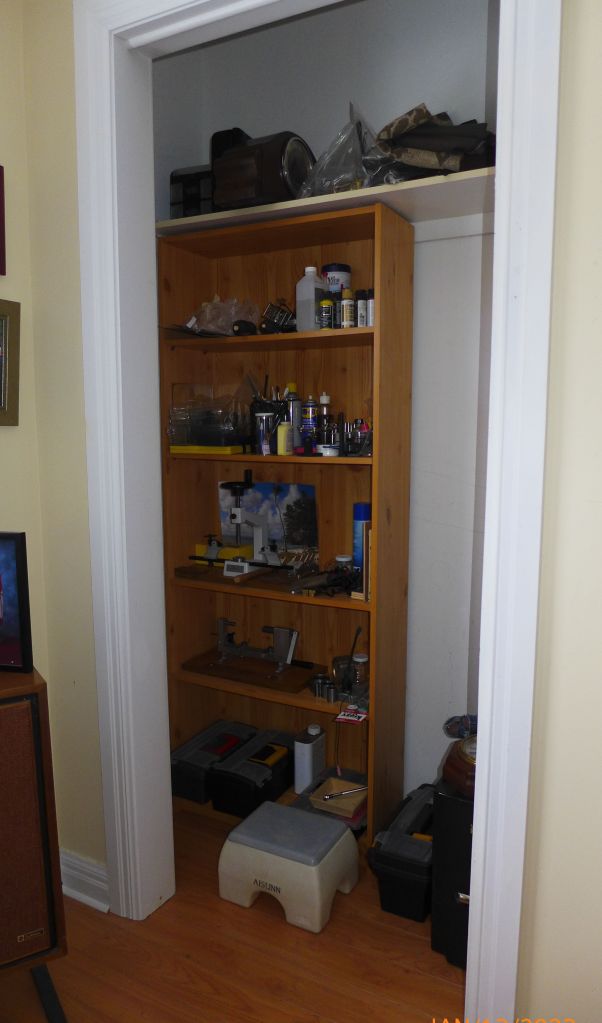
Corner bookcasewith spring winder and Bergeon bushing machine
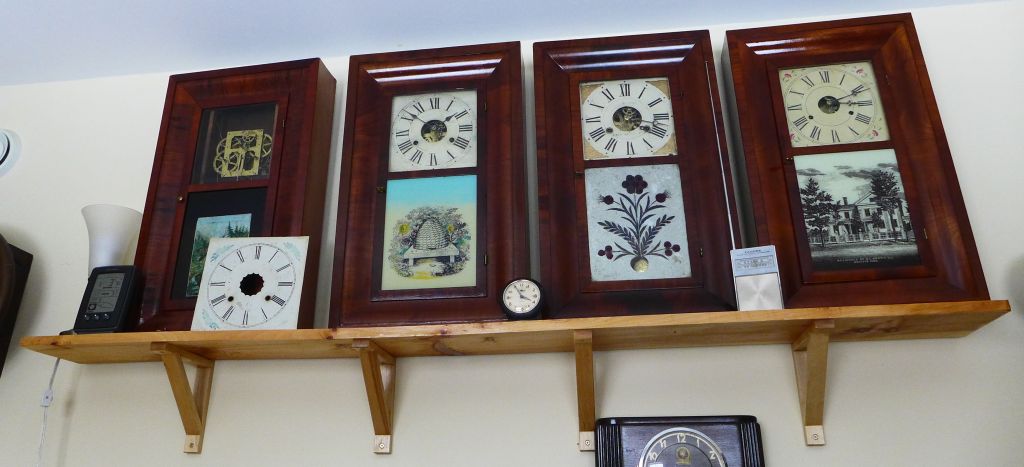
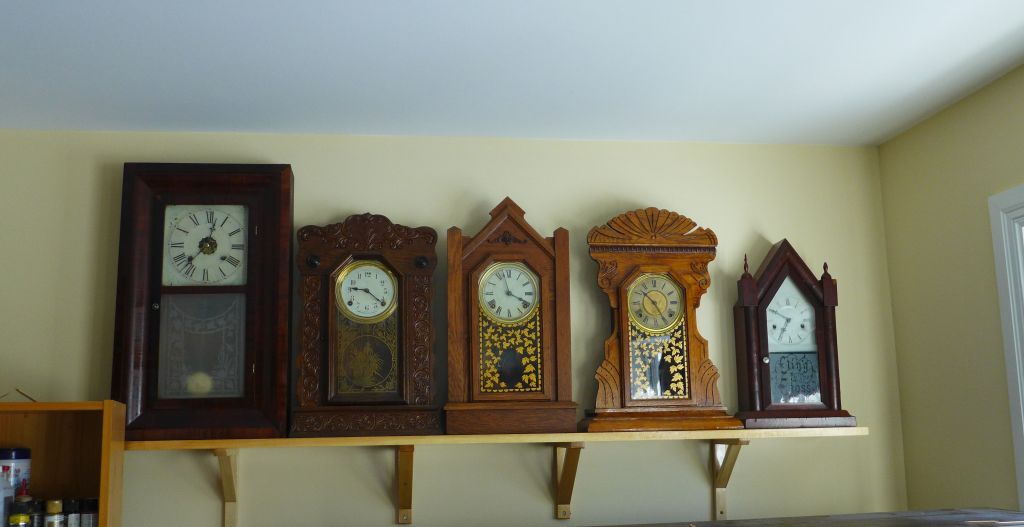
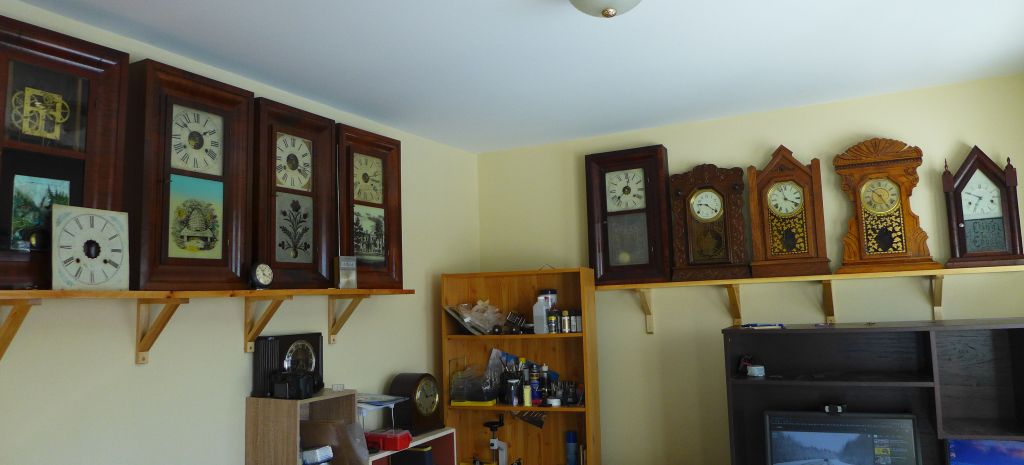
I have been making small changes in the last 4 years but this will be the biggest redo ever. In 2018 I built a shelf for my ogee clocks putting them up on display where they belonged instead of on the floor.
From the left are clocks made by Waterbury, George Clark, and two Chauncey Jeromes
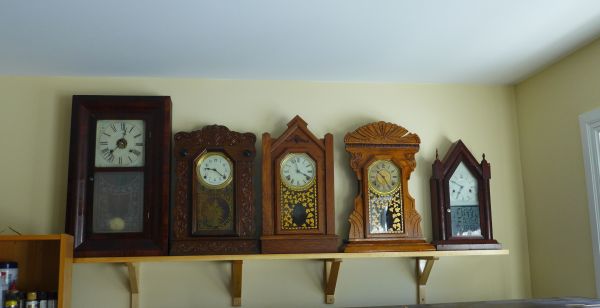
In early January 2023, I added a shelf on the south wall for my Canadian Clocks, the same width, and height.
From the left are clocks made by the Hamilton Clock Co, an Arthur Pequegnat Canuk, two Arthur Pequegant Maple Leafs, and a steeple clock made by the Hamilton Clock Co.Both shelves
The new computer desk may look smaller but it is in fact one foot wider and made with tubular steel and the finest Chinese pressed wood and veneer that money can buy. It also allows for the scanner (not yet placed in the photo) to be located on a lower shelf. The wires in the back are a bit of an eyesore at the moment but a little cable management will fix it.
The bookcase has been moved to a closet that has had the door removed. With the bookcase out of the way, it frees up space for the lathe.
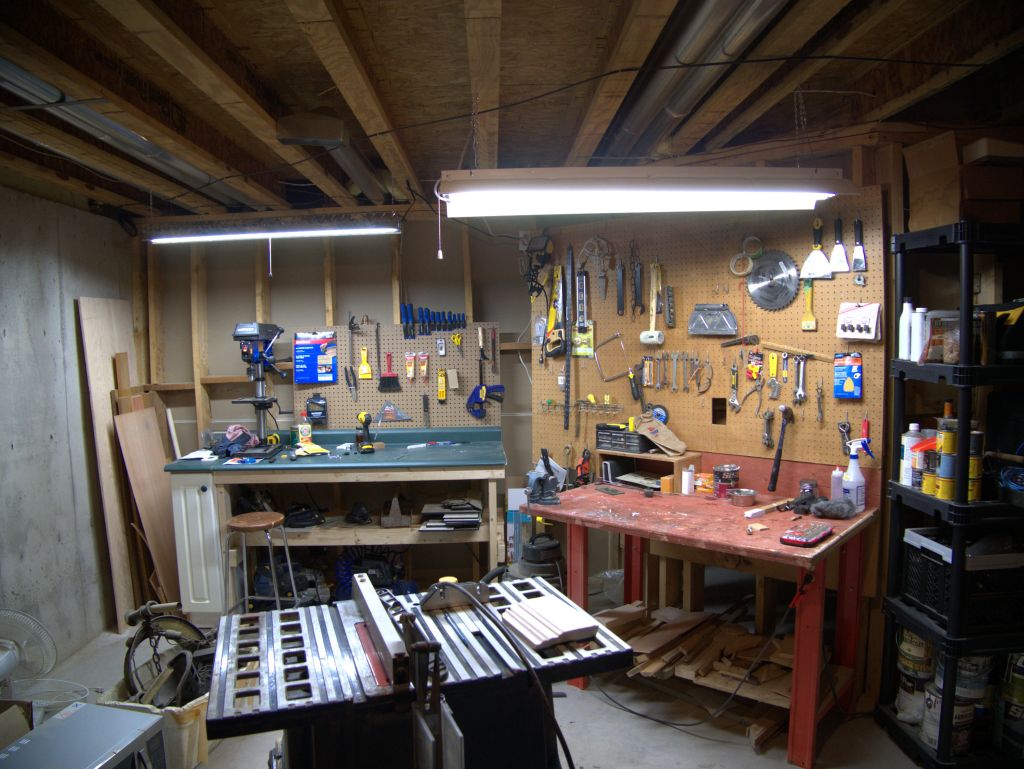
The basement has a work area where clock case repairs, restoration, painting, veneer work, and so on are done. A year ago I moved my Taig metal lathe to the basement but with the reorganization of my office bringing it back up will eliminate frequent trips up and down stairs.
Basement shop
So, that’s it for now. It’s not finished yet, call it a work in progress. When everything is where I want it to be and I am happy with the reconfiguration I will update with a few photos.
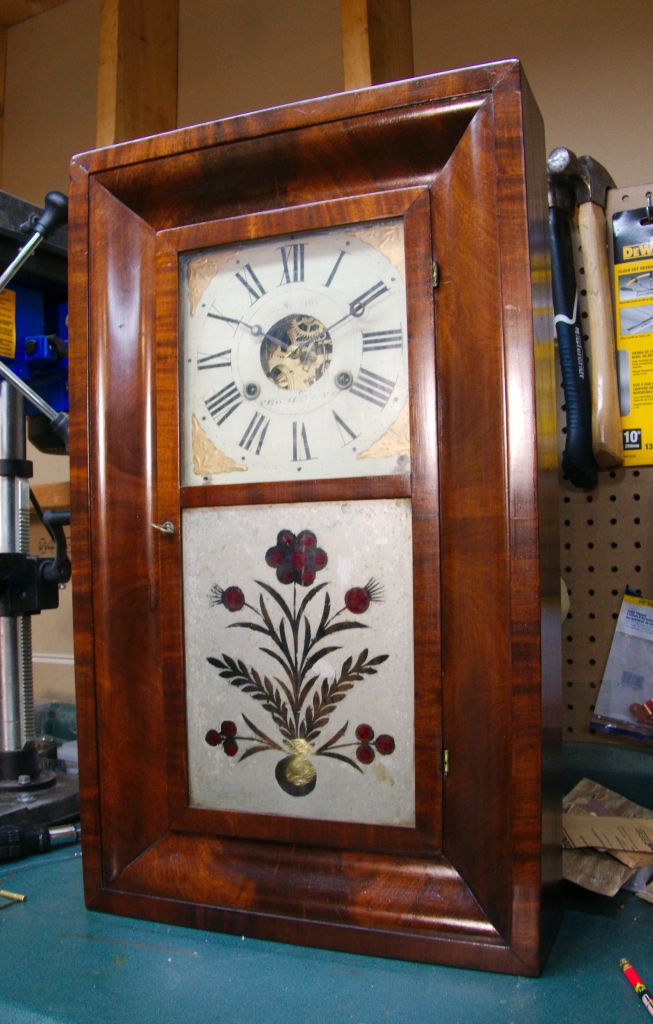
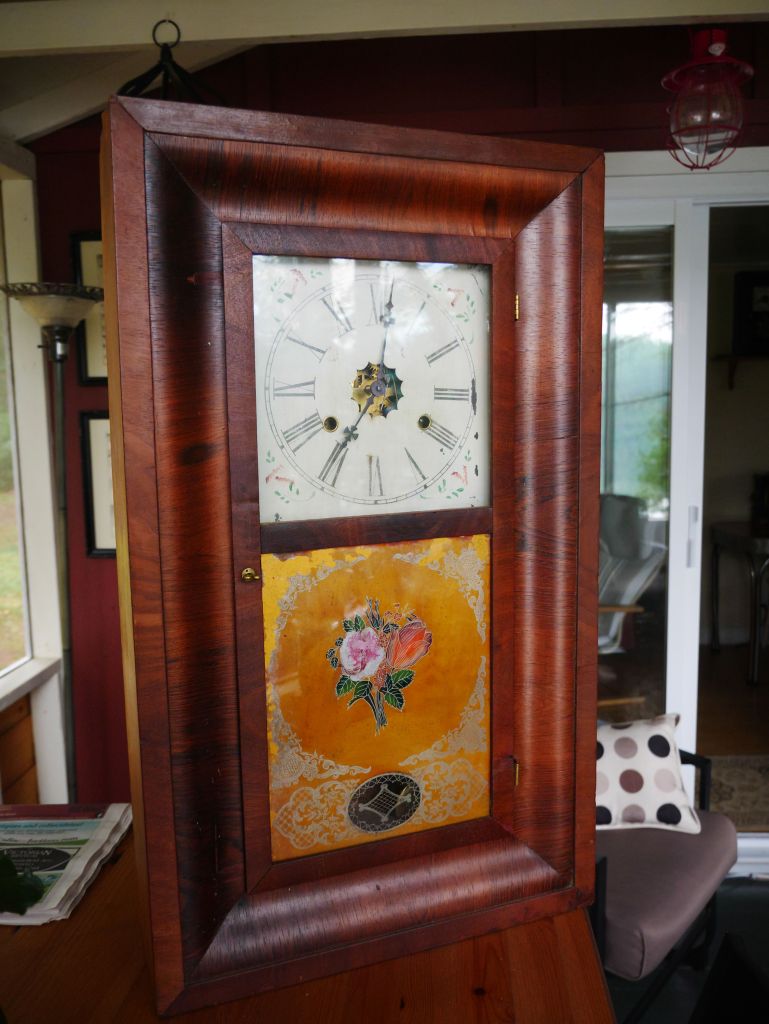
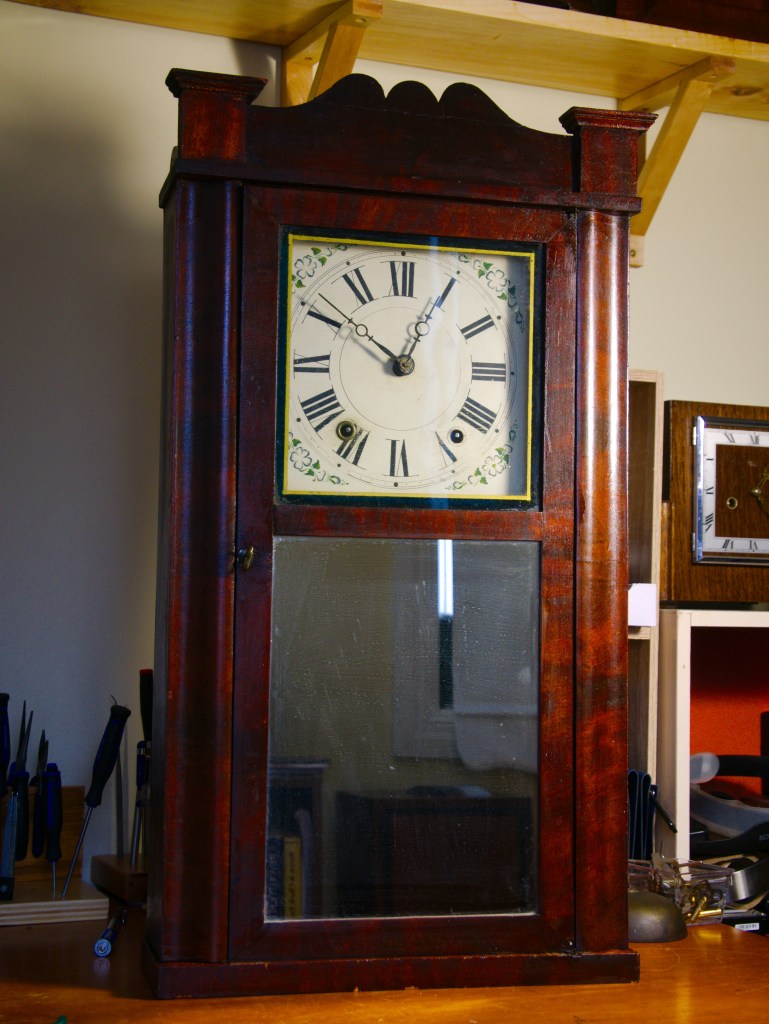
This Chauncey Jerome 30-hour or one-day clock from about 1844-1845 is the example that I am using to illustrate the advantages of using traditional shellac as a finish coat.
The mahogany veneer is in very good condition and it is evident that the clock was not subject to the abuse one would expect of a 180-year-old clock. There is a small dent in the upper left corner but it is hardly noticeable. There are a few scratches here and there consistent with age but all in all the veneer is in great shape.
As found, a dull and lifeless case
First, is cleaning the case. My go-to cleaner for clock cases is Murphy’s Soap. It does a great job of lifting years of grime and dirt from the veneer. The tradeoff is that once you remove the dirt it reveals shellac loss. It was my intention to apply a coat of shellac in the first place so, when I got through layers of dirt and discovered some of the finish gone, I was not too concerned.
Since there are no veneer repairs, refreshing the case was pretty easy. I am not a big believer in maintaining the patina of a clock. if pt is dirty it needs to be cleaned!
I use traditional shellac consisting of flakes mixed with shellac lacquer. I use a wide artist’s brush to apply the shellac and it always produces a superior finish.
One coat of amber shellac
I have decided to leave the lower tablet as-is and as for the dial, I haven’t yet decided on whether or not to address the faded chapter ring though I am also leaning towards leaving it as-is.
The movement has been serviced, the clock is running and striking as it should and I think it looks great after the case refresh.
I was not really looking for an ogee clock to add to my collection. But there it was sitting in a lonely corner of an antique shop calling me, “buy me”; and I did.
It is probably the oldest one in my collection of 4 other ogee clocks. It was made in or about 1845. Now, being old does not necessarily make it valuable. In fact, millions of these clocks were produced and many found their way to online auction sites in recent years contributing to a huge drop in value. You can find them online for a little more than I paid for mine but they are pretty cheap nonetheless. This one was $54.
As found
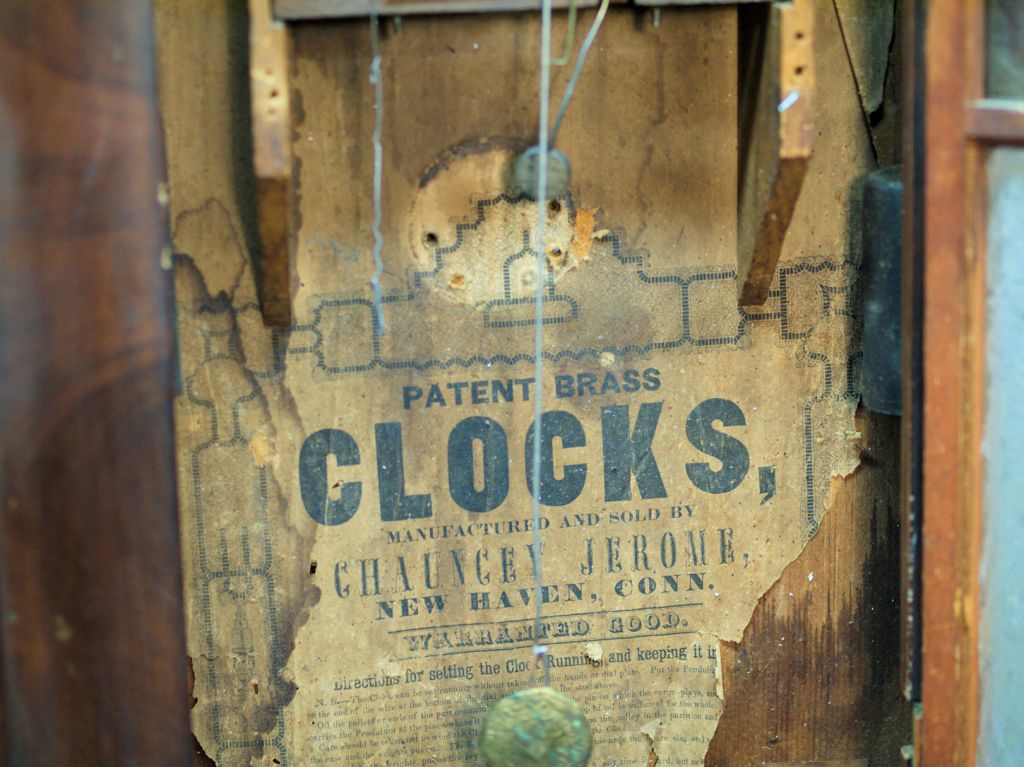
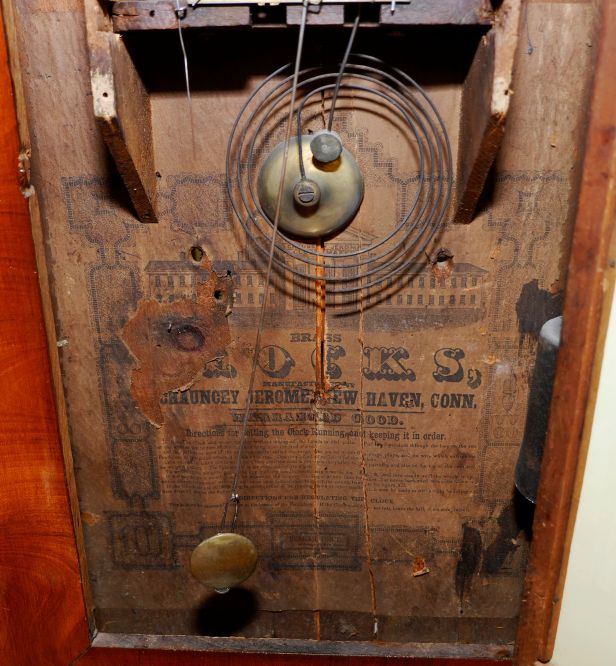
The case label located on the backboard inside the clock case was printed by John Benham in 1845. Comparing the movement in this case with one found on a popular Jerome database site tells me that it is a type 1.311 Jerome movement. Jerome movements were typically marked though some, like this one, were unmarked which is not unusual.
So, the case and the movement are near enough in time to tell me that the movement is very likely original to the case. That is always a good sign as many ogee cases had worn movements replaced over the years. In some cases, there was little intertest in matching the maker of the case to the movement especially if a customer’s only wish is to have a working clock and since the movements were interchangeable it made it that much easier. Many of these clocks are over 180 years old and one can expect some subtle and not-so-subtle changes over the years.
While very attractive and running well this clock (below), a “marriage”, is an EN Welch case with a Waterbury movement. When considering the purchase of an ogee clock, if it is important to you, check that the movement and case are from the same maker though that is not an absolute guarantee they started their lives together.
EN Welch and Waterbury marriage
What is original and what has been replaced?
Typically parts that have been lost/damaged or replaced over the years include the verge, suspension spring/leader, the pendulum bob, the weights, the hands, and case parts like pulley dust caps. In some cases, the lower tablets have been removed altogether because of breakage or severe paint loss, replaced by a clear glass panel, a mirror, a photograph, or a picture (often from a discarded calendar).
The leader and suspension spring are missing. The verge appears to be a replacement, the weights look original as do the hands and pendulum bob. There is a missing top movement block that secures the movement to the backboard and that is about it.
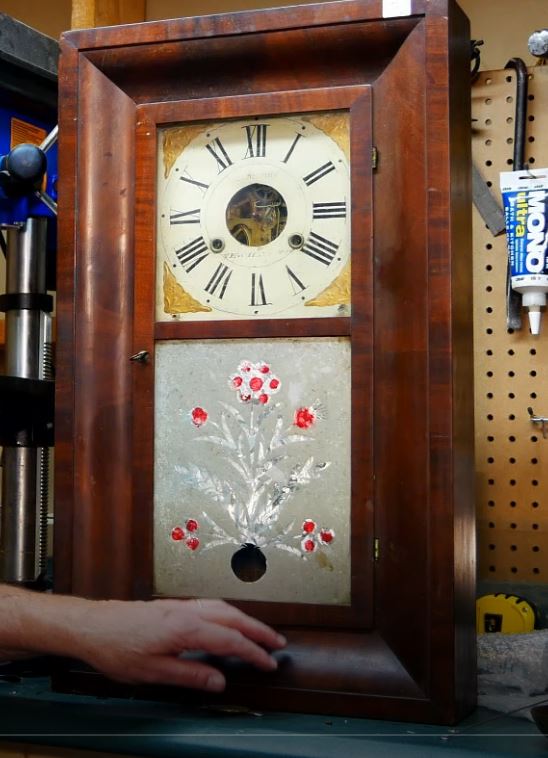
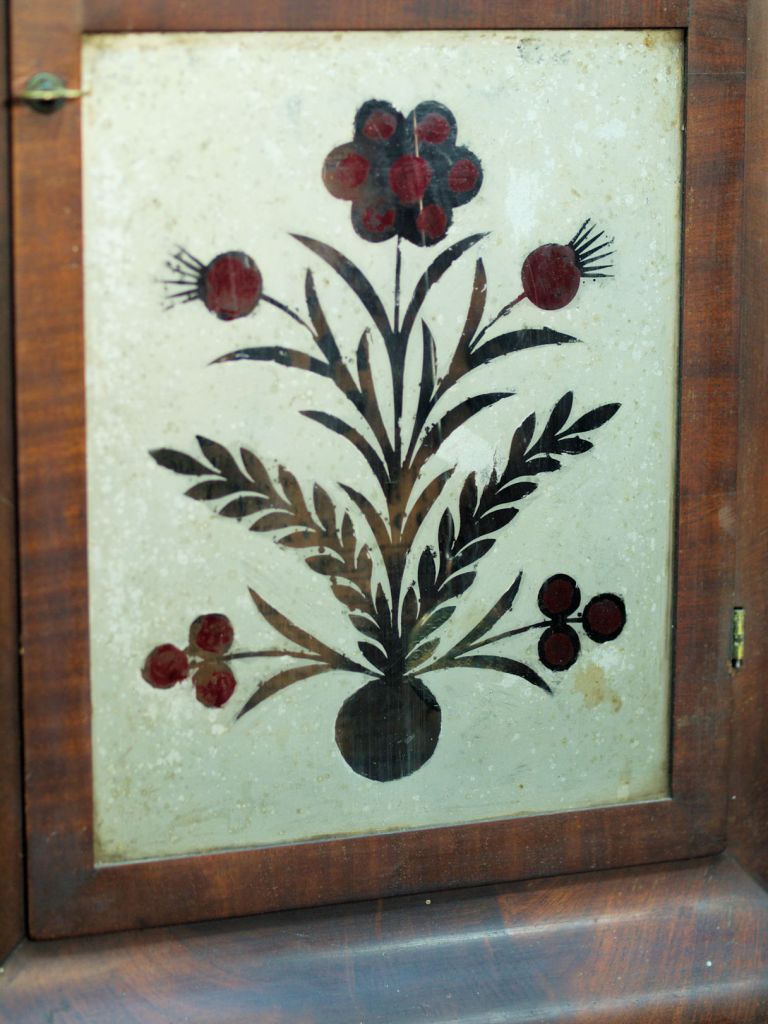
I am reserving judgment on the frosted glass tablet; it may or may not be original. It would be pretty exciting if it were a Fenn design but I doubt it. William Fenn was one of the more prolific tablet-makers of the mid-19th century. The dabs of red paint are certainly added later.
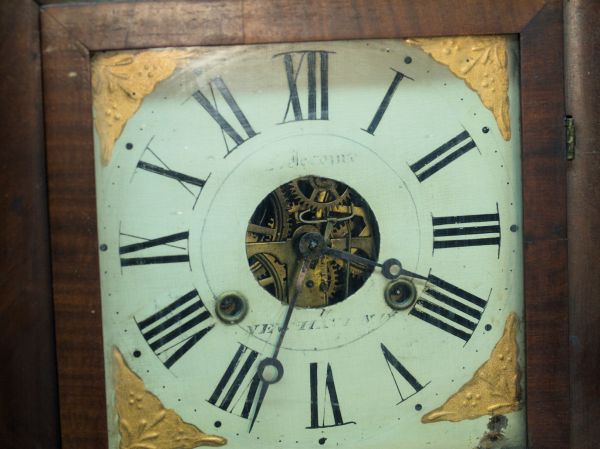
The clock dial, likely original, is signed C. Jerome below the twelve o’clock.
Assessment of the movement
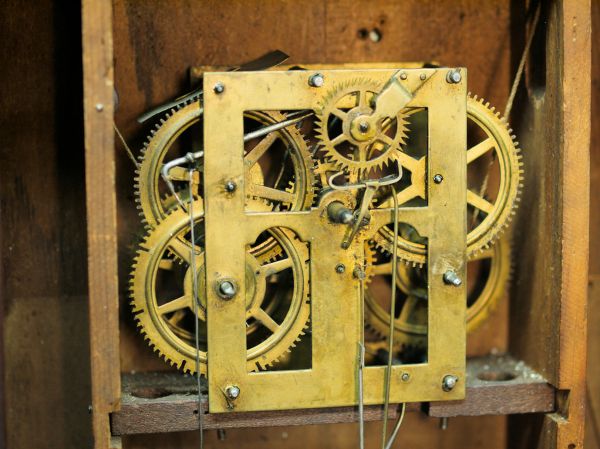
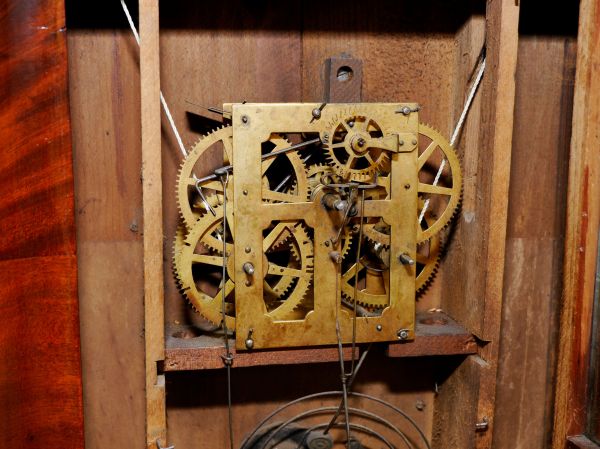
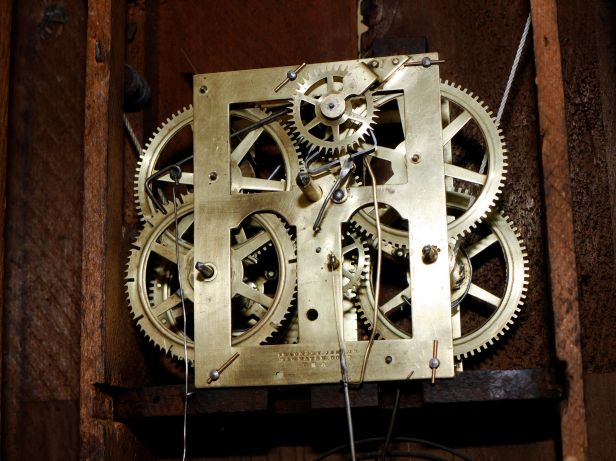
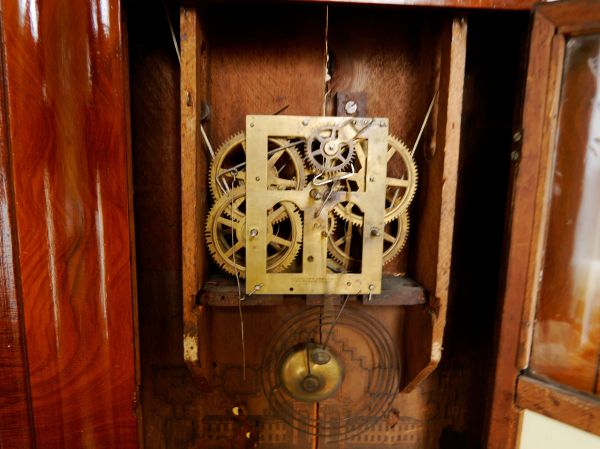
This is a typical 30-hour or one-day time and strike movement.
I found some wear and I was expecting some past repairs. There is a repair date of 1863 on the inside of the access door but I can’t make out what was done at that time.
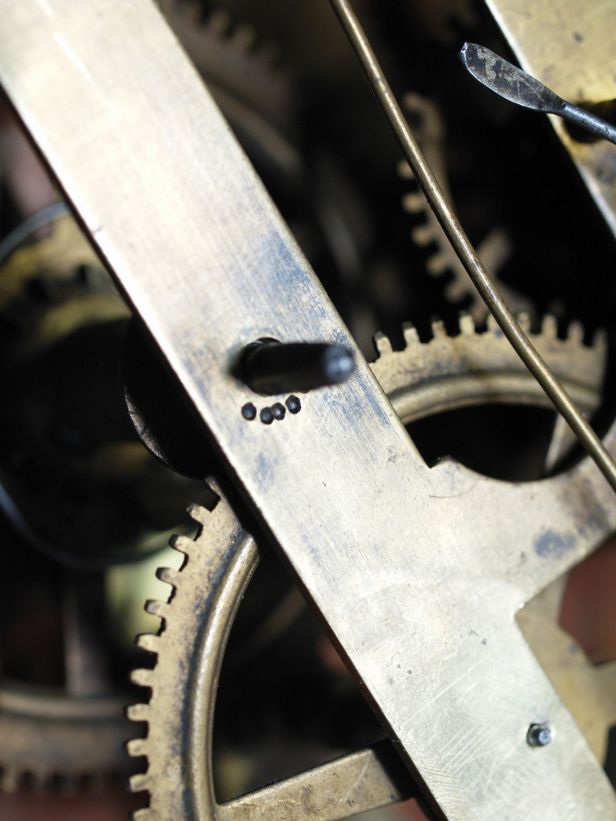
There are two bushings installed on the front plate, the second wheel, and the hour gear. On the back, there are four replacement bushings, evidence that it has had acceptable servicing. One seldom finds replacement bushings on an ogee clock. Most movements I have come across have punch marks around the bushing holes, a common practice by past clock repairers to close elongated holes.
Type 1.311 Jerome movement
Three of the replacement bushings will have to be redone and new bushings are required for the back-plate time side main wheel and the strike side back-plate main wheel for a total of five.
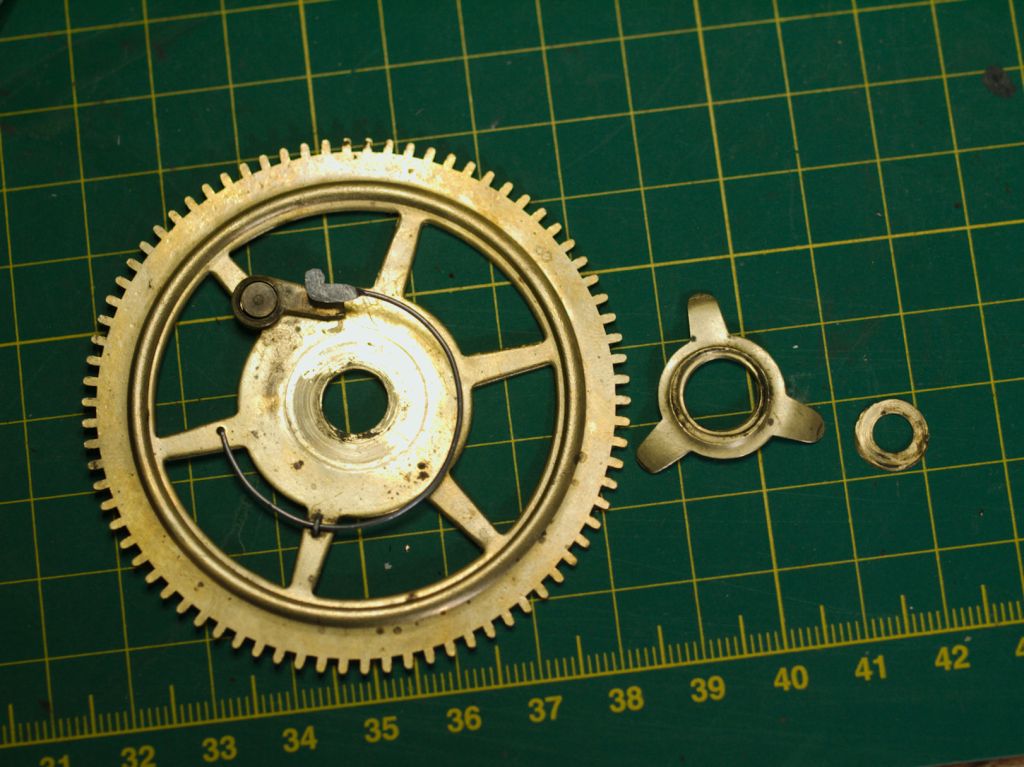
The pressure washer for the time side main wheel is completely worn out. Had I not separated the wheel and ratchet for cleaning I would not have discovered the problem but it tells me that it could fail at some future point.
To the right is the pressure washer with centre worn through
I have a donor New Haven 30-hour movement that will provide the replacement washer.
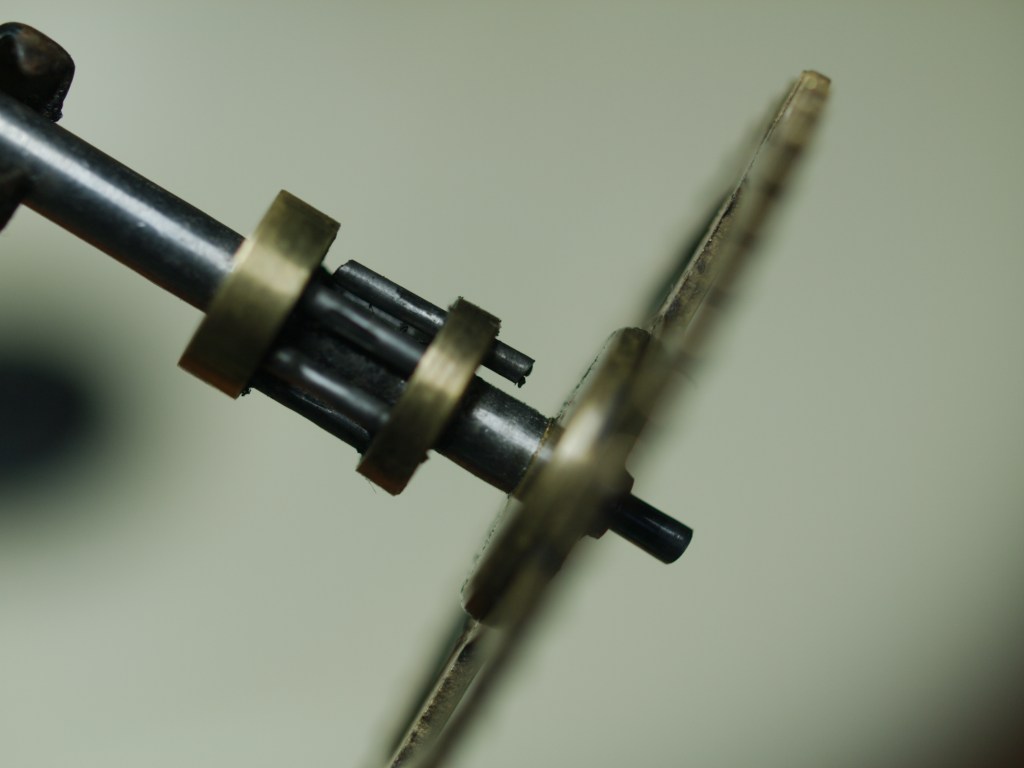
The lantern pinions have some wear but are quite acceptable. One trundle is loose on the escape wheel. Rather than take it apart and re-seat the troublesome trundle, a dab of Loctite Red should fix it in place.
These are two unusual issues but not insurmountable.
A lantern pinion with a loose trundle
Because the movement was so oily and dirty I pre-cleaned the parts prior to putting them in my ultrasonic. This helps extend the life of the solution. I used a medium bristle nylon brush to clean the stubborn areas.
After cleaning and drying the parts, the pivots are polished and I was pleased to find almost no wear on any of them.
Next is the bushing work. My only concern was pushing out what remained of the bushing material in the replacement bushings after drilling. I went slowly and did not apply pressure on the cutter, letting it do its work. As I suspected the Bergeon bushings are marginally smaller but each bushing fit snugly. Although I planned on five bushings, I installed six, adding a bushing for the second wheel on the time side front plate which was a little more worn than I thought. I left the escape wheel as-is, the wear is acceptable.
Next is restringing the weights, re-assembly, and testing. All went as expected.
I have worked on a few of these movements over the years but unique issues always seem to come up. Nonetheless, they are fun to work on.
Following the movement servicing, I will move on to refreshing the case.
An ogee clock is so-called because it is a 19th century U.S. shelf clock with a distinctive S-curve (convex above and concave below) molding.
30-hour ogee clocks were very popular from the early 1840s to as late as the 1890s, a good run for a distinctive style of clock. Before the days of the Internet, these clocks fetched hundreds of dollars at auctions houses and antique stores. Along came eBay and prospective buyers quickly learned that large numbers of these clocks were produced in their day and the supply of clocks flooded the net and prices dropped accordingly. I have 5 ogee clocks among my collection of over 100 clocks and have never paid more than $60 for any of them.
Of course, there are exceptions to the rule. The distinctive case has housed movements other than the 30-hour time and strike commonly found and some are quite desirable. Fusee, single weight 8-day time-only, calendar models, minis, Gesso fronts, 8-day time and strike clocks, and a few unusual ones have good value.
As found
30-hour clocks are worth collecting and if you a new to clock repair, they are a great clock to begin your journey.
This is a Chauncey Jerome 30-hour or one-day clock from about 1844-1845 and based on my research, the movement is from the same period. So, an excellent chance that the case and movement started life together. The pendulum bob looks very old and hard to say if original as pendulums often go missing during a clock’s life. But I’m not sure a modern pendulum bob would have similar detail.
Original (?) bob cleaned with Brasso
The dial is in good condition with attractive Gesso spandrels although the Jerome name under the twelve is barely readable and the chapter ring has faded. The moon hands also look original and the clock came with the correct weights. The mahogany veneer, while very dirty is almost flawless.
The name Jerome is just readable
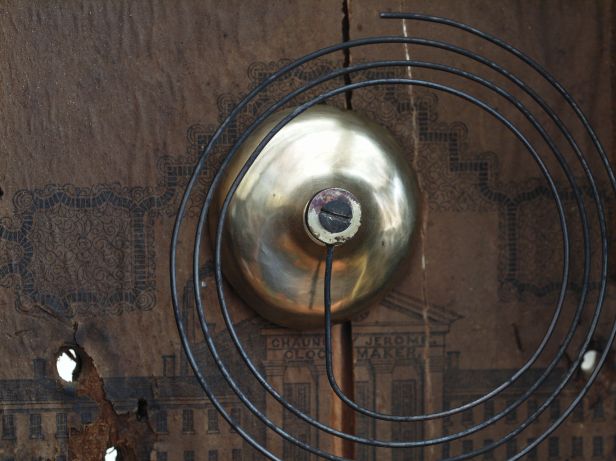
Not original is the strike bell as the clock would have had a coil gong. The suspension spring and leader are missing. A top wooden block that attaches the movement to the case is also missing and the label, printed by John Benham, though readable, has some losses. The suspension spring and leader can be easily sourced, the block fashioned from old stock and I have a spare Jerome style coiled gong in my parts bin.
30-hour unmarked Jerome movement
The tablet design did not look original at first glance but after removing a piece of cardboard (first photo) and Christmas wrapping paper behind the glass I discovered a frosted tablet with thistles and flowers. The red paint might have been added and it is very possible that it was not painted originally.
Original tablet?
The plan is to service the movement, source missing parts, and refresh the case.
I am not a strong believer in maintaining the original patina which one reader opined is just another word for dirt. The case will be cleaned with Murphy’s Soap and a coat of shellac will be applied.
Original materials and techniques will be used when working on the case. This includes the use of traditional shellac (flakes mixed with shellac lacquer), and fasteners like old slot head screws, old wood, and square nails. The replacement coil gong is very similar to other Jeromes I have seen and will come out of a donor ogee case. There are a few stray pieces of label at the bottom of the case that will be glued back in place.
John Benham label is in rough shape
There is not a lot of demand for ogee clocks today as reflected in their asking price. Perhaps the 30-hour ones are considered a hassle for some as they must be wound once per day, nevertheless, I find them very appealing.
Coming soon will be an article on servicing the movement and later on, refreshing the case.
While I have over 85 clocks in my collection twelve are 30-hour or one-day clocks. One of the twelve is a relatively modern clock.
The history of mass-produced clocks in America began in the 1820s and 1830s with 30-hour clocks that had woodworks movements. While the clock business was booming with many companies selling clocks to the masses, an economic recession in the late 1830s brought clock production to a halt.
Pioneer clockmaker Chauncey Jerome, who was in the clock business at the time, considered his “business troubles and disappointments” and he along with his brother Noble formulated the idea that movements could be made from brass. Noble Jerome received patent number 1200 for his brass clock movement, issued June 27, 1839. Woodworks movements began to be phased out and replaced by brass movements which were made in the hundreds of thousands. 30-hour brass movements were made well into the 1860s and were eventually replaced by the 8-day brass movement.
Because 30-hour clocks were produced in the thousands many examples have survived to this day. Most clock aficionados today have at least one ogee clock in their collection.
Of the 12 in my collection 5 are running continuously. Yes, winding a clock everyday is a hassle but we often forget that at one time the thirty hour clock in the form of the bedside alarm clock was a fixture in every home but for this post I am excluding the dozen alarm clocks in my collection.
Half are weight driven, so let’s begin with those.
Sperry and Shaw
Sperry & Shaw 4 column clock
This, a four-column shelf clock designed in the “New York” style was made between 1841 and 1851. Sperry and Shaw were assemblers and distributors and sourced parts from various producers. The movements and cases could have been made by Silas Hoadley or Chauncey Jerome or both.
I bought the clock from student in Halifax, Nova Scotia in the fall of 2018 and he would not budge on the price. My only question to him prior to making the deal was whether or not the clock had the original wafer weights which would be almost impossible to source if missing.
Daniel Pratt and Son
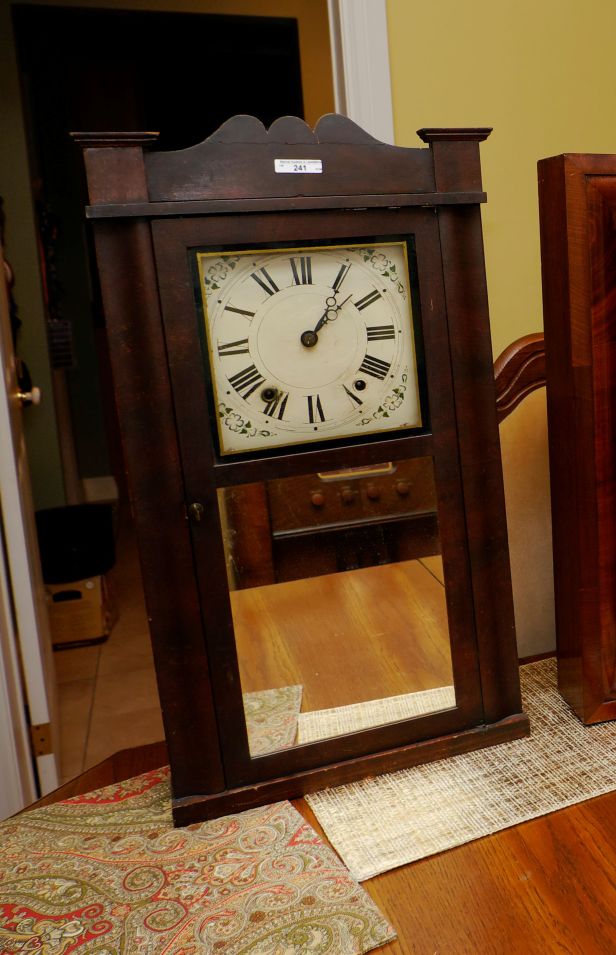
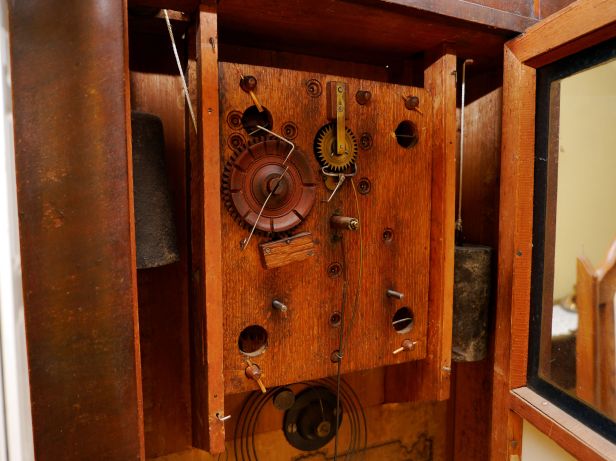
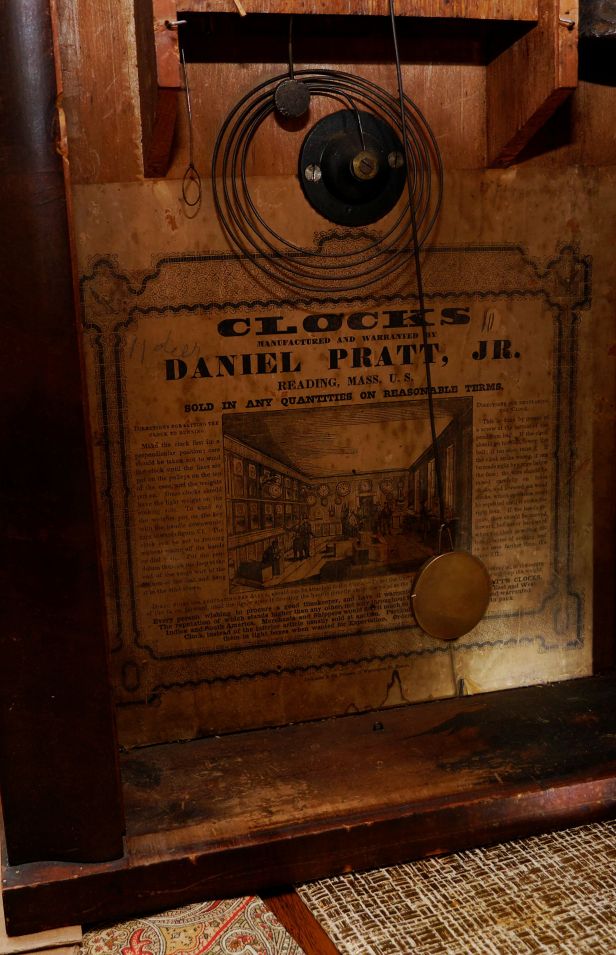
This is the only clock I have with a woodworks movement. Daniel Pratt worked with others but eventually went out on this own in the 1830s. I would date this clock to around 1837. This clock was won at an estate auction for the price of $30 during a time when clock prices were hitting rock bottom. The clock has a wood dial and a mirrored lower tablet (may or may not be original) and the case is in very good condition for its age.
Daniel Pratt and Sons
Chauncey Jerome
Chauncey Jerome 30 hour Ogee clock
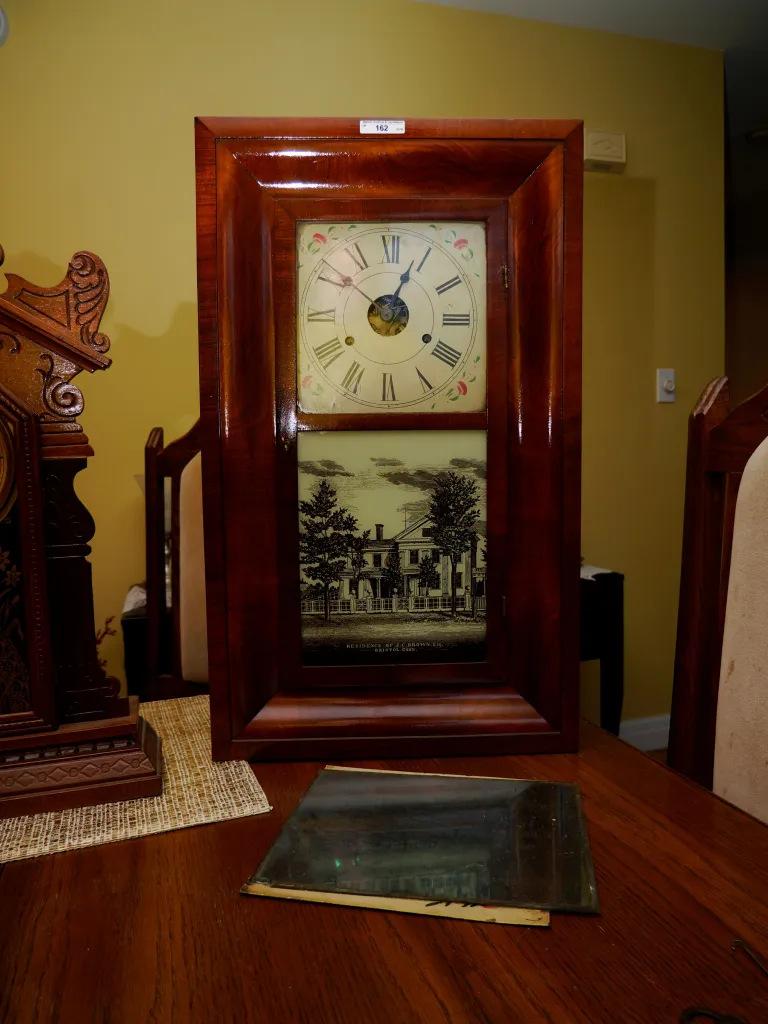
This clock is from around 1855, made just before Chauncey Jerome’s company went into bankruptcy. This was also bought at auction a few years ago. It came with an extra mirrored lower tablet and a “spare” dial. I am not sure if either the mirrored tablet or the JC Brown picture are original. The veneer, however, is in perfect condition.
George H. Clark
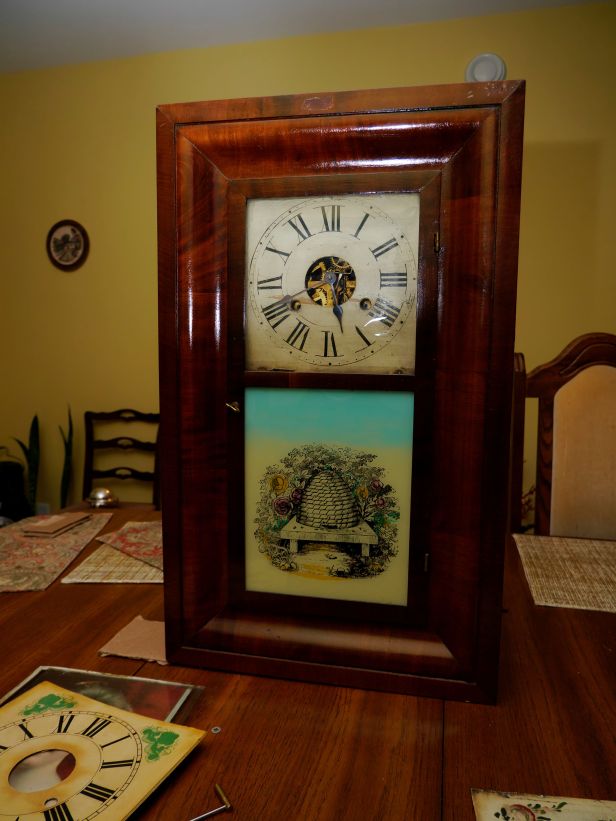
George H Clark 30 hour Ogee shelf clock
This is an ogee from around 1857. There is no makers mark on the works but it is a Waterbury type 2.411 movement. The case is well-preserved and in excellent condition, obviously well-cared for by a previous owner. The beehive tablet looks to be original.
Waterbury Clock Co.
This an ogee style clock from 1865. It was bought at an antique store in Halifax. There was no price on the clock. I asked the owner what he would sell it for. He said, name a price, I said $40 and he said, sold! Evidently it been in his shop for a while. It is the first clock on which I learned how to replace very worn trundles.
Cuckoo clock
Dave’s cuckoo clock
This is a 30-hour cuckoo clock with a Regula movement, made about 1976. A cheap German made mass-produced “tourist” clock that was given to me by a relation. It still works but it is on its 3rd movement.
And now for the spring driven clocks.
Ansonia Cottage clock
This cottage clock is from about 1895. This another clock that was given to me. These were probably dollar clocks at the time. They had cheap movements but were solid and reliable. Surprisingly, these command good prices on the auction sites since so few remain.
OLYMPUS DIGITAL CAMERA
Canada Clock Company
The Hamilton Cottage Extra is from about 1880. These are now very difficult to find since so few have survived. It is Canadian made and collectors will happily pay hundreds of dollars for one. It has a very cheap case made of softwood with no veneers. The acid etched lower tablet is quite unique. It was bought in a local junk store for $40. I could not believe my find.
Hamilton Cottage Extra
Elisha Manross
Elisha Manross gothic steeple
The Manross is a thirty hour time and strike and called a steeple clock. One interesting feature is that the Rosewood veneer is in a vertical orientation on the side columns unlike most that have a horizontal orientation. It is also the only clock in my collection that has brass mainsprings which were phased out in the early 1840s making the clock historically significant. Needless to say that in order to preserve the mainsprings I run this clock infrequently.
Hamilton Clock Company
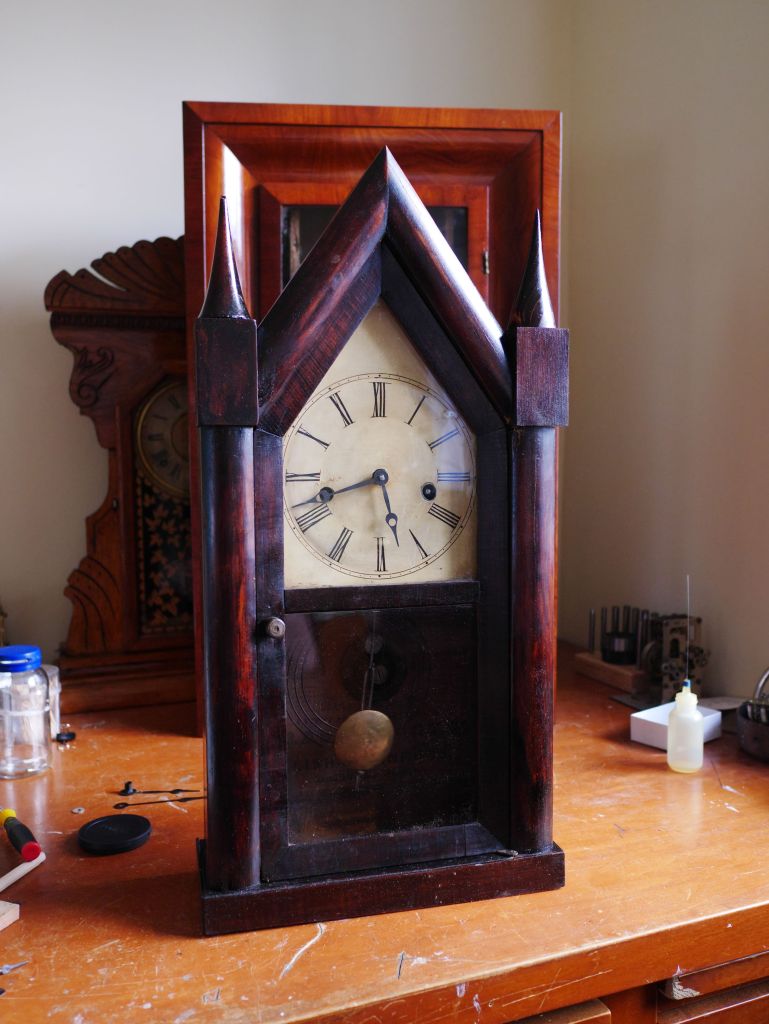
The style is known as gothic steeple. The clock is from about 1876 and features a religious expression on the acid etched lower tablet, “Cling to the Cross”. There are some veneer losses but the clock is in decent shape. The steeple tips never seem to survive on these clocks.
Hamilton Clock Co. 30 hour time and strike
New Haven
This is a spring driven time and strike ogee from around 1875. Unfortunately the veneer has been stripped from the case and the softwood re-stained but it is an attractive little clock nonetheless. The dial is a replacement and the lower tablet has some losses.
Ogee New Haven clock
New Haven
This a called a Sharp Gothic according to the label. It is an American-made clock sold by a jeweler by the name of Thomas B. Spike in Halifax, Nova Scotia (Canada) in the 1880s. The lower tablet features a seaside Parthenon scene which might suggest it was one of many produced for foreign markets. There are some veneer losses but the clock is in running order and keeps reasonably good time. It has replacement mainsprings because it will run for 3 days on a wind. Not bad for a 30-hour clock!
New haven Gothic Steeple clock
I hope you enjoyed this little tour of a part of my collection of 30-hour or one-day clocks and please leave a comment. As for expanding my collection of one-day clocks I am not sure that I would continue acquiring them unless I came across something quite unique or if one were given to me.
My Chauncey Jerome 30-hour Ogee weight driven time and strike clock has stopped for no obvious reason. Let’s see if we can get it going again.
Chauncey Jerome 30-hour Ogee clock
But first, no-one can deny that Chauncey Jerome had made a historic contribution to the American clock industry in the 18th century when he substituted brass works for wooden works and was said to be “the greatest and most far-reaching contributor to the clock industry.” Although he made a fortune selling his clocks, and his business grew quickly his company ultimately failed in 1856.
After researching Mike Baileysexcellent site on Jerome clocks I was able to determine that my clock is a number 11 Ogee made just before the Jerome bankruptcy, 1855. The patent 30-hour brass movement is the number 1.314 which is likely in its original case.
C Jerome 30 hour movement testing in the case
The only time I serviced the movement was in February 2018. It was dirty as expected and it appeared that no work had been done for quite some time. It was well worn. At that time 8 bushings were installed, 4 in the front and 4 on the backplate. Most of the wear was on the strike side and lower in the trains.
C Jerome movement right out of the case in 2018
It ran very well for 3 years and now (May 2021) it has stopped.
Preliminary checks
I performed the usual checks prior to taking the movement out of its case. I inspected the time-side cable for kinks and that it was not binding. A binding cable will definitely stop a clock. It was fine.
I checked the crutch loop clearance and found nothing seriously amiss. It should have run. It did not.
While it was running I noticed that it was drifting in an out of beat and it ran no longer than a minute or so before stopping. This indicates a number of issues; a bent escape wheel teeth, damage/wear to its lantern pinion, a bent escape wheel arbour or an enlarged pivot hole. I suspect the last one is the culprit.
The strike side is fine and it is functioning as it should, but without the time side running correctly the clock is just an ornament.
Next, taking it out of the case
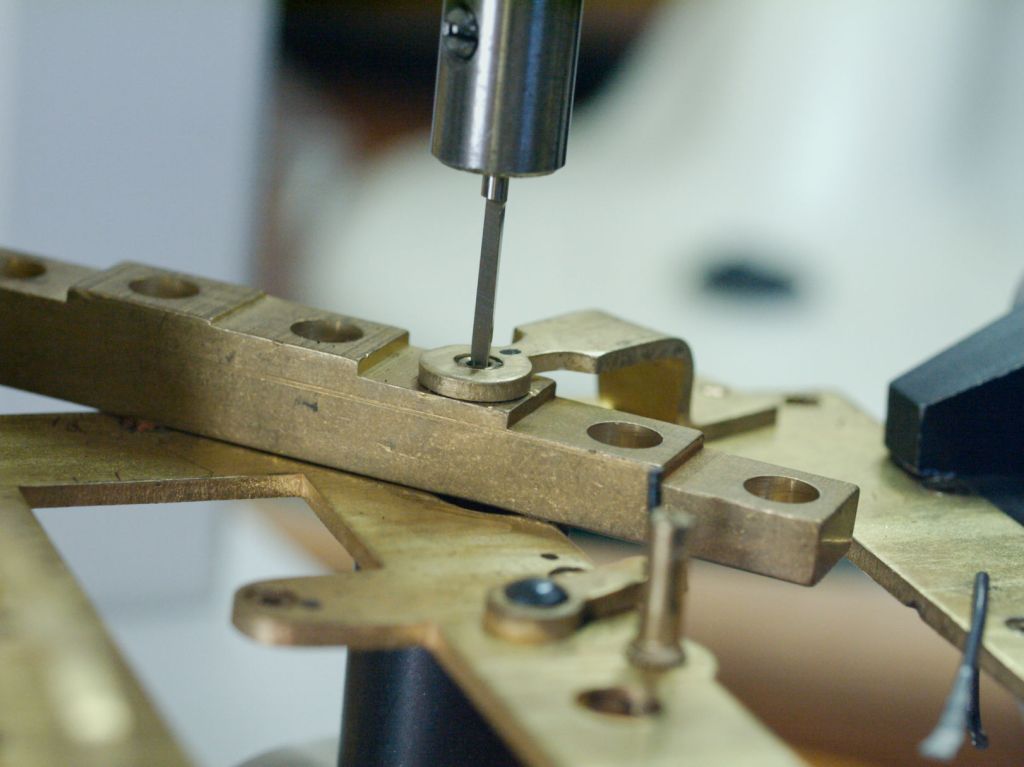
I checked it over and determined that the movement required two new bushings, one for the escape wheel bridge and the other for the hour wheel in the motion works. I did not have a multi-level bridge tool when I serviced this clock the first time three years ago so, it came in very handy. The hour wheel pivot hole looked fine then but now there is enough wear that it justifies being done. I checked the escape wheel arbour and it was straight.
Multi level bridge tool
With those two wear issues addressed I put the movement back together for testing and assumed that the clock would run. Unfortunately the clock stopped after less than a minute. Something else was amiss.
The trouble with trundles
I adjusted the beat but still nothing. I noted where the second wheel, time side, was stopping as it would stop about every eighth of a turn. Since the second wheel gear teeth are in excellent condition, it could only be one thing, worn trundles in the escape wheel lantern pinion that prevent the second wheel from meshing correctly with escape wheel.
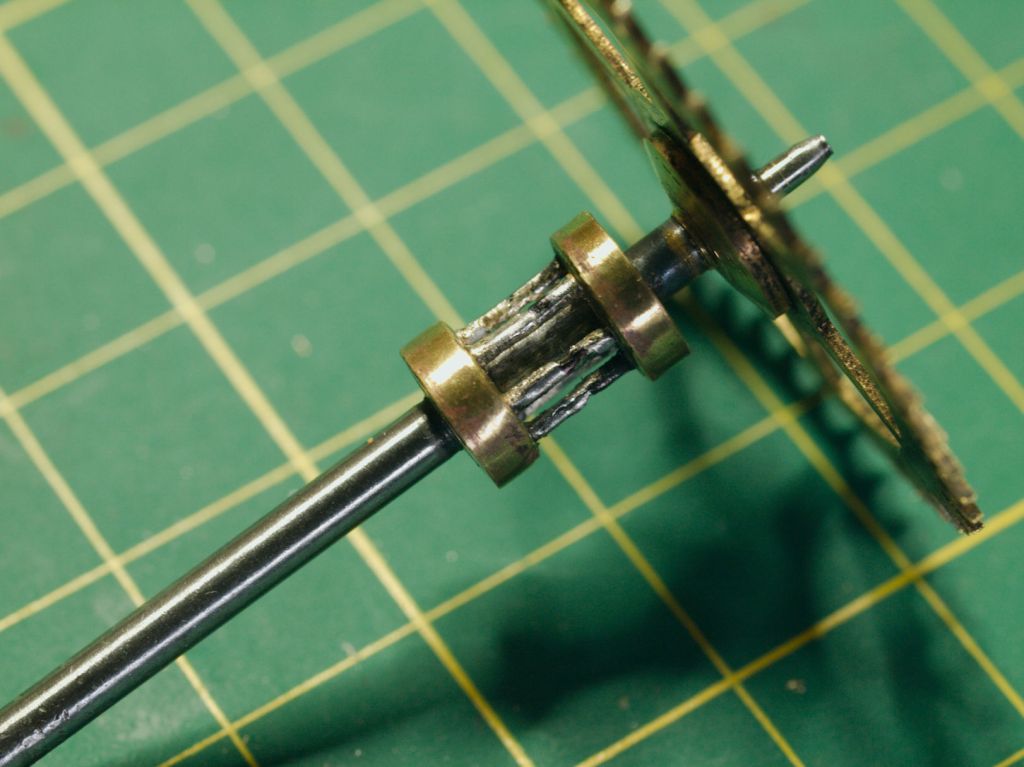
Lantern pinion on escape wheel
As you can see in the above photo the trundles are in terrible condition and there is little doubt that this is what stopped the clock. Wear such as this cannot be ignored. Without a repair the clock will not run.
Trundles are often replaced by drilling out the shroud end where the trundles are inserted, taking the worn trundles out, replacing them with new ones made from pivot wire and staking the holes to ensure they stay in place. On this escape wheel the cap must be removed to access the trundles. This is common on ogee movements such as this and it means a different approach for the repair.
End cap for lantern pinion
I secured my crow’s foot to my bench vice, inserted the top cap of the lantern pinion into the V part of the foot and gently tapped on the pivot end to release the cap. It released easily. The trundles should have literally fallen out but two of the 6 were firmly in place and had to be cut and drilled out. Not fun.
crows foot
I have a good assortment of pivot wire, selected a .95mm wire for the trundles and cut each one to length with a Dremel cutting disk.
I used a hollow staking tool to push the cap back in place and the trundles into their respective holes but the cap was loose. This is when Loctite is your best friend. Using a toothpick I dabbed a small amount onto each end of the trundles, secured the trundles in place and waited 24 hours for the Loctite to cure.
The next day for testing purposes I left out the strike side levers and wheels.
On the test stand the movement ran a couple of 30-hour cycles and the issue has now been addressed. The remaining gears and levers were assembled into the movement and the movement was placed into the case for a final test of both the time and strike side.
It should run reliably for years to come.
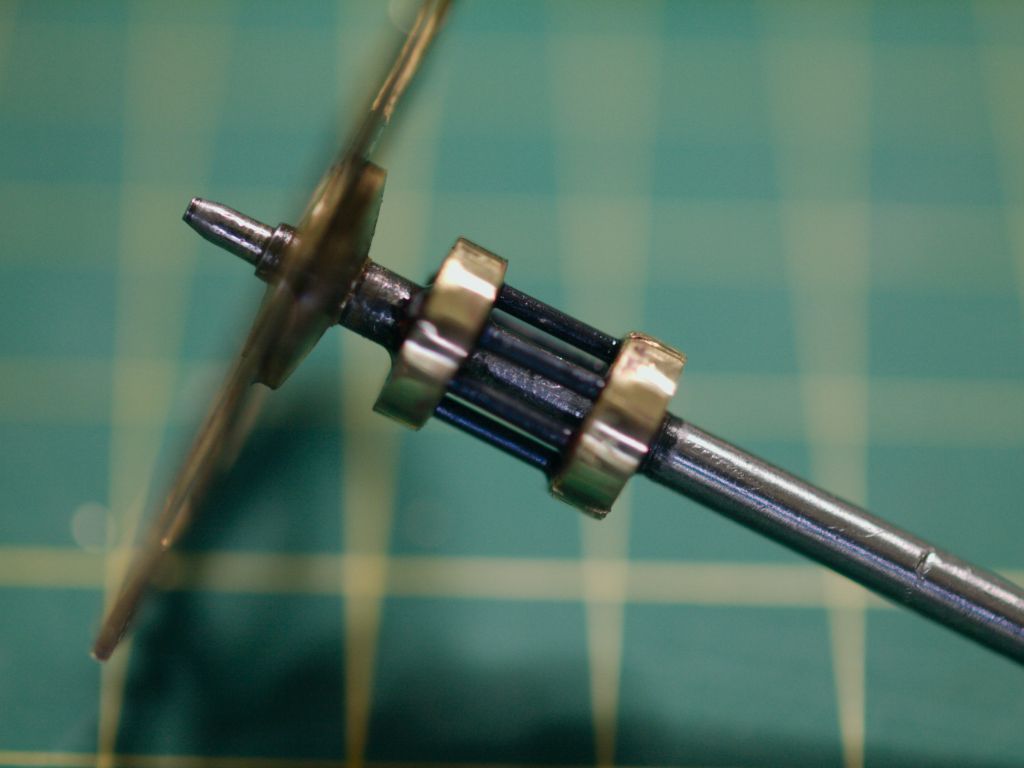
From time to time a repairer will have to deal with worn trundles.
New trundles made from pivot wire
If a clock stops and there is a gear meshing issue, then it is time to replace the trundles but if they are a little worn and the clock runs well, I tend to leave them as-is knowing that at some future date if the clock stops it is one of many issues I will address.
I have mentioned this before but if you are just beginning your journey into clock repair, the 30-hour ogee, because of the large gears, the overall simplicity and the absence of mainsprings make this a great place to start.
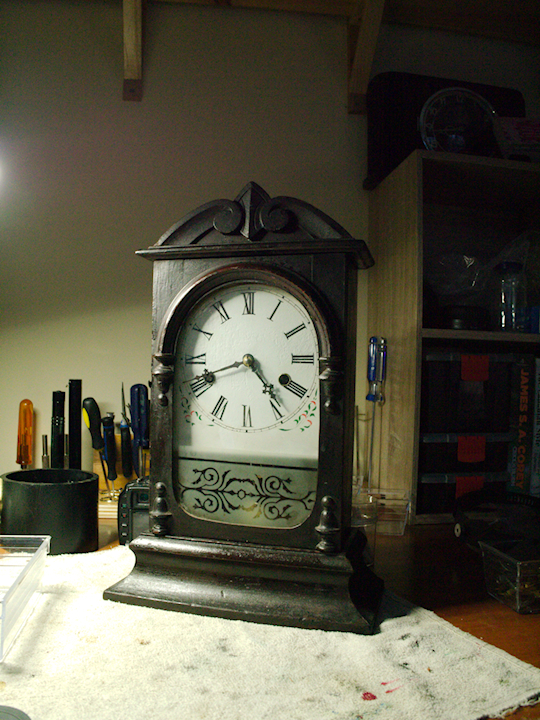
This interesting Rosewood veneered round top, mirrored tablet shelf clock appears to be a Jerome in name only. It is not a fake or marriage but a curious product of early to mid-1870s marketing.
But first, a little Jerome history.
Jerome & Co. shelf clock
One might be tempted to assume that this clock is associated with Chauncey Jerome, one of America’s most noted clockmakers who died in 1868.
Chauncey was well out of the clock business at the time of his death which poses two possibilities; 1) the Jerome in this instance may be Samuel B. Jerome of New Haven, Connecticut or 2) it is the New Haven Clock Company that was selling clocks using the trade name Jerome & Co. It would seem that New Haven and S.B. Jerome would be in conflict with each other. It’s all a bit confusing and perhaps more research is need to find those answers. In any event the Jerome name had strong marketing power.
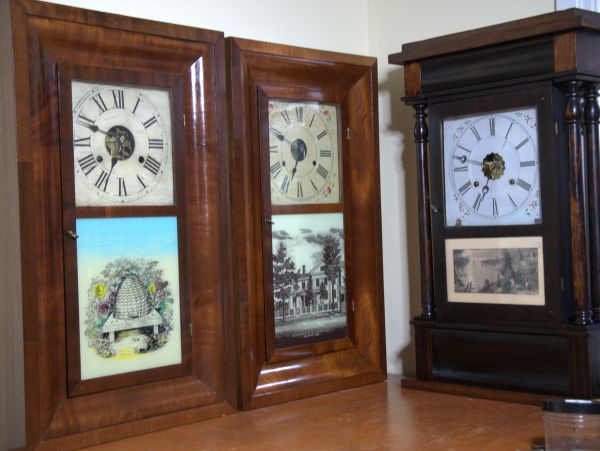
These three 30 hour clocks in the opening photo were serviced in the fall of 2018. The fourth (shown next) is a Waterbury Ogee from about 1870.
It was never my intention to collect 30-hour clocks but I am attracted to this style of clock. Thousands were made, they are surprisingly cheap and come up often on online for-sale sites. Many have the cases that have suffered the ravages of time though these are in very good condition. However, buyers and collectors tend to stay away from 1-day clocks because of the hassle of winding them every day.
I marvel at the engineering and innovative technology of clocks made over 150 years ago and how popular these clocks were in their day.
Waterbury 30-hour Ogee clock
On the left in the opening photo (and below) is a George H Clark, pre-1850. It features a Jerome-like movement and a wood dial.
George H. Clark 30 hour Ogee
All of the clocks on this page have similar movements to this Jerome
Touch-ups to nicks and scratches were all that were required to improve the look of the case but the movement required a good cleaning as well as a couple of bushings.
The middle clock (also seen below) is a Chauncey Jerome Ogee clock. The label dates the clock to about 1855-56 just prior to the company’s bankruptcy.
Chauncey Jerome 30 hour Ogee clock
Eight bushings were installed on this clock. Some of these clocks need a lot of work while others require a good cleaning.
On the far right (and blow) is a Sperry and Shaw 30 hour New York style 4 column shelf clock. The movement was disassembled and cleaned but did not require bushing work. The case was also freshened up.
Sperry & Shaw 4 column clock with a Canada Clock Co 30-hour steeple to the right
I am fascinated with 30 hour clocks. Yes, they require winding every day but I enjoy it and it has become one of my daily rituals. The sound of the gong is not particularly pretty but it is distinctive. You always know when an Ogee clock is striking in a house.
What other mechanical devices keep running after 150+ years?
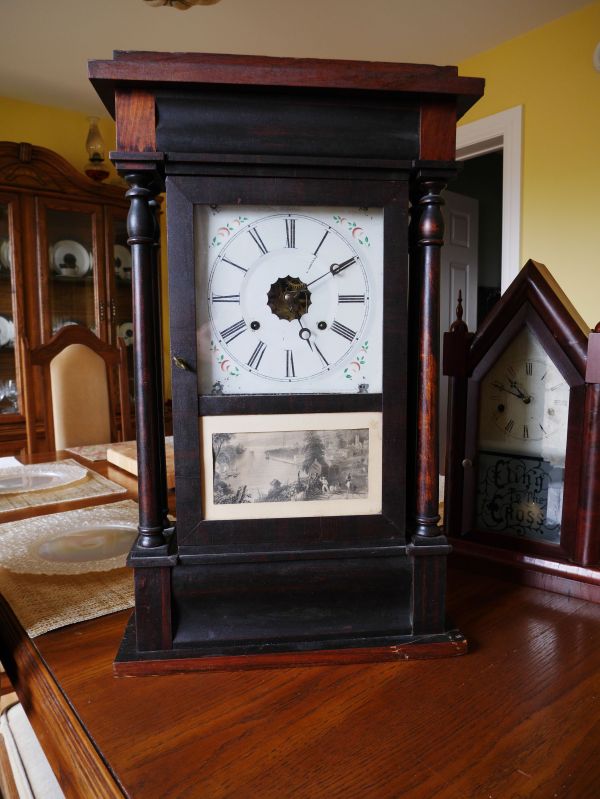
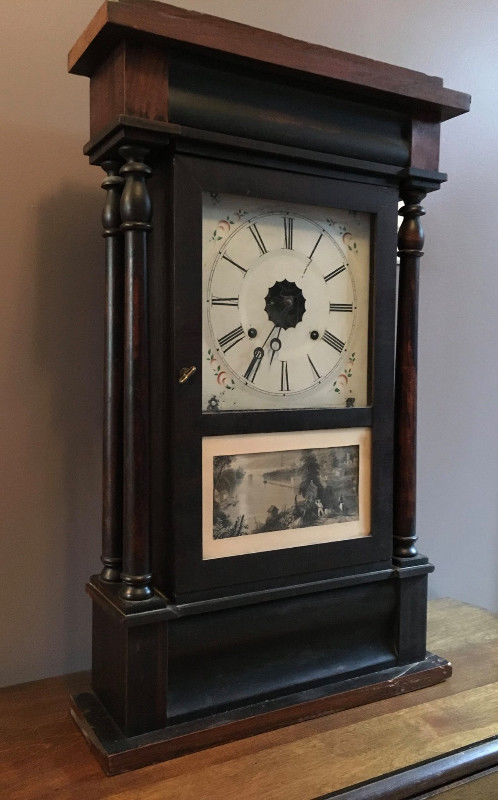
I decided that it was time to service this attractive New York-styled Sperry and Shaw 30 hour time and strike, four column hour-strike clock. The case measures 25 1/2 inches in height by 14 inches in width, very close to the dimensions of a typical ogee clock. This clock is an estate auction buy.
Sperry and Shaw clock showing dial and lower tablet
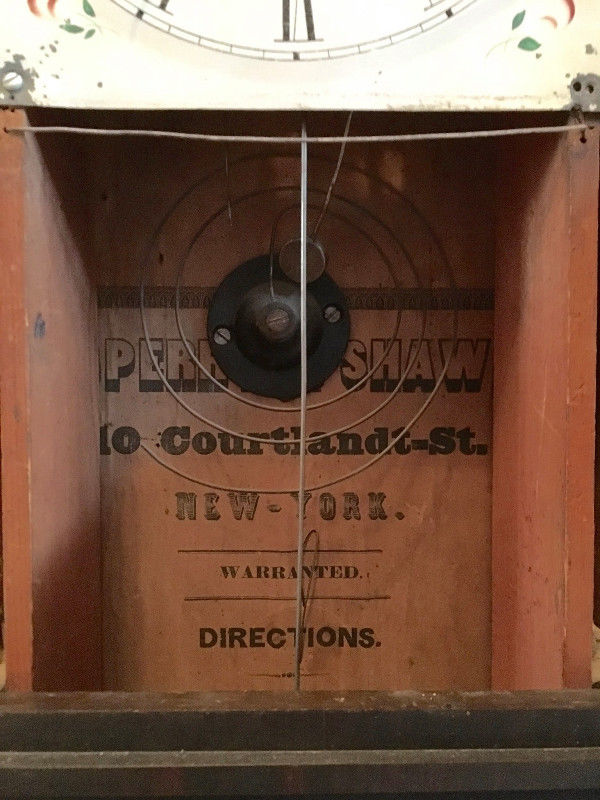
The 4 free-standing turned columns drew my attention. It reflects the decorative period of the Empire style popular in the mid 1850s. While researching the NAWCC site I discovered that this clock was probably made between 1846 and 1847. The label, 98% of which is intact, and affixed to the backboard says 10 Courtlandt Street, the company headquarters during the aforementioned period. Sperry and Shaw were not clock-makers but business partners and were regarded as distributors and assemblers.
They sourced cases and movements, affixed their own stamp on the movement and placed their labels (sometimes over other makers labels) inside the case, a common practice at the time as clocks for the home and workplace both locally and abroad were in great demand.
The movement is Jerome-like and stamped Sperry and Shaw, New Jersey. The plates are thinner than a Jerome evidently a cost cutting measure.
The narrow brick-shaped weights (4 3/4 inches X 1 inch) fit neatly into channels on the left and right with little to spare. When I first contacted the seller, he was unsure if the weights were in the clock. He later contacted me to say that the clock indeed had its weights. Had it not come with the weights I would have passed on it because the narrow weights are the only type that will fit into the channels and they would be difficult to source.
The weight channels are either side of the movement
The case
The weight cords, though not original, were old and frayed. On the first night I raised the strike weight to the halfway point. Twenty minutes later I heard a loud BANG. When I heard the sound I immediately knew. The cord had snapped and the weight had dropped. Fortunately, there was no damage. I promptly replaced the cords.
I am not sure how I will proceed with the case. The veneer appears to be either mahogany, walnut or rosewood. There are small sections of veneer missing here and there but mostly on the corners, a common issue. It has a two-tone appearance though it is hard to tell if it is the result of aging or the original intent of the maker. There is grime on the darker surfaces and I must decide whether to leave as-is or take it down a little to see what’s there. Attending to the veneer issues on the corners should be a straightforward matter. The break in the right corner of the base is a crude repair and that will have to be redone.
Veneer issues
Sperry and Shaw 30-hour movement
The movement
The movement was disassembled and placed in my L&R ultrasonic cleaner with DEOX-007 solution (7 to 1 ratio) for 30 minutes. The ultrasonic did an terrific job and I am always impressed at how well it cleans lantern pinions. Once the parts were washed in warm water and dried it gave me an opportunity to visually check the movement for obvious issues such as broken or worn teeth, bent arbours and so on. All the parts were in good condition.
The movement had punch marks around every single pivot hole which caused me some concern. However, after pegging the pivot holes and polishing the pivots I re-assembled the movement to check pivot wear and found there were three or four pivots holes that were slightly enlarged but not so much that they had to be done immediately. So, no bushing work this time.
The movement was re-assembled and tested. Unfortunately, my movement stand is not set up for weight driven clocks so testing had to be in the clock case.
Sperry and Shaw 30-hour movement tested in the case
I usually test the movement dry for an hour or so before oiling. Why waste clock oil if it must be taken apart again. Once I am satisfied that the movement is running smoothly I take the movement out of its case, oil the pivots and then run it for several days to regulate and to determine if there any minor issues that need to be addressed. Once I am satisfied, the dial and hands are re-attached. With the new weight cords and the movement fully serviced, I tested it for several days.
However, a week later I adjusted the time since it had stopped and the minute hand was disconnected and spinning freely. The main wheel was not communicating with the second wheel because the arbour washer was loose and the resulting wobble meant that the teeth did not engage properly. Out comes the movement to tighten the washer. Now, all is well.
Back to the case. I am still debating what I should do but I may give it a light refresh.
Need a quick primer on developments and inventions in horology. You have come to the right place.
18th Century shelf clock Porto, Portugal
Though by no means a definitive guide the following are some important dates in the history of the clock as gathered through a number of sources. The difficultly in affixing some dates with precision results from discrepancies among sources.
Horological developments during the centuries before the mechanical clock are left out altogether. Water (Clepsydra) and sun clocks of the middle ages and astronomical clocks of ancient China deserve special mention but are the subject of a separate discourse and are not included here.
Important dates in Horological Development
CA. 1300 – First mechanical verge clock, Europe
1364 – Astronomical clock conceived by Giovanni de Dondi, Italy
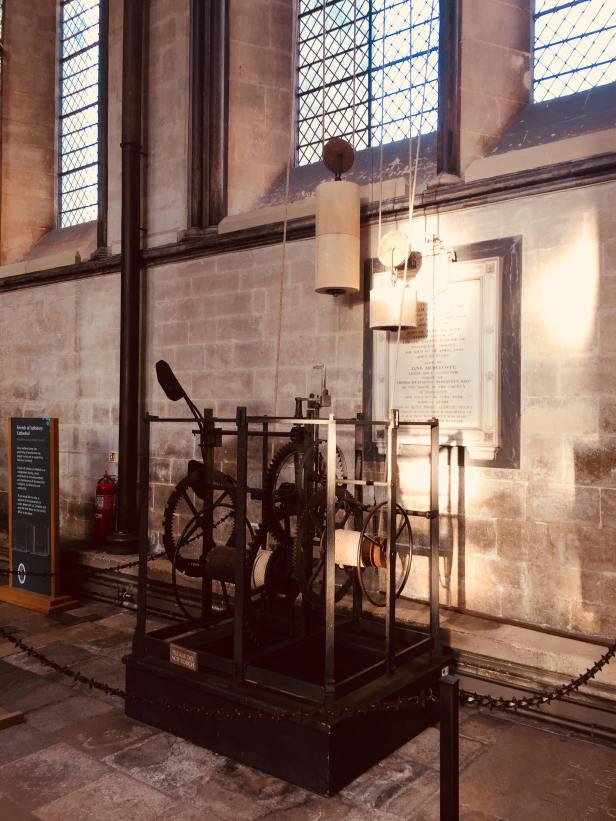
1386 – Tower (turret) clock Salisbury Cathedral, England
Salisbury cathedral clock, photo by Dr. Meghan Joiner
CA. 1400 – Fusee invented by Jacobs, Czechoslovakia
CA. 1450 – Table clock with spring and fusee, Phillip the Good of Burgundy, France
CA. 1500 – Mainspring invented, Germany
CA. 1510 – Watch invented by Peter Henlein, Germany
CA. 1560 – Spring driven portable clock, Germany
CA. 1570 – Oldest known clock with a second hand, Orpheus clock, Germany
1637 – Galileo, swinging temple lamp, pendulum control conceived, Italy
CA. 1650 – First tower clock appears in Colonies, America
1656 – Pendulum clock devised by Huygens, Holland
1657 – Verge and foliot gives way to pendulum control, Huygens, Holland
1658 – Long-case prototype made by Fromanteel adapted from lantern clock, England
1660 – Balance wheel conceived by Hooke, England
CA. 1675 – Richard Towneley invents the dead-beat escapement, England
1675 – Balance wheel with spiral spring invented by Huygens, Holland
CA. 1675 – Recoil escapement and crutch invented by Hooke in collaboration with Clement, England
1676 – Rack striking developed by Barlow, England
1680 – 1700 – famous horologists of this era were Arnold, Earnshaw, East, Graham, Knibb, Compion and Windmills of England; Berthoud, Breguet and LeRoy of France
1701 – St Sulpice seminary tower clock (imported from France), Montreal, Canada
1713 – Harrison invents marine chronometer, England
CA. 1715 – Break-arch dial introduced
1715 – Graham perfects deadbeat escapement, regarded as the “father” of the dead-beat escapement
1717 – First tower clock of America, Benjamin Bagnall, Boston
1726 – Mercurial pendulum invented (temperature compensating pendulum), Graham, England
1726 – Wall clock by Thomas Bennett, 8 day brass, weight driven, America
1736 – Harrison’s marine chronometer tested at sea (accurately ascertaining longitude), England
1770 – White dials appear in English longcase clocks
1776 – Independent seconds train invented for watch, Pouzait, Switzerland
1790 – Vienna regulator style case emerges in Austria
1790 – American woodworks clocks begin to be appear
1802 – Willard patents his banjo clock, America
1806 – Terry introduces Pillar and Scroll clock, America
1809 – Martin Cheney leaves America to set up a clock-making shop in Montreal, Canada
1810 – Carriage clock (Pendule De Voyage) introduced by Breguet of France
1818 – Heman Clark makes wrought brass movement for Pillar and Scroll case, America
1825 – Rolled brass production begins in America
1837 – Noble Jerome 30-hour brass movement patent approved, America
1840 – American brass movements in mass production
1842 – American brass movement clocks exported to England by Chauncey Jerome
1845 – Wood-works movement production ends, America
1850 – Westminster tower clock designed by Lord Grimthorpe and made by Dent, England
CA. 1850 – Brocot (pin-wheel) escapement and pendulum suspension introduced, France
CA. 1850 – American mass production of watches begins
1860 – Junghans (Germany) sent to America to study American mass production techniques
1870 – Decline in English long-case clocks
1874 – Mass production of mantel and wall clocks begin in Whitby, Canada,
1900 – American clock production is at its height; makers are Ansonia, Ingraham, Gilbert, Howard, New Haven, Seth Thomas, Waterbury, and Welch
1904 – Arthur Pequegnat begins clock production in Berlin, Canada
1906 – Eureka electric clock introduced, America
CA. 1910 – Torsion pendulum clock (400-day) introduced, Germany
1920-40 – Decline in American mechanical clock production
1941 – Arthur Pequegnat ceases production, Canada
CA. 1960-70 – End of mass produced mechanical clocks, America (though cheaper Japanese, Korean & Chinese mechanical clocks flood North America)
Present day – Some movement and clockmakers remain; Howard Miller (Ridgeway), Keininger, Hermle, Chelsea, Jaeger LaCoultre among others
The clock is one of mans greatest achievements. The development of instruments to tell time is the unwavering toil of brilliant minds from many disciplines who, over 800 years, worked tirelessly to create, innovate and improve methods for telling the time.
Horology is not only the study of time but the synergy of art, joinery, fashion, design, décor, physics, engineering, metallurgy and mathematics. Indeed, the study of the mechanical clock is a microcosm of our society.
I have the 30-hour clock bug and my collection of them is steadily growing, but where to put them all? I have not decided where to put this one and for the moment it is on the floor of my work room.
Sperry and Shaw were not thought of as a high end clock company but some models like this 4 column New York style were quite attractive
This is a New York-styled Sperry and Shaw 30 hour time and strike, 4 column shelf hour strike clock, measuring 25 1/2 inches in height by 14 inches in width. The 4 free-standing turned columns first drew my attention as I had never seen anything quite like it. While researching the NAWCC site I discovered that this clock was made in or about 1846-47. The label, of which 98% is intact inside the backboard says 10 Courtlandt (not a misspell, there is a second”t”) Street, the company headquarters during the aforementioned period. Sperry and Shaw were business partners and were regarded as distributors and assemblers rather than clock-makers.
Sperry and Shaw’s label showing 10 Cortlandt St.
They sourced cases and movements, affixed their own stamp on the movement and placed their labels (sometimes over other makers labels) inside the case, a common practice at the time as clocks for the home and workplace both locally and abroad were in great demand.
Not everyone in the clock business was happy with Sperry and Shaw. Consider this excerpt from Chauncey Jerome’s book, History of the American Clock Business.
“These New York men would say that they were agents for Jerome and that they would have a plenty in a few days, and make a sale to these merchants of Jerome clocks. They would then go to the Printers and have a lot of labels struck off and put into their cheap clocks, and palm them off as mine. This fraud carried on for several years. I finally sued some of these blackleg parties, Samuels & Dunn and Sperry & Shaw, and found out to my satisfaction that they had used more than two hundred thousand of my labels. They had probably sent about one hundred thousand to Europe.”
Chauncey Jerome had a few clock-makers/assemblers on his hit list that included Sperry and Shaw and at least managed to sue some successfully.
Sperry and Shaw were not thought of as a high-end clock company but some models like this 4 column New York style were quite attractive, sold well at the time and are sought after today by collectors.
The movement is Jerome-like (Counterfeit perhaps?) and stamped Sperry and Shaw, New Jersey. I measured the plate thickness and compared it to a Jerome in my collection and the plates in this clock are a little thinner.
The narrow brick-shaped weights (4 3/4 inches X 1 inch) fit neatly into channels on the left and right. When I first communicated with the seller, he was not sure if the weights were in the clock. He later emailed to say that it did indeed have weights. I would have passed on the clock had it not come with the weights because the narrow bricks are the only type that will fit into the channels and they would have been almost impossible to source. The weight cords, clearly not original, are old and frayed and will be replaced with simulated gut. How old, well on the first night I raised the strike weight up about halfway and about 20 minutes later I heard a loud BANG. I knew exactly what happened; the cord had snapped and the weight had dropped. Luckily there was no damage.
The open moon steel hands are original.
The upper glass appears original and has the waviness you would expect from a clock over 172 years old.
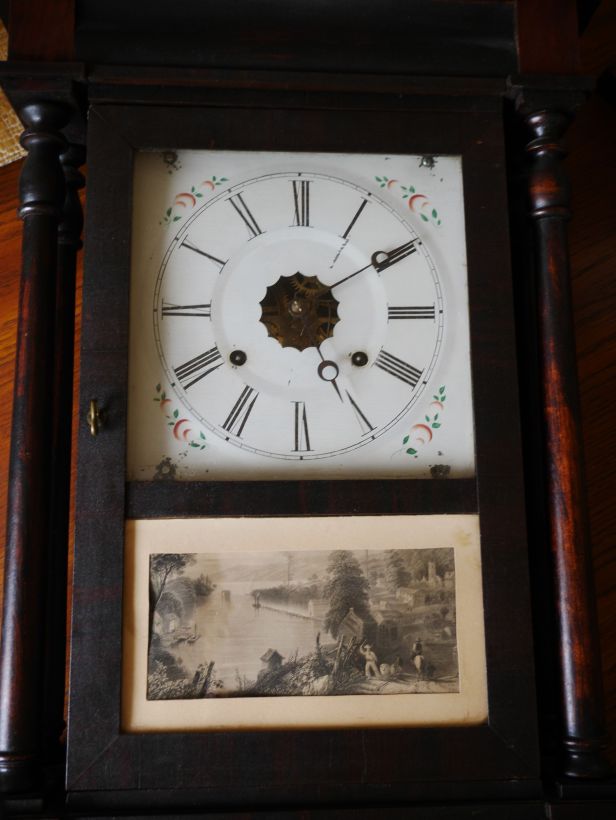
The lower tablet has a cropped image of the Bay of Quinte (Ontario, Canada) taped to the inside – not original but old. The original 18X12 cm steel engraving was drawn by W. H. Bartlett and engraved by J. C. Armytage in 1840; the image can be found here. Since the image is from 1840 and appropriate to the period of the clock, I might just leave it there. It also tells me that the clock likely spent most of its life in Ontario, Canada.
Sperry and Shaw clock showing dial and lower tablet print
The zinc dial is old though not as old as the clock itself since there is a patent stamp on the back of the dial dated Dec 1, 1863.
Dial patent date of 1863, a later addition to the clock
There is also a clock-makers inscription that says, “cleaned by Felo Bros, March XX 1901”. Obviously this particular dial would not have been on the clock at the time it was made. A wood dial would have been appropriate for the period.
Clock-makers inscription in pencil
The case looks good…from a distance. The veneer looks like mahogany or walnut, I am really not sure. There are a few small pieces of veneer missing at various places and mostly on the corners, a common issue. It has a two-tone appearance though the case might have been all one colour when made (??). There is a lot of grime on the darker surfaces and I have to decide whether to leave as-is or take it down a little bit to see what’s there. Attending to the veneer issues should be a fairly straightforward process. The break in the right corner of the base is a crude repair and that will have to be redone.
One of several areas of minor veneer loss
The movement is dirty but should clean up nicely. There is not a lot of pivot wear on the front plate of the movement but I will learn more once it is out of its case.
There are a number of other clocks in the queue but I am eager to tackle this one.
Ogee clock prices seem to be at their lowest level in years. If you have your heart set on an Ogee clock, there is probably no better time to buy than now.
Ogee clock; clock design that originated in the United States in the 1830s, distinguished by a case (usually pine) the front outer edges of which are curved into an S-shape (ogee). This shape is formed by the union of a convex and a concave line. A mass-produced variant of the shelf clock, the ogee clock stands about 30 inches (75 cm) high and is usually weight-driven. The movements were usually made of brass and were made to run for 30 hours or eight days. (Brittanica.com)
Earlier this year (2018) I bought three Ogee clocks at an estate auction. There were about a dozen clocks up for bid, some gingerbreads, a couple of mantel clocks and a few Ogee clocks. Fearing that the auction would bring out collectors I surmised that the clocks would fetch somewhat higher prices. Though there were many clocks there were few aficionados. I scored three clocks, all were in very good condition though they were running poorly.
Daniel Pratt reverse ogee and splat clock
This Daniel Pratt Jr clock caught my eye. It is reverse ogee and splat, time and strike with wood movement made in the mid-1830s. My winning bid was a mere 30CDN. Ogee clocks with wood movements have sold for at least 200CDN in years past and eBay asking prices for Daniel Pratt Jr. clocks are typically between 60US and 200US. Although Ogee clocks have hit rock bottom in Canada the same may not be true elsewhere.
Wooden movement, time and strike
I have written about the decline in clock prices in a previous post. There is a legion of unwanted clocks out there. EBay and other online sites are flooded with ordinary antique clocks though special interest clocks still command higher prices. Many reasons are attributed to the decline though the poor economy in recent years is a major factor. Since 2008 clock prices have been dropping steadily and an upward direction in the near future looks dim. Prices are at or near the bottom. As the economy improves and antique buyers return to the marketplace we will see an uptick in values. In the meantime, now is certainly the time to buy.
Clocks, manufactured and warranted by Daniel Pratt Jr
I paid 60CDN each for the other two Ogee clocks, one a Chauncey Jerome 30 hour time and strike, circa 1857, the other, a George H. Clark 30 hour time and strike, circa 1860.
Chauncey Jerome 30 hour Ogee clock
George H Clark 30 hour Ogee clock
Sellers are posting inflated prices but a clock is only worth what the buyer will pay. Do your research and learn to shop with a critical eye and you be rewarded.
I bought four clocks at an estate auction several weeks ago, this and three other Ogee clocks plus a parlour clock. This clock is no less interesting than the others but I was lucky enough to research its maker and date it fairly accurately. I wish I knew its provenance but nevertheless it is an excellent example and has been well cared for over the years.
It is a Chauncey Jerome 30 hour Ogee weight driven time and strike clock. No-one can deny that Chauncey Jerome had made a historic contribution to the American clock industry in the 18th century when he substituted brass works for wooden works and was said to be “the greatest and most far-reaching contributor to the clock industry.” Although he made a fortune selling his clocks, and his business grew quickly his company failed in 1856.
Chauncey Jerome one-day movement type 1.314
The number 11 Ogee was the last of the Jerome clocks made in 1855. Mike Bailey, a Chauncey Jerome clock collector has an excellent blog in which he meticulously details and dates Jerome cases and movements. After researching his site I was able to determine that my clock is a number 11 Ogee made just before the Jerome bankruptcy, 1855. It has the Jerome patent 30 hour brass movement number 1.314 which is likely original to the case.
Type 1.314 movement, very dirty
There were some issues with the movement as you would expect from a 156 year old clock. There were a number of punch marks here and there, but specifically on the first wheel and the second wheel time side. The movement had years of dirt. The repairs over the years are typical for this type of clock. Punching to close pivot holes would have been the preferred approach to repairing a worn clock. With the advent of the modern bushing machine repairs are much simpler.
Eight bushings were installed. The first wheel strike side, the second wheel strike side plus the fly, the lower gear off the centre cannon, rear plate and 3 bushings on the time side.
Punch marks on first wheel, strike side
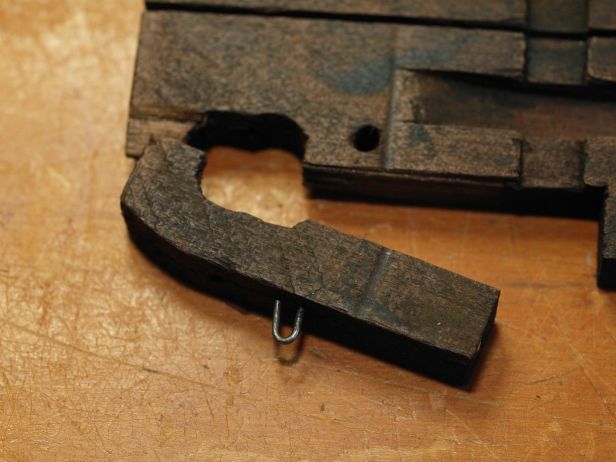
A piece came off the wood support for the movement when I disassembled the movement. Dry-rot perhaps. I had leftover hide glue from a previous project, applied the glue and clamped it for 24 hours.
Broken movement support
The retainer clip for the count wheel was riveted in placed and prevented me from taking it apart.
Retainer clip for count wheel riveted in place, not nice!
Some were punched very close to the pivot hole as you can see in this next photo. I left that as-is and decided to take a second look in a year or two.
Looks like a large pivot hole but actually punched very close to the hole
After eight bushings were installed (4 in the front and 2 in the rear) and an ultrasonic cleaning, the parts are test fit to check the smooth running of the gears. The rope for the weights looked re-usable, they were not replaced. The suspension spring also looked to be in good shape. The crutch wire has had bending and twisting over the years but it was also re-usable.
Test fitting parts after cleaning
30 hour movement servicing, oiled, movement in the case
C Jerome 30 hour movement testing in the case
Now to regulate the movement. The clock is ticking away nicely and in beat. There are always challenges setting the strike side and this movement is no exception. However, through trial and error the strike side is functioning as it should.
These are very simple clocks to service and a great movement to hone your clock repair skills.
I bought four wonderful clocks at an estate auction several weeks ago, this and three other Ogee clocks plus a parlour clock. This clock is no less interesting than the other three but I was lucky enough to research its maker and date the manufacture to within a year or two.
Noble Jerome’s invention showed that with the one-day brass movement, clocks could be mass produced economically and in great quantities
I wish I knew its provenance, how many hands it passed through, where it has been, what homes it has been in and even its last owner. All that is a mystery to me, nonetheless this clock is an excellent example of the classic Ogee weight driven shelf clock and a well-cared-for time-keeper.
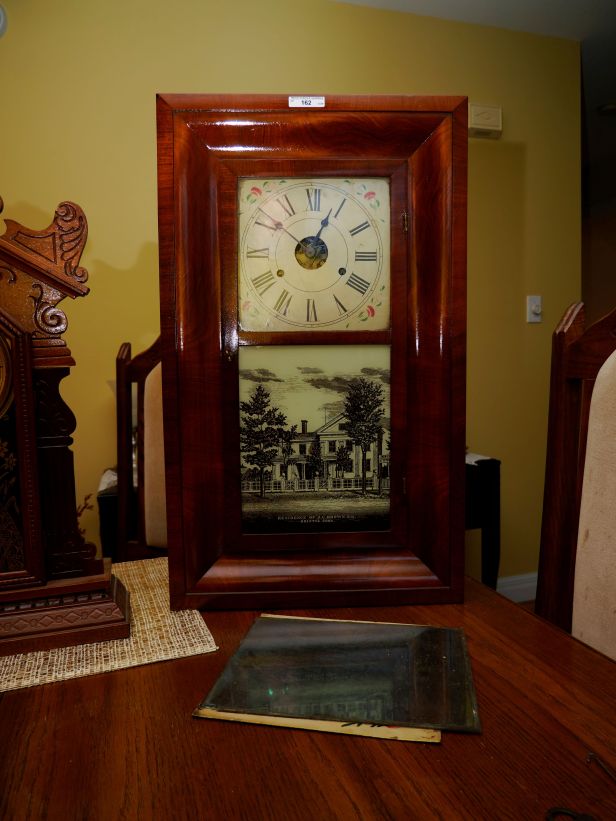
Chauncey Jerome 30 hour Ogee clock with J.C. Brown house in lower tablet
Chauncey Jerome: The greatest and most far-reaching contributor to the clock industry
Chauncey Jerome 30 hour Ogee weight driven time and strike clocks are not a rarity. Thousands upon thousands were made. However, no-one can deny Chauncey Jerome’s historic contribution to the American clock industry in the 18th century when he substituted brass works for wooden works. He was “the greatest and most far-reaching contributor to the clock industry.” Although he made his fortune selling his clocks and his business grew quickly his company eventually failed in 1856.
Chauncey Jerome (1793–1868) was one of many pioneer American clock-makers. Jerome began his career in Waterbury, Connecticut (USA), making dials for long-case clocks. Jerome learned what he could about clocks, particularly clock cases, and went to New Jersey to make seven-foot cases for clocks. In 1816 he went to work for Eli Terry making “Patent Shelf Clocks,” and learned how to make previously handmade cases using machinery. His venture into business for himself eventually led to making cases and trading them to Terry for wooden movements.
In 1822 Jerome moved his business to Bristol, Connecticut opening a small shop with his brother Noble, producing 30-hour and eight-day wooden clocks. By 1837 Jerome’s company was selling more clocks than any of his competitors. A one-day wood-cased clock with wood movement sold for six dollars and had helped put the company on the map. A year later his company was selling that same clock for four dollars. As profits began falling combined with a general malaise in the manufacturing sector, it was not long before Noble Jerome’s patented clockwork innovation, the 30 hour brass weight driven movement introduced in 1839 changed clock making in America. The design was proposed by Chauncey in response to the 1837 nationwide depression that closed many clock factories. Noble’s invention showed that with the one-day brass movement, clocks could be mass produced economically and in great quantities.
Jerome also made clocks according to what he termed the “systematic approach” where selected workers made one part of a clock while other workers simultaneously constructed other parts in the same factory, a precursor to the assembly line method of manufacture.
Coil gong, polished, incorrect position in this photo
In 1842 Jerome moved his clock-case manufacturing operation to St. John Street in New Haven, Connecticut. Three years later, following a fire that destroyed the Bristol plant, Jerome relocated the entire operation to Elm City. Enlarging the plant, the company soon became the largest industrial employer in the city, producing 150,000 clocks annually. In 1850 Jerome formed the Jerome Manufacturing Co. as a joint-stock company with Benedict & Burnham, brass manufacturers of Waterbury. In 1853 the company became known as the New Haven Clock Co., producing 444,000 clocks and timepieces annually. Jerome’s future should have been secure but in 1855 he bought out a failed Bridgeport clock company controlled by P.T. Barnum, (a good read, it is a very tangled story) which wiped him out financially, leaving the Jerome Manufacturing Co. bankrupt in 1856. Jerome never recovered from the loss. By his own admission, he was a better innovator and inventor than a businessman.
In the years following he traveled from town to town and took jobs where he could, often working for clock companies that had learned the business of clock making using Jerome’s inventions. Returning to New Haven near the end of his life, he died, penniless, in 1868 at age 74.
The ticking of a clock is music to me, and although many of my experiences as a business man have been trying and bitter, I have satisfaction of knowing that I have lived the life of an honest man, and have been of some use to my fellow men
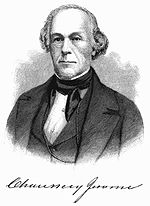
Chauncey Jerome 1860
This the number 11 Ogee was the last of the Jerome clocks made no later than the fall of 1855 when Jerome Manufacturing Co. failed. Mike Bailey, a Chauncey Jerome clock collector has an excellent blog in which he meticulously details and dates Jerome cases and movements. After researching his site I was able to determine that my clock is a number 11 Ogee made just before the Jerome bankruptcy in 1855. It is the Jerome patent 30 hour brass movement number 1.314. The movement appears to be original to the case.
Chauncey Jerome one-day movement type 1.314, yes, very dirty
The clock has a zinc dial and an image of JC Brown’s house in the lower tablet. Jerome was the first to introduce the zinc dial. It might have originally had a mirrored lower tablet. However it now features the JC Brown’s home. The J.C. Brown home in Forestville was featured on the tablet of many of his (Brown) Ogee clocks and it is unclear why it is on this clock. From 1847-1855 Brown conducted business without partners as the Forestville Manufacturing Company or the Forestville Clock Manufactory.
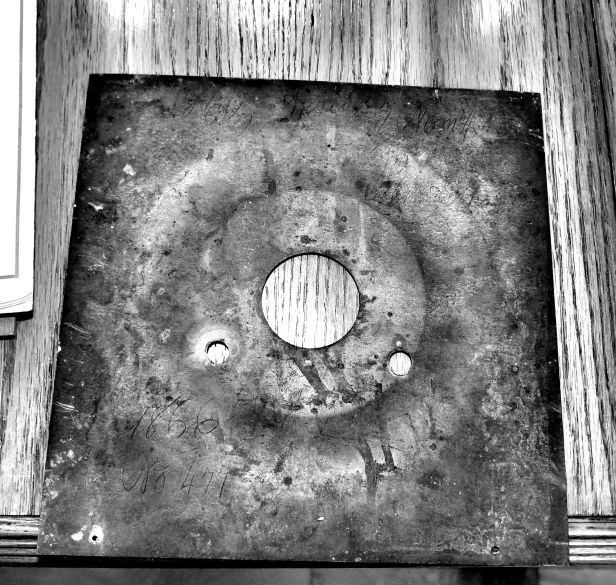
Rear of zinc dial
On the back of the zinc dial are inscriptions that I can barely make out. It says 1860 April 9??? on the top of the dial and 1866, Feb 2 and UPO 477 on the bottom. I tried to enhance it as best I could. Could this dial be a later replacement?
Overall the veneer is in excellent condition though it has been covered at some point with a clear coat of varnish. The weights appear original with the strike side having the slightly lighter weight as one would expect. The pendulum bob is consistent with the age of the clock and the label is largely intact. This was the last label Jerome used before his company went bankrupt.
Label showing Benham Printer, 55 Orange Street, New Haven at bottom center
The movement is not running reliably. It is very dirty and long overdue for a cleaning, plus, the movement has had some poor repairs over the years.
Much of the information for this post is from Chauncey Jerome’s autobiography entitled History of the American Clock Business for the Past 60 Years, a free copy which you can find here.
Next up is servicing the movement which I will cover in a separate post.






















 Antique and Vintage Mechanical Clocks
You must be logged in to post a comment.