I have a collection of 11 Arthur Pequegnat clocks, including three beautiful wall clocks which you can view on this 5-minute YouTube video.
I have written extensively about the Arthur Pequegnat Clock Company, but to summarize: the company was founded in Berlin, Ontario (renamed Kitchener in 1917) in 1904 and produced its final clock in 1941.
As regular readers know, I have been a passionate collector for 15 years, I take great joy in repairing and restoring old clocks. My collection has grown to 85 unique timepieces, each with its own story.
Background music and titles are provided only. If you have any questions about my Pequegnat collection or a specific clock, feel free to leave a comment.
For more about my journey and insights into clock collecting, explore my other blog articles.
Eight years ago I acquired my first Arthur Pequegnat clock. In the years following, I have added to my collection and now have a total of 8. Although my collection of Pequegnat clocks is very modest by comparison to a dedicated Pequegant collector it is a good start and I would certainly like to add to that number in the future.
The Arthur Pequegnat Clock Company (1904–1941) is notable as the longest-lasting Canadian-based clock manufacturer. They made a wide variety of different styled clocks from 1904 through to 1941 from shelf and mantel clocks to wall clocks and floor models.
Nickle-plated steel or brass plates
Unfortunately, it is very difficult to date a Pequegnat clock, except for what is termed pre and post-Berlin, the location of the company’s manufacturing plant. Clocks made before 1917 were inscribed “Berlin, Canada” on the dial face. Kitchener, Ontario was known as Berlin prior to and during the first World War. It was the town of Berlin from 1854 until 1912 then the City of Berlin from 1912 until 1916.
Because the name Berlin was associated with the war against Germany the town fathers decided the name Kitchener was less offensive and the change was made midway through the First World War. Kitchener is the present seat of the Regional Municipality of Waterloo, Ontario, Canada.
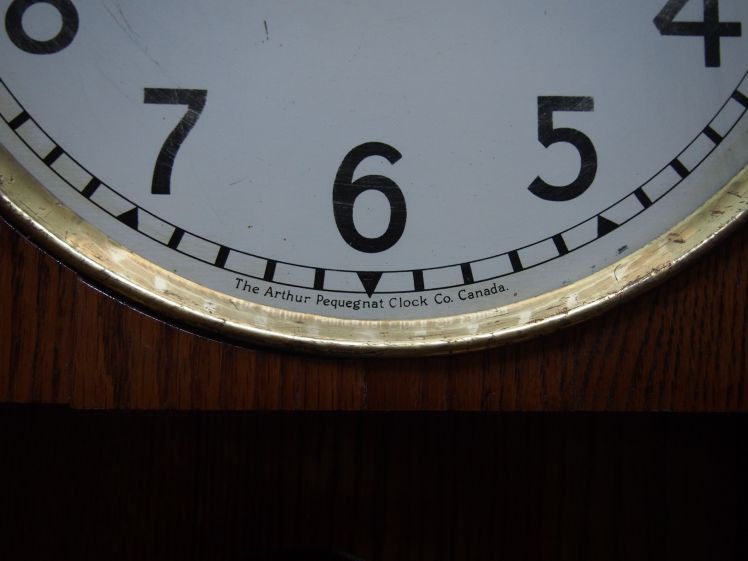
Most Arthur Pequegant clock movements are stamped with the company name but there are no date marks on movements indicating when it was made. Clocks made after the First War wore the company name plus Canada under the number 6 on the dial face. For example, clocks such at the Canadian Time were made from 1904 to 1941 and are separated in age by the Berlin label consequently, my Canadian Time wall clock with the Canada label could be as old as 104 or as “new” as 80 years old.
One distinctive feature on many movements is the use of nickel plating for both brass and steel plates.
Arthur Pequegnat Company name
Many models continued in production right up to 1941. By 1941, the demands of World War II armament makers for brass, the essential ingredient in clock movements as well as the growing popularity of the electric clock, forced the Arthur Pequegnat company to cease production.
And now, beginning with the first clock acquired in 2013.
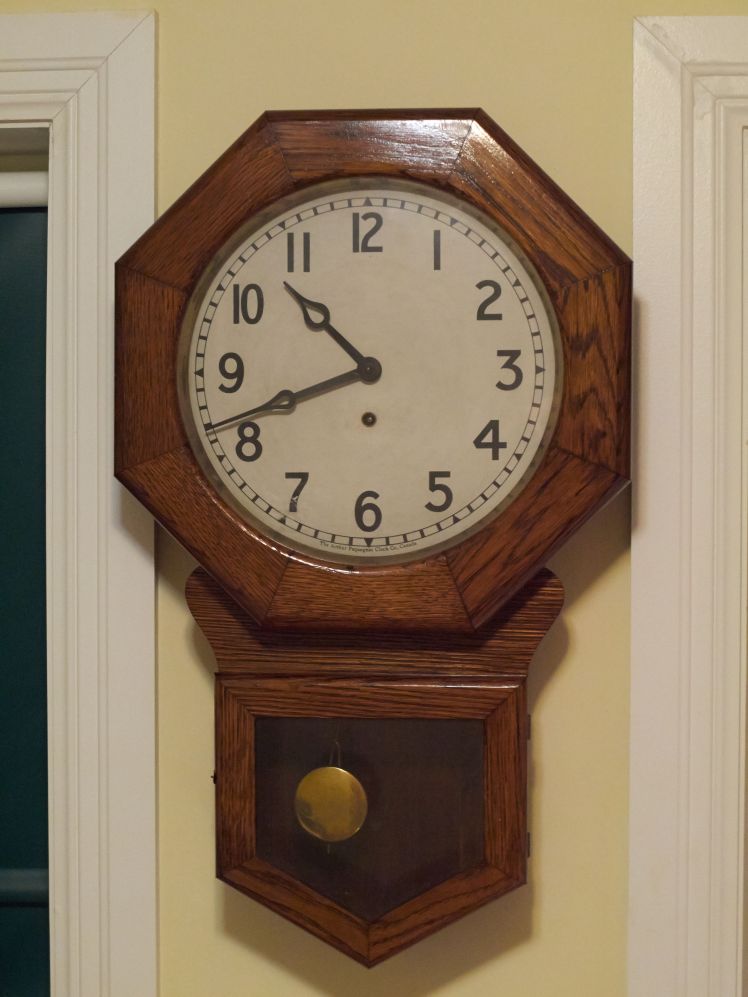
The Canadian Time
My first Pequegant, purchased in September 2013 hung in the Intercolonial Rail Station waiting room in Pictou, Nova Scotia.
Canadian Time
The seller arranged the purchase of the clock just prior to the station’s decommissioning in 1993. It is in very good condition, missing its door clasp but otherwise intact. There are a few scratches and nicks consistent with its age but nothing objectionable.
The Brandon (2nd edititon)
I found this clock in an antique shop just outside Truro, Nova Scotia in 2014.
Arthur Pequegant Brandon II
The case is in excellent condition but the movement was quite worn. Had I known more about servicing clocks at the time of purchase I would not have sent it to a clock repair specialist. It is one of two in my Pequegant collection serviced by someone other than myself. This is the Brandon II. The Brandon 1, the first edition, was made prior to 1918, and had an ornate pressed wood bezel. This one is simpler in design.
The Maple Leaf “Fan-top”
Next came my first Maple Leaf kitchen clock, known for its unique lower tablet of scattered maple leaves and a distinctive maple leaf pendulum.
Arthur Pequegnat Maple Leaf kitchen clock
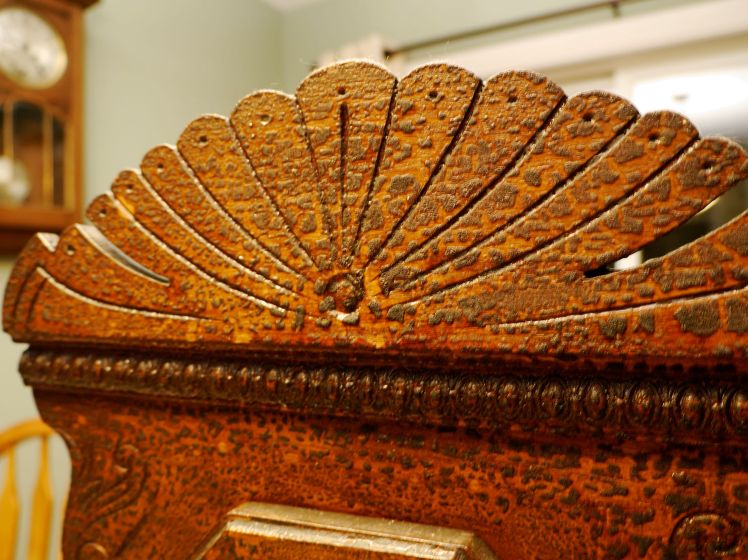
This clock, bought in 2015, was also serviced by a clock professional. The case was in very poor condition. Stripping a case is an absolute last resort as far as I’m concerned but the finish on this clock was pretty bad. I could not leave it as it was.
The finish on a Pequegnat fan-top clock
To Pequegnat collectors, it is known as the fan-top.
The Simcoe
Three years later, the Simcoe followed me home. It was bought at an antique shop in Victoria, British Columbia in 2018.
Arthur Pequegnat Simcoe mantel clock
It is not particularly attractive. It is the only mantel clock in my Pequegnat collection and it is from the “Berlin” period.
The Bedford
2018 was a good year because I acquired 4 Pequegnat clocks. This was number two of that year.
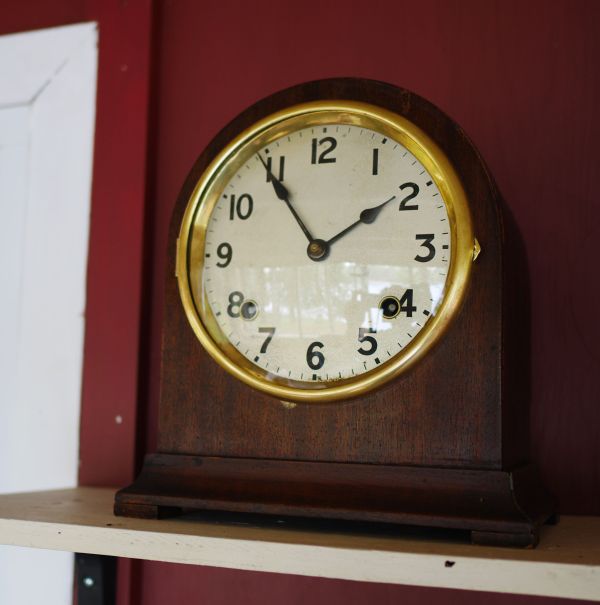
Bedford shelf clock
This clock was gifted to me by a reader. He asked if I wanted the clock but I had to pick it up in Quebec which was on our way to a summer cottage in central Canada. The movement was in very good condition but the case was damaged having taken a plunge off a high shelf.
The movement was serviced without issue but the case required extensive intervention.
The third purchase that year and the fifth in my collection is the Maple Leaf Pointed Top
The Maple Leaf “Pointed Top”
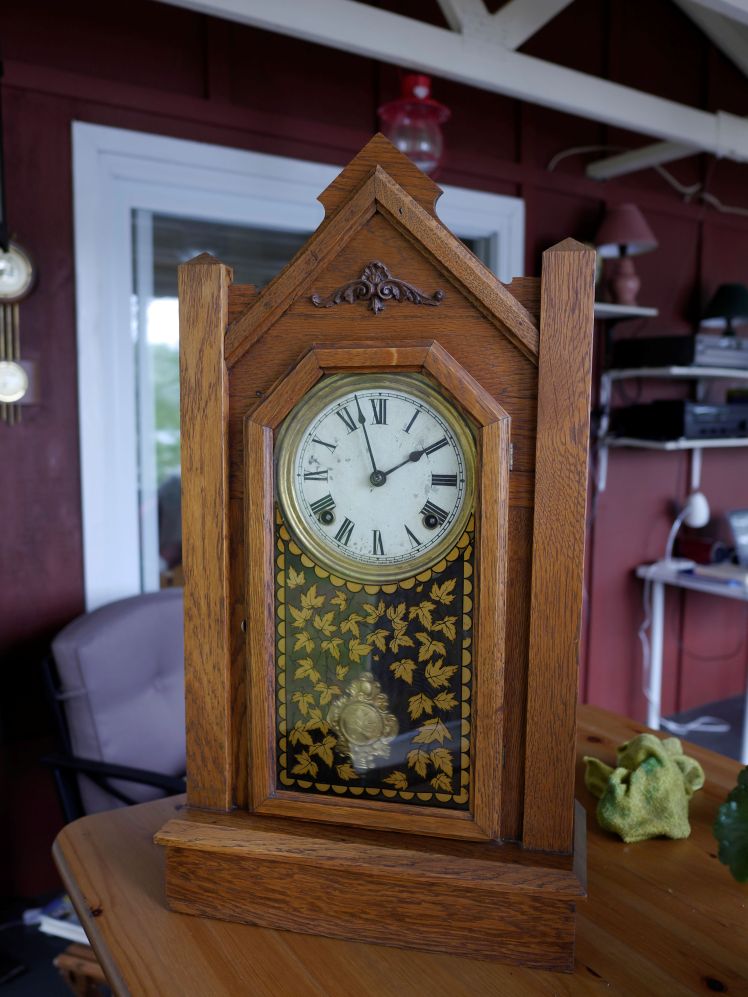
There are 4 Maple Leaf clocks made by Pequegnat. Any version of the Maple Leaf is sought after by Canadian collectors but this one has distinctive pointed side columns, hence the nickname.
Arthur Pequegnat Maple Leaf Pointed Top
Although termed a kitchen clock it could easily have been placed in a living room or parlour.
The Moncton
The last 2018 acquisition was a clock that I had in the back of my mind for quite some time and I was waiting for the right price. This is an excellent copy that is very presentable and looks great on our kitchen wall.
Arthur Pequegnat Moncton
It is a post-Berlin double spring time-only 15-day clock. Many were used in rail stations despite the fact that they were spring-driven. Weight-driven clocks were preferred for their accuracy but the Moncton was up to the task as a timekeeper.
And the last.
The Canuck
This is the only true Pequegant “gingerbread” clock in my view.
Canuck kitchen clock
The case was refreshed and the dial was redone. The movement was also serviced without issue.
Cleaned up more presentable
These are all keepers. Most Pequegants have kept their value over the years and in Canada, they are regarded as quality clocks for the masses. They were well built, well-designed movements with a distinctive Canadian charm as many were named after cities in Canada.
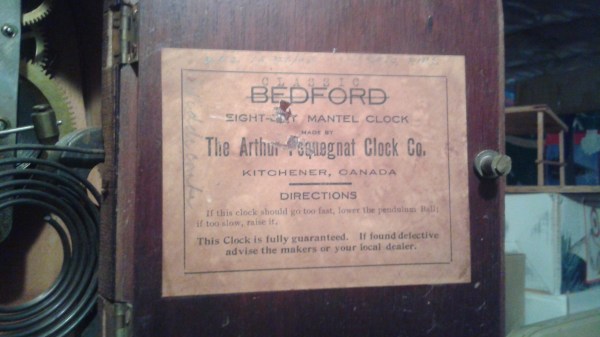
To Canadian clock collectors, Arthur Pequegnat are clocks highly regarded. Irrespective of model names they are generally classified as either “Berlin” or “Kitchener”. The Arthur Pequegnat Bedford is a Kitchener clock. Let me explain.
Although it is impossible to date Pequegnat clocks to the exact year of production, the name Berlin distinguishes clocks made before 1917 and those made after and up to 1941 when the factory finally shut its doors for good. Those made after 1917 are referred to as Kitchener clocks. Prior to 1917 “Berlin”, Ontario (Canada) was inscribed on the dial face and after the war, simply “Canada”.
Later Pequegnat movements, such as this one, have steel plates with brass bushing inserts while older Pequegnat movement plates were nickle plated brass
Kitcheneris the present seat of the Regional Municipality of Waterloo, Ontario (Canada).
This clock was given to me by a gentleman from Quebec City in May 2018. He wrote to me and asked if I wanted it, at no cost. It was his father’s clock and he felt it should go to a home where it would be appreciated. All I had to do was pick it up. While on our annual journey to our cottage in central Canada we stopped by, spent the morning chatting about clocks and other things, and have become friends ever since.
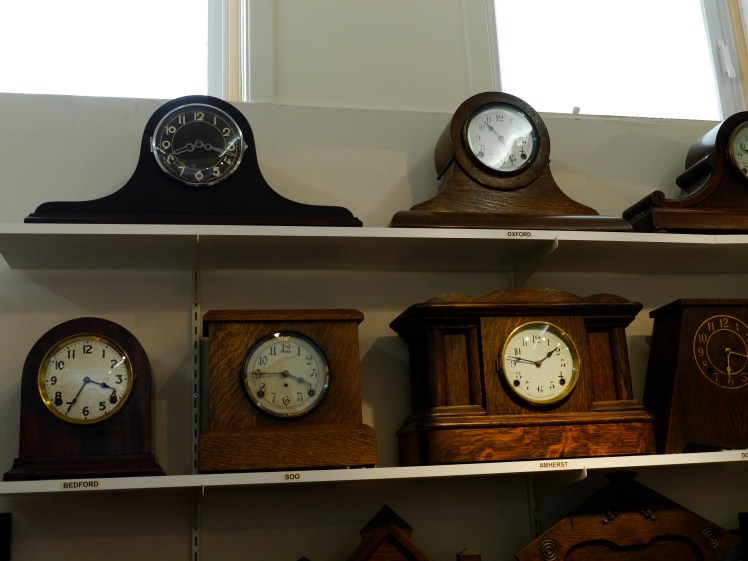
Bedford with a 6-inch dial, Canadian Clock Museum
This clock might possibly be a variant. Most Bedfords have the smaller 6-inch dial as opposed to the larger 7-inch dial on this clock.
The dial bezel and glass might also have been added as part of a later repair. The past owner told me that the clock fell and the damage was extensive. I spend part of the summer of 2018 reconstructing and refinishing the case but did nothing with the movement.
Gluing and clamping the case
Now, two years later, the movement must be serviced.
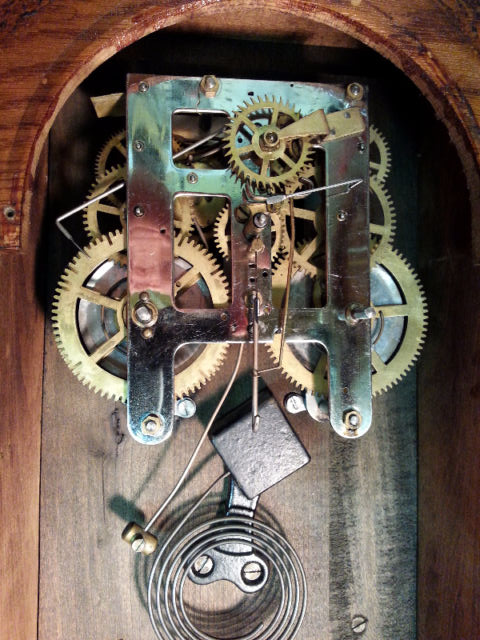
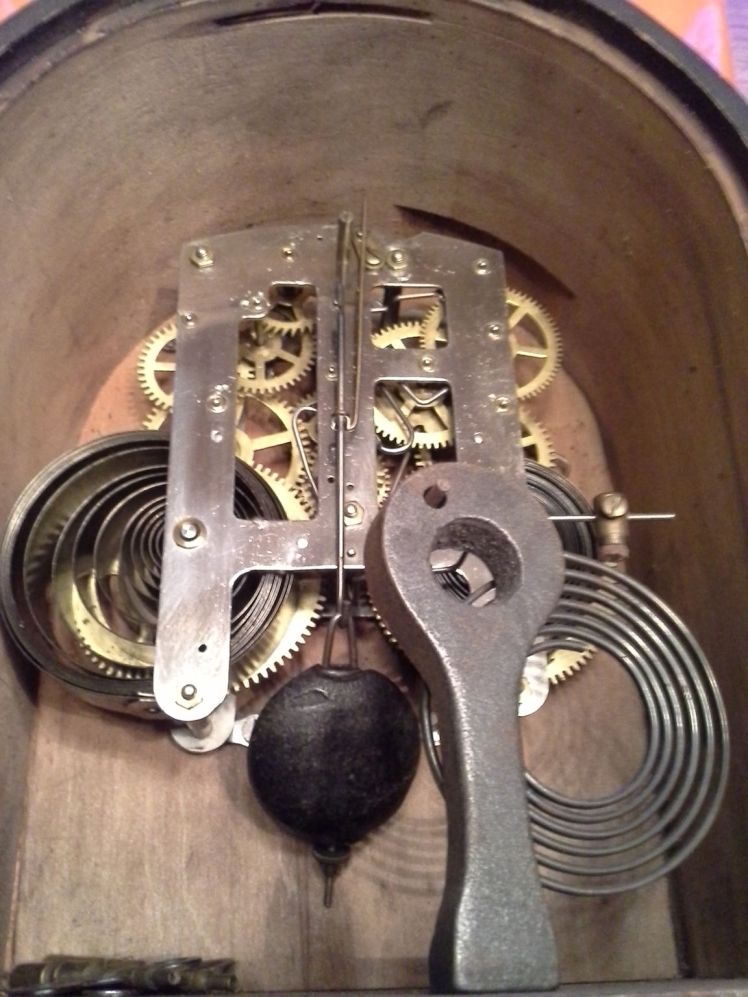
Later Pequegnat movements, such as this one, have steel plates with brass bushing inserts while older Pequegnat movement plates were nickel-plated brass. The change to steel was made during World War I when brass was in short supply. Most Pequegnat movements are stamped with the company name; this movement is unmarked.
Standard Pequegnat movement with steel plates
It was a running clock when I received it, had been running since 2018 and I did not expect too many issues while performing the service nonetheless there were problem areas. In a past repair, someone attempted to close pivot holes by punching into the steel plate. That did not work well. There is some bushing wear and from my initial assessment, at least 5 or 6 new bushings are required. On the other hand, the pivots look to be in very good condition.
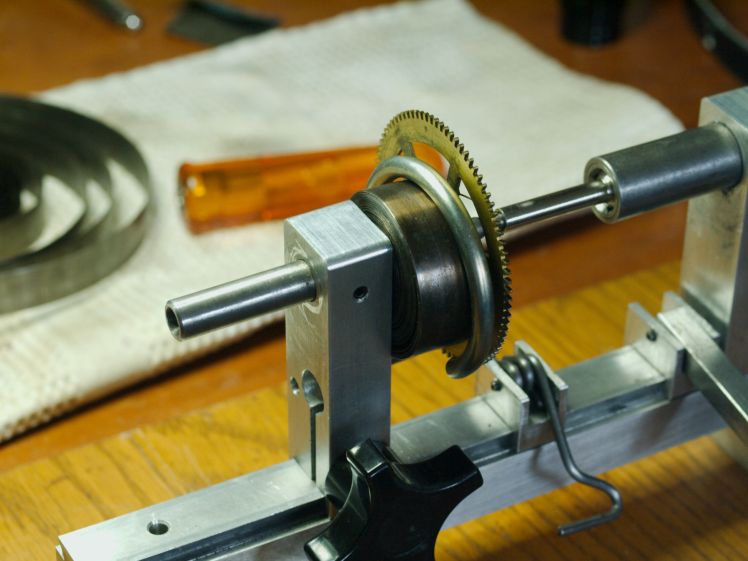
Servicing the mainsprings
The strike side’s main wheel assembly fell apart when I removed the mainspring. Using a punch I staked it back together. The mainsprings are in very good condition with no rust or cracks and will be re-used. They were cleaned, oiled with Keystone mainspring oil and reinstalled on their wheels.
Servicing the mainsprings
Bushing work
As mentioned above, a past repairer attempted to unsuccessfully close at least 4 existing bushings by punching into the steel plate, so, this movement has never been bushed.
This movement was certainly more worn than I thought. After assessing the movement a second time I determined that 9 bushings were required, 6 for the time side and 3 for the strike side. With brass inserts punched into a steel plate, one is always fearful of an insert becoming dislodged or falling out. Not this time, everything went smoothly.
The 4th wheel on the strike side is unlike every other wheel with a thinner shaft just below the pivot area. The shaft was turned in order to access the lantern pinions from that end. Why not come in from the other side?
Odd repair on 4th wheel, strike side
I have seen many interesting repairs over the years so I am not especially surprised.
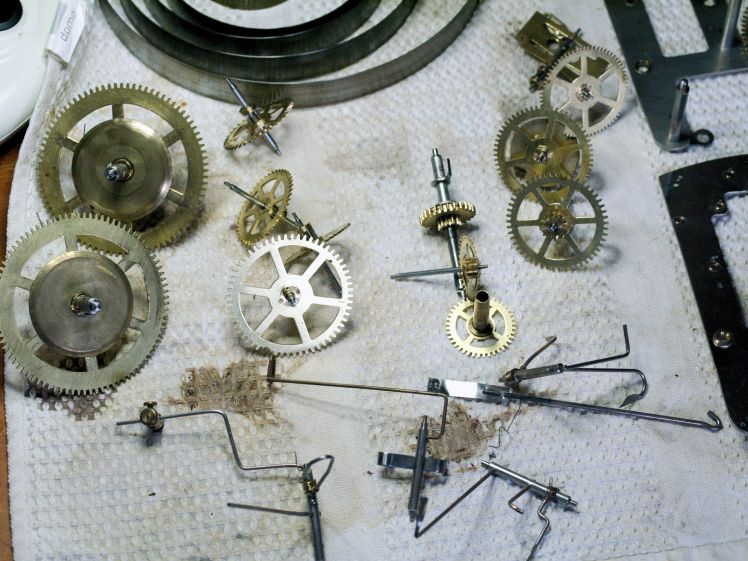
Parts laid out after cleaning in the ultrasonic
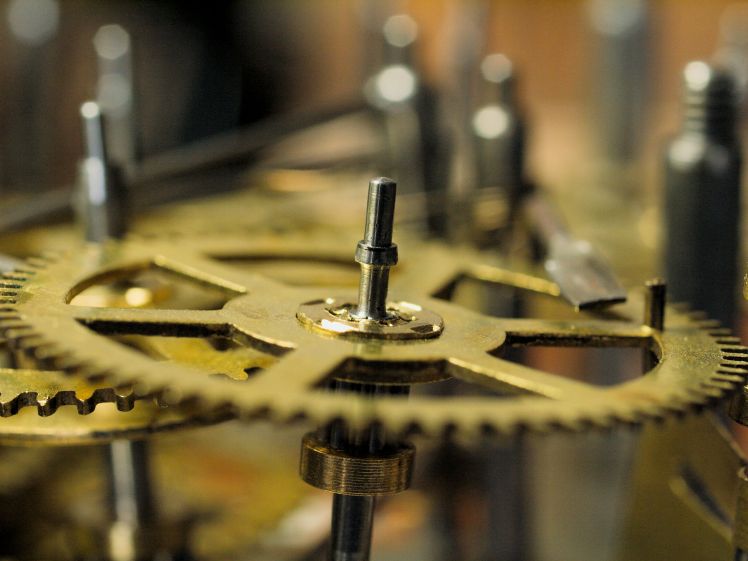
Once the repairs are made, the parts are cleaned, the pivots polished and new bushings installed, it is on to reassembly.
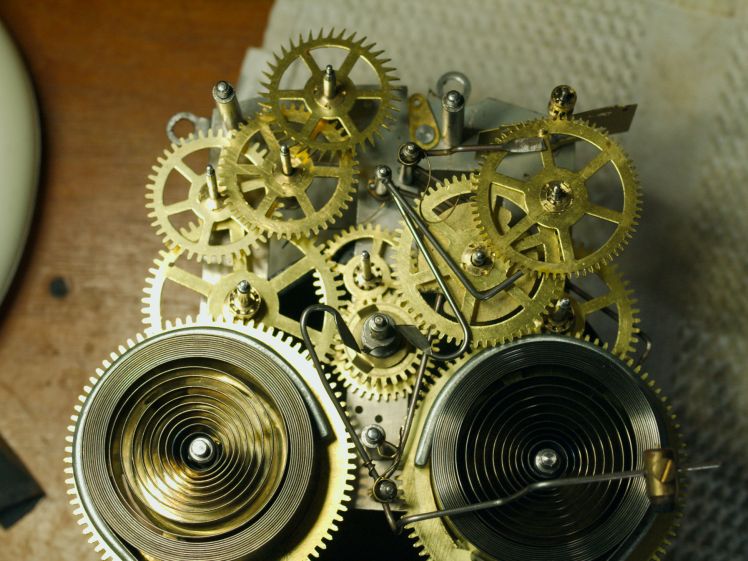
Everything but the verge is ready for the top plate
Once the wheels and levers are in position it is ready for the top plate. The escapement verge is installed once the plates are together.
During the course of reassembly I discovered a bent steel front plate which meant lining holes to the pillars was frustrating. Brass bends easily but steel also bends with enough force. I suppose if one attempts to punch a plate to close pivot holes while the movement is assembled, the plates might just get bent.
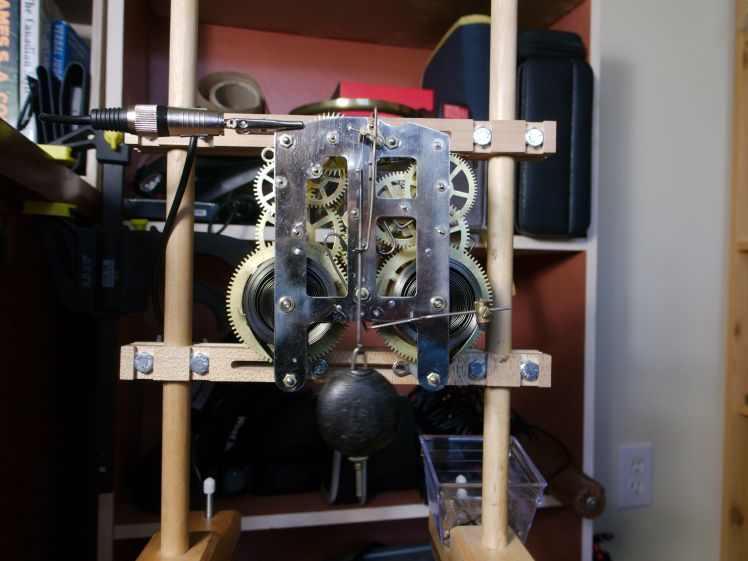
On the test stand. Beat amp microphone attached to set and monitor the beat
Then, it is on the adjustments and testing. The movement is running and striking as it should but a testing period of a couple of 8-day cycles should tell me if any further adjustments are required.
After two weeks all is good and the movement is returned it its case. It should be good for years to come.
In light of current world events the antiquevintageclock.com family wish to convey our sympathy and condolences to those effected by Covid 19
There are a fair number of Canadian clock enthusiasts that have various sized collections of Pequegnat clocks. Skip Kerr‘s extensive collection immediately comes to mind.
Although my collection is modest by comparison with just eight Arthur Pequegnat Canadian-made clocks they cover a range of models from kitchen to wall clocks.
The Arthur Pequegnat Clock Company was in business in Berlin, later renamed, Kitchener, Ontario (Canada) from 1904 to about 1941. Pequegnat clocks are well known among Canadian Clock collectors. Many are still running today and they can be easily found on local and national online for-sale sites and you might even find them on the northern border states of the US.
Here they are; I will let the captioned photos speak for themselves.
Arthur Pequegnat Maple Leaf kitchen clock, otherwise known as the “Fan top”
Arthur Pequegnat Bedford mantel clock (variant with larger dial)
Arthur Pequegnat Simcoe mantel clock, Berlin period
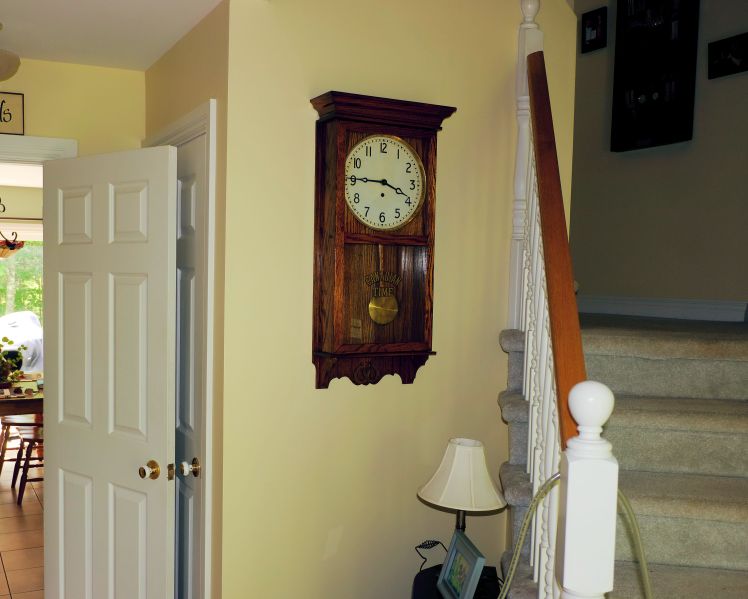
Arthur Pequegnat Canadian Time (time-only) wall clock
Arthur Pequegnat Brandon (second version)
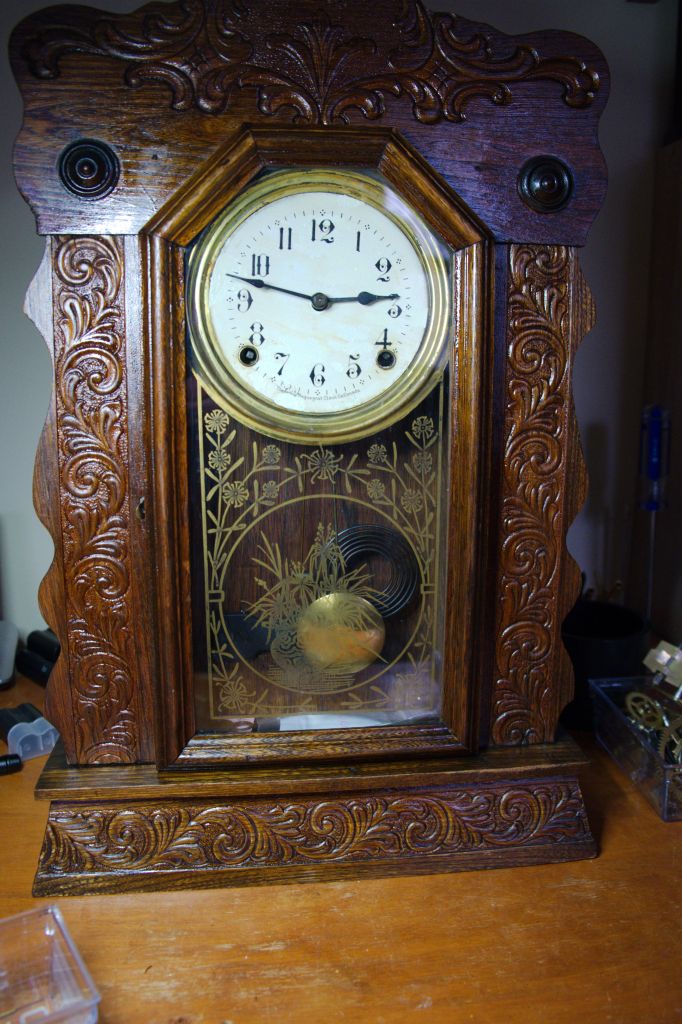
Arthur Pequegnat Canuck kitchen clock (otherwise known as a gingerbread clock)
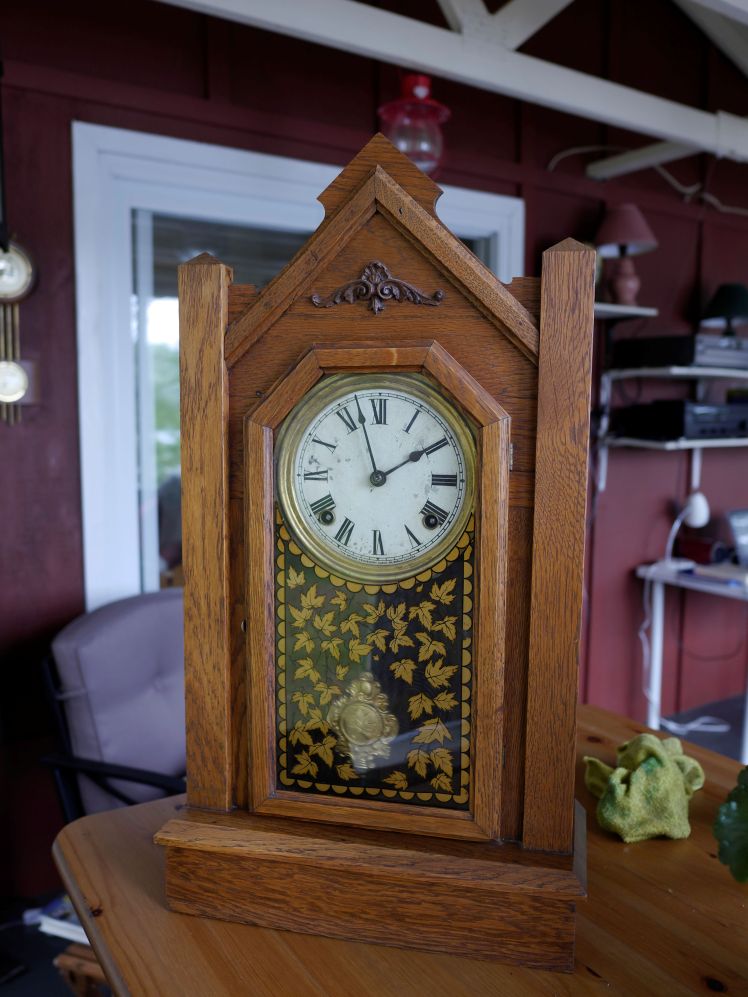
Arthur Pequegnat Kitchen clock, Maple Leaf, otherwise known among collectors as the “pointed top”
Arthur Pequegnat Moncton, double spring time-only 15-day clock, post-Berlin (after 1917)
My journey goes on as I continue to purchase Pequegnat clocks adding them to my collection. I have yet to secure a tambour style clock and a Regulator #1 is certainly on the top of my list.






 Antique and Vintage Mechanical Clocks
You must be logged in to post a comment.