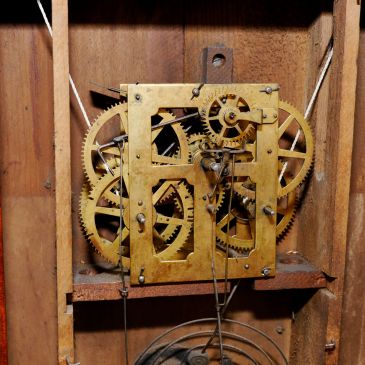
George H Clark Ogee clock – movement and dial work
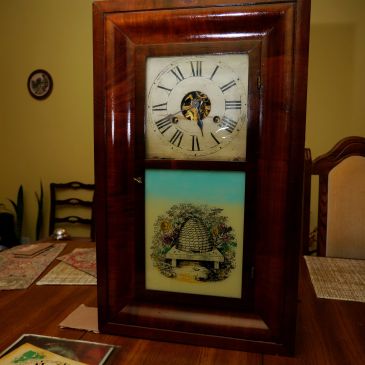
One cannot deny the classic style of an American Ogee clock. This one is in great shape and required almost nothing to get it to top form. 30-hour shelf clocks are abundant but not many cases survive years of wear and tear.

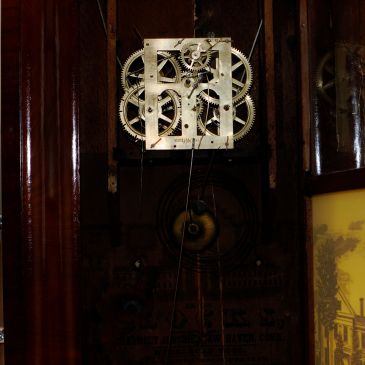
Dial removed to show the 30 hour movement

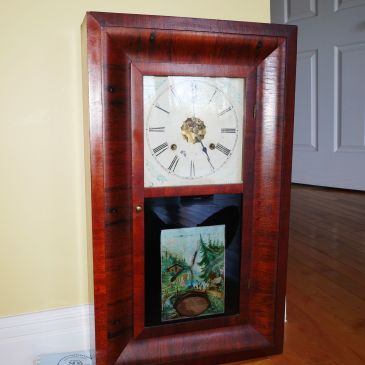
This George H. Clark 30-hour shelf clock is a very good example of Connecticut form. The case form is called an “og” or “ogee”, a mathematical term that describes the “S” curve shape in the primary molding that surrounds the door.

The clock has a brass time and strike, weight driven movement with an excellent original printed paper label on the interior reading in part “Made and Sold at/46 Courtlandt St/New York…. George H. Clark”. It measures 28 x 17 x 4.5”. This rectangular shaped case is decorated with nicely grained mahogany veneers. The veneer has very little if any losses.

The dial face

The upper section of the door is fitted with clear glass. Through this one can view the painted wood dial. The wood dial tells me that it is an early pre-1850 clock. This dial is formatted with a Roman numeral time track.

It is always a challenge matching 100+-year-old paint but by combining white. brown and yellow acrylic paint I was able to approximate the original colour. Some Roman Numerals were touched up with black acrylic paint.

The wood dial before touch-ups
And after numerals and face given a matching paint; you can see the difference in the number 4

I also glued two small blocks under the left and right “L” pins to centre the dial correctly.

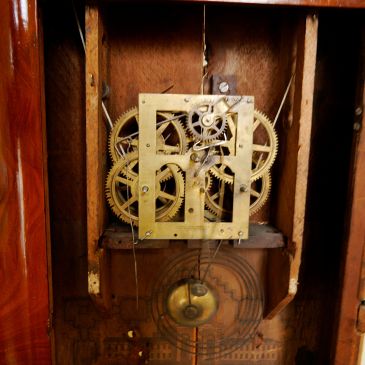
The door is open showing the gong coil and the pasted label in very good condition

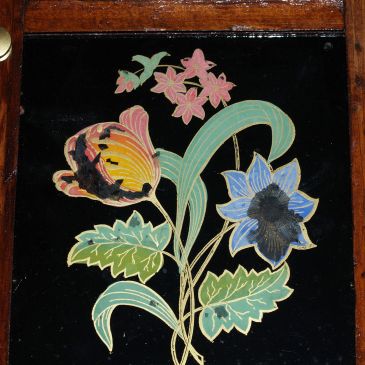
The lower section features a beehive painted tablet. The tablet is a replacement but fairly close to what would have been there at the time.

Beehive design; not original but in keeping with the style

Observations regarding the movement

The movement looks like an early (unmarked) Waterbury, ca. 1860 type 2.411. Waterbury movements have “quarter-round” corners, while most other ogee movements tend to have the “tombstones” or plain rectangles. The movement could have been swapped but It is difficult to tell.

A clean Jerome style movement

Everything except the movement points to a period between 1840-50. If the movement is a replacement it was likely an early replacement.

30-hour movements will run surprisingly well with horrible pivot wear. However, regarding repair, my view is this: I do not normally install new bushings in every single pivot hole on the movement. If a bushing hole is passable I will leave it as-is but if the hole is quite oblong I will install a new bushing to mitigate potential gear meshing issues in the future.

Addressing the movement

I will also ignore some past repairs. For example, in this particular movement I noticed 4 punch marks around the escape wheel bridge pivot hole. As most clock repairers know using a punch to close a pivot hole was an acceptable practice many years ago though it is not considered a good practice today. In this particular case, the pivot hole was in good shape and I decided to leave it as-is. After assessing the movement further, I installed one bushing on the second wheel front plate strike side (S2) and the second on the second wheel strike side rear plate (T2). Just two bushings. As to the three lantern pinions, they were in very good condition.

Reassembly was routine. The time side ran fine.

Adjusting the strike side was not easy and should have been a simple procedure. The problem was not only correctly positioning the warning pin on the fly but ensuring that the warning hook lever could actually meet the warning hook. The levers in this clock had been bent every which way making it a real challenge to find the correct angles. It did not strike correctly before servicing. Trial and error combined with colourful language certainly helped correct the strike.

The finished clock

The gong block and coil were also cleaned up. Tip; it helps to put the same screws back in the same holes. Seems trivial but it is a good practice. Not all screws are the same.

Gong block removed and cleaned

Little time was spent on this clock and I was fortunate to have an almost perfect case. The previous owner knew how to take care of the case but the movement neede work. When many of these clocks stopped they simply became decorations but I am sure that this one will run reliably for many more years to come.

George H. Clark 30-hour Ogee clock – in very nice shape

Wood dial removed

This George H. Clark 30-hour shelf clock is a very good example of Connecticut form. The case form is called and “og” or “ogee”. a mathematical term that describes the “S” curve shape in the primary molding that surrounds the door.

The clock has a brass time, strike, weight driven movement with original printed paper label on the interior reading in part “Made and Sold at/46 Courtlandt St/New York…. George H. Clark”. It measures 28 x 17 x 4.5”. This rectangular shaped case is decorated with nicely grained mahogany veneers. The veneer has very little if any losses. The one blemish on the top is auction label glue which took off some of finish but was later retouched with shellac.

The upper section of the door is fitted with clear glass. Through this one can view the painted wood dial. The wood dial tells us that it is an early pre-1850 clock. This dial is formatted with a Roman numeral time track. The lower section features a beehive painted tablet. The tablet is a replacement but fairly close to what would have been there at the time.

Wood dial in fair shape; the spade hands might not be original, veneer is stripped where an auction label was placed

An online search for “George H. Clark clocks” or “Clarke” turns up various references at 46 Courtlandt Street, anywhere from 1844 to 1847. They mention a George H. Clark (no “E”) in Bristol in the early 1840’s, and then in New York City in the late 1840’s. He is said to have sold Ogee clocks with 30-hour brass weight movements. Spittlers and Bailey, an important source for Ogee clocks of this period, mention George H. Clarke (with the “E”) and they indicate a label with the words “Made and Sold at 46 Courtlandt St.”

Good label and original pendulum bob

They say “No date” for this Clarke. Two different people? A name like Clark/Clarke, may be variants of the same basic name and the same person.

The pendulum bob is also 1840s in style.

Coil gong

The label is in good condition. In pencil below the address are the initials “GLD” plus the date “Dec 29” that may ether refer to a day in the month or the year 1929. A service date perhaps. The overall look of the label is 1840-50 in style.

There is a screw to the right of the gong. Screws in this location are used to anchor the clock to a wall and are common as clocks such as these are top heavy when the weights are wound fully to the top of the case.

George H. Clark 30 hour movement
George H. Clark type 2.411 30 hour movement, possibly Waterbury but unmarked

The movement looks like an early (but unmarked) Waterbury, ca. 1860 type 2.411. Waterbury movements have “quarter-round” corners, while most other ogee movements tend to have the “tombstones” or plain rectangles. The movement could have been swapped but It’s hard to tell because it appears original to the case.

Everything except the movement points to a period between 1840-50.

Aside from touching up the slight damage on the top part of the case there is nothing else to be done. The movement? That will have to be taken out and serviced but I will leave that to another day.

Looking for an antique Ogee clock? Now is the best time to buy

Ogee clock prices seem to be at their lowest level in years. If you have your heart set on an Ogee clock, there is probably no better time to buy than now.

Ogee clockclock design that originated in the United States in the 1830s, distinguished by a case (usually pine) the front outer edges of which are curved into an S-shape (ogee). This shape is formed by the union of a convex and a concave line. A mass-produced variant of the shelf clock, the ogee clock stands about 30 inches (75 cm) high and is usually weight-driven. The movements were usually made of brass and were made to run for 30 hours or eight days. (Brittanica.com)

Earlier this year (2018) I bought three Ogee clocks at an estate auction. There were about a dozen clocks up for bid, some gingerbreads, a couple of mantel clocks and a few Ogee clocks. Fearing that the auction would bring out collectors I surmised that the clocks would fetch somewhat higher prices. Though there were many clocks there were few aficionados. I scored three clocks, all were in very good condition though they were running poorly.

Daniel Pratt reverse ogee and splat clock

This Daniel Pratt Jr clock caught my eye. It is reverse ogee and splat, time and strike with wood movement made in the mid-1830s. My winning bid was a mere 30CDN. Ogee clocks with wood movements have sold for at least 200CDN in years past and eBay asking prices for Daniel Pratt Jr. clocks are typically between 60US and 200US. Although Ogee clocks have hit rock bottom in Canada the same may not be true elsewhere.

Wooden movement, time and strike

I have written about the decline in clock prices in a previous post. There is a legion of unwanted clocks out there. EBay and other online sites are flooded with ordinary antique clocks though special interest clocks still command higher prices. Many reasons are attributed to the decline though the poor economy in recent years is a major factor. Since 2008 clock prices have been dropping steadily and an upward direction in the near future looks dim. Prices are at or near the bottom. As the economy improves and antique buyers return to the marketplace we will see an uptick in values. In the meantime, now is certainly the time to buy.

Clocks, manufactured and warranted by Daniel Pratt Jr

I paid 60CDN each for the other two Ogee clocks, one a Chauncey Jerome 30 hour time and strike, circa 1857, the other, a George H. Clark 30 hour time and strike, circa 1860.

Chauncey Jerome 30 hoir Ogee clock
Chauncey Jerome 30 hour Ogee clock
George H Clark Ogee clock
George H Clark 30 hour Ogee clock

Sellers are posting inflated prices but a clock is only worth what the buyer will pay. Do your research and learn to shop with a critical eye and you be rewarded.


Chauncey Jerome 30 hour ogee – servicing a #1.314 time and strike movement

Chauncey Jerome 30 hoir Ogee clock
Chauncey Jerome 30 hour Ogee clock

I bought four clocks at an estate auction several weeks ago, this and three other Ogee clocks plus a parlour clock. This clock is no less interesting than the others but I was lucky enough to research its maker and date it fairly accurately. I wish I knew its provenance but nevertheless it is an excellent example and has been well cared for over the years.

It is a Chauncey Jerome 30 hour Ogee weight driven time and strike clock. No-one can deny that Chauncey Jerome had made a historic contribution to the American clock industry in the 18th century when he substituted brass works for wooden works and was said to be “the greatest and most far-reaching contributor to the clock industry.” Although he made a fortune selling his clocks, and his business grew quickly his company failed in 1856.

Chauncey Jerome one-day movement type 1.314

The number 11 Ogee was the last of the Jerome clocks made in 1855. Mike Bailey, a Chauncey Jerome clock collector has an excellent blog in which he meticulously details and dates Jerome cases and movements. After researching his site I was able to determine that my clock is a number 11 Ogee made just before the Jerome bankruptcy, 1855. It has the Jerome patent 30 hour brass movement number 1.314 which is likely original to the case.

Type 1.314 movement, very dirty

There were some issues with the movement as you would expect from a 156 year old clock. There were a number of punch marks here and there, but specifically on the first wheel and the second wheel time side. The movement had years of dirt. The repairs over the years are typical for this type of clock. Punching to close pivot holes would have been the preferred approach to repairing a worn clock. With the advent of the modern bushing machine repairs are much simpler.

Eight bushings were installed. The first wheel strike side, the second wheel strike side plus the fly, the lower gear off the centre cannon, rear plate and 3 bushings on the time side.

Punch marks on first wheel
Punch marks on first wheel, strike side

A piece came off the wood support for the movement when I disassembled the movement. Dry-rot perhaps. I had leftover hide glue from a previous project, applied the glue and clamped it for 24 hours.

broken movement support
Broken movement support

The retainer clip for the count wheel was riveted in placed and prevented me from taking it apart.

Retainer clip for count wheel riveted in place
Retainer clip for count wheel riveted in place, not nice!

Some were punched very close to the pivot hole as you can see in this next photo. I left that as-is and decided to take a second look in a year or two.

Looks like a large pivot hole but actally punched close to the hole
Looks like a large pivot hole but actually punched very close to the hole

After eight bushings were installed (4 in the front and 2 in the rear) and an ultrasonic cleaning, the parts are test fit to check the smooth running of the gears. The rope for the weights looked re-usable, they were not replaced. The suspension spring also looked to be in good shape. The crutch wire has had bending and twisting over the years but it was also re-usable.

Test fitting parts
Test fitting parts after cleaning
 30 hour movement servicing
30 hour movement servicing, oiled, movement in the case
C Jerome 30 hour movement testingin the case
C Jerome 30 hour movement testing in the case

Now to regulate the movement. The clock is ticking away nicely and in beat. There are always challenges setting the strike side and this movement is no exception. However, through trial and error the strike side is functioning as it should.

These are very simple clocks to service and a great movement to hone your clock repair skills.

Chauncey Jerome 30 hour Ogee – a 156 year old American clock that is a tribute to the man himself

I bought four wonderful clocks at an estate auction several weeks ago, this and three other Ogee clocks plus a parlour clock. This clock is no less interesting than the other three but I was lucky enough to research its maker and date the manufacture to within a year or two.

Noble Jerome’s invention showed that with the one-day brass movement, clocks could be mass produced economically and in great quantities

I wish I knew its provenance, how many hands it passed through, where it has been, what homes it has been in and even its last owner. All that is a mystery to me, nonetheless this clock is an excellent example of the classic Ogee weight driven shelf clock and a well-cared-for time-keeper.

Chauncey Jerome 30 hoir Ogee clock
Chauncey Jerome 30 hour Ogee clock with J.C. Brown house in lower tablet
Chauncey Jerome: The greatest and most far-reaching contributor to the clock industry

Chauncey Jerome 30 hour Ogee weight driven time and strike clocks are not a rarity. Thousands upon thousands were made. However, no-one can deny Chauncey Jerome’s historic contribution to the American clock industry in the 18th century when he substituted brass works for wooden works. He was “the greatest and most far-reaching contributor to the clock industry.” Although he made his fortune selling his clocks and his business grew quickly his company eventually failed in 1856.

Chauncey Jerome (1793–1868) was one of many pioneer American clock-makers. Jerome began his career in Waterbury, Connecticut (USA), making dials for long-case clocks. Jerome learned what he could about clocks, particularly clock cases, and went to New Jersey to make seven-foot cases for clocks. In 1816 he went to work for Eli Terry making “Patent Shelf Clocks,” and learned how to make previously handmade cases using machinery. His venture into business for himself eventually led to making cases and trading them to Terry for wooden movements.

In 1822 Jerome moved his business to Bristol, Connecticut opening a small shop with his brother Noble, producing 30-hour and eight-day wooden clocks. By 1837 Jerome’s company was selling more clocks than any of his competitors. A one-day wood-cased clock with wood movement sold for six dollars and had helped put the company on the map. A year later his company was selling that same clock for four dollars. As profits began falling combined with a general malaise in the manufacturing sector, it was not long before Noble Jerome’s patented clockwork innovation, the 30 hour brass weight driven movement introduced in 1839 changed clock making in America. The design was proposed by Chauncey in response to the 1837 nationwide depression that closed many clock factories. Noble’s invention showed that with the one-day brass movement, clocks could be mass produced economically and in great quantities.

Jerome also made clocks according to what he termed the “systematic approach” where selected workers made one part of a clock while other workers simultaneously constructed other parts in the same factory, a precursor to the assembly line method of manufacture.

Coil gong
Coil gong, polished, incorrect position in this photo

In 1842 Jerome moved his clock-case manufacturing operation to St. John Street in New Haven, Connecticut. Three years later, following a fire that destroyed the Bristol plant, Jerome relocated the entire operation to Elm City. Enlarging the plant, the company soon became the largest industrial employer in the city, producing 150,000 clocks annually. In 1850 Jerome formed the Jerome Manufacturing Co. as a joint-stock company with Benedict & Burnham, brass manufacturers of Waterbury. In 1853 the company became known as the New Haven Clock Co., producing 444,000 clocks and timepieces annually. Jerome’s future should have been secure but in 1855 he bought out a failed Bridgeport clock company controlled by P.T. Barnum, (a good read, it is a very tangled story) which wiped him out financially, leaving the Jerome Manufacturing Co. bankrupt in 1856. Jerome never recovered from the loss. By his own admission, he was a better innovator and inventor than a businessman.

In the years following he traveled from town to town and took jobs where he could, often working for clock companies that had learned the business of clock making using Jerome’s inventions. Returning to New Haven near the end of his life, he died, penniless, in 1868 at age 74.

The ticking of a clock is music to me, and although many of my experiences as a business man have been trying and bitter, I have satisfaction of knowing that I have lived the life of an honest man, and have been of some use to my fellow men
Chauncey Jerome 1860

This the number 11 Ogee was the last of the Jerome clocks made no later than the fall of 1855 when Jerome Manufacturing Co. failed. Mike Bailey, a Chauncey Jerome clock collector has an excellent blog in which he meticulously details and dates Jerome cases and movements. After researching his site I was able to determine that my clock is a number 11 Ogee made just before the Jerome bankruptcy in 1855. It is the Jerome patent 30 hour brass movement number 1.314. The movement appears to be original to the case.

Chauncey Jerome one-day movement type 1.314
Chauncey Jerome one-day movement type 1.314, yes, very dirty

The clock has a zinc dial and an image of JC Brown’s house in the lower tablet. Jerome was the first to introduce the zinc dial. It might have originally had a mirrored lower tablet. However it now features the JC Brown’s home. The J.C. Brown home in Forestville was featured on the tablet of many of his (Brown) Ogee clocks and it is unclear why it is on this clock. From 1847-1855 Brown conducted business without partners as the Forestville Manufacturing Company or the Forestville Clock Manufactory.

Rear of zinc dial
Rear of zinc dial

On the back of the zinc dial are inscriptions that I can barely make out. It says 1860 April 9???  on the top of the dial and 1866, Feb 2 and UPO 477 on the bottom. I tried to enhance it as best I could. Could this dial be a later replacement?

Overall the veneer is in excellent condition though it has been covered at some point with a clear coat of varnish. The weights appear original with the strike side having the slightly lighter weight as one would expect. The pendulum bob is consistent with the age of the clock and the label is largely intact. This was the last label Jerome used before his company went bankrupt.

Label showing Benham Printer, 56 Orange Street, New Haven
Label showing Benham Printer, 55 Orange Street, New Haven at bottom center

The movement is not running reliably. It is very dirty and long overdue for a cleaning, plus, the movement has had some poor repairs over the years.

Much of the information for this post is from Chauncey Jerome’s autobiography entitled History of the American Clock Business for the Past 60 Years, a free copy which you can find here.

Next up is servicing the movement which I will cover in a separate post.

What style of clock do I have?

Clocks have been more than just timekeepers throughout history; they are reflections of art, culture, and technological innovation. Whether for practical use or decorative appeal, clock styles have evolved to match the tastes, craftsmanship, and technologies of their times. Here’s a look at some of the most iconic and varied clock styles.

The clock is an instrument designed to keep and indicate time. It is one of the oldest human inventions. The clock has evolved through the ages from sundials in ancient times to early tower clocks of the 14th century weight-driven clocks and finally spring-driven clocks from the 1840s to the 1970s.

The world of mechanical clocks encompasses a wide variety of styles, and distinguishing between them can often be confusing—such as understanding the difference between a shelf clock and a mantel clock. In this article, I’ll navigate through these terms and highlight the most common styles or types, using examples from my own clock collection to illustrate them.

Mantel Clock

Many auction sites and even professional websites use the word mantle. The correct terminology is “mantel”. A mantle is a shawl or coat worn by women, an important role passed on from one person to another or the earth’s crust. A mantel is the top framing of a fireplace or a shelf above a fireplace opening.

A mantel clock is designed to fit on top of a fireplace or shelf. A mantel clock can be time only, time and strike, or a chiming clock. Generally, if there are 2 winding arbours it is a time and strike clock, if the clock has 3 winding arbours is it a chiming clock that is, it will play a tune on the quarter hours, the most common being the Westminster chime.

Mantel clocks might also be referred to as shelf clocks or buffet clocks.

Kitchen Clock

Arthur Pequegnat kichen clock
Arthur Pequegnat kitchen clock

Kitchen clocks are often referred to as gingerbread clocks or parlour clocks. At times, it can be difficult to differentiate between a kitchen clock and a parlour clock. Gingerbread clocks are distinctive because their designs are typically created by steam-pressing the wooden front face. However, some clocks, like the one above, are made using a powered cutting saw but are still classified as kitchen clocks. Additionally, some of these clocks included alarm mechanisms. The terms gingerbread, kitchen, and parlour are often used interchangeably.

Another type of kitchen clock is shown below. This is an 8-day time-only delft wall clock made by Forestville.

Delft Clock from Forestville
E. N. Welsh Whittier model
E. N. Welch Whittier model

A parlour clock is generally considered more ornate than a kitchen clock, although it may still be referred to as a kitchen clock. It is placed in front hallways, entryways, and so on. The designs are always cut and there may be finials, a mercury-filled pendulum or very ornate design, garish trim pieces, and a decorative tablet.

Vienna Regulator

Gustav Becker two-weight Vienna regulator

There are many styles but most are of the single-weight or two-weight variety. The definition of a Vienna regulator is always open to debate but the consensus among collectors is that they are weight-driven, made in Austria/Germany, ornate in design, have porcelain dials, decorative crowns, large pendulums, and finials on the top and bottom.

The broad definition of Vienna Regulator includes those that are spring-driven. Though not defined as “regulators” it is acceptable among collectors to refer to them as a Vienna style.

Cottage Clock

Canada Clock Co Hamilton Cottage Extra

Sometimes called a mantel clock or a shelf clock, they are usually diminutive in size to occupy a smaller space. They are found in bedrooms and kitchens and are sturdily built since they are often designed to be portable. They come in time only, time and strike, or may have an alarm function.

Carriage Clock

French Carriage Clock

Carriage clocks are portable and were very popular around the turn of the 20th century. French-made carriage clocks are more collectible and fetch generally higher prices although American ones can be quite desirable. Carriage clocks are designed to be portable and are time-only but some are time and strike (with a repeater function) while others may have an alarm function.

Crystal Regulator

Ansonia Crystal Regulator

Crystal Regulator clocks are identified by a brass case with 4 crystals or glass panels. Porcelain dials, Roman or Arabic numerals, ornate in design but sometimes quite garish. Most are 10-12 inches in height though some are smaller. Makers are American and French though French crystal regulators are called four-glass clocks and tend to have higher value. Distinctive by their mercury or faux mercury pendulums. Some have visible Brocot escapements and the time and strike movements are always visible.

Cuckoo Clock

Cuckoo clock
Cuckoo clock

These clocks are pendulum-regulated and make an automated sound like a cuckoo when it strikes the hours. Some can be very intricate with several animated characters. Desirable ones are antiques from the Black Forest region of Germany. Modern ones are generally frustrating to repair, cheaply built, and are poor timekeepers.

Lantern Clock

Converted lantern clock

A lantern clock is a type of antique weight-driven wall clock, shaped like a lantern. They were the first type of clock widely used in private homes. They probably originated before 1500 but only became common after 1600 and in Britain, around 1620. They became obsolete in the 19th century. The one pictured above has been converted into a fusee movement.

Alarm Clock

Baby Ben alarm clock with second hand
Baby Ben alarm clock with seconds hand

Alarm clocks are wound once per day and designed to do two things, wake you and display the time. They are cheap, and are average timekeepers but have long-lasting and reliable movements.

Desk Clock

Kienzle World Time clock

These sat on fancy office desks or credenzas in office locations. They are either time-only or time-and-strike. Most were time-only to minimize distractions in the office environment. Some are very attractive and have unique designs and are more decorative than utilitarian. This one above is called a World Time Clock by Kienzle.

Wall Clock

Box clock
German Mauthe Box clock

A wall clock is broadly defined as any clock designed to be hung on a wall, making it a practical and visible timekeeping solution. Wall clocks come in various styles, from simple and functional designs to highly decorative pieces. This one by Mauthe is often described as a German “box” clock which became popular after the First World War and made into the 1940s.

Schoolhouse Clock

Ansonia clock project is complete
Ansonia schoolhouse clock

They are known as schoolhouse clocks because they hung in many schoolrooms in North America. Usually distinctive by their octagon shape and short or long drop feature with a glass door displaying a swinging pendulum. Many thousands were made; they had cheap mass-produced softwood cases and robust movements. Most were time-only though some were time and strike and others even included a calendar function.

When they were marketed years ago they were not called “schoolhouse clocks” but rather, clocks made for the schoolroom.

Novelty Clock

Chairman Mao Zetong waving as the clock ticks

These clocks are designed for the tourist trade with interesting features. In the case of the above clock, a smiling Mao Zedong has his little red book in hand and is waving “to the masses” as the clock ticks.

Ogee Clock

Waterbury OG clock
Waterbury OG clock

It is so-called because of the curved molded wood case. It might also be referred to as an OG clock. The design originated in the United States in the 1830s, distinguished by a case (usually pine) the front outer edges of which are curved into an S-shape (Ogee). This shape is formed by the union of a convex and a concave line. A mass-produced variant of the shelf clock, the Ogee clock typically stands about 30 inches (75 cm) high and is usually weight-driven. The movements were generally made of brass (earlier ones were made of wood) and ran for 30 hours or eight days. This is a 30-hour weight-driven version from the 1870s.

Tall Case Clock

Ridgeway Hamilton Country, Westminster chime

Tall case clocks are known by various names depending on the region. They are referred to as tall-case clocks in American terminology, long-case clocks in British terminology, hall clocks in Canada, and sometimes as floor clocks. However, the most commonly used term is “grandfather clock.”

They are usually weight-driven, with the weights on chains or cables, and are distinctive by their obvious height. They are always 6 feet or over but can be as high as 8 feet high (1.8 to 2.4 meters). They often feature elaborately carved ornamentation on the hood (or bonnet), the frames, the throat, and the dial or clock face. Older ones have 30-hour movements but all modern grandfather clocks run on an 8-day cycle.

Smaller clocks are called grandmother and granddaughter clocks. They are under 6 feet.

Anniversary Clock

Kundo standard size 400 day clock
Kundo standard size 400-day clock

These clocks are also called torsion clocks or 400-day clocks. 400-day clocks are torsion driven having a long suspension spring to which a weight oscillates back and forth. Typically these clocks operate at 8 beats per minute and run for long cycles on a single wind, up to 400 days. These clocks were popular as wedding gifts or gifts to mark special occasions. They are relatively simple to repair but can be finicky to set up. The newer quartz clocks are very accurate but do not replace the charm and curiosity of the older mechanical ones.

Some might call them purely decorative.

Tower Clock

Tower clock
Tower clock in Holguin, Cuba

In the early 14th century large mechanical clocks began to appear in the towers of Italian cities. There is no record of any working models preceding these public clocks that were weight-driven and regulated by verge-and-foliot escapements. They are referred to as Turret clocks in the UK.

In conclusion, while there are sub-categories for some of the clocks described above, this overview provides a general understanding of the commonly used terms. Having this knowledge can be especially helpful when shopping for a special gift or identifying the style of clock you may have in your possession.

New Haven Ogee clock – attractive but not without issues

Ogee New Haven clock
Mini Ogee by New Haven, the gaps in the door indicate that the front was once veneered and later stripped

This spring driven 30 hour New Haven Ogee clock is a loud ticker and rapid striker so distinctive that I can hear the ticking outside the room it is in like a mischievous puppy who wants to remind you where it is.

Judging from other New Haven clocks I have researched from this period, 1875 seems to be the approximate date of manufacture. The case measures 18 1/2 by 11 3/4 inches (47cm X 30cm) and the movement measures 3 1/2 by 5 inches (9cm X 12.7cm); a small ogee styled clock some would call a mini.

The clock is a mere reflection of its former self but not unattractive

The New Haven clock Co. has had a long and illustrious history. In 1853 the Haven Clock Company was founded in New Haven, Connecticut by Hiram Camp (1811‑1892) and other clock-makers. The company’s mission was to mass produce inexpensive brass clock movements for use in clocks. In April, 1856 The New Haven Clock Company bought out a competitor’s company, the Jerome Clock Company. They moved their production to the former Jerome factory and New Haven began making clocks under their own trademark. In 1870 some of New Haven’s clocks were marketed under the Jerome & Co. brand.

In 1885 the company stopped selling clocks other than their own New Haven brand. In 1890 the company developed serious financial problems and efforts were made to keep it solvent until 1897 at which time the company emerged after reorganization. In 1902 Walter Chauncey Camp (1859-1925) began to turn the company around. In 1923 Walter Camp stepped down as head of the company and is succeeded by Edwin P. Root.

In 1929 Richard H. Whitehead replaced Root as president of the company but New Haven again faced financial difficulties compounded by the Great Depression in November, 1929. Whitehead was able to keep the company afloat during these troubled times and the firm regained profitability. From 1943 to 1945 the company turned to the war effort, producing products almost exclusively for military use. In March of 1946 The New Haven Clock and Watch Company became the new name of the firm after it reorganized once again. It returns to what it did best before the War, making clocks and watches.

The 1946 reorganization eventually leaves the company vulnerable to foreign investors and it lost control to a consortium of Swiss watchmakers. The man who had successfully shepherded the company through the hard times of the Depression years, resigned as president. In 1956 the New Haven Clock and Watch Company filed Chapter 10 bankruptcy in a U.S. court. Its fortunes have declined precipitously since Whitehead’s departure and it never recovered. In 1960 the company went out of business and the production lines closed. The facilities were sold through a combination of public auction and private negotiation in March of 1960.

Coiled gong - a replacement?
Coiled gong – a replacement from an E. N. Welch or a Gilbert.

This 30 hour New Haven Ogee looks good from a distance but closer inspection reveals a number notable issues. The movement appears original to the case and the case is in fair condition having been reconditioned at one time. Although the sides of the clock are veneered, the veneer on the front has been stripped off presumably because there was too much loss/damage. There is also some veneer loss on the top right side. Crude chisel marks on the left front indicate that the veneer in that area might have been more difficult to strip off. Unfortunate, but I have no intention of re-veneering the front. From a distance it still looks good and the casual observer will hardly know the difference.

The coil gong is a replacement and is in a slightly different location than the original gong judging from screw holes to the right. I can only surmise that the original gong somehow broke. This gong is probably from an E. N. Welch or a Gilbert.

New Haven 30 hour movement
New Haven 30 hour movement, back plate

30 hour movement - front plate
30 hour movement – front plate showing factory installed oil cups

There are oil sinks on the front but not the back plate. The sinks on the front plate are stamped by the factory and were made to look like a more expensive clock since most would not see the rear plate. An odd decision by the manufacturer but a common practice.

Side view of 30 hour movement
Side view of 30 hour movement showing count wheel and cam wheel

The plates are pinned (rather than the newer bolts or screws) and there are two solid gear wheels suggesting that it is an earlier version of this particular 30 hour movement. The suspension spring and leader are a replacement as expected given the age of the clock. The pendulum bob is a replacement and so is the dial face.

I took the movement from its case, inspected it for wear and applied clock oil. The clock is running well and does not require immediate servicing.

The clock is a mere reflection of its former self but not unattractive.

Waterbury Ogee (OG) 30 hour weight driven clock and why they are so undervalued

Why are these clocks so cheap? Discounting the wild prices some seem to be asking on online for-sale sites, a good example can be had for almost nothing. Why? Allow me to explain.

This 30 hour time and strike Waterbury Ogee clock was discovered at an antique store an hour’s drive away. The store has a well-deserved reputation for pricing items for a quick sale and each time we visit there is always a new selection of interesting clocks as well as plenty of other fascinating antiques.

Ogee clock showing replacement pendulum bob
30-hour Ogee clock by Waterbury

Ogee clock, clock design that originated in the United States in the 1830s, distinguished by a case (usually pine) the front outer edges of which are curved into an S-shape (ogee). This shape is formed by the union of a convex and a concave line. A mass-produced variant of the shelf clock, the ogee clock stands about 30 inches (75 cm) high and is usually weight-driven. The movements were usually made of brass and were made to run for 30 hours or eight days. (Brittanica.com)

The Ogee clock – the beginning

In 1839 the first prototype movement was produced for Chauncey Jerome by his brother Noble in Connecticut, USA. Jerome thought that a simple one-day clock could be produced far more cheaply than those with wooden movements at the time. Brass movements were more robust, could be transported easily and were unaffected by humidity. The simple case added to the movement was the Ogee named for its “S” shaped moldings. The success of the Ogee clock convinced other makers that there was a lot of money to be made in clock production.

My new acquisition

The seller knew nothing about clocks and his only interest was to move the item. The proprietor said it was not working. Just as well, I bought the clock for almost nothing. In my opinion these clocks are terribly undervalued.

It came with a winding crank and both weights but no pendulum. A 2.2oz pendulum bob was later fitted to the movement.

The dimensions are 4 1/4 deep X 15 1/4 wide X 25 3/4 inches high. The clock strikes on the hour to conserve the weight drop. The coiled gong on the Waterbury stamped base is loud, and the striking is frantic.

The movement will run and stay in beat (relatively!) but stops after about 15 minutes. That is to be expected and a thorough servicing is in order. Stake and punch marks throughout the movement tell me that the movement has been worked on more than once.

Ogee clock label
Ogee clock label shown with a 2.7 oz pendulum, also testing with a 1.7 oz pendulum

The Rosewood veneer is in remarkably good condition though the outside four corners have been compromised. The label is in very good condition with two small pieces missing at the bottom edge and water staining on the right side. The painted zinc dial with Roman Numerals has some flaking and the numbers are somewhat faded but it otherwise looks very good for the age of the clock. Both spade hands and Ogee hands are on similar dials I have seen so I do not know if these are correct/original. The lower reverse painted tablet is silk screened, looks to be marred around the centre area and the entire scene has minor crackling but it is vivid and largely intact.

Veneer in excellent condition


This is a Type 2.411 movement introduced by the Waterbury Clock Co. when Chauncey Jerome worked for them briefly in 1856-1857 after he went bankrupt. Found in Chauncey Jerome-labeled clocks with movement stamped, “C JEROME.” and also stamped “Waterbury Clock Co. CT” in later (1870) Waterbury clocks. This movement has the Waterbury stamp.

Waterbury clock movement

There is a Canadian connection to this movement. The Canada Clock Co. of Whitby, Ontario 1872-76 made 30 hour weight driven, time and strike movements based on an American design. Research indicates that the Collins Brothers (there were three: William, John, and Edward Collins) made a close copy of the OG movement used by the Waterbury Clock Company in Connecticut, a testament to the excellent design of this movement.

Ogee clock top showing cable pulleys

Why are these clocks so undervalued?

  • The economic collapse of 2008-09 prompted many to sell their clocks and glut the market.
  • The generation of folks who cherished these clocks are dying off.
  • The newer generation consider them irrelevant and are not interested in them.
  • 30 hour clocks are a tough sell because of the hassle of winding them daily.
  • Winding them daily means that most have considerable wear and the cost of repair exceeds the value of the clock
  • Lastly, many tens of thousands were made so they are not especially rare.

Ten years ago an Ogee in good condition would easily sell for $200 to $300. Today I see prices all over the map but none close to the prices they once commanded.

Expect a report on the servicing of this 30 hour Waterbury Ogee in the weeks to come.

What is my clock worth?

Every clock owner wants to know what their clock is worth and every clock seller wants to know what price they can ask for. This article will provide a guide to buying or selling an antique or vintage clock.

I will attempt to answer the following questions beginning with comments about the unpredictable clock market.

  • What factors are considered when assessing the value of a clock?
    • Is it original?
    • What type or style of clock is it?
    • Does the clock have a label, trademark, or prominent name?
    • Is it from the correct period or is it a “knock-off” or “re-issue”?
    • Does the clock have provenance?
    • What is the age and condition?
    • Is the clock collectible?
    • What is the mechanism type?
  • It all comes down to research

The unpredictable clock market

Unfortunately, in this unpredictable market, it is almost impossible to determine the value of a clock. What you think your clock may be worth today may not align with what the experts say and what others are willing to pay. What has value today may not have value tomorrow. Many factors influence the buying and selling of clocks and the clock market can be a battlefield with many casualties.

Recently, I saw a mid-1990s Howard Miller grandfather clock listed for sale on a Facebook site. I tracked the ad over the course of several days. The owner originally wanted $3000 but later stated they would take “no less than $1500” when it became obvious to them that the ad was not attracting attention. Personal value tends to be subjective and while the owner might have paid $3000 or more for a beautifully carved oak grandfather clock, its present value is not anywhere near what he thinks it is worth. I stopped following the ad but the seller likely withdrew it from sale.

Even an appraised value is the subjective opinion of an expert assessment based on condition and collectibility which is always subject to shifts in the market. My Ridgeway grandfather clock is in excellent condition, runs well, and has a command presence in my home but it is not worth much in today’s market.

Ridgeway Grandfather clock, Hamilton Country

What factors are considered when assessing the value of a clock?

Is it original? Original clocks attract buyers. The value of a clock decreases if some or many parts have been changed out. Determining whether or not a clock is original can often be difficult to determine unless viewed by an expert. The many “Vienna Regulator” clocks found on eBay and other online for-sale sites are missing parts, have had parts added such as crowns, finials, dial faces, hands, and even movements, and have weights that are not original to the clock. Back in the 1960s, many Vienna Regulators came to America in wooden crates consisting of loose movements and cases which were then married, assembled, and sold.

Would you expect a 100% original clock when the seller suggests that it is complete and original while at the same time admitting that they know nothing about clocks? Reputable auction houses have more accurate descriptions of the clocks they offer for sale when they describe condition and state if parts are missing or questionable. Moreover, they do not exaggerate the condition of a clock if they value their reputation.

Check out this article on my experience with a clock that did not have original parts

OLYMPUS DIGITAL CAMERA
Gustav Becker 2 weight regulator clock. It looks good but many parts have been replaced over the years.

What type or style of clock is it? Many mantel clocks in my collection are worth almost nothing since thousands were made and few good ones have survived. That said, some American mantel clocks are desirable and command high prices such as the Patti line of clocks from E N Welch or Sonora clocks from Seth Thomas. An 18th-century English bracket clock, an ornate French Cartel clock, or an American jeweler’s regulator are styles and types that are sought after by collectors and have retained their value over the years. On the other hand, tall-case or grandfather clocks, some as old as 200 years, can be had for a fraction of their value. Wall clocks tend to command higher prices than mantel clocks.

Does the clock have a label, trademark, or prominent name? Clocks that have an identifying label or trademark are more desirable than those that do not. Collectors often ask if the label is intact or if the movement is marked. Replacement labels are frowned upon by collectors and unmarked movements are less desirable as they may be replacements. Clocks made by prominent clock-makers add value. Old English bracket clocks with subsidiary dials, made by prominent clockmakers come to mind. A marked E. Howard or an authentic Willard banjo clock has more value than an un-named/unmarked clock similar in style and age.

RS Pequegnat fan top (8)
The rear panel of an Arthur Pequegnat kitchen clock showing the label

Is it from the correct period or a “knock-off”? Is it original or a reproduction? There are excellent examples of reproduction wall clocks that look very much like period clocks from the early 1900s that are no more than 30-40 years old. Seth Thomas made a reissue of the iconic Regulator #2 in the 1970s which is not as desirable as the original #2. Often the differences are very obvious and sometimes quite subtle.

Does the clock have provenance? Does the clock have a story or does it have historical significance or can it be placed within a historical context? This Arthur Pequegnat Canadian Time clock spent most of it’s life in a train station waiting room not 30 minutes drive from my home. In the early nineties when the station was decommissioned it was purchased by a collector and was in his hands until I bought it from him about a few years ago. This is a key selling point and may add value. The history of the clock may be an important element in a sale.

OLYMPUS DIGITAL CAMERA
Canadian Time clock by Pequgnat C.1929

The Ingraham Huron shelf clock (below) had been with a Bridgewater, Nova Scotia family since the 1890s. Balloon clocks, as they are called, seldom come up for auction and are valued by collectors because of their interesting design and limited production. In the case of this clock, This model was made between 1878 to 1880.

RS April 12th
Ingraham Huron shelf clock C.1878

What is the age and condition? Many people think their clock is worth a lot of money when they see a similar clock by the same maker sell for a high price at auction. If their clock is missing case pieces, large sections of veneer, the hands are broken and so on, the value will be adversely affected. If the dial has been badly repainted or there have been poor repairs, the clock is not considered as valuable.

The age of a clock does not always mean that it has more value. A clock may be a style, or by a maker, who, regardless of age is not popular with collectors. Sperry and Shaw 4-column New York-style 30-hour clocks, while attractive, and over 125 years old, are not sought after by collectors as Sperry and Shaw, retailers rather than clock-makers, were clock merchants who used questionable assembling methods and dishonest selling practices.

Sperry & Shaw 4 column clock
172-year-old Sperry & Shaw 4 column clock

Thousands of gingerbread or kitchen clocks were made during the period 1885 to 1915. Despite their age, few have any value.

Is the clock collectible? Rare clocks are rare because few exist or rare because few owners want to sell them. OG (Ogee) clocks are clearly antiques, some more than 150 years old, but because thousands were made they are not as collectible as a one-of-a-kind 17th century English lantern clock. 30-hour Ogee clocks are also tough to sell because of the hassle of winding them every day.

Desirability is also region-specific. Of the many parlour clocks made in Canada, those made by the Hamilton Clock Company in the 1880s (Hamilton, Ontario, Canada) are very desirable by Canadian collectors. Arthur Pequegnat clocks, wall clocks, hall clocks, mantel clocks, or kitchen clocks fetch higher prices than similarly styled clocks because they are actively sought after by collectors in Canada. Outside of Canada, they are worth far less.

Martin Cheney clocks (1810) made in Montreal (Canada) are highly collectible, of exceptional quality, and are very rare. True Vienna Regulator clocks such as those from the Biedermeier period made prior to 1850 and authenticated as original are very desirable, reflect high asking prices, and are valued more than contemporary versions.

The key is research. Check eBay, reputable auction houses, local buy-and-sell sites, clock shops, antique stores and online message boards to get a feel for the range of prices and bear in mind that markets are very volatile

Cartel clocks are exceptional 18th-century French clocks and those fabricated by clock-makers such as Joseph de Saint-Germain or Duponchel à Paris command prices in the many thousands of dollars.

What is the mechanism type? Generally, three train clocks (time, strike, and chime) are mechanically more complex and are normally valued higher than two trains (time and strike) clocks. Three-weight Vienna Regulator Grande Sonnerie clocks generally command higher prices than a single or two-weight Vienna Regulator.

American clock company Sessions sold inexpensive clocks for the masses and produced many thousands. The Sessions Westminster-A tambour style clock has an unusual 2-train chime movement (chiming clocks generally have three trains) and fetch higher prices on auction sites than other Sessions mantel clocks.

Weight-driven clocks generally command higher prices than spring-driven varieties.

RS Sessions Westminster chime circa 1931 (12)
Sessions Westminster A mantel clock, C.1927

It all comes down to research

Do your research: Check eBay, reputable auction houses, your local buy-and-sell sites, clock shops, antique stores, and online message boards to get a feel for prices. Keep in mind that markets are extremely volatile. Do your homework prior to making any purchase. What may have sold for several hundred dollars years ago (30-hour Ogee clocks) are worth much less today.

Ask questions before you purchase your next clock and if you are a seller, provide an honest description of your clock and disclosures (new pendulum, new mainsprings, etc.). Chinese, Korean, and most Japanese clocks are not particularly collectible or desirable. If you firmly believe your prized Chinese-made Daniel Dakota family heirloom is worth over $150, potential buyers may not be beating down your door but a fair price of $40-50 might result in a quick sale.

Converted Daniel Dakota
This 1960s vintage Daniel Dakota wall clock is worth almost nothing

Clock prices are all over the map and we will not see a stabilization of prices any time soon. With the advent of the internet, many clocks thought to be rare have flooded the market depressing prices. The law of supply and demand applies. As demand increases, supply decreases, and prices rise. As supply increases and demand decreases, prices drop. The only constant is high-end clocks, sought after by serious collectors that have managed to retain their value. But how many of us can afford them?

Now is a good time for that special clock. There are certainly bargains to be had if you search carefully, learn as much as you can along the way, and tread lightly into the buyers arena or if you are placing a value on your clock to prepare it for sale.

The shelf clock – what is it, exactly?

What is a shelf clock? If you have a number of clocks as I do it can be quite confusing to describe each specific type to the average person but it is really quite simple. Let me explain how you can identify the clock you might be looking at. The term shelf clock is a broad category but I believe it can be classified in the following ways.

Some 180 years ago the first shelf clocks were OG (Ogee) clocks. These were the first mass-produced American clocks, were inexpensive, and were made up to about the late 1870s. They represented the early years of American clock-making and the transition from more expensively produced wood movements to cheaper brass movement clocks. OG clocks are so named because of the double-curved molding on the front of the clock. The curved molding was designed to hide the weights. Many of these clocks were weight driven with 30-hour or 8-day movements and had mirrored or painted tablets. OG clocks were usually 25 inches in height and 15 inches wide and had hardwood veneers covering a softwood frame. They were surprisingly accurate and reliable.

Clocks
Spring-driven and weight driven 30 hour OG (Ogee) clocks, made by the Canada Clock Company, circa 1872-76 (Canadian Clock Museum)

Later, more stylish clocks could be found. These are called Column clocks because they would either have a half-column or full column on the left and right or even stacked half or full columns such as the one pictured below. Moldings on the top and bottom would be brought together by columns on each side of the clock with mirrored or painted tablets. Column clocks were almost exclusively weight driven with 30-hour or 8-day movements.

Column clock
Stacked Column clock, circa 1870 (Canadian Clock Museum)

At around 1840 Steeple clocks were introduced. They had a peaked centre section bordered by columns topped with finials and a peaked sash with a decorated (often hand-painted) lower tablet. They were spring driven with 8-day movements. Steeple clocks are very distinctive, stood about 15 inches high with veneered hardwood over softwood, often with reverse-painted scenes and are made by a number of well-known companies.

RS on display
Arthur Pequegnat Maple Leaf “fan top” Kitchen clock, circa 1905

Kitchen clocks (Gingerbread) were simple or ornate with carved or steam-pressed patterns made by quick-saws and heavy steel presses, stood 22-24 inches in height and about 15 inches wide, and had a decorated sash which could be a very simple design as you see here or a much fancier reverse-painted glass scene. These inexpensive, visually pleasing timepieces sat in the kitchens of lower and middle-class homes and were produced by the thousands. They were so named because of their likeness to the design of gingerbread houses at the time (early 1900s). They are usually made of oak, walnut or even walnut trimmings on oak with a metal clock face and many had a simple alarm mechanism. The Gingerbread clock you see here is the Maple Leaf “fan top” by Arthur Pequegnat. The Maple Leaf came in 4 unique styles all characterized by the maple leaf decal on the glass door.

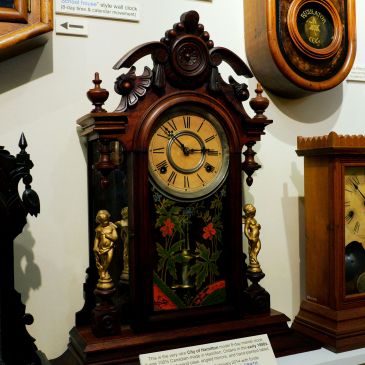
Some kitchen clocks had beautifully carved features and figurines such as this stunning clock made by the Hamilton Clock Company (Canada), though a clock such as this might be found elsewhere in the home and considered a parlor clock.

RS City of Hamilton Canada Clock Co
City of Hamilton, made by the Hamilton Clock Company, circa 1880 (Canadian Clock Museum)

When spring-driven clocks were introduced the Parlor clocks like this Hamilton Clock Company model became popular. They tended to be narrower than column clocks because they had spring-driven movements. These clocks mirrored the furniture styles of the time. This one reflected the Victorian era with its bold figurines, carved finials, elaborate patterns etched into its wooden frame, and the hand-painted floral design of the sash.

RS 45-175
Seth Thomas round top cottage clock, circa 1930

Cottage clocks are less than 15 inches high and typically 8 inches wide are small, simple in design, and take up very little space. Many have basic alarm mechanisms but have one feature that distinguishes them from other pendulum clocks. They have a clip or a clasp that secures the pendulum rod for travel. The “round top” you see here was sold by Henry Birks and Sons an upscale Canadian jeweler. Others had “beehive” tops, flat tops, or octagon tops.

Pendulum rod clip
Pendulum rod clip for Seth Thomas round top

Smaller clocks are often referred to as desk clocks. They are usually mainspring driven with a flat dial. This Kundo 400-day anniversary German clock is an example of a desk clock but it might also be described more specifically as a torsion clock. This one stands less than ten inches tall and has a glass dome, a weighted wheel with 4 balls suspended by a ribbon called a torsion spring, and an exposed movement. It was typically given as a wedding gift.

RS Kundo
Kundo 400 day anniversary clock, circa 1970

Finally, the mantel clock.

Mantel clocks can be ornate, larger, and the centerpiece in a room. This particular clock, a Mauthe pendulum mantel clock offers a precision-built sophisticated German Westminster chime movement in a relatively non-descript but attractive and well-built cabinet that is simple yet elegant.

RS Mauthe mantle clock (30)
Mauthe time. strike and chime, circa 1970

ASIDE: Is it mantel or mantle? I have always considered a mantle as something you wear, a garment or a part of the earth’s crust. A mantel on the other hand is a shelf above, say, a fireplace. I see this word interchanged so often when clocks are advertised or described that either word is universally accepted. I prefer the word “mantel”.

RS April 12th
Ingraham Huron shelf clock, circa 1878

Mantel clocks were inexpensive to make, occupied very little space, and were part decoration and part practical timepieces. Mantel clocks were made with brass, wood, porcelain, slate, Bakelite, and metal though for the most part they were designed to be lightweight (slate clocks and cast iron clocks would be the exception), simple in basic design, and very practical. Mantel clocks have lasted so long, over two centuries, because they are dependable, versatile, and work so well in many domestic situations.

The categories of shelf clocks also include carriage clocks and lantern clocks. One of the first clocks whose movement and external structure was made predominantly from brass instead of iron or wood was the lantern clock. Although the shape of the clock looks somewhat like a lantern, the derivation of the name probably stems from the French word “laiton”, meaning brass. The earliest lantern clocks had striking mechanisms; later in the 17th-century alarms were sometimes added. Some lantern clocks had pendulums and could be hung on the wall.

Carriage clocks were spring-driven clocks developed in 19th century France and are made of plain or gilt brass. They are often no more than 8 inches tall, designed to be portable, and are characterized by a rectangular shape, glass or porcelain panels, and a carrying handle on the top. If you have a Breguet carriage clock as part of your collection you are very lucky indeed!

This is by no means an exhaustive description of the types of shelf clocks. There are others such as swinging clocks, tambour clocks, pillar and scroll, and so on. Whether you are shopping for a clock as a gift or adding one to your collection or even describing what you have seen to a friend, it is important to understand the distinctions between one type and another.

Website Powered by WordPress.com.

Up ↑