
Welch Marine clock – let’s call it a work in progress

Last week (January 20, 2023) I wrote about a wonderful little marine clock that I have just not had the time to service completely. A few weeks ago I cleaned the movement and polished the pivots and left it. All that was left was the bushing work. I spent a few hours on it today and it was worn as expected. Eight bushings for a time-only movement is a lot.

It is a 30-hour brass movement made by E.N. Welch in the 1860s. It has a balance wheel or hairspring lever escapement to use a more exact term. The movement is accessed by removing the dial and bezel (4 screws) and releasing 4 screws that hold the movement to the backboard.

Time only with balance wheel escapement, prior to cleaning

A balance wheel escapement should be no surprise to anyone who knows the purpose of this clock. It is a marine clock, designed to be used on ships and trains, not a ship’s bell or watchkeeper’s clock but a marine clock that simply tells the time.

I suspected part of the reason the clock was so slow was a combination of factors, a kink in the hairspring, the general wear of the movement plus all the dirt and grime that had accumulated over the years.

The arrow shows a little bit of kink after my best attempt to straighten it

I separated the plates to discover that the movement had been worked on previously. Sometimes the work is done well and other times questionable shortcuts are taken. In this case, a glued regulating cup screw and punch marks around some of the pivot holes. You play the cards you’re dealt.

A screw is glued, stripped no doubt

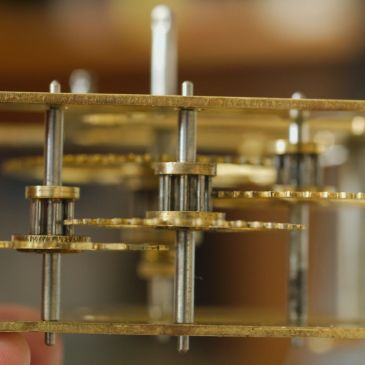
It is a pretty simple clock with not many parts.

The arbour with the lantern pinion in the middle is the “seconds” bit, before cleaning

As mentioned, the balance wheel adjustment cup screw in the rear is glued in place and there is only one reason for it, it is stripped. I am going to leave it as is as there remains a front adjustment screw on the front of the movement which also has the speed regulator wire.

Next, I am preparing for the first bushing by centering the bushing hole. You will notice that I am bushing from the outside of the place. The center wheel did no allow enough space to work from the inside of the plate.

Centering the hole on a Bergeon bushing machine

And on to the bushing work.

Using a reamer on a pivot hole

The only tricky bushing was the mainspring arbour which required a 5.5mm bushing, otherwise, the bushing work went smoothly

Mainspring and new arbour bushing

There was more bushing work than I realized. Yes, it was quite worn but I have seen worse.

Cleaned and in place, the lantern pinions and pivots were in excellent condition

The movement is a little tricky to put back together because of the small plates and how the wheels are close together but it went back together without much of a fuss.

Now for the fun part and that is remounting the balance wheel. I am not a fan of balance wheel escapements. If you have worked on old alarm clocks you know what I am talking about, getting the clock in beat. The problem I am having is lining up the impulse spring with the fork. Every time I try the spring is twisted.

Does the clock work? Yes but not well. It’s well out of beat and I suspect there is not enough impulse from the hairspring. This will take a little more time to figure out but I am not in the testing phase as yet.

Let’s call this a work in progress.

30-hour Welch Marine clock loses 10 minutes per hour

Ten minutes per hour! That is slow. American-made spring driven clocks are poor timekeepers and if yours loses or gains a minute or two a week that is just about the best you can expect.

After having worked on the case a few months ago it is past time to work on the movement.

The clock was in running condition when I acquired it though it did manage to run its rated 30-hour cycle.

Welch Marine clock 30-hour time-only wall clock

Something is definitely amiss. Wear, a good cleaning or something more serious. Read on and we’ll find out what is slowing this clock down.

A Ship’s Bell clock is a type of marine clock but in clock circles, there is a distinct difference between it and the clock you see here.

Marine clocks either tell the time or strike the hours like a normal domestic clock and because they have a balance wheel escapement they can be placed on a moving object such as a train or a boat whereas Ship’s Bell clocks originated in sailing ship days when the crew of a vessel was divided into Port and Starboard Watches, each on duty for four hours, then off for four hours.

An assortment of Marine and Ship’s Bell clocks at the National Association of Watch & Clock Collector museum in Columbia, Pennsylvania

One stroke of the ship’s bell indicates the first half hour of the watch. Then an additional bell is struck for each succeeding half hour for a total of 8 bells.

As seen when acquired

Based on a quick inspection I see nothing amiss other than a crimped hairspring on the balance escapement. I wonder if that might be the issue?

The movement is accessed by removing the hands and dial

Now, let’s take this apart and see what we have. Look for a future article as I detail the servicing of the movement.

Welch marine clock – two issues addressed before servicing the movement

A couple of weeks back I featured this Welch marine style wall clock. A marine clock can also refer to a ships’ bell clock. Ship’s bell time originated in sailing ship days, when the crew of a vessel was divided into Port and Starboard Watches, each on duty four hours, then off four hours. One stroke of the ship’s bell indicates the first half hour of the watch. Then an additional bell is struck for each succeeding half hour for a total of 8 bells.

E. N. Welch marine clock

This is not a ship’s bell clock. However, this is a clock that can be used at sea or in a rail car that simply tells the time. Lever and balance wheel escapement clocks are ideal for ship or train applications because pendulum clocks on do not work in those environments.

The movement was made for the E. N. Welch Clock Co. and I would date it around 1860, so, a 162 year old time-only clock with a balance wheel escapement and a seconds bit running off the second wheel.

The clock was bought at auction earlier this year.

The case is dirty but there are no veneer issues

From the photo above the case appears to be very stressed but under that grime and blackish tarnish could be a jewel of a clock.

Tarnished brass

The exterior of the clock has probably not been cleaned in decades or perhaps not at all.

In the old days folks cared for their furniture with weekly or monthly waxing/wiping/dusting or polishing of brass. That was simply the accepted practice. Items were not designed to be thrown-away and it was common to hold onto possessions as long as practicable.

This little clock has certainly been neglected over the years although there is nothing missing, the movement runs just fine and the open spade hands are likely original. Yes, it is dirty! You might call it patina and many collectors would accept the wear and tear over the years as part of the character of the clock. I take the view that it was meant to be shown and a little bit of intervention is perfectly acceptable.

I don’t have time to service the movement and it can wait till later this year but I was able to clean the case and polish the brass.

The brass took a lot of elbow grease and I am sure I went through half a bottle of Brasso but I like the final result. The case required cleaning with Murphy’s soap and one coat of traditionally prepared shellac.

Before

Since it is a 30-hour clock I doubt I will be running it much and servicing the movement can wait.

After

In the meantime I have an Empire gallery clock that I would like to service for summer cottage duty.

E. N. Welch marine style 30 hour wall clock

Marine movements were in high demand by the 1850s as boat and rail traffic increased. The marine movement is a specific type that does not have a pendulum. Pendulum clocks do not work on a ship or train because they require a stable base. A marine clock has either a balance wheel or lever escapement and were the perfect choice at sea.

This is an E. N. Welch 30-hour marine clock.

Many makers including E.N Welch would buy ready made movements from other shops, assemble them and sell the finished product under their name.

A short history of E. N. Welch. The E. N Welch company was formed on July 6, 1864. Elisha N. Welch (1809 to 1887) had been making clocks at a factory site on East Main Street at Forestville, Conn. since taking over the bankrupt business of J. C. Brown in or about 1856.

Marine style clock by E. N. Welch

The Welch firm was well known for its handsome rosewood cases, though in 1885, with changing styles in furniture, the surviving firm began to introduce new models with solid walnut cases and discontinued some of the older rosewood veneered cases.

After the death of Elisha Welch in 1887, the firm steadily declined, selling off some of its assets and issuing new stock to raise much needed capital. In May of that year the factory was closed down and a receiver was appointed. The receiver spent nearly two years selling off stock and settling the debts of the firm. It was not until 1896 that the firm resumed production.

But the company continued to struggle, would not survive and in 1902 its assets were bought by the Sessions Clock Co.

This movement was not made by E. N. Welch but was sourced from Laporte Hubbell. There were many variations of this movement but the basic two plate layout was identical. In this particular movement the minute wheel is in the two o’clock position and there is the addition of a seconds arbour running off the second wheel just above the “maker’s” stamp. From 1857 to 1863 the E. N. Welch Co. used this 2-plate, 30 hour marine movement. The exact year? Certainly no later than 1863. (source, NAWCC Watch & Clock bulletin, Nov-Dec 2013)

Otherwise, the case is in good condition with two small veneer chips, the brass bezel is very dirty, almost black from years of grime, the dial has minor losses and the movement is running well at this point though at its fastest speed it is running slow.

The plan is to service the movement, and refresh the case. It should be a fun little project.

Website Powered by WordPress.com.

Up ↑