
From Holocaust Survivor to Canadian Visionary: The Story of Craftline Industries
In an era when Canadian furniture manufacturers were struggling to compete with international imports, one company stood out not just for its elegant craftsmanship but for the remarkable story behind its founder.

Craftline Industries, established in Toronto during the mid-20th century, was the brainchild of Manny Drukier, a Holocaust survivor whose vision, ingenuity, and resilience transformed a fledgling furniture operation into one of Canada’s premier producers of home furnishings and decorative clocks. With little formal education but a boundless entrepreneurial spirit, Drukier built more than a business—he created a legacy that continues to tick away in homes across North America.

Manny Drukier, as a young man, after WWII

In preparation for an article on Craftline Industries and its founder, Manny Drukier, I contacted the Drukier family with a series of questions. My main point of contact for this article was Cindy Drukier, Manny’s daughter. The Drukier family responded with remarkable generosity, providing a wealth of information, far exceeding what I had initially sought. I have included the entire text of their reply to me and have their permission to make minor edits for flow and clarity.

A snapshot of production, entitled Production Operations 1974, offers readers a clear sense of the scale and ambition behind Manny Drukier’s vision.

Manny Drukier’s Story as Told by His Family

From his daughter, Cindy Drukier, “The answers to the questions you asked may be more than you bargained for. Apologies for the excessive detail in some places, but the family decided that since such scant online evidence of Craftline exists, this was an opportunity to enter it into the digital record. These days, if it doesn’t exist online, it’s almost as if it never happened. So we’re grateful for the opportunity!”

The answers were written by Manny’s daughter Cindy, with input from her mom, Freda Drukier, and three siblings, Gordon, Laurie, and Wendy. Cindy also consulted the 1974 Canadian Jeweller article (which I have summarized in a separate section) and Manny’s unpublished writings. Manny has a published memoir, “Carved in Stone: Holocaust Years – A Boy’s Tale,” but it stops when he arrives in Canada. He wrote a Part 2, but it wasn’t published before he passed. Manny died in January 2022 of Alzheimer’s at 93.

The Vision

In 1948, Manny arrived in Toronto, a 19-year-old Holocaust survivor from Poland. He’d already spent a year in New York, but his mother and sister had made it to Toronto post-war, so he moved to Canada to join them.

Suddenly, Manny had to find a way to support the family. While buying furniture for their tiny flat with savings from New York, it dawned on him that the city was full of fresh immigrants needing to do the same—furniture would be a booming business, he figured. He had zero experience but managed to finagle (i.e., lie that he had experience) a sales position in a furniture store and quickly excelled at it, earning $30 for a six-day week, plus 2 percent commission.

He lasted less than a year working for someone else. By then he decided he had learned all he could and would go into business for himself. 

He rented his first small store with his brother-in-law, David Rosenfeld, on Bloor St. West near Dufferin in downtown Toronto and called it North American Furniture. It went well, and soon they opened a second location on The Danforth on the east side of downtown Toronto. In 1961, they closed both to open a much larger and more upscale store in a former supermarket at Bathurst and Eglinton.

By 1964, he noticed he was importing more and more goods from the United States because Canadian furniture, although well-made, wasn’t elegant enough for modern consumer demand. He saw an opening in the market. He also disliked being the middleman—selling the wares of others—so he decided to go into manufacturing. 

He didn’t have a clue how to do it, but he thrived on challenge and had infinite faith in his ability to figure things out. He sold North American Furniture to his brother-in-law and cobbled together a couple of partners for his new venture. Leonard Caplan was manufacturing case goods in Georgia, and Henry Gancman was a Canadian maker of chrome kitchen sets, which Manny sold in his store.

Manny, circled in red

They opened a small factory in the north end of Toronto, on Lepage Ct., employing about 15 people. One was my mother, Freda, who set up the bookkeeping and ran the one-woman office. 

A couple of years later they moved to a bigger location, that included a showroom, on Milvan Dr.  A few years after that they bought some land (including some from the power company, Ontario Hydro), to eventually build a 215,000 sq foot factory, showroom, and offices on 13 acres located at 15 Fenmar Drive in Weston, and industrial area at the northwest end of Toronto.

Craftline catalog

Craftline manufactured all-wood occasional furniture such as coffee tables, end tables, curios, and consoles, and, later on, wall units and grandfather and grandmother clocks. It eventually became Canada’s top manufacturer of elegant furniture, employing about 250 people.

Craftline catalogue

Cindy added, “Manny was the main designer for all the furniture, including the clocks. He had no experience in this, of course, and couldn’t really draw on any either, but he always had lots of ideas!”

Production Operations 1974

The information in this section is sourced from the March 1974 issue of Canadian Jeweller magazine.

Demand for Craftline grandfather clocks was high in 1974—so high, in fact, that the company couldn’t keep up with orders. In 1973, Craftline produced 2,500 grandfather clocks and expected to double production by the end of the year, 1974. At the time, owner Manny Drukier estimated the U.S. retail market for clocks, priced between $200 and $4,000, to be worth $200 million.

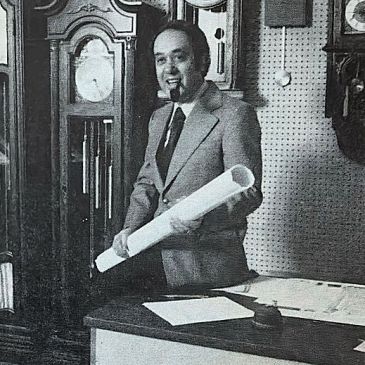
Manny is in the special clock boutique area of the factory

Craftline began making grandfather clocks in 1968, and by 1974, 20% of the company’s total output was devoted to them. The tall clock cases were made from solid lumber and veneered with fruitwood, elm, and ash, in styles such as Spanish, Mediterranean, Colonial, and Country French.

They produced both eight-day mechanical clocks and transistorized, battery-operated, pulsation-type clocks. The higher-priced models used mechanical movements, while the less expensive versions, made by subsidiary Craftique, used battery-powered movements. Craftique, by 1974, had manufactured 14,000 units.

The production floor

In 1974, clock faces, hands, and weights were imported, although Craftline was exploring Canadian sources. The mechanical movements were imported from two suppliers in Schwenningen, Germany. One supplier would have impacted production, while relying on two suppliers was a safer approach.

While the suppliers were not named in the article, at least six companies were manufacturing movements in Schwenningen at the time: Kienzle, Mauthe, Hermle, Schatz, Urgos, and Haller. (Author’s note: Urgos and Hermle would have been the suppliers)

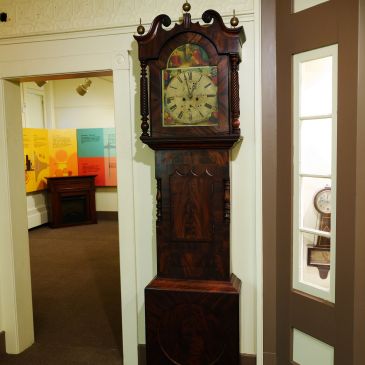
Craftline clock on display at The Canadian Clock Museum in Deep River, Ontario

Eaton department stores began selling Craftline clocks in 1972, but could not get enough stock to meet demand. However, most clocks were sold through furniture stores, where salespeople were well-equipped to market them. Jewellery stores typically bought in smaller volumes, as limited floor space made it harder to display the larger clocks.

Checking on Canadian sources for parts

The Craftline plant could finish 700 clock cases in two days, but the four-person team responsible for installing movements could only assemble 36 completed clocks per day. Much of the training for clock assembly was done in-house, with employees learning from one another.

Back to the story.

Launching the Clock Line

Manny constantly had an antenna up, looking for profitable ways to expand Craftline’s offerings, and, in 1968, he got the idea for grandfather clocks. We’re not sure where the idea came from.

Craftline catalog

Manufacturing the wood cabinets was easy, but not so the clockworks. He had two suppliers in the German Black Forest, but we don’t know more than that. I do know that, being a Holocaust survivor, he initially had misgivings about buying the works from Germany, but they were excellent and reliable, so he went with it. He said he also considered sourcing them from Asia, but decided it was too risky. He had expressed hope of buying them from a Canadian source in the future, but that never happened.

The clock cases were made of hardwood like elm, ash, and fruitwood. There were many designs, including traditional, Spanish, Mediterranean, colonial, and country French. They either had an eight-day wind-up chain mechanism or battery-operated pulsation movements. The highest-end grandfather clock was an oriental design with black lacquer and gold. The wholesale price for that clock was about $1,000 (CAD) in the early 1970s. It was the only model with an imported case—from Portugal, as it turns out. 

He also started a spinoff company called Craftique Originals that produced ornamental objects from molded urethane. Craftique’s products included elaborate mirror frames, framed art reproductions, wall-mounted weather stations, and a line of wall clocks that looked like miniature grandfather clocks—except their brass weights were purely decorative and they didn’t chime. 

Clock Sales and Ice Cream

Craftline had a team of salesmen who covered Canada coast to coast, and a bit of the eastern United States. All clocks were branded as either Craftline or Craftique, and they were sold to department stores and independent retailers, not to individual customers. He did, however, offer a premium service: customers could order a personalized engraved brass plate for their clock. Cindy Drukier spent one summer filing invoices and using an engraving machine to etch out those plates.

And there was one time when Manny traded a grandfather clock for its value in ice cream from the first Canadian importer of Häagen-Dazs. “Best business deal ever for a household with four kids!”

The Difficult Process of Ending Operations

Craftline lasted until 1991, when two hammers fell at once: The Canada-US Free Trade deal (precursor to NAFTA), and the introduction of the GST (Goods and Services Tax). Both hit manufacturers hard. Everyone knew Canada’s furniture industry wouldn’t make it, and despite a valiant effort to keep things afloat, the bank stepped in and forced Craftline into bankruptcy. 

Craftline catalogue

By then, Manny was the sole owner. He and Henry had bought out Leonard in about 1975, and Henry got out in the final few years.

It was very upsetting, says my mom, after putting so much of your life, money, time, energy, and creativity into something, and then to have the rug pulled out from under you through no fault of your own.

She worked by his side the entire time. Manny was more philosophical and practical about it. He really didn’t dwell on things. It happened, so it happened. Meanwhile, he had other business ventures and interests. He also took the opportunity to go to Poland, with Freda, for the first time since the war and write his memoir (Carved in Stone: Holocaust Years – A Boy’s Tale).

Grandfather clock owned by the author’s daughter

Personal Challenges

We had one very fine oriental-style grandfather clock for about 40 years until it was consumed by flames in a house fire in 2011. So we all grew up with that wonderful ambient chime every 15 minutes. We’re elated to hear that many Craftline clocks are still working well!

What he enjoyed most about business was always the challenge. Clocks were just the next challenge, having mastered furniture. Lack of experience was never a barrier. He was not motivated by money—he was motivated by trying to make a longshot succeed. Nothing daunted him. Certainly, that attitude came from surviving the Holocaust. Money was fleeting—in a single day, it could be made worthless. And since he’d already been through the worst, no setback was terribly troubling. He also got bored quickly with the routine.

The Legacy of Manny Drukier

It’s extremely heartwarming to hear that you (author) care to research and record the history of Craftline. He’d be gratified to know it! Occasionally, we hear about this or that Craftline clock still standing in someone’s home, and it’s always satisfying to know its chimes are resonating in someone’s life.

CraftLine grandmother clock
Grandmother clock owned by the author’s sister

Manny had many business ventures over the years, not just Craftline, although Craftline was the constant, and the one that made money. But he also dabbled in real estate, although he found it generally uninteresting (unless he had colourful tenants).

He published two short-lived magazines—a cooking magazine, “à la carte [sic]”, and a literary magazine, “The Idler”. He opened a pub we lived above, also called The Idler, and ran that for 15 years. He became an author and the star of a documentary my husband and I made about his war years called Finding Manny.

Manny was an innovator—if he had a vision, he went for it, and nothing would stop him. Because of the war, his formal education stopped at grade 4, but he was a voracious reader and a lifelong learner. He was a generous mentor and an incurable optimist. He also had a great sense of humor and left us with many useful words of wisdom.

“I’ll leave you with a few gems that seem most apt:

  • LIfe isn’t a cafeteria, you can’t always choose what you want.
  • Sometimes a kick in the pants is also a step forward.
  • Don’t be the schmuck who ends up walking backwards when you’re moving furniture.
  • I think I’ve contributed something by my staying alive. (in Finding Manny):

We agree.

The Drukier Family”

That’s the story—more than I ever expected. I encourage you to watch Finding Manny, which explores Manny’s early life, the profound loss of family members during the Second World War, and the horrors of the death camps.

Given the lack of other dedicated online sources, this stands as the most reliable and comprehensive resource currently available on Craftline Industries.

Unravelling the Various Names of the grandfather clock

The tall clock that may be gracing your hallway or living room belongs to a bygone era. That sense of history and tradition seems to be missing in our modern world. In an era defined by fast-paced technological advancements and fleeting trends, the tall clock stands as a reminder of an earlier era when craftsmanship and longevity were paramount.

A grandfather clock

The Grandfather Clock

A tall case clock is commonly referred to as a “grandfather clock” due to a story that dates back to the 19th century. The term “grandfather clock” is said to have originated from the song “My Grandfather’s Clock,” written by Henry Clay Work in 1876. This song tells the tale of a clock owned by the songwriter’s friend, and it played a significant role in popularizing the term.

Henry Clay Work was an American songwriter and composer known for capturing the spirit and emotions of the time. His greatest hit was “Marching Through Georgia” in 1865, a cheerful marching song.

The lyrics of My Grandfather’s Clock narrate the story of a long-case clock, or a tall case clock, that belonged to the songwriter’s friend’s grandfather. The clock worked perfectly throughout the grandfather’s lifetime but stopped working when he passed away. The song’s lyrics reflect the sentiment that the clock’s ticking was synonymous with the grandfather’s life, and the clock’s stillness upon his death was seen as a representation of his passing.

Over time, this sentimental and catchy song contributed to the popularization of the term “grandfather clock” as a synonym for a tall case clock. The term stuck, and now, tall case clocks are commonly referred to as grandfather clocks in many parts of the world.

Scottish tall case clock
Scottish tall-case clock

Tall Case and Long Case Clocks

However, horologists generally prefer using the terms “tall case clock”, “long case clock” or hall clock instead of “grandfather clock”. The difference in terminology between “tall case clock” in America and “long case clock” in England primarily arises from regional linguistic variations and historical usage.

  1. Tall Case Clock (America): The term “tall case clock” is commonly used in the United States to describe this type of clock. This name emphasizes the clock’s design, which features a tall, vertical case that houses the clock’s movement and the pendulum. The term “tall case” is descriptive of the clock’s physical appearance, highlighting its height and elegant proportions.
  2. Long Case Clock (England): In England, the term “long case clock” is more commonly used. This name also relates to the clock’s appearance, particularly its elongated and vertical shape. The term “long case” emphasizes the clock’s form, again highlighting its height and the distinctive design of the case. On the other hand, a Long case Regulator (Chronometer) is a precision clock known for its accuracy. It often features a simpler, more functional design with a focus on precision rather than ornate decoration.
Clock (Chronometer) (1941) by William by National Gallery of Art is licensed under CC-CC0 1.0

The names simply reflect different ways of describing the same type of clock. Over time, these regional differences have become firmly established.

Hall clock (image by Openverse)

The Hall Clock

The term “hall clock” is also used in some parts of the world as an alternative to “grandfather clock,” “tall case clock,” or “long case clock.” This term, “hall clock,” emphasizes the placement of the clock in a hallway or entrance hall, which is a common location for these impressive and stately clocks.

While the “hall clock” might not be as widely recognized or used as the “grandfather clock” or “tall case clock,” its origin and usage can be traced to the same concept of describing these tall, freestanding clocks with long cases.

The term “hall clock” is descriptive and straightforward. The term continues to be used in some contexts, particularly in regions where the emphasis is on the clock’s placement and role within the home.

Tall Clock by The Metropolitan Museum of Art is licensed under CC-CC0 1.0

The Grandmother Clock

And lastly, a “grandmother clock” is a type of clock that is smaller than a “grandfather clock”.

Similar in design and functionality to its larger counterpart, the grandfather clock, a grandmother clock typically features a pendulum-driven movement enclosed within a vertical wooden case. The main distinction between a grandmother clock and a grandfather clock lies in their size. Grandmother clocks are generally shorter than grandfather clocks, standing around 5 to 6 feet tall, making them more suitable for spaces with limited room.

Despite their smaller size, they often retain the same elegant appearance and decorative features as their larger counterparts.

The term “grandmother clock” is less commonly used than “grandfather clock,” but it serves to describe this intermediate-sized clock that is more compact than the towering grandfather clock.

Different Phrases Express the Same Concept

The various terms used to describe this type of clock—such as “grandfather clock,” “grandmother clock”, “tall case clock,” “long case clock,” and even “hall clock”—all refer to the same basic type of clock: a freestanding weight-driven device with a tall vertical case housing the clock movement and pendulum.

What style of clock do I have?

Clocks have been more than just timekeepers throughout history; they are reflections of art, culture, and technological innovation. Whether for practical use or decorative appeal, clock styles have evolved to match the tastes, craftsmanship, and technologies of their times. Here’s a look at some of the most iconic and varied clock styles.

The clock is an instrument designed to keep and indicate time. It is one of the oldest human inventions. The clock has evolved through the ages from sundials in ancient times to early tower clocks of the 14th century weight-driven clocks and finally spring-driven clocks from the 1840s to the 1970s.

The world of mechanical clocks encompasses a wide variety of styles, and distinguishing between them can often be confusing—such as understanding the difference between a shelf clock and a mantel clock. In this article, I’ll navigate through these terms and highlight the most common styles or types, using examples from my own clock collection to illustrate them.

Mantel Clock

Many auction sites and even professional websites use the word mantle. The correct terminology is “mantel”. A mantle is a shawl or coat worn by women, an important role passed on from one person to another or the earth’s crust. A mantel is the top framing of a fireplace or a shelf above a fireplace opening.

A mantel clock is designed to fit on top of a fireplace or shelf. A mantel clock can be time only, time and strike, or a chiming clock. Generally, if there are 2 winding arbours it is a time and strike clock, if the clock has 3 winding arbours is it a chiming clock that is, it will play a tune on the quarter hours, the most common being the Westminster chime.

Mantel clocks might also be referred to as shelf clocks or buffet clocks.

Kitchen Clock

Arthur Pequegnat kichen clock
Arthur Pequegnat kitchen clock

Kitchen clocks are often referred to as gingerbread clocks or parlour clocks. At times, it can be difficult to differentiate between a kitchen clock and a parlour clock. Gingerbread clocks are distinctive because their designs are typically created by steam-pressing the wooden front face. However, some clocks, like the one above, are made using a powered cutting saw but are still classified as kitchen clocks. Additionally, some of these clocks included alarm mechanisms. The terms gingerbread, kitchen, and parlour are often used interchangeably.

Another type of kitchen clock is shown below. This is an 8-day time-only delft wall clock made by Forestville.

Delft Clock from Forestville
E. N. Welsh Whittier model
E. N. Welch Whittier model

A parlour clock is generally considered more ornate than a kitchen clock, although it may still be referred to as a kitchen clock. It is placed in front hallways, entryways, and so on. The designs are always cut and there may be finials, a mercury-filled pendulum or very ornate design, garish trim pieces, and a decorative tablet.

Vienna Regulator

Gustav Becker two-weight Vienna regulator

There are many styles but most are of the single-weight or two-weight variety. The definition of a Vienna regulator is always open to debate but the consensus among collectors is that they are weight-driven, made in Austria/Germany, ornate in design, have porcelain dials, decorative crowns, large pendulums, and finials on the top and bottom.

The broad definition of Vienna Regulator includes those that are spring-driven. Though not defined as “regulators” it is acceptable among collectors to refer to them as a Vienna style.

Cottage Clock

Canada Clock Co Hamilton Cottage Extra

Sometimes called a mantel clock or a shelf clock, they are usually diminutive in size to occupy a smaller space. They are found in bedrooms and kitchens and are sturdily built since they are often designed to be portable. They come in time only, time and strike, or may have an alarm function.

Carriage Clock

French Carriage Clock

Carriage clocks are portable and were very popular around the turn of the 20th century. French-made carriage clocks are more collectible and fetch generally higher prices although American ones can be quite desirable. Carriage clocks are designed to be portable and are time-only but some are time and strike (with a repeater function) while others may have an alarm function.

Crystal Regulator

Ansonia Crystal Regulator

Crystal Regulator clocks are identified by a brass case with 4 crystals or glass panels. Porcelain dials, Roman or Arabic numerals, ornate in design but sometimes quite garish. Most are 10-12 inches in height though some are smaller. Makers are American and French though French crystal regulators are called four-glass clocks and tend to have higher value. Distinctive by their mercury or faux mercury pendulums. Some have visible Brocot escapements and the time and strike movements are always visible.

Cuckoo Clock

Cuckoo clock
Cuckoo clock

These clocks are pendulum-regulated and make an automated sound like a cuckoo when it strikes the hours. Some can be very intricate with several animated characters. Desirable ones are antiques from the Black Forest region of Germany. Modern ones are generally frustrating to repair, cheaply built, and are poor timekeepers.

Lantern Clock

Converted lantern clock

A lantern clock is a type of antique weight-driven wall clock, shaped like a lantern. They were the first type of clock widely used in private homes. They probably originated before 1500 but only became common after 1600 and in Britain, around 1620. They became obsolete in the 19th century. The one pictured above has been converted into a fusee movement.

Alarm Clock

Baby Ben alarm clock with second hand
Baby Ben alarm clock with seconds hand

Alarm clocks are wound once per day and designed to do two things, wake you and display the time. They are cheap, and are average timekeepers but have long-lasting and reliable movements.

Desk Clock

Kienzle World Time clock

These sat on fancy office desks or credenzas in office locations. They are either time-only or time-and-strike. Most were time-only to minimize distractions in the office environment. Some are very attractive and have unique designs and are more decorative than utilitarian. This one above is called a World Time Clock by Kienzle.

Wall Clock

Box clock
German Mauthe Box clock

A wall clock is broadly defined as any clock designed to be hung on a wall, making it a practical and visible timekeeping solution. Wall clocks come in various styles, from simple and functional designs to highly decorative pieces. This one by Mauthe is often described as a German “box” clock which became popular after the First World War and made into the 1940s.

Schoolhouse Clock

Ansonia clock project is complete
Ansonia schoolhouse clock

They are known as schoolhouse clocks because they hung in many schoolrooms in North America. Usually distinctive by their octagon shape and short or long drop feature with a glass door displaying a swinging pendulum. Many thousands were made; they had cheap mass-produced softwood cases and robust movements. Most were time-only though some were time and strike and others even included a calendar function.

When they were marketed years ago they were not called “schoolhouse clocks” but rather, clocks made for the schoolroom.

Novelty Clock

Chairman Mao Zetong waving as the clock ticks

These clocks are designed for the tourist trade with interesting features. In the case of the above clock, a smiling Mao Zedong has his little red book in hand and is waving “to the masses” as the clock ticks.

Ogee Clock

Waterbury OG clock
Waterbury OG clock

It is so-called because of the curved molded wood case. It might also be referred to as an OG clock. The design originated in the United States in the 1830s, distinguished by a case (usually pine) the front outer edges of which are curved into an S-shape (Ogee). This shape is formed by the union of a convex and a concave line. A mass-produced variant of the shelf clock, the Ogee clock typically stands about 30 inches (75 cm) high and is usually weight-driven. The movements were generally made of brass (earlier ones were made of wood) and ran for 30 hours or eight days. This is a 30-hour weight-driven version from the 1870s.

Tall Case Clock

Ridgeway Hamilton Country, Westminster chime

Tall case clocks are known by various names depending on the region. They are referred to as tall-case clocks in American terminology, long-case clocks in British terminology, hall clocks in Canada, and sometimes as floor clocks. However, the most commonly used term is “grandfather clock.”

They are usually weight-driven, with the weights on chains or cables, and are distinctive by their obvious height. They are always 6 feet or over but can be as high as 8 feet high (1.8 to 2.4 meters). They often feature elaborately carved ornamentation on the hood (or bonnet), the frames, the throat, and the dial or clock face. Older ones have 30-hour movements but all modern grandfather clocks run on an 8-day cycle.

Smaller clocks are called grandmother and granddaughter clocks. They are under 6 feet.

Anniversary Clock

Kundo standard size 400 day clock
Kundo standard size 400-day clock

These clocks are also called torsion clocks or 400-day clocks. 400-day clocks are torsion driven having a long suspension spring to which a weight oscillates back and forth. Typically these clocks operate at 8 beats per minute and run for long cycles on a single wind, up to 400 days. These clocks were popular as wedding gifts or gifts to mark special occasions. They are relatively simple to repair but can be finicky to set up. The newer quartz clocks are very accurate but do not replace the charm and curiosity of the older mechanical ones.

Some might call them purely decorative.

Tower Clock

Tower clock
Tower clock in Holguin, Cuba

In the early 14th century large mechanical clocks began to appear in the towers of Italian cities. There is no record of any working models preceding these public clocks that were weight-driven and regulated by verge-and-foliot escapements. They are referred to as Turret clocks in the UK.

In conclusion, while there are sub-categories for some of the clocks described above, this overview provides a general understanding of the commonly used terms. Having this knowledge can be especially helpful when shopping for a special gift or identifying the style of clock you may have in your possession.

Website Powered by WordPress.com.

Up ↑