Not a clock to be seen anywhere and that’s not a bad thing!

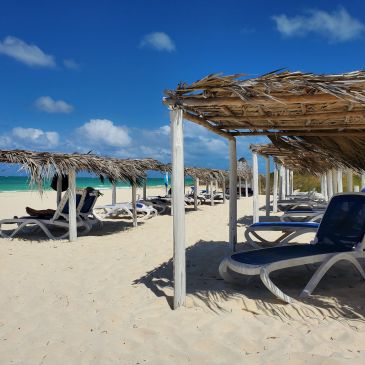
We enjoyed a week-long stay at a resort in the Cayo Coco region of Cuba, where the accommodations were fantastic and catered to all our needs. The goal was to unwind after spending the winter teaching at our local community college campus in rural Nova Scotia. There wasn’t a clock in sight, which was just as we expected.

beach scene

After a day or so we began to realize the absence of clocks started to shift our routines. At home we have breakfast early, lunch around noon, and dinner at 7 pm. But during our stay, we began to enjoy breakfast in the late morning, lunch in the mid-afternoon, and dinner between 8 and 9 pm.

While the resort offered Wi-Fi that was accessible from nearly every spot on the premises, we preferred to leave our phones in the room. Instead, we let our mood and appetite lead us through each day.

the grounds of a Caribbean resort

There is no doubt clocks plays a significant role in structuring our daily routines by providing a sense of time and establishing a schedule for various activities. Clocks help us manage our time by allowing us to plan and allocate time for different tasks and responsibilities throughout the day. A clock helps us create daily routines, such as set times for waking up, eating meals, and going to bed. This can contribute to a sense of stability and consistency in our lives.

moonlit night on a Cuban resort

While clocks help us organize and manage our lives, stepping away from them occasionally can offer a sense of freedom and relaxation from the pressures of a scheduled and regulated routine.

Resorts and spas aren’t the only places where clocks are uncommon. Religious spaces such as churches, temples, monasteries, and meditation centers often refrain from displaying clocks to promote spiritual practice and mindfulness without distractions. Similarly, art galleries and installations may omit clocks to keep the emphasis on art and creativity rather than the passing of time. In darkened settings like theaters and cinemas, clocks are absent to maintain focus on the performance or film. In minimalist homes, clocks may be left out to cultivate a serene and uncluttered atmosphere.

While clocks are a staple in many environments, all of the places mentioned above aim to foster a sense of presence and focus that can be disrupted by the constant awareness of time.

Now that we’re back home, our familiar habits quickly returned. The break was undeniably beneficial for us. It allowed us to step away from the usual hustle and bustle, providing a much-needed reset. Being free from the constraints of the clock gave us a chance to reconnect with our own rhythms and truly unwind.

Tick Talk Tuesday #11 – clocks of Cuba

Tick-Talk Tuesday is about the letters and comments I have received from you, the reader, concerning your clocks, issues you might have had and challenges you face and my responses to your questions with advice on your  particular clock concern(s) and of course, general comments. For those comments and questions that stump even me, I consult within my clock circles for the best possible answer.

On my trip to Cuba in March of 2016 I happen to capture a number of interesting clocks. The two pictured below prompted a comment from JC.

wall clock
Wm Gilbert clock found in a restarant

Floor clock
Malaprade Floor clock

The first two clocks are the most interesting to me. The Gilbert looks fairly standard (often called a “Store Regulator”) but I think it’s been painted black. Normally these are in oak cases, occasionally (but rarely) in walnut. The colour would have matched the interior back.

The second clock looks like a fine and expensive Jeweler’s Pinwheel Regulator. I’m wondering if you’re wrong about it being spring driven. These are normally always weight driven. The weight normally hangs behind the pendulum. Is it possible you didn’t see the weight? The movements from these are almost always Swiss made (near the Jura region of France), with pinwheel escapements. They are VERY EXPENSIVE clocks. The movement alone would fetch around 1000$. I have no idea what that circle is on the dial. I’ve seen some with inlaid marble dials, but most have enameled dials like this one. Cases can range from plain to extremely elaborate, and from 5 feet to 9-10 feet.

The name and place on the dial is the retailer where the clock was sold. It is never the manufacturer (this is typical on all French and some Swiss clocks of this type/vintage – the same is true of Comtoise clocks and French mantle clocks).

The rest of the clocks (with the exception of the 2 figure 8 wall clocks) seem to be imported German clocks from 1930 and later. These include both tall clocks and all the 400 day clocks shown. The figure 8 clocks are either American or Asian made copies (likely from Japan) from the early 1900s.

Clocks of Cuba

During two vacation trips to Cuba in the last 4 months I managed to locate a few clocks in my travels. Though some clocks were very intriguing none that I saw save for the tower clocks were in working condition. Nonetheless it made me wonder about their provenance in a land that time seemingly forgot.

At Christmas time my family and I traveled to Trinidad of Cuba. We stayed overnight at Los Helechos Hotel in Topes de Collantes which is located about a half an hour bus ride from Trinidad of Cuba. The next day we spend our time exploring the wonders of Trinidad of Cuba.

I saw some interesting clocks in a couple of restaurants. The first is a Wm L. Gilbert time and strike wall clock with calendar dial from Winsted Conn., USA. It looked like a reasonably well preserved dark walnut regulator clock with an 8-day brass movement with pressed features dating to about the 1900s.

wall clock
Wm L. Gilbert clock found in a restaurant

The next is unknown to me. It is a Spanish clock. Whether or not Malaprade is the maker was difficult to determine as I could find no information on the internet. However, it is clear that this spring wound time-only clock with second hand feature was made in Barcelona. I would date it to pre-1930. It is a relatively short clock and might have been originally designed as a wall mounted clock as it stands less than 5 feet tall. I am not sure what the area around and below the keyhole represents. I cannot make out any sort of design if there is one.

Floor clock
Malaprade Floor or wall clock

Next is a floor clock. Again the maker is unknown. I do not see any winding arbors on the dial face and can only assume that it is weight driven (the weight was not attached) and that the weight (or weights) were pulled up by chain to reset the clock likely once every 8 days. This clock was clearly in meed of restoration as were most of the clocks that I saw.

Floor clock
Floor clock of unknown maker

In March we stayed at the Paradisus Rio de Oro in Holguin province located on Playa Esmeraldo near Guardelavaca. The resort is set on a beach next to Bahía de Naranjo Natural Park. In it are a number of interesting clocks.

Lobby clocks
Time only lobby clocks

There were a total of 4 of these lobby clocks which were originally intended to display time zones for the guests. They are time-only and the cases appeared to be in good shape but I do not think they have been running for quite a while. My thought is that there is nobody at the resort tasked with the responsibility of maintaining these and other fine clocks.

face of clock
Face of unknown floor clock, second hand is missing

RS Tall case clock (2)
Unknown floor clock

This clock actually works though it needs servicing. It is located in an ante-chamber adjacent to a Mediterranean themed restaurant. I opened the front door of the clock and found the rod gong impeding the pendulum. Once I dislodged the gong the clock happily began to function and it was in beat, surprisingly. Although it had two weights there were three winding arbors and I would be curious to see the internal workings of that movement. Inside the door was an official seal from the Ministerio de Cultura.

400 day clock
400 day clock

This 400 day clock was made in Germany. There were no other markings that I could determine. It could be a Kundo Kieninger & Obergfell dating to about the 1940s or so but that is just a guess. It needs a thorough servicing and clearly it has been neglected for some time.

Carriage style clock
Carriage or wall mounted clock

This is another an anniversary mantel clock but it appears to have a wall mounting bracket on the rear. Not sure why as these clocks are not meant for wall mounting. Again, an unknown maker but possibly German and in very poor condition. The front glass looks like it can be lifted up for adjustment purposes.

clock
Clock in a peasants home

While hiking through El Cubana National Forest we came across a small dwelling and we were able to briefly tour inside. In it I found an old quartz clock dating from the 1980s or earlier.

Tower clock
Tower clock at Peublo La Estrella tourist village

Tower clock
Tower clock in Holguin

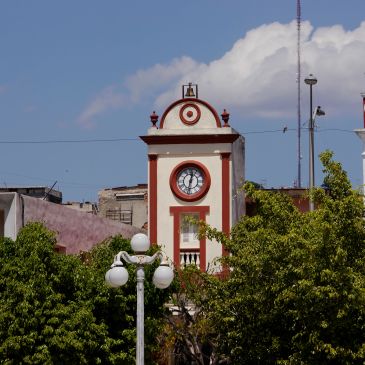
The first tower clock is located in a tourist village in Cayo Santa Maria called Peublo la Estralla while the next is in a downtown principle square in the city of Holguin. The Olvera clock is a modern electric clock and I am assuming that the tower clock in Holguin might also be electric.

I am told that my next stop in Cuba (another time) should be the Paladar Decameron restaurant in Havana, a fixture in the paladar scene that’s located in the leafy residential district of Vedado. The restaurant is said to said have an old world charm with a collection of various collectibles including antique clocks of all shapes and sizes.

Cuba is a fascinating country and certainly worth exploring time and time again.

Website Powered by WordPress.com.

Up ↑