
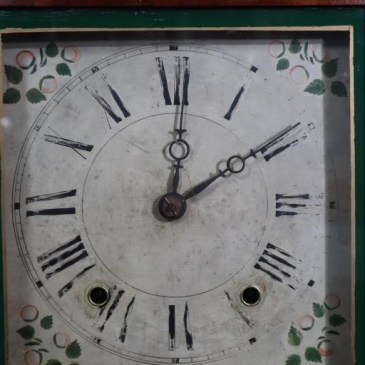
Clocks won at auction – at a fair price
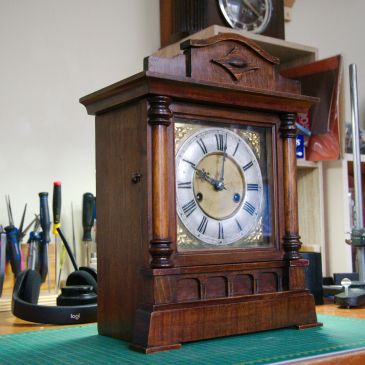
I never actually went to this auction but participated online. It is not quite the same as the rush of bidding in a live auction hall but exciting in its own way.

This particular auction had quite a number of clocks but I would say that most were in rough or what I would call “hobby-ready” condition.

I was looking at one particular clock but three more grabbed my attention. A total of four clocks, two shelf clocks, and two wall clocks.

My budget was $300CDN and I stuck to it. I set the maximum I would pay for each item and placed all bids within the last minute of the auction and walked away from the computer. For two of the clocks, I was prepared to let them go if bidding got too high but at the end of the day I won all four. With fees and taxes, the final invoice was $379 (a little over $300US and 240BP).

Bidding online is always a gamble. What the photos reveal does not always tell you what you are getting and I have been surprised more than once. I have a number of other photos from the auction but these are a good representation.

Hamilton Clock Co.

30-hour Ogee clock

Clock number one is a 30-hour weight-driven ogee made by the Hamilton Clock Co. based in Hamilton, Ontario in the late 19th century. This was a clock I was anxious to have since I am in the process of building a small collection of Canadian-made clocks.

I have one other clock from The Hamilton Clock Co., a 30-hour time and strike steeple clock, and one from the Canada Clock Co., a 30-hour time and strike cottage clock.

I am grouping the two companies together because one essentially grew from the other and made clocks within the same factory and with the same machinery.

Those two have etched lower tablets as on this new acquisition.

Canada Clock Co. Hamilton Cottage Extra
Hamilton Clock Co Gothic steeple clock

The Hamilton Clock Co was formed in 1876 and went out of business in 1880, a very short run for a clock company, unfortunately. The exact year of manufacture is unknown but I may know more when I receive the clock.

This clock looks like every 30-hour ogee ever made and that was the original intent, a familiar clock style that appeals to the masses. The dimensions of this Canadian-made ogee are very similar to American-made ogees and the movements, though made in Canada, are essentially indistinguishable (minor differences aside) from 30-hour ogee time and strike movements made by a number of American manufacturers of the time.

The clock appears to be intact, has its own weights and the lower etched glass tablet seems to be in fine shape judging from the auction photos but the case will need a thorough cleaning and some veneer work.

Daniel Pratt Jr

Clock number two is a Daniel Pratt Jr which I’d like to call a reverse ogee with a splat top but the splat top is missing.

I have just one Daniel Pratt Jr clock in my collection and it has an early woodworks movement. The older Pratt clock shows what the splat should look like.

Daniel Pratt Jr with woodworks movement
Reverse ogee and “splat

According to the label on which the date 1843 is inscribed, one can assume that this is the date of manufacture, approximately.

In any event, it may have a woodworks movement. There were still a few companies who continued with the cost-effective woodworks movement but by that time the rolled brass plate movements were becoming more common.

The loss of the splat top certainly makes the clock less desirable but it was one of the cheaper clocks in this grouping and, who knows, I might have a splat made, we’ll see.

Label, weights and pendulum bob

The green banding on the upper and lower glass sections looks somewhat suspicious and could have been added later. This clock also comes with weights and what looks to be an authentic-looking pendulum bob.

The lower tablet might just be a card-stock image, again, likely not original but old nonetheless. The dial has some losses but what there is of the case looks good.

Unknown gallery clock

Clock number three is an unknown gallery clock. I have no idea of the maker and cannot even guess. I took a chance and I hope the gamble pays off.

Gallery clock

The auction information describes it as 14 inches in diameter so I am assuming the clock face is about 10 inches or so. The hands look very interesting, the case looks well-made (mahogany?) and the clock definitely has a mid to late 1800s English look.

The centrally located winding arbour tells me that it has a time-only mechanical movement.

Back of the clock

The dial looks to have been redone but I am more curious about the movement inside.

A shot of the movement from the bottom

I am not sure what I am seeing in the photo above. Certainly, a homemade door catch on the left and a large gear (perhaps a mainspring barrel), and cylinder-shaped pendulum bob. Fusee movement? I doubt it. I think it has a conventional spring-driven time-only movement but I will know in a few days.

Six-inch gallery or ships style clock

The last is a smaller gallery, ships, or marine-style clock which is spring-driven with a balance wheel. The speed adjsutment lever below the 12 is the give-away.

It is 8 1/2 inches in diameter (6-inch dial), key wound time-only 30-hour clock with a seconds bit. I cannot even guess who the maker is but could be a Waterbury, E N Welch, or some other American manufacturer.

The chunky oak case needs some attention but with a good cleaning and a coat or two of shellac, it should show nicely. Apparently, it is in working order.

Okay, so, two clock makers I am familiar with and two unknowns. I wonder what surprises await me when I open up the two unknown clocks.

In a day or so we shall see what we get. We are driving down to the auction house in the next couple of days but we will make something of our 3+ hour journey and enjoy the sites, have lunch in Annapolis Royal (Nova Scotia) and do some antiquing along the way.

Clock auctions – Ron’s rules for bidding

The psychology of auctions, now that would be a fascinating study. How bidders behave, the frenzy of bidding wars often called “auction fever“, and the emotions wrapped into the pursuit of that one item everybody seems to want would be very enlightening.

Ingraham 30 hour cottage clock, under $30 at auction

Auctions are fantastic places to find great deals. I have found many clocks at auction for exceptional prices and have few regrets.

This post will explore how to use auction rules to the best advantage based on my experience and my observations. Presented are Ron’s tips that I have found effective. The focus is on online auction houses. eBay is another world but I suppose some of my advice may apply.

The photos on this page are auction wins over the past two years.

The classic auction

Although there are other types, the classic type of auction is where a seller sets the price, plus a time limit and bidders are encouraged to bid on the item. The highest bidder wins. This type of auction remains popular because of the familiarity and intuitive nature of the process.

Auctions can be live or online but online auctions are becoming much more common.

Using the “watch list” if offered

Many auction sites have a “watch list” which is a cool method of bookmarking the items you may (or may not) bid on. I generally peruse the auction offerings and click the watch button for those that interest me and in so doing generate a “list” of ten to twenty items for potential bids.

I hold off on bidding until I can determine which ones interest me the most, how much I am prepared to pay, and the total I have budgeted for the auction. I attempt to work within my budget but may make some adjustments during the auction.

The watch list also allows for a sober second thought before or during any auction. Put another way, I thought I wanted the item before but now I don’t.

Why you should not bid early

Auction sites want people to bid early to show everyone there is interest in the item. By revealing interest in the item others might be tempted to bid and this will drive up the bids. This benefits the auction house which makes more money on any item that sells higher. Novice auction goers are easily caught in this trap. Try not to get caught up bidding too high and too early in an auction even if it is something you really want. Fight the urge!

Establishing a limit

I consider each item carefully based on the photos and descriptions provided, determine what I would pay for the item in optimal condition, and factor in wear and tear or any parts missing in order to set an upper limit for my bid.

A tactic that works surprisingly well is to determine a maximum price on an item when the auction opens, make that bid and leave the auction.

Scottish tall case clock
Scottish tall case clock, $275 plus fees and taxes

Let’s say I bid $60, then leave the auction site. The next day or after the auction has ended, I will know if I won within my limit, or lost. If monitoring the auction a green win button will light on what you have won otherwise auction houses send out invoices after the auction has ended detailing items you have won. Winning is very satisfying, of course, but losing is not such a terrible thing, there is plenty of fish in the sea.

Others participating in the auction might also have set the same limit for themselves on a particular item. If I’m willing to spend $60, am I willing to spend $5 more (assuming a bid increment is $5). If I bid just higher than my limit assuming my limit is the same as others, I may still win the item without ignoring the budget I have set for the auction.

Without determining your limit, it’s too easy to get into a bidding war that might go something like this, “I was willing to spend $75, and I was outbid at $80. I could go $5 more and bid $85 but if I lose it at $85, $10 is only a tiny bit more”, and so on.

Stay within the upper limit and do not get caught up in a last-second feeding frenzy.

Auction “estimates”

This is just another method of forcing the bid higher. Ignore auction estimates unless there is a “reserve” on the item. A reserve price is a minimum price that a seller would be willing to accept from a buyer. In an auction, the seller is not typically required to disclose the reserve price to potential buyers. If the reserve price is not met, the seller is not required to sell the item, even to the highest bidder.

Proxy bidding

Most auction sites allow proxy bidding, meaning they will keep your bid as low as possible so you can win, but not exceed your maximum limit.

It works this way. I decide on a $60 upper limit and the auction’s bid increments are $5. At the start someone bids $5, I have set my bid at $60 but currently have the winning bid at $10. If someone else bids $25, my bid automatically goes to $30. They come back at $35, and my bid automatically goes to $40. If the auction ends at that point, I won the item for $40. If someone else came back before the auction ended with a $65 bid, then they win, but I do not exceed my limit. I then walk away from that item and focus on the next.

Rare items

Rare items that are desirable can be expensive. Humans tend to overvalue things they think are rare. However, thinking an item is rare might influence you to bid higher. The item may, in fact, be quite common. Do your research beforehand, or even during the auction.

For example, ogee-style clocks that some people would consider to be quite rare are, in fact, very common as thousands were produced by many American manufacturers over a span of 70 odd years.

Chauncey Jerome ogee clock, $35 at auction

Not so hidden fees and costs

There are additional fees and taxes as you would expect. Auction fees called “buyer’s Premium” is set by the auction house. The buyer’s premium is a percentage that is an additional charge on the hammer piece of the lot which is paid by the winner. Some auction houses will call it a service fee but think of it as a commission.

Buyers’ premiums may be higher for online auctions than live auctions and the percentage varies from auction house to auction house, typically between 15% and 20%. Some auction houses may even have an additional service fee above the buyer’s premium. Add taxes to determine the final price. A winning bid of $60 with a 15% buyer’s premium (our local auction houses) and sales taxes of 15% (Nova Scotia) pushes the final price to $79.35. It is the final price assuming you can jump into your car and bring the item home, otherwise, there are shipping costs. Suddenly your $60 win costs $200.

As a general rule, I do not request antique clocks to be shipped as the risk of breakage is too high.

The psychology of ownership

Here’s how it works. While you hold the winning bid, you begin to feel a sense of ownership, and the longer one holds the bid the stronger the sense of ownership. When outbid, you may think someone is trying to steal something from you and you want it back but now you are caught up in bid frenzy. To get it back you bid higher. However, even if you win the item you still lose because you have likely overpaid for it. Buyer’s remorse is the sense of regret after having paid too much.

Related is the Endowment Effect, meaning people will assign more value to an item that they own purely because they own it. This type of behaviour is typically triggered with items that have a strong emotional or symbolic significance to the individual such as something they had as a child or other nostalgic item.

A pocketful of money

Let’s say I plan on spending $500 at an online auction including buyer’s premium, tax, and shipping, so, I am limiting my actual bidding to approximately $300. Perhaps I am looking at only two items in the auction. For one I’m willing to go to $100, and for the other, I’m willing to bid up to $200 for a total of $300. I win the first item (for which I was willing to spend $100) for $25. I can now decide whether I should spend $200 on the second item, or if I’m now willing to go up to $275.

Determining a budget limit introduces an element of self-control and allows one to refocus attention on other auction offerings. It is also helpful when you are not watching the auction when it ends.

This is always an individual choice based on how much you feel the items are worth and what your research is telling you.

Ansonia Canada parlour clock, part of a $30 lot

Clock auction houses

An auction that consists only of antique clocks is a tough one to navigate and to win an item at a decent price. These auctions attract all manner of collectors and you might be bidding against a very determined collector who will want an item at any cost.

I find the prices in antique clock auctions to be generally quite high and unless you are looking for that special clock it is best to avoid them unless money is no object. I have much better success with estate auctions that do not generally attract dedicated clock collectors so, for the most part, you are bidding against people who have poor knowledge of antique and vintage clocks.

I suppose there are plenty of other strategies but these are the ones that have worked for me.

Here’s what a $12 auction clock looks like

I am a bit of a sucker for cottage clocks, have several of them, most are 1 day but I find them interesting just the same. There are not many survivors for a good reason. They were the cheapest clocks one could buy and when they stopped working they were either thrown away or repaired by some local clock fellow to get a few more years out of them. I am not on a quest to obtain the most inexpensive clock possible but this little cottage clock was tacked onto several items bought on an online auction.

“You won the clock”, my wife said. “What clock?”. “You know, the cottage clock”. “Oh, that one!”

Well, here it is.

Jerome & Co cottage clock

Pretty rough! An initial inspection reveals losses on the dial, missing veneer here and there, losses on the reverse painted tablet on the lower section of the access door, gold trim that has long worn off, and a movement that has had strange things done to it.

1 Day movement

It is a time-only clock that runs for 30 hours, otherwise called a 1-day clock. It was made by Jerome & Co., a subsidiary of the New Haven Clock Co., and has no connection to Chauncey Jerome himself. Chauncey Jerome’s interests were sold off to New Haven by the mid-1850s.

The copper wire soldered to the brass plate next to the escape wheel (photo above) is an improvised bushing. I have seen a lot of interesting repairs over the years but this is different. A few other issues. The plate pins are finishing nails and one pin in the back of the movement is a toothpick! Plus, it has been sprayed with what looks like WD-40.

Like most mechanical clocks, they can be correctly repaired and brought back to life. As to the case? I will have to give it some thought.

Jerome & Co, Rose cottage

When this Jerome & Co 1-day clock was made is a mystery but the solid wheel in the upper right rear of the movement tells me that this clock may be from the 1850s or 1860s.

It’s a $12 clock. What would you do with it?

I have some ideas. Stay tuned.

Website Powered by WordPress.com.

Up ↑